EP0145262B1 - Verfahren zur Entfernung gelösten Sauerstoffes aus einem wässrigen Medium - Google Patents
Verfahren zur Entfernung gelösten Sauerstoffes aus einem wässrigen Medium Download PDFInfo
- Publication number
- EP0145262B1 EP0145262B1 EP84307667A EP84307667A EP0145262B1 EP 0145262 B1 EP0145262 B1 EP 0145262B1 EP 84307667 A EP84307667 A EP 84307667A EP 84307667 A EP84307667 A EP 84307667A EP 0145262 B1 EP0145262 B1 EP 0145262B1
- Authority
- EP
- European Patent Office
- Prior art keywords
- hydrogen
- aqueous medium
- dissolved oxygen
- stream
- water
- Prior art date
- Legal status (The legal status is an assumption and is not a legal conclusion. Google has not performed a legal analysis and makes no representation as to the accuracy of the status listed.)
- Expired
Links
Images
Classifications
-
- B—PERFORMING OPERATIONS; TRANSPORTING
- B01—PHYSICAL OR CHEMICAL PROCESSES OR APPARATUS IN GENERAL
- B01D—SEPARATION
- B01D19/00—Degasification of liquids
- B01D19/0005—Degasification of liquids with one or more auxiliary substances
-
- B—PERFORMING OPERATIONS; TRANSPORTING
- B01—PHYSICAL OR CHEMICAL PROCESSES OR APPARATUS IN GENERAL
- B01D—SEPARATION
- B01D19/00—Degasification of liquids
-
- B—PERFORMING OPERATIONS; TRANSPORTING
- B01—PHYSICAL OR CHEMICAL PROCESSES OR APPARATUS IN GENERAL
- B01J—CHEMICAL OR PHYSICAL PROCESSES, e.g. CATALYSIS OR COLLOID CHEMISTRY; THEIR RELEVANT APPARATUS
- B01J31/00—Catalysts comprising hydrides, coordination complexes or organic compounds
- B01J31/02—Catalysts comprising hydrides, coordination complexes or organic compounds containing organic compounds or metal hydrides
- B01J31/06—Catalysts comprising hydrides, coordination complexes or organic compounds containing organic compounds or metal hydrides containing polymers
- B01J31/08—Ion-exchange resins
-
- C—CHEMISTRY; METALLURGY
- C02—TREATMENT OF WATER, WASTE WATER, SEWAGE, OR SLUDGE
- C02F—TREATMENT OF WATER, WASTE WATER, SEWAGE, OR SLUDGE
- C02F1/00—Treatment of water, waste water, or sewage
- C02F1/20—Treatment of water, waste water, or sewage by degassing, i.e. liberation of dissolved gases
-
- C—CHEMISTRY; METALLURGY
- C02—TREATMENT OF WATER, WASTE WATER, SEWAGE, OR SLUDGE
- C02F—TREATMENT OF WATER, WASTE WATER, SEWAGE, OR SLUDGE
- C02F1/00—Treatment of water, waste water, or sewage
- C02F1/72—Treatment of water, waste water, or sewage by oxidation
- C02F1/725—Treatment of water, waste water, or sewage by oxidation by catalytic oxidation
-
- C—CHEMISTRY; METALLURGY
- C23—COATING METALLIC MATERIAL; COATING MATERIAL WITH METALLIC MATERIAL; CHEMICAL SURFACE TREATMENT; DIFFUSION TREATMENT OF METALLIC MATERIAL; COATING BY VACUUM EVAPORATION, BY SPUTTERING, BY ION IMPLANTATION OR BY CHEMICAL VAPOUR DEPOSITION, IN GENERAL; INHIBITING CORROSION OF METALLIC MATERIAL OR INCRUSTATION IN GENERAL
- C23F—NON-MECHANICAL REMOVAL OF METALLIC MATERIAL FROM SURFACE; INHIBITING CORROSION OF METALLIC MATERIAL OR INCRUSTATION IN GENERAL; MULTI-STEP PROCESSES FOR SURFACE TREATMENT OF METALLIC MATERIAL INVOLVING AT LEAST ONE PROCESS PROVIDED FOR IN CLASS C23 AND AT LEAST ONE PROCESS COVERED BY SUBCLASS C21D OR C22F OR CLASS C25
- C23F11/00—Inhibiting corrosion of metallic material by applying inhibitors to the surface in danger of corrosion or adding them to the corrosive agent
- C23F11/08—Inhibiting corrosion of metallic material by applying inhibitors to the surface in danger of corrosion or adding them to the corrosive agent in other liquids
- C23F11/18—Inhibiting corrosion of metallic material by applying inhibitors to the surface in danger of corrosion or adding them to the corrosive agent in other liquids using inorganic inhibitors
Definitions
- This invention relates to a method for the removal of dissolved oxygen from aqueous media.
- Dissolved oxygen has been identified as a contributor in the corrosion of components in the primary and secondary coolant systems of nuclear power systems. It has been indicated that even very low levels of dissolved oxygen, even about 20 parts per billion or less, can contribute to pitting, denting and oxidation of copper alloy components of the system.
- water storage tanks both in the primary and secondary systems, such as the condensate storage tank, auxiliary feed tank, demineralized water storage tank, reactor makeup tank and refuelling water storage that normally contain a supply of stagnant aerated water which, upon introduction of such water into the steam generation system can introduce oxygenated water thereto.
- Such storage tanks are often located outside a steam generation system enclosure and in cold temperatures, and there is a need to deoxygenate these reservoirs of oxygenated water.
- the Martinola paper discusses the use of a palladium containing polystyrene-based anion exchange resin to aid in the reaction of hydrogen, added to an aqueous medium, with dissolved oxygen in the aqueous medium.
- hydrogen is added to water, containing 8 ppm oxygen, which is passed through a mixing tank containing plexiglass rings, and the mixture then flows to a reactor which contains a palladium catalyst.
- the residual oxygen content of the water after passage through the catalyst column was 0.025 ppm (25 ppb).
- Other systems using hydrogen and the palladium catalyst gave residual oxygen contents of between about 0.015 ppm to 0.025 ppm (15-25 ppb).
- the present invention resides in a method for removing dissolved oxygen from a supply of aqueous medium comprising discharging a stream of aqueous medium from said supply thereof; injecting hydrogen gas into said discharged stream of aqueous medium and intimately mixing said hydrogen with said aqueous medium; characterised by pressurizing the intimately mixed stream to a pressure of between 80-150 psig 551-1034 kPa and contacting said pressurized, intimately mixed stream, at a temperature of 15-40°C, with an effective amount of palladium or platinum, dispersed on a stable carrier material, for a period of time effective to react the hydrogen and dissolved oxygen to produce a deoxygenated aqueous medium stream having a dissolved oxygen content of below about 10 parts per billion by weight.
- the present method is especially useful in the removal of dissolved oxygen from water contained in various storage tanks for use in steam generation systems when the content of dissolved oxygen in a circulating aqueous media must be kept at a very low value.
- a stream of aqueous media containing dissolved oxygen has hydrogen gas added thereto, by injection, which hydrogen gas will react with dissolved oxygen in the aqueous medium.
- the amount of hydrogen gas added to the aqueous stream should be approximately a stoichiometric amount to react with the dissolved oxygen and preferably a slight excess over a stoichiometric amount.
- a ratio of 1.1:1 to 1.5:1 hydrogen to dissolved oxygen is preferred.
- intimate mixing is carried out by passage of the stream through a precolumn comprising a tube or column containing a plurality of glass beads, or other solid particulate material, which provides a tortuous path for the stream through the precolumn and intimate mixing of the hydrogen gas with the dissolved oxygen in the aqueous medium.
- the aqueous medium containing the hydrogen gas is charged, under pressure, to a catalyst column.
- the pressurizing of the aqueous medium is preferably effected by using a variable speed pump which will pressurize and feed the pressurized stream to a column for contact with the catalyst.
- the intimately mixed stream of hydrogen gas and aqueous medium should be pressurized to a pressure of between 80-150 pounds per square inch gauge (psig) (551 to 1034 kPa), and preferably to about 100 psig (689 kPa), when high hydrogen dissolution is required to remove a high oxygen content in the aqueous media.
- a pressure of about 60 psig (413 kPa) would be sufficient in the deoxygenation of water which contains a low amount of dissolved oxygen, such as 1 ppm oxygen.
- a higher pressure is needed, such as a pressure of about 100 psig (689 kPa), in the deoxygenation of water which is saturated with dissolved oxygen, an oxygen content of about 8 ppm. This pressurization is needed to rapidly dissolve the hydrogen gas added in a flowing stream prior to introduction to the catalyst column.
- the pressurized aqueous medium containing the hydrogen gas is contacted with a catalyst bed which comprises palladium or platinum dispersed on a solid carrier medium.
- the solid carrier should be water-insoluble, physically stable under the conditions of the process, and provide a support for finely dispersed palladium or platinum metal.
- Useful as such a solid carrier is a polystyrene-based ion exchange resin, and especially a polystyrene-based anion exchange resin. Examples of commercially available such palladium-containing, polystyrene-based anion exchange resins are known by the trade names Lewatit OC 1045 and Lewatit OC 1040 sold by Mobay Chemical Corporation.
- the palladium or platinum catalyst is preferably retained in a column and the pressurized stream of aqueous media containing the gaseous hydrogen is contacted therewith at ambient temperatures of 15 ⁇ 40°C, preferably at about 25°C.
- the contact time of the pressurized aqueous media containing hydrogen gas with the catalyst should be that which is sufficient to lower the dissolved oxygen content of the aqueous media to less than about 10 parts per billion.
- the specific contact times may vary dependent upon the initial dissolved oxygen content of the aqueous medium, concentration of hydrogen gas added, the amount of palladium or platinum on the carrier, and other factors. Contact times of from 0.5 to 2 minutes have been found to be sufficient. Such contact time has been found to lower the dissolved oxygen content of an aqueous media to less than 10 ppb and preferably less than 2 ppb.
- the catalyst bed should be hydrogen saturated.
- the impact of the catalyst bed saturation with hydrogen, on the extent of oxygen removal, can be summarized in the following manner.
- the extent of oxygen removal is dependent on availability of hydrogen saturated sites where recombination occurs.
- Oxygen recombination, for hydrogen additions into an unsaturated bed does not yield oxygen removal equivalent to the amount of hydrogen that is added, rather some of the hydrogen is used in saturating the bed.
- Equilibrium condition in the catalyst bed occurs when the rate of hydrogen addition is equal to the rate of hydrogen consumption, from the catalyst sites, due to recombinations. Under equilibrium conditions, 1 ppm hydrogen added can recobmine with 8 ppm oxygen.
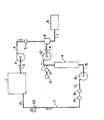
- the accompanying drawing schematically illustrates an apparatus for effecting the present method to remove dissolved oxygen from a supply of water contained in a storage tank 1.
- a stream of water is discharged from a storage tank 1 through line 2 to a pump 3, which then passes the stream of water through line 4 which contains a flow meter 5.
- the stream of water in line 4 passes to a precolumn 6, to which there is also charged a supply of hydrogen gas, through line 7 from a supply 8 of hydrogen gas.
- the hydrogen gas and water are intimately mixed together in the precolumn 6 and the mixture passes through line 9 to a pump 10, such as a variable speed pump which pressurizes the mixture to a pressure of between 80-150 psig (551 to 1034 kPa).
- the pressurized mixture is discharged from pump 10, through line 11, which contains an oxygen content analyzer 12 and hydrogen content analyzer 13.
- the pressurized mixture then passes to the catalyst column 14, which column contains palladium or platinum metal on a solid carrier support. After contact with the catalyst, the mixture is passed through line 15 to a discharge pump 16 which discharges the deoxygenated water through line 17.
- a discharge pump 16 which discharges the deoxygenated water through line 17.
- an oxygen analyzer 18 is used to determine the amount of residual oxygen in the water
- a hydrogen analyzer 19 is used to determine the amount, if any, of residual hydrogen in the water.
- Line 17 then feeds the deoxygenated water to a valve 20, which permits either passage of the deoxygenated water through line 21 back to the tank 1, or, if desired, through line 22 to a use point for deoxygenated water.
- the invention will now be illustrated with reference to the following Examples wherein all parts are by weight unless otherwise indicated.
- the dissolved oxygen content in the Examples was determined by use of an Orbisphere 2713 model digital dissolved oxygen analyzer having an accuracy of plus or minus one part per billion.
- a stream of water which contained a dissolved oxygen content of 7.5 parts per million (ppm) was passed through a precolumn comprising a 9 inch (22.8 cm) long stainless steel, two inch (5.08 cm) interior diameter, pipe packed with 3 mm diameter glass beads, while hydrogen gas in an amount of 1.17 ppm was added thereto.
- the intimately mixed stream from the precolumn, at a pressure of 15 psig, (103 kPa) was passed to a variable speed pump where the stream was pressurized to 80 psig (551 kPa).
- the flow rate of the water was 1000 ml/mm, giving a contact time with the resin of 1 minute.
- the outlet pressure of the water from the catalyst column was 30 psig (207 kPa).
- the initial hydrogen content of the water leaving the catalyst column was 0.005 ppm and the initial oxygen content was 2.4 ppm.
- the inlet hydrogen content was 1.325 ppm and the inlet oxygen content was 7.85 ppm, while the hydrogen content of water leaving the catalyst column was 0.019 ppm and the oxygen content thereof was only 0.0029 ppm (2.9 ppb).
- Example I A series of runs were made following the procedure of Example I.
- the pressures were: 16 psig at the initial flow, 60 psig (413 kPa) at introduction to the catalyst column, and 11 psig (75.8 kPa) at the exit of the catalyst column.
- the temperature of the stream of water was 24°C.
- the inlet hydrogen and outlet hydrogen contents and the inlet oxygen and outlet oxygen contents (from the catalyst column), at various times were recorded and are listed in Table I:
- Example I The procedure of Example I was repeated using a flow of water which contained a lower concentration of dissolved oxygen.
- the temperature of the water was 22°C and the pressures used were: 15 psig (103 kPa) at the initial flow; 100 psig (689 kPa) at introduction to the catalyst column; and 50 psig (345 kPa) at the exit of the catalyst column.
- the temperature of the water was 23.4°C and the pressures used were: 12 psig (82.7 kPa) at the initial flow; 80 psig (551 kPa) at introduction to the catalyst column; and 30 psig (207 kPa) at the exit of the catalyst column.
- the inlet hydrogen and outlet hydrogen contents and inlet oxygen and outlet oxygen contents were recorded in both runs and are listed in Table II:
- Example II As an example showing the need for adequate pressures at the entrance of the feed stream to the catalyst column, the system described in Example I was used, with a flow rate of 1800 ml/min.
- pressures were as follows: 12 psig (82.7 kPa) at initial flow; 60 psig (413 kPa) at the entrance to the catalyst column and 12 psig (82.7 kPa) at the exit of the column.
- the temperature of the water was 25.3°C.
- the hydrogen and oxygen inlet and outlet contents were taken and are listed in Table III. After 80 minutes operation, a gas buildup at the top of the catalyst corner had developed to a depth of 2" (5 cm) from the top of the column.
- Example I As an example showing the need for adequate pressures, as well as intimate mixing of the hydrogen and aqueous medium prior to contact with the palladium, the system of Example I was operated without a precolumn and a pump. The conditions of Example I were repeated, except that the pressures were: 24 psig (165 kPa) at initial flow; 30 psig (207 kPa) at the entrance to the catalyst column; and 18 psig (124 kPa) at the exit of the column. The hydrogen and oxygen inlet and outlet contents were taken and are listed in Table IV. After 30 minutes operation, a 2" (5 cm) gas buildup had developed at the top of the catalyst column. After 42 minutes, the gas buildup had grown to 4" (10.1 cm).
- the present process provides for the deoxygenation of water to values below 10 ppb, and even below 2 ppb, such that the deoxygenated water can be used in steam generating systems without corrosion of the components of the system.
Landscapes
- Chemical & Material Sciences (AREA)
- Organic Chemistry (AREA)
- Chemical Kinetics & Catalysis (AREA)
- Engineering & Computer Science (AREA)
- Life Sciences & Earth Sciences (AREA)
- Hydrology & Water Resources (AREA)
- Water Supply & Treatment (AREA)
- Materials Engineering (AREA)
- Environmental & Geological Engineering (AREA)
- Inorganic Chemistry (AREA)
- Mechanical Engineering (AREA)
- Metallurgy (AREA)
- Removal Of Specific Substances (AREA)
- Catalysts (AREA)
- Treatment Of Water By Oxidation Or Reduction (AREA)
- Manufacture And Refinement Of Metals (AREA)
- Solid-Sorbent Or Filter-Aiding Compositions (AREA)
- Organic Low-Molecular-Weight Compounds And Preparation Thereof (AREA)
Claims (6)
Applications Claiming Priority (2)
| Application Number | Priority Date | Filing Date | Title |
|---|---|---|---|
| US55066083A | 1983-11-10 | 1983-11-10 | |
| US550660 | 1983-11-10 |
Publications (3)
| Publication Number | Publication Date |
|---|---|
| EP0145262A2 EP0145262A2 (de) | 1985-06-19 |
| EP0145262A3 EP0145262A3 (en) | 1985-07-03 |
| EP0145262B1 true EP0145262B1 (de) | 1988-03-09 |
Family
ID=24198087
Family Applications (1)
| Application Number | Title | Priority Date | Filing Date |
|---|---|---|---|
| EP84307667A Expired EP0145262B1 (de) | 1983-11-10 | 1984-11-07 | Verfahren zur Entfernung gelösten Sauerstoffes aus einem wässrigen Medium |
Country Status (6)
| Country | Link |
|---|---|
| EP (1) | EP0145262B1 (de) |
| JP (1) | JPS60175596A (de) |
| KR (1) | KR920002057B1 (de) |
| DE (1) | DE3469679D1 (de) |
| ES (1) | ES537470A0 (de) |
| GB (1) | GB2149391B (de) |
Cited By (2)
| Publication number | Priority date | Publication date | Assignee | Title |
|---|---|---|---|---|
| US8574328B2 (en) | 2006-06-19 | 2013-11-05 | Johnson Matthey Plc | Oxygen removal |
| US9017642B2 (en) | 2006-03-16 | 2015-04-28 | Johnson Matthey Plc | Oxygen removal |
Families Citing this family (20)
| Publication number | Priority date | Publication date | Assignee | Title |
|---|---|---|---|---|
| DE3617273A1 (de) * | 1986-05-23 | 1987-11-26 | Bayer Ag | Katalysatorharze fuer die katalytische reduktion von sauerstoff in waessrigen medien, herstellung der katalysatorharze und neue katalysatorharze |
| IT1202425B (it) * | 1987-01-26 | 1989-02-09 | Giuseppe Bianchi | Processo elettrochimico di deossigenazione per il controllo della corrosione in acque deionizzate |
| DE3735758A1 (de) * | 1987-10-22 | 1989-05-03 | Degussa | Verfahren zur katalytischen reduktion von sauerstoff in waessrigen medien |
| NO880893L (no) * | 1988-03-01 | 1989-09-04 | Norsk Energi | Sentralvarmeanlegg for romoppvarming i bygninger. |
| US5130080A (en) * | 1990-04-02 | 1992-07-14 | General Electric Company | Method of providing extended life expectancy for components of boiling water reactors |
| US5130081A (en) * | 1990-04-02 | 1992-07-14 | General Electric Company | Operation life of on-life boiling water reactors |
| US5135709A (en) * | 1991-05-13 | 1992-08-04 | General Electric Company | Method for reducing corrosion of components exposed to high-temperature water |
| US5147602A (en) * | 1991-05-20 | 1992-09-15 | General Electric Company | Corrosion resistant high chromium stainless steel alloy |
| US5164152A (en) * | 1991-08-02 | 1992-11-17 | General Electric Company | Method for reducing flow assisted corrosion of carbon steel components |
| DE4315520A1 (de) * | 1993-05-10 | 1994-11-17 | Steag Ag | Verfahren und Vorrichtung zum katalytischen Entfernen von Sauerstoff aus Wasser |
| JP2005296939A (ja) * | 2004-03-15 | 2005-10-27 | Japan Organo Co Ltd | 活性酸素除去水の製造方法および製造装置 |
| US7329346B2 (en) | 2005-02-23 | 2008-02-12 | Dionex Corporation | Ion chromatography system using catalytic gas elimination |
| GB0704107D0 (en) * | 2007-03-05 | 2007-04-11 | Johnson Matthey Plc | Oxygen removal |
| KR100941176B1 (ko) * | 2007-06-12 | 2010-02-10 | 한국화학연구원 | 팔라듐 첨착 음이온교환수지와 이의 제조방법 및 이를이용한 용존산소 제거방법 |
| US7585679B1 (en) * | 2008-02-22 | 2009-09-08 | Dionex Corporation | Ion chromatography system with flow-delay eluent recycle |
| US8414685B2 (en) * | 2010-09-08 | 2013-04-09 | Westinghouse Electric Company Llc | System and method for removal of dissolved gases in makeup water of a water-cooled nuclear reactor |
| JP5871652B2 (ja) | 2012-02-23 | 2016-03-01 | オルガノ株式会社 | アルコール中の溶存酸素除去方法、アルコール供給装置並びに洗浄液供給装置 |
| JP5919960B2 (ja) * | 2012-03-30 | 2016-05-18 | 栗田工業株式会社 | 有機物含有水の処理方法 |
| CN103033591B (zh) * | 2012-12-20 | 2015-02-18 | 中国船舶重工集团公司第七一八研究所 | 一种催化剂消氢性能的测试系统及测试方法 |
| US11090606B2 (en) | 2013-12-05 | 2021-08-17 | Dionex Corporation | Gas-less electrolytic device and method |
Family Cites Families (3)
| Publication number | Priority date | Publication date | Assignee | Title |
|---|---|---|---|---|
| BE565365A (de) * | 1957-04-03 | |||
| DE1642494A1 (de) * | 1967-10-12 | 1972-02-17 | Maerkische Steinkohlengewerksc | Verfahren und Vorrichtung zum Entfernen von in Wasser geloestem Sauerstoff,insbesondere im Zuge der Speisewasseraufbereitung |
| JPS6039436B2 (ja) * | 1982-04-02 | 1985-09-05 | 興和化学工業株式会社 | 給水の脱酸素方法及びその装置 |
-
1984
- 1984-10-19 GB GB08426505A patent/GB2149391B/en not_active Expired
- 1984-11-07 ES ES537470A patent/ES537470A0/es active Granted
- 1984-11-07 EP EP84307667A patent/EP0145262B1/de not_active Expired
- 1984-11-07 DE DE8484307667T patent/DE3469679D1/de not_active Expired
- 1984-11-09 JP JP59236555A patent/JPS60175596A/ja active Granted
- 1984-11-09 KR KR1019840007021A patent/KR920002057B1/ko not_active Expired
Non-Patent Citations (1)
| Title |
|---|
| VGB KRAFTWERKSTECHNIK, vol.64, No.1, Jan.84, pp. 61-63. F.MARTINOLA et al : Ein starkbasischer Anionenaustauscher mit zwei Funktionen. * |
Cited By (3)
| Publication number | Priority date | Publication date | Assignee | Title |
|---|---|---|---|---|
| US9017642B2 (en) | 2006-03-16 | 2015-04-28 | Johnson Matthey Plc | Oxygen removal |
| US8574328B2 (en) | 2006-06-19 | 2013-11-05 | Johnson Matthey Plc | Oxygen removal |
| US9284189B2 (en) | 2006-06-20 | 2016-03-15 | Johnson Matthey Plc | Oxygen removal |
Also Published As
| Publication number | Publication date |
|---|---|
| GB8426505D0 (en) | 1984-12-27 |
| EP0145262A2 (de) | 1985-06-19 |
| GB2149391B (en) | 1987-10-07 |
| ES8603340A1 (es) | 1985-12-16 |
| EP0145262A3 (en) | 1985-07-03 |
| JPS60175596A (ja) | 1985-09-09 |
| GB2149391A (en) | 1985-06-12 |
| DE3469679D1 (en) | 1988-04-14 |
| KR850003328A (ko) | 1985-06-17 |
| KR920002057B1 (ko) | 1992-03-10 |
| ES537470A0 (es) | 1985-12-16 |
| JPH0416236B2 (de) | 1992-03-23 |
Similar Documents
| Publication | Publication Date | Title |
|---|---|---|
| EP0145262B1 (de) | Verfahren zur Entfernung gelösten Sauerstoffes aus einem wässrigen Medium | |
| US4789488A (en) | Catalyzed oxygen removal with hydrogen for steam generator systems | |
| US4574071A (en) | Process for removing dissolved oxygen from water using hydrazine | |
| Lin et al. | Removal of nitrogenous compounds from aqueous solution by ozonation and ion exchange | |
| EP0167569B1 (de) | Desoxygenierungsverfahren und vorrichtung | |
| US4875945A (en) | Process for cleaning the exhaust gas of a fusion reactor | |
| US5108624A (en) | Method for deoxygenating a liquid | |
| US4818411A (en) | Deoxygenation process | |
| Ionitã et al. | The separation of deuterium and tritium on PT/SDB/PS and PT/C/PTFE hydrophobe catalysts | |
| EP0787225B1 (de) | Verfahren zum minimieren des lösungsmittelabbaus und korrosion in aminlösungsmittelbehandlungssystemen | |
| JP3224037B2 (ja) | 脱酸素装置 | |
| EP0140587B1 (de) | Verfahren zum Entfernen von gelöstem Sauerstoff aus einem wässrigen Medium | |
| KR100302478B1 (ko) | 활성탄소섬유촉매에의한수중용존산소제거장치 | |
| JP3267704B2 (ja) | 水中溶存酸素の除去方法 | |
| JP2818943B2 (ja) | 原子力プラント及びその運転方法 | |
| JPH08168756A (ja) | 脱気装置 | |
| GB2234501A (en) | Inhibition of corrosion | |
| JPS55164081A (en) | Method for protection of metal in contact with water from corrosion | |
| JPS5943401B2 (ja) | 酸素・水素の再結合方法 | |
| JPH08290007A (ja) | 溶存酸素の除去方法 | |
| Hanika et al. | The hydrogenation of cyclohexene in a laboratory trickle-bed reactor | |
| JP2519122B2 (ja) | 液体中の溶存酸素の除去方法及び装置 | |
| JPH0839081A (ja) | 復水脱塩装置の再生排水の処理方法 | |
| Rastunova et al. | New contact device for separation of hydrogen isotopes in the water-hydrogen system | |
| JPH02265604A (ja) | 水中の溶存酸素除去装置 |
Legal Events
| Date | Code | Title | Description |
|---|---|---|---|
| PUAI | Public reference made under article 153(3) epc to a published international application that has entered the european phase |
Free format text: ORIGINAL CODE: 0009012 |
|
| PUAL | Search report despatched |
Free format text: ORIGINAL CODE: 0009013 |
|
| AK | Designated contracting states |
Designated state(s): BE DE IT SE |
|
| AK | Designated contracting states |
Designated state(s): BE DE IT SE |
|
| 17P | Request for examination filed |
Effective date: 19860103 |
|
| 17Q | First examination report despatched |
Effective date: 19860910 |
|
| ITF | It: translation for a ep patent filed | ||
| GRAA | (expected) grant |
Free format text: ORIGINAL CODE: 0009210 |
|
| AK | Designated contracting states |
Kind code of ref document: B1 Designated state(s): BE DE IT SE |
|
| REF | Corresponds to: |
Ref document number: 3469679 Country of ref document: DE Date of ref document: 19880414 |
|
| PLBI | Opposition filed |
Free format text: ORIGINAL CODE: 0009260 |
|
| 26 | Opposition filed |
Opponent name: BAYER AG, LEVERKUSEN KONZERNVERWALTUNG RP PATENTAB Effective date: 19880906 |
|
| PLBI | Opposition filed |
Free format text: ORIGINAL CODE: 0009260 |
|
| 26 | Opposition filed |
Opponent name: HOECHST AKTIENGESELLSCHAFT,FRANKFURT(MAIN) Effective date: 19881126 Opponent name: BAYER AG, LEVERKUSEN KONZERNVERWALTUNG RP PATENTAB Effective date: 19880906 |
|
| PGFP | Annual fee paid to national office [announced via postgrant information from national office to epo] |
Ref country code: SE Payment date: 19910919 Year of fee payment: 8 |
|
| ITTA | It: last paid annual fee | ||
| PGFP | Annual fee paid to national office [announced via postgrant information from national office to epo] |
Ref country code: DE Payment date: 19911231 Year of fee payment: 8 |
|
| RDAG | Patent revoked |
Free format text: ORIGINAL CODE: 0009271 |
|
| STAA | Information on the status of an ep patent application or granted ep patent |
Free format text: STATUS: PATENT REVOKED |
|
| 27W | Patent revoked |
Effective date: 19900907 |
|
| PGFP | Annual fee paid to national office [announced via postgrant information from national office to epo] |
Ref country code: BE Payment date: 19921012 Year of fee payment: 9 |
|
| EUG | Se: european patent has lapsed |
Ref document number: 84307667.0 Effective date: 19920909 |
|
| APAH | Appeal reference modified |
Free format text: ORIGINAL CODE: EPIDOSCREFNO |