EP0143095B1 - Verfahren zum Herstellen einer Holzbekleidung für einen Fernsprecher, einen Handfernsprecher oder sonstige Bekleidung für die Fernmeldetechnik - Google Patents
Verfahren zum Herstellen einer Holzbekleidung für einen Fernsprecher, einen Handfernsprecher oder sonstige Bekleidung für die Fernmeldetechnik Download PDFInfo
- Publication number
- EP0143095B1 EP0143095B1 EP84850319A EP84850319A EP0143095B1 EP 0143095 B1 EP0143095 B1 EP 0143095B1 EP 84850319 A EP84850319 A EP 84850319A EP 84850319 A EP84850319 A EP 84850319A EP 0143095 B1 EP0143095 B1 EP 0143095B1
- Authority
- EP
- European Patent Office
- Prior art keywords
- timber
- wood
- casing
- case
- aforementioned
- Prior art date
- Legal status (The legal status is an assumption and is not a legal conclusion. Google has not performed a legal analysis and makes no representation as to the accuracy of the status listed.)
- Expired
Links
- 239000002023 wood Substances 0.000 title claims abstract description 54
- 238000004519 manufacturing process Methods 0.000 title claims description 9
- 238000001035 drying Methods 0.000 claims abstract description 24
- 239000000463 material Substances 0.000 claims abstract description 11
- 239000011347 resin Substances 0.000 claims abstract description 6
- 229920005989 resin Polymers 0.000 claims abstract description 6
- 239000011148 porous material Substances 0.000 claims abstract description 3
- 239000012779 reinforcing material Substances 0.000 claims abstract description 3
- 239000002966 varnish Substances 0.000 claims abstract description 3
- 238000000034 method Methods 0.000 claims description 14
- 238000003475 lamination Methods 0.000 claims description 2
- XEEYBQQBJWHFJM-UHFFFAOYSA-N Iron Chemical compound [Fe] XEEYBQQBJWHFJM-UHFFFAOYSA-N 0.000 claims 2
- 229910052742 iron Inorganic materials 0.000 claims 1
- 210000000056 organ Anatomy 0.000 description 11
- 241000196324 Embryophyta Species 0.000 description 9
- 230000003014 reinforcing effect Effects 0.000 description 7
- 238000005336 cracking Methods 0.000 description 5
- 238000010438 heat treatment Methods 0.000 description 5
- 238000012545 processing Methods 0.000 description 5
- 238000010521 absorption reaction Methods 0.000 description 3
- 238000011161 development Methods 0.000 description 3
- 230000018109 developmental process Effects 0.000 description 3
- 238000007789 sealing Methods 0.000 description 3
- 235000018185 Betula X alpestris Nutrition 0.000 description 2
- 235000018212 Betula X uliginosa Nutrition 0.000 description 2
- 239000002184 metal Substances 0.000 description 2
- 238000003801 milling Methods 0.000 description 2
- 239000007787 solid Substances 0.000 description 2
- 240000004731 Acer pseudoplatanus Species 0.000 description 1
- 235000002754 Acer pseudoplatanus Nutrition 0.000 description 1
- 241000167854 Bourreria succulenta Species 0.000 description 1
- 240000007049 Juglans regia Species 0.000 description 1
- 235000009496 Juglans regia Nutrition 0.000 description 1
- 235000006485 Platanus occidentalis Nutrition 0.000 description 1
- 241000750717 Pterocarpus erinaceus Species 0.000 description 1
- 230000003213 activating effect Effects 0.000 description 1
- 238000004026 adhesive bonding Methods 0.000 description 1
- 230000000903 blocking effect Effects 0.000 description 1
- 235000019693 cherries Nutrition 0.000 description 1
- 238000010276 construction Methods 0.000 description 1
- 238000013461 design Methods 0.000 description 1
- 238000010586 diagram Methods 0.000 description 1
- 230000000694 effects Effects 0.000 description 1
- 238000004049 embossing Methods 0.000 description 1
- 238000001704 evaporation Methods 0.000 description 1
- 230000008020 evaporation Effects 0.000 description 1
- 230000001747 exhibiting effect Effects 0.000 description 1
- 238000005304 joining Methods 0.000 description 1
- 230000013011 mating Effects 0.000 description 1
- 238000012986 modification Methods 0.000 description 1
- 230000004048 modification Effects 0.000 description 1
- 238000003825 pressing Methods 0.000 description 1
- 230000001105 regulatory effect Effects 0.000 description 1
- 230000002787 reinforcement Effects 0.000 description 1
- 238000001291 vacuum drying Methods 0.000 description 1
- 210000003462 vein Anatomy 0.000 description 1
- 235000020234 walnut Nutrition 0.000 description 1
Images

Classifications
-
- H—ELECTRICITY
- H04—ELECTRIC COMMUNICATION TECHNIQUE
- H04M—TELEPHONIC COMMUNICATION
- H04M1/00—Substation equipment, e.g. for use by subscribers
- H04M1/02—Constructional features of telephone sets
-
- B—PERFORMING OPERATIONS; TRANSPORTING
- B27—WORKING OR PRESERVING WOOD OR SIMILAR MATERIAL; NAILING OR STAPLING MACHINES IN GENERAL
- B27M—WORKING OF WOOD NOT PROVIDED FOR IN SUBCLASSES B27B - B27L; MANUFACTURE OF SPECIFIC WOODEN ARTICLES
- B27M1/00—Working of wood not provided for in subclasses B27B - B27L, e.g. by stretching
- B27M1/08—Working of wood not provided for in subclasses B27B - B27L, e.g. by stretching by multi-step processes
-
- Y—GENERAL TAGGING OF NEW TECHNOLOGICAL DEVELOPMENTS; GENERAL TAGGING OF CROSS-SECTIONAL TECHNOLOGIES SPANNING OVER SEVERAL SECTIONS OF THE IPC; TECHNICAL SUBJECTS COVERED BY FORMER USPC CROSS-REFERENCE ART COLLECTIONS [XRACs] AND DIGESTS
- Y10—TECHNICAL SUBJECTS COVERED BY FORMER USPC
- Y10T—TECHNICAL SUBJECTS COVERED BY FORMER US CLASSIFICATION
- Y10T156/00—Adhesive bonding and miscellaneous chemical manufacture
- Y10T156/10—Methods of surface bonding and/or assembly therefor
- Y10T156/1002—Methods of surface bonding and/or assembly therefor with permanent bending or reshaping or surface deformation of self sustaining lamina
Definitions
- the present invention relates to a method for producing part of a casing in wood, in particular in the form of a case for a telephone apparatus, a casing for a hand microtelephone or some other form of casing used within the telecommunication industry.
- a casing for a hand microtelephone or some other form of casing used within the telecommunication industry.
- another part of a casing reference may be made to an apparatus casing intended to contain telecommunication components, for example an operator's console.
- the process is best applied to hand microtelephone casings which consist of two mating parts capable of being joined together at a dividing plane along the longitudinal section of the hand microtelephone.
- the execution of the cases for telephone apparatus or similar casings in wood is previously disclosed.
- the aforementioned casings are in that case intended to constitute a variant which is usually executed in a plastic material.
- the external volume of the wooden embodiment must in this case correspond essentially to the external volume of the casing executed in conventional types of material.
- the casing for telephone apparatus for example, will thus require to be milled so as to provide it with an internal volume which is sufficiently great to accommodate the telecommunication components concerned.
- the execution of telephone apparatuses in wood is disclosed, although not in conjunction with requirement that they shall resemble the present- day modern design and with the simultaneous requirement in respect of their internal volume.
- the finished casing will exhibit thin wall sections, for example at lead- throughs or at the holes for the push-buttons making up a keyset.
- the embodiment of the apparatus must be capable of satisfying the requirements in respect of its strength which are imposed on, for example, a case for a telephone apparatus when the telephone apparatus is used in its normal environment.
- a telephone apparatus is subjected heavy-handed treatment within its normal field of use.
- the wood used in the case for the telephone apparatus must be capable, furthermore, of withstanding moisture problems, and it is accordingly not permissible for cracking and deformation to occur in the wooden material as a result of moisture.
- the apparatus must also be able to exhibit a long service life.
- the present invention has as its principal object the presentation of a method for producing a casing of this kind which will solve the problem outlined in the above.
- What principally may be regarded as being characteristic of this novel method are that an initial piece of timber is dried for the duration of a drying period inside an oven or other space until the timber is just above its cell collapse limit, and that at the end of the drying period the temperature is adjusted in such a way as to cause the resin in the wood to flow out and seal the pith fibres of the wood with the intention of preventing the wood from re-absorbing moisture.
- the timber shall be dried for a drying period of between 5 and 75 days, depending on the type of wood used. Drying should take place preferably in the form of cycles consisting of heating and the creation of a vacuum.
- the timber should preferably be dried to such an extent that it has a moisture content of only about 4-5 per cent by weight in its finished-dried state.
- a first temperature of about 50°C is used during. the periods of the aforementioned cycles when the timber is being heated. At the end of the full drying period the temperature is increased to about 65°C in order to achieve the aforementioned outflow of the resin from the wood.
- the blank shall form a solid unit or shall be composed (glued together) from two or more pieces of wood taken from the same plank or length of wood.
- the production of the basic shape of the part of the casing i.e. the milling or pressing of the internal cavity of the casing, should preferably be done by mechanical means.
- the hand microtelephone should preferably be made in the form of two long components which are capable of being joined together along a longitudinal section or at a dividing plane in the longitudinal sense of the hand microtelephone.
- the aforementioned long components are so executed as to exhibit different curved shapes at the joining section, in which case the curved shape for the upper part will exhibit a smaller radius than the corresponding radius of the lower part.
- the long components are held tightly together by means of securing screws in such a way that contact is provided over the entire longitudinal section, which means that reliable sealing will exist at the microphone and ear-phone components.
- the assembly of the aforementioned microphone and ear-phone components should be effected preferably by means of assembly screws which are capable of intracting via a metal bushing arranged in the corresponding component concerned. It is possible in this way to avoid the use of wood screws, which means that the components can be dismantled and assembled a number of times without damaging the wooden material, which would be the case if wood screws had been used in the handle at its point to the ear-phone and microphone components.
- a further embodiment involves the use of marking of the case concerned or the casing concerned with the help of so-called hot-embossing.
- a telephone apparatus may be executed with an apparatus case in a fine-quality wood and may at the same time be utilized as a subscriber apparatus capable of satisfying all the requirements which apply to such an apparatus with regard to its strength. Also eliminated by the use of this process is the risk of cracking in the part of the casing, even if the apparatus is used in comparatively damp areas. The apparatus is able in this way to retain its finish and the surface characteristics which make it attractive from the user's point of view.
- This process permits production in types of wood which are of interest in this connection, such as mahogny, walnut, curly-grained birch, wavy-grained birch, sycamore, cherry or African rosewood, etc.
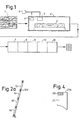
- Figure 1 a laminated piece of timber is indicated by the reference designation 1.
- the timber can be of any desired type of wood, preferably being a fine-quality wood, and may consist of mahogny, for example. Although the novel method is described here in relation to mahogny, it is also capable of being used with other types of wood, for example the types of wood referred to above.
- Figure 1 also illustrates a plant for so-called vacuum drying 2.
- the aforementioned plant incorporates temperature-control organs 3 and vacuum-producing organs 4.
- the plant is equipped in a previously disclosed fashion with one or more openable and closable flaps, doors or similar.
- the vacuum plant 2 is so arranged as to accommodate one or more pieces of timber, for example one or more planks 5, which are to be dried inside the plant 2 during a drying period.
- the aforementioned drying period is selected in accordance with the type of wood and is intended to provide thorough drying of the timber planks 5 concerned.
- the invention is in this case based on the concept that the timber is to be dried to an extremely low moisture content this being a moisture content which lies just above the cell collapse limit of the timber.
- the drying procedure is as follows. Once the piece of timber or plank concerned has been introduced into the plant, it is heated for a long period so that the timber is heated through to the core itself. Once the timber has been introduced into the plant and the latter has been closed, the temperature control organs 3 are switched on in order to provide a temperature preferably of about 50°C. In the case of mahogny, the aforementioned thorough heating will last for about one day. Once the thorough heating process is complete the plant 2 is subjected to a vacuum by activating the vacuum-producing organs 4. The control of the aforementioned temperature-control organs and vacuum-producing organs can take place automatically in a previously disclosed fashion, for example with the help of regulating organs 6.
- the timber is then left under vacuum inside the plant 2 for a short time, for example 10-12 minutes.
- the pressure is reduced, the result will be evaporation at the surface, which means that the surface will become colder and moisture will be driven off from it.
- the temperature difference and the pressure difference which occur in this case mean that moisture will move from the inside of the wood towards the outside, said movement continuing until the surface has cooled.
- the vacuum is interrupted after the aforementioned short period and is followed by a new cycle consisting of a heating period and renewed vacuum application, and so on, until an outstandingly high degree of drying of the timber has been achieved.
- the aforementioned drying process is allowed to continue in accordance with the invention for an unusually long period and until the timber is just above the cell collapse limit.
- the timber should preferably be dried to such an extent that the residual moisture content is only about 4-5 per cent by weight, which must be compared with normal timber drying processes which aim at residual moisture contents of 6-8 per cent by weight.
- a major special characteristic of the invention is that at the end of the aforementioned drying period the temperature is increased from the aforementioned 50°C to 65°C for a short period in relation to the total drying time.
- the temperature is increased from the aforementioned 50°C to 65°C for a short period in relation to the total drying time.
- an out-flowing of the resin in the wood This takes place with the intention of sealing the pith fibres of the wood.
- moisture is prevented or discouraged from once more entering the core of the wood or the timber.
- a certain degree of re-absorption of moisture is permissible during, the subsequent processing of the timber described below.
- the aforementioned re- absorption of moisture is limited, however, to the outer parts of the timber or the wood, and the aforementioned flowing out of the resin enables the wood to be kept in its essentially desiccated state.
- FIG. 1 various processing stations are indicated by the reference designations 7, 8, 9 10 and 11.
- the timber which has been dried in this way is sawn into blanks which are to form the finished wooden objects in question.
- the aforementioned sawing can occur at station 7.
- Different blanks which together are to form an object can also be produced at the aforementioned station 7.
- Each blank can be in the form of a single piece taken from the dried timber.
- the blank may thus consist of two more pieces glued together which in this case have been taken from the same piece of timber or plank.
- Station 8 At a station 8 the milling of the blanktakes place in such a way that the contours of the object are produced in rough form.
- Station 9 is a processing station for detailed processing (for example, including sanding).
- Station 10 is an assembly station for the different finished details.
- Station 11 is a varnishing station.
- Figure 2 shows a vertical section through a case for a telephone apparatus, the external shape of which is at least essentially previously disclosed.
- Figure 2a shows a parallel section through the case in question.
- the parallel section in this case is taken in such a way that it extends through the keyset of the telephone apparatus.
- the casing is indicated by the reference designation 12 and since its form is assumed to be as shown, it is not proposed to describe it in any greater detail here. What may be established, however, is that the casing includes the parts 12a and 12b in which the thickness of the material is comparatively small, for example about 3 mm.
- the casing in accordance with Figure 2 is capable of being connected to a component not shown here which belongs to the telephone apparatus in question.
- the component and the casing are intended in this case to contain telecommunications equipment which extends at least essentially into the casing cavity 12c.
- the thickness of the material at the part 12d in accordance with Figure 2 is also essentially reduced.
- the aforementioned parts 12d are arranged in such a way as to provide rows and columns of holes 13, 14, 15 and 16.
- the strings of parts 12d are reinforced in this case by means of reinforcing elements not illustrated specifically, consisting for example of glued and cross-laminated veneer.
- the strings of parts 12d which are cut in the longitudinal direction of the wood are provided with reinforcement in this case from the aforementioned reinforcing elements, the transverse direction of which extends at right angles to the aforementioned direction of the wood.
- the actual wood of the case in this instance absorbs stresses in one principal direction, whilst the reinforcing element absorbs stresses in the other direction. Thin areas of material in the case can be reinforced in a similar fashion.
- FIG 3 shows a casing in the form of a hand microtelephone having a previously disclosed external shape.
- the hand microtelephone 17 consists in principle of two parts which are capable of being connected together at a dividing plane 18 which extends in the longitudinal sense of the components 17a and 17b and at right angles to the plane of the paper in Figure 3.
- the dividing plane has a curved shape in the aforementioned plane of the paper.
- the upper part 17a is in this case provided with a radius R1 which is smaller than the corresponding radius R2 of the other component 17b.
- This arrangement of different radii means that the components can be held together by means of securing organs 19 and 20 which are positioned close to the centre 21 of the hand microtelephone, at the same time ensuring reliable contact along the entire dividing plane of the components.
- securing organs 19 and 20 consist in this case of cylindrical screws which are capable of being screwed into bushings 22, 23 executed preferably in metal.
- the ear-phone component of the hand microtelephone comprises a first space 24 for the ear-piece unit and a second space 25 for the microphone components. Also present inside the hand microtelephone is a long groove 26 to accommodate the wires between the components.
- Figure 4 a free end edge 27 of the case for a telephone apparatus in accordance with Figure 2.
- the end edge can be reinforced by means of a reinforcing element 28 preferably in wood of the same or a different type.
- the reinforcing element 28 is let into the component 27 but may, of course, also be so arranged as to extend over the entire surface 27a.
- the reinforcing element is provided in order to block effectively any internal stresses in the wood which are present as a result of the blank having been taken from those parts of the timber or the plank in which the veining is oblique, in such a way that the stresses will not cause the aforementioned cracking or warping in the wood.
Landscapes
- Engineering & Computer Science (AREA)
- Life Sciences & Earth Sciences (AREA)
- Signal Processing (AREA)
- Mechanical Engineering (AREA)
- Wood Science & Technology (AREA)
- Forests & Forestry (AREA)
- Chemical And Physical Treatments For Wood And The Like (AREA)
- Dry Formation Of Fiberboard And The Like (AREA)
- Casings For Electric Apparatus (AREA)
- Audible-Bandwidth Dynamoelectric Transducers Other Than Pickups (AREA)
- Telephone Set Structure (AREA)
Claims (5)
Priority Applications (1)
| Application Number | Priority Date | Filing Date | Title |
|---|---|---|---|
| AT84850319T ATE45698T1 (de) | 1983-11-16 | 1984-10-23 | Verfahren zum herstellen einer holzbekleidung fuer einen fernsprecher, einen handfernsprecher oder sonstige bekleidung fuer die fernmeldetechnik. |
Applications Claiming Priority (2)
| Application Number | Priority Date | Filing Date | Title |
|---|---|---|---|
| SE8306317 | 1983-11-16 | ||
| SE8306317A SE454860B (sv) | 1983-11-16 | 1983-11-16 | Sett att i tre framstella en telefonapparatkapa, handmikrotelefon eller annat holje inom teleindustrin |
Publications (3)
| Publication Number | Publication Date |
|---|---|
| EP0143095A2 EP0143095A2 (de) | 1985-05-29 |
| EP0143095A3 EP0143095A3 (en) | 1987-06-03 |
| EP0143095B1 true EP0143095B1 (de) | 1989-08-23 |
Family
ID=20353350
Family Applications (1)
| Application Number | Title | Priority Date | Filing Date |
|---|---|---|---|
| EP84850319A Expired EP0143095B1 (de) | 1983-11-16 | 1984-10-23 | Verfahren zum Herstellen einer Holzbekleidung für einen Fernsprecher, einen Handfernsprecher oder sonstige Bekleidung für die Fernmeldetechnik |
Country Status (7)
| Country | Link |
|---|---|
| US (1) | US4781778A (de) |
| EP (1) | EP0143095B1 (de) |
| JP (1) | JPS6110404A (de) |
| AT (1) | ATE45698T1 (de) |
| CA (1) | CA1220119A (de) |
| DE (1) | DE3479486D1 (de) |
| SE (1) | SE454860B (de) |
Cited By (1)
| Publication number | Priority date | Publication date | Assignee | Title |
|---|---|---|---|---|
| CN105313204A (zh) * | 2015-10-27 | 2016-02-10 | 中山市大涌镇生产力促进中心 | 一种红木双色板的均色处理方法 |
Families Citing this family (10)
| Publication number | Priority date | Publication date | Assignee | Title |
|---|---|---|---|---|
| US4960481A (en) * | 1987-05-08 | 1990-10-02 | Minnesota Mining And Manufacturing Company | Laminating method |
| US5160084A (en) * | 1987-12-03 | 1992-11-03 | Kerr-Mcgee Corporation | Method for adhesively bonding a rail-tie fastening assembly to a wooden railway tie |
| DE3840627C1 (de) * | 1988-12-02 | 1990-02-01 | Zoehrer Kg Rahmen- Und Leistenfabrik, Schwaz, At | |
| JP4225884B2 (ja) * | 2003-12-08 | 2009-02-18 | オリンパス株式会社 | 電子機器 |
| CN100339198C (zh) * | 2004-09-30 | 2007-09-26 | 珠海市海外海科技有限公司 | 一种液晶电脑显示器或液晶电视机的制造方法 |
| US7963048B2 (en) * | 2005-05-23 | 2011-06-21 | Pollard Levi A | Dual path kiln |
| US8201501B2 (en) | 2009-09-04 | 2012-06-19 | Tinsley Douglas M | Dual path kiln improvement |
| MY180222A (en) * | 2016-06-13 | 2020-11-25 | Univ Putra Malaysia | Oil palm lumber drying method and system thereof |
| CN107139302A (zh) * | 2017-07-01 | 2017-09-08 | 安徽省扬子家居新材料有限公司 | 一种木门原木料的预处理工艺 |
| US10619921B2 (en) | 2018-01-29 | 2020-04-14 | Norev Dpk, Llc | Dual path kiln and method of operating a dual path kiln to continuously dry lumber |
Family Cites Families (11)
| Publication number | Priority date | Publication date | Assignee | Title |
|---|---|---|---|---|
| US1066523A (en) * | 1911-11-20 | 1913-07-08 | Frank A Palen | Process for the scientific curing of woods. |
| US1328505A (en) * | 1916-09-20 | 1920-01-20 | Lumber Tie And Timber Vulcaniz | Process of drying lumber |
| US1328506A (en) * | 1916-09-27 | 1920-01-20 | Lumber Tie And Timber Vulcaniz | Sterilized wood |
| US2500954A (en) * | 1947-03-04 | 1950-03-21 | Us Agriculture | Method involving the use of chemicals for increasing the drying rate of wood |
| US3675336A (en) * | 1969-07-17 | 1972-07-11 | Weyerhaeuser Co | Method for drying wood |
| US3862375A (en) * | 1973-07-23 | 1975-01-21 | Wesley L Thomas | Telephone |
| JPS5044545A (de) * | 1973-08-24 | 1975-04-22 | ||
| US3963546A (en) * | 1974-07-15 | 1976-06-15 | Barney Roberti | Method of making a multiple ply wood article |
| CH586492A5 (en) * | 1974-10-17 | 1977-03-31 | Rubitschon Josef | Supplementary protective and decorative fitting for telephone - is hood:like profiled piece of ductile material with openings for dial and handset cradle |
| US4182048A (en) * | 1978-02-21 | 1980-01-08 | U.S. Natural Resources, Inc. | Method of drying lumber |
| IT1107882B (it) * | 1978-04-13 | 1985-12-02 | Pagnozzi Vincenzo | Procedimento ed impianto per essicare il legno massiccio in tavole o senmi lavorati col sistema a vapore surriscaldato |
-
1983
- 1983-11-16 SE SE8306317A patent/SE454860B/sv not_active IP Right Cessation
-
1984
- 1984-10-23 DE DE8484850319T patent/DE3479486D1/de not_active Expired
- 1984-10-23 EP EP84850319A patent/EP0143095B1/de not_active Expired
- 1984-10-23 AT AT84850319T patent/ATE45698T1/de active
- 1984-10-30 CA CA000466571A patent/CA1220119A/en not_active Expired
- 1984-11-16 JP JP59243146A patent/JPS6110404A/ja active Granted
-
1987
- 1987-01-08 US US07/001,479 patent/US4781778A/en not_active Expired - Fee Related
Cited By (1)
| Publication number | Priority date | Publication date | Assignee | Title |
|---|---|---|---|---|
| CN105313204A (zh) * | 2015-10-27 | 2016-02-10 | 中山市大涌镇生产力促进中心 | 一种红木双色板的均色处理方法 |
Also Published As
| Publication number | Publication date |
|---|---|
| JPS6110404A (ja) | 1986-01-17 |
| CA1220119A (en) | 1987-04-07 |
| DE3479486D1 (en) | 1989-09-28 |
| SE8306317L (sv) | 1985-05-17 |
| SE8306317D0 (sv) | 1983-11-16 |
| ATE45698T1 (de) | 1989-09-15 |
| SE454860B (sv) | 1988-06-06 |
| EP0143095A2 (de) | 1985-05-29 |
| JPH0430883B2 (de) | 1992-05-25 |
| US4781778A (en) | 1988-11-01 |
| EP0143095A3 (en) | 1987-06-03 |
Similar Documents
| Publication | Publication Date | Title |
|---|---|---|
| EP0143095A2 (de) | Verfahren zum Herstellen einer Holzbekleidung für einen Fernsprecher, einen Handfernsprecher oder sonstige Bekleidung für die Fernmeldetechnik | |
| CN101108501B (zh) | 形成木制模型的方法以及由该方法加工的木制结构体、车辆内部材料和声学结构体 | |
| US2155375A (en) | Pressed article, particularly airscrew blade, of laminated wood, and method of manufacture | |
| CN107369432A (zh) | 一种吉他及其制备方法 | |
| CA2365484A1 (en) | Hockey stick blade with braided fibre envelope | |
| EP3674044A1 (de) | Bambusbauvorhangwandplatte und herstellungsverfahren dafür | |
| US4301187A (en) | Panel | |
| CN113478592A (zh) | 一种六边形实木拼接结构及其加工方法 | |
| US2028076A (en) | Method of making plywood trays or the like | |
| CN109551598A (zh) | 五层薄木皮拼花实木复合地板及其生产工艺 | |
| US4631218A (en) | Wooden base plate | |
| JPH081616A (ja) | 集合材 | |
| US2370429A (en) | Laminated structure and method for making such structure | |
| CN104441103A (zh) | 用于红木拼宽的胶合方法 | |
| KR890004165B1 (ko) | 가구용 판재 표면에 f.r.p 를 도장하는 방법 | |
| NO136239B (de) | ||
| DE3168320D1 (en) | Method of manufacturing veneer | |
| NO159581B (no) | Fremgangsm te til fremstilling av en hylsterdel i t i form av en telendmikrotelefonhyls ter, eller et annet hylster innen teleindustrien. | |
| KR810001582B1 (ko) | 저압실에서 보강 또는 비보강된 열경화성 수지의 적층을 제조하는 방법 | |
| JPH0158762B2 (de) | ||
| KR20250166648A (ko) | 탄화를 이용한 목재 패널 및 그 제조 방법 | |
| US20020092605A1 (en) | Method of applying veneer to a substrate | |
| DK147786B (da) | Fremgangsmaade ved fremstilling af en fineret plade med indfraesede spor i overfladen | |
| JPH0440883Y2 (de) | ||
| SU1020238A1 (ru) | Способ облицовки дерев нных клееных конструкций |
Legal Events
| Date | Code | Title | Description |
|---|---|---|---|
| PUAI | Public reference made under article 153(3) epc to a published international application that has entered the european phase |
Free format text: ORIGINAL CODE: 0009012 |
|
| AK | Designated contracting states |
Designated state(s): AT DE FR GB IT NL |
|
| PUAL | Search report despatched |
Free format text: ORIGINAL CODE: 0009013 |
|
| AK | Designated contracting states |
Kind code of ref document: A3 Designated state(s): AT DE FR GB IT NL |
|
| 17P | Request for examination filed |
Effective date: 19870907 |
|
| 17Q | First examination report despatched |
Effective date: 19881017 |
|
| GRAA | (expected) grant |
Free format text: ORIGINAL CODE: 0009210 |
|
| AK | Designated contracting states |
Kind code of ref document: B1 Designated state(s): AT DE FR GB IT NL |
|
| REF | Corresponds to: |
Ref document number: 45698 Country of ref document: AT Date of ref document: 19890915 Kind code of ref document: T |
|
| REF | Corresponds to: |
Ref document number: 3479486 Country of ref document: DE Date of ref document: 19890928 |
|
| ITF | It: translation for a ep patent filed | ||
| ET | Fr: translation filed | ||
| REG | Reference to a national code |
Ref country code: GB Ref legal event code: 732 |
|
| NLS | Nl: assignments of ep-patents |
Owner name: STIG OLOFSSON TE NYNAESHAMN, ZWEDEN. |
|
| PLBE | No opposition filed within time limit |
Free format text: ORIGINAL CODE: 0009261 |
|
| STAA | Information on the status of an ep patent application or granted ep patent |
Free format text: STATUS: NO OPPOSITION FILED WITHIN TIME LIMIT |
|
| REG | Reference to a national code |
Ref country code: FR Ref legal event code: TP |
|
| 26N | No opposition filed | ||
| PGFP | Annual fee paid to national office [announced via postgrant information from national office to epo] |
Ref country code: FR Payment date: 19920915 Year of fee payment: 9 |
|
| PGFP | Annual fee paid to national office [announced via postgrant information from national office to epo] |
Ref country code: AT Payment date: 19930816 Year of fee payment: 10 |
|
| PGFP | Annual fee paid to national office [announced via postgrant information from national office to epo] |
Ref country code: GB Payment date: 19931013 Year of fee payment: 10 |
|
| ITTA | It: last paid annual fee | ||
| PGFP | Annual fee paid to national office [announced via postgrant information from national office to epo] |
Ref country code: NL Payment date: 19931031 Year of fee payment: 10 |
|
| PGFP | Annual fee paid to national office [announced via postgrant information from national office to epo] |
Ref country code: DE Payment date: 19931130 Year of fee payment: 10 |
|
| PG25 | Lapsed in a contracting state [announced via postgrant information from national office to epo] |
Ref country code: FR Effective date: 19940630 |
|
| REG | Reference to a national code |
Ref country code: FR Ref legal event code: ST |
|
| PG25 | Lapsed in a contracting state [announced via postgrant information from national office to epo] |
Ref country code: GB Effective date: 19941023 Ref country code: AT Effective date: 19941023 |
|
| PG25 | Lapsed in a contracting state [announced via postgrant information from national office to epo] |
Ref country code: NL Effective date: 19950501 |
|
| NLV4 | Nl: lapsed or anulled due to non-payment of the annual fee | ||
| GBPC | Gb: european patent ceased through non-payment of renewal fee |
Effective date: 19941023 |
|
| PG25 | Lapsed in a contracting state [announced via postgrant information from national office to epo] |
Ref country code: DE Effective date: 19950701 |