EP0136099A2 - Sekundärbatterie mit Kunststoffelektroden - Google Patents
Sekundärbatterie mit Kunststoffelektroden Download PDFInfo
- Publication number
- EP0136099A2 EP0136099A2 EP84305885A EP84305885A EP0136099A2 EP 0136099 A2 EP0136099 A2 EP 0136099A2 EP 84305885 A EP84305885 A EP 84305885A EP 84305885 A EP84305885 A EP 84305885A EP 0136099 A2 EP0136099 A2 EP 0136099A2
- Authority
- EP
- European Patent Office
- Prior art keywords
- polyacetylene
- electrode
- membranes
- positive
- negative
- Prior art date
- Legal status (The legal status is an assumption and is not a legal conclusion. Google has not performed a legal analysis and makes no representation as to the accuracy of the status listed.)
- Granted
Links
Images

Classifications
-
- H—ELECTRICITY
- H01—ELECTRIC ELEMENTS
- H01M—PROCESSES OR MEANS, e.g. BATTERIES, FOR THE DIRECT CONVERSION OF CHEMICAL ENERGY INTO ELECTRICAL ENERGY
- H01M4/00—Electrodes
- H01M4/02—Electrodes composed of, or comprising, active material
- H01M4/13—Electrodes for accumulators with non-aqueous electrolyte, e.g. for lithium-accumulators; Processes of manufacture thereof
- H01M4/137—Electrodes based on electro-active polymers
-
- H—ELECTRICITY
- H01—ELECTRIC ELEMENTS
- H01M—PROCESSES OR MEANS, e.g. BATTERIES, FOR THE DIRECT CONVERSION OF CHEMICAL ENERGY INTO ELECTRICAL ENERGY
- H01M10/00—Secondary cells; Manufacture thereof
- H01M10/05—Accumulators with non-aqueous electrolyte
-
- H—ELECTRICITY
- H01—ELECTRIC ELEMENTS
- H01M—PROCESSES OR MEANS, e.g. BATTERIES, FOR THE DIRECT CONVERSION OF CHEMICAL ENERGY INTO ELECTRICAL ENERGY
- H01M4/00—Electrodes
- H01M4/02—Electrodes composed of, or comprising, active material
- H01M4/36—Selection of substances as active materials, active masses, active liquids
- H01M4/60—Selection of substances as active materials, active masses, active liquids of organic compounds
-
- Y—GENERAL TAGGING OF NEW TECHNOLOGICAL DEVELOPMENTS; GENERAL TAGGING OF CROSS-SECTIONAL TECHNOLOGIES SPANNING OVER SEVERAL SECTIONS OF THE IPC; TECHNICAL SUBJECTS COVERED BY FORMER USPC CROSS-REFERENCE ART COLLECTIONS [XRACs] AND DIGESTS
- Y02—TECHNOLOGIES OR APPLICATIONS FOR MITIGATION OR ADAPTATION AGAINST CLIMATE CHANGE
- Y02E—REDUCTION OF GREENHOUSE GAS [GHG] EMISSIONS, RELATED TO ENERGY GENERATION, TRANSMISSION OR DISTRIBUTION
- Y02E60/00—Enabling technologies; Technologies with a potential or indirect contribution to GHG emissions mitigation
- Y02E60/10—Energy storage using batteries
Definitions
- This invention is concerned with a plastics electrode secondary battery which employs polyacetylene membranes as the electrodes.
- Polyacetylene is the simplest straight-chain conjugated high-molecular weight compound that contains only carbon and hydrogen and has the properties of a semiconductor.
- Apolyacetylene membrane prepared with a Z i egler-Natta catalyst of the type Ti(OC 4 H 9 ) 4 -Al(C 2 H 5 ) 3 has a fibril (fibrous ultrafine crystal) mesh structure with interstices of approx. 200 ⁇ in diameter. When this membrane is slightly doped with halogen gas or arsenic pentafluoride, its conductivity can be significantly altered.
- polyacetylene membrane Since polyacetylene membrane has extremely good chemical stability, light weight and a fibril mesh structure of large surface area, it has already been noted as a suitable electrode material for use in secondary batteries.
- a conventional plastic electrode secondary battery of this type has a positive polyacetylene membrane electrode, a negative polyacetylene membrane electrode, a separator interposed between the positive electrode and the negative electrode, and an electrolyte comprising a solution of lithium perchlorate (LiC10 4 ) in propylene carbonate.
- Secondary batteries of this type have a voltage of 2.5 V, an energy density of 150 Wh/kg, a maximum output density of 17 Kw/Kg, a power efficiency of 80% and can be charged/discharged approx. 300 times. These characteristics compare favourably with those of a bad storage battery, which has a voltage of 2.1 v, an energy density of 30 Wh/Kg, and can be charged/discharged 200-300 times.
- the secondary battery gives improved performance with a reduction in overall weight.
- a plastics electrode secondary battery which comprises, within a container:
- the positive and negative polyacetylene electrodes each consist of a bonded laminate of a plurality of polyacetylene membranes, rather than single membranes.
- the polyacetylene membranes of the laminated electrodes are so arranged that the surface density of the outer membranes adjacent to the auxiliary electrodes is greater than that of the inner membranes adjacent to the separator.
- the number of polyacetylene membranes in the laminated positive electrode is less than the number of polyacetylene membranes in the laminated negative electrode.
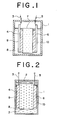
- a plastic electrode secondary battery of the present invention comprises a container 1 formed of an inert synthetic material such as glass or polyethylene, a polyacetylene membrane electrode 4 bonded to a positive auxiliary electrode 9, a polyacetylene membrane electrode 6 bonded to a negative auxiliary electrode 10, a separator 7 comprising a glass fibre film interposed between the positive electrode 4 and the negative electrode 6, and an electrolyte 8 comprising a solution of lithium perchlorate in propylene carbonate sealed in the container 1, the concentration of the solution being IN.
- a bleeder 2 is provided which is capable of exhausting gas externally when the pressure of the gas produced in the container 1 reaches a predetermined value.
- connection 3 and 5 are respectively connected to the auxiliary electrodes 9 and 10, while in Figure 2, the connections 3 and 5 are respectively connected not only to the auxiliary electrodes 9 and 10 but also to the polyacetylene electrodes 4 and 6, the electrodes 9 and 10 being respectively interposed between the electrodes 4 and b and the container 1.
- the surface of the polyacetylene electrode 4 in contact with the auxiliary positive electrode 9 has a film of deposited gold and the surface of the polyacetylene electrode 6 in contact with the auxiliary negative electrode 10 has a film of deposited aluminium.
- the auxiliary electrodes 9 and 10 are respectively bonded to the treated outer surfaces of the polyacetylene electrodes 4 and 6, the inner surfaces of which are in contact with the separator 7, by methods such as press- bonding and supersonic bonding.
- the glass fibre filter of the separator 7 the electrodes 9 and 10 and the container 1 are dried in vacuo, that the PC is dried under reduced pressure, and that the lithium perchlorate is dehydrated in vacuo for 5 hours, then dried under reduced pressure for 24 hours.
- the surface treatment of the polyacetylene electrodes is carried out as follows: gold is heated and deposited at high vacuum as a thin film on that surface of the positive polyacetylene electrode which will be in contact with the auxiliary positive electrode 9 and, similarly, aluminium is heated and deposited at high vacuum as a thin film on that surface of the negative polyacetylene electrode which will be in contact with the auxiliary negative electrode 10.
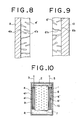
- a film of gold 4'b is deposited in the surface cavities of the fibril structure of the polyacetylene membrane 4' and a film of aluminium 6'b is deposited in the surface cavities of the polyacetylene membrane 6'.
- the thicknesses of the deposited films 4'b and 6'b are preferably in the range of approx. 0.1 microns to 5 microns.
- the deposition time is kept to a minimum to prevent thermal deterioration of the film.
- polyacetylene membranes 25 ml of toluene, 7.2 ml of triethyl aluminium and 4.5 ml of tetraethoxytitanium are mixed to give the Ziegler-Natta catalyst. The mixture is cooled to -78°C and acetylene gas blown in to give polyacetylene membrane with a thickness of 70 microns and a bulk density of 0.36 g/cm 3 .
- the polyacetylene membrane was then cut into square pieces of 2 cm x 2 cm; gold was deposited on the positive electrode and aluminium was deposited on the negative electrode, to a thickness of approx. 1 micron. These membranes were employed in the secondary battery described above.
- the following table shows the shortcircuiting current for such a battery after charging at 0.25 mA for 30 minutes compared with the shortcircuiting current of a battery without surface treated polyacetylene electrodes.
- the effective areas of contact between the positive and negative polyacetylene electrodes and their respective auxiliary electrodes are greater than those of polyacetylene electrodes which have not been surface treated, thereby increasing the shortcircuiting current. Furthermore, the area of contact between the polyacetylene electrodes and the electrolyte is not affected, so that the battery is capable of withstanding heavy loads.
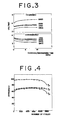
- the voltage of a secondary battery fabricated as described above is 3.3 to 3.5V, the energy density is 424Kh/Kg, and the maximum output density is 24.5 Kw/Kg, all substantial improvements in performance compared with the conventional plastics electrode secondary battery without auxiliary electrodes.
- the power efficiency remains at 80%.
- the electrode reactions of a secondary battery of this type are shown below in such a manner that an arrow to the right indicates a charging reaction and an arrow to the left indicates a discharging reaction:
- the electrolyte absorption rate of the separator is a relatively high 710%, and the internal resistance a relatively low 7.4 ohms.
- a plurality of polyacetylene membranes instead of a single membrane, are laminated to form the positive and negative electrodes, thereby improving the various characteristics of the secondary battery, which will now be described in more detail with reference to Figure 5.
- the table refers to laminated electrodes with a bulk density of 0.3 g/cm 3 prepared by laminating single membranes with a thickness of 70 - 80 microns at a temperature of -78 0 and a pressure of 1 atmosphere for a laminating time of about five minutes. A charging current of 1mA (0.5 mA/cm ) was used in the tests.
- the polyacetylene membranes are not only laminated as described above, but the surface densities of the individual membranes are suitably selected, thereby improving the characteristics of the battery.
- the fundamental structure of the laminated electrodes is the same as that of Figure 5 except that the surface densities of the outer polyacetylene membranes in contact with the auxiliary positive and negative electrodes 9 and 10 are greater than those of the inner polyacetylene membranes which are in contact with the separator 7.
- two Ziegler-Natta catalysts of the type Ti(OC 4 H 9 ) 4 -Al(C 2 H 5 ) 3 containing 100 and 600 mmol/litre of Ti with a Al:Ti molar ratio of 4:1 are typically employed as the catalysts.
- the lamination of the polyacetylene membranes is performed at a temperature of -78 0 and a pressure of 1 atmosphere.
- a vertical laminating bin is filled with an inert gas and rotated at 100 r.p.m. While the laminating bin sealed with inert gas is being rotated, 1 milli litre of the catalyst with 600 mmol/litre of Ti is dropped from a catalyst inlet to the bottom of the bin. When the catalyst has spread on the bottom surface of the bin, rotation is stopped and, the inert gas is evacuated from the bin. Acetylene gas is then introduced into the bin for 10 min. to produce the first layer of polyacetylene membrane (B).
- membrane A has a low surface density, as shown in Figure 6, while membrane B has a large surface density, as shown in Figure 7.
- membrane B has a substantial fibrous part B" with small cavities B'.
- membrane A has a reduced fibrous part A" and larger cavities A'.
- the polyacetylene membrane B is in contact with the auxiliary positive and negative electrodes 9 and 10 and the polyacetylene membrane A is in contact with the separator 7.
- the following table shows the shortcircuiting current after charging for a battery in which the positive and negative electrodes consisted of laminates of polyacetylene membranes of different surface densities, as described above.
- the charging conditions were 2 mA/cm 2 for 1 hour.
- the Table shows that when the surface densities of the polyacetylene membranes in the laminates of the positive and negative electrodes are increased, thereby increasing the effective areas of contact with both auxiliary electrodes, the shortcircuiting currents are increased.
- the effective areas of contact between the positive and negative electrodes and their respective auxiliary electrodes are greater than those for laminated electrodes in which the polyacetylene membranes have a uniform surface density, thereby increasing the shortcircuiting current. Furthermore, the number of cavities in polyacetylene electrodes of this type is significantly reduced, so that the area of contact between the polyacetylene electrodes and the electrolyte is not affected, and the battery is capable of withstanding heavy loads.
- the fundamental structure of the battery is the same as that of Figure 5 except that the characteristics of the battery are improved and the cost of fabrication is reduced by suitably selecting the number of polyacetylene membranes in the laminated electrodes.
- this preferred embodiment of the invention has substantially the same structure as that shown in Figure 5, wherein the same components are designated by the same or equivalent reference numerals.
- the number of polyacetylene membranes 4, 4 1 , .. in the laminated positive electrode is less than the number of polyacetylene membranes 6, 6 1 .. in the laminated negative electrode.
- the first table shows that after 1 hours' charging the shortcircuiting currents for those batteries in which the ratio of negative membranes to positive membranes was ⁇ 2:1 decreased relative to the corresponding battery with an equal number of negative and positive membranes. On the other hand, substantially unchanged currents were obtained when the ratio of negative membranes to positive membranes was ⁇ 2:1.
- the second table shows that after 3 hours' charging the shortcircuiting currents for those batteries in which the ratio of negative membranes to positive membranes was h 2:1 had also decreased relative to the corresponding battery with an equal number of negative and positive membranes, but to a lesser extent than after 1 hours' charging. Again, substantially unchanged currents were obtained when the ratio of negative membranes to positive membranes was ⁇ 2:1.
- the shortcircuiting current of a battery in which the number of positive membranes is reduced to almost half the number of negative membranes is substantially the same as that of the corresponding battery with an equal number of positive and negative membranes, thereby allowing a saving in the cost of fabrication by reducing the number of membranes required in the laminated positive electrode.
Landscapes
- Chemical & Material Sciences (AREA)
- Chemical Kinetics & Catalysis (AREA)
- Electrochemistry (AREA)
- General Chemical & Material Sciences (AREA)
- Engineering & Computer Science (AREA)
- Materials Engineering (AREA)
- Manufacturing & Machinery (AREA)
- Secondary Cells (AREA)
Applications Claiming Priority (6)
| Application Number | Priority Date | Filing Date | Title |
|---|---|---|---|
| JP1983134885U JPS6042269U (ja) | 1983-08-31 | 1983-08-31 | プラスチツク電極二次電池 |
| JP134885/83U | 1983-08-31 | ||
| JP37530/84U | 1984-03-16 | ||
| JP1984037531U JPS60150778U (ja) | 1984-03-16 | 1984-03-16 | プラスチツク電極二次電池 |
| JP1984037530U JPS60150777U (ja) | 1984-03-16 | 1984-03-16 | プラスチツク電極二次電池 |
| JP37531/84U | 1984-03-16 |
Publications (3)
| Publication Number | Publication Date |
|---|---|
| EP0136099A2 true EP0136099A2 (de) | 1985-04-03 |
| EP0136099A3 EP0136099A3 (en) | 1987-04-15 |
| EP0136099B1 EP0136099B1 (de) | 1989-10-25 |
Family
ID=27289499
Family Applications (1)
| Application Number | Title | Priority Date | Filing Date |
|---|---|---|---|
| EP84305885A Expired EP0136099B1 (de) | 1983-08-31 | 1984-08-29 | Sekundärbatterie mit Kunststoffelektroden |
Country Status (2)
| Country | Link |
|---|---|
| EP (1) | EP0136099B1 (de) |
| DE (1) | DE3480312D1 (de) |
Cited By (2)
| Publication number | Priority date | Publication date | Assignee | Title |
|---|---|---|---|---|
| EP0237729A1 (de) * | 1986-03-06 | 1987-09-23 | VARTA Batterie Aktiengesellschaft | Elektrochemisches Sekundärelement mit mindestens einer Polymerelektrode |
| CN113273015A (zh) * | 2019-01-10 | 2021-08-17 | Tdk株式会社 | 全固体电池 |
Family Cites Families (3)
| Publication number | Priority date | Publication date | Assignee | Title |
|---|---|---|---|---|
| FR2502401A1 (fr) * | 1981-03-20 | 1982-09-24 | Centre Nat Rech Scient | Nouveaux generateurs electrochimiques solides, procedes de preparation de ces generateurs et ebauches de generateur pour la mise en oeuvre de ces procedes |
| DE3201482A1 (de) * | 1982-01-20 | 1983-09-08 | Bayer Ag, 5090 Leverkusen | Mehrschichten-flaechengebilde |
| JPS5973864A (ja) * | 1982-10-20 | 1984-04-26 | Showa Denko Kk | 積層型シ−ト状ポリマ2次電池 |
-
1984
- 1984-08-29 DE DE8484305885T patent/DE3480312D1/de not_active Expired
- 1984-08-29 EP EP84305885A patent/EP0136099B1/de not_active Expired
Cited By (4)
| Publication number | Priority date | Publication date | Assignee | Title |
|---|---|---|---|---|
| EP0237729A1 (de) * | 1986-03-06 | 1987-09-23 | VARTA Batterie Aktiengesellschaft | Elektrochemisches Sekundärelement mit mindestens einer Polymerelektrode |
| US4816359A (en) * | 1986-03-06 | 1989-03-28 | Varta Batterie Aktiengesellschaft | Electrochemical secondary element with at least one polymer electrode |
| CN113273015A (zh) * | 2019-01-10 | 2021-08-17 | Tdk株式会社 | 全固体电池 |
| CN113273015B (zh) * | 2019-01-10 | 2023-11-21 | Tdk株式会社 | 全固体电池 |
Also Published As
| Publication number | Publication date |
|---|---|
| DE3480312D1 (en) | 1989-11-30 |
| EP0136099A3 (en) | 1987-04-15 |
| EP0136099B1 (de) | 1989-10-25 |
Similar Documents
| Publication | Publication Date | Title |
|---|---|---|
| CN1137522C (zh) | 多层式非水电解质蓄电池 | |
| US5348817A (en) | Bipolar lead-acid battery | |
| US5498489A (en) | Rechargeable non-aqueous lithium battery having stacked electrochemical cells | |
| US8021775B2 (en) | Cell structure for electrochemical devices and method of making same | |
| US7195840B2 (en) | Cell structure for electrochemical devices and method of making same | |
| US5587253A (en) | Low resistance rechargeable lithium-ion battery | |
| JP3722797B2 (ja) | リチウム蓄電池用電解質含有粒体電極 | |
| CN1170327C (zh) | 包括正温度系数聚合物的复合电极 | |
| KR101440973B1 (ko) | 전극 조립체, 이를 포함하는 전지셀 및 디바이스 | |
| KR100413608B1 (ko) | 리튬이온 2차 전지용 격리막, 그의 제조방법 및 그를포함하여 제조되는 리튬이온 2차 전지 | |
| JP3056054B2 (ja) | 亜鉛2次電池及び亜鉛電極 | |
| EP1078407B1 (de) | Anordnung von elektrochemischen bi-zellen mit isolierelementen zur erhöhung der sicherheit | |
| MXPA98000869A (en) | Lithium ion battery, rechargeable, low resistance | |
| JP2004095400A (ja) | バイポーラ電池とその制御方法 | |
| JP7334693B2 (ja) | 蓄電装置 | |
| JPH1083839A (ja) | 電極製品 | |
| EP0136099B1 (de) | Sekundärbatterie mit Kunststoffelektroden | |
| KR102008392B1 (ko) | 전극 조립체의 제조 방법 및 상기 제조 방법으로 제조된 전극 조립체가 적용된 전기 화학 소자 | |
| JP7543884B2 (ja) | リチウムイオン二次電池 | |
| JP3428184B2 (ja) | 非水電解液二次電池 | |
| JPH10112305A (ja) | 非水電解液二次電池およびその製造方法 | |
| JP5135649B2 (ja) | 固体高分子電解質型電池および固体高分子電解質の製造方法 | |
| JPS61250970A (ja) | プラスチツク電極二次電池 | |
| JPH05283079A (ja) | 固体電解質電池 | |
| JPS5973865A (ja) | 二次電池 |
Legal Events
| Date | Code | Title | Description |
|---|---|---|---|
| PUAI | Public reference made under article 153(3) epc to a published international application that has entered the european phase |
Free format text: ORIGINAL CODE: 0009012 |
|
| AK | Designated contracting states |
Designated state(s): DE FR GB |
|
| PUAL | Search report despatched |
Free format text: ORIGINAL CODE: 0009013 |
|
| AK | Designated contracting states |
Kind code of ref document: A3 Designated state(s): DE FR GB |
|
| 17P | Request for examination filed |
Effective date: 19870611 |
|
| 17Q | First examination report despatched |
Effective date: 19880613 |
|
| GRAA | (expected) grant |
Free format text: ORIGINAL CODE: 0009210 |
|
| AK | Designated contracting states |
Kind code of ref document: B1 Designated state(s): DE FR GB |
|
| REF | Corresponds to: |
Ref document number: 3480312 Country of ref document: DE Date of ref document: 19891130 |
|
| ET | Fr: translation filed | ||
| PLBE | No opposition filed within time limit |
Free format text: ORIGINAL CODE: 0009261 |
|
| STAA | Information on the status of an ep patent application or granted ep patent |
Free format text: STATUS: NO OPPOSITION FILED WITHIN TIME LIMIT |
|
| 26N | No opposition filed | ||
| PGFP | Annual fee paid to national office [announced via postgrant information from national office to epo] |
Ref country code: FR Payment date: 19970811 Year of fee payment: 14 |
|
| PGFP | Annual fee paid to national office [announced via postgrant information from national office to epo] |
Ref country code: GB Payment date: 19970820 Year of fee payment: 14 |
|
| PGFP | Annual fee paid to national office [announced via postgrant information from national office to epo] |
Ref country code: DE Payment date: 19970905 Year of fee payment: 14 |
|
| PG25 | Lapsed in a contracting state [announced via postgrant information from national office to epo] |
Ref country code: GB Free format text: LAPSE BECAUSE OF NON-PAYMENT OF DUE FEES Effective date: 19980829 |
|
| GBPC | Gb: european patent ceased through non-payment of renewal fee |
Effective date: 19980829 |
|
| PG25 | Lapsed in a contracting state [announced via postgrant information from national office to epo] |
Ref country code: FR Free format text: LAPSE BECAUSE OF NON-PAYMENT OF DUE FEES Effective date: 19990430 |
|
| PG25 | Lapsed in a contracting state [announced via postgrant information from national office to epo] |
Ref country code: DE Free format text: LAPSE BECAUSE OF NON-PAYMENT OF DUE FEES Effective date: 19990601 |
|
| REG | Reference to a national code |
Ref country code: FR Ref legal event code: ST |