EP0136062A2 - Gerät und Verfahren zur Verschleierung von Sprachsignalen - Google Patents
Gerät und Verfahren zur Verschleierung von Sprachsignalen Download PDFInfo
- Publication number
- EP0136062A2 EP0136062A2 EP84305704A EP84305704A EP0136062A2 EP 0136062 A2 EP0136062 A2 EP 0136062A2 EP 84305704 A EP84305704 A EP 84305704A EP 84305704 A EP84305704 A EP 84305704A EP 0136062 A2 EP0136062 A2 EP 0136062A2
- Authority
- EP
- European Patent Office
- Prior art keywords
- signal
- voice
- excitation
- vocal tract
- frame
- Prior art date
- Legal status (The legal status is an assumption and is not a legal conclusion. Google has not performed a legal analysis and makes no representation as to the accuracy of the status listed.)
- Granted
Links
Images

Classifications
-
- H—ELECTRICITY
- H04—ELECTRIC COMMUNICATION TECHNIQUE
- H04K—SECRET COMMUNICATION; JAMMING OF COMMUNICATION
- H04K1/00—Secret communication
Definitions
- This invention relates to apparatus for and methods of scrambling voice signals.
- the present invention seeks to provide a method and apparatus which enable the transmission of voice signals over voiceband channels with a high degree of security and with a voice quality that has been heretofore achieved only with channels of substantially greater bandwidth.
- apparatus for scrambling voice signals in a transmission channel includes first means for applying to the transmission channel a first signal which includes information derived from the vocal tract response of a voice signal, and second means for applying to the transmission channel a second signal which includes information derived from the excitation component of the voice signal, the excitation information being represented in the second signal in continuous form.
- a method of scrambling voice signals including applying to a voice transmission channel a first signal which includes information derived from the vocal tract response of a voice signal, and applying to the transmission channel a second signal which includes information derived from the excitation component of the voice signal, the excitation information being represented in the second signal in continuous form.
- the voice signal is divided into two components--the vocal tract response and the excitation signal.
- both the vocal tract response and the excitation signal are conveyed over the transmission channel via signals in which the vocal tract response information and excitation signal information are both represented in digital form.
- the excitation signal is conveyed via information represented in the transmitted signal in continuous form.
- the excitation signal is scrambled, and any intelligibility remaining in the scrambled excitation signal is masked by filtering same using an arbitrary vocal tract response selected from a predetermined codebook as a function of the vocal tract response.
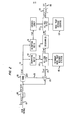
- a continuous voice signal V(t) which is to be encrypted and transmitted to the receiver of FIG. 2 via a voiceband telephone channel 65, is received on lead 9 and applied to A/D converter 10.
- the latter generates on lead 11 12-bit digital voice samples at a rate of 8 KHz, which it applies to speech separator 20.
- Speech can be modeled as the output of a linear system in which a vocal tract response, in the form of an all-pole filter, is driven by an excitation signal--hereinafter also referred to simply as the "excitation"--that has essentially a flat spectral envelope, and speech separator 20 operates on the basis of this characterization.
- speech separator 20 includes an analysis/search circuit 21 and an autocorrelation codebook 22.
- a technique for generating codebook 22 is described, for example, in B. Juang et al, "Distortion Performance of Vector Quantization for LPC Voice Coding," IEEE Trans. Acoustics, Speech and Signal Processing, Vol. ASSP-30, No. 2, April, 1982, pp. 294-304, hereby incorporated by reference.
- Analysis/search circuit 21 calculates for the m th voice sample frame, v(m), an autocorrelation vector r v (m) of length eleven. It then uses vector quantization such as described in A. Buzo et al, "Speech Coding Based Upon Vector Quantization," IEEE Trans. Acoustics, Speech and Signal Processing, Vol. ASS P -28, No. 5, Oct. 1980, pp. 562-574, hereby incorporated by reference, to determine which entry within codebook 22 most closely matches the autocorrelation vector just generated. Circuit 21 then generates an index identifying that vector, the index generated for the m th voice sample frame being denoted i(m).
- Analysis/search circuit 21 illustratively comprises two microprocessors, one of which generates r v (m) and the other of which searches the codebook for the closest match.
- Use of two microprocessors is desirable, given current microprocessor technology, in order to perform all the required processing in real time. Both steps can, however, be performed by a single microprocessor if its processing speed is sufficiently fast.
- the relationship between the r j 's and the a j 's is established by a set of linear equations, known as the normal equations or Yule-Walker equations see J. Makhoul, "Linear Prediction: A tutorial Review", Proceedings IEE E 63, pp. 561-580, 1975.
- index i(m) can be understood as identifying not only a particular autocorrelation vector r i(m) , but also a particular vocal tract response a i(m) .
- the vocal tract response information represented by the stream of indices i(m), m 0, 1, 2,..., is applied within speech separator 20 to all-zero digital filter 23.
- the latter is illustratively realized as another microprocessor and has an associated read-only memory codebook 24.
- the vector a i(m) is retrieved from codebook 24 and the components of the vector are used as the filter coefficients to filter voice sample frame v(m).
- the output of filter 23 is a frame of N samples, these being samples of that portion of the aforementioned excitation signal associated with the m th voice sample frame v(m).
- the m th such frame of excitation signal samples is represented by the vector e(m) and is hereinafter referred to as an excitation frame.
- Circuit 31 is illustratively an off-the-shelf component which implements the conventional Data Encryption Standard utilizing a selected encryption key, denominated KEY1.
- the excitation signal, or information derived therefrom--such as an encrypted version of samples of the excitation signal-- is represented in the transmitted signal in digital form by transmitting the values of those encrypted samples.
- the excitation signal, or information derived therefrom is represented in the transmitted signal in continuous form.
- the excitation signal samples may be applied to a continuous, or analog, carrier, the information itself is still represented digitally, i.e., in the form of discrete rather than continuous, carrier signal chan g es.
- the invention enables the vocal tract response information and excitation information to be transmitted together over a voiceband telephone channel, or other limited-bandwidth channel, with substantially better voice quality than has been heretofore achieved over a channel of like bandwidth using the prior art all-digital approach.
- a scrambled excitation frame ê(m) is generated in response to excitation frame e(m) by scrambler 35 at the same time that encrypted index k(m) is being generated.
- Scambler 35 may be any known type of circuit for scrambling analog signal samples.
- the scrambled excitation frame e(m) is further processed in an all-pole filter 40, as described hereinbelow, to mask any intelligibility remaining therein. For the present, however, it suffices to concentrate on the output of filter 40.
- the output of filter 40 is a frame of N samples V(m) representing a scrambled and filtered version of the excitation frame e(m).
- scrambled/filtered excitation frame V ⁇ (m) has a baseband spectrum that, in this system, extends from about 300 Hz to about 3000 Hz. This leaves a window at the top of the telephone voiceband spectrum of about 200 Bz--from about 3100 Bz to about 3300 Bz.
- a frame of N samples d(m) representing the encrypted index k(m) and having its spectrum within that window is generated by a modulator 50, and is combined with frame V(m) in an adder 55.
- the vocal tract response information and the excitation signal information are frequency-division multiplexed into the voiceband telephone bandwidth of 300-3300 Hz.
- the output of adder 55 is converted to analog form by D/A converter 60, whose output signal, V(t) + d(t), carries continuous excitation signal information as well as the digital vocal tract response information.
- the signal V(t) + d(t) is applied to channel 65.
- scrambled excitation frame e(m) is processed in all-pole filter 40 to mask any intelligibility remaining therein.
- a second encrypted version of the index i(m), denoted p(m), is generated by applying encrypted index k(m) to a second encryption circuit 32.
- the latter is illustratively identical to encryption circuit 31 but utilizes a different encryption key, denominated KEY2.
- Codebook 45 may be identical to codebook 24; or it may have the same entries as codebook 24, but in a different order; or it may have totally different entries which have been generated in any arbitrary way. In any case, the p(m) th entry of codebook 45 is applied to all-pole filter 40.
- the latter generates frame V(m) by filtering scrambled excitation frame e(m) using the components of a' p(m) as the filter coefficients.
- the signal received from channel 65 is the transmitted signal V(t) + d(t) (To facilitate the present description, the signals in the receiver of FIG. 2 bear the same designations as the corresponding signals in the transmitter, even though there inevitably will have been at least some distortion induced by the channel so that, strictly speaking, the transmitted and received signals are not the same.)
- the signal V (t) + d(t) is converted to 12-bit digital form at an 8 KH z rate by A/D converter 160 to provide the sampled signal V(m) + d(m).
- the sampled signal is applied to demodulator 150 which operates on that portion of the signal whose spectrum lies in the range 3100-33OOHz to a) recover encrypted index k(m) and provide it on lead 152, and b) extract frame d(m) and provide the samples which comprise it on lead 151.
- the latter extends to the subtrahend input of a subtractor 155, the minuend input of which receives the signal V(m) + d(m).
- the output of subtractor 140 is thus scrambled/filtered excitation frame V (m).
- encrypted index k(m) is applied to encryption circuit 132, which is illustratively identical to, and uses the same encryption key as, encryption circuit 32 in the transmitter.
- the output of encryption circuit 132 is thus encrypted index p(m), which is used as an address for secondary vocal tract response codebook 145.
- Codebook 145 more particularly, is identical to codebook 45 in the transmitter.
- the p(m) th entry in codebook 145 is the same vocal tract response vector a' p(m) whose components were used in the transmitter as the coefficients of all-pole filter 40 to generate frame V(m) from scrambled excitation frame e(m). In the receiver, however, the inverse of that filtering is performed.
- the components of vector a j(m) are used as the filter coefficients of an all-zero filter 140, which filters frame S(m) to provide scrambled excitation frame i(m). The latter is then descrambled in descrambler 135 to recover excitation frame e(m).
- encrypted index k(m) is also applied to decryption circuit 131 which decrypts k(m) using the key KEY1 to recover index i(m).
- the latter is then used as an address for vocal tract response codebook 124.
- Codebook 124 more particularly, is identical to codebook 24 in the transmitter.
- the i(m) th entry in codebook 124 is the same vocal tract response vector a i(m) whose components were used in the transmitter as the coefficients of all-zero filter 23 to generate excitation frame e(m) from voice sample frame v(m).
- the inverse filtering is performed.
- the components of vector a i(m) are used as the filter coefficients of an all-pole filter 123 which filters the excitation frame e(m) at the output of descrambler 135 to recover voice sample frame v(m). The latter is then converted back to analog form by D/A converter 110 to provide the original continuous voice signal V(t),
- any of various schemes could be used in the receiver to recover at least a portion of the vocal tract information that is embedded in frame v(m) by virtue of the filtering performed in filter 40.
- account must be taken of the fact that, as a result of noise and distortion in the channel, it may not be possible to accurately recover from frame V(m) all the bits of the index that was used to generate frame V(m) from frame e(m). Some of the bits thereof can be accurately recovered, however.
- One approach would be to arrange the entries in codebook 45 in the transmitter in (say) 32 groups each corresponding to that group of values of encrypted index p(m) whose five most significant bits are the same, and with the members of each group of entries in the codebook being as far away from one another in Euclidean space as possible.
- the five least significant bits of each encrypted index they can be transmitted in digital form using frequency division multiplexing as described above. This approach has the advantage that less bandwidth will be required to transmit the digital information. It is also advantageous in that it splits up the encrypted index information into two parts, thereby providing enhanced protection against cryptanalysis.
- the various vocal tract response codebooks can be identical to one another; encrypted index k(m), rather than a separate encrypted index p(m), can be used to address codebook 45; and filtering of scrambled excitation frame e(m) can be eliminated.
- the index encryption and/or scrambling steps can also be eliminated.
Landscapes
- Engineering & Computer Science (AREA)
- Computer Networks & Wireless Communication (AREA)
- Signal Processing (AREA)
- Compression, Expansion, Code Conversion, And Decoders (AREA)
- Transmission Systems Not Characterized By The Medium Used For Transmission (AREA)
- Time-Division Multiplex Systems (AREA)
Applications Claiming Priority (2)
| Application Number | Priority Date | Filing Date | Title |
|---|---|---|---|
| US527962 | 1983-08-31 | ||
| US06/527,962 US4612414A (en) | 1983-08-31 | 1983-08-31 | Secure voice transmission |
Publications (3)
| Publication Number | Publication Date |
|---|---|
| EP0136062A2 true EP0136062A2 (de) | 1985-04-03 |
| EP0136062A3 EP0136062A3 (en) | 1986-04-02 |
| EP0136062B1 EP0136062B1 (de) | 1989-12-27 |
Family
ID=24103694
Family Applications (1)
| Application Number | Title | Priority Date | Filing Date |
|---|---|---|---|
| EP84305704A Expired EP0136062B1 (de) | 1983-08-31 | 1984-08-22 | Gerät und Verfahren zur Verschleierung von Sprachsignalen |
Country Status (6)
| Country | Link |
|---|---|
| US (1) | US4612414A (de) |
| EP (1) | EP0136062B1 (de) |
| JP (1) | JPS6072343A (de) |
| CA (1) | CA1225758A (de) |
| DE (1) | DE3480893D1 (de) |
| ES (1) | ES8604378A1 (de) |
Cited By (1)
| Publication number | Priority date | Publication date | Assignee | Title |
|---|---|---|---|---|
| RU2112319C1 (ru) * | 1997-10-29 | 1998-05-27 | Открытое акционерное общество Холдинговая компания "Электрозавод" Лаборатория II | Способ защиты информации, принимаемой по проводным каналам связи и система для его осуществления |
Families Citing this family (12)
| Publication number | Priority date | Publication date | Assignee | Title |
|---|---|---|---|---|
| JPS6345933A (ja) * | 1986-04-15 | 1988-02-26 | Nec Corp | 秘話装置 |
| US4893339A (en) * | 1986-09-03 | 1990-01-09 | Motorola, Inc. | Secure communication system |
| US5150401A (en) * | 1990-12-04 | 1992-09-22 | Chips International, Inc. | Retrofittable encryption/decryption apparatus using modified frequency modulation |
| US5216714A (en) * | 1991-12-13 | 1993-06-01 | 3Com Corporation | Method and apparatus for controlling the spectral content of a data stream |
| JP2591430B2 (ja) * | 1993-06-30 | 1997-03-19 | 日本電気株式会社 | ベクトル量子化装置 |
| US5781882A (en) * | 1995-09-14 | 1998-07-14 | Motorola, Inc. | Very low bit rate voice messaging system using asymmetric voice compression processing |
| US5701294A (en) * | 1995-10-02 | 1997-12-23 | Telefonaktiebolaget Lm Ericsson | System and method for flexible coding, modulation, and time slot allocation in a radio telecommunications network |
| US6266418B1 (en) | 1998-10-28 | 2001-07-24 | L3-Communications Corporation | Encryption and authentication methods and apparatus for securing telephone communications |
| WO2002087241A1 (en) * | 2001-04-18 | 2002-10-31 | Koninklijke Philips Electronics N.V. | Audio coding with partial encryption |
| RU2216108C2 (ru) * | 2001-07-13 | 2003-11-10 | Попов Никита Викторович | Способ защиты информации от несанкционированного доступа с использованием шумоподобных сигналов |
| DE10138650A1 (de) * | 2001-08-07 | 2003-02-27 | Fraunhofer Ges Forschung | Verfahren und Vorrichtung zum Verschlüsseln eines diskreten Signals sowie Verfahren und Vorrichtung zur Entschlüsselung |
| US8290170B2 (en) * | 2006-05-01 | 2012-10-16 | Nippon Telegraph And Telephone Corporation | Method and apparatus for speech dereverberation based on probabilistic models of source and room acoustics |
Family Cites Families (8)
| Publication number | Priority date | Publication date | Assignee | Title |
|---|---|---|---|---|
| FR2071282A5 (de) * | 1969-12-23 | 1971-09-17 | Cit Alcatel | |
| US3786188A (en) * | 1972-12-07 | 1974-01-15 | Bell Telephone Labor Inc | Synthesis of pure speech from a reverberant signal |
| CA1123955A (en) * | 1978-03-30 | 1982-05-18 | Tetsu Taguchi | Speech analysis and synthesis apparatus |
| US4330689A (en) * | 1980-01-28 | 1982-05-18 | The United States Of America As Represented By The Secretary Of The Navy | Multirate digital voice communication processor |
| JPS5913758B2 (ja) * | 1980-02-22 | 1984-03-31 | 株式会社日立製作所 | 音声合成方法 |
| US4401855A (en) * | 1980-11-28 | 1983-08-30 | The Regents Of The University Of California | Apparatus for the linear predictive coding of human speech |
| US4486899A (en) * | 1981-03-17 | 1984-12-04 | Nippon Electric Co., Ltd. | System for extraction of pole parameter values |
| GB2133255B (en) * | 1982-12-23 | 1986-04-03 | Standard Telephones Cables Ltd | Secure speech transmission system |
-
1983
- 1983-08-31 US US06/527,962 patent/US4612414A/en not_active Expired - Lifetime
-
1984
- 1984-07-19 CA CA000459246A patent/CA1225758A/en not_active Expired
- 1984-08-22 DE DE8484305704T patent/DE3480893D1/de not_active Expired - Fee Related
- 1984-08-22 EP EP84305704A patent/EP0136062B1/de not_active Expired
- 1984-08-27 ES ES535443A patent/ES8604378A1/es not_active Expired
- 1984-08-31 JP JP59180871A patent/JPS6072343A/ja active Granted
Cited By (1)
| Publication number | Priority date | Publication date | Assignee | Title |
|---|---|---|---|---|
| RU2112319C1 (ru) * | 1997-10-29 | 1998-05-27 | Открытое акционерное общество Холдинговая компания "Электрозавод" Лаборатория II | Способ защиты информации, принимаемой по проводным каналам связи и система для его осуществления |
Also Published As
| Publication number | Publication date |
|---|---|
| ES535443A0 (es) | 1986-02-01 |
| JPS6072343A (ja) | 1985-04-24 |
| JPH0449818B2 (de) | 1992-08-12 |
| ES8604378A1 (es) | 1986-02-01 |
| CA1225758A (en) | 1987-08-18 |
| EP0136062A3 (en) | 1986-04-02 |
| US4612414A (en) | 1986-09-16 |
| EP0136062B1 (de) | 1989-12-27 |
| DE3480893D1 (de) | 1990-02-01 |
Similar Documents
| Publication | Publication Date | Title |
|---|---|---|
| US4612414A (en) | Secure voice transmission | |
| CA2158440C (en) | Method and apparatus for signal transmission and reception | |
| US4330689A (en) | Multirate digital voice communication processor | |
| US4979188A (en) | Spectrally efficient method for communicating an information signal | |
| US3967067A (en) | Secret telephony | |
| US4179586A (en) | System of encoded speech transmission and reception | |
| CA2146024A1 (en) | Method and Apparatus for Providing Cryptographic Protection of a Data Stream in a Communication System | |
| JP2001507875A (ja) | オーディオ信号内で補助データを転送するための方法及び装置 | |
| US5051991A (en) | Method and apparatus for efficient digital time delay compensation in compressed bandwidth signal processing | |
| EP0648031B1 (de) | Einrichtung zur Verschlüsselung und Entschlüsselung von Audiosignalen | |
| JPH08293932A (ja) | 線形予測フィルター係数量子化器とフィルターセット | |
| EP0003009A3 (de) | Verfahren und Einrichtung zur Übertragung von digitalen Informationen in ein Fernsprechsystem | |
| US3995115A (en) | Speech privacy system | |
| KR920007093B1 (ko) | 정보 신호 전송 방법 | |
| JPS6234306B2 (de) | ||
| AU641473B2 (en) | Communication apparatus for speech signal | |
| EP0482699B1 (de) | Methode und Einrichtung zur Kodierung und Dekodierung eines abgetasteten Analogsignals mit Wiederholungseigenschaften | |
| GB2133255A (en) | Secure speech transmission system | |
| JPH04304727A (ja) | データ暗号化装置、データ復号化装置、及びデータ暗号化復号化装置 | |
| CA1253254A (en) | Method and apparatus for efficient digital time delay compensation in compressed bandwidth signal processing | |
| KR100466546B1 (ko) | 주파수 대역분할을 이용한 키 송수신 방법 | |
| EP0554934B1 (de) | Übertragung von digitalen Breitbandsignalen | |
| JPH06204982A (ja) | デジタル/アナログ同時伝送方式、及びこの伝送方式を用いた秘話通信装置 | |
| JP2513404B2 (ja) | 秘話装置 | |
| Meier | Secure Speech Communication Over a CCITT-Speech Channel |
Legal Events
| Date | Code | Title | Description |
|---|---|---|---|
| PUAI | Public reference made under article 153(3) epc to a published international application that has entered the european phase |
Free format text: ORIGINAL CODE: 0009012 |
|
| AK | Designated contracting states |
Designated state(s): BE DE FR GB SE |
|
| PUAL | Search report despatched |
Free format text: ORIGINAL CODE: 0009013 |
|
| AK | Designated contracting states |
Kind code of ref document: A3 Designated state(s): BE DE FR GB SE |
|
| 17P | Request for examination filed |
Effective date: 19860904 |
|
| 17Q | First examination report despatched |
Effective date: 19880222 |
|
| GRAA | (expected) grant |
Free format text: ORIGINAL CODE: 0009210 |
|
| AK | Designated contracting states |
Kind code of ref document: B1 Designated state(s): BE DE FR GB SE |
|
| REF | Corresponds to: |
Ref document number: 3480893 Country of ref document: DE Date of ref document: 19900201 |
|
| ET | Fr: translation filed | ||
| PLBE | No opposition filed within time limit |
Free format text: ORIGINAL CODE: 0009261 |
|
| STAA | Information on the status of an ep patent application or granted ep patent |
Free format text: STATUS: NO OPPOSITION FILED WITHIN TIME LIMIT |
|
| 26N | No opposition filed | ||
| EAL | Se: european patent in force in sweden |
Ref document number: 84305704.3 |
|
| REG | Reference to a national code |
Ref country code: GB Ref legal event code: IF02 |
|
| PGFP | Annual fee paid to national office [announced via postgrant information from national office to epo] |
Ref country code: SE Payment date: 20020625 Year of fee payment: 19 |
|
| PGFP | Annual fee paid to national office [announced via postgrant information from national office to epo] |
Ref country code: BE Payment date: 20020710 Year of fee payment: 19 |
|
| PGFP | Annual fee paid to national office [announced via postgrant information from national office to epo] |
Ref country code: FR Payment date: 20020722 Year of fee payment: 19 |
|
| PGFP | Annual fee paid to national office [announced via postgrant information from national office to epo] |
Ref country code: GB Payment date: 20020725 Year of fee payment: 19 |
|
| PGFP | Annual fee paid to national office [announced via postgrant information from national office to epo] |
Ref country code: DE Payment date: 20020916 Year of fee payment: 19 |
|
| PG25 | Lapsed in a contracting state [announced via postgrant information from national office to epo] |
Ref country code: GB Free format text: LAPSE BECAUSE OF NON-PAYMENT OF DUE FEES Effective date: 20030822 |
|
| PG25 | Lapsed in a contracting state [announced via postgrant information from national office to epo] |
Ref country code: SE Free format text: LAPSE BECAUSE OF NON-PAYMENT OF DUE FEES Effective date: 20030823 |
|
| PG25 | Lapsed in a contracting state [announced via postgrant information from national office to epo] |
Ref country code: BE Free format text: LAPSE BECAUSE OF NON-PAYMENT OF DUE FEES Effective date: 20030831 |
|
| BERE | Be: lapsed |
Owner name: *AMERICAN TELEPHONE AND TELEGRAPH CY Effective date: 20030831 |
|
| PG25 | Lapsed in a contracting state [announced via postgrant information from national office to epo] |
Ref country code: DE Free format text: LAPSE BECAUSE OF NON-PAYMENT OF DUE FEES Effective date: 20040302 |
|
| EUG | Se: european patent has lapsed | ||
| GBPC | Gb: european patent ceased through non-payment of renewal fee | ||
| PG25 | Lapsed in a contracting state [announced via postgrant information from national office to epo] |
Ref country code: FR Free format text: LAPSE BECAUSE OF NON-PAYMENT OF DUE FEES Effective date: 20040430 |
|
| REG | Reference to a national code |
Ref country code: FR Ref legal event code: ST |