EP0132703A1 - Verfahren zur Isolierung von salzförmigen Vinylverbindungen in fester Form aus wässrigen Lösungen - Google Patents
Verfahren zur Isolierung von salzförmigen Vinylverbindungen in fester Form aus wässrigen Lösungen Download PDFInfo
- Publication number
- EP0132703A1 EP0132703A1 EP84108165A EP84108165A EP0132703A1 EP 0132703 A1 EP0132703 A1 EP 0132703A1 EP 84108165 A EP84108165 A EP 84108165A EP 84108165 A EP84108165 A EP 84108165A EP 0132703 A1 EP0132703 A1 EP 0132703A1
- Authority
- EP
- European Patent Office
- Prior art keywords
- salts
- salt
- vinyl compounds
- carbon atoms
- acid
- Prior art date
- Legal status (The legal status is an assumption and is not a legal conclusion. Google has not performed a legal analysis and makes no representation as to the accuracy of the status listed.)
- Granted
Links
- 238000000034 method Methods 0.000 title claims abstract description 28
- 239000007864 aqueous solution Substances 0.000 title claims abstract description 25
- 239000007787 solid Substances 0.000 title claims abstract description 8
- 150000003839 salts Chemical class 0.000 title claims description 41
- 125000002348 vinylic group Chemical class 0.000 title description 2
- 238000000926 separation method Methods 0.000 title 1
- 125000000391 vinyl group Chemical group [H]C([*])=C([H])[H] 0.000 claims abstract description 20
- 238000001694 spray drying Methods 0.000 claims abstract description 10
- CERQOIWHTDAKMF-UHFFFAOYSA-N Methacrylic acid Chemical compound CC(=C)C(O)=O CERQOIWHTDAKMF-UHFFFAOYSA-N 0.000 claims description 20
- XLYOFNOQVPJJNP-UHFFFAOYSA-N water Substances O XLYOFNOQVPJJNP-UHFFFAOYSA-N 0.000 claims description 19
- -1 alkyl radical Chemical class 0.000 claims description 18
- SMZOUWXMTYCWNB-UHFFFAOYSA-N 2-(2-methoxy-5-methylphenyl)ethanamine Chemical compound COC1=CC=C(C)C=C1CCN SMZOUWXMTYCWNB-UHFFFAOYSA-N 0.000 claims description 15
- NIXOWILDQLNWCW-UHFFFAOYSA-N Acrylic acid Chemical class OC(=O)C=C NIXOWILDQLNWCW-UHFFFAOYSA-N 0.000 claims description 14
- 229910052751 metal Inorganic materials 0.000 claims description 13
- 239000002184 metal Substances 0.000 claims description 13
- 150000003863 ammonium salts Chemical class 0.000 claims description 11
- 125000004432 carbon atom Chemical group C* 0.000 claims description 10
- VZCYOOQTPOCHFL-OWOJBTEDSA-N Fumaric acid Chemical compound OC(=O)\C=C\C(O)=O VZCYOOQTPOCHFL-OWOJBTEDSA-N 0.000 claims description 8
- 150000003242 quaternary ammonium salts Chemical class 0.000 claims description 8
- VZCYOOQTPOCHFL-UHFFFAOYSA-N trans-butenedioic acid Natural products OC(=O)C=CC(O)=O VZCYOOQTPOCHFL-UHFFFAOYSA-N 0.000 claims description 8
- 229910052739 hydrogen Inorganic materials 0.000 claims description 7
- 239000001257 hydrogen Substances 0.000 claims description 7
- JAHNSTQSQJOJLO-UHFFFAOYSA-N 2-(3-fluorophenyl)-1h-imidazole Chemical compound FC1=CC=CC(C=2NC=CN=2)=C1 JAHNSTQSQJOJLO-UHFFFAOYSA-N 0.000 claims description 5
- UFHFLCQGNIYNRP-UHFFFAOYSA-N Hydrogen Chemical compound [H][H] UFHFLCQGNIYNRP-UHFFFAOYSA-N 0.000 claims description 5
- 150000001450 anions Chemical class 0.000 claims description 5
- 150000002739 metals Chemical class 0.000 claims description 5
- LVHBHZANLOWSRM-UHFFFAOYSA-N methylenebutanedioic acid Natural products OC(=O)CC(=C)C(O)=O LVHBHZANLOWSRM-UHFFFAOYSA-N 0.000 claims description 5
- OFOBLEOULBTSOW-UHFFFAOYSA-N Propanedioic acid Natural products OC(=O)CC(O)=O OFOBLEOULBTSOW-UHFFFAOYSA-N 0.000 claims description 4
- 239000001530 fumaric acid Substances 0.000 claims description 4
- VZCYOOQTPOCHFL-UPHRSURJSA-N maleic acid Chemical compound OC(=O)\C=C/C(O)=O VZCYOOQTPOCHFL-UPHRSURJSA-N 0.000 claims description 4
- 239000011976 maleic acid Substances 0.000 claims description 4
- 125000002496 methyl group Chemical group [H]C([H])([H])* 0.000 claims description 4
- QVGXLLKOCUKJST-UHFFFAOYSA-N atomic oxygen Chemical group [O] QVGXLLKOCUKJST-UHFFFAOYSA-N 0.000 claims description 3
- 239000003153 chemical reaction reagent Substances 0.000 claims description 3
- 229910052760 oxygen Inorganic materials 0.000 claims description 3
- 239000001301 oxygen Substances 0.000 claims description 3
- 150000003254 radicals Chemical class 0.000 claims description 3
- 239000012265 solid product Substances 0.000 claims description 3
- SLRMQYXOBQWXCR-UHFFFAOYSA-N 2154-56-5 Chemical compound [CH2]C1=CC=CC=C1 SLRMQYXOBQWXCR-UHFFFAOYSA-N 0.000 claims description 2
- 239000004215 Carbon black (E152) Substances 0.000 claims description 2
- VEXZGXHMUGYJMC-UHFFFAOYSA-M Chloride anion Chemical compound [Cl-] VEXZGXHMUGYJMC-UHFFFAOYSA-M 0.000 claims description 2
- 229930195733 hydrocarbon Natural products 0.000 claims description 2
- 125000004435 hydrogen atom Chemical group [H]* 0.000 claims description 2
- JZMJDSHXVKJFKW-UHFFFAOYSA-M methyl sulfate(1-) Chemical compound COS([O-])(=O)=O JZMJDSHXVKJFKW-UHFFFAOYSA-M 0.000 claims description 2
- 150000003751 zinc Chemical class 0.000 claims description 2
- CPELXLSAUQHCOX-UHFFFAOYSA-M Bromide Chemical compound [Br-] CPELXLSAUQHCOX-UHFFFAOYSA-M 0.000 claims 1
- 239000003513 alkali Substances 0.000 claims 1
- XMBWDFGMSWQBCA-UHFFFAOYSA-N hydrogen iodide Chemical compound I XMBWDFGMSWQBCA-UHFFFAOYSA-N 0.000 claims 1
- 239000007921 spray Substances 0.000 description 15
- 239000000243 solution Substances 0.000 description 13
- 238000006116 polymerization reaction Methods 0.000 description 12
- 150000001875 compounds Chemical class 0.000 description 8
- 239000002904 solvent Substances 0.000 description 8
- 239000002253 acid Substances 0.000 description 7
- 150000007513 acids Chemical class 0.000 description 7
- 239000000047 product Substances 0.000 description 7
- 238000004519 manufacturing process Methods 0.000 description 5
- 239000000178 monomer Substances 0.000 description 5
- 229920000642 polymer Polymers 0.000 description 5
- 238000002360 preparation method Methods 0.000 description 5
- 238000005956 quaternization reaction Methods 0.000 description 5
- 238000001035 drying Methods 0.000 description 4
- 238000002955 isolation Methods 0.000 description 4
- HEMHJVSKTPXQMS-UHFFFAOYSA-M Sodium hydroxide Chemical compound [OH-].[Na+] HEMHJVSKTPXQMS-UHFFFAOYSA-M 0.000 description 3
- 150000001768 cations Chemical class 0.000 description 3
- 238000006243 chemical reaction Methods 0.000 description 3
- VAYGXNSJCAHWJZ-UHFFFAOYSA-N dimethyl sulfate Chemical compound COS(=O)(=O)OC VAYGXNSJCAHWJZ-UHFFFAOYSA-N 0.000 description 3
- ZAFFWOKULJCCSA-UHFFFAOYSA-N ethyl 2-methylprop-2-enoate;trimethylazanium;chloride Chemical compound [Cl-].C[NH+](C)C.CCOC(=O)C(C)=C ZAFFWOKULJCCSA-UHFFFAOYSA-N 0.000 description 3
- 150000004679 hydroxides Chemical class 0.000 description 3
- 239000000463 material Substances 0.000 description 3
- 239000000203 mixture Substances 0.000 description 3
- 239000011734 sodium Substances 0.000 description 3
- 239000003381 stabilizer Substances 0.000 description 3
- 239000000126 substance Substances 0.000 description 3
- XKMZOFXGLBYJLS-UHFFFAOYSA-L zinc;prop-2-enoate Chemical compound [Zn+2].[O-]C(=O)C=C.[O-]C(=O)C=C XKMZOFXGLBYJLS-UHFFFAOYSA-L 0.000 description 3
- JKNCOURZONDCGV-UHFFFAOYSA-N 2-(dimethylamino)ethyl 2-methylprop-2-enoate Chemical compound CN(C)CCOC(=O)C(C)=C JKNCOURZONDCGV-UHFFFAOYSA-N 0.000 description 2
- CSCPPACGZOOCGX-UHFFFAOYSA-N Acetone Chemical compound CC(C)=O CSCPPACGZOOCGX-UHFFFAOYSA-N 0.000 description 2
- QGZKDVFQNNGYKY-UHFFFAOYSA-N Ammonia Chemical compound N QGZKDVFQNNGYKY-UHFFFAOYSA-N 0.000 description 2
- RYGMFSIKBFXOCR-UHFFFAOYSA-N Copper Chemical compound [Cu] RYGMFSIKBFXOCR-UHFFFAOYSA-N 0.000 description 2
- RTZKZFJDLAIYFH-UHFFFAOYSA-N Diethyl ether Chemical compound CCOCC RTZKZFJDLAIYFH-UHFFFAOYSA-N 0.000 description 2
- LFQSCWFLJHTTHZ-UHFFFAOYSA-N Ethanol Chemical compound CCO LFQSCWFLJHTTHZ-UHFFFAOYSA-N 0.000 description 2
- QIGBRXMKCJKVMJ-UHFFFAOYSA-N Hydroquinone Chemical compound OC1=CC=C(O)C=C1 QIGBRXMKCJKVMJ-UHFFFAOYSA-N 0.000 description 2
- DGAQECJNVWCQMB-PUAWFVPOSA-M Ilexoside XXIX Chemical compound C[C@@H]1CC[C@@]2(CC[C@@]3(C(=CC[C@H]4[C@]3(CC[C@@H]5[C@@]4(CC[C@@H](C5(C)C)OS(=O)(=O)[O-])C)C)[C@@H]2[C@]1(C)O)C)C(=O)O[C@H]6[C@@H]([C@H]([C@@H]([C@H](O6)CO)O)O)O.[Na+] DGAQECJNVWCQMB-PUAWFVPOSA-M 0.000 description 2
- XEEYBQQBJWHFJM-UHFFFAOYSA-N Iron Chemical compound [Fe] XEEYBQQBJWHFJM-UHFFFAOYSA-N 0.000 description 2
- ZLMJMSJWJFRBEC-UHFFFAOYSA-N Potassium Chemical compound [K] ZLMJMSJWJFRBEC-UHFFFAOYSA-N 0.000 description 2
- ATJFFYVFTNAWJD-UHFFFAOYSA-N Tin Chemical compound [Sn] ATJFFYVFTNAWJD-UHFFFAOYSA-N 0.000 description 2
- RTAQQCXQSZGOHL-UHFFFAOYSA-N Titanium Chemical compound [Ti] RTAQQCXQSZGOHL-UHFFFAOYSA-N 0.000 description 2
- 150000001408 amides Chemical class 0.000 description 2
- 239000012736 aqueous medium Substances 0.000 description 2
- 150000003819 basic metal compounds Chemical class 0.000 description 2
- 239000011324 bead Substances 0.000 description 2
- 150000004649 carbonic acid derivatives Chemical class 0.000 description 2
- 229920001577 copolymer Polymers 0.000 description 2
- 229910052802 copper Inorganic materials 0.000 description 2
- 239000010949 copper Substances 0.000 description 2
- DMBHHRLKUKUOEG-UHFFFAOYSA-N diphenylamine Chemical compound C=1C=CC=CC=1NC1=CC=CC=C1 DMBHHRLKUKUOEG-UHFFFAOYSA-N 0.000 description 2
- 230000000694 effects Effects 0.000 description 2
- 150000002148 esters Chemical class 0.000 description 2
- 230000002349 favourable effect Effects 0.000 description 2
- 239000008394 flocculating agent Substances 0.000 description 2
- 229920006158 high molecular weight polymer Polymers 0.000 description 2
- 239000011777 magnesium Substances 0.000 description 2
- 239000003960 organic solvent Substances 0.000 description 2
- 239000011591 potassium Substances 0.000 description 2
- 229910052700 potassium Inorganic materials 0.000 description 2
- 125000001453 quaternary ammonium group Chemical group 0.000 description 2
- 239000012266 salt solution Substances 0.000 description 2
- 229910052708 sodium Inorganic materials 0.000 description 2
- SONHXMAHPHADTF-UHFFFAOYSA-M sodium;2-methylprop-2-enoate Chemical compound [Na+].CC(=C)C([O-])=O SONHXMAHPHADTF-UHFFFAOYSA-M 0.000 description 2
- 229910052718 tin Inorganic materials 0.000 description 2
- 239000010936 titanium Substances 0.000 description 2
- 229910052719 titanium Inorganic materials 0.000 description 2
- 229920002554 vinyl polymer Polymers 0.000 description 2
- 229910052725 zinc Inorganic materials 0.000 description 2
- 239000011701 zinc Substances 0.000 description 2
- QLAJNZSPVITUCQ-UHFFFAOYSA-N 1,3,2-dioxathietane 2,2-dioxide Chemical compound O=S1(=O)OCO1 QLAJNZSPVITUCQ-UHFFFAOYSA-N 0.000 description 1
- QHVBLSNVXDSMEB-UHFFFAOYSA-N 2-(diethylamino)ethyl prop-2-enoate Chemical compound CCN(CC)CCOC(=O)C=C QHVBLSNVXDSMEB-UHFFFAOYSA-N 0.000 description 1
- HRPVXLWXLXDGHG-UHFFFAOYSA-N Acrylamide Chemical compound NC(=O)C=C HRPVXLWXLXDGHG-UHFFFAOYSA-N 0.000 description 1
- 229920002972 Acrylic fiber Polymers 0.000 description 1
- BVKZGUZCCUSVTD-UHFFFAOYSA-M Bicarbonate Chemical class OC([O-])=O BVKZGUZCCUSVTD-UHFFFAOYSA-M 0.000 description 1
- NLZUEZXRPGMBCV-UHFFFAOYSA-N Butylhydroxytoluene Chemical compound CC1=CC(C(C)(C)C)=C(O)C(C(C)(C)C)=C1 NLZUEZXRPGMBCV-UHFFFAOYSA-N 0.000 description 1
- OYPRJOBELJOOCE-UHFFFAOYSA-N Calcium Chemical compound [Ca] OYPRJOBELJOOCE-UHFFFAOYSA-N 0.000 description 1
- QXNVGIXVLWOKEQ-UHFFFAOYSA-N Disodium Chemical class [Na][Na] QXNVGIXVLWOKEQ-UHFFFAOYSA-N 0.000 description 1
- FYYHWMGAXLPEAU-UHFFFAOYSA-N Magnesium Chemical compound [Mg] FYYHWMGAXLPEAU-UHFFFAOYSA-N 0.000 description 1
- CERQOIWHTDAKMF-UHFFFAOYSA-M Methacrylate Chemical compound CC(=C)C([O-])=O CERQOIWHTDAKMF-UHFFFAOYSA-M 0.000 description 1
- VVQNEPGJFQJSBK-UHFFFAOYSA-N Methyl methacrylate Chemical class COC(=O)C(C)=C VVQNEPGJFQJSBK-UHFFFAOYSA-N 0.000 description 1
- FAPWRFPIFSIZLT-UHFFFAOYSA-M Sodium chloride Chemical compound [Na+].[Cl-] FAPWRFPIFSIZLT-UHFFFAOYSA-M 0.000 description 1
- NINIDFKCEFEMDL-UHFFFAOYSA-N Sulfur Chemical group [S] NINIDFKCEFEMDL-UHFFFAOYSA-N 0.000 description 1
- 229910010413 TiO 2 Inorganic materials 0.000 description 1
- 238000006887 Ullmann reaction Methods 0.000 description 1
- HCHKCACWOHOZIP-UHFFFAOYSA-N Zinc Chemical compound [Zn] HCHKCACWOHOZIP-UHFFFAOYSA-N 0.000 description 1
- QCWXUUIWCKQGHC-UHFFFAOYSA-N Zirconium Chemical compound [Zr] QCWXUUIWCKQGHC-UHFFFAOYSA-N 0.000 description 1
- 150000001252 acrylic acid derivatives Chemical class 0.000 description 1
- 239000000654 additive Substances 0.000 description 1
- 150000001298 alcohols Chemical class 0.000 description 1
- 150000001447 alkali salts Chemical class 0.000 description 1
- 150000004703 alkoxides Chemical class 0.000 description 1
- 229910052782 aluminium Inorganic materials 0.000 description 1
- XAGFODPZIPBFFR-UHFFFAOYSA-N aluminium Chemical compound [Al] XAGFODPZIPBFFR-UHFFFAOYSA-N 0.000 description 1
- 125000004103 aminoalkyl group Chemical group 0.000 description 1
- 229910021529 ammonia Inorganic materials 0.000 description 1
- 150000003868 ammonium compounds Chemical class 0.000 description 1
- 229910052787 antimony Inorganic materials 0.000 description 1
- WATWJIUSRGPENY-UHFFFAOYSA-N antimony atom Chemical compound [Sb] WATWJIUSRGPENY-UHFFFAOYSA-N 0.000 description 1
- 150000004982 aromatic amines Chemical class 0.000 description 1
- 238000010533 azeotropic distillation Methods 0.000 description 1
- 159000000009 barium salts Chemical class 0.000 description 1
- 239000002585 base Substances 0.000 description 1
- KFYABKTUNSLTRW-UHFFFAOYSA-N benzyl(dimethyl)azanium;ethyl prop-2-enoate;chloride Chemical compound [Cl-].CCOC(=O)C=C.C[NH+](C)CC1=CC=CC=C1 KFYABKTUNSLTRW-UHFFFAOYSA-N 0.000 description 1
- 229910052797 bismuth Inorganic materials 0.000 description 1
- JCXGWMGPZLAOME-UHFFFAOYSA-N bismuth atom Chemical compound [Bi] JCXGWMGPZLAOME-UHFFFAOYSA-N 0.000 description 1
- 235000010354 butylated hydroxytoluene Nutrition 0.000 description 1
- 229910052791 calcium Inorganic materials 0.000 description 1
- 239000011575 calcium Substances 0.000 description 1
- 150000001732 carboxylic acid derivatives Chemical class 0.000 description 1
- 125000002091 cationic group Chemical group 0.000 description 1
- NEHMKBQYUWJMIP-NJFSPNSNSA-N chloro(114C)methane Chemical compound [14CH3]Cl NEHMKBQYUWJMIP-NJFSPNSNSA-N 0.000 description 1
- 229910017052 cobalt Inorganic materials 0.000 description 1
- 239000010941 cobalt Substances 0.000 description 1
- GUTLYIVDDKVIGB-UHFFFAOYSA-N cobalt atom Chemical compound [Co] GUTLYIVDDKVIGB-UHFFFAOYSA-N 0.000 description 1
- 238000001816 cooling Methods 0.000 description 1
- 150000008050 dialkyl sulfates Chemical class 0.000 description 1
- IZZSMHVWMGGQGU-UHFFFAOYSA-L disodium;2-methylidenebutanedioate Chemical compound [Na+].[Na+].[O-]C(=O)CC(=C)C([O-])=O IZZSMHVWMGGQGU-UHFFFAOYSA-L 0.000 description 1
- 230000003670 easy-to-clean Effects 0.000 description 1
- 125000001495 ethyl group Chemical group [H]C([H])([H])C([H])([H])* 0.000 description 1
- 238000001704 evaporation Methods 0.000 description 1
- 230000008020 evaporation Effects 0.000 description 1
- 238000001914 filtration Methods 0.000 description 1
- 238000005189 flocculation Methods 0.000 description 1
- 230000016615 flocculation Effects 0.000 description 1
- 229910052732 germanium Inorganic materials 0.000 description 1
- GNPVGFCGXDBREM-UHFFFAOYSA-N germanium atom Chemical compound [Ge] GNPVGFCGXDBREM-UHFFFAOYSA-N 0.000 description 1
- 229910052735 hafnium Inorganic materials 0.000 description 1
- VBJZVLUMGGDVMO-UHFFFAOYSA-N hafnium atom Chemical compound [Hf] VBJZVLUMGGDVMO-UHFFFAOYSA-N 0.000 description 1
- 239000008266 hair spray Substances 0.000 description 1
- 150000004820 halides Chemical class 0.000 description 1
- 125000005842 heteroatom Chemical group 0.000 description 1
- 125000000623 heterocyclic group Chemical group 0.000 description 1
- PYGSKMBEVAICCR-UHFFFAOYSA-N hexa-1,5-diene Chemical group C=CCCC=C PYGSKMBEVAICCR-UHFFFAOYSA-N 0.000 description 1
- 239000003112 inhibitor Substances 0.000 description 1
- 229910052742 iron Inorganic materials 0.000 description 1
- 159000000014 iron salts Chemical class 0.000 description 1
- 239000007788 liquid Substances 0.000 description 1
- 229910003002 lithium salt Inorganic materials 0.000 description 1
- 159000000002 lithium salts Chemical class 0.000 description 1
- 229910052749 magnesium Inorganic materials 0.000 description 1
- 150000002696 manganese Chemical class 0.000 description 1
- 238000002844 melting Methods 0.000 description 1
- 230000008018 melting Effects 0.000 description 1
- 229910000000 metal hydroxide Inorganic materials 0.000 description 1
- 229910044991 metal oxide Inorganic materials 0.000 description 1
- 150000004706 metal oxides Chemical class 0.000 description 1
- QPNHNCISNUAHNE-UHFFFAOYSA-N methyl 2-methylprop-2-enoate;trimethylazanium;chloride Chemical compound [Cl-].C[NH+](C)C.COC(=O)C(C)=C QPNHNCISNUAHNE-UHFFFAOYSA-N 0.000 description 1
- CXKWCBBOMKCUKX-UHFFFAOYSA-M methylene blue Chemical compound [Cl-].C1=CC(N(C)C)=CC2=[S+]C3=CC(N(C)C)=CC=C3N=C21 CXKWCBBOMKCUKX-UHFFFAOYSA-M 0.000 description 1
- 229960000907 methylthioninium chloride Drugs 0.000 description 1
- BVWUEIUNONATML-UHFFFAOYSA-N n-benzylethenamine Chemical compound C=CNCC1=CC=CC=C1 BVWUEIUNONATML-UHFFFAOYSA-N 0.000 description 1
- PZUGJLOCXUNFLM-UHFFFAOYSA-N n-ethenylaniline Chemical class C=CNC1=CC=CC=C1 PZUGJLOCXUNFLM-UHFFFAOYSA-N 0.000 description 1
- 238000006386 neutralization reaction Methods 0.000 description 1
- 230000003472 neutralizing effect Effects 0.000 description 1
- 150000002815 nickel Chemical class 0.000 description 1
- 150000002828 nitro derivatives Chemical class 0.000 description 1
- 229910052757 nitrogen Inorganic materials 0.000 description 1
- IJGRMHOSHXDMSA-UHFFFAOYSA-N nitrogen Substances N#N IJGRMHOSHXDMSA-UHFFFAOYSA-N 0.000 description 1
- QJGQUHMNIGDVPM-UHFFFAOYSA-N nitrogen group Chemical group [N] QJGQUHMNIGDVPM-UHFFFAOYSA-N 0.000 description 1
- 230000003647 oxidation Effects 0.000 description 1
- 238000007254 oxidation reaction Methods 0.000 description 1
- 239000002245 particle Substances 0.000 description 1
- 230000000737 periodic effect Effects 0.000 description 1
- 230000002572 peristaltic effect Effects 0.000 description 1
- 150000002989 phenols Chemical class 0.000 description 1
- 229920000867 polyelectrolyte Polymers 0.000 description 1
- 239000002861 polymer material Substances 0.000 description 1
- PNXMTCDJUBJHQJ-UHFFFAOYSA-N propyl prop-2-enoate Chemical compound CCCOC(=O)C=C PNXMTCDJUBJHQJ-UHFFFAOYSA-N 0.000 description 1
- CSXMKCYSXZNHPY-UHFFFAOYSA-N propyl prop-2-enoate;hydrochloride Chemical compound Cl.CCCOC(=O)C=C CSXMKCYSXZNHPY-UHFFFAOYSA-N 0.000 description 1
- OMCBATFUNZDGIA-UHFFFAOYSA-N propyl prop-2-enoate;trimethylazanium;chloride Chemical compound [Cl-].C[NH+](C)C.CCCOC(=O)C=C OMCBATFUNZDGIA-UHFFFAOYSA-N 0.000 description 1
- 150000003856 quaternary ammonium compounds Chemical class 0.000 description 1
- 150000004053 quinones Chemical class 0.000 description 1
- 238000010526 radical polymerization reaction Methods 0.000 description 1
- 239000000376 reactant Substances 0.000 description 1
- 239000012429 reaction media Substances 0.000 description 1
- 230000009257 reactivity Effects 0.000 description 1
- 229920006395 saturated elastomer Polymers 0.000 description 1
- 238000004062 sedimentation Methods 0.000 description 1
- 238000007873 sieving Methods 0.000 description 1
- 238000005507 spraying Methods 0.000 description 1
- 230000000087 stabilizing effect Effects 0.000 description 1
- 229910052712 strontium Inorganic materials 0.000 description 1
- CIOAGBVUUVVLOB-UHFFFAOYSA-N strontium atom Chemical compound [Sr] CIOAGBVUUVVLOB-UHFFFAOYSA-N 0.000 description 1
- 229910052717 sulfur Chemical group 0.000 description 1
- 239000011593 sulfur Chemical group 0.000 description 1
- 239000002562 thickening agent Substances 0.000 description 1
- 238000006276 transfer reaction Methods 0.000 description 1
- 229910052720 vanadium Inorganic materials 0.000 description 1
- GPPXJZIENCGNKB-UHFFFAOYSA-N vanadium Chemical compound [V]#[V] GPPXJZIENCGNKB-UHFFFAOYSA-N 0.000 description 1
- 150000003754 zirconium Chemical class 0.000 description 1
- 229910052726 zirconium Inorganic materials 0.000 description 1
Classifications
-
- C—CHEMISTRY; METALLURGY
- C07—ORGANIC CHEMISTRY
- C07C—ACYCLIC OR CARBOCYCLIC COMPOUNDS
- C07C51/00—Preparation of carboxylic acids or their salts, halides or anhydrides
- C07C51/42—Separation; Purification; Stabilisation; Use of additives
Definitions
- the invention relates to a process for isolating salt-form vinyl compounds, in particular polymerizable compounds of this type, in solid form from aqueous solutions.
- salt-shaped 'vinyl compounds using, mainly as monomers for preparing polymers or copolymers.
- quaternary ammonium groups are preferentially incorporated into molecules that are said to be water-soluble.
- radically polymerizable (vinylic) quaternary ammonium compounds especially those derived from vinyl carboxylic acids, such as acrylic or methacrylic acid (see WF Hoover in Macranol. Sci. Chem., A4 (6) pp 1327-1417, October 1970).
- the application areas for the resulting cationic quaternary polyelectrolytes range from flocculants, sedimentation and thickening agents to hairspray additives (Hoover, loc.cit.).
- the anion associated with the monanar quaternary amnonium salts is usually supplied by the quaternizing reagent.
- the quaternization of dimethylaminoethyl methacrylate with dimethyl sulfate is, for example, the subject of US Pat. No. 2,677,699.
- quaternary ammonium salts which are derived from amine-substituted esters or amides of acrylic and methacrylic acid
- metal and ammonium salts of vinyl carboxylic acids such as acrylic acid and methacrylic acid are also used industrially.
- DE-PS 27 26 260 describes a foamable polymer material which contains a metal salt of acrylic or methacrylic acid as units.
- the Mg 2+ , Zr 4+ , Cr 3+ , Co, Zn 2+ , Cd Bi 3+ , TiO 2+ , or Pb 2+ salts of acrylic and / or methacrylic acid are mentioned.
- Ionically crosslinked acrylic plastics which by radical polymerization of a monomer mixture of at least 50% by weight of (meth) acrylic acid esters and 0.1-50% by weight of at least one salt of acrylic and / or methacrylic acid with a metal cation of one of the elements zinc, Aluminum, tin, lead, titanium, zirconium and hafnium have been produced form the subject of DE-OS 29 43 566.
- Ionically crosslinked copolymers of methyl methacrylate and metal salts of methacrylic acid are described in US Pat. No. 3,493,550.
- the tendency towards polymerization of the acids and the salts is a limiting factor.
- the free acids are usually used, which are reacted in a conventional manner with suitable (basic) compounds of the metals. If water is used as the reaction medium, the salts are often only obtained after concentration and generally contain water.
- DE-OS 32 24 928 therefore describes a process for the preparation of metal salts of methacrylic or acrylic acid by reacting the acids with the oxides or hydroxides of the metals of the I., II. And IV. Main and subgroup and VIII. Subgroup described in at most divalent oxidation state, in which the metal oxides or hydroxides are reacted without the addition of a solvent with at least 1.5 times the stoichiometrically required amount of methacrylic or acrylic acid. The reaction of metal carbonates with acrylic or methacrylic acid in excess without the use of solvents is also possible (DE-OS 32 24 927).
- salt-form vinyl compounds are primarily understood to mean the compounds used industrially, in particular as monomers for polymerization reactions.
- the present process relates in particular to the isolation of salts and salt-like derivatives of vinyl carboxylic acids, especially acrylic and methacrylic acid, maleic acid, fumaric acid and itaconic acid.
- the process according to the invention is therefore primarily suitable for the industrially usable salts or salt-form compounds of vinylcarboxylic acids, e.g. for those mentioned in the prior art (see W.F. Hoover loc.cit. and patent specifications).
- the salts or the salt-like derivatives are present in aqueous solution, optionally also in a mixture of water and organic, water-miscible solvents, such as alcohols, acetone and the like.
- the present task arises mainly when there is sufficient water solubility of the salt vinyl compound available. Adequate solubility in water is considered to be a solubility of at least 20 g of the salt in 100 g of water at 20.degree.
- the salts of (meth) acrylic acid are of particular interest, as are those of maleic acid, fumaric acid and itaconic acid. Particularly worth mentioning are the alkali salts, especially the sodium, potassium, lithium salts, the alkaline earth salts, especially the magnesium, calcium, strontium and barium salts; the salts of subgroups I and II of the periodic system, in particular the copper and zinc salts.
- the salts of the IV Main and subgroup, in particular germanium, tin, lead, titanium and zirconium salts, furthermore the salts of the VIII. Subgroup, in particular iron, cobalt and nickel salts,
- R 1 and R 2 are hydrogen or an alkyl radical having 1 to 18, preferably 1 to 5 carbon atoms
- R 3 and R 4 are hydrogen or an alkyl radical having 1 to 18, preferably 1 to 6 carbon atoms, or in which R 3 and R 4, optionally including one or two further heteroatoms such as nitrogen, oxygen or sulfur, form a five- or six-membered heterocyclic system.
- the quaternary ammonium salts of the formula I are furthermore preferred as the salt-like vinyl compounds wherein R is hydrogen or methyl, Y is oxygen or -NR 4 , where R 4 is hydrogen or an alkyl radical having 1 to 6 carbon atoms, A is an optionally branched hydrocarbon bridge having 2 to 8 carbon atoms, R1 and R 2 are independently alkyl radicals having 1 to 6 Carbon atoms and R3 is an alkyl radical having 1 to 6 carbon atoms or a benzyl radical or one
- Radical -CH 2 -CH CH 2 , -CH 2 -O-CH 3 , -CH 2 -CH 2 -OH and X stands for the anion from the quaternizing reagent.
- the method according to the invention is in principle applicable to aqueous solutions of quaternary ammonium salts of vinyl compounds without distinction.
- these include quaternary diallyl and allylammonium salts, vinyloxyalkylammonium salts, vinylbenzylammonium and vinylanilinium salts and others.
- esters and amides of the formula I in which R is methyl, ie quaternary, are particularly mentioned.
- R 1 , R2, R3 are methyl or ethyl.
- the anions are primarily the chloride and also the methyl sulfate anion. Examples include trimethylammoniumethyl methacrylate chloride and the corresponding triethylammonium compound.
- the concentration of the solid product in the aqueous solution within a wide range is not critical for the process.
- the manufacturing process for the quaternary ammonium salts generally strives for high-percentage solutions, for example in the range from 50 to 85% by weight of solid product in the aqueous solution.
- the salt content of the solutions to be used according to the invention is within the limits of 20% by weight up to the saturation concentration.
- acrylates e.g. 35 wt .-% specified.
- the preparation of the aqueous salt solutions of e.g. Vinyl carboxylic acids are e.g. by neutralizing the acids with oxides, hydroxides, alkoxides, carbonates, bicarbonates of those metals or ammonium compounds whose salts are to be obtained or, if appropriate, also with salts of other volatile, in particular weak, acids.
- the salts are advantageously prepared in an aqueous medium in such a way that the resulting aqueous solutions can be fed directly to the processing according to the invention by spray drying.
- stabilizers or polymerization inhibitors such as e.g. Quinones, phenols, methylene blue, aromatic amines (diphenylamine) or nitro compounds, optionally also copper or iron salts in the amounts usually used.
- the amounts to be added are generally from 0.01 to 0.1% by weight, based on the stabilizing monomeric vinyl compounds. Examples include hydroquinone monanethyl ether, 4-methyl-2,6-di-tert-butylphenol (see Houben-Weyl, 4th edition, volume XIV / 1, p. 42, 1011, Georg-Thieme-Verlag, 1961) .
- Spray drying or atomizing drying is understood in accordance with the usual terminology to mean the division of liquid dry goods into fine, mist-like droplets and drying, usually with a hot air stream. (See Ullmanns Encyklopadie der techn. Chemie, 4th edition, volume 2, pg. 712 and 713, Verlag Chemie, 1972).
- Nozzles single-substance or two-substance nozzles
- rotating disks with a rotational speed of 4000 - 30,000 rpm are used as the atomizing device (see Masters Ind.Eng.Chemistry, 60, (1968) No. 10, pp. 53-63) .
- the air inlet temperature is expediently in the range 100-200 ° C, the outlet temperature 50-100 ° C, preferably 90-100 ° C.
- the residence times are approx. 0.1 - 30 sec., Advantageously 0.5 - 10 sec.
- the desired amount of water together with the C ⁇ , ⁇ -unsaturated carboxylic acid and the stabilizer is expediently placed in a suitable stirrable and coolable kettle and the basic metal compound is added in portions with the introduction of air. Care is advantageously taken, if necessary, by cooling to ensure that the temperature does not rise above 30 ° C. After the entire good has gone into solution, it is filtered through a suitable filter. A clear solution with the predetermined salt content is generally obtained.
- the salt-like vinyl compounds can be carried out with the corresponding spray or spray drying devices of the prior art.
- disk spray towers with between 4000 and 30,000, preferably 22,000 ⁇ 5000 rpm can be used with advantage.
- the use of closed panes is advantageous.
- the air inlet temperature is in the range of 100 to 200 ° C, expediently at 192 ⁇ 5 ° C, the outlet temperature at 50 to 100 ° C, preferably 90 1 5 ° C.
- the dwell times are approx. 0.1 - 30 sec.
- the amount of dry air supplied can be approx.
- a peristaltic pump can be used as the metering device.
- Sieving can be carried out using a suitable sieve, for example a 0.8 mm sieve (type: Allgaier sieve).
- Approx. 20 kg of an approximately 35% zinc diacrylate solution are in a disk spray tower, equipped with a normal disk at 20,000 rpm; Air inlet temperature 190 ° C, air outlet temperature 91 - 95 ° C spray dried. The amount of dry air is approx. 400 m 3 / h. The dwell times are 5 to 10 seconds.
- the throughput is 55.5 kg of zinc diacrylate solution (135%) per 158 minutes, corresponding to approximately 21.1 kg of zinc diacrylate solution per hour.
- the spray yield is over 84%.
- the following example relates to the application of the method to quaternary ammonium salts.
- the other quaternary ammonium salts of the formula I can also be prepared in an analogous manner, e.g. the trimethylammonium propyl acrylate chloride or methosulfate, the benzyldimethylammonium ethyl acrylate chloride, the dimethylallylammonium propylacrylate chloride, the dimethylmethoxymethylammonium ethyl acrylate chloride, the B-hydroxyethyldimethylammonium propyl acrylate methylamethyl methacrylate methylamethyl methacrylate methylammonium methacrylate methylammonium methacrylate methylammonium methacrylate methyl acrylate methylammonium methacrylate methylammonium methacrylate methylammonium methacrylate methylammonium methacrylate methylammonium methacrylate methylammonium methacrylate methylammonium methacrylate methylammonium methacrylate methylam
- Approx. 40 kg of an approximately 45% aqueous solution of sodium methacrylate are spray-dried in a disk spray tower equipped with a normal disk at 20,000 rpm, air inlet temperature 185 ° C. and an air outlet temperature between 85 and 90 ° C.
- the amount of dry air is approx. 400 m 3 / h.
- the residence time is between 7 and 12 seconds.
- the throughput is 23.7 kg sodium methacrylate solution (45%) per hour.
- the spray yield is 10.3 kg solids per hour, corresponding to 96.6% yield.
- the other salts of methacrylic acid for example the I., II., IV., V. and VII. Main and sub-group, the VIII.
- Sub-group and ammonium salts in particular the K ⁇ , Li ⁇ , Sr 2+ , Ba 2+ , Sn 2+ and the ammonium salts.
- the disodium salt of itaconic acid in a 40% aqueous solution is prepared by reacting itaconic acid in water with 2 moles of sodium hydroxide. After filtering you get a completely clear solution.
- Spray drying can be carried out largely based on Example 3.
- the throughput is 23.3 kg disodium itaconate (40%, melting point 290-300 ° C). 8.3 kg of solid substance per hour are obtained, corresponding to 89% yield.
Landscapes
- Chemical & Material Sciences (AREA)
- Organic Chemistry (AREA)
- Engineering & Computer Science (AREA)
- Oil, Petroleum & Natural Gas (AREA)
- Organic Low-Molecular-Weight Compounds And Preparation Thereof (AREA)
Abstract
Description
- Die Erfindung betrifft ein Verfahren zur Isolierung von salzförmigen Vinylverbindungen, insbesondere polymerisationsfähigen Verbindungen dieses Typs, in fester Form aus wäßrigen Lösungen.
- In der Technik finden verschiedene Typen von salzförmigen' Vinylverbindungen Verwendung, hauptsächlich als Monomere zur Herstellung von Polymerisaten bzw. Copolymerisaten. So baut man quartäre Ammoniumgruppen mit Vorliebe in solche Molekeln ein, die wasserlöslich sein sollen.
- Von besonderem Interesse sind radikalisch polymerisationsfähige (vinylische) quartäre Ammoniumverbindungen, insbesondere die von Vinylcarbonsäuren, wie der Acryl- bzw. der Methacrylsäure abgeleiteten Verbindungen (vgl. W.F. Hoover in Macranol. Sci. Chem., A4 (6) pp 1327 - 1417, October 1970). Die Anwendungsgebiete für die daraus gewonnenen kationischen quartären Polyelektrolyte reichen von Flockungs-, Sedimentations- und Verdickungsmitteln bis zu Haarspray-Additiven (Hoover, loc.cit.). Das den monaneren quartären Amnoniunsalzen zugehörige Anion wird in der Regel durch das Quarternierungsreagenz geliefert. Die Quartemierung von Dimethylaminoäthylmethacrylat mit Dimethylsulfat ist zum Beispiel Gegenstand der US-PS 2 677 699.
- Auch in der US-PS 2 741 568 wird die Quarternierung einer über 50 %igen wäßrigen Lösung von Diäthylaminoäthylacrylat mit Dimethylsulfat bei 30 - 35°C beschrieben. Die Verwendung der mittels Dialkylsulfat, insbesondere Dimethylsulfat gewonnenen quartären Ammoniumderivate der Acryl- bzw. der Methacrylsäure überwiegt, jedoch sind auch die Halogenide dieser Verbindungsklasse zur Herstellung von Polymeren verwendet worden. (Vgl. G.C. Overberger et al. in J. Polym. Science XXVII, 381 - 390, 1958) Die Polymerisation derartiger Monomerer in wäßriger Lösung ist eindeutig günstiger als in anderen Lösungsmitteln, weil Übertragungsreaktionen, die sich negativ auf die Molmasse der Polymeren auswirken, hier weniger häufig sind.
- Aus DE-OS 20 09 748 ist bekannt, daß ein besonders günstiger Verlauf der Polymerisation zu erwarten ist, wenn man von konzentrierten wäßrigen Lösungen der Monomeren ausgehen kann.
- Zum Teil kann man durch Anwendung hochkonzentrierter (wäßriger) Lösungen die Schwierigkeiten umgehen, die eine Aufkonzentrierung aus den Lösungsmitteln mit sich bringt, da sich selbst die Isolierung der aus den quartären Ammoniumsalzen gebildeten Polymerisate aus wäßriger Lösung technisch aufwendig gestaltet, z.B. durch azeotrope Wasserauskreisung mit Hilfe inerter organischer Lösungsmittel oder unter Verwendung von Trockenwalzen (US-PS 3 714 136).
- Unmittelbar polymerisationsfähige Mischungen aus Acrylamid und Quarternierungsprodukten von tertiären Aminoalkylestern oder tert. Aminoalkylamiden der Acryl- oder Methacrylsäure erhält man gemäß der DE-PS 2 848 627 in Abwesenheit von Wasser, d.h. ohne Verwendung von Lösungsmitteln. In der US-PS 2 980 657 wird die Quarternierung in Gegenwart von absol. Ethanol als Lösungsmittel vorgenommen; nach der JP-OS 52-148018 werden gesättigte oder ungesättigte aliphatische Nitrile als Lösungsmittel verwendet.
- Außer den quartären Ammoniumsalzen, die sich von aminsubstituierten Estern bzw. Amiden der Acryl- und der Methacrylsäure ableiten, finden auch Metall- und Ammoniumsalze von Vinylcarbonsäuren wie der Acrylsäure und der Methacrylsäure technische Anwendung.
- So wird in der DE-PS 27 26 260 ein schäumbares Polymermaterial beschrieben, das als Einheiten ein Metallsalz der Acryl- bzw. Methacrylsäure enthält. Genannt werden die Mg2+, Zr4+, Cr3+, Co , Zn2+, Cd Bi3+, TiO2+, oder Pb2+-Salze der Acryl-und/oder Methacrylsäure.
- Ionisch vernetzte Acrylkunststoffe, die durch radikalische Polymerisation eines Monomerengemisches aus mindestens 50 Gew.-% (Meth)acrylsäureestern und 0,1 - 50 Gew.-% mindestens eines Salzes der Acryl- und/oder Methacrylsäure mit einem Metallkation von einem der Elemente Zink, Aluminium, Zinn, Blei, Titan, Zirkon und Hafnium hergestellt worden sind, bilden den Gegenstand der DE-OS 29 43 566. Ionisch vernetzte Mischpolymerisate aus Methylmethacrylat und Metallsalzen der Methacrylsäure werden in der US-PS 3 493 550 beschrieben.
- In der DE-OS 29 43 566 wird darauf hingewiesen, daß in der Mehrzahl der Fälle die Metallsalze der Acryl- und der Methacrylsäure schwer darstellbar sind.
- In der Regel stellt die Polymerisationstendenz der Säuren und der Salze einen limitierenden Faktor dar. Meist wird von den freien Säuren ausgegangen, die in an sich üblicher Weise mit geeigneten (basischen) Verbindungen der Metalle umgesetzt werden. Wird Wasser als Reaktionsmedium verwendet, so fallen die Salze oft erst nach dem Einengen und im allgemeinen wasserhaltig an. Man bemüht sich z.B. die Isolierung der besonders zur Polymerisation neigenden Metallsalze dadurch zu umgehen, daß man die ungesättigten Säuren zusammen mit basischen Metallverbindungen in den Polymerisationsansätzen verwendet (DE-OS 31 14 266).
- In der DE-OS 32 24 928 wird daher ein Verfahren zur Herstellung von Metallsalzen der Methacryl- oder der Acrylsäure durch Umsetzung der Säuren mit den Oxiden oder Hydroxiden der Metalle der I., II. und IV. Haupt- und Nebengruppe sowie der VIII. Nebengruppe in höchstens zweiwertiger Oxidationsstufe beschrieben, bei dem man die Metalloxide bzw. -hydroxide ohne Zusatz eines Lösungsmittels mit mindestens dem 1,5-fachen der stöchiometrisch benötigten Menge an Methacryl- bzw. Acrylsäure umsetzt. Auch die Umsetzung von Metallcarbonaten mit Acryl- bzw. Methacrylsäure im Überschuß ohne Verwendung von Lösungsmitteln ist möglich (DE-OS 32 24 927).
- Die Herstellung der Ammoniumsalze der Acryl- oder der Methacrylsäure durch Umsetzung der in wäßrigem Milieu befindlichen säuren mit gasförmigem Ammoniak, wobei während der Reaktion und der nachfolgenden Aufarbeitung die Raumtemperatur nicht wesentlich überschritten werden soll, ist Gegenstand der DE-OS 32 02 663.
- Die Bemühungen des Standes der Technik laufen i.a. darauf hinaus, die hauptsächlich aus der hohen Polymerisationstendenz bzw. sonstigen Reaktivität von salzförmigen α-ständig aktivierten Vinylverbindungen herrührenden Schwierigkeiten dadurch zu umgehen, daß man die Parameter der Umsetzung auf eine möglichst geringe Polymerisationstendenz hin ausrichtet, wobei die Mindestanforderungen an die Produkte wie Reinheit und Einheitlichkeit erfüllt sein müssen. Dazu gehört z.B. das Arbeiten bei höchstens Raumtemperatur, wenn die Salze aus wäßriger Lösung gewonnen werden sollen. Vorliegende Erfahrungen zeigen, daß das azeotrope Wasserauskreisen mit Hilfe inerter organischer Lösungsmittel die Gefahr der Polymerisation keineswegs auf das erforderliche Maß reduziert.
- Verschiedene Vorschläge tendieren im übrigen eher dazu, die Herstellungsverfahren langwieriger, aufwendiger und komplizierter zu gestalten als für die an sich einfachen Umsetzungen angemessen erscheint.
- Es bestand daher nach wie vor das Bedürfnis nach einem Verfahren, das die Herstellung und Isolierung von salzförmigen Vinylverbindungen, insbesondere die Salze und salzförmigen Derivate von Vinylcarbonsäuren aus wäßrigen Lösungen in einfacher, zeit- und kostengünstiger Weise gestattet, wobei die Mindestanforderungen- an die Reinheit und Einheitlichkeit der Produkte erfüllt sein müssen.
- Zur Lösung der bestehenden Aufgabe wird ein Verfahren zur Isolierung von salzförmigen Vinylverbindungen in fester Form aus wäßrigen Lösungen derselben vorgeschlagen, bei dem man die wäßrigen Lösungen der salzfönnigen Vinylverbindungen der Sprühtrocknung unterwirft. (Das Vorliegen der Vinylverbindungen in Salzform setzt - wie üblich - die Fähigkeit zur Dissoziation in wäßriger Lösung in von Wasserstoff verschiedene Kationen und in Anionen voraus. Gegebenenfalls können auch Betaine vorliegen.)
- Unter salzförmigen Vinylverbindungen im Sinne der vorliegenden Erfindung seien vorwiegend die technisch, insbesondere als Monomere für Polymerisationsreaktionen eingesetzten Verbindungen verstanden. Gegenstand des vorliegenden Verfahrens ist insbesondere die Isolierung von Salzen und salzförmigen Derivaten von Vinylcarbonsäuren, speziell der Acryl- und Methacrylsäure, der Maleinsäure, der Fumarsäure und der Itaconsäure. Das erfindungsgemäße Verfahren kamnt somit in erster Linie für die technisch verwendbaren Salze bzw. salzförmigen Verbindungen der Vinylcarbonsäuren in Frage, z.B. für die im Stande der Technik genannten (vgl. W.F. Hoover loc.cit. und Patentschriften).
- Bei der Durchführung des erfindungsgemäßen Verfahrens liegen die Salze bzw. die salzförmigen Derivate in wäßriger Lösung, gegebenenfalls auch in einem Gemisch aus Wasser und organischen, wassermischbaren Lösungsmitteln, wie etwa Alkoholen, Aceton u.ä., vor.
- Die vorliegende Aufgabe stellt sich hauptsächlich, wenn eine hinreichende Wasserlöslichkeit der salzförmigen Vinylverbindungen vorliegt. Als eine hinreichende Wasserlöslichkeit wird eine Löslichkeit von mindestens 20 g des Salzes in 100 g Wasser bei 20°C angesehen. Von besonderem Interesse sind die Salze der (Meth)acrylsäure, daneben auch die der Maleinsäure, Fumarsäure und Itaconsäure. Insbesondere seien genannt die Alkalisalze, speziell die Natrium-, Kalium-, Lithiumsalze, die Erdalkalisalze, insbesondere die Magnesium-, Calcium-, Strontium- und Bariumsalze; die Salze der I. und II. Nebengruppe des periodischen Systems, insbesondere die Kupfer- und Zinksalze. Ferner die Salze der IV. Haupt- und Nebengruppe, insbesondere Germanium-, Zinn-, Blei-, Titan- und Zirkonsalze, weiter die Salze der VIII. Nebengruppe, insbesondere Eisen-, Kobalt- und Nickelsalze,
- ferner die Salze der V. und VII. Haupt- und Nebengruppe, insbesondere Antimon-, Wismut-, Vanadin- und Mangansalze, weiter die Ammoniumsalze, sowohl die von Ammoniumkationen der Formel

- Genannt seien speziell: Löslichkeit in H20 bei 20°C in g Salz/100 g H20

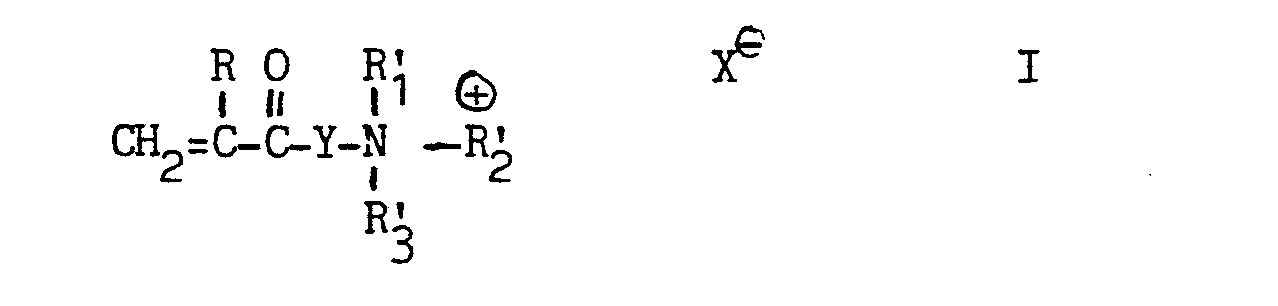
- Rest -CH2-CH=CH2, -CH2-O-CH3,-CH2-CH2-OH bedeutet und X für das Anion aus dem quaternierenden Reagenz steht.
- Das erfindungsgemäße Verfahren ist im Prinzip auf wäßrige Lösungen quartärer Ammoniumsalze von Vinylverbindungen ohne Unterschied anwendbar. Dazu gehören neben den Verbindungen der Formel 1 quartäre Diallyl- und Allylammoniumsalze, Vinyloxyalkylammoniumsalze, Vinylbenzylammonium- und Vinylaniliniumsalze u.a.
- Besonders genannt seien die Ester und die Amide der Formel I in denen R für Methyl steht, d.h. quartäre. Ammoniumsalze. als Abkömmlinge der Methacrylsäure, daneben die der Acrylsäure. Ferner sind die Verbindungen der Formel I bevorzugt, bei denen A für einen Rest -(CH2)2-, -(CH2)3- oder -CH2-C(CH3)2-CH2- steht. Im weiteren sind von besonderem Interesse die Verbindungen bei denen R1, R2, R3 für Methyl oder Äthyl stehen. Als Anionen sind - unter technischen Gesichtspunkten - vor allem das Chlorid- und daneben das Methylsulfatanion wichtig. Genannt seien z.B. das Trimethylammoniumäthylmethacrylatchlorid und die entsprechende Triethylammoniumverbindung.
- Für das Verfahren ist die Konzentration des Festproduktes in der wäßrigen Lösung innerhalb eines weiten Bereiches nicht kritisch. Vom Herstellungsverfahren der quartären Ammoniumsalze her werden in der Regel hochprozentige Lösungen angestrebt, etwa im Bereich 50 - 85 Gew.-% Festprodukt in der wäßrigen Lösung.
- Im Interesse einer günstigen Energiebilanz wird man in allen Fällen bemüht sein, relativ konzentrierte Salzlösungen im erfindungsgemäßen Verfahren einzusetzen. Ein geringerer Salzgehalt wirkt zwar in der Regel technisch nicht limitierend, wohl aber in ökonomischer Hinsicht.
- Im allgemeinen liegt der Salzgehalt der erfindungsgemäß zu verwendenden Lösungen innerhalb der Grenzen von 20 Gew.-% bis zur Sättigungskonzentration. Als Richtwert für Acrylate seien z.B. 35 Gew.-% angegeben. Die Herstellung der wäßrigen Salzlösungen von z.B. Vinylcarbonsäuren wird in an sich bekannter Weise z.B. durch Neutralisation der Säuren mit Oxiden, Hydroxiden, Alkoxiden, Carbonaten, Bicarbonaten derjenigen Metalle bzw. Ammoniumverbindungen durchgeführt, deren Salze man gewinnen will oder gegebenenfalls auch mit Salzen von sonstigen, flüchtigen, insbesondere schwachen Säuren. Mit Vorteil führt man die Herstellung der Salze in wäßrigem Milieu so durch, daß die entstehenden wäßrigen Lösungen unmittelbar der erfindungsgemäßen Verarbeitung durch Sprühtrocknung zugeführt werden können. Hierbei und bei der Durchführung des erfindungsgemäßen Verfahrens empfiehlt sich der Zusatz an sich bekannter Stabilisatoren bzw. Polymerisationsinhibitoren wie z.B. Chinone, Phenole, Methylenblau, aromatische Amine (Diphenylamin) oder Nitroverbindungen gegebenenfalls auch Kupfer- oder Eisensalze in den üblicherweise verwendeten Mengen. Die zuzusetzenden Mengen liegen in der Regel bei 0,01 bis 0,1 Gew.-%, bezogen auf die stabilisierenden monomeren Vinylverbindungen. Genannt seien beispielsweise der Hydrochinonmonanethylether, das 4-Methyl-2,6-di-tert.Butylphenol (vgl. Houben-Weyl, 4. Auflage, Band XIV/1, S. 42, 1011, Georg-Thieme-Verlag, 1961).
- Im Interesse eines möglichst einheitlichen Produkts wird man beispielsweise von der Verwendung von Überschüssen an Reaktanten bei der Herstellung der Salze absehen. z.B. wird man zur Neutralisation etwa stöchiometrische Mengen der das Kation beisteuernden Base anwenden.
- Es können selbstverständlich auch aus anderem Anlaß anfallende wäßrige Lösungen von Salzen der Vinylcarbonsäuren dem erfindungsgemäßen Verfahren unterworfen werden. Unter Sprühtrocknung oder Zerstäubungstrocknung wird im Einklang mit der üblichen Terminologie die Zerteilung flüssiger Trockengüter in feine, nebelartige Tröpfchen und die Trocknung, gewöhnlich mit einem heißen Luftstrom, verstanden. (Vgl. Ullmanns Encyklopädie der techn. Chemie, 4. Auflage, Band 2, pg. 712 u. 713, Verlag Chemie, 1972).
- Als Zerstäubungseinrichtung werden Düsen (Einstoff- oder Zweistoffdüsen) oder rotierende Scheiben mit gewöhnlich einer Umdrehungszahl von 4000 - 30.000 U/min verwendet (vgl. Masters Ind.Eng.Chemistry, 60, (1968) Nr. 10, S. 53-63). Die Lufteintrittstemperatur liegt zweckmäßig im Bereich 100 - 200°C, die Austrittstemperatur bei 50 - 100°C, vorzugsweise 90 - 100°C. Die Verweilzeiten betragen ca. 0,1 - 30 sec., vorteilhaft 0,5 - 10 sec.
- Das erfindungsgemäße Verfahren sei im folgenden näher erläutert:
- wird zweckmäßig in einem geeigneten rührbaren und kühlbaren Kessel die gewünschte Menge Wasser zusammen mit der C <,ß-ungesättigten Carbonsäure und dem Stabilisator vorgelegt und unter Lufteinleitung die basische Metallverbindung portionsweise zugegeben. Vorteilhaft sorgt man, gegebenenfalls durch Kühlung dafür, daß die Temperatur nicht über 30°C ansteigt. Nachdem das gesamte Gut in Lösung gegangen ist, wird über einen geeigneten Filter filtriert. Man erhält in der Regel eine klare Lösung mit dem vorbestimmten Salzgehalt.
- der salzartigen Vinylverbindungen kann mit den entsprechenden Sprüh- bzw. Zerstäubungstrocknungsvorrichtungen des Standes der Technik durchgeführt werden. Beispielsweise können mit Vorteil Scheibensprühtürme mit zwischen 4000 und 30.000, vorzugsweise 22.000 ± 5000 UpM verwendet werden. Vorteilhaft ist z.B. die Verwendung von geschlossenen Scheiben. In vielen Fällen empfiehlt es sich eine möglichst feine Zerstäubung des Sprühguts anzustreben, indem man im oberen möglichen Drehzahlbereich arbeitet. Die Lufteintrittstemperatur liegt im Bereich 100 bis 200°C, zweckmäßig bei 192 ± 5°C, die Austrittstemperatur bei 50 bis 100°C, vorzugsweise bei 90 1 5°C. Die Verweilzeiten betragen ca. 0,1 - 30 sec. Vorteilhaft 0,5 - 10 sec., insbesondere 7±2 sec. Die zugeführte Trockenluftmenge kann als Anhalt ca. 400 - 20.000 m3/h betragen. Als Dosiereinrichtung kann eine Schlauchpumpe verwendet werden. Das Absieben kann über ein geeignetes Sieb, beispielsweise ein 0,8 mm Sieb (Typ: Allgaier-Sieb) vorgenommen werden.
- Ca. 20 kg einer ca. 35 %igen Zinkdiacrylatlösung werden in einem Scheibensprühturm, ausgerüstet mit einer Normalscheibe mit 20.000 UpM; Lufteintrittstemperatur 190°C, Luftaustrittstemperatur 91 - 95°C sprühgetrocknet. Die Trockenluftmenge beträgt ca. 400 m3/h. Die Verweilzeiten betragen 5 bis 10 sec.
- Der Durchsatz beträgt 55,5 kg Zinkdiacrylatlösung (135 %ig) pro 158 min entsprechend ca. 21,1 kg Zinkdiacrylatlösung pro Stunde. Die Sprühausbeute liegt bei über 84 %.
- Es werden klare, z.T. verglaste Perlen gebildet. Ihr Hauptanteil liegt bei 10 - 20 µ, die größten Partikel sind ca. 80 u groß. Die Restfeuchte des Sprühguts liegt bei 0,35 - 0,55 %, das Schüttgewicht bei 540 - 600 g/l. Durch Erhöhung der Arbeitstemperatur kann man höhere Schüttgewichte erzielen. Die Sprühanlage läßt sich infolge der guten Wasserlöslichkeit der Sprühprodukte relativ leicht reinigen.
- Eine Polymerisation zu messbaren Anteilen wurde nicht beobachtet. In analoger Weise können auch die Salze der Metalle der I., II., IV., V. und VII. Haupt- und Nebengruppe und der VIII.-Nebengruppe sowie Ammoniumsalze isoliert werden, insbesondere die K+, Na+, Li+, Sr2+, Ba2+, Sn2+ und Ammoniumsalze.
- Das folgende Beispiel betrifft die Anwendung des Verfahrens auf quartäre Ammoniumsalze.
- Ausgehend von Dimethylaminoethylmethacrylat, Methylchlorid, Wasser und Stabilisator wurde durch Druckquaternierung eine im Feststoffgehalt ca. 80 %ige wäßrige Trimethylammoniumethylmethacrylatchloridlösung erhalten, die für die Sprühtrocknung eingesetzt wird. Für die Sprühtrocknung stand ein Scheibensprühturm der Fa. NIRO des Typs MINOR-PRODUCTION mit einer max. Wasserverdampfung von ca. 30 kg/h Wasser, einem Luftdurchsatz von ca. 400 m3/h, einer Lufteintrittstemperatur von ca. 250°C und einer regelbaren Scheibendrehzahl bis ca. 20.000 UpM zur Verfügung. Auf die mit ca. 15.000 UpM rotierende Lochscheibe wurden bei BeiBlufteingangstemperaturen von 125± 25°C kg/h Trimethylammoniumethylmethacrylatchloridlösung aufgegeben. Die Ablufttemperatur betrug 80± 10°C. In ca. 95 %iger Ausbeute konnten aus dem dem Sprühtrockner nachgeschalteten Zyklon ca. 15 kg/h festes Trimethylammoniummethylmethacrylatchlorid mit einem Restwassergehalt von < 1 % gewonnen werden. Das Sprühprodukt ist polymerisatfrei und eignet sich hervorragend zur Herstellung von hochmolekularen Polymerisaten als Flockungsmittel. So wurde durch Polymerisation in 75 %iger wäßriger Lösung ein hochmolekulares Polymeres erhalten, das 1 %ig in Wasser Viskositäten von 7000 mPa.s ergab und hervorragende Flockungseigenschaften aufwies.
- In analoger Weise können auch die weiteren quartären Ammoniumsalze der Formel I hergestellt werden, z.B. das Trimethylammoniumpropylacrylat-chlorid oder methosulfat, das Benzyldimethylammoniumethylacrylat-chlorid, das Dimethylallylammoniumpropylacrylat-chlorid, das Dimethylmethoxymethylammoniumethylacrylat-chlorid, das B-Hydroxyethyldimethylammoniumpropylacrylat-bromid und die entsprechenden Methacrylsäureester sowie das N-[3-(Trimethylammonium)-2,2-dimethylpropyl- methacrylamid-tosylat].
- Ca. 40 kg einer ungefähr 45 %igen wäßrigen Lösung von Natriummethacrylat werden in einem Scheibensprühturm, ausgerüstet mit einer Normalscheibe mit 20 000 UpM, Lufteintrittstemperatur 185°C und einer Luftaustrittstemperatur zwischen 85 und 90°C sprühgetrocknet. Die Trockenluftmenge beträgt ca. 400 m3/h.'Die Verweilzeit beträgt zwischen 7 und 12 sec. Der Durchsatz beträgt 23,7 kg Natriummethacrylat-Lösung (45 %ig) pro Stunde. Die Sprühausbeute liegt bei 10,3 kg Festsubstanz pro Stunde entsprechend 96,6 % Ausbeute.
- Man erhält klare Perlen im Bereich 10 bis 100 µ. Die Restfeuchte des Sprühguts liegt bei weniger als 0,3 Gew.-%. Das so erhaltene Produkt ist sofort wasserlöslich und ist im wesentlichen frei von Polymerisat.
- In analoger Weise können auch die weiteren Salze der Methacrylsäure, beispielsweise der I., II., IV., V. und VII. Haupt-und Nebengruppe, der VIII. Nebengruppe sowie Ammoniumsalze isoliert werden, insbesondere die K⊕, Li⊕, Sr2+, Ba2+, Sn2+ und die Ammoniumsalze.
- Das Dinatriumsalz der Itaconsäure in einer 40 %igen wäßrigen Lösung wird durch Umsetzung von Itaconsäure in Wasser mit 2 Mol Natriumhydroxid hergestellt. Nachdem Filtern erhält man eine völlig klare Lösung.
- Die Durchführung der Sprühtrocknung kann in weitgehender Anlehnung an Beispiel 3 erfolgen.
- Der Durchsatz beträgt 23,3 kg Dinatrium-Itaconat (40 %ig, Schmelzpunkt 290 - 300°C). Man erhält 8,3 kg Festsubstanz pro Stunde entsprechend 89 % Ausbeute.
- In ähnlicher Weise können auch die anderen Salze von Vinyldicarbonsäuren, z.B. die Natrium-. Kalium- und Ammoniumsalze der Maleinsäure und der Fumarsäure hergestellt werden.
Claims (12)
dadurch gekennzeichnet,
daß man die wäßrigen Lösungen der salzförmigen Vinylverbindungen der Sprühtrocknung unterwirft.

Applications Claiming Priority (4)
| Application Number | Priority Date | Filing Date | Title |
|---|---|---|---|
| DE19833326117 DE3326117A1 (de) | 1983-07-20 | 1983-07-20 | Verfahren zur isolierung von quartaeren ammoniumsalzen in fester form aus waessrigen loesungen |
| DE3326117 | 1983-07-20 | ||
| DE3418664 | 1984-05-19 | ||
| DE19843418664 DE3418664A1 (de) | 1984-05-19 | 1984-05-19 | Verfahren zur herstellung von salzen (alpha),ss-ungesaettigter carbonsaeuren in fester form aus waessrigen loesungen |
Publications (2)
| Publication Number | Publication Date |
|---|---|
| EP0132703A1 true EP0132703A1 (de) | 1985-02-13 |
| EP0132703B1 EP0132703B1 (de) | 1986-12-30 |
Family
ID=25812455
Family Applications (1)
| Application Number | Title | Priority Date | Filing Date |
|---|---|---|---|
| EP84108165A Expired EP0132703B1 (de) | 1983-07-20 | 1984-07-12 | Verfahren zur Isolierung von salzförmigen Vinylverbindungen in fester Form aus wässrigen Lösungen |
Country Status (3)
| Country | Link |
|---|---|
| US (1) | US4614827A (de) |
| EP (1) | EP0132703B1 (de) |
| DE (1) | DE3461783D1 (de) |
Families Citing this family (6)
| Publication number | Priority date | Publication date | Assignee | Title |
|---|---|---|---|---|
| US5869542A (en) * | 1995-06-07 | 1999-02-09 | Cytec Technology Corp. | Spray drying of polymer-containing dispersions, water-in-oil emulsions and microemulsions and dry polymer products formed thereby |
| US6011089A (en) * | 1995-06-07 | 2000-01-04 | Cytec Technology Corp. | Spray drying of polymer-containing dispersions, water-in-oil emulsions and water-in-oil microemulsions, and dry polymer products formed thereby |
| US5849862A (en) * | 1995-06-07 | 1998-12-15 | Cytec Technology Corp. | Processes of spray drying polymer-containing dispersions, water-in-oil emulsions and water-in-oil microemulsions |
| DE19651307A1 (de) * | 1996-12-10 | 1998-06-18 | Basf Ag | Stoffmischungen, enthaltend vinylgruppenhaltige Verbindungen und Stabilisatoren |
| JP3787261B2 (ja) * | 1999-04-16 | 2006-06-21 | 株式会社日本触媒 | 易重合性化合物の重合防止方法 |
| US20110250264A1 (en) | 2010-04-09 | 2011-10-13 | Pacira Pharmaceuticals, Inc. | Method for formulating large diameter synthetic membrane vesicles |
Citations (4)
| Publication number | Priority date | Publication date | Assignee | Title |
|---|---|---|---|---|
| DE1443694A1 (de) * | 1963-01-05 | 1969-03-20 | Dynamit Nobel Ag | Verfahren zur Herstellung monomerer wasserfreier Bleisalze der Acryl- oder Methacrylsaeure |
| GB1353212A (en) * | 1971-09-22 | 1974-05-15 | Hydrierwerk Rodleben Veb | Process for the production of pulverous coolerwater salts |
| DE3011306A1 (de) * | 1979-03-30 | 1980-10-09 | Verdugt Bv | Verfahren zur herstellung von mischungen aus alkalimetall- und kalziumsalzen von karbonsaeuren mit 1 - 3 kohlenstoffatomen |
| DE3224928A1 (de) * | 1982-07-03 | 1984-01-05 | Röhm GmbH, 6100 Darmstadt | Verfahren zur herstellung von salzen der acryl- oder der methacrylsaeure |
Family Cites Families (29)
| Publication number | Priority date | Publication date | Assignee | Title |
|---|---|---|---|---|
| US3285945A (en) * | 1966-11-15 | Process for the production of ester salts | ||
| US2103265A (en) * | 1933-09-12 | 1937-12-28 | Squibb & Sons Inc | Acrylic acid derivatives |
| US2395307A (en) * | 1943-10-06 | 1946-02-19 | Du Pont | Preparation of organic salts |
| US2741568A (en) * | 1951-12-05 | 1956-04-10 | Du Pont | Water insoluble polymeric quaternary ammonium carboxylate salts and the treatment of textiles therewith |
| US2677699A (en) * | 1952-01-21 | 1954-05-04 | Du Pont | Quaternary ammonium salts of oxygen containing strong sulfur acids in the cation of which there are no more than two aryl groups and one group having a methacrylyloxy substituent |
| US2980657A (en) * | 1954-07-06 | 1961-04-18 | Rohm & Haas | Quaternary ammonium compounds of polymers of acrylamido type and methods for making them |
| US3024222A (en) * | 1959-02-09 | 1962-03-06 | Ferro Chemical Corp | Preparation of glassy polymers |
| US3021364A (en) * | 1960-01-12 | 1962-02-13 | Sartomer Resins Inc | Preparation of dry sodium methacrylate |
| US3227738A (en) * | 1962-06-11 | 1966-01-04 | Geigy Chem Corp | Metal salts of thio-bis(alkylene-beta-carboxyacrylates) |
| US3336358A (en) * | 1964-07-23 | 1967-08-15 | Dow Chemical Co | Preparation of 2-aminoethyl esters of methacrylic acid |
| US3420932A (en) * | 1966-12-20 | 1969-01-07 | Armour Pharma | Methods of making alcohol soluble complexes of aluminum and preparations employing the complexes |
| US3493550A (en) * | 1967-07-03 | 1970-02-03 | American Cyanamid Co | Plasticized associated polymers |
| US3689427A (en) * | 1969-08-27 | 1972-09-05 | Okura Industrial Co Ltd | Polymerizable mixtures comprising a bivalent metal salt of an acrylate- or methacrylate-phthalate ester of an alkylene glycol |
| DE2009748A1 (de) * | 1970-03-03 | 1971-09-16 | Basf Ag | Verfahren zur Herstellung von wasser löslichen Polymerisaten |
| US3803189A (en) * | 1971-01-25 | 1974-04-09 | F Haglid | Metal tetrachlorocrotonate compounds and methods of preparation thereof |
| US3714136A (en) * | 1971-10-21 | 1973-01-30 | American Cyanamid Co | Process for recovering acrylamide polymers from gels |
| US3916015A (en) * | 1973-04-11 | 1975-10-28 | Continental Oil Co | Process for condensation of alcohols |
| US4055581A (en) * | 1974-01-02 | 1977-10-25 | Hooker Chemicals & Plastics Corporation | Heat and light stabilizers for halogen containing polymeric resins |
| CA1050687A (en) * | 1974-02-11 | 1979-03-13 | Terence Melvin | Method of making adjuvant for elastomeric composition |
| US4060535A (en) * | 1976-08-31 | 1977-11-29 | Tenneco Chemicals, Inc. | Process for the production of metal salts of organic acids |
| DE2726260C2 (de) * | 1977-06-10 | 1983-05-26 | Röhm GmbH, 6100 Darmstadt | Schäumbares Polymermaterial |
| US4180681A (en) * | 1978-08-17 | 1979-12-25 | Atlantic Richfield Company | Preparation and recovery of methacrylic acid from an aqueous sodium methacrylate solution |
| US4214000A (en) * | 1978-10-30 | 1980-07-22 | Johnson & Johnson | Zinc salt of all-trans-retinoic acid for the treatment of acne |
| DE2848627C2 (de) * | 1978-11-09 | 1982-02-04 | Röhm GmbH, 6100 Darmstadt | Verfahren zur Herstellung eines flüssigen, unmittelbar polymerisierbaren Gemisches aus Acrylamid und Quaternierungsprodukten von tertiären Aminoalkylestern oder tertiären Aminoalkylamiden der Acryl- oder Methacrylsäure |
| CA1156000A (en) * | 1980-10-28 | 1983-10-25 | Siegmund Besecke | Method for making ionic crosslinked acrylic resin |
| DE3114266A1 (de) * | 1981-04-09 | 1982-11-04 | Röhm GmbH, 6100 Darmstadt | Verfahren zur herstellung vernetzter acrylelastomerer |
| DE3202663A1 (de) * | 1982-01-28 | 1983-08-04 | Röhm GmbH, 6100 Darmstadt | Verfahren zur herstellung des ammoniumsalzes der acryl- und der methacrylsaeure |
| DE3224927A1 (de) * | 1982-07-03 | 1984-01-05 | Röhm GmbH, 6100 Darmstadt | Verrfahren zur herstellung von salzen der acryl- oder der methacrylsaeure |
| US4500466A (en) * | 1982-09-21 | 1985-02-19 | The Firestone Tire & Rubber Company | Method for preparing a zinc dimethacrylate powder having a specific surface area range |
-
1984
- 1984-07-10 US US06/629,358 patent/US4614827A/en not_active Expired - Fee Related
- 1984-07-12 EP EP84108165A patent/EP0132703B1/de not_active Expired
- 1984-07-12 DE DE8484108165T patent/DE3461783D1/de not_active Expired
Patent Citations (4)
| Publication number | Priority date | Publication date | Assignee | Title |
|---|---|---|---|---|
| DE1443694A1 (de) * | 1963-01-05 | 1969-03-20 | Dynamit Nobel Ag | Verfahren zur Herstellung monomerer wasserfreier Bleisalze der Acryl- oder Methacrylsaeure |
| GB1353212A (en) * | 1971-09-22 | 1974-05-15 | Hydrierwerk Rodleben Veb | Process for the production of pulverous coolerwater salts |
| DE3011306A1 (de) * | 1979-03-30 | 1980-10-09 | Verdugt Bv | Verfahren zur herstellung von mischungen aus alkalimetall- und kalziumsalzen von karbonsaeuren mit 1 - 3 kohlenstoffatomen |
| DE3224928A1 (de) * | 1982-07-03 | 1984-01-05 | Röhm GmbH, 6100 Darmstadt | Verfahren zur herstellung von salzen der acryl- oder der methacrylsaeure |
Also Published As
| Publication number | Publication date |
|---|---|
| US4614827A (en) | 1986-09-30 |
| DE3461783D1 (en) | 1987-02-05 |
| EP0132703B1 (de) | 1986-12-30 |
Similar Documents
| Publication | Publication Date | Title |
|---|---|---|
| DE69125846T2 (de) | Hyperverzweigte polyester | |
| EP0566974B1 (de) | Reinigung von fluorierten Carbonsäuren | |
| EP0013416B1 (de) | Verfahren zur Herstellung von alpha-beta-ungesättigten N-substituierten Carbonsäureamiden, neue alpha-beta-ungesättigte N-substituierte Carbonsäureamide und ihre Verwendung zur Herstellung von Ionenaustauschern | |
| EP0177812B1 (de) | Verfahren zur Herstellung von unlöslichen, nur wenig quellbaren pulverförmigen Polymerisaten | |
| EP0132703B1 (de) | Verfahren zur Isolierung von salzförmigen Vinylverbindungen in fester Form aus wässrigen Lösungen | |
| DE4217124A1 (de) | Verfahren zur Herstellung von endständig Stickstoffheterocyclus-substituiertem (Meth)acrylsäureester | |
| DE2027443B2 (de) | Verfahren zur Reinigung von Hydroxyalkylacrylaten oder Hydroxyalkylmethacrylaten | |
| EP0453638A1 (de) | Verfahren zur Herstellung von endständig Heterocyclus-substituierten Acryl- und Methacrylsäurealkylestern | |
| DE69518027T2 (de) | Verfahren zur Herstellung von Acrylamid | |
| DE2727326C2 (de) | Verfahren zur Herstellung von Dimethylcyclopropancarbonsäure- oder Phenylessigsäurederivaten | |
| EP0275470B1 (de) | N-substituierte, Estergruppen enthaltende Acrylamide | |
| DE1116409B (de) | Verfahren zur Polymerisation von Vinylverbindungen | |
| DE19524337C1 (de) | Verfahren zur Herstellung von beta-Amino-alpha-hydroxycarbonsäuren und deren Derivaten | |
| DE3227846A1 (de) | Verfahren zur gewinnung und reinigung von phenoxybenzoesaeurederivaten | |
| DE3418664A1 (de) | Verfahren zur herstellung von salzen (alpha),ss-ungesaettigter carbonsaeuren in fester form aus waessrigen loesungen | |
| DE2258567A1 (de) | Verfahren zur herstellung hochmolekularer aromatischer polyamide | |
| EP0812822B1 (de) | Verfahren zur Herstellung von Aminoessigsäuren mit alpha-ständigem tertiären Kohlenwasserstoffrest oder deren Nitrilen | |
| DE3039998A1 (de) | Phosphonoformaldehyd, ein verfahren zu seiner herstellung und seine verwendung als zwischenprodukt fuer die herstellung von arzneimittel | |
| EP0171755A1 (de) | Ester von Vinylcarbonsäuren | |
| WO2006058710A1 (de) | Verfahren zur herstellung von amino- oder hydroxybenzonitrilen | |
| CH625199A5 (de) | ||
| DE1235896B (de) | Verfahren zur Herstellung primaerer oder sekundaerer Aminoalkylestersalze der Acryl-, Methacryl-, Croton-, Itacon- oder Fumarsaeure | |
| DE1960716B2 (de) | Verfahren zur Herstellung von Acryl- und Methacrylsäurecarbalkoxyalkylestern | |
| EP1690855B1 (de) | Mischung umfassend Phenylen-bis-benzimidazol-tetrasulfonsäure-dinatriumsalz | |
| DE3137840A1 (de) | Zirkonmethacrylat, verfahren zu seiner herstellung und anwendung als vernetzungsmittel |
Legal Events
| Date | Code | Title | Description |
|---|---|---|---|
| PUAI | Public reference made under article 153(3) epc to a published international application that has entered the european phase |
Free format text: ORIGINAL CODE: 0009012 |
|
| AK | Designated contracting states |
Designated state(s): DE FR GB |
|
| 17P | Request for examination filed |
Effective date: 19850223 |
|
| GRAA | (expected) grant |
Free format text: ORIGINAL CODE: 0009210 |
|
| AK | Designated contracting states |
Kind code of ref document: B1 Designated state(s): DE FR GB |
|
| REF | Corresponds to: |
Ref document number: 3461783 Country of ref document: DE Date of ref document: 19870205 |
|
| ET | Fr: translation filed | ||
| PLBE | No opposition filed within time limit |
Free format text: ORIGINAL CODE: 0009261 |
|
| STAA | Information on the status of an ep patent application or granted ep patent |
Free format text: STATUS: NO OPPOSITION FILED WITHIN TIME LIMIT |
|
| 26N | No opposition filed | ||
| PGFP | Annual fee paid to national office [announced via postgrant information from national office to epo] |
Ref country code: GB Payment date: 19960708 Year of fee payment: 13 |
|
| PGFP | Annual fee paid to national office [announced via postgrant information from national office to epo] |
Ref country code: FR Payment date: 19960715 Year of fee payment: 13 |
|
| PGFP | Annual fee paid to national office [announced via postgrant information from national office to epo] |
Ref country code: DE Payment date: 19960718 Year of fee payment: 13 |
|
| PG25 | Lapsed in a contracting state [announced via postgrant information from national office to epo] |
Ref country code: GB Free format text: LAPSE BECAUSE OF NON-PAYMENT OF DUE FEES Effective date: 19970712 |
|
| GBPC | Gb: european patent ceased through non-payment of renewal fee |
Effective date: 19970712 |
|
| PG25 | Lapsed in a contracting state [announced via postgrant information from national office to epo] |
Ref country code: FR Free format text: LAPSE BECAUSE OF NON-PAYMENT OF DUE FEES Effective date: 19980331 |
|
| PG25 | Lapsed in a contracting state [announced via postgrant information from national office to epo] |
Ref country code: DE Free format text: LAPSE BECAUSE OF NON-PAYMENT OF DUE FEES Effective date: 19980401 |
|
| REG | Reference to a national code |
Ref country code: FR Ref legal event code: ST |