EP0122576B1 - Verfahren zur Herstellung von vicinalen Polycarbonylverbindungen - Google Patents
Verfahren zur Herstellung von vicinalen Polycarbonylverbindungen Download PDFInfo
- Publication number
- EP0122576B1 EP0122576B1 EP84103945A EP84103945A EP0122576B1 EP 0122576 B1 EP0122576 B1 EP 0122576B1 EP 84103945 A EP84103945 A EP 84103945A EP 84103945 A EP84103945 A EP 84103945A EP 0122576 B1 EP0122576 B1 EP 0122576B1
- Authority
- EP
- European Patent Office
- Prior art keywords
- mmol
- alkyl
- solution
- methylene chloride
- compounds
- Prior art date
- Legal status (The legal status is an assumption and is not a legal conclusion. Google has not performed a legal analysis and makes no representation as to the accuracy of the status listed.)
- Expired
Links
- -1 polycarbonyl Polymers 0.000 title claims description 24
- 238000000034 method Methods 0.000 title claims description 16
- 150000001875 compounds Chemical class 0.000 title claims description 10
- 238000004519 manufacturing process Methods 0.000 title description 3
- IICCLYANAQEHCI-UHFFFAOYSA-N 4,5,6,7-tetrachloro-3',6'-dihydroxy-2',4',5',7'-tetraiodospiro[2-benzofuran-3,9'-xanthene]-1-one Chemical compound O1C(=O)C(C(=C(Cl)C(Cl)=C2Cl)Cl)=C2C21C1=CC(I)=C(O)C(I)=C1OC1=C(I)C(O)=C(I)C=C21 IICCLYANAQEHCI-UHFFFAOYSA-N 0.000 claims description 11
- 229930187593 rose bengal Natural products 0.000 claims description 11
- 229940081623 rose bengal Drugs 0.000 claims description 11
- STRXNPAVPKGJQR-UHFFFAOYSA-N rose bengal A Natural products O1C(=O)C(C(=CC=C2Cl)Cl)=C2C21C1=CC(I)=C(O)C(I)=C1OC1=C(I)C(O)=C(I)C=C21 STRXNPAVPKGJQR-UHFFFAOYSA-N 0.000 claims description 11
- NINIDFKCEFEMDL-UHFFFAOYSA-N Sulfur Chemical compound [S] NINIDFKCEFEMDL-UHFFFAOYSA-N 0.000 claims description 9
- 125000000217 alkyl group Chemical group 0.000 claims description 9
- 125000003118 aryl group Chemical group 0.000 claims description 5
- 125000004435 hydrogen atom Chemical group [H]* 0.000 claims description 4
- 238000002360 preparation method Methods 0.000 claims description 2
- 229910052739 hydrogen Inorganic materials 0.000 claims 2
- 239000001257 hydrogen Substances 0.000 claims 2
- 239000005864 Sulphur Substances 0.000 claims 1
- YMWUJEATGCHHMB-UHFFFAOYSA-N Dichloromethane Chemical compound ClCCl YMWUJEATGCHHMB-UHFFFAOYSA-N 0.000 description 45
- OKKJLVBELUTLKV-UHFFFAOYSA-N Methanol Chemical compound OC OKKJLVBELUTLKV-UHFFFAOYSA-N 0.000 description 36
- QGJOPFRUJISHPQ-UHFFFAOYSA-N Carbon disulfide Chemical compound S=C=S QGJOPFRUJISHPQ-UHFFFAOYSA-N 0.000 description 27
- LFQSCWFLJHTTHZ-UHFFFAOYSA-N Ethanol Chemical compound CCO LFQSCWFLJHTTHZ-UHFFFAOYSA-N 0.000 description 20
- 239000000243 solution Substances 0.000 description 19
- QTBSBXVTEAMEQO-UHFFFAOYSA-N Acetic acid Chemical compound CC(O)=O QTBSBXVTEAMEQO-UHFFFAOYSA-N 0.000 description 15
- HEMHJVSKTPXQMS-UHFFFAOYSA-M Sodium hydroxide Chemical compound [OH-].[Na+] HEMHJVSKTPXQMS-UHFFFAOYSA-M 0.000 description 12
- 238000006243 chemical reaction Methods 0.000 description 11
- KFZMGEQAYNKOFK-UHFFFAOYSA-N Isopropanol Chemical compound CC(C)O KFZMGEQAYNKOFK-UHFFFAOYSA-N 0.000 description 10
- XLYOFNOQVPJJNP-UHFFFAOYSA-N water Substances O XLYOFNOQVPJJNP-UHFFFAOYSA-N 0.000 description 10
- 239000003921 oil Substances 0.000 description 9
- 238000004809 thin layer chromatography Methods 0.000 description 9
- WPYMKLBDIGXBTP-UHFFFAOYSA-N benzoic acid Chemical compound OC(=O)C1=CC=CC=C1 WPYMKLBDIGXBTP-UHFFFAOYSA-N 0.000 description 8
- OJUGVDODNPJEEC-UHFFFAOYSA-N phenylglyoxal Chemical compound O=CC(=O)C1=CC=CC=C1 OJUGVDODNPJEEC-UHFFFAOYSA-N 0.000 description 8
- 229910052717 sulfur Inorganic materials 0.000 description 8
- 239000011593 sulfur Substances 0.000 description 8
- QVGXLLKOCUKJST-UHFFFAOYSA-N atomic oxygen Chemical compound [O] QVGXLLKOCUKJST-UHFFFAOYSA-N 0.000 description 7
- 229910052760 oxygen Inorganic materials 0.000 description 7
- 239000001301 oxygen Substances 0.000 description 7
- LRHPLDYGYMQRHN-UHFFFAOYSA-N N-Butanol Chemical compound CCCCO LRHPLDYGYMQRHN-UHFFFAOYSA-N 0.000 description 6
- 239000002904 solvent Substances 0.000 description 6
- 239000007858 starting material Substances 0.000 description 6
- XQAXGZLFSSPBMK-UHFFFAOYSA-M [7-(dimethylamino)phenothiazin-3-ylidene]-dimethylazanium;chloride;trihydrate Chemical compound O.O.O.[Cl-].C1=CC(=[N+](C)C)C=C2SC3=CC(N(C)C)=CC=C3N=C21 XQAXGZLFSSPBMK-UHFFFAOYSA-M 0.000 description 5
- 238000004821 distillation Methods 0.000 description 5
- 150000002148 esters Chemical class 0.000 description 5
- 229960000907 methylthioninium chloride Drugs 0.000 description 5
- 238000007539 photo-oxidation reaction Methods 0.000 description 5
- 150000003254 radicals Chemical class 0.000 description 5
- 239000007787 solid Substances 0.000 description 5
- 239000005711 Benzoic acid Substances 0.000 description 4
- 238000004458 analytical method Methods 0.000 description 4
- 235000010233 benzoic acid Nutrition 0.000 description 4
- SESFRYSPDFLNCH-UHFFFAOYSA-N benzyl benzoate Chemical compound C=1C=CC=CC=1C(=O)OCC1=CC=CC=C1 SESFRYSPDFLNCH-UHFFFAOYSA-N 0.000 description 4
- 239000000975 dye Substances 0.000 description 4
- 239000000047 product Substances 0.000 description 4
- 239000000126 substance Substances 0.000 description 4
- 238000005160 1H NMR spectroscopy Methods 0.000 description 3
- MCSXGCZMEPXKIW-UHFFFAOYSA-N 3-hydroxy-4-[(4-methyl-2-nitrophenyl)diazenyl]-N-(3-nitrophenyl)naphthalene-2-carboxamide Chemical compound Cc1ccc(N=Nc2c(O)c(cc3ccccc23)C(=O)Nc2cccc(c2)[N+]([O-])=O)c(c1)[N+]([O-])=O MCSXGCZMEPXKIW-UHFFFAOYSA-N 0.000 description 3
- UHOVQNZJYSORNB-UHFFFAOYSA-N Benzene Chemical compound C1=CC=CC=C1 UHOVQNZJYSORNB-UHFFFAOYSA-N 0.000 description 3
- RTZKZFJDLAIYFH-UHFFFAOYSA-N Diethyl ether Chemical compound CCOCC RTZKZFJDLAIYFH-UHFFFAOYSA-N 0.000 description 3
- 241001635574 Sabatia angularis Species 0.000 description 3
- YXFVVABEGXRONW-UHFFFAOYSA-N Toluene Chemical compound CC1=CC=CC=C1 YXFVVABEGXRONW-UHFFFAOYSA-N 0.000 description 3
- 150000005840 aryl radicals Chemical class 0.000 description 3
- 239000007795 chemical reaction product Substances 0.000 description 3
- 238000001816 cooling Methods 0.000 description 3
- LGRLWUINFJPLSH-UHFFFAOYSA-N methanide Chemical compound [CH3-] LGRLWUINFJPLSH-UHFFFAOYSA-N 0.000 description 3
- 239000000203 mixture Substances 0.000 description 3
- FAQJJMHZNSSFSM-UHFFFAOYSA-N phenylglyoxylic acid Chemical compound OC(=O)C(=O)C1=CC=CC=C1 FAQJJMHZNSSFSM-UHFFFAOYSA-N 0.000 description 3
- HORQAOAYAYGIBM-UHFFFAOYSA-N 2,4-dinitrophenylhydrazine Chemical compound NNC1=CC=C([N+]([O-])=O)C=C1[N+]([O-])=O HORQAOAYAYGIBM-UHFFFAOYSA-N 0.000 description 2
- QWNCDHYYJATYOG-UHFFFAOYSA-N 2-phenylquinoxaline Chemical compound C1=CC=CC=C1C1=CN=C(C=CC=C2)C2=N1 QWNCDHYYJATYOG-UHFFFAOYSA-N 0.000 description 2
- IKHGUXGNUITLKF-UHFFFAOYSA-N Acetaldehyde Chemical compound CC=O IKHGUXGNUITLKF-UHFFFAOYSA-N 0.000 description 2
- CSCPPACGZOOCGX-UHFFFAOYSA-N Acetone Chemical compound CC(C)=O CSCPPACGZOOCGX-UHFFFAOYSA-N 0.000 description 2
- VEXZGXHMUGYJMC-UHFFFAOYSA-N Hydrochloric acid Chemical compound Cl VEXZGXHMUGYJMC-UHFFFAOYSA-N 0.000 description 2
- MHAJPDPJQMAIIY-UHFFFAOYSA-N Hydrogen peroxide Chemical compound OO MHAJPDPJQMAIIY-UHFFFAOYSA-N 0.000 description 2
- PMZURENOXWZQFD-UHFFFAOYSA-L Sodium Sulfate Chemical compound [Na+].[Na+].[O-]S([O-])(=O)=O PMZURENOXWZQFD-UHFFFAOYSA-L 0.000 description 2
- 239000002253 acid Substances 0.000 description 2
- FSEXLNMNADBYJU-UHFFFAOYSA-N alpha-Phenylquinoline Natural products C1=CC=CC=C1C1=CC=C(C=CC=C2)C2=N1 FSEXLNMNADBYJU-UHFFFAOYSA-N 0.000 description 2
- MVPPADPHJFYWMZ-UHFFFAOYSA-N chlorobenzene Chemical compound ClC1=CC=CC=C1 MVPPADPHJFYWMZ-UHFFFAOYSA-N 0.000 description 2
- 238000002425 crystallisation Methods 0.000 description 2
- 230000008025 crystallization Effects 0.000 description 2
- JTWJOQUJCWRSAH-UHFFFAOYSA-N diethyl 2-methylsulfanylpropanedioate Chemical compound CCOC(=O)C(SC)C(=O)OCC JTWJOQUJCWRSAH-UHFFFAOYSA-N 0.000 description 2
- 239000003480 eluent Substances 0.000 description 2
- 125000001495 ethyl group Chemical group [H]C([H])([H])C([H])([H])* 0.000 description 2
- 238000001704 evaporation Methods 0.000 description 2
- 230000008020 evaporation Effects 0.000 description 2
- 239000000706 filtrate Substances 0.000 description 2
- 238000007654 immersion Methods 0.000 description 2
- 125000000468 ketone group Chemical group 0.000 description 2
- 238000002844 melting Methods 0.000 description 2
- 230000008018 melting Effects 0.000 description 2
- QPJVMBTYPHYUOC-UHFFFAOYSA-N methyl benzoate Chemical compound COC(=O)C1=CC=CC=C1 QPJVMBTYPHYUOC-UHFFFAOYSA-N 0.000 description 2
- YLHXLHGIAMFFBU-UHFFFAOYSA-N methyl phenylglyoxalate Chemical compound COC(=O)C(=O)C1=CC=CC=C1 YLHXLHGIAMFFBU-UHFFFAOYSA-N 0.000 description 2
- 229910052757 nitrogen Inorganic materials 0.000 description 2
- UUEVFMOUBSLVJW-UHFFFAOYSA-N oxo-[[1-[2-[2-[2-[4-(oxoazaniumylmethylidene)pyridin-1-yl]ethoxy]ethoxy]ethyl]pyridin-4-ylidene]methyl]azanium;dibromide Chemical compound [Br-].[Br-].C1=CC(=C[NH+]=O)C=CN1CCOCCOCCN1C=CC(=C[NH+]=O)C=C1 UUEVFMOUBSLVJW-UHFFFAOYSA-N 0.000 description 2
- MVDYEFQVZNBPPH-UHFFFAOYSA-N pentane-2,3,4-trione Chemical compound CC(=O)C(=O)C(C)=O MVDYEFQVZNBPPH-UHFFFAOYSA-N 0.000 description 2
- 239000012071 phase Substances 0.000 description 2
- 125000001997 phenyl group Chemical group [H]C1=C([H])C([H])=C(*)C([H])=C1[H] 0.000 description 2
- 239000003504 photosensitizing agent Substances 0.000 description 2
- 238000001556 precipitation Methods 0.000 description 2
- 238000012552 review Methods 0.000 description 2
- JPJALAQPGMAKDF-UHFFFAOYSA-N selenium dioxide Chemical compound O=[Se]=O JPJALAQPGMAKDF-UHFFFAOYSA-N 0.000 description 2
- 229910052938 sodium sulfate Inorganic materials 0.000 description 2
- 235000011152 sodium sulphate Nutrition 0.000 description 2
- 238000003756 stirring Methods 0.000 description 2
- GEYOCULIXLDCMW-UHFFFAOYSA-N 1,2-phenylenediamine Chemical compound NC1=CC=CC=C1N GEYOCULIXLDCMW-UHFFFAOYSA-N 0.000 description 1
- BJIRGSLXYCEUMW-UHFFFAOYSA-N 2-phenyl-2-(phenylhydrazinylidene)acetic acid Chemical compound C=1C=CC=CC=1C(C(=O)O)=NNC1=CC=CC=C1 BJIRGSLXYCEUMW-UHFFFAOYSA-N 0.000 description 1
- PQCXLYRKOPHBGI-UHFFFAOYSA-N 3-oxobutyl 5-sulfanylidenepentanoate Chemical compound CC(=O)CCOC(=O)CCCC=S PQCXLYRKOPHBGI-UHFFFAOYSA-N 0.000 description 1
- RZVAJINKPMORJF-UHFFFAOYSA-N Acetaminophen Chemical compound CC(=O)NC1=CC=C(O)C=C1 RZVAJINKPMORJF-UHFFFAOYSA-N 0.000 description 1
- CPELXLSAUQHCOX-UHFFFAOYSA-M Bromide Chemical compound [Br-] CPELXLSAUQHCOX-UHFFFAOYSA-M 0.000 description 1
- CBENFWSGALASAD-UHFFFAOYSA-N Ozone Chemical compound [O-][O+]=O CBENFWSGALASAD-UHFFFAOYSA-N 0.000 description 1
- 241000220317 Rosa Species 0.000 description 1
- VYPSYNLAJGMNEJ-UHFFFAOYSA-N Silicium dioxide Chemical compound O=[Si]=O VYPSYNLAJGMNEJ-UHFFFAOYSA-N 0.000 description 1
- 150000001241 acetals Chemical class 0.000 description 1
- 230000002378 acidificating effect Effects 0.000 description 1
- 150000007513 acids Chemical class 0.000 description 1
- 239000004480 active ingredient Substances 0.000 description 1
- 150000001298 alcohols Chemical class 0.000 description 1
- 239000007864 aqueous solution Substances 0.000 description 1
- 230000009286 beneficial effect Effects 0.000 description 1
- 238000004061 bleaching Methods 0.000 description 1
- 238000009835 boiling Methods 0.000 description 1
- 239000006227 byproduct Substances 0.000 description 1
- VNWKTOKETHGBQD-AKLPVKDBSA-N carbane Chemical compound [15CH4] VNWKTOKETHGBQD-AKLPVKDBSA-N 0.000 description 1
- 125000004432 carbon atom Chemical group C* 0.000 description 1
- 150000008280 chlorinated hydrocarbons Chemical class 0.000 description 1
- 239000012230 colorless oil Substances 0.000 description 1
- 230000000052 comparative effect Effects 0.000 description 1
- 239000000470 constituent Substances 0.000 description 1
- 239000013078 crystal Substances 0.000 description 1
- 239000012954 diazonium Substances 0.000 description 1
- 150000001989 diazonium salts Chemical class 0.000 description 1
- DBKKFIIYQGGHJO-UHFFFAOYSA-N diethyl 2-oxopropanedioate Chemical compound CCOC(=O)C(=O)C(=O)OCC DBKKFIIYQGGHJO-UHFFFAOYSA-N 0.000 description 1
- IJKVHSBPTUYDLN-UHFFFAOYSA-N dihydroxy(oxo)silane Chemical compound O[Si](O)=O IJKVHSBPTUYDLN-UHFFFAOYSA-N 0.000 description 1
- UETWCCPEJFYZLL-UHFFFAOYSA-N dimethyl(3-oxobutoxycarbonyl)sulfanium Chemical compound C(C)(=O)CCOC(=O)[S+](C)C UETWCCPEJFYZLL-UHFFFAOYSA-N 0.000 description 1
- JTNDNBUJMQNEGL-UHFFFAOYSA-N dimethyl(phenacyl)sulfanium Chemical compound C[S+](C)CC(=O)C1=CC=CC=C1 JTNDNBUJMQNEGL-UHFFFAOYSA-N 0.000 description 1
- 238000002845 discoloration Methods 0.000 description 1
- 239000003814 drug Substances 0.000 description 1
- 238000001035 drying Methods 0.000 description 1
- 238000005265 energy consumption Methods 0.000 description 1
- 150000002170 ethers Chemical class 0.000 description 1
- UCMPJVVLBFHCES-UHFFFAOYSA-N ethyl 5-methyl-3-phenyl-1,2,4-triazine-6-carboxylate Chemical compound N1=C(C)C(C(=O)OCC)=NN=C1C1=CC=CC=C1 UCMPJVVLBFHCES-UHFFFAOYSA-N 0.000 description 1
- 239000002360 explosive Substances 0.000 description 1
- 238000000605 extraction Methods 0.000 description 1
- 238000001914 filtration Methods 0.000 description 1
- 125000005843 halogen group Chemical group 0.000 description 1
- 150000002391 heterocyclic compounds Chemical class 0.000 description 1
- 150000004677 hydrates Chemical class 0.000 description 1
- 125000002887 hydroxy group Chemical group [H]O* 0.000 description 1
- 238000011065 in-situ storage Methods 0.000 description 1
- 239000000543 intermediate Substances 0.000 description 1
- 238000002955 isolation Methods 0.000 description 1
- 150000002576 ketones Chemical class 0.000 description 1
- 239000000155 melt Substances 0.000 description 1
- 229940095102 methyl benzoate Drugs 0.000 description 1
- 150000004702 methyl esters Chemical class 0.000 description 1
- 125000002496 methyl group Chemical group [H]C([H])([H])* 0.000 description 1
- 125000001570 methylene group Chemical group [H]C([H])([*:1])[*:2] 0.000 description 1
- LPNPFQNKOSDVTM-UHFFFAOYSA-N n'-aminobenzenecarboximidamide Chemical compound NN=C(N)C1=CC=CC=C1 LPNPFQNKOSDVTM-UHFFFAOYSA-N 0.000 description 1
- 150000002832 nitroso derivatives Chemical class 0.000 description 1
- 239000012074 organic phase Substances 0.000 description 1
- 239000007800 oxidant agent Substances 0.000 description 1
- 230000003647 oxidation Effects 0.000 description 1
- 238000007254 oxidation reaction Methods 0.000 description 1
- 238000005191 phase separation Methods 0.000 description 1
- HKOOXMFOFWEVGF-UHFFFAOYSA-N phenylhydrazine Chemical compound NNC1=CC=CC=C1 HKOOXMFOFWEVGF-UHFFFAOYSA-N 0.000 description 1
- 229940067157 phenylhydrazine Drugs 0.000 description 1
- 230000000886 photobiology Effects 0.000 description 1
- 239000002244 precipitate Substances 0.000 description 1
- 230000001376 precipitating effect Effects 0.000 description 1
- 239000011814 protection agent Substances 0.000 description 1
- 239000005297 pyrex Substances 0.000 description 1
- 230000005855 radiation Effects 0.000 description 1
- 239000011541 reaction mixture Substances 0.000 description 1
- 230000035484 reaction time Effects 0.000 description 1
- AZJPTIGZZTZIDR-UHFFFAOYSA-L rose bengal Chemical compound [K+].[K+].[O-]C(=O)C1=C(Cl)C(Cl)=C(Cl)C(Cl)=C1C1=C2C=C(I)C(=O)C(I)=C2OC2=C(I)C([O-])=C(I)C=C21 AZJPTIGZZTZIDR-UHFFFAOYSA-L 0.000 description 1
- 238000010517 secondary reaction Methods 0.000 description 1
- 239000000741 silica gel Substances 0.000 description 1
- 229910002027 silica gel Inorganic materials 0.000 description 1
- RPACBEVZENYWOL-XFULWGLBSA-M sodium;(2r)-2-[6-(4-chlorophenoxy)hexyl]oxirane-2-carboxylate Chemical compound [Na+].C=1C=C(Cl)C=CC=1OCCCCCC[C@]1(C(=O)[O-])CO1 RPACBEVZENYWOL-XFULWGLBSA-M 0.000 description 1
- 238000005507 spraying Methods 0.000 description 1
- 150000003462 sulfoxides Chemical class 0.000 description 1
- 239000000725 suspension Substances 0.000 description 1
- YNHJECZULSZAQK-UHFFFAOYSA-N tetraphenylporphyrin Chemical compound C1=CC(C(=C2C=CC(N2)=C(C=2C=CC=CC=2)C=2C=CC(N=2)=C(C=2C=CC=CC=2)C2=CC=C3N2)C=2C=CC=CC=2)=NC1=C3C1=CC=CC=C1 YNHJECZULSZAQK-UHFFFAOYSA-N 0.000 description 1
- 231100000331 toxic Toxicity 0.000 description 1
- 230000002588 toxic effect Effects 0.000 description 1
Classifications
-
- C—CHEMISTRY; METALLURGY
- C07—ORGANIC CHEMISTRY
- C07D—HETEROCYCLIC COMPOUNDS
- C07D241/00—Heterocyclic compounds containing 1,4-diazine or hydrogenated 1,4-diazine rings
- C07D241/36—Heterocyclic compounds containing 1,4-diazine or hydrogenated 1,4-diazine rings condensed with carbocyclic rings or ring systems
- C07D241/38—Heterocyclic compounds containing 1,4-diazine or hydrogenated 1,4-diazine rings condensed with carbocyclic rings or ring systems with only hydrogen or carbon atoms directly attached to the ring nitrogen atoms
- C07D241/40—Benzopyrazines
- C07D241/42—Benzopyrazines with only hydrogen atoms, hydrocarbon or substituted hydrocarbon radicals, directly attached to carbon atoms of the hetero ring
-
- C—CHEMISTRY; METALLURGY
- C07—ORGANIC CHEMISTRY
- C07C—ACYCLIC OR CARBOCYCLIC COMPOUNDS
- C07C45/00—Preparation of compounds having >C = O groups bound only to carbon or hydrogen atoms; Preparation of chelates of such compounds
- C07C45/27—Preparation of compounds having >C = O groups bound only to carbon or hydrogen atoms; Preparation of chelates of such compounds by oxidation
- C07C45/32—Preparation of compounds having >C = O groups bound only to carbon or hydrogen atoms; Preparation of chelates of such compounds by oxidation with molecular oxygen
-
- C—CHEMISTRY; METALLURGY
- C07—ORGANIC CHEMISTRY
- C07C—ACYCLIC OR CARBOCYCLIC COMPOUNDS
- C07C49/00—Ketones; Ketenes; Dimeric ketenes; Ketonic chelates
- C07C49/04—Saturated compounds containing keto groups bound to acyclic carbon atoms
- C07C49/12—Ketones containing more than one keto group
-
- C—CHEMISTRY; METALLURGY
- C07—ORGANIC CHEMISTRY
- C07C—ACYCLIC OR CARBOCYCLIC COMPOUNDS
- C07C49/00—Ketones; Ketenes; Dimeric ketenes; Ketonic chelates
- C07C49/76—Ketones containing a keto group bound to a six-membered aromatic ring
- C07C49/86—Ketones containing a keto group bound to a six-membered aromatic ring containing —CHO groups
-
- C—CHEMISTRY; METALLURGY
- C07—ORGANIC CHEMISTRY
- C07C—ACYCLIC OR CARBOCYCLIC COMPOUNDS
- C07C51/00—Preparation of carboxylic acids or their salts, halides or anhydrides
- C07C51/16—Preparation of carboxylic acids or their salts, halides or anhydrides by oxidation
- C07C51/21—Preparation of carboxylic acids or their salts, halides or anhydrides by oxidation with molecular oxygen
- C07C51/215—Preparation of carboxylic acids or their salts, halides or anhydrides by oxidation with molecular oxygen of saturated hydrocarbyl groups
-
- C—CHEMISTRY; METALLURGY
- C07—ORGANIC CHEMISTRY
- C07D—HETEROCYCLIC COMPOUNDS
- C07D253/00—Heterocyclic compounds containing six-membered rings having three nitrogen atoms as the only ring hetero atoms, not provided for by group C07D251/00
- C07D253/02—Heterocyclic compounds containing six-membered rings having three nitrogen atoms as the only ring hetero atoms, not provided for by group C07D251/00 not condensed with other rings
- C07D253/06—1,2,4-Triazines
- C07D253/065—1,2,4-Triazines having three double bonds between ring members or between ring members and non-ring members
- C07D253/07—1,2,4-Triazines having three double bonds between ring members or between ring members and non-ring members with hetero atoms, or with carbon atoms having three bonds to hetero atoms with at the most one bond to halogen, e.g. ester or nitrile radicals, directly attached to ring carbon atoms
Definitions
- This invention relates to a process for the preparation of vicinal polycarbonyl compounds by photooxidation of sulfur ylides.
- Vicinal polycarbonyl compounds such as 1,2-di- and 1,2,3-tricarbonyl compounds, are important starting materials for the production of heterocyclic compounds, which are used, for example, as active ingredients for pharmaceuticals or crop protection agents or as intermediates for the production of dyes (see below “ Chemical Reviews ", 1975, Vol. 75, No. 2, pp. 177 to 202 and DE-OS No. 2710902, pp. 25 to 27).
- vicinal polycarbonyl compounds can be obtained by oxidation of the methylene groups of the corresponding ⁇ -dicarbonyl compounds, for example by treatment with selenium dioxide ( " Helv. Chimica Acta” 57, Fasc. 7 (1974), pp. 2201 to 2208) with nitroso compounds or with Prepare diazonium salts ( " Chemical Reviews", 1975, Vol. 75, No. 2, pp. 178 and 184).
- selenium dioxide " Helv. Chimica Acta” 57, Fasc. 7 (1974), pp. 2201 to 2208
- nitroso compounds or with Prepare diazonium salts ( " Chemical Reviews", 1975, Vol. 75, No. 2, pp. 178 and 184).
- These processes have the major disadvantage of using toxic or explosive substances.
- sulfur ylides which are known not to be attacked by customary oxidizing agents, can be converted into the corresponding keto compounds by treatment with ozone. This method has the disadvantage of high energy consumption and the need
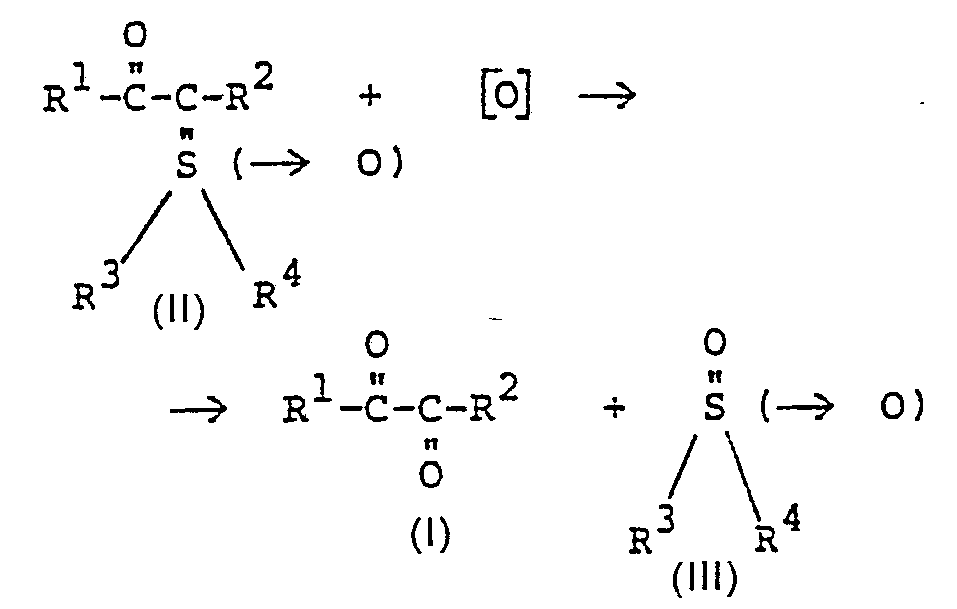
- vicinal polycarbonyl compounds of the formula can be used in which R 1 is an alkyl or aryl radical, the H 5 C 2 O radical, or an R 5 R 6 N radical in which R S represents an alkyl or aryl radical and R 6 represents a hydrogen atom or an alkyl radical and R 2 represents a hydrogen atom, an alkyl radical or a R I OC or R 7 OOC radical in which R represents an alkyl radical, by producing sulfur ylides of the formula in which the radicals R 3 and R 4 each represent alkyl or aryl radicals or both radicals R 3 and R 4 together represent an alkylene radical, photochemically with rose bengal (4,5,6,7-tetrachloro-2 ', 4', 5 ', 7'-tetraiodofluorescein) oxidized as sensitizers.
- the sulfur ylides of formula II are e.g. obtainable by the processes described in German Patent Nos. 1207379 and 1226561.
- alkyl radicals mean e.g. Alkyl radicals with 1 to 12, preferably 1 to 4 carbon atoms.
- Aryl residues are e.g. Phenyl radicals, e.g. can still be substituted by lower alkyl radicals, such as methyl or ethyl groups, or by halogen atoms.
- the ylides are photooxidized in the presence of rose bengal e.g. at temperatures up to 100 ° C, preferably at -20 to + 40 ° C.
- solvents are Water, low molecular weight alcohols, such as methanol and ethanol, low molecular weight acids, such as acetic acid, chlorinated hydrocarbons, such as methylene chloride, aromatics, such as benzene, chlorobenzene or toluene, ethers, low molecular weight ketones, such as acetone or mixtures of these solvents are suitable.
- the sensitizer is given e.g. B. dissolved in methanol or ethanol or the reaction solution in solid form.
- the end of the reaction can be easily determined by thin layer chromatography analysis of the unused ylid.
- the desired polycarbonyl compound can be easily separated from the sulfoxide and sulfone compound of the formula III by distillation, crystallization or extraction or by direct further reaction to give the desired end product. Hydrates, acetals and per Hydroxy adducts of the reaction products are optionally split by known methods.
- the carbon disulfide is distilled off at a bath temperature of 50 ° C., finally with the addition of methylene chloride. It is then concentrated in vacuo and 8.8 g of red oil are obtained, which consists of 80 to 90% of the mesoxalic acid monoethyl ester anilide after thin layer chromatography.
- the content is determined using the 2,4-dinitrophenylhydrazone (3.53 g, 16 mmol, 80% of theory) of the mesoxalic acid monoethyl ester anilide (mp. 208 to 210 ° C., CH 3 OH / CH 2 Cl 2 ).
- the main product is observed in the system Si0 2 / methylene chloride + 5% isopropanol / phenylglyoxal (Rf 0.59).
- the entire reaction mixture is filtered and 5.4 g (50 mmol) of o-phenylenediamine are added to the red colored filtrate.
- the phenylglyoxal reacts with rapid discoloration to dark brown red to 2-phenylquinoxaline (Rf 0.68, Si0 2 / methylene chloride + 5% isopropanol).
- the mixture is concentrated at 40 ° C. under vacuum and the solidifying brown oil is cleaned over 400 g of silica gel 60 using methylene chloride as the eluent.
- a yellow crystallizate is isolated, which melts at 77 to 78 ° C. after redissolving once from methanol. Yield 5.6 g of 2-phenylquinoxaline, which is 54.3% of theory based on the ylid used.
- the test for phenylglyoxal (Rf 0.59), methyl phenylglyoxylate (Rf 0.80) and benzoic acid (Rf 0.50) is carried out in the Si0 2 system , methylene chloride + 5% isopropanol.
- the TLC controls show the ester as the main product in addition to little acid and small amounts of phenylglyoxal and benzoic acid.
- the homogeneous, light red solution is concentrated on a rotary evaporator at 40 ° C until methanol is largely removed.
- An oil separates from the remaining volume of approx. 80 ml.
- the separating funnel is extracted with methylene chloride and dried over sodium sulfate. After concentration in vacuo at 40 ° C., 9.1 g of brown-red oil are obtained. To separate the residues, distillation is carried out in the Kugelrohr. 8.1 g of brown oil, KP 0.25, 70 to 110 ° C. jacket temperature are obtained.
- the reactor contents are freed of methanol at 40 ° C. on a rotary evaporator.
- the remaining alkaline, aqueous solution is washed with methylene chloride.
- the water phase is separated from the remaining solvent on a rotary evaporator.
- the pink solution is adjusted to pH 1 to 2 with ice cooling using hydrochloric acid.
- a pink solid substance precipitates, consisting of rose bengal and benzoic acid.
- the resulting triketone is detected by spraying the TLC plate with 2,4-dinitrophenylhydrazine solution as an orange spot with Rf 0.32.
- acetaldehyde is indicated.
- the bengal pink that fades during the photooxidation is replaced by the addition of several 0.1 g portions of the dye.
- the starting ylid is completely converted.
- the pale red solution is freed from most of the carbon disulphide by distillation on a rotary evaporator at normal pressure and 45 ° C. bath temperature. 100 ml of methylene chloride are added to the residue. Then it is evaporated again to completely remove the carbon disulfide. The remaining solvent and volatile components are then drawn off to a final pressure of 50 mbar.
- 29 g of the 2,3,4-triketopentane formed are obtained in the form of a brown-red solution as the evaporation residue.
- the 2,3,4-triketopentane is converted into the bis-2,4-dinitrophenylhydrazone.
- the evaporation residue is stirred with 400 ml of 2,4-dinitrophenylhydrazine solution (content 0.13 mmol.ml -1 ) at room temperature overnight.
- the solids formed are suction filtered and washed well with water.
- the brown-red residue is stirred in about 0.5 l of methylene chloride.
- the suspension is shaken vigorously with 200 ml of 1N sodium hydroxide solution.
- the rose bengal goes into solution as Na salt.
- the methylene chloride phase is washed three times with 1N sodium hydroxide solution and once with water.
- the organic phase is dried over sodium sulfate and, after filtration on a rotary evaporator, concentrated to about 200 ml.
- the solution is chromatographed over 350 g of silica gel, 0.04 to 0.2 mm, using methylene chloride as the eluent.
- the eluates are tested by thin layer chromatography, system Si0 2 , methylene chloride.
- the fractions which contain the component with the DC-Rf 0.30 in pure form are combined, concentrated on a rotary evaporator at 40 ° C. in vacuo and recrystallized from ethanol.
Landscapes
- Chemical & Material Sciences (AREA)
- Organic Chemistry (AREA)
- Engineering & Computer Science (AREA)
- Oil, Petroleum & Natural Gas (AREA)
- Organic Low-Molecular-Weight Compounds And Preparation Thereof (AREA)
Description
- Diese Erfindung betrifft ein Verfahren zur Herstellung von vicinalen Polycarbonylverbindungen durch Photooxidation von Schwefelyliden.
- Vicinale Polycarbonylverbindungen, wie 1,2-Di- und 1,2,3-Tricarbonylverbindungen, sind wichtige Ausgangsstoffe für die Herstellung heterocyclischer Verbindungen, die z.B. als Wirkstoffe für Arzneimittel oder Pflanzenschutzmittel oder als Zwischenprodukte für die Herstellung von Farbstoffen verwendet werden (s. u.a. "Chemical Reviews", 1975, Vol. 75, No. 2, S. 177 bis 202 und DE-OS Nr. 2710902, S. 25 bis 27).
- Nach den bisher bekannten Methoden lassen sich vicinale Polycarbonylverbindungen durch eine Oxidation der Methylengruppen der entsprechenden β-Dicarbonylverbindungen z.B. durch Behandlung mit Selendioxid ("Helv. Chimica Acta" 57, Fasc. 7 (1974), S. 2201 bis 2208) mit Nitrosoverbindungen oder mit Diazoniumsalzen ("Chemical Reviews", 1975, Vol. 75, No. 2, S. 178 und 184) herstellen. Diese Verfahren haben den grossen Nachteil des Einsatzes toxischer oder explosiver Substanzen. Nach den Angaben in "Chem. Ber." 115 (1982), S. 3032 bis 3041, kann man Schwefelylide, die bekanntlich von üblichen Oxidationsmitteln nicht angegriffen werden, durch Behandlung mit Ozon in die entsprechenden Keto-Verbindungen überführen. Diese Methode hat den Nachteil eines hohen Energieverbrauchs und des Bedarfs spezieller Apparaturen.
- Man hat auch schon versucht, Schwefelylide durch Photooxidation mit Methylenblau und Tetraphenylporphin als Sensibilisatoren in die gewünschten Keto-Verbindungen zu überführen. Dieses in "Photochemistry and Photobiology" 30 (1979), S. 81 bis 87 beschriebene Verfahren ist nicht auf alle Ylide anwendbar. So erhält man z. B. aus Bisacetyldimethylsulfonium-methylid lediglich Essigsäure und aus Phenacyldimethyl-sulfoniumylid nur Benzoesäure und Benzoesäuremethylester. Die Photooxidation mit Methylenblau hat auch den Nachteil längerer Reaktionszeiten, so dass ausbeutemindernde Folge- und Nebenreaktionen in den Vordergrund treten. Ausserdem wird mehr Energie benötigt und eine wesentlich schlechtere Raum-Zeit-Ausbeute erreicht.
- Da Schwefelylide leicht zugängliche Ausgangsstoffe darstellen, war nach einem Verfahren zu suchen, das es ermöglicht, diese Ausgangsstoffe nach einer allgemein anwendbaren vorteilhaften Methode in die gesuchten vicinalen Polycarbonylverbindungen zu überführen.
- Diese Aufgabe wurde durch das erfindungsgemässe Verfahren gelöst. Nach dem Verfahren der Erfindung kann man vicinale Polycarbonylverbindungen der Formel


- Das Verfahren der Erfindung lässt sich formelmässig so beschreiben:
- Die Schwefelylide der Formel II sind z.B. nach den in den deutschen Patentschriften Nrn. 1207379 und 1226561 beschriebenen Verfahren erhältlich.
- In den Schwefelyliden der Formel II bedeuten Alkylreste z.B. Alkylreste mit 1 bis 12, vorzugsweise 1 bis 4 C-Atomen. Arylreste sind z.B. Phenylreste, die z.B. noch durch niedere Alkylreste, wie Methyl- oder Ethylgruppen oder durch Halogenatome substituiert sein können.
- Man photooxidiert die Ylide in Gegenwart von Bengalrosa z.B. bei Temperaturen bis 100°C, vorzugsweise bei -20 bis +40°C. Als Lösungsmittel sind z.B. Wasser, niedermolekulare Alkohole, wie Methanol und Ethanol, niedermolekulare Säuren, wie Essigsäure, Chlorkohlenwasserstoffe, wie Methylenchlorid, Aromaten, wie Benzol, Chlorbenzol oder Toluol, Ether, niedermolekulare Ketone, wie Aceton oder Mischungen dieser Lösungsmittel geeignet. Den Sensibilisator gibt man z. B. in Methanol oder Ethanol gelöst bzw. der Reaktionslösung in fester Form zu.
- Das Reaktionsende lässtsich leicht durch dünnschichtchromatographische Analyse des unverbrauchten Ylids bestimmen. Von der Sulfoxid- und Sulfonverbindung der Formel III lässt sich die gewünschte Polycarbonylverbindung leicht durch Destillation, Kristallisation oder Extraktion bzw. durch direkte Weiterreaktion zum gewünschten Endprodukt abtrennen. Hydrate, Acetale und Perhydroxy-addukte der Reaktionsprodukte werden gegebenenfalls durch bekannte Methoden gespalten.
- Nach dem neuen Verfahren erhält man die vicinalen Polycarbonylverbindungen glatt und in guter Ausbeute. Dieses vorteilhafte Ergebnis war nicht zu erwarten. So ist nämlich im Fortschritte der "Chem. Forschung" Band 9 (1968), S. 506 angegeben, dass sich die Schwefelylide der Formel mit Wasserstoffperoxid nicht oxidieren lassen.
- In einem 1-I-Photoreaktor, der einen 150 Watt Hg-Hochdruckbrenner in einem wassergekühlten Pyrex-Tauchschacht enthält, werden 9,7 g (44 mmol) N,N-Dimethylcarbamoyl-äthoxy- carbonyl-dimethylsulfoniumylid und 0,2 g Bengalrosa in 600 ml Ethanol gelöst. Die tiefrote Lösung wird bei 12°C gerührt und nach Einschalten des Brenners mit 20 I/h Sauerstoff begast. Nach 1 h ist kein Ausgangsylid mehr nachweisbar (DC). Der hellrote, homogene Reaktorinhalt wird eingeengt (Rotationsverdampfer, 45° C Badtemperatur, 20 Torr). Der Rückstand wird im Kugelrohr destilliert. Man erhält 5,86 g (33,8 mmol), 77% d.Th.) N,N-Dimethyl-carbamoyloxalsäure-ethylester.
- H-NMR (80 MHz, CDCI3), t 1,30 (3H, -OCH3CH3), s 3,10 (6H, NCH3), q 4,40 (2H, -OCH2-CH3).
- Man gibt in den in Beispiel 1 beschriebenen Photoreaktor 400 ml Schwefelkohlenstoff und 150 ml Ethanol. Es wird auf 10° C gekühlt und mit 50 I O2/h unter Rühren begast Innerhalb von 15 Minuten wird die Lösung von 5,4 g (20 mmol) N-Phenylcarbamoyl-ethoxycarbonyl-dimethylsulfoniummethylid und 0,5 g Bengalrosa in 110 ml Ethanol zugegeben. Da der Farbstoff verblasst, werden alle 30 Minuten weitere 0,1 g Bengalrosa zugegeben. Nach 4 Stunden ist alles Ylid oxidiert. Der Schwefelkohlenstoff wird bei 50°C Badtemperatur abdestilliert, zuletzt unter Zusatz von Methylenchlorid. Man engt dann im Vakuum ein und erhält 8,8 g rotes Öl, das nach der Dünnschichtchromatographie zu 80 bis 90% aus dem Mesoxalsäuremonoethylesteranilid besteht.
- Die Gehaltsbestimmung erfolgt über das 2,4-Dinitrophenylhydrazon (3,53 g, 16 mmol, 80% d.Th.) des Mesoxalsäuremonoethylesteranilids (Schmp. 208 bis 210°C, CH3OH/CH2Cl2).
- H-NMR (80 MHz, CDCI3): t 1,47 ppm (3H, -OCH2-CH3), q 4,45 ppm (2H, -OCH2-CH3), m 7,08-8,6 ppm (8H, aromatische Protonen), 11,0 ppm und 15,8 ppm (je 1 NH).
-

- In einem 200 ml Photoreaktor, der einen 125 Watt Hg-Hochdruckbrenner (Philipps 125 HPK) enthält, werden 3,8 g (20 mmol) Acetylethoxycarbonyl-dimethylsulfonium-methylid in 120 ml Schwefelkohlenstoff und 15 ml Methanol gelöst und unter Zusatz von 0,3 g Bengalrosa 1 ½ h mit 50 I O2/h begast. Der dabei entstandene Acetyloxalethylester wird in situ mit 20 mmol Benzamidrazon (gelöst in 50 ml Ethanol) umgesetzt. Nach 17 h bei 23° C engt man ein und gewinnt durch Destillation bei 150° C/0,4 Torr und anschliessende Kristallisation aus Ligroin (20 ml) 1,1 g (52% d.Th.) 3-Phenyl-5-methyl-6-ethoxycarbonyl-1,2,4-triazin mit Schmp. 72-73°C.
- H-NMR (80 MHz, CDCI3): t 1,5 ppm (3H, -OCH2CH3), s 2,85 ppm (3H, CH3-Triazin), q 4,60 ppm (2H, -OCH2CH3), m 7,6 ppm (3H, Phenyl), m 8,6 ppm (2H, Phenyl).
-

- 97,4g (450 mmol) Acetylethoxycarbonyl-tetramethylen-sulfoniummethylid und 0,9 g Bengalrosa werden in 150 ml Ethanol und 850 ml Schwefelkohlenstoff gelöst. Man kühlt auf -15°C und begast im Photoreaktor (s. Beispiel 1 ) mit 50 I 02/h.
- Nach 9 h 45 min ist das Ylid völlig verbraucht (DC-Kontrolle). Der Schwefelkohlenstoff wird sorgfältig abdestilliert, dann werden bei 80°C/ 5 Torr alle flüchtigen Bestandteile abgezogen. Man erhält 52,2 g des rohen Acetyloxalethylesters als braunes Öl. Die Gehaltsbestimmung nimmt man über das Bis-2,4-Dinitrophenylhydrazon vor. Die Ausbeute beträgt 73,8% d.Th.
- Man gibt 100 ml Schwefelkohlenstoff und 20 ml Diethylether in den in Beispiel 3 beschriebenen Photoreaktor und bestrahlt unter einem Sauerstoffstrom von 40 I/h. Nach 5 min beginnt man die Lösung von 4,4 g (20 mmol) Diethoxycarbonyldimethylsulfonium-methylid in 20 ml Methanol und 100 mg Bengalrosa zuzugeben. Der ausbleichende Farbstoff wird durch insgesamt 400 mg frisches Bengalrosa portionsweise während der Reaktionsdauer von 150 min ersetzt. 30 min nach Ende der Ylidzugabe ist dieses völlig umgesetzt und die Reaktion wird gestoppt. Durch Abdestillieren der Lösungsmittel erhält man 6,1 g rotes Öl mit festen Anteilen. Man destilliert im Kugelrohr bei 120 bis 125° C/14 mbar und erhält 81,6% d.Th. an Mesoxalsäureethylester (bestimmt als 2,4-Dinitrophenylhydrazon, Schmp. 116 bis 117°C).
- Der in Beispiel 1 beschriebene Photoreaktor wird mit einer Lösung von 10,3 g (50 mmol) Benzoyl-tetramethylensulfonium-methylid und 0,3 g Bengalrosa in 750 ml Methanol beschickt. Bei 12°C und unter Rühren werden in 3 h 1501 Sauerstoff über eine Fritte durch die tiefrote Reaktionslösung geleitet. Durch Dünnschichtchromatographie (System Si02, n-Butanol, Wasser, Essigsäure = 4:1:1) lässt sich kein Ausgangsylid (Rf 0,17) nachweisen. Als Reaktionsprodukte werden Phenylglyoxylsäure (Rf 0,60) und deren Methylester (Rf 0,95) festgestellt. Als Hauptprodukt beobachtet man im System Si02/Methylenchlorid + 5% Isopropanol/Phenylglyoxal (Rf 0,59). Der gesamte Reaktionsansatz wird filtriert und das rotgefärbte Filtrat mit 5,4 g (50 mmol) o- Phenylendiamin versetzt. Unter rascher Verfärbung nach Dunkelbraunrot reagiert das Phenylglyoxal zu 2-Phenylchinoxalin (Rf 0,68, Si02/Methylenchio- rid + 5% Isopropanol).
- Man engt bei 40°C unter Vakuum ein und reinigt das erstarrende braune Öl über 400 g Kieselgel 60 mit Methylenchlorid als Laufmittel. Man isoliert ein gelbes Kristallisat, das nach einmaligem Umlösen aus Methanol bei 77 bis 78° C schmilzt. Ausbeute 5,6 g 2-Phenylchinoxalin, das sind 54,3% d.Th. bezogen auf eingesetztes Ylid.
- Man gibt in den in Beispiel 1 beschriebenen Photoreaktor 750 ml Methanol und 0,2 g Bengalrosa und leitet 5 Minuten unter Belichtung Sauerstoff ein. Dann werden 0,3 g Bengalrosa, 13,1 g (50 mmol) Phenacyldimethylsulfoniumbromid in 150 ml Methanol und 50 ml 1 n Natronlauge zugetropft (Zulaufgeschwindigkeit 80 ml.h-1). Die Reaktorinnentemperatur erreicht durch Eiskühlung 12 bis 15°C. Der Reaktionsverlauf wird dünnschichtchromatographisch verfolgt. Der Test auf Ausgangsylid (Rf0,15) und die gebildete Phenylglyoxylsäure (Rf 0,60) erfolgt im System Si02, n-Butanol, Wasser, Essigsäure = 4:1:1. Der Test auf Phenylglyoxal (Rf 0,59), Phenylglyoxylsäuremethylester (Rf 0,80) und Benzoesäure (Rf 0,50) erfolgt im System Si02, Methylenchlorid + 5% Isopropanol.
- Nach 2¾ h Zulaufzeit und½ h Nachreaktion ist das Ausgangsmaterial vollständig umgesetzt.
- Die DC-Kontrollen zeigen als Hauptprodukt den Ester neben wenig Säure und geringen Mengen Phenylglyoxal und Benzoesäure.
- Die homogene, hellrote Lösung wird am Rotationsverdampfer bei 40° C eingeengt, bis Methanol weitgehend entfernt ist. Aus dem Restvolumen von ca. 80 ml scheidet sich ein Öl ab. Im Scheidetrichter wird mit Methylenchlorid extrahiert und über Natriumsulfat getrocknet. Nach Einengen im Vakuum bei 40° C erhält man 9,1 g braunrotes Öl. Zur Rückstandstrennung wird im Kugelrohr destilliert. Man erhält 8,1 g braunes Öl, KP0,25 70 bis 110°C Manteltemperatur. Nach Feindestillation erhält man 4,7 g (28,6 mmol) Phenylglyoxylsäuremethylester (57,2% d.Th.) als farbloses Öl mit Siedepunkt 77 bis 80°C/0,3 mbar.
- 14,4 g (50 mmol) Phenacyl-tetramethylensulfonium-bromid werden in 250 ml Wasser gelöst und mit 60 ml 2n Natronlauge versetzt. Im Photoreaktor (s. Beispiel 1) mischt man dazu 500 mt Methanol und 0,3 g Bengalrosa. Man leitet während der Bestrahlung Sauerstoff durch die Lösung. Nach 1½ h Bestrahlung bei 15°C sind 75 I O2 durchgeleitet und das Ausgangsmaterial vollständig umgesetzt. Die DC-Kontrolle erfolgt im System Si02, n-Butanol, Wasser, Essigsäure = 4:1:1. Ylid-Rf 0,17; Phenylglyoxylsäure-Rf 0,60 ist als Hauptprodukt entstanden.
- Der Reaktorinhalt wird bei 40°C am Rotationsverdampfer von Methanol befreit. Die verbleibende alkalische, wässerige Lösung wird mit Methylenchlorid gewaschen. Die Wasserphase wird am Rotationsverdampfer vom restlichen Lösungsmittel getrennt. Die rosafarbene Lösung wird bei Eiskühlung mit Salzsäure auf pH 1 bis 2 gestellt. Dabei fällt eine rosafarbene Festsubstanz aus, die aus Bengalrosa und Benzoesäure besteht.
- Zum gerührten sauren Filtrat werden 5,4 g (50 mmol) Phenylhydrazin getropft, dabei fällt ein gelbbrauner Festkörper aus. Er wird nach 2 h abgesaugt, mit Wasser gewaschen und aus Methanol/Wasser umkristallisiert. Nach Trocknen im Vakuum erhält man 6,1 g (25,4 mmol = 50,8% d.Th.) Phenylglyoxylsäure-phenylhydrazon, Fp. 166 bis 167°C.
- In dem in Beispiel 1 beschriebenen Photoreaktor werden 4,0 g (25 mmol) Bisacetyl-dimethylsulfonium-methylid und 0,8 g Bengalrosa in 100 ml Ethanol gelöst und mit 700 ml Schwefelkohlenstoff gemischt. Der tiefrote Reaktorinhalt wird durch Aussenkühlung auf 4°C gekühlt. Die Photooxidation wird bei 4 bis 7°C im Sauerstoffstrom von 50 lh-1 durchgeführt. Die dünnschichtchromatographische Reaktionskontrolle im System Si02, Methylenchlorid + 5% Isopropanol zeigt den Umsatz des Ausgangsmaterials (Rf 0,10) an. Das entstehende Triketon wird durch Besprühen der DC-Platte mit 2,4-Dinitrophenylhydrazin-Lösung als orangefarbener Fleck mit Rf 0,32 nachgewiesen. Als Nebenprodukt wird Acetaldehyd angezeigt. Das während der Photooxidation verblassende Bengalrosa wird durch Zugabe von mehreren 0,1 g-Portionen des Farbstoffes ersetzt. Nach 4 Stunden ist das Ausgangsylid vollständig umgesetzt. Die blassrote Lösung wird durch Destillation am Rotationsverdampfer bei Normaldruck und 45°C Badtemperatur von der Hauptmenge des Schwefelkohlenstoffs befreit. Zum Rückstand werden 100 ml Methylenchlorid gegeben. Dann wird erneut abgedampft um den Schwefelkohlenstoff vollständig zu entfernen. Das restliche Lösungsmittel und leicht flüchtige Anteile werden dann bis zu einem Enddruck von 50 mbar abgezogen. Es werden als Eindampfrückstand 29 g des gebildeten 2,3,4-Triketopentans in Form einer braunroten Lösung erhalten. Zur Isolierung wird das 2,3,4-Triketopentan in das bis-2,4-Dinitrophenylhydrazon überführt. Dazu wird der Eindampfrückstand mit 400 ml 2,4- Dinitrophenylhydrazin-Lösung (Gehalt 0,13 mmol.ml-1) bei Raumtemperatur über Nacht gerührt. Die gebildeten Festkörper werden abgesaugt und gut mit Wasser gewaschen. Der braunrote Rückstand wird in etwa 0,5 I Methylenchlorid gerührt. Die Suspension wird mit 200 ml 1 n Natronlauge intensiv geschüttelt. Das Bengalrosa geht dabei als Na-Salz in Lösung. Nach der Phasentrennung im Scheidetrichter wird die Methylenchloridphase dreimal mit 1 n Natronlauge und einmal mit Wasser gewaschen. Die organische Phase wird über Natriumsulfat getrocknet und nach der Filtration am Rotationsverdampfer auf ca. 200 ml eingeengt. Zur Reinigung des Produktes wird die Lösung über 350 g Kieselgel, 0,04 bis 0,2 mm, mit Methylenchlorid als Laufmittel chromatographiert. Die Eluate werden dünnschichtchromatographisch getestet, System Si02, Methylenchlorid. Die Fraktionen, welche die Komponente mit dem DC-Rf 0,30 in reiner Form enthalten, werden vereinigt, am Rotationsverdampfer bei 40° C im Vakuum eingeengt und aus Ethanol umkristallisiert.
- Man erhält 4,1 g (8,6 mmol) 2,3,4-Triketopentan-bis-2',4'-dinitrophenylhydrazon (34,5% d.Th.), Fp. 195°C Zers.
-

- In dem im Beispiel 1 beschriebenen Photoreaktor werden 22,0 g (100 mmol) Diethoxycarbonyldimethylsulfoniummethylid in 120 ml Ethanol und 750 ml Schwefelkohlenstoff gelöst und mit 2,14 mmol (0,8 g) Methylenblau (Merck 6040) versetzt. Bei 12 bis 15° C werden 40 I/Std Sauerstoff unter Bestrahlung eingegast (Tauchfritte). Durch Dünnschichtchromatographie (System Mack 5719 (Si02), Methylenchlorid + 5% Isopropanol) wird die Umwandlung des Ylids kontrolliert. Nach 8 Stunden sind 50%, nach 15 Stunden 100% umgesetzt. Man destilliert die Lösungsmittel bei 50°C zuletzt am Rotationsverdampfer ab und erhält 31,4 g eines dunkelblauen Öls, das über eine kurze Brücke, bei 14 Torr destilliert wird. Man erhält 19,7 g hellblaues Öl im Intervall von 95 bis 102°C. Die Gehaltsbestimmung erfolgt durch Fällung des 2,4-Dinitrophenylhydrazons des gebildeten Mesoxalesters.
- Man erhält 68,3% d.Th. in Form gelber Kristalle mit dem Schmelzpunkt 110 bis 111°C.
- Man verfährt wie im Absatz a) beschrieben, wobei man jedoch anstelle des Methylenblaus 1,6 mmol (1,6 g) Bengalrosa verwendet. Bereits nach 4% Stunden ist das Ausgangsylid vollständig umgesetzt und man bestimmt den Mesoxalester in 76%iger Ausbeute durch Fällung des 2,4-Dinitrophenylhydrazons (Schmelzpunkt 114 bis 115°C).
Claims (1)
- Verfahren zur Herstellung von vicinalen Polycarbonylverbindungen der Formel


Applications Claiming Priority (2)
| Application Number | Priority Date | Filing Date | Title |
|---|---|---|---|
| DE19833313917 DE3313917A1 (de) | 1983-04-16 | 1983-04-16 | Verfahren zur herstellung von vicinalen polycarbonylverbindungen |
| DE3313917 | 1983-04-16 |
Publications (2)
| Publication Number | Publication Date |
|---|---|
| EP0122576A1 EP0122576A1 (de) | 1984-10-24 |
| EP0122576B1 true EP0122576B1 (de) | 1985-11-06 |
Family
ID=6196642
Family Applications (1)
| Application Number | Title | Priority Date | Filing Date |
|---|---|---|---|
| EP84103945A Expired EP0122576B1 (de) | 1983-04-16 | 1984-04-09 | Verfahren zur Herstellung von vicinalen Polycarbonylverbindungen |
Country Status (2)
| Country | Link |
|---|---|
| EP (1) | EP0122576B1 (de) |
| DE (2) | DE3313917A1 (de) |
Family Cites Families (2)
| Publication number | Priority date | Publication date | Assignee | Title |
|---|---|---|---|---|
| DE573722C (de) * | 1931-05-13 | 1933-04-05 | Knoll Ag | Verfahren zur Darstellung von ª‡-Dicarbonylverbindungen |
| DE1226563B (de) * | 1964-10-30 | 1966-10-13 | Basf Ag | Verfahren zur Herstellung von Carbonylverbindungen |
-
1983
- 1983-04-16 DE DE19833313917 patent/DE3313917A1/de not_active Withdrawn
-
1984
- 1984-04-09 DE DE8484103945T patent/DE3460010D1/de not_active Expired
- 1984-04-09 EP EP84103945A patent/EP0122576B1/de not_active Expired
Also Published As
| Publication number | Publication date |
|---|---|
| EP0122576A1 (de) | 1984-10-24 |
| DE3313917A1 (de) | 1984-10-25 |
| DE3460010D1 (en) | 1985-12-12 |
Similar Documents
| Publication | Publication Date | Title |
|---|---|---|
| DE3219244C2 (de) | Sulfonatderivate, Verfahren zu ihrer Herstellung und diese Derivate enthaltende Arzneimittel | |
| CH618669A5 (de) | ||
| DE2846931C2 (de) | ||
| EP0036663A1 (de) | Oxiranbuttersäure-Derivate, ihre Herstellung und Verwendung, sowie diese enthaltende Arzneimittel | |
| DE2607305C2 (de) | 6-Oxo-6H-indeno[5,4-b]furan-2-carbonsäuren, Verfahren zu ihrer Herstellung und diese Verbindungen enthaltende Arzneimittel | |
| CH648554A5 (de) | Glycidylisocyanursaeureverbindungen. | |
| DE1934809A1 (de) | Neue Hydrazon-N-dithiocarbonsaeureester und Verfahren zur Herstellung derselben | |
| EP0122388B1 (de) | Verfahren zur Herstellung von vicinalen Polycarbonylverbindungen | |
| EP0122576A1 (de) | Verfahren zur Herstellung von vicinalen Polycarbonylverbindungen | |
| Odinokov et al. | Ozonolysis of alkenes and study of reactions of polyfunctional compounds: LXVI. 2* ozonolysis and hydrogenation of diacetonides of 24, 25-and 25, 26-anhydro-20-hydroxyecdysones. Synthesis of ponasterone A | |
| DE2813286A1 (de) | In 3'-stellung oxygenierte derivate von 4'-desoxy-vincaleukoblastin a und b sowie verwandte 1-formylverbindungen | |
| DE2230838A1 (de) | Auftrennung von dl-Campher-10-sulfonsäure | |
| CH454129A (de) | Verfahren zur Herstellung von Dibenzo-dihydrocycloheptenen | |
| EP0031562B1 (de) | Neue Oxazoline, deren Herstellung und die neuen Oxazoline enthaltende pharmazeutische Präparate | |
| DE1291740B (de) | 2, 4- bzw. 2, 6-Dihalogenbenzyl-methyl-sulfoxyde und Verfahren zu ihrer Herstellung | |
| DE1493105C3 (de) | Verfahren zum Entfernen von 3-(3-Oxo-17 beta-hydroxy-4,6-androstadien-17 alpha-yl)-propionsäuregamma-lacton aus dessen Lösung | |
| Howe | Reaction of nitrosobenzene with tetramethylallene | |
| DE2123418A1 (de) | Neue Verbindungen mit Insektenjuvenilhormonwirksamkeit | |
| AT336588B (de) | Verfahren zur herstellung von neuen 1-acyl-3- biphenylyl-propanonen | |
| DE2413189C2 (de) | Verfahren zur Herstellung von Benzohydrochinonen | |
| DE1695605A1 (de) | Verfahren zur Herstellung von Chinoxalin-N,N'-dioxyden | |
| AT346838B (de) | Verfahren zur herstellung von neuen optisch aktiven anthracyclinonen | |
| AT266824B (de) | Verfahren zur Herstellung von neuen Indolderivaten und ihren Salzen | |
| DE1643506C (de) | N hoch 1 Acylphenyl hydrazine, ihre Salze Verfahren zu ihrer Herstellung und diese Verbindungen enthaltende Arznei mittel Ausscheidung aus 1620441 | |
| AT247847B (de) | Verfahren zur Herstellung von neuen 5-(3'-Aminopropyliden)-5H-dibenzo [a, d] cycloheptenen bzw. den 10, 11-Dihydroderivaten derselben |
Legal Events
| Date | Code | Title | Description |
|---|---|---|---|
| PUAI | Public reference made under article 153(3) epc to a published international application that has entered the european phase |
Free format text: ORIGINAL CODE: 0009012 |
|
| 17P | Request for examination filed |
Effective date: 19840814 |
|
| AK | Designated contracting states |
Designated state(s): BE CH DE FR GB IT LI NL |
|
| GRAA | (expected) grant |
Free format text: ORIGINAL CODE: 0009210 |
|
| AK | Designated contracting states |
Designated state(s): BE CH DE FR GB IT LI NL |
|
| ITF | It: translation for a ep patent filed | ||
| REF | Corresponds to: |
Ref document number: 3460010 Country of ref document: DE Date of ref document: 19851212 |
|
| ET | Fr: translation filed | ||
| PLBE | No opposition filed within time limit |
Free format text: ORIGINAL CODE: 0009261 |
|
| STAA | Information on the status of an ep patent application or granted ep patent |
Free format text: STATUS: NO OPPOSITION FILED WITHIN TIME LIMIT |
|
| 26N | No opposition filed | ||
| PGFP | Annual fee paid to national office [announced via postgrant information from national office to epo] |
Ref country code: FR Payment date: 19910314 Year of fee payment: 8 |
|
| PGFP | Annual fee paid to national office [announced via postgrant information from national office to epo] |
Ref country code: CH Payment date: 19910315 Year of fee payment: 8 |
|
| PGFP | Annual fee paid to national office [announced via postgrant information from national office to epo] |
Ref country code: GB Payment date: 19910402 Year of fee payment: 8 |
|
| PGFP | Annual fee paid to national office [announced via postgrant information from national office to epo] |
Ref country code: BE Payment date: 19910409 Year of fee payment: 8 |
|
| PGFP | Annual fee paid to national office [announced via postgrant information from national office to epo] |
Ref country code: DE Payment date: 19910420 Year of fee payment: 8 |
|
| ITTA | It: last paid annual fee | ||
| PGFP | Annual fee paid to national office [announced via postgrant information from national office to epo] |
Ref country code: NL Payment date: 19910430 Year of fee payment: 8 |
|
| PG25 | Lapsed in a contracting state [announced via postgrant information from national office to epo] |
Ref country code: GB Effective date: 19920409 |
|
| PG25 | Lapsed in a contracting state [announced via postgrant information from national office to epo] |
Ref country code: LI Effective date: 19920430 Ref country code: CH Effective date: 19920430 Ref country code: BE Effective date: 19920430 |
|
| BERE | Be: lapsed |
Owner name: BASF A.G. Effective date: 19920430 |
|
| PG25 | Lapsed in a contracting state [announced via postgrant information from national office to epo] |
Ref country code: NL Effective date: 19921101 |
|
| GBPC | Gb: european patent ceased through non-payment of renewal fee | ||
| NLV4 | Nl: lapsed or anulled due to non-payment of the annual fee | ||
| PG25 | Lapsed in a contracting state [announced via postgrant information from national office to epo] |
Ref country code: FR Effective date: 19921230 |
|
| REG | Reference to a national code |
Ref country code: CH Ref legal event code: PL |
|
| PG25 | Lapsed in a contracting state [announced via postgrant information from national office to epo] |
Ref country code: DE Effective date: 19930101 |
|
| REG | Reference to a national code |
Ref country code: FR Ref legal event code: ST |