EP0121242B1 - Tintenpunktdrucker - Google Patents
Tintenpunktdrucker Download PDFInfo
- Publication number
- EP0121242B1 EP0121242B1 EP84103482A EP84103482A EP0121242B1 EP 0121242 B1 EP0121242 B1 EP 0121242B1 EP 84103482 A EP84103482 A EP 84103482A EP 84103482 A EP84103482 A EP 84103482A EP 0121242 B1 EP0121242 B1 EP 0121242B1
- Authority
- EP
- European Patent Office
- Prior art keywords
- ink
- magnetic ink
- needle
- end portion
- dot printer
- Prior art date
- Legal status (The legal status is an assumption and is not a legal conclusion. Google has not performed a legal analysis and makes no representation as to the accuracy of the status listed.)
- Expired
Links
- 230000014759 maintenance of location Effects 0.000 claims description 14
- 230000002940 repellent Effects 0.000 claims description 10
- 239000005871 repellent Substances 0.000 claims description 10
- 230000000717 retained effect Effects 0.000 claims description 10
- XLYOFNOQVPJJNP-UHFFFAOYSA-N water Substances O XLYOFNOQVPJJNP-UHFFFAOYSA-N 0.000 claims description 10
- 230000002093 peripheral effect Effects 0.000 claims description 5
- -1 polytetrafluoroethylene Polymers 0.000 claims description 3
- 229920001343 polytetrafluoroethylene Polymers 0.000 claims description 3
- 239000004810 polytetrafluoroethylene Substances 0.000 claims description 3
- 238000012986 modification Methods 0.000 description 9
- 230000004048 modification Effects 0.000 description 9
- XEEYBQQBJWHFJM-UHFFFAOYSA-N Iron Chemical compound [Fe] XEEYBQQBJWHFJM-UHFFFAOYSA-N 0.000 description 4
- 239000011248 coating agent Substances 0.000 description 2
- 238000000576 coating method Methods 0.000 description 2
- 229910052742 iron Inorganic materials 0.000 description 2
- 150000001875 compounds Chemical class 0.000 description 1
- 238000001035 drying Methods 0.000 description 1
- 238000012423 maintenance Methods 0.000 description 1
- 238000004519 manufacturing process Methods 0.000 description 1
- 238000000034 method Methods 0.000 description 1
Images



Classifications
-
- B—PERFORMING OPERATIONS; TRANSPORTING
- B41—PRINTING; LINING MACHINES; TYPEWRITERS; STAMPS
- B41J—TYPEWRITERS; SELECTIVE PRINTING MECHANISMS, i.e. MECHANISMS PRINTING OTHERWISE THAN FROM A FORME; CORRECTION OF TYPOGRAPHICAL ERRORS
- B41J2/00—Typewriters or selective printing mechanisms characterised by the printing or marking process for which they are designed
- B41J2/22—Typewriters or selective printing mechanisms characterised by the printing or marking process for which they are designed characterised by selective application of impact or pressure on a printing material or impression-transfer material
- B41J2/23—Typewriters or selective printing mechanisms characterised by the printing or marking process for which they are designed characterised by selective application of impact or pressure on a printing material or impression-transfer material using print wires
- B41J2/235—Print head assemblies
- B41J2/25—Print wires
- B41J2/255—Arrangement of the print ends of the wires
-
- B—PERFORMING OPERATIONS; TRANSPORTING
- B41—PRINTING; LINING MACHINES; TYPEWRITERS; STAMPS
- B41J—TYPEWRITERS; SELECTIVE PRINTING MECHANISMS, i.e. MECHANISMS PRINTING OTHERWISE THAN FROM A FORME; CORRECTION OF TYPOGRAPHICAL ERRORS
- B41J2/00—Typewriters or selective printing mechanisms characterised by the printing or marking process for which they are designed
- B41J2/22—Typewriters or selective printing mechanisms characterised by the printing or marking process for which they are designed characterised by selective application of impact or pressure on a printing material or impression-transfer material
- B41J2/23—Typewriters or selective printing mechanisms characterised by the printing or marking process for which they are designed characterised by selective application of impact or pressure on a printing material or impression-transfer material using print wires
- B41J2/305—Ink supply apparatus
Definitions
- the present invention relates to an ink-dot printer which comprises: a magnetic ink storage means storing magnetic ink; a pair of pole plates facing each other so as to define a slit, one end portion of which is contacted with the magnetic ink supplied from the magnetic ink storage means; a magnetic field generating means for magnetizing the pole plates, thereby feeding the magnetic ink from the magnetic ink storage means into the slit to form a magnetic ink curtain in the slit; and a plurality of needles arranged adjacent to one another along the longitudinal direction of the slit and adapted selectively to move in the longitudinal direction of each needle between a first position where one end portion of each needle is immersed in the magnetic ink curtain in the slit between the pole plates and a second position where the one end portion is projected from the magnetic ink curtain in the slit, and wherein the needles are selectively moved from the first position to the second position so that the end faces of the one end portions of the needles are brought into contact with a recording sheet as a recording
- Wire-dot printers and thermal printers are currently used.
- a plurality of needles is selectively driven so that the end faces of the distal end portions of the needles are caused to strike directly against pressure-sensitive manifold paper on a platen or to strike indirectly against recording paper on the platen through a printing ribbon, thereby forming a set of dots on the pressure-sensitive manifold paper or recording paper.
- the resulting set of dots constitutes a print which represents a symbol such as a character or figure.
- the printing of symbols on the pressure-sensitive manifold paper or recording paper produces a lot of noise.
- these printers only permit the use of pressure-sensitive manifold paper, and require expensive printing ribbons which must be frequently replaced.
- a first object of the invention is to provide an ink-dot printer capable of preventing magnetic ink from being retained by the surface tension between the distal end portions of two adjacent needles which are driven and projected simultaneously to form dots, thereby ensuring clear print without any noticeable spots.
- a second object of the invention is to provide an ink-dot printer capable of constantly applying sufficient magnetic inkto the end face of the distal end portion of a needle even though the single needle is repeatedly driven in a consecutive manner, thereby forming dots of a uniform density which makes a distinct print, as well as of the aforementioned function as the first object.
- the first object of the invention may be attained by an ink-dot printer which comprises: a magnetic ink storage means storing magnetic ink; a pair of pole plates facing each other so as to define a slit one end portion of which is contacted with the magnetic ink supplied from the magnetic ink storage means; a magnetic field generating means for magnetizing the pole plates, thereby feeding the magnetic ink from the magnetic ink storage means into the slit to form a magnetic ink curtain in the slit; a plurality of needles arranged adjacent to one another along the longitudinal direction of the slit and adapted selectively to move in the longitudinal direction thereof between a first position where one end portion of each needle is immersed in the magnetic ink curtain in the slit between the pole plates and a second position where the one end portion is projected from the magnetic ink curtain in the slit; and which is characterized by further comprising a magnetic ink retention preventing means which prevents the magnetic ink from being retained between the one end portions of any two adjacent needles by surface tension when the
- the magnetic ink retention preventing means may be formed by coating the peripheral surface of the respective one end portions of the needles with a water repellent.
- the magnetic ink retention preventing means may be manufactured at a very low cost.
- polytetrafluoroethylene is preferably used for the water repellent. This compound is high in durability, low-priced, and easily available.
- the magnetic field generating means is preferably an electromagnet.
- the magnetic ink can be fed into the slit between the pair of pole plates so that the one end portions of the needles in the first position are immersed in the magnetic ink in the slit only during the use of the ink-dot printer. Therefore, the magnetic ink can be prevented from drying in the slit, or from clinging to the surface of the slit or the one end portions of the needles while the printer is not in use.
- the magnetic ink retention preventing means may be formed by making the cross-sectional area of the one end portion of each needle narrower than that of the remaining portion of the needle so that the distance between the one end portions of each two adjacent needles is widened to prevent the magnetic ink from being retained between the portion adjacent to the end face of the one end portions by surface tension when the two needles are simultaneously located in the second position.
- the magnetic ink retention preventing means may be used indefinitely, and its maintenance may be much easier than in the case where water repellent is used for this purpose.
- the distance from the border between the one end portion and the remaining portion of each needle in the first position to the outer surface of the magnetic ink curtain in the slit facing the border is preferably greater than the distance between the first and second positions of the needle.
- the cross section of the one end portion of each needle may alternatively be formed as a semicircle or as a polygon.
- an ink-dot printer which comprises: magnetic ink storage means storing magnetic ink; a pair of pole plates facing each other so as to define a slit, one end portion of which is contacted with the magnetic ink supplied from the magnetic ink storage means; a magnetic field generating means for magnetizing the pole plates, thereby feeding the magnetic ink from the magnetic ink storage means into the slit to form a magnetic ink curtain in the slit; a plurality of needles arranged adjacent to one another along the longitudinal direction of the slit and adapted selectively to move in the longitudinal direction thereof between a first position where one end portion of each needle is immersed in the magnetic ink curtain in the slit between the pole plates and a second position where the one end portion is projected from the magnetic ink curtain in the slit; and which is characterized by further comprising a magnetic ink retention preventing means formed by making the cross-sectional area of the one end portion of each needle narrower than that of the
- the magnetic ink attracting means is preferably formed by magnetizing the one end portion of each needle.
- the one end portion of the needle can easily be magnetized at a low cost.
- the magnetic ink attracting means may be formed by burying a magnet in each end face of the one end portion of each needle, or by forming individual recesses in each end face of the one end portions of each needle.
- each recess may be a through hole extending in the longitudinal direction of each needle. This arrangement facilitates feeding magnetic ink into the recesses.
- a recording sheet 12 as a recording section is passed around a platen 10.
- a carriage 16 is disposed in front of the platen 10 so as to reciprocate along a guide shaft 14 which extends parallel to the platen 10.
- the carriage 16 is coupled with a driving wire 18, which is passed around the driving pulley 22 of a motor 20 and a driven pulley 24 spaced from the driving pulley 22 along the platen 10.
- the carriage 16 is mounted with a needle head 26 and an ink curtain forming unit 28.
- the ink curtain forming unit 28 has an electromagnetic coil 30 as an electromagnet at the upper portion thereof.
- a pair of pole plates 34 and 36 are coupled individually to both ends of the electromagnetic coil 30, facing each other to define a slit 32.
- the pole plates 34 and 36 extend downward from their corresponding ends of the electromagnetic coil 30 so that the-lower end portion of the slit 32 is contacted with magnetic ink 40 supplied from a magnetic ink storage means 38.
- magnetic ink 40 supplied from the magnetic ink storage means 38 is sucked into the slit 32 between the pole plates 34 and 36 to form a magnetic ink curtain 41 in the slit 32, as shown in Fig. 2.
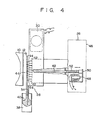
- each needle 42 shown in Fig. 4 Arranged in the slit 32 are distal end portions 44 of a plurality of needles 42 which adjoin one another along the longitudinal direction of the slit 32.
- the distal end portions 44 of the needles 42 are immersed in the magnetic ink curtain 41 in the slit 32, as shown in Fig. 3.
- the proximal end portions of the needles 42 extend into a cover 46 of the needle head 26, as shown in Fig. 4, and are supported by a conventional guide means so as to be movable along their longitudinal direction.
- the position of each needle 42 shown in Fig. 4 will hereinafter be referred to as its first position.
- a plurality of electromagnets 48 for driving the needles 42 are arranged in the cover 46 of the needle head 26.
- a moving iron 50 coupled to the proximal end of each corresponding needle 42 is set beside each corresponding electromagnet 48.
- the electromagnet 48 is energized, the moving iron 50 is attracted thereto against the urging force of a return spring 52 which is wound around the needle 42.
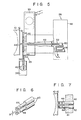
- the distal end portion 44 of the needle 42 is projected toward the recording sheet 12 on the platen 10 through the magnetic ink curtain 41 in the slit 32 so that the end face of the distal end portion 44 is brought into contact with the recorindg sheet 12, as shown in Fig. 5.
- the position of the needle 42 in contact with the recording sheet 12 will hereinafter be referred to as its second position.
- the cross-sectional area of the distal end portion 44 of each needle 42 is narrower than that of the remaining portion of the needle 42.
- the distal end portion 44 is magnetized so that magnetic ink 40 in the magnetic ink curtain 41 is coercively attached to it, especially its end face.
- a magnetic pole mark is illustrated such that only the distal end portion 44 is magnetized. This is only for ease in explanation. In the present technique, it is to be noted that the whole needle 42 will be magnetized.
- the cross-sectional area of the distal end portion 44 of each needle 42 is such that the distance X between the distal end portions 44 of each two adjacent needles 42 is long enough to prevent magnetic ink 40 from being retained between the distal end portions 44 by surface tension when the two distal end portions 44 are simultaneously located in the second position, as shown in Fig. 7.
- one needle 42 may be consecutively driven many times (e.g., in forming the crossbar of the character H).
- magnetic ink 40 in the magnetic ink curtain 41 in the slit 32 is rapidly attracted to the distal end portion 44 of the needle 42 to be coercively attached to the end face of the distal end portion 44, since the distal end portion 44 is magnetized.
- the amount of magnetic ink 40 applied to the end face of the distal end portion 44 of the needle 42 is always sufficient and does not gradually decrease. Therefore, the amount of magnetic ink 40 transferred to the recording sheet 12 is kept constant, so that the density or depth of dots formed by the consecutively repeated drive of even a single needle 42 will be uniform, ensuring a clear.print.
- each needle 42 is narrower in its cross-sectional area than the remaining portion of the needle 42, while the distance between the distal end portions 44 of any two adjacent needles 42 is wide. Therefore, magnetic ink 40 will never be retained between the distal end portions 44 of the two adjacent needles 42 by surface tension when the two needles 42 are simultaneously located in the second position, as shown in Fig. 7. Thus, even though two adjacent needles 42 are concurrently located in the second position shown in Figs. 5 and 7 (e.g., in forming a vertical line of the character H), only that portion of magnetic ink 40 which is applied to the end faces of the distal end portions 44 of the two needles 42 is transferred to the recording sheet 12, ensuring a clear print.
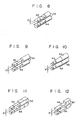
- the cross section of the distal end portion 44 of each needle 42 is not limited to the circular shape as shown in Fig. 6. It may be substantially semicircular (Fig. 8) or square (Fig. 9). Alternatively, it may be formed into a triangular, pentagonal, hexagonal or other polygonal configuration. Also, the distal end portion 44 of each needle 42 may be in the form of a truncated cone whose cross-sectional area gradually increases inward from its end face along the longitudinal direction, as shown in Fig. 10. Further, the cross-sectional area of the remaining portion of each needle 42 may be square, as shown in Fig. 11. As a modification of the structure of Fig. 11, only one of the four peripheral sides of the distal end portion 44 may be cut so that the cross-sectional area of the distal end portion 44 is narrower than that of the remaining portion, as shown in Fig. 12.
- a permanent magnet 54 may be buried in the end face of the distal end portion 44 of each needle 42 to form a magnetic ink attracting means for causing magnetic ink 40 to be coercively attached to the end face of the distal end portion 44.
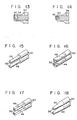
- the end face of the permanent magnet 54 may be located flush with that of the distal end portion 44, as shown in Fig. 13, or the former may be projected from the latter, as shown in Fig. 14.
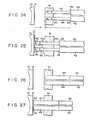
- the magnetic ink attracting means may be recesses 56 formed individually in the end faces of the needles 42 with various cross-sectional shapes, as shown in Figs. 15 to 20, or may be formed by burying the permanent magnet 54 in each recess 56, as shown in Fig. 21.
- the density of dots will not be lowered gradually even though the dots are formed by consecutively driving a single needle 42.
- the magnets 54 buried in the recesses 56 will ensure the coercive seizure of magnetic ink 40 in the recesses 56.
- the recesses 56 may be each in the form of a through hole extending in the longitudinal direction of the needle 42. In this case, no air resistance, or no air cushion, is produced in the recesses 56, so that magnetic ink 40 can more quickly be caught in the recesses 56.
- the distance L from the border 58 between the distal end portion 44 and the remaining portion of each needle 42 in the first position to the outer surface 60 of the magnetic ink curain 41 in the slit 32 facing the border 58 can be made greater than the distance D between the first and second positions of the needle 42, as shown in Fig. 24.
- the magnetic ink retention preventing means may be formed by coating the peripheral surface of the respective distal end portions 44 of the needles 42 with a water repellent.
- the distal end portion 44 may be magnetized, a recess may be formed in the end face of the distal end portion 44, or a permanent magnet may be buried in the end face.
- Polytetrafluoroethylene is preferably used for the water repellent.
- the water repellent of this type is relatively high in durability, low-priced, and easily available.
Landscapes
- Impact Printers (AREA)
Claims (20)
gekennzeichnet durch
gekennzeichnet durch
Applications Claiming Priority (6)
| Application Number | Priority Date | Filing Date | Title |
|---|---|---|---|
| JP56983/83 | 1983-04-01 | ||
| JP5698383A JPS59182750A (ja) | 1983-04-01 | 1983-04-01 | インクドツトプリンタ |
| JP6422983A JPS59188448A (ja) | 1983-04-12 | 1983-04-12 | インクドツトプリンタ |
| JP6423083A JPS59188449A (ja) | 1983-04-12 | 1983-04-12 | インクドツトプリンタ |
| JP64230/83 | 1983-04-12 | ||
| JP64229/83 | 1983-04-12 |
Publications (3)
| Publication Number | Publication Date |
|---|---|
| EP0121242A2 EP0121242A2 (de) | 1984-10-10 |
| EP0121242A3 EP0121242A3 (en) | 1985-05-02 |
| EP0121242B1 true EP0121242B1 (de) | 1987-06-16 |
Family
ID=27296103
Family Applications (1)
| Application Number | Title | Priority Date | Filing Date |
|---|---|---|---|
| EP84103482A Expired EP0121242B1 (de) | 1983-04-01 | 1984-03-29 | Tintenpunktdrucker |
Country Status (3)
| Country | Link |
|---|---|
| US (1) | US4562446A (de) |
| EP (1) | EP0121242B1 (de) |
| DE (1) | DE3464224D1 (de) |
Families Citing this family (3)
| Publication number | Priority date | Publication date | Assignee | Title |
|---|---|---|---|---|
| US4599629A (en) * | 1983-06-10 | 1986-07-08 | Tokyo Electric Co., Ltd. | Magnetic ink dot printer with means for controlling print density |
| JPS6090771A (ja) * | 1983-10-26 | 1985-05-21 | Tokyo Electric Co Ltd | インクドツトプリンタ− |
| CA1292316C (en) * | 1986-09-05 | 1991-11-19 | Robert H. Whisker | Postal meter system |
Family Cites Families (3)
| Publication number | Priority date | Publication date | Assignee | Title |
|---|---|---|---|---|
| IT1119164B (it) * | 1979-09-19 | 1986-03-03 | Olivetti & Co Spa | Dispositivo di stampa ad impatto |
| DE3174800D1 (en) * | 1980-06-17 | 1986-07-24 | Seiko Epson Corp | A wire dot printer |
| JPS57188382A (en) * | 1981-05-15 | 1982-11-19 | Ricoh Co Ltd | Ink type wire printer |
-
1984
- 1984-03-23 US US06/592,573 patent/US4562446A/en not_active Expired - Fee Related
- 1984-03-29 DE DE8484103482T patent/DE3464224D1/de not_active Expired
- 1984-03-29 EP EP84103482A patent/EP0121242B1/de not_active Expired
Also Published As
| Publication number | Publication date |
|---|---|
| EP0121242A3 (en) | 1985-05-02 |
| US4562446A (en) | 1985-12-31 |
| EP0121242A2 (de) | 1984-10-10 |
| DE3464224D1 (en) | 1987-07-23 |
Similar Documents
| Publication | Publication Date | Title |
|---|---|---|
| US3820643A (en) | Recorder head for compound alphanumeric characters and code characters | |
| EP0121242B1 (de) | Tintenpunktdrucker | |
| EP0156547B1 (de) | Punktdruckkopf | |
| EP0140658A2 (de) | Punktdrucker | |
| EP0065102B1 (de) | Hammer und Druckelemente in einem Punktmatrixdrucker | |
| EP0210636B1 (de) | Zusammenbau elektromagnetischer Betätiger für die Hämmer von Schlagdruckern | |
| EP0117123B1 (de) | Tintenzufuhr für einen Punktdrucker | |
| EP0129165B1 (de) | Tintenpunktdrucker | |
| JPH0324347B2 (de) | ||
| JP3021750B2 (ja) | ドットラインプリンタ印刷機構 | |
| JPS5857971A (ja) | ドツトプリンタ用印字ヘツド | |
| EP0581463B1 (de) | Punktnadeldruckkopf | |
| JPS6364766A (ja) | 印字ヘツド | |
| JPS63295271A (ja) | ドットプリンタ | |
| EP0128557A2 (de) | Tintenpunktdrucker | |
| JP2855792B2 (ja) | ドットラインプリンタ | |
| JPS59190864A (ja) | インクドツトプリンタ | |
| JPH0445891Y2 (de) | ||
| JP3565721B2 (ja) | 積層型ワイヤドット印字ヘッド | |
| JPH0717484Y2 (ja) | 2段式印字ヘッド | |
| JPS5942968A (ja) | 印字ヘツド | |
| JPS604075A (ja) | ドツトプリンタ | |
| JPH0321966Y2 (de) | ||
| JPS6010860Y2 (ja) | ドット印字ヘッド | |
| JPS59182749A (ja) | インクドツトプリンタ |
Legal Events
| Date | Code | Title | Description |
|---|---|---|---|
| PUAI | Public reference made under article 153(3) epc to a published international application that has entered the european phase |
Free format text: ORIGINAL CODE: 0009012 |
|
| 17P | Request for examination filed |
Effective date: 19840329 |
|
| AK | Designated contracting states |
Designated state(s): DE FR GB |
|
| PUAL | Search report despatched |
Free format text: ORIGINAL CODE: 0009013 |
|
| AK | Designated contracting states |
Designated state(s): DE FR GB |
|
| 17Q | First examination report despatched |
Effective date: 19860807 |
|
| GRAA | (expected) grant |
Free format text: ORIGINAL CODE: 0009210 |
|
| AK | Designated contracting states |
Kind code of ref document: B1 Designated state(s): DE FR GB |
|
| REF | Corresponds to: |
Ref document number: 3464224 Country of ref document: DE Date of ref document: 19870723 |
|
| ET | Fr: translation filed | ||
| PLBE | No opposition filed within time limit |
Free format text: ORIGINAL CODE: 0009261 |
|
| STAA | Information on the status of an ep patent application or granted ep patent |
Free format text: STATUS: NO OPPOSITION FILED WITHIN TIME LIMIT |
|
| 26N | No opposition filed | ||
| PGFP | Annual fee paid to national office [announced via postgrant information from national office to epo] |
Ref country code: FR Payment date: 19930215 Year of fee payment: 10 |
|
| PGFP | Annual fee paid to national office [announced via postgrant information from national office to epo] |
Ref country code: GB Payment date: 19930319 Year of fee payment: 10 |
|
| PGFP | Annual fee paid to national office [announced via postgrant information from national office to epo] |
Ref country code: DE Payment date: 19930528 Year of fee payment: 10 |
|
| PG25 | Lapsed in a contracting state [announced via postgrant information from national office to epo] |
Ref country code: GB Effective date: 19940329 |
|
| GBPC | Gb: european patent ceased through non-payment of renewal fee |
Effective date: 19940329 |
|
| PG25 | Lapsed in a contracting state [announced via postgrant information from national office to epo] |
Ref country code: FR Effective date: 19941130 |
|
| PG25 | Lapsed in a contracting state [announced via postgrant information from national office to epo] |
Ref country code: DE Effective date: 19941201 |
|
| REG | Reference to a national code |
Ref country code: FR Ref legal event code: ST |