EP0110159B1 - Kontaktklebstoffe - Google Patents
Kontaktklebstoffe Download PDFInfo
- Publication number
- EP0110159B1 EP0110159B1 EP83110815A EP83110815A EP0110159B1 EP 0110159 B1 EP0110159 B1 EP 0110159B1 EP 83110815 A EP83110815 A EP 83110815A EP 83110815 A EP83110815 A EP 83110815A EP 0110159 B1 EP0110159 B1 EP 0110159B1
- Authority
- EP
- European Patent Office
- Prior art keywords
- contact adhesive
- rubber
- adhesive according
- polyurethane
- adhesives
- Prior art date
- Legal status (The legal status is an assumption and is not a legal conclusion. Google has not performed a legal analysis and makes no representation as to the accuracy of the status listed.)
- Expired
Links
- 239000004821 Contact adhesive Substances 0.000 title claims description 15
- 229920001971 elastomer Polymers 0.000 claims description 11
- 239000005060 rubber Substances 0.000 claims description 11
- 229920003225 polyurethane elastomer Polymers 0.000 claims description 10
- 150000001875 compounds Chemical class 0.000 claims description 9
- 125000002887 hydroxy group Chemical group [H]O* 0.000 claims description 8
- ISWSIDIOOBJBQZ-UHFFFAOYSA-M phenolate Chemical compound [O-]C1=CC=CC=C1 ISWSIDIOOBJBQZ-UHFFFAOYSA-M 0.000 claims description 7
- 229940031826 phenolate Drugs 0.000 claims description 7
- ISWSIDIOOBJBQZ-UHFFFAOYSA-N Phenol Chemical compound OC1=CC=CC=C1 ISWSIDIOOBJBQZ-UHFFFAOYSA-N 0.000 claims description 5
- 229910052751 metal Inorganic materials 0.000 claims description 5
- 239000002184 metal Substances 0.000 claims description 5
- 229920002635 polyurethane Polymers 0.000 claims description 5
- 239000004814 polyurethane Substances 0.000 claims description 5
- 229920000915 polyvinyl chloride Polymers 0.000 claims description 5
- 239000004800 polyvinyl chloride Substances 0.000 claims description 5
- 239000007787 solid Substances 0.000 claims description 4
- 229910052782 aluminium Inorganic materials 0.000 claims description 3
- XAGFODPZIPBFFR-UHFFFAOYSA-N aluminium Chemical compound [Al] XAGFODPZIPBFFR-UHFFFAOYSA-N 0.000 claims description 3
- RTAQQCXQSZGOHL-UHFFFAOYSA-N Titanium Chemical compound [Ti] RTAQQCXQSZGOHL-UHFFFAOYSA-N 0.000 claims description 2
- QCWXUUIWCKQGHC-UHFFFAOYSA-N Zirconium Chemical compound [Zr] QCWXUUIWCKQGHC-UHFFFAOYSA-N 0.000 claims description 2
- 239000011521 glass Substances 0.000 claims description 2
- 239000010985 leather Substances 0.000 claims description 2
- 229920001568 phenolic resin Polymers 0.000 claims description 2
- 239000005011 phenolic resin Substances 0.000 claims description 2
- 239000004753 textile Substances 0.000 claims description 2
- 239000010936 titanium Substances 0.000 claims description 2
- 229910052719 titanium Inorganic materials 0.000 claims description 2
- OPSWAWSNPREEFQ-UHFFFAOYSA-K triphenoxyalumane Chemical compound [Al+3].[O-]C1=CC=CC=C1.[O-]C1=CC=CC=C1.[O-]C1=CC=CC=C1 OPSWAWSNPREEFQ-UHFFFAOYSA-K 0.000 claims description 2
- 229910052726 zirconium Inorganic materials 0.000 claims description 2
- KXGFMDJXCMQABM-UHFFFAOYSA-N 2-methoxy-6-methylphenol Chemical compound [CH]OC1=CC=CC([CH])=C1O KXGFMDJXCMQABM-UHFFFAOYSA-N 0.000 claims 1
- 239000004411 aluminium Substances 0.000 claims 1
- 229910010272 inorganic material Inorganic materials 0.000 claims 1
- 239000011147 inorganic material Substances 0.000 claims 1
- 239000011368 organic material Substances 0.000 claims 1
- 239000000853 adhesive Substances 0.000 description 19
- 230000001070 adhesive effect Effects 0.000 description 19
- ZWEHNKRNPOVVGH-UHFFFAOYSA-N 2-Butanone Chemical compound CCC(C)=O ZWEHNKRNPOVVGH-UHFFFAOYSA-N 0.000 description 15
- -1 hydrocarbon radicals Chemical class 0.000 description 7
- 239000012948 isocyanate Substances 0.000 description 7
- 150000002513 isocyanates Chemical class 0.000 description 7
- XEKOWRVHYACXOJ-UHFFFAOYSA-N Ethyl acetate Chemical compound CCOC(C)=O XEKOWRVHYACXOJ-UHFFFAOYSA-N 0.000 description 6
- YXFVVABEGXRONW-UHFFFAOYSA-N Toluene Chemical compound CC1=CC=CC=C1 YXFVVABEGXRONW-UHFFFAOYSA-N 0.000 description 6
- 239000000203 mixture Substances 0.000 description 6
- 230000004913 activation Effects 0.000 description 5
- XLYOFNOQVPJJNP-UHFFFAOYSA-N water Substances O XLYOFNOQVPJJNP-UHFFFAOYSA-N 0.000 description 5
- 239000002313 adhesive film Substances 0.000 description 4
- 150000004707 phenolate Chemical class 0.000 description 4
- 150000002989 phenols Chemical class 0.000 description 4
- 239000002904 solvent Substances 0.000 description 4
- YMWUJEATGCHHMB-UHFFFAOYSA-N Dichloromethane Chemical compound ClCCl YMWUJEATGCHHMB-UHFFFAOYSA-N 0.000 description 3
- LFQSCWFLJHTTHZ-UHFFFAOYSA-N Ethanol Chemical compound CCO LFQSCWFLJHTTHZ-UHFFFAOYSA-N 0.000 description 3
- OKKJLVBELUTLKV-UHFFFAOYSA-N Methanol Chemical compound OC OKKJLVBELUTLKV-UHFFFAOYSA-N 0.000 description 3
- QORUGOXNWQUALA-UHFFFAOYSA-N N=C=O.N=C=O.N=C=O.C1=CC=C(C(C2=CC=CC=C2)C2=CC=CC=C2)C=C1 Chemical compound N=C=O.N=C=O.N=C=O.C1=CC=C(C(C2=CC=CC=C2)C2=CC=CC=C2)C=C1 QORUGOXNWQUALA-UHFFFAOYSA-N 0.000 description 3
- 150000001298 alcohols Chemical class 0.000 description 3
- 125000004432 carbon atom Chemical group C* 0.000 description 3
- 239000003795 chemical substances by application Substances 0.000 description 3
- 229920003986 novolac Polymers 0.000 description 3
- JWAZRIHNYRIHIV-UHFFFAOYSA-N 2-naphthol Chemical compound C1=CC=CC2=CC(O)=CC=C21 JWAZRIHNYRIHIV-UHFFFAOYSA-N 0.000 description 2
- 239000004215 Carbon black (E152) Substances 0.000 description 2
- 229920000459 Nitrile rubber Polymers 0.000 description 2
- YRKCREAYFQTBPV-UHFFFAOYSA-N acetylacetone Chemical compound CC(=O)CC(C)=O YRKCREAYFQTBPV-UHFFFAOYSA-N 0.000 description 2
- 239000000654 additive Substances 0.000 description 2
- 125000000217 alkyl group Chemical group 0.000 description 2
- NTXGQCSETZTARF-UHFFFAOYSA-N buta-1,3-diene;prop-2-enenitrile Chemical compound C=CC=C.C=CC#N NTXGQCSETZTARF-UHFFFAOYSA-N 0.000 description 2
- 125000000484 butyl group Chemical group [H]C([*])([H])C([H])([H])C([H])([H])C([H])([H])[H] 0.000 description 2
- 238000001816 cooling Methods 0.000 description 2
- JHIVVAPYMSGYDF-UHFFFAOYSA-N cyclohexanone Chemical compound O=C1CCCCC1 JHIVVAPYMSGYDF-UHFFFAOYSA-N 0.000 description 2
- 238000002845 discoloration Methods 0.000 description 2
- 239000006185 dispersion Substances 0.000 description 2
- XYIBRDXRRQCHLP-UHFFFAOYSA-N ethyl acetoacetate Chemical compound CCOC(=O)CC(C)=O XYIBRDXRRQCHLP-UHFFFAOYSA-N 0.000 description 2
- 229930195733 hydrocarbon Natural products 0.000 description 2
- ZXEKIIBDNHEJCQ-UHFFFAOYSA-N isobutanol Chemical compound CC(C)CO ZXEKIIBDNHEJCQ-UHFFFAOYSA-N 0.000 description 2
- 239000000463 material Substances 0.000 description 2
- 125000002496 methyl group Chemical group [H]C([H])([H])* 0.000 description 2
- 229920001084 poly(chloroprene) Polymers 0.000 description 2
- 229920001228 polyisocyanate Polymers 0.000 description 2
- 239000005056 polyisocyanate Substances 0.000 description 2
- 235000013824 polyphenols Nutrition 0.000 description 2
- 230000005855 radiation Effects 0.000 description 2
- GHMLBKRAJCXXBS-UHFFFAOYSA-N resorcinol Chemical compound OC1=CC=CC(O)=C1 GHMLBKRAJCXXBS-UHFFFAOYSA-N 0.000 description 2
- 229920003051 synthetic elastomer Polymers 0.000 description 2
- 239000005061 synthetic rubber Substances 0.000 description 2
- DAOVYDBYKGXFOB-UHFFFAOYSA-N tris(2-methylpropoxy)alumane Chemical compound [Al+3].CC(C)C[O-].CC(C)C[O-].CC(C)C[O-] DAOVYDBYKGXFOB-UHFFFAOYSA-N 0.000 description 2
- VPWNQTHUCYMVMZ-UHFFFAOYSA-N 4,4'-sulfonyldiphenol Chemical class C1=CC(O)=CC=C1S(=O)(=O)C1=CC=C(O)C=C1 VPWNQTHUCYMVMZ-UHFFFAOYSA-N 0.000 description 1
- QHPQWRBYOIRBIT-UHFFFAOYSA-N 4-tert-butylphenol Chemical compound CC(C)(C)C1=CC=C(O)C=C1 QHPQWRBYOIRBIT-UHFFFAOYSA-N 0.000 description 1
- 229930185605 Bisphenol Natural products 0.000 description 1
- LRHPLDYGYMQRHN-UHFFFAOYSA-N N-Butanol Chemical class CCCCO LRHPLDYGYMQRHN-UHFFFAOYSA-N 0.000 description 1
- IGFHQQFPSIBGKE-UHFFFAOYSA-N Nonylphenol Natural products CCCCCCCCCC1=CC=C(O)C=C1 IGFHQQFPSIBGKE-UHFFFAOYSA-N 0.000 description 1
- ATUOYWHBWRKTHZ-UHFFFAOYSA-N Propane Chemical class CCC ATUOYWHBWRKTHZ-UHFFFAOYSA-N 0.000 description 1
- WDJHALXBUFZDSR-UHFFFAOYSA-N acetoacetic acid Chemical class CC(=O)CC(O)=O WDJHALXBUFZDSR-UHFFFAOYSA-N 0.000 description 1
- 230000001476 alcoholic effect Effects 0.000 description 1
- 125000003118 aryl group Chemical group 0.000 description 1
- 238000006243 chemical reaction Methods 0.000 description 1
- 238000009833 condensation Methods 0.000 description 1
- 230000005494 condensation Effects 0.000 description 1
- 150000001896 cresols Chemical class 0.000 description 1
- 125000000753 cycloalkyl group Chemical group 0.000 description 1
- 125000000113 cyclohexyl group Chemical group [H]C1([H])C([H])([H])C([H])([H])C([H])(*)C([H])([H])C1([H])[H] 0.000 description 1
- 238000001035 drying Methods 0.000 description 1
- 230000000694 effects Effects 0.000 description 1
- 125000001495 ethyl group Chemical group [H]C([H])([H])C([H])([H])* 0.000 description 1
- 239000004744 fabric Substances 0.000 description 1
- 238000010438 heat treatment Methods 0.000 description 1
- 125000004435 hydrogen atom Chemical group [H]* 0.000 description 1
- 230000007062 hydrolysis Effects 0.000 description 1
- 238000006460 hydrolysis reaction Methods 0.000 description 1
- 125000001449 isopropyl group Chemical group [H]C([H])([H])C([H])(*)C([H])([H])[H] 0.000 description 1
- 238000004519 manufacturing process Methods 0.000 description 1
- 238000002844 melting Methods 0.000 description 1
- 230000008018 melting Effects 0.000 description 1
- WSFSSNUMVMOOMR-NJFSPNSNSA-N methanone Chemical compound O=[14CH2] WSFSSNUMVMOOMR-NJFSPNSNSA-N 0.000 description 1
- 229920003052 natural elastomer Polymers 0.000 description 1
- 239000000025 natural resin Substances 0.000 description 1
- 229920001194 natural rubber Polymers 0.000 description 1
- SNQQPOLDUKLAAF-UHFFFAOYSA-N nonylphenol Chemical compound CCCCCCCCCC1=CC=CC=C1O SNQQPOLDUKLAAF-UHFFFAOYSA-N 0.000 description 1
- 125000002347 octyl group Chemical group [H]C([*])([H])C([H])([H])C([H])([H])C([H])([H])C([H])([H])C([H])([H])C([H])([H])C([H])([H])[H] 0.000 description 1
- 239000003960 organic solvent Substances 0.000 description 1
- 239000004014 plasticizer Substances 0.000 description 1
- 229920001225 polyester resin Polymers 0.000 description 1
- 239000004645 polyester resin Substances 0.000 description 1
- 150000008442 polyphenolic compounds Chemical class 0.000 description 1
- BDERNNFJNOPAEC-UHFFFAOYSA-N propan-1-ol Chemical compound CCCO BDERNNFJNOPAEC-UHFFFAOYSA-N 0.000 description 1
- 235000013849 propane Nutrition 0.000 description 1
- 125000001436 propyl group Chemical group [H]C([*])([H])C([H])([H])C([H])([H])[H] 0.000 description 1
- 230000035484 reaction time Effects 0.000 description 1
- 239000012744 reinforcing agent Substances 0.000 description 1
- 229920005989 resin Polymers 0.000 description 1
- 239000011347 resin Substances 0.000 description 1
- 229920003987 resole Polymers 0.000 description 1
- 238000005728 strengthening Methods 0.000 description 1
- 150000003505 terpenes Chemical group 0.000 description 1
- 235000007586 terpenes Nutrition 0.000 description 1
- 231100000331 toxic Toxicity 0.000 description 1
- 231100000167 toxic agent Toxicity 0.000 description 1
- 230000002588 toxic effect Effects 0.000 description 1
- MYWQGROTKMBNKN-UHFFFAOYSA-N tributoxyalumane Chemical compound [Al+3].CCCC[O-].CCCC[O-].CCCC[O-] MYWQGROTKMBNKN-UHFFFAOYSA-N 0.000 description 1
- AAAQKTZKLRYKHR-UHFFFAOYSA-N triphenylmethane Chemical compound C1=CC=CC=C1C(C=1C=CC=CC=1)C1=CC=CC=C1 AAAQKTZKLRYKHR-UHFFFAOYSA-N 0.000 description 1
- 238000005292 vacuum distillation Methods 0.000 description 1
Classifications
-
- C—CHEMISTRY; METALLURGY
- C09—DYES; PAINTS; POLISHES; NATURAL RESINS; ADHESIVES; COMPOSITIONS NOT OTHERWISE PROVIDED FOR; APPLICATIONS OF MATERIALS NOT OTHERWISE PROVIDED FOR
- C09J—ADHESIVES; NON-MECHANICAL ASPECTS OF ADHESIVE PROCESSES IN GENERAL; ADHESIVE PROCESSES NOT PROVIDED FOR ELSEWHERE; USE OF MATERIALS AS ADHESIVES
- C09J175/00—Adhesives based on polyureas or polyurethanes; Adhesives based on derivatives of such polymers
- C09J175/04—Polyurethanes
-
- C—CHEMISTRY; METALLURGY
- C08—ORGANIC MACROMOLECULAR COMPOUNDS; THEIR PREPARATION OR CHEMICAL WORKING-UP; COMPOSITIONS BASED THEREON
- C08K—Use of inorganic or non-macromolecular organic substances as compounding ingredients
- C08K5/00—Use of organic ingredients
- C08K5/04—Oxygen-containing compounds
- C08K5/13—Phenols; Phenolates
-
- C—CHEMISTRY; METALLURGY
- C08—ORGANIC MACROMOLECULAR COMPOUNDS; THEIR PREPARATION OR CHEMICAL WORKING-UP; COMPOSITIONS BASED THEREON
- C08K—Use of inorganic or non-macromolecular organic substances as compounding ingredients
- C08K5/00—Use of organic ingredients
- C08K5/04—Oxygen-containing compounds
- C08K5/13—Phenols; Phenolates
- C08K5/138—Phenolates
-
- C—CHEMISTRY; METALLURGY
- C08—ORGANIC MACROMOLECULAR COMPOUNDS; THEIR PREPARATION OR CHEMICAL WORKING-UP; COMPOSITIONS BASED THEREON
- C08L—COMPOSITIONS OF MACROMOLECULAR COMPOUNDS
- C08L61/00—Compositions of condensation polymers of aldehydes or ketones; Compositions of derivatives of such polymers
- C08L61/04—Condensation polymers of aldehydes or ketones with phenols only
- C08L61/06—Condensation polymers of aldehydes or ketones with phenols only of aldehydes with phenols
-
- C—CHEMISTRY; METALLURGY
- C08—ORGANIC MACROMOLECULAR COMPOUNDS; THEIR PREPARATION OR CHEMICAL WORKING-UP; COMPOSITIONS BASED THEREON
- C08L—COMPOSITIONS OF MACROMOLECULAR COMPOUNDS
- C08L75/00—Compositions of polyureas or polyurethanes; Compositions of derivatives of such polymers
- C08L75/04—Polyurethanes
-
- C—CHEMISTRY; METALLURGY
- C08—ORGANIC MACROMOLECULAR COMPOUNDS; THEIR PREPARATION OR CHEMICAL WORKING-UP; COMPOSITIONS BASED THEREON
- C08L—COMPOSITIONS OF MACROMOLECULAR COMPOUNDS
- C08L2666/00—Composition of polymers characterized by a further compound in the blend, being organic macromolecular compounds, natural resins, waxes or and bituminous materials, non-macromolecular organic substances, inorganic substances or characterized by their function in the composition
- C08L2666/02—Organic macromolecular compounds, natural resins, waxes or and bituminous materials
- C08L2666/14—Macromolecular compounds according to C08L59/00 - C08L87/00; Derivatives thereof
- C08L2666/16—Addition or condensation polymers of aldehydes or ketones according to C08L59/00 - C08L61/00; Derivatives thereof
-
- C—CHEMISTRY; METALLURGY
- C08—ORGANIC MACROMOLECULAR COMPOUNDS; THEIR PREPARATION OR CHEMICAL WORKING-UP; COMPOSITIONS BASED THEREON
- C08L—COMPOSITIONS OF MACROMOLECULAR COMPOUNDS
- C08L2666/00—Composition of polymers characterized by a further compound in the blend, being organic macromolecular compounds, natural resins, waxes or and bituminous materials, non-macromolecular organic substances, inorganic substances or characterized by their function in the composition
- C08L2666/28—Non-macromolecular organic substances
- C08L2666/34—Oxygen-containing compounds, including ammonium and metal salts
Definitions
- Contact adhesives are adhesives based on mostly synthetic rubbers such as polyurethane rubber, polychloroprene rubber or butadiene-acrylonitrile rubber, which are mainly used in the form of organic solutions, occasionally also as aqueous dispersions. To improve the performance properties, these rubbers are mixed with artificial or natural resins. This is the rule for polychloroprene adhesives and, to an increasing extent, for polyurethane adhesives and butadiene-acrylonitrile adhesives.
- polyisocyanates mostly triphenylmethane triisocyanate
- reinforcers to increase the relatively low heat resistance.
- the strengthening effect of isocyanates brings about the desired increase in heat resistance.
- Isocyanates have a limited shelf life and are sensitive to water. They place special demands on the composition of the solvents. These must not contain any active hydrogen atoms, especially no hydroxyl groups. Isocyanates are highly toxic compounds that also tend die Solutions the gain of polyurethane Kauts d iuken most suitable polyisocyanates based on triphenylmethane both per se as well as in adhesives discoloration.
- such adhesives reinforced with isocyanates offer disadvantages because the adhesive film can be activated only for a short time. This means the following: after the solvent has evaporated, contact adhesives lose their tack after some time, which can be between a few minutes and several hours. H. they tie off. The stickiness can be restored by heat activation, for example by brief exposure to infrared radiation. With some adhesives, this activation can take practically unlimited time, but the tests are usually stopped after four weeks, which is practical. In the case of polyurethane adhesives reinforced with isocyanate, however, only a limited activability is possible, generally only up to 24 h, but at most 2 d. This is of course a disadvantage.
- the object of the present invention is to improve the performance properties, in particular the bond strength under heat, of contact adhesives based on polyurethane rubbers. According to the invention, this is achieved by adding 2.5 to 100, preferably 5 to 60% by weight, based on solid rubber, of a phenolate of titanium, zirconium and / or preferably of aluminum to the rubber solutions.
- the proposal according to the invention brings about reinforced contact adhesives based on polyurethane rubbers customary for this purpose, eg. B. the "Desmocoll types (Bayer AG) and the Elastostic types (BASF AG) that improve the stickiness, the activatability compared to the previously known polyurethane rubbers significantly extended and discoloration is largely or completely avoided.
- a very important advantage of the invention is that, in contrast to the isocyanates previously used as reinforcing agents, the metal phenolates which are used to reinforce the adhesive are not toxic and are insensitive to organic solvents containing water and hydroxyl groups. They can therefore also be used in the form of aqueous dispersions.
- the phenolates which are usually resinous, are expediently prepared by reacting the corresponding metal alcoholates with phenols, by treating the metal alcoholate with the phenol under reduced pressure, the alcohol component escaping.
- the phenol which can be used is phenol itself, bisphenols such as diphenylolmethanes and / or propanes, resorcinol, a- and ⁇ -naphthol, the isomeric cresols or mono- or polyhydric phenols whose hydrocarbon radicals are 1 to 20 preferably 1 to 12 carbon atoms and together advantageously have a maximum of 20 carbon atoms, including those polyphenols as used in the condensation of phenols. with oxo connections (Navolake).
- the hydrocarbon radicals can be an alkyl, cycloalkyl, aryl or aralkyl radical, that is to say e.g. As methyl, ethyl, propyl, the various butyl, octyl and nony residues, further cyclohexyl and terpene residues, the unsubstituted or substituted by alkyl such as methyl, isopropyl or one of the butyl residues or the phenylethylidene residue obtained by styrenization.
- Compounds with cycloalkyl radicals are e.g. B. resinous terpene phenols. Aluminum phenolates of polyhydric phenols are preferred.
- 1,3-dioxo compounds such as acetylacetone, especially with acetoacetic acid esters of monohydric alcohols, e.g. B. those with 1 to 20, preferably 1 to 4 carbon atoms.
- the dioxo compound can be present in an amount up to coordinative saturation, but also in an even larger amount, which then acts as a solvent.
- the contact adhesives reinforced according to the invention contain the customary solvents such as ethyl acetate, methyl ethyl ketone, toluene or mixtures thereof. Like the adhesives that are subsequently reinforced with isocyanates, they are two-component adhesives. The mixture has a limited lifespan. This processing time, known as pot life, can be extended in the usual way for the adhesives according to the invention by adding compounds which contain alcoholic or phenolic hydroxyl groups.
- polyester resins containing hydroxyl groups and preferably Phe are suitable Novolak or resol type resins in an amount of up to 100, preferably 5 to 60, in particular 10 to 45,% by weight of the rubber.
- the z. B. in an amount up to 20, preferably 2 to 10 wt .-% of rubber can be used.
- the use of the compounds containing hydroxyl groups, especially phenolic resins, also improves the stickiness of the adhesive films, without the heat resistance suffering as a result.
- the contact adhesives according to the invention are suitable for bonding a wide variety of materials such as polyvinyl chloride, leather, rubber based on natural and synthetic rubber, textiles of natural or synthetic origin, polyurethane or glass. Fabrics with a plasticizer content can also be glued.
- the invention therefore also relates to the use of the contact adhesives according to the invention for bonding materials of the most varied types.
- d means days, h hours, T parts by weight and% by weight.
- Phenolate A - 20.4 parts of a solution of aluminum triisobutylate in isobutanol with a content of 80.1% aluminum triisobutylate or 9.9% aluminum with 14.3 were in a reaction vessel, which was provided with a stirrer, thermometer and device for vacuum distillation T acetoacetic ester and 47.5 T 4,4'-diphenylolpropane added and heated to 150 ° C in a vacuum of the water jet pump. This resulted in 21.2 T of distillate. After a reaction time of four hours at 150 ° C., the vacuum was released, the mixture was allowed to cool and the mixture was dissolved in 40.0 T of methyl ethyl ketone while cooling.
- Phenolate B- In the apparatus described under A, 20.2 parts of the triisobutylate solution mentioned therein were mixed with 14.2 parts of ethyl acetoacetate, 45.8 parts of paraiso-octylphenol were added and, as under A, in a water jet vacuum at 150 ° C. for 4 hours responds. Then was dissolved as in A in 40.0 T methyl ethyl ketone. 100 T of a solution were obtained which, with a residue of 60% (1 h / 135 ° C.), had a viscosity of 20 mPa.s / 20 ° C.
- Phenolate C - 41.3 parts of a 65.4% solution of aluminum tri-n-butoxide and 57.0 parts of para-tert-butylphenol were in the apparatus described under A in the manner described there for 6 hours at 170 ° C reacted with one another in a water jet vacuum and then dissolved as in A in 40.0 T cyclohexanone. 100 T of a solution were obtained which, with a residue of 60% (1 h / 135 ° C.), had a viscosity of 7 mPas / 20 ° C.
- An adhesive was produced as in Example 1, with 10% phenolate A or 10% triphenylmethane triisocyanate and alternatively with a modified novolak of 4,4'-diphenylolpropane, nonylphenol and formaldehyde, as described in DE-AS No. 2365834 Resin B is described (melting point 107 ° C.).
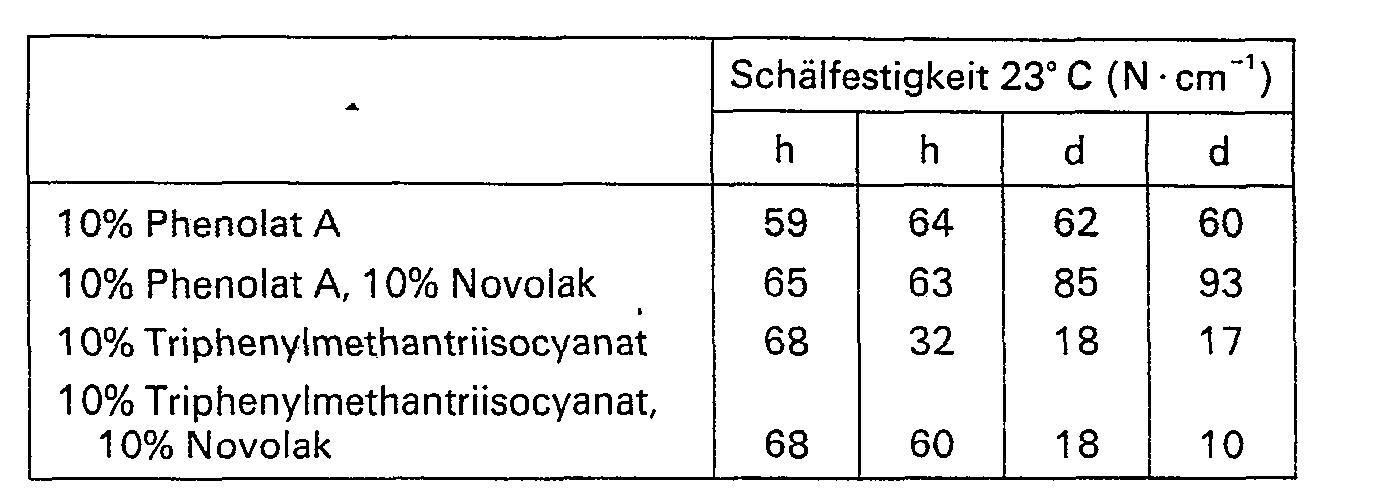
- Adhesive films were produced on soft PVC and after various periods of storage of the coated PVC after activation by infrared radiation, which lasted 3 s, adhesive bonds were produced. As the table below shows, the adhesives according to the invention have practically unchanged or even increased peel strengths even when activated after long storage, that is to say they have a long activatability.
- Example 3 The polyurethane rubber solution mentioned in Example 1 was provided with the additives indicated in the table below and tested by adhesive technology as in Example 1, specifically after 28 days or the optimum time.
- the novolak was identical to that mentioned in Example 2.
- Example 4 The polyurethane rubber solution mentioned in Example 1 was provided with the additives indicated in the table below and tested by adhesive technology as in Example 1. The bonds were made once after 20 minutes flashing at 23 ° C and the other time after 6 hours flashing off at 23 ° C and subsequent infrared activation.
Landscapes
- Chemical & Material Sciences (AREA)
- Organic Chemistry (AREA)
- Health & Medical Sciences (AREA)
- Chemical Kinetics & Catalysis (AREA)
- Medicinal Chemistry (AREA)
- Polymers & Plastics (AREA)
- Adhesives Or Adhesive Processes (AREA)
- Compositions Of Macromolecular Compounds (AREA)
- Polyurethanes Or Polyureas (AREA)
Description
- Kontaktklebstoffe sind Klebstoffe auf Basis von meist synthetischen Kautschuken wie Polyurethankautschuk, Polychloroprenkautschuk oder Butadien-Acrylnitril-Kautschuk, die hauptsächlich in Form organischer Lösungen, gelegentlich auch als wässerige Dispersionen angewendet werden. Zur Verbesserung der Gebrauchseigenschaften werden diese Kautschuke mit künstlichen oder natürlichen Harzen versetzt. Bei Polychloroprenklebstoffen ist das die Regel und bei Polyurethanklebstoffen sowie Butadien-AcryInitril-Klebstoffen in zunehmendem Masse der Fall.
- Bei Polyurethankautschuken verwendet man zur Erhöhung der relativ niedrigen Wärmefestigkeit als Verstärker häufig Polyisocyanate, meist Triphenylmethantriisocyanat. Die verstärkende Wirkung von Isocyanaten bewirkt die gewünschte Erhöhung der Wärmefestigkeit. Das wird aber durch eine Reihe von Nachteilen erkauft. Isocyanate haben nur eine begrenzte Lagerfähigkeit und sind wasserempfindlich. Sie stellen an die Zusammensetzung der Lösemittel besondere Anforderungen. Diese dürfen keine aktiven Wasserstoffatome, insbesondere keine Hydroxylgruppen enthalten. Isocyanate sind hochtoxische Verbindungen, ausserdem neigen diefür die Verstärkung von Polyurethankautsdiuken am besten geeigneten Polyisocyanate auf Basis von Triphenylmethan sowohl für sich als auch in Klebstoffen zu Verfärbungen.
- In klebtechnischer Hinsicht bieten solche mit Isocyanaten verstärkten Klebstoffe Nachteile wegen der nur kurze Zeit dauernden Aktivierbarkeit des Klebfilms. Darunter ist folgendes zu verstehen: Kontaktklebstoffe verlieren nach Abdunsten der Lösemittel nach einiger Zeit, die zwischen einigen Minuten und mehreren Stunden liegen kann, ihre Klebrigkeit, d. h. sie binden ab. Die Klebrigkeit kann durch Wärmeaktivierung, beispielsweise durch kurzfristige Einwirkung von Infrarotstrahlung,wiederhergestelltwerden. DieseAktivierbarkeit kann bei manchen Klebstoffen praktisch unbegrenzt lange dauern, man bricht die Prüfungen aber gewöhnlich nach vier Wochen ab, was praxisgerecht ist. Bei mit Isocyanat verstärkten Polyurethanklebstoffen ist jedoch nur eine beschränkte Aktivierbarkeitmöglich, und zwar in der Regel nur bis 24 h, höchstens jedoch 2 d. Das stellt natürlich einen Nachteil dar.
- Die Aufgabe vorliegender Erfindung besteht in der Verbesserung der Gebrauchseigenschaften, insbesondere der Bindefestigkeit in der Wärme, von Kontaktklebstoffen auf Basis von Polyurethan-Kautschuken. Diese wird erfindungsgemäss dadurch erzielt, dass man den Kautschuk-Lösungen 2,5 bis 100, vorzugsweise 5 bis 60 Gew.-%, bezogen auf festen Kautschuk, eines Phenolats des Titans, Zirkons und/oder vorzugsweise des Aluminiums zugibt.
- Der erfindungsgemässe Vorschlag bewirkt bei verstärkten Kontaktklebstoffen auf Basis von für diesen Zweck üblichen Polyurethan-Kautschuken, z. B. den "Desmocoll-Typen (Firma Bayer AG) und den Elastostic-Typen (Firma BASF AG), dass die Klebrigkeit verbessert, die Aktivierbarkeit im Vergleich zu den bisher bekannten Polyurethan-Kautschuken wesentlich verlängert und eine Verfärbung weitgehend oder vollständig vermieden wird.
- Ein ganz wesentlicher Vorteil der Erfindung besteht darin, dass die Metallphenolate, die zur Verstärkung des Klebstoffs herangezogen werden, im Gegensatz zu den bisher als Verstärkungsmittel verwendeten Isocyanaten nicht toxisch und gegen Wasser und Hydroxylgruppen enthaltende organische Lösemittel unempfindlich sind. Sie sind daher auch in Form wässeriger Dispersionen anwendbar.
- Die Phenolate, die meistens harzartig sind, werden zweckmässig durch Umsetzung der entsprechenden Metallalkoholate mit Phenolen hergestellt, indem das Metallalkoholat mit dem Phenol unter vermindertem Druck behandelt wird, wobei die Alkoholkomponente entweicht. Als Phenol können Phenol selbst, Bisphenole wie Diphenylolmethane und/oder -propane, Resorcin, a- und β-Naphthol, die isomeren Kresole oder ein-, zwei-oder dreifach durch Kohlenwasserstoffreste substituierte ein- oder mehrwertige Phenole, deren Kohlenwasserstoffreste 1 bis 20, vorzugsweise 1 bis 12 C-Atome und zusammen vorteilhaft höchstens 20 C-Atomen haben, verwendet werden, einschliesslich solchen Polyphenolen, wie sie bei der Kondensation von Phenolen. mit Oxo-Verbindungen entstehen (Navolake). Die Kohlenwasserstoffreste kön,nen Alkyl -, Cycloalkyl, Aryl- oder Aralkylreste sein, also z. B. Methyl, Äthyl, Propyl, die verschiedenen Butyl-, Octyl- und Nonytreste, ferner Cyclohexyl- und Terpenreste, der unsubstituierte oder durch Alkyl wie Methyl, Isopropyl oder einen der Butylreste substituierte Phenylrest oder der durch Styrolisierung erhaltene Phenyläthylidenrest. Verbindungen mit Cycloalkylresten sind z. B. harzartige Terpenphenole. Aluminiumphenolate mehrwertiger Phenole sind bevorzugt.
- Zur Verbesserung der Hydrolysebeständigkeit der Phenolate kann es zweckmässig sein, diese in üblicher Weise mit 1,3-Dioxoverbindungen, wie Acetylaceton, besonders mit Acetessigsäureestern von einwertigen Alkoholen zu stabilisieren, z. B. solchen mit 1 bis 20, vorzugsweise 1 bis 4 C-Atomen. Dabei kann die Dioxoverbindung in einer Menge bis zur koordinativen Sättigung zugegen sein, aber auch in einer noch grösseren, dann als Lösemittel wirkenden Menge.
- Die erfindungsgemäss verstärkten Kontaktklebstoffe enthalten die üblichen Lösungsmittel wie Äthylacetat, Methyläthylketon, Toluol bzw. deren Gemische. Sie sind ebenso wie die nachträglich mit Isocyanaten verstärkten Klebstoffe Zweikomponenten-Klebstoffe. Die Mischung hat eine begrenzte Lebensdauer. Diese als Topfzeit bekannte Verarbeitungszeit kann bei den erfindungsgemässen Klebstoffen in üblicher Weise durch Zusatz von Verbindungen verlängert werden, die alkoholische oder phenolische Hydroxylgruppen enthalten. Geeignet sind beispielsweise hydroxylgruppenhaltige Polyesterharze und vorzugsweise Phenolharze des Novolak- oder Resoltyps in einer Menge bis zu 100, vorzugsweise 5 bis 60, insbesondere 10 bis 45 Gew.-% vom Kautschuk Es ist auch möglich, eine Verlängerung durch Zugabe von Alkoholen, besonders von niedrigmolekularen einwertigen Alkoholen wie Methanol, Äthanol, Propanol oder den verschiedenen Butanolen zu erreichen, die z. B. in einer Menge bis 20, vorzugsweise 2 bis 10 Gew.-% vom Kautschuk verwendet werden können. Die Mitverwendung der hydroxylgruppenhaltigen Verbindungen, besonders von Phenolharzen, verbessert auch die Klebrigkeit der Klebfilme, ohne dass dadurch die Wärmefestigkeit leidet.
- Die erfindungsgemässen Kontaktklebstoffe eignen sich zur Verklebung der verschiedensten Materialien wie Polyvinylchlorid, Leder, Gummi auf Basis von Natur- und Synthesekautschuk, Textilien natürlicher oder synthetischer Herkunft, Polyurethan oder Glas. Es können auch Stoffe mit Weichmachergehalt verklebt werden. Gegenstand der Erfindung ist daher auch die Verwendung der erfindungsgemässen Kontaktklebstoffe zur Verklebung von Materialien der verschiedensten Art.
- In den folgenden Beispielen bedeuten d Tage, h Stunden, T Gewichtsteile und % Gewichtsprozent. In den Tabellen beziehen sich die Prozentangaben stets auf Feststoffe.
- Phenolat A - In einem Reaktionsgefäss, welches mit Rührer, Thermometer und Einrichtung zur Vakuumdestillation versehen war, wurden 20,4 T einer Lösung von Aluminiumtriisobutylat in lsobutanol mit einem Gehalt von 80,1% Aluminiumtriisobutylat bzw. 9,9% Aluminium mit 14,3 T Acetessigester und 47,5 T 4,4'- Diphenylolpropan versetzt und im Vakuum der Wasserstrahlpumpe auf 150° C erhitzt. Dabei fielen 21,2 T Destillat an. Nach vierstündiger Reaktionszeit bei 150°C hob man das Vakuum auf, liess abkühlen und löste den Ansatz während des Abkühlens in 40,0 T Methyläthylketon. Nach Abkühlen auf Raumtemperatur erhielt man 100 T einer Lösung, die eine Viskosität von 130 mPa · s/20° C und einen Rückstand von 60,1 % besass. Der Rückstand wurde bestimmt, indem eine Probe von 2 g 1 h bei 135° C im Trockenschrank erhitzt wurde.
- Phenolat B- In der unter A beschriebenen Apparatur wurden 20,2 T der dort genannten Triisobutylat-Lösung mit 14,2 T Acetessigsäureäthylester versetzt, 45,8 T paraiso-Octylphenol zugegeben und wie unter A im Wasserstrahl-Vakuum 4 h bei 150° C reagiert. Dann wurde wie unter A in 40,0 T Methyläthylketon gelöst. Es fielen 100 T einer Lösung an, die bei einem Rückstand von 60% (1 h/135° C) eine Viskosität von 20 mPa - s/20° C aufwies.
- Phenolat C - 41,3 T einer 65,4%igen Lösung von Aluminium-tri-n-butylat und 57,0 T para- tert.-Butylphenol wurden in der unter A beschriebenen Apparatur auf die dort beschriebene Weise 6 h bei 170° C im Wasserstrahl-Vakuum miteinander umgesetzt und dann wie unter A in 40,0 T Cyclohexanon gelöst. Es fielen 100 T einer Lösung an, die bei einem Rückstand von 60% (1 h/135° C) eine Viskosität von 7 mPa - s/20° C aufwies.
- 1. Je eine Probe von 100 T eines elastischen, weitgehend linearen Polyurethankautschuks (OH-Gehalt etwa 0,1%, Dichte 1,23 g/cm3, Lösungsviskosität 0,2 bis 0,8 Pa· s/20° C, 15% in Methyläthylketon; "Desmocoll 400 der Firma Bayer AG) wurde in einem Gemisch aus 215 T Methyläthylketon, 150 T Äthylacetat und 75 T Toluol gelöst und mit 10 T der Phenolate A, B und C für einen Vergleichsversuch mit 10 T Triphenylmethantriisocyanat (als 20%ige Lösung in Methylenchlorid) versetzt. Es wurden Verklebungen auf Weich-PVC hergestellt. Die Verklebungen wurden nach dem Ablüften und Trocknen des Klebefilmes nach 3 s Infrarot-Aktivierung durchgeführt. Nach 7tägiger Lagerung wurden folgende Schälfestigkeiten erhalten.

- 2. Ein Klebstoff wurde wie im Beispiel 1 hergestellt, mit 10% Phenolat A bzw. 10% Triphenylmethantriisocyanat und alternativ mit einem modifizierten Novolak aus 4,4'-Diphenylolpropan, Nonylphenol und Formaldehyd, wie er in der DE-AS Nr. 2365834 als Harz B beschrieben ist (Schmelzpunkt 107° C), versetzt. Es wurden auf Weich-PVC Klebefilme hergestellt und nach unterschiedlich langer Lagerzeit des bestrichenen PVC nach Aktivierung durch Infrarotstrahlung, die 3 s dauerte, Verklebungen hergestellt. Wie die nachstehende Tabelle zeigt, haben die erfindungsgemässen Klebstoffe auch bei Aktivierung nach langer Lagerung praktisch unveränderte oder gar erhöhte Schälfestigkeiten, das heisst, sie haben eine lange Aktivierbarkeit.

- 3. Die im Beispiel 1 genannte Polyurethankautschuk-Lösung wurde mit den in der nachtstehenden Tabelle angegebenen Zusätzen versehen und wie im Beispiel 1 klebtechnisch geprüft, und zwar nach 28 d bzw. der optimalen Zeit. Der Novolak war mit dem im Beispiel 2 genannten identisch.

- 4. Die im Beispiel 1 genannte Polyurethankautschuk-Lösung wurde mit den in der nachstehenden Tabelle angegebenen Zusätzen versehen und wie im Beispiel 1 klebtechnisch geprüft. Die Verklebungen wurden einmal nach 20minütiger Ablüftung bei 23° C und das andere Mal nach 6 h Ablüftung bei 23° C und anschliessender Infrarot-Aktivierung hergestellt.

Claims (7)
Applications Claiming Priority (2)
| Application Number | Priority Date | Filing Date | Title |
|---|---|---|---|
| DE3240396 | 1982-11-02 | ||
| DE19823240396 DE3240396A1 (de) | 1982-11-02 | 1982-11-02 | Kontaktklebstoffe und deren verwendung |
Publications (2)
| Publication Number | Publication Date |
|---|---|
| EP0110159A1 EP0110159A1 (de) | 1984-06-13 |
| EP0110159B1 true EP0110159B1 (de) | 1986-04-02 |
Family
ID=6177089
Family Applications (1)
| Application Number | Title | Priority Date | Filing Date |
|---|---|---|---|
| EP83110815A Expired EP0110159B1 (de) | 1982-11-02 | 1983-10-28 | Kontaktklebstoffe |
Country Status (7)
| Country | Link |
|---|---|
| US (1) | US4507419A (de) |
| EP (1) | EP0110159B1 (de) |
| JP (1) | JPS5998182A (de) |
| CA (1) | CA1237221A (de) |
| DE (2) | DE3240396A1 (de) |
| GR (1) | GR79642B (de) |
| TR (1) | TR21753A (de) |
Families Citing this family (2)
| Publication number | Priority date | Publication date | Assignee | Title |
|---|---|---|---|---|
| US6504065B1 (en) * | 2000-09-29 | 2003-01-07 | General Electric Company | Method of making metal salts of 2,4,6-tri-t-butylphenol |
| JP5029310B2 (ja) * | 2007-11-20 | 2012-09-19 | 東ソー株式会社 | ポリアリーレンスルフィド組成物 |
Family Cites Families (8)
| Publication number | Priority date | Publication date | Assignee | Title |
|---|---|---|---|---|
| US3354237A (en) * | 1964-08-28 | 1967-11-21 | Du Pont | Adhesive compositions of polyurethane elastomer and oil-soluble phenolic resin |
| US3494896A (en) * | 1966-12-26 | 1970-02-10 | Hodogaya Chemical Co Ltd | Polyurethane compositions |
| FR2048119A5 (en) * | 1969-06-02 | 1971-03-19 | Rouget Yves | Diene polymer based adhesives |
| US4013625A (en) * | 1972-08-05 | 1977-03-22 | Bayer Aktiengesellschaft | Process for the linearization of polyurethanes with lactams and lactam addition compounds |
| JPS51136734A (en) * | 1975-05-22 | 1976-11-26 | Yokohama Rubber Co Ltd:The | Rubber composition |
| DE2758112A1 (de) * | 1977-01-03 | 1978-07-13 | Basf Wyandotte Corp | Organische titanverbindungen als viskositaetserniedriger fuer polyolverbindungen |
| DE2735047A1 (de) * | 1977-08-03 | 1979-02-15 | Bayer Ag | Arylsulfonsaeurealkylestergruppen aufweisende polyurethane |
| US4283500A (en) * | 1980-03-31 | 1981-08-11 | Union Carbide Corporation | Polymer/polyisocyanates |
-
1982
- 1982-11-02 DE DE19823240396 patent/DE3240396A1/de not_active Withdrawn
-
1983
- 1983-10-28 EP EP83110815A patent/EP0110159B1/de not_active Expired
- 1983-10-28 DE DE8383110815T patent/DE3362813D1/de not_active Expired
- 1983-10-28 US US06/546,391 patent/US4507419A/en not_active Expired - Lifetime
- 1983-10-31 TR TR21753A patent/TR21753A/xx unknown
- 1983-10-31 GR GR72825A patent/GR79642B/el unknown
- 1983-11-01 CA CA000440169A patent/CA1237221A/en not_active Expired
- 1983-11-01 JP JP58203779A patent/JPS5998182A/ja active Granted
Also Published As
| Publication number | Publication date |
|---|---|
| DE3240396A1 (de) | 1984-05-03 |
| TR21753A (tr) | 1985-06-03 |
| CA1237221A (en) | 1988-05-24 |
| DE3362813D1 (en) | 1986-05-07 |
| JPS6326794B2 (de) | 1988-05-31 |
| EP0110159A1 (de) | 1984-06-13 |
| GR79642B (de) | 1984-10-31 |
| JPS5998182A (ja) | 1984-06-06 |
| US4507419A (en) | 1985-03-26 |
Similar Documents
| Publication | Publication Date | Title |
|---|---|---|
| DE1667309C3 (de) | Verfahren zur Herstellung von Isocyanattrimere!! | |
| DE1720663C3 (de) | Verfahren zur Herstellung von Kunststoffen | |
| EP0381862B1 (de) | Vervendung von hydrophilen, (Meth)Acryloylgruppen aufweisenden Polyurethanen als reaktive Emulgatoren für radikalisch härtbare Kunstharze, und ein wässriges Beschichtungsmittel auf Basis eines Gemischs radikalisch härtbarer Kunstharze. | |
| DE889345C (de) | UEberzugsmasse, insbesondere fuer Klebezwecke | |
| EP2970606B1 (de) | Composite-halbzeuge und daraus hergestellte formteile sowie direkt hergestellte formteile auf basis von hydroxyfunktionalisierten (meth)acrylaten und uretdionen die mittels strahlung duroplastisch vernetzt werden | |
| DE2034479A1 (de) | Polyurethan Kunststoffe und Verfahren zu ihrer Herstellung | |
| EP0054632B1 (de) | Härtbares Klebmittel | |
| DE19851182A1 (de) | Polyurethanbindemittel mit einem niedrigen Gehalt an leichtflüchtigen Monomeren | |
| EP2581398B1 (de) | Verfahren zur Herstellung von niedrigviskosen, wasseremulgierbaren Allophanaten mit strahlenhärtbaren Gruppen | |
| EP1711546B1 (de) | Monomerenarme, niedrigviskose lösungen von tdi-isocyanuraten in verzweigten dialkylphthalaten | |
| EP0542072B1 (de) | Wässrige Polyurethandispersion | |
| DE1294669B (de) | Herstellen von Epoxydharz-Formteilen | |
| EP0110159A1 (de) | Kontaktklebstoffe | |
| DE69922596T2 (de) | Beschichtung mit hoher Witterungsbeständigkeit | |
| EP1634905B1 (de) | Abspalterfrei-härtende blockierte Polyisocyanate für Dual Cure Systeme | |
| EP0827971B1 (de) | Vulkanisierbare Kautschukmischungen enthaltend urethanmodifizierte Novolake zur Steigerung der Stahlcordhaftung und Steifigkeit | |
| DE4141190A1 (de) | Verwendung von octadienylethern als reaktivverduenner | |
| EP0554784B1 (de) | Strahlungshärtbare, wässrige Polyurethandispersionen | |
| EP0496209B1 (de) | Härtergemisch für Isocyanatgruppen aufweisende Vorpolymere | |
| EP0238992A2 (de) | Polyisocyanat-Zubereitungen, ein Verfahren zu ihrer Herstellung und ihrer Verwendung zur Herstellung von Polyurethan-Kunststoffen oder als lufttrocknende Beschichtungs- oder Klebemittel | |
| DE1694192A1 (de) | Polyurethan-Kunststoffe und Verfahren zu ihrer Herstellung | |
| DE1108358B (de) | Lacke auf der Grundlage von Hydroxyl-gruppen aufweisenden Polyestern und Polyisocyanaten | |
| EP0061683B1 (de) | Härtbares Klebmittel | |
| WO1992016575A1 (de) | Isocyanatfreie oligomere urethanharze | |
| AT391706B (de) | Haertbares grundiermittel fuer metallbleche, insbesondere aluminiumbleche |
Legal Events
| Date | Code | Title | Description |
|---|---|---|---|
| PUAI | Public reference made under article 153(3) epc to a published international application that has entered the european phase |
Free format text: ORIGINAL CODE: 0009012 |
|
| AK | Designated contracting states |
Designated state(s): AT BE CH DE FR GB IT LI NL SE |
|
| 17P | Request for examination filed |
Effective date: 19841211 |
|
| RBV | Designated contracting states (corrected) |
Designated state(s): DE |
|
| GRAA | (expected) grant |
Free format text: ORIGINAL CODE: 0009210 |
|
| AK | Designated contracting states |
Kind code of ref document: B1 Designated state(s): DE |
|
| REF | Corresponds to: |
Ref document number: 3362813 Country of ref document: DE Date of ref document: 19860507 |
|
| PLBE | No opposition filed within time limit |
Free format text: ORIGINAL CODE: 0009261 |
|
| STAA | Information on the status of an ep patent application or granted ep patent |
Free format text: STATUS: NO OPPOSITION FILED WITHIN TIME LIMIT |
|
| 26N | No opposition filed | ||
| PGFP | Annual fee paid to national office [announced via postgrant information from national office to epo] |
Ref country code: DE Payment date: 19961213 Year of fee payment: 14 |
|
| PG25 | Lapsed in a contracting state [announced via postgrant information from national office to epo] |
Ref country code: DE Free format text: LAPSE BECAUSE OF NON-PAYMENT OF DUE FEES Effective date: 19980701 |