EP0106513B1 - Oligomere Alkyl-poly(oxyalkylen)acrylester und ihre Copolymere, ihr Gebrauch als Verdickungsmittel und diese enthaltende Kompositionen - Google Patents
Oligomere Alkyl-poly(oxyalkylen)acrylester und ihre Copolymere, ihr Gebrauch als Verdickungsmittel und diese enthaltende Kompositionen Download PDFInfo
- Publication number
- EP0106513B1 EP0106513B1 EP83305275A EP83305275A EP0106513B1 EP 0106513 B1 EP0106513 B1 EP 0106513B1 EP 83305275 A EP83305275 A EP 83305275A EP 83305275 A EP83305275 A EP 83305275A EP 0106513 B1 EP0106513 B1 EP 0106513B1
- Authority
- EP
- European Patent Office
- Prior art keywords
- copolymer
- alkyl
- weight percent
- acid
- water
- Prior art date
- Legal status (The legal status is an assumption and is not a legal conclusion. Google has not performed a legal analysis and makes no representation as to the accuracy of the status listed.)
- Expired
Links
Classifications
-
- A—HUMAN NECESSITIES
- A61—MEDICAL OR VETERINARY SCIENCE; HYGIENE
- A61K—PREPARATIONS FOR MEDICAL, DENTAL OR TOILETRY PURPOSES
- A61K9/00—Medicinal preparations characterised by special physical form
- A61K9/0012—Galenical forms characterised by the site of application
- A61K9/0014—Skin, i.e. galenical aspects of topical compositions
-
- A—HUMAN NECESSITIES
- A61—MEDICAL OR VETERINARY SCIENCE; HYGIENE
- A61K—PREPARATIONS FOR MEDICAL, DENTAL OR TOILETRY PURPOSES
- A61K47/00—Medicinal preparations characterised by the non-active ingredients used, e.g. carriers or inert additives; Targeting or modifying agents chemically bound to the active ingredient
- A61K47/30—Macromolecular organic or inorganic compounds, e.g. inorganic polyphosphates
- A61K47/32—Macromolecular compounds obtained by reactions only involving carbon-to-carbon unsaturated bonds, e.g. carbomers, poly(meth)acrylates, or polyvinyl pyrrolidone
-
- A—HUMAN NECESSITIES
- A61—MEDICAL OR VETERINARY SCIENCE; HYGIENE
- A61K—PREPARATIONS FOR MEDICAL, DENTAL OR TOILETRY PURPOSES
- A61K8/00—Cosmetics or similar toiletry preparations
- A61K8/18—Cosmetics or similar toiletry preparations characterised by the composition
- A61K8/72—Cosmetics or similar toiletry preparations characterised by the composition containing organic macromolecular compounds
- A61K8/84—Cosmetics or similar toiletry preparations characterised by the composition containing organic macromolecular compounds obtained by reactions otherwise than those involving only carbon-carbon unsaturated bonds
- A61K8/86—Polyethers
-
- A—HUMAN NECESSITIES
- A61—MEDICAL OR VETERINARY SCIENCE; HYGIENE
- A61Q—SPECIFIC USE OF COSMETICS OR SIMILAR TOILETRY PREPARATIONS
- A61Q11/00—Preparations for care of the teeth, of the oral cavity or of dentures; Dentifrices, e.g. toothpastes; Mouth rinses
-
- A—HUMAN NECESSITIES
- A61—MEDICAL OR VETERINARY SCIENCE; HYGIENE
- A61Q—SPECIFIC USE OF COSMETICS OR SIMILAR TOILETRY PREPARATIONS
- A61Q19/00—Preparations for care of the skin
-
- C—CHEMISTRY; METALLURGY
- C08—ORGANIC MACROMOLECULAR COMPOUNDS; THEIR PREPARATION OR CHEMICAL WORKING-UP; COMPOSITIONS BASED THEREON
- C08F—MACROMOLECULAR COMPOUNDS OBTAINED BY REACTIONS ONLY INVOLVING CARBON-TO-CARBON UNSATURATED BONDS
- C08F20/00—Homopolymers and copolymers of compounds having one or more unsaturated aliphatic radicals, each having only one carbon-to-carbon double bond, and only one being terminated by only one carboxyl radical or a salt, anhydride, ester, amide, imide or nitrile thereof
- C08F20/02—Monocarboxylic acids having less than ten carbon atoms, Derivatives thereof
- C08F20/10—Esters
- C08F20/26—Esters containing oxygen in addition to the carboxy oxygen
- C08F20/28—Esters containing oxygen in addition to the carboxy oxygen containing no aromatic rings in the alcohol moiety
-
- C—CHEMISTRY; METALLURGY
- C09—DYES; PAINTS; POLISHES; NATURAL RESINS; ADHESIVES; COMPOSITIONS NOT OTHERWISE PROVIDED FOR; APPLICATIONS OF MATERIALS NOT OTHERWISE PROVIDED FOR
- C09D—COATING COMPOSITIONS, e.g. PAINTS, VARNISHES OR LACQUERS; FILLING PASTES; CHEMICAL PAINT OR INK REMOVERS; INKS; CORRECTING FLUIDS; WOODSTAINS; PASTES OR SOLIDS FOR COLOURING OR PRINTING; USE OF MATERIALS THEREFOR
- C09D157/00—Coating compositions based on unspecified polymers obtained by reactions only involving carbon-to-carbon unsaturated bonds
-
- C—CHEMISTRY; METALLURGY
- C09—DYES; PAINTS; POLISHES; NATURAL RESINS; ADHESIVES; COMPOSITIONS NOT OTHERWISE PROVIDED FOR; APPLICATIONS OF MATERIALS NOT OTHERWISE PROVIDED FOR
- C09D—COATING COMPOSITIONS, e.g. PAINTS, VARNISHES OR LACQUERS; FILLING PASTES; CHEMICAL PAINT OR INK REMOVERS; INKS; CORRECTING FLUIDS; WOODSTAINS; PASTES OR SOLIDS FOR COLOURING OR PRINTING; USE OF MATERIALS THEREFOR
- C09D7/00—Features of coating compositions, not provided for in group C09D5/00; Processes for incorporating ingredients in coating compositions
- C09D7/40—Additives
- C09D7/43—Thickening agents
-
- C—CHEMISTRY; METALLURGY
- C09—DYES; PAINTS; POLISHES; NATURAL RESINS; ADHESIVES; COMPOSITIONS NOT OTHERWISE PROVIDED FOR; APPLICATIONS OF MATERIALS NOT OTHERWISE PROVIDED FOR
- C09K—MATERIALS FOR MISCELLANEOUS APPLICATIONS, NOT PROVIDED FOR ELSEWHERE
- C09K3/00—Materials not provided for elsewhere
-
- D—TEXTILES; PAPER
- D06—TREATMENT OF TEXTILES OR THE LIKE; LAUNDERING; FLEXIBLE MATERIALS NOT OTHERWISE PROVIDED FOR
- D06P—DYEING OR PRINTING TEXTILES; DYEING LEATHER, FURS OR SOLID MACROMOLECULAR SUBSTANCES IN ANY FORM
- D06P1/00—General processes of dyeing or printing textiles, or general processes of dyeing leather, furs, or solid macromolecular substances in any form, classified according to the dyes, pigments, or auxiliary substances employed
- D06P1/44—General processes of dyeing or printing textiles, or general processes of dyeing leather, furs, or solid macromolecular substances in any form, classified according to the dyes, pigments, or auxiliary substances employed using insoluble pigments or auxiliary substances, e.g. binders
- D06P1/52—General processes of dyeing or printing textiles, or general processes of dyeing leather, furs, or solid macromolecular substances in any form, classified according to the dyes, pigments, or auxiliary substances employed using insoluble pigments or auxiliary substances, e.g. binders using compositions containing synthetic macromolecular substances
- D06P1/5207—Macromolecular compounds obtained by reactions involving only carbon-to-carbon unsaturated bonds
- D06P1/525—Polymers of unsaturated carboxylic acids or functional derivatives thereof
- D06P1/5257—(Meth)acrylic acid
-
- C—CHEMISTRY; METALLURGY
- C08—ORGANIC MACROMOLECULAR COMPOUNDS; THEIR PREPARATION OR CHEMICAL WORKING-UP; COMPOSITIONS BASED THEREON
- C08L—COMPOSITIONS OF MACROMOLECULAR COMPOUNDS
- C08L33/00—Compositions of homopolymers or copolymers of compounds having one or more unsaturated aliphatic radicals, each having only one carbon-to-carbon double bond, and only one being terminated by only one carboxyl radical, or of salts, anhydrides, esters, amides, imides or nitriles thereof; Compositions of derivatives of such polymers
- C08L33/04—Homopolymers or copolymers of esters
Definitions
- This invention is concerned with alkyl poly(oxyalkylene) acrylate oligomer esters and copolymers thereof, their use as thickeners and compositions containing them.
- European Patent Publication 13,836 entitled “(Meth)acrylic Acid Emulsion Copolymers for Thickening Purposes", discloses certain emulsion copolymers, and the use thereof as thickeners in aqueous dispersions, of (meth)acrylic acid, and alkyl poly(oxyethylene) (meth)acrylate, and a C 1 -C 4 alkyl (meth)acrylate, and, optionally, a small amount of a polyethylenically unsaturated monomer.
- European Patent Publication 11,806 discloses aqueous emulsion polymers which are pH responsive and are prepared by emulsion polymerization of 15-60% of an Q ,[3-ethylenically unsaturated carboxylic acid, 15-80% of an ⁇ , ⁇ -ethylenically unsaturated monomer, and 1-30% of a nonionic vinyl surfactant ester, preferably a monovinyl ester such as nonylphenoxy poly(ethyleneoxy)g ethyl acrylate.
- U.S. Patent 4,138,381 discloses a liquid composition useful as a thickening agent in polymeric latices of (A) 50 weight percent of a polymer of units of (1) 10-98% of an unsaturated C3 C6 carboxylic acid, (2) about 1-50% of a C,-C 3o alkyl (meth)acrylate, and (3) 1-85% of an ester of the formula: where x is 5-80, y is 0-20, R and R 2 are H or CH 3 , and R 1 is alkyl or alkylphenyl; and B as a solvent for (A), (4) a glycol, or (5) a glycol containing up to 50% of its weight of water; the composition being made by free radical solution polymerization techniques.
- U.S. Patent 4,268,641 discloses a normally solid, base-neutralized copolymer having copolymerized therein about 90-99 mole percent of a carboxyl-containing ethylenically unsaturated hydrocarbon and about 1-10 mole percent of a nonionic surfactant acrylate having the formula: wherein R is H or CH 3 , R 1 is a hydrophobe selected from the group consisting of alkyl-a-, alkyl-NH-, and alkyl-CO-, where alkyl contains 4-30 carbon atoms, A is a divalent radical selected from the group consisting of oxyethylene or oxyalkylene units or mixed oxyalkylene units ( ⁇ OC n H 2n ⁇ ) where n is an integer from 2 to 4 and x is an integer of 5 ⁇ 40, said surfactant acrylate having an HLB (hydrophilic lipophilic balance) value of about 10-19.
- HLB hydrophilic lipophilic balance
- Salts of polyacrylic acid and polymethacrylic acid are well known as thickeners for various aqueous systems.
- a polyacrylic acid obtained by copolymerizing acrylic acid with a small amount (about 0.2 to 1% by weight on the weight of acrylic acid) of diallyl sucrose (U.S. Patent 2,798,053) has also been sold for use as a thickener for many years.
- These thickening agents are difficult to handle because they are either powders that are slow to dissolve or very viscous aqueous solutions.
- Adverse effects such as stiffness of water sensitivity also may be imparted to the finished product by the polymeric acid thickener.
- Still another problem associated with the acid thickeners is their electrolyte sensitivity.
- the aqueous systems thickened with these thickeners decrease drastically in viscosity upon addition of an electrolyte, such as sodium chloride.
- British Patent 870,994 discloses the preparation of aqueous emulsion copolymer of methacrylic acid and a lower (C l -C 4 ) alkyl acrylate which gives good thickening upon neutralization.
- the copolymer dispersions having a solids concentration of 25 to 50% by weight are low viscosity fluids and are thus readily added directly to systems to be thickened. However, they also have severe electrolyte sensitivity.
- polyelectrolyte polymers are useful as bodying and suspending agents in various mucilaginous and colloidal gel-like applications such as dentrifices, surgical jellies, creams and ointments, printing paste thickeners, and the like.
- electrolytes such as sodium chloride.
- prior art thickener materials are ion-sensitive and do not adequately maintain the viscosities of water or organic solvent solutions containing inorganic salts such as sodium chloride, even when a third monomer such as 2-ethylhexyl acrylate or styrene, respectively, is included in the polymer as is suggested by the respective prior art patents.
- the copolymer thickeners of the present invention containing the polymerized units of alkyl poly(oxyalkylene) esters of acrylate oligomers defined herein generally can provide markedly greater viscosity at given levels, and may have one or more other advantages, such as less sensitivity to electrolyte content of the aqueous medium thickened and/or improved flow and levelling when used as a rheology modifier in latex coating compositions such as water-base paints.
- thickeners of the present invention may be used to provide attractive properties in respect of use of formulation, compatibility with a wide variety of pigment binders and pigment dispersions, thickening efficiency yielding attractive brilliance of coloration, color yield and sharpness of demarcation, freedom from flushing and haloing, combating stiffening of the printed area, and attractive resistance to crocking, to washing, to drycleaning, and to exposure to sunlight.
- thickeners of the present invention may be used to provide convenience of handling color depth, sharp mark detail (combatting haloing) and good “holdout", i.e. less "strikethrough”.
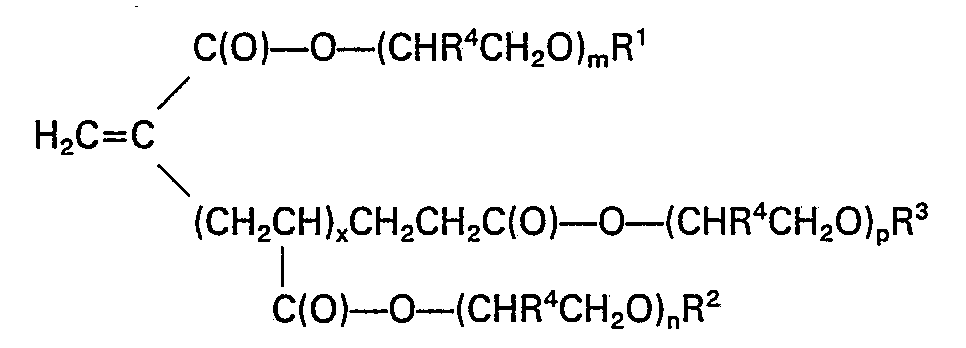
- novel alkyl poly(oxyalkylene) esters of acrylate oligomers of the invention are compounds of the formula: wherein R', R 2 , and R 3 , may be the same or different and may be hydrogen, or alkyl, alkylaryl or polycyclic alkyl groups having 1 to 30 carbon atoms;
- R 4 is hydrogen
- R 2 , R 4 and n are independently selected in the different chains according to the above definitions.
- the above described monomers may be made by reacting, under reflux conditions, appropriate hydroxy or alkoxy polyalkyleneoxyalkanol, for example C 8 to C 30 alkoxy poly(ethyleneoxy) ethanol with appropriate acrylate oligomer in the presence of inhibitor (in minor amount) and a catalytic amount of transesterification catalyst and isolating the product ester.
- novel and improved copolymers, and dispersions thereof, of the present invention are those obtainable by copolymerization of a monomer system comprising:
- Component (1) is methacrylic acid, acrylic acid, itaconic acid and/or acryloxypropionic acid, most preferably methacrylic acid.
- Component (3) is preferably C 1 -C 4 alkyl (meth)acrylic, more preferably ethyl acrylate, butyl acrylate, butyl acrylate, and/or methyl methacrylate, most preferably ethyl acrylate.
- the copolymer can be an emulsion copolymer obtainable by copolymerization of the monomers in an aqueous or inverse emulsion system, a solution polymer in an organic solvent, in water, or in compatible organic-aqueous solvents, a suspension copolymer, a normally solid copolymer or a non-aqueous dispersion (NAD) copolymer.
- a emulsion copolymer obtainable by copolymerization of the monomers in an aqueous or inverse emulsion system
- a solution polymer in an organic solvent, in water, or in compatible organic-aqueous solvents a suspension copolymer, a normally solid copolymer or a non-aqueous dispersion (NAD) copolymer.
- NAD non-aqueous dispersion
- Preferred copolymers, and dispersions thereof are those obtainable by aqueous emulsion copolymerization of a monomer system comprising
- the emulsion copolymer dispersions obtained may have solids contents of from 25 to 50% by weight and the three-component copolymer (having components (1), (2) and (3) described above) dispersion will often have a weight average molecular weight of 100,000 to several million.
- a chain-transfer agent may be used to obtain molecular weights in the lower part of the range or even down to about 8,000.
- use of 0.05% to about 1.0% of monomer component (4), based on total monomer serves to provide molecular weights in or above the higher portion of the range mentioned.
- the relative proportions of the first three components fall in the broad range of (1) 10-70 weight percent, (2) 0.5 to 25 weight percent, and (3) at least 25 weight percent, the total percentages of the three components being 100.
- the most preferred ranges are (1) 30-45%, (2) 1-15%, and (3) 40-60%.
- At least one ofRl, R 2 , and R 3 is preferably C 8 ⁇ C 30 , and most preferably C 12 to C 18 or mixtures thereof, examples being lauryl (C, 2 ), myristyl (C i4 ), cetyl (C '6 ), and stearyl (C 18 ), or longer chain alkyl groups, such as eicosyl (C 20 ), alkylaryl such as octyl-, nonyl- and dinonyl-phenyl, or polycyclic alkyl such as cholestanyl, lanostanyl, and abietyl.
- a mixture of several (C 8 ⁇ C 30 ) alcohols to provide R', R 2 , and R 3 alkyl groups in component (2) may be used.
- component (1) is methacrylic acid.
- component (3) comprises (C l to C 4 )-alkyl (meth)acrylate such as ethyl acrylate, butyl acrylate, or methyl methacrylate, especially ethyl acrylate.
- the invention comprises a water-insoluble emulsion copolymer of:
- the emulsion copolymers of the present invention may be produced by conventional aqueous emulsion polymerization techniques, using appropriate emulsifiers for emulsifying the monomer and for maintaining the polymer obtained in a suitable, dispersed condition.
- emulsifiers for emulsifying the monomer and for maintaining the polymer obtained in a suitable, dispersed condition.
- Commonly used anionic surfactants such as sodium lauryl sulfate, dodecylbenzene sulfonate and ethoxylated fatty alcohol sulfate can be used as emulsifiers.
- the emulsifier may be used in a proportion of 1/2 to 6% of the weight of monomer.
- water-soluble initiator such as alkali metal or ammonium persulfate is used in amounts from 0.01 to 1.0% on the weight of monomer.
- a gradual addition thermal process employed at temperatures between 60°C to 100°C is preferred over redox systems.
- the polymerization system may contain small amounts (0.01 to 5% by weight, based on monomer weight) of chain transfer agent mercaptan such as hydroxyethyl mercaptan, a-mercaptopropionic acid and alkyl mercaptans containing from about 4 to 22 carbon atoms.
- chain transfer agent mercaptan such as hydroxyethyl mercaptan, a-mercaptopropionic acid and alkyl mercaptans containing from about 4 to 22 carbon atoms.
- mercaptan modifier reduces the molecular weight of the polymer and therefore its thickening efficiency. This may be desirable in certain applications where proper rheology but not the thickening efficiency is of primary concern.
- Component (4) is exemplified by diallylphthalate, divinylbenzene, allyl methacrylate, and ethyleneglycol dimethacrylate. Copolymers including this component are either highly branched or in the form of three-dimensional networks. In the neutralized salt form, those networks swell in an aqueous system and the consequent "micro-gel" structure can act as a highly efficient thickener.
- the copolymer may be utilized in a variety of ways to provide thickener or thickened compositions according to the invention.
- the copolymer while in aqueous dispersion or dry form, may be blended into an aqueous system to be thickened followed by addition of a neutralizing agent.
- the copolymer may first be neutralized in aqueous dispersion form and then blended with the aqueous system.
- the components are separately blended (as dry components or as dispersions or slurries) into an aqueous dispersion to be thickened, followed by the neutralization step.
- aqueous concentrates of the copolymer in acid form and the surfactant may be formed and added to an aqueous dispersion to be thickened as needed, followed by neutralization, such concentrates tend to be too viscous for easy handling. It is nevertheless possible to prepare either a dry blend or an aqueous, high solids composition which is sufficiently low in viscosity as to be pumpable or pourable, and then to further thicken the admixture by addition of an alkaline material.
- the copolymer thickener may be provided in a dry state in a number of ways.
- the unneutralized copolymer may be spray or drum dried and, if desired, blended with a surfactant cothickener.
- the more usual method of application of the dispersion of the present invention for aqueous thickening is to add the aqueous dispersion of the carboxylic acid copolymer to the medium to be thickened and, after mixing, to introduce an alkaline material to neutralize the acid. Most of the thickening effect is obtained in a few minutes upon neutralization. In the presence of high concentrations of electrolytes, the viscosity development may take much longer.
- This method of applying a copolymer emulsion to an aqueous system before neutralization enables one to handle a high solids thickener in a non-viscous state, to obtain uniform blend, and then to convert to a highly viscous condition by the simple addition of an alkaline material to bring the pH of the system to 7 or above.
- aqueous solutions thickened with the neutralized latex copolymer of this invention exhibit good viscosity stability even at a pH as high as 13.
- the copolymer may be used to thicken compositions under acidic conditions in the presence of a relatively large amount of surfactants wherein the thickened composition, for example, an aqueous system, has a pH below 7, even as low as 1.
- thickeners described here are useful in a variety of aqueous systems, such as textile printing pastes, latex paint formulations, cosmetic formulations, pigment dispersions, oil well drilling fluids, dentifrices, hand lotions, and liquid detergents.
- thickening A remarkable enhancement of thickening (herein termed “cothickening") has been observed upon the addition of a surfactant to an aqueous system containing the emulsion copolymer of the invention, when the emulsion copolymer is neutralized. In some cases the thickening can be enhanced up to about 40 times the viscosity afforded by the neutralized copolymer alone.
- a wide range of surfactant type and amount is effective. Generally, the surfactant may be used in an amount of about 0.1 to 0.5 parts surfactant per part copolymer, same basis.
- a useful amount of surfactant for optimum cothickening is about 0.1 to 1.0% by weight of the total system.
- the amounts of copolymer and surfactant cothickener may vary widely, even outside these ranges, depending on copolymer and surfactant type and other components of the aqueous system to be thickened.
- the cothickening reaches a maximum as surfactant is added and then decreases.
- the preferred method of application of the emulsion copolymer and the surfactant for aqueous thickening is to add in any sequence the copolymer and the surfactant to the medium to be thickened and, after mixing, to introduce an alkaline material to neutralize the acid.
- This method of applying copolymer emulsion and surfactant to an aqueous system before neutralization enables one to handle a high solids thickener in a non-viscous state, to obtain a uniform blend, and then to convert to a highly viscous condition by the simple addition of an alkaline material to bring the pH of the system to 7 or above.
- the copolymer in the aqueous system may also be neutralized before addition of the surfactant.
- the surfactants which may be used include nonionics and anionics, singly or in combination, the selection necessarily depending upon compatibility with other ingredients of the thickened or thickenable dispersions of the invention.
- Cationic and amphoteric surfactants may also be used provided they are compatible with the copolymer and other ingredients of the aqueous system, or are used in such small amounts as not to cause incompatibility.
- Suitable anionic surfactants include the higher fatty alcohol sulfates such as the sodium or potassium salt of the sulfates of alcohols having from 8 to 18 carbon atoms, alkali metal salts or amine salts of high fatty acid having 8 to 18 carbon atoms, and sulfonated alkyl aryl compounds such as sodium dodecyl benzene sulfonate.
- nonionic surfactants include alkylphenoxypolyethoxy- ethanols having alkyl groups of about 7 to 18 carbon atoms and about 9 to 40 or more oxyethylene units such as octylphenoxypolyethoxyethanols, dodecylphenoxypolyethoxyethanols; ethylene oxide derivatives of long-chain carboxylic acids, such as lauric, myristic, palmitic, oleic; ethylene oxide condensates of long-chain alcohols such as lauryl or cetyl alcohol, and the like.
- cationic surfactants include lauryl pyridinium chloride, octylbenzyltrimethylammonium chloride, dodecyltrimethylammonium chloride, condensates of primary fatty amines and ethylene oxide, and the like.
- a water-in-oil clear concentrate may be prepared, for example, by dissolving 5 parts of a surfactant, such as sorbitan mono-oleate, in 30 parts by weight of mineral spirits (a hydrocarbon distillate cut having a flash point over 120°C), then adding while stirring 58 parts of one of the emulsion polymers of the present invention, e.g., one of the copolymers in Table II below, at 30% solids and mixing therein 7 parts of 28% ammonium hydroxide to at least partially neutralize the polymer dispersion and thereby thicken it.
- the resulting composition may be useful as a clear concentrate that can be diluted with about 95 to 98 parts of water to form a printing clear.
- Such a clear can then be mixed with an aqueous emulsion polymer to serve as a binder, and, if desired, with a color concentrate.
- the commercial practice to date has been to prepare water-in-oil types of clear concentrates commonly used for the textile printing and dyeing industry by mixing a dusty, powdered thickener, such as certain dry products of U.S. Patent 2,798,053 with the other ingredients.
- the probability of adventitious occurrence of such cations, especially that of sodium, is particularly high in the commercially available pigment or color concentrates.
- the emulsion copolymers of the present invention are expected to provide a more efficient thickening effect and are less sensitive to the presence, adventitiously or otherwise, of such cations.
- Pigment pastes may be prepared using various color concentrates from the printing clear obtained as described in the foregoing paragraph by the addition of a color concentrate, e.g., Aqua Hue Blue BGG 9521, and an aqueous emulsion copolymer binder in accordance with the following print paste code or chart:
- a color concentrate e.g., Aqua Hue Blue BGG 9521
- an aqueous emulsion copolymer binder in accordance with the following print paste code or chart:
- a dentifrice may be prepared using one of the polymers of Table II by mixing 1.7 parts of a 30% solids dispersion of the copolymer into a mixture of 20 parts sorbitol and 1.5 parts of a sodium lauryl sulfate. Then 0.07 part of sodium hydroxide is mixed in thoroughly to thicken the mixture and 50 parts of finely-divided calcium carbonate is mixed in water (about 27 parts) being mixed in gradually to form a uniform paste.
- a hand lotion may be prepared by mixing 48.5 parts of glycerine with 1.7 parts of a 30% solids dispersion of copolymers of Table II, adding 0.5 part triethanolamine while stirring and adding about 50.5 parts of water gradually to form an unctuous liquid.
- An all-purpose liquid detergent for household use may be made by mixing the following ingredients in the proportions (parts) and in the order specified in the table:
- a "fracturing" fluid for stimulating the production of oil from oil wells may simply be made up by mixing one part of a 25% to 30% solids dispersion of one of the polymers of the invention listed in Table II with about 0.04 part of NaOH and sufficient water to make a total of 100 parts.
- a pigment dispersion for use in making a water-base paint employing aqueous emulsion vinyl addition polymers, e.g. of acrylic esters, vinyl acetate, styrene-butadiene, etc. as the primary binder may be prepared by mixing a pigment, such as Ti0 2 , with a pigment dispersant, e.g. Tamol@ 731 or Tamol@ 850, with a copolymer dispersion of the present invention listed in Table II with water and neutralizing with a basic material, e.g. NH 3 , NaOH, or triethylamine.
- a suitable formulation is the following, the parts of pigment, dispersant and thickening copolymer of the invention listed in Table II being based on solids.
- Example A is a suitable procedure for producing the acrylate oligomer ester of the invention, which ester also constitutes component (2) of the emulsion copolymer of the invention.
- Example B illustrates a suitable procedure for producing the water-insoluble emulsion copolymers of the invention.
- An emulsion of monomers in water was prepared by mixing 118 g of ethyl acrylate, 94.4 g of methacrylic acid, 23.6 g of monomer prepared in Example A, 6.3 g of 28% sodium lauryl sulfate, and 271 g of water. To a reaction vessel containing 6.3 g of sodium lauryl sulfate in 206 g of water at 86°C there was added 5% of the monomer emulsion and 20.3 g of 1.25% ammonium persulfate solution.
- the cothickening effect of added surfactant is shown in Table III.
- the date was obtained by blending in water the emulsion copolymer dispersion of Example B above and the surfactant and then neutralizing with one equivalent of sodium hydroxide. Viscosities were measured at 75°C using a Brookfield viscometer. The data illustrates a high level of viscosity enchancement and the viscosity dependence on the surfactant concentration.
Landscapes
- Health & Medical Sciences (AREA)
- Chemical & Material Sciences (AREA)
- Life Sciences & Earth Sciences (AREA)
- Animal Behavior & Ethology (AREA)
- General Health & Medical Sciences (AREA)
- Public Health (AREA)
- Veterinary Medicine (AREA)
- Organic Chemistry (AREA)
- Engineering & Computer Science (AREA)
- Chemical Kinetics & Catalysis (AREA)
- Materials Engineering (AREA)
- Medicinal Chemistry (AREA)
- Epidemiology (AREA)
- Dermatology (AREA)
- Pharmacology & Pharmacy (AREA)
- Wood Science & Technology (AREA)
- Birds (AREA)
- Inorganic Chemistry (AREA)
- Textile Engineering (AREA)
- Oral & Maxillofacial Surgery (AREA)
- Polymers & Plastics (AREA)
- Macromonomer-Based Addition Polymer (AREA)
- Addition Polymer Or Copolymer, Post-Treatments, Or Chemical Modifications (AREA)
- Organic Low-Molecular-Weight Compounds And Preparation Thereof (AREA)
- Emulsifying, Dispersing, Foam-Producing Or Wetting Agents (AREA)
- Detergent Compositions (AREA)
Claims (16)


Priority Applications (1)
| Application Number | Priority Date | Filing Date | Title |
|---|---|---|---|
| AT83305275T ATE27142T1 (de) | 1982-09-16 | 1983-09-09 | Oligomere alkyl-poly(oxyalkylen)acrylester und ihre copolymere, ihr gebrauch als verdickungsmittel und diese enthaltende kompositionen. |
Applications Claiming Priority (2)
| Application Number | Priority Date | Filing Date | Title |
|---|---|---|---|
| US06/418,854 US4429097A (en) | 1982-09-16 | 1982-09-16 | Alkyl poly(oxyalkylene) esters of acrylate oligomers and copolymers thereof for thickening purposes |
| US418854 | 1982-09-16 |
Publications (3)
| Publication Number | Publication Date |
|---|---|
| EP0106513A2 EP0106513A2 (de) | 1984-04-25 |
| EP0106513A3 EP0106513A3 (en) | 1985-06-05 |
| EP0106513B1 true EP0106513B1 (de) | 1987-05-13 |
Family
ID=23659816
Family Applications (1)
| Application Number | Title | Priority Date | Filing Date |
|---|---|---|---|
| EP83305275A Expired EP0106513B1 (de) | 1982-09-16 | 1983-09-09 | Oligomere Alkyl-poly(oxyalkylen)acrylester und ihre Copolymere, ihr Gebrauch als Verdickungsmittel und diese enthaltende Kompositionen |
Country Status (9)
| Country | Link |
|---|---|
| US (1) | US4429097A (de) |
| EP (1) | EP0106513B1 (de) |
| JP (1) | JPS5973540A (de) |
| AT (1) | ATE27142T1 (de) |
| AU (1) | AU570644B2 (de) |
| BR (1) | BR8304975A (de) |
| CA (1) | CA1211462A (de) |
| DE (1) | DE3371507D1 (de) |
| MX (1) | MX198618A (de) |
Families Citing this family (63)
| Publication number | Priority date | Publication date | Assignee | Title |
|---|---|---|---|---|
| US4663385A (en) * | 1982-11-17 | 1987-05-05 | Rohm And Haas | Process for thickening with copolymers of alkyl poly (oxyalkylene) itaconic di-esters |
| US4581470A (en) * | 1983-09-27 | 1986-04-08 | Union Carbide Corporation | Novel polyols and uses thereof |
| GB2167075A (en) * | 1984-11-12 | 1986-05-21 | Ici Plc | Treatment of surfaces and compositions for use therefor |
| US5079288A (en) * | 1984-11-12 | 1992-01-07 | Imperial Chemical Industries Plc | Oral hygiene compositions and polymers active therein |
| GB8428523D0 (en) * | 1984-11-12 | 1984-12-19 | Ici Plc | Oral hygiene composition |
| US4911736A (en) * | 1985-09-18 | 1990-03-27 | The Standard Oil Company | Emulsifier and stabilizer for water base emulsions and dispersions of hydrocarbonaceous materials |
| US4670512A (en) * | 1986-03-14 | 1987-06-02 | The Dow Chemical Company | Acrylic coating compositions and method therefor |
| US4731092A (en) * | 1986-04-30 | 1988-03-15 | Ciba-Geigy Corporation | Process for printing or dyeing cellulose-containing textile material with reactive dyes in aqueous foam preparation containing acrylic graft co-polymer |
| GB8613408D0 (en) * | 1986-06-03 | 1986-07-09 | Crown Decorative Prod Ltd | Thickeners |
| ES2045119T3 (es) * | 1987-07-02 | 1994-01-16 | Ici Plc | Composiciones de capa de fondo. |
| GB8813978D0 (en) * | 1988-06-13 | 1988-07-20 | Unilever Plc | Liquid detergents |
| JPH03505471A (ja) * | 1988-09-22 | 1991-11-28 | ユニヴアーシテイ オブ ユタ | タンパク質抵抗およびタンパク質除去のための高分子超界面活性剤 |
| US5057241A (en) * | 1988-11-16 | 1991-10-15 | S. C. Johnson & Son, Inc. | Dual polymer self-sealing detergent compositions and methods |
| GB8829925D0 (en) * | 1988-12-22 | 1989-02-15 | Ici Ltd | Composition and use |
| US5149463A (en) * | 1989-04-21 | 1992-09-22 | The Clorox Company | Thickened acidic liquid composition with sulfonate fwa useful as a bleaching agent vehicle |
| US5242899A (en) * | 1989-09-05 | 1993-09-07 | Total Compagnie Franciase Des Petroles | Emulsfiying agent, reverse emulsions produced using this emulsifying agent and use of these emulsions in drilling wells |
| US5292843A (en) * | 1992-05-29 | 1994-03-08 | Union Carbide Chemicals & Plastics Technology Corporation | Polymers containing macromonomers |
| US5488180A (en) * | 1992-05-29 | 1996-01-30 | Union Carbide Chemicals & Plastics Technology Corporation | Complex hydrophobe compounds |
| US5426182A (en) * | 1992-05-29 | 1995-06-20 | Union Carbide Chemical & Plastics Technology Corporation | Polysaccharides containing complex hydrophobic groups |
| US5478602A (en) * | 1992-05-29 | 1995-12-26 | Union Carbide Chemicals & Plastics Technology Corporation | Polymers containing macromonomers and their use in a method of coating substrates |
| US5739378A (en) * | 1992-05-29 | 1998-04-14 | Union Carbide Chemicals & Plastics Technology Corporation | Complex hydrophobe-containing oligomers |
| US5292828A (en) * | 1992-05-29 | 1994-03-08 | Union Carbide Chemicals & Plastics Technology Corporation | Polymers containing complex hydrophobic groups |
| US5461100A (en) * | 1992-05-29 | 1995-10-24 | Union Carbide Chemicals & Plastics Technology Corporation | Aircraft anti-icing fluids |
| EP0642541A1 (de) * | 1992-05-29 | 1995-03-15 | Union Carbide Chemicals & Plastics Technology Corporation | Makromonomere enthaltende waessrige latexe |
| US5290411A (en) * | 1992-07-14 | 1994-03-01 | California Institute Of Technology | Acrylic polymer electrophoresis support media |
| CA2143328A1 (en) * | 1992-09-01 | 1994-03-17 | Kofi Ofosu-Asante | Liquid or gel dishwashing detergent containing alkyl ethoxy carboxylate, divalent ions and alkylpolyethoxypolycarboxylate |
| US5399618A (en) * | 1993-06-28 | 1995-03-21 | Union Carbide Chemical & Plastics Technology Corporation | Processes for preparing aqueous polymer emulsions |
| US5380447A (en) * | 1993-07-12 | 1995-01-10 | Rohm And Haas Company | Process and fabric finishing compositions for preventing the deposition of dye in fabric finishing processes |
| EP0688822B1 (de) * | 1994-06-21 | 1999-12-15 | The BFGOODRICH COMPANY | Degradierbare Mischungszusammensetzung |
| US5536440A (en) * | 1994-07-14 | 1996-07-16 | Basf Corporation | Stable, aqueous concentrated liquid detergent compositions containing hydrophilic copolymers |
| US5534183A (en) * | 1994-07-14 | 1996-07-09 | Basf Corporation | Stable, aqueous concentrated liquid detergent compositions containing hydrophilic copolymers |
| US5708068A (en) * | 1995-01-16 | 1998-01-13 | Union Carbide Chemicals & Plastics Technology Corporation | Aircraft deicing/anti-icing fluids thickened by associative polymers |
| US5639841A (en) * | 1995-02-28 | 1997-06-17 | Union Carbide Chemicals & Plastics Technology Corporation | Polymers containing macromonomer mixtures |
| DE19512882A1 (de) * | 1995-04-06 | 1996-10-10 | Basf Ag | Wäßrige Polymerisatdispersion |
| GB9521253D0 (en) | 1995-10-17 | 1995-12-20 | Luthra Ajay K | Biocompatible lubricious hydrophilic materials for medical devices |
| EP0799640A4 (de) * | 1995-10-20 | 1999-07-14 | Nippon Catalytic Chem Ind | Adsorbent und methode zur adsorption eines tensides sowie träger des tensides |
| US5851961A (en) * | 1996-06-10 | 1998-12-22 | The Lubrizol Corporation | Anti-settling lubricity agent for water/oil dispersion compositions |
| US6166112A (en) * | 1997-03-10 | 2000-12-26 | Nippon Shokubai Co., Ltd. | Cement admixture and cement composition |
| US6433056B1 (en) | 1997-10-17 | 2002-08-13 | Hercules Incorporated | Fluidized polymer suspension of hydrophobically modified poly(acetal- or ketal-polyether) polyurethane and polyacrylate |
| DE19957177A1 (de) * | 1999-11-27 | 2001-08-02 | Basf Ag | Verfahren zur Herstellung von wasserlöslichen Polymerisaten von Estern aus ethylenisch ungesättigten Carbonsäuren und Polyalkylenglykolen |
| US6376616B1 (en) * | 1999-12-20 | 2002-04-23 | Basf Corporation | Pigment dispersants having anionic functionality for use in anodic electrocoat compositions |
| EP1120451B2 (de) * | 2000-01-28 | 2008-02-13 | Rohm And Haas Company | Verdickungsmittel für wässriger Systeme |
| US6433061B1 (en) | 2000-10-24 | 2002-08-13 | Noveon Ip Holdings Corp. | Rheology modifying copolymer composition |
| US6599970B2 (en) | 2001-01-16 | 2003-07-29 | Rohm And Haas Company | Aqueous compositions containing lipophilically-modified copolymer thickeners |
| DE10125237A1 (de) * | 2001-05-22 | 2002-11-28 | Basf Ag | Wasserlösliche Polymerisate von Estern aus Acrylsäure und Alkylpolyalkylenglykolen |
| US9139676B2 (en) * | 2003-08-18 | 2015-09-22 | Benjamin Moore & Co. | Environmentally friendly colorant compositions and latex paints/coatings |
| JP2006083381A (ja) * | 2004-08-25 | 2006-03-30 | Rohm & Haas Co | 高pH水性系のための増粘剤 |
| EP1630224B1 (de) | 2004-08-25 | 2007-08-01 | Rohm and Haas Company | Verdickungsmittel für wässrige Systeme mit hohem pH-Wert |
| US20100104610A1 (en) * | 2008-10-01 | 2010-04-29 | Dueva-Koganov Olga V | Color cosmetics comprising a random terpolymer |
| CN105919832A (zh) | 2010-06-11 | 2016-09-07 | 宝洁公司 | 用于处理皮肤的组合物 |
| US8691907B2 (en) | 2010-11-23 | 2014-04-08 | Valspar Sourcing, Inc. | Water-borne primer |
| UA108951C2 (uk) | 2011-08-31 | 2015-06-25 | Акцо Нобель Кемікалз Інтернешнл Б.В. | Пральні мийні композиції, які містять брудовідштовхувальну речовину |
| WO2016077327A1 (en) | 2014-11-10 | 2016-05-19 | The Procter & Gamble Company | Personal care compositions with two benefit phases |
| WO2016077325A1 (en) | 2014-11-10 | 2016-05-19 | The Procter & Gamble Company | Personal care compositions with two benefit phases |
| CN107148263B (zh) | 2014-11-10 | 2021-07-06 | 宝洁公司 | 个人护理组合物 |
| US10966916B2 (en) | 2014-11-10 | 2021-04-06 | The Procter And Gamble Company | Personal care compositions |
| US10100243B2 (en) | 2015-07-13 | 2018-10-16 | KMP Holdings, LLC | Environmentally preferable microemulsion composition |
| EP3697374B1 (de) | 2017-10-20 | 2022-02-16 | The Procter & Gamble Company | Aerosolschaum-hautreinigungsmittel |
| CN111212625B (zh) | 2017-10-20 | 2023-05-23 | 宝洁公司 | 气溶胶泡沫洁肤剂 |
| EP3716763A1 (de) | 2017-11-30 | 2020-10-07 | Dow Global Technologies LLC | Hydrophobe polymere als ölrheologiemodifikatoren für agrochemische formulierungen |
| WO2019113035A1 (en) | 2017-12-08 | 2019-06-13 | The Procter & Gamble Company | Methods of screening for mild skin cleanser |
| WO2020112486A1 (en) | 2018-11-29 | 2020-06-04 | The Procter & Gamble Company | Methods for screening personal care products |
| WO2021076537A1 (en) | 2019-10-16 | 2021-04-22 | Rohm And Haas Company | Composition comprising an alkali-swellable copolymer |
Family Cites Families (6)
| Publication number | Priority date | Publication date | Assignee | Title |
|---|---|---|---|---|
| US2892820A (en) | 1956-03-29 | 1959-06-30 | California Research Corp | Oil soluble polymers containing polyalkylene glycol side-chains |
| GB1184957A (en) | 1967-09-26 | 1970-03-18 | Pfizer Ltd | Hydroxyalkyl Esters |
| GB1214443A (en) * | 1968-01-30 | 1970-12-02 | Toa Gosei Chem Ind | Process for preparing a dimer and trimer of an acrylic acid ester |
| US4138381A (en) | 1975-04-14 | 1979-02-06 | E. I. Du Pont De Nemours And Company | Polymeric thickeners, processes for their preparation and uses thereof |
| DE3026127A1 (de) * | 1980-07-10 | 1982-02-18 | Hoechst Ag, 6000 Frankfurt | Bisphenolderivate, verfahren zu ihrer herstellung und ihre verwendung als tenside |
| US4663385A (en) * | 1982-11-17 | 1987-05-05 | Rohm And Haas | Process for thickening with copolymers of alkyl poly (oxyalkylene) itaconic di-esters |
-
1982
- 1982-09-16 US US06/418,854 patent/US4429097A/en not_active Expired - Lifetime
-
1983
- 1983-09-02 CA CA000436018A patent/CA1211462A/en not_active Expired
- 1983-09-06 MX MX19861883A patent/MX198618A/es unknown
- 1983-09-09 AT AT83305275T patent/ATE27142T1/de not_active IP Right Cessation
- 1983-09-09 EP EP83305275A patent/EP0106513B1/de not_active Expired
- 1983-09-09 DE DE8383305275T patent/DE3371507D1/de not_active Expired
- 1983-09-13 AU AU19078/83A patent/AU570644B2/en not_active Expired
- 1983-09-14 JP JP58168515A patent/JPS5973540A/ja active Granted
- 1983-09-14 BR BR8304975A patent/BR8304975A/pt not_active IP Right Cessation
Also Published As
| Publication number | Publication date |
|---|---|
| DE3371507D1 (en) | 1987-06-19 |
| EP0106513A3 (en) | 1985-06-05 |
| CA1211462A (en) | 1986-09-16 |
| MX198618A (es) | 1994-02-28 |
| JPH045010B2 (de) | 1992-01-30 |
| BR8304975A (pt) | 1984-09-04 |
| AU570644B2 (en) | 1988-03-24 |
| JPS5973540A (ja) | 1984-04-25 |
| AU1907883A (en) | 1984-03-22 |
| EP0106513A2 (de) | 1984-04-25 |
| US4429097A (en) | 1984-01-31 |
| ATE27142T1 (de) | 1987-05-15 |
Similar Documents
| Publication | Publication Date | Title |
|---|---|---|
| EP0106513B1 (de) | Oligomere Alkyl-poly(oxyalkylen)acrylester und ihre Copolymere, ihr Gebrauch als Verdickungsmittel und diese enthaltende Kompositionen | |
| EP0109820B1 (de) | Copolymere von Alkyl-poly(oxyalkylen)estern von Itaconsäure und Verdickungsverfahren die diese anwenden | |
| EP0107403B1 (de) | Emulsionscopolymere, Acrylamid enthaltend, deren Verwendung als Verdickungsmittel und Zusammensetzungen, die diese enthalten | |
| US4421902A (en) | Alkyl, poly(oxyethylene) poly(carbonyloxyethylene) acrylate emulsion copolymers for thickening purposes | |
| EP0013836B1 (de) | Zusammensetzungen, die Emulsionsacryl-Copolymere enthalten, und ihre Verwendung als Verdickungsmittel | |
| US4569965A (en) | Crotonate-containing copolymers, processes for their preparation and their use as thickeners in aqueous systems and as sizing agents | |
| KR100379588B1 (ko) | 수계용고성능알칼리팽윤성레올로지첨가제 | |
| AU602865B2 (en) | Acrylic-methylene succinic ester emulsion copolymers for thickening aqueous systems | |
| EP0161038B1 (de) | Verwendung von polymeren Verdickungsmitteln in Druckpaste | |
| CA1152668A (en) | Liquid emulsion polymers useful as ph responsive thickeners for aqueous systems | |
| US4745154A (en) | Water soluble polymers, their preparation and their uses | |
| EP0190892B1 (de) | Verfahren zur Herstellung einer wässrigen Dispersion eines Copolymer-Latex | |
| EP0197635A2 (de) | Acrylatemulsionspolymere als Verdickungsmittel in wässrigen Systemen und copolymerisierbare monomere Emulgiermittel verwendbar in diesen Copolymeren | |
| US11623972B2 (en) | Substituted catechol monomers, copolymers and methods for use | |
| US5656706A (en) | Alkyl and/or alkylphenyl poly(oxyalkylene)sorbate copolymers |
Legal Events
| Date | Code | Title | Description |
|---|---|---|---|
| PUAI | Public reference made under article 153(3) epc to a published international application that has entered the european phase |
Free format text: ORIGINAL CODE: 0009012 |
|
| AK | Designated contracting states |
Designated state(s): AT BE CH DE FR GB IT LI LU NL SE |
|
| 17P | Request for examination filed |
Effective date: 19840827 |
|
| PUAL | Search report despatched |
Free format text: ORIGINAL CODE: 0009013 |
|
| AK | Designated contracting states |
Designated state(s): AT BE CH DE FR GB IT LI LU NL SE |
|
| 17Q | First examination report despatched |
Effective date: 19860505 |
|
| GRAA | (expected) grant |
Free format text: ORIGINAL CODE: 0009210 |
|
| AK | Designated contracting states |
Kind code of ref document: B1 Designated state(s): AT BE CH DE FR GB IT LI LU NL SE |
|
| REF | Corresponds to: |
Ref document number: 27142 Country of ref document: AT Date of ref document: 19870515 Kind code of ref document: T |
|
| ITF | It: translation for a ep patent filed | ||
| REF | Corresponds to: |
Ref document number: 3371507 Country of ref document: DE Date of ref document: 19870619 |
|
| ET | Fr: translation filed | ||
| PLBE | No opposition filed within time limit |
Free format text: ORIGINAL CODE: 0009261 |
|
| STAA | Information on the status of an ep patent application or granted ep patent |
Free format text: STATUS: NO OPPOSITION FILED WITHIN TIME LIMIT |
|
| 26N | No opposition filed | ||
| ITTA | It: last paid annual fee | ||
| EPTA | Lu: last paid annual fee | ||
| EAL | Se: european patent in force in sweden |
Ref document number: 83305275.6 |
|
| PGFP | Annual fee paid to national office [announced via postgrant information from national office to epo] |
Ref country code: AT Payment date: 19990811 Year of fee payment: 17 |
|
| PGFP | Annual fee paid to national office [announced via postgrant information from national office to epo] |
Ref country code: CH Payment date: 19990813 Year of fee payment: 17 |
|
| PGFP | Annual fee paid to national office [announced via postgrant information from national office to epo] |
Ref country code: BE Payment date: 19990823 Year of fee payment: 17 |
|
| PGFP | Annual fee paid to national office [announced via postgrant information from national office to epo] |
Ref country code: LU Payment date: 19991029 Year of fee payment: 17 |
|
| PG25 | Lapsed in a contracting state [announced via postgrant information from national office to epo] |
Ref country code: LU Free format text: LAPSE BECAUSE OF NON-PAYMENT OF DUE FEES Effective date: 20000909 Ref country code: AT Free format text: LAPSE BECAUSE OF NON-PAYMENT OF DUE FEES Effective date: 20000909 |
|
| PG25 | Lapsed in a contracting state [announced via postgrant information from national office to epo] |
Ref country code: LI Free format text: LAPSE BECAUSE OF NON-PAYMENT OF DUE FEES Effective date: 20000930 Ref country code: CH Free format text: LAPSE BECAUSE OF NON-PAYMENT OF DUE FEES Effective date: 20000930 Ref country code: BE Free format text: LAPSE BECAUSE OF NON-PAYMENT OF DUE FEES Effective date: 20000930 |
|
| BERE | Be: lapsed |
Owner name: ROHM AND HASS CY Effective date: 20000930 |
|
| REG | Reference to a national code |
Ref country code: CH Ref legal event code: PL |
|
| REG | Reference to a national code |
Ref country code: GB Ref legal event code: IF02 |
|
| PGFP | Annual fee paid to national office [announced via postgrant information from national office to epo] |
Ref country code: NL Payment date: 20020819 Year of fee payment: 20 Ref country code: FR Payment date: 20020819 Year of fee payment: 20 |
|
| PGFP | Annual fee paid to national office [announced via postgrant information from national office to epo] |
Ref country code: SE Payment date: 20020820 Year of fee payment: 20 |
|
| PGFP | Annual fee paid to national office [announced via postgrant information from national office to epo] |
Ref country code: GB Payment date: 20020904 Year of fee payment: 20 |
|
| PGFP | Annual fee paid to national office [announced via postgrant information from national office to epo] |
Ref country code: DE Payment date: 20020930 Year of fee payment: 20 |
|
| PG25 | Lapsed in a contracting state [announced via postgrant information from national office to epo] |
Ref country code: GB Free format text: LAPSE BECAUSE OF EXPIRATION OF PROTECTION Effective date: 20030908 |
|
| PG25 | Lapsed in a contracting state [announced via postgrant information from national office to epo] |
Ref country code: NL Free format text: LAPSE BECAUSE OF EXPIRATION OF PROTECTION Effective date: 20030909 |
|
| REG | Reference to a national code |
Ref country code: GB Ref legal event code: PE20 |
|
| NLV7 | Nl: ceased due to reaching the maximum lifetime of a patent |
Effective date: 20030909 |
|
| EUG | Se: european patent has lapsed |