EP0104522B1 - Pyrazolo(3,4-b)pyridinderivate und Verfahren zu ihrer Herstellung - Google Patents
Pyrazolo(3,4-b)pyridinderivate und Verfahren zu ihrer Herstellung Download PDFInfo
- Publication number
- EP0104522B1 EP0104522B1 EP83108942A EP83108942A EP0104522B1 EP 0104522 B1 EP0104522 B1 EP 0104522B1 EP 83108942 A EP83108942 A EP 83108942A EP 83108942 A EP83108942 A EP 83108942A EP 0104522 B1 EP0104522 B1 EP 0104522B1
- Authority
- EP
- European Patent Office
- Prior art keywords
- alkyl
- phenyl
- compound
- nil
- formula
- Prior art date
- Legal status (The legal status is an assumption and is not a legal conclusion. Google has not performed a legal analysis and makes no representation as to the accuracy of the status listed.)
- Expired - Lifetime
Links
- 0 CC*(C1)C(C2)=C2[C@]1(C1C)C1=CC Chemical compound CC*(C1)C(C2)=C2[C@]1(C1C)C1=CC 0.000 description 3
Classifications
-
- C—CHEMISTRY; METALLURGY
- C07—ORGANIC CHEMISTRY
- C07D—HETEROCYCLIC COMPOUNDS
- C07D231/00—Heterocyclic compounds containing 1,2-diazole or hydrogenated 1,2-diazole rings
- C07D231/02—Heterocyclic compounds containing 1,2-diazole or hydrogenated 1,2-diazole rings not condensed with other rings
- C07D231/10—Heterocyclic compounds containing 1,2-diazole or hydrogenated 1,2-diazole rings not condensed with other rings having two or three double bonds between ring members or between ring members and non-ring members
- C07D231/14—Heterocyclic compounds containing 1,2-diazole or hydrogenated 1,2-diazole rings not condensed with other rings having two or three double bonds between ring members or between ring members and non-ring members with hetero atoms or with carbon atoms having three bonds to hetero atoms with at the most one bond to halogen, e.g. ester or nitrile radicals, directly attached to ring carbon atoms
- C07D231/38—Nitrogen atoms
-
- A—HUMAN NECESSITIES
- A61—MEDICAL OR VETERINARY SCIENCE; HYGIENE
- A61P—SPECIFIC THERAPEUTIC ACTIVITY OF CHEMICAL COMPOUNDS OR MEDICINAL PREPARATIONS
- A61P25/00—Drugs for disorders of the nervous system
-
- A—HUMAN NECESSITIES
- A61—MEDICAL OR VETERINARY SCIENCE; HYGIENE
- A61P—SPECIFIC THERAPEUTIC ACTIVITY OF CHEMICAL COMPOUNDS OR MEDICINAL PREPARATIONS
- A61P25/00—Drugs for disorders of the nervous system
- A61P25/04—Centrally acting analgesics, e.g. opioids
-
- A—HUMAN NECESSITIES
- A61—MEDICAL OR VETERINARY SCIENCE; HYGIENE
- A61P—SPECIFIC THERAPEUTIC ACTIVITY OF CHEMICAL COMPOUNDS OR MEDICINAL PREPARATIONS
- A61P25/00—Drugs for disorders of the nervous system
- A61P25/20—Hypnotics; Sedatives
-
- A—HUMAN NECESSITIES
- A61—MEDICAL OR VETERINARY SCIENCE; HYGIENE
- A61P—SPECIFIC THERAPEUTIC ACTIVITY OF CHEMICAL COMPOUNDS OR MEDICINAL PREPARATIONS
- A61P29/00—Non-central analgesic, antipyretic or antiinflammatory agents, e.g. antirheumatic agents; Non-steroidal antiinflammatory drugs [NSAID]
-
- C—CHEMISTRY; METALLURGY
- C07—ORGANIC CHEMISTRY
- C07D—HETEROCYCLIC COMPOUNDS
- C07D401/00—Heterocyclic compounds containing two or more hetero rings, having nitrogen atoms as the only ring hetero atoms, at least one ring being a six-membered ring with only one nitrogen atom
- C07D401/02—Heterocyclic compounds containing two or more hetero rings, having nitrogen atoms as the only ring hetero atoms, at least one ring being a six-membered ring with only one nitrogen atom containing two hetero rings
- C07D401/04—Heterocyclic compounds containing two or more hetero rings, having nitrogen atoms as the only ring hetero atoms, at least one ring being a six-membered ring with only one nitrogen atom containing two hetero rings directly linked by a ring-member-to-ring-member bond
-
- C—CHEMISTRY; METALLURGY
- C07—ORGANIC CHEMISTRY
- C07D—HETEROCYCLIC COMPOUNDS
- C07D471/00—Heterocyclic compounds containing nitrogen atoms as the only ring hetero atoms in the condensed system, at least one ring being a six-membered ring with one nitrogen atom, not provided for by groups C07D451/00 - C07D463/00
- C07D471/02—Heterocyclic compounds containing nitrogen atoms as the only ring hetero atoms in the condensed system, at least one ring being a six-membered ring with one nitrogen atom, not provided for by groups C07D451/00 - C07D463/00 in which the condensed system contains two hetero rings
- C07D471/04—Ortho-condensed systems
-
- C—CHEMISTRY; METALLURGY
- C07—ORGANIC CHEMISTRY
- C07D—HETEROCYCLIC COMPOUNDS
- C07D471/00—Heterocyclic compounds containing nitrogen atoms as the only ring hetero atoms in the condensed system, at least one ring being a six-membered ring with one nitrogen atom, not provided for by groups C07D451/00 - C07D463/00
- C07D471/12—Heterocyclic compounds containing nitrogen atoms as the only ring hetero atoms in the condensed system, at least one ring being a six-membered ring with one nitrogen atom, not provided for by groups C07D451/00 - C07D463/00 in which the condensed system contains three hetero rings
- C07D471/14—Ortho-condensed systems
Definitions
- the present invention relates to a new class of pyrazolo pyridine derivatives having CNS-depressant, anxiolytic, analgetic, antiinflammatory activity, to a process for producing them and to pharmaceutical compositions containing them.
- the new pyrazolo pyridines of the present invention are pyrazolo[3,4-b]pyridine derivatives of the following formula I. and their physiologically acceptable acid addition salts, wherein
- (C1 ⁇ 6)alkyl alone or in combination with other groups, represents a straight or branched alkyl group of from 1 to 6 carbon atoms such as methyl, ethyl, n-propyl, iso-propyl, n-butyl, tert-butyl, n-pentyl, n-hexyl and the like.
- (C1 ⁇ 4)alkyl alone or in combination with other groups represents a straight or branched alkyl group of from 1 to 4 carbon atoms.
- (C1 ⁇ 4)alkoxy represents straight or branched alkoxy groups such as methoxy, ethoxy, propoxy, butoxy and the like.
- (C3 ⁇ 7)cycloalkyl represents cycloalkyl rings of from 3 to 7 carbon atoms, such as cyclopropyl, cyclobutyl, cyclopentyl, cyclohexyl, and cycloheptyl.
- (C2 ⁇ 6)alkanoyl represents alkanoyl groups of from 2 to 6 carbon atoms such as acetyl, propionyl, butiryl, n-valeryl, trimethylacetyl, caproyl, and the like.
- hydroxy(C2 ⁇ 4)alkyl identifies straight or branched hydroxyalkyl radicals such as 2-hydroxyethyl, 3-hydroxypropyl, 2-hydroxypropyl, 4-hydroxybutyl, 2-hydroxybutyl or 2-hydroxy-2-methylpropyl.
- halo(C2 ⁇ 4)alkyl identifies straight or branched haloalkyl radicals such as 2-chloroethyl, 2-bromoethyl, 3-chloropropyl, 2-chloropropyl, 3-bromopropyl, 2-bromopropyl, 4-bromobutyl,. 4-chlorobutyl, 3-bromobutyl, 3-chlorobutyl, 2-bromobutyl, 2-chlorobutyl, 2-bromo-2-methylpropyl, 2-chloro-2-methylpropyl, 2-iodoethyl, 3-iodopropyl, or 4-iodobutyl.
- substituted phenyl alone or in combination with other groups, refers to a phenyl group wherein one, two or three hydrogen atoms are replaced by substituents independently selected from, chloro, bromo, fluoro, cyano, nitro, hydroxy, mercapto, trifluoromethyl, (C1 ⁇ 4)alkyl, (C2 ⁇ 4)alkenyl, (C2 ⁇ 4)alkynyl, (C3 ⁇ 7)cycloalkyl, (C1 ⁇ 4)alkoxy, (C1 ⁇ 4)alkylthio, (C1 ⁇ 4)alkoxycarbonyl, carbo(C1 ⁇ 4)alkyl, carbo(C3 ⁇ 7)cycloalkyl, sulfinyl, (C1 ⁇ 4)alkylsulfinyl.
- 4 5, 6 or 7 membered saturated heterocyclic ring refers to saturated heterocyclic groups of from 4 to 7 carbon atoms such as: azetidinyl, pyrrolidyl, piperidinyl, 4-aminopiperidinyl, 4-alkylamino-piperidinyl, piperazinyl, morpholinyl, thiomorpholinyl, 4-methylpiperazinyl, 4-phenylpiperazinyl, 2,6-dimethylpiperazinyl, 3,3-dimethylpiperazinyl, 2,6-dimethylmorpholinyl, and the like.
- halo represents chlorine, bromine or iodine atoms.
- “Inert organic solvent”, as used in the description of the present invention, is a solvent in which the reactants are sufficiently soluble to allow the reaction to proceed, but which does not unfavourably interfere with the reactants or the final products.
- “Physiologically acceptable salts” are pharmaceutically acceptable salts wherein the whole toxicity of the compound is not increased compared with the non-salt. From these, acid addition salts are obtained by treating compounds of formula I above with pharmaceutically acceptable acids.
- acids suitable for the formation of therapeutically acceptable salts there may be mentioned, for example, hydrohalide, sulfuric, phosphoric, and nitric acids; aliphatic, alicyclic, aromatic or heterocyclic carboxylic or sulfonic acids, such as formic, acetic, propionic, succinic, glycolic, lactic, malic, tartaric, citric, ascorbic, d-ketoglutaric, glutamic, aspartic, maleic, hydroxymaleic, pyruvic acid, phenylacetic, benzoic, para-aminobenzoic, anthranilic, para-hydroxybenzoic, salicylic, para-aminosalicylic or embonic acid, methanesulfonic, ethanesulfonic, hydroxyethanesulfonic, ethylenesulfonic acid; halobenzenesulfonic, toluenesulfonic, naphthalenesulfonic acids or sulfanilic acid
- salts of the new compounds may also be used for purifying the resulting compounds by converting them into salts, isolating the latter and liberating the free bases from them.
- compounds of formula I are obtained as the corresponding salts of pharmaceutically acceptable acids, they may be converted into the corresponding free base compounds with a suitable alkali agent.
- the free bases may in turn be transformed into the corresponding salts by reaction with predetermined pharmaceutically acceptable acids.
- a preferred group of compounds of the invention includes those compounds of formula I wherein R represents (C1 ⁇ 6)alkyl, R1 is a methyl group, R2 and R3 taken together represent -(CH2) - n , wherein n is an integer selected from 3, 4, 5, 6, or a -CH2- group may be substituted with a group, wherein R7 is (C1 ⁇ 4)alkyl or alkanoyl.
- R4 represents OR9 wherein R9 is selected from (C1 ⁇ 4)alkyl and hydroxy(C1 ⁇ 4)alkyl, R5 is nil, x is an additional bond and y is nil.
- Another preferred group of compounds of the invention includes those compounds of formula I wherein R represents (C1 ⁇ 6)alkyl, R4 represents an oxygen atom, R5 represents mono- or di-(C1 ⁇ 4)alkylamino(C1 ⁇ 4)alkyl or disubstituted amino(C1 ⁇ 4)alkyl, wherein the nitrogen atom is part of a 5 or 6 membered saturated heterocyclic ring which may be substituted with one (C1 ⁇ 4)alkyl or phenyl group.
- R is (C1 ⁇ 6)alkyl or (C3 ⁇ 7) cycloalkyl
- R1 represents (C1 ⁇ 4)alkyl
- R2 represents C2 ⁇ C4 alkyl or phenyl
- R3 represents (C1 ⁇ 4)alkyl or phenyl
- R2 and R3 taken together represent -(CH2) - n group wherein n is an integer selected from 3, 4, and wherein one of the -(CH2)-groups is substituted with a
- R7 is (C1 ⁇ 4)alkyl, (C2 ⁇ 4)alkanoyl group
- R4 represents R8 as above defined
- R5 is nil
- x is an additional bond
- y is nil.
- U.S. Patent 3891630 is directed to a process for preparing an isoxazole[5,4-e]-[1,4]-or a pyrazolo [3,4e]-[1,4]-thiazepinone compound and it is described that said pyrazolo[3,4-e]-[1,4]-thiazepines can be used inter alia as precursor of substituted pyrazolo[3,4-b]-pyridin-4-ones.
- GB-A 1104145 describes substituted [3,4-b]-pyridines characterized by having a methyl group in the position 3 of the pyrazolo ring.
- the reaction time generally varies from a few minutes to some hours, depending on the compounds involved and the reaction temperature. This reaction step is carried out in the presence of a base.
- Suitable base are aromatic or aliphatic tertiary amines such as 4-picoline, pyridine, triethylamine, trimethylamine and the like. According to a preferred embodiment of the invention, these basic agents can be used also as the reaction solvent.
- Examples of such leaving groups are lower alkyl or aryl groups such as ethyl, propyl, isopropyl, butyl, phenyl, p-tolyl and the like.
- Suitable solvents are inert organic solvents such as benzene, toluene, xylene, ethyl acetate, (C3 ⁇ 10)ethers, dioxane, (C5 ⁇ 7)cycloalkanes and the like.
- an intermediate compound of formula V is obtained and, after recovering it according to common procedures, or directly, without recovery, the substance or reaction mixture is dispersed in a suitable organic solvent or solvent mixture and heated at a temperature between 50°C and the reflux temperature, preferably from about 90°C to about 250°C.
- the reaction time generally is from 1 minute to 8 hours, depending on the other reaction conditions.
- a reaction product is recovered, which is the compound of formula VII.
- This compound of formula VII i.e.
- R9 is a (C1 ⁇ 4)alkyl group
- (C1 ⁇ 4)alkylsulfonates may be advantageously employed instead of the halide VIII.
- the process is carried out by dissolving or suspending a molar amount of the selected compound of formula V in an inert organic solvent, such as, for instance, dioxane, tetrahydrofurane or, preferably, dimethylformamide, and adding to the obtained solution or suspension an equimolecular amount or a slight excess of a strong alkali agent over the compound of formula VII.
- an inert organic solvent such as, for instance, dioxane, tetrahydrofurane or, preferably, dimethylformamide
- Suitable alkali agents may be selected from alkali alkoxides such as, for instance, sodium methoxide, sodium ethoxide or potassium tert-butoxide, alkali metals and, preferably, alkali hydrides, e.g. sodium or potassium hydride.
- the obtained reaction mixture is kept for 2 - 3 hour at a temperature between 50 and 70°C, preferably at about 60°C, then, after cooling to room temperature, a slight molar excess of the compound of formula VIII is added and the mixture is heated for about 1-2 hours at a temperature again between about 50° and about 70°C, preferably at about 60°C.
- the single isomers can be isolated by means of common separation techniques, such as column chromatography, fractioned crystallization, HPLC and the like.
- the compounds of the invention can advantageously be prepared by other routes which involve the transformation of a preexisting R9 substituent into another one falling within the scope of the invention.
- R9 is halo(C2 ⁇ 4)alkyl
- R9 represents an aminoalkyl or substituted amino(C2 ⁇ 4)alkyl as above defined.
- These compounds are prepared simply by reacting the selected halo(C2 ⁇ 4)alkyl derivative with the suitable amine derivative according to known procedure.
- compounds of formula I wherein R9 is halo(C2 ⁇ 4)alkyl may be conveniently prepared from the corresponding hydroxy(C2 ⁇ 4)alkyl derivatives by reacting them with appropriate halogenating agents, such as thionyl or phosphoryl halides and phosphorus pentahalides.
- the reaction is advantageously performed by dissolving or suspending a suitable amount of the compound of formula VII in an organic solvent such as, for instance, a (C1 ⁇ 4)halogenated hydrocarbon and adding to the obtained solution or suspension a molar excess of the halogenating agent, preferably from about 1 to about 3 molar equivalents over the starting compound of formula VII.
- an organic solvent such as, for instance, a (C1 ⁇ 4)halogenated hydrocarbon
- a molar excess of the halogenating agent preferably from about 1 to about 3 molar equivalents over the starting compound of formula VII.
- the reaction is carried out at a temperature between room temperature and about 70°C, and is complete in about 1 - 4 hours.
- R9 represents halo(C2 ⁇ 4)alkyl
- R4 represents an oxygen atom
- R9 represents amino(C2 ⁇ 4)alkyl, mono- or di-substituted amino(C2 ⁇ 4)alkyl or disubstituted amino(C2 ⁇ 4)alkyl wherein the nitrogen atom is part of a 4, 5, 6 or 7 membered saturated heterocyclic ring, by reacting them with the proper amine according to usual procedures.
- a compound of formula III is reacted with an equimolecular amount or a slight excess of a carboxylic acid derivative (such as a carboxylic acid halide, ester or anhydride) of the following formula XIII R8-CO-W XIII wherein R8 is as above and W represents an halogen atom selected from chlorine, bromine, and iodine, a O-R oo or a -O-CO-R8 group, wherein R oo represents, together with the adjacent O atom, a "good leaving group" which does not interfere with the reaction course.
- a carboxylic acid derivative such as a carboxylic acid halide, ester or anhydride
- the reaction solvent is an anhydrous inert organic solvent such as those previously disclosed and includes: (C3 ⁇ 10)ethers, chloro(C1 ⁇ 3)alkanes, xylene, toluene, benzene, carboxylic acids such as formic acid and the like, and carboxylic acid anhydrides such as acetic acid anhydride and the like.
- the carboxylic acid anhydride can be properly selected so that it can act as the reactant as well as the reaction solvent.
- the reaction temperature is between room temperature and the reflux temperature and preferably is the reflux temperature.
- the reaction time is generally between 2 and 6 hours or more. The recovery of the compound of formula XIV so obtained is achieved through common procedures.
- the compound of formula XIV is then reacted with a substance capable of helping the cyclization by acting as a catalyst such as, for example, thionyl and phosphoryl halides in an inert organic solvent, such as a petroleum distillate boiling between 100°C and 250°C, xylene, toluene, benzene, cyclohexane, cyclopentane, methylene chloride and the like at a temperature varying from room temperature to the reflux temperature of the mixture.
- the reaction time is from few minutes to about 25 hours.
- the reaction product is then recovered through common procedures. Generally, the solvent is distilled off under vacuum . The residue is taken up with water and the pH is adjusted to about 8.
- the pyrazolamines of formula III are prepared reacting a pyrazolamine derivative of formula with an equimolecular amount or an excess of a carbonyl compound of formula R2COCH2R3 wherein R2 and R3 are as defined.
- the reaction solvent is preferably an organic acid solvent, and most preferably is a lower organic acid solvent such as propionic or acetic acid.
- the temperature of the mixture is kept between room temperature and the reflux temperature.
- reaction time obviously depends on the different reagents and the reaction temperature, but generally is between a few hours to some days, frequently between 2 hours and 3 days.
- the compounds of the invention possess interesting analgetic, CNS-depressant, antianxiety, and antiinflammatory activity. These activities are generally shared also by some intermediates.
- the compounds of the invention generally have a considerably low toxicity, since most of their LD50 values are higher than 500 mg/kg, when given intraperitoneally and rarely lower than 950 mg/kg when given orally to mice.
- the analgetic activity of the compounds of the present invention was ascertained by means of two known tests for analgesia: the "writhing test” in mice, described by L.C. Hendershot and J. Forsaith, in J. Pharm. Exp. Therap. 125 , 237, (1959), and the "pain relief test” in rats described by L.O. Randall and J.J. Selitto, in Arch. Int. Pharmacodyn. 111 , 409, (1957).
- mice In the former the disappearance or the reduction of writhing in mice, intraperitoneally administered, with p-phenylquinone - a substance known to produce pain especially in the place of injection - is evaluated; the latter test is used to evaluate the ratio of relief from the pain due to compression of oedema paws in rats orally administered with the test compound.
- the above compounds of the invention are from 2 to 10 times as active as acetyl salicylic acid in these tests.
- the LD50 value of co. 57 in orally administered rats is 650 mg/kg, while its LD50 value in orally administered mice is higher than 1000 mg/kg.
- the antiinflammatory activity was ascertained by means of the "carrageenin-induced oedema test" in rats. Said test is performed essentially following the procedure proposed by C.A. Winter et al. in Proc. Soc. Exptl. Biol. Med. 111 , 544, (1962). It was found that oral dosages of between about 1/25 and 1/5 of the LD50 values of the compounds of examples 4, 5, and 48 cause a significant reduction of the oedema over the controls, from about 30% to about 65% depending also on the actual dose.
- the CNS-depressant activity was investigated by means of the general psychophysic screening method, as described by S. Irwin in Psychopharmacologia (Berl.) 13 , 222-257, (1968).
- some representative experiments carried out in mice have shown that amounts from about 5 to about 100 mg/kg i.p. of the compounds of examples 32, 64 and 62 are effective in inhibiting the spontaneous activity and the muscular tone, whereas amounts from about 30 to about 200 mg/kg i.p. significantly impaired the motor coordination and the righting reflex of the laboratory animals. It is generally accepted that the above parameters are directly connected with sedative hypnotic and myorelaxant properties.
- the anti-anxiety activity of the compounds of the invention was investigated by means of the "pole climbing avoidance test", performed essentially as described by G. Maffii, in Journ. Pharm. Pharmacol., 11 ,129, (1959).
- a conditioned animal generally rat, is deconditioned, i.e. is brought to its normal psychic behaviour, by administration of a suitable amount of the compound to be tested.
- an inhibition of the secondary conditioned response (CR2) without a contemporary or coupled with a not significant inhibition of the primary conditioned response (CR) and the unconditioned response (UR) is a clear indication of an antianxiety effect since these last two parameters are connected with sedative and hypnotic properties.
- the compounds of the invention may be administered by different routes. While the preferred routes of administration are oral and rectal, parenteral administration can also be employed.
- the compounds are compounded into pharmaceutical dosage forms, such as, for instance, tablets, capsules, elixirs, solutions and the like.
- the dosage unit may contain the usual excipients, e.g. starch, gums, fatty acids, alcohols, sugars, etc.
- the compounds are administered in the form of suppositories, admixed with conventional vehicles, such as, for example, cocoa butter, wax, spermaceti or polyoxyethyleneglycols and their derivatives.
- the dosage range is from about 0.05 to about 2.0 g per day, preferably administered in divided doses.
- the present invention provides a therapeutic composition
- a therapeutic composition comprising a compound of the invention as the active ingredient together with a pharmaceutically acceptable carrier.
- Phenylisocyanate (0.176 mol) is added to 4-(1-cyclopenten-1-yl)-1,3-dimethyl-1H-pyrazol-5-amine (0.16 mol) in benzene (800 ml). The reaction mixture is stirred at room temperature and then at a temperature between 50 and 70°C. After distillation under vacuum , the product of the title is recovered by usual procedures. M.p. 204°C. By following essentially the same procedure the compounds of examples 16 and 17 are obtained.
- N-phenyl-N'-[4-(1-phenyl-1-propenyl)-1,3-dimethyl-1H-pyrazol-5-yl]urea m.p. 173-195°C, obtained starting from 4-(1-phenyl-1-propenyl)-1,3-dimethyl-1H-pyrazol-5-amine and phenylisocyanate.
- N-[4-(1-cyclohexen-1-yl)-1,3-dimethyl-1H-pyrazol-5-yl]-N'-phenylurea (8.3 g) is fused at about 280°C, for 10 minutes. During the fusion, aniline distilles off. The fused mass is cooled, triturated with methanol and heated to the reflux temperature. Upon cooling and filtering a solid is obtained which is washed with ethyl ether. Upon analysis it is proven to be the compound of the title. M.p. >300°C.
- the compounds of the examples 19 and 20 are obtained, by starting from the corresponding ureas, and carrying out the fusion respectively at about 200°C and about 230°C for 5 minutes.
- a mixture of the compound of example 6 (18.3 g), 4-picoline (100 ml) and ethylisocyanate (18 g) is heated to the reflux temperature for about 7 hours. After cooling to room temperature the solvent is distilled off under reduced pressure and the residue is taken up with ethyl ether and filtered. The recovered solid is boiled in methanol for 5 minutes. Upon filtering, the solid product of the title is recovered. An additional crop of the product may be obtained from the mother liquors. M.p. 269-270°C.
- the compounds of the following examples are obtained by reacting 10 g of the corresponding N-acetyl derivative of formula XII (the compounds of examples 47, 38 and 48, respectively) in ethylether with saturated hydrochloric acid at room temperature for about 1 hour. The organic phase is then concentrated under vacuum and dried. The dihydrochlorides of examples 49 and 50 crystallize from ethanol or methanol. The compound of 51 (free base) crystallizes from ethyl acetate.
- Phosphorusoxychloride, POCl3 (61.33 g) is added to the compound of the above example 52 (N-[1,3-dimethyl-4-(4-methyl-1-cyclohexen-1-yl)-1H-pyrazolo-5-yl] formamide) (27.8 g) in xylene (250 ml). The mixture is refluxed for 4 hours and then distilled under vacuum . The residue is taken up with water and the pH is adjusted to about 8 with aqueous sodium carbonate. Upon filtering, 17 g of the crude product of the title are obtained. M.p. 92-101°C, after crystallization from petroleum ether.
Landscapes
- Chemical & Material Sciences (AREA)
- Organic Chemistry (AREA)
- Health & Medical Sciences (AREA)
- Animal Behavior & Ethology (AREA)
- General Health & Medical Sciences (AREA)
- Veterinary Medicine (AREA)
- Public Health (AREA)
- Life Sciences & Earth Sciences (AREA)
- Chemical Kinetics & Catalysis (AREA)
- General Chemical & Material Sciences (AREA)
- Medicinal Chemistry (AREA)
- Nuclear Medicine, Radiotherapy & Molecular Imaging (AREA)
- Pharmacology & Pharmacy (AREA)
- Engineering & Computer Science (AREA)
- Bioinformatics & Cheminformatics (AREA)
- Biomedical Technology (AREA)
- Neurosurgery (AREA)
- Neurology (AREA)
- Pain & Pain Management (AREA)
- Anesthesiology (AREA)
- Rheumatology (AREA)
- Pharmaceuticals Containing Other Organic And Inorganic Compounds (AREA)
- Nitrogen Condensed Heterocyclic Rings (AREA)
Claims (10)
- Pyrazolo[3,4-b]pyridine der Formel

R und R¹ unabhängig voneinander einen (C₁₋₆)-Alkyl-, (C₃₋₇)-Cycloalkyl-, Phenyl-, substituierten Phenylrest, in dem ein, zwei oder drei Wasserstoffatome durch Substituenten ersetzt sind, die unabhängig ausgewählt sind aus Chlor-, Brom- oder Fluoratomen, Cyano-, Nitro-, Hydroxy-, Mercapto-, Trifluormethyl-, (C₁₋₄)-Alkyl, (C₂₋₄)-Alkenyl-, (C₂₋₄)-Alkinyl-, (C₃₋₇)-Cycloalkyl-, (C₁₋₄)-Alkoxy-, (C₁₋₄)-Alkylthio-, (C₁₋₄)-Alkoxycarbonyl-, Carbo-(C₁₋₄)-alkyl-, Carbo-(C₃₋₇)-cycloalkyl-, Sulfinyl-und (C₁₋₄)-Alkylsulfinylresten, Phenyl-(C₁₋₄)-alkyl- oder substituierte Phenyl-(C₁ ₋₄)-alkylreste bedeuten, wobei die Substituenten wie vorstehend definiert sind,
R² ein Wasserstoffatom, einen (C₁₋₄)-Alkyl-, Phenyl-, substituierten Phenylrest, wobei die Substituenten wie vorstehend definiert sind, Phenyl-(C₁₋₄)-alkyl- oder substituierten Phenyl-(C₁₋₄)-alkylrest darstellt, wobei die Substituenten wie vorstehend definiert sind,
R³ einen (C₁₋₄)-Alkyl-, Phenyl-, substituierten Phenyl-, Phenyl-(C₁₋₄)-alkyl- oder substituierten Phenyl-(C₁₋₄)-alkylrest bedeutet, wobei die Substituenten wie vorstehend definiert sind, oder R² und R³ zusammen einen Rest -(CH₂)n-bedeuten, wobei n eine ganze Zahl im Wert von 3, 4, 5 oder 6 ist, und eine -CH₂-Gruppe durch einen der Reste
wobei
R⁷ einen (C₁₋₄)-Alkyl- oder (C₂₋₆)-Alkanoylrest darstellt;
R⁴ einen der Reste R⁸, -OR⁹ oder ein Sauerstoffatom darstellt;
R⁸ ein Wasserstoffatom, einen (C₁₋₄)-Alkyl-, Phenyl-, substituierten Phenyl-, Phenyl-(C₁₋₄)-alkyl- oder substituierten Phenyl-(C₁₋₄)-alkylrest bedeutet, wobei die Substituenten wie vorstehend definiert sind,
R⁹ ein Wasserstoffatom, einen (C₁₋₄)-Alkyl-, (C₂₋₆)-Alkanoyl-(C₁₋₄)-alkyl-, Hydroxy-(C₂₋₄)-alkyl-, Halogen-(C₂₋₄)-alkyl-, Amino-(C₂₋₄)-alkyl-, Mono-oder Di-(C₁₋₄)-alkylamino-(C₂₋₄)-alkyl- oder disubstituierten Amino-(C₂₋₄)-alkylrest, wobei das Stickstoffatom Teil eines 4-, 5-, 6- oder 7gliedrigen gesättigten heterocyclischen Rings ist, nämlich einer Azetidinyl-, Pyrrolidyl-, Piperidinyl-, 4-Aminopiperidinyl-, Piperazinyl-, Morpholinyl-, Thiomorpholinyl-, 4-Methylpiperazinyl-, 4-Phenylpiperazinyl-, 2,6-Dimethylpiperazinyl-, 3,3-Dimethylpiperazinyl- oder 2,6-Dimethylmorpholinylgruppe, welche gegebenenfalls mit einem Substituenten, ausgewählt aus (C₁₋₄)-Alkyl-, (C₅₋₇)-Cycloalkyl-, Phenyl-, substituierten Phenyl-, Phenyl-(C₁₋₄)-alkyl-und substituierten Phenyl-(C₁₋₄)-alkylresten, substituiert sein können, wobei die Substituenten der Phenylgruppe wie vorstehend definiert sind, bedeutet,
R⁵ den Rest R⁹ gemäß vorstehender Definition darstellt, wenn R⁴ ein Sauerstoffatom ist, y eine zusätzliche Bindung bedeutet und x nicht vorhanden ist, oder R⁵ nicht vorhanden ist, wenn x eine zusätzliche Bindung bedeutet, y nicht vorhanden ist und R⁴ einen der Reste R⁸ oder OR⁹ darstellt, mit der Maßgabe, daß, wenn R, R¹ und R² wie vorstehend definiert sind, R⁴ ein Sauerstoffatom bedeutet, y eine zusätzliche Bindung darstellt, sowohl x als auch R⁹ nicht vorhanden sind, R³ keinen (C₁-C₄)-Alkylrest bedeuten darf, mit der weiteren Maßgabe, daß, wenn R, R¹ und R³ wie vorstehend definiert sind, R⁴ den Rest R⁸ bedeutet, y nicht vorhanden ist und x eine zusätzliche Bindung darstellt, R² keine Methylgruppe bedeuten darf, und mit der weiteren Maßgabe, daß, wenn R¹ eine Methylgruppe bedeutet, dann gleichzeitig R⁴ keinen C₁-C₄-Alkyl-, Phenyl-, Phenyl-(C₁-C₄)-alkyl-, C₁-C₄-Alkoxyphenyl- und Halogenphenylrest bedeuten darf, R keinen C₁-C₄-Alkylrest bedeuten darf und R² und R³ keinen C₁-C₄-Alkyl-, Phenyl-, Phenyl-C₁-C₄-alkyl-, C₁-C₄-Alkoxyphenyl- und Halogenphenylrest bedeuten dürfen. - Verbindung nach Anspruch 1, in der R einen (C₁₋₆)-Alkyl- oder (C₃₋₇)-Cycloalkylrest bedeutet, R¹ einen (C₁₋₄)-Alkylrest darstellt, R² (C₂-C₄)Alkyl oder Phenyl darstellt, und R³ einen (C₁₋₄)-Alkylrest oder eine Phenylgruppe bedeuten oder R² und R³ zusammen einen Rest -(CH₂)n- bedeuten, in dem n eine ganze Zahl von 3 oder 4 ist, und wobei eine der -(CH₂)-Gruppen mit einem der Reste

- Eine Verbindung, nämlich 6,7,8,9-Tetrahydro-1,3-dimethyl-3H-pyrazolo[3,4-c]isochinolin oder ein pharmazeutisch verträgliches Säureadditionssalz davon.
- Verfahren zur Herstellung einer Verbindung nach Anspruch 1, umfassend die Umsetzung eines Pyrazolamin-Derivates der Formel

R²-CO-CH₂-R³
in der R² und R³ die vorstehend angegebenen Bedeutungen haben, in einer organischen Säure als Lösungsmittel bei einer Temperatur zwischen Raumtemperatur und der Rückflußtemperatur, wobei ein Derivat der folgenden Formel III erhalten wird a) wenn die Verbindungen der Erfindung, in denen R, R¹, R² und R³ wie vorstehend definiert sind, R⁴ den Rest OR⁹ bedeutet, wobei R⁹ ein Wasserstoffatom darstellt, R⁵ nicht vorhanden ist, x eine zusätzliche Bindung bedeutet und y nicht vorhanden ist, oder die Verbindungen, in denen R, R¹, R² und R³ wie vorstehend definiert sind, R⁴ ein Sauerstoffatom bedeutet, R⁵ den Rest R⁹ darstellt, welcher ein Wasserstoffatom ist, x nicht vorhanden ist und y eine zusätzliche Bindung bedeutet, gewünscht sind, eine Verbindung der vorstehenden Formel III mit einer äquimolaren Menge oder einem Überschuß einer Isocyanat-Verbindung der Formel Ro-N-CO, in der Ro eine gut austretende Gruppe ist, in einem geeigneten Lösungsmittel und vorzugsweise in Gegenwart eines basischen Stoffes bei einer Temperatur zwischen etwa -5°C und 50°C umgesetzt wird; nach Gewinnung des erhaltenen Zwischenproduktes durch übliche Verfahren oder direkt ohne Reinigung ein geeignetes organisches Lösungsmittel dann zugegeben und das Gemisch auf eine Temperatur zwischen 50°C und der Rückflußtemperatur erhitzt wird; das reine N- oder O-Isomere aus dem Gemisch durch übliche Trennverfahren erhalten wird;b) wenn Verbindungen nach Anspruch 1, in denen R, R¹, R² und R³ wie vorstehend definiert sind, R⁴ den Rest OR⁹ bedeutet, in dem R⁹ eine andere Bedeutung als Wasserstoff hat, R⁵ nicht vorhanden ist, x eine zusätzliche Bindung bedeutet und y nicht vorhanden ist, oder die Verbindungen, in denen R, R¹, R² und R³ wie vorstehend definiert sind, R⁴ ein Sauerstoffatom bedeutet, R⁵ den Rest R⁹ darstellt, der ein Wasserstoffatom ist, x nicht vorhanden ist und y eine zusätzliche Bindung bedeutet, gewünscht werden, können sie durch Umsetzung der entsprechenden Verbindungen, in denen R⁹ ein Wasserstoffatom bedeutet, [die Verbindungen von Punkt a)] mit einem leichten molaren Überschuß eines Halogenids der Formel
R⁹-Halogen VIII
in der R⁹ wie vorstehend definiert ist, und Halogen ein Halogenatom, nämlich ein Chlor-, Brom- oder Jodatom, bedeutet, in Gegenwart eines stark alkalischen Stoffs bei einer Temperatur zwischen 50 und 70°C für etwa 1 bis 2 h und - falls erforderlich - Trennen des Gemisches der N- und O-Isomeren mit Hilfe von Säulenchromatographie oder fraktionierter Kristallisation erhalten werden;c) wenn eine Verbindung der Formel I erhalten wird, in der R⁹ einen Halogen-(C₂₋₄)-alkylrest bedeutet, kann sie durch Umsetzung mit einer äquimolaren Menge oder einem leichten molaren Überschuß des betreffenden Aminderivates in eine Verbindung der Formel I umgewandelt werden, in der R⁹ einen Amino-(C₂₋₄)-alkyl-, Mono- oder Di-(C₁₋₄)-alkylamino-(C₂₋₄)-alkyl-oder disubstituierten Amino-(C₂₋₄)-alkylrest darstellt, wobei das Stickstoffatom Teil eines 4-, 5-, 6- oder 7gliedrigen gesättigten heterocyclischen Rings ist, welcher ein weiteres Heteroatom, ausgewählt aus N, S und O, enthalten kann, und welcher gegebenenfalls mit einem Substituenten substituiert sein kann, ausgewählt aus (C₁₋₄)-Alkyl-, (C₅₋₇)-Cycloalkyl-, Phenyl-, substituiertem Phenyl-, Phenyl-(C₁₋₄)-alkyl und substituiertem Phenyl-(C₁₋₄)-alkylresten;d) wenn eine Verbindung der Formel I erhalten wird, in der R⁹ einen Hydroxy-(C₂₋₄)-alkylrest bedeutet, kann sie durch Umsetzung mit einem Halogenierungsmittel in die entsprechenden Verbindungen der Formel I umgewandelt werden, in denen R⁹ einen Halogen-(C₂₋₄)-alkylrest bedeutet;e) wenn eine Verbindung der Formel I erhalten wird, in der R⁵ und y nicht vorhanden sind, x eine zusätzliche Bindung bedeutet, R⁴ den Rest OR⁹ bedeutet und R⁹ eine 2-Hydroxyethyl-oder 2-Hydroxypropylgruppe darstellt, kann sie durch Umsetzung mit einem Halogenierungsmittel, ausgewählt aus Thionyl- oder Phosphorylhalogeniden und Phosphorpentachlorid, für etwa 1 bis 4 h bei einer Temperatur zwischen Raumtemperatur und etwa 70°C in die entsprechende Verbindung der Formel I umgewandelt werden, in der x nicht vorhanden ist, y eine zusätzliche Bindung bedeutet, R⁵ den Rest R⁹ darstellt und R⁴ ein Sauerstoffatom bedeutet;f) wenn eine Verbindung der Formel I gewünscht wird, in der R⁴ einen Rest R⁸ bedeutet, R⁵ und y nicht vorhanden sind, und x eine zusätzliche Bindung bedeutet, kann sie durch Umsetzung eines Pyrazolamin-Derivates der Formel III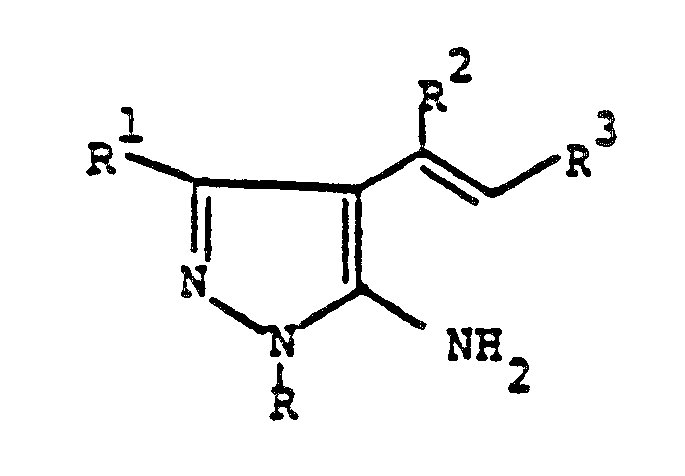
R⁸-CO-W
in der R⁸ wie vorstehend definiert ist und W ein Halogenatom, ausgewählt aus Chlor-, Brom- und Jodatomen, einen Rest Roo oder einen Rest O-CO-R⁸ bedeutet, wobei Roo zusammen mit dem benachbarten Sauerstoffatom eine gut austretende Gruppe darstellt, die in den Reaktionsablauf nicht eingreift, in einem wasserfreien, inerten organischen Lösungsmittel bei einer Temperatur zwischen Raumtemperatur und der Rückflußtemperatur erhalten werden, wobei eine Zwischenverbindung erhalten wird, die thermisch in Gegenwart eines Cyclisierungskatalysators cyclisiert wird. - Verfahren nach Anspruch 4, wobei das geeignete Lösungsmittel von Stufe a) aus hochsiedenden inerten organischen Lösungsmitteln, wie Glykolen mit 2 bis 6 Kohlenstoffatomen und den entsprechenden Mono-(C₁₋₃)-alkylethern oder -acylderivaten, Benzol, Toluol, 5 bis 9 Atomen umfassenden Cycloalkanen ausgewählt ist und die basischen Stoffe tertiäre aliphatische oder aromatische Amine sind.
- Verfahren nach Anspruch 4, wobei der Rest Roo der Stufe f) eine Methyl-, Ethyl-, Propyl-, Isopropyl-, Butyl-, Cyclohexyl-, Phenyl- oder Tolylgruppe ist.
- Verfahren nach Anspruch 4, wobei das wasserfreie, inerte, organische Lösungsmittel der Stufe f) Essigsäureanhydrid ist.
- Verfahren nach Anspruch 4, wobei der Cyclisierungskatalysator der Stufe f) ein Thionyl- oder Phosphorylhalogenid ist.
- Arzneimittel, umfassend mindestens eine Verbindung nach Anspruch 1.
- Eine Verbindung nach Anspruch 1 zur Verwendung als Arzneistoff.
Priority Applications (1)
| Application Number | Priority Date | Filing Date | Title |
|---|---|---|---|
| AT83108942T ATE63913T1 (de) | 1982-09-22 | 1983-09-10 | Pyrazolo(3,4-b)pyridinderivate und verfahren zu ihrer herstellung. |
Applications Claiming Priority (2)
| Application Number | Priority Date | Filing Date | Title |
|---|---|---|---|
| IT2337582 | 1982-09-22 | ||
| IT23375/82A IT1154024B (it) | 1982-09-22 | 1982-09-22 | Derivati pridinici e procedimento per la loro produzione |
Publications (3)
| Publication Number | Publication Date |
|---|---|
| EP0104522A2 EP0104522A2 (de) | 1984-04-04 |
| EP0104522A3 EP0104522A3 (en) | 1985-06-19 |
| EP0104522B1 true EP0104522B1 (de) | 1991-05-29 |
Family
ID=11206534
Family Applications (1)
| Application Number | Title | Priority Date | Filing Date |
|---|---|---|---|
| EP83108942A Expired - Lifetime EP0104522B1 (de) | 1982-09-22 | 1983-09-10 | Pyrazolo(3,4-b)pyridinderivate und Verfahren zu ihrer Herstellung |
Country Status (10)
| Country | Link |
|---|---|
| US (1) | US4612318A (de) |
| EP (1) | EP0104522B1 (de) |
| JP (1) | JPS5989679A (de) |
| AT (1) | ATE63913T1 (de) |
| CA (1) | CA1248532A (de) |
| DE (1) | DE3382299D1 (de) |
| ES (1) | ES8503685A1 (de) |
| GR (1) | GR78987B (de) |
| IT (1) | IT1154024B (de) |
| PT (1) | PT77370B (de) |
Cited By (4)
| Publication number | Priority date | Publication date | Assignee | Title |
|---|---|---|---|---|
| US7435731B2 (en) | 2004-02-27 | 2008-10-14 | Roche Palo Alto Llc | Substituted pyrazolo[3,4-d]pyrimadines and methods of using the same |
| US7452880B2 (en) | 2004-02-27 | 2008-11-18 | Nidhi Arora | Substituted pyrazolo [3,4-d] pyrimidines and methods of using the same |
| US7495015B2 (en) | 2004-02-27 | 2009-02-24 | Roche Palo Alto Llc | Indazole derivatives and methods for using the same |
| US7563799B2 (en) | 2005-08-25 | 2009-07-21 | Roche Palo Alto Llc | Substituted pyrazolo[3,4-D]pyrimidines as p38 map kinase inhibitors |
Families Citing this family (15)
| Publication number | Priority date | Publication date | Assignee | Title |
|---|---|---|---|---|
| NZ208555A (en) * | 1983-06-23 | 1987-06-30 | American Cyanamid Co | (3-amino-1h-pyrazol-4-yl)-arylmethanone derivatives |
| US4751226A (en) * | 1985-09-12 | 1988-06-14 | Fujisawa Pharmaceutical Co., Ltd. | Pyrazoloisoquinoline derivatives, plant growth regulating compositions, and method of use therefor |
| JPH0615542B2 (ja) * | 1986-07-22 | 1994-03-02 | 吉富製薬株式会社 | ピラゾロピリジン化合物 |
| WO1989003385A1 (fr) * | 1987-10-13 | 1989-04-20 | Yoshitomi Pharmaceutical Industries, Ltd. | Composes de pyrazole fusionnes, procede de preparation et utilisation en medecine |
| TW370529B (en) | 1992-12-17 | 1999-09-21 | Pfizer | Pyrazolopyrimidines |
| ES2135062T3 (es) * | 1994-06-16 | 1999-10-16 | Pfizer | Pirazolo y pirrolopiridinas. |
| WO2001098301A1 (en) * | 2000-06-20 | 2001-12-27 | Japan Tobacco Inc. | Pyrazolopyridine compounds and use thereof as drugs |
| JPWO2003020313A1 (ja) * | 2001-09-04 | 2004-12-16 | 小野薬品工業株式会社 | スフィンゴシン−1−リン酸受容体調節剤からなる呼吸器疾患治療剤 |
| DK1522314T3 (da) * | 2002-06-26 | 2014-05-26 | Ono Pharmaceutical Co | Midler for sygdomme forårsaget af vaskulær sammentrækning eller udvidelse |
| EP2468748B1 (de) * | 2006-02-15 | 2016-05-25 | AbbVie Inc. | Pyrazolchinolone als starke PARP-Hemmer |
| WO2010078427A1 (en) * | 2008-12-30 | 2010-07-08 | Arqule, Inc. | Substituted pyrazolo [3, 4-b] pyridine compounds |
| CN102325755B (zh) | 2008-12-30 | 2015-07-01 | 艾科尔公司 | 取代的5,6-二氢-6-苯基苯并[f]异喹啉-2-胺化合物 |
| WO2011159864A1 (en) * | 2010-06-17 | 2011-12-22 | Bracco Imaging S.P.A. | Jte013 analogs and methods of making and using same |
| RU2495039C1 (ru) * | 2012-07-31 | 2013-10-10 | Федеральное государственное бюджетное образовательное учреждение высшего профессионального образования "Пермский государственный национальный исследовательский университет" | МЕТИЛ 3-МЕТИЛ-5-[2-(4-АРИЛАМИНО)-2-ОКСОАЦЕТИЛ]-1,6-ДИФЕНИЛ-1Н-ПИРАЗОЛО[3,4-b]ПИРИДИН-4-КАРБОКСИЛАТЫ И МЕТИЛ 3-МЕТИЛ-5-[2-(4-АРИЛАМИНО)-2-ОКСОАЦЕТИЛ]-6-СТИРИЛ-1-ФЕНИЛ-1Н-ПИРАЗОЛО[3,4-b]ПИРИДИН-4-КАРБОКСИЛАТЫ И СПОСОБ ИХ ПОЛУЧЕНИЯ |
| IL302355A (en) * | 2017-08-23 | 2023-06-01 | Sprint Bioscience Ab | Azaindolylpyridone and diazaindolylpyridone compounds |
Family Cites Families (6)
| Publication number | Priority date | Publication date | Assignee | Title |
|---|---|---|---|---|
| US3403158A (en) * | 1966-03-11 | 1968-09-24 | Upjohn Co | 1h-pyrazolo[3, 4-b]pyridines |
| US3681368A (en) * | 1970-10-15 | 1972-08-01 | Abbott Lab | Pyrazolo naphthridines |
| BE787249A (fr) * | 1971-08-05 | 1973-02-05 | Squibb & Sons Inc | Derives amino d'acides pyrazolopyridine carboxyliques, leurs esters et les sels de ces composes, ainsi que leurs procedes de preparation |
| US3891630A (en) * | 1974-03-04 | 1975-06-24 | Abbott Lab | Substituted pyrazolo{8 3,4-e{9 {8 1,4{9 thiazepines and isoxazolo{8 5,4-e{9 {8 1,4{9 thiazepines |
| US3903096A (en) * | 1974-03-29 | 1975-09-02 | Squibb & Sons Inc | New derivatives of sulfonyl-, sulfinyl- and sulfenyl-1H-pyrazolo {8 3,4-b{9 -pyridines |
| EP0005745B1 (de) * | 1978-05-26 | 1982-07-14 | Gruppo Lepetit S.P.A. | Pyrazolo (3,4-c) und Thiazolo (5,4-c) isochinoline, Verfahren zu ihrer Herstellung, diese Verbindungen zur Verwendung als entzündungshemmende, zentral dämpfende und angstlösende Mittel sowie pharmazeutische Zusammensetzungen |
-
1982
- 1982-09-22 IT IT23375/82A patent/IT1154024B/it active
-
1983
- 1983-09-05 GR GR72382A patent/GR78987B/el unknown
- 1983-09-10 EP EP83108942A patent/EP0104522B1/de not_active Expired - Lifetime
- 1983-09-10 AT AT83108942T patent/ATE63913T1/de not_active IP Right Cessation
- 1983-09-10 DE DE8383108942T patent/DE3382299D1/de not_active Expired - Lifetime
- 1983-09-19 US US06/533,909 patent/US4612318A/en not_active Expired - Fee Related
- 1983-09-21 ES ES83525786A patent/ES8503685A1/es not_active Expired
- 1983-09-21 PT PT77370A patent/PT77370B/pt not_active IP Right Cessation
- 1983-09-21 CA CA000437174A patent/CA1248532A/en not_active Expired
- 1983-09-22 JP JP58176193A patent/JPS5989679A/ja active Pending
Cited By (4)
| Publication number | Priority date | Publication date | Assignee | Title |
|---|---|---|---|---|
| US7435731B2 (en) | 2004-02-27 | 2008-10-14 | Roche Palo Alto Llc | Substituted pyrazolo[3,4-d]pyrimadines and methods of using the same |
| US7452880B2 (en) | 2004-02-27 | 2008-11-18 | Nidhi Arora | Substituted pyrazolo [3,4-d] pyrimidines and methods of using the same |
| US7495015B2 (en) | 2004-02-27 | 2009-02-24 | Roche Palo Alto Llc | Indazole derivatives and methods for using the same |
| US7563799B2 (en) | 2005-08-25 | 2009-07-21 | Roche Palo Alto Llc | Substituted pyrazolo[3,4-D]pyrimidines as p38 map kinase inhibitors |
Also Published As
| Publication number | Publication date |
|---|---|
| ATE63913T1 (de) | 1991-06-15 |
| IT8223375A0 (it) | 1982-09-22 |
| EP0104522A3 (en) | 1985-06-19 |
| GR78987B (de) | 1984-10-02 |
| JPS5989679A (ja) | 1984-05-23 |
| EP0104522A2 (de) | 1984-04-04 |
| PT77370A (en) | 1983-10-01 |
| CA1248532A (en) | 1989-01-10 |
| ES525786A0 (es) | 1985-03-01 |
| ES8503685A1 (es) | 1985-03-01 |
| IT1154024B (it) | 1987-01-21 |
| DE3382299D1 (de) | 1991-07-04 |
| PT77370B (en) | 1986-04-21 |
| US4612318A (en) | 1986-09-16 |
Similar Documents
| Publication | Publication Date | Title |
|---|---|---|
| CA1248532A (en) | Pyrazolo¬3,4-b|pyridine derivatives and process for producing them | |
| US5508300A (en) | Dihydro pyrazolopyrroles, compositions and use | |
| US4880810A (en) | Quinazolinediones and pyridopyrimidinediones | |
| EP0109562B1 (de) | Succinimid-Derivate und deren Herstellung | |
| US4186199A (en) | Indolo-,1,2-dihydroindolo-, and 1,2,6,7-tetrahydroindolo [1,7-ab][1,5] benzodiazepines | |
| CA2211669A1 (en) | 6-substituted pyrazolo [3,4-d¦ pyrimidin-4-ones and compositions and methods of use thereof | |
| EP0000490A1 (de) | Substituierte Naphthyridinone, Verfahren zu ihrer Herstellung und therapeutische Verwendungen | |
| US4782055A (en) | Imidazopyridine compounds useful in the treatment of ulcers | |
| PT683780E (pt) | Imidazopiridinas e sua utilizacao para o tratamento de doencas gastro-intestinais | |
| KR100191972B1 (ko) | 삼환5,6-디하이드로-9h-피라졸로[3,4-c]-1,2,4-트리아졸로[4,3-a]피리딘 | |
| JPS63174988A (ja) | ヘテロアリール3‐オキソ‐プロバンニトリル誘導体及びその製造方法 | |
| CA1117113A (en) | Tricyclic orthofused heterocyclic compounds | |
| JP2815614B2 (ja) | 4―アミノ―3―カルボキシ―ナフチリジン誘導体、その製法および医薬組成物 | |
| JP2707936B2 (ja) | β−オキソ−β−ベンゼンプロパンチオアミド誘導体 | |
| JPH0322389B2 (de) | ||
| US4053600A (en) | Tricyclic 1,2,4-triazolo-quinazolines | |
| US4797403A (en) | Quinazolinediones and pyridopyrimidinediones | |
| EP0299407B1 (de) | 1H-Pyrazol-1-alkanamide und deren Zusammensetzungen, die nützlich als antiarrhythmische Mittel sind. | |
| EP0090275B1 (de) | Isoxazole (5,4-b) Pyridine | |
| AU2001258896B2 (en) | A process for preparing pyrazolopyrimidinone derivatives for the treatment of impotence | |
| US3819627A (en) | 1-substituted-3,4-dihydro-2(1h)-quinazolinones | |
| KR900008550B1 (ko) | 피라졸로[3,4-b]피리딘 유도체의 제조 방법 | |
| US4816461A (en) | 7,8,9,10-tetrahydrothieno[3,2-e]pyrido[4,3-b] indole, a process for their preparation and medicaments containing them | |
| US4347362A (en) | 1-Alkyl-4-amino-3-(3-aminotriazolo)-1,8 naphthyridine-2-ones | |
| US5008282A (en) | Cyclic guanidine derivatives, anti-ulceratives and methods of manufacturing the same |
Legal Events
| Date | Code | Title | Description |
|---|---|---|---|
| PUAI | Public reference made under article 153(3) epc to a published international application that has entered the european phase |
Free format text: ORIGINAL CODE: 0009012 |
|
| AK | Designated contracting states |
Designated state(s): AT BE CH DE FR GB IT LI LU NL SE |
|
| PUAL | Search report despatched |
Free format text: ORIGINAL CODE: 0009013 |
|
| 17P | Request for examination filed |
Effective date: 19841205 |
|
| AK | Designated contracting states |
Designated state(s): AT BE CH DE FR GB IT LI LU NL SE |
|
| 17Q | First examination report despatched |
Effective date: 19861107 |
|
| RAP1 | Party data changed (applicant data changed or rights of an application transferred) |
Owner name: GRUPPO LEPETIT S.P.A. |
|
| GRAA | (expected) grant |
Free format text: ORIGINAL CODE: 0009210 |
|
| AK | Designated contracting states |
Kind code of ref document: B1 Designated state(s): AT BE CH DE FR GB IT LI LU NL SE |
|
| REF | Corresponds to: |
Ref document number: 63913 Country of ref document: AT Date of ref document: 19910615 Kind code of ref document: T |
|
| ITF | It: translation for a ep patent filed | ||
| RAP2 | Party data changed (patent owner data changed or rights of a patent transferred) |
Owner name: GRUPPO LEPETIT S.P.A. |
|
| ET | Fr: translation filed | ||
| REF | Corresponds to: |
Ref document number: 3382299 Country of ref document: DE Date of ref document: 19910704 |
|
| PLBE | No opposition filed within time limit |
Free format text: ORIGINAL CODE: 0009261 |
|
| STAA | Information on the status of an ep patent application or granted ep patent |
Free format text: STATUS: NO OPPOSITION FILED WITHIN TIME LIMIT |
|
| 26N | No opposition filed | ||
| PGFP | Annual fee paid to national office [announced via postgrant information from national office to epo] |
Ref country code: FR Payment date: 19920615 Year of fee payment: 10 |
|
| PGFP | Annual fee paid to national office [announced via postgrant information from national office to epo] |
Ref country code: SE Payment date: 19920622 Year of fee payment: 10 |
|
| PGFP | Annual fee paid to national office [announced via postgrant information from national office to epo] |
Ref country code: GB Payment date: 19920624 Year of fee payment: 10 |
|
| PGFP | Annual fee paid to national office [announced via postgrant information from national office to epo] |
Ref country code: BE Payment date: 19920702 Year of fee payment: 10 Ref country code: AT Payment date: 19920702 Year of fee payment: 10 |
|
| PGFP | Annual fee paid to national office [announced via postgrant information from national office to epo] |
Ref country code: LU Payment date: 19920707 Year of fee payment: 10 |
|
| PGFP | Annual fee paid to national office [announced via postgrant information from national office to epo] |
Ref country code: CH Payment date: 19920806 Year of fee payment: 10 |
|
| PGFP | Annual fee paid to national office [announced via postgrant information from national office to epo] |
Ref country code: NL Payment date: 19920930 Year of fee payment: 10 Ref country code: DE Payment date: 19920930 Year of fee payment: 10 |
|
| EPTA | Lu: last paid annual fee | ||
| PG25 | Lapsed in a contracting state [announced via postgrant information from national office to epo] |
Ref country code: LU Free format text: LAPSE BECAUSE OF NON-PAYMENT OF DUE FEES Effective date: 19930910 Ref country code: GB Effective date: 19930910 Ref country code: AT Effective date: 19930910 |
|
| PG25 | Lapsed in a contracting state [announced via postgrant information from national office to epo] |
Ref country code: SE Effective date: 19930911 |
|
| PG25 | Lapsed in a contracting state [announced via postgrant information from national office to epo] |
Ref country code: LI Effective date: 19930930 Ref country code: CH Effective date: 19930930 Ref country code: BE Effective date: 19930930 |
|
| BERE | Be: lapsed |
Owner name: GRUPPO LEPETIT S.P.A. Effective date: 19930930 |
|
| PG25 | Lapsed in a contracting state [announced via postgrant information from national office to epo] |
Ref country code: NL Effective date: 19940401 |
|
| GBPC | Gb: european patent ceased through non-payment of renewal fee |
Effective date: 19930910 |
|
| NLV4 | Nl: lapsed or anulled due to non-payment of the annual fee | ||
| PG25 | Lapsed in a contracting state [announced via postgrant information from national office to epo] |
Ref country code: FR Free format text: LAPSE BECAUSE OF NON-PAYMENT OF DUE FEES Effective date: 19940531 |
|
| REG | Reference to a national code |
Ref country code: CH Ref legal event code: PL |
|
| PG25 | Lapsed in a contracting state [announced via postgrant information from national office to epo] |
Ref country code: DE Effective date: 19940601 |
|
| REG | Reference to a national code |
Ref country code: FR Ref legal event code: ST |
|
| EUG | Se: european patent has lapsed |
Ref document number: 83108942.0 Effective date: 19940410 |