EP0104518A2 - Verbundstoff mit einer Metallschicht und einer elastomeren Kunststoffschicht und Verfahren zu seiner Herstellung - Google Patents
Verbundstoff mit einer Metallschicht und einer elastomeren Kunststoffschicht und Verfahren zu seiner Herstellung Download PDFInfo
- Publication number
- EP0104518A2 EP0104518A2 EP83108902A EP83108902A EP0104518A2 EP 0104518 A2 EP0104518 A2 EP 0104518A2 EP 83108902 A EP83108902 A EP 83108902A EP 83108902 A EP83108902 A EP 83108902A EP 0104518 A2 EP0104518 A2 EP 0104518A2
- Authority
- EP
- European Patent Office
- Prior art keywords
- layer
- adhesive
- composite
- weight
- metal layer
- Prior art date
- Legal status (The legal status is an assumption and is not a legal conclusion. Google has not performed a legal analysis and makes no representation as to the accuracy of the status listed.)
- Granted
Links
Images

Classifications
-
- B—PERFORMING OPERATIONS; TRANSPORTING
- B32—LAYERED PRODUCTS
- B32B—LAYERED PRODUCTS, i.e. PRODUCTS BUILT-UP OF STRATA OF FLAT OR NON-FLAT, e.g. CELLULAR OR HONEYCOMB, FORM
- B32B7/00—Layered products characterised by the relation between layers; Layered products characterised by the relative orientation of features between layers, or by the relative values of a measurable parameter between layers, i.e. products comprising layers having different physical, chemical or physicochemical properties; Layered products characterised by the interconnection of layers
- B32B7/04—Interconnection of layers
- B32B7/12—Interconnection of layers using interposed adhesives or interposed materials with bonding properties
-
- B—PERFORMING OPERATIONS; TRANSPORTING
- B32—LAYERED PRODUCTS
- B32B—LAYERED PRODUCTS, i.e. PRODUCTS BUILT-UP OF STRATA OF FLAT OR NON-FLAT, e.g. CELLULAR OR HONEYCOMB, FORM
- B32B15/00—Layered products comprising a layer of metal
- B32B15/04—Layered products comprising a layer of metal comprising metal as the main or only constituent of a layer, which is next to another layer of the same or of a different material
- B32B15/06—Layered products comprising a layer of metal comprising metal as the main or only constituent of a layer, which is next to another layer of the same or of a different material of natural rubber or synthetic rubber
-
- B—PERFORMING OPERATIONS; TRANSPORTING
- B32—LAYERED PRODUCTS
- B32B—LAYERED PRODUCTS, i.e. PRODUCTS BUILT-UP OF STRATA OF FLAT OR NON-FLAT, e.g. CELLULAR OR HONEYCOMB, FORM
- B32B15/00—Layered products comprising a layer of metal
- B32B15/04—Layered products comprising a layer of metal comprising metal as the main or only constituent of a layer, which is next to another layer of the same or of a different material
- B32B15/08—Layered products comprising a layer of metal comprising metal as the main or only constituent of a layer, which is next to another layer of the same or of a different material of synthetic resin
- B32B15/085—Layered products comprising a layer of metal comprising metal as the main or only constituent of a layer, which is next to another layer of the same or of a different material of synthetic resin comprising polyolefins
-
- B—PERFORMING OPERATIONS; TRANSPORTING
- B32—LAYERED PRODUCTS
- B32B—LAYERED PRODUCTS, i.e. PRODUCTS BUILT-UP OF STRATA OF FLAT OR NON-FLAT, e.g. CELLULAR OR HONEYCOMB, FORM
- B32B15/00—Layered products comprising a layer of metal
- B32B15/18—Layered products comprising a layer of metal comprising iron or steel
-
- B—PERFORMING OPERATIONS; TRANSPORTING
- B32—LAYERED PRODUCTS
- B32B—LAYERED PRODUCTS, i.e. PRODUCTS BUILT-UP OF STRATA OF FLAT OR NON-FLAT, e.g. CELLULAR OR HONEYCOMB, FORM
- B32B15/00—Layered products comprising a layer of metal
- B32B15/20—Layered products comprising a layer of metal comprising aluminium or copper
-
- B—PERFORMING OPERATIONS; TRANSPORTING
- B32—LAYERED PRODUCTS
- B32B—LAYERED PRODUCTS, i.e. PRODUCTS BUILT-UP OF STRATA OF FLAT OR NON-FLAT, e.g. CELLULAR OR HONEYCOMB, FORM
- B32B25/00—Layered products comprising a layer of natural or synthetic rubber
- B32B25/16—Layered products comprising a layer of natural or synthetic rubber comprising polydienes homopolymers or poly-halodienes homopolymers
-
- B—PERFORMING OPERATIONS; TRANSPORTING
- B32—LAYERED PRODUCTS
- B32B—LAYERED PRODUCTS, i.e. PRODUCTS BUILT-UP OF STRATA OF FLAT OR NON-FLAT, e.g. CELLULAR OR HONEYCOMB, FORM
- B32B27/00—Layered products comprising a layer of synthetic resin
- B32B27/32—Layered products comprising a layer of synthetic resin comprising polyolefins
-
- C—CHEMISTRY; METALLURGY
- C08—ORGANIC MACROMOLECULAR COMPOUNDS; THEIR PREPARATION OR CHEMICAL WORKING-UP; COMPOSITIONS BASED THEREON
- C08J—WORKING-UP; GENERAL PROCESSES OF COMPOUNDING; AFTER-TREATMENT NOT COVERED BY SUBCLASSES C08B, C08C, C08F, C08G or C08H
- C08J5/00—Manufacture of articles or shaped materials containing macromolecular substances
- C08J5/12—Bonding of a preformed macromolecular material to the same or other solid material such as metal, glass, leather, e.g. using adhesives
- C08J5/124—Bonding of a preformed macromolecular material to the same or other solid material such as metal, glass, leather, e.g. using adhesives using adhesives based on a macromolecular component
- C08J5/125—Adhesives in organic diluents
-
- C—CHEMISTRY; METALLURGY
- C09—DYES; PAINTS; POLISHES; NATURAL RESINS; ADHESIVES; COMPOSITIONS NOT OTHERWISE PROVIDED FOR; APPLICATIONS OF MATERIALS NOT OTHERWISE PROVIDED FOR
- C09J—ADHESIVES; NON-MECHANICAL ASPECTS OF ADHESIVE PROCESSES IN GENERAL; ADHESIVE PROCESSES NOT PROVIDED FOR ELSEWHERE; USE OF MATERIALS AS ADHESIVES
- C09J123/00—Adhesives based on homopolymers or copolymers of unsaturated aliphatic hydrocarbons having only one carbon-to-carbon double bond; Adhesives based on derivatives of such polymers
- C09J123/26—Adhesives based on homopolymers or copolymers of unsaturated aliphatic hydrocarbons having only one carbon-to-carbon double bond; Adhesives based on derivatives of such polymers modified by chemical after-treatment
- C09J123/28—Adhesives based on homopolymers or copolymers of unsaturated aliphatic hydrocarbons having only one carbon-to-carbon double bond; Adhesives based on derivatives of such polymers modified by chemical after-treatment by reaction with halogens or compounds containing halogen
-
- C—CHEMISTRY; METALLURGY
- C08—ORGANIC MACROMOLECULAR COMPOUNDS; THEIR PREPARATION OR CHEMICAL WORKING-UP; COMPOSITIONS BASED THEREON
- C08J—WORKING-UP; GENERAL PROCESSES OF COMPOUNDING; AFTER-TREATMENT NOT COVERED BY SUBCLASSES C08B, C08C, C08F, C08G or C08H
- C08J2321/00—Characterised by the use of unspecified rubbers
Definitions
- the invention relates to a composite material with a metal layer and an elastomeric plastic-containing layer, the metal layer being provided with a primer on the composite side and a method for producing such composite materials.
- the actual plastic layer usually a soft PVC layer made of a soft PVC paste, is then applied in a second coating zone, which is then gelled.
- a soft PVC layer made of a soft PVC paste
- plastics can be bonded well with metals, here only polyethylene, polypropylene, polytetrafluoroethylene and rubbers such as ethylene-propylene-diene terpolymers and ethylene-propylene copolymers are referred to, see. for example Kunststoff Chain 7/8, 1982, pages 16 to 19.
- the object of the invention is to create an adhesive bond with high peel strength between a metal layer and elastomeric plastics, in particular based on ethylene-propylene-diene terpolymers and / or ethylene-propylene copolymers.
- a composite with a metal layer which is provided on the composite side with a primer and a vulcanization accelerator-free layer based on EPDM and / or EPM, which are adhesively bonded via an adhesive layer containing crosslinked chlorinated polypropylene, meet the desired requirements.
- a primer based on epoxy resin or modified alkyd resin is used, peel strengths of more than 200 N per 5 cm are achieved for the bond together with the crosslinked chlorinated polypropylene adhesive layer.
- an adhesive according to the invention containing a plastic solution based on chlorinated poly Propylene and crosslinking agent enable the adhesive bond between metal sheets or metal layers and vulcanization accelerator-free elastomeric plastic based on EPDM and / or EPM.
- a preferred adhesive composition according to the invention contains 7 to 30% by weight of chlorinated polypropylene with a chlorine content of 20 to 70%, in particular 25 to 40%, 50 to 85.5% by weight of organic solvents, of which at least 50% are aromatic, cycloaliphatic and / or halogenated hydrocarbons, 7 to 20 wt .-% crosslinking agent, in particular sulfur-containing compounds, 0.5 to 5 wt .-% vulcanization accelerator, 0 to 8 wt .-% vulcanization activators such as zinc oxide, lead oxide, manganese oxide, antimony trisulfide.
- the surprisingly good adhesive strength of the composite according to the invention using a crosslinkable chlorinated polypropylene was not predictable. It is known that chlorinated polypropylene is used due to its good solubility as a coating raw material for chemicals and corrosion-resistant paints and also improves the adhesion to polypropylene.
- the use proposed in the design according to the invention for producing composite materials from metal layers and elastomeric plastics with the selectable high bond strength is therefore all the more surprising.
- the composite materials can be processed and deformed, for example folded, bent or punched, without delamination.
- a vulcanizable adhesive containing a plastic solution based on chlorinated polypropylene and crosslinking agent be applied to the primed side of the metal layer and after the adhesive layer has dried the elastomeric plastic layer is applied and at elevated temperatures pressed from about 70 to 160 ° C with complete curing of the adhesive layer to the composite.
- An adhesive containing 7 to 30% by weight of chlorinated polypropylene, 50 to 85.5% by weight of organic solvent, 7 to 20% by weight of crosslinking agent, 0.5 to 5% by weight of vulcanization accelerator and 0 to 8 is preferred % By weight of vulcanization activators.
- the adhesive is prepared, for example, by swelling the chlorinated polypropylene in an appropriate amount of an organic solvent for the polypropylene for about 1 hour, and then dissolving it with vigorous stirring. Care should be taken to ensure that the temperature during stirring should not exceed 50 ° C.
- This plastic solution is then optionally filled with other organic solvents, which act as thinners, the crosslinking agent, the vulcanization accelerator and the vulcanization activator are added, and are well dispersed in the plastic solution by vigorous stirring.
- An adhesive produced in this way has a storage stability of at least 6 months at room temperature and only needs to be stirred before use in order to avoid settling of the undissolved substances.
- Isotactic chlorinated polypropylenes are used before.
- Particularly suitable solvents are the solvents for chlorinated polypropylene, which are aromatic, cycloaliphatic and / or halogenated hydrocarbons, preferably toluene, xylene, methylene chloride, carbon tetrachloride, trichloroethane, perchloroethane, tetrahydrofuran.
- the adhesive according to the invention to partially replace the organic solvents for the chlorinated polypropylene with polar solvents which act as thinners and in amounts up to 50% based on the total amount of solvent.
- polar solvents which act as thinners and in amounts up to 50% based on the total amount of solvent.
- alcohols, ketones, esters are particularly suitable.
- metal layer is primed with a modified alkyd resin, for example alkyd melamine resin or with an epoxy resin.
- a modified alkyd resin for example alkyd melamine resin or with an epoxy resin.
- the preferred crosslinking agents for the chlorinated polypropylene are crosslinking agents containing sulfur compounds such as thiuram sulfides, substituted ureas, guanidines, xanthates, dithiocarbamates, thiazoles sulfenamides.
- sulfur compounds such as thiuram sulfides, substituted ureas, guanidines, xanthates, dithiocarbamates, thiazoles sulfenamides.
- Substituted ureas such as diphenylthiourea, trimethylthiourea, hexamethylenetetramine, secondary aliphatic or cycloaliphatic amines and others can be used as vulcanization accelerators. be added to the adhesive.
- a preferred embodiment of the composite according to the invention is formed by elastomeric layers based on ethylene-propylene-diene terpolymers and / or ethylene-propylene copolymers which are free of vulcanization accelerators.
- a preferred composition of such an elastomeric layer contains 35 to 46% by weight of EPDM and / or EEM, 40 to 58% by weight of fillers, of which up to 50% carbon black, 5 to 12% by weight of extender or the like, 1.0 to 0.1% by weight of stabilizers, anti-aging agents or the like, 5 to 1.9% by weight of lubricants, processing aids or the like.
- An advantageous continuous procedure for producing the composite according to the invention provides that a primer in an amount of 20 to 40 g / m 2 is applied to one side of a metal sheet and dried at temperatures of about 170 to 250 ° C., followed by the vulcanizable adhesive in an amount of 50 to 150 g / m 2 applied and dried at temperatures of about 130 to 220 ° C, then an elastomeric plastic film is laminated by means of rollers and the composite is cut into sheets and at temperatures of about 110 to 140 ° C at Pressures of about 20 to 70 bar for a period of about 10 to 60 minutes.
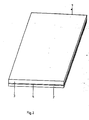
- FIG. 2 shows the composite panel 1 according to the invention, consisting of the metal layer 2, for example an aluminum sheet or steel sheet.
- the metal layer 2 is connected to the plastic layer 3, for example an EPDM film, via the adhesive layer made of a cross-linked chlorinated polypropylene.
- the metal layer is primed on its composite side to form the adhesive layer 4 and, as a rule, is provided on the outside with a protective lacquer or the like, which is not shown here.
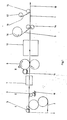
- a steel sheet for example with a width of 1000 mm and a thickness of 0.6 mm, which has already been passivated, galvanized and coated with a chrome layer, is applied to the coating stations I and II fed.
- a primer 9 based on epoxy resin is applied by means of the roll coater, the application is approx. 25 g / m 2 wet, so that an application weight of 5 g / m 2 results after drying.
- a protective lacquer based on alkyd melamine resin is applied to the other side of the steel strip II, likewise wet by means of a roll coater in an amount of 20 g / m 2 , so that an application weight of 10 g / m 2 after drying results.
- the steel strip 2 passes through the first drying channel 1 at a temperature of, for example, 220 ° C.
- the adhesive 11 is then applied to the primed side of the steel strip in the coating station III.
- a reverse roll coater 8 can be used, however, a roll coater or possibly only a doctor blade or a brush can also be used as the application device.
- the adhesive according to the invention is applied, for example, in an amount of 80 g / m 2 , so that an application of 12 g / m 2 results after drying.
- the adhesive contains, for example, 10% by weight of chlorinated polypropylene with a chlorine content of 35%, 10% by weight of tetramethylthiuram disulfide, 1% by weight of diphenylthiourea, 5% by weight of zinc oxide, 30% by weight of methyl isobutyl ketone and 44% by weight. % Toluene.
- the steel strip 2 coated in this way is then dried in the subsequent drying duct at a temperature of 180 ° C.
- an EPDM film 3 with a thickness of 0.8 mm is laminated between the pair of rollers 14 .
- the film 3 is from the supply roll 1 6th deducted.
- a separating film 13 for example an LD-PE or PP film of 0.03 mm, is applied from the supply roll 17 via the pressure roller 15 to the composite web 1, and the composite web 1 thus equipped is preferred at the end 18 wound up.
- the bond strength of this composite is not yet sufficient, since the adhesive has not yet fully hardened. Plates of the desired size are cut from the composite 1, which are pressed together with the release film in presses at elevated temperatures, the adhesive completely curing.
- multi-stage presses are used, with several layers of composite panels being heated simultaneously to temperatures of, for example, 120 to 130 ° C. and being held at this temperature for about half an hour, the pressing pressure being 30 bar.
- the pressed and hardened composite panels in the adhesive layer had a peel strength of 250 N per 5 cm.
- the release film for example a PP film, remains on the boards during the pressing process and also prevents blocking when the composite boards are stacked and only needs to be removed at the construction site when the composite board is used, for example.
- a preferred field of application for the composite material according to the invention are composite sheets in building and civil engineering, as edge safeguards, angle profiles or the like. for tight connection and fixing of sealing sheets made of elastomeric plastics.
- the sealing sheets preferably contain the same elastomeric plastic as the plastic layer of the composite material, so that a homogeneous, in particular welded connection is made possible.
- FIG. 3 shows an exemplary embodiment for the application.
- the concrete pool 20 is lined with the sealing membrane 21 made of EPDM.
- the composite sheet 1 is fastened in the form of an angle profile by means of dowels 22 to the concrete pool 20.
- the sealing membrane 21 is tightly welded to the elastomeric plastic layer 3 made of EPDM in the region 23 and tightly source-welded.
Landscapes
- Chemical & Material Sciences (AREA)
- Chemical Kinetics & Catalysis (AREA)
- Organic Chemistry (AREA)
- General Chemical & Material Sciences (AREA)
- Engineering & Computer Science (AREA)
- Manufacturing & Machinery (AREA)
- Materials Engineering (AREA)
- Health & Medical Sciences (AREA)
- Medicinal Chemistry (AREA)
- Polymers & Plastics (AREA)
- Laminated Bodies (AREA)
- Adhesives Or Adhesive Processes (AREA)
Abstract
Description
- Die Erfindung bezieht sich auf einen Verbundstoff mit eine Metallschicht und einer elastomeren Kunststoff enthaltenden Schicht, wobei die Metallschicht auf der Verbundseite mit einem Primer versehen ist und ein Verfahren zum Herstellen solcher Verbundstoffe.
- Es ist bekannt, Metallbleche mit Kunststoffschichten aus modifizierten Alkydharzen, härtbaren Acrylaten, Weich-PVC u.a. kontinuierlich zu beschichten. Solche Verbundstoffe werden u.a. im Bauwesen angewendet, wo sie beispielsweise die Randverwahrungen von lose verlegten Folien im Hoch-und Tiefbau bilden. Bei der Herstellung dieser Verbundstoffe wird so vorgegangen, daß das blanke Metallband durc ein Phosphatierbad bei Stahl bzw. Chromatierbad bei Aluminium gegen Oxydation geschützt und anschließend durch ein weiteres Bad anodisch aufgeladen bzw. passiviert wird. Nach dieser Vorbehandlung wird das Metallband durch eine ' erste Beschichtungszone, wo ein Primer durch Walzenpaare ggf. beidseitig aufgetragen und ausgehärtet wird.
- In einer zweiten Beschichtungszone erfolgt dann der Auftrag der eigentlichen Kunststoffschicht, meistens einer Weich-PVC-Schicht aus einer Weich-PVC-Paste, die anschließend ausgeliert wird. Zum Stand der Technik verweisen wir auf das Buch von Dr. Paul Schmidt, "Beschichten mit Kunststoffen", Carl Hanser Verlag München 1967, insbesondere Seiten 20 bis 22.
- Nicht alle Kunststoffe lassen sich mit Metallen gut verkleben, hier sei nur auf Polyethylen, Polypropylen, Polytetrafluorethylen und Kautschuke wie Ethylen-Propylen-Dien-Terpolymere und Ethylen-Propylen-Copolymere hingewiesen, s. beispielsweise Kunststoffberater 7/8, 1982, Seite 16 bis 19.
- Die Erfindung hat sich die Aufgabe gestellt, einen haftfesten Verbund mit hoher Schälfestigkeit zwischen einer Metallschicht und elastomeren Kunststoffen, insbesondere auf Basis Ethylen-Propylen-Dien-Terpolymeren und/oder Ethylen-Propylen-Copolymeren zu schaffen.
- Überraschend hat sich herausgestellt, daß ein Verbundstoff mit einer Metallschicht, die auf der Verbundseite mit einem Primer versehen ist und einer vulkanisationsbeschleunigerfreien Schicht auf Basis EPDM und/oder EPM, die über eine Kleberschicht enthaltend vernetzte chlorierte Polypropylen haftfest verbunden sind, die gewünschten Anforderungen erfüllen. Insbesondere bei Einsat eines Primers auf Basis Epoxydharz oder modifizierten Alkydharzes werden zusammen mit der vernetzten chlorierte Polypropylen-Kleberschicht Schälfestigkeiten von mehr als 200 N je 5 cm für den Verbund erreicht.
- Der erfindungsgemäße Einsatz eines Klebers enthaltend eine Kunststofflösung auf Basis von chloriertem Polypropylen sowie Vernetzungsmittel ermöglicht den haftfesten Verbund zwischen Metallblechen bzw. Metallschichten und vulkanisationsbeschleunigerfreien elastomeren Kunststoff auf Basis EPDM und/oder EPM.
- Eine bevorzugte Kleberzusammensetzung gemäß der Erfindung enthält 7 bis 30 Gew.-% chloriertes Polypropylen mit einem Chlorgehalt von 20 bis 70 %, insbesondere 25 bis 40 %, 50 bis 85,5 Gew.-% organische Lösungsmittel, davon mindestens 50 % aromatische, cycloaliphatische und/oder halogenierte Kohlenwasserstoffe, 7 bis 20 Gew.-% Vernetzungsmitt insbesondere Schwefel enthaltende Verbindungen, 0,5 bis 5 Gew.-% Vulkanisationsbeschleuniger, 0 bis 8 Gew.-% Vulkanisationsaktivatoren wie Zinkoxyd, Bleioxyd, Manganoxyd, Antimontrisulfid.
- Die überraschend gute Haftfestigkeit des erfindungsgemäßen Verbundes unter Einsatz eines vernetzbaren chlorierten Polypropylens war nicht vorhersehbar. Es ist zwar bekannt, daß chloriertes Polypropylen aufgrund der guten Löslichkeit als Lackrohstoff für Chemikalien und korrosionsfeste Anstriche eingesetzt wird und auch die Adhäsion zu Polypropy len verbessert. Der in der erfindungsgemäßen Ausbildung vo - geschlagene Einsatz zum Herstellen von Verbundwerkstoffen aus Metallschichten und elastomeren Kunststoffen mit der e - zielbaren hohen Verbundfestigkeit ist daher umso überraschender. Die Verbundwerkstoffe können ohne ein Delaminieren bearbeitet und verformt, beispielsweise gekantet, gebogen oder gestanzt werden.
- Gemäß dem Verfahren nach der Erfindung zum Herstellen von Verbundstoffen wird vorgeschlagen, daß man auf die geprimerte Seite der Metallschicht einen vulkanisierbaren Kleber, enthaltend eine Kunststofflösung auf Basis von chloriertem Polypropylen sowie Vernetzungsmittel aufträgt und nach dem Trocknen der Kleberschicht die elastomere Kunststoffschicht aufbringt und bei erhöhten Temperaturen von etwa 70 bis 160°C unter vollständigem Aushärten der Kleberschicht zum Verbundstoff verpreßt. Bevorzugt wird ein Kleber enthaltend 7 bis 30 Gew.-% chloriertes Polypropylen, 50 bis 85,5 Gew.-% organisches Lösungsmittel, 7 bis 20 Gew.-% Vernetzungsmittel, 0,5 bis 5 Gew.-% Vulkanisationsbeschleuniger und 0 bis 8 Gew.-% Vulkanisationsaktivatoren eingesetzt. Der Kleber wird beispielsweise in der Weise hergestellt, daß das chlorierte Polypropylen in einer entsprechenden Menge eines organischen Lösungsmittel für das Polypropylen während einer Zeit von etwa 1 Stunde angequollen wird, und dann unter starkem Rühren gelöst wird. Hierbei ist darauf zu achten, daß die Temperatur beim Rühren nicht über 50°C ansteigen sollte. Anschließend wird diese Kunststofflösung ggf. mit weiteren organischen Lösungsmitteln, die als Verdünner wirken aufgefüllt, das Vernetzungsmittel, der Vulkanisationsbeschleuniger und der Vulkanisationsaktivator zugegeben und durch starkes Rühren in der Kunststofflösung gut dispergiert. Ein so hergestellter Kleber weist eine Lagerstabilität bei Raumtemperatur von mindestens 6 Monaten auf und muß nur vor Gebrauch aufgerührt werden, um ein Absetzen der nicht gelösten Stoffe zu vermeiden.
- Gut geeignet ist ein chloriertes Polypropylen mit einem Chlorgehalt von 20 bis 70, vorzugsweise 25 bis 40 %. Bevor zugt werden isotaktische chlorierte Polypropylene eingesetzt. Als Lösungsmittel kommen insbesondere die Lösungsmittel für chloriertes Polypropylen, das sind aromatische, cycloaliphatische und/oder halogenierte Kohlenwasserstoffe in Frage, hierbei bevorzugt Toluol, Xylol, Methylen chlorid, Tetrachlormethan, Trichlorethan, Perchlorethan, Tetrahydrofuran. Es ist auch möglich, für den erfindungsgemäßen Kleber die organischen Lösungsmittel für das chlorierte Polypropylen teilweise durch polare Lösungsmittel, die als Verdünner wirksam werden, zu ersetzen und zwar in Mengen bis zu 50 % bezogen auf die Gesamtmenge an Lösungsmittel. Hiervon kommen insbesondere Alkohole, Ketone, Ester in Frage.
- Besonders hohe Haftfestigkeit des Verbundes lassen sich erzielen, wenn die Metallschicht mit einem modifizierten Alkydharz, beispielsweise Alkydmelaminharz oder mit einem Epoxydharz geprimert wird.
- Die bevorzugten Vernetzungsmittel für das chlorierte Polypropylen sind Schwefelverbindungen enthaltende Vernetzungsmittel wie Thiuramsulfide, substituierte Harnstoffe, Guanidine, Xanthogenate, Dithiocarbamate, Thiazole Sulfenamide. Als Vulkanisationsbeschleuniger können substituierte Harnstoffe wie Diphenylthioharnstoff, Trimethyl thioharnstoff, Hexamethylentetramin, sekundäre aliphatisch oder cycloaliphatische Amine u.a. dem Kleber zugegeben werden. Eine bevorzugte Ausführung des erfindungsgemäßen Verbundstoffes bilden elastomere Schichten auf Basis von Ethylen-Propylen-Dien-Terpolymeren und/oder Ethylen-Propylen-Copolymeren, die vulkanisationsbeschleunigerfrei sind. Eine bevorzugte Zusammensetzung einer solchen elastomeren Schicht enthält 35 bis 46 Gew.-% EPDM und/oder EEM, 40 bis 58 Gew.-% Füllstoffe, hiervon bis zu 50 % Ruß, 5 bis 12 Gew.-% Extender o.dgl., 1,0 bis 0,1 Gew.-% Stabilisatoren, Alterungsschutzmittel o.dgl., 5 bis 1,9 Gew.-% Gleitmittel, Verarbeitungshilfsmittel o.dgl.
- Zum Herstellen von Verbundblechen, beispielsweise für das Bauwesen werden geprimerte Metallschichten aus Stahl oder Aluminium einer Dicke von 0,25 bis 1,5 mm mit elastomeren Kunststoffschichten aus Folien einer Dicke von 0,5 bis 1,5 mm durch Aushärten der Kleberschicht bei Temperaturen von insbesondere 110 bis 140°C unter Preßdrucken bis zu etwa 70 bar (70 kp/cm2) miteinander verbunden, wobei eine Schälfestigkeit des Verbundstoffes von mindestens 200 N je 5 cm erreicht wird.
- Eine vorteilhafte kontinuierliche Verfahrensweise zum Herstellen des erfindungsgemäßen Verbundstoffes sieht vor, daß auf eine Seite eines Metallbleches ein Primer in einer Menge von 20 bis 40 g/m2 aufgetragen und bei Temperaturen von etwa 170 bis 250°C getrocknet wird, hierauf der vulkanisierbare Kleber in einer Menge von 50 bis 150 g/m2 aufgetragen und bei Temperaturen von etwa 130 bis 220°C getrocknet wird, dann eine elastomere Kunststoffolie mittels Walzen aufkaschiert wird und der Verbundstoff zu Platten geschnitten wird und bei Temperaturen von etwa 110 bis 140°C bei Drucken von etwa 20 bis 70 bar während einer Dauer von etwa 10 bis 60 Minuten abgepreBt wird.
- Die Erfindung wird nachfolgend an einem Beispiel und der Zeichnung näher erläutert. Es zeigen
- Figur 1 ein schematisches Fließbild des Verfahrens zum Herstellen des Verbundstoffes und
- Figur 2 eine Ansicht einer Verbundplatte.
- In der Figur 2 ist die Verbundplatte 1 gemäß der Erfindung dargestellt, bestehend aus der Metallschicht 2, beispielsweise einem Aluminiumblech oder Stahlblech. Die Metallschicht 2 ist mit der Kunststoffschicht 3, beispielsweise einer EPDM-Folie über die Kleberschicht aus einem vernetzten chlorierten Polypropylen verbunden. Die Metallschicht ist auf ihrer Verbundseite zur Kleberschicht 4 geprimert und in der Regel auf ihrer Außenseite noch mit einem Schutzlack o.dgl., was hier nicht näher dargestellt ist, versehen.
- Bei dem in Figur 1 schematisch dargestellten kontinuierlichen Verfahren zum Herstellen von Verbundstoffen, insbesondere Verbundblechen wird ein Stahlblech, beispielsweise in einer Breite von 1000 mm und Dicke von 0,6 mm das bereits passiviert, verzinkt und mit einer Chromschicht über zogen ist, den Beschichtungsstationen I und II zugeführt. In der Beschichtungsstation I wird mittels des Roll Coaters ein Primer 9 auf Basis Epoxydharz aufgetragen, der Auftrag beträgt ca. 25 g/m2 naß, so daß sich nach dem Trocknen ein Auftragsgewicht von 5 g/m2 ergibt. In der nachfolgenden Beschichtungsstation II wird auf die andere Seite des Stahlbandes II ein Schutzlack auf Basis Alkydmelaminharz aufgebracht, ebenfalls mittels eines Roll Coaters in einer Menge von 20 g/m2 naß, so daß sich nach dem Trocknen ein Auftragsgewicht von 10 g/m2 ergibt. Nach der beidseitigen Beschichtung durchläuft das Stahlband 2 den ersten Trocknungskanal 1 bei einer Temperatur von beispielsweise 220°C. Anschließend wird der Kleber 11 auf die geprimerte Seite des Stahlbandes in der Beschichtungsstation III aufgetragen. Hierfür kann beispielsweise wie dargestellt, ein ReverseRoll Coater 8 benutzt werden, ebenso ist jedoch auch ein Roll Coater oder ggf. nur ein Rakel oder eine Bürste als Auftragseinrichtung benutzbar. Der erfindungsgemäße Kleber wird beispielsweise in einer Menge von 80 g/m2 aufgetragen, so daß sich nach dem Trocknen ein Auftrag von 12 g/m2 ergibt. Der Kleber enthält beispielsweise 10 Gew.-% chloriertes Polypropylen mit einem Chlorgehalt von 35%,10 Gew.-% Tetramethylthiuramdisulfid, 1 Gew.-% Diphenylthioharnstoff, 5 Gew.-% Zinkoxyd, 30 Gew.-% Methylisobutylketon und 44 Gew.-% Toluol. Das so beschichtete Stahlband 2 wird dann in dem nachfolgenden Trocknungskanal bei einer Temperatur von 180°C getrocknet und anschließend wird die Kunststoffschicht, eine EPDM-Folie 3 einer Dicke von 0,8 mm zwischen dem Walzenpaar 14 aufkaschiert. Die Folie 3 wird von der Vorratsrolle 16 abgezogen. Nach ausreichender Abkühlung der Verbundbahn 1 wird noch eine Trennfolie 13, beispielsweise eine LD-PE-oder PP-Folie von 0,03 mm von der Vorratsrolle 17 über die Andrückrolle 15 auf die Verbundbahn 1 aufgebracht und die so ausgerüstete Verbundbahn 1 am Ende 18 bevorzugt aufgewickelt. Die Haftfestigkeit dieses Verbundes ist noch nich ausreichend, da der Kleber noch nicht vollständig ausgehär tet ist. Aus dem Verbund 1 werden Platten gewünschter Größe geschnitten, die zusammen mit der Trennfolie in Pressen be erhöhten Temperaturen abgepreßt werden, wobei der Kleber vollständig aushärtet. Beispielsweise werden Etagenpressen benutzt, wobei mehrere Lagen Verbundplatten gleichzeitig auf Temperaturen z.B. von 120 bis 130°C aufgeheizt und bei dieser Temperatur für etwa eine halbe Stunde gehalten werden, wobei der Preßdruck 30 bar beträgt. Die abgepreßten und in der Kleberschicht ausgehärteten Verbundplatten wiesen eine Schälfestigkeit von 250 N je 5 cm auf. Die Trennfolie, beispielsweise eine PP-Folie bleibt währen des Preßvorganges auf den Platten und verhindert auch das Blocken beim Stapeln der Verbundplatten und braucht erst bei Einsatz der Verbundplatte beispielsweise an der Baustelle abgezogen zu werden.
- Ein bevorzugtes Anwendungsgebiet für das erfindungsgemäße Verbundmaterial sind Verbundbleche im Hoch- und Tiefbau, als Randverwahrungen, Winkelprofile o.dgl. zum dichten Anschließen und Fixieren von Dichtungsbahnen aus elastomeren Kunststoffen. Bevorzugt enthalten die Dichtungsbahnen den gleichen elastomeren Kunststoff wie die Kunststoffschicht des Verbundmaterials, so daß eine homogene, insbesondere Schweißverbindung, ermöglicht ist. In der Figur 3 ist ein Ausführungsbeispiel für die Anwendung dargestellt. Das Betonbecken 20 wird mit der Dichtungsbahn 21 aus EPDM ausgekleidet. Im Eckbereich ist das Verbundblech 1 in Gestalt eines Winkelprofiles mittels Dübeln 22 am Betonbecken 20 be festigt. Die Dichtungsbahn 21 ist mit der elastomeren Kunststoffschicht 3 aus EPDM im Bereich 23 haftfest und dicht quellverschweißt.
Claims (17)
Priority Applications (1)
| Application Number | Priority Date | Filing Date | Title |
|---|---|---|---|
| AT83108902T ATE38487T1 (de) | 1982-09-29 | 1983-09-09 | Verbundstoff mit einer metallschicht und einer elastomeren kunststoffschicht und verfahren zu seiner herstellung. |
Applications Claiming Priority (2)
| Application Number | Priority Date | Filing Date | Title |
|---|---|---|---|
| DE3235978A DE3235978C2 (de) | 1982-09-29 | 1982-09-29 | Verbundstoff mit einer Metallschicht und einer elastomeren Kunststoffschicht, Verfahren zu seiner Herstellung und Kleberlösung zur Durchführung des Verfahrens |
| DE3235978 | 1982-09-29 |
Publications (3)
| Publication Number | Publication Date |
|---|---|
| EP0104518A2 true EP0104518A2 (de) | 1984-04-04 |
| EP0104518A3 EP0104518A3 (en) | 1986-02-05 |
| EP0104518B1 EP0104518B1 (de) | 1988-11-09 |
Family
ID=6174404
Family Applications (1)
| Application Number | Title | Priority Date | Filing Date |
|---|---|---|---|
| EP83108902A Expired EP0104518B1 (de) | 1982-09-29 | 1983-09-09 | Verbundstoff mit einer Metallschicht und einer elastomeren Kunststoffschicht und Verfahren zu seiner Herstellung |
Country Status (3)
| Country | Link |
|---|---|
| EP (1) | EP0104518B1 (de) |
| AT (1) | ATE38487T1 (de) |
| DE (2) | DE3235978C2 (de) |
Cited By (6)
| Publication number | Priority date | Publication date | Assignee | Title |
|---|---|---|---|---|
| DE3708725A1 (de) * | 1987-03-18 | 1988-10-06 | Bayer Ag | Verbundprofile |
| WO1991013758A1 (en) * | 1990-03-09 | 1991-09-19 | Rubore Materials Sweden Ab | Method of making a web for manufacturing gaskets |
| EP0826755A3 (de) * | 1996-08-24 | 1998-07-22 | Henkel Kommanditgesellschaft auf Aktien | Klebstoffsystem für Gummi/Metall-Verbunde |
| EP0832915A3 (de) * | 1996-09-30 | 1998-08-12 | Firma Carl Freudenberg | Verfahren zur Herstellung eines Gummi-Metall-Teils |
| EP0786336A3 (de) * | 1996-01-29 | 1998-09-02 | Firma Carl Freudenberg | Verfahren zur Herstellung eines Gummi-Metall-Teils |
| EP1977890A1 (de) * | 2007-04-03 | 2008-10-08 | Juan Lloveras Calvo | Verbundplatte aus Gummi und Metall sowie deren Herstellverfahren |
Families Citing this family (5)
| Publication number | Priority date | Publication date | Assignee | Title |
|---|---|---|---|---|
| JP2610165B2 (ja) * | 1988-05-17 | 1997-05-14 | 本田技研工業株式会社 | 自動車車体構成部材におけるゴム製部材とアルミニウム合金製部材の組合せ |
| DE4305683A1 (de) * | 1993-02-24 | 1994-08-25 | Daetwyler Ag | Vorhangplatte für Gebäude |
| DE9403810U1 (de) | 1994-03-08 | 1994-05-19 | Grünau GmbH WOLFIN Dach- und Dichtungssysteme, 63452 Hanau | Blechhalbzeug für Bauzwecke |
| DE19754812C2 (de) * | 1997-12-10 | 2003-06-05 | Henkel Kgaa | Verfahren zur Herstellung von Blechhalbzeugen |
| DE10158896A1 (de) * | 2001-11-30 | 2003-06-12 | Braun Gmbh | Verfahren zum festen Verbinden von thermoplastischen Elastomeren (TPE) mit einer metallischen Oberfläche |
Family Cites Families (1)
| Publication number | Priority date | Publication date | Assignee | Title |
|---|---|---|---|---|
| US4079168A (en) * | 1976-11-01 | 1978-03-14 | Lord Corporation | Rubber-metal composite structures having improved resistance to corrosion |
-
1982
- 1982-09-29 DE DE3235978A patent/DE3235978C2/de not_active Expired
-
1983
- 1983-09-09 DE DE8383108902T patent/DE3378409D1/de not_active Expired
- 1983-09-09 EP EP83108902A patent/EP0104518B1/de not_active Expired
- 1983-09-09 AT AT83108902T patent/ATE38487T1/de active
Cited By (6)
| Publication number | Priority date | Publication date | Assignee | Title |
|---|---|---|---|---|
| DE3708725A1 (de) * | 1987-03-18 | 1988-10-06 | Bayer Ag | Verbundprofile |
| WO1991013758A1 (en) * | 1990-03-09 | 1991-09-19 | Rubore Materials Sweden Ab | Method of making a web for manufacturing gaskets |
| EP0786336A3 (de) * | 1996-01-29 | 1998-09-02 | Firma Carl Freudenberg | Verfahren zur Herstellung eines Gummi-Metall-Teils |
| EP0826755A3 (de) * | 1996-08-24 | 1998-07-22 | Henkel Kommanditgesellschaft auf Aktien | Klebstoffsystem für Gummi/Metall-Verbunde |
| EP0832915A3 (de) * | 1996-09-30 | 1998-08-12 | Firma Carl Freudenberg | Verfahren zur Herstellung eines Gummi-Metall-Teils |
| EP1977890A1 (de) * | 2007-04-03 | 2008-10-08 | Juan Lloveras Calvo | Verbundplatte aus Gummi und Metall sowie deren Herstellverfahren |
Also Published As
| Publication number | Publication date |
|---|---|
| DE3378409D1 (en) | 1988-12-15 |
| EP0104518B1 (de) | 1988-11-09 |
| ATE38487T1 (de) | 1988-11-15 |
| DE3235978C2 (de) | 1985-06-27 |
| DE3235978A1 (de) | 1984-03-29 |
| EP0104518A3 (en) | 1986-02-05 |
Similar Documents
| Publication | Publication Date | Title |
|---|---|---|
| DE3514295C2 (de) | Verstärkungs-Klebebahn | |
| DE69226123T2 (de) | Dachabdeckung, härtbare, heisssiegelbare Dachbahn und Dachabdeckungverfahren | |
| DE2922089C2 (de) | Verfahren zur Herstellung partiell vernetzter Folien aus einem EPDM- oder EPM-Kunststoff | |
| EP0215189B1 (de) | Mehrschichtige, selbstklebende und tiefziehbare Schutzfolie insbesondere für Kraftfahrzeuge | |
| EP0104518B1 (de) | Verbundstoff mit einer Metallschicht und einer elastomeren Kunststoffschicht und Verfahren zu seiner Herstellung | |
| DE3033264A1 (de) | Verfahren zum herstellen von mit thermoplastischen kunststoffpasten impraegnierten traegerbahnen | |
| EP3611237A1 (de) | Verfahren zur herstellung einer versiegelten falzverbindung | |
| DE1117803B (de) | Verfahren zur Herstellung eines duennen, festhaftenden, gegen Loesungsmittel und Druckeinwirkung widerstandsfaehigen Abdichtungsfilms | |
| EP3526299A2 (de) | Verfahren zur herstellung einer versiegelten falzverbindung | |
| DE1769422C3 (de) | Verfahren zum Verkleben oder Be schichten von Werkstoffen | |
| DE3607218C2 (de) | ||
| DE2004379B2 (de) | Polymeres Verbundmaterial und Verfahren zu seiner Herstellung | |
| DE2641966C2 (de) | Verfahren zur Herstellung einer thermoplastischen Masse und ihre Verwendung | |
| DE2461894B2 (de) | Verwendung von Regeneratbutylkautschuk enthaltenden Gemischen als Wasserabdichtungsmasse in Kontakt mit Zementmörtel oder Beton | |
| EP1108695A2 (de) | Klebeband mit thermisch härtbarem Kleber zum Maskieren einer KTL-Grundierung | |
| DE4016210A1 (de) | Verfahren zur herstellung einer mindestens einseitig beschichteten vollkunststoffplatte aus recycling-kunststoffen | |
| DE3007531A1 (de) | Formkoerper aus kunststoff mit einer peroxydisch vernetzbaren komponente und verfahren zu seiner herstellung | |
| DE2918923A1 (de) | Schichtstoff mit einer fluorpolymerisatschicht | |
| DE19955856A1 (de) | Klebeband zum Maskieren einer KTL-Grundierung | |
| DE1569547C3 (de) | Verfahren zur Herstellung eines Schutzüberzugs auf der Basis von Kunstkautschuk auf einem verstärkten Gieflharz-Formkörper | |
| DE10163252A1 (de) | Flächenversteifende Kautschuk-Systeme | |
| WO2007135186A1 (de) | Klebverbundkörper mit erhöhter haftung | |
| DE2429378B2 (de) | Klebefolie | |
| DE2240955A1 (de) | Zusammengesetztes schichtmaterial und verfahren zu dessen herstellung | |
| WO2006058739A1 (de) | Primerlose verklebung von profilen |
Legal Events
| Date | Code | Title | Description |
|---|---|---|---|
| PUAI | Public reference made under article 153(3) epc to a published international application that has entered the european phase |
Free format text: ORIGINAL CODE: 0009012 |
|
| AK | Designated contracting states |
Designated state(s): AT BE CH DE FR GB IT LI LU NL SE |
|
| PUAL | Search report despatched |
Free format text: ORIGINAL CODE: 0009013 |
|
| AK | Designated contracting states |
Designated state(s): AT BE CH DE FR GB IT LI LU NL SE |
|
| 17P | Request for examination filed |
Effective date: 19860701 |
|
| 17Q | First examination report despatched |
Effective date: 19870219 |
|
| RAP1 | Party data changed (applicant data changed or rights of an application transferred) |
Owner name: HUELS TROISDORF AKTIENGESELLSCHAFT |
|
| ITF | It: translation for a ep patent filed | ||
| GRAA | (expected) grant |
Free format text: ORIGINAL CODE: 0009210 |
|
| AK | Designated contracting states |
Kind code of ref document: B1 Designated state(s): AT BE CH DE FR GB IT LI LU NL SE |
|
| REF | Corresponds to: |
Ref document number: 38487 Country of ref document: AT Date of ref document: 19881115 Kind code of ref document: T |
|
| GBT | Gb: translation of ep patent filed (gb section 77(6)(a)/1977) | ||
| REF | Corresponds to: |
Ref document number: 3378409 Country of ref document: DE Date of ref document: 19881215 |
|
| ET | Fr: translation filed | ||
| PLBE | No opposition filed within time limit |
Free format text: ORIGINAL CODE: 0009261 |
|
| STAA | Information on the status of an ep patent application or granted ep patent |
Free format text: STATUS: NO OPPOSITION FILED WITHIN TIME LIMIT |
|
| 26N | No opposition filed | ||
| ITTA | It: last paid annual fee | ||
| EPTA | Lu: last paid annual fee | ||
| EAL | Se: european patent in force in sweden |
Ref document number: 83108902.4 |
|
| REG | Reference to a national code |
Ref country code: CH Ref legal event code: PUE Owner name: HT TROPLAST AG |
|
| REG | Reference to a national code |
Ref country code: GB Ref legal event code: 732E |
|
| REG | Reference to a national code |
Ref country code: FR Ref legal event code: TP |
|
| NLS | Nl: assignments of ep-patents |
Owner name: HT TROPLAST AG |
|
| PGFP | Annual fee paid to national office [announced via postgrant information from national office to epo] |
Ref country code: NL Payment date: 19980930 Year of fee payment: 16 |
|
| PGFP | Annual fee paid to national office [announced via postgrant information from national office to epo] |
Ref country code: FR Payment date: 19990818 Year of fee payment: 17 |
|
| PGFP | Annual fee paid to national office [announced via postgrant information from national office to epo] |
Ref country code: GB Payment date: 19990827 Year of fee payment: 17 |
|
| PGFP | Annual fee paid to national office [announced via postgrant information from national office to epo] |
Ref country code: LU Payment date: 19990909 Year of fee payment: 17 |
|
| PGFP | Annual fee paid to national office [announced via postgrant information from national office to epo] |
Ref country code: BE Payment date: 19990915 Year of fee payment: 17 |
|
| PGFP | Annual fee paid to national office [announced via postgrant information from national office to epo] |
Ref country code: SE Payment date: 19990917 Year of fee payment: 17 |
|
| PGFP | Annual fee paid to national office [announced via postgrant information from national office to epo] |
Ref country code: AT Payment date: 19990922 Year of fee payment: 17 |
|
| PGFP | Annual fee paid to national office [announced via postgrant information from national office to epo] |
Ref country code: CH Payment date: 19990923 Year of fee payment: 17 |
|
| PGFP | Annual fee paid to national office [announced via postgrant information from national office to epo] |
Ref country code: DE Payment date: 19991118 Year of fee payment: 17 |
|
| PG25 | Lapsed in a contracting state [announced via postgrant information from national office to epo] |
Ref country code: NL Free format text: LAPSE BECAUSE OF NON-PAYMENT OF DUE FEES Effective date: 20000401 |
|
| NLV4 | Nl: lapsed or anulled due to non-payment of the annual fee |
Effective date: 20000401 |
|
| PG25 | Lapsed in a contracting state [announced via postgrant information from national office to epo] |
Ref country code: LU Free format text: LAPSE BECAUSE OF NON-PAYMENT OF DUE FEES Effective date: 20000909 Ref country code: GB Free format text: LAPSE BECAUSE OF NON-PAYMENT OF DUE FEES Effective date: 20000909 Ref country code: AT Free format text: LAPSE BECAUSE OF NON-PAYMENT OF DUE FEES Effective date: 20000909 |
|
| PG25 | Lapsed in a contracting state [announced via postgrant information from national office to epo] |
Ref country code: SE Free format text: THE PATENT HAS BEEN ANNULLED BY A DECISION OF A NATIONAL AUTHORITY Effective date: 20000929 |
|
| PG25 | Lapsed in a contracting state [announced via postgrant information from national office to epo] |
Ref country code: LI Free format text: LAPSE BECAUSE OF NON-PAYMENT OF DUE FEES Effective date: 20000930 Ref country code: CH Free format text: LAPSE BECAUSE OF NON-PAYMENT OF DUE FEES Effective date: 20000930 Ref country code: BE Free format text: LAPSE BECAUSE OF NON-PAYMENT OF DUE FEES Effective date: 20000930 |
|
| BERE | Be: lapsed |
Owner name: HT TROPLAST A.G. Effective date: 20000930 |
|
| GBPC | Gb: european patent ceased through non-payment of renewal fee |
Effective date: 20000909 |
|
| REG | Reference to a national code |
Ref country code: CH Ref legal event code: PL |
|
| EUG | Se: european patent has lapsed |
Ref document number: 83108902.4 |
|
| PG25 | Lapsed in a contracting state [announced via postgrant information from national office to epo] |
Ref country code: FR Free format text: LAPSE BECAUSE OF NON-PAYMENT OF DUE FEES Effective date: 20010531 |
|
| PG25 | Lapsed in a contracting state [announced via postgrant information from national office to epo] |
Ref country code: DE Free format text: LAPSE BECAUSE OF NON-PAYMENT OF DUE FEES Effective date: 20010601 |
|
| REG | Reference to a national code |
Ref country code: FR Ref legal event code: ST |