EP0103749B1 - Dialkoxymethyl-butyrolactone, Verfahren zu ihrer Herstellung, Zwischenprodukte dafür und ihre Verwendung - Google Patents
Dialkoxymethyl-butyrolactone, Verfahren zu ihrer Herstellung, Zwischenprodukte dafür und ihre Verwendung Download PDFInfo
- Publication number
- EP0103749B1 EP0103749B1 EP83108098A EP83108098A EP0103749B1 EP 0103749 B1 EP0103749 B1 EP 0103749B1 EP 83108098 A EP83108098 A EP 83108098A EP 83108098 A EP83108098 A EP 83108098A EP 0103749 B1 EP0103749 B1 EP 0103749B1
- Authority
- EP
- European Patent Office
- Prior art keywords
- formula
- acid
- dimethyl
- pent
- preparation
- Prior art date
- Legal status (The legal status is an assumption and is not a legal conclusion. Google has not performed a legal analysis and makes no representation as to the accuracy of the status listed.)
- Expired
Links
- 238000000034 method Methods 0.000 title claims description 26
- 230000008569 process Effects 0.000 title claims description 22
- 238000002360 preparation method Methods 0.000 title claims description 17
- 239000000543 intermediate Substances 0.000 title description 2
- 150000002148 esters Chemical class 0.000 claims description 15
- VIBVAEHCYKMTHC-UHFFFAOYSA-N 5-chloro-3,3-dimethylpent-4-enoic acid Chemical compound OC(=O)CC(C)(C)C=CCl VIBVAEHCYKMTHC-UHFFFAOYSA-N 0.000 claims description 12
- 150000001875 compounds Chemical class 0.000 claims description 12
- LVXQQELEULRONY-UHFFFAOYSA-N 5,5-dichloro-3,3-dimethylpentanoic acid Chemical class ClC(Cl)CC(C)(C)CC(O)=O LVXQQELEULRONY-UHFFFAOYSA-N 0.000 claims description 9
- 150000003839 salts Chemical class 0.000 claims description 9
- ABYOLGKAICXVAX-UHFFFAOYSA-N 3-(dichloromethyl)oxolan-2-one Chemical class ClC(Cl)C1CCOC1=O ABYOLGKAICXVAX-UHFFFAOYSA-N 0.000 claims description 8
- -1 alkaline earth metal cation Chemical class 0.000 claims description 8
- 239000002585 base Substances 0.000 claims description 5
- ZAMOUSCENKQFHK-UHFFFAOYSA-N Chlorine atom Chemical compound [Cl] ZAMOUSCENKQFHK-UHFFFAOYSA-N 0.000 claims description 4
- VGGSQFUCUMXWEO-UHFFFAOYSA-N Ethene Chemical compound C=C VGGSQFUCUMXWEO-UHFFFAOYSA-N 0.000 claims description 4
- 239000005977 Ethylene Substances 0.000 claims description 4
- 229910052783 alkali metal Inorganic materials 0.000 claims description 4
- 229910052784 alkaline earth metal Inorganic materials 0.000 claims description 4
- 239000000460 chlorine Substances 0.000 claims description 4
- 229910052801 chlorine Inorganic materials 0.000 claims description 4
- 150000001340 alkali metals Chemical class 0.000 claims description 3
- 230000015572 biosynthetic process Effects 0.000 claims description 3
- 229910052736 halogen Inorganic materials 0.000 claims description 3
- 150000002367 halogens Chemical class 0.000 claims description 3
- 125000004178 (C1-C4) alkyl group Chemical group 0.000 claims 4
- 125000000229 (C1-C4)alkoxy group Chemical group 0.000 claims 1
- PTQGFDXPHNRDCV-UHFFFAOYSA-N 3-formyl-2,2-dimethylcyclopropane-1-carboxylic acid Chemical class CC1(C)C(C=O)C1C(O)=O PTQGFDXPHNRDCV-UHFFFAOYSA-N 0.000 claims 1
- 150000001342 alkaline earth metals Chemical class 0.000 claims 1
- 230000026030 halogenation Effects 0.000 claims 1
- 238000005658 halogenation reaction Methods 0.000 claims 1
- YMWUJEATGCHHMB-UHFFFAOYSA-N Dichloromethane Chemical compound ClCCl YMWUJEATGCHHMB-UHFFFAOYSA-N 0.000 description 30
- 239000002253 acid Substances 0.000 description 29
- OKKJLVBELUTLKV-UHFFFAOYSA-N Methanol Chemical compound OC OKKJLVBELUTLKV-UHFFFAOYSA-N 0.000 description 21
- 238000006243 chemical reaction Methods 0.000 description 17
- 239000011541 reaction mixture Substances 0.000 description 15
- LFQSCWFLJHTTHZ-UHFFFAOYSA-N Ethanol Chemical compound CCO LFQSCWFLJHTTHZ-UHFFFAOYSA-N 0.000 description 13
- VEXZGXHMUGYJMC-UHFFFAOYSA-N Hydrochloric acid Chemical compound Cl VEXZGXHMUGYJMC-UHFFFAOYSA-N 0.000 description 13
- 238000004821 distillation Methods 0.000 description 12
- ZMANZCXQSJIPKH-UHFFFAOYSA-N Triethylamine Chemical compound CCN(CC)CC ZMANZCXQSJIPKH-UHFFFAOYSA-N 0.000 description 9
- 239000000243 solution Substances 0.000 description 9
- 239000002904 solvent Substances 0.000 description 9
- XLYOFNOQVPJJNP-UHFFFAOYSA-N water Substances O XLYOFNOQVPJJNP-UHFFFAOYSA-N 0.000 description 9
- 150000001298 alcohols Chemical class 0.000 description 8
- 239000000203 mixture Substances 0.000 description 8
- FYSNRJHAOHDILO-UHFFFAOYSA-N thionyl chloride Chemical compound ClS(Cl)=O FYSNRJHAOHDILO-UHFFFAOYSA-N 0.000 description 8
- LBHGSAKAIUSJGR-UHFFFAOYSA-N 1,1,5,5-tetrachloro-3,3-dimethylpent-1-ene Chemical compound ClC(Cl)CC(C)(C)C=C(Cl)Cl LBHGSAKAIUSJGR-UHFFFAOYSA-N 0.000 description 6
- KWYUFKZDYYNOTN-UHFFFAOYSA-M Potassium hydroxide Chemical compound [OH-].[K+] KWYUFKZDYYNOTN-UHFFFAOYSA-M 0.000 description 6
- QAOWNCQODCNURD-UHFFFAOYSA-N Sulfuric acid Chemical compound OS(O)(=O)=O QAOWNCQODCNURD-UHFFFAOYSA-N 0.000 description 6
- IXCSERBJSXMMFS-UHFFFAOYSA-N hydrogen chloride Substances Cl.Cl IXCSERBJSXMMFS-UHFFFAOYSA-N 0.000 description 6
- 229910000041 hydrogen chloride Inorganic materials 0.000 description 6
- YEJRWHAVMIAJKC-UHFFFAOYSA-N 4-Butyrolactone Chemical compound O=C1CCCO1 YEJRWHAVMIAJKC-UHFFFAOYSA-N 0.000 description 5
- VQTUBCCKSQIDNK-UHFFFAOYSA-N Isobutene Chemical compound CC(C)=C VQTUBCCKSQIDNK-UHFFFAOYSA-N 0.000 description 5
- 239000011734 sodium Substances 0.000 description 5
- VZGDMQKNWNREIO-UHFFFAOYSA-N tetrachloromethane Chemical compound ClC(Cl)(Cl)Cl VZGDMQKNWNREIO-UHFFFAOYSA-N 0.000 description 5
- PPNCOQHHSGMKGI-UHFFFAOYSA-N 1-cyclononyldiazonane Chemical compound C1CCCCCCCC1N1NCCCCCCC1 PPNCOQHHSGMKGI-UHFFFAOYSA-N 0.000 description 4
- KISQGFVKRXOELO-UHFFFAOYSA-N 5,5-dichloro-3,3-dimethylpentanoyl chloride Chemical compound ClC(Cl)CC(C)(C)CC(Cl)=O KISQGFVKRXOELO-UHFFFAOYSA-N 0.000 description 4
- QJATWRZFOKOIBT-UHFFFAOYSA-N 5-(dichloromethyl)-4,4-dimethyloxolan-2-one Chemical compound CC1(C)CC(=O)OC1C(Cl)Cl QJATWRZFOKOIBT-UHFFFAOYSA-N 0.000 description 4
- JUJWROOIHBZHMG-UHFFFAOYSA-N Pyridine Chemical compound C1=CC=NC=C1 JUJWROOIHBZHMG-UHFFFAOYSA-N 0.000 description 4
- WQDUMFSSJAZKTM-UHFFFAOYSA-N Sodium methoxide Chemical compound [Na+].[O-]C WQDUMFSSJAZKTM-UHFFFAOYSA-N 0.000 description 4
- DTQVDTLACAAQTR-UHFFFAOYSA-N Trifluoroacetic acid Chemical compound OC(=O)C(F)(F)F DTQVDTLACAAQTR-UHFFFAOYSA-N 0.000 description 4
- 125000000217 alkyl group Chemical group 0.000 description 4
- 229930188620 butyrolactone Natural products 0.000 description 4
- 239000000047 product Substances 0.000 description 4
- NGNBDVOYPDDBFK-UHFFFAOYSA-N 2-[2,4-di(pentan-2-yl)phenoxy]acetyl chloride Chemical compound CCCC(C)C1=CC=C(OCC(Cl)=O)C(C(C)CCC)=C1 NGNBDVOYPDDBFK-UHFFFAOYSA-N 0.000 description 3
- ZMXDDKWLCZADIW-UHFFFAOYSA-N N,N-Dimethylformamide Chemical compound CN(C)C=O ZMXDDKWLCZADIW-UHFFFAOYSA-N 0.000 description 3
- BZHJMEDXRYGGRV-UHFFFAOYSA-N Vinyl chloride Chemical compound ClC=C BZHJMEDXRYGGRV-UHFFFAOYSA-N 0.000 description 3
- 150000007513 acids Chemical class 0.000 description 3
- 239000003795 chemical substances by application Substances 0.000 description 3
- 238000006704 dehydrohalogenation reaction Methods 0.000 description 3
- VLKZOEOYAKHREP-UHFFFAOYSA-N n-Hexane Chemical compound CCCCCC VLKZOEOYAKHREP-UHFFFAOYSA-N 0.000 description 3
- 238000010992 reflux Methods 0.000 description 3
- SPEUIVXLLWOEMJ-UHFFFAOYSA-N 1,1-dimethoxyethane Chemical compound COC(C)OC SPEUIVXLLWOEMJ-UHFFFAOYSA-N 0.000 description 2
- GQHTUMJGOHRCHB-UHFFFAOYSA-N 2,3,4,6,7,8,9,10-octahydropyrimido[1,2-a]azepine Chemical compound C1CCCCN2CCCN=C21 GQHTUMJGOHRCHB-UHFFFAOYSA-N 0.000 description 2
- LSNPKCWAXSQSIL-UHFFFAOYSA-N 5-(diethoxymethyl)-4,4-dimethyloxolan-2-one Chemical compound CCOC(OCC)C1OC(=O)CC1(C)C LSNPKCWAXSQSIL-UHFFFAOYSA-N 0.000 description 2
- IZHUMRBEOGPGAY-UHFFFAOYSA-N 5-chloro-3,3-dimethylpent-4-enoyl chloride Chemical compound ClC(=O)CC(C)(C)C=CCl IZHUMRBEOGPGAY-UHFFFAOYSA-N 0.000 description 2
- QTBSBXVTEAMEQO-UHFFFAOYSA-N Acetic acid Chemical compound CC(O)=O QTBSBXVTEAMEQO-UHFFFAOYSA-N 0.000 description 2
- OKTJSMMVPCPJKN-UHFFFAOYSA-N Carbon Chemical compound [C] OKTJSMMVPCPJKN-UHFFFAOYSA-N 0.000 description 2
- AFVFQIVMOAPDHO-UHFFFAOYSA-N Methanesulfonic acid Chemical compound CS(O)(=O)=O AFVFQIVMOAPDHO-UHFFFAOYSA-N 0.000 description 2
- LRHPLDYGYMQRHN-UHFFFAOYSA-N N-Butanol Chemical compound CCCCO LRHPLDYGYMQRHN-UHFFFAOYSA-N 0.000 description 2
- NBIIXXVUZAFLBC-UHFFFAOYSA-N Phosphoric acid Chemical compound OP(O)(O)=O NBIIXXVUZAFLBC-UHFFFAOYSA-N 0.000 description 2
- FAPWRFPIFSIZLT-UHFFFAOYSA-M Sodium chloride Chemical compound [Na+].[Cl-] FAPWRFPIFSIZLT-UHFFFAOYSA-M 0.000 description 2
- 238000005903 acid hydrolysis reaction Methods 0.000 description 2
- 239000003513 alkali Substances 0.000 description 2
- 239000000010 aprotic solvent Substances 0.000 description 2
- 230000008901 benefit Effects 0.000 description 2
- 239000003054 catalyst Substances 0.000 description 2
- KRVSOGSZCMJSLX-UHFFFAOYSA-L chromic acid Substances O[Cr](O)(=O)=O KRVSOGSZCMJSLX-UHFFFAOYSA-L 0.000 description 2
- 125000001495 ethyl group Chemical group [H]C([H])([H])C([H])([H])* 0.000 description 2
- 238000004508 fractional distillation Methods 0.000 description 2
- AWJWCTOOIBYHON-UHFFFAOYSA-N furo[3,4-b]pyrazine-5,7-dione Chemical compound C1=CN=C2C(=O)OC(=O)C2=N1 AWJWCTOOIBYHON-UHFFFAOYSA-N 0.000 description 2
- 230000007062 hydrolysis Effects 0.000 description 2
- 238000006460 hydrolysis reaction Methods 0.000 description 2
- 239000012442 inert solvent Substances 0.000 description 2
- 150000002596 lactones Chemical class 0.000 description 2
- BDAGIHXWWSANSR-UHFFFAOYSA-N methanoic acid Natural products OC=O BDAGIHXWWSANSR-UHFFFAOYSA-N 0.000 description 2
- CIJCKONZBRYEHK-UHFFFAOYSA-N methyl 5,5-dichloro-3,3-dimethylpentanoate Chemical compound COC(=O)CC(C)(C)CC(Cl)Cl CIJCKONZBRYEHK-UHFFFAOYSA-N 0.000 description 2
- OKOIMKCZDWMEJY-UHFFFAOYSA-N methyl 5-chloro-3,3-dimethylpent-4-enoate Chemical compound COC(=O)CC(C)(C)C=CCl OKOIMKCZDWMEJY-UHFFFAOYSA-N 0.000 description 2
- UMJSCPRVCHMLSP-UHFFFAOYSA-N pyridine Natural products COC1=CC=CN=C1 UMJSCPRVCHMLSP-UHFFFAOYSA-N 0.000 description 2
- HEMHJVSKTPXQMS-UHFFFAOYSA-M sodium hydroxide Inorganic materials [OH-].[Na+] HEMHJVSKTPXQMS-UHFFFAOYSA-M 0.000 description 2
- 239000007858 starting material Substances 0.000 description 2
- GETQZCLCWQTVFV-UHFFFAOYSA-N trimethylamine Chemical group CN(C)C GETQZCLCWQTVFV-UHFFFAOYSA-N 0.000 description 2
- CESLIBXHFCBXLU-UHFFFAOYSA-N 1-chloro-3,3-dimethylpent-1-ene Chemical compound CCC(C)(C)C=CCl CESLIBXHFCBXLU-UHFFFAOYSA-N 0.000 description 1
- OSWFIVFLDKOXQC-UHFFFAOYSA-N 4-(3-methoxyphenyl)aniline Chemical compound COC1=CC=CC(C=2C=CC(N)=CC=2)=C1 OSWFIVFLDKOXQC-UHFFFAOYSA-N 0.000 description 1
- BMTAFVWTTFSTOG-UHFFFAOYSA-N Butylate Chemical compound CCSC(=O)N(CC(C)C)CC(C)C BMTAFVWTTFSTOG-UHFFFAOYSA-N 0.000 description 1
- VEXZGXHMUGYJMC-UHFFFAOYSA-M Chloride anion Chemical compound [Cl-] VEXZGXHMUGYJMC-UHFFFAOYSA-M 0.000 description 1
- HEDRZPFGACZZDS-UHFFFAOYSA-N Chloroform Chemical compound ClC(Cl)Cl HEDRZPFGACZZDS-UHFFFAOYSA-N 0.000 description 1
- XTHFKEDIFFGKHM-UHFFFAOYSA-N Dimethoxyethane Chemical compound COCCOC XTHFKEDIFFGKHM-UHFFFAOYSA-N 0.000 description 1
- DGAQECJNVWCQMB-PUAWFVPOSA-M Ilexoside XXIX Chemical compound C[C@@H]1CC[C@@]2(CC[C@@]3(C(=CC[C@H]4[C@]3(CC[C@@H]5[C@@]4(CC[C@@H](C5(C)C)OS(=O)(=O)[O-])C)C)[C@@H]2[C@]1(C)O)C)C(=O)O[C@H]6[C@@H]([C@H]([C@@H]([C@H](O6)CO)O)O)O.[Na+] DGAQECJNVWCQMB-PUAWFVPOSA-M 0.000 description 1
- YGYAWVDWMABLBF-UHFFFAOYSA-N Phosgene Chemical compound ClC(Cl)=O YGYAWVDWMABLBF-UHFFFAOYSA-N 0.000 description 1
- 230000009471 action Effects 0.000 description 1
- 125000003545 alkoxy group Chemical group 0.000 description 1
- 229910000147 aluminium phosphate Inorganic materials 0.000 description 1
- 238000010533 azeotropic distillation Methods 0.000 description 1
- 230000003197 catalytic effect Effects 0.000 description 1
- 239000007795 chemical reaction product Substances 0.000 description 1
- 150000008280 chlorinated hydrocarbons Chemical class 0.000 description 1
- 229960001701 chloroform Drugs 0.000 description 1
- 238000001816 cooling Methods 0.000 description 1
- FDKLLWKMYAMLIF-UHFFFAOYSA-N cyclopropane-1,1-dicarboxylic acid Chemical compound OC(=O)C1(C(O)=O)CC1 FDKLLWKMYAMLIF-UHFFFAOYSA-N 0.000 description 1
- SBZXBUIDTXKZTM-UHFFFAOYSA-N diglyme Chemical compound COCCOCCOC SBZXBUIDTXKZTM-UHFFFAOYSA-N 0.000 description 1
- 238000010790 dilution Methods 0.000 description 1
- 239000012895 dilution Substances 0.000 description 1
- XXBDWLFCJWSEKW-UHFFFAOYSA-N dimethylbenzylamine Chemical compound CN(C)CC1=CC=CC=C1 XXBDWLFCJWSEKW-UHFFFAOYSA-N 0.000 description 1
- 230000008030 elimination Effects 0.000 description 1
- 238000003379 elimination reaction Methods 0.000 description 1
- 238000010931 ester hydrolysis Methods 0.000 description 1
- 230000032050 esterification Effects 0.000 description 1
- 238000005886 esterification reaction Methods 0.000 description 1
- FSSGNHHCDSKKJH-UHFFFAOYSA-N ethyl 3-(hydroxymethyl)-2,2-dimethylcyclopropane-1-carboxylate Chemical compound CCOC(=O)C1C(CO)C1(C)C FSSGNHHCDSKKJH-UHFFFAOYSA-N 0.000 description 1
- IFORXIIYSFJURT-UHFFFAOYSA-N ethyl 3-methyl-3-(oxiran-2-yl)butanoate Chemical compound CCOC(=O)CC(C)(C)C1CO1 IFORXIIYSFJURT-UHFFFAOYSA-N 0.000 description 1
- 238000000605 extraction Methods 0.000 description 1
- 238000001914 filtration Methods 0.000 description 1
- 235000019253 formic acid Nutrition 0.000 description 1
- FTHUKEBATJXQFL-UHFFFAOYSA-N formic acid;hydrochloride Chemical compound Cl.OC=O FTHUKEBATJXQFL-UHFFFAOYSA-N 0.000 description 1
- 239000007789 gas Substances 0.000 description 1
- 238000010438 heat treatment Methods 0.000 description 1
- 239000005457 ice water Substances 0.000 description 1
- 238000011065 in-situ storage Methods 0.000 description 1
- 229910052500 inorganic mineral Inorganic materials 0.000 description 1
- 238000002955 isolation Methods 0.000 description 1
- 239000007791 liquid phase Substances 0.000 description 1
- AHNJTQYTRPXLLG-UHFFFAOYSA-N lithium;diethylazanide Chemical compound [Li+].CC[N-]CC AHNJTQYTRPXLLG-UHFFFAOYSA-N 0.000 description 1
- 229910052751 metal Inorganic materials 0.000 description 1
- 239000002184 metal Substances 0.000 description 1
- 229940098779 methanesulfonic acid Drugs 0.000 description 1
- PKAHQJNJPDVTDP-UHFFFAOYSA-N methyl cyclopropanecarboxylate Chemical compound COC(=O)C1CC1 PKAHQJNJPDVTDP-UHFFFAOYSA-N 0.000 description 1
- 125000002496 methyl group Chemical group [H]C([H])([H])* 0.000 description 1
- 239000011707 mineral Substances 0.000 description 1
- 239000012074 organic phase Substances 0.000 description 1
- 230000020477 pH reduction Effects 0.000 description 1
- YWAKXRMUMFPDSH-UHFFFAOYSA-N pentene Chemical compound CCCC=C YWAKXRMUMFPDSH-UHFFFAOYSA-N 0.000 description 1
- 239000012071 phase Substances 0.000 description 1
- UHZYTMXLRWXGPK-UHFFFAOYSA-N phosphorus pentachloride Chemical compound ClP(Cl)(Cl)(Cl)Cl UHZYTMXLRWXGPK-UHFFFAOYSA-N 0.000 description 1
- 230000009257 reactivity Effects 0.000 description 1
- 230000009467 reduction Effects 0.000 description 1
- 239000012266 salt solution Substances 0.000 description 1
- 238000007127 saponification reaction Methods 0.000 description 1
- 238000007086 side reaction Methods 0.000 description 1
- 229910000033 sodium borohydride Inorganic materials 0.000 description 1
- 239000012279 sodium borohydride Substances 0.000 description 1
- 239000011780 sodium chloride Substances 0.000 description 1
- QDRKDTQENPPHOJ-UHFFFAOYSA-N sodium ethoxide Chemical compound [Na+].CC[O-] QDRKDTQENPPHOJ-UHFFFAOYSA-N 0.000 description 1
- 239000012258 stirred mixture Substances 0.000 description 1
- 238000003756 stirring Methods 0.000 description 1
- ILWRPSCZWQJDMK-UHFFFAOYSA-N triethylazanium;chloride Chemical compound Cl.CCN(CC)CC ILWRPSCZWQJDMK-UHFFFAOYSA-N 0.000 description 1
Classifications
-
- C—CHEMISTRY; METALLURGY
- C07—ORGANIC CHEMISTRY
- C07D—HETEROCYCLIC COMPOUNDS
- C07D307/00—Heterocyclic compounds containing five-membered rings having one oxygen atom as the only ring hetero atom
- C07D307/02—Heterocyclic compounds containing five-membered rings having one oxygen atom as the only ring hetero atom not condensed with other rings
- C07D307/26—Heterocyclic compounds containing five-membered rings having one oxygen atom as the only ring hetero atom not condensed with other rings having one double bond between ring members or between a ring member and a non-ring member
- C07D307/30—Heterocyclic compounds containing five-membered rings having one oxygen atom as the only ring hetero atom not condensed with other rings having one double bond between ring members or between a ring member and a non-ring member with hetero atoms or with carbon atoms having three bonds to hetero atoms with at the most one bond to halogen, e.g. ester or nitrile radicals, directly attached to ring carbon atoms
- C07D307/32—Oxygen atoms
- C07D307/33—Oxygen atoms in position 2, the oxygen atom being in its keto or unsubstituted enol form
-
- C—CHEMISTRY; METALLURGY
- C07—ORGANIC CHEMISTRY
- C07C—ACYCLIC OR CARBOCYCLIC COMPOUNDS
- C07C51/00—Preparation of carboxylic acids or their salts, halides or anhydrides
- C07C51/093—Preparation of carboxylic acids or their salts, halides or anhydrides by hydrolysis of —CX3 groups, X being halogen
-
- C—CHEMISTRY; METALLURGY
- C07—ORGANIC CHEMISTRY
- C07C—ACYCLIC OR CARBOCYCLIC COMPOUNDS
- C07C53/00—Saturated compounds having only one carboxyl group bound to an acyclic carbon atom or hydrogen
- C07C53/15—Saturated compounds having only one carboxyl group bound to an acyclic carbon atom or hydrogen containing halogen
- C07C53/19—Acids containing three or more carbon atoms
-
- C—CHEMISTRY; METALLURGY
- C07—ORGANIC CHEMISTRY
- C07C—ACYCLIC OR CARBOCYCLIC COMPOUNDS
- C07C53/00—Saturated compounds having only one carboxyl group bound to an acyclic carbon atom or hydrogen
- C07C53/38—Acyl halides
- C07C53/46—Acyl halides containing halogen outside the carbonyl halide group
- C07C53/50—Acyl halides containing halogen outside the carbonyl halide group of acids containing three or more carbon atoms
-
- C—CHEMISTRY; METALLURGY
- C07—ORGANIC CHEMISTRY
- C07C—ACYCLIC OR CARBOCYCLIC COMPOUNDS
- C07C57/00—Unsaturated compounds having carboxyl groups bound to acyclic carbon atoms
- C07C57/64—Acyl halides
- C07C57/76—Acyl halides containing halogen outside the carbonyl halide groups
Definitions
- the present invention relates to dialkoxymethylbutyrolactones, a process for their preparation, new intermediates for their preparation and their use for the preparation of caronaldehyde acid derivatives.
- Another process is based on 4,5-epoxy-3,3-dimethyl-pentanoic acid ethyl ester which is reacted in absolute aprotic solvents with lithium diethylamide to give 2-hydroxymethyl-3,3-dimethyl-cyclopropanecarboxylic acid ethyl ester, which is then oxidized with chromic acid in pyridine to caronaldehyde acid becomes.
- This process also starts from difficult to access and expensive starting materials (J.H. Babler et. Al., J. Org. Chem. 41 pp. 885 ff (1976)).
- R is preferably methyl or ethyl. They are manufactured according to the procedure given under 2 (above). If dichloromethylbutyrolactone and sodium methylate are used, this can be represented by the following formula:
- the reaction is carried out between 20 and 100 ° C, preferably between 20 and 80 ° C. One generally works at normal pressure.
- the reaction is carried out in inert solvents.
- the alcohols on which the alcoholates are based are preferred as solvents, i.e. e.g. Methanol.
- the compounds of the formula I can be isolated in a conventional manner from the reaction mixture by distillation. However, they can also be reacted immediately in the form of the reaction mixture, without isolation, to give the compounds of the formula IV.
- hydrogen chloride is introduced into the reaction mixture which formed during the formation of the compounds of the formula 1 and, after the reaction has ended, alkali metal alcoholates such as sodium methylate or sodium ethylate are added to the mixture.
- butyrolactones of the formula are isolated in a manner known per se, e.g. by distillation.
- the reaction is carried out by reacting the acid of the formula V or salts of this acid with chlorine to give the 5-dichloro-methyl-4, 4-dimethyl-butyrolactone of the formula II.
- the reaction takes place at temperatures between approx. -20 ° and 50 ° C in inert solvents, e.g. Dichloromethane or trichloromethane.
- Suitable salts are the alkali metal salts of the acid of the formula V, but also their salts with tertiary bases, such as e.g. Trimethyl or triethylamine can be used.
- the lactone of formula 11 can be isolated purely by fractional distillation, optionally after the salts formed, e.g. Triethylammonium chloride, or hydrogen chloride formed were extracted from the reaction mixture with water.
- the acid of the formula V or its salts are obtained by conventional saponification of the ester.
- the ester of 5, 5-dichloro-3, 3-dimethyl-pentanoic acid is dehydrohalogenated by the action of bases, whereby esters of 5-chloro-3, 3-dimethyl-pent-4-enoic acid of the formula V are obtained.
- bases e.g. Alcoholates such as Na methylate, ethylate and butylate or tertiary bases such as triethylamine, N, N-dimethylbenzylamine, DBU and DBN are used.
- the dehydrohalogenation is generally carried out at temperatures between 65 ° C and 150 ° C, the solvents used are e.g.
- Alcohols such as methanol, ethanol and butanol or aprotic solvents such as dimethylformamide and diethylene glycol dimethyl ether.
- the ester obtained can e.g. can be isolated purely by distillation. However, it can also be hydrolyzed in situ by reaction with alkalis.
- the alkalis are e.g. Sodium or potassium hydroxide. This ester hydrolysis is e.g. in alcohols at temperatures between 20 ° and 80 °.
- the 5-chloro-3, 3-dimethyl-pent-4-enoic acid is then released by acidification with mineral acids such as hydrochloric acid or sulfuric acid and e.g. obtained in pure form by distillation.
- the chloride of the acid of the formula V by catalytic dehydrohalogenation from the 5,5-dichloro-3,3-dimethyl-pentanoic acid chloride.
- Suitable catalysts are, for example, activated carbon doped with metal salts, and BaCl z , FeCl 3 , ZnCl 2 and CuCI can be used as salts.
- the dehydrohalogenation which can take place both in the liquid phase and in the gas phase, is carried out at temperatures between 150 ° and 300 ° C.
- the obtained acid chloride of the acid of formula V is purified by distillation. It can be hydrolyzed to the acid of formula V in a manner known per se.
- the reaction mixture is diluted with water and the acid of the formula Vil with solvents, such as, for example, Chlorinated hydrocarbons extracted.
- solvents such as, for example, Chlorinated hydrocarbons extracted.
- distillable acid mixtures e.g. the reaction mixtures obtained after the hydrolysis with trifluoroacetic acid or formic acid-hydrochloric acid are worked up by distillation in order to obtain the acid of the formula VII in pure form.
- the dichloromethane solution of 4-dichloromethyl-3, 3-dimethyl-butyrolactone obtained according to Example 6 becomes an absolute solution of 6.5 g Na in 100 ml. Ethanol was added dropwise at 0 ° C. The mixture is then heated to the reflux temperature and the dichloromethane is distilled off via a column. After 6 hours, the reaction solution is mixed with ice water and extracted several times with dichloromethane. The fractional distillation of the dichloromethane solution gives 8.9 g of 4-diethoxymethyl -3,3-dimethyl-butyrolactone, bp 0.08 78 ° -80 ° C.
Landscapes
- Chemical & Material Sciences (AREA)
- Organic Chemistry (AREA)
- Engineering & Computer Science (AREA)
- Oil, Petroleum & Natural Gas (AREA)
- Organic Low-Molecular-Weight Compounds And Preparation Thereof (AREA)
- Furan Compounds (AREA)
Description
- Die vorliegende Erfindung betrifft Dialkoxymethylbutyrolactone, ein Verfahren zu ihrer Herstellung, neue Zwischenprodukte zu ihrer Herstellung und, ihre Verwendung zur Herstellung von Caronaldehydsäurederivaten.
- Es sind bereits verschiedene Verfahren zur Herstellung von Caronaldehydsäuren bekannt geworden, z.B. durch partielle Reduktion von Cyclopropandicarbonsäurehalbestern mit Diboran oder Natriumborhydrid zum Hydroxymethyl-cyclopropancarbonsäureester der anschließend mit Chromsäure in Pyridin zu Caronaldeyhdsäure oxidiert wird. Das Verfahren ist jedoch sehr kostspielig, da die verwendeten Ausgangsprodukte nicht leicht zugänglich sind (vgl. DE-OS 2 758 624).
- Ein anderes Verfahren geht aus von 4,5-Epoxy-3,3-dimethyl-pentansäureethylester der in absoluten aprotischen Lösungsmitteln mit Litiumdiethylamid zum 2-Hydroxymethyl-3,3-dimethyl- cyclopropancarbonsäureethylester umgesetzt wird, der dann mit Chromsäure in Pyridin zur Caronaldehydsäure oxidiert wird. Auch dieses Verfahren geht von schwer zugänglichen und teuren Ausgangsmaterialien aus (J.H. Babler et. al.,J. Org. Chem. 41 S. 885 ff (1976)).
- Es ist weiter bekannt geworden (EP-A-31 932), Caronaldehydsäurederivate (2,2-Dimethyl-3-formyl-(dimethylacetal)-cyclopropancarbonsäuremethylester 9) nach dem im folgenden skizzierten Reaktionsweg zu erhalten:

- Auch dieses Verfahren hat den Nachteil, daß es von teuren Ausgangsprodukten ausgeht. Außerdem sind, um zu Caronaldehydsäurederivaten (9) zu gelangen 8 Reaktionsstufen erforderlich.
- Gegenstand der vorliegenden Anmeldung sind:
-
- 1. Dialkoxymethyl-butyrolactone der Formel 1

- R für C1-4-Alkyl steht oder beide Reste R gemeinsam für Ethylen stehen.
- 2. Verfahren zur Herstellung von Dialkoxymethyl-butyrolactonen der Formel
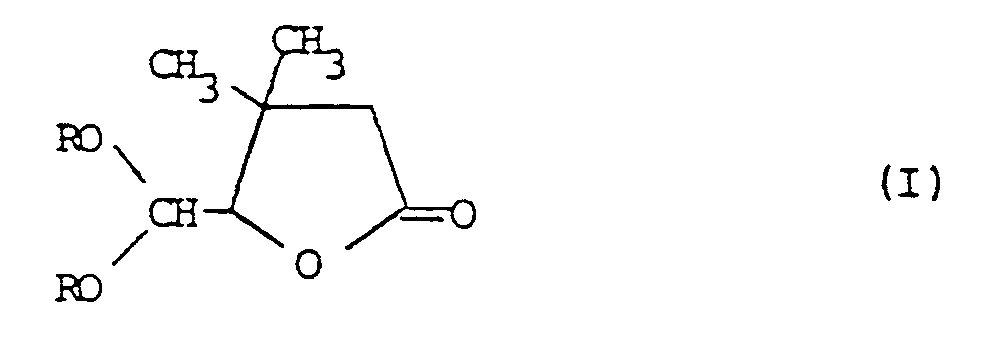
- R für C1-4-Alkyl steht oder beide Reste R gemeinsam für Ethylen stehen, dadurch gekennzeichnet, daß man Dichlormethylbutyrolactone der Formel ll

- R - O - M (lll)
- in welcher
- R die oben angegebene Bedeutung hat und
- M für ein Äquivalent eines Alkali-oder Erdalkalikations steht,
- umsetzt.
- R für C1-4-Alkyl steht oder beide Reste R gemeinsam für Ethylen stehen, dadurch gekennzeichnet, daß man Dichlormethylbutyrolactone der Formel ll
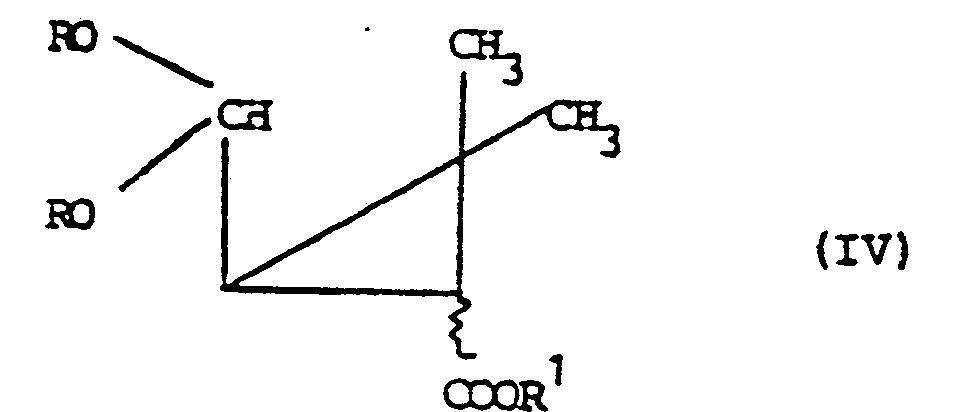
- 3. Verwendung von Dialkoxymethyl-butyrolactonen der Formel zur Herstellung von Caronaldehydsäurederivaten der Formel IV

- R die oben angegebene Bedeutung hat und
- R1 für C1-4-Alkyl steht,
- dadurch gekennzeichnet, daß man die Verbindung der Formel l halogenierend spaltet und unter Dreiringbildung dehydrohalogeniert.
- 4. Dichlormethylbutyrolacton der Formel 11

- 5. Verfahren zur Herstellung von Dichlormethylbutyrolactonen der Forme ll, dadurch gekennzeichnet, daß man 5-Chlor-3,3-dimethyl-pent-4-ensäure der Formel V

- 6. oder ihre Salze (insbesondere Alkali, Erdalkali oder Aminsalze) mit Chlor umsetzt. 5-Chlor-3,3-dimethyl-pent-4-ensäure (derivate) der Formel VI
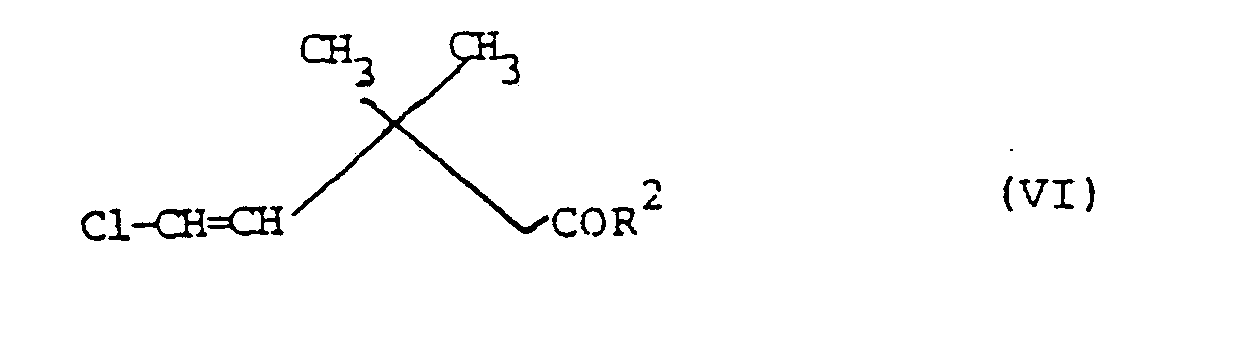
- R2 für OH, C1-4-Alkoxy oder Halogen steht.
- 7. Verfahren zur Herstellung von 5-Chlor-3,3-dimethyl-pent-4-ensäure (derivaten) der Formel VI, dadurch gekennzeichnet, daß man 5,5-Dichlor-3,3-dimethyl -pentansäureester der Formel Vil

- Rl für C1-4-Alkyl steht,
- mit Basen umsetzt und die entstandenen Ester der 5-Chlor-3,3-dimethyl-pent-4-en-säure anschließend in üblicher Weise derivatisiert.
- Mit Hilfe der neuen Verbindungen und den Verfahren zu ihrer Herstellung wurde ein neues preiswertes Verfahren zur Herstellung von Caronaldehydsäureestern gefunden. Dieses neue Verfahren hat den Vorteil, daß es von einfachen und billigen Ausgangsprodukten ausgeht. So ist das 1, 1, 5, 5-Tetra-chlor-3, 3-dimethyl-pent-1 - en, aus dem die 5, 5-Dichlor-3, 3-dimethylpentansäure der Formel VII erhalten wird, in sehr guten Ausbeuten über zwei Stufen aus Tetrachlorkohlenstoff, iso-Buten und Vinylchlorid zugänglich. Die weitere Umsetzung zum Caronaldehydsäurester erfolgt in 5 Stufen. Das heißt verglichen mit dem aus dem Stand der Technik bekannten Verfahren ist eine Stufe weniger zu durchlaufen.
- Es war überraschend, daß mit Hilfe der neuen Verbindungen das Gesamtverfahren zur Herstellung der Caronaldehydsäureester durchgeführt werden konnte. Die Vorteile des neuen Verfahrens liegen darin, daß billigere Ausgangsprodukte verwendet werden können und daß insgesamt eine Reaktionsstufe weniger benötigt wird um zum Caronaldehydsäureester zu gelangen.
- Der Verlauf der Gesamtreaktion war nicht nur deshalb überraschend, weil zu seiner Durchführung neue Verbindungen eingesetzt werden mußten, über deren Eigenschaften und Reaktionsfähigkeiten noch nichts bekannt war. Es war auch überraschend, daß verschiedene der durchlaufenden Reaktionsschritte überhaupt in der beschriebenen Weise abliefen.
- So konnte nicht erwartet werden, daß das Verfahren unter 5 (oben) glatt und mit guten Ausbeuten verläuft. Es hätte erwartet werden können, daß durch Halogenaddition an die Doppelbindung und durch Bildung eines 6-Ringlactons anstelle des gewünschten Butyrolactons Ausbeute und Reinheit der Verbindung der Formel 11 so schlecht sind, daß das Gesamtverfahren nicht wirtschaftlich durchzuführen ist.
- So konnte auch nicht erwartet werden, daß das Verfahren unter 2 (oben) glatt und mit guten Ausbeuten verläuft. Auch hier mußte mit Nebenreaktionen (HCI-Eliminierung unter Ausbeute einer Doppelbindung)-gerechnet werden, wobei Ausbeute und Reinheit das Verfahren unwirtschaftlich hätten machen können.
- Die Dialkoxymethyl-butyrolactone der Formel 1 sind neu. In Formel steht R bevrozugt für Methyl oder Ethyl. Sie werden nach dem unter 2 (oben) angegebenen Verfahren hergestellt. Dies kann, wenn Dichlormethylbutyrolacton und Natriummethylat verwendet wird durch folgendes Formelschema wiedergegeben werden:

- Die Reaktion wird zwischen 20 und 100°C bevorzugt zwischen 20 und 80° C durchgeführt. Man arbeitet im allgemeinen bei Normaldruck. Die Reaktion wird in inerten Lösungsmitteln durchgeführt. Bevorzugt sind die den Alkoholaten zugrundeliegenden Alkohole als Lösungsmittel, also z.B. Methanol.
- Die Verbindungen der Formel I können in üblicher Weise aus dem Reaktionsgemisch durch Destillation isoliert werden. Sie können aber auch in Form des Reaktionsgemisches sofort, ohne Isolierung, zu den Verbindungen der Formel IV weiter umgesetzt werden. Dazu wird Chlorwasserstoff in das Reaktionsgemisch, das bei der Bildung der Verbindungen der Formel 1 entstand, eingeleitet und nach Beendigung der Reaktion das Gemisch mit Alkalialkoholaten wie Natriummethylat oder Natriumethylat versetzt.
- Verbindungen der Formel IV werden auch erhalten, wenn Butyrolactone der Formel l mit Thionylchtorid oder Phosphorpentachlorid z.B. bei Temperaturen zwischen 0° und 40°C umgesetzt werden und das erhaltene Produkt mit Alkoholen und basischen Mitteln behandelt wird. Als Alkohole kommen z.B. Methanol und Ethanol, als basische Mittel z.B. Na-methylat und -ethylat oder DBU bzw. DBN in Frage.
- Die Isolierung der Butyrolactone der Formel erfolgt in an sich bekannter Weise z.B. durch Destillation.
- Das Dichlormethyl-butyrolacton der Formel 11 ist neu. Es wird nach folgendem Formelschema erhalten

- Die Reaktion erfolgt durch Umsetzung der Säure der Formel V oder von Salzen dieser Säure mit Chlor zu dem 5-Dichloro-methyl-4, 4-dimethyl-butyrolacton der Formel ll. Die Umsetzung erfolgt bei Temperaturen zwischen ca. -20° und 50°C in inerten Lösungsmitteln, wie z.B. Dichlor- oder Trichlormethan. Als Salze eignen sich die Alkalisalze der Säure der Formel V, aber auch deren Salze mit tertiären Basen, wie z.B. Trimethyl- oder Triethylamin sind verwendbar. Das Lacton der Formel 11 kann durch fraktionierende Destillation rein isoliert werden, gegebenenfalls nachdem zuvor die entstandenen Salze, z.B. Triethylammoniumchlorid, oder gebildeter Chlorwasserstoff aus dem Reaktionsgemisch mit Wasser extrahiert wurden.
- 5-Chlor-3, 3-dimethyl-pent-4-ensäure und ihre Derivate der Formel V und VI sind neu. Sie wird nach folgendem Formelschema erhalten:

- Durch übliche Verseifung des Esters werden die Säure der Formel V bzw. ihre Salze erhalten.
- Der Ester der 5, 5-Dichlor-3, 3-dimethyl-pentansäure wird durch Einwirkung von Basen dehydrohalogeniert, wobei Ester der 5-Chlor-3, 3-dimethyl-pent-4-ensäure der Formel V erhalten werden. Als Dehydrohalogenierungsmittel werden z.B. Alkoholate, wie Na-methylat, -ethylat und -butylat oder tertiäre Basen wie Triethylamin, N,N-Dimethylbenzylamin, DBU und DBN verwendet. Die Dehydrohalogenierung wird im allgemeinen bei Temperaturen zwischen 65°C und 150°C vorgenommen, als Lösungsmittel dienen z.B. Alkohole wie Methanol, Ethanol und Butanol oder aprotische Lösungsmittel wie Dimethylformamid und Diethylenglykoldimethylether. Der erhaltene Ester kann z.B. durch Destillation rein isoliert werden. Er kann aber auch in situ durch Umsetzung mit Alkalien hydrolysiert werden. Als Alkalien dienen z.B. Natrium- oder Kaliumhydroxid. Diese Esterhydrolyse wird z.B. in Alkoholen bei Temperaturen zwischen 20° und 80° vorgenommen. Durch Ansäuren mit Mineralsäuren wie Salzsäure oder Schwefelsäure wird die 5-Chlor-3, 3-dimethyl-pent-4-ensäure anschließend freigesetzt und z.B. durch Destillation in reiner Form erhalten.
- Es ist auch möglich, das Chlorid der Säure der Formel V durch katalytische Dehydrohalogenierung aus dem 5,5-Dichlor-3,3-dimethyl-pentansäurechlorid zu erhalten. Als Katalysatoren eignen sich z.B. mit Metallsalzen dotierte Aktivkohle, wobei als Salze z.B. BaClz, FeCl3, ZnCl2 und CuCI verwendet werden können. Die Dehydrohalogenierung, die sowohl in der Flüssigphase wie in der Gasphase erfolgen kann, wird bei Temperaturen zwischen 150° und 300° C ausgeführt. Das erhaltent Säurechlorid der Säure der Formel V wird durch Destillation gereinigt. Es kann in an sich bekannter Weise zur Säure der Formel V hydrolysiert werden.
- 5, 5-Dichlor-3, 3-dimethylpentansäure der Formel Vll ist Gegenstand einer noch nicht zum Stand der Technik gehörenden Anmeldung der Anmelderin (vgl. EP-A- 103 136)
- Man erhält sie durch saure Hydrolyse von 1, 1, 5, 5-Tetra-chlor-3, 3-dimethyl-pent-1-en, beispielsweise mit Schwefelsäure. Während der Hydrolyse wird ein Temperaturbereich von ca. 20°-100°C, vorzugsweise von 40°-70°C, eingehalten. Im allgemeinen wird ein Überschuß an Säure eingesetzt, mindestens jedoch soll das Reaktionsgemisch die dem eingesetzten Penten äquivalente Menge Wasser ent halten. Zur Hydrolyse sind neben Schwefelsäure auch andere starke Säuren wie z.B. Phosphorsäure, Methansulfonsäure, Trifluoressigsäure und Gemische aus Ameisensäure und Salzsäure geeignet.
- Will man die Säure der Formel Vll isolieren, so wird das Reaktionsgemisch mit Wasser verdünnt und die Säure der Formel Vil mit Lösungsmitteln, wie z.B. Chlorkohlenwasserstoffen extrahiert. Bei Verwendung destillierbarer Säuregemische, wie z.B. die nach der Hydrolyse mit Trifluoressigsäure oder Ameisensäure-Salzsäure erhaltenen Reaktionsgemische, werden destillativ aufgearbeitet, um die Säure der Formel Vll rein zu gewinnen.
- Es ist aber auch möglich, die nach der sauren Hydrolyse erhaltenen Reaktionsgemische direkt weiter umzusetzen (vgl. Verfahren 7).
- Um 5-Chlor-3, 3-dimethyl-pent-4-ensäure der Formel V zu erhalten, wird die Verbindung der Formel VII zunächst in einen Ester umgewandelt. Dies kann z.B. in bekannter Weise durch Umsetzung mit Thionylchlorid oder Phosgen zum 5,5-Dichlor-3, 3-dimethyl-pentansäurechlorid und die anschließende Umsetzung dieser Verbindung mit Alkoholen, wie z.B. Methanol oder Ethanol, erfolgen. Es ist auch möglich, die Säure in Gegenwart von bekannten Veresterungskatalysatoren direkt mit Alkoholen umzusetzen, wobei zweckmäßig das entstehende Reaktionswasser durch Azeotropdestillation entfernt wird. Besonders vorteilhaft ist für die Herstellung des Esters der Säure der Formel VII die Umsetzung der aus 1, 1, 5, 5-Tetrachlor-3, 3-dimethyl-pent-1-en erhaltenen Reaktionsgemische mit Alkoholen. Der gebildete Ester wird in diesem Fall z.B. durch Extraktion mit Lösungsmitteln wie z. B. Hexan gegebenenfalls nach Verdünnen des Reaktionsgemisches mit Wasser isoliert und durch Destillation gereinigt.
- 1, 1, 5, 5-Tetrachlor-3, 3-dimethyl-pent-1-en ist bekannt. Es ist preiswert aus Tetrachlorkohlenstoff, iso-Buten und Vinylchlorid nach an sich bekannten Verfahren zugänglich.
- 500 g 1, 1, 5, 5-Tetrachlor-3, 3-dimethyl-penten werden innerhalb 1 Stunde unter Rühren so zudosiert, daß die Reaktionsmischung nicht über 45°C steigt. Das Reaktionsgemisch wird weitere 24 Stunden bei 40°-45°C gehalten und dann auf 4 kg Eis gegeben. Die Mischung wird mehrfach mit Dichlormethan extrahiert. Nach dem Abdestillieren des Lösungsmittels erhält man 420 g rohe 5, 5-Dichlor-3, 3-di-methyl-pentansäure, nach der Destillation 380 g reine 5, 5-Dichlor-3,3-dimethyl-pentansäure, Kp.0,2 103-106°C.
- 5, 5-Dichlor-3, 3-dimethyl-pentansäurechlorid
- 52, 25 g 5, 5-Dichlor-3, 3-dimethyl-pentansäure werden mit 150 ml Thionylchlorid zunächst bei Raumtemperatur, nachfolgend unter Erwärmen auf 60°C umgesetzt. Durch destillative Aufarbeitung erhält man 56,5 g 5,5-Dichlor-3,3 -dimethyl-pentansäurechlorid, Kp.15 114-115°C.
- 5, 5-Dichlor-3, 3-dimethyl-pentansäuremethylester
- 22, 5 g des nach Beispiel 2 erhaltenen Säurechlorids werden zu 100 ml Methanol zugetropft und anschließend 1 Std. auf 65°C erwärmt. Durch Destillation des Reaktionsgemisches erhält man 20, 5 g 5, 5-Dichlor-3, 3-dimethyl-pentansäuremethylester, Kp.15 110°-112°C.
- 5-Chlor-3, 3-dimethyl-pent-4-ensäuremethylester
- 62, 8 g des nach Beispiel 3 erhaltenen Esters und 40, 5 g DBN (Diazabicyclononan) werden in 250 ml Dimethoxyethan 40 Stunden auf Rückflußtemperatur erwärmt.
- Dann wird das Lösungsmittel abdestilliert und der Rückstand mit 250 ml Dichlormethan versetzt und mit verdünnter Salzsäure extrahiert. Durch Destillation der organischen Phase werden 30 g 5-Chlor-3, 3-dimethyl-pent-4-en-säuremethylester, Kp.12 87-88° C, erhalten.
- 5-Chlor-3, 3-dimethyl-pent-4-ensäurechlorid
- 38 g des nach Beispiel 4 erhaltenen Esters werden mit 13 g KOH, gelöst in 120 ml Methanol, 8 Stunden auf 40°C erwärmt. Dann wird das Methanol abdestilliert und der Rückstand mit 150 ml Wasser aufgenommen und die Mischung mit Salzsäure angesäuert. Man extrahiert anschließend mit Dichlormethan und verdampft das Lösungsmittel im Vakuum. Die zurückbleibende Säure wird mit 100 ml Thionylchlorid versetzt und 4 Stunden auf 60°C erwärmt. Nach der Destillation des Reaktionsgemisches erhält man 36 g 5-Chlor-3, 3-dimethyl-pent-4- ensäurechlorid, Kp.15 86°-90°C.
- 4-Dichlormethyl-3, 3-dimethyl-butyrolacton
- 13, 1 g des nach Beispiel 5 erhaltenen Säurechlorids werden zu einer gerührten Mischung von 4 g Wasser in 150 ml Dichlormethan getropft. Die Mischung wird 8 Stunden auf Rückflußtemperatur erhitzt. Anschließend werden das Lösungsmittel, Restwasser und Chlorwasserstoff im Vakuum entfernt. Der Rückstand (5-Chlor-3, 3-dimethyl-pent-4-ensäure) wird in 50 ml Dichlormethan gelöst.
- Zu dieser Lösung werden 9, 2 g Triethylamin zugegeben und anschließend werden in diese Salzlösung ca. 7 g Chlor unter Kühlung auf 0°C eingeleitet.
- Um das gebildete 4-Dichlormethyl-3, 3-dimethyl -butyrolacton zu isolieren, wird die erhaltene Lösung mit Wasser extrahiert, getrocknet (Na2S04) und destilliert. Man erhält 8, 5 g 4-Dichlormethyl-3, 3-dimethyl-butyrolacton, Kp.0 15 88°-92°C.
- Zweckmäßig wird das erhaltene rohe Reaktionsprodukt in Lösung weiter gemäß Beispiel 7 umgesetzt.
- Die nach Beispiel 6 erhaltene Dichlormethanlösung von 4-Dichlormethyl-3, 3-dimethyl-butyrolacton wird zu einer Lösung von 6, 5 g Na in 100 ml absol. Ethanol bei 0°C zugetropft. Dann wird auf Rückflußtemperatur erwärmt und über eine Kolonne das Dichlormethan abdestilliert. Nach 6 Stunden wird die Reaktionslösung mit Eiswasser versetzt und mit Dichlormethan mehrfach extrahiert. Die fraktionierte Destillation der Dichlormethanlösung ergibt 8,9 g 4-Diethoxymethyl -3,3-dimethyl-butyrolacton, Kp.0,08 78°-80°C.
- 8, 9 g des nach Beispiel 7 erhaltenen 4-Diethoxymethyl-3, 3-dimethyl-butyrolactons werden in 80 ml absol. Ethanol gelöst und bei Raumtemperatur wird Chlorwasserstoff in die Lösung eingeleitet. Nach 10 Stunden wird das Lösungsmittel und überschüssiger Chlorwasserstoff im Vakuum verdampft. Der Rückstand wird in die Lösung von 1 g Na in 100 ml Ethanol eingetropft und 5 Stunden auf 75°C erwärmt. Das Reaktionsgemisch wird nach Filtration des ausgefallenen Natriumchlorids destilliert. Man erhält 5 g Caronaldehydsäureethylesterdiethylacetat, KPO,04 73°C-77°C.
Claims (7)




Applications Claiming Priority (2)
| Application Number | Priority Date | Filing Date | Title |
|---|---|---|---|
| DE3231815 | 1982-08-26 | ||
| DE19823231815 DE3231815A1 (de) | 1982-08-26 | 1982-08-26 | Dialkoxymethyl-butyrolactone, verfahren zu ihrer herstellung, zwischenprodukte dafuer und ihre verwendung |
Publications (2)
| Publication Number | Publication Date |
|---|---|
| EP0103749A1 EP0103749A1 (de) | 1984-03-28 |
| EP0103749B1 true EP0103749B1 (de) | 1986-07-02 |
Family
ID=6171789
Family Applications (1)
| Application Number | Title | Priority Date | Filing Date |
|---|---|---|---|
| EP83108098A Expired EP0103749B1 (de) | 1982-08-26 | 1983-08-17 | Dialkoxymethyl-butyrolactone, Verfahren zu ihrer Herstellung, Zwischenprodukte dafür und ihre Verwendung |
Country Status (4)
| Country | Link |
|---|---|
| US (1) | US4508913A (de) |
| EP (1) | EP0103749B1 (de) |
| JP (1) | JPS5955850A (de) |
| DE (2) | DE3231815A1 (de) |
Families Citing this family (2)
| Publication number | Priority date | Publication date | Assignee | Title |
|---|---|---|---|---|
| GB8711534D0 (en) * | 1987-05-15 | 1987-06-17 | Ciba Geigy Ag | Corrosion inhibiting composition |
| FR2558833B1 (fr) * | 1984-02-01 | 1986-05-30 | Roussel Uclaf | Nouveaux derives de la 4,4-dimethyl tetrahydro-2-pyran-2-one, leur procede de preparation et leur application a la synthese de derives cyclopropaniques |
Family Cites Families (6)
| Publication number | Priority date | Publication date | Assignee | Title |
|---|---|---|---|---|
| DE1128067B (de) * | 1959-10-09 | 1962-04-19 | Firmenich & Cie | Parfuemkomposition |
| FR1512331A (fr) * | 1964-08-06 | 1968-02-09 | Roussel Uclaf | Procédé de préparation de gamma-lactones substituées et produits en résultant |
| US3758514A (en) * | 1971-10-15 | 1973-09-11 | Mobil Oil Corp | Substituted butyrolactones derived from non conjugated polyolefins |
| DE2916321A1 (de) * | 1979-04-23 | 1980-11-06 | Bayer Ag | Verfahren zur herstellung von styryl- cyclopropan-carbonsaeureestern und neue zwischenprodukte dafuer |
| DE2916375A1 (de) * | 1979-04-23 | 1980-11-06 | Bayer Ag | Verfahren zur herstellung von styryl-cyclopropan-carbonsaeureestern und neue zwischenprodukte dafuer |
| EP0031932B1 (de) * | 1979-12-22 | 1987-07-01 | Hüls Troisdorf Aktiengesellschaft | Substituierte Lactone, Pentacarbonsäurederivate und Verfahren zu ihrer Herstellung |
-
1982
- 1982-08-26 DE DE19823231815 patent/DE3231815A1/de not_active Withdrawn
-
1983
- 1983-08-05 US US06/520,676 patent/US4508913A/en not_active Expired - Fee Related
- 1983-08-17 DE DE8383108098T patent/DE3364377D1/de not_active Expired
- 1983-08-17 EP EP83108098A patent/EP0103749B1/de not_active Expired
- 1983-08-22 JP JP58151737A patent/JPS5955850A/ja active Pending
Also Published As
| Publication number | Publication date |
|---|---|
| DE3231815A1 (de) | 1984-03-01 |
| EP0103749A1 (de) | 1984-03-28 |
| DE3364377D1 (en) | 1986-08-07 |
| US4508913A (en) | 1985-04-02 |
| JPS5955850A (ja) | 1984-03-31 |
Similar Documents
| Publication | Publication Date | Title |
|---|---|---|
| DE2858248C2 (de) | ||
| EP0132733B1 (de) | Neue Fluorpivalsäurefluoride und Verfahren zu ihrer Herstellung | |
| CH634033A5 (de) | Dihalogenvinyl-verbindungen, verfahren zu deren herstellung sowie deren verwendung zur herstellung von dihalogenvinyl-cyclopropancarbonsaeuren und deren ester. | |
| DE2753454A1 (de) | Quadratsaeureester | |
| EP0123187A2 (de) | Verfahren zur Herstellung von fluorierten Phenylessigsäureestern und neue fluorierte Trichlorethylbenzole | |
| DE3026094C2 (de) | Verfahren zur Herstellung von Cyclopropancarbonsäureamiden | |
| EP0095047B1 (de) | Verfahren zur Herstellung von 3-vinylsubstituierten 2,2-Dimethylcyclopropan-1-carbonsäuren bzw. ihren Estern und neue Zwischenprodukte dafür | |
| EP0103749A1 (de) | Dialkoxymethyl-butyrolactone, Verfahren zu ihrer Herstellung, Zwischenprodukte dafür und ihre Verwendung | |
| DE2533396C2 (de) | 3-Methyl-3-aryl-brenztraubensäureester und Verfahren zu ihrer Herstellung | |
| EP0048370B1 (de) | Verfahren zur Herstellung von trans-3-(Z-2-Chlor-2-aryl-vinyl)-2,2-dimethyl-cyclopropan-1-carbon-säure-derivaten, neue Zwischenprodukte hierfür, Verfahren zu deren Herstellung und Verwendung von Zwischenprodukten in Schädlingsbekämpfungsmitteln | |
| EP0006180B1 (de) | 3-Phenoxybenzylidenamine und 3-Benzylbenzylidenamine, ein Verfahren zu deren Herstellung sowie deren Verwendung zur Herstellung der entsprechenden Aldehyde | |
| EP0061629B1 (de) | Verfahren zur Herstellung von substituierter alpha-Halogenpropionsäure und ihren Derivaten; substituiertes Vinylidenchlorid | |
| EP0573999A1 (de) | Verfahren zur Herstellung von Tetronsäurealkylestern | |
| WO2005019154A1 (de) | VERFAHREN ZUR HERSTELLUNG VON α-FLUOR-MALONSÄUREDIALKYLESTERN | |
| EP0024588A1 (de) | Verfahren zur Herstellung von substituierten Cyclopropyl-carbonsäure-(alpha-cyano-3-phenoxy-benzyl)-estern | |
| DE2552615A1 (de) | Verfahren zur herstellung von dihalogenvinylcyclopropancarboxylaten | |
| EP0061641B1 (de) | Verfahren zur Herstellung von Caronaldehydsäure und deren Derivaten | |
| DE3042218A1 (de) | 2,2-dimethylcyclobutanone, und verfahren zu ihrer herstellung | |
| DE1468857A1 (de) | Verfahren zur Herstellung von trans-omega-Hydroxyalken-(2)-saeuren | |
| DE3046059C2 (de) | 4-Halogen-5,5-dialkoxypentansäureester, Verfahren zu ihrer Herstellung und ihre Verwendung zur Herstellung von 2,2-Dialkyl-3-formylcyclopropancarbonsäureestern | |
| DE2952068A1 (de) | Substituierte lactone und verfahren zu deren herstellung | |
| EP0290903A2 (de) | Beta-Fluoracyl-beta-halogenvinylalkylether | |
| DE2621833A1 (de) | Herstellung organischer saeuren | |
| EP0673945A1 (de) | Herstellung eines Wittigestersalzes | |
| DE2621832A1 (de) | Verfahren zur herstellung organischer saeuren |
Legal Events
| Date | Code | Title | Description |
|---|---|---|---|
| PUAI | Public reference made under article 153(3) epc to a published international application that has entered the european phase |
Free format text: ORIGINAL CODE: 0009012 |
|
| 17P | Request for examination filed |
Effective date: 19830817 |
|
| AK | Designated contracting states |
Designated state(s): CH DE FR GB LI |
|
| GRAA | (expected) grant |
Free format text: ORIGINAL CODE: 0009210 |
|
| AK | Designated contracting states |
Kind code of ref document: B1 Designated state(s): CH DE FR GB LI |
|
| REF | Corresponds to: |
Ref document number: 3364377 Country of ref document: DE Date of ref document: 19860807 |
|
| ET | Fr: translation filed | ||
| PLBE | No opposition filed within time limit |
Free format text: ORIGINAL CODE: 0009261 |
|
| STAA | Information on the status of an ep patent application or granted ep patent |
Free format text: STATUS: NO OPPOSITION FILED WITHIN TIME LIMIT |
|
| 26N | No opposition filed | ||
| PGFP | Annual fee paid to national office [announced via postgrant information from national office to epo] |
Ref country code: DE Payment date: 19890718 Year of fee payment: 7 |
|
| PGFP | Annual fee paid to national office [announced via postgrant information from national office to epo] |
Ref country code: FR Payment date: 19890728 Year of fee payment: 7 |
|
| PGFP | Annual fee paid to national office [announced via postgrant information from national office to epo] |
Ref country code: CH Payment date: 19890825 Year of fee payment: 7 |
|
| PGFP | Annual fee paid to national office [announced via postgrant information from national office to epo] |
Ref country code: GB Payment date: 19890831 Year of fee payment: 7 |
|
| PG25 | Lapsed in a contracting state [announced via postgrant information from national office to epo] |
Ref country code: GB Effective date: 19900817 |
|
| PG25 | Lapsed in a contracting state [announced via postgrant information from national office to epo] |
Ref country code: LI Effective date: 19900831 Ref country code: CH Effective date: 19900831 |
|
| GBPC | Gb: european patent ceased through non-payment of renewal fee | ||
| PG25 | Lapsed in a contracting state [announced via postgrant information from national office to epo] |
Ref country code: FR Effective date: 19910430 |
|
| REG | Reference to a national code |
Ref country code: CH Ref legal event code: PL |
|
| PG25 | Lapsed in a contracting state [announced via postgrant information from national office to epo] |
Ref country code: DE Effective date: 19910501 |
|
| REG | Reference to a national code |
Ref country code: FR Ref legal event code: ST |