EP0103384A2 - Lufteinlasssystem für eine Maschine - Google Patents
Lufteinlasssystem für eine Maschine Download PDFInfo
- Publication number
- EP0103384A2 EP0103384A2 EP83304390A EP83304390A EP0103384A2 EP 0103384 A2 EP0103384 A2 EP 0103384A2 EP 83304390 A EP83304390 A EP 83304390A EP 83304390 A EP83304390 A EP 83304390A EP 0103384 A2 EP0103384 A2 EP 0103384A2
- Authority
- EP
- European Patent Office
- Prior art keywords
- airstream
- duct
- intake duct
- plenum
- engine
- Prior art date
- Legal status (The legal status is an assumption and is not a legal conclusion. Google has not performed a legal analysis and makes no representation as to the accuracy of the status listed.)
- Granted
Links
- 239000002245 particle Substances 0.000 claims abstract description 32
- 238000000926 separation method Methods 0.000 claims description 13
- 230000003247 decreasing effect Effects 0.000 claims description 4
- 239000010705 motor oil Substances 0.000 claims description 2
- 238000007599 discharging Methods 0.000 claims 1
- 230000015572 biosynthetic process Effects 0.000 description 3
- 239000003921 oil Substances 0.000 description 2
- 239000004576 sand Substances 0.000 description 2
- 230000035939 shock Effects 0.000 description 2
- 230000000903 blocking effect Effects 0.000 description 1
- 230000009977 dual effect Effects 0.000 description 1
- 239000000428 dust Substances 0.000 description 1
- 239000000945 filler Substances 0.000 description 1
- 230000037406 food intake Effects 0.000 description 1
- 238000010438 heat treatment Methods 0.000 description 1
- 229910001385 heavy metal Inorganic materials 0.000 description 1
- 230000002452 interceptive effect Effects 0.000 description 1
- 239000000463 material Substances 0.000 description 1
- 230000004048 modification Effects 0.000 description 1
- 238000012986 modification Methods 0.000 description 1
- 230000002093 peripheral effect Effects 0.000 description 1
Images


Classifications
-
- B—PERFORMING OPERATIONS; TRANSPORTING
- B64—AIRCRAFT; AVIATION; COSMONAUTICS
- B64D—EQUIPMENT FOR FITTING IN OR TO AIRCRAFT; FLIGHT SUITS; PARACHUTES; ARRANGEMENT OR MOUNTING OF POWER PLANTS OR PROPULSION TRANSMISSIONS IN AIRCRAFT
- B64D33/00—Arrangement in aircraft of power plant parts or auxiliaries not otherwise provided for
- B64D33/02—Arrangement in aircraft of power plant parts or auxiliaries not otherwise provided for of combustion air intakes
-
- F—MECHANICAL ENGINEERING; LIGHTING; HEATING; WEAPONS; BLASTING
- F02—COMBUSTION ENGINES; HOT-GAS OR COMBUSTION-PRODUCT ENGINE PLANTS
- F02C—GAS-TURBINE PLANTS; AIR INTAKES FOR JET-PROPULSION PLANTS; CONTROLLING FUEL SUPPLY IN AIR-BREATHING JET-PROPULSION PLANTS
- F02C7/00—Features, components parts, details or accessories, not provided for in, or of interest apart form groups F02C1/00 - F02C6/00; Air intakes for jet-propulsion plants
- F02C7/04—Air intakes for gas-turbine plants or jet-propulsion plants
- F02C7/05—Air intakes for gas-turbine plants or jet-propulsion plants having provisions for obviating the penetration of damaging objects or particles
-
- B—PERFORMING OPERATIONS; TRANSPORTING
- B64—AIRCRAFT; AVIATION; COSMONAUTICS
- B64D—EQUIPMENT FOR FITTING IN OR TO AIRCRAFT; FLIGHT SUITS; PARACHUTES; ARRANGEMENT OR MOUNTING OF POWER PLANTS OR PROPULSION TRANSMISSIONS IN AIRCRAFT
- B64D33/00—Arrangement in aircraft of power plant parts or auxiliaries not otherwise provided for
- B64D33/02—Arrangement in aircraft of power plant parts or auxiliaries not otherwise provided for of combustion air intakes
- B64D2033/022—Arrangement in aircraft of power plant parts or auxiliaries not otherwise provided for of combustion air intakes comprising bird or foreign object protections
-
- B—PERFORMING OPERATIONS; TRANSPORTING
- B64—AIRCRAFT; AVIATION; COSMONAUTICS
- B64D—EQUIPMENT FOR FITTING IN OR TO AIRCRAFT; FLIGHT SUITS; PARACHUTES; ARRANGEMENT OR MOUNTING OF POWER PLANTS OR PROPULSION TRANSMISSIONS IN AIRCRAFT
- B64D33/00—Arrangement in aircraft of power plant parts or auxiliaries not otherwise provided for
- B64D33/02—Arrangement in aircraft of power plant parts or auxiliaries not otherwise provided for of combustion air intakes
- B64D2033/0266—Arrangement in aircraft of power plant parts or auxiliaries not otherwise provided for of combustion air intakes specially adapted for particular type of power plants
- B64D2033/0293—Arrangement in aircraft of power plant parts or auxiliaries not otherwise provided for of combustion air intakes specially adapted for particular type of power plants for turboprop engines
-
- Y—GENERAL TAGGING OF NEW TECHNOLOGICAL DEVELOPMENTS; GENERAL TAGGING OF CROSS-SECTIONAL TECHNOLOGIES SPANNING OVER SEVERAL SECTIONS OF THE IPC; TECHNICAL SUBJECTS COVERED BY FORMER USPC CROSS-REFERENCE ART COLLECTIONS [XRACs] AND DIGESTS
- Y02—TECHNOLOGIES OR APPLICATIONS FOR MITIGATION OR ADAPTATION AGAINST CLIMATE CHANGE
- Y02T—CLIMATE CHANGE MITIGATION TECHNOLOGIES RELATED TO TRANSPORTATION
- Y02T50/00—Aeronautics or air transport
- Y02T50/60—Efficient propulsion technologies, e.g. for aircraft
Definitions
- This invention relates to an air intake system for separating foreign particles and other objects from air flowing into the inlet of a gaseous power plant such as a gas turbine engine.
- Aircraft engines in particular are susceptible to ingesting objects such as birds, hail, sand, stones, pieces of tire and the like. Such objects can damage or destroy such an engine, particularly if it is a small high speed engine.
- an air intake system which includes improved means for separating particles and other objects from the air entering an engine.
- the invention provides: for use with an engine having an air inlet, a separator for removing foreign particles from the air entering said inlet, said separator comprising:
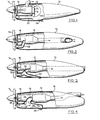
- Fig. 1 shows a typical engine, nacelle and air intake system of the kind presently used in certain aircraft made by The de Company Havilland Aircraft of Canada, Limited.
- a gas turbine engine 12 which drives a propeller 14 through a gearbox 16.
- the engine 12 is mounted with its air inlet 18 located at the rear of the engine and opening radially into a large plenum 20. Air enters an intake duct 22, travels rearwardly, and then travels upwardly through a screen 24 into the engine 12.
- Fig. 2 shows a system used in many aircraft at the present time.
- the engine 12 faces forwardly and air for the engine enters an intake duct 28 and travels directly into the engine. There is no arrangement for removing foreign objects which are ingested, and any such foreign objects may damage the engine.
- Fig. 3 shows a modification of the Fig. 2 arrangement of a kind which has been currently proposed for removing foreign objects and particles.
- a bypass duct 30 branches off the main intake duct 32 and removes about 15% of the intake air as bypass air.
- a screen 34 in the main duct 32 just downstream of the bypass duct 30 prevents foreign objects from travelling into the engine.
- the screen 34 is formed from heavy metal rods.
- the Fig. 3 arrangement has several serious disadvantages. Firstly, the screen 34, even though made of heavy material, must be shock mounted in order to withstand the impact of heavy objects such as birds. Secondly, because the screen 34 tends to ice, it must be electrically heated, thereby adding to the complexity and cost of the arrangement. Thirdly, each of the three ends of the intake duct arrangement must be shock mounted by means of a corrugated mounting, which adds weight and cost. Fourthly, when the engine is to be serviced, the nacelle must be removed and then the three branches of the intake duct must be separately removed, adding to the cost of servicing the engine. Finally, the loss of 15% of the intake air as bypass flow causes a reduction in the efficiency of the engine.
- Fig. 4 An attempt was made by The de Havilland Aircraft Company of Map, Limited to avoid the disadvantages of the Fig. 3 arrangement by adopting the Fig. 4 arrangement.
- a large plenum 36 is provided at the rear of the intake duct 38 and into which the intake duct discharges. It was intended that the air entering the intake duct 38 would find its way upwardly from the plenum 36 through an upwardly directed branch duct 39 into the inlet 18 of the engine. Foreign objects and particles because of their momentum travel straight through into the rear of the plenum 36 for removal via the trapdoor 26.
- FIG. 5 A preferred intake structure 40 according to the invention is shown in Figs. 5 to 17 and has been found to operate in a highly satisfactory manner.
- the structure 40 will first be described generally with reference to Figs. 5 and 9.
- the intake structure 40 includes a main intake duct 42.
- An inlet airstream 44 enters duct 42 and is divided into a primary airstream 46 and a secondary airstream 48.
- the primary airstream 46 turns sharply upwardly and then travels directly into the engine inlet 50 and through the engine intake duct indicated in dotted lines at 51.
- the secondary airstream 48 travels directly rearwardly into a plenum 52 located behind duct 42. Birds, stones, ice and the like entering the main intake duct 42 simply travel straight through the plenum 52 as shown by arrows 56, and exit through a door 58 which is opened when required.
- a third airstream 60 (which may be equal to the entire secondary airstream 48 if no other air is removed from the plenum 52) travels forwardly through an air duct 64 located below and to the sides of the main intake duct 42.
- the third airstream 60 When the third airstream 60 reaches the front end of the air duct 64, it divides into two streams 60a, 60b, one travelling upwardly on each side of the main air intake duct 42.
- the airstreams 60a, 60b rejoin as stream 60c at the top of the main air intake duct 42, and then travel rewarwardly and upwardly through the peripheral gap formed by the engine inlet 50 and intake lip 86 (to be described), to rejoin the primary airstream 46 flowing into the engine inlet 50 and engine intake duct 51.
- a portion of the third airstream also travels from the plenum 52 directly forwardly and upwardly at the sides of the intake duct 42 to rejoin the primary air stream, as will be described.
- the invention solves a problem which in the past had been thought to be almost impossible to solve, i.e. it permits bypass of foreign objects without complexity and without creating significant instabilities, icing problems or substantial losses.
- the intake structure 40 is formed as a unit in a housing 72 connected at its rear to the nacelle 10 by hinges 73.
- the intake structure 40 is normally held in closed position against the nacelle 10 by a set of latches 74 (Fig. 6) which are conventional in nature and therefore will not be described in detail.
- the latches 74 can be released and the intake structure 40 swung downwardly as shown in Fig. 8 for engine servicing.
- the main intake duct 42 is centered laterally within the housing 72.
- the intake duct 42 is generally rectangular in cross-section, as shown in the drawings, but with rounded sides 76 and an inlet opening 77.
- the bottom wall 78 of the main intake duct 42 terminates in the cusp or V-shaped formation 68, which consists of an upwardly curved bottom wall portion 80 and a straight bottom wall portion 82. Both terminate at rear edges 80a, 82a located directly beneath the engine inlet 50, with a concave filler plate 83 extending therebetween.
- the V-shaped formation or cusp 69 extends upwardly to the upper wall 98 (to be described) of the housing, as shown in Figs 9, 12 and 16.
- the top wall 84 of the main intake duct 42 slopes slightly upwardly rearwardly along the bulk of its length and then at its rear curves sharply upwardly at a curved portion 86, terminating just above the bottom of the engine inlet 50.
- the rear edge 88 of the curved portion 86 also forms the front edge of a top opening 90 (Figs. 6, 9 and 16) from the main intake duct 42 into the engine inlet 50.
- the curved portion 86 extends above the opening 90 and into the inlet 50 to help guide the primary airstream 46 upwardly into the inlet 50.
- the housing 72 includes a bottom wall 92, sidewalls 94, a front wall 96, and an upper wall 98.
- a front opening 100 for the main intake duct 42 is located in the front wall 84 of the housing.
- the housing sidewalls 94 extend above the housing upper wall 98 along the front part of the housing 78 and terminate in a formed rim 102 (Fig. 6).
- the rim 102 is shaped to fit the contour of the lower edge of the nacelle 10 and also to ensure that the entire housing 72 can be firmly secured to the nacelle.
- the shape of the rim 102 is also arranged to facilitate access to the front of the engine 12.
- the housing sidewalls 94 each include an upwardly projecting portion 104 adjacent the front thereof, as best shown in Figs. 6 to 8 and 14.
- the upwardly projecting sidewall portions 104 help to ensure that the housing 72 will not detach from the nacelle 10 in use and also, when the housing 72 is swung downwardly, expose the sides of the front of engine 12 for servicing
- the lower portion 64a of the air duct 64 is defined in part by the space between the bottom wall 78 of the main intake duct 42 and the bottom wall 92 of the housing 72.
- the side portions 64b of the air duct 64 are formed by the spaces between the sidewalls 76 of the main intake duct 42 and the sidewalls 94 of the housing 72.
- the front of the air duct 64 is defined by a curved plate 106, best shown in Figs. 9 and 15, which extends from the housing bottom wall 92 upwardly to a position above the front part of the main intake duct top wall 84.
- the curved plate 106 has a hole 107 therein for the intake duct 42 to pass therethrough.
- the top portion 64c of the air duct 64 is defined by the space between the upper part of the curved plate 106 and the curved rear portion 86 of the top wall-84 of the main intake duct 42..
- a longitudinally extending vertical divider plate 108 within the secondary air duct 54 divides the air duct 64 laterally into two equal parts to improve the stability of the third airstream 60 as it travels upwardly on each side of the main intake duct 42.
- its upper wall 98 extends from the front wall 96 over the curved plate 106, and is secured to the housing front wall 96, the curved plate 106, and the sidewalls 94. The upper wall 98 then extends rearwardly to the rear of the housing 72.
- the upper wall 98 includes a generally heart shaped opening 110 bordered by an upstanding rim 112.
- the opening 110 is shaped to match the shape of a standard engine inlet 50.
- the inlet 50 includes a downwardly and outwardly flared rim 114 (Fig. 9) fitted with a conventional outwardly facing O-ring 116 against which the rim 112 seals when the housing 72 is swung to its closed position.
- the plenum 52 in the rear portion of housing 72, is defined by two generally funnel-shaped structures 118, 120, best shown in Figs. 9 and 17, which guide air (and particles) along a path of decreasing cross-sectional area toward the door 58.
- the funnel-shaped structures 118, 120 are separated by a space 122 which allows a fourth stream of air 124 (but not particles) travelling rearwardly through the funnel-shaped structures to travel upwardly and then rearwardly through the open rear end of the housing 72 and into an engine oil cooler 126 located behind the housing 72.
- the funnel-shaped structures 118, 120 are supported by flanges 128, 130 which extend from the tops of the structures 118, 120 to the upper wall 98 of the housing 72.
- the door 58 includes a sector-shaped front surface 132, a flat lower surface 134 which is flush with the housing bottom wall 92 when the door is closed, and an upper surface 136 connected to a hydraulic actuator 138.
- the actuator 138 moves it to the dotted line position in Fig. 9, permitting particles and other objects to exit from the intake structure.
- FIG. 9 there is a stagnation point S just downstream of the engine inlet 50. Air which is directed toward the engine inlet 50 forwardly of the stagnation point S travels into the engine inlet as primary airstream 46. This is typically about 85% of the air entering main intake duct 42. Air directed toward the stagnation point S is indicated by arrow 140. Air flowing rearwardly of arrow 140 travels into the plenum 52 as the secondary airstream 48, together with the particles to be'separated. Dimension dl between arrow 140 and the lower wall 78 of the main intake duct is proportioned so that about 15% of the intake air is bled off as secondary air.
- the third airstream 60 travels forwardly through the air duct 64 (including portions 64a, 64b thereof) beneath and to the sides of the main intake duct 42.
- the third airstream 60 is equal in flow to the secondary airstream 48 less the sum of any air flows travelling to the trapdoor 58, or to the oil cooler 126, or lost in leaks.
- the main portion of the third airstream 60 flows from lower duct 64 upwardly on each side of the main intake duct 42, and then rearwardly and upwardly through duct portion 64c, over curved portion 86 and into the engine inlet 50.
- lip 88 which defines the dimension of the flow gap between the duct 42 and the engine inlet 50, is important. This lip, which guides the primary airstream 46, should be located so as to provide efficient turning of the primary airstream 46 into the engine inlet 50. Thus the lip 88 should not be too far from wall 51a. However, the spacing must be sufficient so as not to choke off the third airstream 60c. However, the spacing between lip 88 and wall 51a should be sufficiently small as not to create a larger third airstream than necessary, since it is desired to have most of the intake air travel directly into the engine inlet 50 which is the most efficient path.
- the plenum 52 is pressurized, helping to produce a positive pressure on the convex side of the primary airstream 46 flowing through the main intake duct 42 into the engine inlet 50. This helps to deflect the primary airstream 46 into the engine inlet, although of course the main deflecting force consists of the suction produced by the engine. As mentioned, the main separation of the primary and secondary airstreams occurs at the stagnation point S which will vary in position with variation of the third airstream to primary airstream flow ratio.
- the cusp 68 which produces an air roller bearing 70, separates the secondary and third airstreams from each other, and thus reduces losses in the system. Without such flow separation, buffeting between the forward and rearward flows tends to occur, and this creates not only losses but also undesired vibrations.
- a further advantage of the system shown is that a simple boot de-icing system may be used, consisting simply of an expansible rubber boot (not shown) fitted around the opening 100 of the main air intake duct 42. Although ice will be broken from the boot and will be shed into the main air intake 42 during operation, the ice will travel rearwardly into the plenum 52 where it can be disposed of without entering the engine.
- a complex anti-icing system (consisting of heating structure to prevent the formation of ice on engine intake screens) is not normally required.
- the air intake system of the invention can be differently oriented with respect to the engine, and can be used with engines in applications other than in aircraft but where dust or particles may present a problem.
Landscapes
- Engineering & Computer Science (AREA)
- Chemical & Material Sciences (AREA)
- Combustion & Propulsion (AREA)
- Mechanical Engineering (AREA)
- General Engineering & Computer Science (AREA)
- Aviation & Aerospace Engineering (AREA)
- Cooling, Air Intake And Gas Exhaust, And Fuel Tank Arrangements In Propulsion Units (AREA)
Applications Claiming Priority (2)
| Application Number | Priority Date | Filing Date | Title |
|---|---|---|---|
| CA409600 | 1982-08-17 | ||
| CA000409600A CA1201894A (en) | 1982-08-17 | 1982-08-17 | Air intake system for engine |
Publications (3)
| Publication Number | Publication Date |
|---|---|
| EP0103384A2 true EP0103384A2 (de) | 1984-03-21 |
| EP0103384A3 EP0103384A3 (en) | 1984-07-11 |
| EP0103384B1 EP0103384B1 (de) | 1988-09-28 |
Family
ID=4123425
Family Applications (1)
| Application Number | Title | Priority Date | Filing Date |
|---|---|---|---|
| EP83304390A Expired EP0103384B1 (de) | 1982-08-17 | 1983-07-29 | Lufteinlasssystem für eine Maschine |
Country Status (3)
| Country | Link |
|---|---|
| EP (1) | EP0103384B1 (de) |
| CA (1) | CA1201894A (de) |
| DE (1) | DE3378137D1 (de) |
Cited By (14)
| Publication number | Priority date | Publication date | Assignee | Title |
|---|---|---|---|---|
| GB2177162A (en) * | 1982-12-27 | 1987-01-14 | Gen Electric | Inlet particle separator for gas turbine engine |
| FR2614072A1 (fr) * | 1987-04-14 | 1988-10-21 | Rolls Royce Plc | Moteur-turbopropulseur a turbine a gaz |
| EP0396736A4 (en) * | 1988-10-27 | 1991-04-03 | Sundstrand Corporation | Sustainer propulsion system |
| FR2659690A1 (fr) * | 1990-03-19 | 1991-09-20 | Gen Electric | Procede et dispositif pour expulser des matieres depuis la voie de l'ecoulement de cóoeur dans la voie d'ecoulement de derivation d'un moteur. |
| FR2680832A1 (fr) * | 1991-09-03 | 1993-03-05 | Gen Electric | Moteur a turbine a gaz muni d'un appareil perfectionne de prelevement de flux d'air et appareil de prelevement de flux d'air pour un tel moteur. |
| WO2000056602A1 (en) * | 1999-03-23 | 2000-09-28 | Bae Systems Plc | Modular air intake duct for aircraft |
| RU2189474C1 (ru) * | 2000-12-27 | 2002-09-20 | Общество с ограниченной ответственностью "Проектно-конструкторское бюро "Энергия" | Способ подачи и отвода потока очищенного охлаждающего воздуха к турбогенератору |
| EP1674694A3 (de) * | 2004-12-23 | 2012-02-29 | Rolls-Royce plc | Saugkanal für einen Verdichter |
| KR101141112B1 (ko) * | 2004-09-15 | 2012-05-02 | 가부시키가이샤 엔.티.티.도코모 | 이동 통신 시스템, 무선 제어국, 무선 기지국, 이동국 및 이동 통신 방법 |
| KR101247551B1 (ko) * | 2008-11-28 | 2013-03-26 | 알까뗄 루슨트 | 장비 보호 방법 및 장치 |
| FR3039209A1 (fr) * | 2015-07-23 | 2017-01-27 | Snecma | Manche d’entree d’air pour un turbopropulseur d’aeronef |
| US9890711B2 (en) | 2010-09-21 | 2018-02-13 | United Technologies Corporation | Gas turbine engine with bleed duct for minimum reduction of bleed flow and minimum rejection of hail during hail ingestion events |
| CN109941446A (zh) * | 2017-12-21 | 2019-06-28 | 空中客车运营简化股份公司 | 包括倾斜的加强框架的推进装置吊舱的前部 |
| CN121448623A (zh) * | 2026-01-07 | 2026-02-03 | 天津天陆嘉航科技有限公司 | 一种防砂面板与进气流道可拆分的进气防护装置 |
Families Citing this family (2)
| Publication number | Priority date | Publication date | Assignee | Title |
|---|---|---|---|---|
| RU2174616C2 (ru) * | 1999-09-21 | 2001-10-10 | Государственное унитарное предприятие "Завод им. В.Я. Климова" - дочернее предприятие государственного унитарного предприятия Военно-промышленный комплекс "МАПО" | Входное устройство для турбовинтового двигателя |
| US9500129B2 (en) | 2012-10-29 | 2016-11-22 | Honeywell International Inc. | Turboshaft engines having improved inlet particle scavenge systems and methods for the manufacture thereof |
Family Cites Families (3)
| Publication number | Priority date | Publication date | Assignee | Title |
|---|---|---|---|---|
| US3329377A (en) * | 1965-10-11 | 1967-07-04 | United Aircraft Canada | Protection for aircraft engines against snow, ice and airborne particles |
| US3371471A (en) * | 1965-10-15 | 1968-03-05 | Avco Corp | Sand and dust collector for engine air inlets |
| US3952972A (en) * | 1974-12-24 | 1976-04-27 | United Aircraft Of Canada Limited | Inertial separator |
-
1982
- 1982-08-17 CA CA000409600A patent/CA1201894A/en not_active Expired
-
1983
- 1983-07-29 EP EP83304390A patent/EP0103384B1/de not_active Expired
- 1983-07-29 DE DE8383304390T patent/DE3378137D1/de not_active Expired
Cited By (16)
| Publication number | Priority date | Publication date | Assignee | Title |
|---|---|---|---|---|
| GB2177162A (en) * | 1982-12-27 | 1987-01-14 | Gen Electric | Inlet particle separator for gas turbine engine |
| FR2614072A1 (fr) * | 1987-04-14 | 1988-10-21 | Rolls Royce Plc | Moteur-turbopropulseur a turbine a gaz |
| EP0396736A4 (en) * | 1988-10-27 | 1991-04-03 | Sundstrand Corporation | Sustainer propulsion system |
| FR2659690A1 (fr) * | 1990-03-19 | 1991-09-20 | Gen Electric | Procede et dispositif pour expulser des matieres depuis la voie de l'ecoulement de cóoeur dans la voie d'ecoulement de derivation d'un moteur. |
| US5123240A (en) * | 1990-03-19 | 1992-06-23 | General Electric Co. | Method and apparatus for ejecting foreign matter from the primary flow path of a gas turbine engine |
| FR2680832A1 (fr) * | 1991-09-03 | 1993-03-05 | Gen Electric | Moteur a turbine a gaz muni d'un appareil perfectionne de prelevement de flux d'air et appareil de prelevement de flux d'air pour un tel moteur. |
| WO2000056602A1 (en) * | 1999-03-23 | 2000-09-28 | Bae Systems Plc | Modular air intake duct for aircraft |
| US6405977B1 (en) | 1999-03-23 | 2002-06-18 | Bae Systems Plc | Modular air intake duct for aircraft |
| RU2189474C1 (ru) * | 2000-12-27 | 2002-09-20 | Общество с ограниченной ответственностью "Проектно-конструкторское бюро "Энергия" | Способ подачи и отвода потока очищенного охлаждающего воздуха к турбогенератору |
| KR101141112B1 (ko) * | 2004-09-15 | 2012-05-02 | 가부시키가이샤 엔.티.티.도코모 | 이동 통신 시스템, 무선 제어국, 무선 기지국, 이동국 및 이동 통신 방법 |
| EP1674694A3 (de) * | 2004-12-23 | 2012-02-29 | Rolls-Royce plc | Saugkanal für einen Verdichter |
| KR101247551B1 (ko) * | 2008-11-28 | 2013-03-26 | 알까뗄 루슨트 | 장비 보호 방법 및 장치 |
| US9890711B2 (en) | 2010-09-21 | 2018-02-13 | United Technologies Corporation | Gas turbine engine with bleed duct for minimum reduction of bleed flow and minimum rejection of hail during hail ingestion events |
| FR3039209A1 (fr) * | 2015-07-23 | 2017-01-27 | Snecma | Manche d’entree d’air pour un turbopropulseur d’aeronef |
| CN109941446A (zh) * | 2017-12-21 | 2019-06-28 | 空中客车运营简化股份公司 | 包括倾斜的加强框架的推进装置吊舱的前部 |
| CN121448623A (zh) * | 2026-01-07 | 2026-02-03 | 天津天陆嘉航科技有限公司 | 一种防砂面板与进气流道可拆分的进气防护装置 |
Also Published As
| Publication number | Publication date |
|---|---|
| EP0103384A3 (en) | 1984-07-11 |
| DE3378137D1 (en) | 1988-11-03 |
| CA1201894A (en) | 1986-03-18 |
| EP0103384B1 (de) | 1988-09-28 |
Similar Documents
| Publication | Publication Date | Title |
|---|---|---|
| US4456458A (en) | Air intake system for engine | |
| EP0103384B1 (de) | Lufteinlasssystem für eine Maschine | |
| US4346860A (en) | Vane fairing for inertial separator | |
| CA1229494A (en) | Aircraft engine air intake including a foreign object separator | |
| EP1942258B1 (de) | Partikelseparator mit Grenzschichtsteuerung | |
| US7611093B2 (en) | Dual flow APU inlet and associated systems and methods | |
| US3483676A (en) | Helicopter engine air inlets | |
| US3766719A (en) | Particle and moisture separator for engine inlet | |
| US3329377A (en) | Protection for aircraft engines against snow, ice and airborne particles | |
| US4836473A (en) | Apparatus for influencing a boundary layer on the surface of a body moving through a medium | |
| US5123240A (en) | Method and apparatus for ejecting foreign matter from the primary flow path of a gas turbine engine | |
| EP0067847B1 (de) | Ablenkplatte und einlass für hilfskrafteinheit | |
| DE3009510C2 (de) | Einrichtung zur Abscheidung von Fremdkörpern aus der Ansaugluft eines Gasturbinentriebwerks | |
| US4004760A (en) | Device for preventing foreign matters from being sucked into a gas turbine engine for an aircraft | |
| DE2452526A1 (de) | Verbesserungen an den dynamischen lufteintritten der turboantriebe von drehfluegel-flugzeugen | |
| US5042603A (en) | Engine air intake apparatus | |
| US20100293964A1 (en) | Breather duct shielding | |
| US3952972A (en) | Inertial separator | |
| EP0940338B1 (de) | Entlüftungsrohrauslass eines Getriebegehäuses | |
| US4502875A (en) | Air intakes of aircraft mounted gas turbine engines | |
| US4844382A (en) | Dual turning vane air inlet assembly | |
| US4425756A (en) | Gas turbine engine and its associated air intake system | |
| US3513641A (en) | Foreign particle separator for an air moving member | |
| JPH04272432A (ja) | ブリーザ出口 | |
| US8539748B2 (en) | Segmented inertial particle separators and methods of assembling turbine engines |
Legal Events
| Date | Code | Title | Description |
|---|---|---|---|
| PUAI | Public reference made under article 153(3) epc to a published international application that has entered the european phase |
Free format text: ORIGINAL CODE: 0009012 |
|
| AK | Designated contracting states |
Designated state(s): DE FR GB IT |
|
| PUAL | Search report despatched |
Free format text: ORIGINAL CODE: 0009013 |
|
| AK | Designated contracting states |
Designated state(s): DE FR GB IT |
|
| 17P | Request for examination filed |
Effective date: 19841222 |
|
| GRAA | (expected) grant |
Free format text: ORIGINAL CODE: 0009210 |
|
| AK | Designated contracting states |
Kind code of ref document: B1 Designated state(s): DE FR GB IT |
|
| REF | Corresponds to: |
Ref document number: 3378137 Country of ref document: DE Date of ref document: 19881103 |
|
| ITF | It: translation for a ep patent filed | ||
| ET | Fr: translation filed | ||
| PLBE | No opposition filed within time limit |
Free format text: ORIGINAL CODE: 0009261 |
|
| STAA | Information on the status of an ep patent application or granted ep patent |
Free format text: STATUS: NO OPPOSITION FILED WITHIN TIME LIMIT |
|
| 26N | No opposition filed | ||
| ITTA | It: last paid annual fee | ||
| ITPR | It: changes in ownership of a european patent |
Owner name: CAMBIO RAGIONE SOCIALE;DE HAVILLAND CANADA LTD |
|
| REG | Reference to a national code |
Ref country code: FR Ref legal event code: CD |
|
| REG | Reference to a national code |
Ref country code: FR Ref legal event code: TP |
|
| ITPR | It: changes in ownership of a european patent |
Owner name: CESSIONE;BOEING OF CANADA LTD "DOWNSVIEW" |
|
| ITPR | It: changes in ownership of a european patent |
Owner name: CESSIONE;DE HAVILLAND INC. |
|
| REG | Reference to a national code |
Ref country code: FR Ref legal event code: TP |
|
| REG | Reference to a national code |
Ref country code: FR Ref legal event code: TP |
|
| REG | Reference to a national code |
Ref country code: GB Ref legal event code: 732E |
|
| REG | Reference to a national code |
Ref country code: GB Ref legal event code: IF02 |
|
| PGFP | Annual fee paid to national office [announced via postgrant information from national office to epo] |
Ref country code: GB Payment date: 20020725 Year of fee payment: 20 |
|
| PGFP | Annual fee paid to national office [announced via postgrant information from national office to epo] |
Ref country code: FR Payment date: 20020821 Year of fee payment: 20 |
|
| PGFP | Annual fee paid to national office [announced via postgrant information from national office to epo] |
Ref country code: DE Payment date: 20020824 Year of fee payment: 20 |
|
| PG25 | Lapsed in a contracting state [announced via postgrant information from national office to epo] |
Ref country code: GB Free format text: LAPSE BECAUSE OF EXPIRATION OF PROTECTION Effective date: 20030728 |
|
| REG | Reference to a national code |
Ref country code: GB Ref legal event code: PE20 |