EP0094036B1 - Erntebergungsvorrichtung für eine Saatgut-Erntemaschine - Google Patents
Erntebergungsvorrichtung für eine Saatgut-Erntemaschine Download PDFInfo
- Publication number
- EP0094036B1 EP0094036B1 EP83104419A EP83104419A EP0094036B1 EP 0094036 B1 EP0094036 B1 EP 0094036B1 EP 83104419 A EP83104419 A EP 83104419A EP 83104419 A EP83104419 A EP 83104419A EP 0094036 B1 EP0094036 B1 EP 0094036B1
- Authority
- EP
- European Patent Office
- Prior art keywords
- rotor
- bristles
- ears
- spindle
- rotors
- Prior art date
- Legal status (The legal status is an assumption and is not a legal conclusion. Google has not performed a legal analysis and makes no representation as to the accuracy of the status listed.)
- Expired
Links
Images



Classifications
-
- A—HUMAN NECESSITIES
- A01—AGRICULTURE; FORESTRY; ANIMAL HUSBANDRY; HUNTING; TRAPPING; FISHING
- A01D—HARVESTING; MOWING
- A01D45/00—Harvesting of standing crops
- A01D45/30—Harvesting of standing crops of grass-seeds or like seeds
-
- A—HUMAN NECESSITIES
- A01—AGRICULTURE; FORESTRY; ANIMAL HUSBANDRY; HUNTING; TRAPPING; FISHING
- A01D—HARVESTING; MOWING
- A01D41/00—Combines, i.e. harvesters or mowers combined with threshing devices
- A01D41/08—Combines with thresh before the stalk is cut
-
- Y—GENERAL TAGGING OF NEW TECHNOLOGICAL DEVELOPMENTS; GENERAL TAGGING OF CROSS-SECTIONAL TECHNOLOGIES SPANNING OVER SEVERAL SECTIONS OF THE IPC; TECHNICAL SUBJECTS COVERED BY FORMER USPC CROSS-REFERENCE ART COLLECTIONS [XRACs] AND DIGESTS
- Y10—TECHNICAL SUBJECTS COVERED BY FORMER USPC
- Y10S—TECHNICAL SUBJECTS COVERED BY FORMER USPC CROSS-REFERENCE ART COLLECTIONS [XRACs] AND DIGESTS
- Y10S56/00—Harvesters
- Y10S56/12—Brush
Definitions
- the invention relates to a harvesting device for a seed harvesting machine having a first rotor which is rotatably mounted on an axis which runs transversely with respect to the conveying direction, which is equipped with radially extending bristles designed as stripping members and with radially extending bristles of a second a rotor arranged parallel to the first axis cooperates.
- a harvesting device for a seed harvesting machine is already known, the harvesting device of which consists of a drivable reel, which is provided above a drum with blow bars, which is arranged at a distance from the reel and thus forms an inlet gap for receiving ears located on stalks.
- the reel is equipped with numerous blow bars with rubber elements, which are intended to help the grains be removed from the ears. Since the rubber elements of the blow bars and the blow bars of the blow bar drum are relatively narrow, only a part of the surface of the ears is not correctly grasped and therefore not all the grains are detached from the ears. Furthermore, there is a risk that the ears are pulled off the stalks with such a harvesting device (US Pat. No. 2,499,047).
- a harvesting device which consists of two interacting rotors, each of which is equipped with bristle bushes evenly distributed on the outer circumference, each having a relatively large distance from one another and serving to pick up clover lying loosely on the ground to prevent seeds from coming out of the clover.
- the harvesting device for harvesting seeds consists of numerous circular disks arranged next to one another with radially extending scraper arms, each of which forms a wedge-shaped space with the scraper arms of the adjacent disk.
- the individual stripping arms have ribs which are intended to act on the ears in order to detach the grains from the ears without separating the ears from the straws. Due to the laterally protruding stripping elements, a relatively rough or corrugated surface is obtained, which can lead to the ears being separated from the stalks. This effect is further supported by the fact that a shear effect is exerted on the ears in the area of the narrowest point of two opposite stripping elements, so that these are cut off from the stems.
- a device for harvesting ergot of the type mentioned at the outset is known (DE-C 933789), which has rotating brush rollers for releasing the ergot from its infructescence on the arms of a rotatable chapel, which interact with brush rollers of a rotor.
- the individual bristles of the pod or of the rotor form a continuous surface in the direction of rotation, with each being at a large distance from one another with a bundle of subsequent bristles at a standstill. In this way, the individual grains can be knocked out of the ears in a pulsed manner, but no uniform frictional effect can be exerted on the ears.
- the object of the invention is to design and arrange the rotors having drivable bristles in such a way that the ears located on the stalks are easily and completely gripped by the bristles, the grains being released from the ears by the frictional action generated by the bristles .
- This object has been achieved in that the bristles of most rotors form circular, side-by-side disks or a spiral-shaped band which have spaces between them for receiving the seed with the adjacent disk or the band part, the bristles of the disks or the band being so tight are arranged side by side so that they form a continuous surface.
- the ears can be moved by means of the second rotor into the spaces between the disks or the band of the rotor, so that the ears an even, continuous friction effect is exerted so that the grains can be easily removed from the ears.
- the individual ears which do not get into the space between the two rotors or into the spaces between the disks or the spiral band, can lie against the end face of the upper rotor, so that they are pressed down into the spaces between the lower rotor.
- the axis of the first upper rotor lies somewhat in front of the axis of the lower or second rotor.
- the displacement of the upper rotor slightly in front of the lower rotor ensures that even upstanding ears are pressed down so far in good time that they can easily be picked up by the lower rotor until they reach the corresponding spaces between the individual discs or the pass through the interstices formed by the band sections.
- a conveying duct which can be acted upon by conveying air via one or more blowers and which is connected to a collecting container. Since at least one blower is arranged downstream of the individual rotors and directs the conveying air into a conveying duct, it is ensured that it is discharged from the rotors easily pass the grains into a collection container without loss. Furthermore, a suction effect can be achieved by the fan on the rotors, which supports the pulling in of the ears in the gap between the two rotors, in order in this way to ensure that the ears are correctly gripped by the rotors.
- each of two disks formed from the bristles and having a continuous, circular surface form a wedge-shaped inlet gap for receiving the crop. This can improve the friction effect and make the removal of the seeds from the ears more effective. It is also advantageous that the rotors are driven in opposite directions at a peripheral speed between 18 and 27 m / sec.
- the individual disks it is advantageous for the individual disks to be connected to the axle rigidly or via a swashplate mechanism, so that the disks can be moved relatively with respect to the axle.
- a swashplate mechanism By using a swashplate mechanism, the disks can move relative to the axis, so that the gap or intermediate space and thus the side walls of the individual disks are guided relatively slowly along the ears, thereby detaching the grains from the ears.
- 10 denotes a harvesting machine, in particular a seed harvesting machine, which has a chassis 12 and a vertically adjustable harvesting device 14 with a housing 16.
- the harvesting device 14 is connected to the front side of the housing 16 via a coupling device 18.
- Coupling device 18 may consist of one or more upper links 20 which are articulated to the front ends of support arms 22.
- the coupling device 18 also has one or more lower links 24, which are also articulated to the chassis 12 and to the housing 16 of the harvesting device 14.
- the upper and lower links 20 and 24 are connected to one another via springs 26.
- the harvesting device 14 can be raised or lowered via hydraulic cylinders 28 which are connected to the chassis 12 at one end and to the handlebars 20 at the other end.
- the hydraulic cylinders 28 are connected to a corresponding hydraulic actuating device or hydraulic motor via hydraulic lines (not shown in the drawing).
- the housing 16 of the harvesting device 14 consists of side walls 30 which are connected at their rear ends via a transverse wall (not shown in the drawing) to which the handlebars 24 are connected.
- a conveyor channel 32 is connected to the housing 16 and serves to receive and pass on the crop stripped from the straws.
- the conveying channel 32 transports the picked crop into a collecting container 33 which adjoins the conveying channel 32 and which can also be designed as a loading wagon.
- the loading wagon is connected to the rear end of the chassis 12 of the seed harvester 10.
- the conveyor channel 32 consists of an upper wall 34 and a bottom 36 and side walls 38.
- the side walls 38 lie flat against the side walls 30 of the housing 16.
- the receiving part or the inlet opening 39 extends between the side walls 38 of the harvesting device 14, to be precise directly behind the stripping device 41, which is part of the harvesting device 14.
- a first blower 50 which generates an air pressure having an overpressure.
- the fan 50 can be of any design and consist of an impeller with a housing 51.
- the housing 51 has an outlet opening 48 which is connected to a channel 52 which opens into the inlet opening of the conveying channel 32 and generates a certain negative pressure behind the stripping device 41 by means of the conveying air.
- the channel 52 is formed from the side walls 30 of the harvesting device 14, an upper wall 53 and an approximately vertically running end wall 54 and a floor 56 provided between the side walls 30.
- the end wall 54 forms a deflector wall or guide device for changing the direction of the flow air.
- the inlet opening of the conveyor channel 32 is formed from a short base plate 56 and the end wall 54. Between the surface of the bottom plate 56 and the end wall 54 there remains a small gap 55 through which the air is moved. The air flow picks up the crop harvested by means of the stripping device 41 and conveys it into the collecting container 33.
- a second fan 60 In a frame 58 above the housing 16 in the area of the inlet end of the harvest Device 14 is a second fan 60, by means of which an air flow is also generated, which is directed towards the rear and in the direction of the stripping device 41.
- the blower 60 has a blower duct 62 which is equipped at its front end with a curved guide device 66 which directs the air flow to the rear.
- the guide device 66 is adjustably connected to the blower duct 62 by means of side parts 67, so that the inclination of the guide device can be varied accordingly.
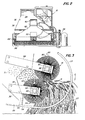
- the air flow in the blower duct 62 is directed downwards and backwards against the ears or stalks of the crop in front of the stripping device 41 in order to press the stalks ST backwards and to bring the ears H of the crop C into a corresponding position (FIG. 3) , so that they can be correctly gripped by the stripping device 41.
- the air flow is directed in the direction of the crop via the guide device 69, which extends from the guide device 66 to a housing or a hood 71, which partially surrounds the upper part of the stripping device 41.
- the stripping device has an upper and a lower rotor 82, 84, which are arranged on transverse axes 86, 88 with respect to the conveying direction of the crop.
- the rotors 82, 84 have corresponding wiping elements or are designed as rotating brushes which wipe the grains from the ears.
- the rotors 82 and 84 designed as rotating bristles 85 and 87 in FIG. 1 can, for example, be made of relatively resistant or stiff plastic bristles, such as e.g. Polyethylene bristles should be formed.
- the individual bristles 85, 87 are so long and are so far apart from one another at their radial outer ends that they form a correspondingly resistant outer surface which, when it comes into contact with the crop, wipes the individual grains from the ears accordingly .
- the ends of the bristles can, for example, have a distance between them which is between 1.25 cm and 3.08 cm.
- the bristles 85 and 87 shown in the exemplary embodiment can have a circular or an oval cross section.
- the individual bristles can be corrugated or crimped or corrugated, or can be designed in a similar manner.
- the axles 86 and 88 receiving the rotors 82 and 84 are received at the ends in bearings 90 and 92 on both sides of the housing 16.
- the upper bearings 90 of the upper rotor 82 are arranged at the front ends of adjustable support arms 94 and the lower bearings of the lower rotor 84 in lower adjustable support arms 96.
- the rotors 82 and 84 can be raised or lowered independently of one another by means of the support arms 94 and 96, in order in this way to adapt the stripping device 41 to the different heights of the crop.
- the diameter of the rotors 82, 84 can be chosen as desired.
- the rotors preferably have a diameter which is between 15 and 20 cm.
- the lower rotor 84 consists of individual bristles arranged side by side in a row in a group, so that they form a continuous band and somewhat with respect to the axis of the rotor. are arranged inclined.
- the belt 98 moves to one side with respect to the direction of movement of the seed harvesting machine, i.e. transverse to the direction of travel. If, for example, the crop enters an intermediate space 99 formed between two belts 98, the rotating belt 98 approaches the corresponding ear and acts on it from below, since the corresponding part of the belt 98 moves upwards during use (FIG 4).
- the ear is thus intensively acted on one side, namely in the direction of the associated stem, so that the seed can be detached from the ear in a simple manner.
- the seed loosened from the ear is then conveyed up and back over the bristles of the rotor 84. Since the seed harvester continues to move forward, the stalk is moved to the side by means of the intermediate space 99 and leaves the intermediate space 99 again in the area of the lower part of the rotor.
- the stalk and ear remain firmly rooted in the ground.
- the intermediate space or gap 99 is larger than the diameter of the ear in order to prevent the ear from being separated from the straw.
- the ears lie or end above the lower rotor 84. As a result, they are gripped by a resistant outer surface of the bristles 85 of the upper rotor, the grains being stripped out of the ears.
- the upward-facing outer part of the rotor 84 and in particular the associated axis 88 lie below the ears, i.e. the seeds of the ears in the field.
- the axis 86 of the upper rotor 82 lies above the seeds or the corresponding ears.
- the front outer boundary of the bristles 85 of the upper rotor 82 ends in front of the bristles 87 of the lower rotor 84.
- the bristles 85 of the upper rotor 82 can thus easily grasp the slightly higher ears, which are are in an inclined position due to the air flow of the fan 60. The ears are held in such a position by means of the upper rotor 85 or are further inclined.
- the air flow of the fan 60 is supported by the suction air from the lower fan 50. Furthermore, the high peripheral speed of the rotors generates an additional air flow. Thus, the crop is pressed backwards by means of the air flow of the blower 60 directed backwards, on the one hand, and drawn backwards by the suction air of the lower blower and by the bristles 85 and 87.
- the Throughput of the blower 60 is approximately 2.17 m 3 / sec, a flow velocity of 44 m / sec being generated at the outlet of the blower duct 62, while a flow velocity of 20 m / sec prevails on the front side of the rotors 82 and 84.
- the lower fan 50 produces a throughput of 2.05 M 3 / S eC, and the air flow of the lower fan passes through the gap 55 at a flow rate of 30 m / sec.
- the stripped seed is conveyed backwards by means of the rotors 82 and 84 and then taken up by the conveying air flow which is generated by the two fans 50 and 60 or by the rotors 82 and 84.
- the rear of the lower rotor 84 is placed so that the air flow of the lower fan 50 sweeps along the surface of the rotor until it enters the channel 32 and takes with it crops that have not been captured or released by the rest of the air flow.
- the rotors or the ends of the bristles 85 and 87 have a linear speed between 18 and 27 m / sec.
- a speed between 21 and 23 m / sec is also particularly advantageous. This has a very advantageous effect on the grains being stripped from the ears and the further transport of the grains into the collecting container 33. However, if this speed is exceeded, the crop can be thrown out of the air stream so that a relatively large loss can occur. At lower speeds, the effect of the air on the stripping process is so small that a large proportion of the grains remain in the ears.
- the rotors 82 and 84 are driven by special motors which are provided on one side of the harvesting device 14 and are acted upon, for example, by means of a hydraulic system which is accommodated in the chassis 12.
- the motors 102 which can thus be designed as hydraulic motors, are connected in series or series, so that leakage losses from the first hydraulic motor are absorbed by the second hydraulic motor before it returns to the collecting container.
- the upper rotor 82 is driven at a somewhat higher speed than the lower rotor.
- the rotor 104 consists of numerous disk-like stripping tools with bristles 106, which roughly correspond to the bristles 85 and 87 in the other exemplary embodiments.
- the bristles 106 form a positive or negative acute angle with the axis of rotation of the rotor.
- the two adjacent brush-like disks 106 A and 106 B extend outward from the axis of rotation, i.e. they are arranged convergingly so that they form a slit-shaped opening.
- the opposite sides 108 of the disk-like bristles 106 A and B form a continuous surface or a circular disk, which acts on the crop in a manner similar to that of the bristles 87 of the rotor 84.
- a rubbing effect is generated on the ear in the direction of the stem, which corresponds to the rubbing effect of the surface of the band 98 of the rotor 84.
- the diverging or outer part 100 of the rotor 104 forms a gap, the width of which is greater than the thickness of the ears, so that when the crop is stripped from the ears, the ears are not pulled off the stems by means of the bristles 87.
- the upper rotor 82 consists of a continuous brush, which, however, can be replaced by a brush according to FIG. (See FIG. 8) which, like the rotor 84, can also consist of a snail-shaped band.
- the rotor 110 strips the crop from the ears in a manner similar to that in the stripping devices 41 described at the outset. Due to the earlier contact of the rotor 110 before the contact of the lower rotor 84 with the crop, the crop becomes relative due to the corresponding action of the surface on the ears released early. It is advantageous that the axis of the upper rotor 110 can be adjusted so that the upper ends of the ears lie below the axis of the rotor in order to press them in the correct direction when the upper rotor comes into contact with the ears.
- the harvesting device 14 is equipped with appropriate straw dividers 112 which, before the crop is gripped by the stripping members, make a corresponding division of the crop to be processed by the rotors.
- the larger stems ST are bent or pressed backwards and downwards, firstly by the upper rotor 82, secondly by the blower air of the blower 60 and by the suction effect of the lower blower 50 and third, by the air generated by the two cooperating rotors 82 and 84.
- Most ears are treated or processed by the lower rotor 84 when the ears get into the space 99 between the two rotors 82 and 84.
- the surface of the belt 98 moves to the side when the seed harvester drives across the field, the surface of the belt 98 acts on the ear in the longitudinal direction of the straw, so that the seeds are released from the ears.
- the seed is moved backwards, specifically into the conveying air flow that is passed through the fan 60 or the two rotors 82 and 84 is generated.
- the individual ears or stems remain rooted in the ground during this harvesting process and are released from the intermediate space 99 when the rotor continues to rotate accordingly.
- the seed is loosened in a similar manner when the side 108 hits the corresponding ears.
- the upper rotor 110 presses the crop or the ears backwards and downwards and in the process brushes the seeds out of the ears, which then passes into the corresponding air flow via which the seeds are conveyed into the collecting container 33.
- the brush speed of the rotor 104 described last can be between 18 and 27 m / sec or advantageously also between 21 and 23 m / sec.
- the seed that does not get directly into the air flow is then detected by the corresponding air flow of the lower blower 50, which returns the seed to the conveying air flow in the conveying duct 32.
- the collected or harvested seed is released into the collecting container 33 via the conveying channel 32.
Landscapes
- Life Sciences & Earth Sciences (AREA)
- Environmental Sciences (AREA)
- Harvesting Machines For Specific Crops (AREA)
- Combines (AREA)
Applications Claiming Priority (2)
| Application Number | Priority Date | Filing Date | Title |
|---|---|---|---|
| US375838 | 1982-05-07 | ||
| US06/375,838 US4679386A (en) | 1982-05-07 | 1982-05-07 | Harvester for the impact-stripping of seed from a standing crop |
Publications (2)
| Publication Number | Publication Date |
|---|---|
| EP0094036A1 EP0094036A1 (de) | 1983-11-16 |
| EP0094036B1 true EP0094036B1 (de) | 1986-08-27 |
Family
ID=23482578
Family Applications (1)
| Application Number | Title | Priority Date | Filing Date |
|---|---|---|---|
| EP83104419A Expired EP0094036B1 (de) | 1982-05-07 | 1983-05-05 | Erntebergungsvorrichtung für eine Saatgut-Erntemaschine |
Country Status (6)
| Country | Link |
|---|---|
| US (1) | US4679386A (da) |
| EP (1) | EP0094036B1 (da) |
| JP (1) | JPS58205417A (da) |
| AU (1) | AU551093B2 (da) |
| CA (1) | CA1195512A (da) |
| DE (1) | DE3365585D1 (da) |
Families Citing this family (18)
| Publication number | Priority date | Publication date | Assignee | Title |
|---|---|---|---|---|
| GB8424395D0 (en) * | 1984-09-27 | 1984-10-31 | British Res Agricult Eng | Crop harvesting |
| GB8608585D0 (en) * | 1986-04-09 | 1986-05-14 | British Res Agricult Eng | Crop harvesting apparatus |
| US4951453A (en) * | 1984-09-27 | 1990-08-28 | National Research Development Corporation | Crop harvesting apparatus and methods |
| US4843806A (en) * | 1984-09-27 | 1989-07-04 | National Research Development Corporation | Crop harvesting apparatus and methods |
| US4815261A (en) * | 1987-05-26 | 1989-03-28 | Anderson Ray W | Seed harvesting device |
| DE4010504A1 (de) * | 1990-04-02 | 1991-10-10 | Claas Ohg | Selbstfahrende vorrichtung zum ernten von empfindlichem erntegut wie rizinuskapseln |
| US5342239A (en) * | 1991-05-10 | 1994-08-30 | Deere & Company | Operation parameters for an axial separator |
| US6640530B1 (en) * | 2001-01-26 | 2003-11-04 | Lee Arbuckle | Harvester with cooperating brushes and combs |
| US20060053686A1 (en) * | 2004-09-15 | 2006-03-16 | Halwas Garry W | Pollen harvesting |
| EA200500455A1 (ru) * | 2005-01-11 | 2006-04-28 | Петр Иванович Чуксин | Способ уборки зерновых культур, зерноуборочный комбайн и его узлы |
| DE102005039708B4 (de) * | 2005-08-23 | 2010-08-26 | Tobias Linsel | Erntevorrichtung zum Ernten von Bestandteilen einer Pflanze und Verfahren hierfür, sowie Verwendungen der Erntevorrichtung zur Behandlung der Pflanze |
| NZ561432A (en) * | 2006-09-12 | 2009-01-31 | Pellenc Australia Pty Ltd | A machine for managing shoots of vines using motorised brushes on either side of the trellis |
| WO2008072218A2 (en) * | 2006-12-11 | 2008-06-19 | Itzhak Agadi | Harvesting machine |
| CN101828471A (zh) * | 2010-05-15 | 2010-09-15 | 中国农业机械化科学研究院呼和浩特分院 | 牧草种子收获机 |
| FR3067215B1 (fr) * | 2017-06-13 | 2019-10-04 | Romain Bouille | Machine agricole de suppression d'epis parasites des cultures agricoles |
| MX2022003951A (es) * | 2019-10-01 | 2022-09-29 | Jb Engles Llc | Cosechadora de cannabis y metodos de uso de la misma. |
| US11944037B2 (en) * | 2019-10-03 | 2024-04-02 | Evolve3, LLC | Hemp harvester |
| US12108707B2 (en) * | 2019-11-29 | 2024-10-08 | Bridgestone Corporation | Seed harvester and related methods |
Family Cites Families (14)
| Publication number | Priority date | Publication date | Assignee | Title |
|---|---|---|---|---|
| US2734329A (en) * | 1956-02-14 | Brush picker for a cotton picking | ||
| US2749916A (en) * | 1956-06-12 | mcconnel | ||
| US781662A (en) * | 1904-06-17 | 1905-02-07 | John C Kistler | Clover-seed harvester. |
| US1206409A (en) * | 1916-07-26 | 1916-11-28 | William R Bruce | Clover-head harvester or picker. |
| US2495417A (en) * | 1943-10-20 | 1950-01-24 | Mcconnel Frederic Whigham | Grain harvesting machine |
| US2499047A (en) * | 1947-06-25 | 1950-02-28 | Edwin H Finlayson | Grass seed stripper |
| US2547749A (en) * | 1948-08-25 | 1951-04-03 | Nicholas H Jacovatos | Grain stripping mechanism |
| US2620614A (en) * | 1948-08-31 | 1952-12-09 | Mcconnel Bomford Ltd | Grain harvesting machine |
| DE933789C (de) * | 1953-04-25 | 1955-10-06 | Excorna Pharmazeutische Praepa | Maschine zum Ernten sowie Verfahren und Maschine zur Erzeugung von Mutterkorn |
| US3184904A (en) * | 1962-09-21 | 1965-05-25 | Allis Chalmers Mfg Co | Centrifugal disk seed harvester |
| US3184905A (en) * | 1964-05-25 | 1965-05-25 | Ramon L Hillier | Grain harvester |
| US3473304A (en) * | 1967-10-03 | 1969-10-21 | Univ Tennessee Res Corp | Vegetable and fruit harvester |
| FR2157197A5 (da) * | 1971-10-21 | 1973-06-01 | Barre Jean Claude | |
| JPS5873704A (ja) * | 1981-10-27 | 1983-05-04 | Toyota Motor Corp | 焼結部品のサイジング方法 |
-
1982
- 1982-05-07 US US06/375,838 patent/US4679386A/en not_active Expired - Fee Related
-
1983
- 1983-04-19 AU AU13636/83A patent/AU551093B2/en not_active Expired
- 1983-04-25 CA CA000426656A patent/CA1195512A/en not_active Expired
- 1983-05-05 EP EP83104419A patent/EP0094036B1/de not_active Expired
- 1983-05-05 DE DE8383104419T patent/DE3365585D1/de not_active Expired
- 1983-05-06 JP JP58079213A patent/JPS58205417A/ja active Granted
Also Published As
| Publication number | Publication date |
|---|---|
| CA1195512A (en) | 1985-10-22 |
| AU551093B2 (en) | 1986-04-17 |
| AU1363683A (en) | 1983-11-10 |
| JPH047170B2 (da) | 1992-02-10 |
| JPS58205417A (ja) | 1983-11-30 |
| US4679386A (en) | 1987-07-14 |
| DE3365585D1 (en) | 1986-10-02 |
| EP0094036A1 (de) | 1983-11-16 |
Similar Documents
| Publication | Publication Date | Title |
|---|---|---|
| EP0094036B1 (de) | Erntebergungsvorrichtung für eine Saatgut-Erntemaschine | |
| DE3854083T2 (de) | Apparat und verfahren zum ernten von feldfrüchten. | |
| DE3751350T2 (de) | Halmfruchterntevorrichtung. | |
| DE3587945T2 (de) | Ernteverfahren und -vorrichtung. | |
| DE3918393C2 (de) | Getreideerntemaschine | |
| DE2628414C2 (da) | ||
| EP1106049B1 (de) | Einzugs- und Pflückeinrichtung mit Häckseleinrichtung | |
| EP0896789B1 (de) | Maisernte-Vorsatz zum Anbau an eine selbstfahrende Erntemaschine | |
| EP0069898B1 (de) | Mehrreihige Erntemaschine, insbesondere für Mais | |
| EP0162431B1 (de) | Erntebergungsmaschine | |
| EP1199920A1 (de) | Erntegerät | |
| EP1911343B1 (de) | Maschine zur Ernte stängelartiger Pflanzen mit einem Abstreifer und einem diesem nachgeordneten Führungselement | |
| DE1507195B2 (de) | Erntemaschine für stengeliges Halmgut, insbesondere Mais | |
| EP1428423B1 (de) | Einzugs- und Pflückeinrichtung | |
| DE3115723C2 (de) | Vorsatzgerät für eine Maiserntemaschine | |
| EP0092824B1 (de) | Erntebergungsvorrichtung für eine Saatgut-Erntemaschine | |
| EP0450290B1 (de) | Selbstfahrende Vorrichtung zum Ernten von empfindlichem Erntegut wie Rizinuskapseln | |
| DE3318554A1 (de) | Verfahren und vorrichtung zum gewinnen von grassamen | |
| EP1129610B1 (de) | Einzugs- und Pflückeinrichtung einer Erntegutbergungsmaschine | |
| AT511146B1 (de) | Erntevorrichtung | |
| DE102008021784A1 (de) | Erntemaschine mit Schrägförderer | |
| DE2621292A1 (de) | Geraet zum aufnehmen und zerkleinern landwirtschaftlicher erntegueter | |
| DE3616717A1 (de) | Pflueckvorrichtung fuer landwirtschaftliche erntemaschinen | |
| DE1096667B (de) | Aufsammellader mit Schneidvorrichtung | |
| DE1482199A1 (de) | Erntemaschine,insbesondere Maehdrescher |
Legal Events
| Date | Code | Title | Description |
|---|---|---|---|
| PUAI | Public reference made under article 153(3) epc to a published international application that has entered the european phase |
Free format text: ORIGINAL CODE: 0009012 |
|
| AK | Designated contracting states |
Designated state(s): BE DE FR GB IT |
|
| ITCL | It: translation for ep claims filed |
Representative=s name: LENZI & C. |
|
| EL | Fr: translation of claims filed | ||
| 17P | Request for examination filed |
Effective date: 19840315 |
|
| ITF | It: translation for a ep patent filed | ||
| GRAA | (expected) grant |
Free format text: ORIGINAL CODE: 0009210 |
|
| AK | Designated contracting states |
Kind code of ref document: B1 Designated state(s): BE DE FR GB IT |
|
| REF | Corresponds to: |
Ref document number: 3365585 Country of ref document: DE Date of ref document: 19861002 |
|
| ET | Fr: translation filed | ||
| PLBE | No opposition filed within time limit |
Free format text: ORIGINAL CODE: 0009261 |
|
| STAA | Information on the status of an ep patent application or granted ep patent |
Free format text: STATUS: NO OPPOSITION FILED WITHIN TIME LIMIT |
|
| 26N | No opposition filed | ||
| ITTA | It: last paid annual fee | ||
| REG | Reference to a national code |
Ref country code: GB Ref legal event code: IF02 |
|
| PGFP | Annual fee paid to national office [announced via postgrant information from national office to epo] |
Ref country code: FR Payment date: 20020521 Year of fee payment: 20 |
|
| PGFP | Annual fee paid to national office [announced via postgrant information from national office to epo] |
Ref country code: GB Payment date: 20020524 Year of fee payment: 20 Ref country code: BE Payment date: 20020524 Year of fee payment: 20 |
|
| PGFP | Annual fee paid to national office [announced via postgrant information from national office to epo] |
Ref country code: DE Payment date: 20020531 Year of fee payment: 20 |
|
| PG25 | Lapsed in a contracting state [announced via postgrant information from national office to epo] |
Ref country code: GB Free format text: LAPSE BECAUSE OF EXPIRATION OF PROTECTION Effective date: 20030504 |
|
| REG | Reference to a national code |
Ref country code: GB Ref legal event code: PE20 |
|
| BE20 | Be: patent expired |
Owner name: *DEERE & CY Effective date: 20030505 |