EP0087036B1 - Verfahren zur Herstellung von masshaltigen Rohren aus aliphatischen Polyamiden zur Förderung von Kraftstoffen für Verbrennungsmotoren - Google Patents
Verfahren zur Herstellung von masshaltigen Rohren aus aliphatischen Polyamiden zur Förderung von Kraftstoffen für Verbrennungsmotoren Download PDFInfo
- Publication number
- EP0087036B1 EP0087036B1 EP83101106A EP83101106A EP0087036B1 EP 0087036 B1 EP0087036 B1 EP 0087036B1 EP 83101106 A EP83101106 A EP 83101106A EP 83101106 A EP83101106 A EP 83101106A EP 0087036 B1 EP0087036 B1 EP 0087036B1
- Authority
- EP
- European Patent Office
- Prior art keywords
- pipe
- polyamide
- diameter
- calibration
- fuels
- Prior art date
- Legal status (The legal status is an assumption and is not a legal conclusion. Google has not performed a legal analysis and makes no representation as to the accuracy of the status listed.)
- Expired
Links
- 239000000446 fuel Substances 0.000 title claims description 20
- 238000000034 method Methods 0.000 title claims description 11
- 239000004953 Aliphatic polyamide Substances 0.000 title claims description 4
- 229920003231 aliphatic polyamide Polymers 0.000 title claims description 4
- 239000004952 Polyamide Substances 0.000 claims description 22
- 229920002647 polyamide Polymers 0.000 claims description 22
- 125000004432 carbon atom Chemical group C* 0.000 claims description 6
- -1 aliphatic diamine Chemical class 0.000 claims description 5
- 238000001816 cooling Methods 0.000 claims description 5
- 238000002485 combustion reaction Methods 0.000 claims description 4
- LFQSCWFLJHTTHZ-UHFFFAOYSA-N Ethanol Chemical compound CCO LFQSCWFLJHTTHZ-UHFFFAOYSA-N 0.000 claims description 3
- 125000005521 carbonamide group Chemical group 0.000 claims description 3
- 238000001125 extrusion Methods 0.000 claims description 2
- OFOBLEOULBTSOW-UHFFFAOYSA-N Malonic acid Chemical compound OC(=O)CC(O)=O OFOBLEOULBTSOW-UHFFFAOYSA-N 0.000 claims 1
- 125000001931 aliphatic group Chemical group 0.000 claims 1
- 239000000470 constituent Substances 0.000 claims 1
- NAQMVNRVTILPCV-UHFFFAOYSA-N hexane-1,6-diamine Chemical compound NCCCCCCN NAQMVNRVTILPCV-UHFFFAOYSA-N 0.000 description 10
- 229920000299 Nylon 12 Polymers 0.000 description 6
- 239000004014 plasticizer Substances 0.000 description 6
- 239000000498 cooling water Substances 0.000 description 5
- 229920002292 Nylon 6 Polymers 0.000 description 4
- OKKJLVBELUTLKV-UHFFFAOYSA-N Methanol Chemical compound OC OKKJLVBELUTLKV-UHFFFAOYSA-N 0.000 description 3
- 229920000571 Nylon 11 Polymers 0.000 description 3
- 229920000572 Nylon 6/12 Polymers 0.000 description 3
- 150000001298 alcohols Chemical class 0.000 description 3
- 230000000052 comparative effect Effects 0.000 description 3
- 150000003951 lactams Chemical class 0.000 description 3
- 239000000203 mixture Substances 0.000 description 3
- 239000004033 plastic Substances 0.000 description 3
- 229920003023 plastic Polymers 0.000 description 3
- CXMXRPHRNRROMY-UHFFFAOYSA-N sebacic acid Chemical compound OC(=O)CCCCCCCCC(O)=O CXMXRPHRNRROMY-UHFFFAOYSA-N 0.000 description 3
- XLYOFNOQVPJJNP-UHFFFAOYSA-N water Substances O XLYOFNOQVPJJNP-UHFFFAOYSA-N 0.000 description 3
- FJKROLUGYXJWQN-UHFFFAOYSA-N 4-hydroxybenzoic acid Chemical compound OC(=O)C1=CC=C(O)C=C1 FJKROLUGYXJWQN-UHFFFAOYSA-N 0.000 description 2
- 229920000305 Nylon 6,10 Polymers 0.000 description 2
- 229920002302 Nylon 6,6 Polymers 0.000 description 2
- WNLRTRBMVRJNCN-UHFFFAOYSA-N adipic acid Chemical compound OC(=O)CCCCC(O)=O WNLRTRBMVRJNCN-UHFFFAOYSA-N 0.000 description 2
- 238000010438 heat treatment Methods 0.000 description 2
- 238000004519 manufacturing process Methods 0.000 description 2
- 239000000155 melt Substances 0.000 description 2
- 238000000465 moulding Methods 0.000 description 2
- BDJRBEYXGGNYIS-UHFFFAOYSA-N nonanedioic acid Chemical compound OC(=O)CCCCCCCC(O)=O BDJRBEYXGGNYIS-UHFFFAOYSA-N 0.000 description 2
- RIKCMEDSBFQFAL-UHFFFAOYSA-N octyl 4-hydroxybenzoate Chemical compound CCCCCCCCOC(=O)C1=CC=C(O)C=C1 RIKCMEDSBFQFAL-UHFFFAOYSA-N 0.000 description 2
- TYFQFVWCELRYAO-UHFFFAOYSA-N suberic acid Chemical compound OC(=O)CCCCCCC(O)=O TYFQFVWCELRYAO-UHFFFAOYSA-N 0.000 description 2
- 229940090248 4-hydroxybenzoic acid Drugs 0.000 description 1
- LSNNMFCWUKXFEE-UHFFFAOYSA-M Bisulfite Chemical compound OS([O-])=O LSNNMFCWUKXFEE-UHFFFAOYSA-M 0.000 description 1
- IPRJXAGUEGOFGG-UHFFFAOYSA-N N-butylbenzenesulfonamide Chemical compound CCCCNS(=O)(=O)C1=CC=CC=C1 IPRJXAGUEGOFGG-UHFFFAOYSA-N 0.000 description 1
- 239000002253 acid Substances 0.000 description 1
- 239000000654 additive Substances 0.000 description 1
- 235000011037 adipic acid Nutrition 0.000 description 1
- 239000001361 adipic acid Substances 0.000 description 1
- 150000001408 amides Chemical class 0.000 description 1
- 230000003712 anti-aging effect Effects 0.000 description 1
- 125000003118 aryl group Chemical group 0.000 description 1
- 239000003795 chemical substances by application Substances 0.000 description 1
- 150000001875 compounds Chemical class 0.000 description 1
- 238000010586 diagram Methods 0.000 description 1
- 238000005516 engineering process Methods 0.000 description 1
- 238000000605 extraction Methods 0.000 description 1
- 238000002347 injection Methods 0.000 description 1
- 239000007924 injection Substances 0.000 description 1
- 238000002844 melting Methods 0.000 description 1
- 230000008018 melting Effects 0.000 description 1
- 239000000049 pigment Substances 0.000 description 1
- 230000010411 postconditioning Effects 0.000 description 1
- 238000003303 reheating Methods 0.000 description 1
- 239000003381 stabilizer Substances 0.000 description 1
- 239000000126 substance Substances 0.000 description 1
Images

Classifications
-
- B—PERFORMING OPERATIONS; TRANSPORTING
- B29—WORKING OF PLASTICS; WORKING OF SUBSTANCES IN A PLASTIC STATE IN GENERAL
- B29C—SHAPING OR JOINING OF PLASTICS; SHAPING OF MATERIAL IN A PLASTIC STATE, NOT OTHERWISE PROVIDED FOR; AFTER-TREATMENT OF THE SHAPED PRODUCTS, e.g. REPAIRING
- B29C55/00—Shaping by stretching, e.g. drawing through a die; Apparatus therefor
- B29C55/30—Drawing through a die
-
- B—PERFORMING OPERATIONS; TRANSPORTING
- B29—WORKING OF PLASTICS; WORKING OF SUBSTANCES IN A PLASTIC STATE IN GENERAL
- B29C—SHAPING OR JOINING OF PLASTICS; SHAPING OF MATERIAL IN A PLASTIC STATE, NOT OTHERWISE PROVIDED FOR; AFTER-TREATMENT OF THE SHAPED PRODUCTS, e.g. REPAIRING
- B29C48/00—Extrusion moulding, i.e. expressing the moulding material through a die or nozzle which imparts the desired form; Apparatus therefor
- B29C48/03—Extrusion moulding, i.e. expressing the moulding material through a die or nozzle which imparts the desired form; Apparatus therefor characterised by the shape of the extruded material at extrusion
- B29C48/09—Articles with cross-sections having partially or fully enclosed cavities, e.g. pipes or channels
-
- B—PERFORMING OPERATIONS; TRANSPORTING
- B29—WORKING OF PLASTICS; WORKING OF SUBSTANCES IN A PLASTIC STATE IN GENERAL
- B29C—SHAPING OR JOINING OF PLASTICS; SHAPING OF MATERIAL IN A PLASTIC STATE, NOT OTHERWISE PROVIDED FOR; AFTER-TREATMENT OF THE SHAPED PRODUCTS, e.g. REPAIRING
- B29C48/00—Extrusion moulding, i.e. expressing the moulding material through a die or nozzle which imparts the desired form; Apparatus therefor
- B29C48/25—Component parts, details or accessories; Auxiliary operations
- B29C48/88—Thermal treatment of the stream of extruded material, e.g. cooling
- B29C48/90—Thermal treatment of the stream of extruded material, e.g. cooling with calibration or sizing, i.e. combined with fixing or setting of the final dimensions of the extruded article
- B29C48/901—Thermal treatment of the stream of extruded material, e.g. cooling with calibration or sizing, i.e. combined with fixing or setting of the final dimensions of the extruded article of hollow bodies
-
- B—PERFORMING OPERATIONS; TRANSPORTING
- B29—WORKING OF PLASTICS; WORKING OF SUBSTANCES IN A PLASTIC STATE IN GENERAL
- B29C—SHAPING OR JOINING OF PLASTICS; SHAPING OF MATERIAL IN A PLASTIC STATE, NOT OTHERWISE PROVIDED FOR; AFTER-TREATMENT OF THE SHAPED PRODUCTS, e.g. REPAIRING
- B29C48/00—Extrusion moulding, i.e. expressing the moulding material through a die or nozzle which imparts the desired form; Apparatus therefor
- B29C48/25—Component parts, details or accessories; Auxiliary operations
- B29C48/88—Thermal treatment of the stream of extruded material, e.g. cooling
- B29C48/90—Thermal treatment of the stream of extruded material, e.g. cooling with calibration or sizing, i.e. combined with fixing or setting of the final dimensions of the extruded article
- B29C48/908—Thermal treatment of the stream of extruded material, e.g. cooling with calibration or sizing, i.e. combined with fixing or setting of the final dimensions of the extruded article characterised by calibrator surface, e.g. structure or holes for lubrication, cooling or venting
-
- B—PERFORMING OPERATIONS; TRANSPORTING
- B29—WORKING OF PLASTICS; WORKING OF SUBSTANCES IN A PLASTIC STATE IN GENERAL
- B29C—SHAPING OR JOINING OF PLASTICS; SHAPING OF MATERIAL IN A PLASTIC STATE, NOT OTHERWISE PROVIDED FOR; AFTER-TREATMENT OF THE SHAPED PRODUCTS, e.g. REPAIRING
- B29C48/00—Extrusion moulding, i.e. expressing the moulding material through a die or nozzle which imparts the desired form; Apparatus therefor
- B29C48/25—Component parts, details or accessories; Auxiliary operations
- B29C48/88—Thermal treatment of the stream of extruded material, e.g. cooling
- B29C48/919—Thermal treatment of the stream of extruded material, e.g. cooling using a bath, e.g. extruding into an open bath to coagulate or cool the material
-
- B—PERFORMING OPERATIONS; TRANSPORTING
- B29—WORKING OF PLASTICS; WORKING OF SUBSTANCES IN A PLASTIC STATE IN GENERAL
- B29C—SHAPING OR JOINING OF PLASTICS; SHAPING OF MATERIAL IN A PLASTIC STATE, NOT OTHERWISE PROVIDED FOR; AFTER-TREATMENT OF THE SHAPED PRODUCTS, e.g. REPAIRING
- B29C48/00—Extrusion moulding, i.e. expressing the moulding material through a die or nozzle which imparts the desired form; Apparatus therefor
- B29C48/03—Extrusion moulding, i.e. expressing the moulding material through a die or nozzle which imparts the desired form; Apparatus therefor characterised by the shape of the extruded material at extrusion
- B29C48/09—Articles with cross-sections having partially or fully enclosed cavities, e.g. pipes or channels
- B29C48/10—Articles with cross-sections having partially or fully enclosed cavities, e.g. pipes or channels flexible, e.g. blown foils
-
- B—PERFORMING OPERATIONS; TRANSPORTING
- B29—WORKING OF PLASTICS; WORKING OF SUBSTANCES IN A PLASTIC STATE IN GENERAL
- B29K—INDEXING SCHEME ASSOCIATED WITH SUBCLASSES B29B, B29C OR B29D, RELATING TO MOULDING MATERIALS OR TO MATERIALS FOR MOULDS, REINFORCEMENTS, FILLERS OR PREFORMED PARTS, e.g. INSERTS
- B29K2077/00—Use of PA, i.e. polyamides, e.g. polyesteramides or derivatives thereof, as moulding material
-
- Y—GENERAL TAGGING OF NEW TECHNOLOGICAL DEVELOPMENTS; GENERAL TAGGING OF CROSS-SECTIONAL TECHNOLOGIES SPANNING OVER SEVERAL SECTIONS OF THE IPC; TECHNICAL SUBJECTS COVERED BY FORMER USPC CROSS-REFERENCE ART COLLECTIONS [XRACs] AND DIGESTS
- Y10—TECHNICAL SUBJECTS COVERED BY FORMER USPC
- Y10S—TECHNICAL SUBJECTS COVERED BY FORMER USPC CROSS-REFERENCE ART COLLECTIONS [XRACs] AND DIGESTS
- Y10S138/00—Pipes and tubular conduits
- Y10S138/07—Resins
-
- Y—GENERAL TAGGING OF NEW TECHNOLOGICAL DEVELOPMENTS; GENERAL TAGGING OF CROSS-SECTIONAL TECHNOLOGIES SPANNING OVER SEVERAL SECTIONS OF THE IPC; TECHNICAL SUBJECTS COVERED BY FORMER USPC CROSS-REFERENCE ART COLLECTIONS [XRACs] AND DIGESTS
- Y10—TECHNICAL SUBJECTS COVERED BY FORMER USPC
- Y10S—TECHNICAL SUBJECTS COVERED BY FORMER USPC CROSS-REFERENCE ART COLLECTIONS [XRACs] AND DIGESTS
- Y10S264/00—Plastic and nonmetallic article shaping or treating: processes
- Y10S264/61—Processes of molding polyamide
-
- Y—GENERAL TAGGING OF NEW TECHNOLOGICAL DEVELOPMENTS; GENERAL TAGGING OF CROSS-SECTIONAL TECHNOLOGIES SPANNING OVER SEVERAL SECTIONS OF THE IPC; TECHNICAL SUBJECTS COVERED BY FORMER USPC CROSS-REFERENCE ART COLLECTIONS [XRACs] AND DIGESTS
- Y10—TECHNICAL SUBJECTS COVERED BY FORMER USPC
- Y10T—TECHNICAL SUBJECTS COVERED BY FORMER US CLASSIFICATION
- Y10T428/00—Stock material or miscellaneous articles
- Y10T428/13—Hollow or container type article [e.g., tube, vase, etc.]
- Y10T428/1352—Polymer or resin containing [i.e., natural or synthetic]
- Y10T428/139—Open-ended, self-supporting conduit, cylinder, or tube-type article
Definitions
- Pipelines made of polyamides are known to be used as delivery lines for fuels for internal combustion engines.
- Aliphatic polyamides which may contain plasticizers, are particularly advantageous. These are polyamides from the basic building block lactam or ro-aminocarboxylic acid with at least five carbon atoms per carbonamide group, such as polyamide 6, polyamide 8, polyamide 11 or polyamide 12 or from equivalent amounts of aliphatic dicarboxylic acids and aliphatic diamines with a total of at least 12 carbon atoms, such as polyamide 66 , Polyamide 68, polyamide 69, polyamide 610, polyamide 612.
- the object of the invention is to provide a method which makes it possible to produce pipes which are dimensionally stable in the conveyance of fuels or alcohol-containing fuels or fuels from alcohols for internal combustion engines, and which therefore do not experience any subsequent linear expansion.
- the problem is solved with a generic method if the polyamide melt is first extruded into a tube with a diameter above the nominal size, this diameter of the tube is fixed by calibration and cooling, the cooled tube by a second calibration device with a smaller caliber than that The nominal diameter of the pipe passes through without external heat supply, so that the longitudinal stresses introduced during use are canceled out by the diffusing fuel components to such an extent that the resulting increase in length of the pipe is compensated for.
- Aliphatic polyamides of the invention are understood to mean polyamides from the basic building block lactam or ⁇ -aminocaribonic acid with at least five carbon atoms per carbonamide group, such as e.g. Polyamide 6 (polycaprolactam), polyamide 8 (polysuberolactam), polyamide 11 (polyundecanoic acid amide) and in particular polyamide 12 (polylaurine lactam), furthermore polyamides from equivalent amounts of aliphatic dicarboxylic acids and aliphatic diamines with a total of at least 12 carbon atoms, e.g.
- Polyamide 66 (from hexamethylene diamine and adipic acid), polyamide 68 (from hexamethylene diamine and suberic acid), polyamide 69 (from hexamethylene diamine and azelaic acid), polyamide 610 (from hexamethylene diamine and sebacic acid), polyamide 612 (from hexamethylene diamine and decanedicarboxylic acid).
- the polyamides contain customary auxiliaries, such as stabilizers and / or anti-aging agents. They can also contain other additives such as color pigments.
- the polyamides can also contain plasticizers. Suitable plasticizers are e.g. Derivatives of aromatic sulfonic acid amides or 4-hydroxybenzoic acid, in particular N-butylbenzenesulfonic acid amide or 4-hydroxybenzoic acid octyl ester. For the present case, they can be contained in the total molding composition in amounts of up to 20 percent by weight, in particular from 2 to 10 percent by weight.
- such a plasticized polyamide composition consists of up to 80 percent by weight of polyamide and up to 20 percent by weight of plasticizer and additionally from the usual auxiliaries.
- Copolyamides with small amounts of comonomers are not excluded insofar as they are suitable for the intended use.
- the pipe is manufactured in a conventional manner with the aid of an extruder with a pipe head, a calibration device, a cooling water tank and an extraction device.
- the polyamide melt emerging at a temperature between 180 and 280 ° C at the ring nozzle of the pipe head, corresponding to the melting temperature of the polyamides, is shaped in the calibration, with an excess being defined in relation to the nominal diameter.
- the pipe is then cooled in the water tank and fixed in the process.
- the cooled, fixed tube which has an oversize compared to the nominal dimension of the diameter, is introduced into a second calibration device with the aid of a trigger device and adjusted there to the nominal diameter. This happens without external heat supply (adiabatic).
- the second calibration is advantageously a disk calibration which, contrary to the cited prior art, has a somewhat smaller diameter than the nominal diameter of the tube.
- the necessary oversize of the pipe before the second calibration process depends on the processing conditions, the composition of the polyamide molding compound and to a certain extent on the medium for which the line is intended and can be adjusted accordingly.
- the excess compared to the nominal diameter can be 5 to 20%, in particular 10 to 15%.
- the cooling water temperature and the length of the cooling bath are not critical, the temperature should only be kept approximately constant.
- the temperature should only be kept approximately constant.
- the inside diameter of the second calibration device must therefore be smaller than the desired diameter of the pipe.
- this inner diameter is 2 to 15%, preferably 5 to 10% smaller than the nominal diameter.
- a tube according to the method of the invention (example 1.1) and a tube according to a method of the prior art (comparative example 1.2) are produced from stabilized polyamide 12 using a single-screw extruder with a tube head.
- the extruder has an inner cylinder diameter of 45 mm, a ratio of cylinder length: inner diameter of 25 and is equipped with a three-zone screw with a flight depth ratio of 3: 1.
- the nozzle of the pipe head has an outer diameter of 16 mm and an inner diameter of 12 mm. All extruder heaters are set to 240 ° C.
- the speed of the screw conveyor is 50 / min.
- Example 1.1 the melt emerging from the nozzle of the tube head is fed into the calibration tube of a vacuum calibration device with an inner diameter of 9.5 mm.
- the vacuum in the vacuum calibration device is 0.36 bar.
- This cooled tube is then passed through a second calibration device with an inner diameter of 7.5 mm. With adiabatic heating, the nominal diameter of the tube is 8 mm with a wall thickness of 1 mm.
- the pipe is then pulled off with a caterpillar take-off and cut to length.
- the melt emerging from the nozzle of the tube head is fed into the calibration tube of a vacuum calibration device with an inner diameter of 8.5 mm.
- the tube with the nominal dimensions of 8 mm outside diameter and 1 mm wall thickness is created. This is cooled in a 4 m long cooling water bath, pulled off with the caterpillar take-off and then cut to length.
- Examples 2.1 to 8.1 and comparative examples 2.2 to 8.2 are carried out in an analogous manner.
- a stabilized polyamide 11 (2.1 or 2.2), a stabilized polyamide 12 (3.1 or 3.2) containing 8% plasticizer, a polyamide 612 (4.1 or 4.2) , a polyamide 68 (5.1 or 5.2), a polyamide 6 (6.1 or 6.2), a stabilized polyamide 12 (with another oversize before recalibration) (7.1 or 7.2) and a stabilized polyamide 12 (8.1 or 8.2) containing 14% plasticizer.
- D means the diameter of the calibration tube of the first calibration device
- d the diameter of the calibration disk of the recalibration.
- VK means gasoline
- M 15 or M 100 means 15 or 100% methanol
- Super-VK and Normal-VK are commercially available fuels according to DIN 51 600. These fuels can also be used for injection engines ).
- the filled fuels were renewed periodically in order to obtain test conditions comparable to those in practice.
Landscapes
- Engineering & Computer Science (AREA)
- Mechanical Engineering (AREA)
- Physics & Mathematics (AREA)
- Thermal Sciences (AREA)
- Extrusion Moulding Of Plastics Or The Like (AREA)
Description
- Die Erfindung betrifft ein Verfahren zur Herstellung von masshaltigen Rohren nach dem ersten Teil des Anspruchs. Rohrleitungen aus Polyamiden werden bekanntlich als Förderleitungen für Kraftstoffe für Verbrennungsmotoren eingesetzt. Besonders vorteilhaft sind hierbei aliphatische, gegebenenfalls Weichmacher enthaltende Polyamide. Das sind Polyamide aus dem Grundbaustein Lactam oder ro-Aminocarbonsäure mit mindestens fünf Kohlenstoffatomen pro Carbonamidgruppe, wie Polyamid 6, Polyamid 8, Polyamid 11 oder Polyamid 12 oder solche aus äquivalenten Mengen von aliphatischen Dicarbonsäuren und aliphatischen Diaminen mit zusammen mindestens 12 Kohlenstoffatomen, wie Polyamid 66, Polyamid 68, Polyamid 69, Polyamid 610, Polyamid 612.
- Es hat sich gezeigt, dass derartige Kraftstoffleitungen aus besagten Polyamiden durch die Einwirkung von Kraftstoffen für Verbrennungsmotoren, insbesondere durch solche Kraftstoffe, die Alkohole enthalten oder aus Alkoholen bestehen, eine Längenausdehnung erfahren. Diese Längenausdehnung kann in der Grössenordnung von einigen Prozenten liegen. Infolge dieser Längenausdehnung hängen die Leitungen zwischen den Befestigungselementen girlandenförmig durch, was als ein Sicherheitsrisiko zu betrachten ist.
- Aus der DE-C-976 270 ist ein Verfahren zur Herstellung von Rohren aus Polyamid durch Extrudieren bekannt, bei dem ein Rohr mit einem über dem Sollmass liegenden Durchmesser ohne erste Kalibrierung extrudiert wird und nach dem Abkühlen und Wiedererwärmen durch eine Kalibriereinrichtung mit kleinerem Kaliber als dem Solldurchmesser geleitet wird. Das nach dem Abkühlen erhaltene Rohr wird einer Nachkonditionierung durch Wärme- und Wasserbehandlung unterworfen.
- Nach dem Verfahren des Standes der Technik werden keine masshaltigen Rohre erhalten, da sowohl die Spannungen im extrudierten Rohr als auch im kalibrierten Rohr durch die Wärmebehandlung aufgehoben werden. Beim Gebrauch solcher Rohre als Kraftstoffleitungen treten die unerwünschten Längenausdehnungen auf.
- Aufgabe der Erfindung ist es, ein Verfahren bereitzustellen, welches es erlaubt, Rohre herzustellen, die bei der Förderung von Kraftstoffen oder alkoholhaltigen Kraftstoffen oder Kraftstoffen aus Alkoholen für Verbrennungsmotoren masshaltig sind, die also keine nachträgliche Längenausdehnung erfahren.
- Die Lösung der Aufgabe gelingt mit einem gattungsgemassen Verfahren, wenn man die Polyamidschmelze zunächst zu einem Rohr mit einem über dem Sollmass liegenden Durchmesser extrudiert, diesen Durchmesser des Rohres durch Kalibrieren und Abkühlen fixiert, das abgekühlte Rohr durch eine zweite Kalibriereinrichtung mit einem kleineren Kaliber als dem Solldurchmesser des Rohres ohne äussere Wärmezufuhr hindurchleitet, so dass die dabei eingebrachten Longitudinalspannungen beim Gebrauch durch die eindiffundierenden Kraftstoffbestandteile gerade soweit aufgehoben werden, dass die damit bewirkte Längenzunahme des Rohres ausgeglichen wird.
- Unter aliphatischen Polyamiden der Erfindung werden verstanden Polyamide aus dem Grundbaustein Lactam oder ω-Aminocaribonsäure mit mindestens fünf Kohlenstoffatomen pro Carbonamidgruppe, wie z.B. Polyamid 6 (Polycaprolactam), Polyamid 8 (Polysuberolactam), Polyamid 11 (Polyundecansäureamid) und insbesondere Polyamid 12 (Polylaurinlactam), ferner Polyamide aus äquivalenten Mengen aliphatischer Dicarbonsäuren und aliphatischer Diamine mit zusammen mindestens 12 Kohlenstoffatomen, wie z.B. Polyamid 66 (aus Hexamethylendiamin und Adipinsäure), Polyamid 68 (aus Hexamethylendiamin und Korksäure), Polyamid 69 (aus Hexamethylendiamin und Azelainsäure), Polyamid 610 (aus Hexamethylendiamin und Sebazinsäure), Polyamid 612 (aus Hexamethylendiamin und Decandicarbonsäure).
- Die Polyamide enthalten, soweit erforderlich, übliche Hilfsstoffe, wie Stabilisatoren und/oder Alterungsschutzmittel. Sie können auch andere Zuschlagstoffe, wie Farbpigmente enthalten. Gegebenenfalls können die Polyamide auch Weichmacher enthalten. Geeignete Weichmacher sind im vorliegenden Falle z.B. Derivate aromatischer Sulfonsäureamide oder der 4-Hydroxybenzoesäure, insbesondere N-Butylbenzolsulfonsäureamid oder 4-Hydroxybenzoesäureoctylester. Sie können für den vorliegenden Fall in Mengen bis zu 20 Gewichtsprozent, insbesondere von 2 bis 10 Gewichtsprozent in der Gesamtformmasse enthalten sein. Mit anderen Worten besteht eine solche weichgemachte Polyamidmasse aus bis zu 80 Gewichtsprozent Polyamid und bis zu 20 Gewichtsprozent Weichmacher und zusätzlich aus den üblichen Hilfsstoffen. Copolyamide mit geringen Mengen an Comonomeren sind nicht ausgeschlossen, soweit sie für den vorgesehenen Verwendungszweck geeignet sind.
- Die Herstellung des Rohres geschieht in herkömmlicher Weise mit Hilfe eines Extruders mit Rohrkopf, einer Kalibriervorrichtung, einem Kühlwassertank und einer Abzugsvorrichtung. Die an der Ringdüse des Rohrkopfes, entsprechend der Schmelztemperatur der Polyamide, mit einer Temperatur zwischen 180 und 280° C austretende Polyamidschmelze wird in der Kalibrierung geformt, wobei ein gegenüber dem Solldurchmesser definiertes Übermass eingestellt wird. Anschliessend wird das Rohr im Wassertank abgekühlt und dabei fixiert.
- Es ist nach dem Stand der Technik auch bekannt, das warmplastische Hohlprofil zunächst mit dem etwa 1,3fachen des gewünschten Durchmessers zu extrudieren und diesen warmplastischen Schlauch in eine Kalibriervorrichtung einzuführen, die sich in einem Wasserbad befindet. In dieser Kalibriervorrichtung wird der warmplastische Schlauch auf den gewünschten kleineren Durchmesser gebracht und gleichzeitig abgekühlt. Dabei hat die Kalibriervorrichtung einen etwas grösseren Durchmesser als den gewünschten Rohrdurchmesser (Kirk-Othmer, Encyclopedia of Chemical Technology, 2. Auflage, Band 16, Seite 99). Derartige Hohlprofile sind nicht masshaltig gegenüber Kraftstoffen; sie erfahren eine unerwünschte Längenausdehnung bei Berührung mit derartigen Kraftstoffen.
- Nach der Erfindung wird das abgekühlte, fixierte Rohr, das ein Übermass gegenüber dem Sollmass des Durchmessers besitzt mit Hilfe einer Abzugsvorrichtung in eine zweite Kalibriereinrichtung eingeführt und dort auf den Solldurchmesser eingestellt. Dies geschieht ohne äussere Wärmezufuhr (adiabatisch).
- Die zweite Kalibrierung ist vorteilhafterweise eine Scheibenkalibrierung, die entgegen dem zitierten Stand der Technik einen etwas kleineren Durchmesser als den Solldurchmesser des Rohres hat.
- Das notwendige Übermass des Rohres vor dem zweiten Kalibriervorgang richtet sich nach den Verarbeitungsbedingungen, der Zusammensetzung der Polyamidformmasse und in einem gewissen Masse nach dem Medium, für das die Leitung bestimmt ist und kann entsprechend eingestellt werden. Das Übermass gegenüber dem Solldurchmesser kann 5 bis 20%, insbesondere 10 bis 15% betragen.
- Die Kühlwassertemperatur und die Kühlbadlänge ist nicht kritisch, die Temperatur sollte nur annähernd konstant gehalten werden. Beim Durchführen des kalten Rohres durch die zweite Kalibriervorrichtung erwärmt sich dieses etwas. Dadurch entsteht eine gewisse elastische Rückstellung des Durchmessers nach dem Kalibriervorgang. Danach kann das Rohr zur Abkühlung noch einmal durch ein Kühlwasserbad geführt werden. Die eingebrachten Longitudinalspannungen bleiben im Rohr erhalten.
- Der Innendurchmesser der zweiten Kalibriervorrichtung muss deshalb kleiner sein als der angestrebte Solldurchmesser des Rohres. Im allgemeinen ist dieser Innendurchmesser 2 bis 15%, vorzugsweise 5 bis 10% kleiner als der Solldurchmesser.
- Mit einem Einschneckenextruder mit Rohrkopf werden ein Rohr nach dem Verfahren der Erfindung (Beispiel 1,1 ) und ein Rohr nach einem Verfahren des Standes der Technik (Vergleichsbeispiel 1,2) aus stabilisiertem Polyamid 12 hergestellt.
- Für beide Fälle hat der Extruder einen Zylinderinnendurchmesser von 45 mm, ein Verhältnis von Zylinderlänge: Innendurchmesser von 25 und ist mit einer Dreizonenschnecke mit dem Gangtiefenverhältnis von 3:1 ausgerüstet. Die Düse des Rohrkopfes hat einen Aussendurchmesser von 16 mm und einen Innendurchmesser von 12 mm. Alle Heizungen des Extruders sind auf 240° C eingestellt. Die Drehzahl der Förderschnecke beträgt 50/min.
- Nach dem Beispiel 1,1 (Erfindung) wird die aus der Düse des Rohrkopfes austretende Schmelze in das Kalibrierrohr einer Vakuumkalibriervorrichtung mit dem Innendurchmesser von 9,5 mm geführt. Der Unterdruck in der Vakuumkalibriervorrichtung beträgt 0,36 bar. Dabei entsteht ein Rohr mit einem Aussendurchmesser von 9,0 mm und einer Wanddicke von 1 mm. Dieses wird in einem 4 m langen Kühlwasserbad abgekühlt und fixiert. Danach wird dieses abgekühlte Rohr durch eine zweite Kalibriervorrichtung mit einem Innendurchmesser von 7,5 mm hindurchgeführt. Dabei stellt sich unter adiabatischer Erwärmung der Solldurchmesser des Rohres von 8 mm bei 1 mm Wanddicke ein. Danach wird das Rohr mit einem Raupenabzug abgezogen und auf Länge geschnitten.
- Nach dem Vergleichsbeispiel 1,2 wird die aus der Düse des Rohrkopfes austretende Schmelze in das Kalibrierrohr einer Vakuumkalibriervorrichtung mit einem Innendurchmesser von 8,5 mm geführt. Dabei entsteht bei einem Unterdruck von 0,25 bar ohne einen zweiten Kalibrierschritt, das Rohr mit den Sollmassen 8 mm Aussendurchmesser und 1 mm Wanddicke. Dieses wird in einem 4 m langen Kühlwasserbad abgekühlt, mit dem Raupenabzug abgezogen und danach auf Länge geschnitten.
- In analoger Weise werden die Beispiele 2,1 bis 8,1 und die Vergleichsbeispiele 2,2 bis 8,2 ausgeführt. Dabei wird ein stabilisiertes Polyamid 11 (2,1 bzw. 2,2), ein 8% Weichmacher enthaltendes, stabilisiertes Polyamid 12 (3,1 bzw. 3,2), ein Polyamid 612 (4,1 bzw. 4,2), ein Polyamid 68 (5,1 bzw. 5,2), ein Polyamid 6 (6,1 bzw. 6,2), ein stabilisiertes Polyamid 12 (bei einem anderen Übermassvorder Nachkalibrierung) (7,1 bzw. 7,2) und ein 14% Weichmacher enthaltendes, stabilisiertes Polyamid 12 (8,1 bzw. 8,2) eingesetzt.
- In der folgenden Tabelle sind die Versuchsergebnisse zusammengestellt. D bedeutet den Durchmesser des Kalibrierrohres der ersten Kalibriervorrichtung, d den Durchmesser der Kalibrierscheibe der Nachkalibrierung.
- Dieso hergestellten Rohre wurden auf eine Länge von 2000 mm zugeschnitten und mit Kraftstoffen folgender Bezeichnung gefüllt:
- M 15-VK, M 100-VK, Super-VK, Normal-VK.
- (Die Bezeichnung VK bedeutet im vorliegenden Fall Vergaserkraftstoff, M 15 bzw. M 100 bedeuten einen Gehalt von 15 bzw. 100% Methanol, Super-VK und Normal-VKsind handelsübliche Kraftstoffe nach DIN 51 600. Diese Kraftstoffe können aber auch für Einspritzmotoren verwendet werden).
- Die eingefüllten Kraftstoffe wurden periodisch erneuert, um mit der Praxis vergleichbare Prüfbedingungen zu erhalten.
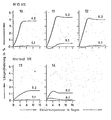
- Es wurde die Längenänderung der Rohrabschnitte in Abhängigkeit von der Einwirkungsdauer bestimmt. Die Ergebnisse sind in den beigefügten Diagrammen 1 bis 14 dargestellt.

Claims (1)
- Verfahren zur Herstellung von masshaltigen Rohren zur Förderung von Kraftstoffen, alkoholhaltigen Kraftstoffen oder Alkohol als Kraftstoff für Verbrennungsmotoren aus gegebenenfalls weichgemachten aliphatischen Polyamiden mit mindestens fünf Kohlenstoffatomen pro Carbonamidgruppe oder aus äquivalenten Mengen der Grundbausteine aliphatischer Dicarbonsäuren und aliphatische Diamine mit zusammen mindestens 12 Kohlenstoffatomen, durch Extrudieren, dadurch gekennzeichnet, dass man die Polyamidschmelze zunächst zu einem Rohr mit einem über dem Sollmass liegenden Durchmesser extrudiert, diesen Durchmesser des Rohres durch Kalibrieren und Abkühlen fixiert, das abgekühlte Rohr durch eine zweite Kalibriereinrichtung mit einem kleineren Kaliber als dem Solldurchmesser des Rohres ohne äussere Wärmezufuhr hindurchleitet, so dass die dabei eingebrachten Longitudinalspannungen beim Gebrauch durch die eindiffundierenden Kraftstoffbestandteile gerade soweit aufgehoben werden, dass die damit bewirkte Längenzunahme des Rohres ausgeglichen wird.
Applications Claiming Priority (4)
| Application Number | Priority Date | Filing Date | Title |
|---|---|---|---|
| DE3206131 | 1982-02-20 | ||
| DE3206131 | 1982-02-20 | ||
| DE3243612 | 1982-11-25 | ||
| DE19823243612 DE3243612A1 (de) | 1982-02-20 | 1982-11-25 | Verfahren zur herstellung von masshaltigen hohlprofilen aus aliphatischen polyamiden und deren verwendung |
Publications (2)
| Publication Number | Publication Date |
|---|---|
| EP0087036A1 EP0087036A1 (de) | 1983-08-31 |
| EP0087036B1 true EP0087036B1 (de) | 1985-07-03 |
Family
ID=25799738
Family Applications (1)
| Application Number | Title | Priority Date | Filing Date |
|---|---|---|---|
| EP83101106A Expired EP0087036B1 (de) | 1982-02-20 | 1983-02-05 | Verfahren zur Herstellung von masshaltigen Rohren aus aliphatischen Polyamiden zur Förderung von Kraftstoffen für Verbrennungsmotoren |
Country Status (7)
| Country | Link |
|---|---|
| US (2) | US4519968A (de) |
| EP (1) | EP0087036B1 (de) |
| AU (1) | AU554878B2 (de) |
| BR (1) | BR8300789A (de) |
| DE (2) | DE3243612A1 (de) |
| ES (1) | ES8400695A1 (de) |
| PL (1) | PL139376B1 (de) |
Families Citing this family (23)
| Publication number | Priority date | Publication date | Assignee | Title |
|---|---|---|---|---|
| DE3510395A1 (de) * | 1985-03-22 | 1986-09-25 | Technoform Caprano + Brunnhofer KG, 3501 Fuldabrück | Kraftstoffuehrende, mit vorgegebener laenge fest installierbare leitung fuer ein kraftfahrzeug |
| JP2742579B2 (ja) * | 1986-02-01 | 1998-04-22 | 臼井国際産業 株式会社 | 可撓性複合ホース |
| IL82632A (en) * | 1986-08-18 | 1991-05-12 | Technicon Instr | Method and apparatus for drawing thermoplastic tubing |
| JPS63125885A (ja) * | 1986-11-13 | 1988-05-30 | 横浜ゴム株式会社 | 冷媒輸送用ホ−ス |
| JPH0697076B2 (ja) * | 1986-12-16 | 1994-11-30 | 横浜ゴム株式会社 | 低透過性ホ−ス |
| DE3887386T2 (de) * | 1987-06-01 | 1994-05-26 | Yokohama Rubber Co Ltd | Schlauchkonstruktion. |
| US4888148A (en) * | 1988-08-15 | 1989-12-19 | The B. F. Goodrich Company | Method of making extruded amorphous thermoplastic pipe having reduced internal stress |
| US5026582A (en) * | 1988-08-15 | 1991-06-25 | The B. F. Goodrich Company | Extruded amorphous thermoplastic pipe having reduced internal stress and method of making the same |
| US6025448A (en) * | 1989-08-31 | 2000-02-15 | The Dow Chemical Company | Gas phase polymerization of olefins |
| US6538080B1 (en) | 1990-07-03 | 2003-03-25 | Bp Chemicals Limited | Gas phase polymerization of olefins |
| US5278272A (en) | 1991-10-15 | 1994-01-11 | The Dow Chemical Company | Elastic substantialy linear olefin polymers |
| US5582923A (en) * | 1991-10-15 | 1996-12-10 | The Dow Chemical Company | Extrusion compositions having high drawdown and substantially reduced neck-in |
| US5674342A (en) * | 1991-10-15 | 1997-10-07 | The Dow Chemical Company | High drawdown extrusion composition and process |
| US5395471A (en) * | 1991-10-15 | 1995-03-07 | The Dow Chemical Company | High drawdown extrusion process with greater resistance to draw resonance |
| US5783638A (en) * | 1991-10-15 | 1998-07-21 | The Dow Chemical Company | Elastic substantially linear ethylene polymers |
| US5525695A (en) * | 1991-10-15 | 1996-06-11 | The Dow Chemical Company | Elastic linear interpolymers |
| FR2687619B1 (fr) * | 1992-02-25 | 1994-04-08 | Elf Atochem Sa | Tube pour transport d'essence. |
| US6041826A (en) * | 1993-06-03 | 2000-03-28 | Elf Atochem S.A. | Petrol supply tube |
| NL9400452A (nl) * | 1994-03-22 | 1995-11-01 | Wavin Bv | Werkwijze en inrichting voor het vervaardigen van biaxiaal georiënteerde buis uit thermoplastisch kunststofmateriaal. |
| NL9400453A (nl) * | 1994-03-22 | 1995-11-01 | Wavin Bv | Werkwijze en inrichting voor het vervaardigen van biaxiaal georiënteerde buis uit thermoplastisch kunststofmateriaal. |
| US5792534A (en) * | 1994-10-21 | 1998-08-11 | The Dow Chemical Company | Polyolefin film exhibiting heat resistivity, low hexane extractives and controlled modulus |
| DE19717324A1 (de) * | 1996-09-04 | 1998-03-05 | Volkswagen Ag | Verbindungsanordnung für eine Kraftstoffleitung |
| DE102006038108A1 (de) * | 2006-08-14 | 2008-02-21 | Evonik Degussa Gmbh | Verwendung eines Formteils aus einer Polyamidformmasse als Inliner für eine Rohrleitung |
Family Cites Families (7)
| Publication number | Priority date | Publication date | Assignee | Title |
|---|---|---|---|---|
| DE976270C (de) * | 1950-07-22 | 1963-07-04 | Polymer Corp | Verfahren zum Behandeln eines rohrfoermigen oder vollen Profilstranges aus Polyamid |
| NL162275B (nl) * | 1950-07-22 | 1900-01-01 | Texas Instruments Inc | Opto-elektronische schakelinrichting. |
| US3182108A (en) * | 1963-01-14 | 1965-05-04 | Phillips Petroleum Co | Extrusion of thermoplastic tubing |
| CH500831A (de) * | 1967-05-05 | 1970-12-31 | Bayer Ag | Verfahren und Vorrichtung zum kontinuierlichen Herstellen massgenauer Profile aus Kunststoffen |
| FI66278C (fi) * | 1978-11-18 | 1984-10-10 | Becker & Co Naturinwerk | Slangfolie foer foerpackning och omhoeljande av pastaartade lismedel speciellt korv och smaeltost foerpackad i form av kenrv |
| US4303771A (en) * | 1978-12-14 | 1981-12-01 | Union Carbide Corporation | Process for the preparation of high density ethylene polymers in fluid bed reactor |
| US4508769A (en) * | 1982-07-06 | 1985-04-02 | Allied Corporation | Process to form amorphous, crystallizable thermoplastic polymers |
-
1982
- 1982-11-25 DE DE19823243612 patent/DE3243612A1/de not_active Withdrawn
- 1982-12-31 PL PL1982239946A patent/PL139376B1/pl unknown
-
1983
- 1983-02-05 DE DE8383101106T patent/DE3360332D1/de not_active Expired
- 1983-02-05 EP EP83101106A patent/EP0087036B1/de not_active Expired
- 1983-02-07 US US06/464,772 patent/US4519968A/en not_active Expired - Fee Related
- 1983-02-18 BR BR8300789A patent/BR8300789A/pt not_active IP Right Cessation
- 1983-02-18 AU AU11649/83A patent/AU554878B2/en not_active Ceased
- 1983-02-18 ES ES519894A patent/ES8400695A1/es not_active Expired
-
1985
- 1985-01-31 US US06/697,124 patent/US4613532A/en not_active Expired - Fee Related
Also Published As
| Publication number | Publication date |
|---|---|
| DE3360332D1 (en) | 1985-08-08 |
| BR8300789A (pt) | 1983-11-29 |
| AU554878B2 (en) | 1986-09-04 |
| EP0087036A1 (de) | 1983-08-31 |
| ES519894A0 (es) | 1983-12-01 |
| US4519968A (en) | 1985-05-28 |
| US4613532A (en) | 1986-09-23 |
| AU1164983A (en) | 1983-08-25 |
| PL239946A1 (en) | 1983-09-12 |
| PL139376B1 (en) | 1987-01-31 |
| DE3243612A1 (de) | 1983-11-03 |
| ES8400695A1 (es) | 1983-12-01 |
Similar Documents
| Publication | Publication Date | Title |
|---|---|---|
| EP0087036A1 (de) | Verfahren zur Herstellung von masshaltigen Rohren aus aliphatischen Polyamiden zur Förderung von Kraftstoffen für Verbrennungsmotoren | |
| DE1595150C3 (de) | Verfahren zur Herstellung von Polyamiden sowie deren Verwendung für Formkörper | |
| CH417934A (de) | Verfahren und Vorrichtung zur Herstellung von Schläuchen aus Kunststoff oder zähelastischen Massen mit ungleichen Wandstärken, insbesondere für die Erzeugung von Hohlkörpern aus solchen Schläuchen | |
| DE1209282B (de) | Verfahren und Vorrichtung zur Herstellung von Rohren mit Aufweitungen und/oder Verdickungen | |
| DE2706927C3 (de) | Anlage zur Herstellung von Kunststoffprofilsträngen | |
| DE961211C (de) | Zwischen Schneckenkopf und Kaliberdorn angeordnete Werkstoffuehrung in Spritzkoepfen von Schneckenpressen | |
| DE69212748T2 (de) | Apparat zum Rekuperieren heterogener Abfälle, insbesonderen heterogener Kunststoff-Abfälle | |
| DE2146024A1 (de) | Kunststoffverarbeitung | |
| DE926682C (de) | Verfahren und Vorrichtung zum Schmelzspinnen | |
| DE2044544A1 (de) | Verfahren und Vorrichtung zur kontinu lerhchen Herstellung von strang oder stab formigen Profilen aus thermoplastischen Werkstoffen | |
| DE2223605A1 (de) | Verfahren und Vorrichtung zur Erzeugung von Seifenstuecken mit in der Seife durchgehend angeordneter Kennzeichnung | |
| EP3744500B1 (de) | Vorrichtung zur extrusion von schwefelvernetzbaren kautschukmischungen, die verwendung der vorrichtung und ein verfahren zum herstellen einer extrudierten, schwefelvernetzbaren kautschukmischung | |
| DE2621465A1 (de) | Strangpressverfahren zur herstellung von aus harz bestehenden koerpern mit unterschiedlichen dicken | |
| DE2602312A1 (de) | Verfahren und vorrichtung zur herstellung von faeden, rohren, profilen, stangen und dergleichen aus kunststoff | |
| EP0175908A2 (de) | Verfahren zur Herstellung von Polyamidformkörpern | |
| DE1037119B (de) | Vorrichtung zur kontinuierlichen Herstellung von Staeben, Profilen, Rohren und derartigen laenglichen Gegenstaenden aus thermoplastischen Stoffen | |
| DE2306698C3 (de) | Mischung zur Herstellung plastifizierter oder harter PVC-Erzeugnisse | |
| DE2149668C3 (de) | Verfahren und Vorrichtung zum Herstellen von langgestrecktem Gut aus einer Elastomermischung | |
| DE2436874B2 (de) | Verfahren zur Herstellung von Drähten und Profilen aus verstärkten Kunststoffen | |
| EP0254264B1 (de) | Verfahren zur Verminderung der Reibungskräfte bei der Herstellung von Kartuschenrohren | |
| DE1504185A1 (de) | Verfahren zur Herstellung von hochtransparenten Folien aus amorphen Polyamiden | |
| DE2311241B2 (de) | Verfahren zum direkten kuehlen von geschmolzenen thermoplastischen kunststoffen bei einem extrusionsverfahren | |
| DE1815192C3 (de) | Verfahren zur Herstellung von Polyxylylenadipinamidfäden | |
| DE1544939C (de) | Verfahren zur Herstellung von Gleitlagermaterial | |
| DE2161908C3 (de) | Verfahren zur Herstellung thermoplastisch verarbeitbarer, glasfaserhaltiger Polyamid-Formmassen |
Legal Events
| Date | Code | Title | Description |
|---|---|---|---|
| PUAI | Public reference made under article 153(3) epc to a published international application that has entered the european phase |
Free format text: ORIGINAL CODE: 0009012 |
|
| 17P | Request for examination filed |
Effective date: 19830618 |
|
| AK | Designated contracting states |
Designated state(s): CH DE FR GB IT LI NL SE |
|
| ITF | It: translation for a ep patent filed | ||
| GRAA | (expected) grant |
Free format text: ORIGINAL CODE: 0009210 |
|
| AK | Designated contracting states |
Designated state(s): CH DE FR GB IT LI NL SE |
|
| REF | Corresponds to: |
Ref document number: 3360332 Country of ref document: DE Date of ref document: 19850808 |
|
| ET | Fr: translation filed | ||
| RAP2 | Party data changed (patent owner data changed or rights of a patent transferred) |
Owner name: HUELS AKTIENGESELLSCHAFT |
|
| REG | Reference to a national code |
Ref country code: CH Ref legal event code: PFA Free format text: HUELS AKTIENGESELLSCHAFT |
|
| PLBE | No opposition filed within time limit |
Free format text: ORIGINAL CODE: 0009261 |
|
| STAA | Information on the status of an ep patent application or granted ep patent |
Free format text: STATUS: NO OPPOSITION FILED WITHIN TIME LIMIT |
|
| 26N | No opposition filed | ||
| NLT2 | Nl: modifications (of names), taken from the european patent patent bulletin |
Owner name: HUELS AKTIENGESELLSCHAFT TE MARL, BONDSREPUBLIEK D |
|
| PGFP | Annual fee paid to national office [announced via postgrant information from national office to epo] |
Ref country code: CH Payment date: 19900222 Year of fee payment: 8 |
|
| PGFP | Annual fee paid to national office [announced via postgrant information from national office to epo] |
Ref country code: GB Payment date: 19910122 Year of fee payment: 9 |
|
| PGFP | Annual fee paid to national office [announced via postgrant information from national office to epo] |
Ref country code: SE Payment date: 19910123 Year of fee payment: 9 |
|
| PGFP | Annual fee paid to national office [announced via postgrant information from national office to epo] |
Ref country code: FR Payment date: 19910201 Year of fee payment: 9 |
|
| ITTA | It: last paid annual fee | ||
| PG25 | Lapsed in a contracting state [announced via postgrant information from national office to epo] |
Ref country code: LI Effective date: 19910228 Ref country code: CH Effective date: 19910228 |
|
| PGFP | Annual fee paid to national office [announced via postgrant information from national office to epo] |
Ref country code: NL Payment date: 19910228 Year of fee payment: 9 |
|
| REG | Reference to a national code |
Ref country code: CH Ref legal event code: PL |
|
| PG25 | Lapsed in a contracting state [announced via postgrant information from national office to epo] |
Ref country code: GB Effective date: 19920205 |
|
| PG25 | Lapsed in a contracting state [announced via postgrant information from national office to epo] |
Ref country code: SE Effective date: 19920206 |
|
| PG25 | Lapsed in a contracting state [announced via postgrant information from national office to epo] |
Ref country code: NL Effective date: 19920901 |
|
| GBPC | Gb: european patent ceased through non-payment of renewal fee | ||
| NLV4 | Nl: lapsed or anulled due to non-payment of the annual fee | ||
| PG25 | Lapsed in a contracting state [announced via postgrant information from national office to epo] |
Ref country code: FR Effective date: 19921030 |
|
| REG | Reference to a national code |
Ref country code: FR Ref legal event code: ST |
|
| PGFP | Annual fee paid to national office [announced via postgrant information from national office to epo] |
Ref country code: DE Payment date: 19940224 Year of fee payment: 12 |
|
| EUG | Se: european patent has lapsed |
Ref document number: 83101106.9 Effective date: 19920904 |
|
| PG25 | Lapsed in a contracting state [announced via postgrant information from national office to epo] |
Ref country code: DE Effective date: 19951101 |