EP0085111A1 - Composite semipermeable membrane, process for its production, and method of its use - Google Patents
Composite semipermeable membrane, process for its production, and method of its use Download PDFInfo
- Publication number
- EP0085111A1 EP0085111A1 EP82902263A EP82902263A EP0085111A1 EP 0085111 A1 EP0085111 A1 EP 0085111A1 EP 82902263 A EP82902263 A EP 82902263A EP 82902263 A EP82902263 A EP 82902263A EP 0085111 A1 EP0085111 A1 EP 0085111A1
- Authority
- EP
- European Patent Office
- Prior art keywords
- membrane
- composite semipermeable
- semipermeable membrane
- group
- cross
- Prior art date
- Legal status (The legal status is an assumption and is not a legal conclusion. Google has not performed a legal analysis and makes no representation as to the accuracy of the status listed.)
- Granted
Links
- 239000012528 membrane Substances 0.000 title claims abstract description 151
- 239000002131 composite material Substances 0.000 title claims abstract description 66
- 238000000034 method Methods 0.000 title claims abstract description 28
- -1 aliphatic diamine Chemical class 0.000 claims abstract description 37
- 239000012982 microporous membrane Substances 0.000 claims abstract description 24
- 238000000576 coating method Methods 0.000 claims description 31
- 150000001875 compounds Chemical class 0.000 claims description 29
- 239000011248 coating agent Substances 0.000 claims description 22
- 239000000243 solution Substances 0.000 claims description 21
- 125000004432 carbon atom Chemical group C* 0.000 claims description 19
- 125000004435 hydrogen atom Chemical group [H]* 0.000 claims description 18
- 238000001223 reverse osmosis Methods 0.000 claims description 18
- 239000007864 aqueous solution Substances 0.000 claims description 15
- ZAMOUSCENKQFHK-UHFFFAOYSA-N Chlorine atom Chemical compound [Cl] ZAMOUSCENKQFHK-UHFFFAOYSA-N 0.000 claims description 13
- 239000000460 chlorine Substances 0.000 claims description 13
- 229910052801 chlorine Inorganic materials 0.000 claims description 13
- 229920005597 polymer membrane Polymers 0.000 claims description 13
- 239000003431 cross linking reagent Substances 0.000 claims description 12
- 230000000844 anti-bacterial effect Effects 0.000 claims description 11
- 239000004372 Polyvinyl alcohol Substances 0.000 claims description 10
- 239000003899 bactericide agent Substances 0.000 claims description 10
- 125000002496 methyl group Chemical group [H]C([H])([H])* 0.000 claims description 10
- 229920002451 polyvinyl alcohol Polymers 0.000 claims description 10
- 239000004953 Aliphatic polyamide Substances 0.000 claims description 9
- 229920003231 aliphatic polyamide Polymers 0.000 claims description 9
- 238000002360 preparation method Methods 0.000 claims description 9
- 239000011253 protective coating Substances 0.000 claims description 9
- 125000001931 aliphatic group Chemical group 0.000 claims description 8
- 125000001495 ethyl group Chemical group [H]C([H])([H])C([H])([H])* 0.000 claims description 8
- 125000000217 alkyl group Chemical group 0.000 claims description 7
- 239000003638 chemical reducing agent Substances 0.000 claims description 7
- 125000002887 hydroxy group Chemical group [H]O* 0.000 claims description 7
- 229910052783 alkali metal Inorganic materials 0.000 claims description 5
- 150000001340 alkali metals Chemical class 0.000 claims description 5
- 239000003795 chemical substances by application Substances 0.000 claims description 5
- 125000004430 oxygen atom Chemical group O* 0.000 claims description 5
- 239000004952 Polyamide Substances 0.000 claims description 4
- 229910052784 alkaline earth metal Inorganic materials 0.000 claims description 4
- 150000001342 alkaline earth metals Chemical class 0.000 claims description 4
- QGZKDVFQNNGYKY-UHFFFAOYSA-O ammonium group Chemical group [NH4+] QGZKDVFQNNGYKY-UHFFFAOYSA-O 0.000 claims description 4
- 125000004433 nitrogen atom Chemical group N* 0.000 claims description 4
- 229920002647 polyamide Polymers 0.000 claims description 4
- 238000005406 washing Methods 0.000 claims description 4
- 125000002915 carbonyl group Chemical group [*:2]C([*:1])=O 0.000 claims description 3
- 238000001035 drying Methods 0.000 claims description 3
- 125000005843 halogen group Chemical group 0.000 claims description 3
- 150000001298 alcohols Chemical class 0.000 claims description 2
- 150000001413 amino acids Chemical class 0.000 claims description 2
- 150000001720 carbohydrates Chemical class 0.000 claims description 2
- 150000001735 carboxylic acids Chemical class 0.000 claims description 2
- 125000002029 aromatic hydrocarbon group Chemical group 0.000 claims 2
- 238000010828 elution Methods 0.000 claims 1
- 125000000816 ethylene group Chemical group [H]C([H])([*:1])C([H])([H])[*:2] 0.000 claims 1
- 238000007254 oxidation reaction Methods 0.000 abstract description 13
- 230000003647 oxidation Effects 0.000 abstract description 12
- 238000006243 chemical reaction Methods 0.000 abstract description 9
- 239000010409 thin film Substances 0.000 abstract 1
- XLYOFNOQVPJJNP-UHFFFAOYSA-N water Substances O XLYOFNOQVPJJNP-UHFFFAOYSA-N 0.000 description 30
- 238000012360 testing method Methods 0.000 description 23
- 230000035699 permeability Effects 0.000 description 18
- 238000011033 desalting Methods 0.000 description 17
- 239000010410 layer Substances 0.000 description 16
- 229920000642 polymer Polymers 0.000 description 15
- 150000004985 diamines Chemical class 0.000 description 14
- 238000004132 cross linking Methods 0.000 description 10
- 239000000203 mixture Substances 0.000 description 10
- 229920002492 poly(sulfone) Polymers 0.000 description 9
- 239000002904 solvent Substances 0.000 description 9
- UWCPYKQBIPYOLX-UHFFFAOYSA-N benzene-1,3,5-tricarbonyl chloride Chemical compound ClC(=O)C1=CC(C(Cl)=O)=CC(C(Cl)=O)=C1 UWCPYKQBIPYOLX-UHFFFAOYSA-N 0.000 description 8
- 239000000463 material Substances 0.000 description 8
- 238000000926 separation method Methods 0.000 description 8
- 229920000768 polyamine Polymers 0.000 description 7
- LFQSCWFLJHTTHZ-UHFFFAOYSA-N Ethanol Chemical compound CCO LFQSCWFLJHTTHZ-UHFFFAOYSA-N 0.000 description 6
- PIICEJLVQHRZGT-UHFFFAOYSA-N Ethylenediamine Chemical compound NCCN PIICEJLVQHRZGT-UHFFFAOYSA-N 0.000 description 6
- OKKJLVBELUTLKV-UHFFFAOYSA-N Methanol Chemical compound OC OKKJLVBELUTLKV-UHFFFAOYSA-N 0.000 description 6
- 239000011734 sodium Substances 0.000 description 6
- 150000004945 aromatic hydrocarbons Chemical group 0.000 description 5
- 125000003118 aryl group Chemical group 0.000 description 5
- 125000000524 functional group Chemical group 0.000 description 5
- 239000004745 nonwoven fabric Substances 0.000 description 5
- HEDRZPFGACZZDS-UHFFFAOYSA-N Chloroform Chemical compound ClC(Cl)Cl HEDRZPFGACZZDS-UHFFFAOYSA-N 0.000 description 4
- 150000001338 aliphatic hydrocarbons Chemical group 0.000 description 4
- 150000001412 amines Chemical class 0.000 description 4
- 150000004984 aromatic diamines Chemical class 0.000 description 4
- 239000002585 base Substances 0.000 description 4
- 229910052799 carbon Inorganic materials 0.000 description 4
- 230000007547 defect Effects 0.000 description 4
- LEQAOMBKQFMDFZ-UHFFFAOYSA-N glyoxal Chemical compound O=CC=O LEQAOMBKQFMDFZ-UHFFFAOYSA-N 0.000 description 4
- 150000004820 halides Chemical class 0.000 description 4
- QWPPOHNGKGFGJK-UHFFFAOYSA-N hypochlorous acid Chemical compound ClO QWPPOHNGKGFGJK-UHFFFAOYSA-N 0.000 description 4
- VLKZOEOYAKHREP-UHFFFAOYSA-N n-Hexane Chemical compound CCCCCC VLKZOEOYAKHREP-UHFFFAOYSA-N 0.000 description 4
- VZGDMQKNWNREIO-UHFFFAOYSA-N tetrachloromethane Chemical compound ClC(Cl)(Cl)Cl VZGDMQKNWNREIO-UHFFFAOYSA-N 0.000 description 4
- ZMXDDKWLCZADIW-UHFFFAOYSA-N N,N-Dimethylformamide Chemical compound CN(C)C=O ZMXDDKWLCZADIW-UHFFFAOYSA-N 0.000 description 3
- IMNFDUFMRHMDMM-UHFFFAOYSA-N N-Heptane Chemical compound CCCCCCC IMNFDUFMRHMDMM-UHFFFAOYSA-N 0.000 description 3
- HEMHJVSKTPXQMS-UHFFFAOYSA-M Sodium hydroxide Chemical compound [OH-].[Na+] HEMHJVSKTPXQMS-UHFFFAOYSA-M 0.000 description 3
- 238000004458 analytical method Methods 0.000 description 3
- FDQSRULYDNDXQB-UHFFFAOYSA-N benzene-1,3-dicarbonyl chloride Chemical compound ClC(=O)C1=CC=CC(C(Cl)=O)=C1 FDQSRULYDNDXQB-UHFFFAOYSA-N 0.000 description 3
- 230000001588 bifunctional effect Effects 0.000 description 3
- 238000000354 decomposition reaction Methods 0.000 description 3
- 230000003412 degenerative effect Effects 0.000 description 3
- 239000012153 distilled water Substances 0.000 description 3
- RTZKZFJDLAIYFH-UHFFFAOYSA-N ether Substances CCOCC RTZKZFJDLAIYFH-UHFFFAOYSA-N 0.000 description 3
- 229910052739 hydrogen Inorganic materials 0.000 description 3
- 229920001477 hydrophilic polymer Polymers 0.000 description 3
- 229910052757 nitrogen Inorganic materials 0.000 description 3
- 229920002432 poly(vinyl methyl ether) polymer Polymers 0.000 description 3
- 229920000036 polyvinylpyrrolidone Polymers 0.000 description 3
- 239000001267 polyvinylpyrrolidone Substances 0.000 description 3
- 235000013855 polyvinylpyrrolidone Nutrition 0.000 description 3
- 239000011148 porous material Substances 0.000 description 3
- 125000001436 propyl group Chemical group [H]C([*])([H])C([H])([H])C([H])([H])[H] 0.000 description 3
- 239000000126 substance Substances 0.000 description 3
- XNWFRZJHXBZDAG-UHFFFAOYSA-N 2-METHOXYETHANOL Chemical compound COCCO XNWFRZJHXBZDAG-UHFFFAOYSA-N 0.000 description 2
- WSFSSNUMVMOOMR-UHFFFAOYSA-N Formaldehyde Chemical compound O=C WSFSSNUMVMOOMR-UHFFFAOYSA-N 0.000 description 2
- SXRSQZLOMIGNAQ-UHFFFAOYSA-N Glutaraldehyde Chemical compound O=CCCCC=O SXRSQZLOMIGNAQ-UHFFFAOYSA-N 0.000 description 2
- MHAJPDPJQMAIIY-UHFFFAOYSA-N Hydrogen peroxide Chemical compound OO MHAJPDPJQMAIIY-UHFFFAOYSA-N 0.000 description 2
- KFZMGEQAYNKOFK-UHFFFAOYSA-N Isopropanol Chemical compound CC(C)O KFZMGEQAYNKOFK-UHFFFAOYSA-N 0.000 description 2
- TWRXJAOTZQYOKJ-UHFFFAOYSA-L Magnesium chloride Chemical compound [Mg+2].[Cl-].[Cl-] TWRXJAOTZQYOKJ-UHFFFAOYSA-L 0.000 description 2
- 229920002873 Polyethylenimine Polymers 0.000 description 2
- 239000004793 Polystyrene Substances 0.000 description 2
- JUJWROOIHBZHMG-UHFFFAOYSA-N Pyridine Chemical compound C1=CC=NC=C1 JUJWROOIHBZHMG-UHFFFAOYSA-N 0.000 description 2
- FAPWRFPIFSIZLT-UHFFFAOYSA-M Sodium chloride Chemical compound [Na+].[Cl-] FAPWRFPIFSIZLT-UHFFFAOYSA-M 0.000 description 2
- CZMRCDWAGMRECN-UGDNZRGBSA-N Sucrose Chemical compound O[C@H]1[C@H](O)[C@@H](CO)O[C@@]1(CO)O[C@@H]1[C@H](O)[C@@H](O)[C@H](O)[C@@H](CO)O1 CZMRCDWAGMRECN-UGDNZRGBSA-N 0.000 description 2
- 229930006000 Sucrose Natural products 0.000 description 2
- BZHJMEDXRYGGRV-UHFFFAOYSA-N Vinyl chloride Chemical compound ClC=C BZHJMEDXRYGGRV-UHFFFAOYSA-N 0.000 description 2
- ROOXNKNUYICQNP-UHFFFAOYSA-N ammonium persulfate Chemical compound [NH4+].[NH4+].[O-]S(=O)(=O)OOS([O-])(=O)=O ROOXNKNUYICQNP-UHFFFAOYSA-N 0.000 description 2
- 230000015556 catabolic process Effects 0.000 description 2
- 229920002301 cellulose acetate Polymers 0.000 description 2
- 229920006037 cross link polymer Polymers 0.000 description 2
- DIOQZVSQGTUSAI-UHFFFAOYSA-N decane Chemical compound CCCCCCCCCC DIOQZVSQGTUSAI-UHFFFAOYSA-N 0.000 description 2
- 238000006731 degradation reaction Methods 0.000 description 2
- 238000004821 distillation Methods 0.000 description 2
- 238000000921 elemental analysis Methods 0.000 description 2
- 238000011156 evaluation Methods 0.000 description 2
- 229940015043 glyoxal Drugs 0.000 description 2
- 238000010438 heat treatment Methods 0.000 description 2
- 229930195733 hydrocarbon Natural products 0.000 description 2
- 150000002430 hydrocarbons Chemical class 0.000 description 2
- 230000000813 microbial effect Effects 0.000 description 2
- BKIMMITUMNQMOS-UHFFFAOYSA-N nonane Chemical compound CCCCCCCCC BKIMMITUMNQMOS-UHFFFAOYSA-N 0.000 description 2
- TVMXDCGIABBOFY-UHFFFAOYSA-N octane Chemical compound CCCCCCCC TVMXDCGIABBOFY-UHFFFAOYSA-N 0.000 description 2
- 229920000620 organic polymer Polymers 0.000 description 2
- 230000003204 osmotic effect Effects 0.000 description 2
- 239000005020 polyethylene terephthalate Substances 0.000 description 2
- 229920002223 polystyrene Polymers 0.000 description 2
- 239000011241 protective layer Substances 0.000 description 2
- 150000003839 salts Chemical class 0.000 description 2
- GEHJYWRUCIMESM-UHFFFAOYSA-L sodium sulfite Chemical compound [Na+].[Na+].[O-]S([O-])=O GEHJYWRUCIMESM-UHFFFAOYSA-L 0.000 description 2
- 239000005720 sucrose Substances 0.000 description 2
- 239000002759 woven fabric Substances 0.000 description 2
- BOSAWIQFTJIYIS-UHFFFAOYSA-N 1,1,1-trichloro-2,2,2-trifluoroethane Chemical compound FC(F)(F)C(Cl)(Cl)Cl BOSAWIQFTJIYIS-UHFFFAOYSA-N 0.000 description 1
- UGCSPKPEHQEOSR-UHFFFAOYSA-N 1,1,2,2-tetrachloro-1,2-difluoroethane Chemical compound FC(Cl)(Cl)C(F)(Cl)Cl UGCSPKPEHQEOSR-UHFFFAOYSA-N 0.000 description 1
- RYHBNJHYFVUHQT-UHFFFAOYSA-N 1,4-Dioxane Chemical compound C1COCCO1 RYHBNJHYFVUHQT-UHFFFAOYSA-N 0.000 description 1
- NGNBDVOYPDDBFK-UHFFFAOYSA-N 2-[2,4-di(pentan-2-yl)phenoxy]acetyl chloride Chemical group CCCC(C)C1=CC=C(OCC(Cl)=O)C(C(C)CCC)=C1 NGNBDVOYPDDBFK-UHFFFAOYSA-N 0.000 description 1
- CBECDWUDYQOTSW-UHFFFAOYSA-N 2-ethylbut-3-enal Chemical compound CCC(C=C)C=O CBECDWUDYQOTSW-UHFFFAOYSA-N 0.000 description 1
- UENRXLSRMCSUSN-UHFFFAOYSA-M 3,5-diaminobenzoate Chemical compound NC1=CC(N)=CC(C([O-])=O)=C1 UENRXLSRMCSUSN-UHFFFAOYSA-M 0.000 description 1
- ZBMISJGHVWNWTE-UHFFFAOYSA-N 3-(4-aminophenoxy)aniline Chemical compound C1=CC(N)=CC=C1OC1=CC=CC(N)=C1 ZBMISJGHVWNWTE-UHFFFAOYSA-N 0.000 description 1
- HLBLWEWZXPIGSM-UHFFFAOYSA-N 4-Aminophenyl ether Chemical compound C1=CC(N)=CC=C1OC1=CC=C(N)C=C1 HLBLWEWZXPIGSM-UHFFFAOYSA-N 0.000 description 1
- CARJPEPCULYFFP-UHFFFAOYSA-N 5-Sulfo-1,3-benzenedicarboxylic acid Chemical compound OC(=O)C1=CC(C(O)=O)=CC(S(O)(=O)=O)=C1 CARJPEPCULYFFP-UHFFFAOYSA-N 0.000 description 1
- JPPYSPAXPNNOBC-UHFFFAOYSA-N 5-chlorosulfonylbenzene-1,3-dicarbonyl chloride Chemical compound ClC(=O)C1=CC(C(Cl)=O)=CC(S(Cl)(=O)=O)=C1 JPPYSPAXPNNOBC-UHFFFAOYSA-N 0.000 description 1
- GVNWZKBFMFUVNX-UHFFFAOYSA-N Adipamide Chemical compound NC(=O)CCCCC(N)=O GVNWZKBFMFUVNX-UHFFFAOYSA-N 0.000 description 1
- 241000894006 Bacteria Species 0.000 description 1
- UXVMQQNJUSDDNG-UHFFFAOYSA-L Calcium chloride Chemical compound [Cl-].[Cl-].[Ca+2] UXVMQQNJUSDDNG-UHFFFAOYSA-L 0.000 description 1
- 239000004215 Carbon black (E152) Substances 0.000 description 1
- VEXZGXHMUGYJMC-UHFFFAOYSA-M Chloride anion Chemical compound [Cl-] VEXZGXHMUGYJMC-UHFFFAOYSA-M 0.000 description 1
- XDTMQSROBMDMFD-UHFFFAOYSA-N Cyclohexane Chemical compound C1CCCCC1 XDTMQSROBMDMFD-UHFFFAOYSA-N 0.000 description 1
- 229920004934 Dacron® Polymers 0.000 description 1
- 239000004677 Nylon Substances 0.000 description 1
- 239000004743 Polypropylene Substances 0.000 description 1
- VMHLLURERBWHNL-UHFFFAOYSA-M Sodium acetate Chemical compound [Na+].CC([O-])=O VMHLLURERBWHNL-UHFFFAOYSA-M 0.000 description 1
- DWAQJAXMDSEUJJ-UHFFFAOYSA-M Sodium bisulfite Chemical compound [Na+].OS([O-])=O DWAQJAXMDSEUJJ-UHFFFAOYSA-M 0.000 description 1
- 239000005708 Sodium hypochlorite Substances 0.000 description 1
- LSNNMFCWUKXFEE-UHFFFAOYSA-N Sulfurous acid Chemical compound OS(O)=O LSNNMFCWUKXFEE-UHFFFAOYSA-N 0.000 description 1
- DHKHKXVYLBGOIT-UHFFFAOYSA-N acetaldehyde Diethyl Acetal Natural products CCOC(C)OCC DHKHKXVYLBGOIT-UHFFFAOYSA-N 0.000 description 1
- 150000001241 acetals Chemical class 0.000 description 1
- 239000002253 acid Substances 0.000 description 1
- 239000003929 acidic solution Substances 0.000 description 1
- 230000002378 acidificating effect Effects 0.000 description 1
- 239000003513 alkali Substances 0.000 description 1
- 239000012670 alkaline solution Substances 0.000 description 1
- 230000001668 ameliorated effect Effects 0.000 description 1
- 125000003277 amino group Chemical group 0.000 description 1
- 229910001870 ammonium persulfate Inorganic materials 0.000 description 1
- 239000004760 aramid Substances 0.000 description 1
- 150000004982 aromatic amines Chemical class 0.000 description 1
- 229920003235 aromatic polyamide Polymers 0.000 description 1
- 125000004429 atom Chemical group 0.000 description 1
- 230000000903 blocking effect Effects 0.000 description 1
- 239000001110 calcium chloride Substances 0.000 description 1
- 229910001628 calcium chloride Inorganic materials 0.000 description 1
- 150000007942 carboxylates Chemical class 0.000 description 1
- 239000003518 caustics Substances 0.000 description 1
- 229920002678 cellulose Polymers 0.000 description 1
- 229910010293 ceramic material Inorganic materials 0.000 description 1
- 150000001804 chlorine Chemical class 0.000 description 1
- 239000000470 constituent Substances 0.000 description 1
- YMHQVDAATAEZLO-UHFFFAOYSA-N cyclohexane-1,1-diamine Chemical compound NC1(N)CCCCC1 YMHQVDAATAEZLO-UHFFFAOYSA-N 0.000 description 1
- 230000003247 decreasing effect Effects 0.000 description 1
- 230000006866 deterioration Effects 0.000 description 1
- 238000011161 development Methods 0.000 description 1
- CEJLBZWIKQJOAT-UHFFFAOYSA-N dichloroisocyanuric acid Chemical compound ClN1C(=O)NC(=O)N(Cl)C1=O CEJLBZWIKQJOAT-UHFFFAOYSA-N 0.000 description 1
- 238000009792 diffusion process Methods 0.000 description 1
- 238000003618 dip coating Methods 0.000 description 1
- 230000000694 effects Effects 0.000 description 1
- 239000004744 fabric Substances 0.000 description 1
- 238000005194 fractionation Methods 0.000 description 1
- 239000013505 freshwater Substances 0.000 description 1
- 239000011521 glass Substances 0.000 description 1
- 229910052736 halogen Inorganic materials 0.000 description 1
- 150000002367 halogens Chemical class 0.000 description 1
- VHHHONWQHHHLTI-UHFFFAOYSA-N hexachloroethane Chemical compound ClC(Cl)(Cl)C(Cl)(Cl)Cl VHHHONWQHHHLTI-UHFFFAOYSA-N 0.000 description 1
- CUILPNURFADTPE-UHFFFAOYSA-N hypobromous acid Chemical compound BrO CUILPNURFADTPE-UHFFFAOYSA-N 0.000 description 1
- 238000011835 investigation Methods 0.000 description 1
- 150000002605 large molecules Chemical class 0.000 description 1
- 229920002521 macromolecule Polymers 0.000 description 1
- 229910001629 magnesium chloride Inorganic materials 0.000 description 1
- 229910052751 metal Inorganic materials 0.000 description 1
- 239000002184 metal Substances 0.000 description 1
- 150000002739 metals Chemical class 0.000 description 1
- 238000001000 micrograph Methods 0.000 description 1
- 239000012046 mixed solvent Substances 0.000 description 1
- KVKFRMCSXWQSNT-UHFFFAOYSA-N n,n'-dimethylethane-1,2-diamine Chemical compound CNCCNC KVKFRMCSXWQSNT-UHFFFAOYSA-N 0.000 description 1
- JTHNLKXLWOXOQK-UHFFFAOYSA-N n-propyl vinyl ketone Natural products CCCC(=O)C=C JTHNLKXLWOXOQK-UHFFFAOYSA-N 0.000 description 1
- 229920001778 nylon Polymers 0.000 description 1
- 239000007800 oxidant agent Substances 0.000 description 1
- JRKICGRDRMAZLK-UHFFFAOYSA-L peroxydisulfate Chemical compound [O-]S(=O)(=O)OOS([O-])(=O)=O JRKICGRDRMAZLK-UHFFFAOYSA-L 0.000 description 1
- 238000005191 phase separation Methods 0.000 description 1
- 238000005293 physical law Methods 0.000 description 1
- 229920002755 poly(epichlorohydrin) Polymers 0.000 description 1
- 229920000139 polyethylene terephthalate Polymers 0.000 description 1
- 239000002861 polymer material Substances 0.000 description 1
- 229920001155 polypropylene Polymers 0.000 description 1
- 229920000915 polyvinyl chloride Polymers 0.000 description 1
- 239000004800 polyvinyl chloride Substances 0.000 description 1
- 239000000843 powder Substances 0.000 description 1
- 238000012545 processing Methods 0.000 description 1
- 230000002035 prolonged effect Effects 0.000 description 1
- 230000001681 protective effect Effects 0.000 description 1
- UMJSCPRVCHMLSP-UHFFFAOYSA-N pyridine Natural products COC1=CC=CN=C1 UMJSCPRVCHMLSP-UHFFFAOYSA-N 0.000 description 1
- 238000007670 refining Methods 0.000 description 1
- 230000001172 regenerating effect Effects 0.000 description 1
- 238000011160 research Methods 0.000 description 1
- 238000007761 roller coating Methods 0.000 description 1
- 150000003335 secondary amines Chemical class 0.000 description 1
- 125000000467 secondary amino group Chemical group [H]N([*:1])[*:2] 0.000 description 1
- 229910052708 sodium Inorganic materials 0.000 description 1
- 239000001632 sodium acetate Substances 0.000 description 1
- 235000017281 sodium acetate Nutrition 0.000 description 1
- 125000004436 sodium atom Chemical group 0.000 description 1
- 239000011780 sodium chloride Substances 0.000 description 1
- JVBXVOWTABLYPX-UHFFFAOYSA-L sodium dithionite Chemical compound [Na+].[Na+].[O-]S(=O)S([O-])=O JVBXVOWTABLYPX-UHFFFAOYSA-L 0.000 description 1
- 235000010267 sodium hydrogen sulphite Nutrition 0.000 description 1
- SUKJFIGYRHOWBL-UHFFFAOYSA-N sodium hypochlorite Chemical compound [Na+].Cl[O-] SUKJFIGYRHOWBL-UHFFFAOYSA-N 0.000 description 1
- 229960001922 sodium perborate Drugs 0.000 description 1
- 239000001488 sodium phosphate Substances 0.000 description 1
- 229910000162 sodium phosphate Inorganic materials 0.000 description 1
- 235000010265 sodium sulphite Nutrition 0.000 description 1
- AKHNMLFCWUSKQB-UHFFFAOYSA-L sodium thiosulfate Chemical compound [Na+].[Na+].[O-]S([O-])(=O)=S AKHNMLFCWUSKQB-UHFFFAOYSA-L 0.000 description 1
- 235000019345 sodium thiosulphate Nutrition 0.000 description 1
- YKLJGMBLPUQQOI-UHFFFAOYSA-M sodium;oxidooxy(oxo)borane Chemical compound [Na+].[O-]OB=O YKLJGMBLPUQQOI-UHFFFAOYSA-M 0.000 description 1
- 238000005507 spraying Methods 0.000 description 1
- LSNNMFCWUKXFEE-UHFFFAOYSA-L sulfite Chemical class [O-]S([O-])=O LSNNMFCWUKXFEE-UHFFFAOYSA-L 0.000 description 1
- 229940124530 sulfonamide Drugs 0.000 description 1
- 125000002128 sulfonyl halide group Chemical group 0.000 description 1
- YBBRCQOCSYXUOC-UHFFFAOYSA-N sulfuryl dichloride Chemical group ClS(Cl)(=O)=O YBBRCQOCSYXUOC-UHFFFAOYSA-N 0.000 description 1
- 239000004094 surface-active agent Substances 0.000 description 1
- 150000003512 tertiary amines Chemical class 0.000 description 1
- RYFMWSXOAZQYPI-UHFFFAOYSA-K trisodium phosphate Chemical compound [Na+].[Na+].[Na+].[O-]P([O-])([O-])=O RYFMWSXOAZQYPI-UHFFFAOYSA-K 0.000 description 1
- 229920002554 vinyl polymer Polymers 0.000 description 1
- 229920003169 water-soluble polymer Polymers 0.000 description 1
Classifications
-
- C—CHEMISTRY; METALLURGY
- C08—ORGANIC MACROMOLECULAR COMPOUNDS; THEIR PREPARATION OR CHEMICAL WORKING-UP; COMPOSITIONS BASED THEREON
- C08G—MACROMOLECULAR COMPOUNDS OBTAINED OTHERWISE THAN BY REACTIONS ONLY INVOLVING UNSATURATED CARBON-TO-CARBON BONDS
- C08G73/00—Macromolecular compounds obtained by reactions forming a linkage containing nitrogen with or without oxygen or carbon in the main chain of the macromolecule, not provided for in groups C08G12/00 - C08G71/00
- C08G73/06—Polycondensates having nitrogen-containing heterocyclic rings in the main chain of the macromolecule
- C08G73/10—Polyimides; Polyester-imides; Polyamide-imides; Polyamide acids or similar polyimide precursors
- C08G73/14—Polyamide-imides
-
- B—PERFORMING OPERATIONS; TRANSPORTING
- B01—PHYSICAL OR CHEMICAL PROCESSES OR APPARATUS IN GENERAL
- B01D—SEPARATION
- B01D69/00—Semi-permeable membranes for separation processes or apparatus characterised by their form, structure or properties; Manufacturing processes specially adapted therefor
- B01D69/12—Composite membranes; Ultra-thin membranes
- B01D69/125—In situ manufacturing by polymerisation, polycondensation, cross-linking or chemical reaction
- B01D69/1251—In situ manufacturing by polymerisation, polycondensation, cross-linking or chemical reaction by interfacial polymerisation
-
- B—PERFORMING OPERATIONS; TRANSPORTING
- B01—PHYSICAL OR CHEMICAL PROCESSES OR APPARATUS IN GENERAL
- B01D—SEPARATION
- B01D71/00—Semi-permeable membranes for separation processes or apparatus characterised by the material; Manufacturing processes specially adapted therefor
- B01D71/06—Organic material
- B01D71/56—Polyamides, e.g. polyester-amides
Definitions
- the present invention relates to a composite semipermeable membrane and, more specifically relates to a composite semipermeable membrane having an excellent semipermeability and outstanding resistance to oxidation.
- the preceding membranes are both what is called a membrane of heterogenous system prepared after a method called phase separation, wherein the membrane is composed of a homogenous layer which functions as a separator and a porous layer which reinforces the membrane, both being made from the same material.
- a method was proposed to prepare a reverse osmosis membrane, wherein a cross- linked thin filmy separation layer was formed by allowing a reactive hydrophilic polymer to react with a cross linking agent upon the porous layer prepared beforehand from a different material.
- This membrane proved to have been greatly improved in hydrolizability, degenerative microbial decomposition, increase of density under high pressure, and dry storability in addition to improved basic performance.
- the North Star Research Institute proved that the use of polyethyleneimine as reactive hydrophilic polymer and the use of such poliacid chloride as isophthalic acid chloride or such polyisocianate as toluylenediisocianate made it possible to achieve the aforementioned improvements.
- Filmtech Inc. (inventor : John E. Caddotte) has recently proposed a composite membrane prepared by cross-linking such a low polymer aromatic amine as methaphenilenediamine, paraphenilenediamine, etc. with such an aromatic polyacid halide as trimesic acid chloride on a microporous film (see Japanese Patent Application Laying-Open No. 147106/80) with a disclosure that it has an excellent desalting performance and outstanding resistance to oxidation.
- a semipermeable membrane of high performance having a more excellent resistance to oxidation and higher desalting function as compared with conventionally known semipermeable membranes, especially a membrane invented by Caddotte et al. mentioned in the above, can be prepared from polyamide having an aliphatic primary amido bond, which has been said to make a membrane having insufficient resistance to oxidation, when a proper selection of an acid component is exercised, thus completing the present invention.
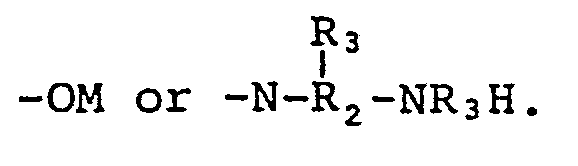
- the present invention is concerned with a composite semipermeable membrane comprising a microporous membrane and a cross-linked high polymer membrane formed thereon containing structural units expressed by the following formula (I) at a mole ratio of 50% at the least wherein R 1 indicates an alkyl group, which may contain a hydroxyl group, having 1 to 3 carbon atoms, or a hydrogen atom; R 2 indicates an aliphatic hydrocarbon residue, which may contain an oxygen atom, having 2 to 15 carbon atoms; Ar indicates a condensed or noncondensed aromatic hydrocarbon residue; X indicates a carbonyl bond (- -) or a sulfonyl bond ( ⁇ SO 2 ⁇ ); Y at least partly indicates a direct bond where cross-linkage takes place and the rest indicates - OM or - -R2 NR3H , where M indicates a hydrogen atom, alkali metal, alkaline earth metal, or ammonium group, and a definition of R 3 is the same as that of R l
- the compsite semipermeable membrane proposed by the present invention comprises a microporous membrane, an explanation of which is made later, and a cross-linked high polymer membrane formed thereon having structural units expressed by the aforementioned formula (I), in which R 1 is an alkyl group, which may contain a hydroxyl group, having 1 to 3 carbon atom, or a hydrogen atom.
- Ri is a hydrogen atom, -CH 3 , -C 2 H s , -C 3 H 7 , -C 2 H 4 OH, or -CH 2 ⁇ CH(OH) ⁇ CH 3 , preferably a hydrogen atom, -CH 3 , -C 2 H 5 , or -C 3 H 7 of which a hydrogen atom is especially preferable.
- R 2 is an aliphatic hydrocarbon residue, which may contain an oxygen atom, having 2 to 15, preferably 2 to 14 carbon atoms and what is mentioned here as aliphatic may be straight-chain or branched aliphatic or cyclic aliphatic.
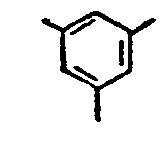
- Ar is a condensed or noncondensed aromatic hydrocarbon residue, preferably having 6 to 13 carbon atoms. As Ar, etc. may be mentioned and is especially preferable.
- X is a carbonyl bond or a sulfonyl bond, of which carbonyl bond is preferable.
- Y must be at least partially a direct bond where cross-linkage takes place and the rest may represent
- M is a hydrogen atom, alkali metal, alkaline earth metal, or ammonium group, of which a hydrogen atom and alkali metal are preferable.
- R 3 may be the same as R 1 ; however, at least one of the R 3 's is a hydrogen atom. It is desirable that 30 to 90%, more desirably 50 to 70% of Y are direct bonds participating in the cross-linkage, and, if possible, it is most desirable that Y are wholly participated in the cross-linkage.
- the aforementioned cross-linked high polymer membrane must necessarily contain structural units, which are expressed by formula (I) and composed of the abovementioned constituents, at a mole ratio of 50% at the least and it is more desirable for the membrane to contain at a mole ratio of 60% or more.
- structural units other than said structural units expressed by formula (I) no specific restrictions may be placed on their use so far as they do not interfere with the effectiveness of the present invention; however, in case where a small amount of structural units originating in an aliphatic diamine containing a secondary amine is contained, water permeability of the obtained membrane can be improved without damaging both the excellent resistance to oxidation and outstanding desalting performance which are the primary effectiveness of the present invention.
- R 4 and Rs are alkyl groups, each of which may independently contain a hydroxyl group, having 1 to 3 carbon atoms, or otherwise R 4 and R s are linked to one another or respectively to R 6 to form a piperazyl group or dipiperidylalkylen group, which may be substituted by a methyl group and/or an ethyl group, together with two nitrogen atoms and R 6 to which they are linked; R 6 indicates an aliphatic hydrocarbon residue, which may contain an oxygen atom, having 2 to 15 carbon atoms.
- the definitions of Ar, X and Y are the same as the aforementioned ones.
- R 4 and R s can be alkyl groups, which may have a hydroxyl group, having 1 to 3 carbon atoms and as their concrete examples, those referred to in the case of the aforementioned R 1 may again be cited, including -CH 3 , -C 2 H 5 , -C 2 H 4 -OH, and -C 3 H 7 as desirable ones, of which -CzHs is especially desirable.
- R 4 and R s are linked to one another or respectively to R 6 to form a piperazyl group or dipiperadylalkylen group, which may be substituted by a methyl group and/or an ethyl group, together with two nitrogen atoms and R 6 to which they are linked, desirably to form a piperazyl group not substituted by a methyl group and/or an ethyl group.
- Ar, X, and Y are defined the same as the above.
- the structural units expressed by the aforementioned formula (II) are contained at a mole ratio of less than 40% and in some desirable modes the content is in the range of mole ratio of 5% to 30%.
- the cross-linked high polymer membrane may be allowed to contain structural units originating from an aromatic diamine, or more particularly structural units expressed by the following formula (VI) at a mole ratio of less than 30%: wherein R 7 and R 8 , being the same or different from each other, are a hydrogen atom or a methyl group; Q is a noncondensed aromatic hydrocarbon residue, which may be substituted by -COOM and/or -S0 3 M and also may contain an ether bond, having 6 to 15 carbon atoms; and definitions of Ar, X, Y are the same as those mentioned in the fore- qoinq . As may be mentioned and are especially desirable.
- formula (VI) at a mole ratio of less than 30%: wherein R 7 and R 8 , being the same or different from each other, are a hydrogen atom or a methyl group; Q is a noncondensed aromatic hydrocarbon residue, which may be substituted by -COOM and/or -S0 3 M and also may contain an ether bond
- cross-linked high polymer menbrane of the present invention may contain structural units expressed by the following formula (VII) at a mole ratio of less than 40%, more preferably less than 30%.
- R 9 and R io are the same or different from each other and indicate an alkyl group, which may contain a hydrogen atom or a hydroxyl group, having 1 to 3 carbon atoms, or otherwise
- R 9 and R 10 are linked to one another or respectively to R 11 to form a piperazyl group or dipiperidylalkylen group, which may be substituted by a methyl group or an ethyl group, together with two nitrogen atoms and Ri l to which they are linked
- R 11 indicates an aliphatic hydrocarbon residue, which may contain an exygen atom, having 2 to 15 carbon atoms, or a noncondensed aromatic hydrocarbon residue, which may be substituted by -COOM and/or -S0 3 M and also may contain an ether bond, having 6 to 15 carbon atoms, where
- the cross-linked high polymer membrane can be additionally covered with a protective coating.
- protective coatings coatings of such water-soluble polymers as polyvinyl pyrrolidone and polyvinyl methyl ether, or of such water-insoluble polyvinyl alcohol, or of porous aliphatic polyamide may be mentioned. Of these coatings, water-insoluble polyvinyl alcohol coatings and porous aliphatic polyamide coatings are preferable.
- water-insoluble polyvinyl alcohol coatings those obtained by thermally gelating polyvinyl alcohol and those obtained by cross-linking polyvinyl alcohol with glutaraldehyde, folmalin, glyoxal, or a sulfurous acid adduct thereof may be mentioned.
- porous aliphatic polyamide coatings porous coatings of such aliphatic polyamides as poly-e-caproamide and polyhexamethyl adipamide may be mentioned.
- vitreous porous materials As the microporous membrane which functions as a supporting substratum in the present invention, vitreous porous materials, sintered metals, ceramic materials, and such organic polymers as cellulose ester, polystyrene, vinylbutyral, polysulfone, vinyl chloride, etc. may be mentioned.
- a polysulfone membrane displays especially outstanding functions when used as a microporous membrane in the present invention and polyvinyl chloride also makes a useful membrane.
- a process for the preparation of a polysulfone microporous membrane is also described in the Report No. 359 published by the OSW, U.S.A.
- the desirable size of pores on the surface of 0 such a membrane is in the range of about 100 A to 1000 A; however, the range of sizes is not limited to these values.
- the size of pores on the surface of a membrane can be anywhere between 50 A and 5000 A depending upon the final use of a composite membrane.
- These microporous membranes can be used in disregard of its being of symmetry structure or asymmetry structure; however, membranes of asymmetry structure are desirably used. In case where the membrane constant of these microporous membrane is 10- 4 g/cm 2 . sec ⁇ atm or less, the water permeability becomes too low and in case.where the membrane constant is lg/cm 2 ⁇ sec ⁇ atm or more, the desalting percentage is liable to decrease, both being undesirable.
- the membrane constant in the range of 1 to 10- 4 g/cm 2 . sec ⁇ atm give a desirable result and the membrane constant in the range of 10 -1 to 10- 3 g/cm 2 ⁇ sec ⁇ atm give the most desirable result.
- the membrane constant referred to in the above is defined to express the value of pure water permeability under pressure of 2 kg/cm 2 and expressed in a unit of g/cm 2 ⁇ sec ⁇ atm.
- microporous membranes are used in a state of being reinforced with the use of a woven fabric or a nonwoven fabric on their reverse side.
- fabrics made from polyethylene terephthalate, polystyrene, polypropylene, nylon or vinyl chloride may be mentioned as ideal examples.
- the composite semipermeable membrane of the present invention comprises a microporous membrane having a thickness of about 40 ⁇ m to 5 mm, especially in case of a microporous membrane of organic polymer, the thickness is in the range of 40 ⁇ m to 70 ⁇ m, and the aforementioned cross-linked high polymer membrane having a thickness of 200 ⁇ to 1500 A formed thereon, with a protective coating having a thickness of 0.1 ⁇ m to 1 ⁇ m formed thereon furthermore, if necessary.
- the composite membrane of the present invention is obtained by cross-linking a diamine compound which contains an aliphatic diamine expressed by the following formula (III) at a mole ratio of 50% at the least, more preferably 60% or more wherein definitions of R 1 and R 2 are the same as the aforementioned definitions; with a cross-linking agent, which mainly comprises an aromatic polyacid halide expressed by the following formula (IV), on the microporous membrane wherein a definition of Ar is the same as the aforementioned one; Z's are the same or diferent from one another, indicating a halogen atom; X indicates a sufonyl bond or a carbonyl group.
- a diamine compound which contains an aliphatic diamine expressed by the following formula (III) at a mole ratio of 50% at the least, more preferably 60% or more wherein definitions of R 1 and R 2 are the same as the aforementioned definitions
- a cross-linking agent which mainly comprises an aromatic polyacid halide expressed
- aliphatic diamines expressed by the abovementioned formula (III) to be used in this invention those which are soluble in a solvent, preferably in water or lower alcohol, are used.
- a solvent preferably in water or lower alcohol.
- the following diamines may be listed as examples:
- ethylenediamine and cyclohexanediamine are especially disirable.
- the abovementioned aliphatic diamines can be used singly or in combination of more than one.
- aromatic diamines can be used to the extent of not damaging the effectiveness of the present invention, for instance, at a mole ratio not exceeding 30%, though the use is not especially desirable.
- aliphatic secondary diamines should be used at a mole ratio of 50% or less, desirably 40% or less, most desirably 30% or less of the whole diamine components, and aromatic diamines should be 30% or less.
- the coating conditions must be controlled to keep the thickness of the applied coating of amine compound in the range of 0.01 to 2pm, preferably 0.02 to 1 ⁇ m, more preferably 0.05 to 0.7 ⁇ m.
- the thickness of a coating of amine compound is less than the abovementioned lower limit (0.01 ⁇ m)
- the active layer of the finally obtained composite membrane will be too thin to keep up enough mechanical strength for practical use.
- diamines When the coating is made thicker than 2 ⁇ m, the active layer becomes too thick, developing a tendency to degrade the water permeability of the composite membrane.
- These diamines must be soluble and it is desirable that they are especially soluble in water, methanol, ethanol, isopropanol, methyl cellosolve, dioxane, or tetrahydrbfuran, or a mixed solvent consisting of more than one of these solvents at a ratio of 0.1 g / 100 ml or more, preferably 0.5 g / 100 mi or more.
- diamines having a solubility of 0.1 g / 100 mi or more, more desirably 0.5 g / 100 mi or more, in water.
- a diamine compound solution of the present invention which is prepared by dissolving more than 0.1% of at least one kind of solvent (water is especially desirable) selected from a group of the abovementioned solvents is coated on or impregnated into the aforementioned microporous membrane of high microporosity.
- microporous membrane which is applied with the aforementioned diamine, is subjected to a cross-linking treatment with the use of an aromatic halide expressed by the aforementioned formula (IV) containing a functional group, which is capable of forming a carbonamide bond or a sulfonamide bond by reacting with said amino group, whereby the aforementioned diamine is transformed into a cross-linked membrane on the microporous membrane.
- the functional group contained in the multifunctional compound, which is used as a cross-linking agent in this invention is either a carbonyl halide group (-COZ) or a sulfonyl halide group (-S0 2 Z) containing 3 of these functional groups in a molecule.
- Especially useful functional groups are an acid chloride group and a sulfonyl chloride group.
- These functional groups contained plurally in a molecule may be similar to or different from one another in kind.
- aromatic multifunctional compounds are useful. The following may be mentioned as concrete examples of these cross-linking agents.
- aromatic multifunctional compounds may be used singly or in combination of more than one.
- bifunctional compounds In cases where these bifunctional compounds are used, their use should be at a mole ratio of 1 to 50%, desirably 5 to 30%, of said trifunctional compounds.
- the composite membrane of the present invention can be obtained by bringing the aforementioned diamine into direct contact with a solution of the abovementioned multifunctional compound on the microporous membrane.
- Solvents to be used in dissolving multifunctional compounds should be those which do not substantially dissolve said polyamine compounds and base materials and such solvents of hydrocarbon type as n-hexane, n-heptane, n-octane, cyclohexane, n-nonane, n-decane, etc.
- hydrocarbons of halogen type as carbon tetrachloride, difluorotetra- chloroethane, trifluorotrichloroethane, hexachloroethane, etc., for instance, may be mentioned.
- concentration of a multifunctional compound dissolved in the solvent may be varied depending upon the kind of the multifunctional compound, solvent, base material, and other conditions and the optimum value of concentration can be determined experimentally.
- the desired effect can be obtained at the concentration of about 0.1 to 5.0% by weight, preferably 0.5 to 3.0% by weight.
- the cross linking of a polyamine compound by use of a multifunctional compound can be appropriately achieved by causing the interface reaction in the hetero-phase between the membrane and the solution, which reaction can be induced by impregnating the polyamine compound coated membrane with a solution of multifunctional compound.
- an interface reaction promoter can be contained beforehand in the aforementioned diamine compound or a solution of the abovementioned multifunctional compound in order to promote the interface cross linking reaction.
- Caustic alkali, sodium phosphate, pyridine, tertiary amine, surface active agent, sodium acetate, and the like can be used as useful promoters.
- Said interface cross linking reaction of the diamine compound with the multifunctional compound can be carried out at room temperature and about 100°C, desirably at temperature between 20 and 50°C, for 2 seconds to 10 minutes, desirably for 10 seconds to 5 minutes.
- This interface cross linking reaction can be conducted in such a way as to be mainly focused on the surface of the membrane.
- the membrane supported by the base material is cured at room temperature or, if necessary, is subjected to heat treatment at 40 to 130°C, desirably at 50 to 80°C for about 1 to 30 minutes, desirably for about 5 to 20 minutes, thus completing said interface cross-linking reaction and also achieving the water insolubility of the aforementioned diamine compound.
- the desired composite membrane having a thin cross-linked polycondensate coating of selective permeability formed on the surface of a microporous membrane is obtained.
- composite membrane of the present invention is endowed with extraordinary resistance to oxidation in addition to its outstanding basic reverse osmotic performance, resistance to blocking under pressure, heat resistance, PH resistance, etc. and it may be said that it has the marked usefulness and characteristics that are not found with other conventional known membranes.
- a water-soluble or water-insoluble protective coating can be formed on the cross-linked high polymer membrane of the composite semipermeable membrane obtained in the above.
- coatings of such compounds as polyvinyl pyrrolidone and polyvinyl methyl ether may be mentioned as water-soluble protective coatings
- a water-isolubilized coating of polyvinyl alcohol and a porous coating of aliphatic polyamide may be mentioned as water-insoluble protective coatings.
- Protective coatings of polyvinyl pyrrolidone and polyvinyl methyl ether can be obtained by dissolving said polymer in such a solvent as water, lower alcohol, or a mixture thereof, coating and drying thus prepared solution on the cross-linked high polymer membrane.
- a water-insolubilized coating of polyvinyl alcohol can be obtained by dissolving polyvinyl alsohol in water together with formalin, glyoxal, glutaraldehyde, and one or more compounds selected from the sulfites thereof, or together with ammonium persulfate and/or potassiun persulfate, coating the surface of the cross-linked high polymer membrane with thus prepared solution, and subjecting the coating to heat-treatment at 50 to 120°C, desirably at 70 to 100°C, for 5 to 30 minutes to have the coating acetal cross-linked or self-gelated.
- a porous coating of aliphatic polyamide can be obtained by forming a polyamide coating on the cross- linked high polymer membrane by application of a solution prepared by dissolving aliphatic polyamide in a methanol solution containing such a poring agent as calcium chloride, for instance, followed by a treatment with water wherein the poring agent is extracted to make the coating porous.
- composite semipermeable membrane can be used in various separation works by use of the membrane based on the physical laws of diffusion and osmosis.
- the membrane is washed with a bactericide after it is used for a specified period and bactericides of chlorine type are used very often.
- bactericides of chlorine type are used very often.
- said treatment of the membrane with a bactericide of chlorine type may be followed usefully by the treatment of the membrane with a solution of reducing agent to release the adsorbed chlorine, thus recovering its performance afresh.
- the membrane is made to contact an aqueous solution in the pH range between 4 to 7 containing 0.5 ppm ⁇ 5,000 ppm bactericide such as sodium hypochlorite, hypochlorous acid, hypobromous acid, hydrogen peroxide, sodium perborate, iodophor and sodium dichloroisocyanurate, at 10 to 50°C for 10 to 100 minutes.
- a bactericide such as sodium hypochlorite, hypochlorous acid, hypobromous acid, hydrogen peroxide, sodium perborate, iodophor and sodium dichloroisocyanurate
- the methods of treating the membrane with a reducing agent which follow the bactericiding carried out by use of bactericides of chlorine type among the abovementioned bactericides there is a method in which the bactericided membrane is made to contact an aqueous solution containing 10 ppm -. 5,000 ppm reducing agent such as sodium thiosulfate, sodium hydrosulfite, sodium sulfite, and sodium bisulfite, at 10 to 50°C for 10 to 100 minutes.
- a reducing agent such as sodium thiosulfate, sodium hydrosulfite, sodium sulfite, and sodium bisulfite
- the abovementioned methods of regenerating the membrane are especially useful in the fields where solutions, which are apt to cause the propagation of bacteria, like aqueous solutions containing, for instance, saccharides, amino acids, alcohols, organic carboxylic acids, etc. are separated by use of the membrane.
- the test was conducted at 25°C under pressure of 42.5 kg/cm 2 G with an ordinary continuous pump circulation reverse osmosis equipment by using an aqueous solution in the pH range of 6.0 to 6.5 always containing 5,000 ppm sodium chloride and 4 to 5 ppm hypochlorous acid.
- the desalting percentage described in the examples is a value obtained by the following equation:
- a piece of Dacron non-woven fabric of a dense texture (unit weight : 180 g/m 2 ) was fixed on a glass plate.
- a solution containing 12.5 wt % polysulfone, 12.5 wt % methyl cellosolve, and dimethylformamide making up the rest was cast to form a layer of about 0.2 mm thickness on said non-woven fabric and the layer was immediately gelated in a water bath at room temperature to obtain a porous polysulfone membrane reinforced with a non-woven fabric.
- the porous polysulfone layer thus formed was about 40 to 70 ⁇ m thick, exhibited an asymmetry structure, and showed a large number of micropores about 200 to 700 A on the surface.
- These porous base materials had a permeability to pure water (membrane constant) in the range of about 3.0 to 7.0 x 10 -2 g/cm 2 ⁇ sec ⁇ atm at 2 kg/ cm 2 G .
- the porous polysulfone membrane obtained in Reference Example 2 was immersed in an aqueous solution prepared by dissolving 1 g of ethylenediamine (immediately after distillation) in 100 m£ of distilled water for 5 minutes, taken out of the aqueous solution, and drained at room temperature for 7 minutes while being hung vertically.
- Example 1 After the composite membrane of Example 1 prepared under the abovementioned conditions was immersed in an aqueous solution of 0.1% NaOH for 24 hours, the membrane was washed several times with distilled water and dried under vacuum. The membrane was then immersed in chloroform and the cross-linked active layer polymer, which could be isolated by eluting the polysulfone microporous membrane, was thoroughly washed with chloroform, followed by washing with alcohol and also with water. When the powder polymer obtained by refining and drying said polymer was subjected to the Na atom absorptiometric analysis, Na of 0.53 milliequivalent/g based on the conversion to sodium carboxylate groups (-COO N a) was detected.
- the composition of the abovementioned polymer estimated from the value thus obtained is as follows:
- a composite membrane was prepared according to the same method as Example 1, wherein an aqueous solution obtained by dissolving 2 g of methaphenilenediamine fresh from distillation in 100 mi of distilled water.
- aqueous solution obtained by dissolving 2 g of methaphenilenediamine fresh from distillation in 100 mi of distilled water.
- the reverse osmosis test was again started under the same conditions and 100 hours later, the relation between water permeability and desalting percentage was 27.3 l/m 2 ⁇ hr and 99.7%, the desalting percentage showing an improvement over the initial value.
- Composite membranes were obtained in the same way as Example 1 except the use of amines described in Table 1 in the place of ethylenediamine. These membranes were subjected to the reverse osmosis oxidation resistance test under the same conditions as Example 1. The results are shown in Table 1 . Compositions of these composite membrane active layer polymers estimated from the Na analytical values and the values obtained from elemental analyses of C, H, and N are shown in Table 2.
- a composite membrane was obtained according to the same method as Example 1 except for the use of 5-chlorosulfonylisophthalic acid chloride as cross-linking agent in the place of trimesic acid chloride.
- the obtained membrane was identified as the composite membrane comprising a cross-linked polymer layer having a polymer composition expressed by the following formula.
- a composite membrane was obtained according to Example 1, wherein a mixture of trimesic acid chloride and isophthalic acid chloride at a mole ratio of 3:1 was used as cross-linking agent instead of the single use of trimesic acid chloride.
- the active polymer layer of this composite membrane was subjected to N a analysis and elemental analysis (C, H, N) according to Example 1 and the obtained results showed that this polymer was a cross-linked polymer having a polymer composition expressed by the following formula.
- Composite membranes were obtained according to Example 1, wherein respective mixtures of a diamine and ethylenediamine at a mole ratio of 1:2 as described in the following Table 3 were used instead of the single use of ethylenediamine. These membranes were subjected to the reverse osmosis test under the same conditions as Example 1 and the following results were obtained as shown in Table 3. The polymer compositions of active polymer layers of these composite membranes are shown in Table 4.
- Composite membranes were obtained according to Example 1, wherein respective aqueous solutions of 1/50 mole diamines described in the following Table 5 in the place of an aqueous solution of ethylenediamine. After the basic separation performance of these membranes were evaluated, the membranes were subjected to the chlorine resistance test and washing test with the use of a reducing agent to know how the membrane performances changed.
- Composite membranes were obtained according to Example 1, wherein equimolar mixtures (as solutions of 0.2 wt % carbon tetrachloride), one consisting of trimesic acid chloride and isophthalic acid chloride and the other consisting of trimesic acid chloride and 5-sulfoisophthalic acid trichloride, were used as cross-linking agent instead of a single use of trimesic acid chloride.
- the basic separation performance and chlorine resistivity of these composite membranes were evaluated under the same conditions as Examples 13 ⁇ 17. The results are shown in Table 6.
- a protective layer of 0.2 to 0.3 ⁇ m thick membrane was formed on the surface of composite membranes prepared according to Example 1 by coating the membranes with each of protective polymer solutions respectively having a composition as shown in Table 8. These composite membranes were subjected to the chlorine resistance test under the same conditions as Exaples 13 ⁇ 17 and the remarkably increase of long-period resistivity due to the presence of the protective layer was observed.
- the composite semipermeable membrane of the present invention can be used in a wide range of separation works in the fields of fresh water generation, enrichment of valuable substances, fractionation of water soluble organic substances, etc. Especially it can be effectively used for separation works in the field of food processing where microbes are apt to proliferate and yet conventional membranes are hardly used for lack of resistance against strong sterilizers and bactericides.
Landscapes
- Chemical & Material Sciences (AREA)
- Chemical Kinetics & Catalysis (AREA)
- Health & Medical Sciences (AREA)
- Medicinal Chemistry (AREA)
- Polymers & Plastics (AREA)
- Organic Chemistry (AREA)
- Separation Using Semi-Permeable Membranes (AREA)
- Compositions Of Macromolecular Compounds (AREA)
Abstract
Description
- Composite Semipermeable Membrane, Process for the Preparation Thereof, and Method of Its use.
- The present invention relates to a composite semipermeable membrane and, more specifically relates to a composite semipermeable membrane having an excellent semipermeability and outstanding resistance to oxidation.
- In the early days of its development, a reverse osmosis membrane of cellulose acetate type developed by Loeb and Sourirajan et al. was widely used because of its excellent basic performance and easiness of preparation. However, it offered problems raised by its week points including hydrolizability in acidic and alkaline solutions, degenerative decomposition due to the growth of microbes, excessive density under high pressure, and unfitness for dry storage and ameliorated varieties of reverse osmosis membranes made from synthetic high polymer materials were proposed to correct these defects. Du Pont proposed a reverse osmosis membrane made from wholly aromatic polyamide. This membrane was much improved in terms of hydrolizability and degenerative microbial decomposition; however, it never exceeded a cellulose acetate membrane in basic performance and it still maintained such week points as excessive density under high pressure and unfitness for dry storage.
- The preceding membranes are both what is called a membrane of heterogenous system prepared after a method called phase separation, wherein the membrane is composed of a homogenous layer which functions as a separator and a porous layer which reinforces the membrane, both being made from the same material.
- On the other hand, a method was proposed to prepare a reverse osmosis membrane, wherein a cross- linked thin filmy separation layer was formed by allowing a reactive hydrophilic polymer to react with a cross linking agent upon the porous layer prepared beforehand from a different material. This membrane proved to have been greatly improved in hydrolizability, degenerative microbial decomposition, increase of density under high pressure, and dry storability in addition to improved basic performance. The North Star Research Institute proved that the use of polyethyleneimine as reactive hydrophilic polymer and the use of such poliacid chloride as isophthalic acid chloride or such polyisocianate as toluylenediisocianate made it possible to achieve the aforementioned improvements. At the same time, however, it was made clear that the membrane thus obtained encountered a major problem in forming a spiral module because of the weakness of the cross- linked layer due to the excess content of amine in polyethyleneimine used as material. Meanwhile, Universal Oil Products Corp. succeeded in correcting the aforementioned defects by use of amine modified polyepichlorohydrin as reactive hydrophilic polymer; however, it has recently been made known publicly that it is difficult to make a membrane having high water permeability due to the difficulty in preparing its material epiamine and that it has a problem in securing a prolonged durability.
- Filmtech Inc. (inventor : John E. Caddotte) has recently proposed a composite membrane prepared by cross-linking such a low polymer aromatic amine as methaphenilenediamine, paraphenilenediamine, etc. with such an aromatic polyacid halide as trimesic acid chloride on a microporous film (see Japanese Patent Application Laying-Open No. 147106/80) with a disclosure that it has an excellent desalting performance and outstanding resistance to oxidation.
- However, the investigation conducted into this composite membrane by the inventors of the present invention made it clear that the resistance to oxidation of this membrane was kept up only for a short duration since the membrane started to show typical phenomena of deterioration of the membrane such as degradation of desalting performance and increase of permeability of water when only 150 hours passed in the continuous reverse osmosis test conducted in the presence of 4 to 5 ppm activated chlorine as described in a comparison example of the present invention.
- Earlier than the disclosure of the abovementioned invention, a proposal was made with relation to a composite membrane of high resistance to oxidation obtained by cross-linking polyamine having a secondary amino group only with an aromatic polyacid halide (see Japanese Patent Application Laying-Open No. 139802/80); however, this membrane generally had a defects of having insufficient removability in percentages of both salt and sucrose. More particularly, its removability of salt was 90 to 95% at the most even in the separation of a solute of large molecule as magnesium chloride and the removability of sucrose hardly exceeded 95%.
- As a result of a concentrated study made in an effort to correct the abovementioned defects found with the membranes proposed heretofore, the inventors of the present invention have come to find, contrary to the past knowledge, that a semipermeable membrane of high performance having a more excellent resistance to oxidation and higher desalting function as compared with conventionally known semipermeable membranes, especially a membrane invented by Caddotte et al. mentioned in the above, can be prepared from polyamide having an aliphatic primary amido bond, which has been said to make a membrane having insufficient resistance to oxidation, when a proper selection of an acid component is exercised, thus completing the present invention. The present invention is concerned with a composite semipermeable membrane comprising a microporous membrane and a cross-linked high polymer membrane formed thereon containing structural units expressed by the following formula (I) at a mole ratio of 50% at the least
 -) or a sulfonyl bond (―SO2―); Y at least partly indicates a direct bond where cross-linkage takes place and the rest indicates - OM or -
 -R2 NR3H, where M indicates a hydrogen atom, alkali metal, alkaline earth metal, or ammonium group, and a definition of R3 is the same as that of Rl, at least one R3 being a hydrogen atom: and a process for the preparation of a composite semipermeable membrane which comprises reacting a diamine compound which contains a compound expressed by the following formula (III) at a mole ratio of 50% at the least

with a cross-linking agent mainly consisting of a compound expressed by the following formula (IV) on a microporous membrane -) or a sulfonyl bond (- S02 -):
and further a method of employing the abovementioned composite semipermeable membrane repeatedly in the reverse osmosis operations, comprising a bactericidal treatment by use of an aqueous solution of pH 4 to pH 7 containing 0.5 to 5,000 ppm bactericide of chlorine type followed by washing with an aqueous solution containing 10 to 5,000 ppm reducing agent. - The compsite semipermeable membrane proposed by the present invention comprises a microporous membrane, an explanation of which is made later, and a cross-linked high polymer membrane formed thereon having structural units expressed by the aforementioned formula (I), in which R1 is an alkyl group, which may contain a hydroxyl group, having 1 to 3 carbon atom, or a hydrogen atom.
- More concretely, Ri is a hydrogen atom, -CH3, -C2Hs, -C3H7, -C2H4OH, or -CH2·CH(OH)·CH3, preferably a hydrogen atom, -CH3, -C2H5, or -C3H7 of which a hydrogen atom is especially preferable.
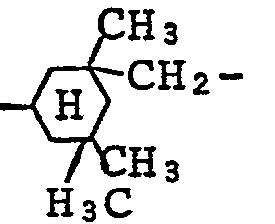
- R2 is an aliphatic hydrocarbon residue, which may contain an oxygen atom, having 2 to 15, preferably 2 to 14 carbon atoms and what is mentioned here as aliphatic may be straight-chain or branched aliphatic or cyclic aliphatic.
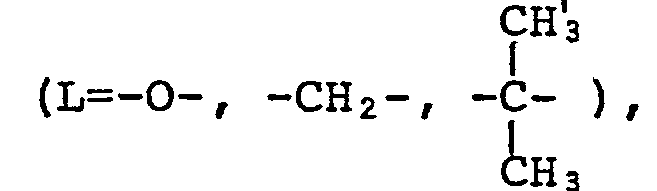
- As R2, -CH2CH2-, -CH2·CH2·CH2-, (̵CH2)̵n (n=4-11),





- Ar is a condensed or noncondensed aromatic hydrocarbon residue, preferably having 6 to 13 carbon atoms. As Ar,

- The aforementioned cross-linked high polymer membrane must necessarily contain structural units, which are expressed by formula (I) and composed of the abovementioned constituents, at a mole ratio of 50% at the least and it is more desirable for the membrane to contain at a mole ratio of 60% or more. As for the structural units other than said structural units expressed by formula (I), no specific restrictions may be placed on their use so far as they do not interfere with the effectiveness of the present invention; however, in case where a small amount of structural units originating in an aliphatic diamine containing a secondary amine is contained, water permeability of the obtained membrane can be improved without damaging both the excellent resistance to oxidation and outstanding desalting performance which are the primary effectiveness of the present invention.
- As the structural units of such type, those structural units expressed by the following formula (II) may be mentioned:

- In the abovementioned formula, R4 and Rs can be alkyl groups, which may have a hydroxyl group, having 1 to 3 carbon atoms and as their concrete examples, those referred to in the case of the aforementioned R1 may again be cited, including -CH3, -C2H5, -C2H4-OH, and -C3H7 as desirable ones, of which -CzHs is especially desirable. R4 and Rs are linked to one another or respectively to R6 to form a piperazyl group or dipiperadylalkylen group, which may be substituted by a methyl group and/or an ethyl group, together with two nitrogen atoms and R6 to which they are linked, desirably to form a piperazyl group not substituted by a methyl group and/or an ethyl group. Ar, X, and Y are defined the same as the above.
- The structural units expressed by the aforementioned formula (II) are contained at a mole ratio of less than 40% and in some desirable modes the content is in the range of mole ratio of 5% to 30%.
- The cross-linked high polymer membrane may be allowed to contain structural units originating from an aromatic diamine, or more particularly structural units expressed by the following formula (VI) at a mole ratio of less than 30%:




- Also the cross-linked high polymer menbrane of the present invention may contain structural units expressed by the following formula (VII) at a mole ratio of less than 40%, more preferably less than 30%.

- The cross-linked high polymer membrane can be additionally covered with a protective coating. As protective coatings, coatings of such water-soluble polymers as polyvinyl pyrrolidone and polyvinyl methyl ether, or of such water-insoluble polyvinyl alcohol, or of porous aliphatic polyamide may be mentioned. Of these coatings, water-insoluble polyvinyl alcohol coatings and porous aliphatic polyamide coatings are preferable. As water-insoluble polyvinyl alcohol coatings, those obtained by thermally gelating polyvinyl alcohol and those obtained by cross-linking polyvinyl alcohol with glutaraldehyde, folmalin, glyoxal, or a sulfurous acid adduct thereof may be mentioned. As porous aliphatic polyamide coatings, porous coatings of such aliphatic polyamides as poly-e-caproamide and polyhexamethyl adipamide may be mentioned.
- As the microporous membrane which functions as a supporting substratum in the present invention, vitreous porous materials, sintered metals, ceramic materials, and such organic polymers as cellulose ester, polystyrene, vinylbutyral, polysulfone, vinyl chloride, etc. may be mentioned.
- A polysulfone membrane displays especially outstanding functions when used as a microporous membrane in the present invention and polyvinyl chloride also makes a useful membrane. A process for the preparation of a polysulfone microporous membrane is also described in the Report No. 359 published by the OSW, U.S.A.
- The desirable size of pores on the surface of 0 such a membrane is in the range of about 100 A to 1000 A; however, the range of sizes is not limited to these values. The size of pores on the surface of a membrane can be anywhere between 50 A and 5000 A depending upon the final use of a composite membrane. These microporous membranes can be used in disregard of its being of symmetry structure or asymmetry structure; however, membranes of asymmetry structure are desirably used. In case where the membrane constant of these microporous membrane is 10-4 g/cm2. sec·atm or less, the water permeability becomes too low and in case.where the membrane constant is lg/cm2· sec·atm or more, the desalting percentage is liable to decrease, both being undesirable. Accordingly, the membrane constant in the range of 1 to 10-4 g/cm2. sec·atm give a desirable result and the membrane constant in the range of 10-1 to 10-3 g/cm2·sec·atm give the most desirable result. The membrane constant referred to in the above is defined to express the value of pure water permeability under pressure of 2 kg/cm2 and expressed in a unit of g/cm2·sec·atm.
- It is desirable that these microporous membranes are used in a state of being reinforced with the use of a woven fabric or a nonwoven fabric on their reverse side. As such woven or nonwoven fabrics, fabrics made from polyethylene terephthalate, polystyrene, polypropylene, nylon or vinyl chloride may be mentioned as ideal examples.
- The composite semipermeable membrane of the present invention comprises a microporous membrane having a thickness of about 40 µm to 5 mm, especially in case of a microporous membrane of organic polymer, the thickness is in the range of 40 µm to 70 µm, and the aforementioned cross-linked high polymer membrane having a thickness of 200 Å to 1500 A formed thereon, with a protective coating having a thickness of 0.1 µm to 1 µm formed thereon furthermore, if necessary.
- The composite membrane of the present invention is obtained by cross-linking a diamine compound which contains an aliphatic diamine expressed by the following formula (III) at a mole ratio of 50% at the least, more preferably 60% or more

with a cross-linking agent, which mainly comprises an aromatic polyacid halide expressed by the following formula (IV), on the microporous membrane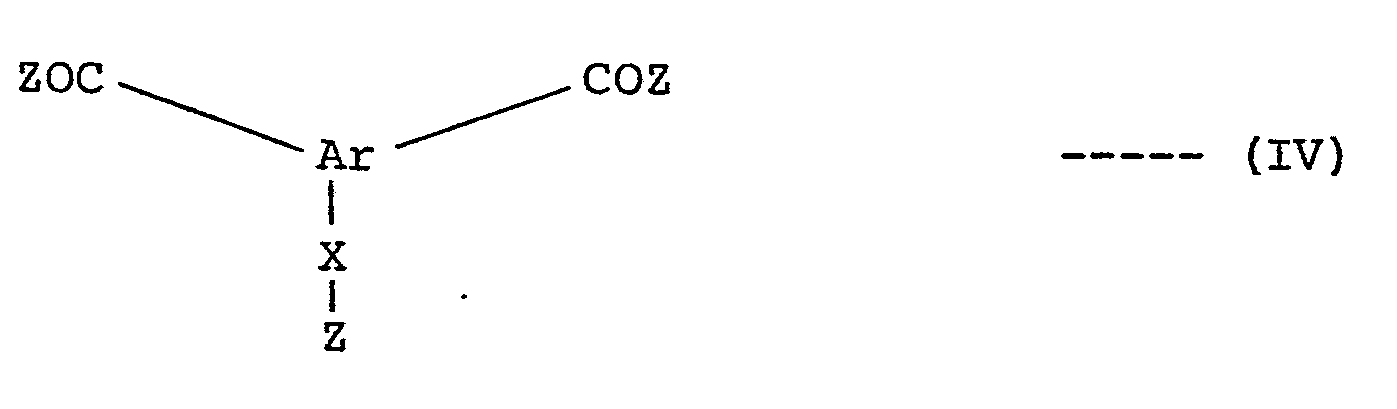
- As the aliphatic diamines expressed by the abovementioned formula (III) to be used in this invention, those which are soluble in a solvent, preferably in water or lower alcohol, are used. The following diamines may be listed as examples:









- Of these aliphatic diamines mentioned above, ethylenediamine and cyclohexanediamine are especially disirable. The abovementioned aliphatic diamines can be used singly or in combination of more than one.
- The use of the abovementioned diamine in combination with other polyamine compound is also included in the scope of the present invention. The following polyamines can be used as suitable ones.
- (1) Straight-chain aliphatic secondary diamines:
- CH3NHCH2CH2NHCH3
- C2HSNHCH2CH2NHC2H5
- HOCH2CH2NHCH2CH2NHCH2CH20H
- (2) Cyclic aliphatic secondary diamines: Piperazine


- The combined use of these polyamines can properly adjust and improve the water permeability and/or desalting performance of the composite membrane of the present invention.
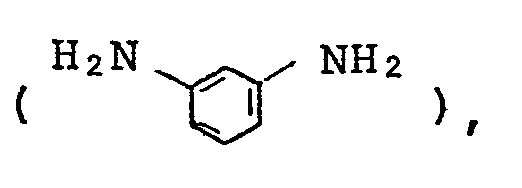
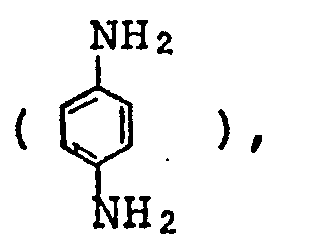
- Also, the following aromatic diamines can be used to the extent of not damaging the effectiveness of the present invention, for instance, at a mole ratio not exceeding 30%, though the use is not especially desirable.
- Methaphenilenediamine
- paraphenilenediamine
- 4,4-diaminodiphenylamine

- 4,4'-diaminodiphenyl ether

- 3,4'-diaminodiphenyl ether

- 3,3'-diaminodiphenylamine

- 3,5-diaminobenzoate
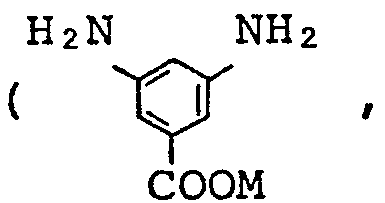
- In case where these diamines are used, aliphatic secondary diamines should be used at a mole ratio of 50% or less, desirably 40% or less, most desirably 30% or less of the whole diamine components, and aromatic diamines should be 30% or less.
- In obtaining the composite membrane of the present invention by use of the aforementioned diamine compounds, it is necessary to apply a solution of any of these amine compounds on the suface of said microporous membrane. Any methods of application including a dip coating method, roller coating method, wick coating method, spray coating method, etc. may be adopted in applying an amine solution; however, the coating conditions must be controlled to keep the thickness of the applied coating of amine compound in the range of 0.01 to 2pm, preferably 0.02 to 1 µm, more preferably 0.05 to 0.7 µm. When the thickness of a coating of amine compound is less than the abovementioned lower limit (0.01 µm), the active layer of the finally obtained composite membrane will be too thin to keep up enough mechanical strength for practical use. When the coating is made thicker than 2 µm, the active layer becomes too thick, developing a tendency to degrade the water permeability of the composite membrane. These diamines must be soluble and it is desirable that they are especially soluble in water, methanol, ethanol, isopropanol, methyl cellosolve, dioxane, or tetrahydrbfuran, or a mixed solvent consisting of more than one of these solvents at a ratio of 0.1 g / 100 mℓ or more, preferably 0.5 g / 100 mi or more. Especially it is desirable to use diamines having a solubility of 0.1 g / 100 mi or more, more desirably 0.5 g / 100 mi or more, in water.
- A diamine compound solution of the present invention which is prepared by dissolving more than 0.1% of at least one kind of solvent (water is especially desirable) selected from a group of the abovementioned solvents is coated on or impregnated into the aforementioned microporous membrane of high microporosity.
- The microporous membrane, which is applied with the aforementioned diamine, is subjected to a cross-linking treatment with the use of an aromatic halide expressed by the aforementioned formula (IV) containing a functional group, which is capable of forming a carbonamide bond or a sulfonamide bond by reacting with said amino group, whereby the aforementioned diamine is transformed into a cross-linked membrane on the microporous membrane.
- The functional group contained in the multifunctional compound, which is used as a cross-linking agent in this invention, is either a carbonyl halide group (-COZ) or a sulfonyl halide group (-S02Z) containing 3 of these functional groups in a molecule. Especially useful functional groups are an acid chloride group and a sulfonyl chloride group. These functional groups contained plurally in a molecule may be similar to or different from one another in kind. As for the multifunctional compound, aromatic multifunctional compounds are useful. The following may be mentioned as concrete examples of these cross-linking agents.

- The abovementioned aromatic multifunctional compounds may be used singly or in combination of more than one.
- According to the present invention, it has been made clear that, in some instances, the combined use of the abovementioned trifunctional compound and the bifunctional compound expressed by the following formula (VI) in stead of the single use of said trifunctional compound facilitates the control of the desalting percentage and/or water permeability of a finally obtained membrane

- As such bifunctional compounds, the following may be mentioned as examples:

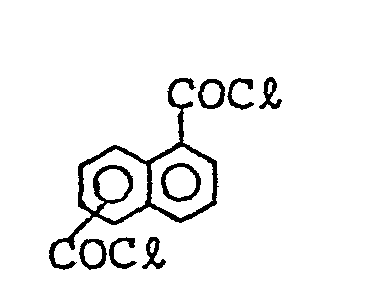
- In cases where these bifunctional compounds are used, their use should be at a mole ratio of 1 to 50%, desirably 5 to 30%, of said trifunctional compounds.
- The composite membrane of the present invention can be obtained by bringing the aforementioned diamine into direct contact with a solution of the abovementioned multifunctional compound on the microporous membrane. Solvents to be used in dissolving multifunctional compounds should be those which do not substantially dissolve said polyamine compounds and base materials and such solvents of hydrocarbon type as n-hexane, n-heptane, n-octane, cyclohexane, n-nonane, n-decane, etc. and such hydrocarbons of halogen type as carbon tetrachloride, difluorotetra- chloroethane, trifluorotrichloroethane, hexachloroethane, etc., for instance, may be mentioned. The appropriate concentration of a multifunctional compound dissolved in the solvent may be varied depending upon the kind of the multifunctional compound, solvent, base material, and other conditions and the optimum value of concentration can be determined experimentally.
- However, in general, the desired effect can be obtained at the concentration of about 0.1 to 5.0% by weight, preferably 0.5 to 3.0% by weight.
- The cross linking of a polyamine compound by use of a multifunctional compound can be appropriately achieved by causing the interface reaction in the hetero-phase between the membrane and the solution, which reaction can be induced by impregnating the polyamine compound coated membrane with a solution of multifunctional compound. At this time, an interface reaction promoter can be contained beforehand in the aforementioned diamine compound or a solution of the abovementioned multifunctional compound in order to promote the interface cross linking reaction. Caustic alkali, sodium phosphate, pyridine, tertiary amine, surface active agent, sodium acetate, and the like can be used as useful promoters.
- Said interface cross linking reaction of the diamine compound with the multifunctional compound can be carried out at room temperature and about 100°C, desirably at temperature between 20 and 50°C, for 2 seconds to 10 minutes, desirably for 10 seconds to 5 minutes. This interface cross linking reaction can be conducted in such a way as to be mainly focused on the surface of the membrane.
- After an excess solution of multifunctional compound is drained for 10 seconds to 2 minutes as case may require, the membrane supported by the base material is cured at room temperature or, if necessary, is subjected to heat treatment at 40 to 130°C, desirably at 50 to 80°C for about 1 to 30 minutes, desirably for about 5 to 20 minutes, thus completing said interface cross-linking reaction and also achieving the water insolubility of the aforementioned diamine compound.
- In this way, the desired composite membrane having a thin cross-linked polycondensate coating of selective permeability formed on the surface of a microporous membrane is obtained.
- A description is given in the above as to a method of first coating the microporous membrane with a diamine compound; however, there is another method of first coating the microporous membrane with a cross-linking agent and then allowing the agent to react with the diamine compound.
- Examples of the cross-linked polyamides which are able to form an active layer of the composite membrane of the present invention thus obtained are given below.


- Thus obtained composite membrane of the present invention is endowed with extraordinary resistance to oxidation in addition to its outstanding basic reverse osmotic performance, resistance to blocking under pressure, heat resistance, PH resistance, etc. and it may be said that it has the marked usefulness and characteristics that are not found with other conventional known membranes.
- Furthermore in the present invention, a water-soluble or water-insoluble protective coating can be formed on the cross-linked high polymer membrane of the composite semipermeable membrane obtained in the above.
- To illustrate such protective coatings by example, coatings of such compounds as polyvinyl pyrrolidone and polyvinyl methyl ether may be mentioned as water-soluble protective coatings, while a water-isolubilized coating of polyvinyl alcohol and a porous coating of aliphatic polyamide may be mentioned as water-insoluble protective coatings.
- Protective coatings of polyvinyl pyrrolidone and polyvinyl methyl ether can be obtained by dissolving said polymer in such a solvent as water, lower alcohol, or a mixture thereof, coating and drying thus prepared solution on the cross-linked high polymer membrane.
- A water-insolubilized coating of polyvinyl alcohol can be obtained by dissolving polyvinyl alsohol in water together with formalin, glyoxal, glutaraldehyde, and one or more compounds selected from the sulfites thereof, or together with ammonium persulfate and/or potassiun persulfate, coating the surface of the cross-linked high polymer membrane with thus prepared solution, and subjecting the coating to heat-treatment at 50 to 120°C, desirably at 70 to 100°C, for 5 to 30 minutes to have the coating acetal cross-linked or self-gelated.
- A porous coating of aliphatic polyamide can be obtained by forming a polyamide coating on the cross- linked high polymer membrane by application of a solution prepared by dissolving aliphatic polyamide in a methanol solution containing such a poring agent as calcium chloride, for instance, followed by a treatment with water wherein the poring agent is extracted to make the coating porous.
- Thus obtained composite semipermeable membrane can be used in various separation works by use of the membrane based on the physical laws of diffusion and osmosis. In ordinary separation works, the membrane is washed with a bactericide after it is used for a specified period and bactericides of chlorine type are used very often. When treated with a bactericide of highly concentrated chlorine solution, conventional membranes become deteriorated, while the composite membrane of this invention remains good for continued use because of its strong resistance to oxidation. Furthermore, in the present invention said treatment of the membrane with a bactericide of chlorine type may be followed usefully by the treatment of the membrane with a solution of reducing agent to release the adsorbed chlorine, thus recovering its performance afresh.
- As the methods of bactericiding the membrane, there is a method in which the membrane is made to contact an aqueous solution in the pH range between 4 to 7 containing 0.5 ppm ~ 5,000 ppm bactericide such as sodium hypochlorite, hypochlorous acid, hypobromous acid, hydrogen peroxide, sodium perborate, iodophor and sodium dichloroisocyanurate, at 10 to 50°C for 10 to 100 minutes.
- As the methods of treating the membrane with a reducing agent which follow the bactericiding carried out by use of bactericides of chlorine type among the abovementioned bactericides, there is a method in which the bactericided membrane is made to contact an aqueous solution containing 10 ppm -. 5,000 ppm reducing agent such as sodium thiosulfate, sodium hydrosulfite, sodium sulfite, and sodium bisulfite, at 10 to 50°C for 10 to 100 minutes.
- The abovementioned methods of regenerating the membrane are especially useful in the fields where solutions, which are apt to cause the propagation of bacteria, like aqueous solutions containing, for instance, saccharides, amino acids, alcohols, organic carboxylic acids, etc. are separated by use of the membrane.
- The present invention will now be described more specifically with reference to examples given below.
- The test was conducted at 25°C under pressure of 42.5 kg/cm2G with an ordinary continuous pump circulation reverse osmosis equipment by using an aqueous solution in the pH range of 6.0 to 6.5 always containing 5,000 ppm sodium chloride and 4 to 5 ppm hypochlorous acid.
- In addition to the abovementioned reverse osmotic testing, an accelerated chlorine resistance evaluation test was conducted likewise by raising the concentration of hypochlorous acid to 1,000 ppm. The performance of the membrane in the test was shown by the data obtained from the membrane after it was further subjected to the reducing agent treatment.
- The desalting percentage described in the examples is a value obtained by the following equation:
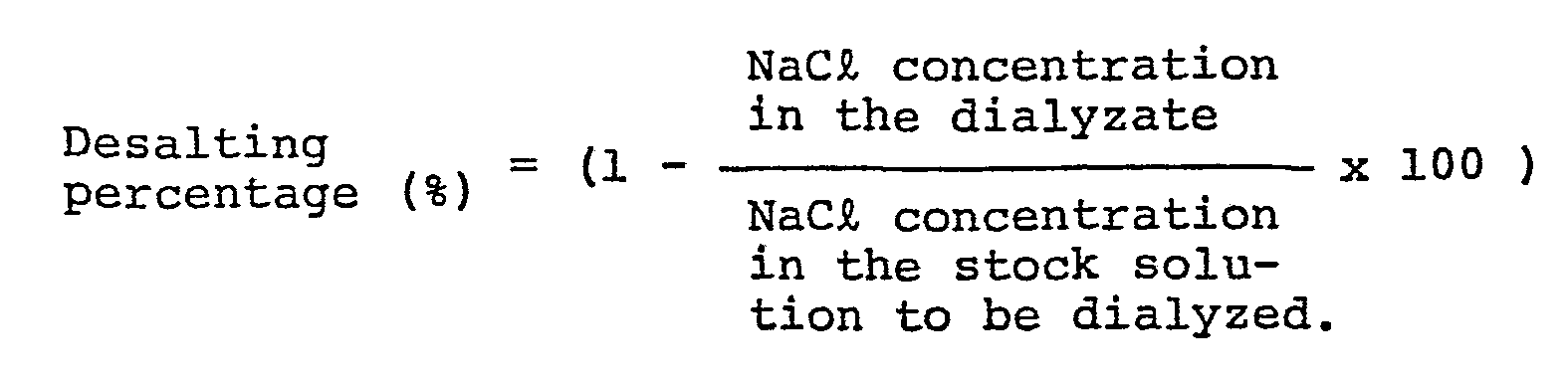
- A piece of Dacron non-woven fabric of a dense texture (unit weight : 180 g/m2) was fixed on a glass plate. A solution containing 12.5 wt % polysulfone, 12.5 wt % methyl cellosolve, and dimethylformamide making up the rest was cast to form a layer of about 0.2 mm thickness on said non-woven fabric and the layer was immediately gelated in a water bath at room temperature to obtain a porous polysulfone membrane reinforced with a non-woven fabric.
- In the electrone microphotograph, the porous polysulfone layer thus formed was about 40 to 70 µm thick, exhibited an asymmetry structure, and showed a large number of micropores about 200 to 700 A on the surface. These porous base materials had a permeability to pure water (membrane constant) in the range of about 3.0 to 7.0 x 10⁻² g/cm2·sec·atm at 2 kg/cm 2 G.
- The porous polysulfone membrane obtained in Reference Example 2 was immersed in an aqueous solution prepared by dissolving 1 g of ethylenediamine (immediately after distillation) in 100 m£ of distilled water for 5 minutes, taken out of the aqueous solution, and drained at room temperature for 7 minutes while being hung vertically.
- After thus drained membrane was immersed in trimesic acid chloride containing 0.5 wt % n-hexane for 20 seconds, the membrane was air-dried at room temperature for 30 minutes.
- When thus obtained composite membrane was subjected to the reverse osmosis test under the conditions described in Reference Example 1, the membrane showed initial performance values, desalting percentage of 98.9% and water permeability of 41.3 I/m2-hr. The membrane was further put to the reverse osmosis test under the same conditions (with the osmosis solution constantly adjusted to pH 6.0 to 6.5 and 4 to 5 ppm hypochlorous acid content during the test), and the desalting percentage and water permeability obtained 200 hours, 500 hours, and 1,000 hours after the test was resumed were 99.1% and 37.5 ℓ/m2·hr, 99.3% and 31.4 ℓ/m2.hr, and 99.3% and 28.6 ℓ/m2·hr respectively. The result showed that the membrane maintained a very stabilized desalting performance though its water permeability decreased slightly.
- After the composite membrane of Example 1 prepared under the abovementioned conditions was immersed in an aqueous solution of 0.1% NaOH for 24 hours, the membrane was washed several times with distilled water and dried under vacuum. The membrane was then immersed in chloroform and the cross-linked active layer polymer, which could be isolated by eluting the polysulfone microporous membrane, was thoroughly washed with chloroform, followed by washing with alcohol and also with water. When the powder polymer obtained by refining and drying said polymer was subjected to the Na atom absorptiometric analysis, Na of 0.53 milliequivalent/g based on the conversion to sodium carboxylate groups (-COONa) was detected. The composition of the abovementioned polymer estimated from the value thus obtained is as follows:

- A composite membrane was prepared according to the same method as Example 1, wherein an aqueous solution obtained by dissolving 2 g of methaphenilenediamine fresh from distillation in 100 mi of distilled water. Thus prepared membrane was subjected to the reverse osmosis chlorine resistance test under the same conditions as Example 1 to give initial performance values, water permeability of 26.5 ℓ/m2·hr and desalting percentage of 98.5%. The reverse osmosis test was again started under the same conditions and 100 hours later, the relation between water permeability and desalting percentage was 27.3 ℓ/m2·hr and 99.7%, the desalting percentage showing an improvement over the initial value. This relations, however, started changing its aspect and 200 hours later the relation was 41.9 ℓ/m2·hr and 99.3%, 500 hours later 56.4 ℓ/m2·hr and 98.2%, and 1,000 hours later 67.3 ℓ/m2·hr and 93.2%, showing the gradual degradation of the membrane.
- Composite membranes were obtained in the same way as Example 1 except the use of amines described in Table 1 in the place of ethylenediamine. These membranes were subjected to the reverse osmosis oxidation resistance test under the same conditions as Example 1. The results are shown in Table 1. Compositions of these composite membrane active layer polymers estimated from the Na analytical values and the values obtained from elemental analyses of C, H, and N are shown in Table 2.


- A composite membrane was obtained according to the same method as Example 1 except for the use of 5-chlorosulfonylisophthalic acid chloride as cross-linking agent in the place of trimesic acid chloride. As the result of Na analysis made according to Example 1, the obtained membrane was identified as the composite membrane comprising a cross-linked polymer layer having a polymer composition expressed by the following formula.

- When this membrane was subjected to the reverse osmosis oxidation resistance test under the same conditions as Example 1, it represented initial values including the water permeability of 56.3 ℓ/m2·hr and desalting percentage of 89.2%. When the test was further continued under the same conditions, the performance values were 43.6 ℓ/m2.hr and 93.3% 200 hours later, 41.0 ℓ/m2·hr and 95.1% 500 hours later, and 37.4 ℓ/m2·hr and 97.7% 1,000 hours later respectively.
- A composite membrane was obtained according to Example 1, wherein a mixture of trimesic acid chloride and isophthalic acid chloride at a mole ratio of 3:1 was used as cross-linking agent instead of the single use of trimesic acid chloride. The active polymer layer of this composite membrane was subjected to Na analysis and elemental analysis (C, H, N) according to Example 1 and the obtained results showed that this polymer was a cross-linked polymer having a polymer composition expressed by the following formula.


- [Na analytical value : 5.74%, C : 54.96%, H : 3.84%, N : 11.95%]
- When this composite membrane was subjected to the reverse osmosis test under the same conditions as Example 1, it represented initial performance values including the water permeability of 54.1 ℓ/m2· hr and desalting percentage of 91.7%, followed by 48.2 ℓ/m2.hr and 93.0% after the continuous 200-hour test, 45.5 ℓ/m2·hr and 95.4% 500 hours after the start of the test, and 39.4 ℓ/m2·hr and 96.3% 1,000 hours after the start of the test respectively.
- Composite membranes were obtained according to Example 1, wherein respective mixtures of a diamine and ethylenediamine at a mole ratio of 1:2 as described in the following Table 3 were used instead of the single use of ethylenediamine. These membranes were subjected to the reverse osmosis test under the same conditions as Example 1 and the following results were obtained as shown in Table 3. The polymer compositions of active polymer layers of these composite membranes are shown in Table 4.
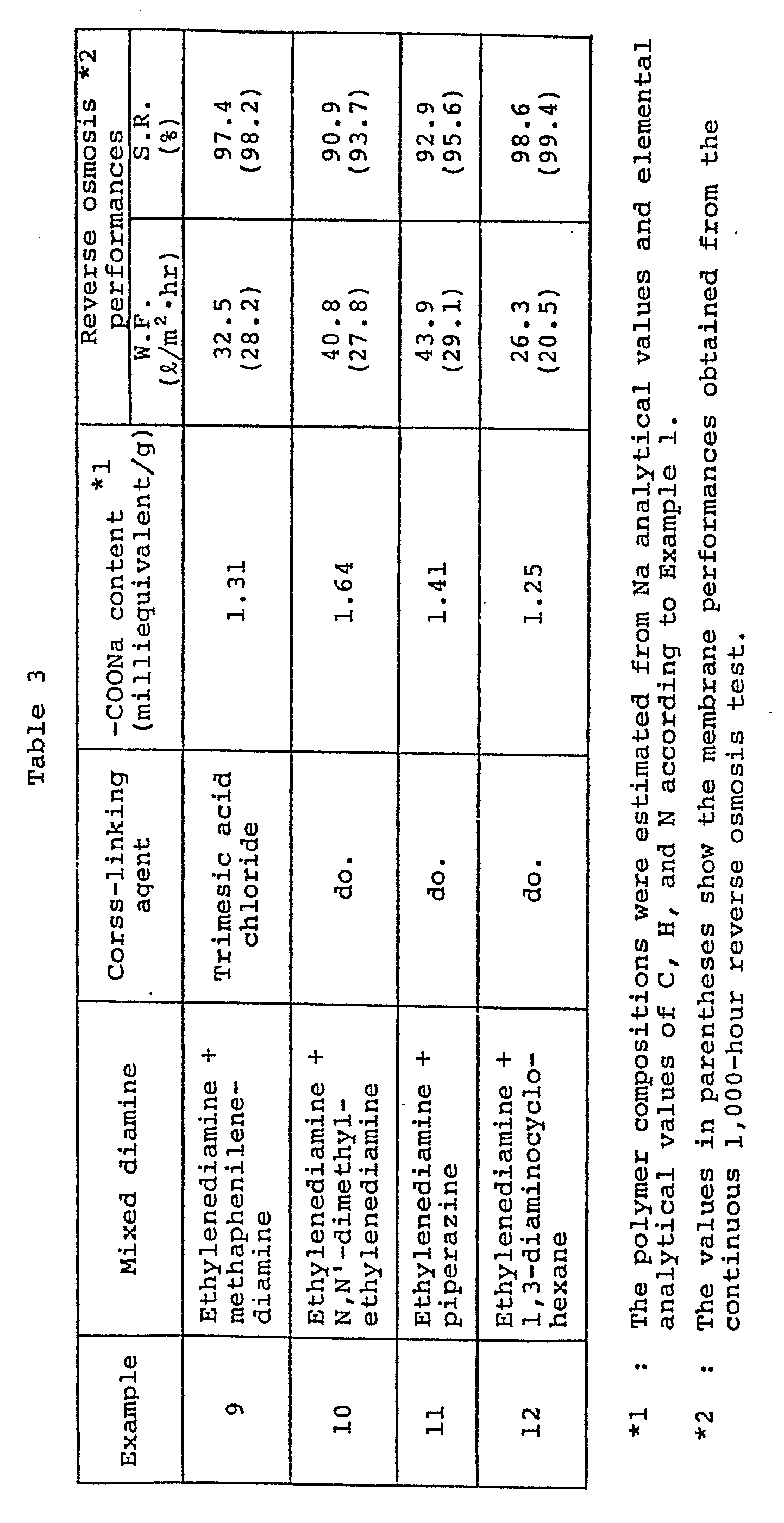


- Composite membranes were obtained according to Example 1, wherein respective aqueous solutions of 1/50 mole diamines described in the following Table 5 in the place of an aqueous solution of ethylenediamine. After the basic separation performance of these membranes were evaluated, the membranes were subjected to the chlorine resistance test and washing test with the use of a reducing agent to know how the membrane performances changed.
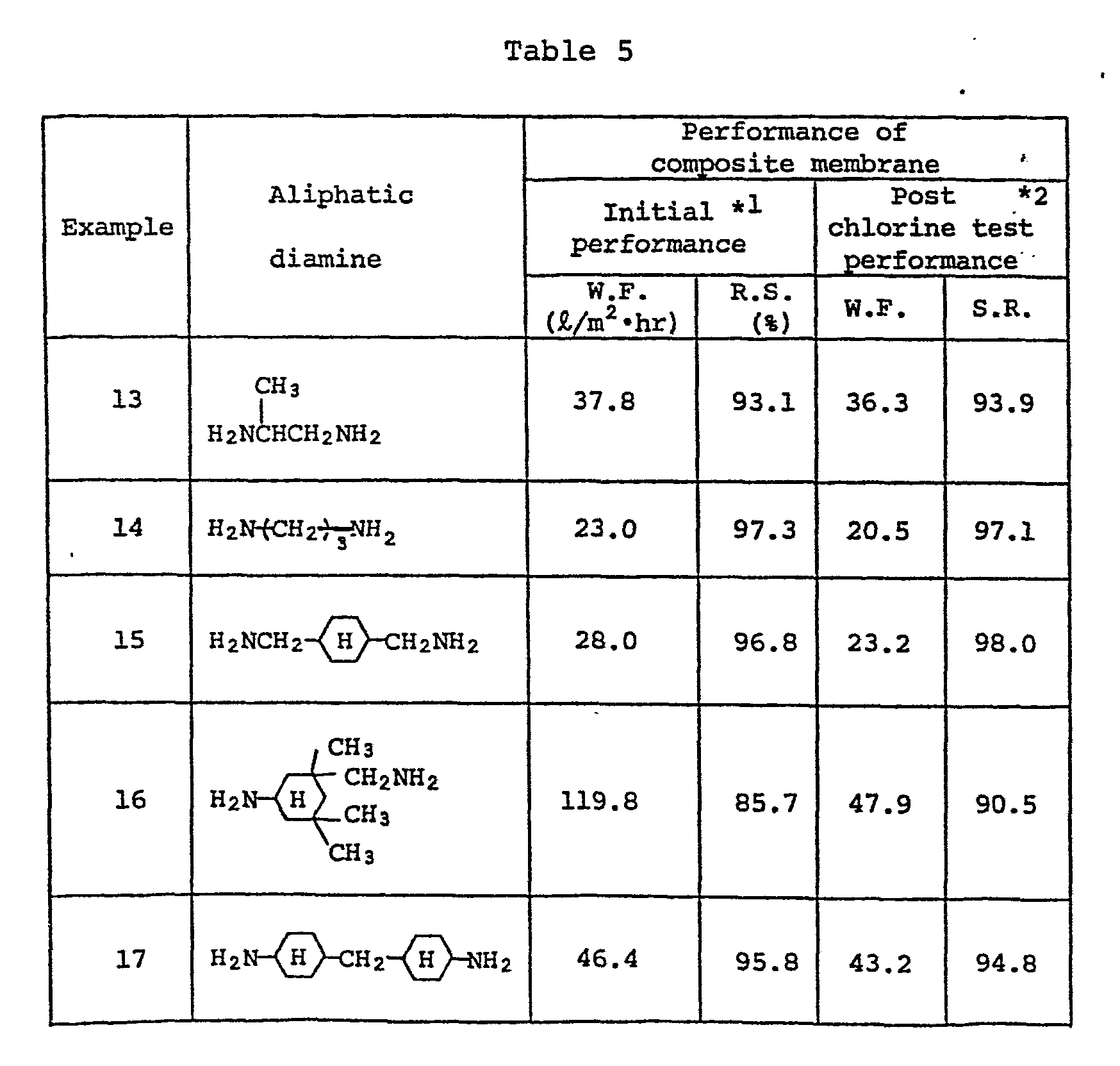
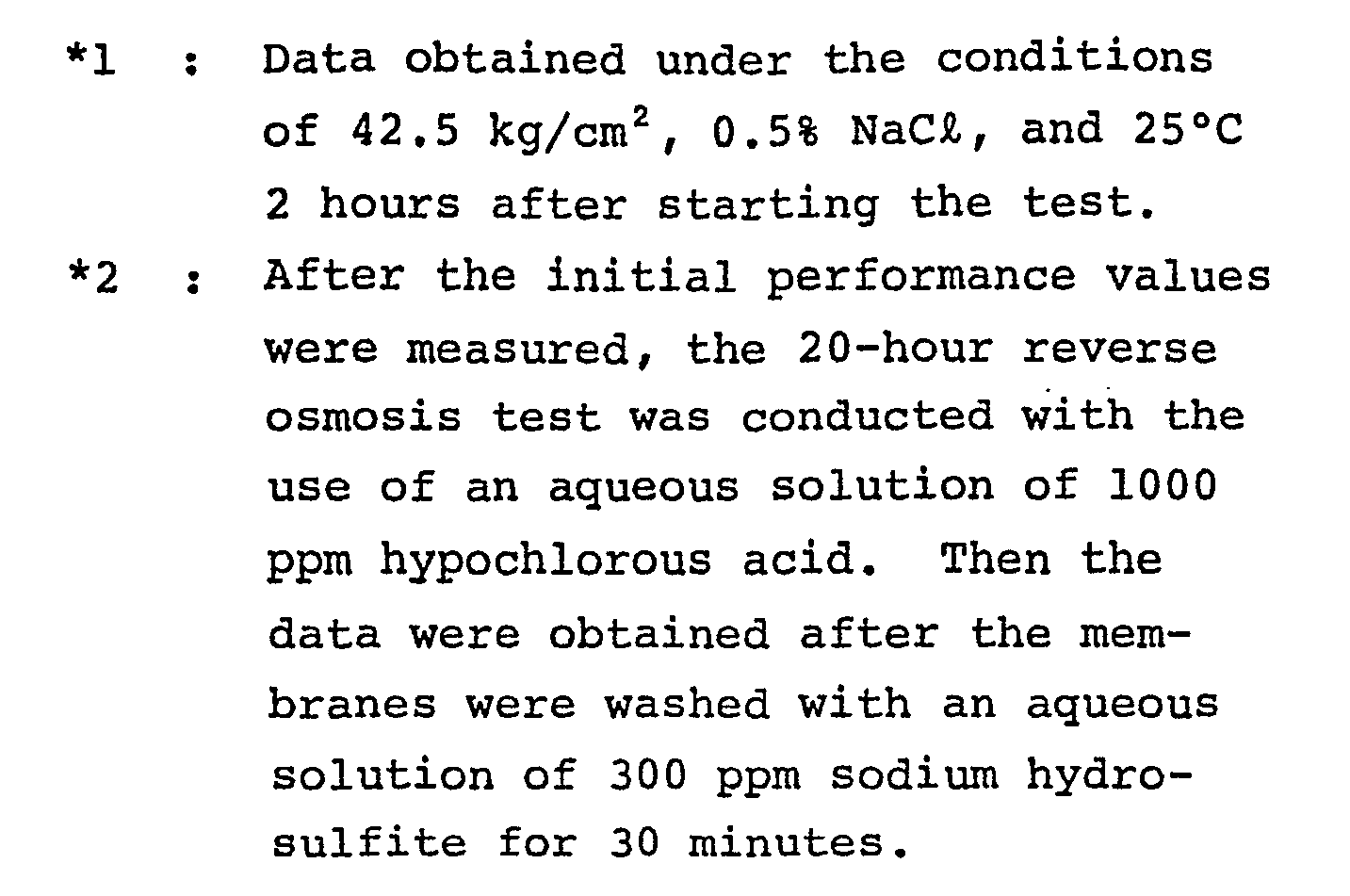
- Composite membranes were obtained according to Example 1, wherein equimolar mixtures (as solutions of 0.2 wt % carbon tetrachloride), one consisting of trimesic acid chloride and isophthalic acid chloride and the other consisting of trimesic acid chloride and 5-sulfoisophthalic acid trichloride, were used as cross-linking agent instead of a single use of trimesic acid chloride. The basic separation performance and chlorine resistivity of these composite membranes were evaluated under the same conditions as Examples 13 ~ 17. The results are shown in Table 6.

- The membrane performance of eliminating water-soluble organic substances mentioned in the following Table 7 was evaluated with the use of the composite membrane of Example 1.
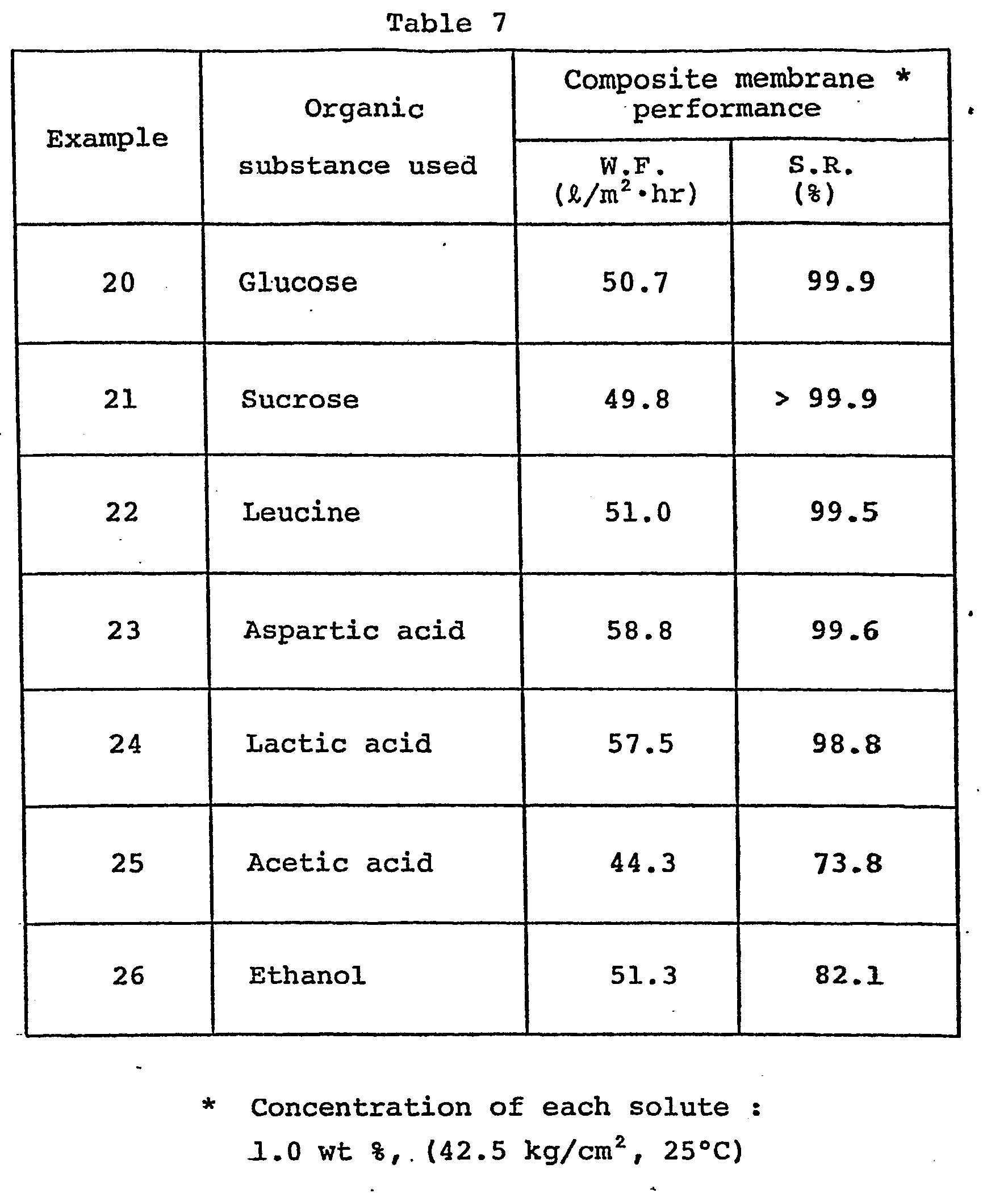
- A protective layer of 0.2 to 0.3µm thick membrane was formed on the surface of composite membranes prepared according to Example 1 by coating the membranes with each of protective polymer solutions respectively having a composition as shown in Table 8. These composite membranes were subjected to the chlorine resistance test under the same conditions as Exaples 13 ~ 17 and the remarkably increase of long-period resistivity due to the presence of the protective layer was observed.

- The composite membranes (in Examples 31 ~ 33) obtained according to Example 1 and the composite membrane (in Comparison Example 2) obtained according to Comparison Example 1 were immersed in the respective solutions of 2% oxidizing agent shown in the following Table 9 at room temperature for 20 hours. The result showing the confirmed changes in the performance of the respective composite membranes is described in Table 9.

- Having an outstanding resistance to oxidization in addition to an excellent selective permeability, the composite semipermeable membrane of the present invention can be used in a wide range of separation works in the fields of fresh water generation, enrichment of valuable substances, fractionation of water soluble organic substances, etc. Especially it can be effectively used for separation works in the field of food processing where microbes are apt to proliferate and yet conventional membranes are hardly used for lack of resistance against strong sterilizers and bactericides.
incicates carboxylate.)
Claims (17)



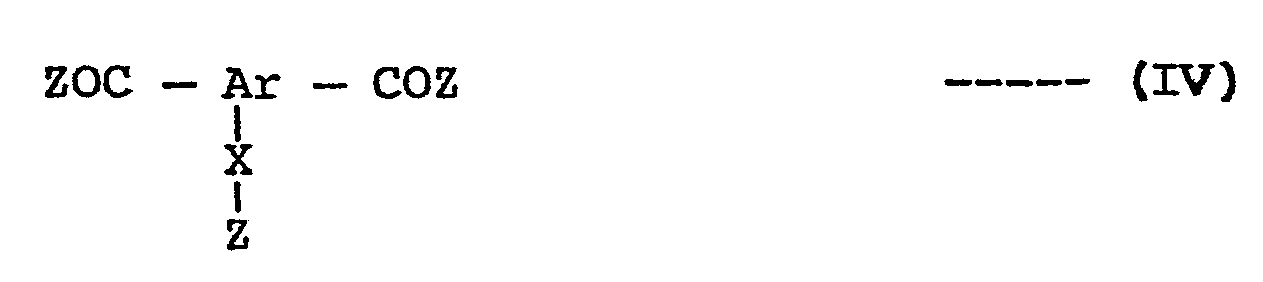


Applications Claiming Priority (2)
| Application Number | Priority Date | Filing Date | Title |
|---|---|---|---|
| JP120675/81 | 1981-08-03 | ||
| JP56120675A JPS5824303A (en) | 1981-08-03 | 1981-08-03 | Oxidation resistant composite semipermeable membrane |
Publications (3)
| Publication Number | Publication Date |
|---|---|
| EP0085111A1 true EP0085111A1 (en) | 1983-08-10 |
| EP0085111A4 EP0085111A4 (en) | 1984-06-29 |
| EP0085111B1 EP0085111B1 (en) | 1987-01-07 |
Family
ID=14792149
Family Applications (1)
| Application Number | Title | Priority Date | Filing Date |
|---|---|---|---|
| EP82902263A Expired EP0085111B1 (en) | 1981-08-03 | 1982-08-02 | Composite semipermeable membrane, process for its production, and method of its use |
Country Status (5)
| Country | Link |
|---|---|
| EP (1) | EP0085111B1 (en) |
| JP (1) | JPS5824303A (en) |
| DE (1) | DE3274951D1 (en) |
| DK (1) | DK147883D0 (en) |
| WO (1) | WO1983000443A1 (en) |
Cited By (23)
| Publication number | Priority date | Publication date | Assignee | Title |
|---|---|---|---|---|
| EP0170233A3 (en) * | 1984-07-30 | 1986-03-26 | E.I. Du Pont De Nemours And Company | Composite membrane |
| EP0217212A3 (en) * | 1985-09-20 | 1987-11-04 | Toray Industries, Inc. | Semipermeable composite membrane and process for preparation thereof |
| US4761234A (en) * | 1985-08-05 | 1988-08-02 | Toray Industries, Inc. | Interfacially synthesized reverse osmosis membrane |
| EP0308153A1 (en) * | 1987-09-15 | 1989-03-22 | Bend Research, Inc. | p-Xylylenediamide/diimide composite ro membranes |
| EP0313354A1 (en) * | 1987-10-23 | 1989-04-26 | Pci Membrane Systems Limited | Reverse osmosis membranes and process for their production |
| EP0365126A1 (en) * | 1988-10-21 | 1990-04-25 | Bend Research, Inc. | Tetrakis-amido high flux membranes |
| EP0350279A3 (en) * | 1988-07-05 | 1990-05-16 | Texaco Development Corporation | Treatment of water |
| EP0316525A3 (en) * | 1987-11-18 | 1990-05-16 | The Dow Chemical Company | Polyamide reverse osmosis membranes |
| EP0432358A1 (en) * | 1989-12-13 | 1991-06-19 | Filmtec Corporation | Treated composite polyamide membranes to separate concentrated solute |
| EP0498596A1 (en) * | 1991-02-04 | 1992-08-12 | E.I. Du Pont De Nemours And Company | Process for the manufacture of thin film composite membranes |
| EP0503596A3 (en) * | 1991-03-12 | 1993-03-10 | Toray Industries, Inc. | Process for producing composite semipermeable membrane |
| ES2050606A1 (en) * | 1992-09-02 | 1994-05-16 | Toray Industries | Procedure for the production of a semipermeable membrane |
| US5593588A (en) * | 1995-07-07 | 1997-01-14 | Korea Institute Of Science And Technology | Composite reverse osmosis membrane having active layer of aromatic polyester or copolymer of aromatic polyester and aromatic polyamide |
| US7806275B2 (en) | 2007-05-09 | 2010-10-05 | The United States Of America As Represented By The Secretary Of The Interior, The Bureau Of Reclamation | Chlorine resistant polyamides and membranes made from the same |
| KR101223634B1 (en) * | 2008-06-27 | 2013-01-18 | 씨.알.에프. 쏘시에타 컨서틸 퍼 아지오니 | Fuel Injector With High Stability Of Operation For An Internal-Combustion Engine |
| US9056284B2 (en) | 2012-08-10 | 2015-06-16 | The United States Of America, As Represented By The Secretary Of The Interior | Chlorine resistant amides, polyamides, and membranes made from the same |
| US10044016B2 (en) | 2015-07-30 | 2018-08-07 | Gs Yuasa International Ltd. | Storage battery |
| EP3616778A4 (en) * | 2017-04-28 | 2021-01-13 | Toray Industries, Inc. | SEMI-PERMEABLE COMPOSITE MEMBRANE AND ITS PRODUCTION PROCESS |
| US10913034B2 (en) | 2018-09-20 | 2021-02-09 | Nitto Denko Corporation | Separation membrane |
| EP3682964A4 (en) * | 2017-09-15 | 2021-06-16 | Nitto Denko Corporation | SEMI-PERMEABLE COMPOSITE MEMBRANE AND ITS MANUFACTURING PROCESS |
| US11219870B2 (en) | 2018-09-20 | 2022-01-11 | Nitto Denko Corporation | Separation membrane |
| US11396460B2 (en) | 2019-03-12 | 2022-07-26 | Nitto Denko Corporation | Sulfate ion removal system and method for removing sulfate ion |
| US12318738B2 (en) | 2019-10-31 | 2025-06-03 | Toray Industries, Inc. | Composite semi-permeable membrane |
Families Citing this family (16)
| Publication number | Priority date | Publication date | Assignee | Title |
|---|---|---|---|---|
| JPS5926101A (en) * | 1982-08-04 | 1984-02-10 | Teijin Ltd | Composite semipermeable membrane, preparation and use thereof |
| JPS59179111A (en) * | 1983-03-31 | 1984-10-11 | Teijin Ltd | Manufacture of durable composite membrane |
| JP2510530B2 (en) * | 1986-09-26 | 1996-06-26 | 東レ株式会社 | Manufacturing method of composite membrane |
| JPH01180208A (en) * | 1988-01-11 | 1989-07-18 | Toray Ind Inc | Production of compound semipermeable membrane |
| WO1991011250A1 (en) * | 1990-01-26 | 1991-08-08 | Toray Industries, Inc. | Composite semipermeable membrane and production thereof |
| EP1382378B9 (en) | 2001-03-19 | 2010-05-26 | Nitto Denko Corporation | Composite semipermeable membrane, method for preparing the same and method for water treatment using the same |
| JP2009006279A (en) | 2007-06-28 | 2009-01-15 | Nitto Denko Corp | Composite semipermeable membrane and method for producing the same |
| JP5701475B2 (en) | 2007-07-12 | 2015-04-15 | 日東電工株式会社 | Composite semipermeable membrane |
| US9504966B2 (en) | 2008-09-26 | 2016-11-29 | Nitto Denko Corporation | Composite semi-permeable membrane and method for producing same |
| JP5377452B2 (en) | 2009-10-16 | 2013-12-25 | 日東電工株式会社 | Manufacturing method of composite semipermeable membrane |
| JP2011101864A (en) | 2009-11-11 | 2011-05-26 | Nitto Denko Corp | Separation membrane unit, and separation membrane element equipped therewith |
| JP5934580B2 (en) | 2011-06-13 | 2016-06-15 | 日東電工株式会社 | Epoxy resin porous membrane, separator for nonaqueous electrolyte electricity storage device, nonaqueous electrolyte electricity storage device, composite semipermeable membrane, and production method thereof |
| CN104335391A (en) | 2012-05-22 | 2015-02-04 | 日东电工株式会社 | Method for producing a separator for a nonaqueous electrolyte power storage device and method for producing epoxy resin porous membrane |
| JP2023143687A (en) | 2022-03-24 | 2023-10-06 | 日東電工株式会社 | Composite semipermeable membrane and spiral membrane element |
| EP4631607A4 (en) | 2022-12-08 | 2026-04-15 | Nitto Denko Corp | SEMIPERMEABLE COMPOSITE MEMBRAN AND SPIRAL MEMBRAN ELEMENT |
| US20240198292A1 (en) | 2022-12-19 | 2024-06-20 | Nitto Denko Corporation | Method for preserving composite semipermeable membrane, preservation solution, and spiral membrane element |
Family Cites Families (10)
| Publication number | Priority date | Publication date | Assignee | Title |
|---|---|---|---|---|
| US3744642A (en) * | 1970-12-30 | 1973-07-10 | Westinghouse Electric Corp | Interface condensation desalination membranes |
| JPS5543367B2 (en) * | 1975-01-08 | 1980-11-06 | ||
| JPS52120978A (en) * | 1976-04-06 | 1977-10-11 | Asahi Chem Ind Co Ltd | Washing method of semipermeable membrane |
| JPS52152879A (en) * | 1976-06-16 | 1977-12-19 | Toray Ind Inc | Thin membrane for reverse osmosis of high capacity |
| US4259183A (en) * | 1978-11-07 | 1981-03-31 | Midwest Research Institute | Reverse osmosis membrane |
| JPS55134602A (en) * | 1979-04-10 | 1980-10-20 | Nippon Shokubai Kagaku Kogyo Co Ltd | Semipermeable composite membrane with high performance and perparation thereof |
| JPS5615804A (en) * | 1979-07-20 | 1981-02-16 | Toray Ind Inc | Semipermeable composite membrane having stable selective separation capacity |
| GB2064367B (en) * | 1979-12-04 | 1984-02-29 | Toray Industries | Semi-permeable composite membrane |
| JPS5727101A (en) * | 1980-07-28 | 1982-02-13 | Nitto Electric Ind Co Ltd | Composite semipermeable membrane and its production |
| JPS5794307A (en) * | 1980-12-03 | 1982-06-11 | Nitto Electric Ind Co Ltd | Treatment of dry composite semipermeable membrane |
-
1981
- 1981-08-03 JP JP56120675A patent/JPS5824303A/en active Pending
-
1982
- 1982-08-02 EP EP82902263A patent/EP0085111B1/en not_active Expired
- 1982-08-02 WO PCT/JP1982/000300 patent/WO1983000443A1/en not_active Ceased
- 1982-08-02 DE DE8282902263T patent/DE3274951D1/en not_active Expired
-
1983
- 1983-03-30 DK DK1478/83A patent/DK147883D0/en not_active IP Right Cessation
Cited By (29)
| Publication number | Priority date | Publication date | Assignee | Title |
|---|---|---|---|---|
| EP0170233A3 (en) * | 1984-07-30 | 1986-03-26 | E.I. Du Pont De Nemours And Company | Composite membrane |
| US4761234A (en) * | 1985-08-05 | 1988-08-02 | Toray Industries, Inc. | Interfacially synthesized reverse osmosis membrane |
| EP0217212A3 (en) * | 1985-09-20 | 1987-11-04 | Toray Industries, Inc. | Semipermeable composite membrane and process for preparation thereof |
| US4758343A (en) * | 1985-09-20 | 1988-07-19 | Toray Industries, Inc. | Interfacially synthesized reverse osmosis membrane |
| US4857363A (en) * | 1985-09-20 | 1989-08-15 | Toray Industries, Inc. | Process for preparation of semipermeable composite membrane |
| EP0308153A1 (en) * | 1987-09-15 | 1989-03-22 | Bend Research, Inc. | p-Xylylenediamide/diimide composite ro membranes |
| GB2211505A (en) * | 1987-10-23 | 1989-07-05 | Pci Membrane Systems Ltd | Reverse osmosis membranes and process for their production |
| EP0313354A1 (en) * | 1987-10-23 | 1989-04-26 | Pci Membrane Systems Limited | Reverse osmosis membranes and process for their production |
| GB2211505B (en) * | 1987-10-23 | 1991-01-30 | Pci Membrane Systems Ltd | Reverse osmosis membranes and process for their production |
| EP0316525A3 (en) * | 1987-11-18 | 1990-05-16 | The Dow Chemical Company | Polyamide reverse osmosis membranes |
| EP0350279A3 (en) * | 1988-07-05 | 1990-05-16 | Texaco Development Corporation | Treatment of water |
| EP0365126A1 (en) * | 1988-10-21 | 1990-04-25 | Bend Research, Inc. | Tetrakis-amido high flux membranes |
| EP0432358A1 (en) * | 1989-12-13 | 1991-06-19 | Filmtec Corporation | Treated composite polyamide membranes to separate concentrated solute |
| EP0498596A1 (en) * | 1991-02-04 | 1992-08-12 | E.I. Du Pont De Nemours And Company | Process for the manufacture of thin film composite membranes |
| EP0503596A3 (en) * | 1991-03-12 | 1993-03-10 | Toray Industries, Inc. | Process for producing composite semipermeable membrane |
| US5324538A (en) * | 1991-03-12 | 1994-06-28 | Toray Industries, Inc. | Process for producing composite semipermeable membrane employing a polyfunctional amine solution and high flash point - solvent |
| ES2050606A1 (en) * | 1992-09-02 | 1994-05-16 | Toray Industries | Procedure for the production of a semipermeable membrane |
| US5593588A (en) * | 1995-07-07 | 1997-01-14 | Korea Institute Of Science And Technology | Composite reverse osmosis membrane having active layer of aromatic polyester or copolymer of aromatic polyester and aromatic polyamide |
| US7806275B2 (en) | 2007-05-09 | 2010-10-05 | The United States Of America As Represented By The Secretary Of The Interior, The Bureau Of Reclamation | Chlorine resistant polyamides and membranes made from the same |
| KR101223634B1 (en) * | 2008-06-27 | 2013-01-18 | 씨.알.에프. 쏘시에타 컨서틸 퍼 아지오니 | Fuel Injector With High Stability Of Operation For An Internal-Combustion Engine |
| US9056284B2 (en) | 2012-08-10 | 2015-06-16 | The United States Of America, As Represented By The Secretary Of The Interior | Chlorine resistant amides, polyamides, and membranes made from the same |
| US10044016B2 (en) | 2015-07-30 | 2018-08-07 | Gs Yuasa International Ltd. | Storage battery |
| EP3616778A4 (en) * | 2017-04-28 | 2021-01-13 | Toray Industries, Inc. | SEMI-PERMEABLE COMPOSITE MEMBRANE AND ITS PRODUCTION PROCESS |
| EP3682964A4 (en) * | 2017-09-15 | 2021-06-16 | Nitto Denko Corporation | SEMI-PERMEABLE COMPOSITE MEMBRANE AND ITS MANUFACTURING PROCESS |
| US10913034B2 (en) | 2018-09-20 | 2021-02-09 | Nitto Denko Corporation | Separation membrane |
| US11219870B2 (en) | 2018-09-20 | 2022-01-11 | Nitto Denko Corporation | Separation membrane |
| US12239942B2 (en) | 2018-09-20 | 2025-03-04 | Nitto Denko Corporation | Separation membrane |
| US11396460B2 (en) | 2019-03-12 | 2022-07-26 | Nitto Denko Corporation | Sulfate ion removal system and method for removing sulfate ion |
| US12318738B2 (en) | 2019-10-31 | 2025-06-03 | Toray Industries, Inc. | Composite semi-permeable membrane |
Also Published As
| Publication number | Publication date |
|---|---|
| DK147883A (en) | 1983-03-30 |
| DE3274951D1 (en) | 1987-02-12 |
| EP0085111A4 (en) | 1984-06-29 |
| DK147883D0 (en) | 1983-03-30 |
| EP0085111B1 (en) | 1987-01-07 |
| WO1983000443A1 (en) | 1983-02-17 |
| JPS5824303A (en) | 1983-02-14 |
Similar Documents
| Publication | Publication Date | Title |
|---|---|---|
| EP0085111B1 (en) | Composite semipermeable membrane, process for its production, and method of its use | |
| US4737325A (en) | Composite semipermeable membrane and process for preparation thereof | |
| US4606943A (en) | Method for preparation of semipermeable composite membrane | |
| US4259183A (en) | Reverse osmosis membrane | |
| EP0316525B1 (en) | Polyamide reverse osmosis membranes | |
| CA1068996A (en) | Semipermeable membranes and the method for the preparation thereof | |
| KR100460168B1 (en) | Flow increase method of composite membrane with polyamide identification layer | |
| US5658460A (en) | Use of inorganic ammonium cation salts to maintain the flux and salt rejection characteristics of reverse osmosis and nanofiltration membranes during drying | |
| EP0357781B1 (en) | Process for producing composite semipermeable membrane | |
| US4913816A (en) | Chlorine tolerant composite semipermeable membrane | |
| EP1707255B1 (en) | Composite polyamide reverse osmosis membrane and method of producing the same | |
| US5922203A (en) | Amine monomers and their use in preparing interfacially synthesized membranes for reverse osmosis and nanofiltration | |
| US4927540A (en) | Ionic complex for enhancing performance of water treatment membranes | |
| JPH0374128B2 (en) | ||
| US4802984A (en) | Composite semipermeable membrane | |
| KR100211338B1 (en) | Manufacturing method of crosslinked polyamide reverse osmosis membrane | |
| KR101230843B1 (en) | Fouling resistance polyamide reverse osmosis membrane and manufacturing method thereof | |
| JP3284115B2 (en) | Method for producing polyamide reverse osmosis composite membrane | |
| EP0465649B1 (en) | Composite semipermeable membrane and production thereof | |
| KR100460011B1 (en) | Post Treatment Process of Polyamide Reverse Osmosis Membrane | |
| EP0227043A2 (en) | Composite semipermeable membrane and process for producing the same | |
| JPH0253089B2 (en) | ||
| JPH0239299B2 (en) | ||
| GB2139113A (en) | Reverse osmosis membrane and method for the preparation thereof | |
| JP2797377B2 (en) | Composite semipermeable membrane and method for producing the same |
Legal Events
| Date | Code | Title | Description |
|---|---|---|---|
| PUAI | Public reference made under article 153(3) epc to a published international application that has entered the european phase |
Free format text: ORIGINAL CODE: 0009012 |
|
| 17P | Request for examination filed |
Effective date: 19830331 |
|
| AK | Designated contracting states |
Designated state(s): DE FR GB NL SE |
|
| GRAA | (expected) grant |
Free format text: ORIGINAL CODE: 0009210 |
|
| AK | Designated contracting states |
Kind code of ref document: B1 Designated state(s): DE FR GB NL SE |
|
| REF | Corresponds to: |
Ref document number: 3274951 Country of ref document: DE Date of ref document: 19870212 |
|
| ET | Fr: translation filed | ||
| PGFP | Annual fee paid to national office [announced via postgrant information from national office to epo] |
Ref country code: NL Payment date: 19870831 Year of fee payment: 6 |
|
| PLBE | No opposition filed within time limit |
Free format text: ORIGINAL CODE: 0009261 |
|
| STAA | Information on the status of an ep patent application or granted ep patent |
Free format text: STATUS: NO OPPOSITION FILED WITHIN TIME LIMIT |
|
| 26N | No opposition filed | ||
| PG25 | Lapsed in a contracting state [announced via postgrant information from national office to epo] |
Ref country code: GB Free format text: LAPSE BECAUSE OF NON-PAYMENT OF DUE FEES Effective date: 19880802 |
|
| PG25 | Lapsed in a contracting state [announced via postgrant information from national office to epo] |
Ref country code: SE Effective date: 19880803 |
|
| PG25 | Lapsed in a contracting state [announced via postgrant information from national office to epo] |
Ref country code: NL Effective date: 19890301 |
|
| NLV4 | Nl: lapsed or anulled due to non-payment of the annual fee | ||
| GBPC | Gb: european patent ceased through non-payment of renewal fee | ||
| PGFP | Annual fee paid to national office [announced via postgrant information from national office to epo] |
Ref country code: FR Payment date: 19910620 Year of fee payment: 10 |
|
| PGFP | Annual fee paid to national office [announced via postgrant information from national office to epo] |
Ref country code: DE Payment date: 19910930 Year of fee payment: 10 |
|
| PG25 | Lapsed in a contracting state [announced via postgrant information from national office to epo] |
Ref country code: FR Effective date: 19930430 |
|
| PG25 | Lapsed in a contracting state [announced via postgrant information from national office to epo] |
Ref country code: DE Effective date: 19930501 |
|
| REG | Reference to a national code |
Ref country code: FR Ref legal event code: ST |
|
| EUG | Se: european patent has lapsed |
Ref document number: 82902263.1 Effective date: 19890510 |