EP0080554A2 - Verfahren zur Herstellung von 5(6)-Thiocyan-benzimidazol-Derivaten - Google Patents
Verfahren zur Herstellung von 5(6)-Thiocyan-benzimidazol-Derivaten Download PDFInfo
- Publication number
- EP0080554A2 EP0080554A2 EP82106803A EP82106803A EP0080554A2 EP 0080554 A2 EP0080554 A2 EP 0080554A2 EP 82106803 A EP82106803 A EP 82106803A EP 82106803 A EP82106803 A EP 82106803A EP 0080554 A2 EP0080554 A2 EP 0080554A2
- Authority
- EP
- European Patent Office
- Prior art keywords
- general formula
- thiocyano
- reduction
- oder
- iron
- Prior art date
- Legal status (The legal status is an assumption and is not a legal conclusion. Google has not performed a legal analysis and makes no representation as to the accuracy of the status listed.)
- Granted
Links
- XDTMQSROBMDMFD-UHFFFAOYSA-N C1CCCCC1 Chemical compound C1CCCCC1 XDTMQSROBMDMFD-UHFFFAOYSA-N 0.000 description 1
Classifications
-
- C—CHEMISTRY; METALLURGY
- C07—ORGANIC CHEMISTRY
- C07D—HETEROCYCLIC COMPOUNDS
- C07D235/00—Heterocyclic compounds containing 1,3-diazole or hydrogenated 1,3-diazole rings, condensed with other rings
- C07D235/02—Heterocyclic compounds containing 1,3-diazole or hydrogenated 1,3-diazole rings, condensed with other rings condensed with carbocyclic rings or ring systems
- C07D235/04—Benzimidazoles; Hydrogenated benzimidazoles
- C07D235/24—Benzimidazoles; Hydrogenated benzimidazoles with hetero atoms or with carbon atoms having three bonds to hetero atoms with at the most one bond to halogen, e.g. ester or nitrile radicals, directly attached in position 2
- C07D235/30—Nitrogen atoms not forming part of a nitro radical
-
- C—CHEMISTRY; METALLURGY
- C07—ORGANIC CHEMISTRY
- C07D—HETEROCYCLIC COMPOUNDS
- C07D235/00—Heterocyclic compounds containing 1,3-diazole or hydrogenated 1,3-diazole rings, condensed with other rings
- C07D235/02—Heterocyclic compounds containing 1,3-diazole or hydrogenated 1,3-diazole rings, condensed with other rings condensed with carbocyclic rings or ring systems
- C07D235/04—Benzimidazoles; Hydrogenated benzimidazoles
- C07D235/24—Benzimidazoles; Hydrogenated benzimidazoles with hetero atoms or with carbon atoms having three bonds to hetero atoms with at the most one bond to halogen, e.g. ester or nitrile radicals, directly attached in position 2
- C07D235/30—Nitrogen atoms not forming part of a nitro radical
- C07D235/32—Benzimidazole-2-carbamic acids, unsubstituted or substituted; Esters thereof; Thio-analogues thereof
Definitions
- the reduction of the compounds of the general formula II with iron is advantageously carried out in an aqueous-organic, heterogeneous solvent system at neutral or weakly acidic pH.
- the cyclization with a cyanamide of the general formula IV is advantageously carried out in an aqueous or aqueous-organic solvent medium in the presence of an inorganic acid and that with a cyanogen halide of the general formula V in an organic solvent.
- the thiocyanine group undergoes neither a reductive nor a hydrolytic conversion during the reduction of the nitro group according to the invention, which makes the use of reagents which are difficult to access and the use of very low temperatures superfluous. It has also been found that the thiocyanine group does not decompose in a relatively strongly acidic medium even when heated, so that the use of the difficult to access 1,3-bis (alkoxycarbonyl) -S-methyl-isothioureas can be avoided in the formation of the benzimidazole ring .
- the reduction - based on the nitro group - is carried out with 2.25 to 3.5 g-atom of iron, which is preferably used in finely divided form.
- the procedure is such that the iron is an activating pretreatment with 0.005 to 0.2 mol of acid or salt, preferably as between room temperature and 100 ° C, in particular between 90 and 95 ° C, subjects.
- Sulfuric acid and hydrochloric acid are preferred as the acid and ammonium chloride
- iron (II) sulfate, iron (III) chloride, ammonium sulfate or calcium chloride are preferred as the salt.
- water-miscible organic solvents such as acetone, dioxane, lower alcohols or water alone, preferably methyl or ethyl alcohol
- the reduction is carried out at temperatures between 20 and 100 ° C, preferably at the boiling point of the solvent used.
- it can take a few minutes or 1 to 2 hours.
- the amount of acid or salt and the reaction conditions are expediently chosen so that the reduction time is 0.25 to 1 hour.
- the cyclization of the thiocyano-o-phenylenediamines of the general formula III with cyanamides of the general formula IV is preferably carried out in an aqueous acidic medium at a pH between 2 and 6, preferably between 3 and 4.
- aqueous acid is preferably added to the solution to maintain the pH of the solution in the desired acidic range.
- the reaction is expediently carried out at temperatures between 25 and 100 ° C., preferably between 70 and 100 ° C.
- Organic or inorganic acids preferably hydrochloric acid or sulfuric acid, can be used as the acid.
- the reaction is expediently carried out in such a way that a thiocyano-o-phenylenediamine of the general formula III is dissolved in an aqueous acid, preferably 5N hydrochloric acid, with heating, and the solution obtained with an aqueous solution of the calcium salt of a compound of the general formula IV transferred.
- an aqueous acid preferably 5N hydrochloric acid
- the calcium salt of the carbalkoxycyanamide of the general formula IV is not isolated beforehand, but instead the calcium salt of the carbalkoxycyanamide formed in situ in the aqueous medium by reacting technical calcium cyanamide with an alkyl chloroformate is used for the ring closure.
- the thiocyano-o-phenylenediamine of the general formula III is reacted with a cyanamide of the general formula IV in a solution of water using an organic solvent (preferably ethanol).
- the reaction of the thiocyano-o-phenylenediamines of the general formula III with cyanogen halides is advantageously carried out in a suitable organic solvent, advantageously in a lower alcohol, e.g. Methanol, ethanol, propanol or isopropanol, preferably ethanol, at a temperature of 0 to 40 ° C.
- a suitable organic solvent advantageously in a lower alcohol, e.g. Methanol, ethanol, propanol or isopropanol, preferably ethanol, at a temperature of 0 to 40 ° C.
- the reaction mixture is mixed with an alkali hydroxide, advantageously sodium hydroxide or potassium hydroxide, or an alkali carbonate, e.g. Sodium or potassium carbonate, treated to give 5 (6) thiocyano-benzimidazole derivatives of the general formula I.
- the 5 (6) -thiocyano-benzimidazole derivatives of the general formula I can be obtained in the pure state in the cyclization of pure thiocyano-o-phenylenediamine so that they can be obtained without further ado Cleaning to the Anthelmintica specified above can be processed further.
Landscapes
- Chemical & Material Sciences (AREA)
- Organic Chemistry (AREA)
- Pharmaceuticals Containing Other Organic And Inorganic Compounds (AREA)
- Organic Low-Molecular-Weight Compounds And Preparation Thereof (AREA)
- Plural Heterocyclic Compounds (AREA)
Abstract
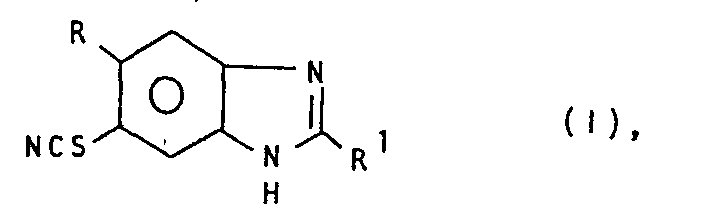
- (R = H, Halogen, C1-4 -Alkyl, C1-3-Alkoxy oder Trifluormethyl,
- R1 = Amino oder C1-4-Alkoxycarbonylamino) sowie deren Salzen, durch Reduktion von 2-Nitro-4-thiocyan-5R-anilin mit Eisen zur entsprechenden Diaminoverbindung, die entweder durch Umsetzung mit einem gegebenenfalls durch C1-4-Alkoxycarbonyl substituierten Cyanamid oder einem Halogencyan zu 1 cyclisiert wird.
Description
- Die Erfindung betrifft ein Verfahren zur Herstellung von 5(6)-Thiocyano-benzimidazol-Derivaten der allgemeinen Formel I
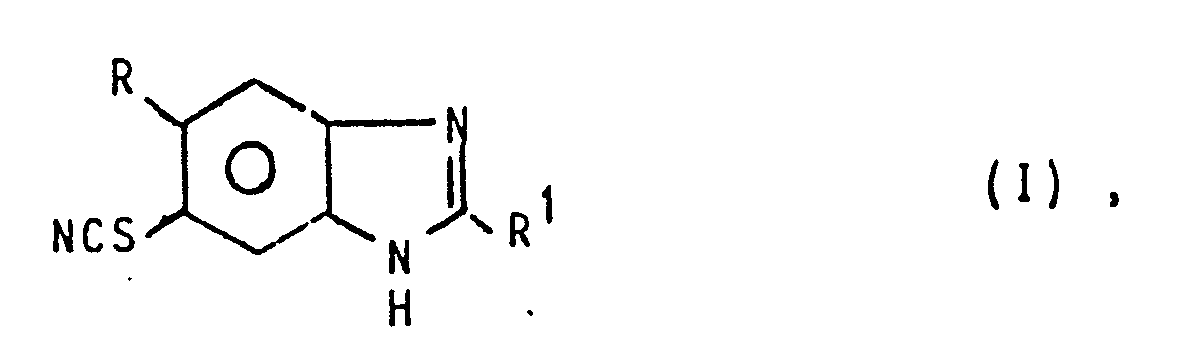
- R Wasserstoff, Halogen, C1-4-Alkyl, C1-3-Alkoxy oder Trifluormethyl,
- R1 Amino oder C1-4-Alkoxycarbonylamino bedeuten, sowie deren Salzen.
- Die 5(6)-Thiocyano-ber:zimidazol-Derivate der allgemeinen Formel I stellen Zwischenprodukte für die Herstellung der als Anthelmintica bekannten Benzimidazolderivate der allgemeinen Formel

- R und R1 die oben angegebene Bedeutung haben und
- R ein ionisch gebundenes Metallatom, ein ionisch oder kovalent gebundenes Wasserstoffatom, C1-6-Alkyl, Alkenyl oder Alkinyl mit jeweils bis zu 6 C-Atomen, oder Cyclohexyl, Benzyl oder 2-Phenyläthyl bedeutet,
- R und R1 die oben angegebene Bedeutung haben und
- R2' ein ionisch gebundenes Metallatom, ein ionisch oder kovalent gebundenes Wasserstoffatom bedeutet,
- R2" C1-6-Alkyl, Alkenyl oder Alkinyl mit jeweils bis zu 6 C-Atomen, Cyclohexyl, Benzyl oder 2-Phenyläthyl und
- Q Hydroxy, Halogen, 1/2 SO4, 1/2 PO3, 1/3 P04, SO3C6H5 oder SO3C6H4CH3 bedeuten,
- Aus der US-PS 4 080 461 ist es bereits bekannt, zur Herstellung von 5(6)-Thiocyano-benzimidazol-Derivaten der Formel I in 1. Verfahrensstufe 1-Amino-2-nitro-4-thiocyano-benzol in konzentrierter Salzsäure bei -40°C mit überschüssigem Zinn(II)chlorid zum 1,2-Diamino-4-thiocyano-benzol zu reduzieren, das dann - nach Extraktion mit Chloroform und Isolierung
in 2. Verfahrensstufe durch Umsetzung mit 1,3-bis-(Alkoxycarbonyl)-S-methyl-isothioharnstoff in einem wäßrigen, essigsauren Medium unter Mercaptanentwicklung in das 5(6)-Thiocyano-benzimidazol-Derivat übergeführt wird (vgl. US-PS 4 080 461, Beispiel 1). - Die Anwendung der ungewöhnlich tiefen Reaktionstemperatur von -40°C in der Reduktionsstufe 1 sowie die Wahl des Cyclisierungsmittels trotz der damit verbundenen Umweltbelastung durch die Mercaptanentwicklung in der Cyclisierungsstufe 2 war trotz der damit verbundenen verfahrenstechnischen Schwierigkeiten für notwendig gehalten worden, weil aus der Literatur bekannt war, daß die Thiocyangruppe sehr reaktionsfähig ist, zu verschiedenen Umwandlungen neigt und im basischen wie sauren Medium zur Bildung von Disulfiden und/oder Thiolverbindungen neben anderen Produkten führt. (Houben-Weil, Methoden der organischen Chemie, Bd. IX, S. 16/17, 866, Thieme Verl. Stuttgart (1955); Chem.Rev. 49, 77 (1951)).
- Da es weiterhin bekannt war, daß die Thiocyangruppe auch auf Reduktions- und Hydrolysebedingungen sehr empfindlich reagiert (R.G.Guy, The Chemistry of Cyanates and their Thioderivates, Teil 2, S. 871 (1974)) war nicht zu erwarten, daß sich die Nitrcgruppe des 1-Amino-2-nitro-4-thiocyano-benzols bei Anwendung üblicher Reduktionsbedingungen zur Aminogruppe reduzieren lassen würde, ohne daß auch die Thiocyangruppe unter Bildung unerwünschter Thiol- und/oder Disulfidnebenprodukte in Reaktion treten würde. Die katalytische Hydrierung in einem neutralen Medium schied allein schon deshalb aus, weil die Thiocyangruppe ein starkes Katalysatorgift ist.
- Es wurde überraschender Weise gefunden, daß sich die 5(6)-Thiocyano-benzimidazol-Derivate der allgemeinen Formel I in sehr einfacher und auch in industriellem Maßstab durchführbaren Weise in guter Ausbeute herstellen lassen, wenn man eine Verbindung der allgemeinen Formel 11

- R die oben angegebene Bedeutung hat,
mit Eisen zur Verbindung der allgemeinen Formel III
- R die oben angegebene Bedeutung hat,
selektiv reduziert, die entweder mit einem Cyanamid der allgemeinen Formel IV
R 3 Wasserstoff oder Cl-4-Alkoxycarbonyl bedeutet, oder mit einem Halogencyan der allgemeinen Formel V
- worin
Hlg Chlor oder Brom bedeutet,
umgesetzt wird. - Die Reduktion der Verbindungen der allgeneinen Formel II mit Eisen wird zweckmäßig in einem wäßrigen-organischen, heterogenen Lösungsmittelsystem bei neutralem oder schwach saurem pH durchgeführt.
- Die Cyclisierung mit einem Cyanamid der allgemeinen Formel IV wird zweckmäßig in einem wäßrigen oder wäßrig-organischen Lösungsmittelmedium in Gegenwart einer anorganischen Säure durchgeführt und die mit einem Halogencyan der allgemeinen Formel V in einem organischen Lösungsmittel.
- Es stellt sich überraschender Weise heraus, daß die Thiocyangruppe bei der Reduktion der Nitrogruppe gemäß Erfindung weder eine reduktive noch eine hydrolytische.Umwandlung erleidet, was den Einsatz schwer zugänglicher Reagentien und die Anwendung sehr niedriger Temperaturen überflüssig macht. Es wurde weiterhin gefunden, daß sich die Thiocyangruppe in verhältnismäßig stark saurem Medium auch unter Erwärmen nicht zersetzt, so daß man bei der Ausbildung des Benzimidazolringes die Verwendung der schwer zugänglichen 1,3-bis-(Alkoxycarbonyl)-S-methyl-isothioharnstoffe umgehen kann.
- Nach einer vorteilhaften Ausführungsform des Verfahrens wird die Reduktion - auf die Nitrogruppe bezogen - mit 2,25 bis 3,5 g-Atom Eisen durchgeführt, das vorzugsweise in feinteiliger Form verwendet wird. Zweckmäßig wird so verfahren, daß man das Eisen einer aktivierenden Vorbehandlung mit 0,005 bis 0,2 Mol Säure oder Salz, vorzugsweise zwischen Raumtemperatur und 100°C, insbesondere zwischen 90 und 95°C, unterwirft. Als Säure werden Schwefelsäure und Salzsäure und als Salz Ammoniumchlorid, Eisen(II)sulfat, Eisen(III)chlorid, Ammoniumsulfat oder Calciumchlorid bevorzugt. Bei der Reduktion können als Reaktionsmedium - je nach Löslichkeit der Ausgangsstoffe - mit Wasser mischbare, organische Lösungsmittel, wie Aceton, Dioxan, niedrige Alkohole oder Wasser allein, vorzugsweise Methyl- oder Äthylalkohol, verwendet werden. Die Reduktion wird bei Temperaturen zwischen 20 und 100°C, vorzugsweise beim Siedepunkt des verwendeten Lösungsmittels, vorgenommen. Sie kann je nach den Ausgangsverbindungen und Reaktionsbedingungen einige Minuten aber auch 1 bis 2 Stunden in Anspruch nehmen. Zweckmäßig werden die Menge der Säure oder des Salzes und die Reaktionsbedingungen so gewählt, daß die Reduktionsdauer 0,25 bis 1 Stunde beträgt.
- Die Cyclisierung der Thiocyano-o-phenylendiamine der allgemeinen Formel III mit Cyanamiden der allgemeinen Formel IV wird vorzugsweise in einem wäßrig sauren Medium bei einem pH-Wert zwischen 2 und 6, vorzugsweise zwischen 3 und 4, vorgenommen. Während des Ringschlusses wird der Lösung vorzugsweise wäßrige Säure zugegeben, um den pH-Wert der Lösung in dem gewünschten sauren Bereich zu halten. Die Reaktion wird zweckmäßig bei Temperaturen zwischen 25 und 100°C, vorzugsweise zwischen 70 und 100°C, durchgeführt. Als Säure können organische oder anorganische Säuren, vorzugsweise Salzsäure oder Schwefelsäure, verwendet werden.
- Die Reaktion wird zweckmäßig in der Weise durchgeführt, daß man ein Thiocyano-o-phenylendiamin der allgemeinen Formel III in einer wäßrigen Säure, vorzugsweise 5 n Salzsäure, unter Erwärmen löst und die erhaltene Lösung mit einer wäßrigen Lösung des Calciumsalzes einer Verbindung der allgemeinen Formel IV versetzt. Man kann aber auch so verfahren, daß man das Calciumsalz des Carbalkoxycyanamids der allgemeinen Formel IV nicht vorher isoliert, sondern für den Ringschluß das in dem wäßrigen Medium durch Umsetzung von technischem Calciumcyanamid mit einem Chlorameisensäurealkylester in situ gebildete Calciumsalz des Carbalkoxycyanamids verwendet. Nach einer vorteilhaften Ausführungsform des Verfahrens wird das Thiocyano-o-phenylendiamin der allgemeinen Formel 111 in einer Lösung von Wasser mit einem organischen Lösungsmittel (vorzugsweise Äthanol) mit einem Cyanamid der allgemeinen Formel IV umgesetzt.
- Die Umsetzung der Thiocyano-o-phenylendiamine der allgemeinen Formel III mit Halogencyanen wird zweckmäßig in einem geeigneten organischen Lösungsmittel, vorteilhaft in einem niedrigen Alkohol, z.B. Methanol, Äthanol, Propanol oder Isopropanol, vorzugsweise Äthanol, bei einer Temperatur von 0 bis 40°C vorgenommen. Das Reaktionsgemisch wird mit einem Alkalihydroxyd, vorteilhaft Natriumhydroxyd oder Kaliumhydroxyd, oder einem Alkalicarbonat, z.B. Natrium- oder Kaliumcarbonat, behandelt, wobei 5(6)-Thiocyano-benzimidazol-Derivate der allgemeinen Formel I erhalten werden.
- Mit dem Verfahren der Erfindung werden die verfahrenstechnischen Nachteile des Verfahrens der US-PS 4 080 461 in sehr einfacher Weise umgangen. Die benötigten Ausgangsverbindungen sind auch in großen Mengen leicht zugänglich, bei der Reduktion werden die Thiocyano-o-phenylendiamine in guten Ausbeuten (bis zu etwa 80 %) erhalten und die Cyclisierung verläuft praktisch ohne Bildung von Nebenprodukten in Ausbeuten bis zu 90 %. Da sich die Thiocyano-o-phenylendiamine leicht reinigen lasser, kann man bei der Cyclisierung von reinem Thiocyano-o-phenylendiamin die 5(6)-Thiocyano-benzimidazol-Derivate der allgemeinen Formel I bereits in so reinem Zustand erhalten, daß sie ohne weitere Reinigung zu den weiter oben angegebenen Anthelmintica weiter verarbeitet werden können.
- Weitere Einzelheiten des Verfahrens der Erfindung sind den nachstehenden Beispielen zu entnehmen.
- 63 g Eisenpulver werden zur Aktivierung eine halbe Stunde mit 12 ml 5 n Salzsäure und 30 ml Wasser auf einem Wasserbad erwärmt. Danach setzt man 270 ml Wasser zu, stellt die Temperatur der Suspension auf 45°C ein und fügt dann eine heiße Lösung von 58,5 g 4-Thiocyano-2-nitro-anilin in 180 ml 96 %igem Aethanol unter Rühren der erhaltenen Suspension zu. Die Temperatur des Reaktionsgemisches erhöht sich langsam. Sobald die Temperatur 75°C erreicht, wird Eiskühlung eingesetzt, um die Temperatur im Reaktionsgemisch unter 85°C zu halten. Die exotherme Phase der Reaktion dauert 3 bis 4 Minuten. Danach erhitzt man das Reaktionsgemisch so lange zum Sieden, bis die dünnschichtchromatographische Analyse ergibt, daß kein Ausgangsprodukt mehr vorhanden ist (etwa 15 Minuten). Dann wird das Reaktionsgemisch warm filtriert, das Filtrat mit 225 ml heißem Wasser versetzt, die erhaltene Lösung mit Aktivkohle entfärbt, warm filtriert und langsam, unter Rühren kristallisieren gelassen. Den Kristallbrei rührt man bei 0°C weitere 5 bis 6 Stunden, saugt dann die Kristalle ab, wäscht sie mit kaltem 25 %igem Aethanol und trocknet sie im Vakuun.
Es werden 41,6 g (79 % Ausbeute) 4-Thiocyano-1,2-di- amino-benzol erhalten. Fp.: 108 bis 110°C. - Einer siedenden Suspension von 19,5 g 2-Nitro-4-thiocyano-anilin, 22,3 g Eisenpulver, 50 ml 96 %igem Aethanol und 50 ml Wasser tropft man unter Rühren innerhalb von 5 Minuten eine Lösung von 2,2 g Ammoniumchlorid in 15 ml Wasser zu, rührt das erhaltene Reaktionsgemisch nocht weitere 15 Minuten, filtriert es warm und gibt zu dem Filtrat 250 ml Wasser. Nach dem Abkühlen wird das ausgefallene kristalline 4-Thiocyano-1,2-diaminobenzol abfiltriert.
Ausbeute: 12,2 g (74 %); Fp.: 108 bis 110°C. - Einer siedenden Suspension von.19,5 g 2-Nitro-4-thiocyano- anilin, 22,3 g Eisenpulver, 40 ml 96 %igem Aethanol und 50 ml Wasser tropft man unter Rühren innerhalb von 3 Minuten eine Lösung von 2,2 g Eisen(II)chlorid in 4 ml Wasser zu, rührt das erhaltene Reaktionsgemisch noch weitere 10 Minuten, filtriert es und gibt zu dem Filtrat 200 ml Wasser. Nach dem Abkühlen wird das ausgefallene kristalline 4-Thiocyano-1,2-diamino-benzol abfiltriert. Ausbeute: 12,3 g (74,5 %); Fp.: 108 bis 110°C.
- 16,5 g 1,2-Diamino-4-thiocyano-benzol löst man in 20 ml 5 n Salzsäure bei 80°C, setzt die warme Lösung innerhalb von 10 Minuten einer 80°C warmen Lösung von 13,7 g des Calciumsalzes des Carbomethoxy-cyanamids in 50 ml Wasser zu und erhöht die Temperatur des Reaktionsgemisches auf 93 bis 95°C. Nach Beendigung der Zugabe wird der pH-Wert der Lösung kontrolliert und - wenn er vom pH-Wert 3 bis 4 differiert - mit 5 n Salzsäure auf diesen Wert eingestellt. Nach einigen Minuten beginnt die Kristallausscheidung, wobei durch zeitweise Zugabe von 5 n Salzsäure der pH-Wert zwischen 3 und 4 gehalten wird. Nach Beendigung der Säureaufnahme wird das Reaktionsgemisch noch 15 Minuten gerührt. Danach saugt man die Kristalle warm ab und wäscht sie zunächst mit Wasser und dann mit heißem Methanol.
Es werden 22,4 g (Ausbeute: 90,5 %) 5(6)-Thiocyano-2-(methoxycarbonyl-amino)-benzimidazol erhalten. Molgewicht des Produktes: 248 (nach Bestimmung durch Massenspektrographie). - 32 g technisches Calciumcyanamid (das 0,22 g Calciumcyanamid entspricht) werden in 114 ml Wasser eine Stunde bei 30°C kräftig gerührt und danach bei dieser Temperatur innerhalb einer halben Stunde tropfenweise mit 20,5 ml (25,4 g; 0,269 Mol) Chlorameisensäuremethylester versetzt. Das erhaltene Reaktionsgemisch rührt man noch eine weitere Stunde, filtriert danach die Verunreinigungen ab, erwärmt das reine Filtrat auf 80°C und fügt dann eine auf 80°C erwärmte Lösung von 33 g (0,2 Mol) 1,2-Diamino-4-thiocyano-benzol in 40 ml 5 n Salzsäure zu. Das erhaltene Gemisch wird dann in der in Beispiel 6 angegebenen Weise weiter aufgearbeitet, wobei man 41 g (Ausbeute 83 %) 5(6)-Thiocyano-2-methoxycarbonyl)-benzimidazol erhält. Das erhaltene Produkt ist identisch mit dem des Beispiels 6.
- Es wird in der in Beispiel ? beschriebenen Weise gearbeitet, jedoch mit dem Unterschied, daß das 1,2-Diamino-4-thiocyano-benzol in einem Gemisch von 50 ml 5 n Salzsäure und 40 ml 96 %igem Aethanol gelöst der Carbomethoxy-cyanamid-Lösung zugesetzt wird. Nach Aufarbeiten der; Gemischen in der in Beispiel 7 angegebenen Weise erhält man das 5(6)-Thiocyano-2-(methoxycarbonyl-amino)-benzimidazol in Form von gut ausgebildeten Kristallen.
- 8,25 g 2-Amino-4-thiocyan-o-anilin werden in 60 ml Aceton gelöst und danach unter Kühlen eine Lösung von 6,1 g Bromcyan in 20 ml Alkohol zugetropft. Das erhaltene Reaktionsgemisch läßt man über Nacht stehen, dampft es danach zur Trockene ein, nimmt den Rückstand in Wasser auf und stellt den pH-Wert der entstandenen Lösung mit 2 n Natriumhydroxydlösung auf 8 ein. Die ausgefallenen Kristalle werden abfiltriert, mit Wasser gewaschen und getrocknet.
Es werden 8,3 g 2-Amino-5-thiocyano-1H-benzimidazol erhalten; Fp.: 204 bis 205°C (unter Zersetzung)


Claims (6)


Hlg Chlor oder Brom bedeutet, umgesetzt wird.
Applications Claiming Priority (2)
| Application Number | Priority Date | Filing Date | Title |
|---|---|---|---|
| HU138780 | 1980-06-03 | ||
| HU801387A HU184780B (en) | 1980-09-17 | 1980-09-17 | Process for producing thiocyanato-benzimidazoles |
Related Parent Applications (2)
| Application Number | Title | Priority Date | Filing Date |
|---|---|---|---|
| EP80106321A Division-Into EP0027646B1 (de) | 1979-10-19 | 1980-10-17 | Verfahren zur Herstellung von Benzimidazolderivaten |
| EP80106321A Division EP0027646B1 (de) | 1979-10-19 | 1980-10-17 | Verfahren zur Herstellung von Benzimidazolderivaten |
Publications (3)
| Publication Number | Publication Date |
|---|---|
| EP0080554A2 true EP0080554A2 (de) | 1983-06-08 |
| EP0080554A3 EP0080554A3 (en) | 1983-08-17 |
| EP0080554B1 EP0080554B1 (de) | 1987-01-07 |
Family
ID=10954230
Family Applications (1)
| Application Number | Title | Priority Date | Filing Date |
|---|---|---|---|
| EP82106803A Expired EP0080554B1 (de) | 1980-06-03 | 1980-10-17 | Verfahren zur Herstellung von 5(6)-Thiocyan-benzimidazol-Derivaten |
Country Status (5)
| Country | Link |
|---|---|
| EP (1) | EP0080554B1 (de) |
| AT (1) | ATE24719T1 (de) |
| HU (1) | HU184780B (de) |
| PL (1) | PL133484B1 (de) |
| SU (1) | SU1261563A3 (de) |
Family Cites Families (5)
| Publication number | Priority date | Publication date | Assignee | Title |
|---|---|---|---|---|
| DE2041324A1 (de) * | 1970-08-20 | 1972-02-24 | Agfa Gevaert Ag | Neue Benzimidazolderivate,sowie ein Verfahren zu ihrer Herstellung |
| US4002640A (en) * | 1972-12-29 | 1977-01-11 | Syntex (U.S.A.) Inc. | 5(6)-Benzene ring substituted benzimidazole-2-carbamate derivatives having anthelmintic activity |
| US3965113A (en) * | 1972-12-29 | 1976-06-22 | Syntex (U.S.A.) Inc. | 5(6)-Benzene ring substituted benzimidazole-2-carbamate derivatives having anthelmintic activity |
| US3929823A (en) * | 1973-11-21 | 1975-12-30 | Syntex Inc | 5(6)-Benzene ring substituted benzimidazole-2-carbamate derivatives having anthelmintic activity |
| US4152522A (en) * | 1978-01-03 | 1979-05-01 | Ethyl Corporation | Process for the preparation of 2-benzimidazole carbamates |
-
1980
- 1980-09-17 HU HU801387A patent/HU184780B/hu not_active IP Right Cessation
- 1980-10-17 PL PL1980237695A patent/PL133484B1/pl unknown
- 1980-10-17 EP EP82106803A patent/EP0080554B1/de not_active Expired
- 1980-10-17 AT AT82106803T patent/ATE24719T1/de not_active IP Right Cessation
-
1981
- 1981-09-03 SU SU3325757A patent/SU1261563A3/ru active
Also Published As
| Publication number | Publication date |
|---|---|
| ATE24719T1 (de) | 1987-01-15 |
| EP0080554A3 (en) | 1983-08-17 |
| HU184780B (en) | 1984-10-29 |
| PL133484B1 (en) | 1985-06-29 |
| SU1261563A3 (ru) | 1986-09-30 |
| PL237695A1 (en) | 1983-06-20 |
| EP0080554B1 (de) | 1987-01-07 |
Similar Documents
| Publication | Publication Date | Title |
|---|---|---|
| DE2611690A1 (de) | Cyclische sulfonyloxyimide | |
| DE2505297C3 (de) | Verfahren zur Herstellung von in 2- und 6-Stellung des Phenylkerns substituierten 2-Phenylamino-2-imidazoun-Derivaten | |
| DE2830469A1 (de) | Herstellung von l-desoxy-nojirimycin und n-substituierten derivaten | |
| CH646156A5 (de) | Schwefelhaltige benzimidazol-derivate und verfahren zu ihrer herstellung. | |
| DE2316377C3 (de) | Verfahren zur Herstellung von 2-Phenyl-amino-2-imidazolin-Derivaten und von deren Salzen | |
| DE1620694B2 (de) | Verfahren zur Herstellung von 5-Methyl-7-diäthylamino-s-triazolo [1,5-a] pyrimidin und seinen Salzen mit Säuren | |
| DE2165554A1 (de) | Verfahren zur herstellung von 1,2,4triazin-5-on-derivaten | |
| DE2454107A1 (de) | Substituierte harnstoff-, acylharnstoff- und sulfonylharnstoff-derivate und verfahren zu deren herstellung | |
| DE2546096C2 (de) | Verfahren zur Herstellung von 4-Alkyl- thiosemicarbaziden | |
| DE2535930C3 (de) | Abietinsaureamidderivate und Verfahren zu ihrer Herstellung | |
| EP0816345B2 (de) | Verfahren zur Herstellung von 4,6-Dihydroxypyrimidin | |
| EP0080554B1 (de) | Verfahren zur Herstellung von 5(6)-Thiocyan-benzimidazol-Derivaten | |
| EP0177681B1 (de) | Verfahren zur Herstellung von in 2-Stellung substituierten Imidazol-4, 5-dicarbonsäuren | |
| DD249479A5 (de) | Verfahren zur herstellung von propionamidin-derivaten | |
| EP0039483A1 (de) | Verfahren zur Herstellung von 2-Hydroxybenzthiazolen | |
| EP0418662B1 (de) | Verfahren zur Herstellung von 2-Alkylamino-4-aminobenzolsulfonsäuren | |
| EP0375617A1 (de) | Verfahren zur Herstellung von Pyrimidinderivaten | |
| EP0027646B1 (de) | Verfahren zur Herstellung von Benzimidazolderivaten | |
| DE2618756A1 (de) | Imidazolverbindungen und verfahren zu deren herstellung | |
| EP0006140B1 (de) | Verfahren zur Herstellung von alpha-Hydroxycarbonsäureamiden | |
| CH652389A5 (en) | Process for the preparation of o,o'-disubstituted phenylhydrazines | |
| DE2111610C3 (de) | Verfahren zur Herstellung von Salzen von Pyrimidyl-pyridiniumderivaten | |
| DE3538747A1 (de) | Verfahren zur herstellung von pyrrolidin-derivaten | |
| EP0104352B1 (de) | Verfahren zur Herstellung von O,S-Dimethyl-thiolophosphorsäureamid | |
| DE3538746A1 (de) | Verfahren zum herstellen von pyrrolidin-derivaten |
Legal Events
| Date | Code | Title | Description |
|---|---|---|---|
| PUAI | Public reference made under article 153(3) epc to a published international application that has entered the european phase |
Free format text: ORIGINAL CODE: 0009012 |
|
| 17P | Request for examination filed |
Effective date: 19820715 |
|
| AC | Divisional application: reference to earlier application |
Ref document number: 27646 Country of ref document: EP |
|
| AK | Designated contracting states |
Designated state(s): AT BE CH DE FR GB IT LI NL SE |
|
| PUAL | Search report despatched |
Free format text: ORIGINAL CODE: 0009013 |
|
| AK | Designated contracting states |
Designated state(s): AT BE CH DE FR GB IT LI NL SE |
|
| RAP1 | Party data changed (applicant data changed or rights of an application transferred) |
Owner name: CHINOIN GYOGYSZER ES VEGYESZETI TERMEKEK GYARA RT. |
|
| 17Q | First examination report despatched |
Effective date: 19860306 |
|
| RAP1 | Party data changed (applicant data changed or rights of an application transferred) |
Owner name: CHINOIN GYOGYSZER ES VEGYESZETI TERMEKEK GYARA RT. |
|
| ITF | It: translation for a ep patent filed | ||
| GRAA | (expected) grant |
Free format text: ORIGINAL CODE: 0009210 |
|
| AC | Divisional application: reference to earlier application |
Ref document number: 27646 Country of ref document: EP |
|
| AK | Designated contracting states |
Kind code of ref document: B1 Designated state(s): AT CH DE FR GB IT LI |
|
| REF | Corresponds to: |
Ref document number: 24719 Country of ref document: AT Date of ref document: 19870115 Kind code of ref document: T |
|
| REF | Corresponds to: |
Ref document number: 3071881 Country of ref document: DE Date of ref document: 19870212 |
|
| RAP2 | Party data changed (patent owner data changed or rights of a patent transferred) |
Owner name: CHINOIN GYOGYSZER ES VEGYESZETI TERMEKEK GYARA RT. |
|
| ET | Fr: translation filed | ||
| PLBE | No opposition filed within time limit |
Free format text: ORIGINAL CODE: 0009261 |
|
| STAA | Information on the status of an ep patent application or granted ep patent |
Free format text: STATUS: NO OPPOSITION FILED WITHIN TIME LIMIT |
|
| 26N | No opposition filed | ||
| PGFP | Annual fee paid to national office [announced via postgrant information from national office to epo] |
Ref country code: GB Payment date: 19900907 Year of fee payment: 11 |
|
| PGFP | Annual fee paid to national office [announced via postgrant information from national office to epo] |
Ref country code: FR Payment date: 19900921 Year of fee payment: 11 |
|
| PGFP | Annual fee paid to national office [announced via postgrant information from national office to epo] |
Ref country code: AT Payment date: 19901003 Year of fee payment: 11 |
|
| PGFP | Annual fee paid to national office [announced via postgrant information from national office to epo] |
Ref country code: DE Payment date: 19901009 Year of fee payment: 11 |
|
| PGFP | Annual fee paid to national office [announced via postgrant information from national office to epo] |
Ref country code: CH Payment date: 19901029 Year of fee payment: 11 |
|
| ITTA | It: last paid annual fee | ||
| PG25 | Lapsed in a contracting state [announced via postgrant information from national office to epo] |
Ref country code: GB Effective date: 19911017 Ref country code: AT Effective date: 19911017 |
|
| PG25 | Lapsed in a contracting state [announced via postgrant information from national office to epo] |
Ref country code: LI Effective date: 19911031 Ref country code: CH Effective date: 19911031 |
|
| GBPC | Gb: european patent ceased through non-payment of renewal fee | ||
| PG25 | Lapsed in a contracting state [announced via postgrant information from national office to epo] |
Ref country code: FR Effective date: 19920630 |
|
| REG | Reference to a national code |
Ref country code: CH Ref legal event code: PL |
|
| PG25 | Lapsed in a contracting state [announced via postgrant information from national office to epo] |
Ref country code: DE Effective date: 19920701 |
|
| REG | Reference to a national code |
Ref country code: FR Ref legal event code: ST |