EP0080138B1 - Verfahren zur Imprägnierung umsponnener Drähte und Litzen durch Extrusion von Thermoplasten - Google Patents
Verfahren zur Imprägnierung umsponnener Drähte und Litzen durch Extrusion von Thermoplasten Download PDFInfo
- Publication number
- EP0080138B1 EP0080138B1 EP82110490A EP82110490A EP0080138B1 EP 0080138 B1 EP0080138 B1 EP 0080138B1 EP 82110490 A EP82110490 A EP 82110490A EP 82110490 A EP82110490 A EP 82110490A EP 0080138 B1 EP0080138 B1 EP 0080138B1
- Authority
- EP
- European Patent Office
- Prior art keywords
- wires
- thread
- covered
- extrusion
- thermoplastic polycondensates
- Prior art date
- Legal status (The legal status is an assumption and is not a legal conclusion. Google has not performed a legal analysis and makes no representation as to the accuracy of the status listed.)
- Expired
Links
- 229920001169 thermoplastic Polymers 0.000 title claims abstract description 16
- 239000004416 thermosoftening plastic Substances 0.000 title claims abstract description 16
- 238000000034 method Methods 0.000 title claims description 26
- 238000001125 extrusion Methods 0.000 title claims description 10
- 239000004020 conductor Substances 0.000 claims abstract description 20
- 239000011248 coating agent Substances 0.000 claims description 12
- 238000000576 coating method Methods 0.000 claims description 12
- 239000003063 flame retardant Substances 0.000 claims description 6
- 238000004804 winding Methods 0.000 claims description 6
- 239000003365 glass fiber Substances 0.000 claims description 4
- 238000002844 melting Methods 0.000 claims description 4
- 230000008018 melting Effects 0.000 claims description 4
- 229920006393 polyether sulfone Polymers 0.000 claims description 4
- 238000007765 extrusion coating Methods 0.000 claims description 3
- 238000005470 impregnation Methods 0.000 abstract description 17
- 238000004519 manufacturing process Methods 0.000 abstract description 4
- 208000027418 Wounds and injury Diseases 0.000 description 12
- 239000003973 paint Substances 0.000 description 12
- 229920000139 polyethylene terephthalate Polymers 0.000 description 11
- GWEVSGVZZGPLCZ-UHFFFAOYSA-N Titan oxide Chemical compound O=[Ti]=O GWEVSGVZZGPLCZ-UHFFFAOYSA-N 0.000 description 10
- 239000000463 material Substances 0.000 description 9
- -1 polyethylene terephthalate Polymers 0.000 description 8
- 238000009987 spinning Methods 0.000 description 8
- RYGMFSIKBFXOCR-UHFFFAOYSA-N Copper Chemical compound [Cu] RYGMFSIKBFXOCR-UHFFFAOYSA-N 0.000 description 7
- 238000009413 insulation Methods 0.000 description 7
- 239000005020 polyethylene terephthalate Substances 0.000 description 7
- 239000011521 glass Substances 0.000 description 6
- RNFJDJUURJAICM-UHFFFAOYSA-N 2,2,4,4,6,6-hexaphenoxy-1,3,5-triaza-2$l^{5},4$l^{5},6$l^{5}-triphosphacyclohexa-1,3,5-triene Chemical compound N=1P(OC=2C=CC=CC=2)(OC=2C=CC=CC=2)=NP(OC=2C=CC=CC=2)(OC=2C=CC=CC=2)=NP=1(OC=1C=CC=CC=1)OC1=CC=CC=C1 RNFJDJUURJAICM-UHFFFAOYSA-N 0.000 description 5
- 239000002904 solvent Substances 0.000 description 4
- 239000004408 titanium dioxide Substances 0.000 description 4
- 239000002966 varnish Substances 0.000 description 4
- 239000004952 Polyamide Substances 0.000 description 3
- 239000010949 copper Substances 0.000 description 3
- 229910052802 copper Inorganic materials 0.000 description 3
- 229920002647 polyamide Polymers 0.000 description 3
- QTBSBXVTEAMEQO-UHFFFAOYSA-M Acetate Chemical compound CC([O-])=O QTBSBXVTEAMEQO-UHFFFAOYSA-M 0.000 description 2
- 229920000742 Cotton Polymers 0.000 description 2
- 208000004221 Multiple Trauma Diseases 0.000 description 2
- XAGFODPZIPBFFR-UHFFFAOYSA-N aluminium Chemical compound [Al] XAGFODPZIPBFFR-UHFFFAOYSA-N 0.000 description 2
- 229910052782 aluminium Inorganic materials 0.000 description 2
- 239000000835 fiber Substances 0.000 description 2
- 239000011810 insulating material Substances 0.000 description 2
- 239000004922 lacquer Substances 0.000 description 2
- 239000012815 thermoplastic material Substances 0.000 description 2
- 239000004953 Aliphatic polyamide Substances 0.000 description 1
- 239000004734 Polyphenylene sulfide Substances 0.000 description 1
- 206010053615 Thermal burn Diseases 0.000 description 1
- 239000000654 additive Substances 0.000 description 1
- 125000001931 aliphatic group Chemical group 0.000 description 1
- 229920003231 aliphatic polyamide Polymers 0.000 description 1
- 238000004873 anchoring Methods 0.000 description 1
- 239000004760 aramid Substances 0.000 description 1
- 229920003235 aromatic polyamide Polymers 0.000 description 1
- 125000003118 aryl group Chemical group 0.000 description 1
- 238000007084 catalytic combustion reaction Methods 0.000 description 1
- 229920002678 cellulose Polymers 0.000 description 1
- 239000001913 cellulose Substances 0.000 description 1
- 238000001816 cooling Methods 0.000 description 1
- USIUVYZYUHIAEV-UHFFFAOYSA-N diphenyl ether Chemical class C=1C=CC=CC=1OC1=CC=CC=C1 USIUVYZYUHIAEV-UHFFFAOYSA-N 0.000 description 1
- 238000005538 encapsulation Methods 0.000 description 1
- 239000004744 fabric Substances 0.000 description 1
- 239000011152 fibreglass Substances 0.000 description 1
- 238000011049 filling Methods 0.000 description 1
- 150000002366 halogen compounds Chemical class 0.000 description 1
- 238000002347 injection Methods 0.000 description 1
- 239000007924 injection Substances 0.000 description 1
- 238000010422 painting Methods 0.000 description 1
- 150000003018 phosphorus compounds Chemical class 0.000 description 1
- 229920001643 poly(ether ketone) Polymers 0.000 description 1
- 229920000728 polyester Polymers 0.000 description 1
- 229920000069 polyphenylene sulfide Polymers 0.000 description 1
- 230000001105 regulatory effect Effects 0.000 description 1
- 230000003252 repetitive effect Effects 0.000 description 1
- 238000002791 soaking Methods 0.000 description 1
- 238000007711 solidification Methods 0.000 description 1
- 230000008023 solidification Effects 0.000 description 1
- 238000005507 spraying Methods 0.000 description 1
- FIQMHBFVRAXMOP-UHFFFAOYSA-N triphenylphosphane oxide Chemical compound C=1C=CC=CC=1P(C=1C=CC=CC=1)(=O)C1=CC=CC=C1 FIQMHBFVRAXMOP-UHFFFAOYSA-N 0.000 description 1
- 238000003466 welding Methods 0.000 description 1
- 238000009736 wetting Methods 0.000 description 1
Classifications
-
- H—ELECTRICITY
- H01—ELECTRIC ELEMENTS
- H01B—CABLES; CONDUCTORS; INSULATORS; SELECTION OF MATERIALS FOR THEIR CONDUCTIVE, INSULATING OR DIELECTRIC PROPERTIES
- H01B13/00—Apparatus or processes specially adapted for manufacturing conductors or cables
- H01B13/06—Insulating conductors or cables
- H01B13/14—Insulating conductors or cables by extrusion
- H01B13/148—Selection of the insulating material therefor
-
- H—ELECTRICITY
- H01—ELECTRIC ELEMENTS
- H01B—CABLES; CONDUCTORS; INSULATORS; SELECTION OF MATERIALS FOR THEIR CONDUCTIVE, INSULATING OR DIELECTRIC PROPERTIES
- H01B13/00—Apparatus or processes specially adapted for manufacturing conductors or cables
- H01B13/06—Insulating conductors or cables
- H01B13/065—Insulating conductors with lacquers or enamels
Definitions
- the invention relates to a method for the extrusion coating of round and profile wires and strands according to the preamble of the main claim.
- the most diverse and more or less temperature-sensitive insulating materials are used, e.g. Cellulose paper, cotton yarn, silk yarn, acetate yarn, polyamide yarn, etc., which are mostly given a temperature-resistant impregnation to improve their thermal properties.
- the use of glass jars for spinning is cheaper because it itself meets the highest temperature requirements and also has valuable electrical properties.
- the wetting and soaking capacity of the glass silk is poor. It is therefore necessary to carry out the impregnation during the spinning process in order to achieve a firm anchoring of the glass fiber on the turn and to prevent the fiberglass spinning from lifting off the wire when the conductor is inserted into the grooves and the associated bends and twists .
- the impregnation varnish also has the task of embedding the easily breaking thin glass threads and baking them together, thus giving the wound wire a smooth surface.
- the dielectric properties are improved.
- a conventional enamelled wire can be used instead of a bare wire.
- the enamelled wound wires are usually produced on conventional enamelled wire machines, which have been supplemented by one or two rewinder devices, or on systems that are similar to the commercial horizontal and interlocking machines used in enamelled wire production.
- the excess paint is preferably wiped off with a rubber sponge.
- thermoplastics in the extrusion process
- hose spraying method ie a hose made of the thermoplastic material is injected around the conductor in a first operation, which is then stretched onto the conductor in a second operation Head is shrunk. This is achieved in that the withdrawal speed of the conductor is greater than the injection speed of the hose.
- the layer thickness is regulated solely by the speed.
- DE-A-26 38 763 makes it possible for the first time to manufacture winding wires by extrusion of thermoplastic polycondensates in one operation without aftertreatment, such as stretching, and in a layer thickness which corresponds to the standard DIN 46435.
- the layer thickness is determined by the nozzle system. Solvent-free, partially crystalline, thermoplastic polycondensates with a crystallite melting point above 170 ° C. are used as the coating material.
- the invention has for its object to improve the generic method in such a way that a simplified method for the impregnation and coating of wound wires and strands is created which, in addition to a simplified procedure, has a higher productivity and improves the solidification and adhesion to the electrical conductor.
- thermoplastic polycondensates can be used as the thermoplastic material for pressure impregnation, e.g. the following semi-crystalline polycondensates: linear aromatic polyesters. such as polyethylene terephthalate, possibly also filled with titanium dioxide, linear aliphatic or aromatic polyamides, polyphenylene sulfide, which have crystallite melting points above 170 ° C, and polyether ketones and araliphatic polyamides with crystallite melting points of at least 280 ° C and the amorphous polyether sulfones.
- linear aromatic polyesters such as polyethylene terephthalate, possibly also filled with titanium dioxide, linear aliphatic or aromatic polyamides, polyphenylene sulfide, which have crystallite melting points above 170 ° C, and polyether ketones and araliphatic polyamides with crystallite melting points of at least 280 ° C and the amorphous polyether sulfones.
- thermoplastic polycondensates used can be those which have been made flame-retardant using the methods known for fire protection equipment with halogen compounds, also in combination with phosphorus compounds, e.g. Polyethylene terephthalate with brominated oligostyrene or with polybrominated diphenyl ether or with hexabromophenyl and triphenylphosphine oxide. It should be noted that the polyethersulfones do not require any additives since they are intrinsically flame-retardant (according to Underwriters Lab. Test 94-VO).
- the wire material for pressure impregnation includes both bare and enamelled wires and extrusion-coated winding wires in the form of round and profile wires and strands, which are coated with the various insulating materials known for spinning, e.g. Cotton, silk, acetate or polyamide yarn, have been spun, but preferably those in which the glass fiber used as a good basis for thermally resistant insulation is used as the spinning material.
- various insulating materials known for spinning e.g. Cotton, silk, acetate or polyamide yarn, have been spun, but preferably those in which the glass fiber used as a good basis for thermally resistant insulation is used as the spinning material.
- the pressure-impregnated wound wires and strands are used wherever high mechanical and thermal requirements are placed, i.e. the usual areas of application for enamelled wound wires and strands.
- a 1 L or a 2 L winding wire was used, which had been produced by coating with a polyethylene terephthalate filled with 8% titanium dioxide in the extrusion process and was then wound with glass fiber once or twice. It first went through a preheating section and, after passing through the coating zone in the extruder head, a wiper nozzle to regulate the layer thickness. The pressure-impregnated wire then passed a cooling section and was wound up.
- the specified extruder temperatures refer to the distance from the inlet to the nozzle, whereby the last three temperature specifications apply to the nozzle system.
Landscapes
- Engineering & Computer Science (AREA)
- Manufacturing & Machinery (AREA)
- Extrusion Moulding Of Plastics Or The Like (AREA)
- Ropes Or Cables (AREA)
- Yarns And Mechanical Finishing Of Yarns Or Ropes (AREA)
Description
- Die Erfindung bezieht sich auf ein Verfahren zur Extrusionsbeschichtung von Rund- und Profildrähten sowie Litzen gemäß dem Gattungsbegriff des Hauptanspruches.
- Es ist seit langem bekannt. Kupferleiter oder Aluminiumleiter, ggf. nach vorheriger Lackisolation, mit einer isolierenden Gewebefaserschicht zu umspinnen und die Umspinnung ggf. anschließend mit einem Lack zu imprägnieren.
- Dabei kommen die verschiedenartigsten mehr oder weniger temperaturempfindlichen Isolierstoffe, z.B. Zellulosepapier, Baumwollgarn, Seidengarn, Acetatgarn, Polyamidgarn u.a., zum Einsatz, die meist zur Verbesserung ihrer thermischen Eigenschaften eine temperaturebeständige Imprägnierung erhalten. Günstiger ist der Einsatz von Glasgern für die Umspinnung, da dieses selbst schon höchsten Temperaturanforderungen genügt und darüber hinaus über wertvolle elektrische Eigenschaften verfügt. Das Netz- und Durchtränkungsvermögen der Glasseide ist allerdings schlecht. Deshalb ist es erforderlich, die Imprägnierung schon bei der Umspinnung vorzunehmen, um so eine feste Verankerung der Glasseide auf dem Dreht zu erzielen und zu verhindern, daß beim Einlagen der Leiter in die Nuten und den damit verbundenen Biegungen und Verdrillungen die Glasseidenumspinnung sich vom Draht abhebt.
- Der Imprägnierlack hat auch die Aufgabe, die leicht brechenden dünnen Glasfäden einzubetten und miteinander zu verbacken und so dem umsponnenen Draht eine glatte Oberfläche zu verleihen.
- Durch die Ausfüllung der Zwischenräume bei der Imprägnierung werden die dielektrischen Eigenschaften verbesssert. Zur weiteren Verbesserung dieser Eigenschaften kann statt eines Blankdrahtes ein konventioneller Lackdraht eingesetzt werden.
- Bisher sind sehr verschiedenartige Lacke zur Imprägnierung verwendet worden, die den lsolierstoffklassen B, F aber auch H angehören. Duch die temperaturbeständige Glasseide kann aber das Gesamtsystem meist der Klasse H zugeordnet werden.
- Die lackgebundenen umsponnenen Drähte werden üblicherweise auf konventionnellen Lackdrahtmaschinen, die um eine bis zwei Umspinnvorrichtungen ergänzt worden sind, oder aber auf Anlagen, die den handelsüblichen Horizontal- und Vertakalmaschinen der Lackdrahtproduktion ähnlich sind, hergestellt. Die Abstreifung des überschüssigen Lackes erfolgt vorzugsweise mit einem Gummischwamm.
- Für ein Verfahren zur Herstellung lackgebundener glasseidenumsponnener Drähte sind dabei die folgenden Arbeitsgänge möglich:
- 1. Auftragen eines Lackes auf den Blankleiter im Lackbad,
- 2. Anhärten des Lackfilms,
- 3. 2. Lackauftrag,
- 4. Umspinnen in den nassen Lackfilm
- 5. 3. Lackauftrag
- 6. zweites, häufig gegenläufiges Umspinnen,
- 7. 4. Lackauftrag,
- 8. Aushärten des nach 1.-7. erhaltenen lsolationsaufbaus,
- 9. 5. Lackauftrag,
- 10. Aushärten,
- 11. die Arbeitsgänge 9. und 10. mehrmals wiederholen entsprechend den Anforderungen, wie gewünschte Schichtstärke efc.
- Die vielen Arbeitsgänge weisen auf ein recht umständliches Verfahren hin.
- Mit der wachsenden Forderung nach elektrischen Leitern mit guten mechanischen und dielektrischen Eigenschaften und hoher Hitzebeständigkeit für den Einsatz auf Gebieten mit hohen mechanischen und thermischen Belastungen, z.B. in Schweißtransformatoren, Bahnmotoren, Anschlußlitzen an elektrischen Bauteilen hoher Temperatur, wächst der Bedarf an umsponnenen Drähten, insbesondere glasseidenumsponnenen Drähten, da die Glasseide als solche schon eine hohe Temperaturfestigkeit bewirkt.
- Die o.g. Verfahrensschritte sind nun nicht nur sehr arbeits- und zeitaufwendig. Das Verfahren besitzt auch weitere Nachteile, die insbesondere durch die Verarbeitung stark lösungsmittelhaltiger Lacke verursacht werden.
- Die Nachteile sind:
- a) Belastung der Umwelt mit lösungsmittelhaltiger Abluft oder aber notwendige katalytische Verbrennung der Lösungsmittel.
- b) Mangelnde Haftung der Umspinnung auf dem Leitermaterial, da der im Verfahren beschriebene dicke Lackfilm nicht optimal ausgehärtet wird.
- c) Nicht blasenfreie Aushärtung des lösungsmittelhaltigen Lackfilms mit dem Ergebnis schlechter elektrischer Eigenschaftswerte, z.B. Isolationswiderstand, Durchschlagsfestigkeit und mangelnder Elastizität des Isolationsaufbaus.
- Aus der EP-A-17 062 ist es bekannt, isolierte Wickeldrähte aus Kupfer in einem Extrusionsverfahren mit amorphen Polyethersulfonen zu beschichten.
- Ebenfalls seit längerer Zeit bekannt ist die Beschichtung von Kupfer- oder Aluminiumleitern mit Thermoplasten im Extrusionsverfahren. Dabei wird von dem sogenannten Schlauchspritzverfahren Gebrauch gemacht, d.h. es wird in einem ersten Arbeitsgang ein Schlauch aus dem thermoplastischen Material um den Leiter gespritzt, der anschließend in einem zweiten Arbeitsgang durch Verstrecken auf den Leiter aufgeschrumpft wird. Das wird dadurch erreicht, daß die Abzugsgeschwindigkeit des Leiters größer ist als die Ausspritzgeschwindigkeit des Schlauches. Die Schichtstärke wird dabei allein durch die Geschwindigkeit geregelt.
- In der DE-A-26 38 763 wird erstmals die Herstellung von Wickeldrähten durch Extrusion von thermoplastischen Polykondensaten in einem Arbeitsgang ohne Nachbehandlung, wie Verstrecken, und in einer Schichtstärke möglich, die der Norm DIN 46435 entspricht. Die Schichtstärke wird dabei durch das Düsensystem bestimmt. Als Beschichtungsmaterial werden lösungsmittelfreie teilkristalline, thermoplastische Polykondensate mit einem Kristallitschmelzpunkt oberhalb 170°C eingesetzt.
- Der Erfindung liegt die Aufgabe zugrunde, das gattungsbildende Verfahren dahingehend zu verbessern, daß ein vereinfachtes Verfahren zur Impragnierung und Beschichtung umsponnener Drähte und Litzen geschaffen wird, das neben einer vereinfachten Verfahrensführung eine höhere Produktivität aufweist und die Verfestigung und Haftung zum elektrischen Leiter verbessert.
- Diese der Erfindung zugrundeliegende Aufgabe wird durch die Lehre des Hauptanspruches gelöst.
- Vorteilhafte Ausgestaltungen der Erfindung sind in den Unteransprüchen erläutert.
- Mit der Erfindung wird die bekannte Extrusionsbeschichtung mit teilkristallinen oder amorphen thermoplastischen Polykondensaten für die Imprägnierung umsponnener Drähte und Litzen eingesetzt, was folgende Vorteile bietet:
- a) Es sind nicht die sich mehrfach wiederholenden Lackier- und Härtungsprozesse erforderlich, sondern die ein- oder mehrfach umsponnenen Blankleiter, Lackdrähte oder Litzen werden in einem einzigen Arbeitsgang imprägniert und dadurch verfestigt.
- b) Das Verfahren ist aber nicht nur sehr wirtschaftlich, sondern durch den Einsatz der lösungsmittelfreien Thermoplaste auch umweltfreundlich.
- c) Als umsponnene Drähte und Litzen können solche eingesetzt werden, die aus im Lackier- oder im Extrusionsverfahren beschichteten Wickeldrähten erhalten worden sind.
- d) Im Gegensatz zu der Lackimprägnierung kann flammwidrig eingestelltes Beschichtungsmaterial eingesetzt werden. Flammwidrige Imprägnierlacke sind bisher nicht bekannt geworden.
- e) Die druckimprägnierten und beschichteten umsponnenen Drähte und Litzen zeichnen sich wohl infolge der Druckimprägnierung in der Düse durch eine verbesserte Einbettung der einzelnen, die Umspinnung aufbauenden Fasern und eine bessere Haftung des Isolationsaufbaus auf dem Leiter sowie auch durch eine verbesserte Elastizität aus.
- Als thermoplastisches Material für die Druckimprägnierung können bekannte thermoplastische Polykondensate eingesetzt werden, z.B. die folgenden teilkristallinen Polykondensate: lineare aromatische Polyester. wie Polyethylenterephthalat, ggf. auch mit Titandioxid gefüllt, lineare aliphatische oder aromatische Polyamide, Polyphenylensulfid, die Kristallitschmelzpunkte oberhalb 170°C besitzen, sowie Polyetherketone und araliphatische Polyamide mit Kristallitschmelzpunkten von mindestens 280°C und die amorphen Polyethersulfone.
- Als flammwidrig eingestellte thermoplastische Polykondensate können solche eingesetzt werden, die nach den für die Branschutzausrüstung bekannten Verfahren mit Halogenverbindungen, auch in Kombination mit Phosphorverbindungen, flammwidrig gemacht wurden, z.B. Polyethylenterephthalat mit bromiertem Oligostyrol oder mit polybromiertem Diphenylether oder mit Hexabromphenyl und Triphenylphosphinoxid. Es sei bemerkt, daß die Polyethersulfone keine Zusätze benötigen, da sie an sich flammwirdrig sind (n. Underwriters Lab. Test 94-VO).
- Das Drahtmaterial für die Druckimprägnierung umfaßt sowohl Blank- als auch Lackdrähte und extrusionsbeschichtete Wickeldrähte in Form von Rund- und Profildrähten und Litzen, die mit den zur Umspinnung bekannten verschiedenartigen Isolierstoffen, wie z.B. Baumwoll-, Seiden-, Acetat- oder Polyamidgarn, umsponnen worden sind, bevorzugt aber solche, bei denen als Umspinnungsmaterial die eine gute Grundlage für thermisch beständige Isolierungen bildende Glasseide verwendet wurde.
- Die druckimprägnierten umsponnenen Drähte und Litzen haben ihre Einsatzgebiete überall dort, wo hohe mechanische und thermische Anforderungen gestellt werden, d.h. den üblichen Einsatzgebieten für lackgebundene umsponnene Drähte und Litzen.
- In den folgenden Beispielen werden die Verarbeitungsbedingungen für ein- oder mehrfach umsponnene Drähte und gefüllte oder ungefüllte thermoplastische Polykondensate bei Benutzung der in der Schweizer Patentanmeldung CH 8446/76 beschriebenen Extrusionsvorrichtung angegeben.
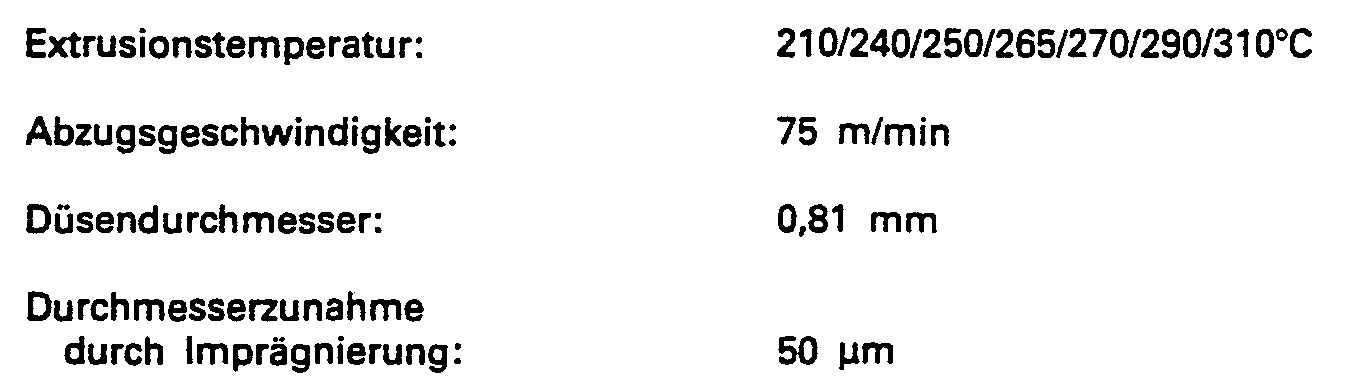
- In den Beispielen 1 bis 4 kam ein 1 L- oder ein 2 L- Wickeldraht, der durch Beschichtung mit einem mit 8% Titandioxid gefülltem Polyethylenterephthalat im Extrusionsverfahren hergestellt worden war und dann anschließend mit Glasseide einfach oder zweifach umsponnen wurde, zum Einsatz. Er durchlief zunächst eine Vorheizstrecke und nach Passieren der Beschichtungszone im Extruderkopf eine Abstreiferdüse zur Regulierung der Schichtstärke. Anschließend passierte der druckimprägnierte Draht eine Kühlstrecke und wurde aufgespult.
- Die angegebenen Extrudertemperaturen beziehen sich jeweils auf die Strecke vom Einlauf bis zur Düse, wobei die drei letzten Temperaturangaben für das Düsensystem gelten.
- Folgender umsponnener Kupferdraht wurde eingesetzt:

- Imprägnierungs- und Beschichtungsmaterial:
- Mit 8% Titandioxid gefülltes Polyethylenterephthalat.
- Verarbeitungsbedingungen:
- Einqesetzter Kupferdraht:

- Imprägnierungs- und Beschichtungsmaterial:
- Polyethylenterephthalat, ungefüllt.
- Verarbeitungsbedingungen:

- Eingesetzter Kupferdraht:

- Imprägnierungs- und Beschichtungsmaterial:
- mit 8% Titandioxid gefülltes Polyethylenterephthalat Verarbeitungsbedingungen:

- Eingesetzter Kupferdraht:

- Imprägnierungs- und Beschichtungsmaterial:
- Polyethylenterephthalat, ungefüllt Verarbeitungsbedingungen:

-

Claims (7)
Priority Applications (1)
| Application Number | Priority Date | Filing Date | Title |
|---|---|---|---|
| AT82110490T ATE18314T1 (de) | 1981-11-19 | 1982-11-13 | Verfahren zur impraegnierung umsponnener draehte und litzen durch extrusion von thermoplasten. |
Applications Claiming Priority (2)
| Application Number | Priority Date | Filing Date | Title |
|---|---|---|---|
| DE19813145918 DE3145918A1 (de) | 1981-11-19 | 1981-11-19 | Verfahren zur impraegnierung umsponnener draehte mit litzen durch extrusion von thermoplasten. |
| DE3145918 | 1981-11-19 |
Publications (2)
| Publication Number | Publication Date |
|---|---|
| EP0080138A1 EP0080138A1 (de) | 1983-06-01 |
| EP0080138B1 true EP0080138B1 (de) | 1986-02-26 |
Family
ID=6146743
Family Applications (1)
| Application Number | Title | Priority Date | Filing Date |
|---|---|---|---|
| EP82110490A Expired EP0080138B1 (de) | 1981-11-19 | 1982-11-13 | Verfahren zur Imprägnierung umsponnener Drähte und Litzen durch Extrusion von Thermoplasten |
Country Status (7)
| Country | Link |
|---|---|
| US (1) | US4590025A (de) |
| EP (1) | EP0080138B1 (de) |
| JP (1) | JPS58501973A (de) |
| AT (1) | ATE18314T1 (de) |
| BR (1) | BR8207940A (de) |
| DE (2) | DE3145918A1 (de) |
| WO (1) | WO1983001864A1 (de) |
Families Citing this family (4)
| Publication number | Priority date | Publication date | Assignee | Title |
|---|---|---|---|---|
| JPH05269726A (ja) * | 1992-03-25 | 1993-10-19 | Mitsui Constr Co Ltd | 土木建築構造物補強材 |
| US6258453B1 (en) | 1996-09-19 | 2001-07-10 | Lawrence V. Montsinger | Thermoplastic composite materials made by rotational shear |
| US6533977B1 (en) * | 1997-12-10 | 2003-03-18 | Acs Industries, Inc. | High temperature composite structure and method of manufacturing same |
| CN115394502B (zh) * | 2022-07-27 | 2024-12-31 | 安徽聚芯智造科技股份有限公司 | 一种高粘度绝缘漆微细线涂漆模 |
Family Cites Families (23)
| Publication number | Priority date | Publication date | Assignee | Title |
|---|---|---|---|---|
| US3172931A (en) * | 1965-03-09 | Method of making conduit utilizing helically preformed elements | ||
| US2163119A (en) * | 1937-12-07 | 1939-06-20 | Anaconda Wire & Cable Co | Magnet wire |
| US2349951A (en) * | 1938-11-16 | 1944-05-30 | Bell Telephone Labor Inc | Electrical conductor |
| US2349952A (en) * | 1939-04-22 | 1944-05-30 | Bell Telephone Labor Inc | Electrical conductor |
| US2669754A (en) * | 1947-11-26 | 1954-02-23 | Danielson Mfg Company | Manufacture of composite wire and rope |
| US2636923A (en) * | 1948-12-30 | 1953-04-28 | Standard Telephones Cables Ltd | Low capacitance cable and method of making the same |
| US2718544A (en) * | 1950-09-09 | 1955-09-20 | Gen Electric | Jacketed multiple conductor cable |
| US3579379A (en) * | 1966-12-01 | 1971-05-18 | Franciscus C A A Van Berkel | Process for producing conductors insulated with polyethylene terephthalate |
| US3606632A (en) * | 1968-01-19 | 1971-09-21 | Anaconda Wire & Cable Co | Extruded cable covering with fibrous interlayer and apparatus |
| US4033800A (en) * | 1971-01-25 | 1977-07-05 | United States Steel Corporation | Method of making an electric cable |
| US3856888A (en) * | 1972-11-01 | 1974-12-24 | Universal Oil Prod Co | Flame retardant compositions |
| JPS5645942B2 (de) * | 1973-01-18 | 1981-10-29 | ||
| JPS5411514B2 (de) * | 1973-03-01 | 1979-05-15 | ||
| US4172859A (en) * | 1975-05-23 | 1979-10-30 | E. I. Du Pont De Nemours And Company | Tough thermoplastic polyester compositions |
| CH616264A5 (de) * | 1976-07-01 | 1980-03-14 | Maillefer Sa | |
| CH612789A5 (de) * | 1976-07-01 | 1979-08-15 | Maillefer Sa | |
| US4131758A (en) * | 1977-08-10 | 1978-12-26 | United States Steel Corporation | Double caged armored electromechanical cable |
| DE2753917A1 (de) * | 1977-12-03 | 1979-06-07 | Beck & Co Ag Dr | Verwendung von thermoplasten zur herstellung von isolierten wickeldraehten im extrusionsverfahren |
| JPS5910698B2 (ja) * | 1978-05-18 | 1984-03-10 | 東洋紡績株式会社 | ポリエステル組成物 |
| DE2911269C2 (de) * | 1979-03-22 | 1982-12-09 | Dr. Beck & Co Ag, 2000 Hamburg | Verwendung von Thermoplasten zur Herstellung von isolierten Wickeldrähten im Extrusionsverfahren |
| DE2936795C2 (de) * | 1979-09-12 | 1982-12-09 | Dr. Beck & Co Ag, 2000 Hamburg | Verfahren zur Herstellung isolierter Wickeldrähte durch Extrusion von Thermoplasten |
| JPS5699914A (en) * | 1979-12-27 | 1981-08-11 | Beck & Co Ag Dr | Method of manufacturing directly soldable insulated coil |
| US4309597A (en) * | 1980-05-19 | 1982-01-05 | Sunbeam Corporation | Blanket wire utilizing positive temperature coefficient resistance heater |
-
1981
- 1981-11-19 DE DE19813145918 patent/DE3145918A1/de not_active Ceased
-
1982
- 1982-11-13 BR BR8207940A patent/BR8207940A/pt not_active IP Right Cessation
- 1982-11-13 JP JP82503534A patent/JPS58501973A/ja active Pending
- 1982-11-13 WO PCT/DE1982/000211 patent/WO1983001864A1/de not_active Ceased
- 1982-11-13 DE DE8282110490T patent/DE3269476D1/de not_active Expired
- 1982-11-13 EP EP82110490A patent/EP0080138B1/de not_active Expired
- 1982-11-13 AT AT82110490T patent/ATE18314T1/de not_active IP Right Cessation
-
1985
- 1985-04-16 US US06/722,770 patent/US4590025A/en not_active Expired - Lifetime
Also Published As
| Publication number | Publication date |
|---|---|
| WO1983001864A1 (fr) | 1983-05-26 |
| US4590025A (en) | 1986-05-20 |
| EP0080138A1 (de) | 1983-06-01 |
| JPS58501973A (ja) | 1983-11-17 |
| DE3269476D1 (en) | 1986-04-03 |
| BR8207940A (pt) | 1983-10-04 |
| ATE18314T1 (de) | 1986-03-15 |
| DE3145918A1 (de) | 1983-05-26 |
Similar Documents
| Publication | Publication Date | Title |
|---|---|---|
| EP0368038B1 (de) | Hochspannungsisoliersystem für elektriche Maschinen | |
| DE1510095C (de) | ||
| DE2526626C3 (de) | Verfahren zur Herstellung eines elektrischen Litzenleiters | |
| DE3786429T2 (de) | Isolierte Leitung mit hochtemperaturbeständiger Multischichtisolierung. | |
| DE2811028A1 (de) | Energiekabel, insbesondere isolierueberzug fuer ein energiekabel | |
| WO2003107512A1 (de) | Glimmschutz | |
| DE102014216761A1 (de) | Kabelsatz und Verfahren zur Herstellung eines solchen | |
| DE2638763B2 (de) | Verfahren zum Herstellen eines lackisolierten Wickeldrahts | |
| EP1042758B1 (de) | Verfahren zur herstellung von glimmer-hältigen isolierbändern sowie deren verwendung | |
| DE4132390A1 (de) | Flammwidriges elektrisches kabel | |
| DE1102265B (de) | Isolierung von Wicklungsdraehten fuer elektrische Maschinen | |
| EP0080138A1 (de) | Verfahren zur Imprägnierung umsponnener Drähte und Litzen durch Extrusion von Thermoplasten | |
| DE102010001991B4 (de) | Flachleitervorrichtung mit zwei umsponnenen Isolierschichten und Herstellungsverfahren | |
| DE4010306C2 (de) | Verfahren und Vorrichtung zur Herstellung von Lackdrähten mit Schmelzharzen | |
| DE102009006763A1 (de) | Spule für eine dynamoelektrische Maschine | |
| DE2936795C2 (de) | Verfahren zur Herstellung isolierter Wickeldrähte durch Extrusion von Thermoplasten | |
| DE4323229C2 (de) | Leiterkabel mit einer Silicon-imprägnierten Glasfaser-Ummantelung | |
| DE19631298A1 (de) | Verfahren und Vorrichtung zum Beschichten von Drähten | |
| DE1089026B (de) | Isolierung fuer Hochspannungsleiter | |
| DE2342070C3 (de) | Verfarhen zur Herstellung einer für dauernde Temperaturbeanspruchung über 250 C geeigneten Wicklungsisolation für eine elektrische Maschine | |
| DE2739571A1 (de) | Elektrischer leiter oder elektrische spule mit einer isolierung aus glimmer- und harzschichten | |
| EP1075030A2 (de) | Verfahren zur elektrischen Isolation von Supraleitern insbesondere aus oxidischem Hochtemperatur-Supraleitermaterial | |
| DE102017208950A1 (de) | Schirmring und/oder Steigungsausgleich für eine Transformatorspule | |
| DE940175C (de) | Verfahren zur Herstellung von isolierenden UEberzuegen aus Glas fuer elektrische Leitungen | |
| DD147435A1 (de) | Verfahren zur herstellung der isolierhuelle von kabel und leitungen |
Legal Events
| Date | Code | Title | Description |
|---|---|---|---|
| PUAI | Public reference made under article 153(3) epc to a published international application that has entered the european phase |
Free format text: ORIGINAL CODE: 0009012 |
|
| AK | Designated contracting states |
Designated state(s): AT BE CH DE FR GB IT LI NL SE |
|
| 17P | Request for examination filed |
Effective date: 19830603 |
|
| GRAA | (expected) grant |
Free format text: ORIGINAL CODE: 0009210 |
|
| AK | Designated contracting states |
Designated state(s): AT BE CH DE FR GB IT LI NL SE |
|
| REF | Corresponds to: |
Ref document number: 18314 Country of ref document: AT Date of ref document: 19860315 Kind code of ref document: T |
|
| REF | Corresponds to: |
Ref document number: 3269476 Country of ref document: DE Date of ref document: 19860403 |
|
| ET | Fr: translation filed | ||
| ITF | It: translation for a ep patent filed | ||
| PLBE | No opposition filed within time limit |
Free format text: ORIGINAL CODE: 0009261 |
|
| STAA | Information on the status of an ep patent application or granted ep patent |
Free format text: STATUS: NO OPPOSITION FILED WITHIN TIME LIMIT |
|
| 26N | No opposition filed | ||
| ITTA | It: last paid annual fee | ||
| EAL | Se: european patent in force in sweden |
Ref document number: 82110490.8 |
|
| NLS | Nl: assignments of ep-patents |
Owner name: SCHENECTADY INTERNATIONAL, INC. |
|
| NLT1 | Nl: modifications of names registered in virtue of documents presented to the patent office pursuant to art. 16 a, paragraph 1 |
Owner name: BASF PROJEKTENTWICKLUNGS AKTIENGESELLSCHAFT |
|
| REG | Reference to a national code |
Ref country code: FR Ref legal event code: TP Ref country code: FR Ref legal event code: CD |
|
| PGFP | Annual fee paid to national office [announced via postgrant information from national office to epo] |
Ref country code: GB Payment date: 19991020 Year of fee payment: 18 |
|
| REG | Reference to a national code |
Ref country code: CH Ref legal event code: PUE Owner name: BASF PROJEKTENTWICKLUNGS-AKTIENGESELLSCHAFT -DANN Ref country code: CH Ref legal event code: PFA Free format text: DR. BECK & CO. AG TRANSFER- BASF PROJEKTENTWICKLUNGS-AKTIENGESELLSCHAFT |
|
| PGFP | Annual fee paid to national office [announced via postgrant information from national office to epo] |
Ref country code: FR Payment date: 19991117 Year of fee payment: 18 |
|
| PGFP | Annual fee paid to national office [announced via postgrant information from national office to epo] |
Ref country code: AT Payment date: 19991119 Year of fee payment: 18 |
|
| PGFP | Annual fee paid to national office [announced via postgrant information from national office to epo] |
Ref country code: BE Payment date: 19991122 Year of fee payment: 18 |
|
| PGFP | Annual fee paid to national office [announced via postgrant information from national office to epo] |
Ref country code: SE Payment date: 19991123 Year of fee payment: 18 Ref country code: NL Payment date: 19991123 Year of fee payment: 18 |
|
| PGFP | Annual fee paid to national office [announced via postgrant information from national office to epo] |
Ref country code: CH Payment date: 19991129 Year of fee payment: 18 |
|
| PGFP | Annual fee paid to national office [announced via postgrant information from national office to epo] |
Ref country code: DE Payment date: 19991130 Year of fee payment: 18 |
|
| PG25 | Lapsed in a contracting state [announced via postgrant information from national office to epo] |
Ref country code: GB Free format text: LAPSE BECAUSE OF NON-PAYMENT OF DUE FEES Effective date: 20001113 Ref country code: AT Free format text: LAPSE BECAUSE OF NON-PAYMENT OF DUE FEES Effective date: 20001113 |
|
| PG25 | Lapsed in a contracting state [announced via postgrant information from national office to epo] |
Ref country code: SE Free format text: THE PATENT HAS BEEN ANNULLED BY A DECISION OF A NATIONAL AUTHORITY Effective date: 20001129 |
|
| PG25 | Lapsed in a contracting state [announced via postgrant information from national office to epo] |
Ref country code: LI Free format text: LAPSE BECAUSE OF NON-PAYMENT OF DUE FEES Effective date: 20001130 Ref country code: CH Free format text: LAPSE BECAUSE OF NON-PAYMENT OF DUE FEES Effective date: 20001130 Ref country code: BE Free format text: LAPSE BECAUSE OF NON-PAYMENT OF DUE FEES Effective date: 20001130 |
|
| BECA | Be: change of holder's address |
Free format text: 20000119 *SCHENECTADY INTERNATIONAL INC.:2750 BALLTOWN ROAD, SCHENECTADY NEW YORK 12309 |
|
| BECH | Be: change of holder |
Free format text: 20000119 *SCHENECTADY INTERNATIONAL INC. |
|
| BERE | Be: lapsed |
Owner name: SCHENECTADY INTERNATIONAL INC. Effective date: 20001130 |
|
| PG25 | Lapsed in a contracting state [announced via postgrant information from national office to epo] |
Ref country code: NL Free format text: LAPSE BECAUSE OF NON-PAYMENT OF DUE FEES Effective date: 20010601 |
|
| GBPC | Gb: european patent ceased through non-payment of renewal fee |
Effective date: 20001113 |
|
| REG | Reference to a national code |
Ref country code: CH Ref legal event code: PL |
|
| EUG | Se: european patent has lapsed |
Ref document number: 82110490.8 |
|
| PG25 | Lapsed in a contracting state [announced via postgrant information from national office to epo] |
Ref country code: FR Free format text: LAPSE BECAUSE OF NON-PAYMENT OF DUE FEES Effective date: 20010731 |
|
| NLV4 | Nl: lapsed or anulled due to non-payment of the annual fee |
Effective date: 20010601 |
|
| PG25 | Lapsed in a contracting state [announced via postgrant information from national office to epo] |
Ref country code: DE Free format text: LAPSE BECAUSE OF NON-PAYMENT OF DUE FEES Effective date: 20010801 |
|
| REG | Reference to a national code |
Ref country code: FR Ref legal event code: ST |