EP0054439A2 - Zeichentrennungsverfahren - Google Patents
Zeichentrennungsverfahren Download PDFInfo
- Publication number
- EP0054439A2 EP0054439A2 EP81305913A EP81305913A EP0054439A2 EP 0054439 A2 EP0054439 A2 EP 0054439A2 EP 81305913 A EP81305913 A EP 81305913A EP 81305913 A EP81305913 A EP 81305913A EP 0054439 A2 EP0054439 A2 EP 0054439A2
- Authority
- EP
- European Patent Office
- Prior art keywords
- mask
- character
- information
- characters
- block
- Prior art date
- Legal status (The legal status is an assumption and is not a legal conclusion. Google has not performed a legal analysis and makes no representation as to the accuracy of the status listed.)
- Granted
Links
Images



Classifications
-
- G—PHYSICS
- G06—COMPUTING OR CALCULATING; COUNTING
- G06V—IMAGE OR VIDEO RECOGNITION OR UNDERSTANDING
- G06V30/00—Character recognition; Recognising digital ink; Document-oriented image-based pattern recognition
- G06V30/40—Document-oriented image-based pattern recognition
- G06V30/41—Analysis of document content
- G06V30/416—Extracting the logical structure, e.g. chapters, sections or page numbers; Identifying elements of the document, e.g. authors
-
- G—PHYSICS
- G06—COMPUTING OR CALCULATING; COUNTING
- G06V—IMAGE OR VIDEO RECOGNITION OR UNDERSTANDING
- G06V30/00—Character recognition; Recognising digital ink; Document-oriented image-based pattern recognition
- G06V30/10—Character recognition
- G06V30/14—Image acquisition
- G06V30/1444—Selective acquisition, locating or processing of specific regions, e.g. highlighted text, fiducial marks or predetermined fields
-
- G—PHYSICS
- G06—COMPUTING OR CALCULATING; COUNTING
- G06V—IMAGE OR VIDEO RECOGNITION OR UNDERSTANDING
- G06V30/00—Character recognition; Recognising digital ink; Document-oriented image-based pattern recognition
- G06V30/10—Character recognition
- G06V30/14—Image acquisition
- G06V30/146—Aligning or centring of the image pick-up or image-field
-
- G—PHYSICS
- G06—COMPUTING OR CALCULATING; COUNTING
- G06V—IMAGE OR VIDEO RECOGNITION OR UNDERSTANDING
- G06V30/00—Character recognition; Recognising digital ink; Document-oriented image-based pattern recognition
- G06V30/10—Character recognition
- G06V30/14—Image acquisition
- G06V30/148—Segmentation of character regions
-
- G—PHYSICS
- G06—COMPUTING OR CALCULATING; COUNTING
- G06V—IMAGE OR VIDEO RECOGNITION OR UNDERSTANDING
- G06V30/00—Character recognition; Recognising digital ink; Document-oriented image-based pattern recognition
- G06V30/10—Character recognition
Definitions
- This invention relates to a character segmentation method, and particularly to the character segmentation method which optically reads and recognizes postal address information including postal code, city name and state name.
- Fig. 1 shows a known optical character reader for reading the postal code on postal material comprising: a scanner 1, an image signal processing unit 3, a character segmentation unit 4, and a character recognition unit 5.
- Scanner 1 optically scans the printed area representing the postal code information and produces a scanning signal.
- the scanning signal is then transformed into electric pattern signals by an image signal processing unit 3.
- the transformed electric signals, representing postal code signals are then transmitted to a character segmentation unit 4 which detects the characters and segments of the postal code, and transmits this information to a character recognition unit 5.
- the character recognition unit recognizes the characters of the code by using a known technique, for example, by comparing the characters with standard patterns.
- the character segmentation unit of the prior art detects and segments only the postal code information.
- both the postal code and its related information e.g., the city name and the state name
- both the postal code and its related information e.g., the city name and the state name
- the object of this invention is to provide a character segmentation method which is so designed that the character recognition processing after character segmentation can be performed in a simple manner.
- each block of address information is detected and classified according to the type of information it contains, and the characters are segmented and read from each distinct block of information.
- Fig. 2 illustrates typical postal material 9 containing some address information 6.
- the lowest line of this address information includes the postal code 9 and its related information consisting of the city name 7, and the state name 8.
- This invention relates to a character segmentation method whereby the city name 7, the state name 8 and the postal code 9 is identified, classified and compared with the desired information recognition.
- the city name 7 is classified by a city name block
- the state name 8 is classified by a state name block
- the postal code 9 is classified by a postal code block. Consequently, the system of this invention can identify and classify the blocks which contain each character, thereby simplifying the character recognition process.
- Use of these separate blocks to distinguish the information having alphabetical characters and the information having numerical characters permits ready identification and recognition. Since the characters within the city name block and the state name block are alphabetical, this information can be easily compared, using known techniques, to standard pattern information of an alphabetical nature. Further, since the. characters within the postal code block are numerical, this information can be easily compared, using known techniques, to standard pattern information of a numerical nature.
- projection mask data M h i.e., horizontal projection mask
- M . i.e., vertical projection mask
- This data is obtained from the electrical pattern signals supplied by the- image signal processing unit 3. This data and its corresponding blocks are then identified by the circuitry within the character segmentation unit.
- a check is made of the gap g between two adjacent character masks as illustrated in Fig. 4. This gap is then compared with an average gap value g between, -adjacent character marks as determined for all the characters. If the comparison indicates the gap (e.g., g 1 in Fig. 4) is larger than the average value g, the circuitry thereby determines that the gap occurs between two blocks of characters. This determination results in the identification of a block of characters.
- a second method for identifying the block character marks is to detect the presence of punctuation marks such as a comma 10 or a period 11 (see Fig. 5). Since such punctuation separates the distinct blocks of information, this method provides an additional identification check which is utilized in the instant invention with the method of Fig. 4.
- the punctuation mark method in part, compares the much smaller mark of such marks with the average height h of the heights h of all the character marks (see Fig. 6). After each of these character blocks is identified by the character segmentation unit 4, the specific classification of each block and the character pattern signals for the block are transmitted, by circuit 4, to a character recognition unit 5 for recognition of each character.
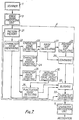
- Fig. 7 shows, in block diagram, the detailed circuitry of the character segmentation unit 4 for identifying and classifying the character blocks by the methods mentioned above.
- a known scanner 1 optically scans the address area 2 (see Fig. 1) on postal material P.
- the output signals of the scanner are supplied to a conventional image signal processing unit 3 for transforming these output signals to pattern signals.
- These pattern signals are then supplied to character segmentation unit 4 which includes a pattern memory 21 for storing the pattern signals.
- Character mask generating circuit 21 detects-the pattern signals, including signals corresponding to the lowest line of address information (i.e., Fig. 2: 7, 8, 9), and generates vertical projection data of each character, according to the stored pattern signals to represent the character mask M for each character.
- the operating scanner 1 is shown in U.S. Patent Nos. 3,846,753 and 4,034,341.
- the operation of image processing unit 3 and the production of pattern signals and character mask generating circuitry 22 are disclosed in IBM Technical Disclosure Bulletin, Vol. 15, No. 7 (6/72) and Japanese Published Patent No. 51-36971 (10/13/76).
- the character mask generating circuit 22 transmits the data to a character mask width detecting circuit 23, a character mask position detecting circuit 24, a character mask height detecting circuit 25 and a punctuation mark detecting circuit 26.
- Circuits 23-25 (see Fig. 10) produce, in part, mask data from the pattern signals and the projection data.
- the data for each mask is made up of the following four bytes of information: D 1 (n); D 2 (n); D3(n); D 4 (n), where n is the mask data for mask M n .
- D 1 (1) is the horizontal distance from a predetermined position A' to each left side of mask M 1 ;
- D 2 (1) is the width of masks M 1 ;
- D 3 (1) is the vertical distance from a predetermined position A to the upper side of mask M l ;
- D 4 (l) is the height of mask M 1 .
- the character mask position detecting circuit 24 detects the position of each character mask M from a predetermined position assigned for the system. As will be explained with reference to Fig. 8, the predetermined position A' is selected as the end of the scanning sequence.
- the character mask width detecting circuit 23 detects the width of the character mask M, while the character mask height detecting circuit detects the height of the character mask M.
- the outputs of the width detecting circuit 23 and the mask position detecting circuits 24 are supplied to a mask gap calculating circuit 27.
- Mask gap calculating circuit 27 calculates the gap g betweer each character mask M on the basis of the position data from the character mask position detecting circuit 24 and the width data from the character mask width detecting circuit 23.
- An average mask gap calculating circuit 28 receives the output of circuit 27, and calculates the average value g of the gaps.
- a comparing circuit 29 compares the output signal of circuit 27, representing each gap, with the average value g and produces an output signal indicating whether or not the gap is larger than the average value g .
- An average character mask height calculation circuit 30, receives the output h of circuit 25, and calculates the average value h of all the heights of the character masks.
- the output of circuit 30 is then supplied to a punctuation mark detecting circuit 26 which utilizes, in part, the average value h to determine if a punctuation mark is present.
- the punctuation mark detecting circuit 26 determines the presence or absence of a punctuation mark, such as comma 10 or period 11, between each character mask. As will be explained with reference to Fig. 12, circuit 26 can distinguish the character mask of a punctuation mark since its corresponding mark is much smaller than the other character masks.
- the circuit compares the height of the punctuation mask with the average height h of all the marks. Also, the circuit determines if the vertical distance to the center of an immediately preceeding mask is less than the vertical distance to the upper side of the punctuation mask.
- a blocking circuit 32 temporarily stores the comparative result of comparing circuit 29 and the output signal of the punctuation mark detecting circuit 26.
- Circuit 32 identifies the character blocks by utilizing the outputs of circuits 29 and 26. For example, when the mask existing between two other masks is detected to be a punctuation mark, circuit 32 can, thereby, determine that the other masks belong to different blocks. Further, for example, when the output of circuit 29 indicates that the gap value g between two masks is largers than the average gap value g, circuit 32 can, thereby, determine that these masks belong to different blocks.
- the character masks M are then separated at that point, and transmitted to the character segmentation circuit 33. Consequently, character masks M are identified for each separate block of postal 'code 9, state name 8 and city name 7, and then transmitted to the character segmentation circuit 33.
- the address information in the lowest line described on the postal material P comprises, in sequence, the postal code 9, the state name 8 and the city name 7. This information is scanned in that sequential order.
- blocking circuit 32 determines if the first identified block to be classified is the postal code block by determining if the block contains five (5) masks since all U.S. postal codes have five characters.
- the second identified adjacent block is then classified as the state name block and the third identified adjacent block is then classified as the city name block.
- each block of information is identified and assigned a classification.
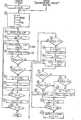
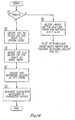
- the character segmentation circuit .33 also segments the characters within each classified block transmitted from circuit 32 in a conventional manner. When the blocked character mask M is transmitted, the corresponding character pattern signals from pattern memory 21 are segmented into characters corresponding to its separate classified block, and then transmitted to the character recognition unit 5.
- the operation of circuit 33 will be explained in more detail with reference to Fig. 14.
- the character recognition unit 5 selects the standard pattern memory corresponding to the type of block information (i.e., numerical or alphabetical) supplied from character segmentating circuit 33. : Recognition unit 5 then recognizes the particular segmented characters transmitted by selecting and using standard pattern memory corresponding to this type of information. That standard pattern information is then compared with the segmented characters within that block. For example, - if the block information corresponds to the postal code block, a numerical standard pattern memory is selected. If the block information corresponds to either the state name block or the city name block, an alphabetical standard pattern memory is selected.
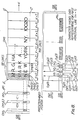
- Fig. 8 shows the vertical scanning of the three lines of address information from C' to D' while the letter is transported in the horizontal direction X. Scanning takes place such that 768 vertical lines are scanned including the last line from B' to A'. A' represents the end of scanning and is also the predetermined position for determining character mask positions. See prior art methods discussed in U.S. Patent Nos. 4,034,341 and 3,846,341.
- the signals are stored in the pattern memory 21 which is also shown in Figs. 8 and 9 as CM 1 .
- VM l mask memory
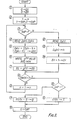
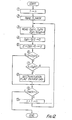
- VM 2-m The registers, counters, control units, and flow charts for performing these functions will be defined and explained below.
- VM 2-3 refers to the line of address information (e.g., Mr. G.
- VM 2-2 refers to the second line (e.g., Park Avenue); and VM 2-1 refers to the first line (e.g., New York, N.Y. 10020). Consequently, the designation VM 2-1 (k), shown in Fig. 8, refers to the value of the vertical projection data along the first line of information at the memory position k.
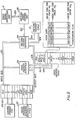
- the address information which has been converted to electrical pattern signals by image processing unit 3 is transferred by BUS 100 and stored in the Pattern Write Control Unit 66 in 16 bits (1 word unit).
- the address information data is obtained as 16 bits; this data is sequentially stored in the designated address of the Pattern Memory 21 through BUS 102 and 104.
- the Pattern Memory Interface 64 designates the address wherein the 16 data bits should be stored in Pattern Memory 21.
- the address information for such designations are obtained from the Register and ALU (CPU 60) through the Output BUS 106.
- Pattern Memory 21 and MM Data between Register and ALU, Pattern Memory 21 and MM are transmitted through the Mask Memory Interface 68 and Pattern Memory Interface 64.
- Output data from CPU 30 to MM and Pattern Memory 21 are transmitted through output BUS 106, BUS 108 and 104.
- Input data from MM to CPU 60 is transmitted through BUS 110 and 112.
- Input data from pattern memory 21 to CPU 60 is transmitted through BUS 112 and 114.
- L line counter: scanning lines are stored in this line counter as the pattern memory is obtained. "L” is used for obtaining the position within each memory portion along the horizontal direction.
- MASK Mask counter or Register
- VM 1 (Register): "VM 1 " contains the data for the vertical projection signals.
- CM 2 (L) (Register): "CM 2 (L)" contains the data value representing the height of the portion of the character at line L. (see, e.g., Fig. 8).
- CM 3 (Register): Data of character height, namely the height of the projection mask are stored in register "CM 3 .” It is used for obtaining the height of each mask. (see e.g., Fig. 8).
- D 1 (n) (Register or Horizontal positioning information): In Fig. 8, D 1 (1), D l (2), D l (3) etc. are designated as the horizontal distance from the predetermined position A' to the left side of each respective mask M 1 , M 2 , M 3 , etc.
- D 2 (n) (Register or Width information): In Fig. 8, D 2 (1), D 2 (2), D 2 (3), etc. designate the width value of each mask M 1 , M 2 , M 3 , etc.
- CL Lock Counter
- D 4 (n) (Register or Height information): In Fig. 8, D 4 (1), D 4 (2), D 4 (3), etc. designate the height value of each respective mask M 1 , M 2 , M 3 , etc.
- D 3 (n) (Register or Vertical position information): In Fig. 8, D 3 (l), D 3 (2), D 3 (3), etc. designate the vertical distance from the predetermined positoin A' to the upper side of each respective M 1 , M 2 , M 3 , etc.
- ⁇ G Gap accumulation register
- ⁇ H Height accumulation register: Is used for accumulating the height value (i.e., D 4 ) of each mask. The obtained accumulation value will be used for calculating the average height value.
- GAP Flip Flop
- g(n) (Register): stores the calculated value of the gap between a mask and its immediately preceeding adjacent mask.
- h (Register): Temporarily stores the content of D 4 (n).
- D (Register): The results of performing the following calculation is stored in "D”: D 4 (n-1)/2. In Fig. 8, when n is 2, the one-half the value of the height of mask M 1 is stored in "D:'
- d (Register): The results of performing the following calculation is stored in "d': D + D 3 (n-1). In Fig. 8, when n is 2, the vertical distance between the predetermined point A' and the center of mask M 1 will be stored in "d.”
- B (Counter): “B” designates the identified blocks of information. For example, in Fig. 8, when B is “1", the left most block is identified (i.e., New York). When B is "2”, the next block is identified (i.e., NY). When B is "3”, the next successive block is identified (i.e., 10020).
- Mask data (Register): Content of D 1 (n), D 2 (n), D 3 (n) and D 4 (n),. corresponding to each mask, are stored in "Mask data.”
- step (14) will go to the following steps for performing the Character Height detecting flow:
- the address information described on the postal material is identified and then classified according to the type of address information.
- the character information, with each classified block, is then segmented and supplied to a character recognition unit. Because the standard pattern memory corresponding to the type of 'classified information is select i.e., numerical or alphabetical), the character recognition processing is simplified.
Landscapes
- Engineering & Computer Science (AREA)
- Computer Vision & Pattern Recognition (AREA)
- Physics & Mathematics (AREA)
- General Physics & Mathematics (AREA)
- Multimedia (AREA)
- Theoretical Computer Science (AREA)
- Artificial Intelligence (AREA)
- Character Input (AREA)
Applications Claiming Priority (2)
| Application Number | Priority Date | Filing Date | Title |
|---|---|---|---|
| JP178423/80 | 1980-12-17 | ||
| JP55178423A JPS57101986A (en) | 1980-12-17 | 1980-12-17 | Character detecting and cutting method |
Publications (3)
| Publication Number | Publication Date |
|---|---|
| EP0054439A2 true EP0054439A2 (de) | 1982-06-23 |
| EP0054439A3 EP0054439A3 (en) | 1984-06-06 |
| EP0054439B1 EP0054439B1 (de) | 1987-11-19 |
Family
ID=16048234
Family Applications (1)
| Application Number | Title | Priority Date | Filing Date |
|---|---|---|---|
| EP81305913A Expired EP0054439B1 (de) | 1980-12-17 | 1981-12-17 | Zeichentrennungsverfahren |
Country Status (4)
| Country | Link |
|---|---|
| US (1) | US4481665A (de) |
| EP (1) | EP0054439B1 (de) |
| JP (1) | JPS57101986A (de) |
| DE (1) | DE3176538D1 (de) |
Cited By (8)
| Publication number | Priority date | Publication date | Assignee | Title |
|---|---|---|---|---|
| EP0258577A3 (en) * | 1986-07-11 | 1990-03-28 | Sumitomo Electric Industries Limited | Optical character reader |
| GB2230633A (en) * | 1989-04-18 | 1990-10-24 | Sharp Kk | Optical character recognition |
| GB2230634A (en) * | 1989-04-18 | 1990-10-24 | Sharp Kk | Optical character recognition |
| EP0629970A3 (de) * | 1993-06-15 | 1995-03-15 | At & T Global Inf Solution | Verfahren zur Detektion finanzieller Beträge in binären Bildern. |
| FR2731535A1 (fr) * | 1995-03-10 | 1996-09-13 | Poste | Marque de reperage et procede de localisation d'une information par ajout de cette marque |
| GB2301470A (en) * | 1995-05-15 | 1996-12-04 | Sanyo Electric Co | Hand-written character recognition in facsimile apparatus |
| US5675601A (en) * | 1995-04-06 | 1997-10-07 | Mitsubishi Denki Kabushiki Kaisha | Semiconductor laser device |
| GB2355100A (en) * | 1999-10-06 | 2001-04-11 | Ibm | Address area extraction |
Families Citing this family (34)
| Publication number | Priority date | Publication date | Assignee | Title |
|---|---|---|---|---|
| US4642813A (en) * | 1983-04-18 | 1987-02-10 | Object Recognition Systems, Inc. | Electro-optical quality control inspection of elements on a product |
| JPS59205679A (ja) * | 1983-05-06 | 1984-11-21 | Nippon Telegr & Teleph Corp <Ntt> | 文字切出し装置 |
| US4635290A (en) * | 1983-12-20 | 1987-01-06 | Nec Corporation | Sectioning apparatus and method for optical character reader systems |
| JPS60183689A (ja) * | 1984-03-02 | 1985-09-19 | Nec Corp | 文字読取制御装置 |
| JPS61266461A (ja) * | 1985-05-22 | 1986-11-26 | Dainippon Ink & Chem Inc | ポリフエニレンサルフアイド樹脂組成物 |
| US5050218A (en) * | 1986-08-26 | 1991-09-17 | Nec Corporation | Apparatus for recognizing address appearing on mail article |
| JP2572048B2 (ja) * | 1986-10-20 | 1997-01-16 | シャープ株式会社 | 単語処理方式 |
| JPS63158678A (ja) * | 1986-12-23 | 1988-07-01 | Sharp Corp | 単語間スペ−ス検出方法 |
| JP2667435B2 (ja) * | 1987-05-01 | 1997-10-27 | 株式会社リコー | 領域抽出方法 |
| US4998285A (en) * | 1988-03-11 | 1991-03-05 | Kabushiki Kaisha Toshiba | Character recognition apparatus |
| DE3825582A1 (de) * | 1988-07-28 | 1990-02-01 | Ralf A Sood | Verfahren und anordnung zum erkennen von zeichen und/oder objekten |
| US5065437A (en) * | 1989-12-08 | 1991-11-12 | Xerox Corporation | Identification and segmentation of finely textured and solid regions of binary images |
| US5131049A (en) * | 1989-12-08 | 1992-07-14 | Xerox Corporation | Identification, characterization, and segmentation of halftone or stippled regions of binary images by growing a seed to a clipping mask |
| CA2037173C (en) * | 1990-03-30 | 1996-01-09 | Hirofumi Kameyama | Character recognizing system |
| US5121440A (en) * | 1990-08-30 | 1992-06-09 | Monolithic Resources Corporation | Analog video character recognition system |
| US5216725A (en) * | 1990-10-31 | 1993-06-01 | Environmental Research Institute Of Michigan | Apparatus and method for separating handwritten characters by line and word |
| US5193122A (en) * | 1990-12-03 | 1993-03-09 | Xerox Corporation | High speed halftone detection technique |
| JP2933801B2 (ja) * | 1993-06-11 | 1999-08-16 | 富士通株式会社 | 文字の切り出し方法及びその装置 |
| JP3050007B2 (ja) * | 1993-08-26 | 2000-06-05 | ミノルタ株式会社 | 画像読取装置およびこれを備えた画像形成装置 |
| DE4344471A1 (de) * | 1993-12-21 | 1995-08-17 | Francotyp Postalia Gmbh | Verfahren und Anordnung zur Erzeugung und Überprüfung eines Sicherheitsabdruckes |
| JPH07256214A (ja) * | 1994-03-22 | 1995-10-09 | Toshiba Corp | 郵便物の宛名読取装置および郵便物の宛名領域判別装置および郵便物の宛名印刷装置 |
| JP3388867B2 (ja) * | 1994-03-31 | 2003-03-24 | 株式会社東芝 | 宛名領域検出装置および宛名領域検出方法 |
| US5754671A (en) * | 1995-04-12 | 1998-05-19 | Lockheed Martin Corporation | Method for improving cursive address recognition in mail pieces using adaptive data base management |
| US5610995A (en) * | 1995-06-06 | 1997-03-11 | United Parcel Service Of America, Inc. | Method and apparatus for compressing images containing optical symbols |
| JPH11226513A (ja) * | 1998-02-18 | 1999-08-24 | Toshiba Corp | 郵便物宛先読取装置及び郵便物区分装置 |
| US6404900B1 (en) * | 1998-06-22 | 2002-06-11 | Sharp Laboratories Of America, Inc. | Method for robust human face tracking in presence of multiple persons |
| FR2801997A1 (fr) * | 1999-12-02 | 2001-06-08 | Itesoft | Technologie adaptative d'analyse automatique de document |
| FR2825171B1 (fr) * | 2001-05-25 | 2004-02-13 | Itesoft Sa | Procede et dispositif de lecture de documents |
| US7164791B2 (en) * | 2002-07-30 | 2007-01-16 | Lockheed Martin Corporation | Method and computer program product for identifying and incorporating new output classes in a pattern recognition system during system operation |
| US7313267B2 (en) * | 2002-11-13 | 2007-12-25 | Lockheed Martin Corporation | Automatic encoding of a complex system architecture in a pattern recognition classifier |
| US7233692B2 (en) * | 2002-11-14 | 2007-06-19 | Lockheed Martin Corporation | Method and computer program product for identifying output classes with multi-modal dispersion in feature space and incorporating multi-modal structure into a pattern recognition system |
| JP2004272798A (ja) * | 2003-03-11 | 2004-09-30 | Pfu Ltd | 画像読み取り装置 |
| JP5705395B2 (ja) * | 2006-07-21 | 2015-04-22 | テクトロニクス・インターナショナル・セールス・ゲーエムベーハー | 信号分析装置 |
| US9042647B2 (en) | 2013-06-06 | 2015-05-26 | Xerox Corporation | Adaptive character segmentation method and system for automated license plate recognition |
Family Cites Families (6)
| Publication number | Priority date | Publication date | Assignee | Title |
|---|---|---|---|---|
| FR2073822A5 (de) * | 1969-12-31 | 1971-10-01 | Ibm | |
| BE789062A (nl) * | 1971-09-23 | 1973-01-15 | Nederlanden Staat | Automatische adresdetectie |
| US4034341A (en) * | 1973-12-17 | 1977-07-05 | Nippon Electric Company, Ltd. | Automatic postal-code-number reading system |
| JPS5156139A (en) * | 1974-11-13 | 1976-05-17 | Hitachi Ltd | Mojomitorisochi niokeru kiridashihoshiki |
| JPS53122500A (en) * | 1977-03-31 | 1978-10-25 | Nec Corp | Postal address detection apparatus |
| JPS5939065B2 (ja) * | 1977-06-03 | 1984-09-20 | 日本電気株式会社 | 郵便物宛名文字列検出装置 |
-
1980
- 1980-12-17 JP JP55178423A patent/JPS57101986A/ja active Pending
-
1981
- 1981-12-16 US US06/331,310 patent/US4481665A/en not_active Expired - Lifetime
- 1981-12-17 DE DE8181305913T patent/DE3176538D1/de not_active Expired
- 1981-12-17 EP EP81305913A patent/EP0054439B1/de not_active Expired
Cited By (15)
| Publication number | Priority date | Publication date | Assignee | Title |
|---|---|---|---|---|
| EP0258577A3 (en) * | 1986-07-11 | 1990-03-28 | Sumitomo Electric Industries Limited | Optical character reader |
| GB2230633A (en) * | 1989-04-18 | 1990-10-24 | Sharp Kk | Optical character recognition |
| GB2230634A (en) * | 1989-04-18 | 1990-10-24 | Sharp Kk | Optical character recognition |
| US5054091A (en) * | 1989-04-18 | 1991-10-01 | Sharp Kabushiki Kaisha | Method for determining coordinates of circumscribed rectangular frame of each character for use in optical character reader |
| US5093868A (en) * | 1989-04-18 | 1992-03-03 | Sharp Kabushiki Kaisha | Method for determining lines of character images for use in an optical reader |
| US5444793A (en) * | 1993-06-15 | 1995-08-22 | Ncr Corporation | Method for detecting machine printed monetary amounts in binary images |
| EP0629970A3 (de) * | 1993-06-15 | 1995-03-15 | At & T Global Inf Solution | Verfahren zur Detektion finanzieller Beträge in binären Bildern. |
| FR2731535A1 (fr) * | 1995-03-10 | 1996-09-13 | Poste | Marque de reperage et procede de localisation d'une information par ajout de cette marque |
| US5675601A (en) * | 1995-04-06 | 1997-10-07 | Mitsubishi Denki Kabushiki Kaisha | Semiconductor laser device |
| GB2301470A (en) * | 1995-05-15 | 1996-12-04 | Sanyo Electric Co | Hand-written character recognition in facsimile apparatus |
| GB2301470B (en) * | 1995-05-15 | 1998-11-11 | Sanyo Electric Co | Document processing apparatus |
| US5991439A (en) * | 1995-05-15 | 1999-11-23 | Sanyo Electric Co., Ltd | Hand-written character recognition apparatus and facsimile apparatus |
| GB2355100A (en) * | 1999-10-06 | 2001-04-11 | Ibm | Address area extraction |
| GB2355100B (en) * | 1999-10-06 | 2003-10-15 | Ibm | Area extraction method and apparatus |
| US6683967B1 (en) | 1999-10-06 | 2004-01-27 | International Business Machines Corporation | Area extraction method, address area extraction method, address area extraction apparatus, and image processing apparatus |
Also Published As
| Publication number | Publication date |
|---|---|
| US4481665A (en) | 1984-11-06 |
| JPS57101986A (en) | 1982-06-24 |
| EP0054439B1 (de) | 1987-11-19 |
| EP0054439A3 (en) | 1984-06-06 |
| DE3176538D1 (en) | 1987-12-23 |
Similar Documents
| Publication | Publication Date | Title |
|---|---|---|
| US4481665A (en) | Character segmentation method | |
| US4408342A (en) | Method for recognizing a machine encoded character | |
| US5034991A (en) | Character recognition method and system | |
| US4045773A (en) | Pattern segmenting system for a pattern recognizing device | |
| US6327385B1 (en) | Character segmentation device and character segmentation system | |
| EP0482187A1 (de) | Zeilenweise segmentierung und schwellenwertbestimmung für optische zeichenerkennung (system und verfahren) | |
| KR100383858B1 (ko) | 문자인식장치의 문자추출방법 및 장치 | |
| JPH02293989A (ja) | 文字認識装置 | |
| JP3897999B2 (ja) | 手書き文字認識方法 | |
| JP2827960B2 (ja) | 宛名行抽出装置 | |
| JP3710164B2 (ja) | 画像処理装置及び方法 | |
| JP2630261B2 (ja) | 文字認識装置 | |
| JP3157530B2 (ja) | 文字切り出し方法 | |
| JP2000339408A (ja) | 文字切り出し装置 | |
| JP2722550B2 (ja) | 光学文字読取装置 | |
| JPH10198761A (ja) | 文字認識方法および文字認識装置 | |
| JPH0782524B2 (ja) | 光学的文字読取装置 | |
| JPH04260980A (ja) | 図形認識装置 | |
| JP3160458B2 (ja) | 文字読取装置及び文字読取方法 | |
| JPH03122786A (ja) | 光学的文字読取装置 | |
| JP2778436B2 (ja) | 文字切り出し装置 | |
| JPH0498477A (ja) | 文字切り出し方法 | |
| JPH0259502B2 (de) | ||
| JPS62281095A (ja) | パタ−ン情報認識方法 | |
| JPS62127985A (ja) | 文字切出し方式 |
Legal Events
| Date | Code | Title | Description |
|---|---|---|---|
| PUAI | Public reference made under article 153(3) epc to a published international application that has entered the european phase |
Free format text: ORIGINAL CODE: 0009012 |
|
| AK | Designated contracting states |
Designated state(s): DE FR GB IT NL |
|
| PUAL | Search report despatched |
Free format text: ORIGINAL CODE: 0009013 |
|
| AK | Designated contracting states |
Designated state(s): DE FR GB IT NL |
|
| RAP1 | Party data changed (applicant data changed or rights of an application transferred) |
Owner name: KABUSHIKI KAISHA TOSHIBA |
|
| 17P | Request for examination filed |
Effective date: 19841126 |
|
| 17Q | First examination report despatched |
Effective date: 19860314 |
|
| GRAA | (expected) grant |
Free format text: ORIGINAL CODE: 0009210 |
|
| AK | Designated contracting states |
Kind code of ref document: B1 Designated state(s): DE FR GB IT NL |
|
| ITF | It: translation for a ep patent filed | ||
| REF | Corresponds to: |
Ref document number: 3176538 Country of ref document: DE Date of ref document: 19871223 |
|
| ET | Fr: translation filed | ||
| PLBE | No opposition filed within time limit |
Free format text: ORIGINAL CODE: 0009261 |
|
| STAA | Information on the status of an ep patent application or granted ep patent |
Free format text: STATUS: NO OPPOSITION FILED WITHIN TIME LIMIT |
|
| 26N | No opposition filed | ||
| ITTA | It: last paid annual fee | ||
| PGFP | Annual fee paid to national office [announced via postgrant information from national office to epo] |
Ref country code: GB Payment date: 19961209 Year of fee payment: 16 |
|
| PGFP | Annual fee paid to national office [announced via postgrant information from national office to epo] |
Ref country code: NL Payment date: 19961231 Year of fee payment: 16 |
|
| PG25 | Lapsed in a contracting state [announced via postgrant information from national office to epo] |
Ref country code: GB Free format text: LAPSE BECAUSE OF NON-PAYMENT OF DUE FEES Effective date: 19971217 |
|
| PG25 | Lapsed in a contracting state [announced via postgrant information from national office to epo] |
Ref country code: NL Free format text: LAPSE BECAUSE OF NON-PAYMENT OF DUE FEES Effective date: 19980701 |
|
| GBPC | Gb: european patent ceased through non-payment of renewal fee |
Effective date: 19971217 |
|
| NLV4 | Nl: lapsed or anulled due to non-payment of the annual fee |
Effective date: 19980701 |
|
| REG | Reference to a national code |
Ref country code: FR Ref legal event code: D6 |
|
| PGFP | Annual fee paid to national office [announced via postgrant information from national office to epo] |
Ref country code: DE Payment date: 20001211 Year of fee payment: 20 |
|
| PGFP | Annual fee paid to national office [announced via postgrant information from national office to epo] |
Ref country code: FR Payment date: 20001212 Year of fee payment: 20 |