EP0053500A2 - Mengsel von Fenylvalerat-Stereoisomeren - Google Patents
Mengsel von Fenylvalerat-Stereoisomeren Download PDFInfo
- Publication number
- EP0053500A2 EP0053500A2 EP81305635A EP81305635A EP0053500A2 EP 0053500 A2 EP0053500 A2 EP 0053500A2 EP 81305635 A EP81305635 A EP 81305635A EP 81305635 A EP81305635 A EP 81305635A EP 0053500 A2 EP0053500 A2 EP 0053500A2
- Authority
- EP
- European Patent Office
- Prior art keywords
- isomer
- isovalerate
- chlorophenyl
- cyano
- phenoxybenzyl
- Prior art date
- Legal status (The legal status is an assumption and is not a legal conclusion. Google has not performed a legal analysis and makes no representation as to the accuracy of the status listed.)
- Withdrawn
Links
Images

Classifications
-
- C—CHEMISTRY; METALLURGY
- C07—ORGANIC CHEMISTRY
- C07C—ACYCLIC OR CARBOCYCLIC COMPOUNDS
- C07C255/00—Carboxylic acid nitriles
-
- A—HUMAN NECESSITIES
- A01—AGRICULTURE; FORESTRY; ANIMAL HUSBANDRY; HUNTING; TRAPPING; FISHING
- A01N—PRESERVATION OF BODIES OF HUMANS OR ANIMALS OR PLANTS OR PARTS THEREOF; BIOCIDES, e.g. AS DISINFECTANTS, AS PESTICIDES OR AS HERBICIDES; PEST REPELLANTS OR ATTRACTANTS; PLANT GROWTH REGULATORS
- A01N37/00—Biocides, pest repellants or attractants, or plant growth regulators containing organic compounds containing a carbon atom having three bonds to hetero atoms with at the most two bonds to halogen, e.g. carboxylic acids
- A01N37/36—Biocides, pest repellants or attractants, or plant growth regulators containing organic compounds containing a carbon atom having three bonds to hetero atoms with at the most two bonds to halogen, e.g. carboxylic acids containing at least one carboxylic group or a thio analogue, or a derivative thereof, and a singly bound oxygen or sulfur atom attached to the same carbon skeleton, this oxygen or sulfur atom not being a member of a carboxylic group or of a thio analogue, or of a derivative thereof, e.g. hydroxy-carboxylic acids
- A01N37/38—Biocides, pest repellants or attractants, or plant growth regulators containing organic compounds containing a carbon atom having three bonds to hetero atoms with at the most two bonds to halogen, e.g. carboxylic acids containing at least one carboxylic group or a thio analogue, or a derivative thereof, and a singly bound oxygen or sulfur atom attached to the same carbon skeleton, this oxygen or sulfur atom not being a member of a carboxylic group or of a thio analogue, or of a derivative thereof, e.g. hydroxy-carboxylic acids having at least one oxygen or sulfur atom attached to an aromatic ring system
-
- Y—GENERAL TAGGING OF NEW TECHNOLOGICAL DEVELOPMENTS; GENERAL TAGGING OF CROSS-SECTIONAL TECHNOLOGIES SPANNING OVER SEVERAL SECTIONS OF THE IPC; TECHNICAL SUBJECTS COVERED BY FORMER USPC CROSS-REFERENCE ART COLLECTIONS [XRACs] AND DIGESTS
- Y02—TECHNOLOGIES OR APPLICATIONS FOR MITIGATION OR ADAPTATION AGAINST CLIMATE CHANGE
- Y02P—CLIMATE CHANGE MITIGATION TECHNOLOGIES IN THE PRODUCTION OR PROCESSING OF GOODS
- Y02P20/00—Technologies relating to chemical industry
- Y02P20/50—Improvements relating to the production of bulk chemicals
- Y02P20/582—Recycling of unreacted starting or intermediate materials
Definitions
- This invention relates to a process for obtaining steroisomers of a-cyano-3-phenoxybenzyl 2-(4-chlorophenyl)isovalerate (commonly know as fenvalerate) having an excellent insecticidal and/or acaricidal activity, including a novel crystal form of an enantiomer pair of the isomers.
- fenvalerate is useful as an insecticide and/or acaricide that has a low toxicity to mammals, and has a low residual effect when used agriculturally (conventional pyrethroid-type insecticides leave a significant residue).
- Fenvalerate has one asymmetric carbon atom on each of the acid and alcohol moieties, and therefore, four optical iosmers are available.
- Combinations of the Aa-isomer and the B ⁇ -isomer and of the Ap-isomer and the Ba-isomer are each in a relationship of enantiomer pair.
- the enantiomer pair of the Aa-isomer and the B ⁇ -isomer is referred to as a Y-isomer, and the enantiomer pair of the A ⁇ -isomer and the Ba-isomer as an X-isomer.
- the insecticidal and/or acaricidal efficacy of the Y-isomer of fenvalerate is twice as high as that of racemic fenvalerate (the ratio of X-isomer to Y-isomer is strictly 1:1 in a racemate, but mixtures having a ratio of X-isomer to Y-isomer of from 60:40 to 45:55 will be herein referred to as a racemate), and the Y-isomer (by which term we include mixtures containing at least 92% of the Y-isomer) or the ester rich in the Y-isomer (i.e.
- a mixture containing more than 60% but less than 92% of the Y-isomer which will be referred to as a Y-rich isomer
- a Y-rich isomer a mixture containing more than 60% but less than 92% of the Y-isomer, which will be referred to as a Y-rich isomer
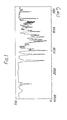
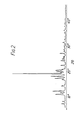
- the thus-obtained crystal of the Y-isomer (herein referred to as a I-type crystal) has a melting point of 40°C, and its infrared absorption spectrum (by a KBr method) and powder X-ray diffraction spectrum (CU-K ) are given respectively in Figures 1 and 2 of the drawings.
- the X-isomer of fenvalerate crystallizes (m.p. 63°-66°C), and that even the racemic fenvalerate can solidify (m.p. 37.0°-53.6°C); and that by crystallizing the X-isomer (by which we mean an ester mixture containing at least 92% of the X-isomer) or a mixture rich in the X-isomer (i.e. a mixture containing more than 60% but less than 92% of the X-isomer) from the racemate and removing the resulting crystal, the Y-rich isomer can be obtained.
- a process of preparing a Y-isomer or Y-rich isomer of fenvalerate comprises depositing a II-type crystal of a Y-isomer of fenvalerate from a solution of a racemate of fenvalerate.
- a process of preparing a Y-isomer of fenvalerate comprises depositing a II-type crystal of a Y-isomer of fenvalerate from a solution of a Y-rich isomer of fenvalerate.
- the II-type crystal of Y-isomer of fenvalerate can be easily prepared by seeding a solution of a racemate or Y-rich isomer of fenvalerate with a II-type crystal of a Y-isomer of fenvalerate.
- a crystal of an X-isomer, X-rich isomer, racemate, A-isomer or B-isomer is present in the system, a crystal of an X-rich isomer is likely to be formed, so care must be taken that such a crystal is not substantially present in the system.
- the starting solution of racemate or Y-rich isomer of fenvalerate is pre-heated to a temperature of 40°C or higher; more preferably, the system is refluxed using a solvent prior to the crystallization.
- the II-type crystal of Y-isomer which can be used as a seed crystal must be substantially free of crystals of an X-isomer, X-rich isomer, racemate, A-isomer or B-isomer of fenvalerate.
- the solvent used for the recrystallization of the seed crystal may be the same as or different from the solvent used for the formation of the II-type crystal from the solution of racemate or Y-rich isomer.
- the solvent which can be used for either purpose are alcohols, aliphatic or alicyclic hydrocarbons and mixtures thereof. These solvents may also be mixed with aromatic hydrocarbons, ketones, esters, ethers, chlorinated hydrocarbon solvents and phenols.
- Preferred examples are alcohols, used alone or admixed with aliphatic hydrocarbons and/or aromatic hydrocarbons; preferred alcohols are those having 1 to 5 carbon atoms, such as methanol, ethanol, n-propanol, isopropanol and n-butanol.
- Preferred aliphatic or alicyclic hydrocarbons are those having 5 to 12 carbon atoms, such as hexane, heptane, octane, petroleum ether, ligroin and methylcyclohexane.
- Preferred aromatic hydrocarbons are benzene, toluene and xylene.
- the optimum amount of the solvent varies with the type of solvent, but generally it is used in a weight of 0.5 to 50 times, preferably at least 5 times, as great as that of the Y-isomer.
- a small amount (e.g. less that 5% by weight of the solvent) of acetic acid may be added to the solvent.
- the optimum amount of the solvent used varies with the type thereof and the crystallization temperature, but generally the solvent is used in a weight of 0.5 to 30 times as great as that of the starting racemate or Y-rich isomer.
- the use of a basic catalyst is not essential.
- the ester is recovered from the mother liquor, and the residual ester in the mother liquor which is rich in the X-isomer is brought into contact with a basic catalyst to subject it to epimerization on the alcohol moiety to restore the ratio of the X-isomer to Y-isomer to an equilibrium, and thereafter, the crystallization is again carried out whereby the racemate can be converted to the Y-isomer almost quantitatively.
- Crystallization and isolation of the Y-isomer can also be performed in the presence of a basic catalyst, and the advantage of this method is that the II-type crystal of Y-isomer can be obtained in an amount greater than that of the Y-isomer initially contained in the racemate (usually 50%). The ester in the mother liquor is recovered and put to further use after purification, if desired.
- the basic catalyst may be removed or made inert (neutralized) without separating the resulting crystal from the mother liquor, and not only the II-type crystal of Y-isomer but also the racemate in the mother liquor can be recovered by concentrating all the mother liquor or by other means, whereby the Y-rich isomer can be obtained.
- the residual Y-isomer in the mother liquor can be used effectively without being lost. The simplicity of this procedure makes it an economically advantageous method that is adapted to industrial production of the desired isomer.
- Examples of the basic catalyst which can be used for the crystallization include nitogen-containing bases such as ammonia, hydrazine, methylamine, ethylamine, a-propylamine, isopropylamine, n-butylamine, dimethylamine, diethylamine, di-n-propylamine, di-n-butylamine, trimethylamine, triethylamine, cyclohexylamine, ethylenediamine, ethanolamine, pyrrolidine, piperidine, morpholine, aniline, 1-naphthylamine, pyridine, quinoline and 1,5-diazabicyclo[4,3,0]-non-5-ene; phosphorus-containing bases such as triphenylphosphine and tri-n-butylphosphine; quaternary ammonium hydroxides such as tetramethylammonium hydroxide and tetra-n-butylammonium hydroxide; and metal
- the amount of the basic catalyst used varies with the type of the catalyst and solvent, their amount and the crystallization temperature, but it is used generally in an amount of 0.001 to 200 mol% per mol of the staring ester, and when ammonia or triethylamine is used, it is generally used in an amount of 5 to 100 mol% per mol of the starting ester.
- a basic catalyst is not required, but the use of a small amount of an acidic catalyst, such as acetic acid, is rather desired for the reason that the occurrence of epimerization can be prevented, especially when a protonic solvent, e.g. an alcohol, is used.
- the ester is recovered from the mother liquor and brought into contact with a basic catalyst to subject it to epimerization on the alcohol moiety, whereby the resulting ester may be reused as a starting material in the crystallization procedure.
- the Y-rich isomer which can be used as the starting material can be obtained not only by the method described above but also by a method wherein a crystal of the X-rich isomer is formed from the racemate and then removed to obtain the Y-rich isomer from the mother liquor.
- the formation of the II-type crystal of Y-isomer from the solution of racemate is generally conducted at a temperature of 25°C or lower, preferably between -30° and 10°C. Furthermore, the formation of the II-type crystal of Y-isomer from the solution of Y-rich isomer is generally conducted at a temperature of 35°C or lower, preferably between -30° and 25°C.
- the present invention can be carried out in a batch manner, semi-continuous manner or continuous manner. It is not essential to stir the system; for example, a method wherein a crystal is grown by circulating the starting solution of racemate or Y-rich isomer may be employed.
- the thus-obtained crystal was found to have an X/Y of 0.4/99.6 and a melting point of 48.5 to 50.0°C.
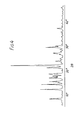
- An infrared absorption spectrum of this crystal according to a KBr method is illustrated in Figure 3.
- Example 2 200 g of the crystalline Y-isomer of fenvalerate used in Example 1 were dissolved in 600 g of heptane under heating. After seeding with 1 mg of the same crystalline racemate of fenvalerate as in Example 1 at 30°C, the mixture was gradually cooled to 15 0 C over a period of time of 2 hours under stirring to obtain crystals of a Y-isomer of fenvalerate (II-type crystal) which were subsequently collected by filtration. The thus-collected crystals (171 g) were found to have an X/Y of 0.2/99.8 and a melting point of 48.2 to 52.0°C.
- Example 2 2 g of the crystalline Y-isomer of fenvalerate as used in Example 1 were dissolved in 40 g of heptane under heating, and the mixture was cooled to 20.5°C, followed by seeding with 1 mg of the II-type crystal of Y-isomer of fenvalerate obtained in Example 1. The resulting mixture was stirred for 3 hours at 20.5 to 22°C, whereupon crystals of a Y-isomer of fenvalerate (II-type crystal) deposited, the mixture being in a slurry state as a whole.
- II-type crystal II-type crystal
- Example 2 To 10 g of the crystalline Y-isomer of fenvalerate as used in Example 1 were added 27 g of heptane and 3 g of toluene, and the mixture was refluxed for 30 minutes. The resulting mixture was cooled to 25°C and seeded with 1 mg of the II-type crystal of Y-isomer of fenvalerate obtained in Example 2, followed by stirring it for 1 hour at the same temperature, whereupon a crystal of a Y-isomer of fenvalerate (II-type crystal) deposited, which mixture was in a slurry state as a whole.
- II-type crystal II-type crystal
- the infrared absorption spectrum of the crystal was substantially the same as that of the crystal obtained in Example 1.
- the racemate solution that had been prepared above was seeded with 1 cc of the slurry thus obtained, and at the same time, 1 cc of a 28% aqueous ammonia solution was added thereto.
- the resulting mixture was stirred for 20 hours at -3°C, followed by subjecting it to filtration to obtain 39.78 g of a crystal of a Y-isomer of fenvalerate (II-type crystal) that was found to have an X/Y of 3.9/96.1.
Landscapes
- Life Sciences & Earth Sciences (AREA)
- Organic Chemistry (AREA)
- Chemical & Material Sciences (AREA)
- Dentistry (AREA)
- Health & Medical Sciences (AREA)
- Engineering & Computer Science (AREA)
- Plant Pathology (AREA)
- General Health & Medical Sciences (AREA)
- Wood Science & Technology (AREA)
- Zoology (AREA)
- Environmental Sciences (AREA)
- Pest Control & Pesticides (AREA)
- Agronomy & Crop Science (AREA)
- Organic Low-Molecular-Weight Compounds And Preparation Thereof (AREA)
Applications Claiming Priority (2)
| Application Number | Priority Date | Filing Date | Title |
|---|---|---|---|
| JP170478/80 | 1980-12-02 | ||
| JP55170478A JPS5793948A (en) | 1980-12-02 | 1980-12-02 | Preparation of stereoisomer mixture of higher active phenylacetic ester derivative |
Publications (2)
| Publication Number | Publication Date |
|---|---|
| EP0053500A2 true EP0053500A2 (de) | 1982-06-09 |
| EP0053500A3 EP0053500A3 (de) | 1982-09-22 |
Family
ID=15905687
Family Applications (1)
| Application Number | Title | Priority Date | Filing Date |
|---|---|---|---|
| EP81305635A Withdrawn EP0053500A3 (de) | 1980-12-02 | 1981-11-27 | Mengsel von Fenylvalerat-Stereoisomeren |
Country Status (3)
| Country | Link |
|---|---|
| US (1) | US4432908A (de) |
| EP (1) | EP0053500A3 (de) |
| JP (1) | JPS5793948A (de) |
Families Citing this family (1)
| Publication number | Priority date | Publication date | Assignee | Title |
|---|---|---|---|---|
| WO2006010994A1 (en) * | 2004-07-20 | 2006-02-02 | Council Of Scientific And Industrial Research | Process for preparing (s)-alpha-cyano-3-phenoxybenzyl-(s)-2-(4-chlorophenyl)-isovalerate |
Family Cites Families (13)
| Publication number | Priority date | Publication date | Assignee | Title |
|---|---|---|---|---|
| US4242357A (en) * | 1976-04-09 | 1980-12-30 | Bayer Aktiengesellschaft | Carboxylic acid esters for combating pests |
| FR2375161A1 (fr) * | 1976-04-23 | 1978-07-21 | Roussel Uclaf | Procede de transformation d'un ester d'acide chiral d'alcool secondaire a-cyane optiquement actif de structure (r) en ester d'acide chiral d'alcool secondaire a-cyane de structure (s) |
| JPS5324019A (en) * | 1976-08-18 | 1978-03-06 | Sumitomo Chem Co Ltd | Inspecticide comprising optically active isomer of alpha-cyano-3-phenoxybenzyl-2-(4-chlorophenyl)-isovalerate as an effective component |
| CH635563A5 (fr) * | 1977-07-07 | 1983-04-15 | Sumitomo Chemical Co | Procede pour la preparation d'un alpha-cyano-3-phenoxybenzyle optiquement actif. |
| CA1215717A (en) * | 1977-09-26 | 1986-12-23 | Samuel B. Soloway | Process for converting a stereoisomeric ester into its diastereoisomer |
| JPS54103831A (en) * | 1978-01-27 | 1979-08-15 | Sumitomo Chem Co Ltd | Separation of stereoisomers of higher active cyanoo33 phenoxybenzyl 22*44chlorophenyl**isovalerate |
| FR2416219A1 (fr) * | 1978-01-31 | 1979-08-31 | Roussel Uclaf | Esters d'acide acetique substitue optiquement actif et d'alcool benzylique substitue racemique ou optiquement actif, doues de proprietes insecticides, leur procede de preparation et les compositions les renfermant |
| GR74446B (de) * | 1978-03-20 | 1984-06-28 | American Cyanamid Co | |
| US4176195A (en) * | 1978-07-20 | 1979-11-27 | Sumitomo Chemical Company, Limited | Pesticidal α-cyanobenzyl ester enantiomer pair |
| ZA794621B (en) * | 1978-09-04 | 1980-09-24 | Ciba Geigy Ag | Novel esters |
| JPS55104249A (en) * | 1979-02-05 | 1980-08-09 | Sumitomo Chem Co Ltd | Optically active carboxylic ester its preparation, and insecticide, and acaricide comprising it |
| JPS55104253A (en) * | 1979-02-06 | 1980-08-09 | Sumitomo Chem Co Ltd | Stereoisomer of more active carboxylic ester, method of obtaining it, insecticide and acaricide comprising it |
| JPS56133253A (en) * | 1980-03-24 | 1981-10-19 | Sumitomo Chem Co Ltd | Optical isomer of cyanohydrin ester, its production and insecticide and acaricide containing the same as effective ingredient |
-
1980
- 1980-12-02 JP JP55170478A patent/JPS5793948A/ja active Granted
-
1981
- 1981-11-27 EP EP81305635A patent/EP0053500A3/de not_active Withdrawn
- 1981-12-01 US US06/326,317 patent/US4432908A/en not_active Expired - Lifetime
Also Published As
| Publication number | Publication date |
|---|---|
| JPS5793948A (en) | 1982-06-11 |
| JPS6360019B2 (de) | 1988-11-22 |
| EP0053500A3 (de) | 1982-09-22 |
| US4432908A (en) | 1984-02-21 |
Similar Documents
| Publication | Publication Date | Title |
|---|---|---|
| DE69324552T4 (de) | N'-substituierte-N,N'Diacylhydrazin-Insektizide | |
| EP0038617B1 (de) | Diastereoisomere von Estern von Aminosäuren, die sie enthaltenden pestiziden Zusammensetzungen und ihre Verwendung in der Schädlingsbekämpfung | |
| DK153136B (da) | Fremgangsmaade til racemisering og opspaltning af et salt af en 2-(2-naftyl)-propionsyre og en nitrogenbase | |
| WO1979000427A1 (en) | Herbicidal pyridine derivative | |
| HU199132B (en) | Process for producing 1,3-oxazolidin-2-one derivatives and pharmaceutical compositions comprising such compounds as active ingredient | |
| DE2903057C2 (de) | ||
| EP0008833B1 (de) | Optisch aktive Derivate von Mercaptoisobuttersäure und ein Verfahren zu ihrer Herstellung | |
| EP0053500A2 (de) | Mengsel von Fenylvalerat-Stereoisomeren | |
| US4246428A (en) | Method for separation of diastereoisomeric 3-(3,4-dibenzyloxyphenyl)serine | |
| DE2830031A1 (de) | Verfahren zur herstellung von optisch aktivem alpha -cyano-3-phenoxybenzyl-2- (4-chlorphenyl)-isovalerat | |
| US4544510A (en) | Process for preparing cyclopropane carboxylic acid ester derivatives | |
| EP0176856A2 (de) | Verfahren zur Herstellung optisch aktiver Amine | |
| JPS6246540B2 (de) | ||
| EP0102062B1 (de) | 1,3-Dithiane, deren Herstellung und Verwendung | |
| US4544508A (en) | Process for the preparation of certain enantiomeric pairs of α-cyano-3-phenoxy-4-fluoro-benzyl permethrate | |
| EP0050521B1 (de) | Herstellung optisch aktiver Ester von Isovaleriansäure mit insektizider Wirkung | |
| US5128497A (en) | Conversion of pyrethroid isomers to more active species | |
| EP0593976A1 (de) | Kristallines (R)-(-)-2-Cycloheptyl-N-methylsulfonyl-[4-(2-chinolinyl-methoxy)-phenyl]-acetamid | |
| EP0060466B1 (de) | Verfahren zur Aufspaltung der 2-(4-Chlorphenyl)-3-methylbuttersäure in ihre optisch aktiven Isomere | |
| DE69320104T2 (de) | Furobenzopyranderivate, Verfahren zu ihrer Herstellung und Herbizide, die diese Derivate als aktive Komponenten enthalten | |
| EP0174358A1 (de) | Neue diateromersalze von phenylalanin sowie n-acyl abkömmlinge davon und verfahren zum trennen des optisch aktiven phenylalanins und dessen n-acyl abkömmlings | |
| US3900567A (en) | Antibiotic substances | |
| US4853477A (en) | Separation of diastereomers of cyclopropanecarboxylic acid esters | |
| EP0046950A1 (de) | Optisch aktive Isomere von trans-3-(2-Chlor-2-(4-chlor-phenyl)-vinyl)-2,2-dimethyl-cyclopropan-1-carbonsäure-(alpha-cyano-4-fluor-3-phenoxy-benzyl)-ester, Verfahren zu deren Herstellung und deren Verwendung als Ektoparasitizide | |
| EP4001271A1 (de) | Kristalline form von 2-chlor-n-cyclopropyl-5-[1-[2,6-dichlor-4-[1,2,2,2-tetrafluor-1-(trifluormethyl)ethyl]phenyl]pyrazol-4-yl]-n-methyl-pyridine-3-carboxamid |
Legal Events
| Date | Code | Title | Description |
|---|---|---|---|
| PUAI | Public reference made under article 153(3) epc to a published international application that has entered the european phase |
Free format text: ORIGINAL CODE: 0009012 |
|
| AK | Designated contracting states |
Designated state(s): CH DE FR GB IT NL |
|
| PUAL | Search report despatched |
Free format text: ORIGINAL CODE: 0009013 |
|
| AK | Designated contracting states |
Designated state(s): CH DE FR GB IT NL |
|
| 17P | Request for examination filed |
Effective date: 19830202 |
|
| STAA | Information on the status of an ep patent application or granted ep patent |
Free format text: STATUS: THE APPLICATION IS DEEMED TO BE WITHDRAWN |
|
| 18D | Application deemed to be withdrawn |
Effective date: 19840131 |
|
| RIN1 | Information on inventor provided before grant (corrected) |
Inventor name: SUZUKI, YUKIOSUMITOMO CHEMICAL APARTMENT Inventor name: TAKUMA, KENZI Inventor name: HAYASHI, MASAHIROSUMITONO CHEMICAL APARTMENT |