EP0052902A1 - Verfahren und Gerät zur Zeichentrennung - Google Patents
Verfahren und Gerät zur Zeichentrennung Download PDFInfo
- Publication number
- EP0052902A1 EP0052902A1 EP81201232A EP81201232A EP0052902A1 EP 0052902 A1 EP0052902 A1 EP 0052902A1 EP 81201232 A EP81201232 A EP 81201232A EP 81201232 A EP81201232 A EP 81201232A EP 0052902 A1 EP0052902 A1 EP 0052902A1
- Authority
- EP
- European Patent Office
- Prior art keywords
- character
- grey
- segment
- value
- values
- Prior art date
- Legal status (The legal status is an assumption and is not a legal conclusion. Google has not performed a legal analysis and makes no representation as to the accuracy of the status listed.)
- Ceased
Links
Images



Classifications
-
- G—PHYSICS
- G06—COMPUTING OR CALCULATING; COUNTING
- G06V—IMAGE OR VIDEO RECOGNITION OR UNDERSTANDING
- G06V30/00—Character recognition; Recognising digital ink; Document-oriented image-based pattern recognition
- G06V30/10—Character recognition
- G06V30/14—Image acquisition
- G06V30/148—Segmentation of character regions
- G06V30/158—Segmentation of character regions using character size, text spacings or pitch estimation
-
- G—PHYSICS
- G06—COMPUTING OR CALCULATING; COUNTING
- G06V—IMAGE OR VIDEO RECOGNITION OR UNDERSTANDING
- G06V30/00—Character recognition; Recognising digital ink; Document-oriented image-based pattern recognition
- G06V30/10—Character recognition
Definitions
- the invention relates to a method and a device for segmenting substantially fixed-pitch aligned characters, in which each character is converted into an image-element pattern.
- addresses on postal articles consist of substantially fixed-pitch type-writer or line-printer characters. Nevertheless, owing to machine defects, these characters may exhibit such pitch deviations as to become hardly segmentable.
- Recognizing a fundamental frequency in a signal is known per se from speech recognition technique, which, however, does not present the problem of spaces as in lines of characters.
- the very presence of these spaces in a character line can influence the fundamental frequency of the signal derived from the character line considerably.
- This procedure has the disadvantage that overlapping characters, or underlining of the character line, may disturb the functioning. Besides, it may be important, e.g. when recognizing characters on postal articles, to be able to recognize a specified group of characters.
- the method and the device according to the invention are based upon the insight that the character pitch can be determined in a simple manner for an entire character line by applying, one by one, several combs having different tooth pitches to the character line and seeing, for each comb, how many characters and spaces are recognized by reading between the teeth.
- the outermost character position is determined by attributing a grey-value to each of the elements making up the character image;by summing the grey-values of the image elements per column; by determining, in a constant proportion, a maximum, a minimum and a threshold of summed grey-values for the entire character line to be segmented and by selecting as outermost character position the set of grey-values summed per column, of which, seen from the end of the character line, the first column grey-value exceeds the threshold grey-value.
- each of the segments is examined at a fixed number of points, of which, in the case the centre-line of a segment of a suitable width coincides with the centre-line of a character, at least one falls at one side and at least one falls at the other side of the character, at least one of the remaining points coinciding with a grey-value column of the character.
- the invention provides a device for carrying out said method(s), comprising means for synchronizing the first segment with the first character on the character line, means for dividing the character line into segments, means for classifying the information found in each of the segments as a character, as a space or as a. non-space and means for comparing the classification results obtained with the segment widths examined.
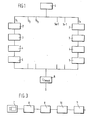
- Fig. 1 in the shape of a functional block diagram, gives an impression of the method according to the invention.
- the character line is digitized in a manner known per se.
- step 2 a start position is found for a first pitch S.
- step 3 the content is determined for every segment of the pitch chosen..
- step 4 it is determined which segments contain characters, which contain spaces and which contain non-spaces.
- step 5 a correlation factor is fixed for the results obtained by step 4 for the pitch chosen.
- the digitizing process comprising the conversion of a character line image into an image element pattern and the vertical projection thereof.
- Fig. 2a represents a character line at random. This character line is converted first into an image element pattern (Fig. 2b). Now a value is attributed to each of the image elements, which is a measure for the grey-value of that image element. Then these grey-values of image elements are summed per column.
- Fig. 2c is a diagram of the grey-values thus added. For simplicity's sake, one and the same grey-value has been attributed to each of the image elements and the number of elements per character has greatly been reduced. In practice, the height of a character corresponds to approximately 32 image elements, the width of a character line to 256 image elements and the shade of grey of each character element can be expressed in 256 values.
- a segment width S is chosen. In practice, it proves sufficient when the smallest segment width chosen corresponds to 9 image elements and the largest corresponds to 30 image elements. In order to avoid that a large and varying number of column values has to be examined for each segment, a segment will be considered described by a small and fixed number of columns. In the embodiment described there are five columns.
- left-hand valley LV
- RV right-hand valley
- LP left-hand peak
- MP middle peak
- RP right-hand peak
- the maximum value MAX and the minimum value MIN of all the grey-value columns (Fig. 2c) of the entire line are determined.
- MIN need not necessarily be zero; if the character line to be segmented is underlined, MIN will give the grey-value of the underlining.
- SPF segment-positioning factor
- the grey-value column in which this level occurs first is designated by k 0 .
- the SPF is determined for every grey-value column for which
- the grey-value column in which SPF is a maximum is called k and is considered start position for the line. Now the grey-value column k 1 is deemed to coincide with the left-hand valley LV of the first segment w 1 .
- the combined steps described, provided for synchronizing the first segment with the first character, are referred to as synchronization.
- the SPF for the area between k 1 and k 1 + S is determined first.
- the values for k and SPF are recorded in one store.
- the starting-line for the next segment is determined by k 1 + S.
- the SPF is determined of each of the segments beginning at k 2 - 1, k 2 and k 2 + 1, respectively.
- the k-value with which the largest SPF is found is regarded as the correct one and serves as starting-point for determining k3. If, however, no grey-values exceeding the value THRES are found over a width S, the segment is assumed to contain a space and the next k is determined by k w + S. In.this manner a starting value k is determined for each segment w, as well as a value for SPF and the values LV, LP, MP, RP and RV.
- an average value LAV and a standard deviation SD are determined for all the values of LV and RV.
- the average value LAV represents the background noise, which can also result from the above-mentioned underlining of the character line. So in the case of a correct segmentation, the background noise L 0 can be defined as
- each grey-value column is normalized between L 0 and L 0 + Q (formula 6).
- the values thus normalized for LV, LP, MP, RP and RV are designated by LV', LP',MP', RP' and RV', respectively.
- the total value -TSC for a line divided into segments is determined by summing the values of all the segments.
- the correlation factor referred to hereinabove is determined by the value TSC, the number of segments U in which a character is found, the number of segments V in which a space is found, the standard deviation SD and the value Q that has been found, in the following proportion:
- a process as has been described in the above paragraphs 2 to 5 is carried out on each of the segment widths deemed possible.
- a correlation factor C F can be determined for each of these pitches. It is clear that the pitch giving the highest correlation factor C F is the most probable pitch.
- the method according to the invention thus provides a reliable segmentation of characters and spaces on a character line and has the particular advantage that, thanks to the designation of each segment, certain groups of spaces and characters can easily be recognized. Thus the place of a postcode can be detected in a simple manner.
- the device according to the invention consists substantially of the parts represented in Fig. 3. It comprises a reading unit 7, which converts the optical signal of the character lines to be segmented into an electric signal consisting of image elements. Such a unit may comprise a TV camera or a series of diodes and is otherwise generally known.
- a pre-processing unit 8 ensures the detecting and correcting of crooked character lines or characters that are not printed straight.
- the width of a character line comprises 256 image elements, so that the total information digitized by the pre-processor 8 can be represented by 256 x 13 bits.
- the process by which this is done is generally known and will not be explained here, since it is no essential part of the present invention.
- a classifying unit 10 classifies the segments found according to their nature - character space or non-space - by the criteria elucidated hereinabove.
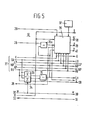
- Fig. 5 is a more detailed representation of the classifying unit.
- the classification data found are fed to a correlation circuit 11, which determines the maximum correlation factor.
- the electric analogue of the image elements projected, which is fed to the synchronizing and segmenting unit 9, is recorded in a 256 x 13 bit addressable store (RAM) 12 (Fig. 4).
- a comparator 13 determines the levels THRES and MAX, after which a comparator-counter 14 detects the first image-element column k 0 of which the value recorded in store 12 exceeds the THRES-level.
- a comparator-counter 15 compares the values stored in 12 over a number of steps between the limits k 0 ⁇ S V , for which the value indicated by store (ROM) 16 is used. In the first cycle the value stored in ROM 16, representing the examined segment width in image-elements, will remain unchanged. In practice a lowest value of 9 image elements for Sv proves to be amply sufficient.
- a generator 17 generates the values for column k at which the first character is assumed to be present and compares the value of k with that of a detector 18, which can determine the highest value of the co-ordinate in store 12 at which a possible character is still detected.
- a counter-store 19 determines the next value every time after a first value k has been found, as explained in the method description.
- a comparator 20 examines whether the area indicated by the k-generator 17 contains a sufficient number of values.
- a segment dividing circuit 21 determines, on the basis of the content of store 12, the segment width concerned and the k-values given by generator 17, the positions of five points P 02 P 1 , P 2 , P 3 and P 4 ; in practice, the following positions prove to result in a suitable distribution, with the relevant values of w and S V :
- a segment positioning circuit 22 derives the segment positioning factor from the values LV, LP, MP, RP and RV found at points P 0 to P 4 by formula (2) stated hereinabove.
- a comparator 23 holds the latest SPF-value and replaces it by a next, if this next value is larger.
- the values LV, LP, MP, RP and RV associated with the largest SPF-value are recorded every time in a store 24.
- the initial co-ordinate k and the co-ordinates of points P 0 to P 4 for which SPF is a maximum are recorded column by column in a tabular RAM 25 for every segment number w supplied by classification unit 10 via input 26.
- circuit 9 has output terminals 27, via which the values recorded in store 25 can be passed to the further circuit; output terminals 28, 29, 30 and 31, for outputting the maximum cumulative grey-value level, the content of store 12, the total number of segments W of the line and the number of image points per segment S, respectively, and an input terminal 32, for changing the address of store 16 in order to set a different value for the pitch S.
- the classification unit 10, represented in more detail in Fig. 5, comprises an adder 33, which adds up the values LV and RV from store 25, in order to determine the average value LAV of the grey-values in the left-hand and right-hand valley of each segment. Therefore adder 33 carries out the following operation:
- a circuit 34 calculates the standard deviation SD of the values LV and RV. As has been observed already, these two values are a measure for the correctness of the segment.width S chosen, since, with a correct .,segment width the standard deviation SD will be nearly equal to zero.
- a subtracter 35 determines the difference between the average value LAV and the standard deviation SD.
- a subtracter 35a subtracts the value found by 35 from the maximum grey-level MAX and the value Q thus found - see formula (6) - is fed to a decision circuit 36, which, on the basis of the values of the pitch S set, the number of segments W, the summed grey-values LV, LP, MP, RP and RV, the co-ordinates k and the values stored in register 12 (Fig.
- Correlation circuit 11 contains a threshold element 41 for normalizing each of the values LV, LP, MP, RP and RV with respect to the average grey-value L 0 and the value Q.
- a selector 43 passes, in the case of a space, the value "0" to its output, and if the relevant segment contains no space, it passes the value fixed by 42.
- An integrator 44 adds up the values fixed by circuit 42 for all segments, in order to find the TSC-value.
- Computing-circuit 45, computing-circuit 46 and computing-circuit 47 calculate the three factors for formula 11, after which multiplier 48 determines the value for C F .
- a difference circuit 49 compares the value of C F with preceding C F - values associated with other S-values and passes, via output 50, a signal back to input 32 -(Fig. 4), in order to set ROM 16 to the next value of S. Every time, a store 51 records the largest value found for C F , together with the associated segment width S. When a correlation factor C F has been determined for each of the S-values, the value of the segment width S for which the correlation factor C - is a maximum appears at output 52. It is self-evident that the device described above for carrying out the method(s) according to the invention is only one of a plurality of embodiments.
- the character and space patterns can be derived from the outputs 27 of store 25, so that the place of a specified character configuration, as a postcode, can be derived in a simple manner.
- the invention thus provides a device for carrying out the method described hereinabove, which, even with a poor quality of print, guarantees a good segmentation of the character line.
Landscapes
- Engineering & Computer Science (AREA)
- Computer Vision & Pattern Recognition (AREA)
- Physics & Mathematics (AREA)
- General Physics & Mathematics (AREA)
- Multimedia (AREA)
- Theoretical Computer Science (AREA)
- Character Input (AREA)
Applications Claiming Priority (2)
| Application Number | Priority Date | Filing Date | Title |
|---|---|---|---|
| NL8006371 | 1980-11-21 | ||
| NLAANVRAGE8006371,A NL183790C (nl) | 1980-11-21 | 1980-11-21 | Werkwijze voor karaktersegmentatie. |
Publications (1)
| Publication Number | Publication Date |
|---|---|
| EP0052902A1 true EP0052902A1 (de) | 1982-06-02 |
Family
ID=19836222
Family Applications (1)
| Application Number | Title | Priority Date | Filing Date |
|---|---|---|---|
| EP81201232A Ceased EP0052902A1 (de) | 1980-11-21 | 1981-10-30 | Verfahren und Gerät zur Zeichentrennung |
Country Status (3)
| Country | Link |
|---|---|
| US (1) | US4466121A (de) |
| EP (1) | EP0052902A1 (de) |
| NL (1) | NL183790C (de) |
Families Citing this family (13)
| Publication number | Priority date | Publication date | Assignee | Title |
|---|---|---|---|---|
| US4562594A (en) * | 1983-09-29 | 1985-12-31 | International Business Machines Corp. (Ibm) | Method and apparatus for segmenting character images |
| US4635290A (en) * | 1983-12-20 | 1987-01-06 | Nec Corporation | Sectioning apparatus and method for optical character reader systems |
| JPH0731714B2 (ja) * | 1986-05-29 | 1995-04-10 | インタ−ナショナル ビジネス マシ−ンズ コ−ポレ−ション | 文字成分切出し方法 |
| JPH0634256B2 (ja) * | 1987-03-04 | 1994-05-02 | シャープ株式会社 | 接触文字切出し方法 |
| NL8901759A (nl) * | 1989-07-10 | 1991-02-01 | Nederland Ptt | Werkwijze voor het detecteren van een streepcode. |
| US5091968A (en) * | 1990-12-28 | 1992-02-25 | Ncr Corporation | Optical character recognition system and method |
| JP2821285B2 (ja) * | 1991-07-23 | 1998-11-05 | キヤノン株式会社 | 画像処理方法及び装置 |
| EP0627693B1 (de) * | 1993-05-05 | 2004-11-17 | Koninklijke Philips Electronics N.V. | Vorrichtung zur Segmentierung von aus Texturen bestehenden Bildern |
| JP3237975B2 (ja) * | 1993-09-20 | 2001-12-10 | 富士通株式会社 | 画像処理装置 |
| US5692069A (en) * | 1995-03-17 | 1997-11-25 | Eastman Kodak Company | Apparatus for performing character segmentation using slant histograms |
| US6295371B1 (en) * | 1998-10-22 | 2001-09-25 | Xerox Corporation | Method and apparatus for image processing employing image segmentation using tokenization |
| US7079686B2 (en) * | 2002-08-20 | 2006-07-18 | Lexmark International, Inc. | Systems and methods for content-based document image enhancement |
| JP5357612B2 (ja) * | 2009-04-13 | 2013-12-04 | 株式会社日立ソリューションズ | 下線除去装置 |
Citations (1)
| Publication number | Priority date | Publication date | Assignee | Title |
|---|---|---|---|---|
| US4206442A (en) * | 1974-07-03 | 1980-06-03 | Nippon Electric Co., Ltd. | Letter segmenting apparatus for OCR comprising multi-level segmentor operable when binary segmenting fails |
-
1980
- 1980-11-21 NL NLAANVRAGE8006371,A patent/NL183790C/xx not_active IP Right Cessation
-
1981
- 1981-10-30 EP EP81201232A patent/EP0052902A1/de not_active Ceased
- 1981-11-09 US US06/319,803 patent/US4466121A/en not_active Expired - Fee Related
Patent Citations (1)
| Publication number | Priority date | Publication date | Assignee | Title |
|---|---|---|---|---|
| US4206442A (en) * | 1974-07-03 | 1980-06-03 | Nippon Electric Co., Ltd. | Letter segmenting apparatus for OCR comprising multi-level segmentor operable when binary segmenting fails |
Non-Patent Citations (5)
| Title |
|---|
| IBM Technical Disclosure Bulletin, Volume 1A, No. 10, March 1972, Armonk (US) R.J. BAUMGARTNER: "Character Pitch Determination", pages 3104-3107 * |
| IBM Technical Disclosure Bulletin, Volume 21, No. 9, February 1979, Armonk (US) D.A. BISHOP et al.: "Character Recognition Approach Involving Histogram Classification", pages 3461-3467 * |
| IBM Technical Disclosure Bulletin, Volume 23, No. 3, August 1980, Armonk (US) C.R. JIH.: "Segmentation Method for Fixed-Pitch and Machine-Printed Documents", page 1194 * |
| IBM, Journal of Research and Development, Volume 15, No. 2, March 1972, Armonk (US) R.L. HOFFMAN et al.: "Segmentatiobn Methods for Recognition of Machine-Printed Characters", pages 153-165 * |
| Wissenschaftliche Berichte, Aeg-Telefunken, Volume 47, No. 3/4, 1974, Berlin (DE) J. SCHURMANN: "Bildvorbereitung fur die Automatische Zeichenerkennung", pages 90-99 * |
Also Published As
| Publication number | Publication date |
|---|---|
| NL8006371A (nl) | 1982-06-16 |
| NL183790B (nl) | 1988-08-16 |
| US4466121A (en) | 1984-08-14 |
| NL183790C (nl) | 1989-01-16 |
Similar Documents
| Publication | Publication Date | Title |
|---|---|---|
| US4466121A (en) | Method and device for character segmentation | |
| US5764799A (en) | OCR method and apparatus using image equivalents | |
| US4926492A (en) | Optical character reading apparatus and method | |
| US4504972A (en) | Method and apparatus for automatic recognition of image and text or graphics areas on printed masters | |
| EP0138445B1 (de) | Verfahren und Anlage für die Segmentierung von Zeichendarstellungen | |
| US4979227A (en) | Method for automatic character recognition employing a lexicon having updated character strings | |
| EP0054439A2 (de) | Zeichentrennungsverfahren | |
| RU2001107822A (ru) | Распознавание знаков | |
| EP0472313A2 (de) | Gerät und Verfahren zur Bildverarbeitung | |
| US4642813A (en) | Electro-optical quality control inspection of elements on a product | |
| US4308523A (en) | Apparatus and method for character recognition | |
| KR101486495B1 (ko) | 사후 광학 문자 인식 처리에서의 형상 클러스터링 기법 | |
| Souza et al. | Automatic filter selection using image quality assessment | |
| US5454049A (en) | Automatic threshold function for machine vision | |
| CN119272786A (zh) | 条码自动识别方法 | |
| US4607387A (en) | Pattern check device | |
| JPS6162983A (ja) | 楽譜読取装置 | |
| JPH0944594A (ja) | 文書画像の領域分割方法および段組種類判別方法 | |
| WO1996030893A1 (en) | Pattern recognition system | |
| JP3202402B2 (ja) | イメージ入力されたバーコードの認識処理方法 | |
| JPH07239899A (ja) | 光学的文字読取装置 | |
| JP2895115B2 (ja) | 文字切出し方法 | |
| JP3157530B2 (ja) | 文字切り出し方法 | |
| JP3163235B2 (ja) | 光学式文字読取装置 | |
| CN111161247B (zh) | 用于可变码识读字符质量验证的检测方法 |
Legal Events
| Date | Code | Title | Description |
|---|---|---|---|
| PUAI | Public reference made under article 153(3) epc to a published international application that has entered the european phase |
Free format text: ORIGINAL CODE: 0009012 |
|
| AK | Designated contracting states |
Designated state(s): BE DE FR GB IT |
|
| ITCL | It: translation for ep claims filed |
Representative=s name: STUDIO MASSARI S.R.L. |
|
| DET | De: translation of patent claims | ||
| 17P | Request for examination filed |
Effective date: 19821202 |
|
| STAA | Information on the status of an ep patent application or granted ep patent |
Free format text: STATUS: THE APPLICATION HAS BEEN REFUSED |
|
| 18R | Application refused |
Effective date: 19871203 |
|
| RIN1 | Information on inventor provided before grant (corrected) |
Inventor name: TAN, HONG SIE Inventor name: DAMEN, JOZEF THEODORUS WILHELMUS |