EP0050870B1 - Verfahren zur Herstellung von N-tert.-Alkylaminen oder Cycloalkylaminen und Estern der Ameisensäure - Google Patents
Verfahren zur Herstellung von N-tert.-Alkylaminen oder Cycloalkylaminen und Estern der Ameisensäure Download PDFInfo
- Publication number
- EP0050870B1 EP0050870B1 EP81108899A EP81108899A EP0050870B1 EP 0050870 B1 EP0050870 B1 EP 0050870B1 EP 81108899 A EP81108899 A EP 81108899A EP 81108899 A EP81108899 A EP 81108899A EP 0050870 B1 EP0050870 B1 EP 0050870B1
- Authority
- EP
- European Patent Office
- Prior art keywords
- tert
- formic acid
- alkanols
- tertiary
- hydrogen cyanide
- Prior art date
- Legal status (The legal status is an assumption and is not a legal conclusion. Google has not performed a legal analysis and makes no representation as to the accuracy of the status listed.)
- Expired
Links
- BDAGIHXWWSANSR-UHFFFAOYSA-N Formic acid Chemical class OC=O BDAGIHXWWSANSR-UHFFFAOYSA-N 0.000 title claims abstract description 35
- 238000000034 method Methods 0.000 title claims abstract description 28
- 238000004519 manufacturing process Methods 0.000 title claims abstract 3
- LELOWRISYMNNSU-UHFFFAOYSA-N hydrogen cyanide Chemical compound N#C LELOWRISYMNNSU-UHFFFAOYSA-N 0.000 claims abstract description 56
- 239000002253 acid Substances 0.000 claims abstract description 18
- 235000019253 formic acid Nutrition 0.000 claims abstract description 17
- OSWFIVFLDKOXQC-UHFFFAOYSA-N 4-(3-methoxyphenyl)aniline Chemical compound COC1=CC=CC(C=2C=CC(N)=CC=2)=C1 OSWFIVFLDKOXQC-UHFFFAOYSA-N 0.000 claims abstract description 15
- 150000002148 esters Chemical class 0.000 claims abstract description 13
- 150000007513 acids Chemical class 0.000 claims abstract description 12
- QAOWNCQODCNURD-UHFFFAOYSA-N Sulfuric acid Chemical compound OS(O)(=O)=O QAOWNCQODCNURD-UHFFFAOYSA-N 0.000 claims description 20
- 150000001412 amines Chemical class 0.000 claims description 14
- 239000011541 reaction mixture Substances 0.000 claims description 13
- -1 formic acid ester Chemical class 0.000 claims description 2
- 235000011149 sulphuric acid Nutrition 0.000 claims 1
- 239000001117 sulphuric acid Substances 0.000 claims 1
- OKKJLVBELUTLKV-UHFFFAOYSA-N Methanol Chemical compound OC OKKJLVBELUTLKV-UHFFFAOYSA-N 0.000 description 24
- HEMHJVSKTPXQMS-UHFFFAOYSA-M Sodium hydroxide Chemical compound [OH-].[Na+] HEMHJVSKTPXQMS-UHFFFAOYSA-M 0.000 description 18
- DKGAVHZHDRPRBM-UHFFFAOYSA-N Tert-Butanol Chemical compound CC(C)(C)O DKGAVHZHDRPRBM-UHFFFAOYSA-N 0.000 description 18
- TZIHFWKZFHZASV-UHFFFAOYSA-N methyl formate Chemical compound COC=O TZIHFWKZFHZASV-UHFFFAOYSA-N 0.000 description 12
- 239000000126 substance Substances 0.000 description 10
- 238000006243 chemical reaction Methods 0.000 description 9
- YBRBMKDOPFTVDT-UHFFFAOYSA-N tert-butylamine Chemical compound CC(C)(C)N YBRBMKDOPFTVDT-UHFFFAOYSA-N 0.000 description 8
- 239000000243 solution Substances 0.000 description 7
- XLYOFNOQVPJJNP-UHFFFAOYSA-N water Substances O XLYOFNOQVPJJNP-UHFFFAOYSA-N 0.000 description 7
- MSXVEPNJUHWQHW-UHFFFAOYSA-N 2-methylbutan-2-ol Chemical compound CCC(C)(C)O MSXVEPNJUHWQHW-UHFFFAOYSA-N 0.000 description 6
- 238000009835 boiling Methods 0.000 description 5
- LFQSCWFLJHTTHZ-UHFFFAOYSA-N Ethanol Chemical compound CCO LFQSCWFLJHTTHZ-UHFFFAOYSA-N 0.000 description 4
- 125000004432 carbon atom Chemical group C* 0.000 description 4
- PAFZNILMFXTMIY-UHFFFAOYSA-N cyclohexylamine Chemical compound NC1CCCCC1 PAFZNILMFXTMIY-UHFFFAOYSA-N 0.000 description 4
- 230000007062 hydrolysis Effects 0.000 description 4
- 238000006460 hydrolysis reaction Methods 0.000 description 4
- 238000002360 preparation method Methods 0.000 description 4
- NDVWOBYBJYUSMF-UHFFFAOYSA-N 2-methylcyclohexan-1-ol Chemical compound CC1CCCCC1O NDVWOBYBJYUSMF-UHFFFAOYSA-N 0.000 description 3
- RTZKZFJDLAIYFH-UHFFFAOYSA-N Diethyl ether Chemical compound CCOCC RTZKZFJDLAIYFH-UHFFFAOYSA-N 0.000 description 3
- 150000001336 alkenes Chemical class 0.000 description 3
- 125000000217 alkyl group Chemical group 0.000 description 3
- HPXRVTGHNJAIIH-UHFFFAOYSA-N cyclohexanol Chemical compound OC1CCCCC1 HPXRVTGHNJAIIH-UHFFFAOYSA-N 0.000 description 3
- 150000003948 formamides Chemical class 0.000 description 3
- 125000002496 methyl group Chemical group [H]C([H])([H])* 0.000 description 3
- GELMWIVBBPAMIO-UHFFFAOYSA-N 2-methylbutan-2-amine Chemical compound CCC(C)(C)N GELMWIVBBPAMIO-UHFFFAOYSA-N 0.000 description 2
- HTSABYAWKQAHBT-UHFFFAOYSA-N 3-methylcyclohexanol Chemical compound CC1CCCC(O)C1 HTSABYAWKQAHBT-UHFFFAOYSA-N 0.000 description 2
- MQWCXKGKQLNYQG-UHFFFAOYSA-N 4-methylcyclohexan-1-ol Chemical compound CC1CCC(O)CC1 MQWCXKGKQLNYQG-UHFFFAOYSA-N 0.000 description 2
- ZHNUHDYFZUAESO-UHFFFAOYSA-N Formamide Chemical compound NC=O ZHNUHDYFZUAESO-UHFFFAOYSA-N 0.000 description 2
- VEXZGXHMUGYJMC-UHFFFAOYSA-N Hydrochloric acid Chemical compound Cl VEXZGXHMUGYJMC-UHFFFAOYSA-N 0.000 description 2
- VQTUBCCKSQIDNK-UHFFFAOYSA-N Isobutene Chemical compound CC(C)=C VQTUBCCKSQIDNK-UHFFFAOYSA-N 0.000 description 2
- AFVFQIVMOAPDHO-UHFFFAOYSA-N Methanesulfonic acid Chemical compound CS(O)(=O)=O AFVFQIVMOAPDHO-UHFFFAOYSA-N 0.000 description 2
- 239000002585 base Substances 0.000 description 2
- 239000003795 chemical substances by application Substances 0.000 description 2
- 239000000203 mixture Substances 0.000 description 2
- SDLAKRCBYGZJRW-UHFFFAOYSA-N n-tert-butylformamide Chemical compound CC(C)(C)NC=O SDLAKRCBYGZJRW-UHFFFAOYSA-N 0.000 description 2
- NOOLISFMXDJSKH-UTLUCORTSA-N (+)-Neomenthol Chemical compound CC(C)[C@@H]1CC[C@@H](C)C[C@@H]1O NOOLISFMXDJSKH-UTLUCORTSA-N 0.000 description 1
- DTGKSKDOIYIVQL-WEDXCCLWSA-N (+)-borneol Chemical compound C1C[C@@]2(C)[C@@H](O)C[C@@H]1C2(C)C DTGKSKDOIYIVQL-WEDXCCLWSA-N 0.000 description 1
- REPVLJRCJUVQFA-UHFFFAOYSA-N (-)-isopinocampheol Natural products C1C(O)C(C)C2C(C)(C)C1C2 REPVLJRCJUVQFA-UHFFFAOYSA-N 0.000 description 1
- MOISVRZIQDQVPF-RNLVFQAGSA-N (rac)-2,6-dimethylcyclohexanol Natural products C[C@@H]1CCC[C@H](C)[C@@H]1O MOISVRZIQDQVPF-RNLVFQAGSA-N 0.000 description 1
- VTBOTOBFGSVRMA-UHFFFAOYSA-N 1-Methylcyclohexanol Chemical compound CC1(O)CCCCC1 VTBOTOBFGSVRMA-UHFFFAOYSA-N 0.000 description 1
- CAKWRXVKWGUISE-UHFFFAOYSA-N 1-methylcyclopentan-1-ol Chemical compound CC1(O)CCCC1 CAKWRXVKWGUISE-UHFFFAOYSA-N 0.000 description 1
- MOISVRZIQDQVPF-UHFFFAOYSA-N 2,6-dimethylcyclohexan-1-ol Chemical compound CC1CCCC(C)C1O MOISVRZIQDQVPF-UHFFFAOYSA-N 0.000 description 1
- BVIJQMCYYASIFP-UHFFFAOYSA-N 2-methylcyclopentan-1-ol Chemical compound CC1CCCC1O BVIJQMCYYASIFP-UHFFFAOYSA-N 0.000 description 1
- FRDAATYAJDYRNW-UHFFFAOYSA-N 3-methyl-3-pentanol Chemical compound CCC(C)(O)CC FRDAATYAJDYRNW-UHFFFAOYSA-N 0.000 description 1
- VEALHWXMCIRWGC-UHFFFAOYSA-N 3-methylcyclopentan-1-ol Chemical compound CC1CCC(O)C1 VEALHWXMCIRWGC-UHFFFAOYSA-N 0.000 description 1
- KYWJZCSJMOILIZ-UHFFFAOYSA-N 3-methylhexan-3-ol Chemical compound CCCC(C)(O)CC KYWJZCSJMOILIZ-UHFFFAOYSA-N 0.000 description 1
- CCOQPGVQAWPUPE-UHFFFAOYSA-N 4-tert-butylcyclohexan-1-ol Chemical compound CC(C)(C)C1CCC(O)CC1 CCOQPGVQAWPUPE-UHFFFAOYSA-N 0.000 description 1
- 229940091886 4-tert-butylcyclohexanol Drugs 0.000 description 1
- NOOLISFMXDJSKH-UHFFFAOYSA-N DL-menthol Natural products CC(C)C1CCC(C)CC1O NOOLISFMXDJSKH-UHFFFAOYSA-N 0.000 description 1
- UFHFLCQGNIYNRP-UHFFFAOYSA-N Hydrogen Chemical compound [H][H] UFHFLCQGNIYNRP-UHFFFAOYSA-N 0.000 description 1
- RMOUBSOVHSONPZ-UHFFFAOYSA-N Isopropyl formate Chemical compound CC(C)OC=O RMOUBSOVHSONPZ-UHFFFAOYSA-N 0.000 description 1
- AMQJEAYHLZJPGS-UHFFFAOYSA-N N-Pentanol Chemical compound CCCCCO AMQJEAYHLZJPGS-UHFFFAOYSA-N 0.000 description 1
- XTUVJUMINZSXGF-UHFFFAOYSA-N N-methylcyclohexylamine Chemical compound CNC1CCCCC1 XTUVJUMINZSXGF-UHFFFAOYSA-N 0.000 description 1
- XBDQKXXYIPTUBI-UHFFFAOYSA-M Propionate Chemical compound CCC([O-])=O XBDQKXXYIPTUBI-UHFFFAOYSA-M 0.000 description 1
- PMZURENOXWZQFD-UHFFFAOYSA-L Sodium Sulfate Chemical compound [Na+].[Na+].[O-]S([O-])(=O)=O PMZURENOXWZQFD-UHFFFAOYSA-L 0.000 description 1
- 230000002378 acidificating effect Effects 0.000 description 1
- VLLNJDMHDJRNFK-UHFFFAOYSA-N adamantan-1-ol Chemical compound C1C(C2)CC3CC2CC1(O)C3 VLLNJDMHDJRNFK-UHFFFAOYSA-N 0.000 description 1
- 239000003513 alkali Substances 0.000 description 1
- 150000003973 alkyl amines Chemical group 0.000 description 1
- WUOACPNHFRMFPN-UHFFFAOYSA-N alpha-terpineol Chemical compound CC1=CCC(C(C)(C)O)CC1 WUOACPNHFRMFPN-UHFFFAOYSA-N 0.000 description 1
- 239000007864 aqueous solution Substances 0.000 description 1
- 125000004429 atom Chemical group 0.000 description 1
- SRSXLGNVWSONIS-UHFFFAOYSA-N benzenesulfonic acid Chemical compound OS(=O)(=O)C1=CC=CC=C1 SRSXLGNVWSONIS-UHFFFAOYSA-N 0.000 description 1
- 229940092714 benzenesulfonic acid Drugs 0.000 description 1
- 230000015572 biosynthetic process Effects 0.000 description 1
- 229940116229 borneol Drugs 0.000 description 1
- CKDOCTFBFTVPSN-UHFFFAOYSA-N borneol Natural products C1CC2(C)C(C)CC1C2(C)C CKDOCTFBFTVPSN-UHFFFAOYSA-N 0.000 description 1
- KXZJHVJKXJLBKO-UHFFFAOYSA-N chembl1408157 Chemical compound N=1C2=CC=CC=C2C(C(=O)O)=CC=1C1=CC=C(O)C=C1 KXZJHVJKXJLBKO-UHFFFAOYSA-N 0.000 description 1
- QCRFMSUKWRQZEM-UHFFFAOYSA-N cycloheptanol Chemical compound OC1CCCCCC1 QCRFMSUKWRQZEM-UHFFFAOYSA-N 0.000 description 1
- 125000000113 cyclohexyl group Chemical group [H]C1([H])C([H])([H])C([H])([H])C([H])(*)C([H])([H])C1([H])[H] 0.000 description 1
- FHADSMKORVFYOS-UHFFFAOYSA-N cyclooctanol Chemical compound OC1CCCCCCC1 FHADSMKORVFYOS-UHFFFAOYSA-N 0.000 description 1
- XCIXKGXIYUWCLL-UHFFFAOYSA-N cyclopentanol Chemical compound OC1CCCC1 XCIXKGXIYUWCLL-UHFFFAOYSA-N 0.000 description 1
- SQIFACVGCPWBQZ-UHFFFAOYSA-N delta-terpineol Natural products CC(C)(O)C1CCC(=C)CC1 SQIFACVGCPWBQZ-UHFFFAOYSA-N 0.000 description 1
- VAYGXNSJCAHWJZ-UHFFFAOYSA-N dimethyl sulfate Chemical compound COS(=O)(=O)OC VAYGXNSJCAHWJZ-UHFFFAOYSA-N 0.000 description 1
- DTGKSKDOIYIVQL-UHFFFAOYSA-N dl-isoborneol Natural products C1CC2(C)C(O)CC1C2(C)C DTGKSKDOIYIVQL-UHFFFAOYSA-N 0.000 description 1
- 150000002170 ethers Chemical class 0.000 description 1
- 125000001495 ethyl group Chemical group [H]C([H])([H])C([H])([H])* 0.000 description 1
- WBJINCZRORDGAQ-UHFFFAOYSA-N formic acid ethyl ester Natural products CCOC=O WBJINCZRORDGAQ-UHFFFAOYSA-N 0.000 description 1
- 238000010438 heat treatment Methods 0.000 description 1
- 229910052739 hydrogen Inorganic materials 0.000 description 1
- 239000001257 hydrogen Substances 0.000 description 1
- 125000001449 isopropyl group Chemical group [H]C([H])([H])C([H])(*)C([H])([H])[H] 0.000 description 1
- 229940041616 menthol Drugs 0.000 description 1
- 229940098779 methanesulfonic acid Drugs 0.000 description 1
- BDERNNFJNOPAEC-UHFFFAOYSA-N propan-1-ol Chemical compound CCCO BDERNNFJNOPAEC-UHFFFAOYSA-N 0.000 description 1
- 125000001436 propyl group Chemical group [H]C([*])([H])C([H])([H])C([H])([H])[H] 0.000 description 1
- 230000035484 reaction time Effects 0.000 description 1
- 238000010992 reflux Methods 0.000 description 1
- 150000003839 salts Chemical class 0.000 description 1
- 229910052938 sodium sulfate Inorganic materials 0.000 description 1
- 235000011152 sodium sulphate Nutrition 0.000 description 1
- 125000005346 substituted cycloalkyl group Chemical group 0.000 description 1
- 150000003460 sulfonic acids Chemical class 0.000 description 1
- 229940116411 terpineol Drugs 0.000 description 1
- 150000003509 tertiary alcohols Chemical class 0.000 description 1
Classifications
-
- C—CHEMISTRY; METALLURGY
- C07—ORGANIC CHEMISTRY
- C07C—ACYCLIC OR CARBOCYCLIC COMPOUNDS
- C07C67/00—Preparation of carboxylic acid esters
- C07C67/18—Preparation of carboxylic acid esters by conversion of a group containing nitrogen into an ester group
- C07C67/22—Preparation of carboxylic acid esters by conversion of a group containing nitrogen into an ester group from nitriles
Definitions
- the invention relates to a process for the preparation of amines and esters by reacting alkanols with hydrogen cyanide in the presence of strong acids.
- N-tertiary alkyl amines Several processes are known for the preparation of N-tertiary alkyl amines. In all cases, N-tert-alkylformamides are initially obtained in a first process step. From these, the N-tert-alkylamines are then produced in a second process stage by hydrolysis, formic acid being formed at the same time.
- N-tert.-alkylformamides by reacting tertiary alcohols or branched alkenes with hydrogen cyanide using formic acid as the condensing agent and to convert the formamides into the N-tert.-alkylamines by hydrolysis using alkali (DE-AS 2 236 040).
- the reaction times for the formation of the formamides are very long and the space-time yields achieved are low.
- Usable yields are only achieved if the hydrogen cyanide and especially the formic acid are used in a multiple molar excess. These substances used in excess can only be recovered with considerable effort and moreover only incompletely.
- N-tert-alkylformamides are formed from tert-alkyl ethers if the ethers are reacted with hydrogen cyanide in 4 to 50 times the amount of concentrated acid and the reaction mixture is diluted with water (US Pat. No. 2,518,156) . This process is very complex because of the large amount of concentrated acid required.
- a process has now been found for the preparation of amines and esters by reacting alkanols with hydrogen cyanide in the presence of strong acids, which is characterized in that tertiary alkanols or cycloalkanols in the presence of up to about twice the molar amounts of the strong acids by means of primary or secondary Alkanols to N-tert-alkylamines or cycloalkylamines and esters of formic acid with primary or secondary alkanols.
- the amines and at the same time the esters of formic acid are formed directly from the alkanols. Both the amines and the esters are obtained in excellent yield.
- the process according to the invention is particularly suitable for the reaction of alkanols of the general formula in which R 1 , R 2 and R 3 are identical or different and are unbranched or branched, optionally substituted, alkyl groups having 1 to 10, preferably 1 to 4, carbon atoms, in particular methyl groups, or R 1 and R 2 together with the C--
- the atom to which they are attached is an optionally substituted cycloalkyl ring with 5 to 12, preferably 5 to 8, carbon atoms in the ring, in particular a cyclohexane ring, and R 3 is hydrogen or an unbranched or branched, optionally substituted and optionally substituted with R 1 or R 2 is an alkyl group which is closed to form a ring and has 1 to 10, preferably 1 to 4, carbon atoms, in particular a methyl group, by means of alkanols of the general formula in which R 4 is an unbranched or branched alkyl group having 1 to 10 carbon atoms, preferably a
- tertiary alkanols are 2-methylpentanol- (2), 2-methylhexanol- (2), 3-methylpentanol- (3), 3-methylhexanol- (3) and 2,3-dime thylbutanol- (2), 2,3-dimethylpentanol- (3), 2,5-dimethylhexanediol- (2.5) and 2,4,4-trimethylpentanol- (2) and as cycloalkanols for example cyclopentanol, cyclohexanol, cycloheptanol, cyclooctanol , 4-tert-butylcyclohexanol, 2,3-dimethylcyclohexanol- (1), 1-methylcyclopentanol, 2-methylcyclopentanol, 3-methylcyclopentanol, 1-methylcyclohexanol, 2-methylcyclohexanol, 3-methylcyclohexanol, 4-methylcyclo
- hydrogen cyanide instead of hydrogen cyanide, substances can be used which give hydrogen cyanide under the reaction conditions, for example salts of hydrocyanic acid, such as sodium cyanide.
- strong acids are monoesters of sulfuric acid, advantageously with an alkanol, of the general formula corresponds in which R 4 has the meanings given above, or sulfonic acids, such as methanesulfonic acid or benzenesulfonic acid, are used. Sulfuric acid is particularly suitable.
- the proportions in which the substances are used and which reaction conditions, such as temperature and pressure, are selected may depend on the type of substances.
- the strong acids are used per mole of the tertiary alkanol or cycloalkanol. In general, it is appropriate to take about 0.8 to 1.8 moles of the acids. Preferably 1.0 to 1.3, in particular 1.05 to 1.15, moles of acids per mole of alkanol are used.
- the quantitative ratio of tertiary alkanol or cycloalkanol to hydrogen cyanide can largely be chosen as desired, but in most cases it is advantageous to take not less than about 0.8 and not more than about 2.0 moles of hydrogen cyanide per mole of the alkanol. Preferably 1.0 to 1.2 moles of hydrogen cyanide are used per mole of the alkanol. Instead of hydrogen cyanide, equivalent amounts of the substances providing hydrogen cyanide can be used. In this case, a corresponding amount of strong acid is required.
- a primary or secondary alkanol This can be introduced as such or with the other substances, optionally bound to sulfuric acid as a monoester.
- the amount of this alkanol can largely be chosen as desired, it is generally expedient to take about 1 to 4 mol, preferably 1.1 to 2.0 mol, of the primary or secondary alkanol per mole of tertiary alkanol or cycloalkanol. If necessary, only a partial amount, about 0.7 to 1.2 mol, is introduced at the beginning of the reaction and the remaining amount of the primary or secondary alkanol is introduced towards the end of the reaction.
- tertiary alkanol or cycloalkanol up to about 1 mole, in some cases up to about 4 moles, of water are generally used.
- the pressure can largely be chosen as desired, it is advantageous not to deviate significantly from the nominal pressure. In some cases, because of the presence of volatile substances, it may be expedient to work at a higher pressure corresponding to the temperatures.
- a preferred procedure is to use the starting substances, the alkanols, the hydrogen cyanide and the strong acid in anhydrous or largely anhydrous form, to carry out the reaction first at low temperatures which are below the boiling point of the reaction mixture, then optionally water and optionally the rest Add portions of the primary or secondary alkanol and finally bring the reaction mixture to a boil.
- the amine and the ester can be separated off and obtained from the reaction mixture in a manner known per se, the procedure possibly being based on the nature of the substances. It is advantageous in many cases, for example in the preparation of tert-butylamine or tert-amylamine on the one hand and the ester of formic acid with propanoic (1), propanol (2), ethanol or methanol on the other hand, first the ester from the To drive off the reaction mixture, then to release the amine in the remaining reaction mixture by means of alkaline substances and finally to drive it off.
- Example 3 The procedure was as in Example 1, but 152 g of 97% sulfuric acid (1.5 mol) and instead of tert-butanol 100.2 g (1.0 mol) of cyclohexanol were used, and 267 g of the 45% sodium hydroxide solution were added. After adding the sodium hydroxide solution, the procedure was as in Example 3. The yield of methyl formate was 52 g, corresponding to 86%, based on the hydrogen cyanide used, the yield of cyclohexylamine 78 g with 92% purity, corresponding to 72%, based on the cyclohexanol used. The boiling point of the cyclohexylamine was 133 ° C.
- Example 2 The procedure was as in Example 1, but a solution of 27.0 g of hydrogen cyanide in 74.1 g of tert-butanol was used and introduced into a mixture of 69.3 g of dimethyl sulfate and 55.6 g of concentrated sulfuric acid and before heating 27.0 g of water and 32.0 g of methanol were added at the boiling point.
- the yield of methyl formate was 56 g, corresponding to 92%, based on the hydrogen cyanide used, and the yield of tert-butylamine 67 g, corresponding to 91%, based on the tert-butanol used.
Landscapes
- Chemical & Material Sciences (AREA)
- Organic Chemistry (AREA)
- Organic Low-Molecular-Weight Compounds And Preparation Thereof (AREA)
- Low-Molecular Organic Synthesis Reactions Using Catalysts (AREA)
Description
- Die Erfindung betrifft ein Verfahren zur Herstellung von Aminen und Estern unter Umsetzung von Alkanolen mit Cyanwasserstoff in Gegenwart starker Säuren.
- Es sind mehrere Verfahren zur Herstellung von N-tert.-Alkylaminen bekannt. In allen Fällen werden zunächst in einer ersten Verfahrensstufe N-tert.-Alkyl- formamide gewonnen. Aus diesen werden dann in einer zweiten Verfahrensstufe durch Hydrolyse die N-tert.-Alkylamine erzeugt, wobei gleichzeitig Ameisensäure entsteht.
- Bekannt ist, dass bei der Umsetzung von Alkenen mit Cyanwasserstoff in Gegenwart von stark sauren Kondensationsmitteln, wie Schwefelsäure, Formamide entstehen und diese durch Hydrolyse mittels starker Säuren oder Basen in die entsprechenden Amine und Ameisensäure übergeführt werden. Beispielsweise wird aus Isobuten das N-tert.-Butylformamid und aus diesem neben Ameisensäure das N-tert.-Butylamin gebildet. Im Falle der Hydrolyse des Formamids mittels Chlorwasserstoffsäure wird aus dem Umsetzungsgemisch zunächst die Ameisensäure und dann nach Zugabe von Basen das Amin abdestilliert (DE-PS 870 856). Nachteilig ist bei diesem Verfahren, dass die Ausbeuten mässig sind und überdies die Ameisensäure in Form unreiner verdünnter wässriger Lösungen anfällt.
- Es ist auch bekannt N-tert.-Alkylformamide durch Umsetzung tertiärer Alkohole oder verzweigter Alkene mit Cyanwasserstoff unter Verwendung von Ameisensäure als Kondensationsmittel zu erzeugen und die Formamide durch Hydrolyse mittels Alkali in die N-tert.-Alkylamine zu überführen (DE-AS 2 236 040). Bei diesem Verfahren sind die Umsetzungszeiten für die Bildung der Formamide sehr lang und die erzielten Raum-Zeit-Ausbeuten gering. Brauchbare Ausbeuten werden nur erreicht, wenn der Cyanwasserstoff und insbesondere die Ameisensäure in mehrfach molarem Überschuss eingesetzt werden. Diese im Überschuss angewendeten Substanzen können nur unter erheblichem Aufwand und überdies nur unvollständig zurückgewonnen werden.
- Bekannt ist ausserdem, dass aus tert.-Alkyläthern die entsprechenden N-tert.-Alkylformamide entstehen, wenn die Äther mit Cyanwasserstoff in der 4fachen bis 50fachen Menge konzentrierter Säure umgesetzt werden und das Umsetzungsgemisch mit Wasser verdünnt wird (US-PS 2 518 156). Dieses Verfahren ist wegen der erforderlichen grossen Menge konzentrierter Säure sehr aufwendig.
- Schliesslich ist auch bekannt, das durch Umsetzung von Alkenen mit Cyanwasserstoff in Gegenwart von Schwefelsäure erzeugte tert.-Butylformamid mittels Natriumhydroxyd zu hydrolysieren, zunächst aus dem Umsetzungsgemisch das tert.-Butylamin abzudestillieren, dann in dem restlichen Umsetzungsgemisch die Ameisensäure mittels Schwefelsäure freizusetzen und mit Methanol zu verestern und schliesslich den Ameisensäuremethylester abzudestillieren (US-PS 4 131 642). Bei diesem Verfahren ist die Ausbeute sowohl an dem tert.-Butylamin als auch an dem Ameisensäureester unbefriedigend.
- Es ist nun ein Verfahren zur Herstellung von Aminen und Estern unter Umsetzung von Alkanolen mit Cyanwasserstoff in Gegenwart starker Säuren gefunden worden, das dadurch gekennzeichnet ist, däss tertiäre Alkanole oder Cyloalkanole in Gegenwart der bis zu etwa zweifachen molaren Mengen der starken Säuren mittels primärer oder sekundärer Alkanole zu N-tert.-Alkylaminen oder Cycloalkylaminen und Estern der Ameisensäure mit primären oder sekundären Alkanolen werden. Bei diesem Verfahren werden unmittelbar aus den Alkanolen die Amine und gleichzeitig die Ester der Ameisensäure gebildet. Sowohl die Amine als auch die Ester fallen mit ausgezeichneter Ausbeute an.
- Das erfindungsgemässe Verfahren ist besonders geeignet für die Umsetzung von Alkanolen der allgemeinen Formel



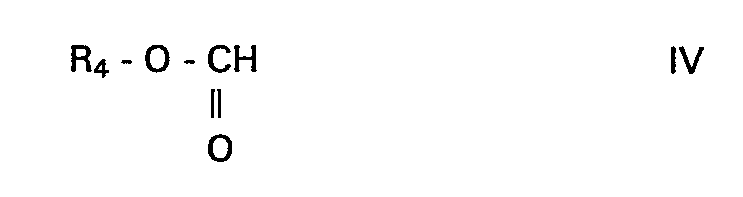
- Als tertiäre Alkanole kommen beispielsweise 2--Methylpentanol-(2), 2-Methylhexanol-(2), 3-Methylpentanol-(3), 3-Methylhexanol-(3), 2,3-Dimethylbutanol-(2), 2,3-Dimethylpentanol-(3), 2,5-Dimethylhexandiol-(2,5) und 2,4,4-Trimethylpentanol-(2) und als Cycloalkanole beispielsweise Cyclopentanol, Cyclohexanol, Cycloheptanol, Cyclooctanol, 4-tert.-Butylcyclohexanol, 2,3-Dimethylcyclohexanol-(1), 1-Methylcyclopentanol, 2-Methylcyclopentanol, 3-Methylcyclopentanol, 1-Methylcyclohexanol, 2-Methylcyclohexanol, 3-Methylcyclohexanol, 4-Methylcyclohexanol, 2,6-Dimethylcyclohexanol, Borneol, Terpineol, Menthol und 1-Adamantol in Frage. Mit besonderem Vorteil ist das erfindungsgemässe Verfahren für die Umsetzung des tert.-Butanols und des tert.-Amylalkohols geeignet.
- Statt Cyanwasserstoff können Substanzen verwendet werden, die unter den Umsetzungsbedingungen Cyanwasserstoff liefern, beispielsweise Salze der Cyanwasserstoffsäure, wie Natriumcyanid.
- Als starke Säuren werden beispielsweise Monoester der Schwefelsäure, zweckmässigerweise mit einem Alkanol, das der allgemeinen Formel

- In welchen Mengenverhältnissen die Substanzen angewendet werden und welche Umsetzungsbedingungen, wie Temperatur und Druck, gewählt werden, richtet sich gegebenenfalls nach der Art der Substanzen.
- Je Mol des tertiären Alkanols oder Cycloalkanols werden bis zu etwa 2 Mol der starken Säuren eingesetzt. Im allgemeinen ist es zweckmässig, etwa 0,8 bis 1,8 Mol der Säuren zu nehmen. Vorzugsweise werden 1,0 bis 1,3, insbesondere 1,05 bis 1,15, Mol der Säuren je Mol des Alkanols angewendet.
- Das Mengenverhältnis tertiäres Alkanol oder Cycloalkanol zu Cyanwasserstoff kann weitgehend beliebig gewählt werden, jedoch ist es in den meisten Fällen vorteilhaft, nicht weniger als etwa 0,8 und nicht mehr als etwa 2,0 Mol Cyanwasserstoff je Mol des Alkanols zu nehmen. Vorzugsweise werden 1,0 bis 1,2 Mol Cyanwasserstoff je Mol des Alkanols angewendet. Anstelle von Cyanwasserstoff können diesem äquivalente Mengen der Cyanwasserstoff liefernden Substanzen eingesetzt werden. In diesem Fall wird zusätzlich eine entsprechende Menge starker Säure benötigt.
- Zur Durchführung des erfindungsgemässen Verfahrens ist es erforderlich, ein primäres oder sekundäres Alkanol zuzusetzen. Dieses kann als solches oder mit den übrigen Substanzen, gegebenenfalls als Monoester an Schwefelsäure gebunden, eingebracht werden. Wenngleich die Menge dieses Alkanols weitgehend beliebig gewählt werden kann, ist es im allgemeinen zweckmässig, je Mol tertiäres Alkanol oder Cycloalkanol etwa 1 bis 4 Mol, vorzugsweise 1,1 bis 2,0 Mol, des primären oder sekundären Alkanols zu nehmen. Gegebenenfalls wird zu Anfang der Umsetzung nur eine Teilmenge, etwa 0,7 bis 1,2 Mol, und gegen Ende der Umsetzung die Restmenge des primären oder sekundären Alkanols eingebracht.
- Es kann, insbesondere gegen Ende der Umsetzung, zweckmässig sein, Wasser zuzusetzen. Je Mol tertiäres Alkanol oder Cycloalkanol werden im allgemeinen bis etwa 1 Mol, in manchen Fällen bis etwa 4 Mol, Wasser angewendet.
- Zweckmässig ist es im allgemeinen, bei Temperaturen etwa zwischen -30 und +100°C zu arbeiten. Vorteilhaft sind in den meisten Fällen Temperaturen zwischen 20 und 80°C. Es kann zweckmässig sein, die Umsetzung bei Temperaturen bis zu etwa 50°C zu beginnen und bei höheren Temperaturen zu beenden, wobei mit Vorteil zunächst Temperaturen gewählt werden, die unterhalb des Siedepunkts des Umsetzungsgemischs liegen, und im weiteren Verlauf das Umsetzungsgemisch zum Sieden gebracht wird.
- Wenngleich der Druck weitgehend beliebig gewählt werden kann, ist es vorteilhaft, vom Nomaldruck nicht wesentlich abzuweichen. In manchen Fällen kann es wegen des Vorliegens flüchtiger Substanzen zweckmässig sein, bei einem der Temperaturen entsprechenden höheren Druck zu arbeiten.
- Eine bevorzugte Verfahrensweise ist, die Ausgangssubstanzen, die Alkanole, den Cyanwasserstoff und die starke Säure, in wasserfreier oder weitgehend wasserfreier Form einzusetzen, die Umsetzung zunächst bei niedrigen Temperaturen, die unterhalb des Siedepunktes des Umsetzungsgemischs liegen, durchzuführen, dann gegebenenfalls Wasser und gegebenenfalls die restlichen Anteile des primären oder sekundären Alkanols zuzusetzen und schliesslich das Umsetzungsgemisch zum Sieden zu bringen.
- Aus dem Umsetzungsgemisch kann das Amin und der Ester in an sich bekannter Weise abgetrennt und gewonnen werden, wobei sich die Verfahrensweise gegebenenfalls nach der Art der Substanzen richtet. Vorteilhaft ist es in vielen Fällen, beispielsweise bei der Herstellung des tert.-Butylamins oder tert.-Amylamins einerseits und des Ester der Ameisensäure mit Propanoi-(1), Propanol-(2), Äthanol oder Methanol andererseits, zunächst den Ester aus dem Umsetzungsgemisch abzutreiben, dann im restlichen Umsetzungsgemisch mittels alkalisch wirkender Substanzen das Amin freizusetzen und schliesslich dieses abzutreiben.
- Eine Lösung von 27,0 g (1,0 Mol) Cyanwasserstoff in 74,1g( 1,0 Mo!) tert.-Butanoiund32.0g (1,0 Mol) Methanol wurde im Verlauf von 30 Minuten in 111,2 g 97%ige Schwefelsäure (1,1 Mol) eingetragen. Die Mischung wurde währenddessen auf 20 bis 25°C, weiter 60 Minuten lang auf 50°C und schliesslich nach Zugabe von 5,7 g Wasser und 32,0 g Methanol 60 Minuten lang unter Rückfluss auf Siedetemperatur gehalten. Dann wurde der Ameisensäuremethylester abdestilliert. Die Ausbeute betrug 55 g, entsprechend 91 %, bezogen auf den eingesetzten Cyanwasserstoff. Aus dem verbliebenen Umsetzungsgemisch wurde nach Zugabe von 100 g Wasser das Methanol und nach Zugabe von 196 g einer 45%igen wässrigen Natriumhydroxidlösung das tert.-Butylamin abdestilliert. Es wurden 62 g des Amins gewonnen, entsprechend 85% Ausbeute, bezogen auf das eingesetzte tert.-Butanol.
- Es wurde wie nach Beispiel 1 verfahren, jedoch wurden statt tert.-Butanol 88,1 g (1,0 Mol) tert.-Amylalkohol eingesetzt. Die Ausbeute an Ameisensäuremethylester betrug 54 g, entsprechend 90%, bezogen auf den eingesetzten Cyanwasserstoff, und die Ausbeute an tert.-Amylamin 74 g, entsprechend 85%, bezogen auf den eingesetzten Amylalkohol.
- Es wurde wie nach Beispiel 1 verfahren, jedoch wurden 152 g 97%ige Schwefelsäure (1,5 Mol) und statt tert.-Butanol 114 g (1,0 Mol) 2-Methylcyclohexanol eingesetzt sowie 267 g der 45%igen Natriumhydroxidlösung zugefügt. Die Ausbeute an Ameisensäuremethylester betrug 43 g, entsprechend 89%, bezogen auf den eingesetzten Cyanwasserstoff. Nach Zugabe der Natriumhydroxidlösung bildeten sich zwei Phasen, von denen die obere 1-Methylcyclohexylamin war. Die untere Phase wurde mit Diäthyläther extrahiert, und der Extrakt wurde mit der oberen Phase vereinigt. Diese wurde dann mit Natriumsulfat getrocknet und zur Gewinnung des Amins destilliert. Der Siedepunkt des Amins war 142°C. Die Ausbeute an Amin betrug 81 g bei 91 % Reinheit, entsprechend 65%, bezogen auf das eingesetzte 2-Methylcyclohexanol.
- Es wurde wie nach Beispiel 1 verfahren, jedoch wurden 152 g 97%ige Schwefelsäure (1,5 Mol) und statt tert.-Butanol 100,2 g (1,0 Mol) Cyclohexanol eingesetzt sowie 267 g der 45%igen Natriumhydroxidlösung zugefügt. Nach Zugabe der Natriumhydroxidlösung wurde wie nach Beispiel 3 verfahren. Die Ausbeute an Ameisensäuremethylester betrug 52 g, entsprechend 86%, bezogen auf den eingesetzten Cyanwasserstoff, die Ausbeute an Cyclohexylamin 78 g bei 92% Reinheit, entsprechend 72%, bezogen auf das eingesetzte Cyclohexanol. Der Siedepunkt des Cyclohexylamins war 133°C.
- Es wurde wie nach Beispiel 1 verfahren, jedoch wurden statt Methanol jeweils 46,1 g (1,0 Mol) Äthanol eingesetzt. Die Ausbeute an Ameisensäure- äthylester betrug 64 g, entsprechend 86%, bezogen auf den eingesetzten Cyanwasserstoff, und die Ausbeute an tert.-Butylamin 62 g, entsprechend 85%, bezogen auf das eingesetzte tert.-Butanol.
- Es wurde wie nach Beispiel 1 verfahren, jedoch wurden statt Methanol jeweils 60,1 g (1,0 Mol) Propanol-(2) eingesetzt. Die Ausbeute an Ameisensäureisopropylester betrug 89 g bei 90% Reinheit, entsprechend 91 %, bezogen auf den eingesetzten Cyanwasserstoff, und die Ausbeute an tert.-Butylamin 64 g, entsprechend 87%, bezogen auf das eingesetzte tert.-Butanol.
- Es wurde wie nach Beispiel 1 verfahren, jedoch wurde eine Lösung von 27,0 g Cyanwasserstoff in 74,1 g tert.-Butanol verwendet und in eine Mischung aus 69,3 g Dimethylsulfat und 55,6 g konzentrierter Schwefelsäure eingetragen und vor dem Erhitzen auf Siedetemperatur wurden 27,0 g Wasser und 32,0 g Methanol zugesetzt. Die Ausbeute an Ameisensäuremethylester betrug 56 g, entsprechend 92%, bezogen auf den eingesetzten Cyanwasserstoff, und die Ausbeute an tert.-Butylamin 67 g, entsprechend 91 %, bezogen auf das eingesetzte tert.-Butanol.
Claims (4)
Priority Applications (1)
| Application Number | Priority Date | Filing Date | Title |
|---|---|---|---|
| AT81108899T ATE8777T1 (de) | 1980-10-27 | 1981-10-25 | Verfahren zur herstellung von n-tert.-alkylaminen oder cycloalkylaminen und estern der ameisensaeure. |
Applications Claiming Priority (2)
| Application Number | Priority Date | Filing Date | Title |
|---|---|---|---|
| DE19803040405 DE3040405A1 (de) | 1980-10-27 | 1980-10-27 | Verfahren zur herstellung von aminen und ester (c) |
| DE3040405 | 1980-10-27 |
Publications (2)
| Publication Number | Publication Date |
|---|---|
| EP0050870A1 EP0050870A1 (de) | 1982-05-05 |
| EP0050870B1 true EP0050870B1 (de) | 1984-08-01 |
Family
ID=6115245
Family Applications (1)
| Application Number | Title | Priority Date | Filing Date |
|---|---|---|---|
| EP81108899A Expired EP0050870B1 (de) | 1980-10-27 | 1981-10-25 | Verfahren zur Herstellung von N-tert.-Alkylaminen oder Cycloalkylaminen und Estern der Ameisensäure |
Country Status (4)
| Country | Link |
|---|---|
| EP (1) | EP0050870B1 (de) |
| JP (1) | JPS57108038A (de) |
| AT (1) | ATE8777T1 (de) |
| DE (2) | DE3040405A1 (de) |
Families Citing this family (2)
| Publication number | Priority date | Publication date | Assignee | Title |
|---|---|---|---|---|
| US5527949A (en) * | 1994-08-23 | 1996-06-18 | Rohm And Haas Company | Method for making an amine and an alkyl ester and method for reducing hydrogen cyanide levels in alkyl ester |
| ATE520647T1 (de) | 2007-10-24 | 2011-09-15 | Basf Se | Verfahren zur herstellung eines primären amins mit tertiärem alpha-c-atom durch umsetzung eines tertiären alkohols mit ammoniak |
Family Cites Families (2)
| Publication number | Priority date | Publication date | Assignee | Title |
|---|---|---|---|---|
| DE1197091B (de) * | 1960-08-25 | 1965-07-22 | Studiengesellschaft Kohle Mbh | Verfahren zur Herstellung von N-(tertiaer Alkyl)-aminen |
| US3338967A (en) * | 1964-09-17 | 1967-08-29 | Armour & Co | Process for preparing secondary-alkyl primary amines from olefins |
-
1980
- 1980-10-27 DE DE19803040405 patent/DE3040405A1/de not_active Withdrawn
-
1981
- 1981-10-22 JP JP56168005A patent/JPS57108038A/ja active Pending
- 1981-10-25 EP EP81108899A patent/EP0050870B1/de not_active Expired
- 1981-10-25 DE DE8181108899T patent/DE3165258D1/de not_active Expired
- 1981-10-25 AT AT81108899T patent/ATE8777T1/de active
Also Published As
| Publication number | Publication date |
|---|---|
| EP0050870A1 (de) | 1982-05-05 |
| JPS57108038A (en) | 1982-07-05 |
| ATE8777T1 (de) | 1984-08-15 |
| DE3040405A1 (de) | 1982-06-09 |
| DE3165258D1 (en) | 1984-09-06 |
Similar Documents
| Publication | Publication Date | Title |
|---|---|---|
| DE1468177A1 (de) | Peroxyverbindungen des 2-Methylpentan-2,4-diols und Verfahren zu ihrer Herstellung | |
| EP0050870B1 (de) | Verfahren zur Herstellung von N-tert.-Alkylaminen oder Cycloalkylaminen und Estern der Ameisensäure | |
| EP0184731A1 (de) | Verfahren zur Herstellung von 2-(1-Hydroxymethyl)-acrylnitril und -acrylestern | |
| EP0050871B1 (de) | Verfahren zur Herstellung von N-tert.-Alkylaminen oder Cycloalkylaminen und Estern der Ameisensäure | |
| DE1200281B (de) | Verfahren zur Herstellung von Acetessigsaeureestern | |
| EP0050869B1 (de) | Verfahren zur Herstellung von N-tert.-Alkylaminen oder Cycloalkylaminen und Estern der Ameisensäure | |
| DE1191367B (de) | Verfahren zur Herstellung von alpha, beta-ungesaettigten Carbonsaeuren aus alpha-Oxycarbonsaeuren | |
| EP0045386B1 (de) | Verfahren zur Herstellung von Aminonitrilen | |
| EP0087585A1 (de) | Verfahren zur Herstellung von 3-Alkoxi-acrylnitrilen | |
| DE2844949A1 (de) | Verfahren zur herstellung von 4-acyloxy-2-methylcrotonaldehyden | |
| DE3130428C2 (de) | Verfahren zur tert. Butylierung von hydroxyaromatischen Verbindungen | |
| EP0050868B1 (de) | Verfahren zur Gewinnung von N-tert-Alkylaminen und Ameisensäureestern | |
| DE1668966B1 (de) | Verfahren zur gleichzeitigen Herstellung von 2,6-Dimethyl-phenol und 4-tert.-Butylphenol | |
| DE1643195C (de) | ||
| EP0128489B1 (de) | Verfahren zur Herstellung von Succinylobernsteinsäuredialkylestern | |
| EP0643036B1 (de) | Verfahren zur Herstellung von Pimelinsäureestern | |
| AT219579B (de) | Verfahren zur Herstellung von α-Cyclohexylbuttersäuredialkylaminoäthylestern und deren Salzen | |
| DE1931062C3 (de) | Verfahren zur Herstellung von 133-Trialkyl-2,4,6-tris-(3^dialkyl-4-hydroxybenzyl)-benzolen | |
| DE1924844A1 (de) | Verfahren zur Herstellung von Trimethyl-2-cyclohexen-1-onen | |
| DE1668966C (de) | Verfahren zur gleichzeitigen Herstellung von 2,6-Dimethyl-phenol und 4-tert-Butylphenol | |
| DE3422915A1 (de) | Verfahren zur herstellung von gegebenenfalls kernsubstituierten zimtsaeuren | |
| AT215987B (de) | Verfahren zur Herstellung organischer Peroxyde | |
| DE3021727A1 (de) | Verfahren zur herstellung von 4-tert.-butylbenzaldehyd | |
| DE1243667B (de) | Verfahren zur Herstellung von gegebenenfalls alkylsubstituierten Adipinsaeuren | |
| DE1668771B2 (de) | Verfahren zur herstellung von 2- methylol-1,2,6-trihydroxyhexan |
Legal Events
| Date | Code | Title | Description |
|---|---|---|---|
| PUAI | Public reference made under article 153(3) epc to a published international application that has entered the european phase |
Free format text: ORIGINAL CODE: 0009012 |
|
| 17P | Request for examination filed |
Effective date: 19811025 |
|
| AK | Designated contracting states |
Designated state(s): AT BE CH DE FR GB LI NL |
|
| GRAA | (expected) grant |
Free format text: ORIGINAL CODE: 0009210 |
|
| AK | Designated contracting states |
Designated state(s): AT BE CH DE FR GB LI NL |
|
| REF | Corresponds to: |
Ref document number: 8777 Country of ref document: AT Date of ref document: 19840815 Kind code of ref document: T |
|
| REF | Corresponds to: |
Ref document number: 3165258 Country of ref document: DE Date of ref document: 19840906 |
|
| ET | Fr: translation filed | ||
| PGFP | Annual fee paid to national office [announced via postgrant information from national office to epo] |
Ref country code: DE Payment date: 19840911 Year of fee payment: 4 |
|
| PGFP | Annual fee paid to national office [announced via postgrant information from national office to epo] |
Ref country code: AT Payment date: 19840925 Year of fee payment: 4 |
|
| PGFP | Annual fee paid to national office [announced via postgrant information from national office to epo] |
Ref country code: BE Payment date: 19840930 Year of fee payment: 4 |
|
| PGFP | Annual fee paid to national office [announced via postgrant information from national office to epo] |
Ref country code: FR Payment date: 19841030 Year of fee payment: 4 |
|
| PGFP | Annual fee paid to national office [announced via postgrant information from national office to epo] |
Ref country code: NL Payment date: 19841031 Year of fee payment: 4 Ref country code: CH Payment date: 19841031 Year of fee payment: 4 |
|
| PLBE | No opposition filed within time limit |
Free format text: ORIGINAL CODE: 0009261 |
|
| STAA | Information on the status of an ep patent application or granted ep patent |
Free format text: STATUS: NO OPPOSITION FILED WITHIN TIME LIMIT |
|
| 26N | No opposition filed | ||
| PG25 | Lapsed in a contracting state [announced via postgrant information from national office to epo] |
Ref country code: AT Effective date: 19851025 |
|
| PG25 | Lapsed in a contracting state [announced via postgrant information from national office to epo] |
Ref country code: NL Effective date: 19860501 |
|
| NLV4 | Nl: lapsed or anulled due to non-payment of the annual fee | ||
| PG25 | Lapsed in a contracting state [announced via postgrant information from national office to epo] |
Ref country code: LI Effective date: 19861031 Ref country code: CH Effective date: 19861031 Ref country code: BE Effective date: 19861031 |
|
| BERE | Be: lapsed |
Owner name: DEGUSSA A.G. Effective date: 19861031 |
|
| PG25 | Lapsed in a contracting state [announced via postgrant information from national office to epo] |
Ref country code: FR Free format text: LAPSE BECAUSE OF NON-PAYMENT OF DUE FEES Effective date: 19870630 |
|
| REG | Reference to a national code |
Ref country code: CH Ref legal event code: PL |
|
| GBPC | Gb: european patent ceased through non-payment of renewal fee | ||
| PG25 | Lapsed in a contracting state [announced via postgrant information from national office to epo] |
Ref country code: DE Effective date: 19870701 |
|
| REG | Reference to a national code |
Ref country code: FR Ref legal event code: ST |
|
| PG25 | Lapsed in a contracting state [announced via postgrant information from national office to epo] |
Ref country code: GB Effective date: 19881118 |