EP0048878A1 - Neue Hydroxiphenylgruppen enthaltende Phosphorigsäureester, Verfahren zu ihrer Herstellung und ihre Verwendung als Stabilisatoren für thermoplastische Polyester - Google Patents
Neue Hydroxiphenylgruppen enthaltende Phosphorigsäureester, Verfahren zu ihrer Herstellung und ihre Verwendung als Stabilisatoren für thermoplastische Polyester Download PDFInfo
- Publication number
- EP0048878A1 EP0048878A1 EP81107218A EP81107218A EP0048878A1 EP 0048878 A1 EP0048878 A1 EP 0048878A1 EP 81107218 A EP81107218 A EP 81107218A EP 81107218 A EP81107218 A EP 81107218A EP 0048878 A1 EP0048878 A1 EP 0048878A1
- Authority
- EP
- European Patent Office
- Prior art keywords
- hydrogen atom
- methyl
- atom
- compounds
- series
- Prior art date
- Legal status (The legal status is an assumption and is not a legal conclusion. Google has not performed a legal analysis and makes no representation as to the accuracy of the status listed.)
- Granted
Links
- 0 *P(*)Oc1ccccc1 Chemical compound *P(*)Oc1ccccc1 0.000 description 5
- XZDDZTGNCUMJHI-UHFFFAOYSA-N CC1(CO)COCOC1 Chemical compound CC1(CO)COCOC1 XZDDZTGNCUMJHI-UHFFFAOYSA-N 0.000 description 1
- QHDHNVFIKWGRJR-UHFFFAOYSA-N OC1=CCCCC1 Chemical compound OC1=CCCCC1 QHDHNVFIKWGRJR-UHFFFAOYSA-N 0.000 description 1
- RMVRSNDYEFQCLF-UHFFFAOYSA-M [S-]c1ccccc1 Chemical compound [S-]c1ccccc1 RMVRSNDYEFQCLF-UHFFFAOYSA-M 0.000 description 1
Classifications
-
- C—CHEMISTRY; METALLURGY
- C08—ORGANIC MACROMOLECULAR COMPOUNDS; THEIR PREPARATION OR CHEMICAL WORKING-UP; COMPOSITIONS BASED THEREON
- C08K—Use of inorganic or non-macromolecular organic substances as compounding ingredients
- C08K5/00—Use of organic ingredients
- C08K5/49—Phosphorus-containing compounds
- C08K5/51—Phosphorus bound to oxygen
- C08K5/52—Phosphorus bound to oxygen only
-
- C—CHEMISTRY; METALLURGY
- C07—ORGANIC CHEMISTRY
- C07F—ACYCLIC, CARBOCYCLIC OR HETEROCYCLIC COMPOUNDS CONTAINING ELEMENTS OTHER THAN CARBON, HYDROGEN, HALOGEN, OXYGEN, NITROGEN, SULFUR, SELENIUM OR TELLURIUM
- C07F9/00—Compounds containing elements of Groups 5 or 15 of the Periodic Table
- C07F9/02—Phosphorus compounds
- C07F9/547—Heterocyclic compounds, e.g. containing phosphorus as a ring hetero atom
- C07F9/6564—Heterocyclic compounds, e.g. containing phosphorus as a ring hetero atom having phosphorus atoms, with or without nitrogen, oxygen, sulfur, selenium or tellurium atoms, as ring hetero atoms
- C07F9/6571—Heterocyclic compounds, e.g. containing phosphorus as a ring hetero atom having phosphorus atoms, with or without nitrogen, oxygen, sulfur, selenium or tellurium atoms, as ring hetero atoms having phosphorus and oxygen atoms as the only ring hetero atoms
- C07F9/6574—Esters of oxyacids of phosphorus
- C07F9/65742—Esters of oxyacids of phosphorus non-condensed with carbocyclic rings or heterocyclic rings or ring systems
-
- C—CHEMISTRY; METALLURGY
- C07—ORGANIC CHEMISTRY
- C07F—ACYCLIC, CARBOCYCLIC OR HETEROCYCLIC COMPOUNDS CONTAINING ELEMENTS OTHER THAN CARBON, HYDROGEN, HALOGEN, OXYGEN, NITROGEN, SULFUR, SELENIUM OR TELLURIUM
- C07F9/00—Compounds containing elements of Groups 5 or 15 of the Periodic Table
- C07F9/02—Phosphorus compounds
- C07F9/547—Heterocyclic compounds, e.g. containing phosphorus as a ring hetero atom
- C07F9/6564—Heterocyclic compounds, e.g. containing phosphorus as a ring hetero atom having phosphorus atoms, with or without nitrogen, oxygen, sulfur, selenium or tellurium atoms, as ring hetero atoms
- C07F9/6571—Heterocyclic compounds, e.g. containing phosphorus as a ring hetero atom having phosphorus atoms, with or without nitrogen, oxygen, sulfur, selenium or tellurium atoms, as ring hetero atoms having phosphorus and oxygen atoms as the only ring hetero atoms
- C07F9/6574—Esters of oxyacids of phosphorus
- C07F9/65746—Esters of oxyacids of phosphorus the molecule containing more than one cyclic phosphorus atom
-
- C—CHEMISTRY; METALLURGY
- C08—ORGANIC MACROMOLECULAR COMPOUNDS; THEIR PREPARATION OR CHEMICAL WORKING-UP; COMPOSITIONS BASED THEREON
- C08K—Use of inorganic or non-macromolecular organic substances as compounding ingredients
- C08K5/00—Use of organic ingredients
- C08K5/49—Phosphorus-containing compounds
- C08K5/51—Phosphorus bound to oxygen
- C08K5/52—Phosphorus bound to oxygen only
- C08K5/527—Cyclic esters
Definitions
- the invention relates to compounds derived from substituted phenols and special derivatives of phosphorous acid, a process for the preparation of these new compounds and their use as stabilizers for thermoplastic polyesters, in particular polyalkylene terephthalates and fully aromatic polyesters.
- Polyalkylene terephthalates such as polyethylene and polybutylene terephthalate, and polyesters, the acid and alcohol components of which are aromatic in nature, are increasingly used due to their unusual combination of properties for the production of fibers, films and moldings by injection molding or extrusion.
- the mechanical strength, abrasion and wear resistance of polyalkylene terephthalates are particularly valued strength, rigidity, hardness, high heat resistance, resistance to chemical influences and good suitability for use in the electrical sector.
- Aromatic polyesters are particularly characterized by high softening temperature and high glass transition temperature as well as good impact or notch impact strength.
- the aromatic polyesters are ideal for the production of moldings that have to be exposed to high temperatures.
- thermoplastic polyesters are subject to water, oxygen and / or thermal stress (e.g. under normal processing conditions, especially when stored under heat or in contact with hot) Water) partial degradation.
- Oxygen atoms in parentheses written on phosphorus atoms mean that the formula describes both the phosphite and the phosphate.
- the compounds of structure I according to the invention permit the production of thermoplastic polyesters which undergo only minor changes even with long-term aging and therefore have a largely constant level of properties.
- the compounds according to the invention can be prepared in a manner known per se by reacting derivatives of phosphorous acid with bisphenols, diols and / or pentaerythritol.
- the invention thus furthermore relates to a process for the preparation of the compounds I, characterized in that reactive derivatives of phosphorous acid with bisphenols of the formula and alcohols of the formula and / or pentaerythritol in amounts such that one mole of bisphenol (IIL) and x -1 mole of alcohol IL is reacted per mole of phosphoric acid derivative, the alcohol IL being able to be replaced in whole or in part by the equivalent amount of pentaerythritol.
- reactive derivatives of phosphorous acid with bisphenols of the formula and alcohols of the formula and / or pentaerythritol in amounts such that one mole of bisphenol (IIL) and x -1 mole of alcohol IL is reacted per mole of phosphoric acid derivative, the alcohol IL being able to be replaced in whole or in part by the equivalent amount of pentaerythritol.
- Preferred reactive derivatives of phosphorous acid are phosphorus trihalides such as phosphorus trichloride or phosphorus tribromide, phosphoric acid ester halides such as phosphorous acid phenyl ester dichloride and phosphorous acid esters such as triethyl phosphite or triphenyl phosphite.
- Preferred bisphenols are IIL 4,4'-dihydroxi-3,3'-di-tert-butyl-diphenylpropane-2,2,4,4'-dihydroxi-3,3'-dicumyl-diphenylpropane-2,2,4,4'- Dihydroxy-3,3'-distyryl-diphenylpropane-2,2,4,4'-dihydroxy-3,3'-dibenzyl-diphenylpropane-2,2,4,4'-dihydroxy-3,3'-dimethyl-diphenylpropane -2,2, 4,4'-dihydroxy-3,3 1, 5,5-tetramethyl-2,2-diphenylpropane, 4,4'-dihydroxy-3,3 ', 5,5'-tetramethyl-diphenylmethane , 4,4'-dihydroxi-3,5-dimethyl-diphenylmethane, 4,4'-dihydroxi-3,5-dimethyl-diphenyl
- Preferred alcohols IL are 1,3-propanediol, 1,3-2-ethylpropanediol, 1,1,1-trishydroximethylpropane, neopentyl glycol and compounds of the following structure:
- reaction components can also be reacted with one another at the same time.
- the molar ratios 1: 2: 2 must be maintained at least approximately.
- Another object of the invention is the use of the compounds I as stabilizers for thermoplastic polyesters, in particular polyalkylene terephthalates and aromatic polyesters.
- Thermoplastic polyesters in the sense of the invention are reaction products of aromatic dicarboxylic acids (or their reactive derivatives) and aliphatic or cycloaliphatic diols or diphenols.
- Preferred polyalkylene terephthalates can be prepared from terephthalic acid (or its reactive derivatives) and alkanediols having 2 to 10 carbon atoms by known methods (Kunststoff-Handbuch, Vol. VIII, pp. 695 ff, Carl Hanser Verlag, Kunststoff 1973). Polyalkylene terephthalates are particularly preferred Polyethylene terephthalate and poly (butanediol-1,4-terephthalate).
- They generally have an intrinsic viscosity of 0.5 to 2.0 dl / g, preferably 0.6 to 1.5 dl / g and in particular 0.7 to 1.3 dl / g, measured in a mixture Phenol and o-dichlorobenzene (50/50% by weight) at 25 ° C.
- Aromatic polyesters and processes for their preparation are also known (WM Eareckson, J. Polym. Sci. Xl, 399-406 (1959); Andre Conix, "Thermoplastic Polyesters from Bisphenols", Ind. Eng. Chem., Vol. 51, No. 2, 147-150, Feb. 1959; FR 1 177 517, US 3 351 624, DE-AS 14 45 384). They mostly contain tere and / or isophthalic acid residues as condensed acid residues; preferred aromatic polyesters contain tere- and isophthalic acid residues, especially in a ratio of about 1: 1.
- Preferred diphenols for the production of the aromatic polyesters are compounds of the formula in which Z is a divalent mono- or polynuclear aromatic radical having 6-30 C atoms, Z being constructed in such a way that the two OH groups are each bonded directly to one C atom of an aromatic system.
- Particularly preferred diphenols are compounds of the formula in which Y is a single bond, an alkylene or alkylidene radical with 1-7 C atoms, a cycloalkylene or cycloalkylidene radical with 5-12 C atoms, -O-, -S-, means, and their nuclear alkylated and nuclear halogenated derivatives.
- the aromatic polyesters generally have relative solution viscosities from 1.18 to 2.0, in particular from 1.2 to 1.5 (measured in 0.5% strength by weight solution in dichloromethane at 25 ° C.).
- polyesters contain the stabilizers of the formula I according to the invention in amounts such that sufficient stabilization is achieved; in general, this is the case with amounts of from 0.01 to 2, preferably from 0.03 to 1.5, in particular from 0.05 to 1,% by weight.
- the polyesters can contain the stabilizers according to the invention alone or as a mixture with one another and also in combination with other stabilizers.
- the compounds I according to the invention can be incorporated by methods known per se during or after polyester production, by incorporating the substances as such or in the form of a separately prepared concentrate in polyester or in a mixture with other additives or solvents. However, incorporation can also take place immediately before further processing of the polyester.
- the molding compositions may also contain other additives, such as Mold release agents, lubricants, nucleating agents, dyes, pigments, fillers, reinforcing materials, flame retardants, plasticizers and light stabilizers.
- additives such as Mold release agents, lubricants, nucleating agents, dyes, pigments, fillers, reinforcing materials, flame retardants, plasticizers and light stabilizers.
- the filled and / or reinforced polyester molding compositions can contain up to 60% by weight, based on the molding composition, of a filler and / or reinforcing material.
- Preferred reinforcing materials are glass fibers.
- Preferred fillers, which can also have a reinforcing effect, are e.g. Glass balls, mica, silicates, quartz, talc, titanium dioxide, wollastonite.
- Flame retardant polyester molding compositions generally contain up to 30% by weight, based on the molding composition, of flame retardant.
- Typical flame retardants are, for example, polyhalide phenyl, polyhalodiphenyl ether, polyhalophthalic acid and its derivatives and polyhalogen polycarbonates, the corresponding bromine compounds being particularly effective.
- they usually contain a synergist, such as antimony trioxide.
- Stabilizer B After phenol has been distilled off, a yellow soft resin is obtained. The product obtained is called Stabilizer B below.
- Example 4 is repeated with 93 g (0.5 mol) of 4,4'-dihydroxidiphenyl instead of 4,4'-dihydroxidiphenyl ether. A total of 140 g of phenol distillate and 141 g of the compound XXXIX are obtained as a solid colorless residue. The compound obtained is called stabilizer E.
- Example 4 is repeated with 55 g (0.5 mol) of hydroquinone instead of 4,4'-dihydroxidiphenyl ether. After a total of 141 g of phenol have passed over, 101 g of the desired compound are obtained as a solid yellowish residue (stabilizer F).
- the granulate was after Dried at 260 ° C on a commercially available injection molding machine sprayed to standard small rods, which were exposed to hot air in a circulating air dryer or which were stored in 95 ° C hot water. After the thermal-oxidative treatment or after the hot water treatment, the impact strength was measured in accordance with DIN 53 453. The tests show that the compounds according to the invention stabilize considerably better than the comparative products. The best of the comparison products (S) according to Table 1 is also inferior to the inventive one in the hot water test. The comparative experiments S, T and S / T also show that combinations of good phenolic stabilizers with good phosphorous ester stabilizers can be considerably less effective than the pure substances and the stabilizers according to the invention.
Landscapes
- Chemical & Material Sciences (AREA)
- Organic Chemistry (AREA)
- Health & Medical Sciences (AREA)
- Life Sciences & Earth Sciences (AREA)
- Polymers & Plastics (AREA)
- Medicinal Chemistry (AREA)
- Chemical Kinetics & Catalysis (AREA)
- Biochemistry (AREA)
- General Health & Medical Sciences (AREA)
- Molecular Biology (AREA)
- Compositions Of Macromolecular Compounds (AREA)
- Fireproofing Substances (AREA)
- Polyesters Or Polycarbonates (AREA)
Abstract
Description
- Die Erfindung betrifft Verbindungen, die sich von substituierten Phenolen und speziellen Derivaten der phosphorigen Säure ableiten, ein Verfahren zur Herstellung dieser neuen Verbindungen und ihre Verwendung als Stabilisatoren für thermoplastische Polyester, insbesondere Polyalkylenterephthalate und voll-aromatische Polyester.
- Polyalkylenterephthalate, wie Polyethylen- und Polybutylenterephthalat, sowie Polyester, deren Säure-und Alkoholkomponenten aromatischer Natur sind, finden aufgrund ihrer ungewöhnlichen Eigenschaftskombination zunehmend Verwendung zur Herstellung von Fasern, Filmen und Formkörpern durch Spritzguß oder Extrusion.
- An Polyalkylenterephthalaten schätzt man besonders die mechanische Festigkeit, Abrieb- und Verschleißfestigkeit, Steifheit, Härte, hohe Wärmeformbeständigkeit, Widerstandsfähigkeit gegen chemische Einflüsse und gute Eignung für den Einsatz auf dem Elektrosektor. Aromatische Polyester zeichnen sich besonders durch hohe Erweichungstemperatur und hohe Glasübergangstemperatur sowie gute Schlag- bzw. Kerbschlagzähigkeit aus.
- Aufgrund ihrer hohen Kristallinität eignen sich die Polyalkylenterephthalate und aufgrund ihrer hohen Einfriertemperatur die aromatischen Polyester hervorragend zur Herstellung von Formteilen, die hohen Temperaturen ausgesetzt werden müssen.
- Allerdings unterliegen thermoplastische Polyester wegen der Instabilität der Esterbindungen, die gegen thermische, oxidative oder hydrolytische Spaltung anfällig sind, in Gegenwart von Wasser, Sauerstoff und/oder bei thermischer Belastung (also z.B. unter den normalen Verarbeitungsbedingungen, erst recht bei Wärmelagerung oder bei Kontakt mit heißem Wasser) einem teilweisen Abbau.
- Diese Abbauvorgänge führen zu einer Verschlechterung der Eigenschaften, insbesondere der Dehnungsfestigkeit und der Schlagzähigkeit sowie der Eigenschaften, die für den Einsatz auf dem Elektrosektor wichtig sind. Auch die manchmal auftretende Verfärbung kann bei einer Reihe von Anwendungen nicht toleriert werden.
- Zur Überwindung dieser Nachteile wurde bereits vorgeschlagen, die Polyester mit Stabilisatoren zu versetzen. Vornehmlich werden bestimmte Ester der phosphorigen Säure und sterisch gehinderte Phenole empfohlen (vgl. Ullmanns Encyclopädie der technischen Chemie, 4. Auflage, Band 8, S. 25, 26, 30, 39-41, Verlag Chemie, Weinheim 1974). Die Ausrüstung der Polyester mit diesen Verbindungen kann aber den thermischen, oxidativen und/oder hydrolytischen Abbau bzw. die daraus resultierende Verfärbung nicht in allen Fällen zuverlässig verhindern; dies gilt insbesondere für die Langzeitalterung in Heißluft oder heißem Wasser. Es bestand daher ein Bedürfnis, diesem Mangel abzuhelfen.
- Gegenstand der Erfindung sind Verbindungen der Formel I

- R1,R2 ein Wasserstoffatom, C1-C9-Alkyl, C5-C6-Cycloalkyl, C7-C12-Aralkyl bedeuten,
- R 3,R 4 die Bedeutung von R1,R2 haben mit der Maßgabe, daß wenigstens einer der Reste R3, R nicht ein Wasserstoffatom ist, wenn A für CH2 oder C(CH3)2 steht,
- A ein Sauerstoff- oder Schwefelatom, CH2, C(CH3)2,

- m,n,r Null oder 1
- x,y ganze Zahlen von 1 bis 3,
- R ein Wasserstoffatom, C1-C18-Alkyl oder Cyclohexyl,
- R 5 ein Wasserstoffatom, Methyl, Ethyl, R8OCH2,

- R 6 CH2,
- R 7 ein Wasserstoff- oder Sauerstoffatom, eine Carbonatgruppe, Methyl, R11 On,


- R8-R13 ein Wasserstoffatom, einen n-wertigen aliphatischen, olefinischen, araliphatischen, aliphatisch-aromatischen oder aromatischen Rest mit 1-18 C-Atomen bedeuten, wobei auch
- R5,R7 und (ggf.) R6 zusammen den in eckiger Klammer stehenden Ausdruck bedeuten können oder zusammen mit dem Kohlenstoffatom C einen 4- bis 6-gliedrigen Ring mit 3 bis 36 C-Atomen und einem Molekulargewicht von bis zu 600 bilden können, der gegebenenfalls Ether-und Estergruppen (z.B. Phosphit, Phosphat, Sulfit, Carbonat) enthalten kann, oder
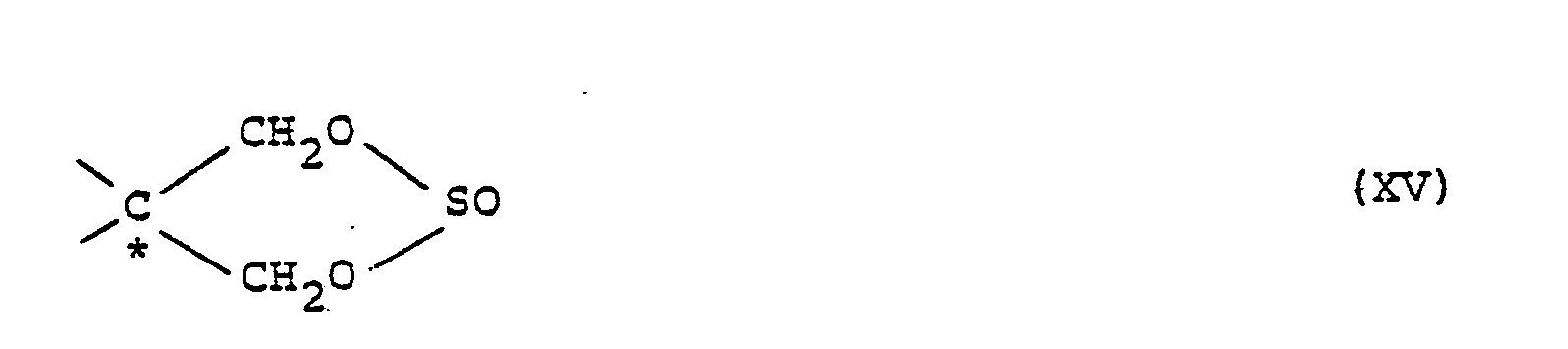
- R7 eine Struktureinheit aus der Reihe


- In Klammern geschriebene, an Phosphoratomen stehende Sauerstoffatome bedeuten, daß die Formel sowohl das Phosphit als auch das Phosphat beschreibt.
- Bevorzugte Beispiele, in denen R5, R6 und R7 zusammen mit dem Kohlenstoffatom C einen 4- bis 6-gliedrigen Ring * bilden, entsprechen den Formeln der Reihe


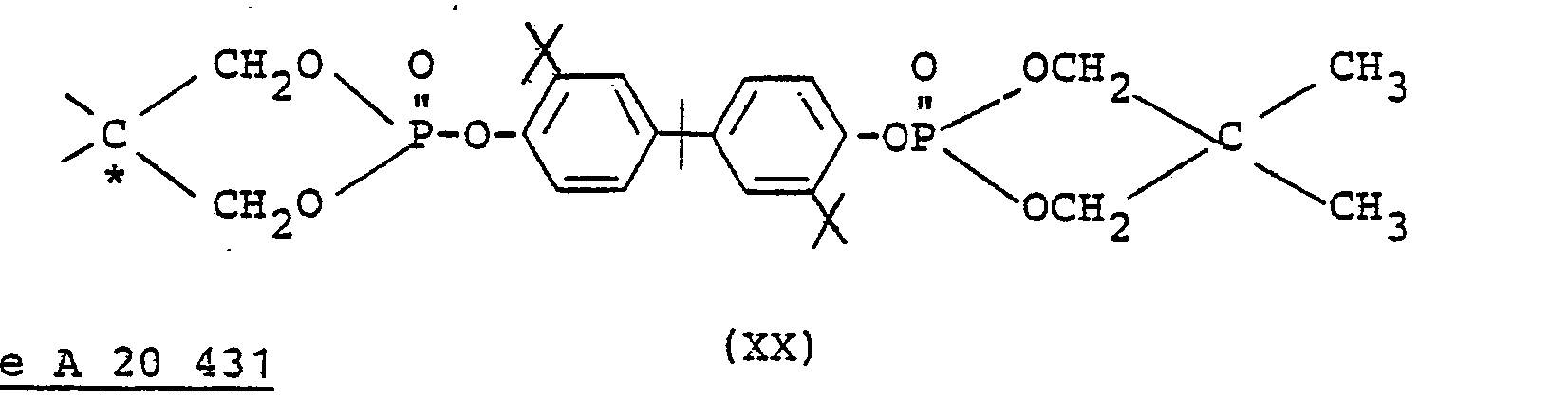


- Bevorzugte Verbindungen der Formel I sind solche, in denen
- R , R2, R3 und R4 ein Wasserstoffatom, Methyl, Isopropyl oder tert.-Butyl,
- A ein Sauerstoff- oder Schwefelatom, CH2, C(CH3)2, C-CH3 (CH2) yCOOR oder eine Einfachbindung,
- R 5 ein Wasserstoffatom, Methyl, Ethyl,
- R 6 CH 2,
- R7 ein Wasserstoffatom, ein Sauerstoffatom, Methyl oder eine Struktureinheit aus der Reihe (II), (VII) bis (XI), und solche Verbindungen, in denen
- R5, R 6 und R7 zusammen mit dem Kohlenstoffätom C ein Oxetan, 1,3-Dioxan, ein cyclisches Carbonat oder eine Struktur aus der Reihe (XIX) bis (XXVIII) und (XXX) bilden und m und n null oder 1,
- r 1,
- x und y 1 oder 2 und
- R ein Wasserstoffatom, Methyl oder Ethyl bedeuten.
- Die Struktur (I) beinhaltet u.a. Verbindungen der Formel XXXI

- Neben den Verbindungen XXXI und dem im vorstehenden Absatz beschriebenen Verbindungstyp werden solche Verbindungen bevorzugt, in denen A ein Sauerstoffatom, eine Einfachbindung oder C-CH3 bedeuten, (CH2)yCOOR und solche Verbindungen, in denen n=O ist. Auch Verbindungen I, deren außerhalb der eckigen Klammer stehende Reste anstelle von Phosphitgruppen Phosphatgruppen enthalten, sind bevorzugte Verbindungen im Sinne der Erfindung.
- In den nachfolgenden Formeln in Klammer gesetzte Substituenten (tert.-Butyl) weisen auf ein Isomerengemisch hin, wobei z.B. in Formel XXXII der zweite tert.-Butylrest entweder am linken oder am rechten phenolischen Kern stehen kann.
- Besonders bevorzugt sind demnach folgende Verbindungen:





- Die erfindungsgemäßen Verbindungen der Struktur I gestatten die Herstellung von thermoplastischen Polyestern, die selbst bei Langzeitalterung nur geringfügige Veränderungen erleiden und deshalb ein weitgehend konstantes Eigenschaftsniveau aufweisen.
- Die erfindungsgemäßen Verbindungen lassen sich durch Reaktion von Derivaten der phosphorigen Säure mit Bisphenolen, Diolen und/oder Pentaerythrit auf an sich bekannte Weise herstellen.
- Weiterer Gegenstand der Erfindung ist also ein Verfahren zur Herstellung der Verbindungen I, dadurch gekennzeichnet, daß man reaktionsfähige Derivate der phosphorigen Säure mit Bisphenolen der Formel


- Bevorzugte reaktionsfähige Derivate der phosphorigen Säure sind Phosphortrihalogenide wie Phosphortrichlorid oder Phosphortribromid, Phosphorigsäureesterhalogenide wie Phosphorigsäurephenylesterdichlorid und Phosphorigsäureester wie Triethylphosphit oder Triphenylphosphit.
- Bevorzugte Bisphenole IIL sind 4,4'-Dihydroxi-3,3'-di-tert.-butyl-diphenylpropan-2,2, 4,4'-Dihydroxi-3,3'-dicumyl-diphenylpropan-2,2, 4,4'-Dihydroxi-3,3'-distyryl-diphenylpropan-2,2, 4,4'-Dihydroxi-3,3'-dibenzyl-diphenylpropan-2,2, 4,4'-Dihydroxi-3,3'-dimethyl-diphenylpropan-2,2, 4,4'-Dihydroxi-3,31,5,5'-tetramethyl-diphenylpropan-2,2, 4,4'-Dihydroxi-3,3',5,5'-tetramethyl-diphenylmethan, 4,4'-Dihydroxi-3,5-dimethyl-diphenylmethan, 4,4'-Dihydroxi-3,3'-di-tert.-butyl-diphenylmethan, 4,4'-Dihydroxi-3,5-di-tert.-butyl-diphenylmethan, 2,4'-Dihydroxi-3,5-di-tert.-butyl-diphenylpropan-2,2, 2,4'-Dihydroxi-3-tert.-butyl-S-methyl-diphenylpropan-2,2, 2,4'-Dihydroxi-3-tert.-butyl-5-methyl-diphenylmethan, 4,4'-Dihydroxi-diphenylether, 4,4'-Dihydroxi-diphenylsulfid, 4,4'-Dihydroxi-diphenyldisulfid, 4,4'-Dihydroxi-3,5'-di-tert.-butyl-diphenylether, 4,4'-Dihydroxi-3,5'-di-tert.-butyl-diphenylsulfid, 4,4'-Dihydroxi-3,5-di-tert.-butyl-diphenylsulfid, Resorcin, 4,6-Dimethyl-resorcin, 4,6-Di-tert.-butyl- resorcin, 4-tert.-Butyl-resorcin, 4-Cumyl-resorcin, Hydrochinon, 2-Methyl-hydrochinon, 2,6-Dimethylhydrochinon, 2,5-Dimethyl-hydrochinon, 2,6-Diethylhydrochinon, 2,6-Di-tert.-butylhydrochinon, 2,5- und 2,6-Distyrylhydrochinon, 2,3-Dimethylhydrochinon, 2,3,5-Trimethylhydrochinon und 2,3,5,6-Tetramethylhydrochinon.
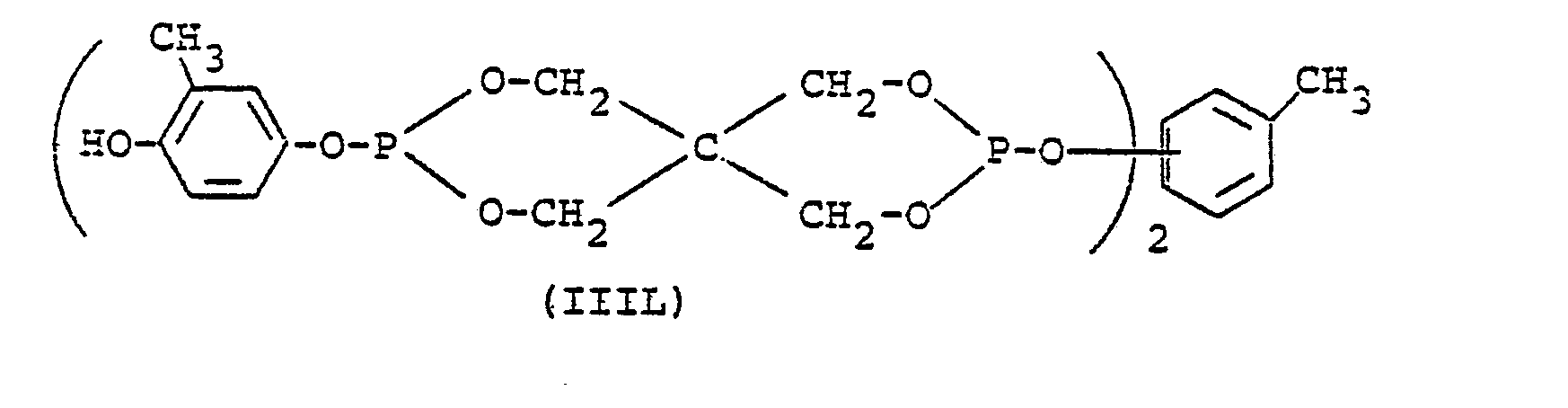
- Bevorzugte Alkohole IL sind Propandiol-1,3, 2-Ethylpropandiol-1,3, Trishydroximethylpropan-1,1,1, Neopentylglykol und Verbindungen folgender Struktur:
-





- Es ist selbstverständlich, daß die Konstitution der erfindungsgemäßen Verbindungen auch ihre Wirkung beeinflußt. Der Fachmann wird daher für die Herstellung der Verbindungen I immer die Alkohole IL auswählen können, die seinen Wünschen am nächsten kommen:
- Der Einbau von höheren aliphatischen Resten begünstigt die Entformbarkeit von Spritzgußteilen (LII-LIV, LVII, LXV und LXXVI), große Strukturelemente unterdrücken die Migration auch bei höheren Temperaturen (LXVI, LXVII, LXXI-LXXIII und LXXV-LXXIX), und geht man z.B. von L, LII-LIV, LVI, LVII, LXI und LXII aus, erhält man eine weichmachende Wirkung.
- Das Herstellungsverfahren sei nachfolgend beispielhaft erörtert:
- Man kann beispielsweise Phosphortrichlorid mit Neopentylglykol im Molverhältnis 1:1 unter HCl-Abspaltung zu einem cyclischen Phosphorigsäureesterchlorid umsetzen, das dann mit einem Mol Bisphenol unter Entfernung des letzten Mols HCl zu der gewünschten phenolischen Verbindung reagiert. Statt Phosphortrichlorid lassen sich in gleicher Weise Phosphorigsäureester, wie z.B. Triphenylphosphit, einsetzen, wobei in analoger Weise vorgegangen und die Umesterung vorzugsweise im Vakuum durchgeführt wird, damit sich die Abspaltungsprodukte rasch und möglichst vollständig aus dem Reaktionsgemisch entfernen.
- Man kann natürlich auch alle Reaktionskomponenten gleichzeitig miteinander umsetzen. Zweckmäßiger und übersichtlicher ist es jedoch, zunächst die cyclischen Phosphorigsäureester herzustellen und diese dann mit den Bisphenolen in den Molverhältnissen bzw. annähernd den Molverhältnissen miteinander zu kondensieren, die sich aus der Struktur der gewünschten Endprodukte ergeben. So sind beispielsweise bei Verwendung von Pentaerythrit Triphenylphosphit und 2,6-Di-tert.-butyl-hydrochinon wenigstens annähernd die Molverhältnisse 1:2:2 einzuhalten.
- Ein weiterer Gegenstand der Erfindung ist die Verwendung der Verbindungen I als Stabilisatoren für thermoplastische Polyester, insbesondere Polyalkylenterephthalate und aromatische Polyester.
- Thermoplastische Polyester im Sinne der Erfindung sind Reaktionsprodukte aus aromatischen Dicarbonsäuren (oder ihren reaktionsfähigen Derivaten) und aliphatischen oder cycloaliphatischen Diolen oder Diphenolen.
- Bevorzugte Polyalkylenterephthalate lassen sich aus Terephthalsäure (oder ihren reaktionsfähigen Derivaten) und Alkandiolen mit 2 bis 10 C-Atomen nach bekannten Methoden herstellen (Kunststoff-Handbuch, Bd. VIII, S. 695 ff, Carl Hanser Verlag, München 1973). Besonders bevorzugte Polyalkylenterephthalate sind Polyethylenterephthalate und Poly(butandiol-1,4-tere- phthalate). Sie besitzen in der Regel eine Intrinsic-Viskosität von 0,5 bis 2,0 dl/g, vorzugsweise 0,6 bis 1,5 dl/g und insbesondere 0,7 bis 1,3 dl/g, gemessen in einem Gemisch aus Phenol und o-Dichlorbenzol (50/50 Gew.-%) bei 25°C.
- Aromatische Polyester und Verfahren zu ihrer Herstellung sind ebenfalls bekannt (W.M. Eareckson, J. Polym. Sci. Xl, 399-406 (1959); Andre Conix, "Thermoplastic Polyesters from Bisphenols", Ind. Eng. Chem., Vol. 51, No. 2, 147-150, Febr. 1959; FR 1 177 517, US 3 351 624, DE-AS 14 45 384). Sie enthalten als einkondensierte Säurereste meistens Tere- und/oder Isophthalsäurereste; bevorzugte aromatische Polyester enthalten Tere- und Isophthalsäurereste insbesondere etwa im Verhältnis 1:1.
- Bevorzugte Diphenole für .die Herstellung der aromatischen Polyester sind Verbindungen der Formel

- Besonders bevorzugte Diphenole sind Verbindungen der Formel


- Die aromatischen Polyester besitzen in der Regel relative Lösungsviskositäten von 1,18 bis 2,0, insbesondere von 1,2 bis 1,5 (gemessen in 0,5 gew.-%iger Lösung in Dichlormethan bei 25°C).
- Die Polyester enthalten die erfindungsgemäßen Stabilisatoren der Formel I in solchen Mengen, daß eine genügende Stabilisierung erzielt wird; im allgemeinen ist dies bei Mengen von 0,01 bis 2, vorzugsweise von 0,03 bis 1,5, insbesondere von 0,05 bis 1, Gew.-% der Fall.
- Die Polyester können die erfindungsgemäßen Stabilisatoren allein oder auch im Gemisch miteinander sowie auch in Kombination mit anderen Stabilisatoren enthalten.
- Die Einarbeitung der erfindungsgemäßen Verbindungen I kann nach an sich bekannten Methoden während oder nach der Polyesterherstellung erfolgen, indem die Substanzen als solche oder auch in Form eines separat hergestellten Konzentrates in Polyester oder im Gemisch mit anderen Zuschlägen oder Lösungsmitteln eingearbeitet werden. Die Einarbeitung kann jedoch auch unmittelbar vor der Weiterverarbeitung der Polyester erfolgen.
- Zur weiteren Eigenschaftsverbesserung können die Formmassen auch andere Zusatzstoffe enthalten, wie z.B. Formtrennmittel, Gleitmittel, Nukleiermittel, Farbstoffe, Pigmente, Füllstoffe, Verstärkungsstoffe, Flammschutzmittel, Weichmacher und Lichtschutzmittel.
- Die gefüllten und/oder verstärkten Polyester-Formmassen können bis zu 60 Gew.-%, bezogen auf die Formmasse, eines Füllstoffes und/oder Verstärkungsstoffes enthalten. Bevorzugte Verstärkungsstoffe sind Glasfasern. Bevorzugte Füllstoffe, die auch verstärkend wirken können, sind z.B. Glaskugeln, Glimmer, Silikate, Quarz, Talkum, Titandioxid, Wollastonit.
- Flammwidrig ausgerüstete Polyester-Formmassen enthalten im allgemeinen bis zu 30 Gew.-%, bezogen auf die Formmasse, an Flammschutzmittel. Übliche Flammschutzmittel sind z.B. Polyhalogenidphenyl, Polyhalogendiphenylether, Polyhalogenphthalsäure und ihre Derivate und Polyhalogenpolycarbonate, wobei die entsprechenden Bromverbindungen besonders wirksam sind. Außerdem enthalten sie in der Regel einen Synergisten, wie z.B. Antimontrioxid.
-

-

- Nach Abdestillieren von Phenol erhält man ein gelbes Weichharz. Das erhaltene Produkt wird im folgenden Stabilisator.B genannt.
-

-

-

-

-

-

-

-

-

- Vergleichsstabilisatoren:
- Stabilisator M

- Stabilisator N

- Stabilisator 0

- Stabilisator P

- Stabilisator Q

- Stabilisator R

- Stabilisator S
- Stabilisator T
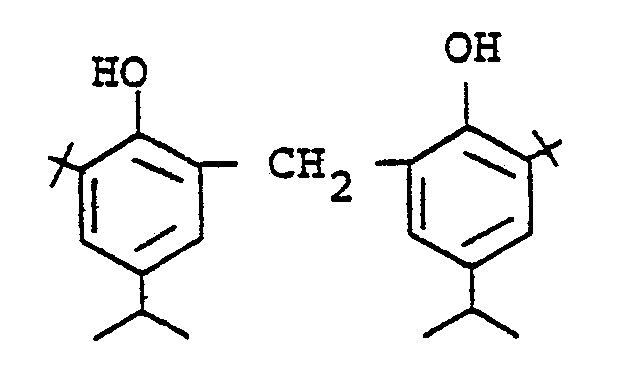
- II. Stabilisierung von Polyestern
- Auf einer gleichsinnig rotierenden Zweiwellenschnecke (ZSK 32 der Fa. Werner und Pfleiderer) wurden 99,9 bzw. 99,8 Gew.-Teile Poly-(1,4-butylen-terephthalat) mit einer Intrinsic-Viskosität von 1,26 dl/g (gemessen bei 25°C in Phenol/o-Dichlorbenzol im Gewichtsverhältnis 1:1), die mit 0,1 bzw. 0,2 Gew.-Teilen Stabilisator grob gemischt waren, aufgeschmolzen und in der Schmelze homogenisiert. Der Schmelzstrang wurde in Wasser abgekühlt und anschließend granuliert. Das Granulat wurde nach dem Trocknen bei 260°C auf einer handelsüblichen Spritzgußmaschine zu Normkleinstäben verspritzt, die in einem Umlufttrockenschrank heißer Luft ausgesetzt wurden bzw. die in 95°C heißem Wasser gelagert wurden. Nach der thermisch-oxidativen Behandlung bzw. nach der Heißwasserbehandlung wurde die Schlagzähigkeit nach DIN 53 453 gemessen.


Claims (10)









Applications Claiming Priority (2)
| Application Number | Priority Date | Filing Date | Title |
|---|---|---|---|
| DE19803036391 DE3036391A1 (de) | 1980-09-26 | 1980-09-26 | Neue hydroxyphenylgruppen enthaltende phosphorigsaeureester, verfahren zur ihrer herstellung und ihre verwendung als stabilisatoren fuer thermoplastische polyester |
| DE3036391 | 1980-09-26 |
Publications (2)
| Publication Number | Publication Date |
|---|---|
| EP0048878A1 true EP0048878A1 (de) | 1982-04-07 |
| EP0048878B1 EP0048878B1 (de) | 1984-07-18 |
Family
ID=6112949
Family Applications (1)
| Application Number | Title | Priority Date | Filing Date |
|---|---|---|---|
| EP81107218A Expired EP0048878B1 (de) | 1980-09-26 | 1981-09-14 | Neue Hydroxiphenylgruppen enthaltende Phosphorigsäureester, Verfahren zu ihrer Herstellung und ihre Verwendung als Stabilisatoren für thermoplastische Polyester |
Country Status (3)
| Country | Link |
|---|---|
| EP (1) | EP0048878B1 (de) |
| JP (1) | JPS5782394A (de) |
| DE (2) | DE3036391A1 (de) |
Cited By (5)
| Publication number | Priority date | Publication date | Assignee | Title |
|---|---|---|---|---|
| FR2516528A1 (fr) * | 1981-11-18 | 1983-05-20 | Borg Warner Chemicals Inc | Stabilisants formes de phosphites pour des resines de polyester |
| EP0251712A3 (de) * | 1986-07-02 | 1989-04-05 | Polyplastics Co. Ltd. | Thermoplastische Polyester-Harzzusammensetzung |
| EP0280178A3 (en) * | 1987-02-25 | 1989-05-03 | Bayer Ag | Stabilized blends thermoplastic polyester and of rubbery polymer, process for the fabrication of these blends, and their use for the fabrication of molded articles |
| EP0594539A1 (de) * | 1992-10-21 | 1994-04-27 | Ciba-Geigy Ag | Phenylphosphite als Stabilisatoren für organische Materialien |
| WO2021043859A1 (en) | 2019-09-05 | 2021-03-11 | Basf Se | Thermoplastic molding compositions that resist heat |
Families Citing this family (1)
| Publication number | Priority date | Publication date | Assignee | Title |
|---|---|---|---|---|
| CN108912173A (zh) * | 2018-06-22 | 2018-11-30 | 南京师范大学常州创新发展研究院 | 环状磷酸酯或环状亚磷酸酯的制备方法 |
Citations (5)
| Publication number | Priority date | Publication date | Assignee | Title |
|---|---|---|---|---|
| US3053878A (en) * | 1961-05-23 | 1962-09-11 | Weston Chemical Corp | Pentaerythritol phosphite esters |
| US3192243A (en) * | 1962-04-10 | 1965-06-29 | Delaware Chemicals Inc | Phosphorous derivatives of pentaerythritol |
| US3305608A (en) * | 1962-10-08 | 1967-02-21 | Hooker Chemical Corp | Phenolic phosphites |
| DE1543530A1 (de) * | 1965-09-15 | 1969-12-18 | Distillers Co Yeast Ltd | Neue organische Phosphite und Verfahren zu ihrer Herstellung |
| DE3003984A1 (de) * | 1979-02-05 | 1980-08-07 | Borg Warner | Verfahren zur herstellung von aromatischen polyphosphiten |
Family Cites Families (5)
| Publication number | Priority date | Publication date | Assignee | Title |
|---|---|---|---|---|
| US3441633A (en) * | 1965-12-03 | 1969-04-29 | Weston Chemical Corp | Cyclic phosphites |
| JPS5125064A (ja) * | 1974-08-26 | 1976-03-01 | Hitachi Ltd | Koanteidodenkaihoshagatadenshiju |
| JPS5231260B2 (de) * | 1974-09-11 | 1977-08-13 | ||
| JPS595141B2 (ja) * | 1975-07-30 | 1984-02-02 | ユニチカ株式会社 | 樹脂組成物 |
| JPS5414451A (en) * | 1977-07-04 | 1979-02-02 | Cosmo Co Ltd | Stabilized synthetic resin composition |
-
1980
- 1980-09-26 DE DE19803036391 patent/DE3036391A1/de not_active Withdrawn
-
1981
- 1981-09-14 DE DE8181107218T patent/DE3164888D1/de not_active Expired
- 1981-09-14 EP EP81107218A patent/EP0048878B1/de not_active Expired
- 1981-09-22 JP JP56148918A patent/JPS5782394A/ja active Granted
Patent Citations (5)
| Publication number | Priority date | Publication date | Assignee | Title |
|---|---|---|---|---|
| US3053878A (en) * | 1961-05-23 | 1962-09-11 | Weston Chemical Corp | Pentaerythritol phosphite esters |
| US3192243A (en) * | 1962-04-10 | 1965-06-29 | Delaware Chemicals Inc | Phosphorous derivatives of pentaerythritol |
| US3305608A (en) * | 1962-10-08 | 1967-02-21 | Hooker Chemical Corp | Phenolic phosphites |
| DE1543530A1 (de) * | 1965-09-15 | 1969-12-18 | Distillers Co Yeast Ltd | Neue organische Phosphite und Verfahren zu ihrer Herstellung |
| DE3003984A1 (de) * | 1979-02-05 | 1980-08-07 | Borg Warner | Verfahren zur herstellung von aromatischen polyphosphiten |
Cited By (7)
| Publication number | Priority date | Publication date | Assignee | Title |
|---|---|---|---|---|
| FR2516528A1 (fr) * | 1981-11-18 | 1983-05-20 | Borg Warner Chemicals Inc | Stabilisants formes de phosphites pour des resines de polyester |
| EP0251712A3 (de) * | 1986-07-02 | 1989-04-05 | Polyplastics Co. Ltd. | Thermoplastische Polyester-Harzzusammensetzung |
| EP0280178A3 (en) * | 1987-02-25 | 1989-05-03 | Bayer Ag | Stabilized blends thermoplastic polyester and of rubbery polymer, process for the fabrication of these blends, and their use for the fabrication of molded articles |
| EP0594539A1 (de) * | 1992-10-21 | 1994-04-27 | Ciba-Geigy Ag | Phenylphosphite als Stabilisatoren für organische Materialien |
| US5414033A (en) * | 1992-10-21 | 1995-05-09 | Ciba-Geigy Corporation | Phenyl phosphites for use as stabilizers for organic materials |
| US5618871A (en) * | 1992-10-21 | 1997-04-08 | Ciba-Geigy Corporation | Phenyl phosphites for use as stabilizers for organic materials |
| WO2021043859A1 (en) | 2019-09-05 | 2021-03-11 | Basf Se | Thermoplastic molding compositions that resist heat |
Also Published As
| Publication number | Publication date |
|---|---|
| DE3164888D1 (en) | 1984-08-23 |
| EP0048878B1 (de) | 1984-07-18 |
| JPH0349914B2 (de) | 1991-07-31 |
| DE3036391A1 (de) | 1982-05-13 |
| JPS5782394A (en) | 1982-05-22 |
Similar Documents
| Publication | Publication Date | Title |
|---|---|---|
| EP0474076B1 (de) | Polyphosphonate auf Melamin-Basis | |
| DE69410949T2 (de) | Hydrolysestabile Polyesterzusammensetzungen | |
| EP0009115B1 (de) | Neue Phosphorigsäureester und ihre Verwendung zur Stabilisierung von Polyamiden | |
| US4371647A (en) | 2,6-Di-tertiary butyl phenyl pentaerythritol spiro bis-phosphites enhancing the stability to heat and light of synthetic resin | |
| DE2140207C3 (de) | Stabilisiertes aromatisches PoIycarbonat | |
| DE2757323A1 (de) | Thermoplastische copolyester | |
| EP0422437A2 (de) | Hochverzweigte Polyphosphonate | |
| DE2252258A1 (de) | Schwerentflammbare thermoplastische polyester | |
| EP0103231B1 (de) | Flammwidrige Polymermischungen | |
| EP0096818A1 (de) | Stabilisatorkombinationen, ihre Verwendung zur Stabilisierung von thermoplastischen Polycarbonaten sowie stabilisierte, thermoplastische Polycarbonate | |
| DE69123262T2 (de) | Flammgeschützte polymermischung aus polybutylenterephthalat und einem aromatischen polycarbonat oder einem polyetherimid | |
| EP0362623B1 (de) | Flammgeschütze, gut kristallisierende Polyethylenterephthalatformmassen | |
| DE2853524A1 (de) | Stabilisierte und plastifizierte polycarbonatzusammensetzung | |
| EP0048878B1 (de) | Neue Hydroxiphenylgruppen enthaltende Phosphorigsäureester, Verfahren zu ihrer Herstellung und ihre Verwendung als Stabilisatoren für thermoplastische Polyester | |
| DE69510163T2 (de) | Thermisch stabile, gammastrahlenbeständige Polycarbonat-Polyester-Mischung | |
| DE2944254A1 (de) | Phosphite und waermestabile polycarbonatmasse, enthaltend ein solches phosphit | |
| DE3520661A1 (de) | Schlagzaehe thermoplatische polyestermassen mit niedriger schmelzviskositaet, verfahren zu ihrer herstellung und ihre verwendung zur herstellung von formkoerpern | |
| EP0001823A2 (de) | Verwendung von Borsäureestern zum Stabilisieren von phosphitfreien Polycarbonaten und die erhaltenen stabilisierten Polycarbonatformmassen | |
| EP0033395B1 (de) | 2,6-Di-tertiärbutyl-phenyl-phosphite und diese Phosphite enthaltende Kunstharzzusammensetzungen | |
| DE2706128A1 (de) | Schnell kristallisierende polyestermassen | |
| DE2833024C2 (de) | ||
| DE3884434T2 (de) | Harzmischung aus einem aromatischen Polycarbonat und einem aromatischen Polyester. | |
| EP0150497A2 (de) | Stabilisierte aromatische Polyester und Polyestercarbonate | |
| DE2653120C2 (de) | Schnellkristallisierende Polyestermassen, Verfahren zu ihrer Herstellung und ihre Verwendung | |
| DE69225060T2 (de) | Polyestercarbonat-Mischung und daraus geformte platten- oder filmförmige Produkte |
Legal Events
| Date | Code | Title | Description |
|---|---|---|---|
| PUAI | Public reference made under article 153(3) epc to a published international application that has entered the european phase |
Free format text: ORIGINAL CODE: 0009012 |
|
| 17P | Request for examination filed |
Effective date: 19810914 |
|
| AK | Designated contracting states |
Designated state(s): CH DE FR GB IT NL |
|
| ITF | It: translation for a ep patent filed | ||
| GRAA | (expected) grant |
Free format text: ORIGINAL CODE: 0009210 |
|
| AK | Designated contracting states |
Designated state(s): CH DE FR GB IT LI NL |
|
| REF | Corresponds to: |
Ref document number: 3164888 Country of ref document: DE Date of ref document: 19840823 |
|
| ET | Fr: translation filed | ||
| PLBE | No opposition filed within time limit |
Free format text: ORIGINAL CODE: 0009261 |
|
| STAA | Information on the status of an ep patent application or granted ep patent |
Free format text: STATUS: NO OPPOSITION FILED WITHIN TIME LIMIT |
|
| 26N | No opposition filed | ||
| PGFP | Annual fee paid to national office [announced via postgrant information from national office to epo] |
Ref country code: DE Payment date: 19900818 Year of fee payment: 10 |
|
| PGFP | Annual fee paid to national office [announced via postgrant information from national office to epo] |
Ref country code: FR Payment date: 19900830 Year of fee payment: 10 |
|
| PGFP | Annual fee paid to national office [announced via postgrant information from national office to epo] |
Ref country code: GB Payment date: 19900831 Year of fee payment: 10 |
|
| PGFP | Annual fee paid to national office [announced via postgrant information from national office to epo] |
Ref country code: CH Payment date: 19900918 Year of fee payment: 10 |
|
| ITTA | It: last paid annual fee | ||
| PGFP | Annual fee paid to national office [announced via postgrant information from national office to epo] |
Ref country code: NL Payment date: 19900930 Year of fee payment: 10 |
|
| PG25 | Lapsed in a contracting state [announced via postgrant information from national office to epo] |
Ref country code: GB Effective date: 19910914 |
|
| PG25 | Lapsed in a contracting state [announced via postgrant information from national office to epo] |
Ref country code: LI Effective date: 19910930 Ref country code: CH Effective date: 19910930 |
|
| PG25 | Lapsed in a contracting state [announced via postgrant information from national office to epo] |
Ref country code: NL Effective date: 19920401 |
|
| GBPC | Gb: european patent ceased through non-payment of renewal fee | ||
| NLV4 | Nl: lapsed or anulled due to non-payment of the annual fee | ||
| PG25 | Lapsed in a contracting state [announced via postgrant information from national office to epo] |
Ref country code: FR Effective date: 19920529 |
|
| REG | Reference to a national code |
Ref country code: CH Ref legal event code: PL |
|
| PG25 | Lapsed in a contracting state [announced via postgrant information from national office to epo] |
Ref country code: DE Effective date: 19920602 |
|
| REG | Reference to a national code |
Ref country code: FR Ref legal event code: ST |