EP0045575B2 - Verfahren zur Extrusion von Flüssigkristall-Polymeren - Google Patents
Verfahren zur Extrusion von Flüssigkristall-Polymeren Download PDFInfo
- Publication number
- EP0045575B2 EP0045575B2 EP81303160A EP81303160A EP0045575B2 EP 0045575 B2 EP0045575 B2 EP 0045575B2 EP 81303160 A EP81303160 A EP 81303160A EP 81303160 A EP81303160 A EP 81303160A EP 0045575 B2 EP0045575 B2 EP 0045575B2
- Authority
- EP
- European Patent Office
- Prior art keywords
- liquid crystal
- crystal polymer
- fluid stream
- flow
- polymer
- Prior art date
- Legal status (The legal status is an assumption and is not a legal conclusion. Google has not performed a legal analysis and makes no representation as to the accuracy of the status listed.)
- Expired - Lifetime
Links
- 229920000106 Liquid crystal polymer Polymers 0.000 title claims description 87
- 239000004977 Liquid-crystal polymers (LCPs) Substances 0.000 title claims description 76
- 238000000034 method Methods 0.000 title claims description 66
- 229920000642 polymer Polymers 0.000 claims description 57
- 229920000728 polyester Polymers 0.000 claims description 42
- 238000001125 extrusion Methods 0.000 claims description 40
- 239000012530 fluid Substances 0.000 claims description 40
- 125000003118 aryl group Chemical group 0.000 claims description 39
- 239000002904 solvent Substances 0.000 claims description 11
- 239000004976 Lyotropic liquid crystal Substances 0.000 claims description 6
- 239000004760 aramid Substances 0.000 claims description 6
- 229920003235 aromatic polyamide Polymers 0.000 claims description 6
- 239000004953 Aliphatic polyamide Substances 0.000 claims description 3
- 229920003231 aliphatic polyamide Polymers 0.000 claims description 3
- 229920003232 aliphatic polyester Polymers 0.000 claims description 3
- 230000001747 exhibiting effect Effects 0.000 claims description 3
- 125000002496 methyl group Chemical group [H]C([H])([H])* 0.000 claims description 3
- 229920000343 polyazomethine Polymers 0.000 claims description 3
- 125000001246 bromo group Chemical group Br* 0.000 claims description 2
- 125000001309 chloro group Chemical group Cl* 0.000 claims description 2
- 125000004435 hydrogen atom Chemical group [H]* 0.000 claims description 2
- 238000011144 upstream manufacturing Methods 0.000 claims description 2
- BVKZGUZCCUSVTD-UHFFFAOYSA-L Carbonate Chemical compound [O-]C([O-])=O BVKZGUZCCUSVTD-UHFFFAOYSA-L 0.000 claims 1
- -1 methyl-1,4-phenylene Chemical group 0.000 description 15
- 239000000155 melt Substances 0.000 description 11
- 238000010438 heat treatment Methods 0.000 description 8
- 230000002535 lyotropic effect Effects 0.000 description 8
- 239000000835 fiber Substances 0.000 description 7
- 239000000463 material Substances 0.000 description 7
- 239000000178 monomer Substances 0.000 description 7
- XBNGYFFABRKICK-UHFFFAOYSA-N 2,3,4,5,6-pentafluorophenol Chemical compound OC1=C(F)C(F)=C(F)C(F)=C1F XBNGYFFABRKICK-UHFFFAOYSA-N 0.000 description 6
- 239000007788 liquid Substances 0.000 description 6
- IZUPBVBPLAPZRR-UHFFFAOYSA-N pentachloro-phenol Natural products OC1=C(Cl)C(Cl)=C(Cl)C(Cl)=C1Cl IZUPBVBPLAPZRR-UHFFFAOYSA-N 0.000 description 6
- 238000012360 testing method Methods 0.000 description 6
- AFVFQIVMOAPDHO-UHFFFAOYSA-N Methanesulfonic acid Chemical class CS(O)(=O)=O AFVFQIVMOAPDHO-UHFFFAOYSA-N 0.000 description 5
- 239000004974 Thermotropic liquid crystal Substances 0.000 description 5
- 239000000654 additive Substances 0.000 description 5
- 239000012071 phase Substances 0.000 description 5
- IJGRMHOSHXDMSA-UHFFFAOYSA-N Atomic nitrogen Chemical compound N#N IJGRMHOSHXDMSA-UHFFFAOYSA-N 0.000 description 4
- KRHYYFGTRYWZRS-UHFFFAOYSA-N Fluorane Chemical compound F KRHYYFGTRYWZRS-UHFFFAOYSA-N 0.000 description 4
- 150000001408 amides Chemical class 0.000 description 4
- 235000013877 carbamide Nutrition 0.000 description 4
- KWGKDLIKAYFUFQ-UHFFFAOYSA-M lithium chloride Chemical compound [Li+].[Cl-] KWGKDLIKAYFUFQ-UHFFFAOYSA-M 0.000 description 4
- 238000002844 melting Methods 0.000 description 4
- 230000008018 melting Effects 0.000 description 4
- 239000007787 solid Substances 0.000 description 4
- QAOWNCQODCNURD-UHFFFAOYSA-N sulfuric acid Substances OS(O)(=O)=O QAOWNCQODCNURD-UHFFFAOYSA-N 0.000 description 4
- MHSKRLJMQQNJNC-UHFFFAOYSA-N terephthalamide Chemical compound NC(=O)C1=CC=C(C(N)=O)C=C1 MHSKRLJMQQNJNC-UHFFFAOYSA-N 0.000 description 4
- FJKROLUGYXJWQN-UHFFFAOYSA-N 4-hydroxybenzoic acid Chemical compound OC(=O)C1=CC=C(O)C=C1 FJKROLUGYXJWQN-UHFFFAOYSA-N 0.000 description 3
- QTBSBXVTEAMEQO-UHFFFAOYSA-N Acetic acid Chemical compound CC(O)=O QTBSBXVTEAMEQO-UHFFFAOYSA-N 0.000 description 3
- KWYHDKDOAIKMQN-UHFFFAOYSA-N N,N,N',N'-tetramethylethylenediamine Chemical compound CN(C)CCN(C)C KWYHDKDOAIKMQN-UHFFFAOYSA-N 0.000 description 3
- 150000001875 compounds Chemical class 0.000 description 3
- 229920001577 copolymer Polymers 0.000 description 3
- 238000005259 measurement Methods 0.000 description 3
- 239000000203 mixture Substances 0.000 description 3
- 239000004033 plastic Substances 0.000 description 3
- 229920003023 plastic Polymers 0.000 description 3
- 239000000376 reactant Substances 0.000 description 3
- 239000002002 slurry Substances 0.000 description 3
- KDISMIMTGUMORD-UHFFFAOYSA-N 1-acetylpiperidine Chemical compound CC(=O)N1CCCCC1 KDISMIMTGUMORD-UHFFFAOYSA-N 0.000 description 2
- XKRFYHLGVUSROY-UHFFFAOYSA-N Argon Chemical compound [Ar] XKRFYHLGVUSROY-UHFFFAOYSA-N 0.000 description 2
- 239000004952 Polyamide Substances 0.000 description 2
- GWEVSGVZZGPLCZ-UHFFFAOYSA-N Titan oxide Chemical compound O=[Ti]=O GWEVSGVZZGPLCZ-UHFFFAOYSA-N 0.000 description 2
- XSQUKJJJFZCRTK-UHFFFAOYSA-N Urea Chemical compound NC(N)=O XSQUKJJJFZCRTK-UHFFFAOYSA-N 0.000 description 2
- 229910052784 alkaline earth metal Inorganic materials 0.000 description 2
- ADCOVFLJGNWWNZ-UHFFFAOYSA-N antimony trioxide Chemical compound O=[Sb]O[Sb]=O ADCOVFLJGNWWNZ-UHFFFAOYSA-N 0.000 description 2
- 238000003491 array Methods 0.000 description 2
- 239000012298 atmosphere Substances 0.000 description 2
- 125000005605 benzo group Chemical group 0.000 description 2
- 239000004202 carbamide Substances 0.000 description 2
- 229910052799 carbon Inorganic materials 0.000 description 2
- 239000003054 catalyst Substances 0.000 description 2
- 230000006835 compression Effects 0.000 description 2
- 238000007906 compression Methods 0.000 description 2
- 238000009833 condensation Methods 0.000 description 2
- 230000005494 condensation Effects 0.000 description 2
- UQSQSQZYBQSBJZ-UHFFFAOYSA-N fluorosulfonic acid Chemical compound OS(F)(=O)=O UQSQSQZYBQSBJZ-UHFFFAOYSA-N 0.000 description 2
- 125000000524 functional group Chemical group 0.000 description 2
- 125000002887 hydroxy group Chemical group [H]O* 0.000 description 2
- 239000004973 liquid crystal related substance Substances 0.000 description 2
- 238000005461 lubrication Methods 0.000 description 2
- 229940098779 methanesulfonic acid Drugs 0.000 description 2
- 229910052757 nitrogen Inorganic materials 0.000 description 2
- 239000012299 nitrogen atmosphere Substances 0.000 description 2
- 239000002245 particle Substances 0.000 description 2
- 229920002647 polyamide Polymers 0.000 description 2
- SCVFZCLFOSHCOH-UHFFFAOYSA-M potassium acetate Chemical compound [K+].CC([O-])=O SCVFZCLFOSHCOH-UHFFFAOYSA-M 0.000 description 2
- 238000002360 preparation method Methods 0.000 description 2
- 150000003839 salts Chemical class 0.000 description 2
- 238000009987 spinning Methods 0.000 description 2
- 229910001887 tin oxide Inorganic materials 0.000 description 2
- 239000010936 titanium Substances 0.000 description 2
- 229910052719 titanium Inorganic materials 0.000 description 2
- 150000003672 ureas Chemical class 0.000 description 2
- XLYOFNOQVPJJNP-UHFFFAOYSA-N water Substances O XLYOFNOQVPJJNP-UHFFFAOYSA-N 0.000 description 2
- AVQQQNCBBIEMEU-UHFFFAOYSA-N 1,1,3,3-tetramethylurea Chemical compound CN(C)C(=O)N(C)C AVQQQNCBBIEMEU-UHFFFAOYSA-N 0.000 description 1
- CYSGHNMQYZDMIA-UHFFFAOYSA-N 1,3-Dimethyl-2-imidazolidinon Chemical compound CN1CCN(C)C1=O CYSGHNMQYZDMIA-UHFFFAOYSA-N 0.000 description 1
- IAWDXWMSIQOZTQ-UHFFFAOYSA-N 1,3-dimethyl-2,5-dihydro-1$l^{5}-phosphole 1-oxide Chemical compound CC1=CCP(C)(=O)C1 IAWDXWMSIQOZTQ-UHFFFAOYSA-N 0.000 description 1
- YLHUPYSUKYAIBW-UHFFFAOYSA-N 1-acetylpyrrolidin-2-one Chemical compound CC(=O)N1CCCC1=O YLHUPYSUKYAIBW-UHFFFAOYSA-N 0.000 description 1
- ZSSWXNPRLJLCDU-UHFFFAOYSA-N 1-diethylphosphorylethane Chemical compound CCP(=O)(CC)CC ZSSWXNPRLJLCDU-UHFFFAOYSA-N 0.000 description 1
- UHHKAVNUKKRGJE-UHFFFAOYSA-N 1-ethyl-3-methyl-2,5-dihydro-1$l^{5}-phosphole 1-oxide Chemical compound CCP1(=O)CC=C(C)C1 UHHKAVNUKKRGJE-UHFFFAOYSA-N 0.000 description 1
- SVWHXFUUCAUJSN-UHFFFAOYSA-N 1-methyl-1$l^{5}-phospholane 1-oxide Chemical compound CP1(=O)CCCC1 SVWHXFUUCAUJSN-UHFFFAOYSA-N 0.000 description 1
- GEZGQQFKEOIGJS-UHFFFAOYSA-N 2-di(propan-2-yl)phosphorylpropane Chemical compound CC(C)P(=O)(C(C)C)C(C)C GEZGQQFKEOIGJS-UHFFFAOYSA-N 0.000 description 1
- DZLUPKIRNOCKJB-UHFFFAOYSA-N 2-methoxy-n,n-dimethylacetamide Chemical compound COCC(=O)N(C)C DZLUPKIRNOCKJB-UHFFFAOYSA-N 0.000 description 1
- 229940090248 4-hydroxybenzoic acid Drugs 0.000 description 1
- QPWXJHNGTLCQFT-UHFFFAOYSA-N CC(C)(C)C(c(cc1)ccc1OCCOc1ccc(C=O)cc1)=O Chemical compound CC(C)(C)C(c(cc1)ccc1OCCOc1ccc(C=O)cc1)=O QPWXJHNGTLCQFT-UHFFFAOYSA-N 0.000 description 1
- UXVMQQNJUSDDNG-UHFFFAOYSA-L Calcium chloride Chemical compound [Cl-].[Cl-].[Ca+2] UXVMQQNJUSDDNG-UHFFFAOYSA-L 0.000 description 1
- 239000005264 High molar mass liquid crystal Substances 0.000 description 1
- 238000004566 IR spectroscopy Methods 0.000 description 1
- 229920006063 Lamide® Polymers 0.000 description 1
- 239000002841 Lewis acid Substances 0.000 description 1
- FXHOOIRPVKKKFG-UHFFFAOYSA-N N,N-Dimethylacetamide Chemical compound CN(C)C(C)=O FXHOOIRPVKKKFG-UHFFFAOYSA-N 0.000 description 1
- ZWXPDGCFMMFNRW-UHFFFAOYSA-N N-methylcaprolactam Chemical compound CN1CCCCCC1=O ZWXPDGCFMMFNRW-UHFFFAOYSA-N 0.000 description 1
- 238000002441 X-ray diffraction Methods 0.000 description 1
- 150000001242 acetic acid derivatives Chemical class 0.000 description 1
- ZOIORXHNWRGPMV-UHFFFAOYSA-N acetic acid;zinc Chemical compound [Zn].CC(O)=O.CC(O)=O ZOIORXHNWRGPMV-UHFFFAOYSA-N 0.000 description 1
- 239000002253 acid Substances 0.000 description 1
- 239000003377 acid catalyst Substances 0.000 description 1
- 125000002252 acyl group Chemical group 0.000 description 1
- 125000004423 acyloxy group Chemical group 0.000 description 1
- 239000003513 alkali Substances 0.000 description 1
- 239000012736 aqueous medium Substances 0.000 description 1
- 229910052786 argon Inorganic materials 0.000 description 1
- 238000000149 argon plasma sintering Methods 0.000 description 1
- 230000009286 beneficial effect Effects 0.000 description 1
- WPYMKLBDIGXBTP-UHFFFAOYSA-N benzoic acid Chemical group OC(=O)C1=CC=CC=C1 WPYMKLBDIGXBTP-UHFFFAOYSA-N 0.000 description 1
- 230000015572 biosynthetic process Effects 0.000 description 1
- 238000007664 blowing Methods 0.000 description 1
- 239000001110 calcium chloride Substances 0.000 description 1
- 229910001628 calcium chloride Inorganic materials 0.000 description 1
- 125000004432 carbon atom Chemical group C* 0.000 description 1
- 125000005587 carbonate group Chemical group 0.000 description 1
- 125000002843 carboxylic acid group Chemical group 0.000 description 1
- 150000001735 carboxylic acids Chemical class 0.000 description 1
- 238000006243 chemical reaction Methods 0.000 description 1
- 150000008280 chlorinated hydrocarbons Chemical class 0.000 description 1
- 239000002131 composite material Substances 0.000 description 1
- JGFBRKRYDCGYKD-UHFFFAOYSA-N dibutyl(oxo)tin Chemical compound CCCC[Sn](=O)CCCC JGFBRKRYDCGYKD-UHFFFAOYSA-N 0.000 description 1
- GUVUOGQBMYCBQP-UHFFFAOYSA-N dmpu Chemical compound CN1CCCN(C)C1=O GUVUOGQBMYCBQP-UHFFFAOYSA-N 0.000 description 1
- 230000000694 effects Effects 0.000 description 1
- 125000004185 ester group Chemical group 0.000 description 1
- 238000001704 evaporation Methods 0.000 description 1
- 239000011521 glass Substances 0.000 description 1
- 150000004820 halides Chemical class 0.000 description 1
- 229910052734 helium Inorganic materials 0.000 description 1
- 239000001307 helium Substances 0.000 description 1
- SWQJXJOGLNCZEY-UHFFFAOYSA-N helium atom Chemical compound [He] SWQJXJOGLNCZEY-UHFFFAOYSA-N 0.000 description 1
- GNOIPBMMFNIUFM-UHFFFAOYSA-N hexamethylphosphoric triamide Chemical compound CN(C)P(=O)(N(C)C)N(C)C GNOIPBMMFNIUFM-UHFFFAOYSA-N 0.000 description 1
- 229940042795 hydrazides for tuberculosis treatment Drugs 0.000 description 1
- 239000001257 hydrogen Substances 0.000 description 1
- 229910052739 hydrogen Inorganic materials 0.000 description 1
- 125000000687 hydroquinonyl group Chemical group C1(O)=C(C=C(O)C=C1)* 0.000 description 1
- 150000007517 lewis acids Chemical class 0.000 description 1
- 239000007791 liquid phase Substances 0.000 description 1
- 229920002521 macromolecule Polymers 0.000 description 1
- 239000002609 medium Substances 0.000 description 1
- 229910052751 metal Inorganic materials 0.000 description 1
- 239000002184 metal Substances 0.000 description 1
- GXMIHVHJTLPVKL-UHFFFAOYSA-N n,n,2-trimethylpropanamide Chemical compound CC(C)C(=O)N(C)C GXMIHVHJTLPVKL-UHFFFAOYSA-N 0.000 description 1
- AJFDBNQQDYLMJN-UHFFFAOYSA-N n,n-diethylacetamide Chemical compound CCN(CC)C(C)=O AJFDBNQQDYLMJN-UHFFFAOYSA-N 0.000 description 1
- VIJUZNJJLALGNJ-UHFFFAOYSA-N n,n-dimethylbutanamide Chemical compound CCCC(=O)N(C)C VIJUZNJJLALGNJ-UHFFFAOYSA-N 0.000 description 1
- MBHINSULENHCMF-UHFFFAOYSA-N n,n-dimethylpropanamide Chemical compound CCC(=O)N(C)C MBHINSULENHCMF-UHFFFAOYSA-N 0.000 description 1
- 150000002903 organophosphorus compounds Chemical class 0.000 description 1
- 230000000704 physical effect Effects 0.000 description 1
- 229920002577 polybenzoxazole Polymers 0.000 description 1
- 229920000139 polyethylene terephthalate Polymers 0.000 description 1
- 239000005020 polyethylene terephthalate Substances 0.000 description 1
- 238000006116 polymerization reaction Methods 0.000 description 1
- 235000011056 potassium acetate Nutrition 0.000 description 1
- 238000010791 quenching Methods 0.000 description 1
- 239000002990 reinforced plastic Substances 0.000 description 1
- 238000011160 research Methods 0.000 description 1
- AJPJDKMHJJGVTQ-UHFFFAOYSA-M sodium dihydrogen phosphate Chemical compound [Na+].OP(O)([O-])=O AJPJDKMHJJGVTQ-UHFFFAOYSA-M 0.000 description 1
- 229910000162 sodium phosphate Inorganic materials 0.000 description 1
- 239000012265 solid product Substances 0.000 description 1
- 238000007614 solvation Methods 0.000 description 1
- 238000010561 standard procedure Methods 0.000 description 1
- 239000000126 substance Substances 0.000 description 1
- 229920001169 thermoplastic Polymers 0.000 description 1
- 239000004416 thermosoftening plastic Substances 0.000 description 1
- XOLBLPGZBRYERU-UHFFFAOYSA-N tin dioxide Chemical compound O=[Sn]=O XOLBLPGZBRYERU-UHFFFAOYSA-N 0.000 description 1
- 239000004408 titanium dioxide Substances 0.000 description 1
- 125000005407 trans-1,4-cyclohexylene group Chemical group [H]C1([H])C([H])([H])[C@]([H])([*:2])C([H])([H])C([H])([H])[C@@]1([H])[*:1] 0.000 description 1
- 239000003039 volatile agent Substances 0.000 description 1
- 238000002166 wet spinning Methods 0.000 description 1
- 239000004246 zinc acetate Substances 0.000 description 1
Images
Classifications
-
- D—TEXTILES; PAPER
- D01—NATURAL OR MAN-MADE THREADS OR FIBRES; SPINNING
- D01D—MECHANICAL METHODS OR APPARATUS IN THE MANUFACTURE OF ARTIFICIAL FILAMENTS, THREADS, FIBRES, BRISTLES OR RIBBONS
- D01D5/00—Formation of filaments, threads, or the like
- D01D5/08—Melt spinning methods
-
- B—PERFORMING OPERATIONS; TRANSPORTING
- B29—WORKING OF PLASTICS; WORKING OF SUBSTANCES IN A PLASTIC STATE IN GENERAL
- B29C—SHAPING OR JOINING OF PLASTICS; SHAPING OF MATERIAL IN A PLASTIC STATE, NOT OTHERWISE PROVIDED FOR; AFTER-TREATMENT OF THE SHAPED PRODUCTS, e.g. REPAIRING
- B29C48/00—Extrusion moulding, i.e. expressing the moulding material through a die or nozzle which imparts the desired form; Apparatus therefor
- B29C48/022—Extrusion moulding, i.e. expressing the moulding material through a die or nozzle which imparts the desired form; Apparatus therefor characterised by the choice of material
-
- B—PERFORMING OPERATIONS; TRANSPORTING
- B29—WORKING OF PLASTICS; WORKING OF SUBSTANCES IN A PLASTIC STATE IN GENERAL
- B29C—SHAPING OR JOINING OF PLASTICS; SHAPING OF MATERIAL IN A PLASTIC STATE, NOT OTHERWISE PROVIDED FOR; AFTER-TREATMENT OF THE SHAPED PRODUCTS, e.g. REPAIRING
- B29C48/00—Extrusion moulding, i.e. expressing the moulding material through a die or nozzle which imparts the desired form; Apparatus therefor
- B29C48/03—Extrusion moulding, i.e. expressing the moulding material through a die or nozzle which imparts the desired form; Apparatus therefor characterised by the shape of the extruded material at extrusion
- B29C48/07—Flat, e.g. panels
- B29C48/08—Flat, e.g. panels flexible, e.g. films
-
- C—CHEMISTRY; METALLURGY
- C08—ORGANIC MACROMOLECULAR COMPOUNDS; THEIR PREPARATION OR CHEMICAL WORKING-UP; COMPOSITIONS BASED THEREON
- C08J—WORKING-UP; GENERAL PROCESSES OF COMPOUNDING; AFTER-TREATMENT NOT COVERED BY SUBCLASSES C08B, C08C, C08F, C08G or C08H
- C08J5/00—Manufacture of articles or shaped materials containing macromolecular substances
- C08J5/18—Manufacture of films or sheets
-
- D—TEXTILES; PAPER
- D01—NATURAL OR MAN-MADE THREADS OR FIBRES; SPINNING
- D01D—MECHANICAL METHODS OR APPARATUS IN THE MANUFACTURE OF ARTIFICIAL FILAMENTS, THREADS, FIBRES, BRISTLES OR RIBBONS
- D01D4/00—Spinnerette packs; Cleaning thereof
-
- D—TEXTILES; PAPER
- D01—NATURAL OR MAN-MADE THREADS OR FIBRES; SPINNING
- D01D—MECHANICAL METHODS OR APPARATUS IN THE MANUFACTURE OF ARTIFICIAL FILAMENTS, THREADS, FIBRES, BRISTLES OR RIBBONS
- D01D5/00—Formation of filaments, threads, or the like
- D01D5/04—Dry spinning methods
-
- B—PERFORMING OPERATIONS; TRANSPORTING
- B29—WORKING OF PLASTICS; WORKING OF SUBSTANCES IN A PLASTIC STATE IN GENERAL
- B29C—SHAPING OR JOINING OF PLASTICS; SHAPING OF MATERIAL IN A PLASTIC STATE, NOT OTHERWISE PROVIDED FOR; AFTER-TREATMENT OF THE SHAPED PRODUCTS, e.g. REPAIRING
- B29C48/00—Extrusion moulding, i.e. expressing the moulding material through a die or nozzle which imparts the desired form; Apparatus therefor
- B29C48/03—Extrusion moulding, i.e. expressing the moulding material through a die or nozzle which imparts the desired form; Apparatus therefor characterised by the shape of the extruded material at extrusion
- B29C48/05—Filamentary, e.g. strands
-
- B—PERFORMING OPERATIONS; TRANSPORTING
- B29—WORKING OF PLASTICS; WORKING OF SUBSTANCES IN A PLASTIC STATE IN GENERAL
- B29C—SHAPING OR JOINING OF PLASTICS; SHAPING OF MATERIAL IN A PLASTIC STATE, NOT OTHERWISE PROVIDED FOR; AFTER-TREATMENT OF THE SHAPED PRODUCTS, e.g. REPAIRING
- B29C48/00—Extrusion moulding, i.e. expressing the moulding material through a die or nozzle which imparts the desired form; Apparatus therefor
- B29C48/03—Extrusion moulding, i.e. expressing the moulding material through a die or nozzle which imparts the desired form; Apparatus therefor characterised by the shape of the extruded material at extrusion
- B29C48/06—Rod-shaped
-
- B—PERFORMING OPERATIONS; TRANSPORTING
- B29—WORKING OF PLASTICS; WORKING OF SUBSTANCES IN A PLASTIC STATE IN GENERAL
- B29C—SHAPING OR JOINING OF PLASTICS; SHAPING OF MATERIAL IN A PLASTIC STATE, NOT OTHERWISE PROVIDED FOR; AFTER-TREATMENT OF THE SHAPED PRODUCTS, e.g. REPAIRING
- B29C48/00—Extrusion moulding, i.e. expressing the moulding material through a die or nozzle which imparts the desired form; Apparatus therefor
- B29C48/03—Extrusion moulding, i.e. expressing the moulding material through a die or nozzle which imparts the desired form; Apparatus therefor characterised by the shape of the extruded material at extrusion
- B29C48/09—Articles with cross-sections having partially or fully enclosed cavities, e.g. pipes or channels
-
- B—PERFORMING OPERATIONS; TRANSPORTING
- B29—WORKING OF PLASTICS; WORKING OF SUBSTANCES IN A PLASTIC STATE IN GENERAL
- B29K—INDEXING SCHEME ASSOCIATED WITH SUBCLASSES B29B, B29C OR B29D, RELATING TO MOULDING MATERIALS OR TO MATERIALS FOR MOULDS, REINFORCEMENTS, FILLERS OR PREFORMED PARTS, e.g. INSERTS
- B29K2105/00—Condition, form or state of moulded material or of the material to be shaped
- B29K2105/0079—Liquid crystals
-
- C—CHEMISTRY; METALLURGY
- C08—ORGANIC MACROMOLECULAR COMPOUNDS; THEIR PREPARATION OR CHEMICAL WORKING-UP; COMPOSITIONS BASED THEREON
- C08J—WORKING-UP; GENERAL PROCESSES OF COMPOUNDING; AFTER-TREATMENT NOT COVERED BY SUBCLASSES C08B, C08C, C08F, C08G or C08H
- C08J2367/00—Characterised by the use of polyesters obtained by reactions forming a carboxylic ester link in the main chain; Derivatives of such polymers
- C08J2367/04—Polyesters derived from hydroxy carboxylic acids, e.g. lactones
Definitions
- the present invention provides an improved process for the extrusion of liquid crystal polymers.
- the process produces shaped articles having enhanced mechanical properties.
- Liquid crystal polymers are well-known in the art. These polymers exhibit anisotropy in the liquid phase. They may be characterized as thermotropic (i.e., liquid crystal in the melt) or lyotropic (i.e., liquid crystal in solution). Liquid crystal polymers nave very stiff, rod-like molecules. In the quiescent state, the molecules line up in an ordered array in local regions, thereby forming domains. The individual domains, however, are not lined up into any particular ordered array; instead, they exhibit random orientations.
- the shaped articles which are produced by the process of the present invention exhibit enhanced mechanical properties due to the orientation of the polymer molecules parallel to the flow direction.
- Articles, such as films, rods, pipes, fibers, and molded articles, having the molecules oriented in such a manner are self-reinforcing, and have mechanical properties comparable to those of articles formed from fiber-reinforced isotropic polymeric materials.
- articles having improver properties due to orientation of the polymer molecules can be formed by converting the flow of liquid crystal polymer to a substantially elongational flow, in the substantial absence of shear flow, prior to the extrusion of the polymer through a die or other extrusion orifice according to the process of claim 1.
- Shear flow is flow in which there is a velocity gradient transverse to the flow direction. Liquid crystal polymer domains can rotate under shear flow, thereby achieving little, if any, orientation.
- Elongational flow is flow in which there is a velocity gradient parallel to the flow direction.
- Elongational flow can be envisioned as a stretching motion.
- Elongational flow can be utilized to achieve an orientation of the polymer molecules in shaped articles formed from liquid crystal polymers.
- Breaker plates are commonly utilized for the purpose of preventing pressure fluctuations in the stream of fluid material in the extrusion apparatus.
- the cylindrical holes commonly employed in breaker plates give rise to an uncontrolled flow pattern which contains a substantial shear flow component.
- Filter packs and other filter media perform the function of removing particles having a relatively large diameter from the stream of fluid material in an extrusion apparatus. Filter media produce a complex flow pattern which, again, includes a substantial shear flow component.
- the present invention provides an improved process for extruding liquid crystal polymer to form shaped articles as defined in claim 1.
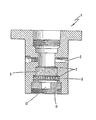
- the drawing is a schematic representation of one embodiment of extrusion apparatus which is suitable for use in the process of the present invention, as described in Example 1, illustrating an elongational grid and its placement within the apparatus.
- the process provided by the present invention relates to the extrusion of liquid crystal polymer.
- the liquid crystal polymers have very stiff, rod-like molecules.
- the stiffness of the molecules can be characterized by the Mark-Houwink-Sakurada relationship where [ ⁇ ] is the intrinsic viscosity, M is the molecular weight, and K and a are constants.
- the exponent a can characterize the stiffness of the molecules.
- the liquid crystal polymers commonly exhibit a value of a greater than 1.0 and less than 2.0. whereas isotropic, randomly coiled polymers commonly exhibit a value of a between 0.5 and 1.0.
- the liquid crystal polymers which are suitable for use in the process of the present invention may be either lyotropic or thermotropic liquid crystal polymers.
- Lyotropic liquid crystal polymers are polymers which are liquid crystalline in solution. Lyotropic polymers include wholly aromatic polyamides, aromatic-aliphatic polyamides, aromatic polyamidehydrazides, polybenzobisoxa- zoles, and polybenzobisthiazoles. The aromatic polyamides are considered be "wholly" aromatic in the sense that each moiety present in the polyamide contributes at least one aromatic ring to the polymer backbone.
- wholly aromatic polyamides include polyparabenzamide and polyparaphenyleneterephthalamide.
- Polyparabenzamide and processes of preparing the same are disclosed in U.S. Patent Nos. 3 109 836; 3 225 011; 3 541 056; 3 542 719; 3 547 895; 3 558 571; 3 575 933; 3 600 350; 3 671 542; 3 699 085; 3 753 957; and 4 025 494.
- Polyparaphenyleneterephthalamide which is available commercially under the trademark Keviar@ and processes of preparing the same are disclosed in U.S. Patent Nos.
- aromatic-aliphatic polyamides such as poly(paraphenylene-1,4-trans-cyclohexyleneamide) and poly[(trans-1,4-cyclohexylene)terephthalamide].
- Aromatic polyamide-hydrazides are disclosed by P.W. Morgan in A.C.S. Polymer Preprints, Vol. 18, No. 1, pp. 131 - 6 (1977), which is herein incorporated by reference in its entirety. Among such polymers can be listed poly(oxalylchloroterephthaloyldihydrazide) and poly(paraphenylene-1,3,4-oxadiazole-co-paraphenyleneterephtha- lamide).
- polybenzobisoxazole poly([benzo(1,2-d:5,4-d')bisoxazole-2,6-diyl]-1,4-phenylene); an example of a polybenzobisthiazole is poly([benzo(1,2-d:4,5-d')bisthiazole-2,6-diyl]-1,4-phenylene).
- the lyotropic polymers described above are liquid crystalline when dissolved in a compatible solvent such as selected amides and ureas, including N,N-dimethylacetamide, N,N-dimethylpropionamide, N,N-dimethylbutyramide, N,N-dimethylisobutyramide, N,N-dimethylmethoxyacetamide, N,N-diethylacetamide, N-methylpyrrolidone-2, N-methyl- piperidone-2, N-methylcaprolactam, N-ethylpyrrolidone-2, N-acetylpyrrolidone, N-acetylpiperidine, N,N'-dimethylethyle- neurea, N,N'-dimethylpropyleneurea, hexamethylphosphoramide and N,N,N',N'-tetramethylurea; organophosphorus compounds, including N,N-dimethyldimethylphosphinamide,N,N,N',
- Mixtures of two or more of the above solvents may be used in suitable combinations, e.g.” any of the amides and ureas; hydrofluoric acid and fluoro-sulfonic acid; methane-sulfonic acid and sulfuric acid; oleum and chloro-, fluoro- or methane-sulfonic acid; and the like.
- the lyotropic polymer may be dissolved in the solvent in a concentration of 1 to 30 percent by weight.
- additives are preferred in many of the solutions. It is believed that particular additives aid the solvation of the polyamide in the solvent.
- amide and urea media it is highly desirable that at least 2.0 weight percent of lithium chloride and/or calcium chloride be added to provide a reasonably concentrated solution from particular isolated polymers, e.g., polyparabenzamide.
- the salt may be conveniently added to the polymer and/or solvent. Salt in excess of 20 weight percent is generally neither necessary nor desired; less than 15 weight percent is preferred, 4 to 8 weight percent being most preferred.
- Thermotropic liquid crystal polymers are polymers which are liquid crystalline (i.e., anisotropic) in the melt phase.
- Thermotropic liquid crystal polymers include wholly aromatic polyesters, aromatic-aliphatic polyesters, aromatic polyazomethines, and aromatic polyester-carbonates.
- the aromatic polyesters are considered to be "wholly" aromatic in the sense that each moiety present in the polyester contributes at least one aromatic ring to the polymer backbone.
- suitable aromatic-aliphatic polyesters are copolymers of polyethylene terephthalate and hydroxybenzoic acid as disclosed in Polyester X7G-A Self Reinforced Thermoplastic, by W.J. Jackson, Jr,, H.F. Kuhfuss, and T.F. Gray, Jr., 30th Anniversary Technical Conference, 1975 Reinforced Plastic/Composites Institute, The Society of the Plastics Industry, Inc., Section 17-D, pages 1 - 4.
- a further disclosure of such copolymer can be found in "Liquid Crystal Polymers: I. Preparation and Properties of p-Hydroxybenzoic Acid Copolymers," Journal of Polymer Science, Polymer Chemistry Edition, Vol. 14, pp. 2043 - 58 (1976), by W. J. Jackson, Jr. and H. F. Kuhfuss.
- the above-cited references are herein incorporated by reference in their entirety.
- Aromatic polyazomethines and processes of preparing the same are disclosed in the U.S. Patent Nos. 3 493 522; 3 493 524; 3 503 739; 3 516 970; 3 516 971; 3 526 611; 4 048 148; and 4 122 070. Each of these patents is herein incorporated by reference in its entirety.
- polymers include poly(nitri- lo-2-methyl-1,4-phenylenenitriloethylidyne-1,4-phenyleneethylidyne); poly(nitrilo-2-methyl-1,4-phenylene-nitrilomethyli- dyne-1,4-phenylene-methylidyne); and poly(nitrilo-2-chloro-1 ,4-phenylenenitrilomethylidyne-1 ,4-phenylene-methylidyne).
- Aromatic polyester-carbonates are disclosed in US-A-4 107 143, which is herein incorporated by reference in its entirety.
- Examples of such polymers include those consisting essentially of hydroxybenzoic acid units, hydroquinone units, carbonate units, and aromatic carboxylic acid units.
- the liquid crystal polymers which are preferred for use in the process of the present invention are the thermotropic wholly aromatic polyesters.
- Recent publications disclosing such polyesters include (a) BE-A-823 935 and BE-A-828 936, (b) NL-A-7 505 551, (c) West German Pat. Nos. 2 520 819, 2 520 820, and 2 722 120, (d) Japanese Pat. Nos. 43-223, 2132-116, 3017-692, and 3021-293, (e) U.S. Pat. Nos.
- Wholly aromatic polyesters which are preferred for use in the present invention are disclosed in commonly-assigned U.S. Patent Nos. 4 067 852; 4 083 829; 4 130 545; 4 161 470; and 4 184 996; and in commonly-assigned EP-A-15 088, EP-A-17 310, EP-A-18 709 and EP-A-22 344, all said European Patent Applications belonging to the prior art according to art 54 (3) EPC.
- the disclosures of all of the above-identified commonly-assigned U.S. patents and applications are herein incorporated by reference in their entirety.
- the wholly aromatic polyesters disclosed therein typically are capable of forming an anisotropic melt phase at a temperature below 350°C.
- the wholly aromatic polyesters which are suitable for use in the process of the present invention may be formed by a variety of ester-forming techniques whereby organic monomer compounds possessing functional groups which upon condensation form the requisite recurring moieties are reacted.
- the functional groups of the organic monomer compounds may be carboxylic acid groups, hydroxyl groups, ester groups, acy- loxy groups, acid halides, etc.
- the organic monomer compounds may be reacted in the absence of a heat exchange fluid via a melt acidolysis procedure. They, accordingly, may be heated initially to form a melt solution of the reactants with the reaction continuing as solid polymer particles are suspended therein. A vacuum may be applied to facilitate removal of volatiles formed during the final stage of the condensation (e.g., acetic acid or water).
- the organic monomer reactants from which the wholly aromatic polyesters are derived may be initially provided in a modified form whereby the usual hydroxy groups of such monomers are esterified (i.e., they are provided as lower acyl esters).
- the lower acyl groups preferably have from about two to about four carbon atoms.
- the acetate esters of organic monomer reactants are provided.
- Representative catalysts which optionally may be employed in either the melt acidolysis procedure or in the slurry procedure of US-A-4 083 829 include dialkyl tin oxide (e.g., dibutyl tin oxide), diaryl tin oxide, titanium dioxide, antimony trioxide, alkoxy titanium silicates, titanium alkoxides, alkali and alkaline earth metal salts of carboxylic acids (e,g., zinc acetate), the gaseous acid catalysts, such as Lewis acids (e.g., BFs), hydrogen halides (e.g., HCI), etc.
- the quantity of catalyst utilized typically is 0.001 to 1 percent by weight based upon the total monomer weight, and most commonly 0.01 to 0.2 percent by weight.
- the wholly aromatic polyesters which are preferred for use in the present invention commonly exhibit a weight average molecular weight of 2,000 to 200,000, and preferably 10,000 to 50,000, e.g. 20,000 to 25,000.
- Such molecular weight may be determined by standard techniques not involving the solutioning of the polymer, e.g., by end group determination via infrared spectroscopy on compression molded films. Alternatively, light scattering techniques in a pentafluorophenol solution may be employed to determine the molecular weight.
- the wholly aromatic polyesters additionally commonly exhibit an inherent viscosity (i.e., I.V.) of at least 2.0 dl/g, e.g., 2.0 to 10.0 dl/g, when dissolved in a concentration of 0.1 percent by weight in pentafluorophenol at 60°C.
- I.V. inherent viscosity
- Especially preferred wholly aromatic polyesters are those which are disclosed in above-noted US-A-4 161 470 and US-A-4 184 996 and in EP-A-15 088, said European Patent Application belonging to the prior art according to article 54 (3) EPC.
- the wholly aromatic polyester which is disclosed in US-A-4 161 470 is a melt processable wholly aromatic polyester capable of forming an anisotropic melt phase at a temperature below 350°C.
- the polyester consists essentially of the recurring moieties I and II wherein; is is The polyester comprises 10 to 90 mole percent of moiety I, and 10 to 90 mole percent of moiety II.
- moiety II is present in a concentration of 65 to 85 mole percent, and preferably in a concentration of 70 to 80 mole percent, e.g., 75 mole percent.
- moiety II is present in a lesser proportion of 15 to 35 mole percent, and preferably in a concentration of 20 to 30 mole percent.
- the wholly aromatic polyester which is disclosed in US-A-4 184 996 is a melt processable wholly aromatic polyester capable of forming an anisotropic melt phase at a temperature below 325°C.
- the polyester consists essentially of the recurring moieties I, II and III wherein:
- the wholly aromatic polyester which is disclosed in EP-A-15 088 (prior art according to article 54(3) EPC) is a melt processable polyester capable of forming an anisotropic melt phase at a temperature no higher than 320°C consisting essentially of the recurring moieties I, II, III, and IV wherein:
- a fluid stream of liquid crystal polymer is provided to any conventional extrusion apparatus.
- the liquid crystal polymer is a lyotropic polymer
- the fluid stream will be in the form of a liquid crystal polymer solution
- the liquid crystal polymer is a thermotropic polymer
- the fluid stream will be in the form of a liquid crystal polymer melt.
- the fluid stream of liquid crystal polymer within the extrusion apparatus will commonly exhibit a flow pattern having a substantial shear flow component.
- thermotropic liquid crystal polymers employs a contact melting method so that melt residence time can be kept short and constant.
- the apparatus includes a heated surface against which a molded rod of liquid crystal polymer is pressed.
- the fluid stream of molten polymer is then introduced to the extrusion chamber of which are disposed a filter pack and an elongational grid which will be described in greater detail hereinafter.
- the polymer melt is extruded through an appropriate extrusion orifice (e.g., slit die, spinneret, etc.). Examples of other suitable extrusion apparatus are described in Plastics Engineering Handbook of the Society of the Plastics Industry, Inc., Fourth Edition, edited by Joel Frados, Van Nostrand Reinhold Company (1976), pp. 156 - 203.
- the flow of the fluid stream of liquid crystal polymer is then converted to a substantially elongational flow in the substantial absence of shear flow.
- elongational flow is flow in which there is a velocity gradient parallel to the flow direction
- shear flow is flow in which there is a velocity gradient transverse to the flow direction.
- the flow of the fluid stream of liquid crystal polymer can be converted to elongational flow by converging the fluid stream of liquid crystal polymer. This is accomplished by passing the fluid stream of liquid crystal polymer through at least one grid having a plurality of converging passages.
- the converging passages preferably have an exit diameter of 20 to 1,000 micrometer, and most preferably of 75 to 150 micrometer (e.g., 100 micrometer).
- Such a grid contains at least two converging passages (or holes). However, better elongational flow is achieved as the number of holes in the grid increases. Thus, it is preferred that the elongational grid contain 0,15 to 15,5 holes per square millimeter (100 to 10,000 holes per square inch). As described in Example 1, applicant has obtained excellent results employing a grid containing 43 holes in a 7.9 mm (5/16 inch) diameter circular plate (0.87 holes per square millimeter (561 holes per square inch)), although excellent results can also be obtained employing grids having both a larger and smaller number of holes.
- the converging passages are cone-shaped holes.
- the cone-shaped holes may have a half-angle within the range of 10° to 60°, e.g., 20° to 45°.
- the converging passages may also have curved sides, thereby forming trumpet-shaped holes.
- the wall of the grid may be lubricated by a stream of inert, low viscosity fluid in order to obtain an almost complete absence of shear flow.
- lubrication may make the process more complex and difficult to operate. Thus, for most purposes, lubrication is not necessary.
- elongational flow coexists with shear flow and the degree of each type of flow varies depending upon the location in the cone.
- the maximum of the elongation rate occurs at the exit of the cone along the centerline where shear rate is zero, and the elongation rate becomes zero at the wall where the shear rate is maximum.
- the quantitative description of the degree of the elongational flow depends upon the rheological properties of the fluid and is not yet established for the liquid crystal polymers. However, if we assume the fluid to be Newtonian fluid (which is the most simple fluid model), the maximum elongation rate (e max) can be calculated by where Q is the volumetric flow rate per hole.
- D is the hole exit diameter and a is the half-angle of the cone as discussed by A.E. Everage and R.C. Ballman in Journal of Applied Polymer Science, Vol. 18, pages 933 - 37 (1974).
- a high flow rate and a small hole diameter provide a high elongation rate.
- very large angles e.g., > 60°
- the formation of the vortex flow near the wall depends on the rheological characteristics (particularly elongational flow response) of the fluid.
- holes with the angle which gradually varies from 180° to 0° are suitable.
- the elongational flow provided by the present invention have an elongation rate of at least 1.0 second- 1 .
- the elongational flow preferably has an elongation rate of 100 to 5,000 second .1 .
- the fluid stream of liquid crystal polymer After the flow of the fluid stream of the liquid crystal polymer has been converted to a substantially elongational flow by passing the fluid stream of liquid crystal polymer through a grid having a plurality of converging passages, the fluid stream of liquid crystal polymer is extruded to form a shaped article having the polymer molecules oriented substantially parallel to the flow direction.
- the orientation of the polymer molecules can be confirmed by determining orientation angle by X-ray analysis.
- the solvent is removed from the polymer following extrusion.
- the removal of solvent is commonly accomplished by evaporating the solvent from the extruded article or by extracting the solvent from the extruded article with an aqueous medium, utilizing processes which are well-known in the art.
- thermotropic polymers are extruded at a temperature within the range of 20°C to 150°C and at a pressure within the range of 207 to 2760 kPa (30 p.s.i. to 400 p.s.i.), and thermotropic polymers are extruded at a temperature within the range of 280°C to 400°C and at a pressure within the range of 690 to 34474 kPa (100 p.s.i. to 5.000 p.s.i.).
- the liquid crystal polymers can be extruded to form a variety of shaped articles.
- the liquid crystal polymer can be extruded through a die to form a film.
- film includes any of various thin, flat structures which may be known in the art as sheet, film, etc.
- the liquid crystal polymer can also be extruded through a spinneret to form a plurality of filaments or can be extrusion molded to form a molded article.
- the thermotropic liquid crystal polymers are also useful in the extrusion of elongated three-dimensional articles such as rods or pipes.
- the shaped articles which are produced by the process of the present invention exhibit enhanced mechanical properties due to the orientation of the polymer molecules in a direction substantially parallel to the flow direction.
- Articles having the molecules oriented in such a manner are self-reinforcing, having mechanical properties comparable to those of articles formed from fiber-reinforced isotropic polymeric materials.
- the manner in which the process of the present invention aids in the orientation of the polymer molecules involves complex theoretical considerations and is incapable of simple explanation. However, it is believed that subjecting the fluid stream of liquid crystal polymer to elongational flow prior to extrusion helps to reduce the polymer domain structure, thereby allowing the polymer molecules to orient more easily during extrusion.
- liquid crystal polymers have very stiff, rod-like molecules. In the quiescent state, the polymer molecules line up in local regions, thereby forming ordered arrays or domains.
- the existence of domain texture within the microstructure of a liquid crystal polymer may be confirmed by conventional polarized light techniques whereby a polarizing microscope utilizing crossed-polarizers is employed. The individual domains, however, are not lined up in any particular direction; instead, they exhibit random orientations.
- Shear flow alone does not affect the domain structure of liquid crystal polymers.
- liquid crystal polymers having a domain texture within the microstructure commonly behave like a solid.
- yield stress a critical value
- liquid crystal polymers having a domain texture within the microstructure commonly behave like a solid.
- the shear stress applied to the material is not uniform but varies throughout the material. For example, in the case of extrusion through a duct, the shear stress applied to the material is at a maximum at the wall and is zero in the middle. In such a case, liquid crystal polymer in the middle region where the stress is below the yield stress does not flow like a liquid but travels along like a solid mass thereby forming "plug flow". The plug still consists of randomly ordered arrays. Even where the applied stress is greater than the yield stress, liquid crystal polymer domains may break up into smaller domains, but not to a significant degree.
- the mechanical properties of shaped articles produced in accordance with the process of the present invention can be improved still further by subjecting the articles to a heat treatment following extrusion.
- the articles may be thermally treated in an inert atmosphere (e.g., nitrogen, argon, helium) or alternatively a flowing oxygen- containing atmosphere (e.g., air).
- the article may be brought to a temperature 10°C to 30°C below the melting temperature of the liquid crystal polymer, at which temperature the article remains a solid object.
- the heat treatment times commonly range from a few minutes to a number of days, e.g., from 0.5 to 200 hours, or more.
- the heat treatment is conducted for a time of 1 to 48 hours (e.g., 24 to 30 hours).
- the heat treatment improves the properties of the article by increasing the molecular weight of the liquid crystalline polymer and increasing the degree of crystallinity.
- thermotropic liquid crystalline wholly aromatic polyester comprising 75 mole percent of p-oxybenzoyl units and 25 mole percent of 6-oxy-2-naphthoyl units.
- This polymer exhibited a melting temperature of 295°C and an inherent viscosity of 7.57 dl/g when measured in a concentration of 0.1 percent by weight in pentafluorophenol at 60°C.
- c concentration of solution (0,1 percent by weight)
- 1l rel relative viscosity. The relative viscosity was measured by dividing the flow time for the pure solvent.
- the polymer was extruded utilizing a conventional film extrusion apparatus with a slit die, as illustrated in the drawing.
- the unit employed a contact melting method so that melt residence time could be kept short and constant.
- a compression molded rod (not shown) made from well-dried polymer chips was pressed against a heated surface (not shown). That portion of the rod in contact with the heated surface was melted and introduced to the extrusion apparatus 1 through passage 3, where the fluid stream of wholly aromatic polyester had a flow pattern comprising substantial shear flow.
- the melt was passed through a filter pack 5 comprising shattered metal of 177 to 125 pm diameter 80 - 120 mesh) sandwiched between two screens 7 with sieve openings of 44 pm (325 mesh).
- the melt was passed through a grid 9, measuring 8 mm (5/16 inch) in diameter and containing 43 cone-shaped holes, which was placed after the filter pack and just before the die.
- the grid was a Baker wet spinning jet spinneret which was adapted for use in the film extrusion apparatus.
- the holes had an inlet diameter of 814 micrometer, an exit diameter of 102 micrometer and a capillary length of 137 micrometer.
- the half-angle of the cone-shaped portion of the holes was 23.3°.
- the grid provided an elongation rate of 397 second -1 when calculated using Equation (2) above.
- the polymer melt was extruded through a slit die 11.
- the slit 13 measured 0.18 mm (0.007 inches) by 6.35 mm (0.25 inches) and had a length of 6.35 mm (0.25 inches).
- Extruded films were quenched by blowing nitrogen through a quench ring (not shown) located beneath the die.
- films were also extruded in the manner described above with the exception that the elongation grid was not used. Mechanical properties of these films were measured and are also listed in Table I. The tensile properties listed in Table I were measured in accordance with standard ASTM Test No. D882. The measurements were made in the machine direction; i.e., parallel to the orientation of the polymer molecules.
- Example 1 Films produced in accordance with Example 1 were subjected to a heat treatment in a nitrogen atmosphere at 260°C for thirty hours. Following heat treatment, the mechanical properties of the films were measured and are listed in Table II. The measurements were made using the same tests as in Example 1. The data demonstrate the increase in properties which is obtained by subjecting the liquid crystal polymer to elongational flow prior to extrusion.
- Example 1 The process of Example 1, was repeated, except that the liquid crystal polymer used was a thermotropic wholly aromatic polyester comprising 75 mole percent of p-oxybenzoyl units and 25 mole percent of 6-oxy-2-naphthoyl units and having an inherent viscosity of 8.24 when measured in a concentration of 0.1 percent by weight in pentafluorophenol at 60°C.
- the mechanical properties of the films produced were measured in accordance with the tests listed in Example 1. and the results are listed in Table III. Again, the data indicate a dramatic increase in properties of films produced in accordance with the process of the present invention over films produced conventionally.
- Example 3 Films produced in accordance with the process of Example 3 were subjected to the heat treatment process described in Example 2.
- the mechanical properties of the films produced with and without the elongational grid were measured in accordance with the tests listed in Example 1 and the results are given in Table IV.
- the data again demonstrate the improved properties which are obtained when films are formed from liquid crystal polymer which has been subjected to elongational flow prior to extrusion.
- the films were extruded according to the process of Example 1, except that the liquid crystal polymer used was a thermotropic wholly aromatic polyester comprising 40 mole percent of p-oxybenzoyl units, 15 mole percent of 1,2-ethyle- nedioxy-4,4'-dibenzoyl units. 15 mole percent of terephthaloyl units, and 30 mole percent of methyl substituted 1,4-dioxyphenylene units.
- This polymer exhibited an inherent viscosity of 2.4 dl/g when measured in a concentration of 0.3 weight/volume percent in pentafluorophenol at 60°C.
- Example 5 The films produced in accordance with Example 5 were subjected to a heat treatment at 250°C. for 24 hours in a nitrogen atmosphere.
- the mechanical properties of the heat treated films were measured in accordance with the tests listed in Example 1. The results of these measurements are listed in Table VI. Again, the data indicate that heat treated films produced from a liquid crystal polymer which has been subjected to elongational flow prior to extrusion exhibit improved properties.
Landscapes
- Engineering & Computer Science (AREA)
- Mechanical Engineering (AREA)
- Textile Engineering (AREA)
- Chemical & Material Sciences (AREA)
- Manufacturing & Machinery (AREA)
- Medicinal Chemistry (AREA)
- Health & Medical Sciences (AREA)
- Chemical Kinetics & Catalysis (AREA)
- Materials Engineering (AREA)
- Polymers & Plastics (AREA)
- Organic Chemistry (AREA)
- Extrusion Moulding Of Plastics Or The Like (AREA)
- Manufacture Of Macromolecular Shaped Articles (AREA)
- Liquid Crystal Substances (AREA)
- Artificial Filaments (AREA)
- Compositions Of Macromolecular Compounds (AREA)
Claims (21)







Applications Claiming Priority (2)
| Application Number | Priority Date | Filing Date | Title |
|---|---|---|---|
| US169013 | 1980-07-15 | ||
| US06/169,013 US4332759A (en) | 1980-07-15 | 1980-07-15 | Process for extruding liquid crystal polymer |
Publications (3)
| Publication Number | Publication Date |
|---|---|
| EP0045575A1 EP0045575A1 (de) | 1982-02-10 |
| EP0045575B1 EP0045575B1 (de) | 1983-08-31 |
| EP0045575B2 true EP0045575B2 (de) | 1990-02-07 |
Family
ID=22613918
Family Applications (1)
| Application Number | Title | Priority Date | Filing Date |
|---|---|---|---|
| EP81303160A Expired - Lifetime EP0045575B2 (de) | 1980-07-15 | 1981-07-10 | Verfahren zur Extrusion von Flüssigkristall-Polymeren |
Country Status (6)
| Country | Link |
|---|---|
| US (1) | US4332759A (de) |
| EP (1) | EP0045575B2 (de) |
| JP (1) | JPS5756235A (de) |
| BR (1) | BR8104502A (de) |
| CA (1) | CA1170417A (de) |
| DE (1) | DE3160817D1 (de) |
Families Citing this family (44)
| Publication number | Priority date | Publication date | Assignee | Title |
|---|---|---|---|---|
| JPS5943115A (ja) * | 1982-08-27 | 1984-03-10 | Toray Ind Inc | ミツクス糸の製造方法 |
| US5374706A (en) * | 1982-09-17 | 1994-12-20 | The Dow Chemical Company | Liquid crystalline polymer compositions process, and products |
| US5260365A (en) * | 1982-09-17 | 1993-11-09 | Dow Chemical Co | Liquid crystalline polymer compositions, process, and products |
| US4617371A (en) * | 1982-11-29 | 1986-10-14 | Alexandre Blumstein | Novel polymeric liquid crystals and methods for their preparation |
| US4468364A (en) * | 1983-04-28 | 1984-08-28 | Celanese Corporation | Process for extruding thermotropic liquid crystalline polymers |
| JPS626211A (ja) * | 1985-02-06 | 1987-01-13 | Sumitomo Electric Ind Ltd | 高配向性樹脂製補強部材およびその製造方法 |
| US4728698A (en) * | 1985-09-06 | 1988-03-01 | University Of Akron | Liquid crystal fiber-reinforced polymer composite and process for preparing same |
| JPH0686594B2 (ja) * | 1985-09-20 | 1994-11-02 | 日本石油株式会社 | モノドメイン化されたコレステリツク液晶性ポリエステルフイルムまたはシ−トの製造方法 |
| US4939235A (en) * | 1985-09-26 | 1990-07-03 | Foster-Miller, Inc. | Biaxially oriented ordered polybenzothiazole film |
| US6132668A (en) * | 1985-09-26 | 2000-10-17 | Foster-Miller, Inc. | Biaxially oriented ordered polymer films |
| US4973442A (en) * | 1985-09-26 | 1990-11-27 | Foster Miller Inc. | Forming biaxially oriented ordered polymer films |
| US4734240A (en) * | 1986-01-24 | 1988-03-29 | Hoechst Celanese Corporation | Melt-extrusion of polymer which is capable of forming an anisotropic melt phase to form large shaped articles exhibiting improved polymeric orientation |
| DE3603995A1 (de) * | 1986-02-08 | 1987-08-20 | Bayer Ag | Verfahren zur herstellung und die teile aus thermotropen fluessigkristallinen kunststoffen mit definierter orientierung der lc-polymere |
| DE3604829A1 (de) * | 1986-02-15 | 1987-08-20 | Basf Ag | Verfahren zur herstellung von flaechigem halbzeug |
| US4966806A (en) * | 1986-12-16 | 1990-10-30 | Foster Miller, Inc. | Film-based structural components with controlled coefficient of thermal expansion |
| JPH0772367B2 (ja) * | 1987-02-10 | 1995-08-02 | 株式会社クラレ | 高弾性繊維の製造方法 |
| JP2588533B2 (ja) * | 1987-07-17 | 1997-03-05 | 株式会社クラレ | 芳香族ポリエステル繊維 |
| BG50083A1 (en) * | 1987-09-29 | 1992-05-15 | Knippi Niproruda | Method for preparing of liquid- crystalline polymer lamillats |
| JPH0192408A (ja) * | 1987-10-02 | 1989-04-11 | Kuraray Co Ltd | 芳香族ポリエステル繊維の製造方法 |
| JPH0164285U (de) * | 1987-10-19 | 1989-04-25 | ||
| US4891261A (en) * | 1988-02-29 | 1990-01-02 | Aluminum Company Of America | Thermoplastic stock shape and method for making the same |
| US4966807A (en) * | 1988-06-13 | 1990-10-30 | Foster Miller, Inc. | Multiaxially oriented thermotropic polymer films and method of preparation |
| JPH0639533B2 (ja) * | 1988-06-17 | 1994-05-25 | 株式会社クラレ | 全芳香族ポリエステルフイルム及びその製造方法 |
| JP3003116B2 (ja) * | 1988-06-20 | 2000-01-24 | フオスター・ミラー・インコーポレイテツド | 制御された熱膨張率を有する分子的に配向された管状構成要素 |
| US4975312A (en) * | 1988-06-20 | 1990-12-04 | Foster-Miller, Inc. | Multiaxially oriented thermotropic polymer substrate for printed wire board |
| JPH0328822A (ja) * | 1989-06-27 | 1991-02-07 | Nippon Oil Co Ltd | 液晶表示素子用補償板 |
| US5156785A (en) * | 1991-07-10 | 1992-10-20 | Cordis Corporation | Extruded tubing and catheters having increased rotational stiffness |
| US5248305A (en) * | 1989-08-04 | 1993-09-28 | Cordis Corporation | Extruded tubing and catheters having helical liquid crystal fibrils |
| FR2654380B1 (fr) * | 1989-11-10 | 1992-02-21 | Rhone Poulenc Chimie | Procede de preparation de poudres de polymere thermotrope par extrusion-granulation-broyage, les granules conduisant par broyage a ces poudres et les poudres fines et coulables obtenues. |
| US5141693A (en) * | 1991-01-09 | 1992-08-25 | E. I. Du Pont De Nemours And Company | Process for improving the strength of fibers from anisotropic-melt-forming polyesters |
| US5158725A (en) * | 1991-04-29 | 1992-10-27 | The Goodyear Tire & Rubber Company | Continuous mixing of elastomeric compounds |
| US5296185A (en) * | 1992-12-03 | 1994-03-22 | The Dow Chemical Company | Method for spinning a polybenzazole fiber |
| WO1994022936A1 (en) * | 1993-03-26 | 1994-10-13 | Hoechst Celanese Corporation | Rapid heat treatment of liquid crystalline fibers |
| USH1502H (en) * | 1993-08-17 | 1995-11-07 | Fiberweb North America, Inc. | Meltblown fibers and webs produced from liquid crystal polymers |
| US5882741A (en) * | 1996-01-26 | 1999-03-16 | Foster-Miller, Inc. | Members having a multiaxially oriented coating of thermotropic liquid crystalline polymer and method and apparatus for producing such members |
| US6064007A (en) * | 1996-04-29 | 2000-05-16 | Electric Power Research Institute Inc. | Moisture resistant underground cable |
| US6057000A (en) * | 1998-10-29 | 2000-05-02 | Xerox Corporation | Extrusion coating process |
| US20050147777A1 (en) * | 2004-01-05 | 2005-07-07 | Fries Carolyn A. | Lightweight plastic laminate suitable for gas and moisture resistant environmental housings |
| US7951116B2 (en) * | 2004-11-12 | 2011-05-31 | Boston Scientific Scimed, Inc. | Selective surface modification of catheter tubing |
| KR100818562B1 (ko) | 2006-05-08 | 2008-04-02 | 서용석 | 양 말단에 반응기를 가진 액정단위(메조겐유닛)를 이용한고분자수지의 분자량 증가방법과 높은 내 충격성을 가지는고분자수지 제조 |
| EP2370244A2 (de) * | 2008-12-04 | 2011-10-05 | Eidgenössische Technische Hochschule Zürich | Polymerartikel, verfahren und werkzeuge zu ihrer herstellung |
| JP2015508348A (ja) | 2012-01-06 | 2015-03-19 | アイトゲネーシッシュ テヒニッシュ ホッホシュレ チューリッヒEidgenossische Technische Hochschule Zurich | ポリマー物品ならびに同一物を製造するための方法およびダイ |
| GB201400738D0 (en) * | 2014-01-16 | 2014-03-05 | Cedar Advanced Technology Group Ltd | Polymer film |
| WO2018122747A1 (en) * | 2016-12-27 | 2018-07-05 | Sabic Global Technologies B.V. | Novel die design for property enhancement |
Family Cites Families (14)
| Publication number | Priority date | Publication date | Assignee | Title |
|---|---|---|---|---|
| US2923972A (en) * | 1960-02-09 | De ghetto | ||
| GB750067A (en) * | 1951-05-16 | 1956-06-06 | Celanese Corp | Production and treatment of filamentary materials |
| US2838011A (en) * | 1954-11-20 | 1958-06-10 | Braibanti Mario | Device for locking the extruding die on the head of an extruding press for doughy materials |
| NL234062A (de) * | 1958-12-10 | 1900-01-01 | ||
| GB1327046A (en) * | 1970-01-28 | 1973-08-15 | Ici Ltd | Filter seal |
| US3825379A (en) * | 1972-04-10 | 1974-07-23 | Exxon Research Engineering Co | Melt-blowing die using capillary tubes |
| US4015924A (en) * | 1973-08-10 | 1977-04-05 | Celanese Corporation | Spinning apparatus providing for essentially constant extensional strain rate |
| US3856277A (en) * | 1973-09-28 | 1974-12-24 | Gloucester Eng Co Inc | Screen assembly for processing plastic |
| US4183895A (en) * | 1975-04-29 | 1980-01-15 | E. I. Du Pont De Nemours And Company | Process for treating anisotropic melt-forming polymeric products |
| US4247514A (en) * | 1975-05-05 | 1981-01-27 | E. I. Du Pont De Nemours And Company | Process for strengthening a shaped article of a polyester |
| JPS595407B2 (ja) * | 1976-10-12 | 1984-02-04 | 旭化成株式会社 | 芳香族ポリアミドフイルムの製造法 |
| US4184996A (en) * | 1977-09-12 | 1980-01-22 | Celanese Corporation | Melt processable thermotropic wholly aromatic polyester |
| US4130545A (en) * | 1977-09-12 | 1978-12-19 | Celanese Corporation | Melt processable thermotropic wholly aromatic polyester comprising both para-oxybenzoyl and meta-oxybenzoyl moieties |
| US4160755A (en) * | 1978-01-23 | 1979-07-10 | Celanese Corporation | Process for producing anisotropic dopes and articles thereof from benzoic acid derivative polymers |
-
1980
- 1980-07-15 US US06/169,013 patent/US4332759A/en not_active Expired - Lifetime
-
1981
- 1981-07-10 DE DE8181303160T patent/DE3160817D1/de not_active Expired
- 1981-07-10 EP EP81303160A patent/EP0045575B2/de not_active Expired - Lifetime
- 1981-07-14 CA CA000381655A patent/CA1170417A/en not_active Expired
- 1981-07-14 BR BR8104502A patent/BR8104502A/pt unknown
- 1981-07-14 JP JP56108935A patent/JPS5756235A/ja active Granted
Also Published As
| Publication number | Publication date |
|---|---|
| JPS5756235A (en) | 1982-04-03 |
| JPH0134134B2 (de) | 1989-07-18 |
| CA1170417A (en) | 1984-07-10 |
| US4332759A (en) | 1982-06-01 |
| EP0045575A1 (de) | 1982-02-10 |
| EP0045575B1 (de) | 1983-08-31 |
| DE3160817D1 (en) | 1983-10-06 |
| BR8104502A (pt) | 1982-03-30 |
Similar Documents
| Publication | Publication Date | Title |
|---|---|---|
| EP0045575B2 (de) | Verfahren zur Extrusion von Flüssigkristall-Polymeren | |
| CA1168820A (en) | Processing of melt processable liquid crystal polymer by control of thermal history | |
| US4468364A (en) | Process for extruding thermotropic liquid crystalline polymers | |
| EP0063880B1 (de) | Von 6-hydroxy-2-naphthoesäure abgeleitetes Poly(esteramid) | |
| US4540737A (en) | Method for the formation of composite articles comprised of thermotropic liquid crystalline polymers and articles produced thereby | |
| US4375530A (en) | Polyester of 2,6-naphthalene dicarboxylic acid, 2,6-dihydroxy naphthalene, terephthalic acid, and hydroquinone capable of forming an anisotropic melt | |
| US4330457A (en) | Poly(ester-amide) capable of forming an anisotropic melt phase derived from 6-hydroxy-2-naphthoic acid, dicarboxylic acid, and aromatic monomer capable of forming an amide linkage | |
| US4355132A (en) | Anisotropic melt phase forming poly(ester-amide) derived from p-hydroxybenzoic acid, 2,6-naphthalenedicarboxylic acid, aromatic monomer capable of forming an amide linkage, and, optionally, hydroquinone and additional carbocyclic dicarboxylic acid | |
| US4339375A (en) | Poly(ester-amide) capable of forming an anisotropic melt phase derived from p-hydroxybenzoic acid, 2,6-dihydroxynaphthalene, carbocyclic dicarboxylic acid, aromatic monomer capable of forming an amide linkage, and, optionally, additional aromatic diol | |
| US4384016A (en) | Mutiaxially oriented high performance laminates comprised of uniaxially oriented sheets of thermotropic liquid crystal polymers | |
| US4318842A (en) | Polyester of 6-hydroxy-2-naphthoic acid, aromatic diol, and 1,4-cyclohexanedicarboxylic acid capable of undergoing melt processing | |
| JPH0320337A (ja) | 全芳香族ポリエステルフィルム | |
| EP0022344A1 (de) | Aus der Schmelze verarbeitbarer, anisotroper, vollaromatischer Polyester, der 6-Oxy-2-naphthoyleinheiten enthält; Formmassen, Formkörper und aus dem Polyester hergestellte Folien und Fasern | |
| CA1131847A (en) | Thermotropic polyesters of 2,6-dihydroxyanthraquinone | |
| EP0985748B1 (de) | Verfahren zur Herstellung von multilobalen Hochdenier-Filamenten aus thermotropischen Flüssigkristallpolymeren | |
| US4457962A (en) | Molded article comprised of a thermotropic liquid crystal line polymer with an inherently weak weld line incorporated therein | |
| EP0095865A2 (de) | Thermogeformte Gegenstände aus thermotropen flüssigen Polymeren und Verfahren zu ihrer Herstellung | |
| US4614791A (en) | Melt processable optically anisotropic polyesters | |
| EP0066359A1 (de) | Poly(ester-amid) abgeleitet von Dihydroxyanthrachinon, Hydroxybenzoesäure, Dicarbonsäure und einem eine Amidbindung bildenden aromatischen Monomer | |
| EP0166830B1 (de) | Nichtgewobene Artikel aus thermotropischen flüssigen Kristall-Polymeren, und Verfahren zur Herstellung derselben | |
| CA1211608A (en) | Method for the formation of composite articles comprised of thermotropic liquid crystalline polymers and articles produced thereby | |
| JPS6042287B2 (ja) | スプリツトフアイバ−の製造法 | |
| MXPA99008302A (en) | Procedure for manufacturing multilobular filaments of crystalline crystalline liquid polymers of high number of deniers, and compositions paralo mi |
Legal Events
| Date | Code | Title | Description |
|---|---|---|---|
| PUAI | Public reference made under article 153(3) epc to a published international application that has entered the european phase |
Free format text: ORIGINAL CODE: 0009012 |
|
| AK | Designated contracting states |
Designated state(s): BE DE FR GB IT NL |
|
| 17P | Request for examination filed |
Effective date: 19820714 |
|
| GRAA | (expected) grant |
Free format text: ORIGINAL CODE: 0009210 |
|
| AK | Designated contracting states |
Designated state(s): BE DE FR GB IT NL |
|
| PG25 | Lapsed in a contracting state [announced via postgrant information from national office to epo] |
Ref country code: NL Effective date: 19830831 Ref country code: IT Free format text: LAPSE BECAUSE OF FAILURE TO SUBMIT A TRANSLATION OF THE DESCRIPTION OR TO PAY THE FEE WITHIN THE PRESCRIBED TIME-LIMIT;WARNING: LAPSES OF ITALIAN PATENTS WITH EFFECTIVE DATE BEFORE 2007 MAY HAVE OCCURRED AT ANY TIME BEFORE 2007. THE CORRECT EFFECTIVE DATE MAY BE DIFFERENT FROM THE ONE RECORDED. Effective date: 19830831 Ref country code: BE Effective date: 19830831 |
|
| REF | Corresponds to: |
Ref document number: 3160817 Country of ref document: DE Date of ref document: 19831006 |
|
| ET | Fr: translation filed | ||
| NLV1 | Nl: lapsed or annulled due to failure to fulfill the requirements of art. 29p and 29m of the patents act | ||
| PLBI | Opposition filed |
Free format text: ORIGINAL CODE: 0009260 |
|
| 26 | Opposition filed |
Opponent name: BASF AKTIENGESELLSCHAFT Effective date: 19840309 |
|
| PLBI | Opposition filed |
Free format text: ORIGINAL CODE: 0009260 |
|
| 26 | Opposition filed |
Opponent name: AKZO N.V. Effective date: 19840530 |
|
| PUAH | Patent maintained in amended form |
Free format text: ORIGINAL CODE: 0009272 |
|
| STAA | Information on the status of an ep patent application or granted ep patent |
Free format text: STATUS: PATENT MAINTAINED AS AMENDED |
|
| 27A | Patent maintained in amended form |
Effective date: 19900207 |
|
| AK | Designated contracting states |
Kind code of ref document: B2 Designated state(s): BE DE FR GB IT NL |
|
| ET3 | Fr: translation filed ** decision concerning opposition | ||
| PGFP | Annual fee paid to national office [announced via postgrant information from national office to epo] |
Ref country code: GB Payment date: 19940627 Year of fee payment: 14 |
|
| PGFP | Annual fee paid to national office [announced via postgrant information from national office to epo] |
Ref country code: DE Payment date: 19940930 Year of fee payment: 14 |
|
| PGFP | Annual fee paid to national office [announced via postgrant information from national office to epo] |
Ref country code: FR Payment date: 19950612 Year of fee payment: 15 |
|
| PG25 | Lapsed in a contracting state [announced via postgrant information from national office to epo] |
Ref country code: GB Effective date: 19950710 |
|
| GBPC | Gb: european patent ceased through non-payment of renewal fee |
Effective date: 19950710 |
|
| PG25 | Lapsed in a contracting state [announced via postgrant information from national office to epo] |
Ref country code: DE Effective date: 19960402 |
|
| APAC | Appeal dossier modified |
Free format text: ORIGINAL CODE: EPIDOS NOAPO |
|
| APAC | Appeal dossier modified |
Free format text: ORIGINAL CODE: EPIDOS NOAPO |
|
| PG25 | Lapsed in a contracting state [announced via postgrant information from national office to epo] |
Ref country code: FR Effective date: 19970328 |
|
| REG | Reference to a national code |
Ref country code: FR Ref legal event code: ST |
|
| APAH | Appeal reference modified |
Free format text: ORIGINAL CODE: EPIDOSCREFNO |