EP0043501B1 - Unter Wasserausschluss lagerfähige plastische Organopolysiloxan-Formmassen - Google Patents
Unter Wasserausschluss lagerfähige plastische Organopolysiloxan-Formmassen Download PDFInfo
- Publication number
- EP0043501B1 EP0043501B1 EP81104881A EP81104881A EP0043501B1 EP 0043501 B1 EP0043501 B1 EP 0043501B1 EP 81104881 A EP81104881 A EP 81104881A EP 81104881 A EP81104881 A EP 81104881A EP 0043501 B1 EP0043501 B1 EP 0043501B1
- Authority
- EP
- European Patent Office
- Prior art keywords
- weight
- approx
- parts
- organopolysiloxane
- methyl
- Prior art date
- Legal status (The legal status is an assumption and is not a legal conclusion. Google has not performed a legal analysis and makes no representation as to the accuracy of the status listed.)
- Expired
Links
- 238000000465 moulding Methods 0.000 title claims description 8
- XLYOFNOQVPJJNP-UHFFFAOYSA-N water Substances O XLYOFNOQVPJJNP-UHFFFAOYSA-N 0.000 title claims description 8
- 229920001296 polysiloxane Polymers 0.000 title claims description 7
- 229920003023 plastic Polymers 0.000 title claims description 3
- 239000004033 plastic Substances 0.000 title claims description 3
- 239000000203 mixture Substances 0.000 claims description 23
- RJWUMFHQJJBBOD-UHFFFAOYSA-N 2-methylheptadecane Chemical compound CCCCCCCCCCCCCCCC(C)C RJWUMFHQJJBBOD-UHFFFAOYSA-N 0.000 claims description 6
- 239000003431 cross linking reagent Substances 0.000 claims description 6
- 239000000945 filler Substances 0.000 claims description 5
- AFABGHUZZDYHJO-UHFFFAOYSA-N 2-Methylpentane Chemical compound CCCC(C)C AFABGHUZZDYHJO-UHFFFAOYSA-N 0.000 claims description 4
- BANXPJUEBPWEOT-UHFFFAOYSA-N 2-methyl-Pentadecane Chemical compound CCCCCCCCCCCCCC(C)C BANXPJUEBPWEOT-UHFFFAOYSA-N 0.000 claims description 4
- GTJOHISYCKPIMT-UHFFFAOYSA-N 2-methylundecane Chemical compound CCCCCCCCCC(C)C GTJOHISYCKPIMT-UHFFFAOYSA-N 0.000 claims description 4
- SGVYKUFIHHTIFL-UHFFFAOYSA-N Isobutylhexyl Natural products CCCCCCCC(C)C SGVYKUFIHHTIFL-UHFFFAOYSA-N 0.000 claims description 4
- 229930195733 hydrocarbon Natural products 0.000 claims description 4
- 150000002430 hydrocarbons Chemical class 0.000 claims description 4
- VKPSKYDESGTTFR-UHFFFAOYSA-N isododecane Natural products CC(C)(C)CC(C)CC(C)(C)C VKPSKYDESGTTFR-UHFFFAOYSA-N 0.000 claims description 4
- 239000012188 paraffin wax Substances 0.000 claims description 4
- NHTMVDHEPJAVLT-UHFFFAOYSA-N Isooctane Chemical compound CC(C)CC(C)(C)C NHTMVDHEPJAVLT-UHFFFAOYSA-N 0.000 claims description 3
- 125000004432 carbon atom Chemical group C* 0.000 claims description 3
- 150000001732 carboxylic acid derivatives Chemical class 0.000 claims description 3
- 125000004122 cyclic group Chemical group 0.000 claims description 3
- JVSWJIKNEAIKJW-UHFFFAOYSA-N dimethyl-hexane Natural products CCCCCC(C)C JVSWJIKNEAIKJW-UHFFFAOYSA-N 0.000 claims description 3
- 229910001385 heavy metal Inorganic materials 0.000 claims description 3
- -1 siloxanes Chemical class 0.000 claims description 3
- 229940043268 2,2,4,4,6,8,8-heptamethylnonane Drugs 0.000 claims description 2
- XDTMQSROBMDMFD-UHFFFAOYSA-N Cyclohexane Chemical compound C1CCCCC1 XDTMQSROBMDMFD-UHFFFAOYSA-N 0.000 claims description 2
- 238000000576 coating method Methods 0.000 claims description 2
- KUVMKLCGXIYSNH-UHFFFAOYSA-N isopentadecane Natural products CCCCCCCCCCCCC(C)C KUVMKLCGXIYSNH-UHFFFAOYSA-N 0.000 claims description 2
- 239000000049 pigment Substances 0.000 claims description 2
- 150000003839 salts Chemical class 0.000 claims description 2
- LLZRNZOLAXHGLL-UHFFFAOYSA-J titanic acid Chemical class O[Ti](O)(O)O LLZRNZOLAXHGLL-UHFFFAOYSA-J 0.000 claims 1
- VYPSYNLAJGMNEJ-UHFFFAOYSA-N silicon dioxide Inorganic materials O=[Si]=O VYPSYNLAJGMNEJ-UHFFFAOYSA-N 0.000 description 12
- GWEVSGVZZGPLCZ-UHFFFAOYSA-N Titan oxide Chemical compound O=[Ti]=O GWEVSGVZZGPLCZ-UHFFFAOYSA-N 0.000 description 10
- 150000001875 compounds Chemical class 0.000 description 8
- 239000003973 paint Substances 0.000 description 7
- 150000002148 esters Chemical class 0.000 description 6
- 230000007062 hydrolysis Effects 0.000 description 5
- 238000006460 hydrolysis reaction Methods 0.000 description 5
- 230000001771 impaired effect Effects 0.000 description 5
- 239000000377 silicon dioxide Substances 0.000 description 5
- 238000003756 stirring Methods 0.000 description 5
- 239000004408 titanium dioxide Substances 0.000 description 5
- 239000000654 additive Substances 0.000 description 4
- 239000004205 dimethyl polysiloxane Substances 0.000 description 4
- 229920000435 poly(dimethylsiloxane) Polymers 0.000 description 4
- 239000013522 chelant Substances 0.000 description 3
- 238000004132 cross linking Methods 0.000 description 3
- VTYYLEPIZMXCLO-UHFFFAOYSA-L Calcium carbonate Chemical compound [Ca+2].[O-]C([O-])=O VTYYLEPIZMXCLO-UHFFFAOYSA-L 0.000 description 2
- PPBRXRYQALVLMV-UHFFFAOYSA-N Styrene Chemical compound C=CC1=CC=CC=C1 PPBRXRYQALVLMV-UHFFFAOYSA-N 0.000 description 2
- RTAQQCXQSZGOHL-UHFFFAOYSA-N Titanium Chemical compound [Ti] RTAQQCXQSZGOHL-UHFFFAOYSA-N 0.000 description 2
- XLOMVQKBTHCTTD-UHFFFAOYSA-N Zinc monoxide Chemical compound [Zn]=O XLOMVQKBTHCTTD-UHFFFAOYSA-N 0.000 description 2
- 239000002253 acid Substances 0.000 description 2
- 230000003014 reinforcing effect Effects 0.000 description 2
- 239000000565 sealant Substances 0.000 description 2
- 239000010936 titanium Substances 0.000 description 2
- 229910052719 titanium Inorganic materials 0.000 description 2
- NIXOWILDQLNWCW-UHFFFAOYSA-M Acrylate Chemical compound [O-]C(=O)C=C NIXOWILDQLNWCW-UHFFFAOYSA-M 0.000 description 1
- 239000004971 Cross linker Substances 0.000 description 1
- 239000005909 Kieselgur Substances 0.000 description 1
- XBDQKXXYIPTUBI-UHFFFAOYSA-N Propionic acid Chemical class CCC(O)=O XBDQKXXYIPTUBI-UHFFFAOYSA-N 0.000 description 1
- 229920000180 alkyd Polymers 0.000 description 1
- 229910000019 calcium carbonate Inorganic materials 0.000 description 1
- 239000003054 catalyst Substances 0.000 description 1
- 238000010276 construction Methods 0.000 description 1
- 238000007872 degassing Methods 0.000 description 1
- 239000000839 emulsion Substances 0.000 description 1
- 230000007717 exclusion Effects 0.000 description 1
- 150000002736 metal compounds Chemical class 0.000 description 1
- 230000007935 neutral effect Effects 0.000 description 1
- 238000010422 painting Methods 0.000 description 1
- 229920002689 polyvinyl acetate Polymers 0.000 description 1
- 239000011118 polyvinyl acetate Substances 0.000 description 1
- 239000000843 powder Substances 0.000 description 1
- 239000010453 quartz Substances 0.000 description 1
- 239000011541 reaction mixture Substances 0.000 description 1
- 238000007789 sealing Methods 0.000 description 1
- 125000005372 silanol group Chemical group 0.000 description 1
- 150000003377 silicon compounds Chemical class 0.000 description 1
- 239000002904 solvent Substances 0.000 description 1
- 229920002554 vinyl polymer Polymers 0.000 description 1
- 239000011787 zinc oxide Substances 0.000 description 1
Classifications
-
- C—CHEMISTRY; METALLURGY
- C08—ORGANIC MACROMOLECULAR COMPOUNDS; THEIR PREPARATION OR CHEMICAL WORKING-UP; COMPOSITIONS BASED THEREON
- C08K—Use of inorganic or non-macromolecular organic substances as compounding ingredients
- C08K5/00—Use of organic ingredients
-
- C—CHEMISTRY; METALLURGY
- C08—ORGANIC MACROMOLECULAR COMPOUNDS; THEIR PREPARATION OR CHEMICAL WORKING-UP; COMPOSITIONS BASED THEREON
- C08K—Use of inorganic or non-macromolecular organic substances as compounding ingredients
- C08K5/00—Use of organic ingredients
- C08K5/01—Hydrocarbons
-
- C—CHEMISTRY; METALLURGY
- C08—ORGANIC MACROMOLECULAR COMPOUNDS; THEIR PREPARATION OR CHEMICAL WORKING-UP; COMPOSITIONS BASED THEREON
- C08K—Use of inorganic or non-macromolecular organic substances as compounding ingredients
- C08K5/00—Use of organic ingredients
- C08K5/04—Oxygen-containing compounds
-
- C—CHEMISTRY; METALLURGY
- C08—ORGANIC MACROMOLECULAR COMPOUNDS; THEIR PREPARATION OR CHEMICAL WORKING-UP; COMPOSITIONS BASED THEREON
- C08K—Use of inorganic or non-macromolecular organic substances as compounding ingredients
- C08K5/00—Use of organic ingredients
- C08K5/54—Silicon-containing compounds
-
- Y—GENERAL TAGGING OF NEW TECHNOLOGICAL DEVELOPMENTS; GENERAL TAGGING OF CROSS-SECTIONAL TECHNOLOGIES SPANNING OVER SEVERAL SECTIONS OF THE IPC; TECHNICAL SUBJECTS COVERED BY FORMER USPC CROSS-REFERENCE ART COLLECTIONS [XRACs] AND DIGESTS
- Y10—TECHNICAL SUBJECTS COVERED BY FORMER USPC
- Y10S—TECHNICAL SUBJECTS COVERED BY FORMER USPC CROSS-REFERENCE ART COLLECTIONS [XRACs] AND DIGESTS
- Y10S528/00—Synthetic resins or natural rubbers -- part of the class 520 series
- Y10S528/901—Room temperature curable silicon-containing polymer
Definitions
- the invention relates to platically deformable mixtures of organopolysiloxanes with certain crosslinking agents which change into a rubber-elastic state at temperatures below 50 ° C. in the presence of water or water vapor and which have good paintability.
- Such mixtures - also called RTV one-component compounds - are primarily used as jointing and sealing compounds in the building industry, in sanitary facilities and in aquarium construction. They all contain, as a basic component, an oc, (o-dihydroxypolydiorganosiloxane which may be mixed with filler. If this is mixed with a silicon compound which contains more than two reactive groups which can react with both silanol groups and with water, all of them are closed off Moisture is the result of storage-stable reaction mixtures that are converted into an elastomeric crosslinking product when atmospheric air enters them.
- Such RTV single-component systems have long been known per se. So-called "neutral" jointing compounds have proven very effective (cf. B. DE-PS 1 247 646, DE-PS 1 258 087), in which carboxylic acid amido-alkylalkoxysilanes are used as crosslinking agents or an insufficient one Paint adhesion is a disadvantage.
- the present invention thus relates to plastic organopolysiloxane molding compositions which are storable with the exclusion of water and which, under the action of water or atmospheric air, convert to rubber-elastic moldings or coatings even at room temperature, produced by mixing IX, w-dihydroxypolydiorganosiloxanes with carboxylic acid amido- alkyl-alkoxy-silicon compounds and complex titanium acid esters. and optionally with fillers, pigments and with known known to accelerate the crosslinking heavy metal salts, which are characterized in that the mixture is branched and 0.2-15 wt .-% - based on the total mixture / or contains cyclic paraffin hydrocarbons with 6 to 24 carbon atoms.
- Reinforcing such as colloidally dispersed silicas, are preferred as fillers, but slightly reinforcing ones, such as quartz powder, diatomaceous earth or zinc oxide and chalk, can also be used for this purpose.
- Suitable additives according to the invention are: branched or cyclic paraffin hydrocarbons having 6 to 24 carbon atoms, such as. B. isohexane, isooctane, isohexadecane, isododecane, isooctadecane / cyclohexane.
- the one-component systems according to the invention are suitable in principle for all uses purposes where appropriate paintability is desired. Such systems are particularly preferably used for grouting on windows, facades and in the do-it-yourself sector.
- the paintability or overpaintability is given for all suitable paints for the mentioned application areas, especially for commercially available paints based on alkyd resin (pre-paints and top coats), for emulsion paints based on mixtures, depending on the intended use, of acrylate, styrene, polyvinyl acetate and polyvinyl propionates.
- the pre-coat should be applied after 1-3 days, after which the painting can be carried out in the usual way.
- the molding compositions according to the invention are prepared from their mixture components in a known manner, usually by mixing the largely water-free, non-crosslinking components first, then admixing the crosslinking agent and finally degassing the overall mixture at room temperature.
- a mixture of 66.2 parts by weight of ⁇ , ⁇ -dihydroxypolydimethylsiloxane of 50,000 mPas and 4.5 parts by weight of di-i-butoxy-titanium-diacetoacetic ester chelate is introduced.
- 20.0 parts by weight of chalk, 1.0 part by weight of titanium dioxide and 3.5 parts by weight of a finely disperse silica (130 m 2 / g BET) obtained by flame hydrolysis are mixed at room temperature until homogeneous (approx . 20-30 minutes) and then evacuated for about 5 minutes. Then 0.7 parts by weight of an organotin compound is added. Stirring time approx. 5 min. Finally, 4.0 parts by weight of di-N-methylbenzamido-methyl-ethoxysilane are stirred in and evacuated for approx. 15 min.
- the mass is filled into cartridges and sealed. Can be stored for at least half a year without the ingress of moisture, without the properties being impaired in a later application.
- the mechanical properties (both before and after storage): Young's modulus 100% - approx. 0.3 N / mm 2 , tensile strength - approx. 0.7 N / mm 2 , elongation at break - approx. 550%, Shore A hardness - approx. 22, density - approx.1.27 g / cm 3 .
- a mixture of 45.3 parts by weight of ⁇ , ⁇ -dihydroxy-polydimethylsiloxane of 50,000 mPas and 4.5 parts by weight of di-i-butoxy-titanium-diacetoacetic ester is submitted.
- 40.0 parts by weight of chalk, 1.0 part by weight of titanium dioxide and 4.5 parts by weight of a finely disperse silica obtained by flame hydrolysis are stirred at room temperature until homogeneous (approx. 20-30 minutes) and evacuated about 5 minutes.
- This is followed by the addition of 0.7 part by weight of an organotin compound, dissolved in 1.0 part by weight of an isooctadecane, with a stirring time of about 5 minutes.
- 4.0 parts by weight of di-N-methyl Benzamido-methyl-ethoxy-silane stirred in and evacuated for about 15 minutes.
- the mass is filled into cartridges and sealed. Can be stored for at least half a year without the ingress of moisture, without the properties being impaired in a later application.
- the mechanical properties (both before and after storage): Young's modulus 100% - approx. 0.5 N / mm 2 , tensile strength - approx. 0.7 N / mm 2 , elongation at break - approx. 330%, Shore A hardness - approx. 40, density - approx. 1.4 g / cm 3 .
- a mixture of 56.3 parts by weight of x) dihydroxy-polydimethylsiloxane of 50,000 mPas and 4.5 parts by weight of di-i-butoxy-titanium-diacetoacetic ester chelate is introduced.
- 25 parts by weight of chalk, 1.0 part by weight of titanium dioxide and 8.0 parts by weight of a finely dispersed silica obtained by flame hydrolysis are stirred until homogeneous (approx. 20-30 minutes) and approx 5 minutes evacuated.
- the mechanical properties (both before and after storage): modulus of elasticity 100% - approx. 0.4 N / mm 2 , tensile strength - approx. 1.0 N / mm 2 , elongation at break - approx. 530%, Shore- A hardness - approx. 40, density - approx.1.22 g / cm 3 .
- a mixture of 44.3 parts by weight of ⁇ , ⁇ -dihydroxy-polydimethylsiloxane of 50,000 mPas and 4.5 parts by weight of di-i-butoxy-titanium-diacetoacetic ester chelate is presented.
- 40.0 parts by weight of chalk, 1.0 part by weight of titanium dioxide and 4.5 parts by weight of a finely disperse silica obtained by flame hydrolysis are stirred at room temperature until homogeneous (approx. 20-30 minutes) and evacuated about 5 minutes. This is followed by the addition of 0.7 part by weight of an organotin compound, dissolved in 1.0 part by weight of an isododecane. Stirring time approx. 5 min.
- 4.0 parts by weight of di-N-methylbenzamido-methyl-ethoxysilane are stirred in and evacuated for approx. 15 min.
- the mass is filled into cartridges and sealed. Can be stored for at least half a year without the ingress of moisture, without the properties being impaired in a later application.
- the mechanical properties (both before and after storage): modulus of elasticity 100% - approx. 0.4 N / mm 2 , tensile strength - approx. 0.6 N / mm 2 , elongation at break - approx. 330%, Shore A hardness - approx. 40, density - approx. 1.4 g / cm 3 .
- a mixture of 44.3 parts by weight of ⁇ , ⁇ -dihydroxy-polydimethylsiloxane and 4.5 parts by weight of di-i-butoxy-titanium-diacetoacetic acid ester is presented.
- 40.0 parts by weight of chalk, 1.0 part by weight of titanium dioxide and 4.5 parts by weight of a finely disperse silica obtained by flame hydrolysis are stirred at room temperature until homogeneous (approx. 20-30 minutes) and evacuated about 5 minutes. This is followed by the addition of 0.7 part by weight of an organotin compound, dissolved in 1.0 part by weight of an isooctane. Stirring time approx. 5 min. Finally, 4.0 parts by weight of di-N-methylbenzamido-methyl-ethoxysilane are stirred in and evacuated for approx. 15 min.
- the mass is filled into cartridges and sealed. Can be stored for at least half a year without the ingress of moisture, without the properties being impaired in a later application.
- the mechanical properties (both before and after storage): modulus of elasticity 100% - approx. 0.4 N / mm 2 , tensile strength - approx. 0.6 N / mm 2 , elongation at break - approx. 330%, Shore A hardness - approx. 40, density - approx. 1.4 g / cm 3 .
Landscapes
- Chemical & Material Sciences (AREA)
- Health & Medical Sciences (AREA)
- Chemical Kinetics & Catalysis (AREA)
- Medicinal Chemistry (AREA)
- Polymers & Plastics (AREA)
- Organic Chemistry (AREA)
- Compositions Of Macromolecular Compounds (AREA)
- Paints Or Removers (AREA)
- Sealing Material Composition (AREA)
Description
- Die Erfindung betrifft platisch verformbare Gemische von Organopolysiloxanen mit bestimmten Vernetzungsmitteln, die bei Temperaturen unterhalb 50°C in Anwesenheit von Wasser oder Wasserdampf in einen gummielastischen Zustand übergehen und die eine gute Überstreichbarkeit besitzen.
- Derartige Gemische - auch RTV-Einkomponenten-Massen genannt - finden vornehmlich Verwendung als Fugen- und Dichtungsmassen im Bauwesen, bei sanitären Anlagen und im Aquarienbau. Sie enthalten alle als Grundbestandteil ein gegebenenfalls mit Füllstoff vermischtes oc,(o-Dihydroxypolydiorganosiloxan. Mischt man dies mit einer Siliciumverbindung, die mehr als zwei reaktive Gruppen enthält, welche sowohl mit Silanolgruppen als auch mit Wasser reagieren können, und schließt man dabei den Zutritt jeglicher Feuchtigkeit aus, so ergeben sich lagerbeständige Reaktionsgemische, die bei Zutritt atmosphärischer Luft durch deren Wasserdampfgehalt in ein elastomeres Vernetzungsprodukt umgewandlet werden. Derartige RTV-Einkomponentensysteme sind an sich seit langem bekannt. Sehr gut bewährt haben sich sog. »neutrale« Fugendichtungsmassen (vgl. z. B. DE-PS 1 247 646, DE-PS 1 258 087), bei denen als Vernetzungsmittel Carbonsäureamido-alkylalkoxysilane verwendet werden. Für zahlreiche Anwendungsgebiete, insbesondere bei Fensterabdichtungen und Fugen zwischen Betonwänden, aber auch bei zahlreichen anderen Einsatzgebieten war die mangelnde Uberstreichbarkeit bzw. eine ungenügende Lackhaftung von Nachteil.
- Es wurden zahlreiche Anstrengungen und Versuche unternommen, um die Überstreichbarkeit von Einkomponentenmassen bzw. die Lackhaftung zu verbessern. So hat man z. B. versucht, die Dichtungsmassen durch Zusätze wie nadelförmiges Calciumcarbonat oder bestimmte Lösungsmittel überstreichbar zu machen. Die resultierenden Produkte weisen jedoch stark veränderte mechanische Eigenschaften auf (hoher Modul, niedrige Bruchdehnung, hohe Shore-A-Härte, große Volumenänderung nach der Aushärtung), so daß ihre Qualität den an sie gestellten Anforderungen nicht mehr genügen kann.
- Es wurde nun gefunden, daß sich die genannten Nachteile ohne Einbußen der anderen vorteilhaften Eigenschaften vermeiden lassen, wenn Organopolysiloxanmassen bestimmte Zusätze zugegeben werden.
- Gegenstand der vorliegenden Erfindung sind somit unter Ausschluß von Wasser lagerfähige plastische Organopolysiloxan-Formmassen, die sich unter Einwirkung von Wasser oder atmosphärischer Luft bereits bei Raumtemperatur in gummielastische Formkörper oder Überzüge umwandeln, hergestellt durch Mischen von lX,w-Dihydroxypolydiorganosiloxanen mit als Vernetzungsmittel dienenden Carbonsäureamido-alkyl-alkoxy-Silicium-Verbindungen und komplexen Titansäureestern .und gegebenenfalls mit Füllstoffen, Pigmenten und mit bekanntermaßen die Vernetzung beschleunigenden Schwermetallsalzen, die dadurch gekannzeichnet sind, daß das Gemisch 0,2-15 Gew.-% - bezogen auf die Gesamtmischung - verzweigte und/oder cyclische Paraffin-Kohlenwasserstoffe mit 6 bis 24 C-Atomen enthält.
- Überraschenderweise hat sich herausgestellt, daß durch solche Zusätze in den genannten Einkomponentensystemen eine gute Überstreichbarkeit bei guter Lackhaftung und gutem Oberflächenverlauf erzielt werden kann.
- Die Mengenverhältnisse der Mischungskomponenten sind analog denen der bekannten Massen. Bevorzugt ist ein Gemisch, das auf 100 Gewichtsteile α,ω-Dihydroxypolydiorganosiloxan von 1000 bis 500 000 m Pas, insbesondere 10 000 bis 60 000 m Pas Viskosität bei 20° C, 3-20 Teilen eines komplexen Titansäureesters, 10 bis 150 Gewichtsteile eines Füllstoffes, 3 bis 20 Gewichtsteile des Vernetzungsmittels und gegebenenfalls 0,1 bis 3,0 einer Schwermetallverbindung als Katalysator enthält. Als Vernetzer kommen Carbonsäureamido-alkyl-alkoxy-Silicium-Verbindungen in Frage wie z. B.
- Di-N-methylbenzamido-methyl-ethoxy-silan
- Di-N-methylbenzamido-methyl-methoxy-silan
- Di-N-methylpropylamido-methyl-ethoxy-silan
- Mono-N-methylpropylamido-methyl-diethoxy-silan
- Di-N-methylpropylamido-methyl-methoxysilan
- Di-N-methylcaprolactam-methyl-ethoxy-silan
- Di-N-methylcaprolactam-methyl-methoxy-silan.
- Als Füllstoffe werden verstärkend wirkende, wie kolloiddisperse Kieselsäuren, bevorzugt, doch lassen sich dazu auch gering verstärkende verwenden, wie Quarzmehl, Diatomeenerde oder Zinkoxid und Kreide.
- Als erfindungsgemäße Zusatzstoffe eignen sich: verzweigte oder cyclische Paraffin-Kohlenwasserstoffe mit 6 bis 24 C-Atomen, wie z. B. Isohexan, Isooktan, Isohexadecan, Isododecan, Isooktadecan/Cyclohexan.
- Die erfindungsgemäßen Einkomponenten-Systeme eignen sich prinzipiell für alle Verwendungszwecke wo eine entsprechende Überstreichbarkeit gewünscht wird. Besonders bevorzugt werden derartige Systeme bei Verfugungen an Fenstern, Fassaden und im Do-it-your-self-Sektor verwendet. Die Überstreichbarkeit bzw. Überlackierbarkeit ist bei allen geeigneten Lacken für die genannten Anwendungsgebiete gegeben, besonders bei handelsüblichen Lacken auf Alkydharz-Basis (Vorlacke und Decklacke), bei Dispersionsfarben auf Basis von Mischungen, je nach Verwendungszweck, aus Acrylat, Styrol, Polyvinylacetat und Polyvinylpropionaten.
- Dabei ist der Vorlack je nach Schichtdicke des Dichtstoffes nach 1-3 Tagen aufzubringen, und danach kann die Lackierung in üblicher Weise erfolgen.
- Die Herstellung der erfindungsgemäßen Formmassen aus ihren Mischungskomponenten erfolgt in bekannter Weise, wobei man gewöhnlich zunächst die weitgehend wasserfreien, nicht vernetzend wirkenden Komponenten zusammenmischt, danach das Vernetzungsmittel beimengt und schließlich das Gesamtgemisch bei Raumtemperatur entgast.
- Der Gegenstand der vorliegenden Erfindung soll anhand der folgenden Beispiele noch näher erläutert werden.
- Es wird eine Mischung aus 66,2 Gewichtsteilen α,ω-Dihydroxypolydimethylsiloxan von 50 000 m Pas und 4,5 Gew.-Teilen Di-i-butoxy-titan-diacetessigesterchelat vorgelegt. Dazu werden bei Raumtemperatur 20,0 Gew.-Teile Kreide, 1,0 Gew.-Teile Titandioxid und 3,5 Gew.-Teile einer fein dispersen, durch Flammenhydrolyse gewonnenen Kieselsäure (130 m2/g BET) bis zur Homogenität (ca. 20-30 Min.) gerührt und anschließend ca. 5 Min. evakuiert. Dann folgt der Zusatz von 0,7 Gew.-Teilen einer Organozinnverbindung. Rührzeit ca. 5 Min. Zum Schluß werden 4,0 Gew.-Teile Di-N-methylbenzamido-methyl-ethoxy-silan untergerührt und ca. 15 Min. evakuiert.
- Die Masse wird in Kartuschen abgefüllt und verschlossen. Lagerfähigkeit ohne Feuchtigkeitszutritt mindestens 1/2 Jahr, ohne daß die Eigenschaften bei einer späteren Anwendung beeinträchtigt werden.
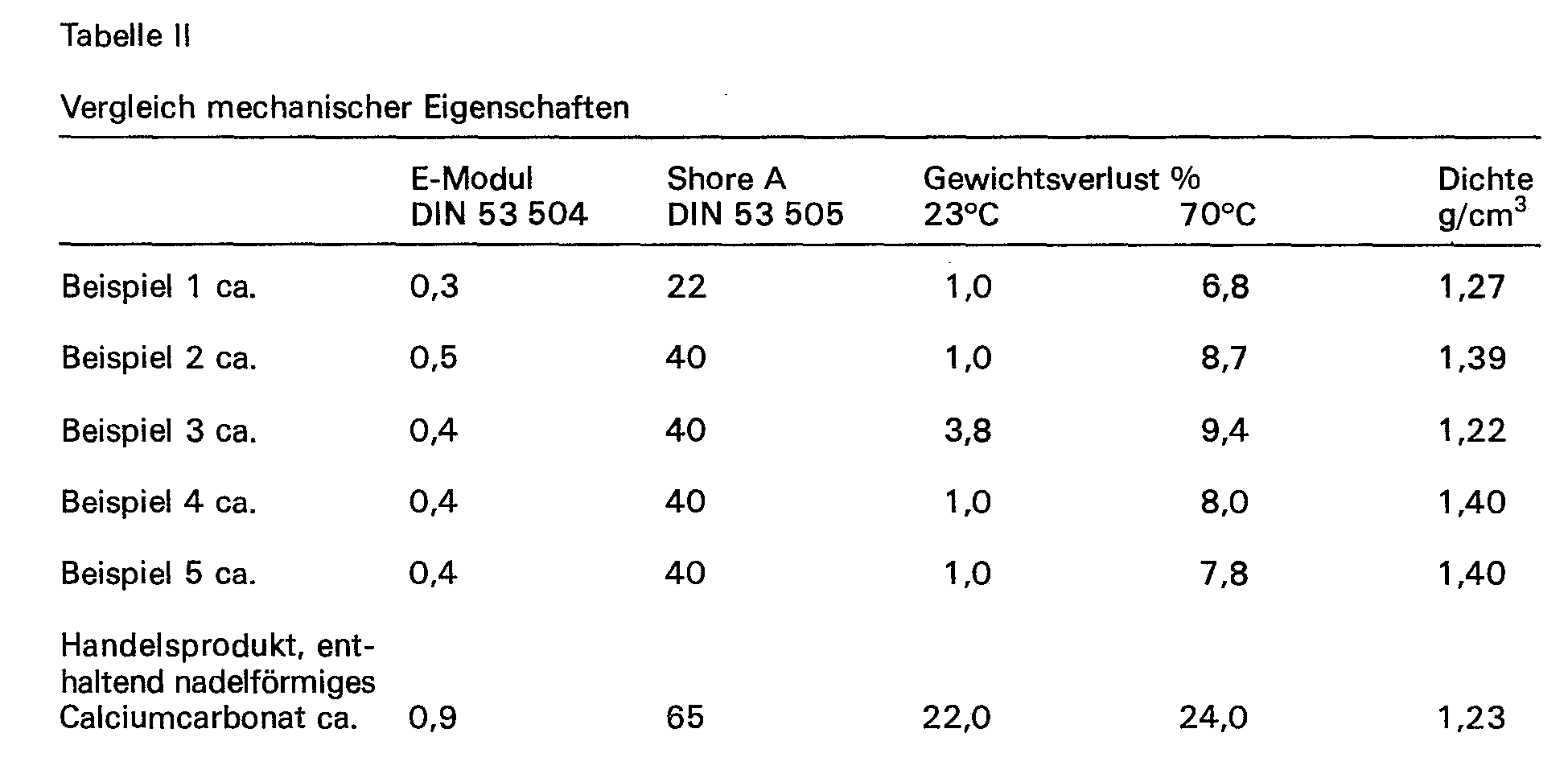
- Die mechanischen Eigenschaften (sowohl vor als auch nach der Lagerung): E-Modul 100% - ca. 0,3 N/mm2, Reißfestigkeit - ca. 0,7 N/mm2, Bruchdehnung - ca. 550%, Shore-A-Härte - ca. 22, Dichte - ca. 1,27 g/cm3.
- Es wird eine Mischung aus 45,3 Gew.-Teilen α,ω-Dihydroxy-polydimethylsiloxan von 50 000 m Pas und 4,5 Gew.-Teilen Di-i-butoxy-titan-diacetessigestercheiat vorgelegt. Dazu werden bei Raumtemperatur 40,0 Gew.-Teile Kreide, 1,0 Gew.-Teile Titandioxid und 4,5 Gew.-Teile einer fein dispersen, durch Flammenhydrolyse gewonnenen Kieselsäure bis zur Homogenität (ca. 20-30 Min.) gerührt und ca. 5 Min. evakuiert. Dann folgt der Zusatz von 0,7 Gew.-Teilen einer Organozinnverbindung, gelöst in 1,0 Gew.-Teilen eines Isooktadecan mit Rührzeit von ca. 5 Min. Zum Schluß werden 4,0 Gew.-Teile Di-N-methyl-benzamido-methyl-ethoxy-silan untergerührt und ca. 15 Min. evakuiert.
- Die Masse wird in Kartuschen abgefüllt und verschlossen. Lagerfähigkeit ohne Feuchtigkeitszutritt mindestens 1/2 Jahr, ohne daß die Eigenschaften bei einer späteren Anwendung beeinträchtigt werden.
- Die mechanischen Eigenschaften (sowohl vor als auch nach der Lagerung): E-Modul 100% - ca. 0,5 N/mm2, Reißfestigkeit - ca. 0,7 N/mm2, Bruchdehnung - ca. 330%, Shore-A-Härte - ca. 40, Dichte - ca. 1,4 g/cm3.
- Es wird eine Mischung aus 56,3 Gew.-Teilen xü)-Dihydroxy-polydimethylsiloxan von 50 000 m Pas und 4,5 Gew.-Teilen Di-i-butoxy-titan-diacetessigesterchelat vorgelegt. Dazu werden bei Raumtemperatur 25 Gew.-Teile Kreide, 1,0 Gew.-Teile Titandioxid und 8,0 Gew.-Teile einer fein dispersen, durch Flammenhydrolyse gewonnenen Kieselsäure bis zur Homogenität (ca. 20-30 Min.) gerührt und ca. 5 Min. evakuiert. Dann folgt der Zusatz von 0,7 Gew.-Teilen einer Organozinnverbindung, gelöst in 5,0 Gew.-Teilen Isododecan, Rührzeit ca. 5 Min. Zum Schluß werden 4,0 Gew.-Teile Di-N-methylbenzamido-methyl-ethoxy-silan untergerührt und ca. 15 Min. evakuiert. Die Masse wird in Kartuschen abgefüllt und verschlossen. Lagerfähigkeit ohne Feuchtigkeitszutritt mindestens 1/2 Jahr, ohne daß die Eigenschaften bei einer späteren Anwendung beeinträchtigt werden.
- Die mechanischen Eigenschaften (sowohl vor als auchd nach der Lagerung): E-Modul 100% - ca. 0,4 N/mm2, Reißfestigkeit - ca. 1,0 N/mm2, Bruchdehnung - ca. 530%, Shore-A-Härte - ca. 40, Dichte - ca. 1,22 g/cm3.
- Es wird eine Mischung aus 44,3 Gew.-Teilen α,ω-Dihydroxy-polydimethylsiloxan von 50 000 m Pas und 4,5 Gew.-Teilen Di-i-butoxy-titan-diacetessigesterchelat vorgelegt. Dazu werden bei Raumtemperatur 40,0 Gew.-Teile Kreide, 1,0 Gew.-Teile Titandioxid und 4,5 Gew.-Teile einer fein dispersen, durch Flammhydrolyse gewonnenen Kieselsäure bis zur Homogenität (ca. 20-30 Min.) gerührt und ca. 5 Min. evakuiert. Dann folgt der Zusatz von 0,7 Gew.-Teilen einer Organozinnverbindung, gelöst in 1,0 Gew.-Teile eines Isododecans. Rührzeit ca. 5 Min. Zum Schluß werden 4,0 Gew.-Teile Di-N-methylbenzamido-methyl-ethoxy-silan untergerührt und ca. 15 Min. evakuiert.
- Die Masse wird in Kartuschen abgefüllt und verschlossen. Lagerfähigkeit ohne Feuchtigkeitszutritt mindestens 1/2 Jahr, ohne daß die Eigenschaften bei einer späteren Anwendung beeinträchtigt werden.
- Die mechanischen Eigenschaften (sowohl vor als auch nach der Lagerung): E-Modul 100% - ca. 0,4 N/mm2, Reißfestigkeit - ca. 0,6 N/mm2, Bruchdehnung - ca. 330%, Shore-A-Härte - ca. 40, Dichte - ca. 1,4 g/cm3.
- Es wird eine Mischung aus 44,3 Gew.-Teilen α,ω-Dihydroxy-polydimethylsiloxan und 4,5 Gew.-Teilen Di-i-butoxy-titan-diacetessigestercheiat vorgelegt. Dazu werden bei Raumtemperatur 40,0 Gew.-Teile Kreide, 1,0 Gew.-Teile Titandioxid und 4,5 Gew.-Teile einer fein dispersen, durch Flammenhydrolyse gewonnenen Kieselsäure bis zur Homogenität (ca. 20-30 Min.) gerührt und ca. 5 Min. evakuiert. Dann folgt der Zusatz von 0,7 Gew.-Teilen einer Organozinnverbindung, gelöst in 1,0 Gew.-Teile eines Isooctans. Rührzeit ca. 5 Min. Zum Schluß werden 4,0 Gew.-Teile Di-N-methylbenzamido-methyl-ethoxy-silan untergerührt und ca. 15 Min. evakuiert.
- Die Masse wird in Kartuschen abgefüllt und verschlossen. Lagerfähigkeit ohne Feuchtigkeitszutritt mindestens 1/2 Jahr, ohne daß die Eigenschaften bei einer späteren Anwendung beeinträchtigt werden.
- Die mechanischen Eigenschaften (sowohl vor als auch nach der Lagerung): E-Modul 100% - ca. 0,4 N/mm2, Reißfestigkeit - ca. 0,6 N/mm2, Bruchdehnung - ca. 330%, Shore-A-Härte - ca. 40, Dichte - ca. 1,4 g/cm3.

Claims (3)
Applications Claiming Priority (2)
| Application Number | Priority Date | Filing Date | Title |
|---|---|---|---|
| DE3025376 | 1980-07-04 | ||
| DE19803025376 DE3025376A1 (de) | 1980-07-04 | 1980-07-04 | Unter wasserausschluss lagerfaehige, plastische organopolysiloxan-formmassen |
Publications (2)
| Publication Number | Publication Date |
|---|---|
| EP0043501A1 EP0043501A1 (de) | 1982-01-13 |
| EP0043501B1 true EP0043501B1 (de) | 1983-11-30 |
Family
ID=6106423
Family Applications (1)
| Application Number | Title | Priority Date | Filing Date |
|---|---|---|---|
| EP81104881A Expired EP0043501B1 (de) | 1980-07-04 | 1981-06-24 | Unter Wasserausschluss lagerfähige plastische Organopolysiloxan-Formmassen |
Country Status (5)
| Country | Link |
|---|---|
| US (1) | US4357438A (de) |
| EP (1) | EP0043501B1 (de) |
| JP (1) | JPS5744657A (de) |
| CA (1) | CA1158382A (de) |
| DE (2) | DE3025376A1 (de) |
Families Citing this family (16)
| Publication number | Priority date | Publication date | Assignee | Title |
|---|---|---|---|---|
| DE3210337A1 (de) * | 1982-03-20 | 1983-09-22 | Consortium für elektrochemische Industrie GmbH, 8000 München | Silane, verfahren zu ihrer herstellung und massen, die unter verwendung der silane bereitet worden sind |
| JPS6151056A (ja) * | 1984-08-16 | 1986-03-13 | Toray Silicone Co Ltd | 室温硬化後塗装可能なオルガノポリシロキサン組成物 |
| FR2581389B1 (fr) * | 1985-05-03 | 1987-06-05 | Rhone Poulenc Spec Chim | Compositions organopolysiloxaniques contenant des polyacyloxysilanes et durcissant tres rapidement a la chaleur en elastomeres en presence d'accelerateur a groupement carboxy-2 carboxamide |
| DE3532687A1 (de) * | 1985-09-13 | 1987-03-26 | Bayer Ag | Silicon-abformmassen |
| DE3544619A1 (de) * | 1985-12-17 | 1987-06-19 | Bayer Ag | Farbige siliconmassen |
| JPS62251266A (ja) * | 1986-04-25 | 1987-11-02 | Akebono Brake Ind Co Ltd | アンチロツク制御方法 |
| DE3836916A1 (de) * | 1988-10-29 | 1990-05-10 | Bayer Ag | Unter ausschluss von feuchtigkeit lagerfaehige rtv-1k-massen, die ueberstreichbare elastomere bilden |
| DE19614140C1 (de) * | 1996-04-10 | 1997-05-07 | B & F Formulier Und Abfuell Gm | Verfahren zur Herstellung einer Dichtungsmasse |
| DE19620100A1 (de) * | 1996-05-18 | 1997-11-20 | B & F Formulier Und Abfuell Gm | Aushärtbare Dichtungsmasse |
| PT842974E (pt) | 1996-11-19 | 2000-06-30 | Krafft S A | Composicoes de silicone endureciveis na presenca de agua ou de humidade do ar |
| CA2396485C (en) | 2000-01-19 | 2010-12-07 | General Electric Company | Room temperature curable silicone sealant |
| DE10156918A1 (de) * | 2001-11-21 | 2003-06-05 | Ge Bayer Silicones Gmbh & Co | Anstrichverträgliche bis überstreichbare Polyorganosiloxan-Zusammensetzungen |
| US7883118B2 (en) * | 2005-03-29 | 2011-02-08 | Sumitomo Metal Industries, Ltd. | Threaded joint for steel pipes |
| KR101249271B1 (ko) | 2005-04-06 | 2013-04-02 | 다우 코닝 코포레이션 | 오가노실록산 조성물 |
| GB0905204D0 (en) | 2009-03-26 | 2009-05-13 | Dow Corning | Preparation of organosiloxane polymers |
| GB0905205D0 (en) | 2009-03-26 | 2009-05-13 | Dow Corning | Preparation of organosiloxane polymer |
Family Cites Families (5)
| Publication number | Priority date | Publication date | Assignee | Title |
|---|---|---|---|---|
| DE1224039B (de) | 1964-02-06 | 1966-09-01 | Bayer Ag | Unter Ausschluss von Wasser lagerfaehige, plastische Organopolysiloxanformmassen |
| US3701753A (en) * | 1970-09-28 | 1972-10-31 | Gen Electric | Solutions of room temperature vulcanizable silicone rubber compositions |
| US3957714A (en) * | 1975-05-19 | 1976-05-18 | Dow Corning Corporation | Method for making paintable silicone surfaces and elastomer |
| ES8103128A1 (es) * | 1979-01-16 | 1981-02-16 | Krafft S A | Mejoras introducidas en los procesos de fabricacion de composiciones endurecibles a base de silicona. |
| DE2929635A1 (de) * | 1979-07-21 | 1981-02-12 | Bayer Ag | Polysiloxanformmassen |
-
1980
- 1980-07-04 DE DE19803025376 patent/DE3025376A1/de not_active Withdrawn
-
1981
- 1981-06-12 US US06/272,872 patent/US4357438A/en not_active Expired - Lifetime
- 1981-06-24 EP EP81104881A patent/EP0043501B1/de not_active Expired
- 1981-06-24 DE DE8181104881T patent/DE3161546D1/de not_active Expired
- 1981-07-02 JP JP56102344A patent/JPS5744657A/ja active Granted
- 1981-07-02 CA CA000380994A patent/CA1158382A/en not_active Expired
Also Published As
| Publication number | Publication date |
|---|---|
| EP0043501A1 (de) | 1982-01-13 |
| CA1158382A (en) | 1983-12-06 |
| JPS6118940B2 (de) | 1986-05-15 |
| DE3025376A1 (de) | 1982-02-04 |
| US4357438A (en) | 1982-11-02 |
| JPS5744657A (en) | 1982-03-13 |
| DE3161546D1 (en) | 1984-01-05 |
Similar Documents
| Publication | Publication Date | Title |
|---|---|---|
| EP0043501B1 (de) | Unter Wasserausschluss lagerfähige plastische Organopolysiloxan-Formmassen | |
| DE3500979C2 (de) | Organopolysiloxanmasse und ihre Verwendung | |
| DE69011154T2 (de) | Härtbare gefüllte Polysiloxanverbindungen. | |
| DE3407031C2 (de) | ||
| DE69010938T2 (de) | Aminosilan und/oder Amidosilan enthaltende, durch Wasserabspaltung zu einem Elastomer härtbare, wässerige Silikondispersion. | |
| EP0022976B1 (de) | Polysiloxanformmassen | |
| DE2621796C2 (de) | ||
| DE3736654A1 (de) | Unter abspaltung von oximen haertende 1 k rtv massen | |
| EP0619355B1 (de) | Dichtstoffe | |
| DE60307169T2 (de) | Bei Raumtemperatur vernetzbare Organopolysiloxan-Zusammensetzungen | |
| DE4033096A1 (de) | Feuchtigkeitshaertende einkomponenten-polysiloxanmasse | |
| DE2244644C2 (de) | ||
| DE3836916A1 (de) | Unter ausschluss von feuchtigkeit lagerfaehige rtv-1k-massen, die ueberstreichbare elastomere bilden | |
| DE2754795A1 (de) | Bei raumtemperatur haertende silikon-zusammensetzungen mit guter waermedaemmung | |
| DE4019074C1 (de) | ||
| EP0333021B1 (de) | Bei Raumtemperatur zu anstrichverträglichen bis überstreichbaren Elastomeren vernetzende Organopolysiloxanmassen | |
| EP0854893B1 (de) | Verfahren zur schäumung acyloxysilanhaltiger silikonmassen | |
| DE3224258A1 (de) | Bei raumtemperatur haertbare silikonzusammensetzungen | |
| EP0093918A1 (de) | Dichtstoff auf Basis von Butylkautschuk und/oder Polyisobutylen | |
| DD154993A5 (de) | Sauerstoffhaertbare mercaptoorganosiloxanmasse und ihre verwendung zur herstellung hoehermolekularer produkte | |
| DE19832687B4 (de) | Bausatz zur Herstellung von schnellhärtenden, acetoxysilanvernetzenden Silikonmassen, Verfahren zu seiner Herstellung und seine Verwendung | |
| DE2635176A1 (de) | Haertbare formmassen auf der basis chlorsulfonierter polyolefine | |
| EP0778862B1 (de) | Zusammensetzung zur herstellung von schnellhärtenden aminosilanevernetzenden silikonmassen | |
| DE1669940B2 (de) | Unter formgebung durch vernetzung zu elastomeren haertbare massen auf organopolysiloxangrundlage | |
| EP0369291A2 (de) | Unter Feuchtigkeitsausschluss lagerfähige RTV-1K-Massen |
Legal Events
| Date | Code | Title | Description |
|---|---|---|---|
| PUAI | Public reference made under article 153(3) epc to a published international application that has entered the european phase |
Free format text: ORIGINAL CODE: 0009012 |
|
| 17P | Request for examination filed |
Effective date: 19810624 |
|
| AK | Designated contracting states |
Designated state(s): BE DE FR GB IT NL |
|
| ITF | It: translation for a ep patent filed | ||
| GRAA | (expected) grant |
Free format text: ORIGINAL CODE: 0009210 |
|
| AK | Designated contracting states |
Designated state(s): BE DE FR GB IT NL |
|
| REF | Corresponds to: |
Ref document number: 3161546 Country of ref document: DE Date of ref document: 19840105 |
|
| ET | Fr: translation filed | ||
| PLBE | No opposition filed within time limit |
Free format text: ORIGINAL CODE: 0009261 |
|
| STAA | Information on the status of an ep patent application or granted ep patent |
Free format text: STATUS: NO OPPOSITION FILED WITHIN TIME LIMIT |
|
| 26N | No opposition filed | ||
| ITTA | It: last paid annual fee | ||
| REG | Reference to a national code |
Ref country code: FR Ref legal event code: TP |
|
| NLS | Nl: assignments of ep-patents |
Owner name: GE BAYER SILICONES GMBH & CO. KG |
|
| BECA | Be: change of holder's address |
Free format text: 19990630 *GE BAYER SILICONES G.M.B.H. & CO. K.G.:FALKENBERG 1, 40699 ERKRATH |
|
| REG | Reference to a national code |
Ref country code: GB Ref legal event code: 732E |
|
| PGFP | Annual fee paid to national office [announced via postgrant information from national office to epo] |
Ref country code: FR Payment date: 20000518 Year of fee payment: 20 |
|
| PGFP | Annual fee paid to national office [announced via postgrant information from national office to epo] |
Ref country code: GB Payment date: 20000621 Year of fee payment: 20 Ref country code: BE Payment date: 20000621 Year of fee payment: 20 |
|
| PGFP | Annual fee paid to national office [announced via postgrant information from national office to epo] |
Ref country code: DE Payment date: 20000627 Year of fee payment: 20 |
|
| PGFP | Annual fee paid to national office [announced via postgrant information from national office to epo] |
Ref country code: NL Payment date: 20000630 Year of fee payment: 20 |
|
| BE20 | Be: patent expired |
Free format text: 20010624 *GE BAYER SILICONES G.M.B.H. & CO. K.G. |
|
| PG25 | Lapsed in a contracting state [announced via postgrant information from national office to epo] |
Ref country code: GB Free format text: LAPSE BECAUSE OF EXPIRATION OF PROTECTION Effective date: 20010623 |
|
| PG25 | Lapsed in a contracting state [announced via postgrant information from national office to epo] |
Ref country code: NL Free format text: LAPSE BECAUSE OF EXPIRATION OF PROTECTION Effective date: 20010624 |
|
| REG | Reference to a national code |
Ref country code: GB Ref legal event code: PE20 Effective date: 20010623 |
|
| NLV7 | Nl: ceased due to reaching the maximum lifetime of a patent |
Effective date: 20010624 |