EP0034718A2 - Verfahren zur Herstellung von aromatischen Sulfonsäurehalogeniden - Google Patents
Verfahren zur Herstellung von aromatischen Sulfonsäurehalogeniden Download PDFInfo
- Publication number
- EP0034718A2 EP0034718A2 EP81100612A EP81100612A EP0034718A2 EP 0034718 A2 EP0034718 A2 EP 0034718A2 EP 81100612 A EP81100612 A EP 81100612A EP 81100612 A EP81100612 A EP 81100612A EP 0034718 A2 EP0034718 A2 EP 0034718A2
- Authority
- EP
- European Patent Office
- Prior art keywords
- aromatic
- acid
- sulfonic acid
- trihalomethyl
- acids
- Prior art date
- Legal status (The legal status is an assumption and is not a legal conclusion. Google has not performed a legal analysis and makes no representation as to the accuracy of the status listed.)
- Granted
Links
Classifications
-
- C—CHEMISTRY; METALLURGY
- C07—ORGANIC CHEMISTRY
- C07C—ACYCLIC OR CARBOCYCLIC COMPOUNDS
- C07C309/00—Sulfonic acids; Halides, esters, or anhydrides thereof
-
- C—CHEMISTRY; METALLURGY
- C07—ORGANIC CHEMISTRY
- C07C—ACYCLIC OR CARBOCYCLIC COMPOUNDS
- C07C51/00—Preparation of carboxylic acids or their salts, halides or anhydrides
- C07C51/58—Preparation of carboxylic acid halides
Definitions
- the invention relates to a process for the simultaneous production of aromatic sulfonic acid halides and aromatic carboxylic acid halides or the associated carboxylic acids by reacting aromatic sulfonic acids with aromatic trihalomethyl compounds in the presence of a Bronsted or Lewis acid.
- DRP 574 836 it is known from DRP 574 836 to react the sodium salts of aromatic sulfonic acids with benzotrichloride to give the corresponding aromatic sulfonic acid chloride.
- This DRP also contains the information that the known reaction of free carboxylic acids with benzotrichloride in g e nwart of zinc chloride for the preparation of carboxylic acid chlorides to free organic sulfonic acids is not transferable.
- alkyl which may be mentioned are straight-chain or branched hydrocarbon radicals having 1 to 6, preferably 1 to 4, particularly preferably 1 to 2, such as methyl, ethyl, propyl, isopropyl, butyl, isobutyl, pentyl or hexyl.
- cycloalkyl examples include cyclopentyl and cyclohexyl, preferably cyclohexyl.
- Aryl may, for example, be aromatic carbocyclic radicals such as phenyl, naphthyl or anthryl, preferably phenyl.
- aralkyl examples include hydrocarbon radicals having 1 to 6 carbon atoms in the aliphatic part and 6 to 14 carbon atoms in the aromatic part, such as benzyl, ß-phenyl-ethyl, naphthylmethyl, naphthylethyl, anthrylmethyl, ⁇ -phenyl-propyl and B-phenyl-n-hexyl.
- Preferred aralkyl is benzyl.
- alkoxy which may be mentioned are straight-chain or branched residues of aliphatic alcohols of 1 to 6, preferably 1 to 4, especially 1 to 2 carbon atoms, such as methoxy, ethoxy, propoxy, isopropyloxy, butoxy, isobutyloxy, pentyloxy and hexyloxy.
- Aryloxy may be radicals of aromatic hydroxyl compounds having 6 to 14 carbon atoms, such as phenoxy, naphthyloxy and anthryloxy, preferably phenoxy.
- Halogen is, for example, fluorine, chlorine, bromine and JQ d, preferably fluorine, chlorine and bromine, particularly preferably chlorine and fluorine.
- two of the radicals R 1 to R 3 or R 4 to R 6 can be parts of a fused cycloaliphatic or aromatic ring, including the benzene nucleus of the formula (I) or the formula ( II) understood the indane, indene, tetrahydronaphthalene and naphthalene system.
- the preferred condensed ring systems are the naphthalene and tetrahydronaphthalene systems. The naphthalene system is particularly preferred.
- Aromatic sulfonic acids for the process according to the invention may be mentioned, for example: benzenesulfonic acid, 2-, 3- and 4-toluenesulfonic acid, 2-, 3- and 4-chlorobenzenesulfonic acid, 2,5- and 3,4-dichlorobenzenesulfonic acid, benzene- 1,3-disulfonic acid, 2-chlorotoluene-4-sulfonic acid, 4-chlorotoluene-2-sulfonic acid, toluene-2,4-disulfonic acid, 1-acetylamino-benzene-4-sulfonic acid, 4-carbomethoxyamino-benzenesulfonic acid, 1- and 2-naphthalenesulfonic acid, naphthalene-1,5 -, - 2,6- and 2,7-disulfonic acid, 4-biphenyl-sulfonic acid, 4,4'-biphenyl-s
- Examples are the following trichloromethyl Ver - named compounds: benzotrichloride, 1-chloro-2-trichloromethylbenzene, 1-chloro-4-trichloromethylbenzene, 2,4-dichloro-1-trichloromethylbenzene, 1,3-bis (trichloromethyl) -benzene, 1,4-bis (trichloromethyl) benzene, 1-trichlorme ethyl naphthalene, 2-trichloromethyl naphthalene, 4-trichloromethyl biphenyl, 4,4'-bis (trichloromethyl) biphenyl, 4-trichloromethyl diphenyl ether, 4-trichloromethyl diphenyl methane, benzotribromide, l-bromo-2-tribromomethylbenzene and 1-bromo-4-tribromomethylbenzene.
- aromatic sulfonic acids of the formula (III) are preferably reacted with aromatic trichloromethyl compounds of the formula (V), particularly preferably sulfonic acids of the formula (IV) with trichloromethyl compounds of the formula (VI).
- a Bronsted acid is generally characterized in that it contains a dissociable hydrogen atom; a Lewis acid is generally characterized by the fact that it has an electron pair gap (see the textbooks on theoretical chemistry, for example HA Staab, Introduction to theoretical organic chemistry, 3rd edition, page 599 ff, Verlag Chemie, Weinheim 1962) .
- Bronsted acids for the process according to the invention are, for example, sulfuric acid, pyrosulfuric acid, phosphoric acid, pyrophosphoric acid and the acidic salts of these acids, furthermore polyphosphoric acid, fluorosulfonic acid, chlorosulfonic acid and bromosulfonic acid.
- Lewis acids for the process according to the invention are, for example, aluminum chloride, iron chloride, zinc chloride, cadmium chloride, mercury (II) chloride, beryllium chloride, magnesium chloride, boron trifluoride, boron trichloride, gallium chloride, titanium dichloride, titanium tetrachloride, zirconium tetrachloride, nickel chloride, niobium pentachloride, uranium tetrachloride Copper (I) chloride, copper (II) chloride, cobalt chloride, chromium trichloride, bismuth trichloride, antimony trichloride, antimony pentachloride, tellurium tetrachloride, arsenic trichloride and arsenic pentachloride.
- the Brönsted and Lewis acids mentioned can be used both individually and as a mixture of different Brönsted acids, as a mixture of different Lewis acids and as a mixture of
- the process according to the invention is preferably carried out in the presence of sulfuric acid, chlorosulfonic acid, iron (III) chloride, zinc chloride or a mixture of these substances. It is particularly preferred to work in the presence of sulfuric acid or iron (III) chloride.
- sulfonating agents such as those contained in technical sulfonic acids from the manufacturing process, for example sulfuric acid or chlorosulfonic acid, are present.
- the Bronsted or Lewis acid is used in the process according to the invention, for example in an amount of 0.01 to 20 mol%, preferably 0.1 to 10 mol%, based on the sulfonic acid used.
- the process according to the invention can be carried out at 20-300 ° C., for example at a temperature of 30 to 130 ° C., preferably 40 to 110 ° C., particularly preferably 50 to 95 ° C.
- the pressure is not essential for the feasibility of the process according to the invention, so that work can be carried out under normal pressure, elevated or reduced pressure.
- the preferred variant is that at normal pressure.
- the process according to the invention can be carried out with or without an additional reaction medium.
- Suitable reaction media are those which are inert under the reaction conditions, for example halogenated hydrocarbons such as chloroform, carbon tetrachloride, trichloroethane, tetrachloroethane, pentachloroethane, chlorobenzene, dichlorobenzene, chlorotoluene or dichlorotoluene.
- An excess of trihalomethyl compound used or the aromatic carboxylic acid chloride formed in the course of the reaction can also serve as the reaction medium.
- the preferred variant is that without an additional solvent.
- the aromatic trihalomethyl compound produces the corresponding benzoic acid.
- the aromatic trihalomethyl compound gives the corresponding benzoyl halide.
- the aromatic trihalomethyl compound in excess, based on the aromatic sulfonic acid, for example in an amount of up to 5 equivalents per equivalent of sulfonic acid. In this latter variant, the excess aromatic trihalomethyl compound serves as a solvent or diluent. One more A larger excess is not critical for the process according to the invention, but is less favorable for economic reasons.
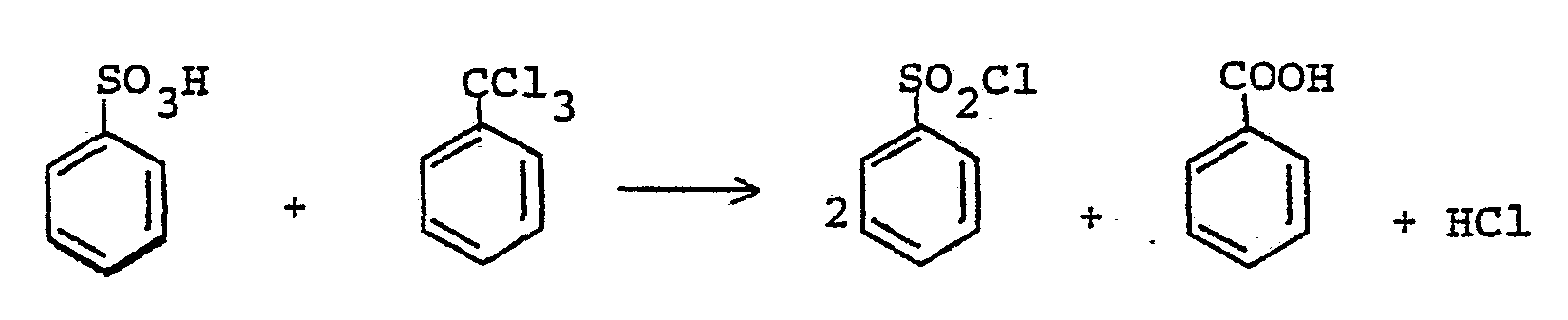
- reaction of the process according to the invention is illustrated by the following reaction equations using different equivalence ratios of aromatic sulfonic acid and aromatic trihalomethyl compound using the example of the reaction of benzenesulfonic acid with benzotrichloride:
- sulfochlorides are preferably prepared by the process according to the invention: benzenesulfochloride, 2-, 3- and 4-toluenesulfochloride, 2-, 3- and 4-chlorobenzenesulfochloride, benzene-1,3-disulfochloride, 1- and 2-naphthalenesulfochloride.
- the process according to the invention thus also allows the production of an aromatic carboxylic acid, or preferably its associated carboxylic acid halide.
- an aromatic carboxylic acid or preferably its associated carboxylic acid halide.
- aromatic trihalomethyl - connection in the context of formula (II)
- the described choice of the equivalence between aromatic sulfonic acid and aromatic trihalomethyl compound is a Wide range of variations with regard to the simultaneous production of either an aromatic carboxylic acid or its corresponding carboxylic acid halide, as well as the substitution of this aromatic carboxylic acid or its carboxylic acid halide.
- the order of addition of the starting materials in the process according to the invention is arbitrary.
- the aromatic sulfonic acid, the aromatic trihalomethyl compound and the Bronsted or Lewis acid can be combined in succession.
- the process according to the invention can be carried out batchwise or continuously.
- continuous implementation it is possible, for example, to work in a circulation reactor known to those skilled in the art the.
- the starting materials are added at one point in the circulation reactor via one or more inlets, while after passing through the circulation reactor the reaction mixture is at least partially removed from the reactor shortly before the addition points are reached again.
- the reaction mixture withdrawn is worked up by customary work-up methods, for example by fractional distillation.
- a residue obtained here, which can contain the Brönsted or Lewis acid, can at least partially be added to the circulation reactor again.
- the Brönsted or Lewis acid is added to the aromatic sulfonic acid and the aromatic trihalomethyl compound in a stirring apparatus and the mixture is heated to the reaction temperature with stirring until the evolution of gas has ended.
- Working up is carried out by known methods, for example by fractional distillation, but also by extraction or other processes.
- the gaseous hydrogen chloride obtained in the reaction can be collected in a suitable absorption apparatus, for example as aqueous or as alcoholic hydrochloric acid. However, it can also be compressed in its pure form and used in this form.
- aromatic sulfone that can be produced according to the invention acid chlorides and the resulting aromatic carboxylic acids or the corresponding aromatic.
- Carboxylic acid halides are known to the person skilled in the art as indispensable intermediates for a large number of syntheses, for example for esters, amides, .hydrazides and further derivatives of sulfonic or carboxylic acids for dyes, medicaments and other products.
- the process according to the invention has the advantage over the production of the sulfonic acid chlorides by chlorosulfonation that no waste acids are formed. Compared to the process with thionyl chloride or phosgene under dialkylformamide catalysis, it has the advantage that no exhaust gas mixtures which are difficult to separate occur and that no carcinogenic dialkylcarbamoyl chlorides can be formed. Compared to the non-catalyzed reaction of aromatic sulfonic acids with Trichlormethylaromaten has the inventive method the advantage of a significantly reduced re eraturen tressstem p and times.
- aromatic trihalomethyl compound to be used can be largely varied according to its availability, the separability of the product mixture and the need for the aromatic carboxylic acid or the corresponding aromatic sulfonic acid halide which is formed simultaneously. If necessary, the amount of aromatic trihalomethyl compound used can be greatly reduced compared to the prior art processes.
- Example 2 7.9 g (8 mol%) of sulfuric acid are added after the 0-hour sample, and samples are taken at the same intervals and analyzed by gas chromatography. Table 1 shows the yields after the corresponding reaction times.
- PhS0 2 Cl mean benzenesulfonyl chloride, PhCOCl benzoyl chloride and PhCCl 3 benzotrichloride. Percentages in all examples relate to the theoretical yield.
- Examples 5 to 8 were carried out in the same batch size as in Example 3, but a defined amount of catalyst was added to the benzenesulfonic acid.
- the data are shown in Table 3 below.
- the distillation is carried out at 10 mbar using a 1 m mirror column ( ⁇ 5 cm, filling: Raschig rings 5 x 5 mm).
Landscapes
- Chemical & Material Sciences (AREA)
- Organic Chemistry (AREA)
- Engineering & Computer Science (AREA)
- Oil, Petroleum & Natural Gas (AREA)
- Organic Low-Molecular-Weight Compounds And Preparation Thereof (AREA)
- Low-Molecular Organic Synthesis Reactions Using Catalysts (AREA)
Abstract
Description
- Die Erfindung betrifft ein Verfahren zur gleichzeitigen Herstellung von aromatischen Sulfonsäurehalogeniden und aromatischen Carbonsäurehalogeniden oder den zugehörigen Carbonsäuren durch Umsetzung von aromatischen Sulfonsäuren mit aromatischen Trihalogenmethyl-Verbindungen in Gegenwart einer Brönsted- oder Lewis-Säure.
- Es ist aus der US-Patentschrift 3.686.301 bekannt, 3,5-Dichlorsulfo-benzoylchlorid durch Reaktion von 180°C heißer 3,5-Disulfo-benzoesäure mit der dreifach molaren Menge Benzotrichlorid zu erhalten, wobei das Benzotrichlorid während eines Zeitraumes von 3 Stunden zugegeben wird und die Temperatur während der Zugabe langsam auf 130°C reduziert wird und das Gemisch eine weitere Stunde bei 130°C gerührt wird.
- Weiterhin ist aus DRP 574 836 bekannt, die Natriumsalze aromatischer Sulfonsäuren mit Benzotrichlorid zu dem entsprechenden aromatischen Sulfonsäurechlorid umzusetzen. Diese DRP enthält weiterhin den Hinweis, daß die bekannte Umsetzung freier Carbonsäuren mit Benzotrichlorid in Ge- genwart von Zinkchlorid zur Herstellung der Carbonsäurechloride auf freie organische Sulfonsäuren nicht übertragbar ist.
- Es wurde nun ein Verfahren zur gleichzeitigen Herstellung aromatischer Sulfonsäurehalogenide und aromatischer Carbonsäurehalogenide oder der zugehörigen Carbonsäuren durch Umsetzung aromatischer Sulfonsäuren oder Sulfonsäureanhydride mit aromatischen Trihalogenmethyl-Verbindungen gefunden, das dadurch gekennzeichnet ist, daß man mindestens ein halbes Äquivalent einer aromatischen Trihalogenmethyl-Verbindung pro Äquivalent Sulfonsäure in Gegenwart einer Brönsted- oder Lewis-Säure bei einer Temperatur von 20 - 300°C, gegebenenfalls in einem inerten Lösungsmittel, umsetzt.
- Als aromatische Sulfonsäuren können im erfindungsgemäßen Verfahren beispielsweise solche der allgemeinen Formel

- X für Wasserstoff,


- R 1 ,R2, R3, R1' und R2' unabhängig voneinander Wasserstoff, Alkyl, Cycloalkyl, Aryl, Aralkyl, Hydroxy, Alkoxy, Acyloxy, Halogen, Isocyanato, Acylamino, N-Carbalkoxyamino, N-Carbaryloxyamino, Nitro, die Sulfonsäuregruppe, die Carbonsäuregruppe, die Carbonsäureestergruppe oder die Harnstoffgruppe bedeuten, und weiterhin zwei der Reste R1,R2 oder R3, wenn sie benachbart sind, Teil eines kondensierten, gegebenenfalls durch eine Sulfonsäuregruppe substituierten cycloaliphatischen oder aromatischen Ringes sein können.
- An Stelle der genannten Sulfonsäuren können auch die entsprechenden Sulfonsäureanhydride eingesetzt werden.
- Als aromatische Trihalogenmethyl-Verbindungen für das erfindungsgemäße Verfahren können beispielsweise solche der allgemeinen Formel

- U für Wasserstoff,

- R4, R5, R6, R4' und R5' unabhängig voneinander Wasserstoff, Alkyl, Cycloalkyl, Aryl, Aralkyl, Alkoxy, Aryloxy, CHal3, Halogen, Isocyanato, N-Carbalkoxyamino oder N-Carbaryloxyamino bedeuten und weiterhin zwei der Reste R4, R5 oder R6, wenn sie benachbart sind, Teil eines kondensierten, gegebenenfalls durch CHal3 substituierten cycloaliphatischen oder aromatischen Ringes sein können und
- Hal für Chlor oder Brom steht.
- Als Alkyl seien beispielsweise geradkettige oder verzweigte Rohlenwasserstoffreste mit 1 bis 6, bevorzugt 1 bis 4, besonders bevorzugt 1 bis 2 Kohlenstoffatomen genannt, wie Methyl, Ethyl, Propyl, Isopropyl, Butyl, Isobutyl, Pentyl oder Hexyl.
- Als Cycloalkyl seien beispielsweise Cyclopentyl und Cyclohexyl, bevorzugt Cyclohexyl, genannt.
- Als Aryl seien beispielsweise aromatische carbocyclische Reste wie Phenyl, Naphthyl oder Anthryl, bevorzugt Phenyl, genannt.
- Als Aralkyl seien beispielsweise Kohlenwasserstoffreste mit 1 bis 6 Kohlenstoffatomen im aliphatischen Teil und 6 bis 14 Kohlenstoffatomen im aromatischen Teil genannt, wie Benzyl, ß-Phenyl-ethyl, Naphthylmethyl, Naphthylethyl, Anthrylmethyl, δ-Phenyl-propyl und B-Phenyl-n-hexyl. Bevorzugtes Aralkyl ist Benzyl.
- Als Alkoxy seien beispielsweise geradkettige oder verzweigte Reste von aliphatischen Alkoholen von 1 bis 6, bevorzugt 1 bis 4, besonders 1 bis 2 Kohlenstoffatomen genannt, wie Methoxy, Ethoxy, Propoxy, Isopropyloxy, Butoxy, Isobutyloxy, Pentyloxy und Hexyloxy.
- Als Aryloxy seien Reste von aromatischen Hydroxylverbindungen mit 6 bis 14 Kohlenstoffatomen genannt, wie Phenoxy, Naphthyloxy und Anthryloxy, bevorzugt Phenoxy.
- Als Halogen seien beispielsweise Fluor, Chlor, Brom und JQd, bevorzugt Fluor, Chlor und Brom, besonders bevorzugt Chlor und Fluor, genannt.
- Für den Fall, daß zwei der Reste R 1 bis R 3 oder R 4 bis R6, wenn sie benachbart sind, Teile eines kondensierten cycloaliphatischen oder aromatischen Ringes sein können, seien unter Einschluß des Benzolkerns der Formel (I) bzw. der Formel (II) das Indan-, Inden-, Tetrahydronaphthalin- und Naphthalin-System verstanden. Die bevorzugten kondensierten Ringsysteme sind das Naphthalin-und das Tetrahydronaphthalin-System. Besonders bevorzugt ist das Naphthalin-System.
- Als bevorzugte aromatische Sulfonsäuren für das erfindungsgemäße Verfahren seien beispielsweise solche der Formel
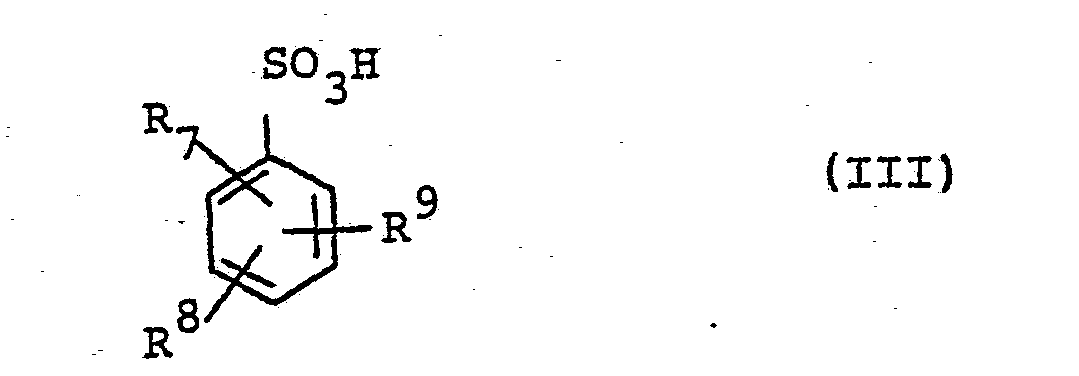
- R 7, R8 und R9 unabhängig voneinander Wasserstoff, C1-C4-Alkyl, Phenyl, Benzyl, Methoxy, Ethoxy, Phenoxy, Fluor, Chlor, Brom, Nitro oder die Sulfonsäuregruppe bedeuten und in der 7 9 weiterhin zwei der Reste R bis R , wenn sie benachbart sind, Teil eines kondensierten cycloaliphatischen oder aromatischen 6-Ringes sein können.
- Als aromatische Sulfonsäuren für das erfindungsgemäße Verfahren seien besonders bevorzugt solche der allgemeinen Formel

genannt, in der - R10 und R11 unabhängig voneinander Wasserstoff, Methyl, Ethyl, Chlor oder Fluor bedeuten und in der R10 und R , wenn sie benachbart sind, Teil eines kondensierten cycloaliphatischen oder aromatischen 6-Ringes sein können.
- Als aromatische Sulfonsäuren für das erfindungsgemäße Verfahren seien beispielsweise genannt: Benzolsulfonsäure, 2-, 3- und 4-Toluolsulfonsäure, 2-, 3- und 4-Chlor-benzolsulfonsäure, 2,5- und 3,4-Dichlor-benzolsulfonsäure, Benzol-1,3-disulfonsäure, 2-Chlor-toluol-4-sulfonsäure, 4-Chlor-toluol-2-sulfonsäure, Toluol-2,4- disulfonsäure, 1-Acetylamino-benzol-4-sulfonsäure, 4-Carbomethoxyamino-benzolsulfonsäure, 1- und 2-Naphthalinsulfonsäure, Naphthalin-1,5-,-2,6- und-2,7-disulfonsäure, 4-Biphenyl-sulfonsäure, 4,4'-Biphenyl-disulfonsäure, 4-Phenoxy-benzolsulfonsäure und Diphenylmethan-4-sulfonsäure.
- Als aromatische Trihalogenmethyl-Verbindungen für das erfindungsgemäße Verfahren seien besonders aromatische Trichlormethyl-Verbindungen genannt. Trichlormethyl-Verbindungen sind beispielsweise solche der allgemeinen Formel

- R12, R 13 und R 14 unabhängig voneinander Wasserstoff, Chlor, Trifluormethyl oder Trichlormethyl bedeuten und in der zwei der 12 14 Reste R12 bis R14, wenn sie benachbart sind, Teil eines kondensierten cycloaliphatischen oder aromatischen 6-Ringes sein können.
- Besonders bevorzugt werden im erfindungsgemäßen Verfahren Trichlormethyl-Verbindungen der allgemeinen Formel (VI)

eingesetzt, in der - R 15 und R16 unabhängig voneinander Wasserstoff, Methyl, Chlor oder Trichlormethyl bedeuten und in der die Reste R 15 und R16, wenn sie benachbart sind, Teil eines kondensierten cycloaliphatischen oder aromatischen 6-Ringes sein können.
- Beispielsweise seien die folgenden Trichlormethyl-Ver- bindungen genannt: Benzotrichlorid, 1-Chlor-2-trichlor- methylbenzol, 1-Chlor-4-trichlormethylbenzol, 2,4-Dichlor-1-trichlormethylbenzol, 1,3-Bis-(Trichlormethyl)-benzol, 1,4-Bis-(Trichlormethyl)-benzol, 1-Trichlormethyl-naphthalin, 2-Trichlormethyl-naphthalin, 4-Trichlormethyl-biphenyl, 4,4'-Bis-(Trichlormethyl)-biphenyl, 4-Trichlormethyl-diphenylether, 4-Trichlormethyl-diphenylmethan, Benzotribromid, l-Brom-2-tribrommethylbenzol und 1-Brom-4-tribrommethylbenzol.
- Im erfindungsgemäßen Verfahren werden bevorzugt aromatische Sulfonsäuren der Formel (III) mit aromatischen Trichlormethyl-Verbindungen der Formel (V), besonders bevorzugt Sulfonsäuren der Formel (IV) mit Trichlormethyl-Verbindungen der Formel (VI), umgesetzt.
- Das erfindungsgemäße Verfahren wird in Gegenwart einer Brönsted- oder Lewis-Säure durchgeführt. Eine Brönsted-Säure ist allgemein dadurch gekennzeichnet, daß sie ein dissoziierbares Wasserstoffatom enthält; eine Lewis-Säure ist allgemein dadurch gekennzeichnet, daß sie eine Elektronenpaar-Lücke hat (siehe hierzu die Lehrbücher der theoretischen Chemie, beispielsweise H.A. Staab, Einführung in die theoretische organische Chemie, 3. Auflage, Seite 599 ff, Verlag Chemie, Weinheim 1962). Brönsted-Säuren für das erfindungsgemäße Verfahren sind beispielsweise Schwefelsäure, Pyroschwefelsäure, Phosphorsäure, Pyrophosphorsäure und die sauren Salze dieser Säuren, ferner Polyphosphorsäure, Fluorsulfonsäure, Chlorsulfonsäure und Bromsulfonsäure. Lewis-Säuren für das erfindungsgemäße Verfahren sind beispielsweise Aluminiumchlorid, Eisenchlorid, Zinkchlorid, Cadmiumchlorid, Quecksilber-(II)-chlorid, Berylliumchlorid, Magnesiumchlorid, Bortrifluorid, Bortrichlorid, Galliumchlorid, Titandichlorid, Titantetrachlorid, Zirkontetrachlorid, Nickelchlorid,Niobpentachlorid, Urantetrachlorid, Kupfer-(I)-chlorid, Kupfer-(II)-chlorid, Kobaltchlorid, Chromtrichlorid, Wismuttrichlorid, Antimontrichlorid, Antimonpentachlorid, Tellurtetrachlorid, Arsentrichlorid und Arsenpentachlorid. Die genannten Brönsted- und Lewis-Säuren können sowohl einzeln, als auch als Gemisch verschiedener Brönsted-Säuren, als Gemisch verschiedener Lewis-Säuren und als Gemisch von Brönsted- und Lewis-Säuren eingesetzt werden.
- Im erfindungsgemäßen Verfahren wird bevorzugt in Gegenwart von Schwefelsäure, Chlorsulfonsäure, Eisen-(III)-chlorid, Zinkchlorid oder einem Gemisch dieser Stoffe gearbeitet. Besonders bevorzugt wird in Gegenwart von Schwefelsäure oder Eisen-(III)-chlorid gearbeitet. Für das erfindungsgemäße Verfahren kann es weiterhin ausreichend sein, daß Sulfonierungsmittel, wie sie in technischen Sulfonsäuren aus dem Herstellungsprozeß enthalten sind, beispielsweise Schwefelsäure oder Chlorsulfonsäure, gegenwärtig sind.
- Die Brönsted- oder Lewis-Säure wird im erfindungsgemäßen Verfahren beispielsweise in einer Menge von 0,01 bis 20 Mol-%, bevorzugt von 0,1 bis 10 Mol-%, bezogen auf die eingesetzte Sulfonsäure, eingesetzt.
- Das erfindungsgemäße Verfahren kann bei 20-300°C, beispielsweise bei einer Temperatur von 30 bis 130°C, bevorzugt 40 bis 110°C, besonders bevorzugt 50 bis 95°C, durchgeführt werden.
- Der Druck ist für die Durchführbarkeit des erfindungsgemäßen Verfahrens nicht wesentlich, so daß bei Normaldruck, erhöhtem oder vermindertem Druck gearbeitet werden kann. Die bevorzugte Variante ist die bei Normaldruck. Das erfindungsgemäße Verfahren kann mit oder ohne zusätzliches Reaktionsmedium durchgeführt werden. Geeignete Reaktionsmedien sind solche, die unter den Reaktionsbedingungen inert sind, beispielsweise Halogenkohlenwasserstoffe, wie Chloroform, Tetrachlorkohlenstoff, Trichlorethan, Tetrachlorethan, Pentachlorethan, Chlorbenzol, Dichlorbenzol, Chlortoluol oder Dichlortoluol. Als Reaktionsmedium kann weiterhin im Überschuß eingesetzte Trihalogenmethyl-Verbindung oder das im Reaktionsverlauf entstehende aromatische Carbonsäurechlorid dienen. Die bevorzugte Variante ist die ohne zusätzliches Lösungsmittel.
- Zum vollständigen Umsatz der aromatischen Sulfonsäure im erfindungsgemäßen Verfahren ist es erforderlich, mindestens ein halbes Äquivalent der aromatischen Trihalogenmethyl-Verbindung pro Äquivalent Sulfonsäure einzusetzen. Dabei entsteht aus der aromatischen Trihalogenmethyl-Verbindung die entsprechende Benzoesäure. Vorzugsweise ist es jedoch auch möglich, die aromatische Trihalogenmethyl-Verbindung in größerer als der halbäquivalenten Menge, bezogen auf die aromatische Sulfonsäure, beispielsweise in äquimolarer Menge, einzusetzen. In diesem Falle entsteht aus der aromatischen Trihalogenmethyl-Verbindung das entsprechende Benzoylhalogenid. Weiterhin ist es möglich, die aromatische Trihalogenmethyl-Verbindung im Überschuß, bezogen auf die aromatische Sulfonsäure, beispielsweise in einer Menge von bis zu 5 Äquivalenten pro Äquivalent Sulfonsäure, einzusetzen. Bei dieser letzteren Variante dient die überschüssige aromatische Trihalogenmethyl-Verbindung als Lösungs- bzw. Verdünnungsmittel. Ein noch größerer Überschuß ist für das erfindungsgemäße Verfahren unkritisch, jedoch aus wirtschaftlichen Gründen weniger günstig.
- Die Reaktion des erfindungsgemäßen Verfahrens sei bei verschiedenen Äquivalenzverhältnissen von aromatischer Sulfonsäure und aromatischer Trihalogenmethyl-Verbindung am Beispiel der Umsetzung von Benzolsulfonsäure mit Benzotrichlorid durch die folgenden Reaktionsgleichungen dargestellt:

- Im erfindungsgemäßen Verfahren können demnach aromatische Sulfonsäurehalogenide der allgemeinen Formel
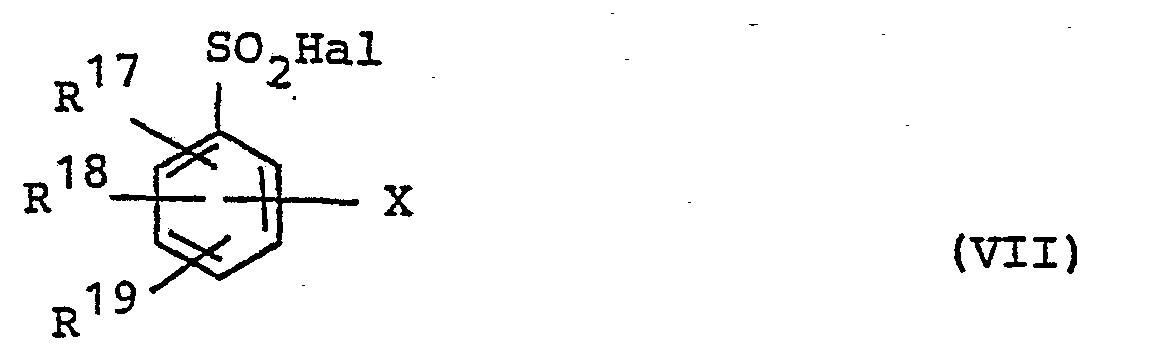
- X für Wasserstoff,
- R17, R18, R19, R17' und R18' den Bedeutungen von R1, R2, R3, R1' und R2' haben, wobei aber anstelle der Sulfonsäuregruppe -SO3H die Halogensulfonylgruppe -SO2Hal und anstelle der Carbonsäuregruppe -C02H die Carbonsäurehalogenidgruppe -COHal erscheint, und
- Hal für Chlor oder Brom steht.
- Bevorzugt werden die folgenden Sulfochloride nach dem erfindungsgemäßen Verfahren hergestellt: Benzolsulfochlorid, 2-, 3- und 4-Toluolsulfochlorid, 2-, 3- und 4-Chlorbenzolsulfochlorid, Benzol-1,3-disulfochlorid, 1- und 2-Naphthalinsulfochlorid.
- Im erfindungsgemäßen Verfahren wird die eingesetzte aromatische Trihalogenmethyl-Verbindung in die entsprechende aromatische Carbonsäure-Verbindung der allgemeinen Formel

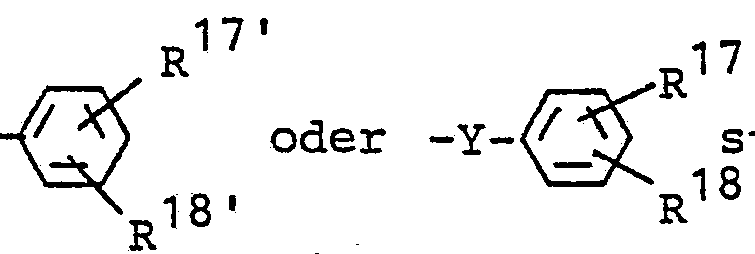
- U für Wasserstoff, -

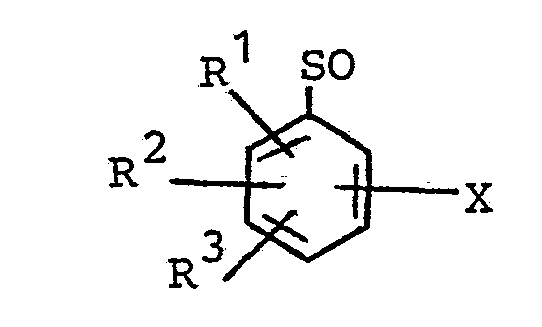
- wobei V für -O-, -SO2-, -N=N- oder -CH2- steht, R20, R21, R22, R20' und R21' den Bedeutungsumfang von R4, R5, R6, R4' und R 51 haben, wobei jedoch anstelle der Trihalogenmethylgruppe -CHal3 die Gruppe -COZ tritt, und
- Z für Hydroxyl, Chlor oder Brom steht.
- Das erfindungsgemäße Verfahren erlaubt somit neben der Herstellung des aromatischen Sulfonsäurehalogenids gleichzeitig die Herstellung einer aromatischen Carbonsäure, bzw. bevorzugt ihres zugehörigen Carbonsäurehalogenids. Hierbei besteht-nicht nur eine breite Variationsmöglichkeit in Bezug auf die Herstellung des aromatischen Sulfonsäurehalogenids, sondern ebenso durch die Auswahl der aromatischen Trihalogenmethyl-Verbindung im Rahmen der Formel (II) und durch die geschilderte Wahl der Äquivalenz zwischen aromatischer Sulfonsäure und aromatischer Trihalogenmethyl-Verbindung ein breite Variationsmöglichkeit bezüglich der gleichzeitigen Herstellung entweder einer aromatischen Carbonsäure oder ihres entsprechenden Carbonsäurehalogenids, sowie der Substitution dieser aromatischen Carbonsäure bzw. ihres Carbonsäurehalogenids.
- Die Reihenfolge der Zugabe der Ausgangsstoffe im erfindungsgemäßen Verfahren ist beliebig. So können beispielsweise hintereinander die aromatische Sulfonsäure, die aromatische Trihalogenmethyl-Verbindung und die Brönsted- oder Lewis-Säure zusammengegeben werden. Man kann jedoch auch die Brönsted- oder Lewis-Säure vorlegen und dann die aromatische Sulfonsäure und die aromatische Trihalogenmethyl-Verbindung hintereinander oder gleichzeitig getrennt oder als Gemisch zugeben.
- Das erfindungsgemäße Verfahren kann absatzweise oder kontinuierlich durchgeführt werden. Bei der kontinuierlichen Durchführung kann beispielsweise in einem dem Fachmann bekannten Umlaufreaktor gearbeitet werden. Hierbei werden an einer Stelle des Umlaufreaktors über einen oder mehrere Einlässe die Ausgangsstoffe zugegeben, während das Reaktionsgemisch nach Durchlaufen des Umlaufreaktors an einer Stelle kurz vor dem Wiedererreichen der Zugabestellen zumindest teilweise dem Reaktor wieder entnommen wird. Das entnommene Reaktionsgemisch wird durch übliche Aufarbeitungsmethoden, beispielsweise durch fraktionierte Destillation, aufgearbeitet. Ein hierbei anfallender Rückstand, der die Brönsted--oder Lewis-Säure enthalten kann, kann zumindest teilweise dem Umlaufreaktor wieder zugesetzt werden.
- Bei der absatzweisen Durchführung werden beispielsweise die aromatische Sulfonsäure und die aromatische Trihalogenmethyl-Verbindung in einer Rührapparatur mit der Brönsted- oder Lewis-Säure versetzt und unter Rühren auf die Reaktionstemperatur erhitzt, bis die Gasentwicklung beendet ist. Die Aufarbeitung erfolgt nach bekannten Methoden, beispielsweise durch fraktionierte Destillation, aber auch durch Extraktion oder andere Verfahren.
- Der bei der Reaktion anfallende gasförmige Chlorwasserstoff kann in einer geeigneten Absorptionsapparatur beispielsweise als wäßrige oder als alkoholische Salzsäure aufgefangen werden. Er kann jedoch auch in reiner Form komprimiert werden und in dieser Form weiterverwendet werden.
- Die erfindungsgemäß herstellbaren aromatischen Sulfonsäurechloride und die gleichzeitig entstehenden aromatischen Carbonsäuren bzw. die entsprechenden aromatischen. Carbonsäurehalogenide sind dem Fachmann als unentbehrliche Zwischenprodukte für eine Vielzahl von Synthesen, beispielsweise für Ester, Amide,.Hydrazide und weitere Derivate der Sulfon- bzw. Carbonsäuren für Farbstoffe, Arzneimittel und andere Produkte, bekannt.
- Das erfindungsgemäße Verfahren bietet gegenüber der Herstellung der Sulfonsäurechloride durch Chlorsulfonierung den Vorteil, daß keine Abfallsäuren entstehen. Gegenüber dem Verfahren mit Thionylchlorid oder Phosgen unter Dialkylformamid-Katalyse bietet es den Vorteil, daß keine schwer trennbaren Abgasgemische auftreten und daß keine potentiell carcinogenen Dialkylcarbamidsäurechloride gebildet werden können. Gegenüber der nicht katalysierten Reaktion von aromatischen Sulfonsäuren mit Trichlormethylaromaten hat das erfindungsgemäße Verfahren den Vorteil erheblich reduzierter Re- aktionstemperaturen und -zeiten. Ein weiterer Vorteil besteht darin, daß die zu verwendende aromatische Trihalogenmethyl-Verbindung entsprechend ihrer Verfügbarkeit, der Trennbarkeit des Produktgemisches und dem Bedarf an der simultan entstehenden aromatischen Carbonsäure bzw. dem korrespondierenden aromatischen Sulfonsäurehalogenid weitgehend variiert werden kann. Gegebenenfalls kann die Menge der eingesetzten aromatischen Trihalogenmethyl-Verbindung gegenüber den Verfahren des Standes der Technik stark verringert werden.
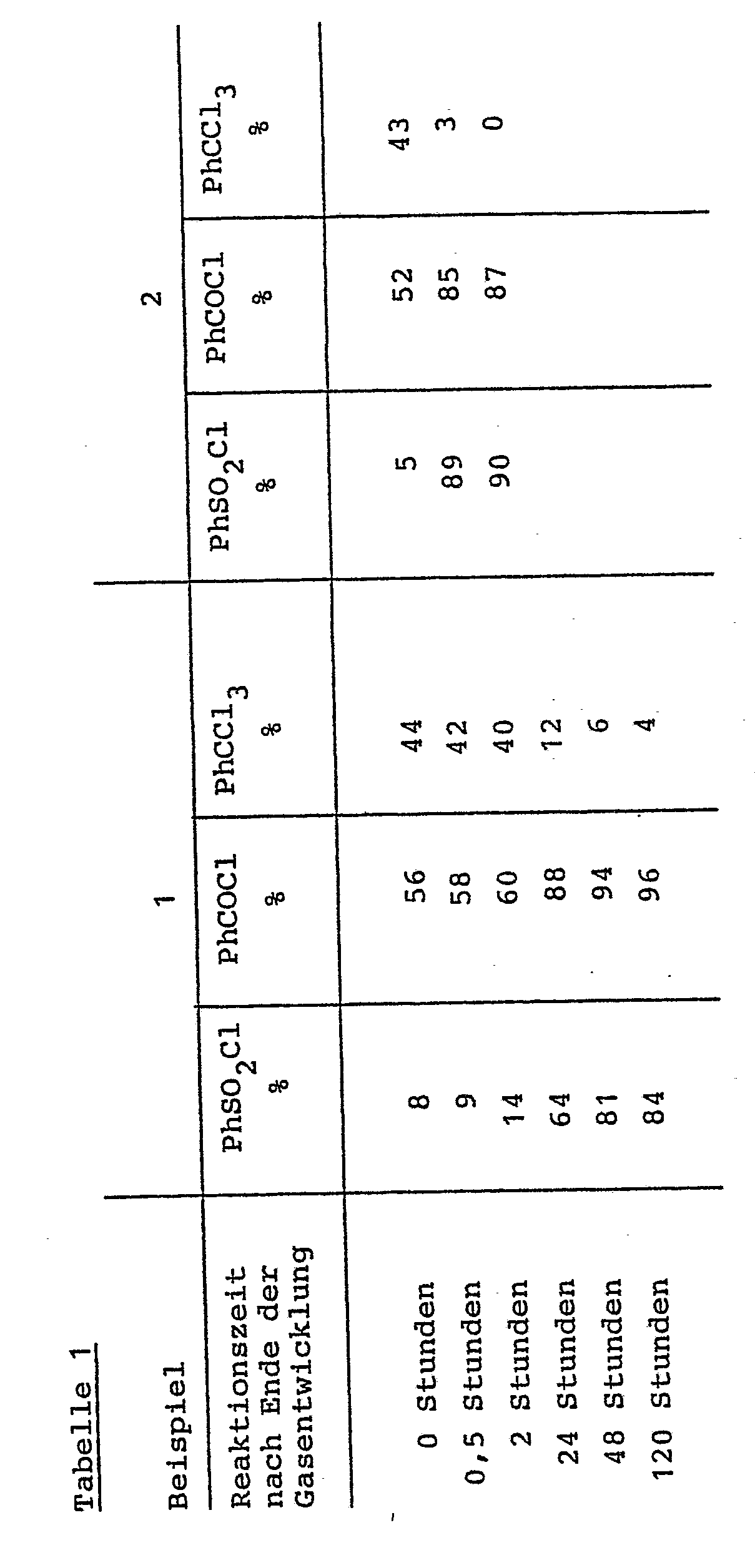
- Je 158 g (1 Mol) Benzolsulfonsäure (98,5 %ig, schwefelsäurefrei) und 195,5 g (116 ml, 1 Mol) Benzotrichlorid (98,5 %ig) werden in einem Glaskolben mit Rührer, Innenthermometer und Rückflußkühler mit Blasenzähler auf 60°C erhitzt. Nach etwa 1/2 Stunde und Nachlassen der Gasentwicklung wird die erste Probe entnommen (0-Stunden-Probe). Dann wird in Beispiel 1 weiter erhitzt und nach den angegebenen Zeiten je eine Probe entnommen.
- In Beispiel 2 werden nach der 0-Stunden-Probe 7,9 g (8 Mol-%) Schwefelsäure zugesetzt und in den jeweils gleichen Abständen Proben genommen und gaschromatographisch untersucht. Tabelle 1 enthält die Ausbeuten nach den entsprechenden Reaktionszeiten. Hierbei bedeuten PhS02Cl Benzolsulfonsäurechlorid, PhCOCl Benzoylchlorid und PhCCl3 Benzotrichlorid. Prozentangaben in allen Beispielen beziehen sich auf die theoretische Ausbeute.
- 158 g (1 Mol) Benzolsulfonsäure (98,5 %ig, schwefelsäurefrei) werden in einem Glaskolben mit Rührer, Innenthermometer, Tropftrichter und Rückflußkühler vorgelegt und auf 60 beziehungsweise 110°C erwärmt (siehe Tabelle 2). Während drei Stunden werden 195,5 g (116 ml, 1 Mol) Benzotrichlorid zugetropft. Dann wird 1 Stunde bei gleicher Temperatur nachgerührt. Das Produktgemisch wird bei 10 mbar über eine verspiegelte Kolonne (3 cm x 30 cm) fraktioniert destilliert.
- Die Ausbeuten sind in Tabelle 2 angegeben.

- Die Beispiele 5 bis 8 wurden in gleicher Ansatzgröße analog Beispiel 3 durchgeführt, jedoch wird der Benzolsulfonsäure jeweils eine definierte Menge Katalysator zugesetzt. Die Daten sind der nachstehenden Tabelle 3 zu entnehmen.
-

- 2500 g (14,8 Mol) einer 93,8 %igen Benzolsulfonsäure, die durch Sulfonierung von Benzol mit S03 hergestellt wurde und 1,8 Gew.-% H2SO4 enthält, werden bei 110°C mit 3093 g (15,6 Mol) Benzotrichlorid (98,5 %ig) analog
- Die Destillation erfolgt bei 10 mbar über eine 1 m-Spiegelkolonne (Ø 5 cm, Füllung: Raschigringe 5 x 5 mm).


- 158 g (1 Mol) Benzolsulfonsäure (98,5 %ig) und 1,0 g FeCl3 werden bei 95°C analog Beispiel 3 mit 97,8 g (0,5 Mol) Benzotrichlorid (98,5 %ig) umgesetzt.

- 172 g(1 Mol) p-Toluolsulfonsäure (90 %ig) und 4 g Schwefelsäure werden bei 80°C analog Beispiel 3 mit 207 g (1,06 Mol) Benzotrichlorid umgesetzt.

- 158 g (1 Mol) Benzolsulfonsäure (98,5 %ig) und 4 g Schwefelsäure werden analog Beispiel 4 mit 166 g (0,53 Mol) 1,3-Bis-(trichlormethyl)-benzol umgesetzt.

- 841,5 g (5 Mol) einer 94%igen Benzolsulfonsäure, die durch Sulfonierung von Benzol mit SO3 hergestellt wurde und 1,8 Gew.-% H2SO4 enthält, werden bei 95°C mit 977,5 g (5 Mol) Benzotrichlorid (98,5%ig) innerhalb einer Stunde versetzt. Dann wird eine Stunde bei 95°C nachgerührt. Die Destillation erfolgt bei 10 mbar über eine verspiegelte Kolonne (3 cm x 30 cm).

Claims (10)

steht, wobei Y für -O-, -S02-, -N=N- oder -CH2- steht, und


Applications Claiming Priority (2)
| Application Number | Priority Date | Filing Date | Title |
|---|---|---|---|
| DE3004693 | 1980-02-08 | ||
| DE19803004693 DE3004693A1 (de) | 1980-02-08 | 1980-02-08 | Verfahren zur herstellung von aromatischen sulfonsaeurehalogeniden |
Publications (3)
| Publication Number | Publication Date |
|---|---|
| EP0034718A2 true EP0034718A2 (de) | 1981-09-02 |
| EP0034718A3 EP0034718A3 (en) | 1982-03-10 |
| EP0034718B1 EP0034718B1 (de) | 1983-11-23 |
Family
ID=6094122
Family Applications (1)
| Application Number | Title | Priority Date | Filing Date |
|---|---|---|---|
| EP81100612A Expired EP0034718B1 (de) | 1980-02-08 | 1981-01-28 | Verfahren zur Herstellung von aromatischen Sulfonsäurehalogeniden |
Country Status (4)
| Country | Link |
|---|---|
| US (1) | US4349471A (de) |
| EP (1) | EP0034718B1 (de) |
| JP (1) | JPS56125355A (de) |
| DE (2) | DE3004693A1 (de) |
Families Citing this family (3)
| Publication number | Priority date | Publication date | Assignee | Title |
|---|---|---|---|---|
| JPH0278654A (ja) * | 1988-09-13 | 1990-03-19 | Agency Of Ind Science & Technol | ホルミルジアルキルベンゼンスルホニルハライド及びその製造方法 |
| CZ294098B6 (cs) * | 1996-08-23 | 2004-10-13 | Americanácyanamidácompany | Způsob přípravy chloridů azinylových kyselin |
| CA2758182C (en) | 2003-03-05 | 2014-03-25 | Toray Industries, Inc. | A compound obtained by reacting a compound having a carbohydrazide structure with an acid or a base |
Family Cites Families (5)
| Publication number | Priority date | Publication date | Assignee | Title |
|---|---|---|---|---|
| DE574836C (de) | 1931-07-29 | 1933-04-20 | I G Farbenindustrie Akt Ges | Verfahren zur Darstellung von organischen Sulfonsaeurehalogeniden |
| US3686301A (en) * | 1969-05-23 | 1972-08-22 | Lawrence S Kirch | Preparation of halosulfonylbenzoyl halides |
| BE758209A (fr) * | 1969-10-31 | 1971-04-29 | Hoechst Ag | Procede de preparation de chlorures d'acides carboxyliques de la serie benzenique |
| JPS5524121A (en) * | 1978-08-10 | 1980-02-21 | Sanwa Kagaku Kogyo Kk | Hydrolysis of benzotrihalide |
| DE2841541A1 (de) * | 1978-09-23 | 1980-04-03 | Bayer Ag | Verfahren zur herstellung von gegebenenfalls substituiertem benzoylchlorid |
-
1980
- 1980-02-08 DE DE19803004693 patent/DE3004693A1/de not_active Withdrawn
-
1981
- 1981-01-22 US US06/227,445 patent/US4349471A/en not_active Expired - Lifetime
- 1981-01-28 DE DE8181100612T patent/DE3161451D1/de not_active Expired
- 1981-01-28 EP EP81100612A patent/EP0034718B1/de not_active Expired
- 1981-02-05 JP JP1511281A patent/JPS56125355A/ja active Granted
Also Published As
| Publication number | Publication date |
|---|---|
| EP0034718B1 (de) | 1983-11-23 |
| DE3161451D1 (en) | 1983-12-29 |
| JPS56125355A (en) | 1981-10-01 |
| DE3004693A1 (de) | 1981-08-13 |
| EP0034718A3 (en) | 1982-03-10 |
| US4349471A (en) | 1982-09-14 |
| JPH0448786B2 (de) | 1992-08-07 |
Similar Documents
| Publication | Publication Date | Title |
|---|---|---|
| EP0319767B1 (de) | Verfahren zur Herstellung von Trifluormethansulfonsäurechlorid | |
| EP0124002B1 (de) | Verfahren zur Herstellung von aromatischen Verbindungen, die über ein Heteroatom gebundene perfluorierte Seitenketten enthalten | |
| EP0034718B1 (de) | Verfahren zur Herstellung von aromatischen Sulfonsäurehalogeniden | |
| EP0735016B1 (de) | Verfahren zur Herstellung von Alpha-Chloralkylarylketonen | |
| DE2652810C3 (de) | Verfahren zur Herstellung von aromatischen Fluorverbindungen | |
| EP0057844B1 (de) | Verfahren zur Herstellung von Polychlorbenzoylchloriden | |
| DE3133732C2 (de) | Verfahren zur Herstellung von Difluorbromacetylfluorid oder Difluorjodacetylfluorid | |
| EP0047948B1 (de) | Verfahren zur Herstellung von Polyfluorcarbonylverbindungen sowie einige neue Vertreter dieser Verbindungsklasse | |
| EP0123187A2 (de) | Verfahren zur Herstellung von fluorierten Phenylessigsäureestern und neue fluorierte Trichlorethylbenzole | |
| EP0023584B1 (de) | Verfahren zur Herstellung von Trifluormethyl-Naphthalinen | |
| EP0001276B1 (de) | Verfahren zur Herstellung von Sulfonsäurechloriden | |
| EP1598331B1 (de) | Verfahren zur Herstellung von Phthalsäuredichlorid | |
| EP0061113B1 (de) | Verfahren zur Herstellung von gegebenenfalls substituierten Fluor-nitro-benzaldehyden | |
| DE3712610C2 (de) | ||
| EP0266544B1 (de) | Verfahren zur Herstellung von Halogenalkoholen | |
| EP0302331B1 (de) | Ester von Arylbisperfluoralkylcarbinolen, Verfahren zur Herstellung dieser Verbindungen und der zugrundeliegenden Arylbisperfluoralkylcarbinole | |
| EP0023647B1 (de) | Verfahren zur Herstellung von halogenierten Benzoylfluoriden | |
| DE2721429C2 (de) | ||
| EP0561298B1 (de) | Verfahren zur Herstellung von 2-Nitro-3,6-dichlorphenol | |
| EP0743299B1 (de) | Verfahren zur Herstellung von 2-Fluorcyclopropylaminsulfonsäuresalzen | |
| DE19536846A1 (de) | Verfahren zur Herstellung von 2-Chlor-4-methylphenol | |
| CH630347A5 (de) | Verfahren zur herstellung von sulfonsaeurechloriden. | |
| DE2616612C2 (de) | Verfahren zur Herstellung von Chlorsulfonylbenzoylchlorid | |
| EP0226152A1 (de) | Verfahren zur Herstellung von gegebenenfalls substituierten 2-Benzyl-toluolen | |
| DE1900758A1 (de) | Verfahren zur Herstellung von ss,ss,ss-Trifluor-d,d-dichlorpropionsaeurefluorid |
Legal Events
| Date | Code | Title | Description |
|---|---|---|---|
| PUAI | Public reference made under article 153(3) epc to a published international application that has entered the european phase |
Free format text: ORIGINAL CODE: 0009012 |
|
| 17P | Request for examination filed |
Effective date: 19810128 |
|
| AK | Designated contracting states |
Designated state(s): BE CH DE FR GB IT |
|
| PUAL | Search report despatched |
Free format text: ORIGINAL CODE: 0009013 |
|
| AK | Designated contracting states |
Designated state(s): BE CH DE FR GB IT |
|
| ITF | It: translation for a ep patent filed | ||
| GRAA | (expected) grant |
Free format text: ORIGINAL CODE: 0009210 |
|
| AK | Designated contracting states |
Designated state(s): BE CH DE FR GB IT LI |
|
| REF | Corresponds to: |
Ref document number: 3161451 Country of ref document: DE Date of ref document: 19831229 |
|
| PGFP | Annual fee paid to national office [announced via postgrant information from national office to epo] |
Ref country code: BE Payment date: 19831231 Year of fee payment: 4 |
|
| PGFP | Annual fee paid to national office [announced via postgrant information from national office to epo] |
Ref country code: CH Payment date: 19840110 Year of fee payment: 4 |
|
| ET | Fr: translation filed | ||
| PLBE | No opposition filed within time limit |
Free format text: ORIGINAL CODE: 0009261 |
|
| STAA | Information on the status of an ep patent application or granted ep patent |
Free format text: STATUS: NO OPPOSITION FILED WITHIN TIME LIMIT |
|
| 26N | No opposition filed | ||
| PG25 | Lapsed in a contracting state [announced via postgrant information from national office to epo] |
Ref country code: LI Effective date: 19850131 Ref country code: CH Effective date: 19850131 Ref country code: BE Effective date: 19850131 |
|
| BERE | Be: lapsed |
Owner name: BAYER A.G. Effective date: 19850128 |
|
| REG | Reference to a national code |
Ref country code: CH Ref legal event code: PL |
|
| PGFP | Annual fee paid to national office [announced via postgrant information from national office to epo] |
Ref country code: FR Payment date: 19940114 Year of fee payment: 14 |
|
| PGFP | Annual fee paid to national office [announced via postgrant information from national office to epo] |
Ref country code: GB Payment date: 19940118 Year of fee payment: 14 |
|
| PGFP | Annual fee paid to national office [announced via postgrant information from national office to epo] |
Ref country code: DE Payment date: 19941212 Year of fee payment: 15 |
|
| PG25 | Lapsed in a contracting state [announced via postgrant information from national office to epo] |
Ref country code: GB Effective date: 19950128 |
|
| GBPC | Gb: european patent ceased through non-payment of renewal fee |
Effective date: 19950128 |
|
| PG25 | Lapsed in a contracting state [announced via postgrant information from national office to epo] |
Ref country code: FR Effective date: 19950929 |
|
| REG | Reference to a national code |
Ref country code: FR Ref legal event code: ST |
|
| PG25 | Lapsed in a contracting state [announced via postgrant information from national office to epo] |
Ref country code: DE Effective date: 19961001 |