EP0033569B1 - Non gathering panty and method of manufacture thereof - Google Patents
Non gathering panty and method of manufacture thereof Download PDFInfo
- Publication number
- EP0033569B1 EP0033569B1 EP81200092A EP81200092A EP0033569B1 EP 0033569 B1 EP0033569 B1 EP 0033569B1 EP 81200092 A EP81200092 A EP 81200092A EP 81200092 A EP81200092 A EP 81200092A EP 0033569 B1 EP0033569 B1 EP 0033569B1
- Authority
- EP
- European Patent Office
- Prior art keywords
- panty
- crotch
- panel
- border
- fabric
- Prior art date
- Legal status (The legal status is an assumption and is not a legal conclusion. Google has not performed a legal analysis and makes no representation as to the accuracy of the status listed.)
- Expired
Links
Images


Classifications
-
- A—HUMAN NECESSITIES
- A61—MEDICAL OR VETERINARY SCIENCE; HYGIENE
- A61F—FILTERS IMPLANTABLE INTO BLOOD VESSELS; PROSTHESES; DEVICES PROVIDING PATENCY TO, OR PREVENTING COLLAPSING OF, TUBULAR STRUCTURES OF THE BODY, e.g. STENTS; ORTHOPAEDIC, NURSING OR CONTRACEPTIVE DEVICES; FOMENTATION; TREATMENT OR PROTECTION OF EYES OR EARS; BANDAGES, DRESSINGS OR ABSORBENT PADS; FIRST-AID KITS
- A61F13/00—Bandages or dressings; Absorbent pads
- A61F13/15—Absorbent pads, e.g. sanitary towels, swabs or tampons for external or internal application to the body; Supporting or fastening means therefor; Tampon applicators
- A61F13/45—Absorbent pads, e.g. sanitary towels, swabs or tampons for external or internal application to the body; Supporting or fastening means therefor; Tampon applicators characterised by the shape
- A61F13/49—Absorbent pads, e.g. sanitary towels, swabs or tampons for external or internal application to the body; Supporting or fastening means therefor; Tampon applicators characterised by the shape specially adapted to be worn around the waist, e.g. diapers, nappies
- A61F13/49003—Reusable, washable fabric diapers
- A61F13/49006—Reusable, washable fabric diapers the reusable article being in the form of pants or briefs, e.g. slip or panty for light incontinence
-
- A—HUMAN NECESSITIES
- A41—WEARING APPAREL
- A41B—SHIRTS; UNDERWEAR; BABY LINEN; HANDKERCHIEFS
- A41B9/00—Undergarments
- A41B9/004—Undergarments characterized by the crotch
-
- A—HUMAN NECESSITIES
- A41—WEARING APPAREL
- A41B—SHIRTS; UNDERWEAR; BABY LINEN; HANDKERCHIEFS
- A41B2500/00—Materials for shirts, underwear, baby linen or handkerchiefs not provided for in other groups of this subclass
- A41B2500/30—Non-woven
Definitions
- This invention relates to a brief or panty and the construction thereof, and more particularly to a panty or like garment made from elastic nonwoven material and adapted to fit a range of sizes comfortably.
- the invention also relates to a method of making the panty or brief.
- the panty must be constructed of a material that has a fit that both lies flat against the body and is comfortable to wear.
- the panty must be constructed not to ride up through the crotch or over the buttocks but still provide for a comfortable fit around the leg openings and waist.
- the panty must be manufactured in a process where elastic portions are provided in or adjacent to the fabric which are inexpensive to attach and manufacture and the complete panty is subject to mass production applications.
- the prior art teaches a panty construction and method of manufacture wherein the elastic members in the panty are attached to the panty fabric while the members are under tension; US Patent 3,613,686 issued to De Woskin on October 19, 1971 and US Patent 4,031,568 issued to Huff on June 28, 1977.
- Other examples of prior art teach panties having elastic portions secured to the fabric at each panty opening in separate steps: US Patent No. 4,003,094 issued to Newmar on January 18, 1977; US Patent No. 3,488,778 issued to Goujon et al. on January 13, 1970; and US Patent No. 3,594,820 issued to McCurry on July 27, 1971.
- panties of this construction have elastic legbands and waistbands with non- breathable latex material as the panty fabric between the elastic legbands and waistbands.
- a panty formed of a porous fabric panel incorporating elastic material such that the panty is non gathered and is elastic in all directions, said panel having an hourglass shape defining front and rear panel portions and leg opening portions, said leg opening portions defining a crotch region, and said elastic material being disposed at least along the edges of the panel, wherein the panty comprises an assembly of two layers of non woven polymeric elastomeric material, a first layer forming the fabric panel, and a second layer comprising a border member extending around the external margin of said hourglass shaped panel, the internal margin of said border member having a similar hourglass shape and defining the width of said border, the inner margins of the borders of the respective leg openings in the crotch region being laterally spaced from each other.
- a method of forming a non-gathered panty from a porous elastomeric fabric comprises the steps of:
- a preferred method of attaching the elastic member or members to the fabric of a panty blank is to superimpose the elastic members on the panty blank and then to subject the assembly to a hot vacuum-forming process which bonds the elastic member to the fabric of the panty blank while additionally improving the appearance and function of the panty fabric and elastic.
- the elastic and fabric may be joined by any other conventional means within the scope of the invention as well, provided that the bond joining the elastic and fabric is able to stretch along with the adjacent fabric.
- the garment is completed by joining the longitudinally opposed flap portions on each side of the panty blank by any of several well known techniques, such as by ultrasonically welding the respective flaps together.
- the panty of the current invention is made from a lightweight, nonwoven fabric which is noticeably lighter to wear than existing conventional panties.
- panty of this invention inexpensive.
- the low cost of the panty of the invention allows the panty to be disposed of after a few launderings.
- panty disclosed herein lies flat against the body and thus is difficult to detect under the outer clothing of the wearer.
- Conventional panty constructions wherein a tensioned elastic is applied to a nontensioned fabric, show a gathering of panty fabric which results from a difference in the respective lengths of the unstressed elastic and the fabric to which it is attached. This results in wrinkling of the fabric which is frequently visible through the outer clothing of the wearer, detracting from the wearer's appearance. Such unsightly wrinkling will be present unless the panty fabric is taut. If the panty is worn with the elastic stretched to its furthest extent allowed by the fabric, the garment would be very uncomfortable.
- panty construction disclosed herein requires that the elastic member be applied to an elastic fabric in unstretched condition and as such would not wrinkle the panty fabric on wearing. Due to the construction disclosed herein, there is no wrinkling of the panty fabric adjacent the elastic member and consequently the garment lies flat against the body and does not cause wrinkles which detract from the wearer's appearance. Furthermore, the use of an unstretched elastic element applied to panty fabric allows mass production of panties and eliminates the time-consuming step of stretching the elastic member before attaching it to the fabric.
- panty construction of the current invention incorporates elastomeric fabric and will provide a better fit to wearers of the various physical dimensions within a given size range.
- An additional feature of the invention is that use of a relatively wide strip of nonwoven material as the elastic member eliminates discomfort and unsightly bulges which otherwise result from the indentation of a narrow elastic member into the skin of the wearer.
- FIG. 1 a panty blank 10 is depicted having a substantially hourglass-shaped exterior margin, comprised of panty fabric, having side flaps 12, 13, 14 and 15, crotch portion edges 16 and 17, and front and rear panels 18 and 19.
- a functional crotch 20 is attached to the brief n the crotch region thereof as seen in Figure 3, and in this embodiment, functional crotch 20 overlies panty fabric 10.
- a superior fit is obtained when the panty is assembled with material having greater capacity for elongation in the direction substantially perpendicular to the spine. This can be done by assembling the J anty from oriented Kraton fabric panels with material having its machine direction parallel to the spine.
- a material made of melt blown Kraton rubber is well suited for the panty fabric material.
- the basis weight of this material is lighter than the basis weight of conventional panty material: cotton, 3.12 ounces per yards 2 (105.9 g/m 2 ): or nylon, 2.64 ounces/yardS 2 (89.6 g/m 2 ).
- a Kraton G (Kraton G is a trademark of the Shell Chemical Company, One Shell Plaza, P.O. Box 2463, Houston, Texas, 77001) oriented melt-blown nonwoven fabric is particularly suited for this application. Fibres can be melt blown as taught in US Patent 3,825,380 issued on July 23, 1974 to Hard- ing hereby incorporated by reference.
- a particularly useful composition contains the following components: Kraton G-1652, 20% by weight stearic acid, 1% by weight Ti0 2 plus 0.1% by weight antioxidant Irganox 1010 (lrganox is a trademark of Ciba-Geigy, Ardsley, New York).
- a fabric of this material can be made through a melt blowing process having a fibre collection surface at an angle of 0-60° to that of the fibre/air stream. This results in a nonwoven material in which the majority of the fibres are oriented in the direction of travel of the moving air stream of fibres.
- the composition of Kraton G rubber and a fatty chemical is mixed in an in-line mixer or in an extruder and put into a conventional extruder for extrusion.
- the extruder has a melt blowing head at the nozzle.
- the Kraton material is extruded through small orifices linearly arrayed in a knife-edge segment. Hot gases pass on either side of the extruded Kraton around the knife edge to carry the material out of the extrusion orifice.
- the hot gas such as air or nitrogen, is at a temperature of over 500°F and moves at high velocity. The hot air takes the extruded rubber and pulls it at a rate faster than extrusion speed out of the orifices.
- the air stream carries the fibres until they impact the collection plate oriented at 0-60° with the air stream.
- the forward end of the fibre contacts the collection plate and is temporarily anchored on the forward end while the latter parts of the fibre are carried along with the air stream over the plate resulting in fibres substantially oriented in the direction of the flowing air stream.
- This method leaves less fibres perpendicular to the movement of the air stream.
- Fibres may be connected at their intersection points due to fibre entanglement and from the processing conditions in the melt blowing process, such as the temperatures of extrusion or of the air stream.
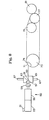
- a process to make melt blown Kraton fabrics is disclosed below and shown schematically in Figure 8.
- Kraton G-1652 20% by weight stearic acid, 1 % by weight Tio 2 and 0.1 % by weight Irganox 1010 is mixed in a conventional in-line mixer.
- the mixed composition is then fed through intake 51 into extruder 50, such as the 5/8" (1.59 cm) screw diameter Wayne Yellowjacket Extruder made by Wayne Machine & Die Co., 100 Furler Street, Totowa, New Jersey 07512.
- the extruder 50 has an extrusion screw (not shown) with a 20:1 L/D ratio and a 3:1 compression ratio. The extruder progressively heats the composition to extrusion temperature.
- the extruder has a first heating zone 53 which heats the mixture to a temperature of 320°F (160°C) and a second heating zone 55 which heats the mixture to a temperature of 390°F (199°C).
- the screw turns at 30 RPM resulting in a resin flow through the extruder of approximately 7 grams per minute to extrusion nozzle 57.
- the extrusion nozzle 57 is heated by conventional means 59, such as heating tapes, up to an extrusion temperature of 390°F (199°C).
- the rubber composition is extruded through an extrusion nozzle 57 having extrusion orifices 61 lying along the edge of a knife-shaped apparatus 63, through an air box 65 having means 67 to allow the inflow of heated air.
- the air is heated by conventional means not shown, has a temperature of 650°F (343°C) and a flow rate of 1150 SCGH (32560 L/min at STP) at 90 PSIG (0.0704 Kg/cm 2 ).
- the air takes the extruded rubber composition and elongates it as it comes through the extrusion orifices 61 to carry it out the air stream outlet 69 of the extrusion air box 65.
- the fibre and air stream impact a collection surface 71 angled at 3 inches (7.6 cm) below the air stream outlet 69 and a horizontal distance of 4 inches (10.16 cm) from outlet 69.
- the collection surface 71 is preferably a 60 x 40 mesh bronze wire screen that is mounted around a vacuum roll 73 having a vacuum of 1.75 inches (4.4 cm) of mercury on vacuum section 74.
- the collection surface 71 moves around a vacuum mounted roller 73 through a first idler roller 75 and a drive roller 77.
- Drive roller 77 is driven by conventional means not shown.
- the fibres collect on the screen to form an oriented melt blown fabric which is taken off on roll 81.
- Kraton G rubber is an A-B-A block copolymer.
- the A component is polystyrene and the B component is a copolymer of ethylene and butylene referred to as ethylene-butylene.
- Kraton G itself cannot be successfully extruded as fibres without melt fracture.
- the fatty chemicals solubilize the B block of the Kraton molecule and allow it to be easily extruded by promoting movement of one molecule over another during the extrusion process.
- the fatty chemicals take a soiid form.
- the extruded Kraton G fibres then become a rubber material containing solid particles. These solid particles impede the elastic movement of the rubber molecules.and have a deleterious effect on the performance of the rubber.
- the performance of the rubber can be enhanced after extrusion by extracting substantially all the fatty chemicals from the mixture of Kraton and fatty chemicals at room temperature. Fatty chemicals can be successfully extracted from the rubber compound by soaking it in an isopropyl alcohol bath.
- the alcohol dissolves the fatty chemicals in the fibres and removes them from the rubber mixture resulting in improved rubber qualities.
- Fatty chemicals are extracted by immersing the Kraton rubber formulation in a solution with a heavy excess of isopropyl alcohol exceeding at 10 to 1 alcohol-rubber ratio.
- Kraton rubbers having 20% stearic acid, Kraton G-1652; 1% Ti0 2 and 0.1% Irganox 1010 (all compositions listed by weight) have the properties listed in the unextracted column.
- Kraton rubber fibres having fatty chemicals substantially removed by soaking in isopropyl alcohol are shown in the extracted column. The Kraton fibres measured under the extracted column have less than 1 % fatty chemical content.
- MD refers to machine-direction which is the direction of longitudinal motion of collection surface 71 in Figure 8.
- CD refers to the cross-machine direction and it is perpendicular to the machine direction.
- the material used to form marginal elastic border member 11 is formed into a "picture frame" shape, as seen in Figure 3, having a generally hourglass shape, an exterior margin 21 of approximately the same shape and size as the outside margins of panty fabric blank 10 and an interior margin 22 with a shape similar to the exterior margin with a relatively small span between the outer margin 21 and inner margin 22 of the elastic member.
- the configuration indicated in the drawing is employed in order to provide vertical reinforcement of the side of the finished garment.
- An additional advantage which is realised by using a picture-frame-shaped marginal elastic border member 11 to serve all the elastic and reinforcing functions of the panty is that such an elastic member 11 is easily handled and may be attached to fabric 10 while maintaining all the parts of the elastic member in registration.
- the elastic border member 11 is made of the same material as the panty blank fabric 10.
- Elastic border member 11 has waist band portions 26 and 27, which will overlie the longitudinal edges of fabric panel 18 and 19 respectively; legband back portions 28 and 29 which are superimposed on the curved portion of panel 18 and overlie the buttocks when worn; and thigh elastic bands 30 and 31 which are to be superimposed on front panel 19 and will overlie the inside of the thighs when worn.
- Crotch bridges 32 and 33 overlie the longitudinal edges 20c and 20d of the functional crotch element 20 and the crotch elastic members 34 and 35 will overlie the transverse edges 20a and 20b of functional crotch element 20.
- the panty may be made to have areas of different secant moduli of elasticity by varying the width of the elastic member between exterior margin 21 and interior margin 22 at various points.
- the width of the elastic member between exterior margin 21 and interior margin 22 at various points.
- an appropriate extensibility is determined for each region of the elastic member and the width of the elastic material is varied to change the cross-sectional. area of elastic in order to satisfy the following relation: where "E” is the desired extensibility, "K” is a constant for a given material which depends on the secant modulus thereof as defined in Table I, and "a” is the area of a cross-section of the material at the point where extensibility is calculated.
- the extensibility "E” will vary with the cross-sectional area of the nonwoven material and can be adjusted to a desired value by varying the width of a piece of material of given basis weight.
- the width of the elastic member may vary with the location on the panty, i.e. the waist band portion or leg band portion, and the size of the panty.
- a panty that is more comfortable and has a better fit can be made from the construction of this invention by altering the width of the legband back portions 28 and 29.
- the panty By increasing the width, and therefore the secant modulus of elasticity, of leg band back portions 28 and 29, the panty is more tightly secured to the wearer and is prevented from riding up the buttocks when worn.
- the panty By decreasing the width, and therefore the secant modulus of elasticity of thigh elastic bands 30 and 31 and crotch elastic members 34 and 35, the panty will stretch more easily around the inner thigh and crotch and be more comfortable to wear.
- Crotch element 20 has transverse edges 20a and 20b corresponding to the panty blank 10 crotch portion edges 16 and 17, and longitudinal edges 20c and 20d which have the general configuration of crotch bridge 32 and 33.
- crotch element 20 is comprised of a skin-contacting porous thermo-plastic topsheet 23, an absorbent medium 24 and a moisture-impervious, vapour- pervious backsheet 25.
- the backsheet 25 structure is more completely described in US Patent No. 3,989,867, issued to Sisson on November 2, 1976.
- the functional crotch element 20 will absorb and contain small amounts of menstrual fluid or urine.
- Topsheet 23 is made from a sheet of polyethylene film having an initial thickness of 0.001 inches (2.54 x 10- 3 cm).
- Topsheet 23 has a structure having capillaries 23a (see Figure 2a) which can be manufactured, for example, by placing the raw film on the surface of an apertured 1/32 inch (0.079 cm) honeycomb vacuum mold and conformed thereto by applying a vacuum of 8 to 10 inches HG (0.296 to 0.345 Kg/sq cm) to one side of the film and impinging on the other side of the film a stream of air heated to a temperature of 600 degrees Fahrenheit (316°C) and supplied at a rate of 280 cubic cm per second per square centimetre of material per second.
- capillaries 23a see Figure 2a
- the film forms a structure having a plurality of apertured pores which have sidewalls having an angle ⁇ of 0-10°, and preferably 0°, to a line perpendicular to the plane of the topsheet. In this structure, the pores open into the absorbent layer 24.
- Backsheet 25 is made from a sheet of polyethylene film having an initial thickness of 0.001 inches (2.54 x 10- 3 cm).
- the backsheet has a structure that is liquid impervious to prevent leakage of any body liquids contained in the absorbent layer, and yet vapour pervious to allow air to circulate in crotch element 20 to make the panties comfortable.
- This film can be formed on the same honeycomb vacuum-forming machine used to form topsheet 23, except that an 80 mesh molding screen having a wire diameter of 0.005 inches (0.0127 cm), available from Appleton Wire, Industrial Products Division, 714 East Hancock, Appleton, Wisconsin 54911, is used to form and perforate backsheet 25.
- the backsheet has a tapered capillary pore structure created by the impression of the film being vacuum-formed around the interstices of the wire mesh.
- the backsheet 25 has tapered capillary pores 25a (see Figure 2a) formed by the film being formed into a square shaped pore having walls of curvilinear cross-section formed around parallel wires in the molding screen.
- the tapered capillary pore contains liquid in the absorbent medium through capillary action which prevents liquid from moving through a pore in the direction of increasing cross section and yet allows air to freely circulate through the crotch.
- topsheet 23 and backsheet 25 of the crotch portion 20 are made of an elastic material.
- a crotch portion having, an elastic topsheet 23 and backsheet 25 will allow the crotch portion 20 to more easily conform to the body and body movements of the wearer and, consequently, be more comfortable.
- Materials that may be used for topsheet 23 and backsheet 25 are Kraton rubber derivative films (Kraton is a trademark of Shell Chemical Co., One Sheel Plaza, Houston, Texas 77002).
- topsheet 23 made of polyethylene and Kraton films were tested for relevant properties and the results are displayed in Table II below.
- the Kraton films are of Kraton G-1652, solvent cast using Cyclohexane to yield a film 0.001 inches (2.54 x 10- 3 cm) thick.
- the polyethylene used was of a blown film 0.001 inches (2.54 x 10- 3 cm) thick and was tested in both the machine direction (MD) [machine direction refers to the direction in which the polyethylene was blown] and cross-machine-direction (CD) [cross machine direction is perpendicular to machine direction].
- MD machine direction
- CD cross-machine-direction
- the topsheet structure tested was vacuum-formed over a 1/32 inch (0.079 cm) honeycomb vacuum mold as disclosed above.
- the honeycomb structured films were stressed in a Y direction (parallel to a line between two apices of a hexagonal honeycomb) and in an X direction (a direction perpendicular to the Y direction).
- Stress Relaxation refers to a testing method having the following steps: a 2" (5 cm) gauge length sample is extended to 100% elongation five times using a cross head speed of 20 inches/minute on an Instron Model 1122 Testing Machine manufactured by Instron Corporation, 2500 Washington Street, Canton, Massachusetts 02021. On the fifth extension, the sample is held at 100% extension and stress relaxation is measured over time. The measured stress relaxation is:
- the sample is then measured for Set.
- the sample is returned to the 0% extension position for 30 seconds.
- the cross head is then adjusted to pull the sample taut (where tension is first registered) and the length is measured.
- Absorbent medium 24 may be any hydrophilic medium capable of absorbing moderate quantities of fluid such as menstrual fluid or urine.
- a preferred absorbent medium is a Sontara apertured Rayon nonwoven material having a basis weight of 1.7 oz per square yard (58 gm per square metre), available from E. I. DuPont deNemours Inc., Textile Fiber Department, Centre Road, Wilmington, Delaware 19898.
- Crotch element 20 is assembled by superimposing layers of the respective materials comprising sheets 23, 24, and 25 and die-cutting the assembly. At the same time as the crotch assembly is die- cut, it is convenient to cut a plurality of holes about the perimeter of crotch element 20. As explained below, this facilitates the attachment of the crotch to the rest of the garment.
- the second step in the manufacture of a panty in accordance with the present invention is to pretreat the panty fabric.
- the starting material for manufacture of the panty blank 10 is a nonwoven fabric having a basis weight of 2 ounces per square yard (68 gm per square metre) made of melt blown Kraton G.
- the press is heated to 220 degrees Fahrenheit (105°C), the fabric is placed between the screens of the press, and about 2.34 Kg/cm 2 of pressure is applied to the material for 15 seconds. As a result of this treatment, the fabric develops a desirable cloth-like texture which improves the aesthetic appeal of the finished panty garment.
- the elements of the garment are assembled and secured to one another in a flat configuration. This may be accomplished by any of a number of joining methods well known in the art, such as by ultrasonic welding, gluing, pressure bonding, heat bonding or the like.
- One especially preferred method of assembling the garment using apparatus 36 is to mask a 1/32 inch (0.079 cm) hexagonally closepack honeycomb molding surface 38 to define bonding zones which are generally congruent with respect to elastic member 11.
- the elastic member 11 is then placed on the bonding zone adjacent the molding surface 38 so that elastic member 11 lies over the unmasked portions of the honeycomb molding surface (see Figure 5).
- the molding surface 38 having a meshed portion with a honeycomb configuration defined by holes 39 is slidably mounted on surface 37.
- the crotch 20 is then placed on the molding surface 38 with its perforated perimeter longitudinal edges 20c and 20d overlapping crotch bridges 32 and 33 and crotch transverse edge 20a and 20b overlying crotch elastic members 34 and 35 respectfully.
- Panty assembly 40 is made by overlying panty blank 10 over elastic member 11 and crotch element 20.
- the elements of the panty are joined by passing the molding surface and assembly across a thermal vacuum-forming slot 41 in apparatus 36, as shown in Figure 5.
- Apparatus 36 is comprised of a flat surface 37 onto which is cut a vacuum slot 41.
- slot 41 is 0.125 inches (0.318cm) across and 22 inches (56 cm) wide.
- a vacuum of 10 inches Hg (0.3453 Kg/cm 2 ) is maintained at this slot.
- Manifold 42 has an outlet 43 which is 0.25 inches (0.64 cm) across and 22 inches (56 cm) wide.
- Manifold 42 supplies air at 500 degrees Fahrenheit (260°C) and 120 cubic feet per minute (56.640 cu cm/sec) to the opposite side of molding surface 38 and panty assembly 40.
- Molding surface 38 is passed between slot 41 and manifold 42 at the rate of 1.4 inches per second (3.6 cm/sec).
- the lapped portions of the assembly which overlie the unmasked portions of molding surface 38, are conformed to the honeycomb surface of molding surface 38. This perforates the exposed surfaces and at the same time thermally bonds the lapped surfaces together.
- Crotch portion 20, fabric 10 and elastic member 11 are drawn into engagement through the holes 39 and heat-bonded together, thus binding the three elements of the crotch assembly together.
- panty blank 10 and elastic member 11 will draw portions of panty blank 10 and elastic member 11 into holes 20e of crotch 20 and be bonded together to secure the crotch portion in place.
- panty assembly As the panty assembly is vacuum-formed, it is possible to create decorative patterns in selected portions of the garment, especially in portions of elastic member 11, by placing a decoratively perforated metal shield between molding surface 39 and panty assembly 40 and then vacuum-forming the assembly as described above.
- the waste material resulting when the panty blank 10 and elastic member 11 are cut from webs of material may conveniently be recovered by any of the methods known to those skilled in the art, such as by disintegrating a nonwoven web into its component fibres or by melting down a thermoplastic web and forming a new web of material therefrom. Such recovery is desirable because a certain amount of material is wasted when a picture-frame-shaped member is cut from a solid sheet of material. It is also possible to reduce this problem by forming webs of material which already have the proper configuration without the need for waste material to be cut away.
- the final step in the assembly of a completed panty is to join the transverse edge of panty side flap 12 to the corresponding transverse edge of panty side flap 15, and to join the transverse edge of panty side flap 13 to the corresponding transverse edge of panty side flap 14.
- This assembly may be joined at the side seams to form a finished panty by any of the numerous conventional techniques, such as gluing, sewing, heat sealing or the like.
- a perspective view of the panty constructed in the above noted method is seen in Figure 6.
- An especially preferred method to join the side seams and to simultaneously trim the sides of the garment is an ultrasonic welding technique which forms the flanged butt joint shown in Figure 7, where the flanges extend inwardly from the inside of the completed garment.
- the seam is sealed using an Ultrasonic Welder with a 0.5 inch (1.27 cm) by 7 inch (18 cm) horn attachment, available from Branson Sonic Power Company, Eagle Road, Danbury, Connecticut 06810.
- the welder is set at an air pressure of 60 psig (4.22 Kg/cm 2 ), a weld time of 0.5 second and a hold time of 1.0 seconds.
- the panty assembly is first folded in half so that the inner surface of the panty is presented outwardly and transverse edges 13 and 14 are adjacent one another.
- the transverse edge of the folded panty is then inserted between the horn and the anvil of the welder, and the welder is actuated to seal the edges of the panty blank while trimming surplus material from the transverse edges 13 and 14.
- Transverse edges 12 and 15 are similarly joined to form the second side seal.
- the panty is then everted so that the exterior surface of the panty is presented outwardly in the finished garment.
- waist portions 18 and 19 are joined in the assembled panty to form a single waist encircling elastic member.
- the waistband is made of a composite of the fabric of panty back panel 18 and front panel 19 and elastic member waistband portions 26 and 27 respectively.
- the crotch margin portions 16 and 17 are each looped to form a thigh-encircling portion, and the side flaps 12 and 13 are joined to side flaps 15 and 14 respectively to form vertically reinforced sides in the finished garment.
- panties and panties themselves have industrial application in producing a panty that is comfortable when worn by a woman or child.
- the method disclosed teaches a method of high speed manufacture of the panty.
- a moisture impervious backsheet incorporated in the panty prevents leakage of the urine or menses to the outer garments.
- the backsheet is vapour pervious to make this panty particularly comfortable by allowing air flow through the crotch element.
Landscapes
- Health & Medical Sciences (AREA)
- Engineering & Computer Science (AREA)
- Life Sciences & Earth Sciences (AREA)
- Biomedical Technology (AREA)
- Heart & Thoracic Surgery (AREA)
- Vascular Medicine (AREA)
- Epidemiology (AREA)
- Animal Behavior & Ethology (AREA)
- General Health & Medical Sciences (AREA)
- Public Health (AREA)
- Veterinary Medicine (AREA)
- Textile Engineering (AREA)
- Absorbent Articles And Supports Therefor (AREA)
- Undergarments, Swaddling Clothes, Handkerchiefs Or Underwear Materials (AREA)
Applications Claiming Priority (2)
| Application Number | Priority Date | Filing Date | Title |
|---|---|---|---|
| US117427 | 1980-02-01 | ||
| US06/117,427 US4355425A (en) | 1980-02-01 | 1980-02-01 | Panty with a built-in elastic system to minimize gathering and provide a comfortable, conforming fit and method to assemble a panty |
Publications (3)
| Publication Number | Publication Date |
|---|---|
| EP0033569A2 EP0033569A2 (en) | 1981-08-12 |
| EP0033569A3 EP0033569A3 (en) | 1981-08-26 |
| EP0033569B1 true EP0033569B1 (en) | 1984-06-13 |
Family
ID=22372878
Family Applications (1)
| Application Number | Title | Priority Date | Filing Date |
|---|---|---|---|
| EP81200092A Expired EP0033569B1 (en) | 1980-02-01 | 1981-01-26 | Non gathering panty and method of manufacture thereof |
Country Status (5)
| Country | Link |
|---|---|
| US (1) | US4355425A (enExample) |
| EP (1) | EP0033569B1 (enExample) |
| JP (1) | JPS56159301A (enExample) |
| CA (1) | CA1157601A (enExample) |
| DE (1) | DE3164030D1 (enExample) |
Cited By (1)
| Publication number | Priority date | Publication date | Assignee | Title |
|---|---|---|---|---|
| US6240569B1 (en) | 1993-08-31 | 2001-06-05 | Kimberly-Clark Worldwide, Inc. | Disposable menstrual Panty |
Families Citing this family (115)
| Publication number | Priority date | Publication date | Assignee | Title |
|---|---|---|---|---|
| GB2176692B (en) * | 1985-06-18 | 1989-07-12 | Ganmill Ltd | Incontinence pants |
| US4657802A (en) * | 1985-07-30 | 1987-04-14 | Kimberly-Clark Corporation | Composite nonwoven elastic web |
| US4720415A (en) * | 1985-07-30 | 1988-01-19 | Kimberly-Clark Corporation | Composite elastomeric material and process for making the same |
| US4692371A (en) * | 1985-07-30 | 1987-09-08 | Kimberly-Clark Corporation | High temperature method of making elastomeric materials and materials obtained thereby |
| US4652487A (en) * | 1985-07-30 | 1987-03-24 | Kimberly-Clark Corporation | Gathered fibrous nonwoven elastic web |
| US4663220A (en) * | 1985-07-30 | 1987-05-05 | Kimberly-Clark Corporation | Polyolefin-containing extrudable compositions and methods for their formation into elastomeric products including microfibers |
| US4756709A (en) * | 1985-09-06 | 1988-07-12 | Kimberly-Clark Corporation | Form-fitting self-adjusting disposable garment with a 3-section stretchable outer cover |
| CA1308865C (en) | 1985-09-06 | 1992-10-20 | Andrew E. Huntoon | Disposable diaper or incontinence garment with elasticized leg gaskets and absorbent core gathers |
| JPS6260205U (enExample) * | 1985-09-30 | 1987-04-14 | ||
| US4690681A (en) * | 1986-01-23 | 1987-09-01 | Kimberly-Clark Corporation | Disposable leakproof catamenial device |
| US4803117A (en) * | 1986-03-24 | 1989-02-07 | Kimberly-Clark Corporation | Coformed ethylene-vinyl copolymer elastomeric fibrous webs |
| US4741944A (en) * | 1986-07-30 | 1988-05-03 | Kimberly-Clark Corporation | Wet wipe and wipe dispensing arrangement |
| US4747846A (en) * | 1987-04-03 | 1988-05-31 | Kimberly-Clark Corporation | Stretchable disposable absorbent undergarment |
| US4834736A (en) * | 1987-04-03 | 1989-05-30 | Kimberly-Clark Corporation | Disposable absorbent garment having elastic outer cover and absorbent insert structure integrated therein using stress-release means |
| EP0304124A3 (en) * | 1987-08-20 | 1991-06-12 | Shell Internationale Researchmaatschappij B.V. | Elastomeric fibres, structures fashioned therefrom and elastomeric films |
| JPH0519055Y2 (enExample) * | 1987-10-02 | 1993-05-20 | ||
| US4938753A (en) * | 1987-12-16 | 1990-07-03 | Kimberly-Clark Corporation | Seam construction in a disposable training pant, incontinence garment, or diaper |
| US4938757A (en) * | 1987-12-16 | 1990-07-03 | Kimberly-Clark Corporation | Disposable training pant or incontinence garment |
| US4940464A (en) * | 1987-12-16 | 1990-07-10 | Kimberly-Clark Corporation | Disposable incontinence garment or training pant |
| US4892598A (en) * | 1987-12-30 | 1990-01-09 | Kimberly-Clark Corporation | Method of integrating an absorbent insert into an elastomeric outer cover of a diaper garment |
| US4923456A (en) * | 1987-12-31 | 1990-05-08 | Kimberly-Clark Corporation | Adjustable combination fastener for a disposable diaper |
| US4936840A (en) * | 1987-12-31 | 1990-06-26 | Kimberly-Clark Corporation | Method of reducing fastener irritation and waist droop in a disposable diaper |
| JPH01253322A (ja) * | 1988-04-01 | 1989-10-09 | Alpine Electron Inc | Bs受信方法 |
| US5651779A (en) * | 1989-07-03 | 1997-07-29 | Burrell; Helen | Panty liner construction |
| CA2019457C (en) * | 1990-04-02 | 2001-03-20 | Anne Marie Fahrenkrug | Stretchable shaped absorbent garment |
| JP2579379B2 (ja) * | 1990-06-12 | 1997-02-05 | 日産自動車株式会社 | 車両用駆動力制御装置 |
| USD329927S (en) | 1990-07-30 | 1992-09-29 | Thomas Miriam W | Sanitary garment for an animal |
| US5182815A (en) * | 1991-06-03 | 1993-02-02 | Young Margaret B | Athletic pants |
| US5157793A (en) * | 1991-09-26 | 1992-10-27 | Cindy Michels | Ergonomically engineered underwear |
| US5246433A (en) * | 1991-11-21 | 1993-09-21 | The Procter & Gamble Company | Elasticized disposable training pant and method of making the same |
| US5236430A (en) * | 1991-11-21 | 1993-08-17 | The Procter & Gamble Company | Disposable training pant having fusion-slit side seams |
| JP3350094B2 (ja) * | 1992-05-22 | 2002-11-25 | ザ、プロクター、エンド、ギャンブル、カンパニー | 改良された伸縮性サイドパネルを有する使い捨てトレーニングパンツ |
| US5368584A (en) * | 1992-09-25 | 1994-11-29 | The Procter & Gamble Company | Absorbent article with dynamic elastic leg feature comprising elasticized thigh panels |
| EP0662811B1 (en) * | 1992-09-28 | 1997-07-30 | The Procter & Gamble Company | Absorbent article with dynamic elastic feature comprising elasticized hip panels |
| US5895382A (en) | 1993-04-26 | 1999-04-20 | Kimberly-Clark Worldwide, Inc. | Foreshortened containment flaps in a disposable absorbent article |
| US5358500A (en) * | 1993-06-03 | 1994-10-25 | The Procter & Gamble Company | Absorbent articles providing sustained dynamic fit |
| US5363511A (en) * | 1993-09-16 | 1994-11-15 | Brewer Christine G | Panties and a method of fabricating the same |
| SE507668C2 (sv) * | 1993-10-07 | 1998-06-29 | Moelnlycke Ab | Sanitetstrosa |
| US5855573A (en) * | 1993-10-07 | 1999-01-05 | Molnlycke Ab | Sanitary panty |
| WO1995013775A1 (en) * | 1993-11-19 | 1995-05-26 | The Procter & Gamble Company | Absorbent article with multi-directional extensible side panels |
| US5899895A (en) * | 1993-11-19 | 1999-05-04 | The Procter & Gamble Company | Disposable absorbent article with extensible side panels |
| US5997521A (en) * | 1993-11-19 | 1999-12-07 | The Procter & Gamble Company | Disposable absorbent article with extensible side panels |
| USD353933S (en) | 1993-11-23 | 1995-01-03 | Michels Cynthia L | Pair of underwear |
| US6168585B1 (en) | 1993-12-15 | 2001-01-02 | Kimberely-Clark Worldwide, Inc. | Disposable training pant with elastically suspended absorbent assembly |
| US5601544A (en) | 1993-12-23 | 1997-02-11 | Kimberly-Clark Corporation | Child's training pant with elasticized shaped absorbent and method of making the same |
| US5575782A (en) * | 1994-01-03 | 1996-11-19 | The Procter & Gamble Company | Garment-like disposable absorbent article having a bloused outer cover |
| US6149637A (en) * | 1994-01-03 | 2000-11-21 | The Procter & Gamble Company | Elastomeric disposable absorbent article and method of making same |
| US5569234A (en) * | 1995-04-03 | 1996-10-29 | The Procter & Gamble Company | Disposable pull-on pant |
| CA2149477C (en) | 1995-05-16 | 1997-04-08 | Marilyn V. Mcmahon-Ayerst | Leakproof and breathable undergarments and swim wear |
| US5685874A (en) * | 1996-02-22 | 1997-11-11 | The Procter & Gamble Company | Disposable pull-on pant |
| WO1997037065A1 (en) | 1996-03-29 | 1997-10-09 | Hercules Incorporated | Polypropylene fibers and items made therefrom |
| US5985193A (en) * | 1996-03-29 | 1999-11-16 | Fiberco., Inc. | Process of making polypropylene fibers |
| DE19704603A1 (de) * | 1996-06-28 | 1998-01-08 | Dagmar Schelling | Hygiene-Höschen |
| US6017989A (en) * | 1997-04-01 | 2000-01-25 | The Standard Products Company | Exterior automotive component of an elastomeric modified polyolefin material having pleasing appearance |
| CA2293362C (en) | 1997-05-23 | 2004-10-26 | The Procter & Gamble Company | Three-dimensional structures useful as cleaning sheets |
| US6287169B1 (en) * | 1997-11-13 | 2001-09-11 | The Procter & Gamble Company | Garment for use with an absorbent article |
| AU728344B2 (en) | 1997-11-13 | 2001-01-04 | Procter & Gamble Company, The | Garment for use with an absorbent article |
| US7150731B2 (en) | 1997-11-17 | 2006-12-19 | Kimberly-Clark Worldwide, Inc. | Disposable absorbent underpants |
| US7344524B2 (en) | 1997-11-17 | 2008-03-18 | Kimberly-Clark Worldwide, Inc. | Disposable absorbent underpants |
| JP3847051B2 (ja) * | 2000-03-31 | 2006-11-15 | ユニ・チャーム株式会社 | 生理用ショーツ |
| JP3664633B2 (ja) * | 2000-03-31 | 2005-06-29 | ユニ・チャーム株式会社 | 生理用ショーツ |
| US6569139B1 (en) | 2000-06-22 | 2003-05-27 | Kimberly-Clark Worldwide, Inc. | Disposable absorbent underpants for containing body fluid |
| WO2002028210A2 (en) | 2000-10-05 | 2002-04-11 | Alba-Waldensian, Inc. | Garments assembled without sewing |
| US6517651B2 (en) | 2000-12-21 | 2003-02-11 | Tefron Ltd. | Apparatus and method for joining fabrics without sewing |
| US6946413B2 (en) * | 2000-12-29 | 2005-09-20 | Kimberly-Clark Worldwide, Inc. | Composite material with cloth-like feel |
| US20020132543A1 (en) * | 2001-01-03 | 2002-09-19 | Baer David J. | Stretchable composite sheet for adding softness and texture |
| ITMI20010413A1 (it) * | 2001-02-28 | 2002-08-28 | Fashion Lab S R L | Procedimento per la realizzazione di slip mutandine e simili |
| US8206366B2 (en) | 2001-03-01 | 2012-06-26 | Kimberly-Clark Worldwide, Inc. | Convertible diaper/pant with ease of application |
| US20030066593A1 (en) * | 2001-10-05 | 2003-04-10 | Alberto Kopelowicz | Elastic band |
| FR2831794B1 (fr) * | 2001-11-05 | 2004-02-13 | Depuy France | Procede de selection d'elements de prothese de genou et dispositif pour sa mise en oeuvre |
| US8715257B2 (en) † | 2001-12-28 | 2014-05-06 | Kimberly-Clark Worldwide, Inc. | Ratio of absorbent area to outer peripheral area for disposable absorbent articles |
| RU2304047C2 (ru) * | 2001-12-28 | 2007-08-10 | Ска Хайджин Продактс Аб | Эластичная ткань и способ и устройство для ее изготовления, и одноразовое абсорбирующее изделие, содержащее эластичную ткань |
| US20030171051A1 (en) * | 2002-03-08 | 2003-09-11 | 3M Innovative Properties Company | Wipe |
| JP3959307B2 (ja) * | 2002-06-24 | 2007-08-15 | ユニ・チャーム株式会社 | 開放型の使い捨て着用物品 |
| CA2467090A1 (en) * | 2002-09-17 | 2004-04-01 | Basell Poliolefine Italia S.P.A. | Polyolefin composition with improved abrasion resistance |
| EP1413275B1 (en) * | 2002-10-17 | 2006-04-26 | Uni-Charm Corporation | Wearing article |
| US8216203B2 (en) * | 2003-01-01 | 2012-07-10 | Kimberly-Clark Worldwide, Inc. | Progressively functional stretch garments |
| US7018369B2 (en) * | 2003-05-30 | 2006-03-28 | Kimberly-Clark Worldwide, Inc. | Disposable pant-like undergarment having an elastic band adjacent the waist opening |
| US7604624B2 (en) * | 2003-05-30 | 2009-10-20 | Kimberly-Clark Worldwide, Inc. | Disposable absorbent article with overlapping absorbent assembly secured to front and back panels |
| US20040243085A1 (en) * | 2003-05-30 | 2004-12-02 | Kimberly-Clark Worldwide, Inc. | Disposable absorbent article having an integral waistband |
| US20050004549A1 (en) * | 2003-07-01 | 2005-01-06 | Kimberly-Clark Worldwide, Inc. | Disposable pant-like undergarment |
| US7264686B2 (en) * | 2003-12-12 | 2007-09-04 | Kimberly-Clark Worldwide, Inc. | Method of forming a waist band on an absorbent article |
| US20050192555A1 (en) * | 2004-01-29 | 2005-09-01 | Thomas Camille M. | Absorbent undergarments for obese body types |
| ES2391219T3 (es) * | 2004-06-22 | 2012-11-22 | Trimurti Holding Corporation | Copolímeros de bloques elastoméricos de monoalquenil areno-dieno conjugado |
| MX2007007487A (es) * | 2004-12-22 | 2007-09-27 | Advantage Polymers Llc | Composiciones termoplasticas y metodos de uso de las mismas para articulos moldeados. |
| US7854022B2 (en) * | 2005-01-10 | 2010-12-21 | Hbi Branded Apparel Enterprises, Llc | Garments having seamless edge bands and processes for making same |
| US20070038199A1 (en) * | 2005-08-10 | 2007-02-15 | Edward Erdman | Absorbent article with improved side seams |
| US20090158505A1 (en) * | 2007-12-19 | 2009-06-25 | Fleming Sebron E | Urinary penis pocket for undergarments and outer garments |
| US8551064B2 (en) * | 2008-06-17 | 2013-10-08 | The Procter & Gamble Company | Absorbent article |
| DE102009042057A1 (de) * | 2009-09-10 | 2011-03-24 | Sig Technology Ag | Vorrichtung und Verfahren zum Verpressen |
| US8397314B2 (en) | 2010-05-28 | 2013-03-19 | Rodney B. Burke | Lower torso garment system |
| IT1402850B1 (it) * | 2010-07-28 | 2013-09-27 | Artsana Spa | Mutande con elemento assorbente integrato e lavabile |
| US9713351B2 (en) * | 2011-08-17 | 2017-07-25 | The Underwares Group, Llc | Undergarment and gusset therefor |
| USD679068S1 (en) | 2012-01-17 | 2013-04-02 | EasyUndies, LLC | Women's underwear |
| USD683519S1 (en) * | 2012-01-17 | 2013-06-04 | EasyUndies, LLC | Women's underwear |
| USD677447S1 (en) * | 2012-02-09 | 2013-03-12 | Susanne L. Shoemaker | Panty garment |
| US9072323B2 (en) | 2013-03-08 | 2015-07-07 | Curtis WEBER | Anti-riding underpants |
| EP2991605B1 (en) | 2013-05-03 | 2020-03-25 | Knix Wear Inc. | Absorbent garment |
| US9301550B2 (en) | 2013-06-06 | 2016-04-05 | Amy Styczynski Sabin | Apparatus for providing tension in garments and method of use |
| GB2519504A (en) * | 2013-08-20 | 2015-04-29 | Nailah Nadeem Dar | A device for early menstruation |
| GB2566464A (en) * | 2017-09-13 | 2019-03-20 | First Hand Learning Ltd | Absorbent undergarment |
| US12037688B2 (en) | 2019-04-12 | 2024-07-16 | Basell Poliolefine Italia S.R.L. | Polymer compositions suitable for producing plated products |
| US12121431B2 (en) | 2019-10-07 | 2024-10-22 | The Procter & Gamble Company | Durable underwear adapted for use with absorbent component |
| US20210177068A1 (en) * | 2019-12-11 | 2021-06-17 | Margaret Karabetyan | Garment for suppressing genital bulge caused by a penis |
| US12343240B2 (en) | 2020-01-27 | 2025-07-01 | The Procter & Gamble Company | Durable absorbent pant |
| KR102528835B1 (ko) * | 2020-11-20 | 2023-05-04 | 이현의 | 생리용 팬티 |
| US12295819B2 (en) | 2020-11-24 | 2025-05-13 | Jockey International, Inc. | Enhanced women's reusable absorbent panty |
| US11497263B1 (en) | 2021-07-08 | 2022-11-15 | Knix Wear Inc. | Garments with moisture capture assemblies and associated methods |
| CA3162293C (en) | 2021-07-08 | 2023-11-28 | Knix Wear Inc. | Garments with moisture capture assemblies and associated methods |
| US11590034B2 (en) | 2021-07-08 | 2023-02-28 | Knix Wear Inc. | Reusable absorbent accessories and associated methods |
| CA3135873C (en) | 2021-10-25 | 2024-02-27 | Knix Wear Inc. | Garments with moisture capture assemblies and associated methods |
| US12048335B2 (en) | 2022-07-29 | 2024-07-30 | Knix Wear Inc. | Lower body garments with an interior lining and related methods |
| WO2024121467A1 (fr) * | 2022-12-08 | 2024-06-13 | Tente Rouge | Culotte menstruelle |
| US12097103B1 (en) | 2023-06-01 | 2024-09-24 | Knix Wear Inc. | Garments with fluid retention assemblies and related methods |
| CN117845437A (zh) * | 2023-12-28 | 2024-04-09 | 厦门市华飚科技有限公司 | 一种内裤自动生产工艺及生产线 |
Family Cites Families (10)
| Publication number | Priority date | Publication date | Assignee | Title |
|---|---|---|---|---|
| DE1610806A1 (de) * | 1967-07-18 | 1972-04-06 | Triumph International Ag | Verfahren zur rationellen Herstellung von Kleidungsstuecken jeder Art |
| FR1600733A (enExample) * | 1968-12-31 | 1970-07-27 | ||
| US3594820A (en) * | 1969-05-16 | 1971-07-27 | Kimberly Clark Co | Disposable panty |
| US3613687A (en) * | 1969-06-13 | 1971-10-19 | Kendall & Co | Quick-drying, absorbent nether garment |
| BE755992A (fr) * | 1970-02-16 | 1971-02-15 | Winkler Greiff Werke | Pantalon en matiere elastique |
| US3856224A (en) * | 1972-07-31 | 1974-12-24 | Movatex Prod Ltd | Sewing apparatus |
| FR2222865A5 (en) * | 1973-03-21 | 1974-10-18 | Pajel Inst | Woven fabric for lingerie - has certain regions impregnated with elastomeric layer |
| US4031568A (en) * | 1975-05-30 | 1977-06-28 | The Procter & Gamble Company | Legless panty |
| NZ184646A (en) * | 1976-07-23 | 1980-05-27 | Johnson & Johnson | Disposable undergarments: micropleated non-woven fabric blank |
| US4205679A (en) * | 1976-07-23 | 1980-06-03 | Johnson & Johnson | Disposable undergarment |
-
1980
- 1980-02-01 US US06/117,427 patent/US4355425A/en not_active Expired - Lifetime
-
1981
- 1981-01-26 DE DE8181200092T patent/DE3164030D1/de not_active Expired
- 1981-01-26 EP EP81200092A patent/EP0033569B1/en not_active Expired
- 1981-01-30 CA CA000369708A patent/CA1157601A/en not_active Expired
- 1981-02-02 JP JP1419181A patent/JPS56159301A/ja active Granted
Cited By (2)
| Publication number | Priority date | Publication date | Assignee | Title |
|---|---|---|---|---|
| US6240569B1 (en) | 1993-08-31 | 2001-06-05 | Kimberly-Clark Worldwide, Inc. | Disposable menstrual Panty |
| US6367089B2 (en) | 1993-08-31 | 2002-04-09 | Kimberly-Clark Worldwide, Inc. | Disposable menstrual panty |
Also Published As
| Publication number | Publication date |
|---|---|
| JPH0231121B2 (enExample) | 1990-07-11 |
| JPS56159301A (en) | 1981-12-08 |
| CA1157601A (en) | 1983-11-29 |
| DE3164030D1 (en) | 1984-07-19 |
| EP0033569A2 (en) | 1981-08-12 |
| EP0033569A3 (en) | 1981-08-26 |
| US4355425A (en) | 1982-10-26 |
Similar Documents
| Publication | Publication Date | Title |
|---|---|---|
| EP0033569B1 (en) | Non gathering panty and method of manufacture thereof | |
| US4655760A (en) | Elasticized garment and method of making the same | |
| CA1293095C (en) | Disposable absorbent garment having elastic outer cover and integrated absorbent insert structure | |
| US4639949A (en) | Elastic form-fitting closure constructions for disposable garments | |
| KR100245353B1 (ko) | 1회용 탄성 의복 및 그의 제조방법 | |
| US4747846A (en) | Stretchable disposable absorbent undergarment | |
| US4834741A (en) | Diaper with waist band elastic | |
| US4968313A (en) | Diaper with waist band elastic | |
| CA1286052C (en) | Disposable absorbent garment having elastic outer cover and integrated absorbent insert structure | |
| US4641381A (en) | Disposable underpants, such as infant's training pants and the like | |
| KR0171215B1 (ko) | 제트방향 가변 밀도를 갖는 흡수체를 포함하는 흡수 용품 및 이 흡수 용품의 제조 방법 | |
| KR100348716B1 (ko) | 보유플랩구조물 | |
| CA2072478C (en) | Method for mass-producing disposable diapers with elastically different front and rear panels and the disposable pants made therefrom | |
| JP3361806B2 (ja) | 溶融切断された側面継目を有する使い捨てトイレ訓練用パンツの製造法およびこの方法によって製造された使い捨てトイレ訓練用パンツ | |
| US4857067A (en) | Disposable diaper having shirred ears | |
| US4936840A (en) | Method of reducing fastener irritation and waist droop in a disposable diaper | |
| KR101018605B1 (ko) | 천공 층을 가진 선택적 신장가능한 라미네이트 | |
| EP0323634A2 (en) | Disposable diaper having abdominal support band | |
| GB2170394A (en) | Disposable underpant | |
| WO1991004724A1 (en) | A method of securing an elastic band | |
| KR20040085197A (ko) | 팬츠의 형상을 갖는 흡수품들의 생산방법 | |
| JP2004522486A (ja) | パーソナルケア製品のための体液密封用伸張可能ガスケット | |
| CZ284462B6 (cs) | Složený netkaný materiál a způsob jeho výroby | |
| JPH0884747A (ja) | パンツ型使いすておむつ及びその製造方法 | |
| JP3517852B2 (ja) | パンツ型使いすておむつ及びその製造方法 |
Legal Events
| Date | Code | Title | Description |
|---|---|---|---|
| PUAI | Public reference made under article 153(3) epc to a published international application that has entered the european phase |
Free format text: ORIGINAL CODE: 0009012 |
|
| PUAL | Search report despatched |
Free format text: ORIGINAL CODE: 0009013 |
|
| AK | Designated contracting states |
Designated state(s): BE DE FR GB IT NL |
|
| AK | Designated contracting states |
Designated state(s): BE DE FR GB IT NL |
|
| 17P | Request for examination filed |
Effective date: 19820216 |
|
| ITF | It: translation for a ep patent filed | ||
| GRAA | (expected) grant |
Free format text: ORIGINAL CODE: 0009210 |
|
| AK | Designated contracting states |
Designated state(s): BE DE FR GB IT NL |
|
| REF | Corresponds to: |
Ref document number: 3164030 Country of ref document: DE Date of ref document: 19840719 |
|
| ET | Fr: translation filed | ||
| PLBE | No opposition filed within time limit |
Free format text: ORIGINAL CODE: 0009261 |
|
| STAA | Information on the status of an ep patent application or granted ep patent |
Free format text: STATUS: NO OPPOSITION FILED WITHIN TIME LIMIT |
|
| 26N | No opposition filed | ||
| ITTA | It: last paid annual fee | ||
| PGFP | Annual fee paid to national office [announced via postgrant information from national office to epo] |
Ref country code: GB Payment date: 19991202 Year of fee payment: 20 |
|
| PGFP | Annual fee paid to national office [announced via postgrant information from national office to epo] |
Ref country code: NL Payment date: 19991213 Year of fee payment: 20 |
|
| PGFP | Annual fee paid to national office [announced via postgrant information from national office to epo] |
Ref country code: FR Payment date: 19991217 Year of fee payment: 20 |
|
| PGFP | Annual fee paid to national office [announced via postgrant information from national office to epo] |
Ref country code: DE Payment date: 19991229 Year of fee payment: 20 |
|
| PGFP | Annual fee paid to national office [announced via postgrant information from national office to epo] |
Ref country code: BE Payment date: 20000210 Year of fee payment: 20 |
|
| BE20 | Be: patent expired |
Free format text: 20010126 THE *PROCTER & GAMBLE CY |
|
| PG25 | Lapsed in a contracting state [announced via postgrant information from national office to epo] |
Ref country code: GB Free format text: LAPSE BECAUSE OF EXPIRATION OF PROTECTION Effective date: 20010125 |
|
| PG25 | Lapsed in a contracting state [announced via postgrant information from national office to epo] |
Ref country code: NL Free format text: LAPSE BECAUSE OF EXPIRATION OF PROTECTION Effective date: 20010126 |
|
| REG | Reference to a national code |
Ref country code: GB Ref legal event code: PE20 Effective date: 20010125 |
|
| NLV7 | Nl: ceased due to reaching the maximum lifetime of a patent |
Effective date: 20010126 |