EP0032547B2 - Polyisocyanat-Polyaddukte und Verfahren zu ihrer Herstellung - Google Patents
Polyisocyanat-Polyaddukte und Verfahren zu ihrer Herstellung Download PDFInfo
- Publication number
- EP0032547B2 EP0032547B2 EP80107551A EP80107551A EP0032547B2 EP 0032547 B2 EP0032547 B2 EP 0032547B2 EP 80107551 A EP80107551 A EP 80107551A EP 80107551 A EP80107551 A EP 80107551A EP 0032547 B2 EP0032547 B2 EP 0032547B2
- Authority
- EP
- European Patent Office
- Prior art keywords
- oligomeric
- ester
- molecular weight
- removal
- aminobenzoate
- Prior art date
- Legal status (The legal status is an assumption and is not a legal conclusion. Google has not performed a legal analysis and makes no representation as to the accuracy of the status listed.)
- Expired
Links
- 0 C*1C=CC([N+]([O-])O*(O*(C2=CC=CC(C)(*)C=C2)=O)O*(C2=CC=CC(C)(*)C=C2)=O)=CC=C1 Chemical compound C*1C=CC([N+]([O-])O*(O*(C2=CC=CC(C)(*)C=C2)=O)O*(C2=CC=CC(C)(*)C=C2)=O)=CC=C1 0.000 description 7
Classifications
-
- C—CHEMISTRY; METALLURGY
- C08—ORGANIC MACROMOLECULAR COMPOUNDS; THEIR PREPARATION OR CHEMICAL WORKING-UP; COMPOSITIONS BASED THEREON
- C08G—MACROMOLECULAR COMPOUNDS OBTAINED OTHERWISE THAN BY REACTIONS ONLY INVOLVING UNSATURATED CARBON-TO-CARBON BONDS
- C08G18/00—Polymeric products of isocyanates or isothiocyanates
- C08G18/06—Polymeric products of isocyanates or isothiocyanates with compounds having active hydrogen
- C08G18/28—Polymeric products of isocyanates or isothiocyanates with compounds having active hydrogen characterised by the compounds used containing active hydrogen
- C08G18/40—High-molecular-weight compounds
- C08G18/48—Polyethers
- C08G18/50—Polyethers having heteroatoms other than oxygen
- C08G18/5021—Polyethers having heteroatoms other than oxygen having nitrogen
- C08G18/5024—Polyethers having heteroatoms other than oxygen having nitrogen containing primary and/or secondary amino groups
- C08G18/5027—Polyethers having heteroatoms other than oxygen having nitrogen containing primary and/or secondary amino groups directly linked to carbocyclic groups
-
- C—CHEMISTRY; METALLURGY
- C08—ORGANIC MACROMOLECULAR COMPOUNDS; THEIR PREPARATION OR CHEMICAL WORKING-UP; COMPOSITIONS BASED THEREON
- C08G—MACROMOLECULAR COMPOUNDS OBTAINED OTHERWISE THAN BY REACTIONS ONLY INVOLVING UNSATURATED CARBON-TO-CARBON BONDS
- C08G18/00—Polymeric products of isocyanates or isothiocyanates
- C08G18/06—Polymeric products of isocyanates or isothiocyanates with compounds having active hydrogen
- C08G18/28—Polymeric products of isocyanates or isothiocyanates with compounds having active hydrogen characterised by the compounds used containing active hydrogen
- C08G18/40—High-molecular-weight compounds
- C08G18/48—Polyethers
- C08G18/50—Polyethers having heteroatoms other than oxygen
- C08G18/5021—Polyethers having heteroatoms other than oxygen having nitrogen
- C08G18/5036—Polyethers having heteroatoms other than oxygen having nitrogen containing -N-C=O groups
- C08G18/5039—Polyethers having heteroatoms other than oxygen having nitrogen containing -N-C=O groups containing amide groups
-
- C—CHEMISTRY; METALLURGY
- C08—ORGANIC MACROMOLECULAR COMPOUNDS; THEIR PREPARATION OR CHEMICAL WORKING-UP; COMPOSITIONS BASED THEREON
- C08G—MACROMOLECULAR COMPOUNDS OBTAINED OTHERWISE THAN BY REACTIONS ONLY INVOLVING UNSATURATED CARBON-TO-CARBON BONDS
- C08G18/00—Polymeric products of isocyanates or isothiocyanates
- C08G18/06—Polymeric products of isocyanates or isothiocyanates with compounds having active hydrogen
- C08G18/28—Polymeric products of isocyanates or isothiocyanates with compounds having active hydrogen characterised by the compounds used containing active hydrogen
- C08G18/40—High-molecular-weight compounds
- C08G18/64—Macromolecular compounds not provided for by groups C08G18/42 - C08G18/63
Definitions
- This invention relates to synthetic polymers and to methods for their preparation by an isocyanate polyaddition process. More particularly, it relates to the production of such synthetic polymeric products in the form of cast elastomers by the reaction of an oligomeric para-, meta- or di-meta-aminobenzoic acid ester or amide a polyisocyanate which is liquid at ambient temperature.
- polymeric products such as polyurethane elastomers by the di-isocyanate polyaddition process
- polymeric products such as polyurethane elastomers by the di-isocyanate polyaddition process
- di-isocyanate polyaddition process will involve the formulation and curing of a composition comprising a polyol, a di- isocyanate and a chain-extending or curing agent.
- the polyol such as a polyester or polyether polyol having terminal hydroxyl groups and a molecular weight, for example, in the range of 750 to 2000, will be pre-reacted with a di-isocyanate to provide an isocyanate-terminated prepolymer which may then be reacted with a chainextending or curing agent forthe production of a polyurethane elastomer.
- polyurethane elastomers have been accomplished by the reaction of a polyol and a toluene di-isocyanate (TDI), either in admixture or pre-reacted, and a chainextending or curing agent such as MOCA, i.e., 4,4' -methylene bis(o-chloroaniline).
- TDI toluene di-isocyanate
- MOCA chainextending or curing agent
- a system based upon a polyol and 4,4'-diphenylmethane di-isocyante (MDI) and a 1,4-butanediol curative has achieved commercial application as an alternative to TDI/MO-CA systems for the production of polyurethane elastomers.
- the various systems utilized for the production of synthetic polymers may have certain disadvantages with regard to the handling and working of the systems and the properties of the resulting polymeric materials.
- the utilization of a MOCA or other diamine curative may necessitate the heating of the reaction components to assure adequate mixing of the curative and to prevent crystallization thereof from the reaction system.
- elevated temperatures may, however, increase reactivity and cause premature curing thereby limiting the time available for mixing and handling the desired mixture.
- certain problems are associated with the utilization of 1,4-butanediol curative in, for example, a 1,4-butanediol/MDI system.
- the curative tends to pick up moisture as the result of exposure to the atmosphere and frequently results in the appearance of bubbles or foaming in the cured polymer.
- the re-- suiting polymeric material often exhibits a "cheesy" character, thus, hampering demolding offab- ricated pieces.
- TDI/ MOCA system nor a 1,4-butanediol/MDI system is especially suited to a handmixing operation from the standpoint of pot life, and where the manufacture of cured parts by fabricators utilizing such operations is an important consideration, the employment of such systems may be decidedly disadvantageous.
- the polyurethane materials of commerce in addition to the presence of repeating urethane groups, may contain other groups such as urea, ester, ether, aromatic, amine, biuret or allophanate groups.
- groups such as urea, ester, ether, aromatic, amine, biuret or allophanate groups.
- the number, variation and repeatability of these groups along with the urethane groups will depend upon the active hydrogen- bearing materials reacted with a di-isocyante for production of a polymer. The manner in which these groups are combined will determine to a large extent the major physical properties of the finished polymer.
- DE-A 2 648 774 relates to cast elastomers from a liquid polyisocyanate (TDI) and the o-aminobenzoic acid esters of high molecular weight polyols.
- TDI liquid polyisocyanate
- ortho isomer gives rise to elastomers with rather poor mechanical properties.
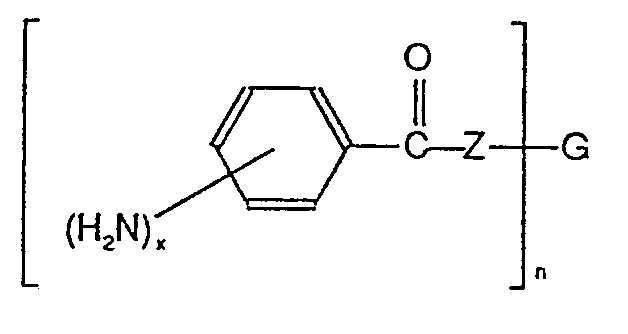
- the present invention provides synthetic polymers which are in the form of cast elastomers . and which comprise the products of solventless reactions of polyisocyanates which are liquid at ambient temperature, and substantially equivalent amounts of oligomeric aminobenzoic acid esters or amides having the formula
- n is an integer of from 2 to 4; each x is one or two; each benzoyl nucleus is para-, meta-or di-meta-amino-substituted; each Z is -0- or and G is an n-valent radical obtained by the removal of hydroxy, or amino groups, respectively, from an n-valent oligomeric polyol or polyamine having a molecular weight of from 400 to 6,000.
- synthetic polymers having useful and desirable physical properties can be simply and effectively provided from a reaction system based upon substantially equivalent amounts of a polyisocyanate and an oligomeric para, meta- or di- meta-aminobenzoic acid or amide of the aforedescribed formula.
- the present invention is based in part upon the incorporation of the backbone of an oligomeric polyol or polyamine, in the form of an n-valent radical G, into an aminobenzoic acid ester or amide having the hereinbefore described formula and the utilization of the resulting oligomeric aminobenzoic acid ester or amide in a polyisocyanate addition process, without the required employment of a curative or chain-extending agent, in the production of useful synthetic polymeric products.
- the present invention thus, provides a method whereby such synthetic polymeric products can be simply and effectively provided by the reaction of a polyisocyanate and the oligomeric aminobenzoic acid ester or amide.
- This method thus represents a departure from the conventional isocyanate polyaddition process involving the reaction of a curative or chain-extending agent with an admixture of pre-reacted product of a polyol and a polyisocyanate.
- the synthetic polymers of the present invention are prepared by a polyaddition process whereby a polyisocyanate which is liquid at ambient temperature is reacted with a substantially equivalent amount of an oligomeric aminobenzoic acid ester or amide having the following formula wherein n is an integer of from 2 to 4; each x is one or two; each benzoyl nucleus is para-, meta-or di-meta-amino-substituted; each Z is -0- or and G is an n-valent radical obtained by the removal of hydroxyl groups or amino groups, respectively, from an n-valent polyol or polyamine having a molecular weight of from 400 to 6,000.
- radial G as an n-valent radical which may be obtained by the removal of hydroxyl groups or amino groups, respectively, from an n-valent polyol or polyamine
- radial G is set forth for convenience in defining the nature of radical G per se, notwithstanding that abstraction or removal of hydroxyl or amino groups from such polyol or polyamine is not mechanistically involved in the synthesis or production of the oligomeric aminobenzoic acid esters and amides hereof.
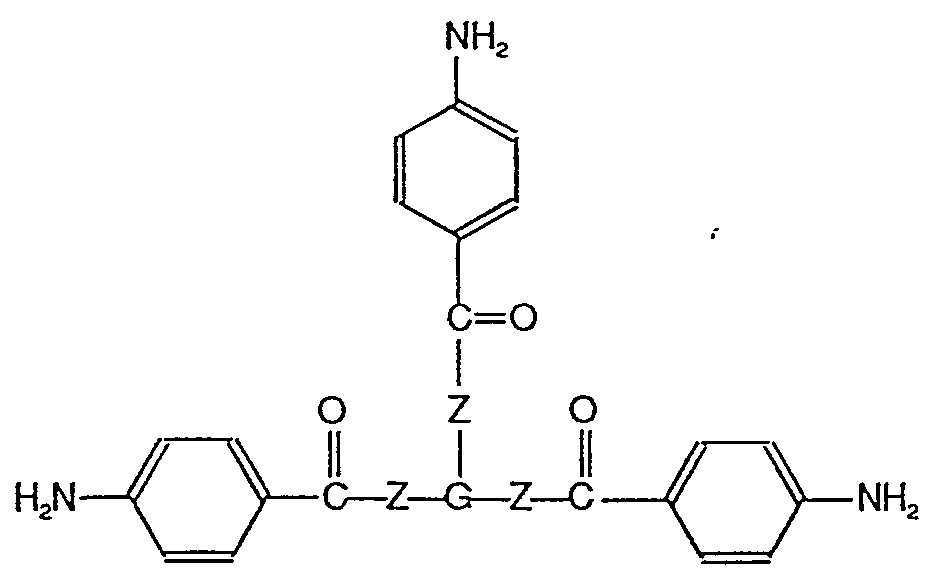
- the oligomeric aminobenzoic acid esters utilized in the present invention comprise di, tri- and tetra(aminobenzoate) esters of oligomeric polyol materials where n is, respectively, 2, 3 or 4.
- the oligomeric aminobenzoic acid amides comprise di, tri- and tetra(aminobenzoic acid) amides of oligomeric polyamine materials where n is, respectively, 2, 3 or 4.
- oligomeric amino benzoic acid esters and amides may be termed oligomeric polyamines. Accordingly, the term "oligomeric polyamine" can be utilized in reference to the essential aminobenzoic acid ester or amide components of the polyaddition product and process of the present invention.
- oligomeric aminobenzoic acid esters utilized in the practice of the polyaddition process of the present invention are aminobenzoate esters of oligomeric polyol materials and can be conveniently provided by reaction of a nitro-substituted benzoyl halide, or a nitro-substituted benzoic acid, with a suitable polyol, such as a polyalkylene ether or ester polyol, followed by reduction of the nitro groups of the resulting product to the corresponding amino groups.
- an oligomeric di(p-amino-benzoate) ester useful herein can be prepared by reaction of two moles of p-nitro-benzoyl chloride with one mole of a dihydric alcohol such as poly(ethylene glycol) having a molecular weight in the range of from 400 to 6,000 and by reduction of the resulting poly(ethylene glycol) di(p-nitro-benzoate) ester.
- a dihydric alcohol such as poly(ethylene glycol) having a molecular weight in the range of from 400 to 6,000
- This reaction is illustrated by the following reaction scheme wherein the value of integer a is such as to provide a molecular weight within the afore-described range
- oligomeric aminobenzoic acid amides useful herein can be provided by reaction of a nitro-substituted benzoyl halide, or a nitro- substituted benzoic acid, with a suitable polyamine, followed by a reduction of the benzoyl halide or benzoic acid nitro-substituents to corresponding amino groups.
- an oligomeric di(p-aminobenzoic acid) amide useful herein can be prepared by reaction of two moles of p-nitrobenzoic acid with one mole of an oligomeric diamine such as a propoxylated propylene diamine having a molecular weight in the range of from 400 to 6,000 and by reaction of the nitro groups to amino groups.
- This reaction is illustrated by the following reaction scheme wherein the value of integer c is such as to provide a molecular weight within the afore-described range
- the nature of radical G of the aminobenzoic acid esters and amides can vary and will depend upon the nature of the oligomeric polyol and polyamine materials utilized in the preparation thereof.
- the radical G will be derived from a polyol or polyamine material having a molecular weight of from 400 to 6,000.
- the polyol or polyamine will have a molecular weight in the range of about 650 to 2,000.
- the radical G can comprise an n-valent saturated or unsaturated, straight chain or branched chain hydrocarbon radical which can be interrupted by oxygen ether atoms.
- the corresponding G radical will comprise repeating oxygen ether atoms.
- radical G will include such oxygen ether atoms.
- radical G will be a divalent radical -G- obtained by removal or abstraction of two hydroxyl or amino groups, respectively, from an oligomeric polyol or polyamine having a molecular weight of from 400 to 6,000.
- G will represent a trivalent radical obtained by removal of three hydroxyl or amino groups from a polyol or polyamine having a molecular weight in the same range.
- radical G will represent a tetravalent radical obtained by removal of four hydroxyl or amino groups from a polyol or polyamine having a molecular weight in the same range.
- the Z moieties of the oligomeric aminobenzoic acid ester and amide compounds hereof can independently be oxygen or amino groups and, accordingly, each Z is defined as being -0- or While the utilization of, for example, an oligomeric polyol or polyamine having, respectively, only hydroxyl or amino groups will be preferred from the standpoint of convenience and ease of preparation, compounds having both hydroxyl and amino groups can be utilized for the preparation of mixed aminobenzoic acid ester/amide compounds hereof. The preparation of such compounds can be illustrated by the following reaction scheme
- polyol materials can be suitably employed for the preparation of the oligomeric aminobenzoic acid esters utilized herein.
- examples of such polyols, which provide divalent, trivalent or tetravalent G radicals include oligomeric diols, such as polyalkyleneether glycols and polyalkylene-arylene-ether glycols; oligomeric triols, such as the polyalkyleneether glycerols or mixed polyalkylene-arylene-ether glycerols; and oligomeric tetrols, such as the polyalkyleneether pentaerythritols or mixed polyalkylene-arylene-ether pentaerythritols.
- a preferred class of polyol materials useful in the preparation of the aminobenzoic acid esters herein comprises the polyalkyleneether glycols which provide a divalent G radical and which may be represented by the formula HO-(RO)- a H wherein R is an alkylene radical containing up to ten carbon atoms and a is an integer sufficient to provide a molecular weight within the range of from 400 to 6,000, and preferably, from about 650 to 2,000.
- R is an alkylene radical of from 2 to 4 carbon atoms.
- polyalkyleneether glycols useful herein include polyethy- leneether glycol, polypropyleneether glycol, pol- yhexyleneether glycol, polytetramethyleneether glycol, polydecamethyleneether glycol, poly-1,2-dimethyl ethyleneether glycol and the copo- lymeroftetrahydrofuran and 1-allyloxy-2,3-epoxypropane.
- polyalkyleneether glycols herein can be readily obtained, for example, by polymerization to suitable molecular weight of an alkylene ether, e.g., ethylene oxide, tetahydrofuran, propylene oxide, or, an admixture thereof, in the presence of water or other low molecular weight alcohol or hydrogen-donor compound.
- suitable molecular weight of an alkylene ether e.g., ethylene oxide, tetahydrofuran, propylene oxide, or, an admixture thereof, in the presence of water or other low molecular weight alcohol or hydrogen-donor compound.
- the polyalkylene-arylene-ether glycols can also be employed for the preparation of oligomeric p-aminobenzoic acid esters utilized herein. These glycols, similar in structure to the polyalkylene- ether glycols, additionally contain arylene radicals. Thus, arylene groups such as phenylene, naphthylene and anthracene radicals can be present in the polyalkylene-arylene-ether glycols. In general, the arylene groups will be present in minor proportion relative to the alkylene groups. Normally, the glycol will contain at least one polyalkyleneether radical of molecular weight of about 500 for each arylene radical.
- the radical G derived therefrom will comprise an n-valent saturated or unsaturated, straight or branched chain hydrocarbon radical which may be obtained by removal of hydroxyl groups from a saturated or unsaturated straight or branched chain hydrocarbon polymer having a molecular weight within the previously set forth range.
- the n-valent G radical will be an aliphatic hydrocarbon radical derived from an aliphatic hydrocarbon polyol.
- suitable hydrocarbon polyol materials include the polyols obtained from the polymerization of polymerizable ethylenically unsaturated monomers, such as 1,4-butadiene, and by the introduction of hydroxyl groups in known manner.
- Such polyol materials are known and can be prepared, for example, by free-radical initiated polymerization of a polymerizable ethylenically-unsaturated monomer to provide a dicarboxylate-substituted hydrocarbone polymer, for example, a dicarboxylate-terminated polymer. Reduction in known manner provides an aliphatic hydrocarbon polyol, for example, an aliphatic hydrocarbon diol.
- a suitable method for the production of such polyol materials is described in greater detail in U.S. Patent 2 888 439 (issued May 26, 1959 to D.M. Simons).
- the polyol materials useful for the preparation of the oligomeric aminobenzoic acid esters utilized herein also include polyols capable, by abstraction, respectively, of three of four hydroxyl groups, of providing a trivalent or tetravalent radical G.
- polyalkyleneether polyols and mixed polyalkylene-arylene-ether polyols derived from such polyhydric alcohols as glycerol, trimethylolpropane, pentaerythritol and the like can be employed.
- Such materials can be obtained by oxyalkylation as, for example, by reaction of glycerol or pentaerythritol with ethylene oxide, propylene oxide or a mixture thereof.
- the resulting trifunctional and tetrafunctional ethers may be advantageously employed for the preparation of oligomeric tri- and tetra-(aminobenzoate) esters which can be suitably employed for the production of polymers having increased cross-linking.
- polyamines can be utilized for the preparation of oligomeric aminobenzoic acid amides useful herein.
- examples of such polyamines, which provide divalent, trivalent or tetravalent G radicals include oligomeric diamines, triamines and tetramines.
- oligomeric diamines useful for the provision of oligomeric aminobenzoic acid amides include polyamines of . the formula
- each of R' and R 2 is a divalent saturated or unsaturated, straight chain or branched chain hydrocarbon radical; c is zero or an integer; d is an integer; and the combined value of c and d is such to provide a molecular weight for the polyamine of from 400 to 6,000.
- each of R 1 and R 2 is an aliphatic, straight or branched chain divalent hydrocarbon radical, e.g., an alkylene radical of from 2 to 10 carbon atoms, and more preferably from 2to 4 carbon atoms.
- Suitable polyamines are known and commercially available and can be obtained, for example, by polymerization of an alkylene oxide and conversion of terminal hydroxyl groups to amino groups by known amination technique.
- the polyol and polyamine materials from which the n-valent G radical is derived can contain substituent moieties where such substituents do not interfere with the desired reaction of the aminobenzoic acid ester or amide with an isocyanate. Alkyl or halo substituents, for example, can be suitably present.
- the n-valent G radical can also contain repeating oxygen ether atoms as will the case where the polyol or polyamine from which radical G is derived comprises, for example, a polyalkyleneether glycol, a polyalkylene- ether glycerol, a polyalkyleneether pentaerythritol, a mixed polyalkylene-arylene-ether polyol or an amine-terminated polyalkyleether.
- the polyol and polyamine materials can additionally contain ester linkages.
- polyol materials of suitable molecular weight i.e., in the range of from 400 to 6,000, having ester linkages as may be obtained, for example, by reaction of a polycarboxylic acid and a polyhydric material can be suitably employed.
- polyols having ester groups include the oligomeric polyester polyols such as may be obtained by the condensation of adipic acid and ethylene glycol.
- the oligomeric aminobenzoic acid esters utilized herein for the production of polymeric products include the di(aminobenzoate) esters (obtained, for example, by reaction of two moles of a nitrosubstituted benzoyl chloride with one mole of an oligomeric glycol having a molecular weight of 400 to 6,000, followed by reduction of nitro-to-amino-groups); and the tri(aminobenzoate) esters (from three moles of a nitro-substituted benzoyl chloride and one mole of an oligomeric triol of molecular weight of 400 to 6,000, followed by reduction of nitro-to-amino-groups).
- the oligomeric aminobenzoic acid esters include the tetra(aminobenzoate) esters derived from four moles of a nitrosubstituted benzoyl chloride per mole of an oligomeric tetrol of molecular weight of 400 to 6,000, followed by a suitable nitro-to-amino-group reduction.
- These oligomeric aminobenzoate esters can conveniently be represented by the following formulae and
- oligomeric aminobenzoic acid amides utilized herein for the production of polymeric products include the di(aminobenzoic acid) amides, the tri(aminobenzoic acid) amides and the tetra(aminobenzoic acid) amides.
- These oligomeric aminobenzoic acid amides can conveniently be represented by the following formulae and
- G will represent, respectively, a divalent, trivalent or tetravalent radical derived from a polyol or polyamine having a molecular weight in the range of 400 to 6,000, and preferably, in the range of from about 650 to about 2,000.
- the phenyl group of each benzoyl moiety contains one or two amino groups depending upon the value of each x as one or two.
- each benzoyl nucleus is para-amino-substituted, meta-amino-substituted or dimeta-amino-substituted.
- the oligomeric aminobenzoic acid esters and esters hereof are inclusive of para-aminobenzoic acid esters and amides; meta-aminobenzoic acid esters and amides; and d-meta-aminobenzoic acid esters. It will be appreciated that each benzoyl moiety of an oligomeric aminobenzoic acid ester or amide hereof, while para-, meta- or di-meta- amino-substituted, need not be identically, substituted.
- Preferred oligomeric aminobenzoic acid esters and amides herein are those wherein the benzoyl moieties are each para-substituted.
- the benzoyl groups can be substituted with non-interfering groups. Accordingly, the benzoyl moieties of the aminobenzoic acid ester and amide compounds hereof can be substituted with halogen, alkyl or other substituents which do not interfere with the desired polyisocyanate addition process.
- oligomeric aminobenzoic acid esters useful herein and represented by Formula I include the following wherein a and b are integers having values corresponding to molecular weights for the polyols from which they are derived of from 400 to 6,000. and
- oligomeric aminobenzoate esters having values corresponding to the molecular useful herein and represented by Formula II in- weights for the polyols from which they are de-clude the following wherein a and b are integers rived of from 400 to 6,000. and
- An example of an oligomeric aminobenzoate ester represented by Formula III includes the following wherein each a is an integer having a value corresponding to a molecular weight for the polyalkyleneether pentaerythritol from which the aminobenzoate ester is derived of from 400 to 6,000.
- oligomeric aminobenzoic acid amides useful herein and represented by Formula IV include the following wherein each c is an integer having values corresponding to molecular weights for the polyamines from which they are derived of from 400 to 6,000.
- an oligomeric aminobenzoic amide useful herein and represented by Formula V is the following wherein each c has a value corresponding to the molecular weight for the polyamine from which the amide is derived of from 400 to 6,000.
- An example of an oligomeric aminobenzoic acid amide represented by Formula VI includes the following wherein each c is an integer having a value corresponding to a molecular weight for the polyamine from which the amide is derived of from 400 to 6,000.
- the synthetic polymers prepared by the process of the present invention are prepared by a polyaddition process involving the reaction of a oligomeric aminobenzoic acid ester or amide as defined hereinbefore with substantially an equivalent amount of a liquid polyisocyanate.
- an oligomeric aminobenzoic acid ester or amide having, for example, the structure represented by Formula B or K will be reacted with substantially an equimolar amount of a liquid polyisocyanate, for example, a diisocyanate.
- Polyisocyanates useful in the production of synthetic polymers by the process of the present invention include a variety of polyisocyanate materials employed in the production of conventional polyurethanes. These include a variety of aliphatic polyisocyanates and aromatic polyisocyanates.
- Suitable polyisocyanates include the toluene di-isocyanates (TDI) such as 2,4-toluene di-isocyanate; 2,6-toluene di-isocyanate; mixtures of TDI isomers such as a mixture (80/20 by weight) of 2,4-toluene di-isocyanate and 2,6-toluene di-isocyanate or a mixture (65/35 by weight) of 2,4-toluene di-isocyanate and 2,6-toluene di-isocyanate; hexamethylene di-isocyanate and 2,6-toluene di-isocyanate.
- TDI toluene di-isocyanates
- 2,4-toluene di-isocyanate 2,6-toluene di-isocyanate
- mixtures of TDI isomers such as a mixture (80/20 by weight) of 2,4-toluene di-
- Aliphatic di-isocyanates such as the C 36 aliphatic di-isocyanate derived from the dimer of ricinoleic acid can be suitably employed and are commercially available, for example, as DDI-1410 (Henkel Corporation, Resin Division, Minneapolis, Minnesota).
- the polyisocyanates thereof are known polyisocyanates in the field of polyurethane technology and can be employed singly or in admixture.
- Other examples of such polyisocyanates can be found, for example, in The Development and Use of Polyurethane Products, E.N. Doyle, McGraw-Hill Book Company, page 27 (1971).
- the polyisocyanates for employment in the process of the present invention are polyisocyanate materials in a liquid form at ambient temperatures. These materials facilitate the production of polymeric products from normally liquid oligomeric aminobenzoic acid esters or amides and obviate the requirement of melting a solid polyisocyanate as a prerequisiste to providing a suitable reaction mixture.
- Suitable liquid polyisocyanate materials are known and include, for example, polymeric MDI (4,4'-diphenylmethane di-isocyanate) products obtained as by products from the synthesis of MDI.
- polyisocyanate products comprising such polymeric polyisocyanate species in admixture with pure MDI, i.e., the undistilled reaction mixture, can also be employed.
- Polymeric MDI products can be employed herein to advantage and are commercially available under such trade designations as Rubinate M (available from Rubicon Chemicals Inc., Geisman, La.) and PaPI 27, PaPI 135, PaP) 580 and PaPt 901 (available from the Upjohn Company, Kalamazoo, Michigan).
- Another liquid polyisocyanate material which can be employed where cross-linking is desirably introduced into the polymeric products hereof comprises an admixture of MDI and a tri-functional cycloaddition product of MDI.
- Such an admixture is available under the designation "Liquid MDI", Isonate 143L (The Upjohn Company, Kalamazoo, Michigan).
- the process of the present invention can be utilized for the production of polymeric products by reaction of an oligomeric aminobenzoic acid ester or amide and substantially an equivalent amount of the polyisocyanate under a variety of reaction conditions.
- the reaction can be suitably conducted under conditions of room temperature with the provision of polymeric products within suitable pot-life and demold-time parameters.
- the reaction system can be heated. It has been found, however, that the process of the-present invention permits the fabrication of polymeric pieces from reaction mixtures having, in general, a pot life of at least five minutes and that the polymeric pieces can be demolded within about 15 minutes.
- oligomeric aminobenzoic acid ester or amide and polyisocyanate components are reacted in substantially equivalent proportions.
- substantially equivalent refers to the utilization, in general, of an amount of polyisocyanate reactant of about 0.9 to 1.2 equivalents per equivalent of the oligomeric aminobenzoic ester or amide, based upon the isocyanate groups and amino groups, respectively of the polyisocyanate and oligomeric aminobenzoic acid ester or amide reactants.
- the particular oligomeric aminobenzoic acid ester or amide and polyisocyanate reactants utilized in the conduct of the process of the invention can be varied for desired control of elastomer properties in finished pieces, for control of handling characteristics or to otherwise permit latitude in reaction conditions.
- the aminobenzoic acid esters and amides utilized herein can be employed in a polyisocyanate polyaddition process in admixture.
- a mixture of a para- aminobenzoic acid ester or amide can be utilized in combination with a meta-aminobenzoic acid ester or amide.
- the polyisocyanate will be utilized in an amount substantially equivalent, as defined herein, to the amine functionality of the mixture of aminobenzoic acid ester or amide.
- a mixture, for example, of oligomeric aminobenzoate esters having para- and meta-amino substitution can be employed for desirable control of rate of reaction.
- Such mixtures include a mixture of a di(4-aminobenzoate) ester having the formula wherein G represents a divalent radical obtained by the removal of two hydroxyl groups from an oligomeric polyol having a molecular weight in the range of 400 to 6,000; and from about 1%to about 50% by weight of said di(4-aminobenzoate) ester, of a di(3-aminobenzoate) ester having the formula wherein G represents a divalent radical obtained by the removal of two hydroxyl groups from an oligomeric polyol having a molecular weight in the range of from 400 to 6,000.
- a preferred polyaddition reaction system utilizing such an admixture involves the reaction of a polyisocyanate with a mixture of isomeric aminobenzoate esters having the formulae and wherein each R is an alkylene of from two to ten, and preferably, two to four carbon atoms; and each a is an integer such that the molecular weight of the polyalkyleneether glycols from which the aminobenzoate esters are derived is in the range of from 400 to 6,000, and preferably from about 650 to about 2,000.
- the utilization of an admixture of such isomers permits desired control of the rate of reaction of the polyisocyanate polyaddition process.
- Another preferred polyaddition reaction system of the present invention involves the reaction of a polyisocyanate with a mixture of an oligomeric di(4-aminobenzoate) ester and an oligomeric di(3,5-diaminobenzoate) ester.
- Such mixtures includes a mixture of a di(4-aminobenzoate) ester having the formula wherein G represents a divalent radical obtained by the removal of two hydroxyl groups from an oligomeric polyol having a molecular weight in the range of from 400 to 6,000; and from about 1% to about 15% by weight of said di(4-aminobenzoate) ester, of a di(3,5-diaminobenzoate) ester having the formula wherein G represents a divalent radical obtained by the removal of two hydroxyl groups from an oligomeric polyol having a molecular weight in the range of from 400 to 6,000.
- a preferred polyaddition reaction system utilizing such an admixture involves the reaction of a polyisocyanate with a mixture of oligomeric di(aminobenzoate) esters having the formulae and wherein each R is an alkylene radical of from two to ten, and preferably, two to four carbon atoms; and each a is an integer such that the molecular weight of the polyalkylene-ether glycols from which the aminobenzoate esters are derived is in the range of from 400 to 6,000, and preferably from about 650 to about 2,000.
- the utilization of a content of the tetramine compound, i.e., the di(3,5-diaminobenzoate) ester, in the polyaddition reaction system permits cross-linking reactions to occur in the polyisocyanate reaction and, thus, provides a means for controlling crosslinking in accordance with the dictates of physical properties required in a particular elastomeric product.
- p-aminobenzoic acid esters and amides utilized herein can be reacted with a polyisocyanate, if desired, in combination with, for example, a di(3-aminobenzoic) acid ester or amide and a di(3,5-diaminobenzoic) acid ester or amide.
- a suitable reaction includes, for example, the reaction of a polyisocyanate with substantially an equivalent amount of a mixture of aminobenzoate esters comprising a di(4-aminobenzoate) ester having the formula and by weight of the di(4-aminobenzoate) ester, about 1% to about 50%, of a mixture of a di(3-aminobenzoate) ester having the formula and a di(3,5-diaminobenzoate) ester having the formula wherein each G represents a divalent radical obtained by the removal of two hydroxyl groups from an oligomeric polyol having a molecular weight in the range of from 400 to 6,000.
- mixtures of the oligomeric aminobenzoic acid esters or amides, as described hereinbefore are desirably reacted with a polyisocyanate
- mixtures as are obtained, for example, from the reaction of a mixture of nitro-substituted benzoic acids or halides with a polyol polyamine, followed by reduction of nitro-to-amino-groups.
- two moles of a mixture of p-nitrobenzyl chloride and m-nitrobenzoyl chloride can be suitably reacted with a mole of polyol or polyamine for production of a statistical distribution of isomeric di(nitrobenzoic) acid esters or amides.
- a mixture of di(aminobenzoate) ester and tri(aminobenzoate) ester oligomers, as represented by Formulas I and 11 hereinbefore, can also be utilized, particularly where increased cross-linking is desired.
- mixtures of polyisocyanate reactants can be employed to advantage for control of cross-linking in finished pieces.
- another reaction system of the present invention involves the reaction of a polyisocyanate with a mixture of oligomeric aminobenzoates comprising a di(aminobenzoate) ester as represented by the structure of Formula I, and by weight of the di(aminobenzoate) ester, from about 1% to about 20%, of a tri(aminobenzoate) ester having the structure of Formula II.
- Such reaction system permits the fabrication of liquid-cast elastomeric pieces exhibiting desired physical properties while providing efficient pot life and demold time parameters.
- the synthetic polymers prapared by the process of the present invention are cast polymeric materials which can, for example, be formed by the casting of a mixture of aminobenzoic acid ester or amide and a polyisocyanate and the curing thereof to a polymeric material.
- the polymeric materials can be formulated to the characterstics of thermosetting or thermoplastic polymers.
- the term "cast polymeric materials" refers to solid non-cellular synthetic polymers which are formed by the casting of the reaction mixture of the polyaddition process hereof and the curing thereof to a polymeric product. These cast polymers can be distinguished from the cellular polymers formed by action of a blowing agent and commonly referred to as polymeric foams.
- Synthetic cast polymers prepared by the process of the present invention can be suitably formed by casting a reaction mixture of an aminobenzoic acid ester or amide and polyisocyanate, for example, into a mold and allowing the curing of the reaction mixture to a thermosetting or thermoplastic polymeric material.
- the reaction components can be admixed in a container and the contents thereof can be discharged or otherwise introduced into a mold for desired curing.
- a suitable technique for forming the cast polymers hereof, particularly in high-production modes involves the mixing, as by in-line mixing, of the reaction components immediately prior to the casting of the reaction mixture into a suitable mold for curing.
- the reaction components can be utilized in connection with conventional casting and molding operations including extrusion, rotation molding and like operations where the reaction components are proportioned and mixed for curing to a solid non-cellular polymeric material.
- the reaction mixtures and process hereof can be employed in the production of cast pieces or fabrications formulated to suit the requirements of hard, abrasion-resistant, flexible pieces of thermosetting or thermoplastic character as desired.
- the process hereof can also be utilized in the production of solid noncellular polymeric coatings or films. These coatings or films can be provided by casting the reaction components, in neat form onto a coatable substrate and allowing the coating to cure to the desired polymeric film or coating.
- the process of the present in the form of invention permits the realization of certain advantages in the manufacture of polymeric materials cast elastomeric pieces or fabrications prepared by a variety of casting and molding operations.
- the polymeric materials hereof can be conveniently prepared without resort to the utilization of chain-extending or curing agents conventionally employed in the polyurethane art.
- the provision of an oligomeric moiety in an aminobenzoic acid ester or amide thus permits the production of polymeric materials having useful physical characteristics by the simple and direct reaction of an oligomeric aminobenzoic acid ester or amide as described herein with a polyisocyanate reactant.
- the requirement of dissolving a solid curative in a reaction system as a prerequisite to the casting and production of polymeric products is, thus, also obviated.
- polyamino organic compounds described as suitable for reaction with the isocyanate groups of an isocyanate are the polyalkylene ethers terminated with primary or secondary amino groups, the aminoesters of hydroxy terminated polyalkylene ethers, the di(amino esters) of hydroxy terminated long chain aliphatic hydrocarbons derived from polydienes such as polybutadiene, polyisoprene and the like, and the polydiene diamines having substantially terminal amino groups and hydrogenated polydiene diamines which may or may not contain residual ethylenic double bonds in the molecules.
- the process of the present invention represents a departure from the disclosure of U.S. Patent 3 256 213 in that the process of the invention permits the production of polymeric products by a simple and direct reaction of a polyisocyanate and an oligomeric aminobenzoic acid ester or amide as described hereinbefore without the presence in the reaction mixture of polyaklylene ether glycols or polyols.
- the utilization of such oligomeric aminobenzoic acid ester or amide materials as components for reaction with a polyisocyanate in accordance with the present invention permits desired production of polymeric materials without instantaneous or near-instantaneous reactivity.
- the process of the present invention permits the fabrication of polymeric materials from reaction mixtures having suitable pot-life, in general, of at least five minutes.
- This desirable reaction system parameter is realized without need of polyalkylene ether glycols or polyols or acidic agents utilized for reaction rate control by formation of a polyamine salt.
- the polyalkylene ether glycols and polyols described in U.S. Patent 3 256 213 are not included as reactants in the process of the present invention, the resulting polymers do not contain the reaction products of an isocyanate and such polyalkylene ether glycols or polyols.
- Patent 3256213 are not employed in the process hereof. Accordingly, the production of such other salts as are formed by the reaction of an amine salt and a subsequently added basic material, as described in the patent, is avoided. It is, thus, a significant aspect of the present invention that the reaction mixture utilized in the production of the polymers in accordance with the process of the invention is substantially free of polyalkylene ether glycols or polyols and reaction rate-controlling acidic, polyamine salt-forming agents. Accordingly, the polymers of the present invention are substantially free of the reaction product of an isocyanate and a polyalkylene ether glycol or polyol and substantially free of salts formed during production of the polymer by reaction of a basic material and an amine salt.
- GB-A 2009764 relates to a method for the preparation of polyurethane elastomers using a polyethylene glycol bis (4-aminobenzoate) which is a low molecular p-amino benzoic acid terminated curing agent.
- This reference does not suggest reacting a polyisocyanate only with a (macromolecular) p-aminobenzoic acid terminated polyether without using a curing agent (chain extender).
- This example illustrates the preparation of an oligomeric di(p-aminobenzoate) ester of a polytetramethylene oxide diol.
- a reaction mixture was prepared by the addition to 500 cc of toluene of the following ingredients: 253.6 g (0.25 mole) of a polytetramethylene oxide diol having a molecular weight of about 1000 (Polymeg 1000 available from The Quaker Oats Company, Chicago, Illinois); 60.3 g (0.6 mole) of tri-ethylamine; and 106.3 g (0.57 mole) of p-nitro-benzoyl chloride.
- the reaction mixture was heated and allowed to reflux overnight.
- the reaction mixture was cooled, filtered and washed with an aqueous solution (5% by weight) of sodium carbonate.
- the resulting product was evaporated with recovery of 266 g of an amber resin.
- the resinous product as recovered above, was dissolved in one liter of ethanol. To the resulting solution was added 5 g of 5%-palladium-on-carbon catalyst, followed by addition of 31.2 g (0.6 mole) of hydrazine hydrate. The resulting reaction mixture was heated, allowed to reflux for three hours, cooled, filtered and evaporated to yield 228 g of a clear resin. Analysis of the resin indicated an amine equivalent of 1.58 milliequivalents per gram of resin (meq/g). Completion of the esterification reaction of the p-nitro-benzoyl chloride with the hydroxyl groups of the polytetramethylene oxide diol was indicated by analysis of the resin product for residual acidity (0.02 meq H + /g). The resin product was an oligomeric di(p-aminobenzoate) ester of polytetramethylene oxide diol, the product being represented by the following structure:
- This example illustrates the preparation of an oligomeric tri(p-aminobenzoate) ester of a polypropylene oxide trio.
- a reaction mixture was prepared by the addition to 500 cc of toluene of the following ingredients: 525 g of a polypropylene oxide triol having a molecular weight of about 5,500 (available as Voranol 4701, from the Dow Chemical Company, Midland, Michigan); 60 g of p-nitro-benzoyl chloride; and 40 g of triethylamine.
- the reaction mixture was heated and allowed to reflux overnight.
- the reaction mixture was cooled, filtered, washed with an aqueous solution (5% by weight) of sodium carbonate and evaporated to yield 514.5 g of an amber resin.
- This example illustrates, like Example I, the preparation of an oligomeric di(p-aminobenzoate) ester of a polytetramethylene oxide diol, except that, this Example illustrates the utilization of a polytetramethylene oxide diol of lower molecular weight.
- a reaction mixture was prepared by addition to 500 cc of toluene of the following ingredients: 165.5 g of a polytetramethylene oxide diol having a molecular weight of about 650 (available as Polymeg 650, from The Quaker Oats Company, Chicago, Illinois); 106.3 g of p-nitrobenzoyl chloride; and 60.3 g of triethylamine.
- the reaction mixture was heated and allowed to reflux overnight.
- the reaction mixture was cooled, filtered, washed with an aqueous (5% by weight) solution of sodium carbonate and evaporated to yield 225 g of an amber resin.
- This example illustrates the preparation of an oligomeric di(m-aminobenzoate) ester of a polytetramethylene oxide dio.
- a reaction mixture was prepared by addition to 500 cc of toluene of the following ingredients: 103 g of a polytetramethylene oxide diol having a molecular weight of about ' 1000, available as Polymeg 1000, from The Quaker Oats Company, Chicago, Illinois); 103 g of m-nitrobenzoyl chloride; and 60.3 g of triethylamine.
- the reaction mixture was heated and allowed to reflux overnight.
- the reaction mixture was cooled, filtered, washed with an aqueous (5% by weight) solution of the sodium carbonate and evaporated to yield a yellow resin.
- the yellow resin as recovered above, was dissolved in one liter of ethanol. To the resulting solution was added 5 g of a 5% palladium-on-carbon catalyst, followed by 31.2 g of hydrazine hydrate. The reaction mixture was heated, allowed to reflux for three hours, cooled, filtered and evaporated to yield 243.8 g of a clear resin product. The product was analyzed for amine equivalents (1.55 meq/g) and for residual acidity (0.03 meq H + /g). The resin product was an oligomeric di(m-aminobenzoate) ester of polytetramethylene oxide diol, the product being represented by the following structure:
- This example illustrates the preparation of an oligomeric di(3,5-diaminobenzoate) ester of a polytetramethylene oxide diol.
- a reaction mixture was prepared by addition to 500 cc of toluene of the following ingredients: 246.3 g of a polytetramethylene oxide diol having a molecular weight of about 1000 (available as Polymeg 1000, from The Quaker Oats Company, Chicago, Illinois); 125 g of 3,5-dinitrobenzoyl chloride; and 55.6 g of triethylamine.
- the reaction mixture was heated and allowed to reflux overnight.
- the reaction mixture was cooled and 500 cc of cyclohexane were added. Following filtration, the solution was evaporated to yield 230 g of a dark resin.
- This example illustrates the production by the polyaddition process of a cast elastomer utilizing oligomeric di(p-aminobenzoate) ester of polytetramethylene oxide diol and a liquid polyisocyanate.
- a reaction mixture was prepared by mix- .
- This example illustrates the production by the polyaddition process of a liquid-cast elastomer utilizing a liquid polyisocyanate and an admixture of oligomeric di(p-aminobenzoate) and di(3,4-diaminobenzoate) esters of polytetramethylene oxide diol.
- This example illustrates the production by the polyaddition process of a cast elastomer utilizing a liquid polyisocyanate and an oligomeric tri(p-aminobenzoate) ester of a polypropylene oxide triol.
- This Example illustrates the production by the polyaddition process of a liquid-cast elastomer utilizing a liquid polyisocyanate and an admixture of oligomeric di(p-aminobenzoate) and di(m-aminobenzoate) esters of polytetramethylene oxide diol.
- the degassed mixture was then mixed at room temperature with 15.4 g of a liquid polyisocyanate comprising MDI and a trifunctional cycloadduct thereof (available as Isocyanate 143L from The Upjohn Company, Kalamazoo, Michigan).
- the resulting mixture which exhibited a pot life of eight minutes, was poured into a mold which had been pre-heated to a temperature of 110°C.
- the resulting firm and non-cheesy elastomer was demolded and maintained overnight at a temperature of 110°C.
- the elastomer exhibited the following physical properties, set forth in Table 4:
- This Example illustrates the production by the polyaddition process of a liquid-cast elastomer utilizing a liquid polyisocyanate and an admixture of oligomeric di(p-aminobenzoate) esters of polytetramethylene oxide diols.
- the degassed mixture was then mixed with 17.7 g of a liquid polyisocyanate comprising MDI and a tri- functional cycloadduct thereof (available as Isonate 143L from The Upjohn Company, Kalamazoo, Michigan).
- the resulting mixture which exhibited a pot life of nine minutes, was poured into a mold which had been pre-heated to a temperature of 110°C. After one half hour, the resulting firm and non-cheesy elastomer was demolded and maintained overnight at a temperature of 110°C. After a one-week aging period, at room temperature and 50% relative humidity, the elastomer exhibited the following physical properties, set forth in Table 5:
- oligomeric aminobenzoate An oligomeric di(ortho-aminobenzoate) ester of polytetramethylene oxide diol was prepared in the following manner.
- Tecol 1000
- This Example illustrates the production by the polyaddition process of polymeric materials utilizing a liquid polyisocyanate and an oligomeric di(aminobenzoate) ester of a polytetramethylene oxide diol.
- the oligomeric di(aminobenzoate) ester of polytetramethylene oxide diol was the di(p-aminobenzoate) ester utilized in Example I.
- the oligomeric di(aminobenzoate) ester was the di(o-aminobenzoate) ester of Example Xl.
- the polimeric materials were prepared in the following manner.
- a reaction mixture was prepared in each case by mixing the following ingredients; 50 g (0.07 equivalent) of the appropriate oligomeric di(aminobenzoate) ester of polytetramethylene oxide diol; and 9.3 g (0.07 equivalent) of a liquid polyisocyanate comprising MDI and polymeric MDI (available as PaPI901 from The Upjohn Company, Kalamazoo, Michigan).
- the resulting mixture was in each case poured into a mold which had been pre-heated to a temperature of 110°C and was retained in the mold at this temperature for one hour.
- the resulting polymeric material was then in each case demolded, maintained at a temperature of 110°C overnight and aged for one week at room temperature and 50% relative humidity.
- Table 6 sets forth the results of the physical properties of the resulting polymers.
- the polymeric material was demolded and cut in half along a diagonal.
- One half of the polymeric material (Polymer XIII-R.T.) was aged for one week at room temperature (R.T.) and 50% relative humidity.
- the second half (Polymer XIII-1 10°C) was heated to a temperature of 110°C overnight and was then aged at room temperature and 50% relative humidity for the remainder of the one week period.
- Physical properties of the two polymeric materials subjected to the respective heat histories afore-described, were measured and are reported as follows in Table 7.
Landscapes
- Chemical & Material Sciences (AREA)
- Health & Medical Sciences (AREA)
- Chemical Kinetics & Catalysis (AREA)
- Medicinal Chemistry (AREA)
- Polymers & Plastics (AREA)
- Organic Chemistry (AREA)
- Polyurethanes Or Polyureas (AREA)
- Organic Low-Molecular-Weight Compounds And Preparation Thereof (AREA)
Claims (19)




Priority Applications (1)
| Application Number | Priority Date | Filing Date | Title |
|---|---|---|---|
| AT80107551T ATE11672T1 (de) | 1979-12-03 | 1980-12-03 | Polyisocyanat-polyaddukte und verfahren zu ihrer herstellung. |
Applications Claiming Priority (4)
| Application Number | Priority Date | Filing Date | Title |
|---|---|---|---|
| US9985779A | 1979-12-03 | 1979-12-03 | |
| US99857 | 1979-12-03 | ||
| US189149 | 1980-09-22 | ||
| US06/189,149 US4328322A (en) | 1979-12-03 | 1980-09-22 | Synthetic polymers by polyisocyanate polyaddition process |
Publications (4)
| Publication Number | Publication Date |
|---|---|
| EP0032547A2 EP0032547A2 (de) | 1981-07-29 |
| EP0032547A3 EP0032547A3 (en) | 1981-10-21 |
| EP0032547B1 EP0032547B1 (de) | 1985-02-06 |
| EP0032547B2 true EP0032547B2 (de) | 1989-07-26 |
Family
ID=26796551
Family Applications (1)
| Application Number | Title | Priority Date | Filing Date |
|---|---|---|---|
| EP80107551A Expired EP0032547B2 (de) | 1979-12-03 | 1980-12-03 | Polyisocyanat-Polyaddukte und Verfahren zu ihrer Herstellung |
Country Status (6)
| Country | Link |
|---|---|
| US (1) | US4328322A (de) |
| EP (1) | EP0032547B2 (de) |
| KR (1) | KR840000523B1 (de) |
| AU (1) | AU538880B2 (de) |
| CA (1) | CA1179098A (de) |
| DE (1) | DE3070132D1 (de) |
Families Citing this family (59)
| Publication number | Priority date | Publication date | Assignee | Title |
|---|---|---|---|---|
| JPS6038412B2 (ja) * | 1982-09-21 | 1985-08-31 | 東洋ゴム工業株式会社 | ポリエ−テルポリオ−ル誘導体及びその製造法 |
| JPS5989322A (ja) * | 1982-11-13 | 1984-05-23 | Toyo Tire & Rubber Co Ltd | ポリウレタンウレア重合体及びその製造法 |
| US4537945A (en) * | 1984-04-02 | 1985-08-27 | Toyo Tire & Rubber Company Limited | Polyether derivative and a poly(urethane)ureamide obtained therefrom |
| US4732959A (en) * | 1984-11-22 | 1988-03-22 | Toyo Tire & Rubber Company Limited | Polyesterpolyol derivative and a poly(urethane)ureamide obtained therefrom |
| US4609683A (en) * | 1985-06-21 | 1986-09-02 | Texaco Inc. | Quasi-prepolymers from isatoic anhydride derivatives of polyoxyalkylene polyamines and rim products made therefrom |
| US4609684A (en) * | 1985-06-21 | 1986-09-02 | Texaco Inc. | Rim products made from isatoic anhydride derivatives of polyoxyalkylene polyamines |
| DE3534947A1 (de) * | 1985-10-01 | 1987-04-09 | Bayer Ag | Verfahren zur herstellung von polyaminen, polyamine und deren verwendung zur herstellung von polyurethanen |
| US5283364A (en) * | 1985-10-18 | 1994-02-01 | Bayer Aktiengesellschaft | Hydrolysis process for polyamines |
| US4847416A (en) * | 1986-10-27 | 1989-07-11 | The Dow Chemical Company | Capping of polyols with aromatic amines |
| JP2577900B2 (ja) * | 1987-02-18 | 1997-02-05 | イハラケミカル工業 株式会社 | ポリ尿素樹脂の製造方法 |
| US5079275A (en) * | 1987-04-06 | 1992-01-07 | The Dow Chemical Company | Polyurea resins from poly(aminoaromatic) compounds |
| DE3731067A1 (de) * | 1987-09-16 | 1989-04-06 | Basf Ag | Eingedickte formmassen |
| US4885353A (en) * | 1988-11-16 | 1989-12-05 | Mobay Corporation | Liquid isocyanate prepolymers |
| US4914174A (en) * | 1989-01-23 | 1990-04-03 | Mobay Corporation | Liquid isocyanate prepolymers |
| US4898971A (en) * | 1989-01-23 | 1990-02-06 | Mobay Corporation | Liquid isocyanate prepolymers |
| CA2038104C (en) * | 1990-03-30 | 2002-07-23 | Thomas S. Reid | Polyurethaneurea composition |
| US5162481A (en) * | 1990-03-30 | 1992-11-10 | Minnesota Mining And Manufacturing Company | Polyurethaneurea composition |
| US5219973A (en) * | 1990-12-07 | 1993-06-15 | Miles Inc. | Polyurea rim systems |
| US5273558A (en) * | 1991-08-30 | 1993-12-28 | Minnesota Mining And Manufacturing Company | Abrasive composition and articles incorporating same |
| US5273559A (en) * | 1991-08-30 | 1993-12-28 | Minnesota Mining And Manufacturing Company | Abrasive dental articles |
| US5319058A (en) * | 1991-10-22 | 1994-06-07 | Ihara Chemical Industry Co., Ltd. | Method for the preparation of a polyurea resin |
| US5183877A (en) * | 1991-10-25 | 1993-02-02 | H. B. Fuller Company | Polyurea or polyurea-urethane adhesive for bonding elastomers |
| JP3220873B2 (ja) * | 1992-07-02 | 2001-10-22 | イハラケミカル工業株式会社 | ポリウレタンウレアエラストマー |
| US5202413A (en) * | 1993-02-16 | 1993-04-13 | E. I. Du Pont De Nemours And Company | Alternating (ABA)N polylactide block copolymers |
| US5407452A (en) * | 1993-07-28 | 1995-04-18 | Chevron Chemical Company | Fuel compositions containing poly(oxyalkylene) aromatic esters |
| US5380345A (en) * | 1993-12-03 | 1995-01-10 | Chevron Research And Technology Company | Polyalkyl nitro and amino aromatic esters and fuel compositions containing the same |
| US5538521A (en) * | 1993-12-23 | 1996-07-23 | Chevron Chemical Company | Fuel compositions containing polyalkyl and poly(oxyalkylene)aromatic esters |
| US5525683A (en) * | 1994-11-22 | 1996-06-11 | Bayer Corporation | Ether-linked amine-terminated polyesters and a process for their production |
| US5637121A (en) * | 1994-12-30 | 1997-06-10 | Chevron Chemical Company | Poly(oxyalkylene) aromatic amides and fuel compositions containing the same |
| US5540743A (en) * | 1994-12-30 | 1996-07-30 | Chevron Chemical Company | Polyalky and poly(oxyalkylene) benzyl amine esters and fuel compositions containing the same |
| US5466268A (en) * | 1994-12-30 | 1995-11-14 | Chevron Chemical Company | Polyalkyl and polyalkenyl aromatic amides and fuel compositions containing the same |
| CA2178677A1 (en) * | 1995-07-06 | 1997-01-07 | Richard E. Cherpeck | Aromatic amides of poly(oxyalkylene)carbamates and fuel compositions containing the same |
| US5628803A (en) | 1995-12-29 | 1997-05-13 | Chevron Chemical Company | Polyalkylphenyl and polyalkyloxycarbonylphenyl amino and nitro benzoates and fuel compositions containing the same |
| US5618320A (en) * | 1996-05-14 | 1997-04-08 | Chevron Chemical Company | Aromatic esters of polyalkylphenoxyalkanols and fuel compositions containing the same |
| US6039773A (en) * | 1997-12-22 | 2000-03-21 | Chevron Chemical Company Llc | Fuel compositions containing polyamines of polyalkyl aromatic esters |
| US5865861A (en) * | 1997-12-22 | 1999-02-02 | Chevron Chemical Company Llc | Fuel compositions containing polyamines of poly(oxyalkylene) aromatic |
| KR100562446B1 (ko) | 1998-02-19 | 2006-03-20 | 미네소타 마이닝 앤드 매뉴팩춰링 캄파니 | 연마 용품 및 유리 연마 방법 |
| US5942014A (en) * | 1998-08-28 | 1999-08-24 | Chevron Chemical Company Llc | Pyridyl and piperidyl esters of polyalklphenoxyalkanols and fuel compositions containing the same |
| US6020392A (en) * | 1998-09-04 | 2000-02-01 | Air Products And Chemicals, Inc. | Polyurea elastomeric microcellular foam |
| IT1302496B1 (it) * | 1998-09-14 | 2000-09-05 | Sixton Holding Sa | Schiuma poliuretanica rigida. |
| US6117197A (en) * | 1998-11-25 | 2000-09-12 | Chevron Chemical Company Llc | Fuel compositions containing aromatic esters of polyalkylphenoxy alkanols, poly(oxyalkylene) amines and di- or tri-carboxylic acid esters |
| US6071319A (en) * | 1998-12-22 | 2000-06-06 | Chevron Chemical Company Llc | Fuel additive compositions containing aromatic esters of polyalkylphenoxyalkanols and aliphatic amines |
| US6179887B1 (en) | 1999-02-17 | 2001-01-30 | 3M Innovative Properties Company | Method for making an abrasive article and abrasive articles thereof |
| US6458018B1 (en) | 1999-04-23 | 2002-10-01 | 3M Innovative Properties Company | Abrasive article suitable for abrading glass and glass ceramic workpieces |
| IL129583A (en) * | 1999-04-25 | 2005-05-17 | Kenneth I Sawyer | Diesters of oligobutyleneglycol and amidine benzoic acid and their use for preparation of moisture-curable, storage-stable, one-part polyurethane/urea compositions |
| AU5006700A (en) * | 1999-05-13 | 2000-12-05 | K & L Technologies, Inc. | Polyurea composition |
| US6165236A (en) * | 1999-06-02 | 2000-12-26 | Chevron Chemical Company Llc | Poly(oxyalkylene) pyridyl and piperidyl esters and fuel compositions containing the same |
| US6403063B1 (en) | 1999-07-26 | 2002-06-11 | Kenneth I. Sawyer | Method of treating nail fungus |
| US6401724B1 (en) | 1999-10-11 | 2002-06-11 | Par Pharmaceuticals Incorporated | Method of applying a cosmetic nail lacquer or polish to a nail |
| US20030212291A1 (en) * | 2002-05-02 | 2003-11-13 | Crompton Corporation | Diamine curing agents for the preparation of polyurethane-urea elastomers |
| US20060216267A1 (en) * | 2002-08-20 | 2006-09-28 | Kovacs Stephen G | Hydrophobic elastomeric polymer chemistry device for inhibiting the growth of onychomycosis and urushiol-induced allergic contact dermatitis |
| JP2004137422A (ja) * | 2002-10-21 | 2004-05-13 | Fuji Photo Film Co Ltd | ポリエーテル誘導体及びその製造方法 |
| US7572461B2 (en) * | 2004-03-05 | 2009-08-11 | Kenneth I. Sawyer | Borer-resistant wood, wood products, and wooden structures and methods |
| CA2566605A1 (en) * | 2004-05-14 | 2005-12-01 | Kenneth I. Sawyer | Polyurea compositions and compounds for the preparation thereof |
| US8664292B2 (en) * | 2004-05-27 | 2014-03-04 | Croda International Plc | Compositions and articles containing a cross-linked polymer matrix and an immobilized active liquid, as well as methods of making and using the same |
| US20110117156A1 (en) * | 2004-05-27 | 2011-05-19 | Arizona Chemical Company | Compositions and articles containing an active liquid in a polymeric matrix and methods of making and using the same |
| US8771725B2 (en) * | 2007-10-12 | 2014-07-08 | Chesson Laboratory Associates, Inc. | Poly(urea-urethane) compositions useful as topical medicaments and methods of using the same |
| EP3250636B1 (de) * | 2015-01-27 | 2020-05-06 | Hewlett-Packard Development Company, L.P. | Polymere aminsynergisten |
| US10414927B2 (en) | 2015-01-27 | 2019-09-17 | Hewlett-Packard Development Company, L.P. | Polymeric photo active agents |
Family Cites Families (19)
| Publication number | Priority date | Publication date | Assignee | Title |
|---|---|---|---|---|
| US2888439A (en) * | 1957-08-16 | 1959-05-26 | Du Pont | Polyurethane diamines |
| NL293505A (de) * | 1962-05-31 | |||
| US3426097A (en) * | 1965-08-24 | 1969-02-04 | Gen Motors Corp | Latent curing agents for epoxide polymers and polyurethanes |
| DE1720680A1 (de) | 1967-07-06 | 1971-07-15 | Bayer Ag | Verfahren zur Herstellung von Formkoerpern,UEberzuegen,Filmen und Verklebungen |
| US3632536A (en) | 1967-08-24 | 1972-01-04 | Matsushita Electric Works Ltd | Block copolymers prepared by reacting prepolymers containing terminal isocyanate groups with aromatic oligamides |
| DE2019432C3 (de) * | 1970-04-22 | 1982-05-06 | Bayer Ag, 5090 Leverkusen | Verfahren zur Herstellung von endständige Aminogruppen aufweisenden organischen Verbindungen und deren Verwendung zur Herstellung von Kunststoffen |
| DE2040644C3 (de) * | 1970-08-17 | 1978-11-02 | Bayer Ag, 5090 Leverkusen | Verfahren zur herstellung von polyurethankunststoffen |
| US3817940A (en) * | 1970-08-17 | 1974-06-18 | Bayer Ag | Aromatic diamines |
| US3975428A (en) * | 1971-12-07 | 1976-08-17 | Bayer Aktiengesellschaft | Aromatic amines formed by the reaction of isatoic acid anhydride with compounds containing at least one tertiary nitrogen atom and at least two hydroxyl groups |
| FR2242425B1 (de) * | 1973-08-29 | 1978-02-17 | Inst Francais Du Petrole | |
| US3932360A (en) * | 1974-03-14 | 1976-01-13 | Polaroid Corporation | Polyurethane elastomers prepared from diamine curing agents |
| AT340690B (de) * | 1975-10-27 | 1977-12-27 | Polyair Maschinenbau Gmbh | Verfahren zur herstellung von neuen, endstandige aminogruppen aufweisenden polyathern und ihre verwendung als reaktionspartner bei der herstellung von kunststoffen |
| US4129741A (en) * | 1975-10-27 | 1978-12-12 | Lim-Holding, S.A. | Novel polyethers having terminal amino groups, a process for their production and their application |
| DD127235A5 (de) * | 1975-10-27 | 1977-09-14 | ||
| DE2619840A1 (de) * | 1976-05-05 | 1977-11-24 | Bayer Ag | Amino- und hydroxyl- bzw. mercaptogruppenhaltige polymere und ihre verwendung zur herstellung von polyurethankunststoffen |
| US4186257A (en) * | 1977-02-15 | 1980-01-29 | Bayer Aktiengesellschaft | Process for the preparation of new segmented polyurethane resins derived from block copolymers being linked together through ester and/or urethane and/or urea groups |
| US4174455A (en) * | 1977-12-09 | 1979-11-13 | Ciba-Geigy Corporation | Anthranilates of oxyalkylated carboxamides |
| JPS5480397A (en) | 1977-12-09 | 1979-06-27 | Ihara Chem Ind Co Ltd | Production of polyurethane elastomer |
| US4180644A (en) * | 1978-07-31 | 1979-12-25 | Texaco Development Corp. | Polyurethane chain-extenders |
-
1980
- 1980-09-22 US US06/189,149 patent/US4328322A/en not_active Expired - Lifetime
- 1980-12-02 CA CA000365946A patent/CA1179098A/en not_active Expired
- 1980-12-03 EP EP80107551A patent/EP0032547B2/de not_active Expired
- 1980-12-03 AU AU65026/80A patent/AU538880B2/en not_active Ceased
- 1980-12-03 KR KR1019800004605A patent/KR840000523B1/ko not_active Expired
- 1980-12-03 DE DE8080107551T patent/DE3070132D1/de not_active Expired
Also Published As
| Publication number | Publication date |
|---|---|
| KR840000523B1 (ko) | 1984-04-17 |
| CA1179098A (en) | 1984-12-04 |
| AU6502680A (en) | 1981-06-11 |
| EP0032547A3 (en) | 1981-10-21 |
| EP0032547A2 (de) | 1981-07-29 |
| KR830004349A (ko) | 1983-07-09 |
| DE3070132D1 (en) | 1985-03-21 |
| EP0032547B1 (de) | 1985-02-06 |
| US4328322A (en) | 1982-05-04 |
| AU538880B2 (en) | 1984-08-30 |
Similar Documents
| Publication | Publication Date | Title |
|---|---|---|
| EP0032547B1 (de) | Polyisocyanat-Polyaddukte und Verfahren zu ihrer Herstellung | |
| US4365051A (en) | Polyurethane prepared from diamine and prepolymer | |
| KR930004365B1 (ko) | 폴리우레아 수지의 제조방법 및 폴리우레아 수지 | |
| US4469831A (en) | Moisture-curing, storage stable, single-component polyurethane systems | |
| CA1236947A (en) | Di(alkylthio)diamine chain extenders for polyurethane elastomers | |
| US4327204A (en) | Process for producing polyurethane elastomer by mixing a hardener composition with an isocyanate composition | |
| US3681290A (en) | Aromatic diamines containing ester groups and the production of polyurethane elastomers therefrom | |
| US4504648A (en) | Polyurethaneurea and process for preparing the same | |
| EP0199086B1 (de) | Härter für die Polyurethanherstellung | |
| US3954825A (en) | Biuret polyisocyanates | |
| JPS6299351A (ja) | 置換p,p′−メチレン−ビス−アニリン | |
| CA1155137A (en) | Aromatic diamines and polyurethanes cured thereby | |
| US3940371A (en) | Diamino disulfide curatives for polyurethanes | |
| US4222955A (en) | 3,5-Diamino-4-tert.-alkylbenzonitriles | |
| US4537945A (en) | Polyether derivative and a poly(urethane)ureamide obtained therefrom | |
| US4816543A (en) | Polyurethane system using monotertiary-alkyltoluenediamine as a cross linker | |
| WO1982001709A1 (en) | Synthetic polymers by polyisocyanate polyaddition process | |
| US4152510A (en) | Polyurethane elastomers and a process for their production | |
| JPH0725976A (ja) | 潜在性硬化剤を含有するイソシアネート組成物の硬化方法 | |
| US4950789A (en) | Aromatic polyalkyleneoxy polyamines containing amioncarbonyl or aminothiocarbonyl moieties and a compatible mixture of high and low molecular weight polyols made therefrom | |
| US4898971A (en) | Liquid isocyanate prepolymers | |
| EP0333626B1 (de) | Ames-negativer Diamin-Härter für Polyurethane | |
| US4914174A (en) | Liquid isocyanate prepolymers | |
| US5079275A (en) | Polyurea resins from poly(aminoaromatic) compounds | |
| EP0370286B1 (de) | Flüssige Isocyanat-präpolymere |
Legal Events
| Date | Code | Title | Description |
|---|---|---|---|
| PUAI | Public reference made under article 153(3) epc to a published international application that has entered the european phase |
Free format text: ORIGINAL CODE: 0009012 |
|
| AK | Designated contracting states |
Designated state(s): AT BE CH DE FR GB IT LU NL SE |
|
| PUAL | Search report despatched |
Free format text: ORIGINAL CODE: 0009013 |
|
| AK | Designated contracting states |
Designated state(s): AT BE CH DE FR GB IT LU NL SE |
|
| RHK1 | Main classification (correction) |
Ipc: C08G 18/50 |
|
| 17P | Request for examination filed |
Effective date: 19811007 |
|
| ITF | It: translation for a ep patent filed | ||
| GRAA | (expected) grant |
Free format text: ORIGINAL CODE: 0009210 |
|
| AK | Designated contracting states |
Designated state(s): AT BE CH DE FR GB IT LI LU NL SE |
|
| REF | Corresponds to: |
Ref document number: 11672 Country of ref document: AT Date of ref document: 19850215 Kind code of ref document: T |
|
| REF | Corresponds to: |
Ref document number: 3070132 Country of ref document: DE Date of ref document: 19850321 |
|
| ET | Fr: translation filed | ||
| PLBI | Opposition filed |
Free format text: ORIGINAL CODE: 0009260 |
|
| 26 | Opposition filed |
Opponent name: BAYER AG, LEVERKUSEN KONZERNVERWALTUNG RP PATENTAB Effective date: 19851007 |
|
| NLR1 | Nl: opposition has been filed with the epo |
Opponent name: BAYER AG |
|
| PUAH | Patent maintained in amended form |
Free format text: ORIGINAL CODE: 0009272 |
|
| STAA | Information on the status of an ep patent application or granted ep patent |
Free format text: STATUS: PATENT MAINTAINED AS AMENDED |
|
| 27A | Patent maintained in amended form |
Effective date: 19890726 |
|
| AK | Designated contracting states |
Kind code of ref document: B2 Designated state(s): AT BE CH DE FR GB IT LU NL SE |
|
| ET3 | Fr: translation filed ** decision concerning opposition | ||
| NLR2 | Nl: decision of opposition | ||
| ITF | It: translation for a ep patent filed | ||
| NLR3 | Nl: receipt of modified translations in the netherlands language after an opposition procedure | ||
| REG | Reference to a national code |
Ref country code: CH Ref legal event code: PUE Owner name: AIR PRODUCTS AND CHEMICALS, INC. |
|
| REG | Reference to a national code |
Ref country code: GB Ref legal event code: 732 |
|
| ITPR | It: changes in ownership of a european patent |
Owner name: CESSIONE;AIR PRODUCTS AND CHEMICALS INC. |
|
| REG | Reference to a national code |
Ref country code: FR Ref legal event code: TP |
|
| NLS | Nl: assignments of ep-patents |
Owner name: AIR PRODUCTS AND CHEMICALS, INC. TE ALLENTOWN, PEN |
|
| PGFP | Annual fee paid to national office [announced via postgrant information from national office to epo] |
Ref country code: BE Payment date: 19920114 Year of fee payment: 12 |
|
| PGFP | Annual fee paid to national office [announced via postgrant information from national office to epo] |
Ref country code: LU Payment date: 19921204 Year of fee payment: 13 |
|
| ITTA | It: last paid annual fee | ||
| PG25 | Lapsed in a contracting state [announced via postgrant information from national office to epo] |
Ref country code: BE Effective date: 19921231 |
|
| EPTA | Lu: last paid annual fee | ||
| BERE | Be: lapsed |
Owner name: AIR PRODUCTS AND CHEMICALS INC. Effective date: 19921231 |
|
| PG25 | Lapsed in a contracting state [announced via postgrant information from national office to epo] |
Ref country code: LU Free format text: LAPSE BECAUSE OF NON-PAYMENT OF DUE FEES Effective date: 19931203 |
|
| PGFP | Annual fee paid to national office [announced via postgrant information from national office to epo] |
Ref country code: SE Payment date: 19941121 Year of fee payment: 15 |
|
| PGFP | Annual fee paid to national office [announced via postgrant information from national office to epo] |
Ref country code: CH Payment date: 19950110 Year of fee payment: 15 |
|
| EAL | Se: european patent in force in sweden |
Ref document number: 80107551.6 |
|
| PG25 | Lapsed in a contracting state [announced via postgrant information from national office to epo] |
Ref country code: SE Effective date: 19951204 |
|
| PG25 | Lapsed in a contracting state [announced via postgrant information from national office to epo] |
Ref country code: LI Effective date: 19951231 Ref country code: CH Effective date: 19951231 |
|
| REG | Reference to a national code |
Ref country code: CH Ref legal event code: PL |
|
| PGFP | Annual fee paid to national office [announced via postgrant information from national office to epo] |
Ref country code: NL Payment date: 19960924 Year of fee payment: 17 |
|
| PG25 | Lapsed in a contracting state [announced via postgrant information from national office to epo] |
Ref country code: NL Free format text: LAPSE BECAUSE OF NON-PAYMENT OF DUE FEES Effective date: 19980701 |
|
| NLV4 | Nl: lapsed or anulled due to non-payment of the annual fee |
Effective date: 19980701 |
|
| PGFP | Annual fee paid to national office [announced via postgrant information from national office to epo] |
Ref country code: AT Payment date: 19991103 Year of fee payment: 20 |
|
| PGFP | Annual fee paid to national office [announced via postgrant information from national office to epo] |
Ref country code: GB Payment date: 19991112 Year of fee payment: 20 |
|
| PGFP | Annual fee paid to national office [announced via postgrant information from national office to epo] |
Ref country code: FR Payment date: 19991202 Year of fee payment: 20 |
|
| PGFP | Annual fee paid to national office [announced via postgrant information from national office to epo] |
Ref country code: DE Payment date: 19991222 Year of fee payment: 20 |
|
| PG25 | Lapsed in a contracting state [announced via postgrant information from national office to epo] |
Ref country code: GB Free format text: LAPSE BECAUSE OF EXPIRATION OF PROTECTION Effective date: 20001202 |
|
| PG25 | Lapsed in a contracting state [announced via postgrant information from national office to epo] |
Ref country code: AT Free format text: LAPSE BECAUSE OF EXPIRATION OF PROTECTION Effective date: 20001203 |
|
| REG | Reference to a national code |
Ref country code: GB Ref legal event code: PE20 Effective date: 20001202 |