EP0027457B1 - Diazo film developing apparatus - Google Patents
Diazo film developing apparatus Download PDFInfo
- Publication number
- EP0027457B1 EP0027457B1 EP80900848A EP80900848A EP0027457B1 EP 0027457 B1 EP0027457 B1 EP 0027457B1 EP 80900848 A EP80900848 A EP 80900848A EP 80900848 A EP80900848 A EP 80900848A EP 0027457 B1 EP0027457 B1 EP 0027457B1
- Authority
- EP
- European Patent Office
- Prior art keywords
- chamber
- film
- developing
- developing chamber
- temperature
- Prior art date
- Legal status (The legal status is an assumption and is not a legal conclusion. Google has not performed a legal analysis and makes no representation as to the accuracy of the status listed.)
- Expired
Links
- 125000000664 diazo group Chemical group [N-]=[N+]=[*] 0.000 title claims abstract description 22
- QGZKDVFQNNGYKY-UHFFFAOYSA-N Ammonia Chemical compound N QGZKDVFQNNGYKY-UHFFFAOYSA-N 0.000 claims abstract description 59
- 238000000926 separation method Methods 0.000 claims abstract description 30
- 229910021529 ammonia Inorganic materials 0.000 claims abstract description 23
- VHUUQVKOLVNVRT-UHFFFAOYSA-N Ammonium hydroxide Chemical compound [NH4+].[OH-] VHUUQVKOLVNVRT-UHFFFAOYSA-N 0.000 claims abstract description 13
- XLYOFNOQVPJJNP-UHFFFAOYSA-N water Substances O XLYOFNOQVPJJNP-UHFFFAOYSA-N 0.000 claims abstract description 13
- 238000010438 heat treatment Methods 0.000 claims abstract description 11
- 239000000839 emulsion Substances 0.000 claims description 10
- 238000000034 method Methods 0.000 abstract description 4
- 125000006850 spacer group Chemical group 0.000 description 7
- 229910052782 aluminium Inorganic materials 0.000 description 4
- XAGFODPZIPBFFR-UHFFFAOYSA-N aluminium Chemical compound [Al] XAGFODPZIPBFFR-UHFFFAOYSA-N 0.000 description 3
- 238000004891 communication Methods 0.000 description 2
- 238000010276 construction Methods 0.000 description 2
- 238000001704 evaporation Methods 0.000 description 2
- 230000008020 evaporation Effects 0.000 description 2
- 229910001220 stainless steel Inorganic materials 0.000 description 2
- 239000010935 stainless steel Substances 0.000 description 2
- 230000004308 accommodation Effects 0.000 description 1
- 230000015572 biosynthetic process Effects 0.000 description 1
- 230000005494 condensation Effects 0.000 description 1
- 238000009833 condensation Methods 0.000 description 1
- 230000001143 conditioned effect Effects 0.000 description 1
- 238000002508 contact lithography Methods 0.000 description 1
- 238000010586 diagram Methods 0.000 description 1
- 238000004519 manufacturing process Methods 0.000 description 1
- 239000000523 sample Substances 0.000 description 1
- 229920006395 saturated elastomer Polymers 0.000 description 1
- 239000012815 thermoplastic material Substances 0.000 description 1
Images
Classifications
-
- G—PHYSICS
- G03—PHOTOGRAPHY; CINEMATOGRAPHY; ANALOGOUS TECHNIQUES USING WAVES OTHER THAN OPTICAL WAVES; ELECTROGRAPHY; HOLOGRAPHY
- G03D—APPARATUS FOR PROCESSING EXPOSED PHOTOGRAPHIC MATERIALS; ACCESSORIES THEREFOR
- G03D7/00—Gas processing apparatus
Definitions
- This invention relates to a diazo film developing apparatus.
- Diazo sensitized papers have been used for making duplicate copies from originals by means of contact printing and development of the exposed diazo paper in an aqueous ammonia vapor atmosphere.
- Diazo sensitized films have been used as a medium for making microfilm or microfiche masters and duplicates thereof because of the low cost, the high resolution and the increased speed of operation.
- Increasing demands are made on the film developing process, especially as to the speed of developing so as to enable an efficient and high volume production of diazo film copies from a master.
- the British Patent No. 1,463,686 discloses a diazo film developing apparatus including a developing chamber having a pair of spaced, parallel, surfaces defining a path for the film; heating means for heating said developing chamber; transport means for moving exposed film through said developing chamber; and a separation chamber connected with said developing chamber and adapted to evaporate aqueous ammonia introduced thereinto and to supply ammonia vapor to said developing chamber to contact the emulsion side of said film moving therethrough so as to develop said film, wherein the temperature in said developing chamber is arranged to be higher than the temperature in said separation chamber.
- the temperature differential between the two chambers tends to eliminate condensation and thereby alleviate the above-mentioned problem.
- separate heaters are required for the two chambers and the evaporation chamber with its heater arrangement has a rather complex structure.
- the U.S. Patent No. 4,099,868 discloses a diazo film developing apparatus of the above kind in which the separation chamber is of simpler construction and is connected to the developing chamber by a short pipe.
- both chambers are heated to a temperature above 100°C, this apparatus has the disadvantage of high heating costs and that the high temperatures used may cause damage to certain types of diazo film.
- This object is achieved according to the invention by the provision of a thermal resistor engaging one of said surfaces and in contact with a wall of said separation chamber to resist the flow of heat from said developing chamber, which is maintained at a temperature below 100°C, to said separation chamber, thereby to maintain a temperature differential between the two chambers.
- a diazo film developing apparatus has a separation chamber in the form of a cavity in the wall of the developing chamber at the lower part thereof.
- heat is conducted from the developing chamber to the separation chamber via a thermal resistor so that the evaporation chamber is at a lower temperature than the developing chamber, both chambers being maintained at temperatures substantially less than 100°C, preferably in the range of 77°C to 88°C. It is found that by virtue of the temperature differential between the two chambers the formation of moisture drops on the diazo film in the developing chamber is avoided.
- the apparatus has the additional advantages of relatively low heating costs and that only one heating element is required.
- the fact that the developing chamber is at a higher temperature than the separation chamber ensures faster dispersal of the ammonia vapor in the developing chamber.
- the film is developed in ammonia vapor at a pressure which does not substantially exceed atmospheric pressure.
- the pressure may be only slightly higher than atmospheric pressure by an amount no more than that required to introduce the vapor into the developing chamber.
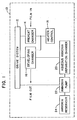
- the film developing apparatus comprises a plurality of major parts as shown in Fig. 1 and wherein the enclosure structure 10 and the various major parts of the developing apparatus are shown in block form.
- the major parts of the developing apparatus include a drive system 12 associated with a preheating chamber 14 and a developing chamber 16, which chambers are in communication with a heater control 18 for the purpose of providing the desired temperatures in the respective chambers.
- the drive system 12 is also in communication with an ammonia pump 22 - which receives ammonia from a reservoir 24 and conveys the ammonia in aqueous form into a separation chamber 20.
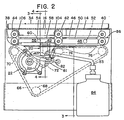
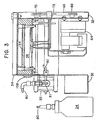
- Fig. 2 is shown a front elevational view of the developing apparatus and in Fig. 3 is shown a partial sectional and side elevational view thereof with certain of the parts being placed for accommodation on the drawing.
- a base assembly 32 provides support for the various parts of the developing apparatus and a cover assembly 34 is secured to the top of the unit in suitable manner.
- a portion of a diazo film 36 is shown entering at the right side in Fig. 2 and a portion of the film 38, after developing thereof, is shown leaving at the left side.
- the diazo film 36 is caused to be moved in a path between a pair of rollers 40 into and through the preheating chamber 14 and further caused to be moved by a pair of rollers 42 into and through the developing chamber 16 and finally, a pair of rollers 44 convey the developed film 38 from the developing apparatus.
- the preheating chamber 14 includes an upper plate 46 and a lower plate or block 48 which are spaced apart by means of a spacer 50 on each side of the film path a distance sufficiently to enable passage of the film 36 as it is moved from the right to the left in Fig. 2.
- a heater 52 in the form of a rod is embedded in the lower plate 48 for heating thereof and of the upper plate 46 through the spacers 50 for the purpose of preconditioning the emulsion on the film.
- the developing chamber 16 includes an upper plate 54 and a lower plate or block 56 which are likewise spaced from each other by means of a spacer 58, one of which is positioned on either side of the path of the film 36.
- a heater 60 and a thermal resistor 62 are associated with the developing chamber 16 so as to maintain a desired temperature in the developing chamber 16 and also to control the amount of heat to the aqueous ammonia separation chamber 20.
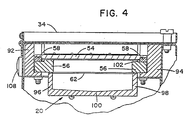
- a suitable thermometer 108 (shown in Fig. 4) is preferably located at the front of the deveioping chamber 16 for viewing the temperature therein.
- a motor 64 shown in Fig. 3, is provided to drive the various pairs of rollers by means of a drive chain 66 trained around a series of pulleys 68, 70, 72, 74 and 76, as seen in Fig. 2, for driving or traveling in a clockwise direction so as to cause the diazo film 36 to be moved from right to left.
- the drive system also accommodates the pump 22 to cause the pump to move the aqueous ammonia from the reservoir 24 through a bulkhead fitting by means of a tubing 80 and from the fitting by a tubing 81 to the pump.
- the ammonia is moved from the pump 22 to the separation chamber 20 through a tubing 82 extending into one side of the chamber 20.
- a tube 83 has one end thereof disposed for draining the separation chamber 20 of accumulated water and to deposit such water into a container or bottle 84.
- Fig. 4 is shown a sectional view through the developing chamber 16 and through the separation chamber 20 which is located at the entrance end of the developing chamber and is in the shape of a deep cavity or trough to accommodate the temperature differential between the aqueous ammonia being introduced into the lower chamber 20 and the upper part of the developing chamber 16.
- the developing chamber 16 includes the side walls 92 and 94 which are covered by the cover assembly 34 so as to provide a closed container for the developing portion of the processor.
- the separation chamber 20 includes the side or end walls 96 and 98 and a lower base 100 and which forms an elongated cavity at the entrance end of the developing chamber 16 for enabling the vaporized ammonia to rise and thereby make contact with the emulsion side of the diazo film 36.
- An edge seal 102 in the form of an 0-ring is placed adjacent the spacers 58 and between the upper plate 54 and the lower plate 56 of the developing chamber 16 to arrest the ammonia vapors and prevent escape thereof into the surrounding atmosphere. Additionally, seals 104 and 106 are provided adjacent the pair of rollers 42 and rollers 44 to contain the ammonia vapor within the chamber 16.
- the thermometer 108 mentioned earlier, is on the left side in Fig. 4 with its probe extending about midway through the lower plate 56.
- the diazo film 36 in an exposed and cut-to- length condition and with the emulsion side of the film disposed in a downward direction, is caused to be moved by rollers 40 into the preheating chamber 14 wherein the emulsion on the film is preconditioned by the elevated temperature through heating the plate 48 by use of the heater 52 and which heat is caused to be moved by thermal conduction through the spacers 50 and to the upper plate 46.
- the second pair of pinch rollers 42 then transport the conditioned film 36 into the developing chamber 16 where the emulsion on the lower side of the film is exposed to and contacted by the ammonia vapors which react with the emulsion and thereby develop the film.
- the third pair of rollers 44 then convey the developed film 38 from the chamber 16 and onto a tray (not shown) on the side of the processor.
- the heater 60 provides the desired heat in the developing chamber 16 to the elevated temperature in heating the lower plate 56 and through the spacers 58 to also heat the upper plate 54.
- the aluminum plates 46, 48 in the preheating chamber 14 and also the aluminum plates 54, 56 in the developing chamber 16, along with the aluminum spacers 50, 58 between the plates distribute the heat by thermal conduction and the aluminum plates in each of the chambers are coated with suitable thermoplastic material on the surfaces which are adjacent the film path.
- the aqueous ammonia is introduced into the separation chamber 20 and with a certain amount of heat being transferred from the plate 56 through the thermal resistor 62 and to the walls of the separation chamber 20, the separation chamber is caused to be heated a desired amount which is lower than the temperature of the upper chamber.
- the thermal resistor 62 is a controlling factor in determining the desired temperature differential between the two chambers 16 and 20 and is made of stainless steel to provide and maintain a temperature differential between the two chambers.
- the higher temperature environment at the top of the separating chamber 20 is saturated with ammonia vapor in a uniform manner so that when the film passes across the open chamber 20 the contact with the emulsion causes development of the film within a period of one to two seconds.
- the water is accumulated and drains off after the ammonia has separated and because the water is only in the cooler portion of the chamber 20, the water does not enter and does not appear on surfaces in the developing chamber 16.
- the ammonia when the aqueous ammonia is injected or introduced into the separation chamber or trough 20 below the film developing area, the ammonia separates from the water and the ammonia vapors rise with the warm air to contact the preheated emulsion on the underside of the diazo film 36 for developing thereof as the film passes over the open chamber 20. In this manner the water is prevented from contacting the film and thus the film is free of water spots.
- the optimum temperature in the developing chamber 16 was 82°C and that an 18 tooth sprocket in the ammonia pump 22 provided the correct amount of ammonia vapor for superior development of the film and thereby consuming a minimum amount of aqueous ammonia.
- the thermal resistor or spacer 62 was made of 18 gauge stainless steel which proved in the final design to uniformly control the heat flow from the lower plate 56 in the developing chamber 16 to the separation chamber 20 so as to provide the optimum temperature differential between the developing area 16 and the bottom of the trough 20.
- thermometer 108 read 82.2°C
- typical observed temperatures of the upper plate 54, the lower plate 56, and the bottom of the trough 20 were 80.2-80.4°C, 82.4-84.8°C, and 81.4-82.0°C, respectively, to provide a temperature differential of 1-2.8°C between the lower plate and the bottom of the trough with a desired figure of 1.67-2.78°C for proper separation of the ammonia and water.
- the invention provides a high speed, low temperature, substantially atmospheric pressure, and low aqueous ammonia consumption apparatus and method which is extremely reliable and efficient for developing the diazo film.
Landscapes
- Physics & Mathematics (AREA)
- General Physics & Mathematics (AREA)
- Non-Silver Salt Photosensitive Materials And Non-Silver Salt Photography (AREA)
- Feeding, Discharge, Calcimining, Fusing, And Gas-Generation Devices (AREA)
Applications Claiming Priority (2)
| Application Number | Priority Date | Filing Date | Title |
|---|---|---|---|
| US31695 | 1979-04-19 | ||
| US06/031,695 US4243310A (en) | 1979-04-19 | 1979-04-19 | High speed, low temperature diazo processor |
Publications (3)
| Publication Number | Publication Date |
|---|---|
| EP0027457A1 EP0027457A1 (en) | 1981-04-29 |
| EP0027457A4 EP0027457A4 (en) | 1981-08-31 |
| EP0027457B1 true EP0027457B1 (en) | 1983-10-05 |
Family
ID=21860901
Family Applications (1)
| Application Number | Title | Priority Date | Filing Date |
|---|---|---|---|
| EP80900848A Expired EP0027457B1 (en) | 1979-04-19 | 1980-11-04 | Diazo film developing apparatus |
Country Status (7)
| Country | Link |
|---|---|
| US (1) | US4243310A (enExample) |
| EP (1) | EP0027457B1 (enExample) |
| JP (1) | JPS56500429A (enExample) |
| BE (1) | BE882811A (enExample) |
| CA (1) | CA1126075A (enExample) |
| DE (1) | DE3065116D1 (enExample) |
| WO (1) | WO1980002335A1 (enExample) |
Families Citing this family (1)
| Publication number | Priority date | Publication date | Assignee | Title |
|---|---|---|---|---|
| US4412731A (en) * | 1981-07-29 | 1983-11-01 | Ncr Corporation | High speed low temperature diazo processor |
Family Cites Families (21)
| Publication number | Priority date | Publication date | Assignee | Title |
|---|---|---|---|---|
| US2009962A (en) * | 1932-08-30 | 1935-07-30 | Kalle & Co Ag | Apparatus for gaseous development of light-sensitive material, especially of diazo-type by means of ammonia gas |
| US2761364A (en) * | 1950-06-26 | 1956-09-04 | Ozalid Co Ltd | Photographic developing machines |
| US3147687A (en) * | 1961-10-05 | 1964-09-08 | Ozalid Co Ltd | Method of and apparatus for the development of light sensitive diazotype materials |
| US3411906A (en) * | 1964-05-25 | 1968-11-19 | Ibm | Diazo development process |
| US3364833A (en) * | 1965-02-03 | 1968-01-23 | Ibm | Wash ammonia development device |
| US3435751A (en) * | 1966-11-03 | 1969-04-01 | Gaf Corp | Photocopy developing apparatus |
| JPS4835007A (enExample) * | 1971-09-10 | 1973-05-23 | ||
| JPS4911952U (enExample) * | 1972-05-08 | 1974-01-31 | ||
| US4062031A (en) * | 1972-09-09 | 1977-12-06 | Hoechst Aktiengesellschaft | Apparatus for producing a developer medium for diazotype materials |
| DE2309303C2 (de) * | 1973-02-24 | 1982-04-22 | Hoechst Ag, 6000 Frankfurt | Verfahren für die Regelung der Temperatur im Entwicklungsraum und Verdampfer |
| HU168796B (enExample) * | 1973-04-25 | 1976-07-28 | ||
| JPS50106626A (enExample) * | 1974-01-22 | 1975-08-22 | ||
| DE2534352C3 (de) * | 1975-08-01 | 1979-05-10 | Hoechst Ag, 6000 Frankfurt | Verfahren zur Trockenentwicklung von nicht wärmeentwickelbaren Zweikomponenten-Diazotypiematerialien |
| US4056824A (en) * | 1975-09-03 | 1977-11-01 | Ricoh Company, Ltd. | Developing apparatus for diazo copying machine |
| DE2613331C2 (de) * | 1976-03-29 | 1981-06-25 | Hoechst Ag, 6230 Frankfurt | Vorrichtung zur Erzeugung von ammoniakhaltigem Entwicklergas für die Entwicklungseinrichtung eines Diazo-Kopiergerätes |
| DE2623982B2 (de) * | 1976-05-28 | 1978-10-12 | Hoechst Ag, 6000 Frankfurt | Verfahren zur Herstellung von Diazotypiekopien |
| US4122473A (en) * | 1976-06-28 | 1978-10-24 | Addressograph-Multigraph Corporation | Developer residue waste eliminator for diazo machines |
| DE2656901C2 (de) * | 1976-12-16 | 1978-06-22 | Hoechst Ag, 6000 Frankfurt | Entwicklungsvorrichtung für Diazokopiermaterial, insbesondere in einer Lichtpausmaschine |
| DE2659485C2 (de) * | 1976-12-30 | 1979-01-04 | Hoechst Ag, 6000 Frankfurt | Verfahren zur Ammoniakfuhrung in einer Entwicklungseinrichtung zur Entwicklung von Diazokopiermaterial |
| DE7702598U1 (de) * | 1977-01-29 | 1977-05-18 | Hoechst Ag, 6000 Frankfurt | Verdampfer zur erzeugung von ammoniakgashaltigem entwicklungsgas aus ammoniakwasser zur entwicklung von diazokopiermaterial |
| US4150992A (en) * | 1977-12-27 | 1979-04-24 | Quantor Corporation | High speed, low temperature and pressure diazo processing method |
-
1979
- 1979-04-19 US US06/031,695 patent/US4243310A/en not_active Expired - Lifetime
-
1980
- 1980-03-18 CA CA347,873A patent/CA1126075A/en not_active Expired
- 1980-03-27 DE DE8080900848T patent/DE3065116D1/de not_active Expired
- 1980-03-27 WO PCT/US1980/000337 patent/WO1980002335A1/en not_active Ceased
- 1980-03-27 JP JP50102780A patent/JPS56500429A/ja active Pending
- 1980-04-16 BE BE0/200246A patent/BE882811A/fr not_active IP Right Cessation
- 1980-11-04 EP EP80900848A patent/EP0027457B1/en not_active Expired
Also Published As
| Publication number | Publication date |
|---|---|
| JPS56500429A (enExample) | 1981-04-02 |
| BE882811A (fr) | 1980-08-18 |
| US4243310A (en) | 1981-01-06 |
| DE3065116D1 (en) | 1983-11-10 |
| WO1980002335A1 (en) | 1980-10-30 |
| EP0027457A1 (en) | 1981-04-29 |
| CA1126075A (en) | 1982-06-22 |
| EP0027457A4 (en) | 1981-08-31 |
Similar Documents
| Publication | Publication Date | Title |
|---|---|---|
| US3440944A (en) | Process and apparatus for the development of photocopying material | |
| US3774521A (en) | Photographic developing apparatus | |
| US5264899A (en) | Sheet moisture replacement system using porous rolls | |
| US5665257A (en) | Flat bed thermophotographic film processor | |
| US3449547A (en) | Thermographic developing apparatus | |
| US4052732A (en) | Apparatus for developing and fixing heat sensitive film | |
| US4853743A (en) | Moisture-controlled image recording apparatus | |
| US3330189A (en) | Fixing system for copy machine | |
| US3832730A (en) | Apparatus for processing photographic films | |
| GB1027596A (en) | Apparatus for making photographic prints | |
| US3202818A (en) | Thermographic reproduction apparatus with thermosensitive heat regulator | |
| US3836252A (en) | Microfiche duplicator | |
| US4243310A (en) | High speed, low temperature diazo processor | |
| US5895592A (en) | Apparatus and method for thermally processing an imaging material employing a system for reducing fogging on the imaging material during thermal processing | |
| US4112280A (en) | Thermal processor | |
| US2921513A (en) | Diazotype printing and developing apparatus | |
| US1999965A (en) | Photographic developing apparatus | |
| US4150992A (en) | High speed, low temperature and pressure diazo processing method | |
| US5790069A (en) | Thermal Processor with air flow preventing structure | |
| US4412731A (en) | High speed low temperature diazo processor | |
| KR830006020A (ko) | 복 사 기 | |
| US4147422A (en) | Method and apparatus for evacuating aqueous ammonia vapor from film developing chambers | |
| NL8006100A (nl) | Inrichting voor het ontwikkelen van belicht kopieermateriaal. | |
| GB1189938A (en) | Apparatus for Replenishing Developer in an Electrophotographic System | |
| GB1037264A (en) | Apparatus for developing diazo materials |
Legal Events
| Date | Code | Title | Description |
|---|---|---|---|
| PUAI | Public reference made under article 153(3) epc to a published international application that has entered the european phase |
Free format text: ORIGINAL CODE: 0009012 |
|
| AK | Designated contracting states |
Designated state(s): DE FR GB |
|
| 17P | Request for examination filed |
Effective date: 19810325 |
|
| DET | De: translation of patent claims | ||
| GRAA | (expected) grant |
Free format text: ORIGINAL CODE: 0009210 |
|
| AK | Designated contracting states |
Designated state(s): DE FR GB |
|
| REF | Corresponds to: |
Ref document number: 3065116 Country of ref document: DE Date of ref document: 19831110 |
|
| ET | Fr: translation filed | ||
| PLBE | No opposition filed within time limit |
Free format text: ORIGINAL CODE: 0009261 |
|
| STAA | Information on the status of an ep patent application or granted ep patent |
Free format text: STATUS: NO OPPOSITION FILED WITHIN TIME LIMIT |
|
| 26N | No opposition filed | ||
| PGFP | Annual fee paid to national office [announced via postgrant information from national office to epo] |
Ref country code: FR Payment date: 19890126 Year of fee payment: 10 |
|
| PGFP | Annual fee paid to national office [announced via postgrant information from national office to epo] |
Ref country code: GB Payment date: 19890131 Year of fee payment: 10 |
|
| PGFP | Annual fee paid to national office [announced via postgrant information from national office to epo] |
Ref country code: DE Payment date: 19890403 Year of fee payment: 10 |
|
| PG25 | Lapsed in a contracting state [announced via postgrant information from national office to epo] |
Ref country code: GB Effective date: 19900327 |
|
| REG | Reference to a national code |
Ref country code: FR Ref legal event code: TP |
|
| GBPC | Gb: european patent ceased through non-payment of renewal fee | ||
| PG25 | Lapsed in a contracting state [announced via postgrant information from national office to epo] |
Ref country code: FR Effective date: 19901130 |
|
| PG25 | Lapsed in a contracting state [announced via postgrant information from national office to epo] |
Ref country code: DE Effective date: 19901201 |
|
| REG | Reference to a national code |
Ref country code: FR Ref legal event code: ST |