EP0020957B1 - Verfahren zur Herstellung von Calciumcarbid - Google Patents
Verfahren zur Herstellung von Calciumcarbid Download PDFInfo
- Publication number
- EP0020957B1 EP0020957B1 EP80102455A EP80102455A EP0020957B1 EP 0020957 B1 EP0020957 B1 EP 0020957B1 EP 80102455 A EP80102455 A EP 80102455A EP 80102455 A EP80102455 A EP 80102455A EP 0020957 B1 EP0020957 B1 EP 0020957B1
- Authority
- EP
- European Patent Office
- Prior art keywords
- coke
- oxygen
- furnace
- lime
- thermal
- Prior art date
- Legal status (The legal status is an assumption and is not a legal conclusion. Google has not performed a legal analysis and makes no representation as to the accuracy of the status listed.)
- Expired
Links
- 238000000034 method Methods 0.000 title claims description 28
- 238000004519 manufacturing process Methods 0.000 title claims description 15
- 239000005997 Calcium carbide Substances 0.000 title claims description 14
- CLZWAWBPWVRRGI-UHFFFAOYSA-N tert-butyl 2-[2-[2-[2-[bis[2-[(2-methylpropan-2-yl)oxy]-2-oxoethyl]amino]-5-bromophenoxy]ethoxy]-4-methyl-n-[2-[(2-methylpropan-2-yl)oxy]-2-oxoethyl]anilino]acetate Chemical compound CC1=CC=C(N(CC(=O)OC(C)(C)C)CC(=O)OC(C)(C)C)C(OCCOC=2C(=CC=C(Br)C=2)N(CC(=O)OC(C)(C)C)CC(=O)OC(C)(C)C)=C1 CLZWAWBPWVRRGI-UHFFFAOYSA-N 0.000 title claims description 14
- 239000000571 coke Substances 0.000 claims description 50
- 239000007789 gas Substances 0.000 claims description 21
- 235000008733 Citrus aurantifolia Nutrition 0.000 claims description 20
- 235000011941 Tilia x europaea Nutrition 0.000 claims description 20
- 239000004571 lime Substances 0.000 claims description 20
- QVGXLLKOCUKJST-UHFFFAOYSA-N atomic oxygen Chemical compound [O] QVGXLLKOCUKJST-UHFFFAOYSA-N 0.000 claims description 19
- 229910052760 oxygen Inorganic materials 0.000 claims description 19
- 239000001301 oxygen Substances 0.000 claims description 19
- 239000003077 lignite Substances 0.000 claims description 15
- 239000000203 mixture Substances 0.000 claims description 10
- 239000003245 coal Substances 0.000 claims description 7
- XLYOFNOQVPJJNP-UHFFFAOYSA-N water Substances O XLYOFNOQVPJJNP-UHFFFAOYSA-N 0.000 claims description 7
- 239000002918 waste heat Substances 0.000 claims description 4
- 238000001035 drying Methods 0.000 claims description 3
- 239000011261 inert gas Substances 0.000 claims description 2
- 238000002347 injection Methods 0.000 claims description 2
- 239000007924 injection Substances 0.000 claims description 2
- 239000002245 particle Substances 0.000 claims 2
- 238000006243 chemical reaction Methods 0.000 description 12
- OKTJSMMVPCPJKN-UHFFFAOYSA-N Carbon Chemical compound [C] OKTJSMMVPCPJKN-UHFFFAOYSA-N 0.000 description 3
- 230000015572 biosynthetic process Effects 0.000 description 3
- 229910052799 carbon Inorganic materials 0.000 description 3
- 239000012159 carrier gas Substances 0.000 description 3
- 239000011335 coal coke Substances 0.000 description 3
- RHZUVFJBSILHOK-UHFFFAOYSA-N anthracen-1-ylmethanolate Chemical compound C1=CC=C2C=C3C(C[O-])=CC=CC3=CC2=C1 RHZUVFJBSILHOK-UHFFFAOYSA-N 0.000 description 2
- 239000003830 anthracite Substances 0.000 description 2
- 238000001354 calcination Methods 0.000 description 2
- 238000003786 synthesis reaction Methods 0.000 description 2
- 238000011144 upstream manufacturing Methods 0.000 description 2
- 238000005422 blasting Methods 0.000 description 1
- 238000003889 chemical engineering Methods 0.000 description 1
- 238000002485 combustion reaction Methods 0.000 description 1
- 230000000052 comparative effect Effects 0.000 description 1
- 238000001816 cooling Methods 0.000 description 1
- 238000000354 decomposition reaction Methods 0.000 description 1
- 230000005611 electricity Effects 0.000 description 1
- 238000005516 engineering process Methods 0.000 description 1
- 238000000605 extraction Methods 0.000 description 1
- 230000005484 gravity Effects 0.000 description 1
- 238000010438 heat treatment Methods 0.000 description 1
- 238000009434 installation Methods 0.000 description 1
- 239000000463 material Substances 0.000 description 1
- 238000002156 mixing Methods 0.000 description 1
- 239000002006 petroleum coke Substances 0.000 description 1
- 230000035899 viability Effects 0.000 description 1
- 239000003039 volatile agent Substances 0.000 description 1
- 239000002912 waste gas Substances 0.000 description 1
Images
Classifications
-
- C—CHEMISTRY; METALLURGY
- C01—INORGANIC CHEMISTRY
- C01B—NON-METALLIC ELEMENTS; COMPOUNDS THEREOF; METALLOIDS OR COMPOUNDS THEREOF NOT COVERED BY SUBCLASS C01C
- C01B32/00—Carbon; Compounds thereof
- C01B32/90—Carbides
- C01B32/914—Carbides of single elements
- C01B32/942—Calcium carbide
-
- Y—GENERAL TAGGING OF NEW TECHNOLOGICAL DEVELOPMENTS; GENERAL TAGGING OF CROSS-SECTIONAL TECHNOLOGIES SPANNING OVER SEVERAL SECTIONS OF THE IPC; TECHNICAL SUBJECTS COVERED BY FORMER USPC CROSS-REFERENCE ART COLLECTIONS [XRACs] AND DIGESTS
- Y02—TECHNOLOGIES OR APPLICATIONS FOR MITIGATION OR ADAPTATION AGAINST CLIMATE CHANGE
- Y02P—CLIMATE CHANGE MITIGATION TECHNOLOGIES IN THE PRODUCTION OR PROCESSING OF GOODS
- Y02P20/00—Technologies relating to chemical industry
- Y02P20/10—Process efficiency
- Y02P20/129—Energy recovery, e.g. by cogeneration, H2recovery or pressure recovery turbines
Definitions
- the invention relates to a process for the production of calcium carbide by reacting coke with lime in the presence of oxygen in an oxygen thermal furnace, also called a carbothermal furnace, the coke being produced in a hearth furnace.
- an oxygen thermal furnace also called a carbothermal furnace
- the present invention accordingly relates to a process for the production of calcium carbide by reacting coke with lime in the presence of oxygen in an oxygen-thermal furnace, which is characterized in that lignite with a grain size of up to 150 mm in an oven at exhaust gas temperatures of at least 750 ° C, preferably at 1100-1500 ° C, carbonized, the coke thus obtained, with its still inherent temperature of over 500 ° C, is fed directly to the oxygen-thermal furnace process and calcium carbide is obtained in the oxygen-thermal furnace with the addition of lime and oxygen.
- the concept of the oxygen-thermal furnace process has to be interpreted broadly; This does not only mean the feeding of the coke into the immediate reaction vessel, rather the coke can also be fed in upstream or intermediate apparatus in which a premixing with other oil components - in particular lime - takes place, which is thereby heated. The only important thing is that the total heat of the coke is entered directly or indirectly into the oxygen thermal furnace.
- coal is to be understood to mean all carbon-containing materials as can usually be used in the hearth furnace, e.g. Hard coal, lignite, petroleum coke.
- the coke produced in the hearth furnace is fed to the oxygen thermal furnace.
- brown coal is particularly advantageous. This is advantageously reduced to a water content of below about 25% by weight, in particular below about 15% by weight, e.g. dried by means of counter pressure steam.
- Their grain size can be chosen to be less than 20 mm, advantageously less than 6 mm, in particular even less than 3 mm.
- lumpy e.g. use shaped coal up to 150 mm in size.
- the coke leaving the hearth furnace has a maximum grain size such that it can be used in an oxygen-thermal furnace.
- the method according to the invention advantageously makes it possible, in particular, to use fine-grained coke.
- the carbonaceous feedstocks are coked in the hearth furnace in a known manner.
- the exhaust gas temperature should be above the calcination temperature, i.e. generally above 900 ° C, the temperature of the withdrawn coke at the calcination temperature above about 500 ° C.
- Cokes obtained in this way contain no water, 0.5-20.0% by weight of volatiles and 3-12% by weight in the proposed combination.
- the fixed carbon content can be 65-90% by weight and higher.
- the waste heat from the hearth furnace and also from the oxygen-thermal furnace is used at least partially, advantageously but as completely as possible to generate steam.
- the steam generated can at least partially be used to obtain the oxygen and to dry the coal used in the hearth furnace.
- the coke resulting from the hearth furnace and drawn off there is fed directly into the carbide furnace process.
- the introduction into the oxygen thermal furnace takes place in the usual way, e.g. over locks or with a carrier gas or by using gravity.
- the furnace is also operated in a known manner.
- the calcium carbide obtained corresponds in its properties to the carbide obtained in electrothermal furnaces and, like the raw gas from the furnace, can be used in a conventional manner, with an excess of energy e.g. B. can be used to convert the raw gas into a synthesis gas.
- the coke can now be fed from the hearth furnace to the reaction vessel of the carbothermal furnace via one or more heat-insulated feed tubes designed as downpipes, gas escape through the feed tubes being prevented by pressure compensation in the reaction vessel.
- the hot hearth furnace coke can be mixed in a particularly advantageous manner with at least parts of the lime of approximately the same grain size and only this mixture can be fed to the reaction vessel of the carbothermal furnace. In this case, so much lime is generally added to the hot coke to preheat it that the temperature of the lime / coke mixture before entry into the reaction vessel is about 600 ° C. or below.
- This method of operation enables the mixture to be conveyed without disadvantages, since the mixing temperature is below the very hot coke temperature in that part of the heat is absorbed by the lime. Nevertheless, the total heat reaches the reaction vessel, where temperature peaks are avoided as a further advantage and a uniform temperature profile in the reaction space and reaction process is ensured.
- the hot coke or the hot lime / coke mixture can be at least partially blown into the reaction vessel of the carbothermal furnace. This injection then takes place using inert gas, i.e. it is carried out in particular with the furnace exhaust gas containing CO.
- This embodiment of the invention in which the components resulting from the hearth furnace are blown in, enables the latter - e.g. for reasons of spatial design - not above, but next to the oxygen thermal furnace.
- the method according to the invention also makes it possible to operate a carbide furnace only with lignite coke. Another particular advantage is that the oxygen-thermal carbide production can now also be carried out entirely with fine coke.
- the oxygen-thermal production of calcium carbide is significantly improved in the energy balance and thus in economy. This is also helped by the fact that any calcareous ash components of the coals are also converted into calcium carbide.
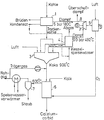
- Lignite milled to a grain size of 0-10 mm is dried in the upstream system 1 using counterpressure steam from a turbine 2 to a water content of 14% by weight. Vapors or condensates that occur during drying are removed.
- the dried coal arrives in the hearth furnace 3, where it is coked with air at a gas space temperature of, for example, 1400 ° C.
- the exhaust gases leaving the gas space are used in a waste heat boiler 4 to generate superheated high-pressure steam, which is passed into the turbine 2.
- the power converted into mechanical energy in the turbine is used for the low-temperature decomposition of air in the plant 5 and thus for the production of the oxygen required in the oxygen-thermal carbide furnace 6 and for the generation of electricity in the generator 8.
- the coke drawn off from the hearth furnace 3 at a temperature of 900 ° C. is introduced into the reaction vessel, for example with the aid of a blasting system, in a carrier gas stream formed from the exhaust gas of the carbide furnace, into which lime and the oxygen originating from the installation 5 are also introduced.
- the exhaust gas from the carbide furnace 6, which leaves it at about 600 ° C., is used after dedusting in the cyclone 7 to heat the boiler feed water. Part of the exhaust gas can then serve as a carrier gas for the stove coke.
- the carbide is removed from the carbide furnace 6. Since the raw gas from the furnace consists of approx. 87 vol.% CO and approx. 12 vol.% H 2 , it is advisable to convert this waste gas into synthesis gas using the above-mentioned excess energy.
- Example 2 The procedure is as in Example 1, the coke not being cooled but fed hot to the reactor.
- 65 t / h dry coal (grain size up to 10 mm, water content 14% by weight) is obtained from 139 t / h raw lignite (water content 60.0% by weight). Because of the hot coke task drops the required amount of coke to 23 t / h, which has a temperature of around 900 ° C behind the stove.
- the coke is mixed with 7.5 t / h lime with a grain size of up to 5 mm and the mixture, which is still around 600 ° C hot, is fed to the reaction vessel and there with the remaining lime and - because of the hot coke input - with a 13400 m 3 (iN ) implemented reduced amount of oxygen per hour.
- Example 2 The procedure is as in Example 2, but the 23 t / h coke, which has a temperature of about 900 ° C. behind the hearth furnace, is fed to the oxygen-thermal furnace process at this temperature.
- the coke is first mixed with 15 t / h lime and the mixture, which is then around 400 ° C., is fed to the reaction vessel and reacted there with oxygen.
Landscapes
- Chemical & Material Sciences (AREA)
- Organic Chemistry (AREA)
- Inorganic Chemistry (AREA)
- Carbon And Carbon Compounds (AREA)
- Coke Industry (AREA)
- Solid Fuels And Fuel-Associated Substances (AREA)
- Processing Of Solid Wastes (AREA)
Applications Claiming Priority (2)
| Application Number | Priority Date | Filing Date | Title |
|---|---|---|---|
| DE2925897 | 1979-06-27 | ||
| DE19792925897 DE2925897A1 (de) | 1979-06-27 | 1979-06-27 | Verfahren zur herstellung von calciumcarbid |
Publications (2)
| Publication Number | Publication Date |
|---|---|
| EP0020957A1 EP0020957A1 (de) | 1981-01-07 |
| EP0020957B1 true EP0020957B1 (de) | 1983-05-18 |
Family
ID=6074275
Family Applications (1)
| Application Number | Title | Priority Date | Filing Date |
|---|---|---|---|
| EP80102455A Expired EP0020957B1 (de) | 1979-06-27 | 1980-05-06 | Verfahren zur Herstellung von Calciumcarbid |
Country Status (9)
| Country | Link |
|---|---|
| EP (1) | EP0020957B1 (da) |
| JP (1) | JPS5641819A (da) |
| AU (1) | AU544486B2 (da) |
| CA (1) | CA1146720A (da) |
| DD (1) | DD151736A5 (da) |
| DE (2) | DE2925897A1 (da) |
| IN (1) | IN154590B (da) |
| PL (1) | PL122735B1 (da) |
| ZA (1) | ZA803816B (da) |
Families Citing this family (6)
| Publication number | Priority date | Publication date | Assignee | Title |
|---|---|---|---|---|
| DE3035026A1 (de) * | 1980-09-17 | 1982-04-22 | Hoechst Ag, 6000 Frankfurt | Verfahren zur herstellung von calciumcarbid |
| DE3124672A1 (de) * | 1981-06-24 | 1983-01-13 | Hoechst Ag, 6000 Frankfurt | Verfahren zur herstellung von calciumcarbid |
| EP0428148A3 (en) * | 1989-11-13 | 1992-02-12 | Aeci Limited | Process for producing calcium carbide |
| CN106276901B (zh) * | 2015-05-28 | 2020-07-24 | 中国科学院上海高等研究院 | 一种氧热法生产电石和co气体的方法及系统 |
| CN106241809B (zh) * | 2016-08-31 | 2024-01-12 | 浙江嵘润机械有限公司 | 电石生产成套设备 |
| CN111892956A (zh) * | 2020-07-28 | 2020-11-06 | 中国科学院上海高等研究院 | 氧热法生产电石和合成气的方法及系统 |
Family Cites Families (4)
| Publication number | Priority date | Publication date | Assignee | Title |
|---|---|---|---|---|
| FR605530A (fr) * | 1925-10-09 | 1926-05-28 | Procédé et dispositif pour la fabrication simultanée de carbure de calcium, de coke et de produits synthétiques | |
| FR1063300A (fr) * | 1951-07-30 | 1954-04-30 | Air Reduction | Procédé de préparation des charges des fours à carbure de calcium |
| FR1090320A (fr) * | 1952-12-30 | 1955-03-29 | Stamicarbon | Procédé pour amorcer la production de carbure de calcium dans un four à cuve |
| US3623839A (en) * | 1968-08-21 | 1971-11-30 | Standard Oil Co | Method of making alkaline earth metal carbide |
-
1979
- 1979-06-27 DE DE19792925897 patent/DE2925897A1/de not_active Withdrawn
-
1980
- 1980-05-06 EP EP80102455A patent/EP0020957B1/de not_active Expired
- 1980-05-06 DE DE8080102455T patent/DE3063271D1/de not_active Expired
- 1980-06-24 DD DD80222118A patent/DD151736A5/de unknown
- 1980-06-26 PL PL1980225235A patent/PL122735B1/pl unknown
- 1980-06-26 AU AU59668/80A patent/AU544486B2/en not_active Ceased
- 1980-06-26 ZA ZA00803816A patent/ZA803816B/xx unknown
- 1980-06-26 CA CA000354910A patent/CA1146720A/en not_active Expired
- 1980-06-27 IN IN741/CAL/80A patent/IN154590B/en unknown
- 1980-06-27 JP JP8668980A patent/JPS5641819A/ja active Pending
Non-Patent Citations (1)
| Title |
|---|
| Betriebswirtschaftliche Betrachtungen zum Karbidofen-Prozess, E. Liebscher Verlag Technik Berlin (1952) * |
Also Published As
| Publication number | Publication date |
|---|---|
| ZA803816B (en) | 1981-07-29 |
| PL122735B1 (en) | 1982-08-31 |
| PL225235A1 (da) | 1981-05-08 |
| IN154590B (da) | 1984-11-17 |
| JPS5641819A (en) | 1981-04-18 |
| EP0020957A1 (de) | 1981-01-07 |
| AU544486B2 (en) | 1985-05-30 |
| CA1146720A (en) | 1983-05-24 |
| DD151736A5 (de) | 1981-11-04 |
| AU5966880A (en) | 1981-01-08 |
| DE3063271D1 (en) | 1983-07-07 |
| DE2925897A1 (de) | 1981-01-22 |
Similar Documents
| Publication | Publication Date | Title |
|---|---|---|
| DE19945771C1 (de) | Verfahren zur Vergasung von organischen Stoffen und Stoffgemischen | |
| DE4404673C2 (de) | Verfahren zur Erzeugung von Brenngas | |
| EP0047856B1 (de) | Verfahren zur Herstellung von Calciumcarbid | |
| DE19755693C1 (de) | Verfahren zur Vergasung von organischen Stoffen und Stoffgemischen | |
| DE3330750A1 (de) | Verfahren zur erzeugung von acetylen und synthese- oder reduktionsgas aus kohle in einem lichtbogenprozess | |
| DE112012001242T5 (de) | Komplexes System zum Verwenden von Kohle bei der Herstellung von Koks und Rohmaterialgas und der Erzeugung von elektrischer Energie | |
| EP0020957B1 (de) | Verfahren zur Herstellung von Calciumcarbid | |
| DE60026264T2 (de) | Verfahren und Anlage für die Herstellung von brennbaren Gasen aus an organischen Materialien reichen Einsätzen | |
| EP0068303B1 (de) | Verfahren zur Herstellung von Calciumcarbid | |
| DE10030778C2 (de) | Verfahren und Vorrichtung zur Erzeugung eines Brenngases aus Biomassen | |
| DE10226862B3 (de) | Verfahren und Vorrichtung zur Erzeugung eines Brenngases aus Biomassen | |
| AT505927A4 (de) | Verfahren zum verbessern der produkteigenschaften von klinker beim brennen von rohmehl | |
| EP3126474B1 (de) | Verfahren und vorrichtung zum herstellen von brenngas aus kohlenstoffhaltigen festen einsatzstoffen | |
| EP1167492A2 (de) | Verfahren und Vorrichtung zur Erzeugung eines Brenngases aus Biomasse | |
| DE3035715C2 (de) | Verfahren zur Herstellung von Synthesegas aus festen Brennstoffen mittels Lichtbogen | |
| DE4339403A1 (de) | Verfahren zur Herstellung von Calciumcarbid | |
| DE102008061743A1 (de) | Verfahren zur Herstellung von Zement oder Zementersatzstoffen | |
| DE4428305A1 (de) | Verfahren zur Herstellung von Calciumcarbid | |
| US4288293A (en) | Form coke production with recovery of medium BTU gas | |
| DE2932399C2 (de) | Verfahren zur Erzeugung von Schwelgas, Wassergas und Koks aus feinkörnigem festem Brennstoff | |
| DE740734C (de) | Verfahren zur ununterbrochenen Erzeugung von Wassergas | |
| DE3217030A1 (de) | Verfahren zur verschwelung und vergasung von kohlenstoffhaltigen feststoffen | |
| DE3217040A1 (de) | Verfahren zur trocknung, verschwelung und vergasung von kohlenstoffhaltigen feststoffen | |
| DE4210003A1 (de) | Kombiniertes Verfahren zur Erzeugung von metallurgischem Koks und Eisenschwamm | |
| DE4241244A1 (de) | Verfahren zur Herstellung von Calciumcarbid |
Legal Events
| Date | Code | Title | Description |
|---|---|---|---|
| PUAI | Public reference made under article 153(3) epc to a published international application that has entered the european phase |
Free format text: ORIGINAL CODE: 0009012 |
|
| AK | Designated contracting states |
Designated state(s): BE DE FR GB NL |
|
| 17P | Request for examination filed |
Effective date: 19810529 |
|
| GRAA | (expected) grant |
Free format text: ORIGINAL CODE: 0009210 |
|
| AK | Designated contracting states |
Designated state(s): BE DE FR GB NL |
|
| REF | Corresponds to: |
Ref document number: 3063271 Country of ref document: DE Date of ref document: 19830707 |
|
| ET | Fr: translation filed | ||
| PLBE | No opposition filed within time limit |
Free format text: ORIGINAL CODE: 0009261 |
|
| STAA | Information on the status of an ep patent application or granted ep patent |
Free format text: STATUS: NO OPPOSITION FILED WITHIN TIME LIMIT |
|
| PGFP | Annual fee paid to national office [announced via postgrant information from national office to epo] |
Ref country code: FR Payment date: 19840420 Year of fee payment: 5 |
|
| 26N | No opposition filed | ||
| PGFP | Annual fee paid to national office [announced via postgrant information from national office to epo] |
Ref country code: BE Payment date: 19840630 Year of fee payment: 5 |
|
| PGFP | Annual fee paid to national office [announced via postgrant information from national office to epo] |
Ref country code: DE Payment date: 19840725 Year of fee payment: 5 |
|
| PGFP | Annual fee paid to national office [announced via postgrant information from national office to epo] |
Ref country code: NL Payment date: 19860531 Year of fee payment: 7 |
|
| BERE | Be: lapsed |
Owner name: RHEINISCHE BRAUNKOHLENWERKE A.G. Effective date: 19870531 Owner name: HOECHST A.G. Effective date: 19870531 |
|
| PG25 | Lapsed in a contracting state [announced via postgrant information from national office to epo] |
Ref country code: NL Effective date: 19871201 |
|
| NLV4 | Nl: lapsed or anulled due to non-payment of the annual fee | ||
| PG25 | Lapsed in a contracting state [announced via postgrant information from national office to epo] |
Ref country code: FR Free format text: LAPSE BECAUSE OF NON-PAYMENT OF DUE FEES Effective date: 19880129 |
|
| PG25 | Lapsed in a contracting state [announced via postgrant information from national office to epo] |
Ref country code: DE Effective date: 19880202 |
|
| GBPC | Gb: european patent ceased through non-payment of renewal fee | ||
| REG | Reference to a national code |
Ref country code: FR Ref legal event code: ST |
|
| PG25 | Lapsed in a contracting state [announced via postgrant information from national office to epo] |
Ref country code: GB Free format text: LAPSE BECAUSE OF NON-PAYMENT OF DUE FEES Effective date: 19881118 |
|
| PG25 | Lapsed in a contracting state [announced via postgrant information from national office to epo] |
Ref country code: BE Effective date: 19890531 |