EP0014918B1 - Vorrichtung zum Übertragen von Tintentröpfchen auf einen Aufzeichnungsträger - Google Patents
Vorrichtung zum Übertragen von Tintentröpfchen auf einen Aufzeichnungsträger Download PDFInfo
- Publication number
- EP0014918B1 EP0014918B1 EP80100647A EP80100647A EP0014918B1 EP 0014918 B1 EP0014918 B1 EP 0014918B1 EP 80100647 A EP80100647 A EP 80100647A EP 80100647 A EP80100647 A EP 80100647A EP 0014918 B1 EP0014918 B1 EP 0014918B1
- Authority
- EP
- European Patent Office
- Prior art keywords
- ink
- plate
- layer
- holes
- photoconductive
- Prior art date
- Legal status (The legal status is an assumption and is not a legal conclusion. Google has not performed a legal analysis and makes no representation as to the accuracy of the status listed.)
- Expired
Links
- 238000000151 deposition Methods 0.000 title description 3
- 239000000463 material Substances 0.000 claims description 23
- 230000005855 radiation Effects 0.000 claims description 15
- 238000010438 heat treatment Methods 0.000 claims description 8
- 239000007787 solid Substances 0.000 claims description 5
- 230000001133 acceleration Effects 0.000 claims description 4
- CJOBVZJTOIVNNF-UHFFFAOYSA-N cadmium sulfide Chemical compound [Cd]=S CJOBVZJTOIVNNF-UHFFFAOYSA-N 0.000 claims description 2
- 229910052980 cadmium sulfide Inorganic materials 0.000 claims description 2
- 229910052710 silicon Inorganic materials 0.000 claims description 2
- 239000010703 silicon Substances 0.000 claims description 2
- PEDCQBHIVMGVHV-UHFFFAOYSA-N Glycerol Natural products OCC(O)CO PEDCQBHIVMGVHV-UHFFFAOYSA-N 0.000 claims 1
- XUIMIQQOPSSXEZ-UHFFFAOYSA-N Silicon Chemical compound [Si] XUIMIQQOPSSXEZ-UHFFFAOYSA-N 0.000 claims 1
- 230000004927 fusion Effects 0.000 claims 1
- 229910052732 germanium Inorganic materials 0.000 claims 1
- GNPVGFCGXDBREM-UHFFFAOYSA-N germanium atom Chemical compound [Ge] GNPVGFCGXDBREM-UHFFFAOYSA-N 0.000 claims 1
- 239000007788 liquid Substances 0.000 claims 1
- 239000000976 ink Substances 0.000 description 75
- 239000004020 conductor Substances 0.000 description 6
- 238000005553 drilling Methods 0.000 description 5
- 238000000034 method Methods 0.000 description 5
- 230000035939 shock Effects 0.000 description 4
- 230000007423 decrease Effects 0.000 description 3
- 238000006073 displacement reaction Methods 0.000 description 3
- 230000000694 effects Effects 0.000 description 3
- 230000003287 optical effect Effects 0.000 description 3
- 239000000049 pigment Substances 0.000 description 3
- VEXZGXHMUGYJMC-UHFFFAOYSA-N Hydrochloric acid Chemical compound Cl VEXZGXHMUGYJMC-UHFFFAOYSA-N 0.000 description 2
- PXHVJJICTQNCMI-UHFFFAOYSA-N Nickel Chemical compound [Ni] PXHVJJICTQNCMI-UHFFFAOYSA-N 0.000 description 2
- FAPWRFPIFSIZLT-UHFFFAOYSA-M Sodium chloride Chemical compound [Na+].[Cl-] FAPWRFPIFSIZLT-UHFFFAOYSA-M 0.000 description 2
- 230000005611 electricity Effects 0.000 description 2
- 238000010894 electron beam technology Methods 0.000 description 2
- 239000011521 glass Substances 0.000 description 2
- 238000004519 manufacturing process Methods 0.000 description 2
- 239000011159 matrix material Substances 0.000 description 2
- 230000005499 meniscus Effects 0.000 description 2
- 239000000126 substance Substances 0.000 description 2
- 238000009834 vaporization Methods 0.000 description 2
- 230000008016 vaporization Effects 0.000 description 2
- 241000135309 Processus Species 0.000 description 1
- PNEYBMLMFCGWSK-UHFFFAOYSA-N aluminium oxide Inorganic materials [O-2].[O-2].[O-2].[Al+3].[Al+3] PNEYBMLMFCGWSK-UHFFFAOYSA-N 0.000 description 1
- 230000015572 biosynthetic process Effects 0.000 description 1
- 239000000919 ceramic Substances 0.000 description 1
- 238000003486 chemical etching Methods 0.000 description 1
- 230000002301 combined effect Effects 0.000 description 1
- 230000005670 electromagnetic radiation Effects 0.000 description 1
- 230000005686 electrostatic field Effects 0.000 description 1
- 238000001914 filtration Methods 0.000 description 1
- 239000010419 fine particle Substances 0.000 description 1
- 230000002706 hydrostatic effect Effects 0.000 description 1
- 238000005286 illumination Methods 0.000 description 1
- 239000012535 impurity Substances 0.000 description 1
- 238000002955 isolation Methods 0.000 description 1
- 239000004973 liquid crystal related substance Substances 0.000 description 1
- 230000008018 melting Effects 0.000 description 1
- 238000002844 melting Methods 0.000 description 1
- 229910052759 nickel Inorganic materials 0.000 description 1
- 230000003071 parasitic effect Effects 0.000 description 1
- 239000002245 particle Substances 0.000 description 1
- 238000001259 photo etching Methods 0.000 description 1
- 239000004033 plastic Substances 0.000 description 1
- 229920003023 plastic Polymers 0.000 description 1
- 230000001105 regulatory effect Effects 0.000 description 1
- 230000000717 retained effect Effects 0.000 description 1
- 239000011780 sodium chloride Substances 0.000 description 1
- 239000007921 spray Substances 0.000 description 1
- 229910001220 stainless steel Inorganic materials 0.000 description 1
- 239000010935 stainless steel Substances 0.000 description 1
- 230000008961 swelling Effects 0.000 description 1
- WFKWXMTUELFFGS-UHFFFAOYSA-N tungsten Chemical compound [W] WFKWXMTUELFFGS-UHFFFAOYSA-N 0.000 description 1
- 229910052721 tungsten Inorganic materials 0.000 description 1
- 239000010937 tungsten Substances 0.000 description 1
- XLYOFNOQVPJJNP-UHFFFAOYSA-N water Substances O XLYOFNOQVPJJNP-UHFFFAOYSA-N 0.000 description 1
Images


Classifications
-
- B—PERFORMING OPERATIONS; TRANSPORTING
- B41—PRINTING; LINING MACHINES; TYPEWRITERS; STAMPS
- B41J—TYPEWRITERS; SELECTIVE PRINTING MECHANISMS, i.e. MECHANISMS PRINTING OTHERWISE THAN FROM A FORME; CORRECTION OF TYPOGRAPHICAL ERRORS
- B41J2/00—Typewriters or selective printing mechanisms characterised by the printing or marking process for which they are designed
- B41J2/005—Typewriters or selective printing mechanisms characterised by the printing or marking process for which they are designed characterised by bringing liquid or particles selectively into contact with a printing material
- B41J2/01—Ink jet
- B41J2/135—Nozzles
- B41J2/145—Arrangement thereof
- B41J2/155—Arrangement thereof for line printing
-
- B—PERFORMING OPERATIONS; TRANSPORTING
- B41—PRINTING; LINING MACHINES; TYPEWRITERS; STAMPS
- B41J—TYPEWRITERS; SELECTIVE PRINTING MECHANISMS, i.e. MECHANISMS PRINTING OTHERWISE THAN FROM A FORME; CORRECTION OF TYPOGRAPHICAL ERRORS
- B41J2/00—Typewriters or selective printing mechanisms characterised by the printing or marking process for which they are designed
- B41J2/005—Typewriters or selective printing mechanisms characterised by the printing or marking process for which they are designed characterised by bringing liquid or particles selectively into contact with a printing material
- B41J2/01—Ink jet
- B41J2/135—Nozzles
- B41J2/14—Structure thereof only for on-demand ink jet heads
- B41J2/14016—Structure of bubble jet print heads
- B41J2/14088—Structure of heating means
- B41J2/14104—Laser or electron beam heating the ink
Definitions
- the present invention relates to a device intended for depositing ink drops on a support and in particular an apparatus used for printing graphics on a support of limited dimensions such as postal items, tickets or labels.
- Ink jet or droplet machines are known in which the ink is in equilibrium at the ejection orifice under the action of the hydrostatic pressure and the surface tension of the ink.
- the ejection of the drop of ink from the orifice is obtained from a chamber containing ink and limited by two plates, one of which has the ejection holes.
- the two plates are subjected to an electrical potential difference and the plate having no holes is crossed by laser radiation.
- the ink subjected to an electrostatic field comprises photoconductive pigments which move towards the plate having holes.
- the device used requires the presence of photoconductive pigments, that is to say very fine particles dispersed in the ink.
- the phenomena involved are exclusively of an electrostatic nature, the effect of light on the photoconductive pigments triggering the movement of the particles.
- the device only works if, in the absence of a laser beam, the ink is retained by a very low capillary force. Then the slightest shock can cause an inadvertent ejection of ink.
- Document US-A 3,582,954 discloses a device making it possible to deposit ink drops on a support so as to form on this support by mosaics of graphics dots, comprising a regularly perforated plate opposite said support and a second plate substantially parallel to the first plate and having a layer of photoconductive material, the space between the plates defining a chamber containing the ink to be deposited and comprising a radiation source making it possible to illuminate selected zones of said layer of material photoconductive to allow a selective acceleration of the ink contained in certain holes of the first plate with a view to the ejection of a drop towards said support.
- the means for selectively accelerating the ink contained in certain holes comprise a cathode ray tube whose electron beam is directed selectively over certain holes and gives the insulating ink in this zone an electrical charge. Thanks to this load and an acceleration potential applied to the hole openings and to the support, a drop is ejected from a selected hole when a mechanical shock is applied to the entire perforated plate. As in the previous case, the triggering of the ejection of the drops comes from a mechanical shock. Therefore, the device is very sensitive against parasitic shocks.
- the object of the invention is to remedy this drawback and to provide a more reliable and more robust device with regard to the triggering of the drops.
- the present invention relates to a device for depositing on a support drops of ink so as to form on this support by mosaics of dots graphics, comprising a plate regularly perforated opposite said support and a second plate substantially parallel to the first plate, and having a layer of photoconductive material, the space between the plates defining a chamber containing ink to be deposited, and comprising a radiation source making it possible to illuminate selected areas of said layer of photoconductive material to allow a selective acceleration of the ink in certain holes of the first plate with a view to ejecting a drop towards said support, characterized in that said second plate also comprises at least one electrically conductive layer, which is transparent and located next to said photoconductive layer directed towards said radiation source, and that a source of electric voltage that heating is applied to said electrically conductive layer and to another layer located on the opposite side of said photoconductive layer, and which produces an electric current between said two electrically conductive layers by the illuminated zones of said layer of photoconductive material, this electric current used to heat selected areas of the ink to a degree that
- the device according to FIG. 1 comprises a plate 1 which is pierced with a set of holes 4 and defines, with a rear plate 2, a chamber 3 containing ink to be deposited. A seal 6 is interposed between the two plates. A printing medium 5 is placed opposite the plate 1. The ink is brought to the device by a conduit 7 opening into the plate 2 at one end and connected by the other end to a reservoir, not shown. Chamber 3 is connected by holes 8 at ambient atmospheric pressure, and the ink is at an approximately constant level. The ink is maintained in the chamber 3 and in the holes 4 under the combined effect on the one hand of the pressure difference due to the difference in level between the free surface of the reservoir and the holes 4, on the other hand of the forces of capillarity.
- the shape of the outlet of the conduit 7 as well as its location in a hole in the plate 2 is only an example of embodiment. It can also be unblocked anywhere in the chamber 3 not occupied by other elements of the device.
- the ink passage section must however be sufficient to ensure the flow rate corresponding to the maximum rate of the ejected drops. It is possible, for example, to provide an ink inlet hole in the plate 1 or in the joint 6, to provide a supply by several conduits opening out at different locations in the chamber 3. It is also possible to provide between the reservoir and the chamber 3 a or several filters intended to stop the impurities likely to clog the orifices 4.
- the pressure in the chamber 3 varying with the drop in level of the reservoir following the consumption of the ink, it is possible to improve the device by inserting into the conduit 7 a pump with a pressure regulating system.
- the use of a pump also allows the use of filters with greater pressure drops, and therefore more efficient filtering.
- the ink can remain between the plates 1 and 2 by the sole effect of the surface tension, without requiring watertight walls closing the periphery of said chamber.
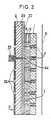
- the holes 8 intended for the evacuation of air or gas bubbles which may appear in the chamber 3 are located at the highest points of said chamber. This applies as well for the case of operation in a vertical position as shown in Figure 2 as for the case of operation in another position, horizontal for example.
- means make it possible to move all of the plates 1 and 2 relative to the support in one or two directions parallel to the plane of said plates.
- the integral plates 1 and 2 are connected to a frame by means of two or more deformable elements comprising leaf springs or spring rods and each allowing movement in a different direction of the printing device relative to the support.
- the movement of the device can be achieved by means of electromagnets, each of these electromagnets bringing the printing device into a position determined from among several possible positions according to the directions of movement.
- FIG. 2 shows a variant of an electrically heated ejection device which may include a very large number of ejection holes.
- the plate 2 is covered with a layer 29 of electrically conductive material, the whole of the plate 2 with the layer 29 being transparent to electromagnetic radiation.
- This layer 29 is covered with a layer 30 of a photoconductive material whose electrical resistivity is greatly reduced, ie in a ratio of 1 to 10 for example, when it is illuminated with the aid of the aforementioned radiation.
- the ink contained in the chamber 3 is of the resistive type and the plate 1 is electrically conductive, or has a conductive layer on the side of the chamber 3, and is electrically insulated from the plate 2.
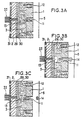
- FIGS. 3A, 3B, 3C represent three successive phases of the process of ejecting a drop of ink through a hole 11, forming part of the set of holes 4.
- the ink is suddenly heated in the vicinity of the hole 11.
- the heating of the ink by the electric current causes on the one hand a decrease in the viscosity and the surface tension of the ink, which decreases the energy required for ejection, and on the other hand, an early vaporization of the ink.
- This vaporization causes the growth of a gas bubble 13 which expels the ink in front of it through the hole 11, the pressure in the bubble increasing to overcome the forces opposing the movement of the ink, namely the surface tension, the viscosity and inertia of the ink.
- the increase in pressure is also transmitted by the ink contained in the chamber 3 to the hole 12 which must not eject a drop.
- the expansion of the gas bubble 13 causes the formation of a drop 14 as well as swelling of the meniscus towards the outside of the hole 12.
- the drop 14 is detached of the plate 1 and moves towards the support 5. Then, the heat source having been removed, the gas of the bubble condenses which causes a suction causing the meniscus to retreat inside the hole 11, of the ink then being sucked from the reservoir via the conduit 7 and from the chamber 3, under the effect of capillary forces, in order to compensate for the volume of ink of the ejected drop.
- the resistance to the passage of the ink along the path from 13 to 12 must be significantly higher than on the path from 13 to 11 , this being obtained by the choice of the shape and dimensions of the device by showing differences in the forces of inertia and viscosity according to the paths mentioned.
- this is achieved by choosing the ratio of the thickness of the chamber 3 to the spacing of the holes 4 sufficiently small. The upper limit of this ratio is approximately 1/2. This limit can however be exceeded if the ink used has a viscosity or a surface tension varying enough with temperature. In this case the ink in the hole 11 being sufficiently heated, its ejection is facilitated, while that in the hole 12 remaining at the initial temperature, can only be ejected by greater forces.
- a particular use of the devices described above consists in using an ink of very high viscosity or an ink solid at normal operating temperature.
- the sudden heating in the vicinity of the chosen ejection hole causes local liquefaction of the ink. Since the ink in the neighboring holes remains solid or viscous, there is no danger of ejection of unwanted drops therefrom.
- the surface of the support 5 is disposed far enough from the plate 1, so that the drops actually have room to form and move.
- the holes 4 of the plate 1 are preferably cylindrical because, in this case, their manufacture is generally easier. Their diameter cqndition the dimensions of the ejected drops and is preferably chosen between 10 microns and 100 microns. Economic drilling techniques for drilling large quantities of small holes are, for example, laser beam drilling, electron beam drilling, ultrasonic drilling or chemical etching. One can also manufacture the plate 1 with its holes by electro-chemical forming.
- Possible materials for plates 1 and 2 are for example stainless steel, glasses, nickel, alumina ceramics, tungsten, plastics.
- Figures 7 and 8 show a variant of the device, in which protrusions 15 have been brought to the plate 2 regularly distributed between the locations of the holes 4 in the plate 1 so as to oppose the movement of the ink between holes neighbors and thus avoid the ejection of unwanted drops as described above.
- These protuberances can be obtained by photogravures. They do not necessarily have to be of a height equal to the thickness of the chamber 3 as shown in FIG. 8. This arrangement has the advantage, however, of ensuring correct spacing of the plates 1 and 2.
- the protuberances 15 could also be taken in plate 1 instead of plate 2.
- the maximum ink flow rate circulating in the said chamber is also reduced, and we increase by therefore the maximum frequency of ejection.
- the resistivity of the ink must be adjusted to a value depending on the electrical voltage used, the dimensions of the device and the heating required for ejection.
- a mask 31 which is not essential for the functioning of the device, facilitates the control in position and in size of the region 34.
- This mask 31 consists of a layer of material opaque to the radiation used and in which openings 32 are formed facing each other. with respect to the holes 4 of the plate 1.
- the duration of the current pulse can be determined either by the duration of the beam 33 or by the duration of the electrical powering up of the layer 29 relative to the plate 1.
- Various means can be used to provide the beam 33.
- One means consists in using a laser beam deflected in the direction of the holes selected by movable mirrors or by acousto-optical or electro-optical processes known in the techniques for using laser rays.
- Another means consists in using an array of laser diodes or light-emitting diodes (LEDs), such that each hole 4 corresponds to a diode, or else such that, each diode corresponding to several holes 4, said array is movable relative to the plate 1 so as to cover all of the holes 4.
- Said network can be pressed directly against the plate 2 or the mask 31, or else be placed at a certain distance. It is also possible to interpose a suitable optical system between the array of diodes and the plate 2, for example Fresnel lenses, so as to form on the layer 30 an image if necessary reduced or enlarged of said array.
- Another means for supplying the beam 33 consists in placing a cover in front of the plate 2, this cover representing the pattern to be printed on the support 5 and in lighting the layer 30 through this cover by one or more lamps, for example lamps with incandescent, or fluorescent lamps, or electric gas discharge lamps.
- Said cover may include fixed parts, interchangeable or not, for printing possible constant parts of the pattern, and mobile parts, with automatic adjustment or not, for the variable parts of the pattern. It is also possible to use a liquid crystal matrix, or any other optical switch with electrical control, as a cover.
- the resistivity of the unlit photoconductive layer 30 must be sufficiently high compared to that of the ink used to ensure its isolation from the layer 29 and that the resistivity of the illuminated photoconductive layer 30 is rather weak compared to that of the ink so as to let the electric current pass.
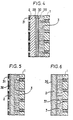
- FIG. 4 represents a variant of an ejection device comprising, as in FIG. 2, a photoconductive layer 30, this layer being in this case separated from the ink of the chamber 3 by an additional layer 35 of a material conducting the electricity whose resistivity and thickness are chosen so that the creation of heat by passage of the electric current takes place mainly in layer 35, or in layers 30 and 35.
- This arrangement has the advantage of widening the field of the possible values for the resistivity of the ink as well as to protect the layer 30 in the event of chemical incompatibility between the ink and the material of the layer 30.
- the layer 35 can also be made of a material which is a good conductor of the electricity, the electric voltage pulse being applied no longer between layer 29 and plate 1 as before, but between layers 29 and 35, the heat necessary for ejection is then generated exclusively in the neck che 30, such a device making it possible to use inks and materials for the plate 1 of any electrical resistivity.
- FIG. 5 represents another variant of a photoconductive ejection device in which the plate 2 itself is made of a photoconductive material, for example silicon and is covered with a layer of an electrically conductive material 36, on the side not bathed by the ink, this layer 36 being covered or not with the mask 31.
- the heating of the ink in this device is done in a manner analogous to the previous devices, the electric voltage being applied between the layer 36 and the plate 1 this plate being made of an electrically conductive material and the ink contained in the chamber 3 having an appropriate electrical resistivity so that the generation of heat takes place mainly in the ink, or in the plate 2, or in ink and in plate 2.
- the photoconductive material of the layer 30 of FIGS. 2 and 4 can for example be cadmium sulphide deposited in a few microns thick, the unlighted electrical resistivity of which is greater than 10 8 Ohm - cm and the illuminated resistivity of the order of 100 Ohm - centimeter.
- This material is sensitive to radiation with a wavelength of approximately 0.5 microns allowing the use of a plate 2 made of ordinary glass and a source of incandescent radiation.
- the thickness of the chamber 3 can be from 10 to 50 microns approximately, the ink having a resistivity of 500 Ohm - approximately centimeter. The electrical voltage used must then be of the order of 50 volts.
- the different variants of the ink drop ejection device described above are well suited for printing small graphics, for example 30 cm 2 , since the printing can then be carried out either without any relative movement of the device. printing relative to the printing medium, ie with only small amplitude displacements, for example 1 mm amplitude.
- These devices are more particularly suitable when the graphics have a constant part and a variable part, the constant part possibly being changed by exchanging a part or a set of parts of the device.
- variable part of these graphics can be. produced using a device according to any one of FIGS. 2 to 6, the constant part being able to be produced either in the same way, or preferably using simplified variants of the same devices.
- a first simplified variant consists in providing in the plate 1 only the holes corresponding to the mosaic representation of the constant graphics to be printed, as well as a complete network of holes in the area corresponding to the variable part of the graphics.
- the ejection through the holes of the constant graphics can then be controlled from a single electrode, or a single resistance, deposited on the plate 1 or the plate 2 and extending over the entire area corresponding to the set of these holes.
- a plate 1 normally pierced with a complete network of holes 4 corresponding to the variable and constant areas of the graphic, the printing of the constant part of the graphic being controlled using a single electrode consisting of a layer of electrically conductive material deposited on the plate 2, this layer itself being covered with an electrically insulating layer.
- the shape of the desired constant graphics is obtained by providing openings in the insulating layer, all of the openings forming the mosaic image of the desired graphics. The openings can be obtained by photochemical etching. If the plate 2 is made of an electrically conductive material, this serves as an electrode and the conductive layer is superfluous.
Landscapes
- Physics & Mathematics (AREA)
- Optics & Photonics (AREA)
- Particle Formation And Scattering Control In Inkjet Printers (AREA)
- Ink Jet (AREA)
- Exposure Of Semiconductors, Excluding Electron Or Ion Beam Exposure (AREA)
- Coating Apparatus (AREA)
- Manufacture Or Reproduction Of Printing Formes (AREA)
- Ink Jet Recording Methods And Recording Media Thereof (AREA)
Claims (7)
Priority Applications (1)
| Application Number | Priority Date | Filing Date | Title |
|---|---|---|---|
| AT80100647T ATE3833T1 (de) | 1979-02-16 | 1980-02-08 | Vorrichtung zum uebertragen von tintentroepfchen auf einen aufzeichnungstraeger. |
Applications Claiming Priority (2)
| Application Number | Priority Date | Filing Date | Title |
|---|---|---|---|
| FR7904012A FR2448979B1 (fr) | 1979-02-16 | 1979-02-16 | Dispositif destine a deposer sur un support des gouttes d'encre |
| FR7904012 | 1979-02-16 |
Publications (2)
| Publication Number | Publication Date |
|---|---|
| EP0014918A1 EP0014918A1 (de) | 1980-09-03 |
| EP0014918B1 true EP0014918B1 (de) | 1983-06-22 |
Family
ID=9222084
Family Applications (1)
| Application Number | Title | Priority Date | Filing Date |
|---|---|---|---|
| EP80100647A Expired EP0014918B1 (de) | 1979-02-16 | 1980-02-08 | Vorrichtung zum Übertragen von Tintentröpfchen auf einen Aufzeichnungsträger |
Country Status (5)
| Country | Link |
|---|---|
| US (1) | US4312009A (de) |
| EP (1) | EP0014918B1 (de) |
| AT (1) | ATE3833T1 (de) |
| DE (1) | DE3063802D1 (de) |
| FR (1) | FR2448979B1 (de) |
Families Citing this family (151)
| Publication number | Priority date | Publication date | Assignee | Title |
|---|---|---|---|---|
| DE3269768D1 (en) * | 1981-01-21 | 1986-04-17 | Matsushita Electric Industrial Co Ltd | Ink jet printing head utilizing pressure and potential gradients |
| US4403228A (en) * | 1981-03-19 | 1983-09-06 | Matsushita Electric Industrial Company, Limited | Ink jet printing head having a plurality of nozzles |
| US4822418A (en) * | 1981-03-27 | 1989-04-18 | Dataproducts Corporation | Drop on demand ink jet ink comprising dubutyl sebecate |
| US4450455A (en) * | 1981-06-18 | 1984-05-22 | Canon Kabushiki Kaisha | Ink jet head |
| US4558333A (en) * | 1981-07-09 | 1985-12-10 | Canon Kabushiki Kaisha | Liquid jet recording head |
| DE3250115C2 (de) * | 1981-07-09 | 2000-02-24 | Canon Kk | Flüssigkeitsstrahl-Aufzeichnungskopf |
| GB2106039A (en) * | 1981-08-14 | 1983-04-07 | Hewlett Packard Co | Thermal ink jet printer |
| US4793264A (en) * | 1981-12-07 | 1988-12-27 | Dataproducts Corporation | Low corrosion impulse ink jet ink containing anti-oxidant |
| US4659383A (en) * | 1981-12-17 | 1987-04-21 | Exxon Printing Systems, Inc. | High molecular weight, hot melt impulse ink jet ink |
| US4758276A (en) * | 1981-12-17 | 1988-07-19 | Dataproducts Corporation | Stearic acid-containing ink jet inks |
| US5182572A (en) * | 1981-12-17 | 1993-01-26 | Dataproducts Corporation | Demand ink jet utilizing a phase change ink and method of operating |
| US4470055A (en) * | 1982-03-10 | 1984-09-04 | Fuji Xerox Co., Ltd. | Photo-thermal ink transferring device |
| JPS59165662A (ja) * | 1983-03-10 | 1984-09-18 | Fuji Xerox Co Ltd | インクジエツト噴射装置 |
| JPS59187870A (ja) * | 1983-04-08 | 1984-10-25 | Canon Inc | 液体噴射記録装置 |
| FR2548964B1 (fr) * | 1983-06-23 | 1988-02-19 | Nippon Telegraph & Telephone | Systeme d'impression thermique a transfert d'encre |
| JPS6071260A (ja) * | 1983-09-28 | 1985-04-23 | Erumu:Kk | 記録装置 |
| US4546360A (en) * | 1983-12-16 | 1985-10-08 | Xerox Corporation | Electrothermic ink jet |
| US4607267A (en) * | 1983-12-19 | 1986-08-19 | Ricoh Company, Ltd. | Optical ink jet head for ink jet printer |
| USRE34029E (en) * | 1984-05-10 | 1992-08-11 | Willett International Limited | Method for applying a hot melt ink to a substrate |
| JPS6175227A (ja) * | 1984-09-20 | 1986-04-17 | Nippon Kokan Kk <Nkk> | 移動物体の温度測定装置 |
| US4631557B1 (en) * | 1984-10-15 | 1997-12-16 | Data Products Corp | Ink jet employing phase change ink and method of operation |
| US4667206A (en) * | 1984-10-15 | 1987-05-19 | Deyoung Thomas W | Ink jet apparatus and method of operating the ink jet apparatus wherein phase change ink is supplied in solid-state form |
| US5350446A (en) * | 1984-11-05 | 1994-09-27 | Dataproducts Corporation | Hot melt impulse ink jet ink with dispersed solid pigment in a hot melt vehicle |
| EP0195863B1 (de) * | 1985-03-27 | 1989-10-18 | Elm Co., Ltd. | Thermischer Farbstrahldrucker |
| EP0202370B1 (de) * | 1985-05-20 | 1990-05-16 | Elm Co., Ltd. | Druckkopf |
| DE3677669D1 (de) * | 1985-08-13 | 1991-04-04 | Matsushita Electric Industrial Co Ltd | Farbstrahldrucker. |
| DE3702643A1 (de) * | 1986-02-10 | 1987-08-13 | Toshiba Kawasaki Kk | Tintenstrahlschreiber sowie schreibkopf und schreibkopfkassette dafuer |
| US4931955A (en) * | 1987-04-28 | 1990-06-05 | Juki Corporation | Ink jet printing apparatus with preprinting jet purging mechanism |
| JPS63272558A (ja) * | 1987-04-30 | 1988-11-10 | Nec Corp | インクジェット記録装置 |
| US5189437A (en) * | 1987-09-19 | 1993-02-23 | Xaar Limited | Manufacture of nozzles for ink jet printers |
| US4882595A (en) * | 1987-10-30 | 1989-11-21 | Hewlett-Packard Company | Hydraulically tuned channel architecture |
| US4829319A (en) * | 1987-11-13 | 1989-05-09 | Hewlett-Packard Company | Plastic orifice plate for an ink jet printhead and method of manufacture |
| US4998120A (en) * | 1988-04-06 | 1991-03-05 | Seiko Epson Corporation | Hot melt ink jet printing apparatus |
| US5208604A (en) * | 1988-10-31 | 1993-05-04 | Canon Kabushiki Kaisha | Ink jet head and manufacturing method thereof, and ink jet apparatus with ink jet head |
| US5682187A (en) * | 1988-10-31 | 1997-10-28 | Canon Kabushiki Kaisha | Method for manufacturing an ink jet head having a treated surface, ink jet head made thereby, and ink jet apparatus having such head |
| US4949102A (en) * | 1989-05-30 | 1990-08-14 | Eastman Kodak Company | Bubble jet print head orifice construction |
| US5235350A (en) * | 1990-01-22 | 1993-08-10 | Dataproducts Corporation | Pigmented semiconductive hot melt ink and ink jet apparatus employing same |
| JP3032021B2 (ja) * | 1990-02-02 | 2000-04-10 | キヤノン株式会社 | インクジェット記録装置 |
| DE69111936T2 (de) * | 1990-08-16 | 1996-04-11 | Hewlett Packard Co | Photo-ablatierte Bauteile für Farbstrahldruckkopf. |
| US5442384A (en) * | 1990-08-16 | 1995-08-15 | Hewlett-Packard Company | Integrated nozzle member and tab circuit for inkjet printhead |
| US5305015A (en) * | 1990-08-16 | 1994-04-19 | Hewlett-Packard Company | Laser ablated nozzle member for inkjet printhead |
| US5291226A (en) * | 1990-08-16 | 1994-03-01 | Hewlett-Packard Company | Nozzle member including ink flow channels |
| US5469199A (en) * | 1990-08-16 | 1995-11-21 | Hewlett-Packard Company | Wide inkjet printhead |
| JPH0564889A (ja) * | 1990-12-14 | 1993-03-19 | Ricoh Co Ltd | インク飛翔記録方法及び装置及び該装置の製作方法 |
| IL97034A (en) * | 1991-01-24 | 1994-07-31 | Carmon Amiram | Ink jet print heads utilizing fused silicon microcapillary ink channels |
| JPH05177834A (ja) * | 1991-06-04 | 1993-07-20 | Seiko Epson Corp | インクジェット記録ヘッド |
| US5594481A (en) * | 1992-04-02 | 1997-01-14 | Hewlett-Packard Company | Ink channel structure for inkjet printhead |
| US5300959A (en) * | 1992-04-02 | 1994-04-05 | Hewlett-Packard Company | Efficient conductor routing for inkjet printhead |
| US5278584A (en) * | 1992-04-02 | 1994-01-11 | Hewlett-Packard Company | Ink delivery system for an inkjet printhead |
| US5563642A (en) * | 1992-04-02 | 1996-10-08 | Hewlett-Packard Company | Inkjet printhead architecture for high speed ink firing chamber refill |
| US5450113A (en) * | 1992-04-02 | 1995-09-12 | Hewlett-Packard Company | Inkjet printhead with improved seal arrangement |
| US5297331A (en) * | 1992-04-03 | 1994-03-29 | Hewlett-Packard Company | Method for aligning a substrate with respect to orifices in an inkjet printhead |
| US5420627A (en) * | 1992-04-02 | 1995-05-30 | Hewlett-Packard Company | Inkjet printhead |
| US5604519A (en) * | 1992-04-02 | 1997-02-18 | Hewlett-Packard Company | Inkjet printhead architecture for high frequency operation |
| US5648805A (en) * | 1992-04-02 | 1997-07-15 | Hewlett-Packard Company | Inkjet printhead architecture for high speed and high resolution printing |
| US5648806A (en) | 1992-04-02 | 1997-07-15 | Hewlett-Packard Company | Stable substrate structure for a wide swath nozzle array in a high resolution inkjet printer |
| US5638101A (en) * | 1992-04-02 | 1997-06-10 | Hewlett-Packard Company | High density nozzle array for inkjet printhead |
| US5568171A (en) * | 1992-04-02 | 1996-10-22 | Hewlett-Packard Company | Compact inkjet substrate with a minimal number of circuit interconnects located at the end thereof |
| US5440332A (en) * | 1992-07-06 | 1995-08-08 | Compa Computer Corporation | Apparatus for page wide ink jet printing |
| KR940010649A (ko) * | 1992-10-14 | 1994-05-26 | 오오가 노리오 | 인쇄장치와 감광지 |
| GB9226846D0 (en) * | 1992-12-23 | 1993-02-17 | Episys Limited | Improvements in and relating to printing apparatus |
| GB2286157B (en) * | 1994-01-31 | 1998-01-14 | Neopost Ltd | Ink jet printing device |
| JP3303901B2 (ja) * | 1994-09-16 | 2002-07-22 | セイコーエプソン株式会社 | 電界駆動型インクジェット式記録ヘッド、及びこれの駆動方法 |
| US6003986A (en) * | 1994-10-06 | 1999-12-21 | Hewlett-Packard Co. | Bubble tolerant manifold design for inkjet cartridge |
| US5736998A (en) * | 1995-03-06 | 1998-04-07 | Hewlett-Packard Company | Inkjet cartridge design for facilitating the adhesive sealing of a printhead to an ink reservoir |
| US5852460A (en) * | 1995-03-06 | 1998-12-22 | Hewlett-Packard Company | Inkjet print cartridge design to decrease deformation of the printhead when adhesively sealing the printhead to the print cartridge |
| US5812162A (en) * | 1995-04-12 | 1998-09-22 | Eastman Kodak Company | Power supply connection for monolithic print heads |
| DE69623135T2 (de) * | 1995-04-12 | 2003-05-08 | Eastman Kodak Co., Rochester | Vorrichtung zum Drucken mit flüssiger Tinte |
| AUPN232695A0 (en) * | 1995-04-12 | 1995-05-04 | Eastman Kodak Company | Nozzle duplication for fault tolerance in integrated printing heads |
| WO1996032284A1 (en) * | 1995-04-12 | 1996-10-17 | Eastman Kodak Company | Monolithic printing heads and manufacturing processes therefor |
| AUPN234695A0 (en) * | 1995-04-12 | 1995-05-04 | Eastman Kodak Company | Heater structure for monolithic lift print heads |
| EP0769187A3 (de) * | 1995-04-12 | 1997-09-24 | Eastman Kodak Co | Bürofarbdrucker mit aufzeichnung digitaler bildseite mit hoher kapazität |
| DE69603429T2 (de) * | 1995-04-12 | 2000-01-27 | Eastman Kodak Co., Rochester | Drucksystem mit koinzidierender tropfenauswahl und tropfentrennung |
| AUPN229195A0 (en) * | 1995-04-12 | 1995-05-04 | Eastman Kodak Company | A color plotter using lift printing technology |
| AUPN232095A0 (en) * | 1995-04-12 | 1995-05-04 | Eastman Kodak Company | A removable pressurised liquid ink cartridge for lift printers |
| AUPN231695A0 (en) * | 1995-04-12 | 1995-05-04 | Eastman Kodak Company | Heater power compensation for print density in lift printing systems |
| AUPN232195A0 (en) * | 1995-04-12 | 1995-05-04 | Eastman Kodak Company | Multiple simultaneous drop sizes in proximity lift printing |
| US5825385A (en) * | 1995-04-12 | 1998-10-20 | Eastman Kodak Company | Constructions and manufacturing processes for thermally activated print heads |
| AUPN231395A0 (en) * | 1995-04-12 | 1995-05-04 | Eastman Kodak Company | Electrostatic drop separation in lift printing |
| AUPN230795A0 (en) * | 1995-04-12 | 1995-05-04 | Eastman Kodak Company | Nozzle placement in monolithic drop-on-demand print heads |
| US5892524A (en) * | 1995-04-12 | 1999-04-06 | Eastman Kodak Company | Apparatus for printing multiple drop sizes and fabrication thereof |
| US5864351A (en) * | 1995-04-12 | 1999-01-26 | Eastman Kodak Company | Heater power compensation for thermal lag in thermal printing systems |
| EP0765568A1 (de) * | 1995-04-12 | 1997-04-02 | Eastman Kodak Company | Faksimilegerät mit gleichzeitiger tropfenauswahl und -trennung im tintenstrahldruckverfahren |
| US5841449A (en) * | 1995-04-12 | 1998-11-24 | Eastman Kodak Company | Heater power compensation for printing load in thermal printing systems |
| US5808639A (en) * | 1995-04-12 | 1998-09-15 | Eastman Kodak Company | Nozzle clearing procedure for liquid ink printing |
| US5856836A (en) * | 1995-04-12 | 1999-01-05 | Eastman Kodak Company | Coincident drop selection, drop separation printing method and system |
| AUPN229295A0 (en) * | 1995-04-12 | 1995-05-04 | Eastman Kodak Company | A notebook computer with integrated lift color printing system |
| AUPN233995A0 (en) * | 1995-04-12 | 1995-05-04 | Eastman Kodak Company | Four level ink set for bi-level color printing |
| AUPN232595A0 (en) * | 1995-04-12 | 1995-05-04 | Eastman Kodak Company | Block fault tolerance in integrated printing heads |
| JPH10501763A (ja) * | 1995-04-12 | 1998-02-17 | イーストマン コダック カンパニー | モノリシック印刷ヘッド用の電源接続 |
| AUPN231795A0 (en) * | 1995-04-12 | 1995-05-04 | Eastman Kodak Company | Accurate control of temperature pulses in printing heads |
| US6045710A (en) * | 1995-04-12 | 2000-04-04 | Silverbrook; Kia | Self-aligned construction and manufacturing process for monolithic print heads |
| AUPN229595A0 (en) * | 1995-04-12 | 1995-05-04 | Eastman Kodak Company | Integrated drive circuitry in lift print heads |
| AUPN231595A0 (en) * | 1995-04-12 | 1995-05-04 | Eastman Kodak Company | Heater power compensation for thermal lag in lift printing systems |
| US5920331A (en) * | 1995-04-12 | 1999-07-06 | Eastman Kodak Company | Method and apparatus for accurate control of temperature pulses in printing heads |
| US5914737A (en) * | 1995-04-12 | 1999-06-22 | Eastman Kodak Company | Color printer having concurrent drop selection and drop separation, the printer being adapted for connection to a computer |
| US6012799A (en) * | 1995-04-12 | 2000-01-11 | Eastman Kodak Company | Multicolor, drop on demand, liquid ink printer with monolithic print head |
| WO1996032809A1 (en) * | 1995-04-12 | 1996-10-17 | Eastman Kodak Company | A color photocopier using a drop on demand ink jet printing system |
| AUPN229495A0 (en) * | 1995-04-12 | 1995-05-04 | Eastman Kodak Company | A nozzle clearing procedure for liquid ink fault tolerant (lift) printing |
| US5781202A (en) * | 1995-04-12 | 1998-07-14 | Eastman Kodak Company | Fax machine with concurrent drop selection and drop separation ink jet printing |
| US5880759A (en) * | 1995-04-12 | 1999-03-09 | Eastman Kodak Company | Liquid ink printing apparatus and system |
| WO1996032267A1 (en) * | 1995-04-12 | 1996-10-17 | Eastman Kodak Company | Constructions and manufacturing processes for thermally activated print heads |
| AUPN231895A0 (en) * | 1995-04-12 | 1995-05-04 | Eastman Kodak Company | Data distribution in monolithic lift print heads |
| US5796418A (en) * | 1995-04-12 | 1998-08-18 | Eastman Kodak Company | Page image and fault tolerance control apparatus for printing systems |
| US5905517A (en) * | 1995-04-12 | 1999-05-18 | Eastman Kodak Company | Heater structure and fabrication process for monolithic print heads |
| AUPN233395A0 (en) * | 1995-04-12 | 1995-05-04 | Eastman Kodak Company | A high speed digital fabric printer |
| WO1996032261A1 (en) * | 1995-04-12 | 1996-10-17 | Eastman Kodak Company | A portable printer using a concurrent drop selection and drop separation printing system |
| US5801739A (en) * | 1995-04-12 | 1998-09-01 | Eastman Kodak Company | High speed digital fabric printer |
| US5850241A (en) * | 1995-04-12 | 1998-12-15 | Eastman Kodak Company | Monolithic print head structure and a manufacturing process therefor using anisotropic wet etching |
| US5838339A (en) * | 1995-04-12 | 1998-11-17 | Eastman Kodak Company | Data distribution in monolithic print heads |
| US5815179A (en) * | 1995-04-12 | 1998-09-29 | Eastman Kodak Company | Block fault tolerance in integrated printing heads |
| US5796416A (en) * | 1995-04-12 | 1998-08-18 | Eastman Kodak Company | Nozzle placement in monolithic drop-on-demand print heads |
| US5859652A (en) * | 1995-04-12 | 1999-01-12 | Eastman Kodak Company | Color video printer and a photo CD system with integrated printer |
| AUPN230495A0 (en) * | 1995-04-12 | 1995-05-04 | Eastman Kodak Company | Integrated four color lift print heads |
| AUPN232895A0 (en) * | 1995-04-12 | 1995-05-04 | Eastman Kodak Company | Fault tolerance in high volume lift printing presses |
| AUPN234995A0 (en) * | 1995-04-12 | 1995-05-04 | Eastman Kodak Company | A self-aligned manufacturing process for monolithic lift print heads |
| US6030072A (en) * | 1995-04-12 | 2000-02-29 | Eastman Kodak Company | Fault tolerance in high volume printing presses |
| AUPN231995A0 (en) * | 1995-04-12 | 1995-05-04 | Eastman Kodak Company | Page image and fault tolerance routing device for lift printing systems |
| EP0765226A1 (de) * | 1995-04-12 | 1997-04-02 | Eastman Kodak Company | Farbenvideodrucker und photo-cd system mit integriertem drucker |
| US5984446A (en) * | 1995-04-12 | 1999-11-16 | Eastman Kodak Company | Color office printer with a high capacity digital page image store |
| AUPN230695A0 (en) * | 1995-04-12 | 1995-05-04 | Eastman Kodak Company | A manufacturing process for monolithic lift print heads using anistropic wet etching |
| RU2080005C1 (ru) * | 1995-04-21 | 1997-05-20 | Сергей Николаевич Максимовский | Способ струйной печати и струйная печатающая головка для его осуществления |
| US5909231A (en) * | 1995-10-30 | 1999-06-01 | Hewlett-Packard Co. | Gas flush to eliminate residual bubbles |
| JPH09216392A (ja) * | 1996-02-09 | 1997-08-19 | Sharp Corp | 光熱変換記録装置 |
| RU2088411C1 (ru) * | 1996-02-19 | 1997-08-27 | Сергей Николаевич Максимовский | Способ печати и печатающее устройство для его осуществления |
| KR100205745B1 (ko) * | 1996-06-14 | 1999-07-01 | 윤종용 | 잉크젯 프린터의 분사 장치 및 분사 방법 |
| KR100205747B1 (ko) * | 1996-07-04 | 1999-07-01 | 윤종용 | 잉크젯프린터의 분사장치 및 분사방법 |
| KR100189159B1 (ko) * | 1996-07-24 | 1999-06-01 | 윤종용 | 잉크젯 프린터의 분사장치 및 분사방법 |
| IL127484A (en) | 1998-12-09 | 2001-06-14 | Aprion Digital Ltd | Laser container printing method and method |
| US6644789B1 (en) | 2000-07-06 | 2003-11-11 | Lexmark International, Inc. | Nozzle assembly for an ink jet printer |
| US6684504B2 (en) | 2001-04-09 | 2004-02-03 | Lexmark International, Inc. | Method of manufacturing an imageable support matrix for printhead nozzle plates |
| RU2212148C2 (ru) * | 2001-09-17 | 2003-09-20 | Дальневосточный институт повышения квалификации руководящих работников и специалистов рыбной промышленности и хозяйства | Агрегат для извлечения мяса моллюска из раковин |
| US6798520B2 (en) * | 2002-03-22 | 2004-09-28 | Diversa Corporation | Method for intensifying the optical detection of samples that are held in solution in the through-hole wells of a holding tray |
| US7169265B1 (en) | 2002-12-31 | 2007-01-30 | Albany International Corp. | Method for manufacturing resin-impregnated endless belt and a belt for papermaking machines and similar industrial applications |
| US7005044B2 (en) * | 2002-12-31 | 2006-02-28 | Albany International Corp. | Method of fabricating a belt and a belt used to make bulk tissue and towel, and nonwoven articles and fabrics |
| US7166196B1 (en) | 2002-12-31 | 2007-01-23 | Albany International Corp. | Method for manufacturing resin-impregnated endless belt structures for papermaking machines and similar industrial applications and belt |
| US7022208B2 (en) * | 2002-12-31 | 2006-04-04 | Albany International Corp. | Methods for bonding structural elements of paper machine and industrial fabrics to one another and fabrics produced thereby |
| US7008513B2 (en) * | 2002-12-31 | 2006-03-07 | Albany International Corp. | Method of making a papermaking roll cover and roll cover produced thereby |
| US7005043B2 (en) * | 2002-12-31 | 2006-02-28 | Albany International Corp. | Method of fabrication of a dryer fabric and a dryer fabric with backside venting for improved sheet stability |
| US7014735B2 (en) | 2002-12-31 | 2006-03-21 | Albany International Corp. | Method of fabricating a belt and a belt used to make bulk tissue and towel, and nonwoven articles and fabrics |
| US7919173B2 (en) * | 2002-12-31 | 2011-04-05 | Albany International Corp. | Method for controlling a functional property of an industrial fabric and industrial fabric |
| US6863382B2 (en) * | 2003-02-06 | 2005-03-08 | Eastman Kodak Company | Liquid emission device having membrane with individually deformable portions, and methods of operating and manufacturing same |
| US8707312B1 (en) | 2003-07-03 | 2014-04-22 | Google Inc. | Document reuse in a search engine crawler |
| US7725452B1 (en) | 2003-07-03 | 2010-05-25 | Google Inc. | Scheduler for search engine crawler |
| US7287833B2 (en) * | 2004-04-13 | 2007-10-30 | Hewlett-Packard Development Company, L.P. | Fluid ejection devices and operation thereof |
| US7987172B1 (en) | 2004-08-30 | 2011-07-26 | Google Inc. | Minimizing visibility of stale content in web searching including revising web crawl intervals of documents |
| US7465037B2 (en) * | 2005-10-11 | 2008-12-16 | Kia Silverbrook | Printhead with rectifying valve at ink chamber inlet |
| US7705253B2 (en) * | 2006-10-26 | 2010-04-27 | Illinois Tool Works, Inc. | Appliance lock using a motor driven linear actuator with helical spring drive |
| FR2990055B1 (fr) * | 2012-04-30 | 2014-12-26 | Total Sa | Matrice de depot d'au moins un fluide conducteur sur un substrat, ainsi que dispositif comprenant cette matrice et procede de depot |
| WO2018193454A1 (en) * | 2017-04-19 | 2018-10-25 | Precise Bio Inc. | Microfluidic head for laser induced forward transfer |
| EP3663090A1 (de) * | 2018-12-04 | 2020-06-10 | Nederlandse Organisatie voor toegepast- natuurwetenschappelijk onderzoek TNO | Hochauflösende laserinduzierte vorwärtsübertragung |
Family Cites Families (16)
| Publication number | Priority date | Publication date | Assignee | Title |
|---|---|---|---|---|
| US2487865A (en) * | 1947-02-27 | 1949-11-15 | Eastman Kodak Co | Photoelectric line scanning |
| US2556550A (en) * | 1947-02-27 | 1951-06-12 | Eastman Kodak Co | Heat sensitive printing element and method |
| US3179042A (en) * | 1962-06-28 | 1965-04-20 | Sperry Rand Corp | Sudden steam printer |
| US3177800A (en) * | 1962-06-28 | 1965-04-13 | Sperry Rand Corp | Immersed spark gap printer |
| DE1512650B2 (de) * | 1966-01-26 | 1971-10-07 | Xerox Corp , Rochester, N Y (V St A ) | Verfahren und einrichtung zur aufzeichnung von informationen mit einer elektroviskosen tinte |
| US3533708A (en) * | 1967-11-16 | 1970-10-13 | Dainihon Bungu Co Ltd | Ball point pen for water soluble ink |
| CH495590A (de) * | 1968-06-21 | 1970-08-31 | Precisa Ag | Verfahren zum Drucken von Zeichen und Vorrichtung zur Durchführung des Verfahrens |
| US3582954A (en) * | 1969-02-24 | 1971-06-01 | Stephen F Skala | Printing by selective ink ejection from capillaries |
| BE758057A (fr) * | 1969-10-29 | 1971-04-27 | Xerox Corp | Impression par propulsion de vapeur |
| US3790703A (en) * | 1970-06-17 | 1974-02-05 | A Carley | Method and apparatus for thermal viscosity modulating a fluid stream |
| US3743408A (en) * | 1971-02-12 | 1973-07-03 | G Ohno | Electrostatic printing method and apparatus |
| CH548866A (fr) * | 1971-11-17 | 1974-05-15 | Battelle Memorial Institute | Dispositif d'impression avec une encre liquide, conductrice d'electricite. |
| US3927410A (en) * | 1974-04-30 | 1975-12-16 | Ibm | Ink jet nozzle |
| US4010477A (en) * | 1976-01-29 | 1977-03-01 | The Mead Corporation | Head assembly for a jet drop recorder |
| US4117497A (en) * | 1976-10-21 | 1978-09-26 | International Business Machines Corporation | Printing and displaying technology using selective laser beam pricking of liquid film for writing information |
| CA1127227A (en) * | 1977-10-03 | 1982-07-06 | Ichiro Endo | Liquid jet recording process and apparatus therefor |
-
1979
- 1979-02-16 FR FR7904012A patent/FR2448979B1/fr not_active Expired
-
1980
- 1980-02-05 US US06/118,726 patent/US4312009A/en not_active Expired - Lifetime
- 1980-02-08 AT AT80100647T patent/ATE3833T1/de not_active IP Right Cessation
- 1980-02-08 EP EP80100647A patent/EP0014918B1/de not_active Expired
- 1980-02-08 DE DE8080100647T patent/DE3063802D1/de not_active Expired
Also Published As
| Publication number | Publication date |
|---|---|
| EP0014918A1 (de) | 1980-09-03 |
| US4312009A (en) | 1982-01-19 |
| ATE3833T1 (de) | 1983-07-15 |
| DE3063802D1 (en) | 1983-07-28 |
| FR2448979A1 (fr) | 1980-09-12 |
| FR2448979B1 (fr) | 1986-05-23 |
Similar Documents
| Publication | Publication Date | Title |
|---|---|---|
| EP0014918B1 (de) | Vorrichtung zum Übertragen von Tintentröpfchen auf einen Aufzeichnungsträger | |
| EP1949145B1 (de) | Herstellen eines zweiphasen-flüssigkeits- bzw. flüssigkeits- oder gassystems in der mikrofluidik | |
| CA2027615C (fr) | Tete d'impression a jet d'encre et procede de mise en oeuvre de cette tete destinee notamment a l'impression de caracteres de grandes dimensions | |
| FR2493226A1 (fr) | Dispositif d'impression a jet selectif d'encre et tete d'impression utilisant ledit dispositif | |
| EP0742914A1 (de) | Vorrichtung und verfahren zur herstellung und reparatur von farbfiltern | |
| EP1913433B1 (de) | Betätigungseinrichtung mit einer durch elektrobenässung gesteuerten flexiblen membran | |
| FR2548964A1 (fr) | Systeme d'impression thermique a transfert d'encre | |
| EP1236052A1 (de) | Elektrische prüfung der verbindung von leitern auf einem substrat | |
| EP0106802A1 (de) | Vorrichtung zum Ausstoss von Tröpfchen einer elektrisch leitenden Flüssigkeit | |
| US6120130A (en) | Recording method and recording apparatus | |
| FR2656453A1 (fr) | Panneau d'affichage a plasma. | |
| FR2833741A1 (fr) | Panneau de visualisation d'images forme d'une matrice de cellules electroluminescentes a effet memoire shuntees | |
| FR2754471A1 (fr) | Procede et dispositif d'emission de liquide de maniere controlee, application a l'impression | |
| FR2758431A1 (fr) | Dispositif d'affichage electroluminescent en couche mince et a excitation alternative et son procede de realisation | |
| EP2844485B1 (de) | Düse zum auftragen von mindestens einer leitenden flüssigkeit auf ein substrat und vorrichtung mit solch einer matrix sowie auftragungsverfahren | |
| FR3088242A1 (fr) | Procede et dispositif de formation de gouttes a l'aide d'une cavite a facteur de qualite degrade | |
| EP3679604B1 (de) | Verfahren zur herstellung einer led-basierten emittierenden anzeigevorrichtung | |
| WO2003012869A2 (fr) | Panneau de visualisation d'images forme d'une matrice de cellules electroluminescentes a effet memoire | |
| EP1830694A2 (de) | Verfahren zur herstellung einer miniaturisierten vorrichtung in volumen | |
| EP1290402A1 (de) | Verfahren zur versorgung einer mittels brennstoff betriebenen batterie mit wasserstoff, wobei die pyrotechnische elemente sequentiell betätigt werden | |
| FR3124523A1 (fr) | Equipement d’impression additive par laser mid ir | |
| FR3091006A1 (fr) | Procede de remplissage selectif, par un liquide de remplissage, d’un groupe de cavites parmi une pluralite de cavites | |
| WO2003085442A1 (fr) | Composant comportant au moins une cellule comprenant une structure microelectromecanique | |
| FR2795135A1 (fr) | Systeme de micropropulsion a poudre et procede de realisation d'un tel systeme de micropropulsion | |
| EP3799126A1 (de) | Animationsvorrichtung von analogen leuchtflächen, und entsprechendes herstellungsverfahren |
Legal Events
| Date | Code | Title | Description |
|---|---|---|---|
| PUAI | Public reference made under article 153(3) epc to a published international application that has entered the european phase |
Free format text: ORIGINAL CODE: 0009012 |
|
| AK | Designated contracting states |
Designated state(s): AT BE CH DE GB IT NL SE |
|
| 17P | Request for examination filed |
Effective date: 19801002 |
|
| ITF | It: translation for a ep patent filed | ||
| RAP1 | Party data changed (applicant data changed or rights of an application transferred) |
Owner name: SMH-ALCATEL SOCIETE ANONYME DITE: |
|
| GRAA | (expected) grant |
Free format text: ORIGINAL CODE: 0009210 |
|
| AK | Designated contracting states |
Designated state(s): AT BE CH DE GB IT NL SE |
|
| REF | Corresponds to: |
Ref document number: 3833 Country of ref document: AT Date of ref document: 19830715 Kind code of ref document: T |
|
| REF | Corresponds to: |
Ref document number: 3063802 Country of ref document: DE Date of ref document: 19830728 |
|
| PGFP | Annual fee paid to national office [announced via postgrant information from national office to epo] |
Ref country code: DE Payment date: 19831222 Year of fee payment: 5 |
|
| PGFP | Annual fee paid to national office [announced via postgrant information from national office to epo] |
Ref country code: CH Payment date: 19831227 Year of fee payment: 5 |
|
| PGFP | Annual fee paid to national office [announced via postgrant information from national office to epo] |
Ref country code: SE Payment date: 19831231 Year of fee payment: 5 |
|
| PGFP | Annual fee paid to national office [announced via postgrant information from national office to epo] |
Ref country code: AT Payment date: 19840213 Year of fee payment: 5 |
|
| PGFP | Annual fee paid to national office [announced via postgrant information from national office to epo] |
Ref country code: NL Payment date: 19840229 Year of fee payment: 5 |
|
| PGFP | Annual fee paid to national office [announced via postgrant information from national office to epo] |
Ref country code: BE Payment date: 19840331 Year of fee payment: 5 |
|
| PLBE | No opposition filed within time limit |
Free format text: ORIGINAL CODE: 0009261 |
|
| STAA | Information on the status of an ep patent application or granted ep patent |
Free format text: STATUS: NO OPPOSITION FILED WITHIN TIME LIMIT |
|
| 26N | No opposition filed | ||
| PG25 | Lapsed in a contracting state [announced via postgrant information from national office to epo] |
Ref country code: AT Effective date: 19850208 |
|
| PG25 | Lapsed in a contracting state [announced via postgrant information from national office to epo] |
Ref country code: SE Effective date: 19850209 |
|
| PG25 | Lapsed in a contracting state [announced via postgrant information from national office to epo] |
Ref country code: CH Effective date: 19850228 Ref country code: BE Effective date: 19850228 |
|
| BERE | Be: lapsed |
Owner name: SMH-ALCATEL S.A. Effective date: 19850208 |
|
| PG25 | Lapsed in a contracting state [announced via postgrant information from national office to epo] |
Ref country code: NL Effective date: 19850901 |
|
| GBPC | Gb: european patent ceased through non-payment of renewal fee | ||
| NLV4 | Nl: lapsed or anulled due to non-payment of the annual fee | ||
| REG | Reference to a national code |
Ref country code: CH Ref legal event code: PL |
|
| PG25 | Lapsed in a contracting state [announced via postgrant information from national office to epo] |
Ref country code: DE Effective date: 19851101 |
|
| PG25 | Lapsed in a contracting state [announced via postgrant information from national office to epo] |
Ref country code: GB Effective date: 19881118 |
|
| EUG | Se: european patent has lapsed |
Ref document number: 80100647.9 Effective date: 19860129 |