EP0014428B1 - Verfahren zur Herstellung von Polymerisatschäumen - Google Patents
Verfahren zur Herstellung von Polymerisatschäumen Download PDFInfo
- Publication number
- EP0014428B1 EP0014428B1 EP80100467A EP80100467A EP0014428B1 EP 0014428 B1 EP0014428 B1 EP 0014428B1 EP 80100467 A EP80100467 A EP 80100467A EP 80100467 A EP80100467 A EP 80100467A EP 0014428 B1 EP0014428 B1 EP 0014428B1
- Authority
- EP
- European Patent Office
- Prior art keywords
- weight
- ethylene
- acrylic acid
- mixture
- proportion
- Prior art date
- Legal status (The legal status is an assumption and is not a legal conclusion. Google has not performed a legal analysis and makes no representation as to the accuracy of the status listed.)
- Expired
Links
- 239000006260 foam Substances 0.000 title claims description 28
- 238000000034 method Methods 0.000 title claims description 15
- 238000004519 manufacturing process Methods 0.000 title description 14
- 239000000203 mixture Substances 0.000 claims description 40
- 239000005977 Ethylene Substances 0.000 claims description 37
- VGGSQFUCUMXWEO-UHFFFAOYSA-N Ethene Chemical group C=C VGGSQFUCUMXWEO-UHFFFAOYSA-N 0.000 claims description 31
- IMROMDMJAWUWLK-UHFFFAOYSA-N Ethenol Chemical group OC=C IMROMDMJAWUWLK-UHFFFAOYSA-N 0.000 claims description 20
- 125000005396 acrylic acid ester group Chemical group 0.000 claims description 15
- NIXOWILDQLNWCW-UHFFFAOYSA-N acrylic acid group Chemical group C(C=C)(=O)O NIXOWILDQLNWCW-UHFFFAOYSA-N 0.000 claims description 11
- SMZOUWXMTYCWNB-UHFFFAOYSA-N 2-(2-methoxy-5-methylphenyl)ethanamine Chemical compound COC1=CC=C(C)C=C1CCN SMZOUWXMTYCWNB-UHFFFAOYSA-N 0.000 claims description 9
- HRPVXLWXLXDGHG-UHFFFAOYSA-N Acrylamide Chemical compound NC(=O)C=C HRPVXLWXLXDGHG-UHFFFAOYSA-N 0.000 claims description 8
- 229920001567 vinyl ester resin Polymers 0.000 claims description 7
- CERQOIWHTDAKMF-UHFFFAOYSA-N Methacrylic acid Chemical compound CC(=C)C(O)=O CERQOIWHTDAKMF-UHFFFAOYSA-N 0.000 claims description 6
- QVGXLLKOCUKJST-UHFFFAOYSA-N atomic oxygen Chemical compound [O] QVGXLLKOCUKJST-UHFFFAOYSA-N 0.000 claims description 6
- 239000001301 oxygen Substances 0.000 claims description 6
- 229910052760 oxygen Inorganic materials 0.000 claims description 6
- 150000003333 secondary alcohols Chemical class 0.000 claims description 6
- 150000003509 tertiary alcohols Chemical class 0.000 claims description 6
- 230000007717 exclusion Effects 0.000 claims description 3
- 238000002360 preparation method Methods 0.000 claims description 3
- 125000005395 methacrylic acid group Chemical group 0.000 claims description 2
- 229920001577 copolymer Polymers 0.000 description 35
- 229920000642 polymer Polymers 0.000 description 26
- XTXRWKRVRITETP-UHFFFAOYSA-N Vinyl acetate Chemical compound CC(=O)OC=C XTXRWKRVRITETP-UHFFFAOYSA-N 0.000 description 13
- 230000000379 polymerizing effect Effects 0.000 description 11
- 229920002959 polymer blend Polymers 0.000 description 10
- 238000006116 polymerization reaction Methods 0.000 description 9
- 238000005187 foaming Methods 0.000 description 7
- 229920003023 plastic Polymers 0.000 description 6
- 239000004033 plastic Substances 0.000 description 6
- 238000006243 chemical reaction Methods 0.000 description 5
- 238000010438 heat treatment Methods 0.000 description 5
- 239000000178 monomer Substances 0.000 description 5
- NNBZCPXTIHJBJL-UHFFFAOYSA-N decalin Chemical compound C1CCCC2CCCCC21 NNBZCPXTIHJBJL-UHFFFAOYSA-N 0.000 description 4
- 239000011148 porous material Substances 0.000 description 4
- 239000007858 starting material Substances 0.000 description 4
- ISXSCDLOGDJUNJ-UHFFFAOYSA-N tert-butyl prop-2-enoate Chemical compound CC(C)(C)OC(=O)C=C ISXSCDLOGDJUNJ-UHFFFAOYSA-N 0.000 description 4
- 229920001169 thermoplastic Polymers 0.000 description 4
- 239000004416 thermosoftening plastic Substances 0.000 description 4
- 239000004604 Blowing Agent Substances 0.000 description 3
- HEMHJVSKTPXQMS-UHFFFAOYSA-M Sodium hydroxide Chemical compound [OH-].[Na+] HEMHJVSKTPXQMS-UHFFFAOYSA-M 0.000 description 3
- 238000004132 cross linking Methods 0.000 description 3
- 229920001038 ethylene copolymer Polymers 0.000 description 3
- 239000007789 gas Substances 0.000 description 3
- 239000011261 inert gas Substances 0.000 description 3
- 238000005259 measurement Methods 0.000 description 3
- BAPJBEWLBFYGME-UHFFFAOYSA-N Methyl acrylate Chemical compound COC(=O)C=C BAPJBEWLBFYGME-UHFFFAOYSA-N 0.000 description 2
- 229910000831 Steel Inorganic materials 0.000 description 2
- XLOMVQKBTHCTTD-UHFFFAOYSA-N Zinc monoxide Chemical compound [Zn]=O XLOMVQKBTHCTTD-UHFFFAOYSA-N 0.000 description 2
- 229920006322 acrylamide copolymer Polymers 0.000 description 2
- 230000001476 alcoholic effect Effects 0.000 description 2
- 229910001854 alkali hydroxide Inorganic materials 0.000 description 2
- 150000008044 alkali metal hydroxides Chemical class 0.000 description 2
- 230000015572 biosynthetic process Effects 0.000 description 2
- 238000000354 decomposition reaction Methods 0.000 description 2
- 239000003999 initiator Substances 0.000 description 2
- 238000009413 insulation Methods 0.000 description 2
- 239000000463 material Substances 0.000 description 2
- 239000005022 packaging material Substances 0.000 description 2
- -1 polyethylene Polymers 0.000 description 2
- 230000035484 reaction time Effects 0.000 description 2
- 239000000523 sample Substances 0.000 description 2
- 238000007127 saponification reaction Methods 0.000 description 2
- 239000002904 solvent Substances 0.000 description 2
- 239000010959 steel Substances 0.000 description 2
- 238000012360 testing method Methods 0.000 description 2
- PXXNTAGJWPJAGM-UHFFFAOYSA-N vertaline Natural products C1C2C=3C=C(OC)C(OC)=CC=3OC(C=C3)=CC=C3CCC(=O)OC1CC1N2CCCC1 PXXNTAGJWPJAGM-UHFFFAOYSA-N 0.000 description 2
- 125000000391 vinyl group Chemical group [H]C([*])=C([H])[H] 0.000 description 2
- UIERETOOQGIECD-UHFFFAOYSA-N Angelic acid Natural products CC=C(C)C(O)=O UIERETOOQGIECD-UHFFFAOYSA-N 0.000 description 1
- JIGUQPWFLRLWPJ-UHFFFAOYSA-N Ethyl acrylate Chemical compound CCOC(=O)C=C JIGUQPWFLRLWPJ-UHFFFAOYSA-N 0.000 description 1
- 239000004716 Ethylene/acrylic acid copolymer Substances 0.000 description 1
- 239000004831 Hot glue Substances 0.000 description 1
- UFHFLCQGNIYNRP-UHFFFAOYSA-N Hydrogen Chemical compound [H][H] UFHFLCQGNIYNRP-UHFFFAOYSA-N 0.000 description 1
- YIVJZNGAASQVEM-UHFFFAOYSA-N Lauroyl peroxide Chemical compound CCCCCCCCCCCC(=O)OOC(=O)CCCCCCCCCCC YIVJZNGAASQVEM-UHFFFAOYSA-N 0.000 description 1
- 239000004698 Polyethylene Substances 0.000 description 1
- 239000004793 Polystyrene Substances 0.000 description 1
- 239000000853 adhesive Substances 0.000 description 1
- 230000001070 adhesive effect Effects 0.000 description 1
- 150000001336 alkenes Chemical class 0.000 description 1
- 239000012298 atmosphere Substances 0.000 description 1
- 125000000751 azo group Chemical group [*]N=N[*] 0.000 description 1
- 150000001728 carbonyl compounds Chemical class 0.000 description 1
- 125000003178 carboxy group Chemical group [H]OC(*)=O 0.000 description 1
- 239000000919 ceramic Substances 0.000 description 1
- 150000008280 chlorinated hydrocarbons Chemical class 0.000 description 1
- 239000002131 composite material Substances 0.000 description 1
- CGPRUXZTHGTMKW-UHFFFAOYSA-N ethene;ethyl prop-2-enoate Chemical compound C=C.CCOC(=O)C=C CGPRUXZTHGTMKW-UHFFFAOYSA-N 0.000 description 1
- MEGHWIAOTJPCHQ-UHFFFAOYSA-N ethenyl butanoate Chemical compound CCCC(=O)OC=C MEGHWIAOTJPCHQ-UHFFFAOYSA-N 0.000 description 1
- 239000011521 glass Substances 0.000 description 1
- 239000001257 hydrogen Substances 0.000 description 1
- 229910052739 hydrogen Inorganic materials 0.000 description 1
- 229920002521 macromolecule Polymers 0.000 description 1
- 238000000691 measurement method Methods 0.000 description 1
- 239000000155 melt Substances 0.000 description 1
- 239000002184 metal Substances 0.000 description 1
- 229910052751 metal Inorganic materials 0.000 description 1
- 239000006262 metallic foam Substances 0.000 description 1
- 229920003145 methacrylic acid copolymer Polymers 0.000 description 1
- 238000002156 mixing Methods 0.000 description 1
- 239000002667 nucleating agent Substances 0.000 description 1
- JRZJOMJEPLMPRA-UHFFFAOYSA-N olefin Natural products CCCCCCCC=C JRZJOMJEPLMPRA-UHFFFAOYSA-N 0.000 description 1
- 230000003647 oxidation Effects 0.000 description 1
- 238000007254 oxidation reaction Methods 0.000 description 1
- PNJWIWWMYCMZRO-UHFFFAOYSA-N pent‐4‐en‐2‐one Natural products CC(=O)CC=C PNJWIWWMYCMZRO-UHFFFAOYSA-N 0.000 description 1
- 150000002978 peroxides Chemical class 0.000 description 1
- 229920002401 polyacrylamide Polymers 0.000 description 1
- 229920000573 polyethylene Polymers 0.000 description 1
- 229920002223 polystyrene Polymers 0.000 description 1
- 229920002635 polyurethane Polymers 0.000 description 1
- 239000004814 polyurethane Substances 0.000 description 1
- 239000004800 polyvinyl chloride Substances 0.000 description 1
- 229920000915 polyvinyl chloride Polymers 0.000 description 1
- 239000003380 propellant Substances 0.000 description 1
- 238000010992 reflux Methods 0.000 description 1
- 230000001105 regulatory effect Effects 0.000 description 1
- 230000002040 relaxant effect Effects 0.000 description 1
- 229920006395 saturated elastomer Polymers 0.000 description 1
- 229930195734 saturated hydrocarbon Natural products 0.000 description 1
- 150000004760 silicates Chemical class 0.000 description 1
- 238000003756 stirring Methods 0.000 description 1
- 239000000758 substrate Substances 0.000 description 1
- 229920006027 ternary co-polymer Polymers 0.000 description 1
- GJBRNHKUVLOCEB-UHFFFAOYSA-N tert-butyl benzenecarboperoxoate Chemical compound CC(C)(C)OOC(=O)C1=CC=CC=C1 GJBRNHKUVLOCEB-UHFFFAOYSA-N 0.000 description 1
- 238000010998 test method Methods 0.000 description 1
- 238000007669 thermal treatment Methods 0.000 description 1
- 229930195735 unsaturated hydrocarbon Natural products 0.000 description 1
- 239000011787 zinc oxide Substances 0.000 description 1
Classifications
-
- C—CHEMISTRY; METALLURGY
- C08—ORGANIC MACROMOLECULAR COMPOUNDS; THEIR PREPARATION OR CHEMICAL WORKING-UP; COMPOSITIONS BASED THEREON
- C08J—WORKING-UP; GENERAL PROCESSES OF COMPOUNDING; AFTER-TREATMENT NOT COVERED BY SUBCLASSES C08B, C08C, C08F, C08G or C08H
- C08J9/00—Working-up of macromolecular substances to porous or cellular articles or materials; After-treatment thereof
- C08J9/0061—Working-up of macromolecular substances to porous or cellular articles or materials; After-treatment thereof characterized by the use of several polymeric components
-
- C—CHEMISTRY; METALLURGY
- C08—ORGANIC MACROMOLECULAR COMPOUNDS; THEIR PREPARATION OR CHEMICAL WORKING-UP; COMPOSITIONS BASED THEREON
- C08J—WORKING-UP; GENERAL PROCESSES OF COMPOUNDING; AFTER-TREATMENT NOT COVERED BY SUBCLASSES C08B, C08C, C08F, C08G or C08H
- C08J9/00—Working-up of macromolecular substances to porous or cellular articles or materials; After-treatment thereof
- C08J9/02—Working-up of macromolecular substances to porous or cellular articles or materials; After-treatment thereof using blowing gases generated by the reacting monomers or modifying agents during the preparation or modification of macromolecules
-
- C—CHEMISTRY; METALLURGY
- C08—ORGANIC MACROMOLECULAR COMPOUNDS; THEIR PREPARATION OR CHEMICAL WORKING-UP; COMPOSITIONS BASED THEREON
- C08J—WORKING-UP; GENERAL PROCESSES OF COMPOUNDING; AFTER-TREATMENT NOT COVERED BY SUBCLASSES C08B, C08C, C08F, C08G or C08H
- C08J2323/00—Characterised by the use of homopolymers or copolymers of unsaturated aliphatic hydrocarbons having only one carbon-to-carbon double bond; Derivatives of such polymers
- C08J2323/02—Characterised by the use of homopolymers or copolymers of unsaturated aliphatic hydrocarbons having only one carbon-to-carbon double bond; Derivatives of such polymers not modified by chemical after treatment
- C08J2323/04—Homopolymers or copolymers of ethene
- C08J2323/08—Copolymers of ethene
-
- C—CHEMISTRY; METALLURGY
- C08—ORGANIC MACROMOLECULAR COMPOUNDS; THEIR PREPARATION OR CHEMICAL WORKING-UP; COMPOSITIONS BASED THEREON
- C08J—WORKING-UP; GENERAL PROCESSES OF COMPOUNDING; AFTER-TREATMENT NOT COVERED BY SUBCLASSES C08B, C08C, C08F, C08G or C08H
- C08J2423/00—Characterised by the use of homopolymers or copolymers of unsaturated aliphatic hydrocarbons having only one carbon-to-carbon double bond; Derivatives of such polymers
Definitions
- the present invention relates to a method for producing polymer foams from mixtures of ethylene copolymers.
- Foamed plastics have a wide range of applications. In addition to being used as packaging material, they are mainly used for heat and sound insulation.
- a wide variety of thermoplastics can serve as the starting material for the production of the foamed plastics, e.g. Polyurethanes, polystyrene, polyethylene, hard and soft polyvinyl chloride.
- the foaming can take place using a grater of known methods. According to one method of working, a blowing agent is added to the plastics, which decomposes in the melt of the thermoplastic used with gas evolution and causes the mass to expand and pore formation. Another process involves dissolving an inert gas in the plastic under very high pressure and then relaxing. The foam then forms through expansion of the gas.
- a process for the production of foams without the addition of blowing agents is described in Japanese patent application 71/36 474 (cf. unit in C.A. Vol. 77, 1972, No. 89 428f).
- the process is characterized in that the foaming is caused by gaseous decomposition products which form when the thermoplastics are heated.
- the plastics used are copolymers of ethylene with a comonomer such as vinyl acetate, vinyl butyrate, methyl acrylate or methacrylic acid, which are heated with the exclusion of oxygen to temperatures at which the gaseous decomposition products form without the polymer chains being cleaved.
- This process provides foams that are only slightly cross-linked. Their pore structure is not very pronounced and can hardly be influenced by varying the composition of the starting materials. In addition, the production of the foams requires long reaction times of around 2 hours.
- European patent EP 0 007 085 describes foamable copolymers which consist of 40 to 98% by weight of ethylene units, 1 to 30% by weight of vinyl alcohol units, 1 to 30% by weight of acrylic acid ester units of secondary or tertiary alcohols and up to 2% by weight .-% vinyl acetate units exist. By heating to 250 to 350 ° C in the absence of oxygen, they can be easily converted into polymer foams.
- the invention thus consists in a process for the production of polymer foams from ethylene units, vinyl alcohol units, acrylic acid ester units and acrylic acid units or methacrylic acid units and, if appropriate, copolymers containing vinyl esters and acrylamide, by heating with the exclusion of oxygen to 250 to 350 ° C.
- the new process proves to be extremely flexible with regard to the polymers used.
- the composition of the total mixture of the individual copolymer components can be adapted to the individual requirements in a wide range.
- copolymers which can be present in the overall mixture are binary polymers of ethylene and acrylic acid, ethylene and acrylic acid esters of secondary or tertiary alcohols, Ethylene and acrylic acid, ethylene and acrylic acid esters of secondary or tertiary alcohols, ethylene and vinyl alcohol, ternary copolymers, for example from ethylene, vinyl alcohol and vinyl acetate, ethylene, acrylic acid ester and acrylic acid amide, quaternary copolymers, for example from ethylene, acrylic acid ester, acrylic acid or methacrylic acid and acrylamide , and copolymers composed of five monomers, for example ethylene, acrylic acid ester, acrylic acid, vinyl alcohol and vinyl acetate.
- the molecular weight of the copolymers is usually between 10,000 and 100,000.
- the preparation of the copolymers is known. It is carried out by high pressure polymerization of the monomers in autoclaves or in tubular reactors at pressures from 1,500 to 3,500 bar and temperatures from 200 to 350 ° C in the presence of suitable initiators such as oxygen, peroxides, e.g. tert-butyl perbenzoate or dilauroyl peroxide or azo compounds such as azo-butyronitrile.
- suitable initiators such as oxygen, peroxides, e.g. tert-butyl perbenzoate or dilauroyl peroxide or azo compounds such as azo-butyronitrile.
- the initiators are used in amounts of 2 to 200 ppm / mol, based on the monomers used.
- the polymerization is advantageously carried out in the presence of moderators such as aliphatic alcohols and carbonyl compounds, saturated and unsaturated hydrocarbons or chlorinated hydrocarbons and hydrogen.
- copolymers of vinyl alcohol saponification is carried out using copolymers containing vinyl esters.
- the polymer e.g. react the polymer with an alcoholic solution of alkali hydroxide.
- Alkali hydroxide is used in an amount of 1 to 5% by weight, based on the polymer used.
- the reaction takes place at temperatures from 60 to 120, preferably 80 to 100 ° C.
- the reaction time is 100 to 250, preferably 120 to 180 minutes. If the reaction conditions mentioned are observed, acrylic acid esters which may be present in the copolymer remain unchanged.
- not all of the vinyl ester e.g. Vinyl acetate implemented so that a residual vinyl ester remains in the copolymers.
- mixtures of ethylene copolymers serve as the starting material for the production of the polymer foams.
- the polymers are mixed mechanically before they are thermally treated. In order to obtain uniform foamed products, care must be taken that the mixture of the starting materials is homogeneous.
- the polymer mixtures are heated to temperatures of 250 to 350 ° C. for 5 to 60 minutes.
- the duration of the treatment time depends on the selected temperature, higher temperatures require shorter heating times than lower temperatures. In contrast, the duration of the heating is independent of the material composition of the polymer mixture.
- the thermal treatment of the copolymer mixture can take place inside or outside a mold.
- the thermoplastic mixture is not chemically influenced by oxidation processes, it must be ensured that the foaming takes place in the absence of oxygen. This is done either in a closed form or with the addition of inert gas.
- the acrylic acid ester contained in the polymer mixture in the form of a copolymer is thermally split into acrylic acid and olefin, which acts as a blowing agent.
- acrylic acid ester By varying the proportion of acrylic acid ester in the polymer mixture, it is possible to influence the pore structure of the foam and thus its density. The higher the concentration of acrylic acid ester in the polymer mixture, the lower the density of the foam.
- the shape and size of the pores can also be regulated in a known manner by mixing the polymer mixture with so-called nucleating agents, such as finely powdered silicates, zinc oxide or chalk.
- nucleating agents such as finely powdered silicates, zinc oxide or chalk.
- the foams produced by the process according to the invention are cross-linked, since cross-connections between the polymer chains are formed during foaming through intermolecular conformation reactions. They are therefore insoluble in normal solvents and are characterized by high thermal stability and toughness values.
- the proportion of vinyl alcohol units in the polymer mixture is decisive for the degree of crosslinking of the foam. The higher the vinyl alcohol concentration in the polymer mixture, the more the foamed polymer mixture is cross-linked.
- the foam produced by the process according to the invention can be used in a known manner as packaging material and for thermal and acoustic insulation.
- they are ideal as hot melt adhesives for a wide variety of substrates, e.g. for connecting metal with each other or with other materials such as glass, ceramic and plastic.
- copolymer mixtures are heated to 300 ° C. in an inert gas atmosphere for 30 minutes.
- Copolymers containing vinyl alcohol are obtained from the corresponding copolymers of vinyl acetate by reaction with 5% alcoholic NaOH solution at about 90 ° C. in a reaction vessel with stirring and reflux.
- the peel strength is determined using a Zwick tearing machine (vertical design), in the clamping jaws of which the surfaces (30x100 mm 2 ) of a steel composite system are angled by 90 ° sheet metal foam sheet steel can be clamped.
- the actual adhesive surface (70x100 mm 2 ) is perpendicular to the clamping jaws.
- the train speed is 50 mm / min.
- the tearing or peeling forces that occur are recorded by means of a recorder.
- a 1 mm thick plate serves as test specimen, which is beaten with a pendulum impact tester.
- the impact energy used (mJ / mm 2 ) is measured in a normal climate of 23 ° C. and 50% relative air humidity.
- the measurements are carried out using a "Z 465" testing device from Zwick & Co. at temperatures of 190 ° C. and a contact pressure of 2.16 kg.
- the quantity in g ejected through a nozzle of 2.095 mm 0 and 8 mm length is based on a throughput time of 10 minutes.
- the reduced viscosity is defined as the quotient of the specific viscosity and concentration of the solution.
- the determination is carried out using solutions of the sample material in decalin (0.025 g / 100 ml solvent) with an Ubelebohde capillary viscometer. Dissolve the sample material in decalin and measure the viscosity at 100 ° C ⁇ 0.2 ° C.
- the polymer has an RSV of 0.40.
- the polymer has an RSV of 0.30.
- Components A and B are mixed in a ratio of 1: 1 and thermally treated. A foamed, crosslinked product is obtained.
- the properties of the starting components and the product are summarized in the following table:
- the polymer has an RSV value of 0.8.
- the polymer has an RSV of 0.33.
- Components A and B are mixed in a ratio of 2: 3 and treated thermally. A foamed, crosslinked product is obtained.
- the properties of the starting components and the product are summarized in the following table:
- the polymer has an RSV of 0.75.
- the polymer has an RSV value of 0.5.
- Components A and B are mixed in a ratio of 3: 2 and treated thermally. A foamed, crosslinked product is obtained.
- the properties of the starting components and the product are summarized in the following table:
- the polymer has an RSV value of 5.5.
- the polymer has an RSV value of 0.5.
- Components A and B are mixed in a ratio of 1: 1 and thermally treated. A foamed, crosslinked product is obtained.
- the properties of the starting components and the product are summarized in the following table:
- the polymer has an RSV of 0.75.
- the polymer has an RSV of 0.30.
- Components A and B are mixed in a ratio of 3: 2 and treated thermally. A foamed, crosslinked product is obtained.
- the properties of the starting components and the product are summarized in the following table:
- the polymer has an RSV of 0.75.
- the polymer has an RSV of 0.35.
- Components A and B are mixed in a ratio of 1: 1 and thermally treated. A foamed, crosslinked product is obtained.
- the properties of the starting components and the product are summarized in the following table:
Landscapes
- Chemical & Material Sciences (AREA)
- Engineering & Computer Science (AREA)
- Materials Engineering (AREA)
- Health & Medical Sciences (AREA)
- Chemical Kinetics & Catalysis (AREA)
- Medicinal Chemistry (AREA)
- Polymers & Plastics (AREA)
- Organic Chemistry (AREA)
- Manufacture Of Porous Articles, And Recovery And Treatment Of Waste Products (AREA)
- Compositions Of Macromolecular Compounds (AREA)
- Addition Polymer Or Copolymer, Post-Treatments, Or Chemical Modifications (AREA)
Description
- Die vorliegende Erfindung betrifft ein Verfahren zur Herstellung von Polymerisatschäumen aus Gemischen von Ethylen-Mischpolymerisaten.
- Geschäumte Kunststoffe haben einen weiten Anwendungsbereich. Außer als Verpackungsmaterial finden sie vor allem zur Wärme- und Schalldämmung Verwendung. Als Ausgangsmaterial für die Herstellung der geschäumten Kunststoffe können die verschiedensten Thermoplaste dienen, z.B. Polyurethane, Polystyrol, Polyethylen, Hart- und Weichpolyvinylchlorid. Das Aufschäumen kann nach einer Reibe bekannter Verfahren erfolgen. Entsprechend einer Arbeitsweise setzt man den Kunststoffen ein Treibmittel zu, das sich in der Schmelze des verwendeten Thermoplasten unter Gasentwicklung zersetzt und das Aufblähen der Masse, sowie die Porenbildung bewirkt. Nach einem anderen Verfahren löst man ein Inertgas unter sehr hohem Druck im Kunststoff und entspannt anschließend. Durch Expansion des Gases bildet sich dann der Schaumstoff.
- Die vorstehend beschriebenen sogenannten Treibgasverfahren haben den Nachteil, daß man im allgemeinen in zwei Stufen schäumen muß. In der ersten Stufe arbeitet man mit geschlossenen, in Pressen eingesetzten Formen, in der zweiten Stufe wird bei gewöhnlichem Druck und bei einer wenig über dem Erweichungspunkt liegenden Temperatur nachgeschäumt.
- Ein Verfahren zur Herstellung von Schaumstoffen ohne Zusatz von Treibmitteln ist in der japanischen Patentanmeldung 71/36 474 (vgl. Referat in C.A. Vol. 77, 1972, Nr. 89 428f) beschrieben. Das Verfahren ist dadurch charakterisiert, daß die Schaumbildung durch gasförmige Zersetzungsprodukte veranlaßt wird, die sich beim Erhitzen der Thermoplaste bilden. Als Kunststoffe gelangen Copolymerisate des Ethylens mit einem Comonomeren wie Vinylacetat, Vinylbutyrat, Methylacrylat oder Methacrylsäure sum Einsatz, die unter Ausschluß von Sauerstoff auf Temperaturen erhitzt werden, bei denen sich die gasförmigen Zersetzungsprodukte bilden, ohne daß eine Spaltung-der Polymerisatketten eintritt.
- Dieses Verfahren liefert Schaumstoffe, die nur in geringem Maße vernetzt sind. Ihre Porenstruktur ist wenig ausgeprägt und kann durch Variation der Zusammensetzung der Ausgangsstoffe kaum beeinflußt werden. Darüber hinaus erfordert die Herstellung der Schaumstoffe lange Reaktionszeiten von etwa 2 Stunden.
- In dem europäischen Patent EP 0 007 085 sind verschäumbare Mischpolymerisate beschrieben, die aus 40 bis 98 Gew.-% Ethyleneinheiten, 1 bis 30 Gew.-% Vinylalkoholeinheiten, 1 bis 30 Gew.-% Acrylsäureestereinheiten sekundärer oder tertiärer Alkohole und bis au 2 Gew.-% Vinylacetateinheiten bestehen. Durch Erhitzen auf 250 bis 350°C unter Ausschluß von Sauerstoff können sie in einfacher Weise in Polymerisatschäume überführt werden.
- Es wurde nun gefunden, daß es nicht erforderlich ist, zur Herstellung von Polymerisatschäumen von einheitlichen Copolymerisaten bestimmter Zusammensetzung auszugehen, sondern daß mit gleich gutem Erfolg Mischungen verschiedener Copolymerisate eingesetzt werden können.
- Die Erfindung besteht somit in einem Verfahren zur Herstellung von Polymerisatschäumen aus Ethyleneinheiten, Vinylalkoholeinheiten, Acrylsäureestereinheiten und Acrylsäureeinheiten oder Methacylsäureeinheiten und gegebenenfalls Vinylester und Acrylamid enthaltenden Mischpolymerisaten, durch Erhitzen unter Ausschluß von Sauerstoff zwischen 5 und 60 Minuten auf 250 bis 350°C und ist dadurch gekennzeichnet, daß man Gemische aus verschiedenen Ethylen-Mischpolymerisaten verwendet, wobei insgesamt der Ethylenanteil 35 bis 98 Gew.-%, der Vinylalkoholanteil 1 bis 30 Gew.-%, der Acrylsäureanteil 0 bis 7,38 Gew.-% oder der Methacrylsäureanteil 0 bis 2,4 Gew.-%, der Anteil an Acrylsäureestern sekundärer oder tertiärer Alkohole 1 bis 30 Gew.-% und der Vinylesteranteil bis zu 5 Gew.-% und der Acrylsäureamidanteil 0 bis 2,28 Gew.-%, bezogen jeweils auf die Gesamtmischung, beträgt.
- Qualitative und quantitative Zusammensetzung der Mischpolymerisate, die in der Gesamtmischung enthalten sind, haben keinen Einfluß auf die Durchführbarkeit der erfindungsgemäßen Arbeitsweise, da es ausschließlich auf die Zusammensetzung der Gesamtmischung und die Anwesenheit bestimmter Monomereinheiten in bestimmten Gewichtsanteilen ankommt. Das gleiche gilt auch hinsichtlich Zahl und Anteil der im Polymerisatgemisch enthaltenen Copolymerisate. Wichtig ist jedoch, daß in jedem einzelnen Copolymerisat als Bausteine Vinylalkoholeinheiten und/oder Acrylsäureestereinheiten sekundärer oder tertiärer Alkohole enthalten sind, da diese Gruppen die reaktionsfähigen Glieder in den Polymerisatketten darstellen und Schaumbildung und Vernetzung bewirken. Vernetzung, nicht aber Aufschäumen, wird auch durch freie Carboxylgruppen im Makromolekül hervorgerufen, so daß auch diese Reste tragende Monomere als Bausteine im Copolymerisat neben Vinylalkohol und Acrylsäureester enthalten sein können.
- Üblicherweise wird man nur zwei Copolymerisate zur Herstellung der erfindungsgemäßen Schäume miteinander mischen, doch ist es durchaus auch möglich, Gemische einzusetzen, die aus mehr als zwei Copolymerisaten bestehen.
- Dadurch erweist sich das neue Verfahren als außerordentlich flexibel hinsichtlich der eingesetzten Polymerisate. Darüber hinaus läßt sich durch Variation der Zusammensetzung der Gesamtmischung aus den einzelnen Copolymerisat-Komponenten das Eigenschaftsbild der Polymerisatschäume in weiten Bereichen den individuellen Forderungen anpassen.
- Beispiele für Copolymerisate, die in der Gesamtmischung enthalten sein können, sind binäre Polymerisate aus Ethylen und Acrylsäure, Ethylen und Acrylsäureester sekundärer oder tertiärer Alkohole, Ethylen und Acrylsäure, Ethylen und Acrylsäureester sekundärer oder tertiärer Alkohole, Ethylen und Vinylalkohol, ternäre Copolymerisate, z.B. aus Ethylen, Vinylalkohol und Vi'nyiacetat, Ethylen, Acrylsäureester und Acrylsäureamid, quaternäre Copolymerisate, z.B. aus Ethylen, Acrylsäureester, Acrylsäure bzw. Methacrylsäure und Acrylamid, sowie aus fünf Monomeren aufgebaute Copolymerisate, z.B. Ethylen, Acrylsäureester, Acrylsäure, Vinylalkohol und Vinylacetat. Das Molekulargewicht der Copolymerisate liegt üblicherweise zwischen 10.000 und 100.000.
- Die Herstellung der Copolymerisate ist bekannt. Sie erfolgt durch Hochdruckpolymerisation der Monomeren in Autoklaven oder in Rohrreaktoren bei Drücken von 1.500 bis 3.500 bar und Temperaturen von 200 bis 350°C in Gegenwart geeigneter Initiatoren wie Sauerstoff, Peroxiden, z.B. tert.-Butylperbenzoat oder Dilauroylperoxid oder Azoverbindungen wie Azo-buttersäuredinitril. Die Initiatoren werden in Mengen von 2 bis 200 ppm/Mol, bezogen auf die eingesetzten Monomeren, verwendet. Vorteilhaft führt man die Polymerisation in Gegenwart von Moderatoren wie aliphatische Alkohole und Carbonylverbindungen, gesättigte und ungesättigte Kohlenwasserstoffe oder chlorierte Kohlenwasserstoffe und Wasserstoff durch.
- Zur Herstellung von Copolymerisaten des Vinylalkohols verseift man Copolymerisate, die Vinylester enthalten. Hierzu kann man z.B. das Polymerisat mit einer alkoholischen Lösung von Alkalihydroxid umsetzen. Alkalihydroxid kommt dabei in einer Menge von 1 bis 5 Gew.-%, bezogen auf das eingesetzte Polymerisat, zur Anwendung. Die Reaktion erfolgt bei Temperaturen von 60 bis 120, vorzugsweise 80 bis 100°C. Die Umsetzungsdauer beträgt 100 bis 250, vorzugsweise 120 bis 180 Minuten. Bei Einhaltung der genannten Reaktionsbedingungen bleiben im Copolymerisat gegebenenfalls enthaltene Acrylsäureester unverändert. Im allgemeinen wird bei dieser Hydrolyse nicht der gesamte Vinylester, z.B. Vinylacetat umgesetzt, so daß in den Copolymerisaten noch ein Restgehalt Vinylester vorhanden bleibt.
- Erfindungsgemäß dienen als Ausgangsmaterial für die Herstellung der Polymerisatschäume Gemische aus Ethylen-Mischpolymerisaten, für die vorstehend Beispiele angegeben wurden. Die Mischung der Polymerisate vor ihrer thermischen Behandlung erfolgt in einfacher Weise auf mechanischem Wege. Um einheitliche geschäumte Produkte zu erhalten, ist dafür Sorge zu tragen, daß die Mischung der Ausgangsstoffe homogen ist.
- Zum Verschäumen werden die Polymerisatgemische 5 bis 60 Minuten auf Temperaturen von 250 bis 350°C erhitzt. Die Dauer der Behandlungszeit ist abhängig von der gewählten Temperatur, höhere Temperaturen erfordern geringere Erhitzungszeiten als niedere Temperaturen. Dagegen ist die Dauer der Erhitzung unabhängig von der stofflichen Zusammensetzung des Polymerisatgemisches.
- Je nach der beabsichtigtem Verwendung kann die thermische Behandlung des Mischpolymerisat-Gemisches innerhalb oder außerhalb einer Form erfolgen. Um sicherzustellen, daß das Thermoplastgemisch nicht durch Oxidationsvorgänge chemisch beeinflußt wird, ist darauf zu achten, daß die Verschäumung unter Ausschluß von Sauerstoff erfolge. Hierzu erhitzt man entweder in einer geschlossenen Form oder unter Zusatz von Inertgas.
- Durch das Erhitzen wird der im Polymerisatgemisch in Form eines Copolymerisats enthaltene Acrylsäureester thermisch zu Acrylsäure und Olefin, das als Treibmittel wirkt, gespalten. Durch Variation des Acrylsäureesteranteils im Polymerisatgemisch ist es möglich, die Porenstruktur des Schaumstoffes und damit seine Dichte zu beeinflussen. Je höher die Acrylsäureester-Konzentration im Polymerisatgemisch ist, desto geringer ist die Dichte des Schaumstoffes.
- Gestalt und Größe der Poren lassen sich weiterhin in bekannter Weise durch Abmischung des Polymerisatgemisches mit sogenannten Keimbildnern, wie feinpulvrigen Silikaten, Zinkoxid oder Kreide regeln.
- Die nach dem erfindungsgemäßen Verfahren hergestellten Schaumstoffe sind vernetzt, da beim Verschäumen durch intermolekulare Konensationsreaktionen Querverbindungen zwischen den Polymerketten ausgebildet werden. Sie sind daher in normalen Lösungsmitteln unlöslich und zeichnen sich durch hohe Thermostabilitäts- und Zähigkeitswerte aus.
- Maßgebend für den Vernetzungsgrad des Schaumstoffes ist der Anteil der Vinylalkoholeinheiten im Polymerisatgemisch. Je höher die Vinylalkoholkonzentration im Polymerisatgemisch ist, desto stärker ist das geschäumte Polymerisatgemisch vernetzt.
- Die nach dem erfindungsgemäßen Verfahren hergestellten Schaumstoffs können in bekannter Weise als Verpackungsmaterial und zur Wärme- und Schalldämmung eingesetzt werden. Darüber hinaus eignen sie sich hervorragend als Schmelzkleber für die verschiedensten Substrate, z.B. zur Verbindung von Metall miteinander oder mit anderen Materialien wie Glas, Keramik und Kunststoff.
- In den folgenden Beispielen wird die Herstellung der erfindungsgemäßen Schaumstoffe näher beschrieben. In allen Fällen werden die Copolymerisatgemische in Inertgasatmosphäre 30 Minuten auf 300°C erhitzt. Vinylalkohol enthaltende Copolymerisate erhält man aus den entsprechenden Copolymerisaten des Vinylacetats durch Umsetzung mit 5%-iger alkoholischer NaOH-Lösung bei etwa 90°C in einem Reaktionsgefäß unter Rühren und Rückflußkühlung.
- Zur Charakterisierung der Schaumstoffe finden folgende Prüf- und Meßmethoden Anwendung:
- Die Bestimmung der Schälfestigkeit erfolgt mit einer Zwick-Zerreißmaschine (vertikale Bauart), in deren Spannbacken die um 90° abgewinkelten Flächen (30x100 mm2) eines Verbundsystems Stahlblech-Schaumstoff-Stahlblech eingespannt werden. Die eigentliche Klebfläche (70x100 mm2) steht hierbei senkrecht zu den Spannbacken. Die Zuggeschwindigkeit beträgt 50 mm/min. Die auftretenden Reiß- bzw. Schälkräfte werden mittels eines Schreibers registriert.
- Als Probekörper dient eine 1 mm starke Platte, die mit einem Pendelschlagwerk geschlagen wird. Man mißt die verbrauchte Schlagarbeit (mJ/mm2) im Normalklima von 23°C und 50% relativer Luftfeuchte.
- Die Messungen werden mit eines Prüfgerät "Z 465" der Fa. Zwick & Co. bei Temperaturen von 190°C und einem Auflagedruck von 2,16 kg durchgeführt. Die durch eine Düse von 2,095 mm 0 und 8 mm Länge ausgestoßene Menge in g wird auf eine Durchlaufzeit von 10 Minuten bezogen.
- Die reduzierte Viskosität ist definiert als Quotient von spezifischer Viskosität und Konzentration der Lösung. Die Bestimmung erfolgt an Hand von Lösungen des Probematerials in Dekalin (0,025 g/100 ml Lösungsmittel) mit einem Übbelohde-Kapillarviskosimeter. Das Auflösen des Probematerials in Dekalin und die Viskositätsmessung werden bei 100°C±0,2°C vorgenommen.
- Herstellung eines Schaumstoffes aus der Mischung eines Ethylen/tert.-Butylacrylat-Copolymerisats mit einem Ethylen/VinylalkohoI/Vinylacetat-Copolymerisat.
-

- Das Polymerisat hat einen RSV-Wert von 0,40.
-

- Das Polymerisat hat einen RSV-Wert von 0,30.
- Die Komponenten A und B werden im Verhältnis 1:1 gemischt und thermisch behandelt. Man erhält ein geschäumtes, vernetztes Produkt. In der folgenden Tabelle sind die Eigenschaften der Ausgangskomponenten und des Produktes zusammengefaßt:

- Herstellung eines Schaumstoffes aus der Mischung eines Ethylen/tert.-Butylacrylat/VinylalkoholNinyl- acetat-Copolymerisats mit einem Ethylen/Acrylsäure-Copolymerisat.
-

- Das Polymerisat hat einen RSV-Wert von 0,8.
-

- Das Polymerisat hat einen RSV-Wert von 0,33.
- Die Komponenten A und B werden im Verhältnis 2:3 gemischt und thermisch behandelt. Man erhält ein geschäumtes, vernetztes Produkt. In der folgenden Tabelle sind die Eigenschaften der Ausgangskomponenten und des Produktes zusammengefaßt:

- Herstellung eines Schaumstoffes aus der Mischung eines Ethylen/tert.-Butylacrylat-Copolymerisats mit einem EthylenNinylalkoholNinylacetat-Copolymerisat.
-


-

- Das Polymerisat hat einen RSV-Wert von 0,5.
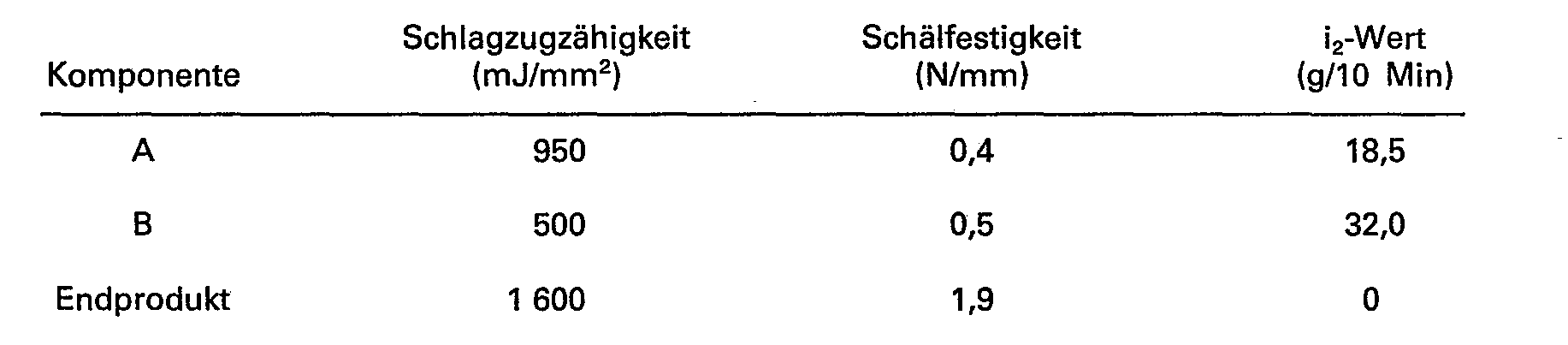
- Die Komponenten A und B werden im Verhältnis 3:2 gemischt und thermisch behandelt. Man erhält ein geschäumtes, vernetztes Produkt. In der folgenden Tabelle sind die Eigenschaften der Ausgangskomponenten und des Produktes zusammengefaßt:
- Herstellung eines Schaumstoffes aus der Mischung eines Ethylen/Ethylacrylat/AcrylsäureNinylalkoholNinylacetat-Copolymerisats und eines Ethylen/tert.-Butylacrylat-Copolymerisats.
-

- Das Polymerisat hat einen RSV-Wert von 5,5.
-

- Das Polymerisat hat einen RSV-Wert von 0,5.
- Die Komponenten A und B werden im Verhältnis 1:1 gemischt und thermisch behandelt. Man erhält ein geschäumtes, vernetztes Produkt. In der folgenden Tabelle sind die Eigenschaften der Ausgangskomponenten und des Produktes zusammengefaßt:

- Herstellung eines Schaumstoffes aus der Mischung eines Ethylen/tert.-Butylacrylat/Acrylamid-Copolymerisats und eines EthylenNinylalkoholNinylacetat-Copolymerisats.
-

- Das Polymerisat hat einen RSV-Wert von 0,75.
-

- Das Polymerisat hat einen RSV-Wert von 0,30.
- Die Komponenten A und B werden im Verhältnis 3:2 gemischt und thermisch behandelt. Man erhält ein geschäumtes, vernetztes Produkt. In der folgenden Tabelle sind die Eigenschaften der Ausgangskomponenten und des Produktes zusammengefaßt:

- Herstellung eines Schaumstoffes aus der Mischung eines Ethylen/tert.-Butylacrylat/Methacryl- säure/Acrylamid-Copolymerisats mit einem Ethylen/VinylalkoholNinylacetat-Copolymerisat.
-

- Das Polymerisat hat einen RSV-Wert von 0,75.
-

- Das Polymerisat hat einen RSV-Wert von 0,35.
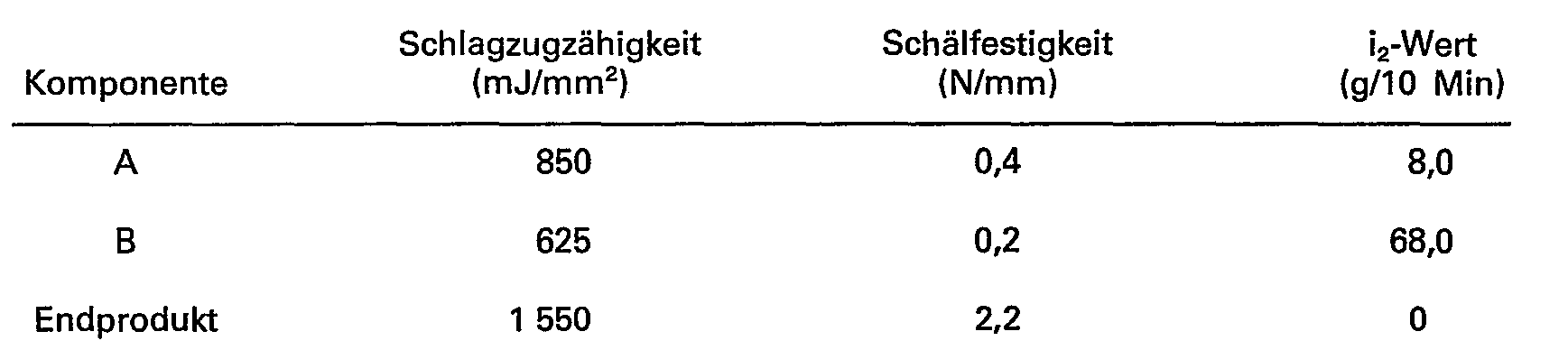
- Die Komponenten A und B werden im Verhältnis 1:1 gemischt und thermisch behandelt. Man erhält ein geschäumtes, vernetztes Produkt. In der folgenden Tabelle sind die Eigenschaften der Ausgangskomponenten und des Produktes zusammengefaßt:
Claims (1)
- Verfahren zur Herstellung von Polymerisatschäumen aus Ethyleneinheiten, Vinylalkoholeinheiten Acrylsäureestereinheiten und Acrylsäureeinheiten oder Methacrylsäureeinheiten und gegebenenfalls Vinylester und Acrylamid enthaltenden Mischpolymerisaten, wobei- der Ethylenanteil 35 bis 98 Gew.-%,- der Vinylalkoholenteil 1 bis 30 Gew.-%,- der Acrylsäureanteil 0 bis 7,38 Gew.-% oder Methacrylsäureanteil 0 bis 2,4 Gew.-%,- der Anteil an Acrylsäureestern sekundärer oder tertiärer Alkohole 1 bis 30 Gew.-% und- der Vinylesteranteil bis zu 5 Gew.-% und der Acrylsäureamidanteil 0 bis 2,28 Gew.-%,
bezogen jeweils auf die Gesamtmischung, beträgt, durch Erhitzen auf 250 bis 350°C unter Anschluß von Sauerstoff während 5 bis 60 Minuten, dadurch gekennzeichnet, daß man Mischungen verschiedener Ethylenmischpolymerisate verwendet.
Applications Claiming Priority (2)
| Application Number | Priority Date | Filing Date | Title |
|---|---|---|---|
| DE19792904082 DE2904082A1 (de) | 1979-02-03 | 1979-02-03 | Verfahren zur herstellung von polymerisatschaeumen |
| DE2904082 | 1979-02-03 |
Publications (2)
| Publication Number | Publication Date |
|---|---|
| EP0014428A1 EP0014428A1 (de) | 1980-08-20 |
| EP0014428B1 true EP0014428B1 (de) | 1985-10-09 |
Family
ID=6062061
Family Applications (1)
| Application Number | Title | Priority Date | Filing Date |
|---|---|---|---|
| EP80100467A Expired EP0014428B1 (de) | 1979-02-03 | 1980-01-30 | Verfahren zur Herstellung von Polymerisatschäumen |
Country Status (3)
| Country | Link |
|---|---|
| EP (1) | EP0014428B1 (de) |
| JP (1) | JPS608050B2 (de) |
| DE (2) | DE2904082A1 (de) |
Citations (1)
| Publication number | Priority date | Publication date | Assignee | Title |
|---|---|---|---|---|
| EP0007085A1 (de) * | 1978-07-10 | 1980-01-23 | Ruhrchemie Aktiengesellschaft | Mischpolymerisate des Äthylens und ihre Verwendung zur Herstellung von Schaumstoffen |
Family Cites Families (2)
| Publication number | Priority date | Publication date | Assignee | Title |
|---|---|---|---|---|
| DE2132295A1 (de) * | 1971-06-29 | 1973-01-11 | Polytech Systems | Verfahren zur herstellung von schaumstoffen |
| DE2033007A1 (de) * | 1970-07-03 | 1972-01-13 | Basf Ag | Verfahren zur Herstellung offenzelli ger Schaume aus Athylencopolymerisaten |
-
1979
- 1979-02-03 DE DE19792904082 patent/DE2904082A1/de not_active Withdrawn
-
1980
- 1980-01-28 JP JP55007863A patent/JPS608050B2/ja not_active Expired
- 1980-01-30 EP EP80100467A patent/EP0014428B1/de not_active Expired
- 1980-01-30 DE DE8080100467T patent/DE3071157D1/de not_active Expired
Patent Citations (1)
| Publication number | Priority date | Publication date | Assignee | Title |
|---|---|---|---|---|
| EP0007085A1 (de) * | 1978-07-10 | 1980-01-23 | Ruhrchemie Aktiengesellschaft | Mischpolymerisate des Äthylens und ihre Verwendung zur Herstellung von Schaumstoffen |
Also Published As
| Publication number | Publication date |
|---|---|
| JPS608050B2 (ja) | 1985-02-28 |
| DE2904082A1 (de) | 1980-08-07 |
| EP0014428A1 (de) | 1980-08-20 |
| JPS55104329A (en) | 1980-08-09 |
| DE3071157D1 (en) | 1985-11-14 |
Similar Documents
| Publication | Publication Date | Title |
|---|---|---|
| DE1720563A1 (de) | Verfahren zur Herstellung von emulgierbaren Poly-alpha-olefinen | |
| DE2019150A1 (de) | Mischpolymerisate aus Tetrafluoraethylen und Fluoralkyl-perfluorvinylaethern sowie Verfahren zur Herstellung derselben | |
| DE1545032A1 (de) | Verfahren zur Herstellung von Blockpolymeren | |
| DE1795464A1 (de) | Verfahren zur Herstellung von amorphen,durchsichtigen Polyamiden | |
| DE69029458T2 (de) | Kontinuierliche schicht von durch elektronenstrahl gehärtetem schaum | |
| DE69909901T2 (de) | Chlorotrifluoroethylen-Copolymere | |
| EP0007085B1 (de) | Mischpolymerisate des Äthylens und ihre Verwendung zur Herstellung von Schaumstoffen | |
| DE2747822C2 (de) | Thermoplastische Formmassen | |
| US3714083A (en) | Method for producing foamed article from polypropylene | |
| DE1569238A1 (de) | Verfahren zur Herstellung vernetzter Zellkoerper auf der Grundlage von Polyvinylchlorid | |
| DE1494259B2 (de) | Verfahren zur Herstellung von Formkörpern | |
| EP0014428A1 (de) | Verfahren zur Herstellung von Polymerisatschäumen | |
| DE2448342B2 (de) | Verfahren zur Herstellung von Copolymerisaten des Ethylene und ihre Verwendung | |
| DE2626320A1 (de) | Modifizierte polyolefinmasse | |
| DE2825962C2 (de) | Gleitmittel für die formgebende Verarbeitung von thermoplastischen Kunststoffen | |
| DE3686380T2 (de) | Verfahren zur herstellung formgeschaeumter formkoerper einer vinylchloridzusammensetzung. | |
| DE1595561C3 (de) | Verfahren zur Herstellung von chlorierten Polyäthylenwachsen | |
| DE4221473A1 (de) | Verfahren zur Herstellung von Polymerisatschäumen | |
| EP0648785B1 (de) | Verfahren zur Herstellung von carboxylgruppenhaltigen Copolymerisaten des Ethylens | |
| US3298972A (en) | Cellular polymeric compositions and method for their preparation | |
| DE1944234A1 (de) | Chemisch vernetzte nitrierte Polymere und Verfahren zu ihrer Herstellung | |
| DE2053399A1 (en) | Resin blowing agent - comprising pyrocarbonic ester | |
| AT344402B (de) | Verfahren zur herstellung von polyurethanen | |
| DE2119047A1 (en) | Ethylene copolymer - contg units of (meth) acrylic acid, normal alkyl (meth)acrylate and opt t-butyl (meth)acrylate | |
| DE3036127C2 (de) | Verfahren zur Herstellung von Vinylchlorid-Polymeren |
Legal Events
| Date | Code | Title | Description |
|---|---|---|---|
| PUAI | Public reference made under article 153(3) epc to a published international application that has entered the european phase |
Free format text: ORIGINAL CODE: 0009012 |
|
| AK | Designated contracting states |
Designated state(s): BE DE FR GB IT NL |
|
| 17P | Request for examination filed | ||
| ITF | It: translation for a ep patent filed | ||
| GRAA | (expected) grant |
Free format text: ORIGINAL CODE: 0009210 |
|
| AK | Designated contracting states |
Designated state(s): BE DE FR GB IT NL |
|
| REF | Corresponds to: |
Ref document number: 3071157 Country of ref document: DE Date of ref document: 19851114 |
|
| ET | Fr: translation filed | ||
| PLBE | No opposition filed within time limit |
Free format text: ORIGINAL CODE: 0009261 |
|
| STAA | Information on the status of an ep patent application or granted ep patent |
Free format text: STATUS: NO OPPOSITION FILED WITHIN TIME LIMIT |
|
| 26N | No opposition filed | ||
| PGFP | Annual fee paid to national office [announced via postgrant information from national office to epo] |
Ref country code: NL Payment date: 19870131 Year of fee payment: 8 |
|
| PG25 | Lapsed in a contracting state [announced via postgrant information from national office to epo] |
Ref country code: GB Effective date: 19890130 |
|
| PG25 | Lapsed in a contracting state [announced via postgrant information from national office to epo] |
Ref country code: BE Effective date: 19890131 |
|
| BERE | Be: lapsed |
Owner name: HOECHST A.G. Effective date: 19890131 |
|
| PG25 | Lapsed in a contracting state [announced via postgrant information from national office to epo] |
Ref country code: NL Effective date: 19890801 |
|
| NLV4 | Nl: lapsed or anulled due to non-payment of the annual fee | ||
| GBPC | Gb: european patent ceased through non-payment of renewal fee | ||
| PG25 | Lapsed in a contracting state [announced via postgrant information from national office to epo] |
Ref country code: FR Free format text: LAPSE BECAUSE OF NON-PAYMENT OF DUE FEES Effective date: 19890929 |
|
| REG | Reference to a national code |
Ref country code: FR Ref legal event code: ST |
|
| PG25 | Lapsed in a contracting state [announced via postgrant information from national office to epo] |
Ref country code: DE Effective date: 19900301 |