EP0012350B1 - Azofarbstoffe sowie deren Herstellung und Verwendung zum Färben von N-haltigen Materialien - Google Patents
Azofarbstoffe sowie deren Herstellung und Verwendung zum Färben von N-haltigen Materialien Download PDFInfo
- Publication number
- EP0012350B1 EP0012350B1 EP79104936A EP79104936A EP0012350B1 EP 0012350 B1 EP0012350 B1 EP 0012350B1 EP 79104936 A EP79104936 A EP 79104936A EP 79104936 A EP79104936 A EP 79104936A EP 0012350 B1 EP0012350 B1 EP 0012350B1
- Authority
- EP
- European Patent Office
- Prior art keywords
- dyestuffs
- formula
- acid
- radical
- oder
- Prior art date
- Legal status (The legal status is an assumption and is not a legal conclusion. Google has not performed a legal analysis and makes no representation as to the accuracy of the status listed.)
- Expired
Links
- 0 CN=Nc1ccc(*)cc1 Chemical compound CN=Nc1ccc(*)cc1 0.000 description 2
Classifications
-
- C—CHEMISTRY; METALLURGY
- C09—DYES; PAINTS; POLISHES; NATURAL RESINS; ADHESIVES; COMPOSITIONS NOT OTHERWISE PROVIDED FOR; APPLICATIONS OF MATERIALS NOT OTHERWISE PROVIDED FOR
- C09B—ORGANIC DYES OR CLOSELY-RELATED COMPOUNDS FOR PRODUCING DYES, e.g. PIGMENTS; MORDANTS; LAKES
- C09B45/00—Complex metal compounds of azo dyes
- C09B45/02—Preparation from dyes containing in o-position a hydroxy group and in o'-position hydroxy, alkoxy, carboxyl, amino or keto groups
- C09B45/24—Disazo or polyazo compounds
-
- C—CHEMISTRY; METALLURGY
- C09—DYES; PAINTS; POLISHES; NATURAL RESINS; ADHESIVES; COMPOSITIONS NOT OTHERWISE PROVIDED FOR; APPLICATIONS OF MATERIALS NOT OTHERWISE PROVIDED FOR
- C09B—ORGANIC DYES OR CLOSELY-RELATED COMPOUNDS FOR PRODUCING DYES, e.g. PIGMENTS; MORDANTS; LAKES
- C09B35/00—Disazo and polyazo dyes of the type A<-D->B prepared by diazotising and coupling
- C09B35/02—Disazo dyes
- C09B35/039—Disazo dyes characterised by the tetrazo component
- C09B35/28—Disazo dyes characterised by the tetrazo component the tetrazo component containing two aryl nuclei linked by at least one of the groups —CON<, —SO2N<, —SO2—, or —SO2—O—
-
- C—CHEMISTRY; METALLURGY
- C09—DYES; PAINTS; POLISHES; NATURAL RESINS; ADHESIVES; COMPOSITIONS NOT OTHERWISE PROVIDED FOR; APPLICATIONS OF MATERIALS NOT OTHERWISE PROVIDED FOR
- C09B—ORGANIC DYES OR CLOSELY-RELATED COMPOUNDS FOR PRODUCING DYES, e.g. PIGMENTS; MORDANTS; LAKES
- C09B35/00—Disazo and polyazo dyes of the type A<-D->B prepared by diazotising and coupling
- C09B35/38—Trisazo dyes ot the type
- C09B35/44—Trisazo dyes ot the type the component K being a hydroxy amine
- C09B35/46—Trisazo dyes ot the type the component K being a hydroxy amine the component K being an amino naphthol
-
- C—CHEMISTRY; METALLURGY
- C09—DYES; PAINTS; POLISHES; NATURAL RESINS; ADHESIVES; COMPOSITIONS NOT OTHERWISE PROVIDED FOR; APPLICATIONS OF MATERIALS NOT OTHERWISE PROVIDED FOR
- C09B—ORGANIC DYES OR CLOSELY-RELATED COMPOUNDS FOR PRODUCING DYES, e.g. PIGMENTS; MORDANTS; LAKES
- C09B35/00—Disazo and polyazo dyes of the type A<-D->B prepared by diazotising and coupling
- C09B35/50—Tetrazo dyes
- C09B35/60—Tetrazo dyes of the type
Definitions
- Suitable radicals R 1 and R 2 are, for example, those of the hydroxy, amino and hydroxyaminobenzene or naphthalene series and the heterocyclic series, in particular the pyrazolone, aminopyrazole and pyridone series and the CH-acidic series, for example the acetoaceticarylide series.
- the rings AF can contain further substituents and the radicals -S0 3 H are bound to one of the rings AF or R 3 .
- Suitable substituents are, for example, halogen, such as chlorine or bromine, optionally substituted alkyl such as methyl, ethyl, hydroxyethyl or cyanoethyl, optionally substituted alkoxy, such as methoxy, ethoxy or methoxyethoxy, nitro, cyano, alkylsulfonyl such as methyl- or ethylsulfonyl, carbamoyl, sulfamoyl , N-substituted carbamoyl, such as mono- or di-N-alkylamides, N-substituted sulfamoyl, such as mono- or di-N-alkylsulfamides, alkyl- (such as methyl-, ethyl-) carbonylamino, ureido, carboxyl, Alkoxycarbonyl, such as methoxy-, ethoxy- or propoxy-carbonyl,
- the alkyl and alkoxy radicals are preferably those with 1-4 carbon atoms.
- R 7 is preferably 2,4-diaminophenyl-, 2,4-diamino-5-sulfophenyl-, 2-hydroxy-4-phenylamino-phenyl-, resorcinyl-, 4-diethylamino-2-acetylamino-phenyl-, 4- Amino-7-sulfonaphthyl- (1), 4-hydroxy-3-carboxyphenyl-. 1- (3'- or 4'-Sulfophenyl) -3-methyl-pyrazolonyl- (5) - or 3'- or 4'-sulfoaniline-acetoacetyl- (2) mean.
- the dyes (VI) can be oxidatively coppered in a known manner.
- the mono-copper complexes are likely to be formed.
- the coupling is carried out in a manner known per se.
- the dyestuffs obtainable by the process described above can be subjected to further reactions customary in dyestuffs, for example by diazotizing primary aromatic amino groups and reacting them with further coupling components or by reacting dyestuffs with sites capable of coupling with diazonium salts.
- Tris, tetrakis or poly-azo dyes of the formula I are thus obtained which formally carry azobenzene, benzolazonaphthalene or naphthalene-azonaphthalene substituents.
- the order of the reactions can be varied widely, as is known in azochemistry. It is common practice to react the bisdiazonium salt of compound IX with 2 equivalents of coupling components X and XI and then to carry out further reactions in the above sense.
- Metallizable dyes of the formula I can be treated with metal-donating agents, in particular with chromium, cobalt, copper, iron or nickel salts, possibly with the addition of oxidizing agents. Dyes which have reducible, in particular nitro groups, can be reduced.
- Dyes which contain acylatable or alkylatable groups can be acylated or alkylated and
- Dyes that can be sulfonated can be sulfonated with chlorosulfonic acid, oleum or sulfur trixoid.
- the new dyes are suitable for dyeing nitrogen-containing fiber materials such as wool and polyamide and for dyeing leather.
- the first coupling is adjusted to a pH of 4 with 130 ml of a 20% sodium acetate solution and, while maintaining this value (20% acetate solution), the suspension of the diazonium salt is slowly added.
- Example 1 If in Example 1 the 4 - aminobenzene-sulfonic acid and the 3-phenylamino-phenol are replaced by the equivalent amounts A and B in the following table, valuable dyes are also obtained
- Example 17 4-aminobenzenesulfonic acid and 1,3-phenylenediamine are replaced by the equivalent amounts A and B in the following table, valuable dyes are also obtained.
- 0.0725 mol of 8-amino, 1-hydroxy-naphthalene (3,6) disulfonic acid are, as in Example 1, with 0.0725 mol of the bis-diazonium ion of the 4,4'-diamino-benzenesulfonic acid phenyl ester and then with enem pH of 4 reacted with 0.0725 mol of the same bis-diazonium ion.
- the dye of the formula dyes wool, polyamide, leather in gray-black.
- Other valuable dyes of the general structure is obtained with the following components A and B.
- the dyes of Examples 26 to 28 can be oxidatively coppered:
- a solution of 0.036 mol of copper sulfate pentahydrate in a little water is added to 0.036 mol of the dye from Example 26, neutral dissolved with a little sodium carbonate.
- the pH is adjusted to 4.5 with 30% hydrochloric acid and 50 ml of a 20% sodium acetate solution are added.
- a solution of 0.09 mol of hydrogen peroxide (30% strength) in 40 ml of water is added dropwise at room temperature. The reaction is complete after 30 minutes, the mixture is salted out with sodium chloride, filtered off with suction and dried in vacuo.
- the dye dye polyamide, wool and leather in orange-brown shades.
Landscapes
- Chemical & Material Sciences (AREA)
- Organic Chemistry (AREA)
- Coloring (AREA)
Description
- Gegenstand der Erfindung sind gegebenenfalls metallhaltige Azofarbstoffe, die in Form der freien Säure der Formel 1 entsprechen :

- R1, R2 = Rest einer gegebenenfalls funktionell abgewandelten Kupplungskomponente
- n = 1-6 und wobei die Ringe A und B weitersubstituiert sein können.
- R 1 und R2 können gleich oder verschieden sein.
- Geeignete Reste R1 und R2 sind beispielsweise solche der Hydroxy-, amino- und Hydroxy-aminobenzol- bzw. -naphthalinreihe sowie der heterocyclischen Reihe, insbesondere der Pyrazolon-, Aminopyrazol- und Pyridonreihe und der CH-aciden Reihe, beispielsweise der Acetessigarylidreihe.
- Bevorzugte Farbstoffe entsprechen der Formel II
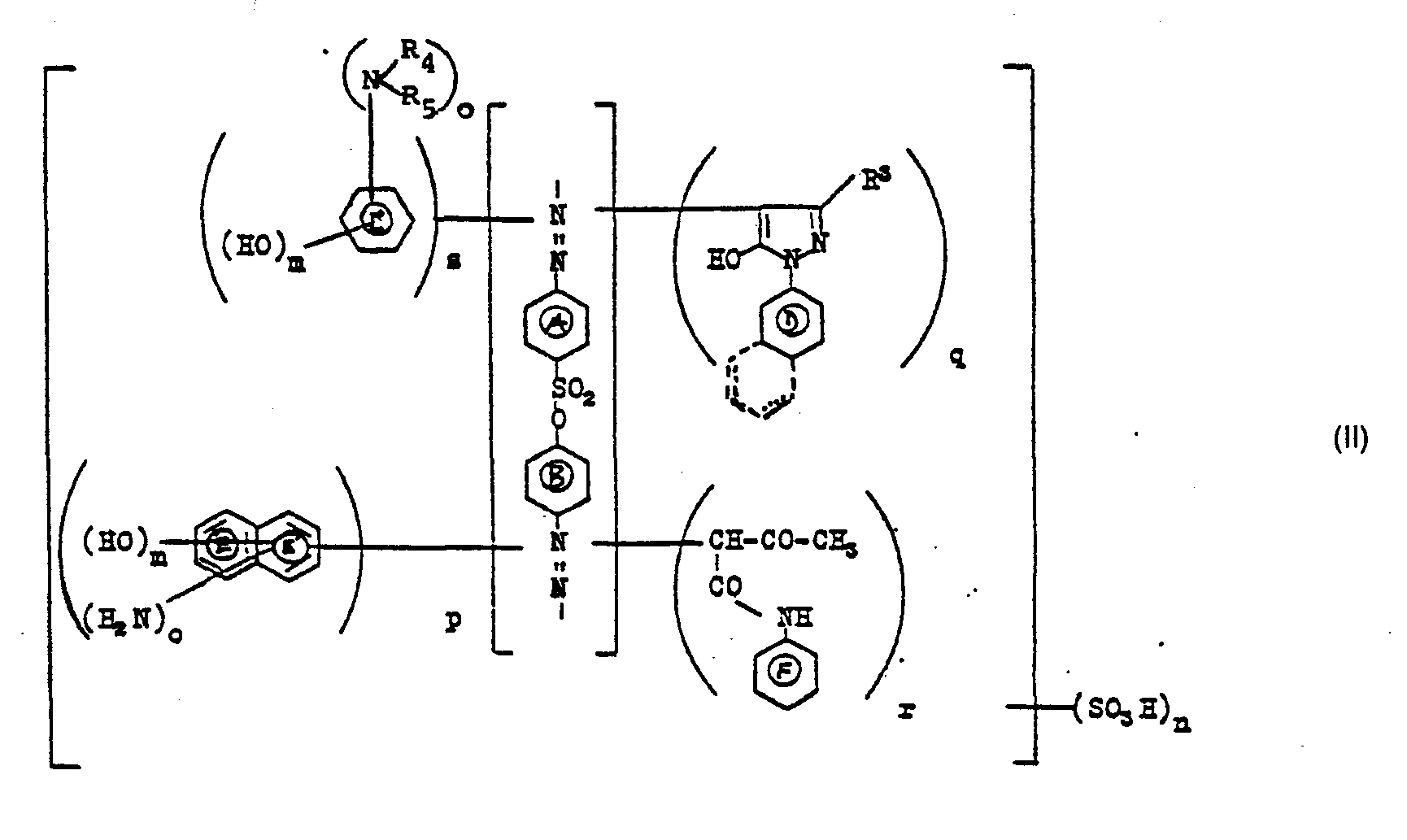
- n = 1-6
- o und m = 0, 1 oder 2 und
- (o + m) ≠ 0
- R3 = Methyl, Carboxyl, CN,
- R4, R5 = Wasserstoff oder gegebenenfalls substituiertes Alkyl und
- p, q, r und s = 0, 1 oder 2 und
- (p + q + r + s) = 2,
- wobei die Ringe A-F weitere Substituenten enthalten können und die Reste -S03H an einem der Ringe A-F oder R3 gebunden sind.
- Geeignete Substituenten sind beispielsweise Halogen, wie Chlor oder Brom, gegebenenfalls substituiertes Alkyl wie Methyl, Ethyl, Hydroxyethyl oder Cyanethyl, gegebenenfalls substituiertes Alkoxy, wie Methoxy, Ethoxy oder Methoxyethoxy, Nitro, Cyan, Alkylsulfonyl wie Methyl- oder Ethyl-sulfonyl, Carbamoyl, Sulfamoyl, N-substituiertes Carbamoyl, wie mono- oder di-N-Alkylamide, N-substituiertes Sulfamoyl, wie mono- oder di-N-Alkyl-sulfamide, Alkyl-(wie Methyl-, Ethyl-)-carbonylamino, Ureido, Carboxyl, Alkoxycarbonyl, wie Methoxy-, Ethoxy- oder Propoxy-carbonyl, Phenylazo- oder Hydroxysulfonyl.
- Die Alkyl- und Alkoxyreste sind vorzugsweise solche mit 1-4 C-Atomen.
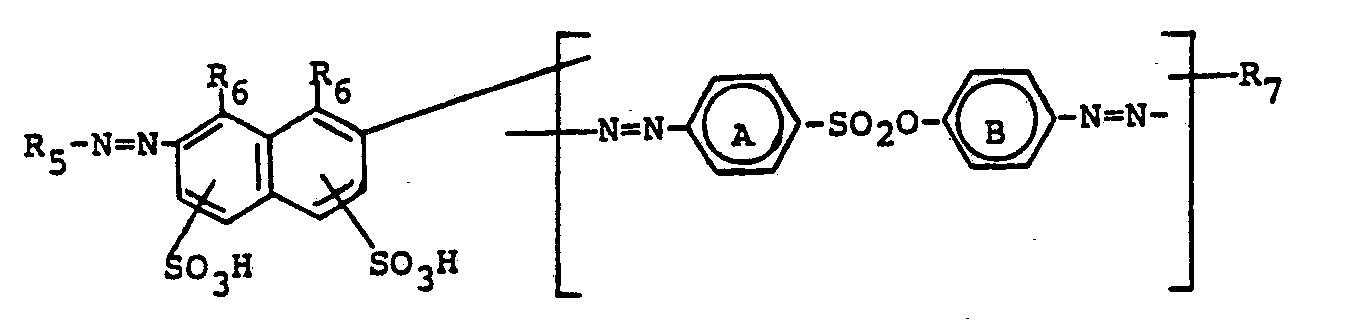
- Weitere bevorzugte Farbstoffe sind solche der Formel

- R5 den Rest einer Diazokomponente der Benzol- oder Naphthalinreihe, bevorzugt Phenyl-, 4-Nitrophenyl-, 4-Sulfo- oder 2,5- bzw. 2,4-Disulfophenyl-, 2-Hydroxy-5-sulfophenyl- oder 6- bzw. 7-Sulfo-2-naphthyl darstellt,
- ein R6 NH2, das andere
- R6 OH und
- R7 den Rest einer Kupplungskomponente insbesondere der Aminobenzol-, Hydroxybenzol-, Aminonaphthalin- oder Acetessigarylidreihe.
- Bevorzugt steht R7 für 2,4-Diaminophenyl-, 2,4-Diamino-5-sulfophenyl-, 2-Hydroxy-4-phenylamino- phenyl-, Resorcinyl-, 4-Diäthylamino-2-acetylamino-phenyl-, 4-Amino-7-sulfonaphthyl-(1), 4-Hydroxy-3-carboxyphenyl-. 1-(3'- oder 4'-Sulfophenyl)-3-methyl-pyrazolonyl-(5)- oder 3'- oder 4'-Sulfoanilin-acetoacetyl-(2) bedeuten.
- Bevorzugte Metallkomplexfarbstoffe sind solche auf Basis von metallfreien Farbstoffen der Formel

- u, w = 0, 1 ; v = 0,1, 2 oder 3, insbesondere die 1: 1-bzw. 1: 2-Metallkomplexe mit Cr, Co, Fe und Cu als Metallatom.
- Weitere bevorzugte Farbstoffe sind solche der Formel

- R7 die obengenannte Bedeutung hat und
- R8 für den Rest einer Aminohydroxynaphtalinmono- oder- disulfonsäure steht, insbesondere einer solchen der Formel
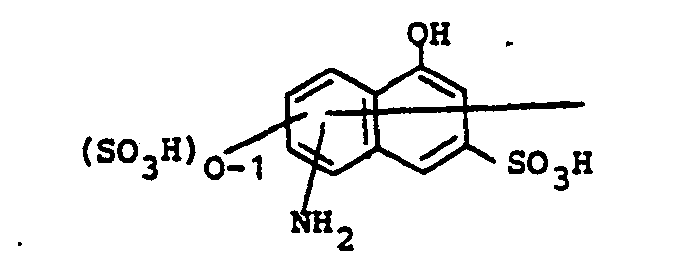
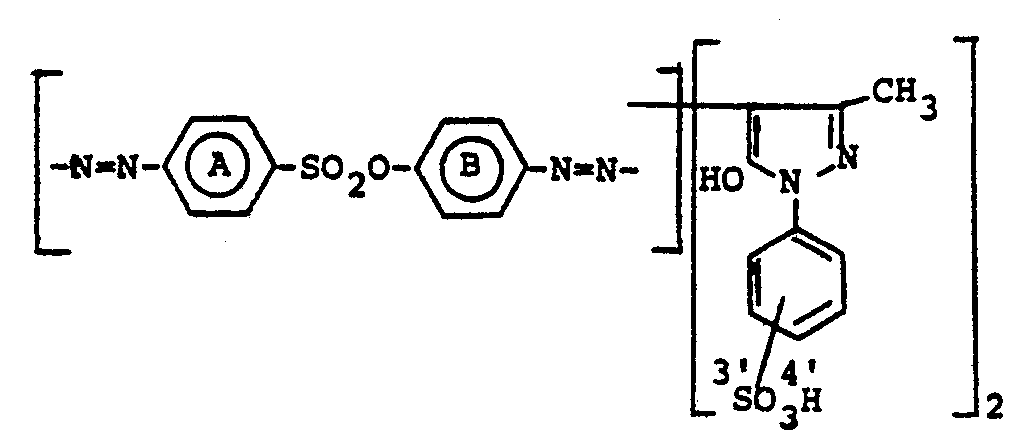
- Weitere bevorzugte Farbstoffe sind folgende :


- Die Farbstoffe (VI) lassen sich in bekannter Weise oxidativ kupfern. Dabei entstehen wahrscheinlich die Mono-Kupferkomplexe.
- Die Farbstoffe I werden bevorzugt durch Kupplung des Bisdiazoniumsalzes einer Verbindung


- Geeignete, gegebenenfalls funktionell abgewandelte Kupplungskomponenten (X) bzw. (XI) sind beispielsweise
- a) N,N-Dialkylaniline,
- N,N-Dialkyl-m-toluidine,
- N,N-Dialkyl-N'-acyl-phenylendiamine und
- Diaminobenzolsulfonsäuren, wie
- 2,4- und 2,5-Diaminobenzolsulfonsäure,
wobei Alkyl vorzugsweise für Methyl oder gegebenenfalls durch Hydroxy, Cyan oder Methoxy substituiertes Ethyl bzw. Propyl steht und Acyl bevorzugt Acetyl, Methylsulfonyl oder Benzosulfonyl bedeuten. - b) Phenole wie
- Phenol,
- Resorcin,
- 3-Phenylamino-phenol und
- Bisphenol A
- c) Naphthole wie a-oder β-Naphthol oder deren Sulfonsäuren, wie
- 1-Hydroxy-napththalin-3-, 4- oder 6-sulfonsäure,
- 1-Hydroxy-naphthalin-3,6-disulfonsäure,
- 2-Hydroxy-naphthalin-3,6-disulfonsäure,
- d) Naphtylamine wie
- 1-Naphthylamin-6- oder 7-sulfonsäure,
- e) Aminonaphthole wie
- 1-Hydroxy-8-aminonaphthalin-5-sulfonsäure,
- 8-Amino-1-naphthol-3-, 6- oder 3-, 5-disulfonsäure bzw.
- 6- oder 7-Amino-1-naphthol-3-sulfonsäure.
- f) Pyrazolonderivate wie 3-Methyl- oder -carboxyl-1-phenyl-pyrazolon-5 und deren 3'- oder 4'-sulfonsäuren. Auch die entsprechenden 2'-Methyl-4'-sulfonsäure oder 2'-Chlor-4'-sulfonsäure sind geeignet.
- g) Acetessigarylide wie Anilin-, o, m oder p-Toluidin- oder o, m oder p-Anisidin-acetoacetat und derensulfonsäuren.
- Die nach dem vorstehend beschriebenen Verfahren erhältlichen Farbstoffe können weiteren, an Farbstoffen üblichen, Umsetzungen unterzogen werden, beispielsweise, indem man primäre aromatische Aminogruppen diazotiert und mit weiteren Kupplungskomponenten umsetzt oder indem man Farbstoffe mit kupplungsfähigen Stellen mit Diazoniumsalzen zur Reaktion bringt. Man erhält so Tris-, Tetrakis- oder Poly-azo-Farbstoffe der Formel I, die formal Azobenzol-, Benzolazonaphthalin- oder Naphthalin-azonaphthalin-Substituenten tragen. Die Reihenfolge der Umsetzungen ist in weitem Rahmen, wie in der Azochemie bekannt, variierbar. So ist es geläufig, das Bisdiazoniumsalz der Verbindung IX mit 2- Äquivalenten Kupplungskomponenten X bzw. XI umzusetzen und dann weitere Reaktionen im obigen Sinne durchzuführen.
- Häufig ist der Weg, zunächst nur 1 Äquivalent Kupplungskomponente zur Reaktion zu bringen, an der Monoazoverbindung weitere Reaktionen vorzunehmen und danach mit dem zweiten Äquivalent Kupplungskomponente umzusetzen, ebenso gangbar.
- Metallisierbare Farbstoffe der Formel I können mit metallabgebenden Mitteln, insbesondere mit Chrom-, Kobalt-, Kupfer-, Eisen- oder Nickel-Salzen, evtl. unter Zusatz von Oxidationsmitteln, behandelt werden. Farbstoffe, die reduzierbare, insbesondere Nitrogruppen, aufweisen, können reduziert werden.
- Farbstoffe, welche acylierbare oder alkylierbare Gruppen enthalten, können acyliert bzw. alkyliert und
- Farbstoffe, die sulfonierbar sind, können mit Chlorsulfonsäure, Oleum oder Schwefeltrixoid sulfoniert werden.
- Die neuen Farbstoffe eignen sich zum Färben stickstoffhaltiger Fasermaterialien wie Wolle und Polyamid sowie zum Färben von Leder.
- 0,0725 Mol 4,4'-Diamino-benzolsulfonsäure-phenylester-di-hydrochlorid werden, in 250 ml Wasser und 40 ml Salzsäure (30 %ig) gelöst, bei 0-5° mit 34 ml einer 4,35 molaren Natrium-nitrit-Lösung diazotiert. Das Bisdiazoniumsalz fällt teilweise aus. Nach 30-minütigem Rühren wird der geringe Nitritüberschuß mit Amidosulfonsäure entfernt.
- 0,0725 Mol 8-Amino-1-hydroxy-naphthalin-disulfonsäure (3,6) werden in 100 ml Wasser mit 40 %iger Natronlauge neutralgelöst und dannach mit 25 ml 30 %iger Salzsäure bei einem pH-Wert von ca. 1 gefällt. Man setzt 100 g Eis zu und läßt die Suspension des Bisdiazoniumsalzes einlaufen. Der pH-Wert sinkt auf 0,5 ab. Die Kupplung ist nach etwa einer Stunde beendet.
- 0,0725 Mol 4-Amino-benzolsulfonsäure werden in 100 ml Wasser mit 40 %iger Natronlauge neutral gelöst. Nach Zugabe von 100 g Eis und 40 mt 30 %iger Salzsäure wird mit etwa 17 ml 4,35 molarer Natrium-nitrit-Lösung diazotiert. Der Nitritüberschuß wird nach 30 Minuten mit wenig Amidosulfonsäure entfernt.
- Die erste Kupplung wird mit 130 ml einer 20 %igen Natriumacetatlösung auf einen pH-Wert von 4 gestellt und unter Halten dieses Wertes (20 %ige Acetatlösung) langsam mit der Suspension des Diazoniumsalzes versetzt.
- 0,0725 Mol 3-Phenylamino-phenol werden in 150 ml Wasser suspendiert zugegeben. Der pH-Wert wird mit 18 %iger Sodalösung auf 7-8 gestellt. Nach 1 Stunde ist die Kupplung beendet. Man neutralisiert mit 30 %iger Salzsäure, salzt mit Kaliumchlorid aus, saugt ab und trocknet im Vakuum. Man erhält einen Farbstoff, der Polyamid, Wolle und Leder grauschwarz färbt. Seine Struktur entspricht der Formel

- Ersetzt man im Beispiel 1 die 4-Aminobenzol-sulfonsäure und das 3-Phenylamino-phenol durch die äquivalenten Mengen A bzw. B der folgenden Tabelle, so erhält man ebenfalls wertvolle Farbstoffe


- 0,0725 Mol 4-Aminobenzolsulfonsäure werden wie in Beispiel 1 diazotiert.
- 0,0725 Mol 8-Amino, 1-hydroxy-naphthalindisulfonsäure (3,6) werden in 100 ml Wasser mit 40 %iger Natronlauge neutral gelöst. Mit 25 ml 30 %iger Salzsäure wird gefällt (pH-Wert : ca. 1). Nach Zugabe von 100 g Eis wird die Diazoniumsalzlösung zugegeben. Mit 20 %iger Natriumacetatlösung wird ein pH-Wert von 1 eingestellt. Die Kupplung ist nach 2 Stunden beendet. Der pH-Wert wird mit wenig 40 %iger Natronlauge auf 4 gestellt.
- 0,0725 Mol 4,4'-Diamino-benzolsulfonsäurephenylester-dihydrochlorid werden in 380 ml Wasser gelöst, mit 40 ml 30 %iger Salzsäure versetzt und mit 34,5 ml 4,35 molarer Natriumnitritlösung bei 0-5° diazotiert. Nach 30 Minuten wird der Nitritüberschuß mit wenig Amidosulfonsäure entfernt. Bei pH 4,5 gibt man die Suspension des Bis-Diazoniumsalzes zum Monoazofarbstoff. Die Kupplung dauert 30 Minuten.
- 0,0725 Mol 1,3-Phenylendiamin werden, in 80 ml Wasser gelöst, langsam zugegeben, wobei ein pH-Wert von 9 mit 18 %iger Sodalösung gehalten wird. Nach der Kupplung wird angesäuert, der Farbstoff mit Kochsalz ausgesalzen, abgesaugt und im Vakuum getrocknet. Man erhält 60 g eines Farbstoffes der Formel

- Ersetzt man im Beispiel 17 4-Aminobenzolsulfonsäure und 1,3-Phenylendiamin durch die äquivalenten Mengen A und B der folgenden Tabelle, so erhält man ebenfalls wertvolle Farbstoffe.

- 0,0725 Mol 8-Amino, 1-hydroxy-naphthalin-(3,6)-disulfonsäure werden wie im Beispiel 1 mit 0,0725 Mol des Bis-Diazoniumions des 4,4'-Diamino-benzolsulfonsäure-phenylesters und dann bei enem pH-Wert von 4 mit 0,0725 Mol des gleichen Bis-Diazoniumions umgesetzt.
- Nach beiden Kupplungen gibt man 0,145 Mol 2,4-Diaminobenzolsulfonsäure zu, hält etwa 3 Stunden einen pH-Wert von 9 ein, neutralisiert mit 30 %iger Salzsäure, salzt mit Kochsalz aus, saugt ab und trocknet den Farbstoff im Vakuum.
- Der Farbstoff der Formel


- Die Farbstoffe der Beispiele 26 bis 28 lassen sich oxidativ kupfern :
- 0,036 Mol Farbstoff des Beispiels 26, mit wenig Soda neutral gelöst, werden mit einer Lösung von 0,036 Mol Kupfersulfatpentahydrat in wenig Wasser versetzt. Man stellt mit 30 %iger Salzsäure auf pH 4,5 und gibt 50 ml einer 20 %igen Natriumacetat-Lösung zu. Bei Raumtemperatur tropft man eine Lösung von 0,09 Mol Wasserstoffperoxid (30 %ig) in 40 ml Wasser zu. Nach 30 Minuten ist die Reaktion beendet, man salzt mit Kochsalz aus, saugt ab und trocknet im Vakuum.
- Der Farbstoff färbt Polyamid, Wolle und Leder in orangebraunen Nuancen an.
- Die oxidativ gekupferten Farbstoffe der Beispiele 27 und 28 haben ähnliche Nuancen.
Claims (7)


wobei die Ringe A-F weitere Substituenten enthalten können und die Reste -S03H an einem der Ringe A-F oder R3 gebunden sind.




Applications Claiming Priority (2)
| Application Number | Priority Date | Filing Date | Title |
|---|---|---|---|
| DE2853935 | 1978-12-14 | ||
| DE19782853935 DE2853935A1 (de) | 1978-12-14 | 1978-12-14 | Azofarbstoffe |
Publications (2)
| Publication Number | Publication Date |
|---|---|
| EP0012350A1 EP0012350A1 (de) | 1980-06-25 |
| EP0012350B1 true EP0012350B1 (de) | 1982-04-07 |
Family
ID=6057126
Family Applications (1)
| Application Number | Title | Priority Date | Filing Date |
|---|---|---|---|
| EP79104936A Expired EP0012350B1 (de) | 1978-12-14 | 1979-12-05 | Azofarbstoffe sowie deren Herstellung und Verwendung zum Färben von N-haltigen Materialien |
Country Status (5)
| Country | Link |
|---|---|
| EP (1) | EP0012350B1 (de) |
| JP (1) | JPS5582159A (de) |
| BR (1) | BR7908172A (de) |
| DE (2) | DE2853935A1 (de) |
| ES (1) | ES486864A1 (de) |
Family Cites Families (2)
| Publication number | Priority date | Publication date | Assignee | Title |
|---|---|---|---|---|
| US2862919A (en) * | 1956-05-19 | 1958-12-02 | Bayer Ag | Disazo dyestuffs |
| FR1394571A (fr) * | 1964-05-19 | 1965-04-02 | Lvovsky Politekhnitchesky Inst | Procédé de préparation de colorants azoïques polaires |
-
1978
- 1978-12-14 DE DE19782853935 patent/DE2853935A1/de not_active Withdrawn
-
1979
- 1979-12-05 EP EP79104936A patent/EP0012350B1/de not_active Expired
- 1979-12-05 DE DE7979104936T patent/DE2962480D1/de not_active Expired
- 1979-12-12 JP JP16042679A patent/JPS5582159A/ja active Pending
- 1979-12-13 ES ES486864A patent/ES486864A1/es not_active Expired
- 1979-12-13 BR BR7908172A patent/BR7908172A/pt unknown
Also Published As
| Publication number | Publication date |
|---|---|
| JPS5582159A (en) | 1980-06-20 |
| DE2853935A1 (de) | 1980-07-03 |
| BR7908172A (pt) | 1980-07-22 |
| ES486864A1 (es) | 1980-06-16 |
| DE2962480D1 (en) | 1982-05-19 |
| EP0012350A1 (de) | 1980-06-25 |
Similar Documents
| Publication | Publication Date | Title |
|---|---|---|
| DE3034686C2 (de) | Wasserlösliche 1:2-Chromkomplexe von Disazoverbindungen, deren Herstellung und Verwendung | |
| EP0078007B1 (de) | Metallkomplexe von Polyazofarbstoffen | |
| EP0355601A2 (de) | Polyazofarbstoffe und deren Zwischenprodukte | |
| EP0068245B1 (de) | Sulfonsäuregruppenhaltige Farbstoffe | |
| CH324677A (de) | Verfahren zur Herstellung von schwermetallhaltigen Azofarbstoffen | |
| EP0012350A1 (de) | Azofarbstoffe sowie deren Herstellung und Verwendung zum Färben von N-haltigen Materialien | |
| EP0045868A1 (de) | Metallkomplexfarbstoffe und ihre Verwendung zum Färben stickstoffhaltiger Materialien | |
| EP0073387B1 (de) | Wasserlösliche Polyazofarbstoffe, ihre Herstellung und ihre Verwendung | |
| EP0014882B1 (de) | Azofarbstoffe sowie deren Verwendung zum Färben und Bedrucken stickstoffhaltiger Materialien und Leder | |
| EP0175324A2 (de) | Unsymmetrische 1:2-Chromkomplexfarbstoffe | |
| EP0017841A1 (de) | Polyazofarbstoffe sowie ihre Verwendung zum Färben stickstoffhaltiger Fasermaterialien | |
| EP0177978B1 (de) | Naphtolamin-Derivate | |
| EP0087715B1 (de) | Sulfonamid- und aminogruppenfreie Metallkomplexfarbstoffe | |
| DE930770C (de) | Verfahren zur Herstellung wasserloeslicher kupferhaltiger Dis- und Polyazofarbstoffe | |
| DE909383C (de) | Verfahren zur Herstellung von Monoazofarbstoffen | |
| DE842091C (de) | Verfahren zur Herstellung von metallisierbaren Azofarbstoffen | |
| DE849287C (de) | Verfahren zur Herstellung von Trisazofarbstoffen | |
| DE1444671C3 (de) | Metallhaltige Azofarbstoffe und ihre Verwendung zum Färben vegetabilischer Fasern | |
| EP0423071B1 (de) | Polyazofarbstoffe | |
| AT220742B (de) | Verfahren zur Herstellung von neuen Azofarbstoffen | |
| DE842098C (de) | Verfahren zur Herstellung von metallisierbaren Dis- oder Polyazofarbstoffen der Dipyrazolonreihe | |
| DE1191059B (de) | Verfahren zur Herstellung von Azofarbstoffen | |
| DE2010656C3 (de) | Kupfer-, Nickel-, Chrom- und Kobaltkomplexverbindungen von Monoazofarbstoffen, Verfahren zu ihrer Herstellung und ihre Verwendung | |
| DE2311396A1 (de) | Kupferhaltige wasserloesliche diazofarbstoffe | |
| CH478896A (de) | Verfahren zur Herstellung von reaktiven Azofarbstoffen |
Legal Events
| Date | Code | Title | Description |
|---|---|---|---|
| PUAI | Public reference made under article 153(3) epc to a published international application that has entered the european phase |
Free format text: ORIGINAL CODE: 0009012 |
|
| 17P | Request for examination filed | ||
| AK | Designated contracting states |
Designated state(s): BE CH DE FR GB IT |
|
| ITF | It: translation for a ep patent filed | ||
| GRAA | (expected) grant |
Free format text: ORIGINAL CODE: 0009210 |
|
| AK | Designated contracting states |
Designated state(s): BE CH DE FR GB IT |
|
| REF | Corresponds to: |
Ref document number: 2962480 Country of ref document: DE Date of ref document: 19820519 |
|
| PG25 | Lapsed in a contracting state [announced via postgrant information from national office to epo] |
Ref country code: BE Effective date: 19821205 |
|
| PG25 | Lapsed in a contracting state [announced via postgrant information from national office to epo] |
Ref country code: FR Free format text: LAPSE BECAUSE OF NON-PAYMENT OF DUE FEES Effective date: 19830831 |
|
| REG | Reference to a national code |
Ref country code: FR Ref legal event code: ST |
|
| GBPC | Gb: european patent ceased through non-payment of renewal fee | ||
| PGFP | Annual fee paid to national office [announced via postgrant information from national office to epo] |
Ref country code: DE Payment date: 19841130 Year of fee payment: 6 |
|
| PG25 | Lapsed in a contracting state [announced via postgrant information from national office to epo] |
Ref country code: GB Effective date: 19881118 |
|
| PG25 | Lapsed in a contracting state [announced via postgrant information from national office to epo] |
Ref country code: DE Effective date: 19900901 |
|
| PGFP | Annual fee paid to national office [announced via postgrant information from national office to epo] |
Ref country code: CH Payment date: 19901206 Year of fee payment: 12 |
|
| PG25 | Lapsed in a contracting state [announced via postgrant information from national office to epo] |
Ref country code: CH Effective date: 19911231 |
|
| REG | Reference to a national code |
Ref country code: CH Ref legal event code: PL |
|
| PLBE | No opposition filed within time limit |
Free format text: ORIGINAL CODE: 0009261 |