EP0007793B1 - Isothermal shaping of titanium-containing workpieces - Google Patents
Isothermal shaping of titanium-containing workpieces Download PDFInfo
- Publication number
- EP0007793B1 EP0007793B1 EP79301467A EP79301467A EP0007793B1 EP 0007793 B1 EP0007793 B1 EP 0007793B1 EP 79301467 A EP79301467 A EP 79301467A EP 79301467 A EP79301467 A EP 79301467A EP 0007793 B1 EP0007793 B1 EP 0007793B1
- Authority
- EP
- European Patent Office
- Prior art keywords
- workpiece
- lubricant
- vitreous
- forging
- shaping
- Prior art date
- Legal status (The legal status is an assumption and is not a legal conclusion. Google has not performed a legal analysis and makes no representation as to the accuracy of the status listed.)
- Expired
Links
- 238000007493 shaping process Methods 0.000 title claims description 24
- RTAQQCXQSZGOHL-UHFFFAOYSA-N Titanium Chemical compound [Ti] RTAQQCXQSZGOHL-UHFFFAOYSA-N 0.000 title claims description 9
- 229910052719 titanium Inorganic materials 0.000 title claims description 9
- 239000010936 titanium Substances 0.000 title claims description 9
- 239000000463 material Substances 0.000 claims description 84
- 239000000203 mixture Substances 0.000 claims description 72
- 239000000314 lubricant Substances 0.000 claims description 60
- 239000011230 binding agent Substances 0.000 claims description 29
- 238000000034 method Methods 0.000 claims description 29
- 239000007787 solid Substances 0.000 claims description 28
- 239000010439 graphite Substances 0.000 claims description 20
- 229910002804 graphite Inorganic materials 0.000 claims description 20
- OKTJSMMVPCPJKN-UHFFFAOYSA-N Carbon Chemical compound [C] OKTJSMMVPCPJKN-UHFFFAOYSA-N 0.000 claims description 19
- VYPSYNLAJGMNEJ-UHFFFAOYSA-N Silicium dioxide Chemical compound O=[Si]=O VYPSYNLAJGMNEJ-UHFFFAOYSA-N 0.000 claims description 17
- 239000002904 solvent Substances 0.000 claims description 16
- 239000002245 particle Substances 0.000 claims description 11
- 229910052582 BN Inorganic materials 0.000 claims description 10
- JKWMSGQKBLHBQQ-UHFFFAOYSA-N diboron trioxide Chemical compound O=BOB=O JKWMSGQKBLHBQQ-UHFFFAOYSA-N 0.000 claims description 10
- PZNSFCLAULLKQX-UHFFFAOYSA-N Boron nitride Chemical compound N#B PZNSFCLAULLKQX-UHFFFAOYSA-N 0.000 claims description 9
- 239000000377 silicon dioxide Substances 0.000 claims description 8
- 229910001069 Ti alloy Inorganic materials 0.000 claims description 7
- 239000003960 organic solvent Substances 0.000 claims description 7
- 239000011248 coating agent Substances 0.000 claims description 6
- 238000000576 coating method Methods 0.000 claims description 6
- 239000004926 polymethyl methacrylate Substances 0.000 claims description 5
- 229910052810 boron oxide Inorganic materials 0.000 claims description 4
- 229920003229 poly(methyl methacrylate) Polymers 0.000 claims description 4
- 238000010438 heat treatment Methods 0.000 claims description 3
- 229920001083 polybutene Polymers 0.000 claims description 3
- 239000004793 Polystyrene Substances 0.000 claims description 2
- KPUWHANPEXNPJT-UHFFFAOYSA-N disiloxane Chemical class [SiH3]O[SiH3] KPUWHANPEXNPJT-UHFFFAOYSA-N 0.000 claims description 2
- 230000008018 melting Effects 0.000 claims description 2
- 238000002844 melting Methods 0.000 claims description 2
- 229920002223 polystyrene Polymers 0.000 claims description 2
- 239000011236 particulate material Substances 0.000 claims 1
- 238000005242 forging Methods 0.000 description 33
- 239000011521 glass Substances 0.000 description 22
- 238000004513 sizing Methods 0.000 description 21
- 238000010275 isothermal forging Methods 0.000 description 12
- 229910000601 superalloy Inorganic materials 0.000 description 12
- 229910052751 metal Inorganic materials 0.000 description 10
- 239000002184 metal Substances 0.000 description 10
- KFZMGEQAYNKOFK-UHFFFAOYSA-N Isopropanol Chemical compound CC(C)O KFZMGEQAYNKOFK-UHFFFAOYSA-N 0.000 description 8
- 230000001050 lubricating effect Effects 0.000 description 8
- -1 for example Substances 0.000 description 7
- 239000003085 diluting agent Substances 0.000 description 6
- 229910044991 metal oxide Inorganic materials 0.000 description 6
- 150000004706 metal oxides Chemical class 0.000 description 6
- LFQSCWFLJHTTHZ-UHFFFAOYSA-N Ethanol Chemical compound CCO LFQSCWFLJHTTHZ-UHFFFAOYSA-N 0.000 description 5
- CTQNGGLPUBDAKN-UHFFFAOYSA-N O-Xylene Chemical compound CC1=CC=CC=C1C CTQNGGLPUBDAKN-UHFFFAOYSA-N 0.000 description 5
- 239000006185 dispersion Substances 0.000 description 5
- 235000019441 ethanol Nutrition 0.000 description 5
- 239000008096 xylene Substances 0.000 description 5
- PXHVJJICTQNCMI-UHFFFAOYSA-N Nickel Chemical compound [Ni] PXHVJJICTQNCMI-UHFFFAOYSA-N 0.000 description 4
- 229910045601 alloy Inorganic materials 0.000 description 4
- 239000000956 alloy Substances 0.000 description 4
- 238000009472 formulation Methods 0.000 description 4
- 239000007788 liquid Substances 0.000 description 4
- 239000005368 silicate glass Substances 0.000 description 4
- 239000000126 substance Substances 0.000 description 4
- 239000000725 suspension Substances 0.000 description 4
- 239000003981 vehicle Substances 0.000 description 4
- UHOVQNZJYSORNB-UHFFFAOYSA-N Benzene Chemical compound C1=CC=CC=C1 UHOVQNZJYSORNB-UHFFFAOYSA-N 0.000 description 3
- YXFVVABEGXRONW-UHFFFAOYSA-N Toluene Chemical compound CC1=CC=CC=C1 YXFVVABEGXRONW-UHFFFAOYSA-N 0.000 description 3
- 229910000272 alkali metal oxide Inorganic materials 0.000 description 3
- 239000005388 borosilicate glass Substances 0.000 description 3
- 238000011109 contamination Methods 0.000 description 3
- 238000007598 dipping method Methods 0.000 description 3
- 230000000694 effects Effects 0.000 description 3
- 229910000464 lead oxide Inorganic materials 0.000 description 3
- YEXPOXQUZXUXJW-UHFFFAOYSA-N oxolead Chemical compound [Pb]=O YEXPOXQUZXUXJW-UHFFFAOYSA-N 0.000 description 3
- 229920000642 polymer Polymers 0.000 description 3
- 230000008569 process Effects 0.000 description 3
- 230000009257 reactivity Effects 0.000 description 3
- 230000009467 reduction Effects 0.000 description 3
- 229920005989 resin Polymers 0.000 description 3
- 239000011347 resin Substances 0.000 description 3
- 239000012260 resinous material Substances 0.000 description 3
- 238000000926 separation method Methods 0.000 description 3
- 238000005507 spraying Methods 0.000 description 3
- 229910001040 Beta-titanium Inorganic materials 0.000 description 2
- VYZAMTAEIAYCRO-UHFFFAOYSA-N Chromium Chemical compound [Cr] VYZAMTAEIAYCRO-UHFFFAOYSA-N 0.000 description 2
- DGAQECJNVWCQMB-PUAWFVPOSA-M Ilexoside XXIX Chemical compound C[C@@H]1CC[C@@]2(CC[C@@]3(C(=CC[C@H]4[C@]3(CC[C@@H]5[C@@]4(CC[C@@H](C5(C)C)OS(=O)(=O)[O-])C)C)[C@@H]2[C@]1(C)O)C)C(=O)O[C@H]6[C@@H]([C@H]([C@@H]([C@H](O6)CO)O)O)O.[Na+] DGAQECJNVWCQMB-PUAWFVPOSA-M 0.000 description 2
- BAPJBEWLBFYGME-UHFFFAOYSA-N Methyl acrylate Chemical group COC(=O)C=C BAPJBEWLBFYGME-UHFFFAOYSA-N 0.000 description 2
- 239000004115 Sodium Silicate Substances 0.000 description 2
- PPBRXRYQALVLMV-UHFFFAOYSA-N Styrene Chemical compound C=CC1=CC=CC=C1 PPBRXRYQALVLMV-UHFFFAOYSA-N 0.000 description 2
- XLOMVQKBTHCTTD-UHFFFAOYSA-N Zinc monoxide Chemical compound [Zn]=O XLOMVQKBTHCTTD-UHFFFAOYSA-N 0.000 description 2
- 229920000180 alkyd Polymers 0.000 description 2
- 239000002585 base Substances 0.000 description 2
- 230000001680 brushing effect Effects 0.000 description 2
- 239000000919 ceramic Substances 0.000 description 2
- 229910052804 chromium Inorganic materials 0.000 description 2
- 239000011651 chromium Substances 0.000 description 2
- 229910052681 coesite Inorganic materials 0.000 description 2
- 229910052906 cristobalite Inorganic materials 0.000 description 2
- 238000001704 evaporation Methods 0.000 description 2
- 230000008020 evaporation Effects 0.000 description 2
- 238000007654 immersion Methods 0.000 description 2
- 239000004615 ingredient Substances 0.000 description 2
- 238000011068 loading method Methods 0.000 description 2
- 239000000155 melt Substances 0.000 description 2
- 150000002739 metals Chemical class 0.000 description 2
- 229910052759 nickel Inorganic materials 0.000 description 2
- 239000003921 oil Substances 0.000 description 2
- 235000019198 oils Nutrition 0.000 description 2
- 239000011368 organic material Substances 0.000 description 2
- 235000012239 silicon dioxide Nutrition 0.000 description 2
- 229920002050 silicone resin Polymers 0.000 description 2
- 229910052708 sodium Inorganic materials 0.000 description 2
- 239000011734 sodium Substances 0.000 description 2
- NTHWMYGWWRZVTN-UHFFFAOYSA-N sodium silicate Chemical compound [Na+].[Na+].[O-][Si]([O-])=O NTHWMYGWWRZVTN-UHFFFAOYSA-N 0.000 description 2
- 229910052911 sodium silicate Inorganic materials 0.000 description 2
- 229910052682 stishovite Inorganic materials 0.000 description 2
- 238000005979 thermal decomposition reaction Methods 0.000 description 2
- 229910052905 tridymite Inorganic materials 0.000 description 2
- POAOYUHQDCAZBD-UHFFFAOYSA-N 2-butoxyethanol Chemical compound CCCCOCCO POAOYUHQDCAZBD-UHFFFAOYSA-N 0.000 description 1
- NLHHRLWOUZZQLW-UHFFFAOYSA-N Acrylonitrile Chemical group C=CC#N NLHHRLWOUZZQLW-UHFFFAOYSA-N 0.000 description 1
- XDTMQSROBMDMFD-UHFFFAOYSA-N Cyclohexane Chemical compound C1CCCCC1 XDTMQSROBMDMFD-UHFFFAOYSA-N 0.000 description 1
- 102000002322 Egg Proteins Human genes 0.000 description 1
- 108010000912 Egg Proteins Proteins 0.000 description 1
- 229910018487 Ni—Cr Inorganic materials 0.000 description 1
- 229920005372 Plexiglas® Polymers 0.000 description 1
- 239000004698 Polyethylene Substances 0.000 description 1
- 239000004743 Polypropylene Substances 0.000 description 1
- ZLMJMSJWJFRBEC-UHFFFAOYSA-N Potassium Chemical compound [K] ZLMJMSJWJFRBEC-UHFFFAOYSA-N 0.000 description 1
- 238000009825 accumulation Methods 0.000 description 1
- 150000001298 alcohols Chemical class 0.000 description 1
- 150000001338 aliphatic hydrocarbons Chemical class 0.000 description 1
- 229910021535 alpha-beta titanium Inorganic materials 0.000 description 1
- PNEYBMLMFCGWSK-UHFFFAOYSA-N aluminium oxide Inorganic materials [O-2].[O-2].[O-2].[Al+3].[Al+3] PNEYBMLMFCGWSK-UHFFFAOYSA-N 0.000 description 1
- 239000003849 aromatic solvent Substances 0.000 description 1
- 238000000498 ball milling Methods 0.000 description 1
- 239000003795 chemical substances by application Substances 0.000 description 1
- VNNRSPGTAMTISX-UHFFFAOYSA-N chromium nickel Chemical compound [Cr].[Ni] VNNRSPGTAMTISX-UHFFFAOYSA-N 0.000 description 1
- 238000004140 cleaning Methods 0.000 description 1
- 150000001875 compounds Chemical class 0.000 description 1
- 238000000354 decomposition reaction Methods 0.000 description 1
- 238000009837 dry grinding Methods 0.000 description 1
- 238000001035 drying Methods 0.000 description 1
- 210000003278 egg shell Anatomy 0.000 description 1
- 239000003822 epoxy resin Substances 0.000 description 1
- 150000002170 ethers Chemical class 0.000 description 1
- 230000002349 favourable effect Effects 0.000 description 1
- 239000010419 fine particle Substances 0.000 description 1
- 238000010304 firing Methods 0.000 description 1
- 238000000227 grinding Methods 0.000 description 1
- LNEPOXFFQSENCJ-UHFFFAOYSA-N haloperidol Chemical compound C1CC(O)(C=2C=CC(Cl)=CC=2)CCN1CCCC(=O)C1=CC=C(F)C=C1 LNEPOXFFQSENCJ-UHFFFAOYSA-N 0.000 description 1
- 229930195733 hydrocarbon Natural products 0.000 description 1
- 150000002430 hydrocarbons Chemical class 0.000 description 1
- 229910052500 inorganic mineral Inorganic materials 0.000 description 1
- 235000021388 linseed oil Nutrition 0.000 description 1
- 239000000944 linseed oil Substances 0.000 description 1
- 238000005461 lubrication Methods 0.000 description 1
- 238000003754 machining Methods 0.000 description 1
- 238000004519 manufacturing process Methods 0.000 description 1
- 238000003801 milling Methods 0.000 description 1
- 239000011707 mineral Substances 0.000 description 1
- 239000000178 monomer Substances 0.000 description 1
- MOWNZPNSYMGTMD-UHFFFAOYSA-N oxidoboron Chemical class O=[B] MOWNZPNSYMGTMD-UHFFFAOYSA-N 0.000 description 1
- 229920002239 polyacrylonitrile Polymers 0.000 description 1
- 229920000647 polyepoxide Polymers 0.000 description 1
- 229920000573 polyethylene Polymers 0.000 description 1
- 229920001155 polypropylene Polymers 0.000 description 1
- 229920001296 polysiloxane Polymers 0.000 description 1
- 229920000915 polyvinyl chloride Polymers 0.000 description 1
- 239000004800 polyvinyl chloride Substances 0.000 description 1
- 229910052700 potassium Inorganic materials 0.000 description 1
- 239000011591 potassium Substances 0.000 description 1
- 238000009877 rendering Methods 0.000 description 1
- 230000000717 retained effect Effects 0.000 description 1
- 150000003839 salts Chemical class 0.000 description 1
- 238000005488 sandblasting Methods 0.000 description 1
- 239000010703 silicon Substances 0.000 description 1
- 229910052814 silicon oxide Inorganic materials 0.000 description 1
- 238000005549 size reduction Methods 0.000 description 1
- 239000002002 slurry Substances 0.000 description 1
- 235000015096 spirit Nutrition 0.000 description 1
- 239000007921 spray Substances 0.000 description 1
- 239000000375 suspending agent Substances 0.000 description 1
- 238000010345 tape casting Methods 0.000 description 1
- 230000009466 transformation Effects 0.000 description 1
- 238000000844 transformation Methods 0.000 description 1
- XLYOFNOQVPJJNP-UHFFFAOYSA-N water Substances O XLYOFNOQVPJJNP-UHFFFAOYSA-N 0.000 description 1
- 239000011787 zinc oxide Substances 0.000 description 1
Images
Classifications
-
- C—CHEMISTRY; METALLURGY
- C10—PETROLEUM, GAS OR COKE INDUSTRIES; TECHNICAL GASES CONTAINING CARBON MONOXIDE; FUELS; LUBRICANTS; PEAT
- C10M—LUBRICATING COMPOSITIONS; USE OF CHEMICAL SUBSTANCES EITHER ALONE OR AS LUBRICATING INGREDIENTS IN A LUBRICATING COMPOSITION
- C10M103/00—Lubricating compositions characterised by the base-material being an inorganic material
-
- B—PERFORMING OPERATIONS; TRANSPORTING
- B21—MECHANICAL METAL-WORKING WITHOUT ESSENTIALLY REMOVING MATERIAL; PUNCHING METAL
- B21J—FORGING; HAMMERING; PRESSING METAL; RIVETING; FORGE FURNACES
- B21J3/00—Lubricating during forging or pressing
-
- C—CHEMISTRY; METALLURGY
- C10—PETROLEUM, GAS OR COKE INDUSTRIES; TECHNICAL GASES CONTAINING CARBON MONOXIDE; FUELS; LUBRICANTS; PEAT
- C10M—LUBRICATING COMPOSITIONS; USE OF CHEMICAL SUBSTANCES EITHER ALONE OR AS LUBRICATING INGREDIENTS IN A LUBRICATING COMPOSITION
- C10M2201/00—Inorganic compounds or elements as ingredients in lubricant compositions
-
- C—CHEMISTRY; METALLURGY
- C10—PETROLEUM, GAS OR COKE INDUSTRIES; TECHNICAL GASES CONTAINING CARBON MONOXIDE; FUELS; LUBRICANTS; PEAT
- C10M—LUBRICATING COMPOSITIONS; USE OF CHEMICAL SUBSTANCES EITHER ALONE OR AS LUBRICATING INGREDIENTS IN A LUBRICATING COMPOSITION
- C10M2201/00—Inorganic compounds or elements as ingredients in lubricant compositions
- C10M2201/04—Elements
- C10M2201/041—Carbon; Graphite; Carbon black
-
- C—CHEMISTRY; METALLURGY
- C10—PETROLEUM, GAS OR COKE INDUSTRIES; TECHNICAL GASES CONTAINING CARBON MONOXIDE; FUELS; LUBRICANTS; PEAT
- C10M—LUBRICATING COMPOSITIONS; USE OF CHEMICAL SUBSTANCES EITHER ALONE OR AS LUBRICATING INGREDIENTS IN A LUBRICATING COMPOSITION
- C10M2201/00—Inorganic compounds or elements as ingredients in lubricant compositions
- C10M2201/04—Elements
- C10M2201/041—Carbon; Graphite; Carbon black
- C10M2201/042—Carbon; Graphite; Carbon black halogenated, i.e. graphite fluoride
-
- C—CHEMISTRY; METALLURGY
- C10—PETROLEUM, GAS OR COKE INDUSTRIES; TECHNICAL GASES CONTAINING CARBON MONOXIDE; FUELS; LUBRICANTS; PEAT
- C10M—LUBRICATING COMPOSITIONS; USE OF CHEMICAL SUBSTANCES EITHER ALONE OR AS LUBRICATING INGREDIENTS IN A LUBRICATING COMPOSITION
- C10M2201/00—Inorganic compounds or elements as ingredients in lubricant compositions
- C10M2201/06—Metal compounds
- C10M2201/061—Carbides; Hydrides; Nitrides
-
- C—CHEMISTRY; METALLURGY
- C10—PETROLEUM, GAS OR COKE INDUSTRIES; TECHNICAL GASES CONTAINING CARBON MONOXIDE; FUELS; LUBRICANTS; PEAT
- C10M—LUBRICATING COMPOSITIONS; USE OF CHEMICAL SUBSTANCES EITHER ALONE OR AS LUBRICATING INGREDIENTS IN A LUBRICATING COMPOSITION
- C10M2201/00—Inorganic compounds or elements as ingredients in lubricant compositions
- C10M2201/06—Metal compounds
- C10M2201/062—Oxides; Hydroxides; Carbonates or bicarbonates
-
- C—CHEMISTRY; METALLURGY
- C10—PETROLEUM, GAS OR COKE INDUSTRIES; TECHNICAL GASES CONTAINING CARBON MONOXIDE; FUELS; LUBRICANTS; PEAT
- C10M—LUBRICATING COMPOSITIONS; USE OF CHEMICAL SUBSTANCES EITHER ALONE OR AS LUBRICATING INGREDIENTS IN A LUBRICATING COMPOSITION
- C10M2201/00—Inorganic compounds or elements as ingredients in lubricant compositions
- C10M2201/06—Metal compounds
- C10M2201/063—Peroxides
-
- C—CHEMISTRY; METALLURGY
- C10—PETROLEUM, GAS OR COKE INDUSTRIES; TECHNICAL GASES CONTAINING CARBON MONOXIDE; FUELS; LUBRICANTS; PEAT
- C10M—LUBRICATING COMPOSITIONS; USE OF CHEMICAL SUBSTANCES EITHER ALONE OR AS LUBRICATING INGREDIENTS IN A LUBRICATING COMPOSITION
- C10M2201/00—Inorganic compounds or elements as ingredients in lubricant compositions
- C10M2201/10—Compounds containing silicon
- C10M2201/102—Silicates
-
- C—CHEMISTRY; METALLURGY
- C10—PETROLEUM, GAS OR COKE INDUSTRIES; TECHNICAL GASES CONTAINING CARBON MONOXIDE; FUELS; LUBRICANTS; PEAT
- C10M—LUBRICATING COMPOSITIONS; USE OF CHEMICAL SUBSTANCES EITHER ALONE OR AS LUBRICATING INGREDIENTS IN A LUBRICATING COMPOSITION
- C10M2201/00—Inorganic compounds or elements as ingredients in lubricant compositions
- C10M2201/10—Compounds containing silicon
- C10M2201/105—Silica
-
- C—CHEMISTRY; METALLURGY
- C10—PETROLEUM, GAS OR COKE INDUSTRIES; TECHNICAL GASES CONTAINING CARBON MONOXIDE; FUELS; LUBRICANTS; PEAT
- C10M—LUBRICATING COMPOSITIONS; USE OF CHEMICAL SUBSTANCES EITHER ALONE OR AS LUBRICATING INGREDIENTS IN A LUBRICATING COMPOSITION
- C10M2201/00—Inorganic compounds or elements as ingredients in lubricant compositions
- C10M2201/12—Glass
-
- C—CHEMISTRY; METALLURGY
- C10—PETROLEUM, GAS OR COKE INDUSTRIES; TECHNICAL GASES CONTAINING CARBON MONOXIDE; FUELS; LUBRICANTS; PEAT
- C10M—LUBRICATING COMPOSITIONS; USE OF CHEMICAL SUBSTANCES EITHER ALONE OR AS LUBRICATING INGREDIENTS IN A LUBRICATING COMPOSITION
- C10M2201/00—Inorganic compounds or elements as ingredients in lubricant compositions
- C10M2201/16—Carbon dioxide
-
- C—CHEMISTRY; METALLURGY
- C10—PETROLEUM, GAS OR COKE INDUSTRIES; TECHNICAL GASES CONTAINING CARBON MONOXIDE; FUELS; LUBRICANTS; PEAT
- C10M—LUBRICATING COMPOSITIONS; USE OF CHEMICAL SUBSTANCES EITHER ALONE OR AS LUBRICATING INGREDIENTS IN A LUBRICATING COMPOSITION
- C10M2201/00—Inorganic compounds or elements as ingredients in lubricant compositions
- C10M2201/18—Ammonia
-
- C—CHEMISTRY; METALLURGY
- C10—PETROLEUM, GAS OR COKE INDUSTRIES; TECHNICAL GASES CONTAINING CARBON MONOXIDE; FUELS; LUBRICANTS; PEAT
- C10M—LUBRICATING COMPOSITIONS; USE OF CHEMICAL SUBSTANCES EITHER ALONE OR AS LUBRICATING INGREDIENTS IN A LUBRICATING COMPOSITION
- C10M2205/00—Organic macromolecular hydrocarbon compounds or fractions, whether or not modified by oxidation as ingredients in lubricant compositions
- C10M2205/02—Organic macromolecular hydrocarbon compounds or fractions, whether or not modified by oxidation as ingredients in lubricant compositions containing acyclic monomers
- C10M2205/022—Ethene
-
- C—CHEMISTRY; METALLURGY
- C10—PETROLEUM, GAS OR COKE INDUSTRIES; TECHNICAL GASES CONTAINING CARBON MONOXIDE; FUELS; LUBRICANTS; PEAT
- C10M—LUBRICATING COMPOSITIONS; USE OF CHEMICAL SUBSTANCES EITHER ALONE OR AS LUBRICATING INGREDIENTS IN A LUBRICATING COMPOSITION
- C10M2205/00—Organic macromolecular hydrocarbon compounds or fractions, whether or not modified by oxidation as ingredients in lubricant compositions
- C10M2205/02—Organic macromolecular hydrocarbon compounds or fractions, whether or not modified by oxidation as ingredients in lubricant compositions containing acyclic monomers
- C10M2205/024—Propene
-
- C—CHEMISTRY; METALLURGY
- C10—PETROLEUM, GAS OR COKE INDUSTRIES; TECHNICAL GASES CONTAINING CARBON MONOXIDE; FUELS; LUBRICANTS; PEAT
- C10M—LUBRICATING COMPOSITIONS; USE OF CHEMICAL SUBSTANCES EITHER ALONE OR AS LUBRICATING INGREDIENTS IN A LUBRICATING COMPOSITION
- C10M2205/00—Organic macromolecular hydrocarbon compounds or fractions, whether or not modified by oxidation as ingredients in lubricant compositions
- C10M2205/02—Organic macromolecular hydrocarbon compounds or fractions, whether or not modified by oxidation as ingredients in lubricant compositions containing acyclic monomers
- C10M2205/026—Butene
-
- C—CHEMISTRY; METALLURGY
- C10—PETROLEUM, GAS OR COKE INDUSTRIES; TECHNICAL GASES CONTAINING CARBON MONOXIDE; FUELS; LUBRICANTS; PEAT
- C10M—LUBRICATING COMPOSITIONS; USE OF CHEMICAL SUBSTANCES EITHER ALONE OR AS LUBRICATING INGREDIENTS IN A LUBRICATING COMPOSITION
- C10M2205/00—Organic macromolecular hydrocarbon compounds or fractions, whether or not modified by oxidation as ingredients in lubricant compositions
- C10M2205/04—Organic macromolecular hydrocarbon compounds or fractions, whether or not modified by oxidation as ingredients in lubricant compositions containing aromatic monomers, e.g. styrene
-
- C—CHEMISTRY; METALLURGY
- C10—PETROLEUM, GAS OR COKE INDUSTRIES; TECHNICAL GASES CONTAINING CARBON MONOXIDE; FUELS; LUBRICANTS; PEAT
- C10M—LUBRICATING COMPOSITIONS; USE OF CHEMICAL SUBSTANCES EITHER ALONE OR AS LUBRICATING INGREDIENTS IN A LUBRICATING COMPOSITION
- C10M2205/00—Organic macromolecular hydrocarbon compounds or fractions, whether or not modified by oxidation as ingredients in lubricant compositions
- C10M2205/14—Synthetic waxes, e.g. polythene waxes
-
- C—CHEMISTRY; METALLURGY
- C10—PETROLEUM, GAS OR COKE INDUSTRIES; TECHNICAL GASES CONTAINING CARBON MONOXIDE; FUELS; LUBRICANTS; PEAT
- C10M—LUBRICATING COMPOSITIONS; USE OF CHEMICAL SUBSTANCES EITHER ALONE OR AS LUBRICATING INGREDIENTS IN A LUBRICATING COMPOSITION
- C10M2209/00—Organic macromolecular compounds containing oxygen as ingredients in lubricant compositions
-
- C—CHEMISTRY; METALLURGY
- C10—PETROLEUM, GAS OR COKE INDUSTRIES; TECHNICAL GASES CONTAINING CARBON MONOXIDE; FUELS; LUBRICANTS; PEAT
- C10M—LUBRICATING COMPOSITIONS; USE OF CHEMICAL SUBSTANCES EITHER ALONE OR AS LUBRICATING INGREDIENTS IN A LUBRICATING COMPOSITION
- C10M2209/00—Organic macromolecular compounds containing oxygen as ingredients in lubricant compositions
- C10M2209/02—Macromolecular compounds obtained by reactions only involving carbon-to-carbon unsaturated bonds
-
- C—CHEMISTRY; METALLURGY
- C10—PETROLEUM, GAS OR COKE INDUSTRIES; TECHNICAL GASES CONTAINING CARBON MONOXIDE; FUELS; LUBRICANTS; PEAT
- C10M—LUBRICATING COMPOSITIONS; USE OF CHEMICAL SUBSTANCES EITHER ALONE OR AS LUBRICATING INGREDIENTS IN A LUBRICATING COMPOSITION
- C10M2209/00—Organic macromolecular compounds containing oxygen as ingredients in lubricant compositions
- C10M2209/02—Macromolecular compounds obtained by reactions only involving carbon-to-carbon unsaturated bonds
- C10M2209/08—Macromolecular compounds obtained by reactions only involving carbon-to-carbon unsaturated bonds containing monomers having an unsaturated radical bound to a carboxyl radical, e.g. acrylate type
- C10M2209/084—Acrylate; Methacrylate
-
- C—CHEMISTRY; METALLURGY
- C10—PETROLEUM, GAS OR COKE INDUSTRIES; TECHNICAL GASES CONTAINING CARBON MONOXIDE; FUELS; LUBRICANTS; PEAT
- C10M—LUBRICATING COMPOSITIONS; USE OF CHEMICAL SUBSTANCES EITHER ALONE OR AS LUBRICATING INGREDIENTS IN A LUBRICATING COMPOSITION
- C10M2209/00—Organic macromolecular compounds containing oxygen as ingredients in lubricant compositions
- C10M2209/10—Macromolecular compoundss obtained otherwise than by reactions only involving carbon-to-carbon unsaturated bonds
-
- C—CHEMISTRY; METALLURGY
- C10—PETROLEUM, GAS OR COKE INDUSTRIES; TECHNICAL GASES CONTAINING CARBON MONOXIDE; FUELS; LUBRICANTS; PEAT
- C10M—LUBRICATING COMPOSITIONS; USE OF CHEMICAL SUBSTANCES EITHER ALONE OR AS LUBRICATING INGREDIENTS IN A LUBRICATING COMPOSITION
- C10M2209/00—Organic macromolecular compounds containing oxygen as ingredients in lubricant compositions
- C10M2209/10—Macromolecular compoundss obtained otherwise than by reactions only involving carbon-to-carbon unsaturated bonds
- C10M2209/101—Condensation polymers of aldehydes or ketones and phenols, e.g. Also polyoxyalkylene ether derivatives thereof
-
- C—CHEMISTRY; METALLURGY
- C10—PETROLEUM, GAS OR COKE INDUSTRIES; TECHNICAL GASES CONTAINING CARBON MONOXIDE; FUELS; LUBRICANTS; PEAT
- C10M—LUBRICATING COMPOSITIONS; USE OF CHEMICAL SUBSTANCES EITHER ALONE OR AS LUBRICATING INGREDIENTS IN A LUBRICATING COMPOSITION
- C10M2211/00—Organic non-macromolecular compounds containing halogen as ingredients in lubricant compositions
- C10M2211/06—Perfluorinated compounds
-
- C—CHEMISTRY; METALLURGY
- C10—PETROLEUM, GAS OR COKE INDUSTRIES; TECHNICAL GASES CONTAINING CARBON MONOXIDE; FUELS; LUBRICANTS; PEAT
- C10M—LUBRICATING COMPOSITIONS; USE OF CHEMICAL SUBSTANCES EITHER ALONE OR AS LUBRICATING INGREDIENTS IN A LUBRICATING COMPOSITION
- C10M2213/00—Organic macromolecular compounds containing halogen as ingredients in lubricant compositions
- C10M2213/02—Organic macromolecular compounds containing halogen as ingredients in lubricant compositions obtained from monomers containing carbon, hydrogen and halogen only
-
- C—CHEMISTRY; METALLURGY
- C10—PETROLEUM, GAS OR COKE INDUSTRIES; TECHNICAL GASES CONTAINING CARBON MONOXIDE; FUELS; LUBRICANTS; PEAT
- C10M—LUBRICATING COMPOSITIONS; USE OF CHEMICAL SUBSTANCES EITHER ALONE OR AS LUBRICATING INGREDIENTS IN A LUBRICATING COMPOSITION
- C10M2213/00—Organic macromolecular compounds containing halogen as ingredients in lubricant compositions
- C10M2213/06—Perfluoro polymers
- C10M2213/062—Polytetrafluoroethylene [PTFE]
-
- C—CHEMISTRY; METALLURGY
- C10—PETROLEUM, GAS OR COKE INDUSTRIES; TECHNICAL GASES CONTAINING CARBON MONOXIDE; FUELS; LUBRICANTS; PEAT
- C10M—LUBRICATING COMPOSITIONS; USE OF CHEMICAL SUBSTANCES EITHER ALONE OR AS LUBRICATING INGREDIENTS IN A LUBRICATING COMPOSITION
- C10M2217/00—Organic macromolecular compounds containing nitrogen as ingredients in lubricant compositions
- C10M2217/02—Macromolecular compounds obtained from nitrogen containing monomers by reactions only involving carbon-to-carbon unsaturated bonds
- C10M2217/026—Macromolecular compounds obtained from nitrogen containing monomers by reactions only involving carbon-to-carbon unsaturated bonds containing monomers having an unsaturated radical bound to a nitrile group
-
- C—CHEMISTRY; METALLURGY
- C10—PETROLEUM, GAS OR COKE INDUSTRIES; TECHNICAL GASES CONTAINING CARBON MONOXIDE; FUELS; LUBRICANTS; PEAT
- C10M—LUBRICATING COMPOSITIONS; USE OF CHEMICAL SUBSTANCES EITHER ALONE OR AS LUBRICATING INGREDIENTS IN A LUBRICATING COMPOSITION
- C10M2229/00—Organic macromolecular compounds containing atoms of elements not provided for in groups C10M2205/00, C10M2209/00, C10M2213/00, C10M2217/00, C10M2221/00 or C10M2225/00 as ingredients in lubricant compositions
- C10M2229/02—Unspecified siloxanes; Silicones
-
- C—CHEMISTRY; METALLURGY
- C10—PETROLEUM, GAS OR COKE INDUSTRIES; TECHNICAL GASES CONTAINING CARBON MONOXIDE; FUELS; LUBRICANTS; PEAT
- C10M—LUBRICATING COMPOSITIONS; USE OF CHEMICAL SUBSTANCES EITHER ALONE OR AS LUBRICATING INGREDIENTS IN A LUBRICATING COMPOSITION
- C10M2229/00—Organic macromolecular compounds containing atoms of elements not provided for in groups C10M2205/00, C10M2209/00, C10M2213/00, C10M2217/00, C10M2221/00 or C10M2225/00 as ingredients in lubricant compositions
- C10M2229/04—Siloxanes with specific structure
- C10M2229/041—Siloxanes with specific structure containing aliphatic substituents
-
- C—CHEMISTRY; METALLURGY
- C10—PETROLEUM, GAS OR COKE INDUSTRIES; TECHNICAL GASES CONTAINING CARBON MONOXIDE; FUELS; LUBRICANTS; PEAT
- C10M—LUBRICATING COMPOSITIONS; USE OF CHEMICAL SUBSTANCES EITHER ALONE OR AS LUBRICATING INGREDIENTS IN A LUBRICATING COMPOSITION
- C10M2229/00—Organic macromolecular compounds containing atoms of elements not provided for in groups C10M2205/00, C10M2209/00, C10M2213/00, C10M2217/00, C10M2221/00 or C10M2225/00 as ingredients in lubricant compositions
- C10M2229/04—Siloxanes with specific structure
- C10M2229/05—Siloxanes with specific structure containing atoms other than silicon, hydrogen, oxygen or carbon
-
- C—CHEMISTRY; METALLURGY
- C10—PETROLEUM, GAS OR COKE INDUSTRIES; TECHNICAL GASES CONTAINING CARBON MONOXIDE; FUELS; LUBRICANTS; PEAT
- C10N—INDEXING SCHEME ASSOCIATED WITH SUBCLASS C10M RELATING TO LUBRICATING COMPOSITIONS
- C10N2010/00—Metal present as such or in compounds
- C10N2010/02—Groups 1 or 11
-
- C—CHEMISTRY; METALLURGY
- C10—PETROLEUM, GAS OR COKE INDUSTRIES; TECHNICAL GASES CONTAINING CARBON MONOXIDE; FUELS; LUBRICANTS; PEAT
- C10N—INDEXING SCHEME ASSOCIATED WITH SUBCLASS C10M RELATING TO LUBRICATING COMPOSITIONS
- C10N2010/00—Metal present as such or in compounds
- C10N2010/04—Groups 2 or 12
-
- C—CHEMISTRY; METALLURGY
- C10—PETROLEUM, GAS OR COKE INDUSTRIES; TECHNICAL GASES CONTAINING CARBON MONOXIDE; FUELS; LUBRICANTS; PEAT
- C10N—INDEXING SCHEME ASSOCIATED WITH SUBCLASS C10M RELATING TO LUBRICATING COMPOSITIONS
- C10N2040/00—Specified use or application for which the lubricating composition is intended
- C10N2040/20—Metal working
- C10N2040/24—Metal working without essential removal of material, e.g. forming, gorging, drawing, pressing, stamping, rolling or extruding; Punching metal
-
- C—CHEMISTRY; METALLURGY
- C10—PETROLEUM, GAS OR COKE INDUSTRIES; TECHNICAL GASES CONTAINING CARBON MONOXIDE; FUELS; LUBRICANTS; PEAT
- C10N—INDEXING SCHEME ASSOCIATED WITH SUBCLASS C10M RELATING TO LUBRICATING COMPOSITIONS
- C10N2040/00—Specified use or application for which the lubricating composition is intended
- C10N2040/20—Metal working
- C10N2040/241—Manufacturing joint-less pipes
-
- C—CHEMISTRY; METALLURGY
- C10—PETROLEUM, GAS OR COKE INDUSTRIES; TECHNICAL GASES CONTAINING CARBON MONOXIDE; FUELS; LUBRICANTS; PEAT
- C10N—INDEXING SCHEME ASSOCIATED WITH SUBCLASS C10M RELATING TO LUBRICATING COMPOSITIONS
- C10N2040/00—Specified use or application for which the lubricating composition is intended
- C10N2040/20—Metal working
- C10N2040/242—Hot working
-
- C—CHEMISTRY; METALLURGY
- C10—PETROLEUM, GAS OR COKE INDUSTRIES; TECHNICAL GASES CONTAINING CARBON MONOXIDE; FUELS; LUBRICANTS; PEAT
- C10N—INDEXING SCHEME ASSOCIATED WITH SUBCLASS C10M RELATING TO LUBRICATING COMPOSITIONS
- C10N2040/00—Specified use or application for which the lubricating composition is intended
- C10N2040/20—Metal working
- C10N2040/243—Cold working
-
- C—CHEMISTRY; METALLURGY
- C10—PETROLEUM, GAS OR COKE INDUSTRIES; TECHNICAL GASES CONTAINING CARBON MONOXIDE; FUELS; LUBRICANTS; PEAT
- C10N—INDEXING SCHEME ASSOCIATED WITH SUBCLASS C10M RELATING TO LUBRICATING COMPOSITIONS
- C10N2040/00—Specified use or application for which the lubricating composition is intended
- C10N2040/20—Metal working
- C10N2040/244—Metal working of specific metals
-
- C—CHEMISTRY; METALLURGY
- C10—PETROLEUM, GAS OR COKE INDUSTRIES; TECHNICAL GASES CONTAINING CARBON MONOXIDE; FUELS; LUBRICANTS; PEAT
- C10N—INDEXING SCHEME ASSOCIATED WITH SUBCLASS C10M RELATING TO LUBRICATING COMPOSITIONS
- C10N2040/00—Specified use or application for which the lubricating composition is intended
- C10N2040/20—Metal working
- C10N2040/244—Metal working of specific metals
- C10N2040/245—Soft metals, e.g. aluminum
-
- C—CHEMISTRY; METALLURGY
- C10—PETROLEUM, GAS OR COKE INDUSTRIES; TECHNICAL GASES CONTAINING CARBON MONOXIDE; FUELS; LUBRICANTS; PEAT
- C10N—INDEXING SCHEME ASSOCIATED WITH SUBCLASS C10M RELATING TO LUBRICATING COMPOSITIONS
- C10N2040/00—Specified use or application for which the lubricating composition is intended
- C10N2040/20—Metal working
- C10N2040/244—Metal working of specific metals
- C10N2040/246—Iron or steel
-
- C—CHEMISTRY; METALLURGY
- C10—PETROLEUM, GAS OR COKE INDUSTRIES; TECHNICAL GASES CONTAINING CARBON MONOXIDE; FUELS; LUBRICANTS; PEAT
- C10N—INDEXING SCHEME ASSOCIATED WITH SUBCLASS C10M RELATING TO LUBRICATING COMPOSITIONS
- C10N2040/00—Specified use or application for which the lubricating composition is intended
- C10N2040/20—Metal working
- C10N2040/244—Metal working of specific metals
- C10N2040/247—Stainless steel
Definitions
- Isothermal shaping of metal includes isothermal forging, in which substantial amounts of new surface are generated, and isothermal sizing, in which a previously contoured workpiece is brought within predetermined tolerances, and the die and the workpiece are heated and maintained at a predetermined temperature during the shaping operation.
- the dies used in such processes are generally made of the so- called superalloy materials which contain substantial amounts of nickel and chromium.
- U.S. Patent 3,154,849 which describes the precoat lubrication of the interface between the die and a metal (titanium) workpiece with a vitreous composition characterised by the presence therein of silica and lead oxide.
- the Dolch patent relates to impact forging and the lubricant is applied as a slurry by spray gun application to the workpiece.
- An organic precoat medium consisting of a solution of a resinous material in an organic solvent and/or a diluent is used to assist application of the lubricant to the workpiece.
- the organic solvent for example, alcohol, evaporates and the resinous material, which serves as a temporary binder, is ultimately thermally decomposed.
- Isothermal forging and sizing both the die and the workpiece are raised to the forging or sizing temperature and rather than impact shaping, a slow, steady high pressure is applied, for example, by hydraulic means.
- Isothermal sizing is essentially the same process as isothermal forging, but involves the application of relatively light reductions to the workpiece to bring a forged workpiece to final net dimensions and surface finish. Ease of release or separation from the die is vital and accumulation of material from the lubricant or separation compound is not tolerable for an isothermal forging or sizing operation.
- the first lubricants used for isothermal forging were composed of graphite suspended in water. It was later found that sodium silicate provided a suitable vehicle for graphite and, compositions so produced worked quite well at conventional die temperatures.
- prior art lubricating compositions for use in hot forging or sizing techniques are based on the use of a minor amount of a relatively soft dry lubricant, for example, graphite and/or boron nitride, suspended in a fused glass-like vehicle.
- a relatively soft dry lubricant for example, graphite and/or boron nitride
- problems have been encountered in isothermal hot forging techniques with the effectiveness of such lubricants, with the pressure required to move considerable amounts of metal, that is to effect substantial reductions, with the build-up of lubricant in the die, and with the poor surface characteristics of the workpiece obtained.
- prior art compositions have been found to have a narrow temperature range, for example, about 66°C, over which they are useful.
- the present invention is concerned with an isothermal shaping process in which improved lubricating compositions are used, these compositions containing a relatively high concentration of solid lubricant, which has a self- cleaning effect on the dies and greatly alleviates the problem of glass build-up in the dies.
- a method of isothermally shaping a titanium or titanium alloy workpiece which comprises
- the workpieces separate well from the dies and are substantially free of "orange peel” or “egg shell” or other surface texture blemishes, and a greater proportion of commercially acceptable shaped workpieces is obtained than in the prior art.
- Limiting of the particle size of the vitreous material appears to be responsible for the improved performance. Why this should be so is not clear (particularly when it is considered that the vitreous material functions as a liquid vehicle for the solid lubricant material under isothermal shaping conditions).
- the precoat compositions used in the method according to the invention has a favourable influence on the die loading because they reduce the force required to effect shaping. This results, in turn, in improved die life.
- precoat composition being used for the composition (comprising solid lubricant material, vitreous material, binder and organic solvent) which is applied to the workpiece and the term “lubricating composition” being used for the - residue of vitreous material and solid lubricant material remaining on the workpiece at the time of shaping thereof.
- the lubricating composition produced in the method according to the invention comprises a vitreous material and a solid lubricant material which is graphite and/or boron nitride.
- the ratio of lubricant material: vitreous material is preferably not more than 0.5:1, more preferably not more than 5.67:1.
- Lubricating compositions in which the lubricant material is present in an amount from 50% up to about 85% by weight are especially suitable for isothermal forging conditions wherein considerable new surface is generated in the forging operation and a substantial amount of metal is moved.
- the lubricating composition preferably contains 75% to 95% by weight of lubricant. In each case, preheating of the coated workpiece for 5 to 60 minutes at at least 704°C is important to the production of commercially acceptable workpieces.
- the vitreous material used in the present invention must be a liquid at the shaping temperature used, which is, in general, from 732°C to 955°C.
- the upper end of this temperature range is particularly useful with alpha and alpha-beta titanium alloys whereas the lower end is particularly useful with beta titanium alloys.
- the maximum temperature is determined by the stability of the superalloy die material and by any metallurgical transformations that may occur in the workpiece alloys.
- the vitreous material is normally a solid at ordinary temperatures and remains so until temperatures of at least 427°C are reached.
- the vitreous material is generally a mixture of metal oxides, a primary example thereof being silicon dioxide, Si0 2 . While some simple oxide materials, such as silicon dioxide or boron trioxide, may be used alone, it is generally preferred to use complex metal oxides or mixtures of metal oxides.
- Typical examples of vitrous materials which may be used in accordance with this invention include borosilicate glass containing 2% alumina, zinc oxide modified glass, silicate glass containing 31 %, 51% or 80% lead oxide, boron trioxide, borosilicate glass containing 6% potassium (as oxide) and silicate glass containing 39% sodium (as oxide).
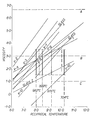
- the number of metal oxide complexes and compositions which may be used in accordance with the present invention is innumerable and it has been found the most useful way of describing the limits of useful materials is by means of a "forging window".
- the logarithm of the viscosity of the molten vitreous component should be between the drip point of 1 and 3.5, the preferred range of working viscosities being from 1.5 to 3.5, most preferably about 3.
- the best temperature range expressed in terms of reciprocal temperature is between approximately 10.0 and 8.00, corresponding to forging temperatures of 732°C to 955°C, which temperature range has been found particularly satisfactory for the isothermal forging and sizing of titanium and titanium alloy workpieces in superalloy dies.
- the "forging window" is shown in the graph forming the Figure between the viscosity limits of 1.5 to 3.5 expressed as the logarithm of the viscosity in Pascal seconds and between the operating temperatures of 732°C and 955°C.
- Reciprocal temperatures are used in the Figure for the sake of convenience so that the resultant curves for the various vitreous materials will appear as nearly straight lines.
- "Reciprocal temperature” is defined as 10,000 divided by the absolute temperature of forging expressed in degrees Kelvin. Any glass composition falling within the "forging window” referred to above for the particular forging operation to be performed, and giving due consideration to reactivity with the workpiece, contamination of the workpiece or dies, and reactivity with the die materials, may be used.
- Each forging system that is, die material and workpiece material
- has its own “forging window” which, in general, will vary laterally on the graph of the Figure with the temperature of the forging operation.
- glass V-6 is an acceptable vitreous material for use in the method according to the present invention, as within the temperature range of 815°C to 927°C, it has a viscosity curve which is acceptably within the "forging window".
- Glass V-2 is outside the "forging window” for titanium alloy being worked in nickel-chromium superalloy dies; it may, however, be within the "forging window” for use in dies or with metals where higher temperatures of forging and/or sizing can be utilized.
- Glasses X, Y and Z are, respectively, silicate glass containing 31% lead oxide, silicate glass containing 39% sodium (as oxide), and pure boron oxide.
- the vertical black bars in the Figure are illustrative of preferred working ranges within the "forging window" at the indicated temperatures. If the viscosity curve for a particular glass crosses the black line at the predetermined forging temperature, the glass may be used. Secondary considerations as to usefulness involve reactivity of the glass with the workpiece and/or dies, and contamination of the workpiece and/or dies. Sulphur- or arsenic- containing vitreous materials and those containing appreciable percentages of alkali metal oxides are generally avoided in titanium metal forging for contamination and die life reasons.
- the dotted line A across the top of the graph indicates the viscosity at the softening point of the glasses.
- the preferred working point is shown by horizontal dotted line B and is at a viscosity of 3.0.
- (Horizontal dotted line C represents the drip point.) Satisfactory results are obtained, in general, with a viscosity of from 1.5 to 3.5, the preferred range being from 1.8 to 3.2.
- vitreous compositions suitable for use in accordance with the invention.
- the vitreous materials contain substantial amounts, i.e. 30% to 70% by weight of the glass, of silica; boron oxide, or a mixture of silicon and boron oxides.
- alkali metal oxides tend to be corrosive to superalloy die materials and the alkali metal oxide content is therefore desirably limited to less than 5% by weight, more preferably below 2%.
- the metal oxide or mixture of metal oxides from which the vitreous component is made is used in finely divided form, the average particle size thereof being preferably from 1 to 74 microns, more preferably from 2 to 40 microns.
- a convenient and useful screen size is less than 44 ⁇ m (-325 mesh).
- the vitreous material is generally available commercially as a glass frit which may have a wide variety of chemical composition such as set forth in the table above, the composition of the vitreous material used being selected with the isothermal forging or sizing conditions in mind so that the working characteristics of the vitreous component under isothermal shaping conditions is within the "forging window" illustrated in the Figure.
- the vitreous material is dispersed in a solution of an organic binder, together with the lubricant material.
- the solvent and the organic binder may be the same as those present in the suspension of the solid lubricant material, but if they are not the same, they should-be compatible therewith.
- a precoat composition formed from commercially available vitreous materials e.g. a borosilicate glass frit V-1 1 in Table I above, ball milled using ceramic balls for a period of 24 hours at a solids concentration of between 15% to 35% by weight in the organic medium, produces a vitreous material which has a particle size such that less than about 2% of the vitreous component is retained upon 74 ⁇ m (200 mesh) screen, U.S. standard sieve sizes, which may then be mixed with a suspension of the lubricant material for use as the precoat composition in the method according to the invention. It is preferred that the vitreous material undergoes size reduction separately from the solid lubricant material which normally already has a very fine particle size. The materials may, however, be ground together if desired.
- any suitable milling procedure such as impact dry grinding in a "micronizer”, or dispersion grinding in a “sandmill” (see U.S. Patent 2,581,414) may be used.
- the solid lubricant material used in the method according to the invention is graphite, boron nitride, or a mixture of graphite and boron nitride.
- Graphite is preferred, because boron nitride tends to accumulate in the dies.
- the lubricant material may be blended into the precoat composition in dry powdered form, or used as commercially available dispersions of the solid lubricant in an organic solvent, for example, an alcohol, xylene or an aliphatic hydrocarbon.
- organic solvent for example, an alcohol, xylene or an aliphatic hydrocarbon.
- Such dispersions may include a polymeric binder, such as a polymethyl silicone, and organic suspended agents may be included in the dispersions to improve the stability thereof, if desired (such suspending agents being thermally decomposed or volatilized with the other organic materials during pre-heating of the workpiece).
- a commercially available material which is a suspension of extremely finely divided electric furnace graphite (less than 74 ,um) (minus 200 mesh) in alcohol is Acheson No. 154 which contains from 20% solids in an isopropanol vehicle.
- the particle size of the graphite is in general 10 microns and under, and for best results ranges between 6 microns and 0.5 microns.
- the above described essential components of the lubricant compositions are those which exist under forging or sizing conditions.
- the vitreous material and the solid lubricant are suspended in an organic medium or carrier liquid, which enables the lubricating composition to be applied to the workpiece by any convenient method such as brushing, spraying or dipping.
- a solids concentration (including the resin) should be from 10% to 30% by weight.
- the chemical nature of the organic materials should be such that they produce a suitable composition by means of which the lubricant composition can be applied to the workpiece surface.
- the precoat ingredients include, therefore, an organic solvent and/or diluent and a polymeric binder as the carrier medium.
- the solvent is removed from the workpiece by evaporation during a preliminary preheat cycle, and the polymeric binder is removed by thermal decomposition during the final preheat cycle.
- the polymeric binder is preferably a polymer which is non-charring at decomposition temperatures and one that has good "green strength" after low temperature preheating of the coated workpiece at 66°C to 121 °C, for example, 82-93°C. This enables transfer of the preheated workpiece to an oven for preheating to attain a temperature near shaping temperature.
- the particular solvent used will be determined largely by the nature of the polymeric binder and the amount by the selected mode of application. Any volatile solvent or solvent/diluent composition may be used so long as it dissolves or extends the resinous material.
- a suitable solvent is methyl acrylate monomer, isopropyl alcohol or xylene
- the polymeric binder is an acrylonitrile polymer, acrylonitrile monomer may be used as the solvent
- polystyrene is the polymeric binder, monomeric styrene may be used as the solvent.
- Numerous other polymeric binders can be used and suitable solvents and diluents therefor are well known.
- Suitable solvents include, for example, aromatic solvents, such as xylene, toluene and benzene; alcohols, such as isopropyl alcohol and ethyl alcohol; ethers, such as 2-butoxyethanol; or hydrocarbons such as mineral spirits, naphtha or cyclohexane.
- polymeric binders are polyethylene, polybutene, polypropylene, polyvinylchloride, silicone resins, epoxy resins, alkyd resins, oil modified alkyd resins and drying oils, for example, linseed oil.
- Silicone resins (such as polymethyl siloxanes) are particularly suitable because they decompose to SiO 2 , a useful vitreous material.
- Non-charring polymers such as polymethyl methacrylate (such as that available under the Trade Mark Plexiglas) or polybutene are preferred.
- the vitreous material and the solid lubricant are present in particulate form, the weight ratio of lubricant to vitreous material being at least 1:1, for example, up to 9.5:1.
- these ingredients are insoluble in the solvent used, they must be dispersed therein in an amount sufficient to yield a sprayable, brushable, or liquid bath composition for dipping or immersion of the workpiece.
- Formulation of the compositions to any of these modes of application will be well known to those skilled in the art, and will be readily apparent from the specific examples which follow.
- precoat compositions containing 5 to 30% by weight of solids (including the resin) will be suitable for spraying, brushing or dipping. Higher solids concentrations, for example, about 40% by weight, may be used for other modes of application, e.g., knife coating, if desired.
- the precoat composition is preferably agitated so as to limit settling and separation of the solids during application.
- the lubricant composition is the residue remaining after evaporation of the solvent and thermal decomposition or depolymerisation of the polymeric binder material.
- the residue is composed of the lubricant material and the vitreous material, the latter being present in an amount of not more than 50%, and preferably not more than 40%, based on the weight of lubricant material and vitreous material with the lubricant material preferably constituting the balance of the lubricant composition. Minor amounts of other materials may be present, if desired.
- the concentration of the lubricant material will vary slightly depending on whether the isothermal shaping operation is forging or sizing, more lubricant material being used in sizing than in forging.
- the precoat composition properly selected for the temperature of shaping is applied to the workpiece as one or more coats, e.g., 3 applications.
- a coating thickness prior to firing of from about 0,25-3,81 fl m is generally satisfactory.
- the wet workpiece is then generally dried in an oven at a temperature sufficient to remove solvent and/or diluent and set the polymeric binder, the oven temperature being, for example, in the range 66°C to 121 °C, preferably 82°Cto 110°C the latter range being especially suitable for a "polymethylmethacrylate resin binder, whereby a precoated workpiece having sufficient "green strength" to allow handling thereof with tongs without damaging the coating is produced.
- the workpiece is then heated in a furnace to a temperature of 538°C to 760°C for from 1 to 30 minutes, depending on the size of the workpiece, to decompose the organic portion of the coating and leave the glass/solid lubricant composition on the surface.
- the coated workpiece is thus preheated, nearly to the sizing or forging temperature, which minimizes the time required for the heated dies to reach the forging or sizing temperature.
- the workpiece is then transferred to a preheated die system, such as a horizontally split 2-piece die. Thereafter, the die-workpiece assembly attains the shaping temperature and pressure using, for example, hydraulic means applied to the workpiece until shaping is complete and the workpiece is stress relieved.
- the pressure is released and the workpiece is released from the die. It may then be cooled at a controlled rate, or spontaneously air cooled, and then cleaned by sand blasting, immersion in molten salt, or other chemical means. The cycle may then be repeated.
- Ti-6A1-4.V which has the following analysis (in percentages by weight):
- a typical nickel-base superalloy for use as the die material has the following analysis (in percentages by weight):
- a typical iron-base superalloy for use as the die material has the following analysis (in percentages by weight):
- a 51% graphite precoat composition having the following formulation was made up: Prior to fomulation, the binder, the B 2 O 3 , the frit and a portion of the xylene were ball milled for 24 hours using ceramic balls to less than 74,um (-200 mesh.) The graphite dispersion was added and xylene added to a solids content 3096 (including the binder). The binder was found to decompose to leave a residue of 7.7 grams of silica.
- This precoat compositon in bulk was agitated with air to maintain the suspension and a titanium alloy aircraft part preheated to about 38°C was immersed in the composition. The coating was allowed to dry in air.
- the part was then isothermally forged in superalloy dies in accordance with the procedure outlined below.
- the part was then in "net” shape.
- the procedure was repeated using sizing dies of superalloy composition to the final size.
- the resultant shaped product was free of surface blemishes and was commercially acceptable.
- a precoat sizing composition containing graphite and vitreous components in a 7.1:1 ratio was made up as follows:
- This composition is especially suited to isothermal sizing and may be used following Example 1 above for the final isothermal sizing operation.
- the siloxane portion of the binder decomposes to leave a residue of 2.1 gms of silica.
- a sprayable precoat composition for isothermal forging which includes graphite and vitreous components in a weight ratio of about 5.0:1 is as follows:
- composition which was especially useful for isothermal forging at the upper end of the temperature range and which can be applied to a workpiece as a thick layer, was made up as follows:
- a precoat composition having the following formulation was made up:
- This example illustrates a composition having a mixed binder and mixed graphite-boron nitride solid lubricant.
- the ratio of solid lubricant to vitreous material was 1.7:1.
- a precoat composition having the following formulation was made up:
- This example illustrates a composition containing a boron nitride solid lubricant system, in which the ratio of solid lubricant to vitreous component was 3:1.
Landscapes
- Chemical & Material Sciences (AREA)
- Chemical Kinetics & Catalysis (AREA)
- General Chemical & Material Sciences (AREA)
- Oil, Petroleum & Natural Gas (AREA)
- Organic Chemistry (AREA)
- Engineering & Computer Science (AREA)
- Mechanical Engineering (AREA)
- Forging (AREA)
- Lubricants (AREA)
Applications Claiming Priority (2)
| Application Number | Priority Date | Filing Date | Title |
|---|---|---|---|
| US928395 | 1978-07-27 | ||
| US05/928,395 US4281528A (en) | 1978-07-27 | 1978-07-27 | Process for isothermally shaping a titanium-containing metal workpiece |
Publications (2)
| Publication Number | Publication Date |
|---|---|
| EP0007793A1 EP0007793A1 (en) | 1980-02-06 |
| EP0007793B1 true EP0007793B1 (en) | 1982-08-25 |
Family
ID=25456187
Family Applications (1)
| Application Number | Title | Priority Date | Filing Date |
|---|---|---|---|
| EP79301467A Expired EP0007793B1 (en) | 1978-07-27 | 1979-07-24 | Isothermal shaping of titanium-containing workpieces |
Country Status (7)
| Country | Link |
|---|---|
| US (1) | US4281528A (OSRAM) |
| EP (1) | EP0007793B1 (OSRAM) |
| JP (1) | JPS5519494A (OSRAM) |
| AU (1) | AU529637B2 (OSRAM) |
| CA (1) | CA1119020A (OSRAM) |
| DE (1) | DE2963581D1 (OSRAM) |
| IL (1) | IL57763A (OSRAM) |
Families Citing this family (23)
| Publication number | Priority date | Publication date | Assignee | Title |
|---|---|---|---|---|
| US4358544A (en) * | 1980-07-04 | 1982-11-09 | Daniel Doncaster & Sons Limited | Single phase glass compositions for use in protective and lubricating coatings for the heat treatment and hot working of metals |
| US4595473A (en) * | 1984-08-28 | 1986-06-17 | Trw Inc. | Forging lubricant |
| US4674672A (en) * | 1986-03-17 | 1987-06-23 | Alcotec Wire Co. | Process for welding aluminum articles |
| JPS636093A (ja) * | 1986-06-27 | 1988-01-12 | Shin Etsu Chem Co Ltd | 窒化ほう素含有離型用または潤滑用組成物 |
| US4780226A (en) * | 1987-08-03 | 1988-10-25 | General Motors Corporation | Lubrication for hot working rare earth-transition metal alloys |
| EP0553197B1 (en) * | 1990-10-19 | 1994-07-27 | United Technologies Corporation | Rheologically controlled glass lubricant for hot metal working |
| US5242506A (en) * | 1990-10-19 | 1993-09-07 | United Technologies Corporation | Rheologically controlled glass lubricant for hot metal working |
| JPH0517795A (ja) * | 1991-07-17 | 1993-01-26 | Hanano Shoji Kk | アルミニウム合金鍛造用粉末潤滑剤 |
| FR2716398B1 (fr) * | 1994-02-22 | 1996-05-24 | Seva | Procédé de fabrication d'un élément d'enceinte de fluide. |
| KR100207103B1 (ko) * | 1994-12-16 | 1999-07-15 | 정몽규 | 티타늄 합금재의 표면 처리 방법 |
| ZA963198B (en) * | 1995-05-16 | 1996-10-25 | Timcal Ltd | Lubricant composition for use on workpieces in the hot forming of metals |
| GB2434153A (en) * | 2006-01-16 | 2007-07-18 | L & S Fluids Ltd | Boron nitride dry-film lubricant compositions |
| MX2008013368A (es) * | 2006-04-24 | 2009-03-20 | Sumitomo Metal Ind | Una composicion de lubricante para trabajar metal en caliente y metodo para trabajar metal en caliente mediante el uso del mismo. |
| DE102009009124A1 (de) * | 2008-10-24 | 2010-04-29 | Paul Hettich Gmbh & Co. Kg | Auszugsführung für Haushaltsgeräte |
| US8549889B2 (en) | 2010-11-09 | 2013-10-08 | GM Global Technology Operations LLC | Metal forming process |
| US9192973B1 (en) | 2013-03-13 | 2015-11-24 | Meier Tool & Engineering, Inc. | Drawing process for titanium |
| JP2014213365A (ja) * | 2013-04-26 | 2014-11-17 | 株式会社神戸製鋼所 | 熱間鍛造方法 |
| JP6045434B2 (ja) * | 2013-04-26 | 2016-12-14 | 株式会社神戸製鋼所 | 熱間鍛造方法 |
| JP6399297B2 (ja) * | 2013-10-01 | 2018-10-03 | 日立金属株式会社 | 熱間鍛造方法 |
| CN110337335B (zh) * | 2016-12-21 | 2021-04-20 | 日立金属株式会社 | 热锻材的制造方法 |
| US10793800B2 (en) * | 2017-02-07 | 2020-10-06 | Aero Accessories, Llc | Lubricant compositions and methods of use |
| CN116967380B (zh) * | 2023-07-26 | 2025-09-26 | 江西景航航空锻铸有限公司 | 一种tc4航空锻件壳体的加工方法 |
| JP7782758B1 (ja) * | 2024-03-06 | 2025-12-09 | 株式会社プロテリアル | 熱間鍛造材の製造方法 |
Family Cites Families (11)
| Publication number | Priority date | Publication date | Assignee | Title |
|---|---|---|---|---|
| ES256960A1 (es) | 1959-04-14 | 1960-07-01 | Ompagnie Du Filage Et Des Join | Metodo de extrusiën provista de un troquel en un extremo |
| US3154849A (en) * | 1961-01-18 | 1964-11-03 | Thompson Ramo Wooldridge Inc | Metal forging process |
| US3254401A (en) * | 1964-07-10 | 1966-06-07 | Corning Glass Works | Protection and lubrication of metals at high temperatures |
| US3384580A (en) * | 1967-05-09 | 1968-05-21 | Acheson Ind Inc | Graphite dispersions |
| US3411564A (en) * | 1967-05-17 | 1968-11-19 | Dresser Ind | Continuous casting of steel |
| US3584487A (en) * | 1969-01-16 | 1971-06-15 | Arne H Carlson | Precision forming of titanium alloys and the like by use of induction heating |
| US3635068A (en) * | 1969-05-07 | 1972-01-18 | Iit Res Inst | Hot forming of titanium and titanium alloys |
| US3575858A (en) * | 1969-05-20 | 1971-04-20 | Us Air Force | Lubricating composition consisting of perarylated silanes and solid lubricant powders |
| GB1371204A (en) * | 1970-09-25 | 1974-10-23 | Inst De Quimica Fisica Rocasol | Lubrication of metal surfaces |
| US4096076A (en) * | 1976-01-29 | 1978-06-20 | Trw Inc. | Forging compound |
| US4055975A (en) * | 1977-04-01 | 1977-11-01 | Lockheed Aircraft Corporation | Precision forging of titanium |
-
1978
- 1978-07-27 US US05/928,395 patent/US4281528A/en not_active Expired - Lifetime
-
1979
- 1979-07-10 IL IL57763A patent/IL57763A/xx unknown
- 1979-07-16 JP JP9024279A patent/JPS5519494A/ja active Granted
- 1979-07-17 CA CA000331986A patent/CA1119020A/en not_active Expired
- 1979-07-20 AU AU49100/79A patent/AU529637B2/en not_active Ceased
- 1979-07-24 EP EP79301467A patent/EP0007793B1/en not_active Expired
- 1979-07-24 DE DE7979301467T patent/DE2963581D1/de not_active Expired
Also Published As
| Publication number | Publication date |
|---|---|
| JPS6157094B2 (OSRAM) | 1986-12-05 |
| EP0007793A1 (en) | 1980-02-06 |
| IL57763A0 (en) | 1979-11-30 |
| DE2963581D1 (en) | 1982-10-21 |
| AU4910079A (en) | 1980-01-31 |
| US4281528A (en) | 1981-08-04 |
| CA1119020A (en) | 1982-03-02 |
| AU529637B2 (en) | 1983-06-16 |
| IL57763A (en) | 1981-12-31 |
| JPS5519494A (en) | 1980-02-12 |
Similar Documents
| Publication | Publication Date | Title |
|---|---|---|
| EP0007793A1 (en) | Isothermal shaping of titanium-containing workpieces | |
| US4154075A (en) | Method of hot die isothermal dwell forging | |
| US4003867A (en) | Glass mold coating dispersion of aluminum phosphate and resinous agent, pigment, stabilizer and dispersing agents | |
| US4039337A (en) | Release coating for glass manufacture | |
| US2588625A (en) | Forging lubricant and method of using same | |
| EP0293064A2 (en) | Sol-gel method for making ultra-low expansion glass | |
| US4183236A (en) | Method of isothermal forging | |
| DE2458417B2 (de) | Trenn- und schmiermitteldispersion | |
| US3035318A (en) | Method of casting metal in a coated mold, and composition and method for coating the casting mold | |
| CN110483986A (zh) | 一种选择性激光烧结用尼龙12余粉的回收利用方法 | |
| EP0295074B1 (en) | Environmentally acceptable forging lubricants: and a method of hot forging using same | |
| US4071368A (en) | Mold release composition | |
| JP2918689B2 (ja) | 溶銑加工用レオロジー制御ガラス潤滑剤 | |
| US5242506A (en) | Rheologically controlled glass lubricant for hot metal working | |
| US3915870A (en) | Mold release composition containing tungsten disulfide | |
| CA1047705A (en) | Release coating for glass manufacture | |
| US5495737A (en) | Elevated temperature metal forming lubrication | |
| US6409813B1 (en) | Glass-release coating, coating process, and coated parts for manufacturing glass | |
| WO2009007093A2 (de) | Schlichtesystem zum schutz von giesswerkzeugen | |
| US4358544A (en) | Single phase glass compositions for use in protective and lubricating coatings for the heat treatment and hot working of metals | |
| US2756493A (en) | Forging with fusible coating | |
| US4162163A (en) | Coating for gold or gold alloy castings for dental bridges and crowns | |
| US2715765A (en) | Hot working vanadium | |
| US4013570A (en) | Graphite and copper in hot forging liquid lubricant | |
| GB1370253A (en) | Method of brazing |
Legal Events
| Date | Code | Title | Description |
|---|---|---|---|
| PUAI | Public reference made under article 153(3) epc to a published international application that has entered the european phase |
Free format text: ORIGINAL CODE: 0009012 |
|
| AK | Designated contracting states |
Designated state(s): BE DE FR GB IT SE |
|
| 17P | Request for examination filed | ||
| ITF | It: translation for a ep patent filed | ||
| GRAA | (expected) grant |
Free format text: ORIGINAL CODE: 0009210 |
|
| AK | Designated contracting states |
Designated state(s): BE DE FR GB IT SE |
|
| REF | Corresponds to: |
Ref document number: 2963581 Country of ref document: DE Date of ref document: 19821021 |
|
| PGFP | Annual fee paid to national office [announced via postgrant information from national office to epo] |
Ref country code: DE Payment date: 19840619 Year of fee payment: 6 |
|
| PGFP | Annual fee paid to national office [announced via postgrant information from national office to epo] |
Ref country code: FR Payment date: 19840813 Year of fee payment: 6 |
|
| PGFP | Annual fee paid to national office [announced via postgrant information from national office to epo] |
Ref country code: SE Payment date: 19840930 Year of fee payment: 6 Ref country code: BE Payment date: 19840930 Year of fee payment: 6 |
|
| PG25 | Lapsed in a contracting state [announced via postgrant information from national office to epo] |
Ref country code: SE Effective date: 19870725 |
|
| BERE | Be: lapsed |
Owner name: TRW INC. Effective date: 19870731 |
|
| PG25 | Lapsed in a contracting state [announced via postgrant information from national office to epo] |
Ref country code: FR Free format text: LAPSE BECAUSE OF NON-PAYMENT OF DUE FEES Effective date: 19880331 |
|
| PG25 | Lapsed in a contracting state [announced via postgrant information from national office to epo] |
Ref country code: DE Effective date: 19880401 |
|
| GBPC | Gb: european patent ceased through non-payment of renewal fee | ||
| REG | Reference to a national code |
Ref country code: FR Ref legal event code: ST |
|
| PG25 | Lapsed in a contracting state [announced via postgrant information from national office to epo] |
Ref country code: GB Free format text: LAPSE BECAUSE OF NON-PAYMENT OF DUE FEES Effective date: 19881118 |
|
| PG25 | Lapsed in a contracting state [announced via postgrant information from national office to epo] |
Ref country code: BE Effective date: 19890731 |
|
| EUG | Se: european patent has lapsed |
Ref document number: 79301467.1 Effective date: 19880831 |
|
| PLBE | No opposition filed within time limit |
Free format text: ORIGINAL CODE: 0009261 |
|
| STAA | Information on the status of an ep patent application or granted ep patent |
Free format text: STATUS: NO OPPOSITION FILED WITHIN TIME LIMIT |