EP0004231B1 - Procédé et installation d'acidulation du lait, notamment pour la préparation de la caséine et lactosérum obtenu - Google Patents
Procédé et installation d'acidulation du lait, notamment pour la préparation de la caséine et lactosérum obtenu Download PDFInfo
- Publication number
- EP0004231B1 EP0004231B1 EP79400131A EP79400131A EP0004231B1 EP 0004231 B1 EP0004231 B1 EP 0004231B1 EP 79400131 A EP79400131 A EP 79400131A EP 79400131 A EP79400131 A EP 79400131A EP 0004231 B1 EP0004231 B1 EP 0004231B1
- Authority
- EP
- European Patent Office
- Prior art keywords
- milk
- resin
- casein
- conduit
- weight
- Prior art date
- Legal status (The legal status is an assumption and is not a legal conclusion. Google has not performed a legal analysis and makes no representation as to the accuracy of the status listed.)
- Expired
Links
Images
Classifications
-
- A—HUMAN NECESSITIES
- A23—FOODS OR FOODSTUFFS; TREATMENT THEREOF, NOT COVERED BY OTHER CLASSES
- A23C—DAIRY PRODUCTS, e.g. MILK, BUTTER OR CHEESE; MILK OR CHEESE SUBSTITUTES; MAKING OR TREATMENT THEREOF
- A23C9/00—Milk preparations; Milk powder or milk powder preparations
- A23C9/14—Milk preparations; Milk powder or milk powder preparations in which the chemical composition of the milk is modified by non-chemical treatment
- A23C9/146—Milk preparations; Milk powder or milk powder preparations in which the chemical composition of the milk is modified by non-chemical treatment by ion-exchange
-
- A—HUMAN NECESSITIES
- A23—FOODS OR FOODSTUFFS; TREATMENT THEREOF, NOT COVERED BY OTHER CLASSES
- A23J—PROTEIN COMPOSITIONS FOR FOODSTUFFS; WORKING-UP PROTEINS FOR FOODSTUFFS; PHOSPHATIDE COMPOSITIONS FOR FOODSTUFFS
- A23J1/00—Obtaining protein compositions for foodstuffs; Bulk opening of eggs and separation of yolks from whites
- A23J1/20—Obtaining protein compositions for foodstuffs; Bulk opening of eggs and separation of yolks from whites from milk, e.g. casein; from whey
- A23J1/202—Casein or caseinates
Definitions
- the present invention relates to the treatment of milk and lactic materials. More particularly, the invention relates to processes for acidifying milk, to the installations provided for this purpose and to the products resulting from these treatments.
- skimmed milk having a pH between about 6.6 and 6.8. It is a mixture of an aqueous phase and a colloidal phase.
- the aqueous phase contains lactose, water-soluble vitamins, mineral salts in solution and serum proteins.
- Protein nitrogen which accounts for about 95% of total nitrogen, includes casein, about 78% by weight, serum proteins, about 16% by weight, and 1% minor proteins, such as lactotransferrin, lactollin, fatty cell membranes, enzymes.
- the serum proteins are in particular the thermostable peptone proteoses (4 to 6%) and the thermolabile albumins and globulins, such as the B lactoglobulins (from 5 to 7% approximately) the ⁇ -lactalbumin (approximately 1 to 3%); serum albumin (approximately 0.5% to 1.5%) and immunoglobulins (approximately 2 to 4%).
- Casein the average content of which in cow's milk is approximately 27 grams per liter, includes ⁇ -caseins (45%), in particular ace, casein and K-caseins (15%) in particular para K casein ( 9%) and glycopeptides (3%), as well as B-casein and casein.
- casein is the protein compound that is precipitated from milk at pH 4.6. This complex is also called isoelectric (or Hammarsten casein). Casein has many uses, especially in the food industry and in the adhesive industry.
- Casein is characterized by its preparation process and a distinction is made in particular between lactic casein and hydrochloric casein.
- milk is spontaneously fermented.
- the acidity is poretée at 90 ° Dornic approximately (10 ° Dornic corresponds to 1 ml of normal soda per gram). It has also been proposed to add milk to acidifying ferments, such as Str. Cremoris, Str. Lactis, to reach a pH of 4.5 in a dozen hours.
- lactic casein The serious drawback of lactic casein is the need to store large volumes for fermentation for extended periods of time.
- the washed casein is then pressed on a horizontal decanter to remove as much free water as possible from the curd (dry extract 45 to 50% by weight) and entered into a dryer.
- the pressed curd which is in the form of a cake, must be granulated.
- the drying is generally carried out on a fluidized bed drier.
- a hydrochloric casein whey contains 12 to 14% by weight of mineral matter relative to the dry extract and approximately 7 to 8% by weight, or even more of chlorides.
- German patent 1,270,938 proposes a treatment with resins in Na form to exchange calcium.
- French patent 1,469,793 it is proposed to lower the pH of skimmed milk by adding whey (whey) whose pH has been lowered by ion exchange using resin under form H. This process involves a concentration of whey at 60-65%, crystallization, separation of lactose, dilution with soft whey and heating, all independently of the coagulation operation itself. called milk. He is complicated. It is expensive. The processed milk largely retains its mineral matter which is found in the whey.
- the invention remedies these drawbacks by gentle acidification of skimmed milk, without adding unnecessary anions which can be applied on a large scale to industry and which makes it possible to save acid.
- the Applicant has in fact taken up the idea of acidifying the milk by bringing it into contact with cationic resin in H + form .
- the resin exchanges its H + cations with the cations of the milk metals. There is thus no charge of anions.
- the acidulated skimmed milk is separated from the resin beads and the acidulation is terminated with a dilute acid, for example with dilute HCl, until a pH of approximately 4.6 is obtained. It is then finished in the conventional manner by separating the curd and the serum, and by washing, pressing and drying the casein.
- a dilute acid for example with dilute HCl
- the first acidification stage according to the invention is carried out by bringing the milk, in particular the skimmed milk, into contact with cationic resins in H form.
- resin conventional cationic resins can be used, for example under the brands Amberlite from Rohm & Haas, Duolite from Diamond Alkali Co., Kastel, Couvex (copolymers of styrene and divinylbenzene with functional exchange groups), Lewalit, Relite , Zerolit etc.
- those of the macroporous type which are more resistant, are preferred to those of the gel type (Lewatit S100 or Duolite C20).
- the density of the resin is close to that of milk, for example around 1.035.
- the size of the beads is preferably between approximately 0.5 and 1 mm. It is important that the size of the balls is uniform to ensure a very uniform distribution of the balls in the skimmed milk and to avoid any local coagulation on a ball that is too heavy or too light to be moved by stirring the suspension. Too light a ball would remain on the surface of the suspension. As the milk balls must then be separated, it is preferred that the balls have a sufficient size to be rejected by a separation sieve.
- the ratio of the weight of skimmed milk to the weight of the beads can vary greatly depending on the duration of the treatment and the agitation of the suspension. This ratio is all the smaller the shorter the duration and the less agitation. In general, this ratio is between 1/6 and 1/20. For example, good results have been obtained with 80 to 100 ml of resins per 1 liter of milk, while stirring for 3 to 5 minutes with a magnetic stirrer. If necessary, the stirring can be completed by an air jet on the surface of the suspension, sent intermittently to avoid foaming, especially in the case of a large capacity tank. In general, durations of 1 to 30 minutes are suitable.
- the invention also relates to an installation for implementing the process, which comprises a container for receiving milk and the cationic resin, means for keeping the milk and the cationic resin in relative movement in the container and a pH meter, characterized by means, controlled by the pH meter, for selectively removing the milk or the resin when the pH of the milk reaches a given value.
- said selective removal means are constituted by the fact that the resin, in the form of balls, is in a basket whose mesh openings are smaller than the dimensions of the balls and by a device for removing the basket from the container.
- the serum obtained is very strongly acid and mineralized.
- a hydrochloric casein serum contains 12 to 14% of mineral matter, including 7 to 8% of chlorides expressed as sodium chloride.
- the acidity is between 50 and 60 ° Dornic.
- the whey according to the invention has a proportion by weight of mineral matter of less than 10% and better still less than 8%, and an ash alkalinity rate of less than 750 and better still less than 500, expressed in mg of Na l C0 3 per gram of ash.
- the casein obtained is also new. It is of excellent quality, more airy and firmer structure, also whiter and not having undergone a violent addition of acid and has interesting properties.
- Whey obtained by placing skimmed milk in contact with a cationic resin, differs from a conventional whey of hydrochloric casein mainly by a lower overall mineral content of 8 to 9% instead of 11 to 14% and a chloride content, expressed as NaCI, much lower, less than 3.5% instead of 6 to 8%, and lower sodium, potassium and calcium contents.
- the subject of the invention is therefore a whey characterized by a proportion by weight of mineral matter of less than 9% and by a proportion by weight of chlorides, expressed in NaCl, of less than 3.5%.
- the weight proportions of sodium and potassium are less than 1.0% and 3% respectively and that of calcium is between 1.5 and 2%. Although these last three ranges overlap those of a hydrochloric whey, the contents are low, so that the proportion by weight of the whole sodium, potassium and calcium is less than 5%, which is not the case for a hydrochloric whey.
- a subject of the invention is also a process for the preparation of casein from skimmed milk which consists in bringing skimmed milk into contact, with stirring, with a cationic resin in H form for a period allowing milk to be obtained, at a pH higher than 4.7 but lower than the pH of the initial milk and the resin saturated with metal ions, to separate the milk obtained from the saturated resin to coagulate the separated milk to obtain curd and serum which is separated , characterized in that it consists in regenerating the saturated resin with separate serum.
- the serum is concentrated before using it for regeneration. It is also possible to use concentrated serum to finish the coagulation or flocculation, in place of the acid usually used.
- the first stage of the casein preparation process according to the invention consists in bringing skimmed milk into contact with stirring, with a cationic resin in H form for a period allowing milk to be obtained at a pH greater than 4.7, but below the pH of the initial milk as described above.
- the second stage of the process according to the invention consists in separating the milk obtained, the pH of which has therefore been lowered but still remains above the flocculation point, from the resin saturated with metal ions.
- This separation can be carried out very simply on an inclined screen, the reflux of the screen represented by the resins sliding on the inclined side and being taken up by a conveyor, to be returned to a reservoir of resins to be regenerated, while the already acidulated milk is taken up by a pump to be sent in general to an intermediate storage, before being reheated, degassed and coagulated in a coagulation tube where the third stage of the process according to the invention takes place.
- the fourth stage of the process according to the invention consists in separating the quail or solid matter formed during the coagulation of the liquid serum.
- an inclined sieve can be used, allowing the curd to fall into a curd dilution tank before it goes to a washing tower, to a decanter and to a conventional dryer in the caseinery, while, in accordance to the invention, the serum is returned, if necessary after evaporation, to the reservoir where the resin to be regenerated is located, thus thus using the residual acidity of the serum for useful purposes. If necessary, this acidity of the serum can also be used to replace all or part of the acid necessary for the completion of coagulation in the coagulation tube.
- the invention also relates to a casein preparation installation comprising from upstream to downstream each apparatus communicating with the preceding apparatus, a container, equipped with a stirrer, for acidifying skimmed milk with resin, a sieve separating sour milk from saturated resin and a coagulation tube from sour milk, characterized by a separator, downstream of the tube, curd and serum formed in the coagulation tube, by two resin tanks, mounted in parallel and communicating, alternately with the container, by a means for loading the saturated resin coming from the sieve and by a conduit, connecting the serum side of the separator alternately to one and to the other reservoir.
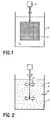
- FIGS. 1 and 2 are diagrams of two installations for implementing the method according to the invention
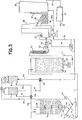
- FIG. 3 is a diagram of a casein factory.
- skimmed milk L is placed in a container 1.
- a basket 2 filled with resin beads of dimensions larger than the mesh opening of the basket, is agitated in the container 1.
- a pH meter indicates a certain pH value
- the basket 2 is removed from the container 1 using a hoist 3.
- an agitator 5 with a double skirt puts balls 6 of cationic resin in suspension in skimmed milk L contained in a container 7.
- a pH meter 8 indicates that the milk L has a pH of 4.9, the milk L is taken out of the container 7 while retaining the balls 6.
- FIG. 3 The casein installation of FIG. 3 comprises a container 1 a provided with an agitator 2a, open at the top, and from the bottom of which a conduit 3a on which is located a closing valve 4a.
- a conduit 5a opening at the top of the container 1a comprises a two-way valve 6a making it possible to put the conduit 5a in communication with a branch 7a or a branch 8a.
- the other end of the branch 7g opens out at the bottom of a reservoir 9 for cationic resin.
- the other end of the branch Sa opens out at the bottom of a reservoir 10 for cationic resin.
- the conduit 3a opens out above an inclined screen 11 whose side wall 12 and the bottom 13 of the support form a chamber 14 for recovering liquid milk whose pH is for example 5.0.
- a conduit 15 opening at the bottom of the chamber 14, and by a pump 16, this already acidulated milk is sent via a conduit 17, to a storage tank 18.
- the milk can pass through a conduit 19 provided with a valve in a tank 20 for launching the curdling chain. From the bottom of this tank 20, leaves a conduit 21 which opens at the top 22 of a conventional milk heating device.
- the milk is sent to a degassing device 24 then, from the latter, by a conduit 25 at the bottom of a coagulation tube 26 which can receive, via a conduit 27, from acid, especially hydrochloric acid intended to finish coagulation
- the solid curd falls into a dilution tank 30 to go, via a conduit 31, to a washing tower 32, then through a conduit 33, to a horizontal decanter 34, before going through a conduit 35, to a non-drying represented.
- the serum which has passed through the screen 29 and which, in fact, is a mixture of serum and fines, passes through a conduit 36 in a separator 37 for the fines.
- the separated casein fines are sent through a conduit 38a to the bottom of the washing tower 32.
- the serum freed from the fines leaves the separator 37 via a conduit 38 and goes, with the possibility of intermediate concentration in an evaporator 39, via a double-way valve 40, either to the tank 9 via a conduit 41, or to the tank 10 by a conduit 42.
- bypass duct 43 which opens at the start of the coagulation tube 26 or into the acid supply tube 27.
- the installation works as follows. Skim milk is loaded into the container 1 g, while the tank 9 is full of resin in H form and the tank 10 is full of resin saturated with metal ions.
- the valve 6 is closed.
- the container 1a and the reservoir 9 are placed in communication by operating the valve 6g, so that resin in H form arrives via the conduits 7a and 5a in the reservoir 1, while the agitator 2a is operating.
- the pH of the milk in the container 1 is close to 5.0.
- the valve 4a is opened and all the milk at a pH close to 5.0 and the resins suspended in it flows through the line 3a and arrives on the screen 11.
- the resins constitute the rejection of this screen and are sucked by a pump 44 and a conduit 45 dividing into a branch 46 and into a branch 47 leading respectively to the top of the tanks 9 and 10.
- the resins are sent by the branch 46 to the top of the tank 9 which has emptied its resins in the form of H, the communication between the tank 9 and the container 1 having been interrupted as soon as this tank has been emptied.
- the serum passes through the conduit 36, the separator 37 and the conduit 38, to go into the reservoir 10 where there is resin to be regenerated, the valve 40 preventing the passage of the acid in the reservoir 9.
- the position of the valve 40 is modified, so that the acid serum then arrives in the tank 9.
- the tank 10 is ready to play the same role as the tank 9 at the start of operation.
- washing tower could, in this installation, have smaller dimensions for the same capacity as those which it must have in conventional caseinery installations not using cationic resins for the acidulation of skim milk.
- Example 1 is used again, but operating at 50 ° C. The pH is lowered to 5.0 in 4 minutes.
Landscapes
- Life Sciences & Earth Sciences (AREA)
- Chemical & Material Sciences (AREA)
- Engineering & Computer Science (AREA)
- Food Science & Technology (AREA)
- Polymers & Plastics (AREA)
- Biochemistry (AREA)
- Dairy Products (AREA)
Applications Claiming Priority (2)
| Application Number | Priority Date | Filing Date | Title |
|---|---|---|---|
| FR7806006 | 1978-03-02 | ||
| FR7806006A FR2418626A1 (fr) | 1978-03-02 | 1978-03-02 | Procede et installations pour la preparation de la caseine a partir du lait et produits ainsi obtenus |
Publications (3)
| Publication Number | Publication Date |
|---|---|
| EP0004231A2 EP0004231A2 (fr) | 1979-09-19 |
| EP0004231A3 EP0004231A3 (en) | 1980-07-09 |
| EP0004231B1 true EP0004231B1 (fr) | 1983-02-09 |
Family
ID=9205250
Family Applications (1)
| Application Number | Title | Priority Date | Filing Date |
|---|---|---|---|
| EP79400131A Expired EP0004231B1 (fr) | 1978-03-02 | 1979-03-01 | Procédé et installation d'acidulation du lait, notamment pour la préparation de la caséine et lactosérum obtenu |
Country Status (17)
| Country | Link |
|---|---|
| US (1) | US4423081A (ro) |
| EP (1) | EP0004231B1 (ro) |
| JP (1) | JPS54163858A (ro) |
| AR (1) | AR219582A1 (ro) |
| AU (1) | AU520397B2 (ro) |
| BR (1) | BR7901176A (ro) |
| CA (1) | CA1110908A (ro) |
| CS (1) | CS227667B2 (ro) |
| DE (1) | DE2964686D1 (ro) |
| DK (1) | DK86579A (ro) |
| ES (1) | ES477919A1 (ro) |
| FR (1) | FR2418626A1 (ro) |
| HU (1) | HU178770B (ro) |
| NZ (1) | NZ189783A (ro) |
| PL (1) | PL213823A1 (ro) |
| RO (1) | RO77278A (ro) |
| SU (1) | SU880239A3 (ro) |
Families Citing this family (10)
| Publication number | Priority date | Publication date | Assignee | Title |
|---|---|---|---|---|
| DE3164983D1 (en) * | 1980-04-17 | 1984-08-30 | Bridel Laiteries | Decationized milk, process for treating milk by a cation exchange resin for the manufacture of decationized milk and use of the decationized milk in the manufacture of curdled milk casein for cheeses and lactoserum |
| FR2480568A1 (fr) * | 1980-04-17 | 1981-10-23 | Bridel Laiteries | Procede de traitement du lait par une resine echangeuse de cations en vue de la fabrication de la caseine et du lactoserum |
| FR2525867B1 (fr) * | 1982-04-29 | 1985-07-19 | Triballat Laiteries | Procede de traitement d'un produit lactoserique et produit proteinique en resultant |
| IE54979B1 (en) * | 1982-07-09 | 1990-04-11 | Bridel Laiteries | Process for treating milk with a cation-exchange resin for the preparation of decationised,acidified milk |
| DE3445223A1 (de) * | 1983-12-16 | 1985-10-03 | Martin Prof. Dr.-Ing. 3050 Wunstorf Herrmann | Verfahren zum ausfaellen von eiweiss bei milch und/oder molke |
| EP0153967B1 (fr) * | 1984-03-02 | 1988-04-27 | Societe Des Produits Nestle S.A. | Procédé de traitement de sous-produits laitiers |
| NL1019816C1 (nl) | 2002-01-22 | 2003-07-23 | Adriaan Cornelis Kweldam | Kaasmelkeiwit vezel, met een nieuwe eigenschap, gebakken kaasvlees smelt niet, kaas wel. |
| MD2469G2 (ro) * | 2002-06-18 | 2004-12-31 | Государственный Университет Молд0 | Procedeu de obţinere a agentului de coagulare catalitică a laptelui (variante), agent de coagulare catalitică a laptelui (variante) şi procedeu de coagulare catalitică a laptelui |
| EP2149307B1 (en) * | 2007-04-26 | 2014-08-06 | Meiji Co, Ltd. | Fermented whey preparation and method for producing the same |
| SE532738C2 (sv) * | 2008-01-30 | 2010-03-30 | Delaval Holding Ab | Arrangemang och metod vid mjölkprovtagning vid mjölkning av ett djur |
Family Cites Families (14)
| Publication number | Priority date | Publication date | Assignee | Title |
|---|---|---|---|---|
| US2477558A (en) * | 1945-04-26 | 1949-08-02 | M & R Dietetic Lab Inc | Preparation of high-grade crude lactose |
| US2477588A (en) * | 1946-02-08 | 1949-08-02 | George H Dumm | Hydraulic insole |
| US2503866A (en) * | 1946-04-12 | 1950-04-11 | M & R Dietetic Lab Inc | Preparation of a stabilized cream product |
| US2707152A (en) * | 1951-01-30 | 1955-04-26 | Chaney | Low-sodium milk and processes for producing same |
| US2708633A (en) * | 1951-07-14 | 1955-05-17 | Nat Dairy Res Lab Inc | High protein deionized milk and process of making the same |
| US2793953A (en) * | 1954-03-01 | 1957-05-28 | Carnation Co | Method for replacing cations in milk |
| US2879166A (en) * | 1956-04-25 | 1959-03-24 | Foremost Dairies Inc | Milk product having low sodium content and process of producing same |
| DE1270938B (de) * | 1960-11-15 | 1968-06-20 | Muensterlaendische Margarine W | Verfahren zur Herstellung saurer Milchmischgetraenke |
| US3020161A (en) * | 1961-01-19 | 1962-02-06 | Atomic Energy Commission | Process for removal of radionuclides from milk |
| FR1469793A (fr) * | 1966-02-22 | 1967-02-17 | Procédé de séparation de la caséine du lait en vue de la production de petit-lait pour la fabrication de lactose et de produits alimentaires | |
| US3615664A (en) * | 1969-12-05 | 1971-10-26 | Foremost Mckesson | Treatment of whey |
| FR2177562A1 (en) | 1972-03-29 | 1973-11-09 | Depince Ets | Continuous lactic casein prepn - by fermentation of skimmed milk |
| FR2331963A1 (fr) * | 1975-11-20 | 1977-06-17 | Zuid Nl Melkindustrie | Procede de fabrication de petit-lait ou de produits de petit-lait a partir de lait ecreme ou de ses melanges |
| SE414451B (sv) | 1977-05-10 | 1980-08-04 | Svenska Mejeriernas Riksforeni | Sett att avsalta vassle genom jonbyte samt anordning |
-
1978
- 1978-03-02 FR FR7806006A patent/FR2418626A1/fr active Granted
-
1979
- 1979-02-20 CS CS791130A patent/CS227667B2/cs unknown
- 1979-02-21 ES ES477919A patent/ES477919A1/es not_active Expired
- 1979-02-22 BR BR7901176A patent/BR7901176A/pt unknown
- 1979-02-26 CA CA322,285A patent/CA1110908A/en not_active Expired
- 1979-02-27 NZ NZ189783A patent/NZ189783A/xx unknown
- 1979-02-28 AU AU44662/79A patent/AU520397B2/en not_active Ceased
- 1979-03-01 RO RO7996754A patent/RO77278A/ro unknown
- 1979-03-01 PL PL21382379A patent/PL213823A1/xx unknown
- 1979-03-01 DE DE7979400131T patent/DE2964686D1/de not_active Expired
- 1979-03-01 DK DK86579A patent/DK86579A/da not_active Application Discontinuation
- 1979-03-01 HU HU79TI274A patent/HU178770B/hu unknown
- 1979-03-01 EP EP79400131A patent/EP0004231B1/fr not_active Expired
- 1979-03-01 SU SU792733598A patent/SU880239A3/ru active
- 1979-03-02 AR AR275684A patent/AR219582A1/es active
- 1979-03-02 JP JP2501079A patent/JPS54163858A/ja active Pending
-
1980
- 1980-11-18 US US06/207,927 patent/US4423081A/en not_active Expired - Lifetime
Also Published As
| Publication number | Publication date |
|---|---|
| PL213823A1 (ro) | 1980-07-01 |
| BR7901176A (pt) | 1979-11-20 |
| AU520397B2 (en) | 1982-01-28 |
| EP0004231A2 (fr) | 1979-09-19 |
| FR2418626A1 (fr) | 1979-09-28 |
| DE2964686D1 (en) | 1983-03-17 |
| NZ189783A (en) | 1981-10-19 |
| JPS54163858A (en) | 1979-12-26 |
| DK86579A (da) | 1979-09-03 |
| SU880239A3 (ru) | 1981-11-07 |
| RO77278A (ro) | 1982-04-12 |
| AR219582A1 (es) | 1980-08-29 |
| HU178770B (en) | 1982-06-28 |
| ES477919A1 (es) | 1980-04-01 |
| EP0004231A3 (en) | 1980-07-09 |
| FR2418626B1 (ro) | 1982-05-14 |
| CS227667B2 (en) | 1984-05-14 |
| CA1110908A (en) | 1981-10-20 |
| US4423081A (en) | 1983-12-27 |
| AU4466279A (en) | 1979-09-06 |
Similar Documents
| Publication | Publication Date | Title |
|---|---|---|
| EP0038732B1 (fr) | Lait décationisé, procédé de traitement du lait par une résine échangeuse de cations pour la fabrication du lait décationisé, et utilisation du lait décationisé pour la fabrication de la caséine du caillé de lait pour fromages et du lactosérum | |
| EP0004231B1 (fr) | Procédé et installation d'acidulation du lait, notamment pour la préparation de la caséine et lactosérum obtenu | |
| WO1998053702A1 (fr) | Procede de traitement d'une matiere premiere lactique contenant du gmp | |
| EP0368864A1 (en) | PROTEIN FRACTIONS OF SMALL MILK. | |
| EP0209414B1 (fr) | Procédé de séparation sélective de l'alpha-lactalbumine des protéines du lactosérum | |
| EP0398802A1 (fr) | Procédé d'élimination sélective et quantitative des lactoglobulines à partir d'une matière de départ contenant des protéines de lactosérum | |
| EP0511277B1 (fr) | Procede de traitement du lait ecreme | |
| FR2480568A1 (fr) | Procede de traitement du lait par une resine echangeuse de cations en vue de la fabrication de la caseine et du lactoserum | |
| CA1176909A (fr) | Procede de remise en suspension de la caseine floculee du lait en vue de l'obtention d'une matiere premiere laitiere enrichie en proteines, applications, notamment en fromagerie, et produits obtenus | |
| IE48210B1 (en) | Improvements in and relating to the treatment of milk and lactic substances | |
| FR2613368A1 (fr) | Procede pour extraire des proteines du lactoserum, par adsorption et elution | |
| FR2529759A1 (fr) | Procede pour la recuperation des proteines du lactoserum, installation pour sa mise en oeuvre et applications, notamment a la production fromagere | |
| EP0091369B1 (fr) | Procédé et installation de préparation de caséinates acides | |
| FR2579421A1 (fr) | Procede pour la production de fromage coagule au calcium a partir d'un lait concentre par ultrafiltration | |
| EP0112241B1 (fr) | Installation et procédé de préparation de caséinates acides | |
| BE843777A (fr) | Procede de preparation d'une poudre contenant du lactulose et destinee a l'alimentation | |
| CA1334423C (fr) | Procede de separation d'acides amines | |
| CS227675B2 (cs) | Způsob výroby kaseinu a zařízení k jeho provádění | |
| EP0094289B1 (fr) | Procédé destiné à améliorer l'aptitude fromagère du lait entrant dans la préparation des fromages à pâtes pressées non cuites ou demi-cuites et fromages obtenus par ce procédé | |
| EP0093663B1 (fr) | Procédé destiné à améliorer l'aptitude fromagère du lait entrant dans la préparation des fromages à pâtes molles et fromages obtenus par ce procédé | |
| AU701254B2 (en) | A process for separating milk clotting enzymes, and stable rennet compositions | |
| BE548583A (ro) | ||
| FR2529758A2 (fr) | Procede de traitement du lait par une resine echangeuse de cations pour la fabrication du lait decationise, acidule | |
| SU1666028A1 (ru) | Способ очистки сухого казеина | |
| CN116200233A (zh) | 一种葡萄汁悬浮澄清方法 |
Legal Events
| Date | Code | Title | Description |
|---|---|---|---|
| PUAI | Public reference made under article 153(3) epc to a published international application that has entered the european phase |
Free format text: ORIGINAL CODE: 0009012 |
|
| AK | Designated contracting states |
Designated state(s): BE CH DE GB IT NL SE |
|
| PUAL | Search report despatched |
Free format text: ORIGINAL CODE: 0009013 |
|
| 17P | Request for examination filed | ||
| AK | Designated contracting states |
Designated state(s): BE CH DE GB IT NL SE |
|
| GRAA | (expected) grant |
Free format text: ORIGINAL CODE: 0009210 |
|
| AK | Designated contracting states |
Designated state(s): BE CH DE GB IT NL SE |
|
| PG25 | Lapsed in a contracting state [announced via postgrant information from national office to epo] |
Ref country code: SE Effective date: 19830209 Ref country code: IT Free format text: LAPSE BECAUSE OF FAILURE TO SUBMIT A TRANSLATION OF THE DESCRIPTION OR TO PAY THE FEE WITHIN THE PRESCRIBED TIME-LIMIT;WARNING: LAPSES OF ITALIAN PATENTS WITH EFFECTIVE DATE BEFORE 2007 MAY HAVE OCCURRED AT ANY TIME BEFORE 2007. THE CORRECT EFFECTIVE DATE MAY BE DIFFERENT FROM THE ONE RECORDED. Effective date: 19830209 |
|
| PGFP | Annual fee paid to national office [announced via postgrant information from national office to epo] |
Ref country code: DE Payment date: 19830309 Year of fee payment: 5 Ref country code: CH Payment date: 19830309 Year of fee payment: 5 |
|
| REF | Corresponds to: |
Ref document number: 2964686 Country of ref document: DE Date of ref document: 19830317 |
|
| PGFP | Annual fee paid to national office [announced via postgrant information from national office to epo] |
Ref country code: NL Payment date: 19830330 Year of fee payment: 5 |
|
| PGFP | Annual fee paid to national office [announced via postgrant information from national office to epo] |
Ref country code: BE Payment date: 19830331 Year of fee payment: 5 |
|
| PG25 | Lapsed in a contracting state [announced via postgrant information from national office to epo] |
Ref country code: CH Effective date: 19840331 Ref country code: BE Effective date: 19840331 |
|
| BERE | Be: lapsed |
Owner name: LAITERIES HUBERT TRIBALLAT Effective date: 19840301 |
|
| PG25 | Lapsed in a contracting state [announced via postgrant information from national office to epo] |
Ref country code: NL Effective date: 19841001 |
|
| GBPC | Gb: european patent ceased through non-payment of renewal fee | ||
| NLV4 | Nl: lapsed or anulled due to non-payment of the annual fee | ||
| GBPC | Gb: european patent ceased through non-payment of renewal fee | ||
| REG | Reference to a national code |
Ref country code: CH Ref legal event code: PL |
|
| PG25 | Lapsed in a contracting state [announced via postgrant information from national office to epo] |
Ref country code: DE Effective date: 19841201 |
|
| PG25 | Lapsed in a contracting state [announced via postgrant information from national office to epo] |
Ref country code: GB Effective date: 19881117 |
|
| PLBE | No opposition filed within time limit |
Free format text: ORIGINAL CODE: 0009261 |
|
| STAA | Information on the status of an ep patent application or granted ep patent |
Free format text: STATUS: NO OPPOSITION FILED WITHIN TIME LIMIT |