EP0003317B1 - Verfahren zum Herstellen von Acyloxysilanen und gegebenenfalls Acyloxysiloxanen - Google Patents
Verfahren zum Herstellen von Acyloxysilanen und gegebenenfalls Acyloxysiloxanen Download PDFInfo
- Publication number
- EP0003317B1 EP0003317B1 EP79100134A EP79100134A EP0003317B1 EP 0003317 B1 EP0003317 B1 EP 0003317B1 EP 79100134 A EP79100134 A EP 79100134A EP 79100134 A EP79100134 A EP 79100134A EP 0003317 B1 EP0003317 B1 EP 0003317B1
- Authority
- EP
- European Patent Office
- Prior art keywords
- column
- carboxylic acid
- chlorosilane
- acyloxysiloxanes
- process according
- Prior art date
- Legal status (The legal status is an assumption and is not a legal conclusion. Google has not performed a legal analysis and makes no representation as to the accuracy of the status listed.)
- Expired
Links
- 238000000034 method Methods 0.000 claims description 21
- 239000005046 Chlorosilane Substances 0.000 claims description 20
- KOPOQZFJUQMUML-UHFFFAOYSA-N chlorosilane Chemical compound Cl[SiH3] KOPOQZFJUQMUML-UHFFFAOYSA-N 0.000 claims description 20
- 150000007933 aliphatic carboxylic acids Chemical class 0.000 claims description 12
- XLYOFNOQVPJJNP-UHFFFAOYSA-N water Substances O XLYOFNOQVPJJNP-UHFFFAOYSA-N 0.000 claims description 9
- 238000006243 chemical reaction Methods 0.000 claims description 6
- 238000004519 manufacturing process Methods 0.000 claims description 6
- 150000001735 carboxylic acids Chemical class 0.000 claims description 5
- ZAMOUSCENKQFHK-UHFFFAOYSA-N Chlorine atom Chemical compound [Cl] ZAMOUSCENKQFHK-UHFFFAOYSA-N 0.000 claims description 3
- 239000000460 chlorine Substances 0.000 claims description 3
- 229910052801 chlorine Inorganic materials 0.000 claims description 3
- 230000001105 regulatory effect Effects 0.000 claims description 2
- -1 hydrocarbon radicals Chemical class 0.000 description 21
- QTBSBXVTEAMEQO-UHFFFAOYSA-N Acetic acid Chemical compound CC(O)=O QTBSBXVTEAMEQO-UHFFFAOYSA-N 0.000 description 20
- 229960000583 acetic acid Drugs 0.000 description 8
- 150000001732 carboxylic acid derivatives Chemical class 0.000 description 8
- XEEYBQQBJWHFJM-UHFFFAOYSA-N Iron Chemical compound [Fe] XEEYBQQBJWHFJM-UHFFFAOYSA-N 0.000 description 6
- 239000004215 Carbon black (E152) Substances 0.000 description 4
- FAPWRFPIFSIZLT-UHFFFAOYSA-M Sodium chloride Chemical compound [Na+].[Cl-] FAPWRFPIFSIZLT-UHFFFAOYSA-M 0.000 description 4
- WYURNTSHIVDZCO-UHFFFAOYSA-N Tetrahydrofuran Chemical compound C1CCOC1 WYURNTSHIVDZCO-UHFFFAOYSA-N 0.000 description 4
- 239000012362 glacial acetic acid Substances 0.000 description 4
- 229930195733 hydrocarbon Natural products 0.000 description 4
- YMWUJEATGCHHMB-UHFFFAOYSA-N Dichloromethane Chemical compound ClCCl YMWUJEATGCHHMB-UHFFFAOYSA-N 0.000 description 3
- YXFVVABEGXRONW-UHFFFAOYSA-N Toluene Chemical compound CC1=CC=CC=C1 YXFVVABEGXRONW-UHFFFAOYSA-N 0.000 description 3
- 229910052742 iron Inorganic materials 0.000 description 3
- 239000002904 solvent Substances 0.000 description 3
- FERIUCNNQQJTOY-UHFFFAOYSA-N Butyric acid Chemical compound CCCC(O)=O FERIUCNNQQJTOY-UHFFFAOYSA-N 0.000 description 2
- KXJLGCBCRCSXQF-UHFFFAOYSA-N [diacetyloxy(ethyl)silyl] acetate Chemical compound CC(=O)O[Si](CC)(OC(C)=O)OC(C)=O KXJLGCBCRCSXQF-UHFFFAOYSA-N 0.000 description 2
- 239000007864 aqueous solution Substances 0.000 description 2
- 125000004429 atom Chemical group 0.000 description 2
- XBDQKXXYIPTUBI-UHFFFAOYSA-N dimethylselenoniopropionate Natural products CCC(O)=O XBDQKXXYIPTUBI-UHFFFAOYSA-N 0.000 description 2
- 125000001495 ethyl group Chemical group [H]C([H])([H])C([H])([H])* 0.000 description 2
- 230000007717 exclusion Effects 0.000 description 2
- 239000011521 glass Substances 0.000 description 2
- 125000002496 methyl group Chemical group [H]C([H])([H])* 0.000 description 2
- 239000000203 mixture Substances 0.000 description 2
- 238000010992 reflux Methods 0.000 description 2
- 239000011780 sodium chloride Substances 0.000 description 2
- YLQBMQCUIZJEEH-UHFFFAOYSA-N tetrahydrofuran Natural products C=1C=COC=1 YLQBMQCUIZJEEH-UHFFFAOYSA-N 0.000 description 2
- ZOYFEXPFPVDYIS-UHFFFAOYSA-N trichloro(ethyl)silane Chemical compound CC[Si](Cl)(Cl)Cl ZOYFEXPFPVDYIS-UHFFFAOYSA-N 0.000 description 2
- SQQMLXVHVBAYCH-UHFFFAOYSA-N CC(=O)O[SiH2]O[SiH3] Chemical compound CC(=O)O[SiH2]O[SiH3] SQQMLXVHVBAYCH-UHFFFAOYSA-N 0.000 description 1
- HNUALPPJLMYHDK-UHFFFAOYSA-N C[CH]C Chemical compound C[CH]C HNUALPPJLMYHDK-UHFFFAOYSA-N 0.000 description 1
- VGGSQFUCUMXWEO-UHFFFAOYSA-N Ethene Chemical compound C=C VGGSQFUCUMXWEO-UHFFFAOYSA-N 0.000 description 1
- 239000005977 Ethylene Substances 0.000 description 1
- VEXZGXHMUGYJMC-UHFFFAOYSA-N Hydrochloric acid Chemical compound Cl VEXZGXHMUGYJMC-UHFFFAOYSA-N 0.000 description 1
- YUDRVAHLXDBKSR-UHFFFAOYSA-N [CH]1CCCCC1 Chemical compound [CH]1CCCCC1 YUDRVAHLXDBKSR-UHFFFAOYSA-N 0.000 description 1
- CIUQDSCDWFSTQR-UHFFFAOYSA-N [C]1=CC=CC=C1 Chemical compound [C]1=CC=CC=C1 CIUQDSCDWFSTQR-UHFFFAOYSA-N 0.000 description 1
- 125000002877 alkyl aryl group Chemical group 0.000 description 1
- RMRFFCXPLWYOOY-UHFFFAOYSA-N allyl radical Chemical compound [CH2]C=C RMRFFCXPLWYOOY-UHFFFAOYSA-N 0.000 description 1
- 125000001797 benzyl group Chemical group [H]C1=C([H])C([H])=C(C([H])=C1[H])C([H])([H])* 0.000 description 1
- 230000015572 biosynthetic process Effects 0.000 description 1
- 238000009835 boiling Methods 0.000 description 1
- 125000004432 carbon atom Chemical group C* 0.000 description 1
- 125000004218 chloromethyl group Chemical group [H]C([H])(Cl)* 0.000 description 1
- 238000004040 coloring Methods 0.000 description 1
- 239000008139 complexing agent Substances 0.000 description 1
- 239000000470 constituent Substances 0.000 description 1
- 125000000596 cyclohexenyl group Chemical group C1(=CCCCC1)* 0.000 description 1
- 125000002433 cyclopentenyl group Chemical group C1(=CCCC1)* 0.000 description 1
- 125000001511 cyclopentyl group Chemical group [H]C1([H])C([H])([H])C([H])([H])C([H])(*)C1([H])[H] 0.000 description 1
- 229920005645 diorganopolysiloxane polymer Polymers 0.000 description 1
- 238000004508 fractional distillation Methods 0.000 description 1
- 238000005194 fractionation Methods 0.000 description 1
- IXCSERBJSXMMFS-UHFFFAOYSA-N hydrogen chloride Substances Cl.Cl IXCSERBJSXMMFS-UHFFFAOYSA-N 0.000 description 1
- 229910000041 hydrogen chloride Inorganic materials 0.000 description 1
- 230000007062 hydrolysis Effects 0.000 description 1
- 238000006460 hydrolysis reaction Methods 0.000 description 1
- 125000002887 hydroxy group Chemical group [H]O* 0.000 description 1
- 150000002506 iron compounds Chemical class 0.000 description 1
- KQNPFQTWMSNSAP-UHFFFAOYSA-N isobutyric acid Chemical compound CC(C)C(O)=O KQNPFQTWMSNSAP-UHFFFAOYSA-N 0.000 description 1
- 125000001449 isopropyl group Chemical group [H]C([H])([H])C([H])(*)C([H])([H])[H] 0.000 description 1
- 239000005055 methyl trichlorosilane Substances 0.000 description 1
- JLUFWMXJHAVVNN-UHFFFAOYSA-N methyltrichlorosilane Chemical compound C[Si](Cl)(Cl)Cl JLUFWMXJHAVVNN-UHFFFAOYSA-N 0.000 description 1
- 230000004048 modification Effects 0.000 description 1
- 238000012986 modification Methods 0.000 description 1
- 238000002360 preparation method Methods 0.000 description 1
- 235000019260 propionic acid Nutrition 0.000 description 1
- 125000001436 propyl group Chemical group [H]C([*])([H])C([H])([H])C([H])([H])[H] 0.000 description 1
- IUVKMZGDUIUOCP-BTNSXGMBSA-N quinbolone Chemical compound O([C@H]1CC[C@H]2[C@H]3[C@@H]([C@]4(C=CC(=O)C=C4CC3)C)CC[C@@]21C)C1=CCCC1 IUVKMZGDUIUOCP-BTNSXGMBSA-N 0.000 description 1
- 239000000376 reactant Substances 0.000 description 1
- 125000002914 sec-butyl group Chemical group [H]C([H])([H])C([H])([H])C([H])(*)C([H])([H])[H] 0.000 description 1
- 239000007787 solid Substances 0.000 description 1
- 239000000126 substance Substances 0.000 description 1
- 125000003944 tolyl group Chemical group 0.000 description 1
- 125000000391 vinyl group Chemical group [H]C([*])=C([H])[H] 0.000 description 1
- 229920002554 vinyl polymer Polymers 0.000 description 1
Classifications
-
- C—CHEMISTRY; METALLURGY
- C07—ORGANIC CHEMISTRY
- C07F—ACYCLIC, CARBOCYCLIC OR HETEROCYCLIC COMPOUNDS CONTAINING ELEMENTS OTHER THAN CARBON, HYDROGEN, HALOGEN, OXYGEN, NITROGEN, SULFUR, SELENIUM OR TELLURIUM
- C07F7/00—Compounds containing elements of Groups 4 or 14 of the Periodic Table
- C07F7/02—Silicon compounds
- C07F7/08—Compounds having one or more C—Si linkages
- C07F7/18—Compounds having one or more C—Si linkages as well as one or more C—O—Si linkages
- C07F7/1896—Compounds having one or more Si-O-acyl linkages
-
- C—CHEMISTRY; METALLURGY
- C07—ORGANIC CHEMISTRY
- C07F—ACYCLIC, CARBOCYCLIC OR HETEROCYCLIC COMPOUNDS CONTAINING ELEMENTS OTHER THAN CARBON, HYDROGEN, HALOGEN, OXYGEN, NITROGEN, SULFUR, SELENIUM OR TELLURIUM
- C07F7/00—Compounds containing elements of Groups 4 or 14 of the Periodic Table
- C07F7/02—Silicon compounds
- C07F7/08—Compounds having one or more C—Si linkages
- C07F7/0834—Compounds having one or more O-Si linkage
- C07F7/0838—Compounds with one or more Si-O-Si sequences
- C07F7/0872—Preparation and treatment thereof
- C07F7/0874—Reactions involving a bond of the Si-O-Si linkage
-
- C—CHEMISTRY; METALLURGY
- C07—ORGANIC CHEMISTRY
- C07F—ACYCLIC, CARBOCYCLIC OR HETEROCYCLIC COMPOUNDS CONTAINING ELEMENTS OTHER THAN CARBON, HYDROGEN, HALOGEN, OXYGEN, NITROGEN, SULFUR, SELENIUM OR TELLURIUM
- C07F7/00—Compounds containing elements of Groups 4 or 14 of the Periodic Table
- C07F7/02—Silicon compounds
- C07F7/08—Compounds having one or more C—Si linkages
- C07F7/0834—Compounds having one or more O-Si linkage
- C07F7/0838—Compounds with one or more Si-O-Si sequences
- C07F7/0872—Preparation and treatment thereof
- C07F7/0876—Reactions involving the formation of bonds to a Si atom of a Si-O-Si sequence other than a bond of the Si-O-Si linkage
Definitions
- acyloxysiloxanes Compared to the process for the production of acyloxysiloxanes, likewise known from US Pat. No. 3,974,198, by reacting chlorosilane with aliphatic carboxylic acid in the presence of iron in a column, the process according to the invention for the production of acyloxysiloxanes has the particular advantage that the acyloxysiloxanes produced thereafter do not coexist Iron compounds, which can lead to undesirable coloring, are contaminated.
- the process according to the invention has e.g. the advantages that the concomitant use of the relatively difficult to access tetrahydrofuran and, like in the process according to US Pat. No. 3,974,198, the effort for a separate production of acyloxysilane is not necessary.
- the invention relates to a process for the preparation of acyloxysilanes and optionally acyloxysiloxanes by reacting chlorosilane with aliphatic carboxylic acid at elevated temperature in a column, characterized in that aliphatic carboxylic acid in evaporated form counteracts chlorosilane from bottom to top, aliphatic carboxylic acid in amounts of at most 1 , 3 moles per gram atom of Si-bound chlorine in chlorosilane and in the extent of their consumption by the reaction with chlorosilane is introduced into the column, in the production of acyloxysiloxanes in addition to carboxylic acid and chlorosilane up to 10 percent by weight, based on the weight of the carboxylic acid, water in the column is introduced, and acyloxysilane and / or acyloxysiloxane is run off at the lower end of the column.
- Chlorosilanes in the context of the invention are those of the general formula wherein R is the same or different, monovalent optionally substituted hydrocarbon radicals having 1 to 8 carbon atoms and a 0, 1, 2 or 3, preferred.
- hydrocarbon radicals R are alkyl radicals, such as the methyl, ethyl, isopropyl, sec-butyl and 2-ethylhexyl radical; Alkenyl radicals, such as the vinyl and allyl radical, and also hexadienyl radicals; Cycloalkyl radicals, such as the cyclopentenyl and cyclohexyl radical; Cycloalkenyl radicals, such as cyclopentyl, cyclohexenyl and ethylcyclohexenyl radicals; aromatic hydrocarbon radicals, such as the phenyl radical; Aralkyl radicals, such as the benzyl and phenylethyl radical; and alkaryl groups such as tolyl and dimethylphenyl groups.
- Halogenated hydrocarbon radicals are preferred as substituted hydrocarbon radicals R. Examples of halogenated hydrocarbon radicals are the chloromethyl, 3-chloropropyl and 3,3,3-trifluor
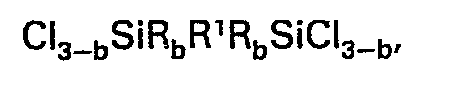
- chlorosilanes used in the process according to the invention need not necessarily be those of the formula given above. Rather, you can also use, for example, those of the general formula wherein R has the meaning given above for it, R 'is a divalent hydrocarbon radical, for example an ethylene or phenylene radical and b is 1 or 2.
- the carboxylic acids used in the process according to the invention can be acetic acid, propionic acid, butyric acid or dimethyl acetic acid.
- Aliphatic carboxylic acid is preferably used in amounts of at least 1 mol per gram atom of Si-bonded chlorine in the chlorosilane.
- the dosage of carboxylic acid introduced into the column is preferably regulated by a device controlled by the temperature in the lower third of the column.
- Chlorosilane is preferably introduced into the column at least 90 cm above the point of introduction of carboxylic acid. This means that the column is also preferably at least 90 cm long. The upper limit of the column length is only a question of economy.
- the reaction of chlorosilane with aliphatic carboxylic acid can be carried out under the pressure of the surrounding atmosphere, that is to say at 760 mm Hg (abs.) Or about 760 mm Hg (abs.).
- acyloxysilanes and / or acyloxysiloxanes with no or particularly low levels of unreacted carboxylic acid and hydrogen chloride, it is preferred to carry out this reaction at 13 to 800 m bar (abs.), In particular 65 to 400 m bar (abs.) to carry out.
- the elevated temperature in the reaction of chlorosilane with aliphatic carboxylic acid is of course that or approximately that of the boiling point of the carboxylic acid used in each case under the pressure conditions used in each case.
- water is also used in the process according to the invention to produce acyloxysiloxanes, this water can be introduced into the column at any point at which the formation of solid hydrolysates is excluded. However, it is preferably used in a mixture with the carboxylic acid. If water is also used in the process according to the invention, it is preferably used in amounts of at least 0.5 percent by weight, based on the amount of carboxylic acid used in each case.
- solvent which is inert to the reactants is neither desirable nor necessary, but is by no means excluded.
- solvents which can be used in the process according to the invention are toluene and methylene chloride.
- the process according to the invention is preferably carried out continuously.
- acyloxysilanes produced according to the invention have the general formula wherein R and a each have the meaning given above, and R 'is the methyl, ethyl, propyl or isopropyl radical, if as chlorosilane of the general formula was used.
- acyloxysilanes and acyloxysiloxanes produced according to the invention can be used wherever acyloxysilanes and acyloxysiloxanes have been able to be used previously, that is to say, in particular, mixed with diorganopolysiloxanes each having an Si-bonded hydroxyl group in the terminal units in order to be storable with the exclusion of water when access occurs To produce water at room temperature to elastomeric masses.
- a 3.5 m long glass tube with an inner diameter of 100 mm and filled with Raschig rings with a diameter of 8 mm is used as the column.
- the top of the column opens into a reflux condenser which is operated with an aqueous solution of sodium chloride which has a temperature of -20 ° C.
- a reflux condenser which is operated with an aqueous solution of sodium chloride which has a temperature of -20 ° C.
- 400 ml of ethyltrichlorosilane are introduced per hour.
- a 3.5 m long glass tube with an inner diameter of 100 mm and filled with Raschig rings with a diameter of 8 mm is used as the column.
- the top of the column opens into a reflux condenser which is operated with an aqueous solution of sodium chloride which has a temperature of -20 ° C.
- a reflux condenser which is operated with an aqueous solution of sodium chloride which has a temperature of -20 ° C.
- 250 ml of methyltrichlorosilane are introduced per hour.
- acetic acid which contains 4 percent by weight, based on its weight, of water are introduced into the column, with a control element which is connected to a temperature sensing device, by switching the on and off Pump, which conveys the acetic acid into the column, the temperature is kept at about 130 ° C. in a circulation evaporator which is electrically heated with constant energy supply.
- the pressure of the column is 180 m bar (abs.), So that the acetic acid evaporates immediately after introduction into the column and rises against the methylrichlorosilane.
- Example 2 The procedure described in Example 1 is repeated with the modification that glacial acetic acid is used which is contaminated with 100 ppm FeCl 3 . Here too the yield is 98% by weight d. Th. The content of ethyl triacetoxysilane in the product has dropped only insignificantly, namely to 92.5 percent by weight.
Landscapes
- Chemical & Material Sciences (AREA)
- Organic Chemistry (AREA)
- Chemical Kinetics & Catalysis (AREA)
Description
- Verfahren zum Herstellen von Acyloxysilanen und Acyloxysiloxanen durch Umsetzen von Chlorsilan mit aliphatischer Carbonsäure bei erhöhter Temperatur in einer Kolonne sind bereits bekannt. Gegenüber diesem z.B. aus US-PS 3 974 198 (ausgegeben 10. August 1976, B.A. Ashby assignor to General Electric Company) bekannten Verfahren zum Herstellen von Acyloxysilanen hat das erfindungsgemäße Verfahren insbesondere die Vorteile, daß es auch ohne Ausschluß von Eisen bzw. auch ohne Mitverwendung von Eisenkomplexbildner und ohne Mitverwendung von Lösungsmitteln, für deren Einsatz zusätzlicher Aufwand erforderlich ist, innerhalb kurzer Zeit und mit ausgezeichneten Ausbeuten Acyloxysilane mit sehr geringem Gehalt an Acyloxysiloxanen ergibt.
- Gegenüber dem ebenfalls aus US-PS 3 974 198 bekannten Verfahren zum Herstellen von Acyloxysiloxanen durch Umsetzen von Chlorsilan mit aliphatischer Carbonsaüre in Gegenwart von Eisen in einer Kolonne, hat das erfindungsgemäße Verfahren zum Herstellen von Acyloxysiloxanen insbesondere den Vorteil, daß die danach hergestellten Acyloxysiloxane nicht mit Eisenverbindungen, die zu unerwünschten Färbungen führen können, verunreinigt sind.
- Gegenüber dem Verfahren gemäß Referat 15 35 25q von Chemical Abstracts, Band 77, 1972, Seite 70, wonach Acyloxysiloxane durch Teilhydrolyse von Acyloxysilanen in Tetrahydrofuran hergestellt werden, hat das erfindungsgemäße Verfahren z.B. die Vorteile, daß die Mitverwendung des verhältnismäßig schwer zugänglichen Tetrahydrofurans und ebenso wie bei dem Verfahren gemäß US-PS 3 974 198 der Aufwand für eine getrennte Herstellung von Acyloxysilan nicht erforderlich ist.
- Gegenstand der Erfindung ist ein Verfahren zum Herstellen von Acyloxysilanen und gegebenenfalls Acyloxysiloxanen durch Umsetzen von Chlorsilan mit aliphatischer Carbonsäure bei erhöhter Temperatur in einer Kolonne, dadurch gekennzeichnet, daß aliphatische Carbonsäure in verdampfter Form von unten nach oben Chlorsilan entgegenführt, aliphatische Carbonsäure in Mengen von höchstens 1,3 Mol je Grammatom Si-gebundenen Chlors im Chlorsilan und im Maße ihres Verbrauchs durch die Umsetzung mit Chlorsilan in die Kolonne eingeführt wird, bei Herstellung von Acyloxysiloxanen zusätzlich zu Carbonsäure und Chlorsilan bis zu 10 Gewichstprozent, bezogen auf das Gewicht der Carbonsäure, Wasser in die Kolonne eingeführt werden, und am unteren Ende der Kolonne Acyloxysilan und/oder Acyloxysiloxan ablaufen gelassen wird.
- Als Chlorsilane sind im Rahmen der Erfindung solche der allgemeinen Formel

- Beispiele für Kohlenwasserstoffreste R sind Alkylreste, wie der Methyl-, Äthyl-, Isopropyl-, sec.-Butyl- und 2-Äthylhexylrest; Alkenylreste, wie der Vinyl- und Allylrest, sowie Hexadienylreste; Cycloalkylreste, wie der Cyclopentenyl-und Cylcohexylrest; Cycloalkenylreste, wie Cyclopentyl-, Cyclohexenyl- und Äthylcyclohexenylreste; aromatische Kohlenwasserstoffreste, wie der Phenylrest; Aralkylreste, wie der Benzyl- und Phenyläthylrest; und Alkarylreste, wie Tolyl- und Dimethylphenylreste. Als substituierte Kohlenwasserstoffreste R sind halogenierte Kohlenwasserstoffreste bevorzugt. Als Beispiele für halogenierte Kohlenwasserstoffreste seien der Chlormethyl-, 3-Chlorpropyl-und 3,3,3-Trifluorpropylrest genannt.
- Die im Rahmen des erfindungsgemäßen Verfahrens eingesetzten Chlorsilane müssen nicht unbedingt solche der oben angegebenen Formel sein. Sie können vielmehr auch z.B. solche der allgemeinen Formel
- Die im Rahmen des erfindungsgemäßen Verfahrens eingesetzten Carbonsäuren können Essigsäure, Propionsäure, Buttersäure oder Dimethylessigsäure sein.
- Vorzugsweise wird aliphatische Carbonsäure in Mengen von mindestens 1 Mol je Grammatom Si-gebundenen Chlors im Chlorsilan eingesetzt.
- Vorzugsweise wird die Dosierung von in die Kolonne eingeführter Carbonsäure durch eine durch die Temperatur im unteren Drittel der Kolonne gesteuerte Vorrichtung geregelt.
- Als Kolonne kann im Rahmen des erfindungsgemäßen Verfahrens jedes, meist mit Füllungen oder Einbauten versehene Rohr verwendet werden, das auch bei der fraktionierten Destillation zum Fraktionieren eingesetzt werden kann, beispielsweise eine Füllkörperkolonne. Vorzugsweise wird Chlorsilan mindestens 90 cm oberhalb der Einführungsstelle von Carbonsäure in die Kolonne eingeführt. Das bedeutet, daß auch die Kolonne vorzugsweise mindestens 90 cm lang ist. Die obere Grenze der Kolonnenlänge ist lediglich eine Frage der Wirtschaftlichkeit.
- Bei dem erfindungsgemäßen Verfahren kann die Umsetzung von Chlorsilan mit aliphatischer Carbonsäure beim Druck der umgebenden Atmosphäre, also bei 760 mm Hg (abs.) oder etwa 760 mm Hg (abs.), durchgeführt werden. Um jedoch Acyloxysilane und/oder Acyloxysiloxane mit keinem oder besonders geringem Gehalt an nicht-umgesetzter Carbonsäure und Chlorwasserstoff zu erhalten, ist es bevorzugt, diese Umsetzung bei 13 bis 800 m Bar (abs.), insbesondere 65 bis 400 m Bar (abs.), durchzuführen.
- Die erhöhte Temperatur bei der Umsetzung von Chlorsilan mit aliphatischer Carbonsäure ist selbstverständlich diejenige, oder etwa diejenige des Siedepunkts der jeweils eingesetzten Carbonsäure unter den jeweils angewandten Druckbedingungen.
- Wird bei dem erfindungsgemäßen Verfahren Wasser mitverwendet, um Acyloxysiloxane herzustellen, so kann dieses Wasser an einer beliebigen Stelle in die Kolonne eingeführt werden, an der die Bildung fester Hydrolysate ausgeschlossen ist. Vorzugsweise wird es jedoch im Gemisch mit der Carbonsäure eingesetzt. Wird bei dem erfindungsgemäßen Verfahren Wasser mitverwendet, so wird es vorzugsweise in Mengen von mindestens 0,5 Gewichtsprozent, bezogen auf die jeweils eingesetzte Menge an Carbonsäure, eingesetzt.
- Die Mitverwendung von gegenüber den Reaktionsteilnehmern inertem Lösungsmittel ist weder erwünscht noch erforderlich, aber auch keineswegs ausgeschlossen. Beispiele für bei dem erfindungsgemäßen Verfahren mitverwendbare Lösungsmittel sind Toluol und Methylenchlorid.
- Vorzugsweise wird das erfindungsgemäße Verfahren kontinuierlich durchgeführt.
- Die erfindungsgemäß hergestellten Acyloxysilane haben die allgemeine Formel


- Die erfindungsgemäß hergestellten Acyloxysilane und Acyloxysiloxane können überall dort eingesetzt werden, wo auch bisher Acyloxysilane und Acyloxysiloxane eingesetzt werden konnten, also insbesondere mit in den endständigen Einheiten je eine Si-gebundene Hydroxlgruppe aufweisenden Diorganopolysiloxanen vermischt werden, um unter Ausschluß von Wasser lagerfähige, bei Zutritt von Wasser bei Raumtemperatur zu Elastomeren härtende Massen herzustellen.
- Es wird als Kolonne ein 3,5 m langes Glasrohr mit 100 mm Innendurchmesser, das mit Raschigringen mit einem Durchmesser von 8 mm gefüllt ist, verwendet. Der Kopf der Kolonne mündet in einen Rückflußkühler, der mit eine Temperatur von -20°C aufweisender wäßriger Lösung von Natriumchlorid betrieben wird. Etwa in der Mitte der Kolonne werden je Stunde 400 ml Äthyltrichlorsilan eingeleitet. Kurz über dem unteren Ende der Kolonne werden je Stunde 550 ml Eisessig in die Kolonne eingeführt, wobei durch ein Steuerelement, das mit einer Temperaturfühlvorrichtung verbunden ist, durch Aus- bzw. Anschalten der Pumpe, welche den Eisessig in die Kolonne fördert, die Temperatur in einem elektrisch mit gleichbleibender Energiezufuhr beheizten Umlaufverdampfer bei etwa 135°C gehalten wird. Der Druck in der Kolonne beträgt 160 m Bar (abs.), so daß der Eisessig sofort nach dem Einführen in die Kolonne verdampft und dem Äthyltrichlorsilan entgegensteigt.
- Am unteren Ende wird stetig Äthyltriacetoxysilan abgezogen.

- Es wird als Kolonne ein 3,5 m langes Glasrohr mit 100 mm Innendurchmesser, das mit Raschigringen mit einem Durchmesser von 8 mm gefüllt ist, verwendet. Der Kopf der Kolonne mündet in einen Rückflußkühler, der mit eine Temperatur von -20°C aufweisender wäßriger Lösung von Natriumchlorid betrieben wird. Etwa 'in der Mitte der Kolonne werden je Stunde 250 ml Methyltrichlorsilan eingeleitet. Kurz über dem unteren Ende der Kolonne werden je Stunde 220 ml Essigsäure, die 4 Gewichtsprozent, bezogen auf ihr Gewicht, Wasser enthält, in die Kolonne eingeführt, wobei durch ein Steuerelement, das mit einer Temperaturfühlvorrichtung verbunden ist, durch Aus- bzw. Anschalten der Pumpe, welche die Essigsäure in die Kolonne befördert, die Temperatur in einem elektrisch mit gleichbleibender Energiezufuhr beheizten Umlaufverdampfer bei etwa 130°C gahalten wird. Der Druck der Kolonne beträgt 180 m Bar (abs.), so daß die Essigsäure sofort nach dem Einführen in die Kolonne verdampft und dem Methylrichlorsilan entgegensteigt.
- Am unteren Ende der Kolonne wird stetig ein bei Raumtemperatur nicht kristallisierendes Gemisch aus Methylacetoxysiloxanen, dessen Hauptbestandteile 1,3-Dimethyl-1,1,3,3-tetra- .acetoxydisiloxan ist, abgezogen.
- Die in Beispiel 1 beschriebene Arbeitsweise wird wiederholt mit der Abänderung, daß als Eisessig solcher verwendet wird, der mit 100 ppm FeCI3 verunreinigt ist. Auch hier beträgt die Ausbeute 98 Gewichtsprozent d. Th. Der Gehalt des Produktes an Äthyltriacetoxysilan ist nur unwesentlich, nämlich auf 92,5 Gewichtsprozent, gesunken.
Claims (4)
Applications Claiming Priority (2)
| Application Number | Priority Date | Filing Date | Title |
|---|---|---|---|
| DE19782801780 DE2801780A1 (de) | 1978-01-17 | 1978-01-17 | Verfahren zum herstellen von acyloxysilanen und gegebenenfalls acyloxysiloxanen |
| DE2801780 | 1978-01-17 |
Publications (2)
| Publication Number | Publication Date |
|---|---|
| EP0003317A1 EP0003317A1 (de) | 1979-08-08 |
| EP0003317B1 true EP0003317B1 (de) | 1981-04-22 |
Family
ID=6029646
Family Applications (1)
| Application Number | Title | Priority Date | Filing Date |
|---|---|---|---|
| EP79100134A Expired EP0003317B1 (de) | 1978-01-17 | 1979-01-17 | Verfahren zum Herstellen von Acyloxysilanen und gegebenenfalls Acyloxysiloxanen |
Country Status (5)
| Country | Link |
|---|---|
| US (1) | US4176130A (de) |
| EP (1) | EP0003317B1 (de) |
| JP (1) | JPS54103500A (de) |
| CA (1) | CA1137100A (de) |
| DE (2) | DE2801780A1 (de) |
Families Citing this family (11)
| Publication number | Priority date | Publication date | Assignee | Title |
|---|---|---|---|---|
| DE2919559A1 (de) * | 1979-05-15 | 1980-11-27 | Bayer Ag | Verfahren zur herstellung von mehrfach verzweigten siliciumfunktionellen polyorganosiloxanen |
| US4332956A (en) * | 1981-06-26 | 1982-06-01 | General Electric Company | Process for preparing acyloxysilanes |
| US4329484A (en) * | 1981-06-29 | 1982-05-11 | General Electric Company | Continuous process for preparing acyloxysilanes |
| DE3331515A1 (de) * | 1983-09-01 | 1985-03-21 | Merck Patent Gmbh, 6100 Darmstadt | Trialkanoyloxysilane |
| US4556725A (en) * | 1985-01-24 | 1985-12-03 | Union Carbide Corporation | Process for preparing triacetoxysilanes from tris(amino)silanes |
| DE4112650A1 (de) * | 1991-04-18 | 1992-10-22 | Huels Chemische Werke Ag | Verfahren zur gleichzeitigen und kontinuierlichen herstellung von carbonoyloxysilanen und carbonsaeurechloriden |
| US5387706A (en) | 1994-06-27 | 1995-02-07 | Dow Corning Corporation | Process for preparing acyloxysilanes |
| KR100342576B1 (ko) * | 1995-02-08 | 2002-11-23 | 고려화학 주식회사 | 실리콘실란트용초산형가교제의제조방법 |
| US5523446A (en) * | 1995-10-03 | 1996-06-04 | General Electric Company | Process for preparing a mixture of alkoxyacyloxy silane and alkyltriacyloxsilane |
| FI20096291A0 (fi) | 2009-12-04 | 2009-12-04 | Mateve Oy | Maapiiri matalaenergiajärjestelmässä |
| US10316046B2 (en) | 2015-03-10 | 2019-06-11 | National Institute Of Advanced Industrial Science And Technology | Method for producing acyloxysilanes, acyloxysilanes obtained thereby, and use of same |
Family Cites Families (3)
| Publication number | Priority date | Publication date | Assignee | Title |
|---|---|---|---|---|
| US4028391A (en) * | 1973-12-26 | 1977-06-07 | Owens-Corning Fiberglas Corporation | Method of preparing organosilicon carboxylates |
| US3974198A (en) * | 1975-09-02 | 1976-08-10 | General Electric Company | Process for producing methyltriacetoxysilane |
| US4066680A (en) * | 1976-10-18 | 1978-01-03 | Sws Silicones Corporation | Process for making alpha,omega-siloxanediols |
-
1978
- 1978-01-17 DE DE19782801780 patent/DE2801780A1/de not_active Withdrawn
- 1978-12-28 US US05/974,200 patent/US4176130A/en not_active Expired - Lifetime
-
1979
- 1979-01-12 CA CA000319545A patent/CA1137100A/en not_active Expired
- 1979-01-12 JP JP139479A patent/JPS54103500A/ja active Granted
- 1979-01-17 EP EP79100134A patent/EP0003317B1/de not_active Expired
- 1979-01-17 DE DE7979100134T patent/DE2960275D1/de not_active Expired
Also Published As
| Publication number | Publication date |
|---|---|
| JPS54103500A (en) | 1979-08-14 |
| US4176130A (en) | 1979-11-27 |
| JPS5753360B2 (de) | 1982-11-12 |
| EP0003317A1 (de) | 1979-08-08 |
| CA1137100A (en) | 1982-12-07 |
| DE2801780A1 (de) | 1979-07-19 |
| DE2960275D1 (en) | 1981-07-30 |
Similar Documents
| Publication | Publication Date | Title |
|---|---|---|
| EP0032376B1 (de) | Verfahren zur kontinuierlichen Herstellung von SiOC-Gruppen aufweisenden Silanen oder SiOC-Gruppen aufweisenden Polysiloxanen | |
| DE874908C (de) | Verfahren zur Herstellung von acyloxymethylsubstituierten Siloxanen | |
| DE2849092A1 (de) | Silylphosphate und verfahren zu deren herstellung | |
| DE1301139B (de) | Verfahren zur Herstellung von Vinylsulfidgruppen enthaltenden Organopolysiloxanen | |
| EP0003317A1 (de) | Verfahren zum Herstellen von Acyloxysilanen und gegebenenfalls Acyloxysiloxanen | |
| DE2540210B2 (de) | Verfahren zur Herstellung von Organozinntrihalogeniden und sich davon ableitende Organozinn-Stabilisatoren | |
| DE2625108A1 (de) | Verfahren zum herstellen von methyltriacetoxysilan | |
| DE1495868C3 (de) | Verfahren zur Herstellung von Acyloxyalkylgruppen enthaltenden Organo polysiloxanen | |
| DE1906675A1 (de) | Mono-2-halogenaethylester der 2-Chloraethanphosphonsaeure | |
| DE2251297A1 (de) | Verfahren zur herstellung von organosiliciumverbindungen | |
| DE1193504B (de) | Verfahren zur Herstellung von Polysiloxanen mit endstaendigen Diketongruppen | |
| DE69014419T2 (de) | Silylierungsmittel. | |
| DE1668425A1 (de) | Verfahren zur Herstellung von Diorganoantimonacylaten | |
| DE1288089B (de) | Verfahren zur vollständigen Reduktion von Organosiliciumverbindungen | |
| DE1227914B (de) | Verfahren zur Herstellung von 3-(1, 2-Dithia-cyclopentyl)-5-pentansaeure | |
| EP0273189A1 (de) | Verfahren zur Herstellung von Ketoximosilanen | |
| DE2635174A1 (de) | Verfahren zur herstellung von butandiol und/oder butendiol | |
| DE1156809B (de) | Verfahren zur Herstellung von Cyanalkylfluorsilanen | |
| DE2107084A1 (de) | ||
| DE2123989A1 (de) | Verfahren zur Herstellung von C tief 1bis C tief 10-Alkylestern der Chrysanthemsäure | |
| EP0121914A2 (de) | Verfahren zur Herstellung von asymmetrischen Disiloxanen | |
| DE1593405C (de) | ||
| DE2819450C2 (de) | ||
| DE942628C (de) | Verfahren zur Herstellung von Disiloxanen | |
| EP0144806B1 (de) | Verfahren zur Herstellung von Dimethylsilyldicyanid |
Legal Events
| Date | Code | Title | Description |
|---|---|---|---|
| PUAI | Public reference made under article 153(3) epc to a published international application that has entered the european phase |
Free format text: ORIGINAL CODE: 0009012 |
|
| AK | Designated contracting states |
Designated state(s): BE DE FR GB |
|
| 17P | Request for examination filed | ||
| GRAA | (expected) grant |
Free format text: ORIGINAL CODE: 0009210 |
|
| AK | Designated contracting states |
Designated state(s): BE DE FR GB |
|
| REF | Corresponds to: |
Ref document number: 2960275 Country of ref document: DE Date of ref document: 19810730 |
|
| PGFP | Annual fee paid to national office [announced via postgrant information from national office to epo] |
Ref country code: FR Payment date: 19961216 Year of fee payment: 19 |
|
| PGFP | Annual fee paid to national office [announced via postgrant information from national office to epo] |
Ref country code: GB Payment date: 19961220 Year of fee payment: 19 |
|
| PGFP | Annual fee paid to national office [announced via postgrant information from national office to epo] |
Ref country code: BE Payment date: 19961223 Year of fee payment: 19 |
|
| PGFP | Annual fee paid to national office [announced via postgrant information from national office to epo] |
Ref country code: DE Payment date: 19970206 Year of fee payment: 19 |
|
| PG25 | Lapsed in a contracting state [announced via postgrant information from national office to epo] |
Ref country code: GB Free format text: LAPSE BECAUSE OF NON-PAYMENT OF DUE FEES Effective date: 19980117 |
|
| PG25 | Lapsed in a contracting state [announced via postgrant information from national office to epo] |
Ref country code: FR Free format text: THE PATENT HAS BEEN ANNULLED BY A DECISION OF A NATIONAL AUTHORITY Effective date: 19980131 Ref country code: BE Free format text: LAPSE BECAUSE OF NON-PAYMENT OF DUE FEES Effective date: 19980131 |
|
| BERE | Be: lapsed |
Owner name: WACKER-CHEMIE G.M.B.H. Effective date: 19980131 |
|
| GBPC | Gb: european patent ceased through non-payment of renewal fee |
Effective date: 19980117 |
|
| PG25 | Lapsed in a contracting state [announced via postgrant information from national office to epo] |
Ref country code: DE Free format text: LAPSE BECAUSE OF NON-PAYMENT OF DUE FEES Effective date: 19981001 |
|
| REG | Reference to a national code |
Ref country code: FR Ref legal event code: ST |
|
| PLBE | No opposition filed within time limit |
Free format text: ORIGINAL CODE: 0009261 |
|
| STAA | Information on the status of an ep patent application or granted ep patent |
Free format text: STATUS: NO OPPOSITION FILED WITHIN TIME LIMIT |