EP0003114B1 - Herbizid wirksame ungesättigte Ester von 4-(3',5'-Dihalogenpyridyl -(2')-oxy)-alpha-phenoxypropionsäuren, Verfahren zu ihrer Herstellung sowie sie enthaltende herbizide Mittel und deren Verwendung - Google Patents
Herbizid wirksame ungesättigte Ester von 4-(3',5'-Dihalogenpyridyl -(2')-oxy)-alpha-phenoxypropionsäuren, Verfahren zu ihrer Herstellung sowie sie enthaltende herbizide Mittel und deren Verwendung Download PDFInfo
- Publication number
- EP0003114B1 EP0003114B1 EP79100035A EP79100035A EP0003114B1 EP 0003114 B1 EP0003114 B1 EP 0003114B1 EP 79100035 A EP79100035 A EP 79100035A EP 79100035 A EP79100035 A EP 79100035A EP 0003114 B1 EP0003114 B1 EP 0003114B1
- Authority
- EP
- European Patent Office
- Prior art keywords
- formula
- acid
- radical
- oxy
- compound
- Prior art date
- Legal status (The legal status is an assumption and is not a legal conclusion. Google has not performed a legal analysis and makes no representation as to the accuracy of the status listed.)
- Expired
Links
- 0 CC(C(O*=C1CCCCC1)=O)Oc(cc1)ccc1Oc(ncc(Cl)c1)c1Cl Chemical compound CC(C(O*=C1CCCCC1)=O)Oc(cc1)ccc1Oc(ncc(Cl)c1)c1Cl 0.000 description 1
Classifications
-
- C—CHEMISTRY; METALLURGY
- C07—ORGANIC CHEMISTRY
- C07D—HETEROCYCLIC COMPOUNDS
- C07D213/00—Heterocyclic compounds containing six-membered rings, not condensed with other rings, with one nitrogen atom as the only ring hetero atom and three or more double bonds between ring members or between ring members and non-ring members
- C07D213/02—Heterocyclic compounds containing six-membered rings, not condensed with other rings, with one nitrogen atom as the only ring hetero atom and three or more double bonds between ring members or between ring members and non-ring members having three double bonds between ring members or between ring members and non-ring members
- C07D213/04—Heterocyclic compounds containing six-membered rings, not condensed with other rings, with one nitrogen atom as the only ring hetero atom and three or more double bonds between ring members or between ring members and non-ring members having three double bonds between ring members or between ring members and non-ring members having no bond between the ring nitrogen atom and a non-ring member or having only hydrogen or carbon atoms directly attached to the ring nitrogen atom
- C07D213/60—Heterocyclic compounds containing six-membered rings, not condensed with other rings, with one nitrogen atom as the only ring hetero atom and three or more double bonds between ring members or between ring members and non-ring members having three double bonds between ring members or between ring members and non-ring members having no bond between the ring nitrogen atom and a non-ring member or having only hydrogen or carbon atoms directly attached to the ring nitrogen atom with hetero atoms or with carbon atoms having three bonds to hetero atoms with at the most one bond to halogen, e.g. ester or nitrile radicals, directly attached to ring carbon atoms
- C07D213/62—Oxygen or sulfur atoms
- C07D213/63—One oxygen atom
- C07D213/64—One oxygen atom attached in position 2 or 6
- C07D213/643—2-Phenoxypyridines; Derivatives thereof
-
- A—HUMAN NECESSITIES
- A01—AGRICULTURE; FORESTRY; ANIMAL HUSBANDRY; HUNTING; TRAPPING; FISHING
- A01N—PRESERVATION OF BODIES OF HUMANS OR ANIMALS OR PLANTS OR PARTS THEREOF; BIOCIDES, e.g. AS DISINFECTANTS, AS PESTICIDES OR AS HERBICIDES; PEST REPELLANTS OR ATTRACTANTS; PLANT GROWTH REGULATORS
- A01N43/00—Biocides, pest repellants or attractants, or plant growth regulators containing heterocyclic compounds
- A01N43/34—Biocides, pest repellants or attractants, or plant growth regulators containing heterocyclic compounds having rings with one nitrogen atom as the only ring hetero atom
- A01N43/40—Biocides, pest repellants or attractants, or plant growth regulators containing heterocyclic compounds having rings with one nitrogen atom as the only ring hetero atom six-membered rings
Definitions
- the present invention relates to new herbicidally active unsaturated esters of 4- (3 ', 5'-dihalopyridyl- (2') - oxy) - ⁇ -phenoxy-propionic and propionthiol acids, processes for their preparation and further herbicidal compositions which use them contain new compounds as active ingredients, and the use of the new active ingredients and the compositions containing them for the selective control of weeds in crop plants.
- heterocyclic analogs such as appropriately substituted pyridyl phenyl ether, have become known, cf. DE-A-2 546 251 or FR-A 2 288 089, JP-A-1 139 627 and DE-A-2 732 846 or FR-A 2 359 129.
- the new unsaturated 4- (3 ', 5'-dihalopyridyl- (2') - oxy) - ⁇ -phenoxy-propion- and propionthiolic acid esters of the present invention correspond to formula 1 where Hal independently of one another is chlorine or bromine, X is an oxygen or sulfur atom, and R is a straight-chain or branched C 3 -C 6 -alkynyl radical which may be substituted by chlorine and which, in addition to the triple bond, may also contain a double bond, the 2-ethynyl-cyclohexyl- ( 1) radical, a straight-chain or branched cyanoalkyl radical having 1 to 5 carbon atoms in the alkyl part, the 1-cyano-cyclohexyl (1) radical or a radical of the formula which is connected to an oxygen atom X.
- Hal independently of one another is chlorine or bromine
- X is an oxygen or sulfur atom
- R is a straight-chain or branched C 3 -C 6
- R 1 is hydrogen or an alkyl radical having 1 to 4 carbon atoms and R 2 is an alkyl radical having 1 to 4 carbon atoms, or R 1 and R 2 together with the adjacent carbon atom form a cyclopentane or cyclohexane ring and R 3 represents hydrogen, methyl or a cyano group.
- Alkynyl radicals R can be straight-chain or branched, the triple bond can be terminal or lie inside the -C-C chain, and a double bond can also be present in addition to the triple bond.
- the alkynyl radicals can also be substituted by chlorine.
- Hal is preferably chlorine.
- R those with a - C ⁇ C triple bond are more effective than the cyanoalkyl and oxime esters.
- the active compounds of the formula I according to the invention and the herbicidal compositions containing them as the active component are particularly useful for the selective control of grasses which are difficult to control in crop plants, both in dicotyledon (cotton, soybean) and in monocotyledonous crop plants, such as rice, wheat and other cereals.
- the compounds according to the invention are therefore well tolerated by crop plants and very effective on grasses.
- the active compounds according to the invention are distinguished from the known saturated esters and thiol esters of the pyridyloxy- ⁇ -phenoxy-propionic acid series by a significantly better tolerance to crop plants, such as, in particular, wheat, barley and rice (selectivity), from known aromatically unsaturated esters and thiol esters by a better activity against grasses, such as Avena fatua (wild oat species).
- the object of this invention was therefore to create new esters in the range of halogenated 4- (pyridyloxy) - ⁇ -phenoxypropion- and -propionthiol acids, which are superior to known compounds of a similar structure in herbicidal activity against grasses which are difficult to control and against important crop plants such as wheat, Barley and rice are more tolerable, so represent an enrichment of technology.
- the corresponding hydroxyphenyl pyridyl ether or a salt thereof, of the formula IV is used wherein Y is hydrogen or the equivalent of an alkali metal or alkaline earth metal cation, with an ⁇ -halopropion (thiol) acid ester of the formula V in the presence of an acid-binding agent (base).
- Suitable solvents are those from a wide variety of substance classes, such as aliphatic and aromatic, optionally chlorinated hydrocarbons, for. B. ethylene chloride, etc., and polar organic solvents such as alcohols, ethers, ketones, amides, stable esters, e.g. B. methyl ethyl ketone, dimethoxyethane, dimethylformamide, dimethyl sulfoxide, tetrahydrofuran.
- substance classes such as aliphatic and aromatic, optionally chlorinated hydrocarbons, for. B. ethylene chloride, etc.
- polar organic solvents such as alcohols, ethers, ketones, amides, stable esters, e.g. B. methyl ethyl ketone, dimethoxyethane, dimethylformamide, dimethyl sulfoxide, tetrahydrofuran.
- aqueous alkali metal hydroxides such as KOH and NaOH
- other customary basic substances such as carbonates (K 2 C0 3 , NaHC0 3 ), alcoholates (NaOCH 3 and potassium tert.- butylate), but also organic bases such as triethylamine
- organic bases such as triethylamine
- the free propionthiolic acid and its metal salts that can be used for this purpose are produced from the corresponding propionic acid halide with hydrogen sulfide, Na 2 S or NaHS in the presence of a basic acid acceptor.
- the 4- (3 ', 5'-dichloropyridyl- (2') oxy) -tx-phenoxy-propionthiolic acid produced by this method is an oil of refractive index which melts at 85-87 ° C after crystallization.
- the invention also relates to herbicidal compositions which contain a new active ingredient of the formula 1, and to processes for pre- and in particular post-emergent weed control, in particular of monocotyledon weeds.
- the agents according to the invention can be present in the usual formulations.
- the active ingredients are mixed with solid carriers to produce solid processing forms (dusts, scattering agents, granules).
- Carriers include, for example, kaolin, talc, bolus, loess, chalk, limestone, lime grits, ataclay, dolomite, diatomaceous earth, precipitated silica, alkaline earth metal silicates, sodium and potassium aluminum silicates (feldspar and mica), calcium and magnesium sulfates, magnesium oxide, ground plastics, Fertilizers, such as ammonium sulfate, ammonium phosphate, ammonium nitrate, urea, ground vegetable products, such as cereal flour, tree bark flour, wood flour, nutshell flour, cellulose powder, residues from plant extracts, activated carbon etc., each individually or as a mixture with one another in question.
- Granules can be prepared by dissolving the active ingredients in an organic solvent and the resulting solution on a granulated agent, for. B. attapulgite, Si0 2 , granicalcium or bentonite, and then the organic solvent evaporates again.
- a granulated agent for. B. attapulgite, Si0 2 , granicalcium or bentonite
- Polymer granules can be produced by e.g. B. a finished, porous polymer granules, such as urea / formaldehyde polymers, polyacrylonitrile and polyester, with a certain surface and a favorable, predetermined absorption / desorption ratio with the active ingredients, for. B. in the form of their solutions (in a low-boiling solvent), impregnated and the solvent removed.
- Polymer granules of this type can also be applied in the form of microgranules with bulk densities of preferably 300 g / liter to 600 g / liter with the aid of atomizers. The atomization can be carried out over extensive treatment areas with the help of airplanes.
- Granules can also be obtained by compacting the carrier material with the active ingredients and additives and then comminuting it.
- agents can also be added to the active ingredient stabilizing additives and / or nonionic, anionic and cationic substances that improve, for example, the adhesive strength of the active ingredients on plants and parts of plants (adhesives and adhesives) and / or better wettability (wetting agents) and dispersibility (dispersants ) guaranteed.
- Suitable adhesives are the following: olein-lime mixture, cellulose derivatives (methyl cellulose, carboxymethyl cellulose), hydroxyethylene glycol ether of mono- and dialkylphenols with 5 to 15 ethylene oxide residues per molecule and 8 to 9 carbon atoms in the alkyl residue, lignin sulfonic acid, its alkali metal and alkaline earth metal , Polyethylene glycol ether (Carbowaxe), fatty alcohol polyglycol ether with 5 to 20 ethylene oxide residues per molecule and 8 to 18 carbon atoms in the fatty alcohol part, condensation products of ethylene oxide, propylene oxide, polyvinylpyrrolidones, polyvinyl alcohols, condensation products of urea-formaldehyde and latex products.
- olein-lime mixture cellulose derivatives (methyl cellulose, carboxymethyl cellulose), hydroxyethylene glycol ether of mono- and dialkylphenols with 5 to 15 ethylene oxide residues per molecule and 8 to 9 carbon atom
- Active ingredient concentrates dispersible in water i.e. H. Wettable powder, pastes and emulsion concentrates are agents that can be diluted with water to any desired concentration. They consist of active ingredient, carrier, optionally additives stabilizing the active ingredient, surface-active substances and anti-foaming agents and optionally solvents.
- wettable powders wettable powder
- pastes are obtained by mixing and grinding the active ingredients with dispersants and powdered carriers in suitable devices until homogeneous.
- Suitable carriers are, for example, those mentioned above for the solid processing forms. In some cases it is advantageous to use mixtures of different carriers.
- the dispersants can be used, for example: condensation products of sulfonated naphthalene and sulfonated naphthalene derivatives with formaldehyde, condensates of naphthalene or of naphthalenesulfonic acids with phenol and formaldehyde, and alkali metal, ammonium and alkaline earth metal salts of lignosulfonic acid, further alkylarylsulfonates, alkali metal and alkaline earth metal salts of dibutylnaphthalenesulfonic acid, fatty alcohol sulfates such as salts of sulfated hexadecanols, heptadecanols and salts of sulfated fatty alcohol polyethyleneglycol ether, the sodium salt of oleyl methyl tauride, ditertiary acetylene glycolie, dialkyldilaurylammonium chloride and fatty acid alkali and alkaline
- Silicones for example, can be used as anti-foaming agents.
- the active ingredients are mixed, ground, sieved and passed with the additives listed above in such a way that the solid fraction in the wettable powders does not exceed a particle size of 0.02 to 0.04 and in the pastes does not exceed 0.03 mm.
- dispersants such as those listed in the previous sections, organic solvents and water are used.
- suitable solvents are the following: alcohols, xylenes, toluene, dimethyl sulfoxide, N, N-dialkylated amides and trialkylamines.
- the solvents must be practically odorless, not phytotoxic, inert to the active substances and not easily flammable.
- the agents according to the invention can be used in the form of solutions.
- the active ingredient or several active ingredients of the formula I are dissolved in suitable organic solvents, solvent mixtures, water or mixtures of organic solvents with water.
- suitable organic solvents solvent mixtures, water or mixtures of organic solvents with water.
- Aliphatic and aromatic hydrocarbons, their chlorinated derivatives, alkylnaphthalenes, alone or as a mixture with one another can be used as organic solvents.
- the content of active ingredient in the agents described above is between 0.1 and 95%, preferably between 1 and 80%.
- Application forms can be diluted down to 0.001%.
- the application rates are generally 0.1 to 10 kg ai / ha, preferably 0.25 to 5 kg ai / ha.
- the active ingredients of Formula 1 can be formulated, for example, as follows (parts mean parts by weight):
- the specified active ingredient is drawn onto the corresponding carrier substances (kaolin and chalk) and then mixed and ground. Spray powder of excellent wettability and suspension is obtained. Suspensions of any desired active ingredient concentration can be obtained from such wettable powders by dilution with water. Such suspensions are used to control weeds and weeds in crops in the post-emergence process.
- the active ingredient is intimately mixed and ground with the additives in suitable devices.
- a paste is obtained, from which suspensions of any desired concentration can be prepared by dilution with water.
- This concentrate can be diluted with water to form emulsions to suitable concentrations.
- Agents according to the invention which contain at least one compound of formula 1 as the active component are particularly suitable for the selective control of monocotyledon grasses which are difficult to control, such as Avena fatua (wild oat), Rotboellia, Digitaria, Setaria etc. in pre- and in particular post-emergent use in crop plants , such as B. wheat, barley, rice, but also soybeans, cotton, sugar cane etc.
- weeds and crop plants both monocotyledon and dicotyledon, were applied after emergence (in the 4- to 6-leaf stage) with an aqueous active ingredient dispersion in various dosages (0.125, 0.25, 0.5 and 1 kg of active ingredient per hectare) the plants are sprayed and these at 23-26 ° C and 45-60% rel. Humidity kept. 15 days after treatment, the test is evaluated and the result is rated according to the same grading scale as in the pre-emergent test
- Spring barley was treated 39 days after sowing, when it was in the 4-6 leaf stage and weeded with Avena fatua in the 5-1 leaf stage, by spray application from above with the active ingredient dispersions.
- compound B already showed 60% damage to the barley at the application rate of 0.5 kg / ha, while the active compounds 1 and 2 according to the invention only damaged the barley by 30%.
- the effect on Avena fatua was 100% for all three active ingredients used.
- the active compounds according to the invention are therefore distinguished by a significantly better selectivity at the application rate of 0.5 kg / ha which is sufficient to completely destroy the weeds.
- comparative compound B already showed 50% damage to the wheat with 0.5 kg / ha, with 0.75 and 1.5 kg / ha 70% damage to the wheat with 100% action on Avena in each case fatua.
- Comparative compound A was less phytotoxic (20% wheat damage at 0.5 to 1.5 kg / ha), but had an unsatisfactory effect on Avena fatua (only 30% at 0.5 kg / ha and 80% at 1.5 kg / ha).
- Comparative compound b produced 30-70% damage to the wheat at 0.5, 0.75 and 1 kg / ha with 60-90% weed activity, compound A did not show any damage to the wheat in all of these concentration ranges, but only a 30 - up to 50% weed action.
- the active compounds 1 and 2 according to the invention did not show any damage to the wheat with a 70-90% weed action at the above application amounts of 0.5, 0.75 and 1 kg / ha.
- At least one application dose can be selected in the field test which, with optimal weed action, results in minimal damage to the grain, which is not the case with any of the comparative compounds : With each selectable dose, these are either too little weed-effective or too phytotoxic for the grain.
Landscapes
- Life Sciences & Earth Sciences (AREA)
- Organic Chemistry (AREA)
- Chemical & Material Sciences (AREA)
- Dentistry (AREA)
- Health & Medical Sciences (AREA)
- Engineering & Computer Science (AREA)
- Plant Pathology (AREA)
- General Health & Medical Sciences (AREA)
- Wood Science & Technology (AREA)
- Zoology (AREA)
- Environmental Sciences (AREA)
- Pest Control & Pesticides (AREA)
- Agronomy & Crop Science (AREA)
- Agricultural Chemicals And Associated Chemicals (AREA)
- Pyridine Compounds (AREA)
Description
- Vorliegende Erfindung betrifft neue herbizid wirksame ungesättigte Ester von 4-(3',5'-Dihalogenpy- ridyl-(2')-oxy)-α-phenoxy-propion- und propionthiolsäuren, Verfahren zu ihrer Herstellung, ferner herbizide Mittel, die diese neuen Verbindungen als Wirkstoffe enthalten, sowie die Verwendung der neuen Wirkstoffe und der sie enthaltenden Mittel zur selektiven Bekämpfung von Unkräutern in Kulturpflanzenbeständen.
- In den letzten Jahren sind zahlreiche Derivate von para-substituierten Hydroxy-diphenyläthern bekannt geworden, vgl. DE-A-223 894, DE-A-2 433 067, DE-A-2 531 643, DE-A-2 649 706, DE-A-2 609 461, DE-A-2 611 695, DE-A-2 623 558, DE-A-2 628 384, DE-A-2 652 384, DE-A-2 730 591, DE-A-2 809 541.
- Außerdem sind heterocyclische Analoga, wie beispielsweise entsprechend substituierte Pyridyl-phenyläther bekannt geworden, vgl. DE-A-2 546 251 bzw. FR-A 2 288 089, JP-A-1 139 627 und DE-A-2 732 846 bzw. FR-A 2 359 129.
- Es wurde nun überraschenderweise gefunden, daß die im Pyridylring dihalogenierten neuen Wirkstoffe gemäß vorliegender Erfindung den in den Handel eingeführten Produkten und den strukturell nächst verwandten Verbindungen der FR-A 2 288 089 sowie den unter den Umfang der FR-A 2 359 129 fallenden nächstvergleichbaren trihalogenierten Analogen in der selektiven Unkrautbekämpfung klar überlegen sind.
- Die neuen ungesättigten 4-(3',5'-Dihalogen-pyridyl-(2')-oxy)-α-phenoxy-propion- und propionthiolsäure-Ester vorliegender Erfindung entsprechen der Formel 1


- Alkinylreste R können geradkettig oder verzweigt sein, die Dreifachbindung kann endständig sein oder im Innern der -C-C-Kette liegen, es kann neben der Dreifachbindung noch eine Doppelbindung vorhanden sein. Die Alkinylreste können auch durch Chlor substituiert sein.
- In der Formel I ist Hal vorzugsweise Chlor. Von den Resten R sind solche mit - C≡ C-Dreifachbindung den Cyanalkyl- und den Oximestern wirkungsmäßig eher überlegen.
- Die erfindungsgemäßen Wirkstoffe der Formel I und die sie als aktive Komponente enthaltenden herbiziden Mittel sind insbesondere brauchbar zur selektiven Bekämpfung von schwer bekämpfbaren Ungräsern in Kulturpflanzenbeständen, sowohl in dicotylen (Baumwolle, Soja) wie auch in monokotylen Kulturpflanzen, wie Reis, Weizen und anderen Getreidesorten. Die erfindungsgemäßen Verbindungen sind also gegenüber Kulturpflanzen gut verträglich und gegen Ungräser sehr wirksam.
- Die bereits bekannten 2.4-Dichlorphenoxyphenoxyderivate des Standes der Technik wie die erwähnten gesättigten und die doppelt oder dreifach ungesättigten Verbindungen der Deutschen Offenlegungsschriften 2 223 894, 2 623 558, 2 628 384 und 2611 695 befriedigen bezüglich Aktivität gegen schwierig zu bekämpfende Ungräser - insbesondere in tiefen Aufwandmengen - nicht vollständig.
- Die bereits bekannten substituierten Pyridyloxyphenoxy-alkancarbonsäurederivate des Standes der Technik, wie die Ester und Thioester der FR-A 2 288 089 sowie Nitrile und Ester mit anderen Substituenten im Pyridyloxyrest sind gegenüber empfindlichen Kulturpflanzen wie z. B. Weizen entweder zu aggressiv oder zeigen bei guter Verträglichkeit eine zu geringe Aktivität gegenüber den zu bekämpfenden Ungräsern. Die vergleichbaren ungesättigen Ester von im Pyridylring dreifach substituierten Pyridyloxyphenoxy-propionsäuren der FR-A 2 359 129 sind herbizid nur schwach wirksam.
- Überraschenderweise zeichnen sich die erfindungsgemäßen Wirkstoffe gegenüber den bekannten gesättigten Estern und Thiolestern der Pyridyloxy-α-phenoxy-propionsäurereihe durch eine deutlich besser Verträglichkeit gegenüber Kulturpflanzen, wie insbesondere Weizen, Gerste und Reis aus (Selektivität), gegenüber bekannten aromatisch ungesättigten Estern und Thiolestern durch eine bessere Aktivität gegen Ungräser, wie insbesondere Avena fatua (Wildhaferarten).
- Aufgabe dieser Erfindung war also, neue Ester in der Reihe der halogenierten 4-(Pyridyloxy)-α-phenoxypropion- und -propionthiolsäuren zu schaffen, welche bekannten Verbindungen ähnlicher Struktur in der herbiziden Wirkung gegen schwer bekämpfbare Ungräser überlegen und gegenüber wichtigen Kulturpflanzen wie Weizen, Gerste und Reis verträglicher sind, also eine Bereicherung der Technikdarstellen.
- Zur Herstellung der neuen Ester der Formel 1 dienen an sich bekannte Verfahren:
- Nach einem dieser Verfahren setzt man ein entsprechendes 4-(3',5'-Dihalogen-pyridyl-(2')-oxy)-x-phenoxy-propionsäurehalogenid der Formel II


- Gemäß einem weiteren Verfahren setzt man den entsprechenden Hydroxy-phenyl-pyridyläther oder ein Salz desselben, von der Formel IV


- Die Umsetzungen werden vorzugsweise in einem gegenüber den Reaktionskomponenten inerten Lösungsmittel durchgeführt. Als Lösungsmittel kommen solche aus den verschiedensten Stoffklassen in Frage, wie aliphatische und aromatische, gegebenenfalls chlorierte Kohlenwasserstoffe, z. B. Äthylenchlorid etc., sowie polare organische Lösungsmittel, wie Alkohole, Äther, Ketone, Amide, stabile Ester, z. B. Methyläthylketon, Dimethoxyäthan, Dimethylformamid, Dimethylsulfoxid, Tetrahydrofuran.
- Als basische Säureakzeptoren für die Umsetzung mit den Halogenverbindungen der Formel 11 und V können wässerige Alkalimetallhydroxide, wie KOH und NaOH sowie weitere übliche basische Stoffe, wie Karbonate (K2C03, NaHC03), Alkoholate (NaOCH3 und Kalium-tert.-butylat), aber auch organische Basen wie Triäthylamin verwendet werden.
- Die Ausgangsstoffe der Formeln 11 bis V sind zum Teil bekannt oder können nach bekannten Verfahren hergestellt werden.
- Zu den Propion- und Propionthiol-säureestern der Formel I (X=O oder S) kann man auch gelangen, indem man die entsprechende freie 4-(3',5'-Dihalogen-pyridyl-(2')-oxy)-x-phenoxy-propion(thiol)säure bzw. ein Metallsalz dieser Säure mit einem ungesättigten Halogenid der Formel Hal-R in Gegenwart einer Base umsetzt.
- Die Herstellung der dazu verwendbaren freien Propionthiolsäure und ihrer Metallsalze erfolgt aus dem entsprechenden Propionsäurehalogenid mit Schwefelwasserstoff, Na2S oder NaHS in Gegenwart eines basischen Säureakzeptors. Die nach dieser Methode hergestellte 4-(3',5'-Dichlor-pyridyl-(2')oxy)-tx-phenoxy-propionthiolsäure ist ein ÖI vom Brechungsindex

- Schließlich kann man zur Herstellung von ungesättigten Estern der 4-(3',5'-Dihalogenpyridyl-(2')-oxy-α-phenoxy-propionsäure (X= Sauerstoff) die freie Säure auch direkt mit einem entsprechenden Alkohol nach bekannten Methoden verestern.
- Die nachfolgenden Beispiele veranschaulichen die Herstellung einiger erfindungsgemäßer Wirkstoffe der Formel I. Weitere in entsprechender Weise oder nach einer anderen der im Text erwähnten Methoden hergestellte Endstoffe der Formel sind anschließend tabellarisch aufgeführt.
- 10,2 g (0,04 Mol) 4-(3',5'-Dichlorpyridyl-2'-oxy)-phenol, 8,4 g (0,044 Mol) α-Brompropionsäurepropargylester und 8,5 g (0,06 Mol) Kaliumcarbonat werden in 120 ml Äthylmethylketon 6 Std. unter Rückfluß erhitzt. Die Salze werden abfiltriert, das Filtrat eingedampft. Zur Reinigung wird das Produkt in Chloroform über eine kurze Kieselgelsäule filtriert. Nach dem Abdampfen des Chloroforms erhält man 9 g (62%) α-[4-(3',5'-Dichlorpyridyl-2'-oxy)-phenoxy]-propionsäure-propargylester als hellgelbes ÖI mit einem Brechungsindex von n 40 D = 1,5524. (Verbindung Nr. 1)
- 26,8 g (0,082 Mol α-(4-(3',5'-Dichlorpyridyl-2'-oxy)-phenoxy)-propionsäure werden mit 30 ml Thionylchlorid versetzt und, nachdem die Gasentwicklung abgeklungen ist, auf 50°C erwärmt. Nach 2 Std. wird das Reaktionsgemisch am Vacuum eingedampft, mit 100 ml Toluol versetzt und wieder eingedampft. Als Produkt erhält man ein dunkelbraunes Öl, das langsam zu kristallisieren beginnt. Es werden 25,9 g (86,7%) x-(4-(3',5'-Dichlorpyridyl-2'-oxy)-phenoxy)-propionsäurechlorid vom Schmelzpunkt 45° C erhalten.
- 17,3 g (0,05 Mol) dieses Säurechlorids werden zu einem Gemisch von 4,6 g (0,055 Mol) 70%igem, wässerigem Glycolsäurenitril, 7,6 g (0,055 Mol) Triäthylamin und 100 ml Methylenchlorid getropft, wobei die Temperatur auf 35°C ansteigt. Nach einer Stunde versetzt man das Reaktionsgemisch mit 100 ml Wasser. Die organische Phase filtriert man über eine kleine Kieselgelsäule und erhält beim Eindampfen des Filtrats 14,7 g (80,3%) α-(4-(3',5'-Dichlorpyridyl-2'-oxy)-phenoxy)-propionsäure-cya- nomethylester in Form weißer Kristalle vom Schmelzpunkt 67 -68° C (Verbindung Nr. 20).
- 17,2 g (0,0496 Mol) α-(4-(3',5'-Dichlorpyridyl-2'-oxy)-phenoxy)-propionsäurechlorid, hergestellt gemäß Beispiel 2, werden einem Gemisch von 8,9 g KOH in 4,9 ml Wasser und 75 ml Dimethoxyäthan zugetropft, das bei 10-15°C unter starkem Rühren mit H2S gesättigt wurde. Während des Zutropfens hält man die Temperatur mit einem Eisbad bei 10°C. Anschließend läßt man 30 Min. bei Raumtemperatur ausrühren und gießt das Reaktionsgemisch auf 150 ml Eis/Wasser. Die trübe, braune Lösung wird mit conc. HCI auf pH 1 gestellt. Dabei fällt ein braunes Öl aus, das in Methylenchlorid aufgenommen wird. Die organische Phase wird direkt auf eine kleine Kieselgelsäule gegeben und mit Methylenchlorid durchgespült. Nach dem Eindampfen der hellgelben Lösung erhält man ein oranges, klares ÖI. Dieses kristallisiert beim Verreiben mit Petroläther. Man erhält 16,8 g a-(4-(3',5'-Dichlorpyridyl-2'-oxy)-phenoxy)-propionthiolsäure als gelbe Kristalle vom Schmelzpunkt 85-87° C.
- 17,2 g (0,05 Mol) α-(4-(3',5'-Diehlorpyridyl-2'-oxy)-phenoxyj-propionsäurechlorid, hergestellt gemäß Beispiel 2, werden in 20 ml Methylenchlorid gelöst und bei 20° C zu dem vorgelegten Gemisch von 4,0 g (0,055 Mol) Acetonoxim, 7,3 ml NaOH 30%ig, 30 ml Wasser und 50 ml Methylenchlorid zugetropft. Anschließend läßt man Std. ausrühren und trennt die organische Phase ab. Diese gibt man direkt auf eine kleine Kieselgelsäule und spült das Produkt mit Methylenchlorid durch. Die farblose, klare Lösung dampft man am Wasserstrahlvacuum ein und erhält 8,4 g (44,0%) α-(4-(3',5'-Dichlorpyridyl-2'-oxy)-phenoxy)-propionsäure-aceton-oximester als klares, gelbliches Öl mit dem Brechungsindex von n 20 D =1,5678 (Verbindung Nr. 36).
- 328 g (1 Mol) α-(4-(3',5'-Dichlorpyridyl-2'-oxy)-phenoxy)-propionsäure, 84 g (1,5 Mol) Propargylalkohol und 5 g p-Toluolsulfonsäure werden in Toluol 14 Std. an einem Wasserabscheider unter Rückfluß erhitzt. Die Lösung im Reaktionsgefäß wird eingedampft, in Äther aufgenommen und klarfiltriert. Die p-Toluolsulfonsäure wird durch Ausschütteln mit wässerigem Bicarbonat entfernt. Nach dem Trocknen mit Magnesiumsulfat wird der Äther eingedampft. Man erhält 355 g (96,9% d. Theorie) reinen Propargylester der Ausgangssäure als Öl, das langsam kristallisiert. Die Kristalle haben dann einen Schmelzpunkt von 62-65° C (vgl. auch Beispiel 1, Verbindung Nr. 1).
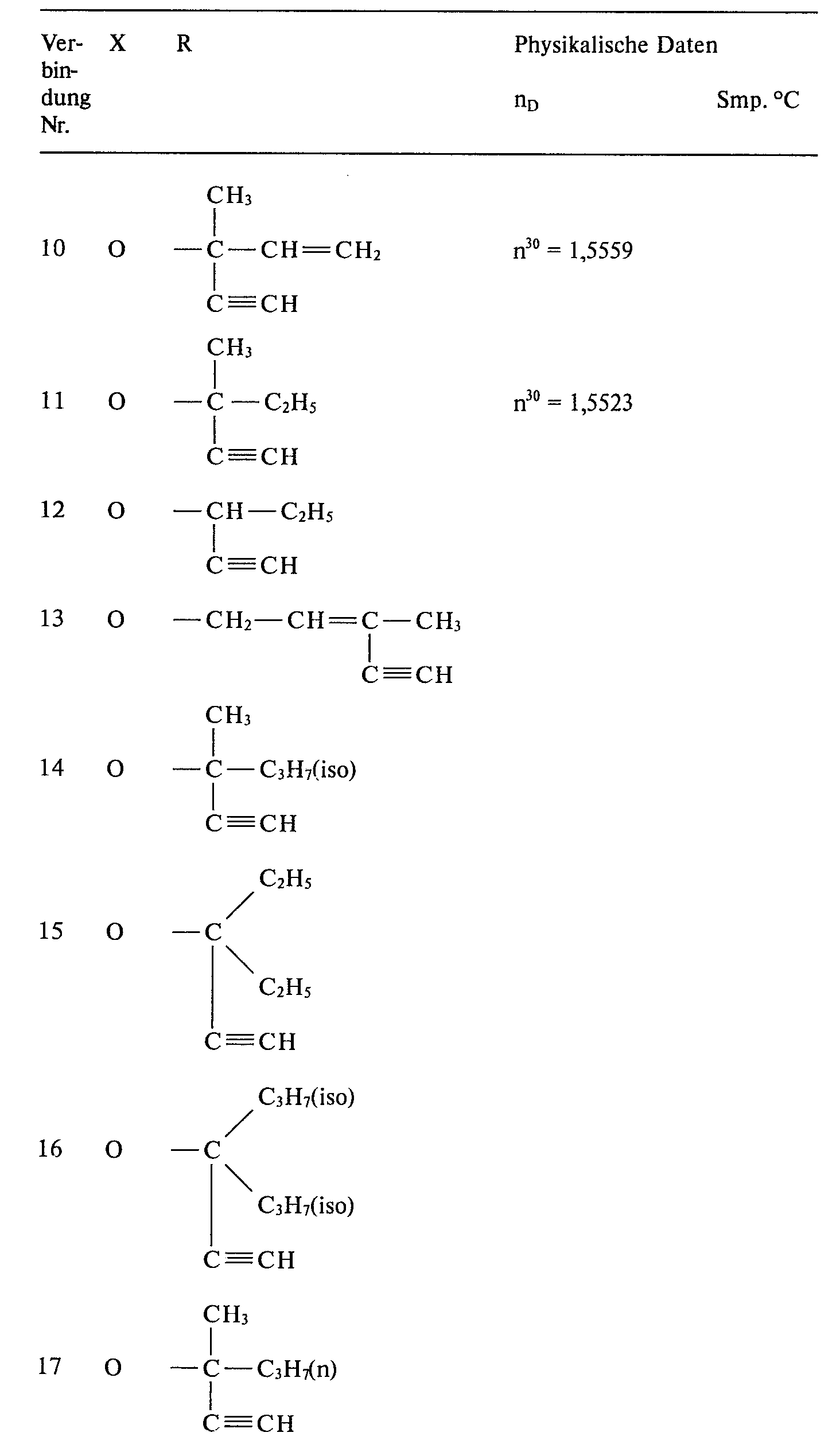
- Die in den vorstehenden Beispielen beschriebenen sowie weitere in analoger Weise hergestellte Verbindungen der Formel sind nachstehend tabellarisch angeführt.
-

-

- Fortsetzung
- Fortsetzung

-

- Fortsetzung

-

- Weitere Ketoximester des Taps der Verbindung Nr. 36:
- 43) Methyl-isobutyl-ketoximester
- 44) Methyl-äthyl-ketoximester
- 45) Diäthyl-ketoximester
- 46) Methyl-propyl-ketoximester
- 47) Methyl-tert.butyl- ketoximester
-


- Die Erfindung betrifft auch herbizide Mittel, welche einen neuen Wirkstoff der Formel 1 enthalten, sowie Verfahren zur pre- und insbesondere post-emergenten Unkrautbekämpfung, insbesondere von monocotylen Ungräsern.
- Die erfindungsgemäßen Mittel können in den üblichen Formulierungen vorliegen.
- Die Herstellung erfindungsgemäßer Mittel erfolgt in an sich bekannter Weise durch inniges Vermischen und Vermahlen von Wirkstoffen der Formel I mit geeigneten Trägerstoffen, gegebenenfalls unter Zusatz von gegenüber den Wirkstoffen inerten Dispersions- oder Lösungsmitteln. Die Wirkstoffe können in den folgenden Aufarbeitungsformen vorliegen und angewendet werden:
- Feste Aufarbeitungsformen:
Stäubemittel, Streumittel, Granulate, Umhüllungsgranulate, Imprägnierungsgranulate und Homogengranulate; - in Wasser dispergierbare Wirkstoffkonzentrate: Spritzpulver (wettable powder), Pasten, Emulsionen;
- flüssige Aufarbeitungsformen: Lösungen.
- Zur Herstellung fester Aufarbeitungsformen (Stäubemittel, Streumittel, Granulate) werden die Wirkstoffe mit festen Trägerstoffen vermischt. Als Trägerstoffe kommen zum Beispiel Kaolin, Talkum, Bolus, Löß, Kreide, Kalkstein, Kalkgrits, Ataclay, Dolomit, Diatomeenerde, gefällte Kieselsäure, Erdalkalisilikate, Natrium- und Kaliumaluminiumsilikate (Feldspäte und Glimmer), Calcium- und Magnesiumsulfate, Magnesiumoxid, gemahlene Kunststoffe, Düngemittel, wie Ammoniumsulfat, Ammoniumphosphat, Ammoniumnitrat, Harnstoff, gemahlene pflanzliche Produkte, wie Getreidemehl, Baumrindemehl, Holzmehl, Nußschalenmehl, Cellulosepulver, Rückstände von Pflanzenextraktionen, Aktivkohle etc., je für sich oder als Mischungen untereinander in Frage.
- Granulate lassen sich herstellen, indem man die Wirkstoffe in einem organischen Lösungsmittel löst und die so erhaltene Lösung auf ein granuliertes Mittel, z. B. Attapulgit, Si02, Granicalcium oder Bentonit, aufbringt und dann das organische Lösungsmittel wieder verdampft.
- Polymergranulate können hergestellt werden, indem man z. B. ein fertiges, poröses Polymerengranulat, wie Harnstoff/Formaldehyd-Polymerisate, Polyacrylnitril und Polyester, mit bestimmter Oberfläche und günstigem, vorausbestimmtem Absorptions/Desorptions-Verhältnis mit den Wirkstoffen, z. B. in Form ihrer Lösungen (in einem niedrig siedenden Lösungsmittel), imprägniert und das Lösungsmittel entfernt. Derartige Polymerengranulate können in Form von Mikrogranulaten mit Schüttgewichten von vorzugsweise 300 g/Liter bis 600 g/Liter auch mit Hilfe von Zerstäubern aufgebracht werden. Das Zerstäuben kann über ausgedehnte Behandlungsflächen mit Hilfe von Flugzeugen durchgeführt werden.
- Granulate sind auch durch Kompaktieren des Trägermaterials mit den Wirk- und Zusatzstoffen und anschließendes Zerkleinern erhältlich.
- Diesen Mitteln können ferner den Wirkstoff stabilisierende Zusätze und/oder nichtionische, antionaktive und kationenaktive Stoffe zugegeben werden, die beispielsweise die Haftfestigkeit der Wirkstoffe auf Pflanzen und Pflanzenteilen verbessern (Haft- und Klebemittel) und/oder eine bessere Benetzbarkeit (Netzmittel) sowie Dispergierbarkeit (Dispergatoren) gewährleistet. Als Klebemittel kommen beispielsweise die folgenden in Frage: Olein-Kalk-Mischung, Cellulosederivate (Methylcellulose, Carboxymethylcellulose), Hydroxyäthylenglykoläther von Mono- und Dialkylphenolen mit 5 bis 15 Äthylenoxidresten pro Molekül und 8 bis 9 Kohlenstoffatomen im Alkylrest, Ligninsulfonsäure, deren Alkalimetall- und Erdalkalimetallsalze, Polyäthylenglykoläther (Carbowaxe), Fettalkoholpolyglykol- äther mit 5 bis 20 Äthylenoxidresten pro Molekül und 8 bis 18 Kohlenstoffatomen im Fettalkoholteil, Kondensationsprodukte von Äthylenoxid, Propylenoxid, Polyvinylpyrrolidone, Polyvinylalkohole, Kondensationsprodukte von Harnstoff-Formaldehyd sowie Latex-Produkte.
- In Wasser dispergierbare Wirkstoffkonzentrate, d. h. Spritzpulver (wettable powder), Pasten und Emulsionskonzentrate stellen Mittel dar, die mit Wasser auf jede gewünschte Konzentration verdünnt werden können. Sie bestehen aus Wirkstoff, Trägerstoff, gegebenenfalls den Wirkstoff stabilisierenden Zusätzen, oberflächenaktiven Substanzen und Antischaummitteln und gegebenenfalls Lösungsmitteln.
- Die Spritzpulver (wettable powder) und Pasten werden erhalten, indem man die Wirkstoffe mit Dispergiermitteln und pulverförmigen Trägerstoffen in geeigneten Vorrichtungen bis zur Homogenität vermischt und vermahlt. Als Trägerstoffe kommen beispielsweise die vorstehend für die festen Aufarbeitungsformen erwähnten in Frage. In manchen Fällen ist es vorteilhaft, Mischungen verschiedener Trägerstoffe zu verwenden. Als Dispergatoren können beispielsweise verwendet werden: Kondensationsprodukte von sulfoniertem Naphthalin und sulfonierten Naphthalinderivaten mit Formaldehyd, Kondensationsprodukte des Naphthalins bzw. von Naphthalinsulfonsäuren mit Phenol und Formaldehyd sowie Alkalimetall-, Ammonium- und Erdalkalimetallsalze von Ligninsulfonsäure, weiter Alkylarylsulfonate, Alkali- und Erdalkalimetallsalze der Dibutylnaphthalinsulfonsäure, Fettalkoholsulfate, wie Salze sulfatierter Hexadecanole, Heptadecanole und Salze von sulfatiertem Fettalkoholpolyäthylenglykoläther, das Natriumsalz von Oleylmethyltaurid, ditertiäre Acetylenglykoie, Dialkyldilaurylamrnoniumchlorid und fettsaure Alkali- und Erdalkalimetallsalze.
- Als Antischaummittel kommen zum Beispiel Silicone in Frage.
- Die Wirkstoffe werden mit den oben aufgeführten Zusätzen so vermischt, vermahlen, gesiebt und passiert, daß bei den Spritzpulvern der feste Anteil eine Korngröße von 0,02 bis 0,04 und bei den Pasten von 0,03 mm nicht überschreitet. Zur Herstellung von Emulsionskonzentraten und Pasten werden Dispergiermittel, wie sie in den vorangehenden Abschnitten aufgeführt wurden, organische Lösungsmittel und Wasser verwendet. Als Lösungsmittel kommen beispielsweise die folgenden in Frage: Alkohole, Xylole, Toluol, Dimethylsulfoxid, N,N-dialkylierte Amide und Trialkylamine. Die Lösungsmittel müssen praktisch geruchlos, nicht phytotoxisch, den Wirkstoffen gegenüber inert und dürfen nicht leicht brennbar sein.
- Ferner können die erfindungsgemäßen Mittel in Form von Lösungen angewendet werden. Hierzu wird der Wirkstoff bzw. werden mehrere Wirkstoffe der Formel I in geeigneten organischen Lösungsmitteln, Lösungsmittelgemischen, Wasser oder Gemischen von organischen Lösungsmitteln mit Wasser gelöst. Als organische Lösungsmittel können aliphatische und aromatische Kohlenwasserstoffe, deren chlorierte Derivate, Alkylnaphthaline, allein oder als Mischung untereinander verwendet werden.
- Der Gehalt an Wirkstoff in den oben beschriebenen Mitteln liegt zwischen 0,1 und 95%, bevorzugt zwischen 1 und 80%. Anwendungsformen können bis hinab zu 0,001% verdünnt werden. Die Aufwandmengen betragen in der Regel 0,1 bis 10 kg AS/ha, vorzugsweise 0,25 bis 5 kg AS/ha. Die Wirkstoffe der Formel 1 können beispielsweise wie folgt formuliert werden (Teile bedeuten Gewichtsteile):
- Zur Herstellung eines a) 50%igen, b) 25%igen und c) 10%igen Spritzpulvers werden folgende Bestandteile verwendet:


- Der angegebene Wirkstoff wird auf die entsprechenden Trägerstoffe (Kaolin und Kreide) aufgezogen und anschließend vermischt und vermahlen. Man erhält Spritzpulver von vorzüglicher Benetzbarkeit und Schwebefähigkeit. Aus solchen Spritzpulvern können durch Verdünnen mit Wasser Suspensionen jeder gewünschten Wirkstoffkonzentration erhalten werden. Derartige Suspensionen werden zur Bekämpfung von Unkräutern und Ungräsern in Kulturpflanzungen im Nachauflaufverfahren verwendet.
- Zur Herstellung einer 45%igen Paste werden folgende Stoffe verwendet:

- Der Wirkstoff wird mit den Zuschlagstoffen in dazu geeigneten Geräten innig vermischt und vermahlen. Man erhält eine Paste, aus der sich durch Verdünnen mit Wasser Suspensionen jeder gewünschten Konzentration herstellen lassen.
- Zur Herstellung eines 25%igen Emulsionskonzentrats werden

- Anstatt des jeweiligen in den vorhergehenden Formulierungsbeispielen angegebenen Wirkstoffes kann auch eine andere der von der Formel umfaßten Verbindungen verwendet werden. Erfindungsgemäße Mittel, die als aktive Komponente mindestens eine Verbindung der Formel 1 enthalten, eignen sich besonders zur selektiven Bekämpfung schwerbekämpfbarer monocotyler Ungräser, wie Avena fatua (Wildhafer), Rotboellia, Digitaria, Setaria etc. in pre- und insbesondere post-emergenter Anwendung in Kulturpflanzenbeständen, wie z. B. Weizen, Gerste, Reis, aber auch Soja, Baumwolle, Zuckerrohr etc.
- Im Gewächshaus wird unmittelbar nach der Einsaat der Versuchspflanzen in Saatschalen die Erdoberfläche mit einer wässerigen Dispersion der Wirkstoffe, erhalten aus einem 25%igen Emulsionskonzentrat resp. aus einem 25%igen Spritzpulver mit Wirkstoffen, die wegen ungenügender Löslichkeit nicht als Emulsionskonzentrat hergestellt werden können, behandelt. Es wurden vier verschiedene Konzentrationsreihen angewendet, entsprechend 4, 2, 1 und 0,5 kg Wirksubstanz pro Hektar. Die Saatschalen werden im Gewächshaus bei 22-25°C und 50-70% rel. Luftfeuchtigkeit gehalten und der Versuch nach 3 Wochen ausgewertet und die Resultate nach folgender Notenskala bonitiert:
- 1 = Pflanzen nicht gekeimt oder total abgestorben
- 2-3 = sehr starke Wirkung
- 4-6 = mittlere Wirkung
- 7-8 = geringe Wirkung
- 9 = keine Wirkung (wie unbehandelte Kontrolle)
- Als Versuchspflanzen dienen:

- Ein oder mehrere Unkräuter und Kulturpflanzen, sowohl monocotyle wie dicotyle, wurden nach dem Auflaufen (im 4- bis 6-Blattstadium) mit einer wäßrigen Wirkstoffdispersion in verschiedenen Dosierungen (0,125; 0,25; 0,5 und 1 kg Wirksubstanz pro Hektar) auf die Pflanzen gespritzt und diese bei 23-26°C und 45-60% rel. Luftfeuchtigkeit gehalten. 15 Tage nach Behandlung wird der Versuch ausgewertet und das Ergebnis wie im pre-emergent-Versuch nach derselben Notenskala bonitiert
- In diesen post-emergent-Versuchen (Kontaktherbizidwirkung) wurden als Vergleichsverbindungen von den folgenden vorbekannten, gesättigten und ungesättigten Hydroxy-diphenyläther-Derivaten jeweils die strukturell nächstverwandten Verbindungen in den Test einbezogen.

- Erste Versuchsreihe
- Kulturpflanze: Weizen (triticum) Sorte >Probus<
- Unkraut: Wildhafer (Avena fatua)
- Aufwandmengen: 1 kg und 0,5 kg Wirksubstanz pro Hektar

- Fortsetzung

- Kulturpflanze: Gerste (hordeum) Sorte >Mazurka<
- Unkraut: Avena fatua (Wildhafer)
- Aufwandmengen: 0,25 kg Wirksubstanz pro Hektar

- Dritte Versuchsreihe
- Kulturpflanze: Soja, Sorte >Hark<
- Unkräuter: Hirsen (Rotboellia, Digitaria, Setaria)
- Aufwandmengen: 0,5, 0,25 und 0,125 kg Wirksubstanz pro HektarFortsetzung


- Vierte Versuchsreihe
- Kulturpflanze: Trockenreis, Sorte >Caloro<
- Unkräuter: Digitaria, Setaria
- Aufwandmengen: 0,5, 0,25 und 0,125 kg Wirksubstanz pro Hektar

- Es sind auch Feldversuche in den USA durchgeführt worden, wobei zwei erfindungsgemäße Verbindungen (Nr. 1 und 2) in Getreide bezüglich Phytotoxizität und Unkrautwirkung auf Avena fatua mit dem Handelsprodukt A und der Vergleichsverbindung B in ihrer Wirkung unter Anwendung verschiedener Dosen verglichen worden sind; die Aufwandmengen variierten zwischen 0,5 und 1,5 kg Wirksubstanz pro Hektar.
- Sommergerste wurde 39 Tage nach der Aussaat, als sie sich im 4-6-Blattstadium befand und mit Avena fatua im 5-1-Blattstadium verunkrautet war, durch Spritzapplikation von oben mit den Wirkstoffdispersionen behandelt.
- 22 Tage nach dieser Behandlung zeigte Verbindung B bei der Aufwandmenge von 0,5 kg/ha schon eine 60%ige Schädigung der Gerste, während die erfindungsgemäßen Wirkstoffe 1 und 2 die Gerste nur zu 30% schädigten. Die Wirkung auf Avena fatua war für alle drei eingesetzten Wirkstoffe 100%ig.
- Die erfindungsgemäßen Wirkstoffe zeichnen sich also durch eine bedeutend bessere Selektivität bei der zur völligen Vernichtung der Unkräuter ausreichenden Aufwandmenge von 0,5 kg/ha aus.
- Winterweizen, der im Oktober gesät worden war, wurde im März, als er das 2-3-Blattstadium erreicht hatte und mit Avena fatua im 1 -5-Blattstadium verunkrautet war, durch Spritzapplikation der wässerigen Wirkstoffpräparate von oben behandelt.
- 37 Tage nach der Behandlung zeigte Vergleichsverbindung B schon mit 0,5 kg/ha eine 50%ige Schädigung des Weizens, bei 0,75 und 1,5 kg/ha eine 70%ige Schädigung des Weizens bei jeweils 100%oiger Wirkung auf Avena fatua. Vergleichsverbindung A war weniger phytotoxisch (20%ige Weizenschädigung bei 0,5 bis 1,5 kg/ha), besaß aber eine nicht befriedigende Wirkung auf Avena fatua (nur 30% bei 0,5 kg/ha und 80% bei 1,5 kg/ha).
- Die erfindungsgemäßen Verbindungen 1 und 2 zeigten ein bedeutend besseres Gesamtbild:
- Während Verbindung 1 bei voller Unkrautwirkung in allen Konzentrationen den Weizen zwischen 20 und 50% schädigte, zeigte Verbindung 2 bei 0,5 und 0,75 kg/ha überhaupt keine Schädigung des Weizens bei 90%iger Unkrautwirkung.
- Ebenso gute Ergebnisse wurden mit Sommerweizen (Olaf) erzielt: 1 Monat nach der Saat erfolgte die post-emergente Spritzbehandlung, als der Weizen 3 Blätter und Avena fatua 2 bis 3 Blätter ausgebildet hatten.
- 15 Tage nach Applikation zeigte sich folgendes Bild:
- Vergleichsverbindung b erzeugte bei 0,5, 0,75 und 1 kg/ha 30- bis 70%ige Schädigung des Weizens bei 60-90%iger Unkrautwirkung, Verbindung A ergab zwar in allen diesen Konzentrationsbereichen keine Schädigung des Weizens, aber nur eine 30- bis 50%ige Unkrautwirkung.
- Demgegenüber zeigten die erfindungsgemäßen Wirkstoffe 1 und 2 bei den obigen Anwendungsmengen von 0,5, 0,75 und 1 kg/ha überhaupt keine Schädigung des Weizens bei 70- bis 90%iger Unkrautwirkung.
- Daraus geht hervor, daß für jede der erfindungsgemäßen Verbindungen 1 und 2 in den erwähnten, mit Avena fatua verunkrauteten Getreidekulturen im Feldtest mindestens eine Aufwendungsdosis gewählt werden kann, die bei optimaler Unkrautwirkung eine minimale Schädigung des Getreides ergibt, was bei keiner der Vergleichsverbindungen der Fall ist: Diese sind bei jeder wählbaren Dosis entweder zu wenig unkrautwirksam oder zu phytotoxisch für das Getreide.
- Ein Vergleichsversuch zwischen Verbindung 1 und dem vom FR-A 2359 129 umfaßten, darin aber nicht genannten Propargylester der x-(4-(3',5',6'-Trichlorpyridyl-2'-oxy)-phenoxy)-propionsäure ergab eine ganz klare Überlegenheit von Verbindung 1, da die Herbizidwirkung des Propargylesters aus FR-A 2 359 129 völlig ungenügend war.
Claims (14)


Applications Claiming Priority (2)
| Application Number | Priority Date | Filing Date | Title |
|---|---|---|---|
| CH51378 | 1978-01-18 | ||
| CH513/78 | 1978-01-18 |
Publications (2)
| Publication Number | Publication Date |
|---|---|
| EP0003114A1 EP0003114A1 (de) | 1979-07-25 |
| EP0003114B1 true EP0003114B1 (de) | 1982-01-27 |
Family
ID=4188722
Family Applications (1)
| Application Number | Title | Priority Date | Filing Date |
|---|---|---|---|
| EP79100035A Expired EP0003114B1 (de) | 1978-01-18 | 1979-01-08 | Herbizid wirksame ungesättigte Ester von 4-(3',5'-Dihalogenpyridyl -(2')-oxy)-alpha-phenoxypropionsäuren, Verfahren zu ihrer Herstellung sowie sie enthaltende herbizide Mittel und deren Verwendung |
Country Status (19)
| Country | Link |
|---|---|
| US (1) | US4300944A (de) |
| EP (1) | EP0003114B1 (de) |
| JP (1) | JPS54109981A (de) |
| AT (1) | AT370413B (de) |
| AU (1) | AU522590B2 (de) |
| BR (1) | BR7900301A (de) |
| CA (1) | CA1101865A (de) |
| CS (1) | CS207740B2 (de) |
| DD (1) | DD141774A5 (de) |
| DE (1) | DE2961917D1 (de) |
| ES (1) | ES476918A1 (de) |
| HU (1) | HU181666B (de) |
| IL (1) | IL56438A (de) |
| MX (1) | MX5629E (de) |
| NZ (1) | NZ189414A (de) |
| PH (1) | PH15224A (de) |
| RO (1) | RO76838A (de) |
| TR (1) | TR20481A (de) |
| ZA (1) | ZA79194B (de) |
Families Citing this family (27)
| Publication number | Priority date | Publication date | Assignee | Title |
|---|---|---|---|---|
| US4397680A (en) * | 1978-01-18 | 1983-08-09 | Ciba-Geigy Corporation | Herbicidally active oxime esters of halogenated α-[4-(pyridyl-2'-oxy)phenoxy]-propionic acids |
| US4325728A (en) * | 1978-07-20 | 1982-04-20 | Ciba-Geigy Corporation | Herbicidal compositions containing N-(3-trifluoromethyl-1,2,4-thiadiazolyl-5)-N'-methyl-N'-methoxy urea and α-[4-(3'-5'-dichloropyridyl-2'-oxy)-phenoxy]-propionic acid propargyl ester for control of weeds in wheat cultures |
| PH17279A (en) * | 1980-10-15 | 1984-07-06 | Ciba Geigy | Novel alpha-(pyridyl-2-oxy-phenoxy)-propionic acid derivatives and their use as herbicides and/or regulators of plant growth |
| EP0052798B1 (de) * | 1980-11-26 | 1985-05-08 | F. HOFFMANN-LA ROCHE & CO. Aktiengesellschaft | Oximester, Verfahren zu deren Herstellung, ihre Verwendung, sowie diese Oximester enthaltende Mittel |
| US4505743A (en) * | 1981-12-31 | 1985-03-19 | Ciba-Geigy Corporation | α-[4-(3-Fluoro-5'-halopyridyl-2'-oxy)-phenoxy]-propionic acid derivatives having herbicidal activity |
| MA19709A1 (fr) * | 1982-02-17 | 1983-10-01 | Ciba Geigy Ag | Application de derives de quinoleine a la protection des plantes cultivees . |
| DE3434447A1 (de) * | 1984-09-17 | 1986-03-27 | Schering AG, 1000 Berlin und 4709 Bergkamen | 7-(aryloxy)-2-naphthyloxy-alkancarbonsaeurederivate, verfahren zur herstellung dieser verbindungen sowie diese enthaltende mittel mit herbizider wirkung |
| AU570341B2 (en) * | 1984-09-17 | 1988-03-10 | Schering Aktiengesellschaft | 7-(aryloxy)-2-naphthoxy alkanecarboxylic acid |
| DE3562138D1 (en) * | 1984-09-17 | 1988-05-19 | Schering Ag | 7-(aryloxy)-2-naphthoxyalkanecarboxylic acid derivatives, processes for the preparation of these compounds, as well as agents having herbicidal activity containing these compounds |
| DE3678485D1 (de) * | 1985-04-01 | 1991-05-08 | Ciba Geigy Ag | 3-fluorpyridyl-2-oxy-phenoxy-derivate mit herbizider wirkung. |
| US4615728A (en) * | 1985-08-19 | 1986-10-07 | Sandoz Ltd. | Pyridinyloxy propoinamide derivatives useful in increasing the recoverable sugar in sugarcane |
| DE3545571A1 (de) * | 1985-12-21 | 1987-06-25 | Hoechst Ag | Heterocyclische phenylaether, verfahren zu deren herstellung und diese enthaltende herbizide mittel |
| EP0378508B1 (de) * | 1989-01-11 | 1995-03-01 | Ciba-Geigy Ag | Antidots zur Verbesserung der Kulturpflanzenvertäglichkeit agrochemischer Wirkstoffe |
| EP1836894A1 (de) | 2006-03-25 | 2007-09-26 | Bayer CropScience GmbH | Neue Sulfonamid-haltige feste Formulungen |
| DE102007013362A1 (de) | 2007-03-16 | 2008-09-18 | Bayer Cropscience Ag | Penetrationsförderer für herbizide Wirkstoffe |
| EP1844654A1 (de) | 2006-03-29 | 2007-10-17 | Bayer CropScience GmbH | Penetrationsförderer für agrochemische Wirkstoffe |
| WO2011076731A1 (de) | 2009-12-23 | 2011-06-30 | Bayer Cropscience Ag | Flüssige formulierung von 2-iodo-n-[(4-methoxy-6-methyl-1,3,5-triazin-2-yl)carbamoyl] benzolsulfonamid |
| US20130316901A1 (en) | 2011-02-15 | 2013-11-28 | Bayer Intellectual Property Gmbh | Synergistic combinations containing a dithino-tetracarboxamide fungicide and a herbicide, safener or plant growth regulator |
| DE102011080016A1 (de) | 2011-07-28 | 2012-10-25 | Bayer Cropscience Ag | Verwendung von Saatgutbehandlungs-Wirkstoffen aus der Gruppe der Strobilurin-Fungizide als Safener |
| DE102011080010A1 (de) | 2011-07-28 | 2012-10-25 | Bayer Cropscience Ag | Verwendung von Saatgutbehandlungs-Wirkstoffen aus den Gruppen der Anilid- und Thiazol-Fungizide als Safener |
| DE102011080001A1 (de) | 2011-07-28 | 2012-10-25 | Bayer Cropscience Ag | Verwendung von Saatgutbehandlungs-Wirkstoffen aus der Gruppe der Carbamat-Insektizide als Safener |
| DE102011079991A1 (de) | 2011-07-28 | 2012-09-13 | Bayer Crop Science Ag | Verwendung von Saatgutbehandlungs-Wirkstoffen aus der Gruppe der Nicotinoid-Insektizide als Safener |
| DE102011080020A1 (de) | 2011-07-28 | 2012-09-13 | Bayer Cropscience Ag | Verwendung von Saatgutbehandlungs-Wirkstoffen aus der Gruppe der Dicarboximid-Fungizide als Safener |
| DE102011079997A1 (de) | 2011-07-28 | 2012-09-13 | Bayer Corpscience Ag | Verwendung von Saatgutbehandlungs-Wirkstoffen aus der Gruppe der Pyrazol-Insektizide als Safener |
| DE102011080007A1 (de) | 2011-07-28 | 2012-09-13 | Bayer Cropscience Ag | Verwendung von Saatgutbehandlungs-Wirkstoffen aus den Gruppen der Conazole- und Triazol-Fungizide als Safener |
| DE102011080004A1 (de) | 2011-07-28 | 2012-09-13 | Bayer Cropscience Ag | Verwendung von Saatgutbehandlungs-Wirkstoffen aus der Gruppe der Carbamat-Fungizide als Safener |
| EA026839B1 (ru) | 2012-10-19 | 2017-05-31 | Байер Кропсайенс Аг | Комбинации активных соединений, содержащие карбоксамидные соединения |
Family Cites Families (12)
| Publication number | Priority date | Publication date | Assignee | Title |
|---|---|---|---|---|
| DE2223894C3 (de) * | 1972-05-17 | 1981-07-23 | Hoechst Ag, 6000 Frankfurt | Herbizide Mittel auf Basis von Phenoxycarbonsäurederivaten |
| DE2433067B2 (de) | 1974-07-10 | 1977-11-24 | a- [4-(4" Trifluormethylphenoxy)-phenoxy] -propionsäuren und deren Derivate, Verfahren zu ihrer Herstellung und diese enthaltende herbizide Mittel Hoechst AG, 6000 Frankfurt | Alpha- eckige klammer auf 4-(4' trifluormethylphenoxy)-phenoxy eckige klammer zu -propionsaeuren und deren derivate, verfahren zu ihrer herstellung und diese enthaltende herbizide mittel |
| CS185694B2 (en) | 1974-07-17 | 1978-10-31 | Ishihara Sangyo Kaisha | Herbicidal agent |
| US4083714A (en) * | 1974-10-17 | 1978-04-11 | Ishihara Sangyo Kaisha, Ltd. | Alkoxyalkyl esters of substituted pyridyloxyphenoxy-2-propanoic acids, herbicidal composition containing the same and method of use thereof |
| US4092151A (en) * | 1974-10-17 | 1978-05-30 | Ishihara Sangyo Kaisha, Ltd. | Herbicidal compound, herbicidal composition containing the same and method of use thereof |
| DK154074C (da) * | 1974-10-17 | 1989-02-27 | Ishihara Sangyo Kaisha | Alfa-(4-(5 eller 3,5 substitueret pyridyl-2-oxy)-phenoxy)-alkan-carboxylsyrer eller derivater deraf til anvendelse som herbicider, herbicidt middel samt fremgangsmaader til bekaempelse af ukrudt |
| DE2609461C2 (de) | 1976-03-08 | 1984-11-22 | Hoechst Ag, 6230 Frankfurt | α-4-(Trifluormethylphenoxy)-phenoxy-propionsäuren und ihre Derivate, Verfahren zu ihrer Herstellung und sie enthaltende herbizide Mittel |
| DE2611695A1 (de) * | 1976-03-19 | 1977-09-29 | Hoechst Ag | Herbizide mittel |
| DE2623558C2 (de) * | 1976-05-26 | 1984-12-06 | Hoechst Ag, 6230 Frankfurt | 2-[4'-Phenoxy-phenoxy]propionsäure-Derivate, Verfahren zu ihrer Herstellung und sie enthaltende herbizide Mittel |
| DE2628384C2 (de) | 1976-06-24 | 1984-09-27 | Hoechst Ag, 6230 Frankfurt | 2-(4-Phenoxyphenoxy)- bzw. 2-(4-Benzylphenoxy)-propionsäurederivate, Verfahren zu ihrer Herstellung und ihre Verwendung als Pflanzenbehandlungsmittel |
| US4133675A (en) * | 1976-07-23 | 1979-01-09 | Ciba-Geigy Corporation | Pyridyloxy-phenoxy-alkanecarboxylic acid derivatives which are effective as herbicides and as agents regulating plant growth |
| DE2758002A1 (de) | 1976-09-10 | 1979-07-05 | Hoechst Ag | Optisch aktive herbizide mittel |
-
1979
- 1979-01-08 DE DE7979100035T patent/DE2961917D1/de not_active Expired
- 1979-01-08 EP EP79100035A patent/EP0003114B1/de not_active Expired
- 1979-01-12 US US06/002,923 patent/US4300944A/en not_active Expired - Lifetime
- 1979-01-15 RO RO7996283A patent/RO76838A/ro unknown
- 1979-01-16 CA CA319,681A patent/CA1101865A/en not_active Expired
- 1979-01-16 IL IL56438A patent/IL56438A/xx not_active IP Right Cessation
- 1979-01-17 DD DD79210515A patent/DD141774A5/de not_active IP Right Cessation
- 1979-01-17 TR TR20481A patent/TR20481A/xx unknown
- 1979-01-17 ZA ZA79194A patent/ZA79194B/xx unknown
- 1979-01-17 CS CS79380A patent/CS207740B2/cs unknown
- 1979-01-17 AT AT0035179A patent/AT370413B/de not_active IP Right Cessation
- 1979-01-17 ES ES476918A patent/ES476918A1/es not_active Expired
- 1979-01-17 AU AU43436/79A patent/AU522590B2/en not_active Expired
- 1979-01-17 PH PH22069A patent/PH15224A/en unknown
- 1979-01-17 NZ NZ189414A patent/NZ189414A/xx unknown
- 1979-01-17 MX MX797662U patent/MX5629E/es unknown
- 1979-01-17 HU HU79CI1898A patent/HU181666B/hu not_active IP Right Cessation
- 1979-01-17 BR BR7900301A patent/BR7900301A/pt unknown
- 1979-01-18 JP JP598179A patent/JPS54109981A/ja active Granted
Also Published As
| Publication number | Publication date |
|---|---|
| ZA79194B (en) | 1980-01-30 |
| JPS54109981A (en) | 1979-08-29 |
| IL56438A0 (en) | 1979-03-12 |
| TR20481A (tr) | 1981-07-28 |
| DD141774A5 (de) | 1980-05-21 |
| NZ189414A (en) | 1982-03-09 |
| RO76838A (ro) | 1981-05-30 |
| CA1101865A (en) | 1981-05-26 |
| ATA35179A (de) | 1982-08-15 |
| MX5629E (es) | 1983-11-15 |
| JPS6134419B2 (de) | 1986-08-07 |
| PH15224A (en) | 1982-09-27 |
| AT370413B (de) | 1983-03-25 |
| US4300944A (en) | 1981-11-17 |
| IL56438A (en) | 1982-03-31 |
| AU4343679A (en) | 1979-07-26 |
| BR7900301A (pt) | 1979-08-14 |
| DE2961917D1 (en) | 1982-03-11 |
| AU522590B2 (en) | 1982-06-17 |
| ES476918A1 (es) | 1979-10-16 |
| EP0003114A1 (de) | 1979-07-25 |
| CS207740B2 (en) | 1981-08-31 |
| HU181666B (en) | 1983-10-28 |
Similar Documents
| Publication | Publication Date | Title |
|---|---|---|
| EP0003114A1 (de) | Herbizid wirksame ungesättigte Ester von 4-(3',5'-Dihalogenpyridyl -(2')-oxy)-alpha-phenoxypropionsäuren, Verfahren zu ihrer Herstellung sowie sie enthaltende herbizide Mittel und deren Verwendung | |
| EP0003313B1 (de) | Neue Pyridyloxy-phenoxy-alpha-propionsäure-aminoalkyl-ester mit herbizider Wirkung,ihre Herstellung, sie enthaltende Mittel und deren Verwendung | |
| EP0083556B1 (de) | Alpha-(4-(3'-Fluor-5'-halogen-pyridyl-2'-oxy)-phenoxy)-propionsäure derivate mit herbizider Wirkung | |
| EP0000351A1 (de) | Phenoxy-phenylthio-alkancarbonsäurederivate, Verfahren zu deren Herstellung und deren Verwendung als Herbizide und als Pflanzenwachstumsregulierungsmittel | |
| DD149013A5 (de) | Herbizides und pflanzenregulierendes mittel | |
| EP0248968A1 (de) | (R)-2-[4-(5-Chlor-3-fluorpyridin-2-yloxy)-phenoxy]-propionsäure-propinylester mit herbizider Wirkung | |
| DE2652384A1 (de) | Neue herbizid wirksame, kernsubstituierte phenoxy-phenoxy-alkancarbonsaeurederivate und deren verwendung zur bekaempfung von ungraesern | |
| EP0003295B1 (de) | Neue Phenoxy-phenoxy-alkancarbonsäurederivate mit herbizider Wirkung, deren Herstellung, sie enthaltende Mittel und deren Verwendung | |
| EP0075840B1 (de) | Heterocyclische Phenyläther, Verfahren zu deren Herstellung und diese enthaltende herbizide Mittel | |
| EP0036390B1 (de) | Diphenyläther-Harnstoffe mit herbizider Wirkung | |
| EP0008624B1 (de) | Ester von O-(Pyridyloxy-phenyl)-milchsäuren, Verfahren zu ihrer Herstellung und ihre Verwendung als Herbizide und Pflanzenwachstumsregulatoren | |
| EP0002812B1 (de) | Phenoxy-alkyl-oxazoline, ihre Herstellung, sie enthaltende Mittel sowie deren Verwendung als Herbizide | |
| EP0058639B1 (de) | 2-(4-(6-Halogen-chinoxalinyl-2-oxy)-phenoxy)-propionsäureester, Verfahren zu ihrer Herstellung sowie ihre Verwendung als Herbizide und Pflanzenwuchsregulatoren | |
| EP0007089B1 (de) | Acylanilide mit herbicider und fungicider Wirkung, Verfahren zu ihrer Herstellung und ihre Verwendung | |
| EP0001641B1 (de) | 2-(2'-Nitro-5-(2"-chlor-4"-trifluormethylphenoxy)-phenoxy)-propionsäure-methoxyäthylester, ein diesen Ester als Wirkstoff enthaltendes Mittel und dessen Verwendung als Herbizid. | |
| CH623725A5 (en) | Herbicide containing, as active substance, novel phenoxy-alpha-phenoxyalkanecarboxylic acid derivatives | |
| EP0003059B1 (de) | Herbizid wirksame 4-(p-Phenoxy-phenoxy)-alpha-propionsäure-alkoxyalkylamide, Verfahren zu ihrer Herstellung und sie enthaltende herbizide Mittel und deren Verwendung | |
| EP0003297B1 (de) | Neue Phenoxy-alkyl-oxazoline, deren Herstellung, sie enthaltende herbizide Mittel und deren Verwendung | |
| EP0003517B1 (de) | Cyanomethylester der 4-(p-Trifluormethylphenoxy)-alpha-phenoxy-propionsäure, Verfahren zu seiner Herstellung und ihn als Wirkstoff enthaltendes herbizides Mittel und dessen Verwendung | |
| EP0005709B1 (de) | Herbizid wirksame substituierte Diphenylätherderivate, diese als Wirkstoffe enthaltende herbizide Mittel und deren Verwendung | |
| EP0071572A2 (de) | Derivate der 2-Nitro-4- oder 5-Pyridyloxy-phenylphosphonsäure, Verfahren zu ihrer Herstellung, ihre Verwendung als Herbizide und/oder Pflanzenwachstumsregulatoren und/oder Mikrobizide, sowie zur Herstellung der Derivate verwendete Zwischenprodukte, Verfahren zu deren Herstellung und deren Verwendung als Herbizide | |
| EP0007471B1 (de) | Herbizid aktive 3,4-Dinitro-diphenyläther, ihre Herstellung, herbizide Mittel und ihre Verwendung | |
| DE2163381A1 (de) | Herbizide Komposition | |
| EP0058885B1 (de) | Herbizid wirksames 4-Amino-6-(2-chlor-1-methyl-cyclopropyl)-3-methylthio-1,2,4-triazin-5-on | |
| AT379802B (de) | Verfahren zur herstellung von neuen alpha-(pyridyloxy-phenoxy-propionsaeure-aminoalk l-estern |
Legal Events
| Date | Code | Title | Description |
|---|---|---|---|
| PUAI | Public reference made under article 153(3) epc to a published international application that has entered the european phase |
Free format text: ORIGINAL CODE: 0009012 |
|
| AK | Designated contracting states |
Designated state(s): BE CH DE FR GB IT NL |
|
| 17P | Request for examination filed | ||
| ITF | It: translation for a ep patent filed | ||
| GRAA | (expected) grant |
Free format text: ORIGINAL CODE: 0009210 |
|
| AK | Designated contracting states |
Designated state(s): BE CH DE FR GB IT NL |
|
| REF | Corresponds to: |
Ref document number: 2961917 Country of ref document: DE Date of ref document: 19820311 |
|
| ITTA | It: last paid annual fee | ||
| PGFP | Annual fee paid to national office [announced via postgrant information from national office to epo] |
Ref country code: NL Payment date: 19940131 Year of fee payment: 16 Ref country code: BE Payment date: 19940131 Year of fee payment: 16 |
|
| PGFP | Annual fee paid to national office [announced via postgrant information from national office to epo] |
Ref country code: CH Payment date: 19940414 Year of fee payment: 16 |
|
| PGFP | Annual fee paid to national office [announced via postgrant information from national office to epo] |
Ref country code: FR Payment date: 19941208 Year of fee payment: 17 |
|
| PGFP | Annual fee paid to national office [announced via postgrant information from national office to epo] |
Ref country code: GB Payment date: 19941220 Year of fee payment: 17 |
|
| PGFP | Annual fee paid to national office [announced via postgrant information from national office to epo] |
Ref country code: DE Payment date: 19941222 Year of fee payment: 17 |
|
| PG25 | Lapsed in a contracting state [announced via postgrant information from national office to epo] |
Ref country code: CH Effective date: 19950131 Ref country code: BE Effective date: 19950131 |
|
| BERE | Be: lapsed |
Owner name: CIBA-GEIGY A.G. Effective date: 19950131 |
|
| PG25 | Lapsed in a contracting state [announced via postgrant information from national office to epo] |
Ref country code: NL Effective date: 19950801 |
|
| REG | Reference to a national code |
Ref country code: CH Ref legal event code: PL |
|
| NLV4 | Nl: lapsed or anulled due to non-payment of the annual fee |
Effective date: 19950801 |
|
| PG25 | Lapsed in a contracting state [announced via postgrant information from national office to epo] |
Ref country code: GB Effective date: 19960108 |
|
| GBPC | Gb: european patent ceased through non-payment of renewal fee |
Effective date: 19960108 |
|
| PG25 | Lapsed in a contracting state [announced via postgrant information from national office to epo] |
Ref country code: FR Effective date: 19960930 |
|
| PG25 | Lapsed in a contracting state [announced via postgrant information from national office to epo] |
Ref country code: DE Effective date: 19961001 |
|
| REG | Reference to a national code |
Ref country code: FR Ref legal event code: ST |
|
| PLBE | No opposition filed within time limit |
Free format text: ORIGINAL CODE: 0009261 |
|
| STAA | Information on the status of an ep patent application or granted ep patent |
Free format text: STATUS: NO OPPOSITION FILED WITHIN TIME LIMIT |