CN115077458B - Lever ball type universal precision measuring method for rotary part section bending eccentric - Google Patents

Lever ball type universal precision measuring method for rotary part section bending eccentric Download PDF

Info

Publication number
CN115077458B
CN115077458B CN202210670591.8A CN202210670591A CN115077458B CN 115077458 B CN115077458 B CN 115077458B CN 202210670591 A CN202210670591 A CN 202210670591A CN 115077458 B CN115077458 B CN 115077458B
Authority
CN
China
Prior art keywords
eccentric
measured
section
model
lever
Prior art date
Legal status (The legal status is an assumption and is not a legal conclusion. Google has not performed a legal analysis and makes no representation as to the accuracy of the status listed.)
Active
Application number
CN202210670591.8A
Other languages
Chinese (zh)
Other versions
CN115077458A (en
Inventor
裴永臣
辛清源
刘建尧
张贺龙
王斌
罗梦演
Current Assignee (The listed assignees may be inaccurate. Google has not performed a legal analysis and makes no representation or warranty as to the accuracy of the list.)
Jilin University
Original Assignee
Jilin University
Priority date (The priority date is an assumption and is not a legal conclusion. Google has not performed a legal analysis and makes no representation as to the accuracy of the date listed.)
Filing date
Publication date
Application filed by Jilin University filed Critical Jilin University
Priority to CN202210670591.8A priority Critical patent/CN115077458B/en
Publication of CN115077458A publication Critical patent/CN115077458A/en
Application granted granted Critical
Publication of CN115077458B publication Critical patent/CN115077458B/en
Active legal-status Critical Current
Anticipated expiration legal-status Critical

Links

Images

Classifications

    • GPHYSICS
    • G01MEASURING; TESTING
    • G01BMEASURING LENGTH, THICKNESS OR SIMILAR LINEAR DIMENSIONS; MEASURING ANGLES; MEASURING AREAS; MEASURING IRREGULARITIES OF SURFACES OR CONTOURS
    • G01B21/00Measuring arrangements or details thereof, where the measuring technique is not covered by the other groups of this subclass, unspecified or not relevant
    • G01B21/20Measuring arrangements or details thereof, where the measuring technique is not covered by the other groups of this subclass, unspecified or not relevant for measuring contours or curvatures, e.g. determining profile
    • GPHYSICS
    • G01MEASURING; TESTING
    • G01BMEASURING LENGTH, THICKNESS OR SIMILAR LINEAR DIMENSIONS; MEASURING ANGLES; MEASURING AREAS; MEASURING IRREGULARITIES OF SURFACES OR CONTOURS
    • G01B21/00Measuring arrangements or details thereof, where the measuring technique is not covered by the other groups of this subclass, unspecified or not relevant
    • G01B21/22Measuring arrangements or details thereof, where the measuring technique is not covered by the other groups of this subclass, unspecified or not relevant for measuring angles or tapers; for testing the alignment of axes
    • G01B21/24Measuring arrangements or details thereof, where the measuring technique is not covered by the other groups of this subclass, unspecified or not relevant for measuring angles or tapers; for testing the alignment of axes for testing alignment of axes
    • GPHYSICS
    • G01MEASURING; TESTING
    • G01BMEASURING LENGTH, THICKNESS OR SIMILAR LINEAR DIMENSIONS; MEASURING ANGLES; MEASURING AREAS; MEASURING IRREGULARITIES OF SURFACES OR CONTOURS
    • G01B21/00Measuring arrangements or details thereof, where the measuring technique is not covered by the other groups of this subclass, unspecified or not relevant
    • G01B21/32Measuring arrangements or details thereof, where the measuring technique is not covered by the other groups of this subclass, unspecified or not relevant for measuring the deformation in a solid
    • GPHYSICS
    • G06COMPUTING OR CALCULATING; COUNTING
    • G06FELECTRIC DIGITAL DATA PROCESSING
    • G06F17/00Digital computing or data processing equipment or methods, specially adapted for specific functions
    • G06F17/10Complex mathematical operations
    • GPHYSICS
    • G06COMPUTING OR CALCULATING; COUNTING
    • G06FELECTRIC DIGITAL DATA PROCESSING
    • G06F17/00Digital computing or data processing equipment or methods, specially adapted for specific functions
    • G06F17/10Complex mathematical operations
    • G06F17/14Fourier, Walsh or analogous domain transformations, e.g. Laplace, Hilbert, Karhunen-Loeve, transforms
    • GPHYSICS
    • G06COMPUTING OR CALCULATING; COUNTING
    • G06FELECTRIC DIGITAL DATA PROCESSING
    • G06F17/00Digital computing or data processing equipment or methods, specially adapted for specific functions
    • G06F17/10Complex mathematical operations
    • G06F17/16Matrix or vector computation, e.g. matrix-matrix or matrix-vector multiplication, matrix factorization
    • GPHYSICS
    • G06COMPUTING OR CALCULATING; COUNTING
    • G06FELECTRIC DIGITAL DATA PROCESSING
    • G06F30/00Computer-aided design [CAD]
    • G06F30/20Design optimisation, verification or simulation

Landscapes

  • Engineering & Computer Science (AREA)
  • Physics & Mathematics (AREA)
  • General Physics & Mathematics (AREA)
  • Mathematical Physics (AREA)
  • Theoretical Computer Science (AREA)
  • Data Mining & Analysis (AREA)
  • Pure & Applied Mathematics (AREA)
  • Mathematical Optimization (AREA)
  • Mathematical Analysis (AREA)
  • Computational Mathematics (AREA)
  • General Engineering & Computer Science (AREA)
  • Algebra (AREA)
  • Databases & Information Systems (AREA)
  • Software Systems (AREA)
  • Computing Systems (AREA)
  • Computer Hardware Design (AREA)
  • Evolutionary Computation (AREA)
  • Geometry (AREA)
  • Length Measuring Devices With Unspecified Measuring Means (AREA)

Abstract

回转零件截面弯曲偏心的杠杆球式通用精密测量方法属于回转零件截面弯曲偏心检测领域,由测量参数预处理模型和实测数据处理模型两部分组成。首先,将杠杆球式测量机构的结构尺寸和被测截面标准轮廓信息输入参数预处理模型,计算测量机构的杠杆比;进行无偏心工件的回转测量过程仿真,获得形状项参量的傅里叶系数矩阵。之后,将被测截面的实测信号代入实测数据处理模型,求取被测截面初始解的估计值;采用循环迭代方式,获得被测截面偏心的精确解。通过设置测量机构的结构尺寸,本方法可拟合计算任意形状、任意尺寸回转工件的偏心量、偏心角和初始姿态角,本方法应用领域广,通用性强,检测效率高,适宜大范围推广应用。

Figure 202210670591

The lever ball general precision measurement method for section bending eccentricity of rotary parts belongs to the field of detection of section bending eccentricity of rotary parts, and consists of two parts: a measurement parameter preprocessing model and an actual measurement data processing model. Firstly, the structural dimensions of the lever ball measuring mechanism and the standard profile information of the measured section are input into the parameter preprocessing model to calculate the leverage ratio of the measuring mechanism; the simulation of the rotary measurement process of the non-eccentric workpiece is carried out to obtain the Fourier coefficient of the shape parameter matrix. Afterwards, the measured signal of the measured section is substituted into the measured data processing model to obtain the estimated value of the initial solution of the measured section; the eccentric solution of the measured section is obtained by means of cyclic iteration. By setting the structural size of the measuring mechanism, this method can fit and calculate the eccentricity, eccentric angle and initial attitude angle of any shape and any size of the rotary workpiece. This method has a wide range of applications, strong versatility, high detection efficiency, and is suitable for large-scale promotion application.

Figure 202210670591

Description

Lever ball type universal precision measuring method for rotary part section bending eccentric
Technical Field
The invention belongs to the field of detection of cross section bending eccentricity of a rotary part, and particularly relates to a universal precision measurement method for detecting the cross section bending eccentricity of the rotary part through contact of a lever ball type measurement mechanism.
Background
The rotary parts comprise standard geometric parts and anisotropic rotary parts, are widely applied to rotary machines and production equipment, and are important components in modern transmission devices. With the rapid development of industrial technology, the rotary parts with more precise and compact manufacturing structure and more stable transmission become important demands in the field of industrial production, and the precise detection of the parts is a basis and means for ensuring the geometric precision of the parts.
The cross-sectional shape of the rotating part and the straightness of the axis are particularly important in the manufacturing and assembling processes of the part, and the mounting precision of the part and the stability of equipment are determined; during the installation and operation of the parts, bending deformations and radial eccentricities of the rotating parts are difficult to avoid. Part bending can lead to unstable transmission and inaccurate transmission ratio on one hand; on the other hand, significant vibrations, noise or even damage to the mechanical system can occur. Currently, there are two main types of conventional rotary part shape and position error detection: the optical non-contact measurement and the folding lever type contact measurement are obviously affected by the surrounding environment condition during the detection, and the measurement results are inaccurate due to the interference factors such as greasy dirt, dust, impurities and the like in the measurement area; the measuring rod is limited by the structure of the measuring rod, only the rotary part with the convex and multi-deformation cross section can be measured, but the concave surface can not be measured, and when the regular polygon prism is measured, only partial section data or individual key points can be adopted, so that the accuracy is low and the repeatability is poor; in addition, the existing rotary part measuring method is only suitable for measuring parts with regular cross sections, but an effective measuring method for parts with complex cross section shapes or arbitrary cross section shapes is not yet available.
In summary, the development of the technology for detecting the bending eccentricity of the cross section of the rotary part is urgent to need a lever ball type universal precision measurement method with simple structure, high test efficiency, low price and controllable precision.
Disclosure of Invention
The invention aims to provide a lever ball type universal precision measurement method for the cross section bending eccentricity of a rotary part, which utilizes an arc-shaped structure of a measuring ball to ensure that the part always has one contact point with the measuring ball and only has one contact point in the rotating process, thereby increasing effective test information and rapidly and accurately acquiring the cross section bending eccentricity of the rotary part.
In order to achieve the above purpose, the invention comprises two parts of measurement parameter preprocessing and actual measurement data processing, wherein the measurement parameter preprocessing comprises a leverage ratio solving model and a non-eccentric part rotation measuring model, the actual measurement data processing comprises a test signal component analysis model and a cyclic iteration model, and the specific operation steps are as follows:
(1) According to the debugging and running conditions of the acquisition equipment, the coordinates (A, B) of the part rotation center O and the basic structural dimensions of the lever ball type measuring mechanism (2) are accurately acquired, wherein the basic structural dimensions comprise a driving arm length D, a driven arm length r, a spherical measuring head diameter s, a distance E between the spherical center of the measuring head and a lever and a distance C between a sensor probe and the lever;
(2) Inputting the parameters A, B, C, D, E, r, s into a leverage ratio solving model, and calculating the leverage ratio K of the leverage ball measuring mechanism 2 b
(3) Based on the profile function expression or measured data of the measured part 3, standard profile data (x) of the measured section without eccentricity is calculated P ,y P );
(4) Standard profile data (x P ,y P ) The simulation test signal z is obtained by bringing a rotation measurement model of the non-eccentric part into the simulation test signal z m Calculating a Fourier coefficient matrix A of the shape item parameters; so far, the pretreatment of the measurement parameters is completed;
(5) Obtaining an actual measurement signal Z of a measured section by using measuring equipment with a lever ball type measuring mechanism 2;
(6) Inputting the measured signal Z into a test signal component analysis model, and calculating the estimated value of the measured section eccentric parameter
Figure GDA0004222350890000021
Figure GDA0004222350890000022
(7) Will estimate the value
Figure GDA0004222350890000023
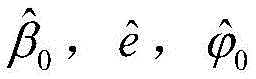
Substitution loop iterationThe model is subjected to iteration solution in a cyclic iteration mode, an accurate solution of the eccentric parameter of the measured section is obtained after cyclic convergence, and the iteration quantity of the cyclic iteration model is an attitude angle beta 0 Eccentric amount e and eccentric angle ∈>
Figure GDA0004222350890000024
The convergence evaluation index is the calculation error of the fitting signal and the original signal;
the step (2) and the step (4) respectively correspond to a lever ratio solving model and a non-eccentric part rotation measuring model which are used for preprocessing measured parameters, and the step (6) and the step (7) respectively correspond to a test signal component analysis model and a cyclic iteration model which are used for processing measured data.
The basic structural size C, r, D, E, s of the lever ball type measuring mechanism 2 and the coordinates (A, B) of the part rotation center O point in the step (1) are required to be determined according to the installation and debugging state of the actual measuring equipment, a test bed is required to be calibrated before testing, so that the accurate value of the structural size is obtained, and a whole ball or a hemisphere can be used for measuring the ball.
In the step (3), in the process of calculating the standard contour data of the measured section without eccentricity, if the function expression of the section contour of the part is known, the contour data information of the part can be directly obtained through function calculation; if the measured part 3 is a non-standard part or the cross section contour function is unknown, contour data information can be obtained through an image recognition and part test mode.
In the step (4), the combination center of the part for simulation analysis coincides with the rotation center, the initial phase angle of the section posture is 0, and the obtained signal is a simulation test signal z m
In the step (5), the measured signal Z is an engineering test signal obtained when the lever ball type measuring mechanism 2 is used to measure the measured part 3 in engineering application, and the measured signal Z and the simulation test signal Z in the step (4) m Are generally not equal in value.
The invention has the advantages that:
1) The measuring method can detect the rotary parts with any shapes and any sizes on line, has wide application field, high detection efficiency and high iteration accuracy, and greatly improves the detection accuracy of the rotary parts. By changing the structural size of the lever ball type measuring mechanism, the measuring method can realize the measuring treatment of parts with any shape and any size, and has strong universality;
2) Compared with the traditional flat-folding lever measurement method, the measurement method can ensure that only one point is in contact with the measured part in the rotation process of the part, so that the problem of measurement information loss caused when the measured section is a concave polygon is avoided, and accurate profile measurement information is provided for subsequent data processing;
3) Compared with an optical non-contact measuring method, the measuring method is not influenced by the surrounding environment condition, the measuring result is accurate, the cost is low, the measuring method can be used for a long time after one calibration, and the operation is simple and convenient.
Drawings
FIG. 1 is a flow chart of an embodiment of the present invention
FIG. 2 is a schematic diagram of the lever ball type measuring mechanism 2 of the present invention in the equilibrium position
FIG. 3 is a schematic diagram of the lever ball type measuring mechanism 2 according to the present invention when measuring arbitrary cross section
FIG. 4 is a schematic diagram of the test of the part 3 without eccentricity according to the present invention
FIG. 5 is a schematic diagram of the test of the tested part 3 of the present invention in the presence of eccentricity
FIG. 6 is a graph showing the variation of the calculation error with the increase of the number of iterations
FIG. 7 is an iteration term β of the present invention 0 ,e,
Figure GDA0004222350890000031
Graph of variation with increasing number of iterations
Wherein: 1: contact displacement sensor, 2: lever ball measuring mechanism, 3: part under test
Detailed Description
The invention provides a lever ball type universal precision measurement method for the section bending eccentricity of a rotary part, which is used for further describing a scheme by taking a cam and a cycloidal gear as examples in the attached drawings of the embodiment in order to make the purposes, the technical scheme and the effect of the invention better and clear. The specific examples described herein are intended to be illustrative only and are not intended to be limiting. The invention is further described below with reference to the accompanying drawings:
as shown in fig. 1, the method comprises two parts of measurement parameter preprocessing and actual measurement data processing, wherein the measurement parameter preprocessing comprises a leverage ratio solving model and a non-eccentric part rotation measuring model, the actual measurement data processing comprises a test signal component analysis model and a cyclic iteration model, and the specific operation steps are as follows:
(1) According to the debugging and running conditions of the acquisition equipment, the coordinates (A, B) of the part rotation center O and the basic structural dimensions of the lever ball type measuring mechanism 2 are accurately acquired, wherein the basic structural dimensions comprise the length D of a driving arm, the length r of a driven arm and the diameter of a spherical measuring head
s, the distance E between the sphere center of the measuring head and the lever and the distance C between the sensor probe and the lever;
(2) Inputting the parameters A, B, C, D, E, r, s into a leverage ratio solving model, and calculating the leverage ratio K of the leverage ball measuring mechanism 2 b
(3) According to the outline function expression or measured data of the measured part 3, calculating the standard of the measured section without eccentricity
Contour data (x) P ,y P );
(4) Standard profile data (x P ,y P ) The simulation method is carried into a rotary measurement model of the non-eccentric part, and simulates the return of the non-eccentric part
Converting the measurement process to obtain a simulation test signal z m Calculating a Fourier coefficient matrix A of the shape item parameters; so far, the pretreatment of the measurement parameters is completed;
(5) Obtaining an actual measurement signal Z of a measured section by using measuring equipment with a lever ball type measuring mechanism 2;
(6) Inputting the measured signal Z into a test signal component analysis model, and calculating the estimated value of the measured section eccentric parameter
Figure GDA0004222350890000041
Figure GDA0004222350890000042
(7) Will estimate the value
Figure GDA0004222350890000043
Substituting the iteration model of the loop, carrying out iteration solution in a loop iteration mode, and recycling
After convergence, obtaining an accurate solution of the eccentric parameter of the measured section, wherein the iteration quantity of the cyclic iteration model is an attitude angle beta 0 Deviation of the
Heart rate e and eccentric angle
Figure GDA0004222350890000044
The convergence evaluation index is the calculation error of the fitting signal and the original signal;
the step (2) and the step (4) respectively correspond to a lever ratio solving model and a non-eccentric part rotation measuring model which are used for preprocessing measured parameters, and the step (6) and the step (7) respectively correspond to a test signal component analysis model and a cyclic iteration model which are used for processing measured data.
As shown in fig. 2 and 3, the lever ball type universal precision measuring device is composed of a contact type displacement sensor 1 and a lever ball type measuring mechanism 2, a rotation center O of the lever ball type measuring mechanism 2 is used as an origin, a straight line where a horizontal position of a folding rod at the lower side of the lever ball type measuring mechanism 2 is located is used as an x axis, and a vertical direction is used as a y axis to establish a global coordinate system of the lever ball type measuring mechanism 2. The basic structural dimensions of the lever ball type measuring mechanism 2 are C, r, D, E and s respectively. If the measured part 3 is a non-circular section or the rotation center is not coincident with the geometric center, the lever ball type measuring mechanism 2 will swing up and down around the rotation center O when the measured part 3 rotates. The angle between the lever ball type measuring mechanism 2 and the x-axis is set to be theta, the coordinate of the rotation center O is (0, 0), and the indication value of the displacement sensor 1 is z. The radius of the circumcircle of the measured part 3 is R m The measured cross-section geometric center O' coordinates (A 0 ,B 0 ) The actual rotation center O' of the cross section has the coordinates of (A, B), e and
Figure GDA0004222350890000045
the measured section eccentric amount (deflection) and the eccentric angle of the measured part 3 are respectively.
The linear equations of the two folding rods of the contact type displacement sensor 1 and the lever ball type measuring mechanism 2 are respectively as follows:
L 0 :x=-r (1)
L 1 :y=xtan(θ)-C/cos(θ) (2)
L 2 :y=xtan(θ)+E/cos(θ) (3)
substituting formula (1) into formula (2), and removing the initial position-C of the contact displacement sensor 1 at θ=0, the absolute indication value of the contact displacement sensor 1 is obtained as:
z=C-rtan(θ)-C/cos(θ) (4)
according to the plane analysis geometric principle and trigonometric function relation, the geometric center O' (A) 0 ,B 0 ) The coordinate conversion relation with the actual rotation center O' (a, B) is:
Figure GDA0004222350890000051
in the formula ,
Figure GDA0004222350890000052
for initial eccentric angle at installation, < >>
Figure GDA0004222350890000053
To measure the angle through which the section of the part is rotated during the process.
When the lever ball type measuring mechanism 2 is in the horizontal position, the coordinates of the center of sphere of the measuring ball are (D, E), and when the angle between the lever ball type measuring mechanism 2 and the x-axis is θ, the coordinates of the center of sphere of the measuring ball are (x s ,y s ) Is that
Figure GDA0004222350890000058
No matter the part rotates by any angle, the surface of the part is always contacted with the measuring ball of the lever ball type measuring mechanism 2, and when the section is not eccentric, the estimated value of the lever measuring dip angle theta is
Figure GDA0004222350890000054
The contour data point vector of the measured part 3 with the geometric center thereof as the origin of coordinates is (x) P ,y P ) Consider them as polar functions of the cross-sectional phase angle gamma, 0<γ<2 pi. Initial phase angle of section posture beta 0 Then when measuring rotation
Figure GDA0004222350890000055
After the angle, the section coordinates of the part become
Figure GDA0004222350890000056
Then the distance from any point of the cross section of the part to the center of sphere
Figure GDA0004222350890000057
At theta m As an initial value, when d Ns When (θ) =0, the θ solution is precisely determined by numerical iteration.
As shown in FIG. 3, the leverage ratio solution model establishment and leverage ratio K in step (2) b The solving process of (2) is as follows:
let K be b For the leverage ratio of the lever ball measuring mechanism 2, the lever ball measuring mechanism can be used for realizing the conversion between the sensor indication z and the eccentric quantity, and the radius R of the circumcircle of the measured section m With a small disturbance ε applied thereto, equations (4) (7) are converted to
z ε (ε)=C-rtan(θ ε )-C/tan(θ ε ) (10)
Figure GDA0004222350890000061
Bringing (11) into (10), and obtaining the partial derivative of epsilon about (10) and simplifying
Figure GDA0004222350890000062
As shown in FIG. 4, in step (4), a rotation measurement model without eccentric parts is built and the test signal z is simulated m The acquisition process of the matrix A of the Fourier coefficients of the shape term parameters is as follows:
when the part is not eccentric in the rotation process, all obtained signals come from signal fluctuation caused by the shape of the part, and the signal fluctuation reflects the shape item parameters of the part. No eccentricity e=0, no initial phase angle β of attitude 0 =0, measurement process simulation test signal z m Along with the rotation angle
Figure GDA0004222350890000063
The variation relation of (2) is that
Figure GDA0004222350890000064
Performing Fourier series expansion on the obtained product
Figure GDA0004222350890000065
wherein ,
Figure GDA0004222350890000066
A=[a 0 ,a 1 ,b 1 ,a 2 ,b 2 ,...,a k ,b k ,...] T
at the same time, the Fourier coefficient matrix of the shape term parameters is converted into A,
Figure GDA0004222350890000067
as shown in FIG. 5, in the step (6), the test signal component analysis model establishment process of the section with rotation eccentricity and the initial solution estimated value of the section to be tested are carried out
Figure GDA0004222350890000068
The procedure was as follows:
simulating the test signal z in the presence of a small eccentricity e of the measured section m Essentially a superposition of the shape term and the eccentric term,
Figure GDA0004222350890000069
fourier expansion is respectively carried out on the shape item and the eccentric item
Figure GDA0004222350890000071
Shape item:
Figure GDA0004222350890000072
wherein ,
Figure GDA0004222350890000073
eccentric term:
Figure GDA0004222350890000074
wherein ,
Figure GDA0004222350890000075
The Fourier form of equation (16) is therefore,
Figure GDA0004222350890000076
by simplifying the equation (19), the attitude angle beta is obtained 0 Is the most significant of (3)The solution formula for the small value and variable c,
Figure GDA0004222350890000077
Figure GDA0004222350890000078
the discretized form of formulas (20) (21) is,
Figure GDA0004222350890000079
Figure GDA00042223508900000710
wherein ,
Figure GDA00042223508900000715
for the measurement value of the contact displacement sensor 1, < >>
Figure GDA00042223508900000711
For the corner sampling interval, +.>
Figure GDA00042223508900000712
As the rotation angle vector,
Figure GDA00042223508900000713
the estimation formulas of the eccentric amount and the eccentric angle of the measured section of the part are as follows,
Figure GDA00042223508900000714
Figure GDA0004222350890000081
wherein ,
Figure GDA0004222350890000082
to this end, an estimated value of the initial solution is obtained
Figure GDA0004222350890000083
As shown in fig. 5 and 6, the iteration quantity of the cyclic iteration model is the attitude angle β 0 Eccentric amount e and eccentric angle
Figure GDA0004222350890000084
The convergence evaluation index is the calculation error of the fitting signal and the original signal. The calculation error gradually decreases along with the increase of the iteration times in the iteration solving process, and the accurate solution beta of the measured section is obtained through a certain number of iterations 0 ,e,
Figure GDA0004222350890000085
FIG. 6 shows the variation of the calculation error with increasing number of iterations, and FIG. 7 (a) (b) (c) shows β, respectively 0 ,e,
Figure GDA0004222350890000086
A change curve increasing with the number of iterations.
Based on the initial solution estimate obtained in step (6)
Figure GDA0004222350890000087
By adopting a cyclic iteration mode, for beta 0 ,e,
Figure GDA0004222350890000088
Performing iterative solution, obtaining an accurate solution after loop convergence, wherein the iterative function is as follows
Figure GDA0004222350890000089
The discretized form of the iterative function is
Figure GDA00042223508900000810

Claims (5)

1. The lever ball type universal precision measurement method for the bending eccentricity of the cross section of a rotary part comprises two parts of measurement parameter preprocessing and actual measurement data processing, wherein the measurement parameter preprocessing comprises a lever ratio solving model and a non-eccentric part rotary measurement model, the actual measurement data processing comprises a test signal component analysis model and a cyclic iteration model, and the specific operation steps are as follows:
(1) According to the debugging and running conditions of the acquisition equipment, the coordinates (A, B) of the part rotation center O and the basic structural dimensions of the lever ball type measuring mechanism (2) are accurately acquired, wherein the basic structural dimensions comprise a driving arm length D, a driven arm length r, a spherical measuring head diameter s, a distance E between the spherical center of the measuring head and a lever and a distance C between a sensor probe and the lever;
(2) Inputting the parameter A, B, C, D, E, r, s into a lever ratio solving model, and calculating the lever ratio K of the lever ball type measuring mechanism (2) b
(3) According to the profile function expression or measured data of the measured part (3), calculating the standard profile data (x) of the measured section without eccentricity P ,y P );
(4) Standard profile data (x P ,y P ) The simulation test signal z is obtained by bringing a rotation measurement model of the non-eccentric part into the simulation test signal z m Calculating a Fourier coefficient matrix A of the shape item parameter, so that the preprocessing of the measurement parameter is completed;
(5) Obtaining an actual measurement signal Z of a measured section by using measuring equipment with a lever ball type measuring mechanism (2);
(6) Inputting the measured signal Z into a test signal component analysis model, and calculating the estimated value of the measured section eccentric parameter
Figure FDA0004222350870000011
Figure FDA0004222350870000012
(7) Will estimate the value
Figure FDA0004222350870000013
Substituting the measured cross section eccentric parameter into a cyclic iteration model, carrying out iterative solution in a cyclic iteration mode, and obtaining an accurate solution of the measured cross section eccentric parameter after cyclic convergence, wherein the iteration quantity of the cyclic iteration model is an attitude angle beta 0 Eccentric amount e and eccentric angle ∈>
Figure FDA0004222350870000014
The convergence evaluation index is the calculation error of the fitting signal and the original signal;
the step (2) and the step (4) respectively correspond to a lever ratio solving model and a non-eccentric part rotation measuring model which are used for preprocessing measured parameters, and the step (6) and the step (7) respectively correspond to a test signal component analysis model and a cyclic iteration model which are used for processing measured data.
2. The universal lever ball type precision measurement method for the cross section bending eccentricity of a rotary part according to claim 1, wherein the method is characterized in that: in the step (2), a leverage ratio solving model is established and leverage ratio K b The solving process of (2) is as follows:
let K be b The lever ratio of the lever ball type measuring mechanism (2) can be used for realizing the conversion between the sensor indication z and the eccentric quantity, and the radius R of the circumcircle of the measured section m Applying small disturbance epsilon to the sensor signal z ε Estimated value theta of lever measurement inclination angle ε It is indicated that the number of the elements is,
z ε (ε)=C-r tan(θ ε )-C/tan(θ ε ) (10)
Figure FDA0004222350870000021
bringing (11) into (10), obtaining the partial derivative of epsilon about (10), simplifying,
Figure FDA0004222350870000022
3. the universal lever ball type precision measurement method for the cross section bending eccentricity of a rotary part according to claim 1, wherein the method is characterized in that: in the step (4), a rotation measurement model without eccentric parts is established, and a test signal z is simulated m The acquisition process of the matrix A of the Fourier coefficients of the shape term parameters is as follows:
when the part is not eccentric in the rotation process, the obtained signals are all from signal fluctuation caused by the shape of the part, which reflects the shape item parameters of the part, and the part is free of eccentric e=0 and attitude initial phase angle beta 0 =0, measurement process simulation test signal z m Along with the rotation angle
Figure FDA0004222350870000023
The change relation of (c) is that,
Figure FDA0004222350870000024
the method carries out Fourier series expansion on the model,
Figure FDA0004222350870000025
wherein ,
Figure FDA0004222350870000026
A=[a 0 ,a 1 ,b 1 ,a 2 ,b 2 ,...,a k ,b k ,...] T
at the same time, the Fourier coefficient matrix of the shape term parameters is converted into A,
Figure FDA0004222350870000027
4. the universal lever ball type precision measurement method for the cross section bending eccentricity of a rotary part according to claim 1, wherein the method is characterized in that: in the step (6), the test signal component analysis model establishment process of the section with rotation eccentricity and the initial solution estimated value of the measured section
Figure FDA0004222350870000028
The procedure was as follows:
simulating the test signal z in the presence of a small eccentricity e of the measured section m Essentially a superposition of the shape term and the eccentric term,
Figure FDA0004222350870000029
the shape term and the eccentric term are respectively Fourier-expanded,
shape item:
Figure FDA0004222350870000031
wherein ,
Figure FDA0004222350870000032
eccentric term:
Figure FDA0004222350870000033
wherein ,
Figure FDA0004222350870000034
c=[x e ,y e ,z 0 ] T
Thus, the Fourier form of equation (16) is,
Figure FDA0004222350870000035
by simplifying the equation (19), the attitude angle beta is obtained 0 A solution formula for the minimum value of (c) and the variable c,
Figure FDA0004222350870000036
Figure FDA0004222350870000037
the discretized form of formulas (20) (21) is,
Figure FDA0004222350870000038
Figure FDA0004222350870000039
wherein ,
Figure FDA00042223508700000310
for the measurement of the contact displacement sensor (1), a sensor is provided>
Figure FDA00042223508700000311
For the corner sampling interval, +.>
Figure FDA00042223508700000312
As the rotation angle vector,
Figure FDA00042223508700000313
the estimation formulas of the eccentric amount and the eccentric angle of the measured section of the part are as follows,
Figure FDA00042223508700000314
Figure FDA00042223508700000315
wherein ,
Figure FDA00042223508700000316
to this end, an estimated value of the initial solution is obtained
Figure FDA0004222350870000041
5. The universal lever ball type precision measurement method for the cross section bending eccentricity of a rotary part according to claim 1, wherein the method is characterized in that: based on the initial solution estimate obtained in step (6)
Figure FDA0004222350870000042
By adopting a cyclic iteration mode, for beta 0 ,e,
Figure FDA0004222350870000043
Performing iterative solution, obtaining an accurate solution after loop convergence, wherein the iterative function is that,
Figure FDA0004222350870000044
the discretized form of the iterative function is that,
Figure FDA0004222350870000045
CN202210670591.8A 2022-06-14 2022-06-14 Lever ball type universal precision measuring method for rotary part section bending eccentric Active CN115077458B (en)

Priority Applications (1)

Application Number Priority Date Filing Date Title
CN202210670591.8A CN115077458B (en) 2022-06-14 2022-06-14 Lever ball type universal precision measuring method for rotary part section bending eccentric

Applications Claiming Priority (1)

Application Number Priority Date Filing Date Title
CN202210670591.8A CN115077458B (en) 2022-06-14 2022-06-14 Lever ball type universal precision measuring method for rotary part section bending eccentric

Publications (2)

Publication Number Publication Date
CN115077458A CN115077458A (en) 2022-09-20
CN115077458B true CN115077458B (en) 2023-06-16

Family

ID=83251047

Family Applications (1)

Application Number Title Priority Date Filing Date
CN202210670591.8A Active CN115077458B (en) 2022-06-14 2022-06-14 Lever ball type universal precision measuring method for rotary part section bending eccentric

Country Status (1)

Country Link
CN (1) CN115077458B (en)

Families Citing this family (2)

* Cited by examiner, † Cited by third party
Publication number Priority date Publication date Assignee Title
CN117804401B (en) * 2023-12-28 2025-04-04 河北华伦线缆有限公司 Method for checking eccentricity of insulation layer for cable
CN119533326B (en) * 2024-11-08 2025-09-16 吉林大学 Round section contour and precise measurement and determination method for circumferential harmonic component thereof

Family Cites Families (5)

* Cited by examiner, † Cited by third party
Publication number Priority date Publication date Assignee Title
JP3722288B2 (en) * 2003-03-03 2005-11-30 福島県 Cylindrical shape measurement method
CN105136099B (en) * 2015-05-18 2017-09-26 长春理工大学 A kind of eccentric method of inspection of revolving body
CN110906901B (en) * 2018-09-14 2020-11-24 吉林大学 A method for measuring shaft eccentricity of regular hexagonal section
CN109855590B (en) * 2019-01-12 2021-03-23 吉林大学 A lever-type continuous measurement method for the bending deformation axis of cylindrical parts
CN111043960B (en) * 2019-12-26 2021-04-30 哈尔滨工业大学 Large-scale high-speed rotation equipment error measuring and separating method based on laser sensing

Also Published As

Publication number Publication date
CN115077458A (en) 2022-09-20

Similar Documents

Publication Publication Date Title
CN107588742B (en) A method for measuring tooth profile deviation of cylindrical gears based on linear structured light
CN110375694B (en) Self-calibration method based on angle measurement error of circular grating of portable articulated coordinate measuring machine
CN115077458B (en) Lever ball type universal precision measuring method for rotary part section bending eccentric
CN108020409B (en) A Four-point Dynamic Measurement and Separation Method of Spindle Rotation Error
CN107560583A (en) The axial line bearing calibration of cylindrical workpiece and its diameter measuring method for being segmented section
CN106908240B (en) Online testing device and testing method for thermal error of machine tool spindle
CN109032070A (en) A kind of contactless R-test measuring instrument scaling method using eddy current displacement sensor
CN108317985A (en) The measuring device and measurement method of high-precision industrial robot repetitive positioning accuracy
CN105333828A (en) Four-axis linkage tracking crankshaft measuring method
CN103862327A (en) Ball joint center position detecting method
CN101750031B (en) Method and device for measuring two-dimensional contour shape
CN120403407B (en) High-precision three-dimensional contour weak stiffness detection system and method for component surface
CN112344895B (en) Establishment and calibration method of a multi-parameter model of an articulated arm coordinate measuring machine
CN109059768B (en) A Pose Calibration Method for Container Built-in Parts Detection System
CN111238372A (en) Synchronous Detection Method of Joint Position Error of Double Compound Coordinate Measuring System
CN113137943A (en) Displacement sensor calibration device and measurement method thereof
CN102095366A (en) Method for measuring large-gradient aspheric surface profile
CN208269868U (en) The measuring device of high-precision industrial robot repetitive positioning accuracy
CN115717866B (en) Device and method for measuring steady-state deformation of rotating blades in casing
CN104729796A (en) Rotational inertia torsional pendulum period measuring method
CN113282055B (en) Small-stroke and high-precision two-axis linkage error measurement system and control method
CN115752294A (en) Method for measuring three-dimensional surface profile of large complex shaft of aero-engine
CN110906901B (en) A method for measuring shaft eccentricity of regular hexagonal section
CN108375337B (en) Robot and method and device for measuring relative pose of process equipment of robot
CN114777607A (en) Device and method for detecting coaxiality error of a rotating body

Legal Events

Date Code Title Description
PB01 Publication
PB01 Publication
SE01 Entry into force of request for substantive examination
GR01 Patent grant
GR01 Patent grant