Disclosure of Invention
In view of this, the invention aims to provide a clamping device for clamping cables during electric meter box assembly, so that accurate clamping of cables of an electric meter box is realized by controlling the cooperation of guide rails, and the installation efficiency and the installation quality of the electric meter box are improved.
In order to achieve the above object, the present invention provides a clamping device for clamping a cable in an electric meter box assembly, including a supporting base 10, a first beam 20, a second beam 30, a machine head 40, and a controller 70;
the first beam 20 is fixed on the support base 10, a first guide rail 21 for the second beam 30 to slide transversely is arranged on the first beam 20, a second guide rail 31 for the machine head 40 to slide longitudinally is arranged on the side surface of the second beam 30, and the machine head 40 is used for clamping a cable;
a connecting device 60 is arranged at one end of the second beam 30 close to the first beam 20, and the machine head 40 is connected with the second beam 30 through the connecting device 60;
the controller 70 is configured to control the second beam 30 and the machine head 40 to move according to a set trajectory.
Optionally, the machine head 40 includes a first vertical beam 41 and a clamp 42 for clamping the electric wire, the first vertical beam 41 is connected to the second cross beam 30 through the connecting device 60, a third guide rail 411 for allowing the clamp 42 to slide axially is provided on the first vertical beam 41, and the clamp 42 is used for clamping the cable.
Optionally, the third rail 411 and the first rail 21 have the same cross section, the first vertical beam 41 and the clamp 42 are connected through the connecting device 60, and the controller 70 is further configured to control the clamping state of the clamp 42.
Optionally, the machine head 40 further includes a second vertical beam 43, the second vertical beam 43 is disposed adjacent to the clamp 42, and a fourth guide rail 431 is disposed on the second vertical beam 43 and allows the drilling machine 44 to axially slide;
the length of the fourth guide rail 431 is smaller than that of the third guide rail 411, the fourth guide rail 431 is arranged in parallel with the third guide rail 411, and the controller 70 is further used for controlling the working state of the drilling machine 44.
Optionally, the first rail 21 and the second rail 31 have the same size, the connecting device 60 includes a driving device 61 and a slider 62, and the controller 70 is configured to control the driving device 61.
Optionally, the clamping device further comprises a power supply device 50, wherein the power supply device 50 is used for supplying power to the clamping device;
the supporting base 10 is a hollow structure, and the power supply device 50 is disposed in the supporting base 10.
Optionally, a visual camera is further disposed on the handpiece 40, and the visual camera is connected to the controller 70.
Optionally, a light supplement lamp is further arranged on the machine head 40, and the light supplement lamp is adjacent to the vision camera.
Optionally, an alarm is further disposed on the machine head 40.
The invention has the beneficial effects that: according to the embodiment of the invention, accurate clamping of the cable of the electric meter box can be realized by matching the control guide rail, and the installation efficiency and the installation quality of the electric meter box are improved.
Detailed Description
Preferred embodiments of the present invention will be described in detail below with reference to the accompanying drawings.
In the description of the present invention, it is to be understood that the terms "center", "longitudinal", "lateral", "length", "width", "thickness", "upper", "lower", "front", "rear", "left", "right", "vertical", "horizontal", "top", "bottom", "inner", "outer", "clockwise", "counterclockwise", and the like, indicate orientations and positional relationships based on those shown in the drawings, and are used only for convenience of description and simplicity of description, and do not indicate or imply that the device or element being referred to must have a particular orientation, be constructed and operated in a particular orientation, and thus, should not be considered as limiting the present invention. Furthermore, the terms "first", "second" and "first" are used for descriptive purposes only and are not to be construed as indicating or implying relative importance or implicitly indicating the number of technical features indicated. Thus, features defined as "first", "second", may explicitly or implicitly include one or more of the described features. In the description of the present invention, "a plurality" means two or more unless specifically defined otherwise.
In the description of the present invention, it should be noted that, unless otherwise explicitly specified or limited, the terms "mounted," "connected," and "connected" are to be construed broadly, e.g., as meaning either a fixed connection, a removable connection, or an integral connection; may be mechanically connected, may be electrically connected or may be in communication with each other; either directly or indirectly through intervening media, either internally or in any other relationship. The specific meanings of the above terms in the present invention can be understood by those skilled in the art according to specific situations.
In the present invention, unless otherwise expressly stated or limited, "above" or "below" a first feature means that the first and second features are in direct contact, or that the first and second features are not in direct contact but are in contact with each other via another feature therebetween. Also, the first feature being "on," "above" and "over" the second feature includes the first feature being directly on and obliquely above the second feature, or merely indicating that the first feature is at a higher level than the second feature. A first feature being "under," "below," and "beneath" a second feature includes the first feature being directly under and obliquely below the second feature, or simply meaning that the first feature is at a lesser elevation than the second feature.
The following disclosure provides many different embodiments or examples for implementing different features of the invention. To simplify the disclosure of the present invention, the components and arrangements of specific examples are described below. Of course, they are merely examples and are not intended to limit the present invention. Furthermore, the present invention may repeat reference numerals and/or letters in the various examples, such repetition is for the purpose of simplicity and clarity and does not in itself dictate a relationship between the various embodiments and/or configurations discussed. In addition, the present invention provides examples of various specific processes and materials, but one of ordinary skill in the art may recognize applications of other processes and/or uses of other materials.
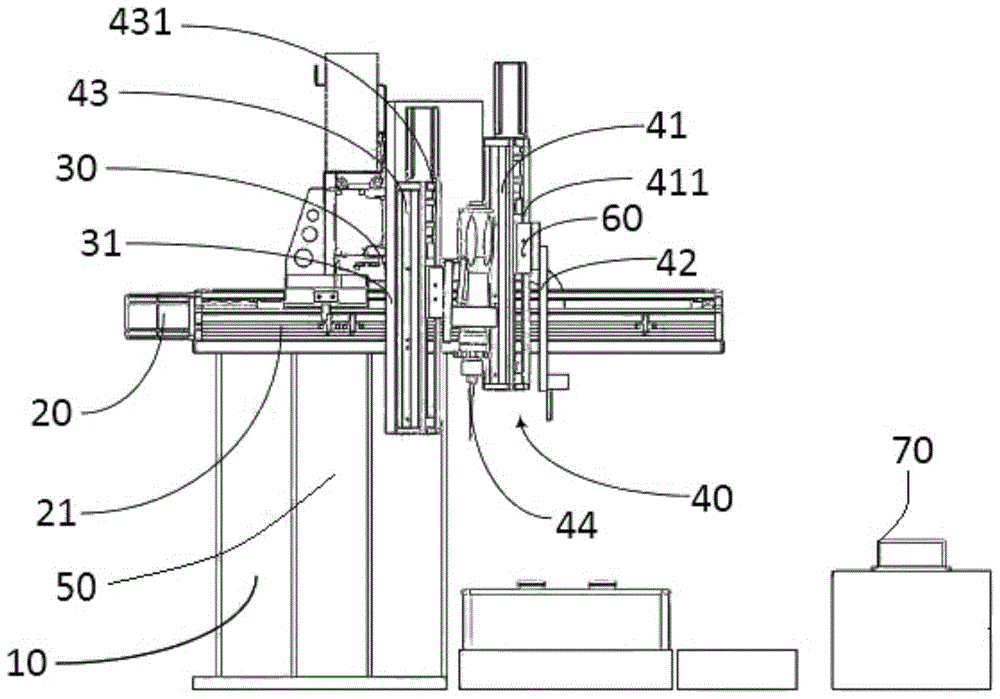
The embodiment of the invention provides a clamping device, which is used for clamping a cable for assembling an electric meter box, and as shown in fig. 1 and 2, the clamping device comprises a supporting base 10, a first cross beam 20, a second cross beam 30, a machine head 40 and a controller 70;
the first beam 20 is fixed on the support base 10, a first guide rail 21 for the second beam 30 to slide transversely is arranged on the first beam 20, a second guide rail 31 for the machine head 40 to slide longitudinally is arranged on the side surface of the second beam 30, and the machine head 40 is used for clamping a cable;
a connecting device 60 is arranged at one end of the second beam 30 close to the first beam 20, and the machine head 40 is connected with the second beam 30 through the connecting device 60;
the controller 70 is configured to control the second beam 30 and the machine head 40 to move according to a set trajectory.
In the embodiment, the first beam 20 is provided with the first guide rail 21 for the second beam 30 to slide transversely, the side surface of the second beam 30 is provided with the second guide rail 31 for the machine head 40 to slide longitudinally, and the machine head 40 is used for clamping the cable.
This embodiment can realize realizing through the cooperation of control guide rail that accurate ammeter case cable clamp is got, for example through the first guide rail 21 and the control of second guide rail 31 cooperation realization to aircraft nose 40 position to press from both sides the cable through aircraft nose 40 and get, improve ammeter case installation effectiveness and installation quality.
Optionally, the machine head 40 includes a first vertical beam 41 and a clamp 42 for clamping the electric wire, the first vertical beam 41 is connected to the second cross beam 30 through the connecting device 60, a third guide rail 411 for allowing the clamp 42 to slide axially is provided on the first vertical beam 41, and the clamp 42 is used for clamping the cable.
Optionally, the third rail 411 and the first rail 21 have the same cross section, the first vertical beam 41 and the clamp 42 are connected through the connecting device 60, and the controller 70 is further configured to control the clamping state of the clamp 42.
Specifically, as shown in fig. 1, the machine head 40 includes a first vertical beam 41 and a clamp 42 for clamping the electric wire, the first vertical beam 41 is connected to the second cross beam 30 through the connecting device 60, the first vertical beam 41 is provided with a third guide rail 411 for the clamp 42 to slide, the third guide rail 411 has the same cross section as the first guide rail 21, the first vertical beam 41 is connected to the clamp 42 through the connecting device 60, and the clamping state of the clamp 42 can be controlled by the controller 70. In some embodiments, the first beam 20 is perpendicular to the second beam 30, and the second beam 30 is perpendicular to the head 40, which is more convenient for the user to adjust the spatial position of the clamp 42.
Optionally, the machine head 40 further includes a second vertical beam 43, the second vertical beam 43 is disposed adjacent to the clamp 42, and a fourth guide rail 431 is disposed on the second vertical beam 43 and allows the drilling machine 44 to axially slide;
the length of the fourth guide rail 431 is smaller than that of the third guide rail 411, the fourth guide rail 431 is arranged in parallel with the third guide rail 411, and the controller 70 is further used for controlling the working state of the drilling machine 44.
In some preferred embodiments, a second vertical beam 43 is also secured adjacent to the clamp 42. A fourth guide rail 431 is arranged on the second vertical beam 43 and can be used for sliding the drilling machine 44, the length of the fourth guide rail 431 is smaller than that of the third guide rail 411 and is parallel to the length of the third guide rail 411, and the working state of the drilling machine 44 can be regulated and controlled by the controller 70.
Optionally, the first rail 21 and the second rail 31 have the same size, the connecting device 60 includes a driving device 61 and a slider 62, and the controller 70 is configured to control the driving device 61.
The first rail 21 and the second rail 31 in this embodiment have the same size. As shown in fig. 3, a driving device 61 and a sliding block 62 are disposed inside the connecting device 60, and both the driving device 61 and the power supply device 50 can be controlled by the controller 70.
Optionally, the clamping device further comprises a power supply device 50, wherein the power supply device 50 is used for supplying power to the clamping device;
the supporting base 10 is a hollow structure, and the power supply device 50 is disposed in the supporting base 10.
In some alternative embodiments, the supporting base 10 is a hollow structure, and the power supply device 50 is installed inside the supporting base 10, thereby optimizing the space occupied by the motor.
Optionally, a visual camera is further disposed on the handpiece 40, and the visual camera is connected to the controller 70.
Optionally, a light supplement lamp is further arranged on the machine head 40, and the light supplement lamp is adjacent to the vision camera.
Optionally, an alarm is further disposed on the machine head 40.
Specifically, in the present embodiment, the head 40 is further provided with a visual camera connected to the controller 70, a light supplement lamp is further provided beside the visual camera, a detection unit is provided inside the visual camera, and the head 40 is further provided with an alarm for alarming, for example, a buzzer alarm. The alarm, the vision camera and the light supplement lamp are all connected with the controller 70. The light filling lamp is used for improving the brightness of the working environment after being started, and the vision camera is used for grabbing the electric wire and feeding back the electric wire to the controller 70, so that the working condition of the machine monitored by workers is facilitated.
According to the invention, the first beam 20 and the second beam 30 which are perpendicular to each other are arranged, the machine head 40 slides on the second beam 30, and the second beam 30 slides on the first beam 20, so that the machine head 40 can move on the top of the electric box in all directions.
The invention sets a clamp 42 and a drilling machine 44 after the device clamps the electric wire to the corresponding station. The screws are manually placed in the screw placing machine and then fastened through the drilling machine 44, only the screws need to be manually placed in the whole process, and therefore labor cost is greatly saved.
In the description herein, references to the description of the terms "one embodiment," "certain embodiments," "an illustrative embodiment," "an example," "a specific example," or "some examples," etc., mean that a particular feature, structure, material, or characteristic described in connection with the embodiment or example is included in at least one embodiment or example of the invention. In this specification, schematic representations of the above terms do not necessarily refer to the same embodiment or example. Furthermore, the particular features, structures, materials, or characteristics described may be combined in any suitable manner in any one or more embodiments or examples.
Finally, it is noted that the above-mentioned preferred embodiments illustrate rather than limit the invention, and that, although the invention has been described in detail with reference to the above-mentioned preferred embodiments, it will be understood by those skilled in the art that various changes in form and detail may be made therein without departing from the scope of the invention as defined by the appended claims.