CN100409373C - Composite structure material for positive temperature coefficient thermistor element and manufacturing method thereof - Google Patents
Composite structure material for positive temperature coefficient thermistor element and manufacturing method thereof Download PDFInfo
- Publication number
- CN100409373C CN100409373C CNB01109754XA CN01109754A CN100409373C CN 100409373 C CN100409373 C CN 100409373C CN B01109754X A CNB01109754X A CN B01109754XA CN 01109754 A CN01109754 A CN 01109754A CN 100409373 C CN100409373 C CN 100409373C
- Authority
- CN
- China
- Prior art keywords
- metal level
- carbon black
- metal
- composite layer
- sandwich
- Prior art date
- Legal status (The legal status is an assumption and is not a legal conclusion. Google has not performed a legal analysis and makes no representation as to the accuracy of the status listed.)
- Expired - Fee Related
Links
- 239000002131 composite material Substances 0.000 title claims abstract description 124
- 239000000463 material Substances 0.000 title claims abstract description 31
- 238000004519 manufacturing process Methods 0.000 title description 22
- 229910052751 metal Inorganic materials 0.000 claims abstract description 168
- 239000002184 metal Substances 0.000 claims abstract description 168
- 239000006229 carbon black Substances 0.000 claims abstract description 112
- 229920000642 polymer Polymers 0.000 claims abstract description 43
- 238000000034 method Methods 0.000 claims abstract description 28
- 238000009713 electroplating Methods 0.000 claims description 34
- -1 polyethylene Polymers 0.000 claims description 21
- PXHVJJICTQNCMI-UHFFFAOYSA-N Nickel Chemical compound [Ni] PXHVJJICTQNCMI-UHFFFAOYSA-N 0.000 claims description 20
- 239000002648 laminated material Substances 0.000 claims description 18
- 239000003822 epoxy resin Substances 0.000 claims description 16
- 229920000647 polyepoxide Polymers 0.000 claims description 16
- 239000004744 fabric Substances 0.000 claims description 15
- 239000004698 Polyethylene Substances 0.000 claims description 12
- 229920001940 conductive polymer Polymers 0.000 claims description 12
- BASFCYQUMIYNBI-UHFFFAOYSA-N platinum Chemical compound [Pt] BASFCYQUMIYNBI-UHFFFAOYSA-N 0.000 claims description 12
- 229920000573 polyethylene Polymers 0.000 claims description 12
- 238000007747 plating Methods 0.000 claims description 10
- 229920001721 polyimide Polymers 0.000 claims description 10
- RYGMFSIKBFXOCR-UHFFFAOYSA-N Copper Chemical compound [Cu] RYGMFSIKBFXOCR-UHFFFAOYSA-N 0.000 claims description 9
- 239000011889 copper foil Substances 0.000 claims description 9
- 239000011888 foil Substances 0.000 claims description 7
- 229910000881 Cu alloy Inorganic materials 0.000 claims description 6
- 229910000990 Ni alloy Inorganic materials 0.000 claims description 6
- 229910052759 nickel Inorganic materials 0.000 claims description 6
- 229910052697 platinum Inorganic materials 0.000 claims description 6
- 239000000758 substrate Substances 0.000 claims description 6
- 239000004642 Polyimide Substances 0.000 claims description 5
- 239000004743 Polypropylene Substances 0.000 claims description 5
- 229910001260 Pt alloy Inorganic materials 0.000 claims description 5
- 229920001577 copolymer Polymers 0.000 claims description 5
- 239000009719 polyimide resin Substances 0.000 claims description 5
- 229920001155 polypropylene Polymers 0.000 claims description 5
- 238000007731 hot pressing Methods 0.000 claims description 4
- KGBXLFKZBHKPEV-UHFFFAOYSA-N boric acid Chemical compound OB(O)O KGBXLFKZBHKPEV-UHFFFAOYSA-N 0.000 claims description 3
- 239000004327 boric acid Substances 0.000 claims description 3
- 230000004888 barrier function Effects 0.000 claims 18
- 239000011521 glass Substances 0.000 claims 7
- 238000004220 aggregation Methods 0.000 claims 4
- 230000002776 aggregation Effects 0.000 claims 4
- 239000011152 fibreglass Substances 0.000 claims 4
- 229910052731 fluorine Inorganic materials 0.000 claims 4
- 239000011737 fluorine Substances 0.000 claims 4
- 210000003850 cellular structure Anatomy 0.000 claims 2
- 239000007788 liquid Substances 0.000 claims 1
- 239000002245 particle Substances 0.000 abstract description 5
- 238000012360 testing method Methods 0.000 description 10
- 230000000052 comparative effect Effects 0.000 description 7
- 239000011347 resin Substances 0.000 description 5
- 229920005989 resin Polymers 0.000 description 5
- ATJFFYVFTNAWJD-UHFFFAOYSA-N Tin Chemical compound [Sn] ATJFFYVFTNAWJD-UHFFFAOYSA-N 0.000 description 4
- 238000010586 diagram Methods 0.000 description 4
- 239000003365 glass fiber Substances 0.000 description 4
- OKTJSMMVPCPJKN-UHFFFAOYSA-N Carbon Chemical compound [C] OKTJSMMVPCPJKN-UHFFFAOYSA-N 0.000 description 2
- 239000000919 ceramic Substances 0.000 description 2
- 239000003153 chemical reaction reagent Substances 0.000 description 2
- 238000005265 energy consumption Methods 0.000 description 2
- 238000005259 measurement Methods 0.000 description 2
- 239000011156 metal matrix composite Substances 0.000 description 2
- 238000012986 modification Methods 0.000 description 2
- 230000004048 modification Effects 0.000 description 2
- KERTUBUCQCSNJU-UHFFFAOYSA-L nickel(2+);disulfamate Chemical compound [Ni+2].NS([O-])(=O)=O.NS([O-])(=O)=O KERTUBUCQCSNJU-UHFFFAOYSA-L 0.000 description 2
- 230000001151 other effect Effects 0.000 description 2
- 230000000737 periodic effect Effects 0.000 description 2
- 238000002360 preparation method Methods 0.000 description 2
- 230000005855 radiation Effects 0.000 description 2
- GUTLYIVDDKVIGB-OUBTZVSYSA-N Cobalt-60 Chemical compound [60Co] GUTLYIVDDKVIGB-OUBTZVSYSA-N 0.000 description 1
- 239000000853 adhesive Substances 0.000 description 1
- 230000001070 adhesive effect Effects 0.000 description 1
- 229910052799 carbon Inorganic materials 0.000 description 1
- 239000011248 coating agent Substances 0.000 description 1
- 238000000576 coating method Methods 0.000 description 1
- 238000004891 communication Methods 0.000 description 1
- 230000006835 compression Effects 0.000 description 1
- 238000007906 compression Methods 0.000 description 1
- 239000004020 conductor Substances 0.000 description 1
- 238000013461 design Methods 0.000 description 1
- 238000001514 detection method Methods 0.000 description 1
- 230000000694 effects Effects 0.000 description 1
- 230000005611 electricity Effects 0.000 description 1
- 238000005516 engineering process Methods 0.000 description 1
- 238000010438 heat treatment Methods 0.000 description 1
- 238000002844 melting Methods 0.000 description 1
- 230000008018 melting Effects 0.000 description 1
- 239000002905 metal composite material Substances 0.000 description 1
- 150000002739 metals Chemical class 0.000 description 1
- 239000004033 plastic Substances 0.000 description 1
- 229920003023 plastic Polymers 0.000 description 1
- 238000012545 processing Methods 0.000 description 1
- 239000007779 soft material Substances 0.000 description 1
Images










Landscapes
- Laminated Bodies (AREA)
Abstract
一种用于正温度系数热敏电阻元件的复合结构材料及其制法,其将碳黑电镀至金属薄板层压材料的金属电极表面,使之形成含有碳黑的连续多孔性结构,再将该金属薄板层压材料与碳黑填充导电结晶性高分子复合材料板材予以热压成型,使金属薄板层压材料的金属电极表面与炭黑填充导电结晶性高分子复合材料板之间形成良好粘接。同时,能让碳黑填充导电结晶性高分子复合材料中的碳黑粒子,能够和金属电极表面电镀层充分接触,降低界面电阻。
A composite structural material for positive temperature coefficient thermistor elements and a method for making the same, wherein carbon black is electroplated onto the metal electrode surface of a metal sheet laminate to form a continuous porous structure containing carbon black, and then the metal sheet laminate and the carbon black filled conductive crystalline polymer composite material sheet are hot pressed to form a good bond between the metal electrode surface of the metal sheet laminate and the carbon black filled conductive crystalline polymer composite material sheet. At the same time, the carbon black particles in the carbon black filled conductive crystalline polymer composite material can fully contact the electroplated layer on the metal electrode surface, thereby reducing the interface resistance.
Description
技术领域 technical field
一种用于正温度系数热敏电阻元件的复合结构材料及其制法,特别是指一种含碳黑的导电高分子复合材料,可用于正温度系数热敏电阻元件的复合结构材料以及其制法。A composite structural material for positive temperature coefficient thermistor elements and its preparation method, especially a conductive polymer composite material containing carbon black, which can be used for composite structural materials of positive temperature coefficient thermistor elements and its method.
背景技术 Background technique
热敏电阻元件被广泛应用于温度检测、安全控制、温度补偿等领域。过去,热敏电阻元件主要以陶瓷为材料,但陶瓷需较高温度,制造温度多在摄氏九百度以上,需消耗大量的能源,制造过程也比较复杂。而后,高分子基的热敏电阻元件被开发出来,由于高分子基材的热敏电阻元件的制造温度约在摄氏三百度以下,比较容易加工、成型,能源消耗较少,制造过程简单,成本低廉,因此应用领域日渐宽广。Thermistor elements are widely used in temperature detection, safety control, temperature compensation and other fields. In the past, the thermistor element was mainly made of ceramics, but ceramics required a relatively high temperature, and the manufacturing temperature was usually above 900 degrees Celsius, which required a large amount of energy consumption and the manufacturing process was relatively complicated. Then, polymer-based thermistor elements were developed. Because the manufacturing temperature of polymer-based thermistor elements is below 300 degrees Celsius, it is easier to process and shape, with less energy consumption, simple manufacturing process, and low cost. Inexpensive, so the field of application is increasingly broad.
而碳黑填充导电结晶性高分子复合材料,由于具备正温度系数热敏阻抗特性,在常温时为低电阻状态,当流经碳黑填充导电结晶性高分子复合材料的电流过大,造成碳黑填充导电结晶性高分子复合材料的温度达到聚乙烯的熔点附近时,碳黑填充导电结晶性高分子复合材料中的树脂基材体积膨胀,使碳黑填充导电结晶性高分子复合材料中的导电填充材由相互连通状态,撑断变成不连续的状态,造成碳黑填充导电结晶性高分子复合材料阻抗迅速上升,而碳黑填充导电结晶性高分子复合材料所制成的板材,会因而切断电流。因此,可以将碳黑填充导电结晶性高分子复合材料所制成的板材应用于多层的电路层压结构中,作为电流过载保护,以及温度开关功能的设计。The carbon black-filled conductive crystalline polymer composite material, due to its positive temperature coefficient thermistor resistance, is in a low-resistance state at room temperature. When the current flowing through the carbon black-filled conductive crystalline polymer composite material is too large, carbon When the temperature of the black-filled conductive crystalline polymer composite material reaches near the melting point of polyethylene, the volume of the resin base material in the carbon black-filled conductive crystalline polymer composite material expands, so that the carbon black-filled conductive crystalline polymer composite material The conductive filling material changes from the interconnected state to the discontinuous state, which causes the impedance of the carbon black-filled conductive crystalline polymer composite material to rise rapidly, and the plate made of carbon black-filled conductive crystalline polymer composite material will The current is thus cut off. Therefore, the plate made of carbon black-filled conductive crystalline polymer composite material can be applied to a multi-layer circuit laminated structure, as the current overload protection, and the design of the temperature switch function.
但是金属薄板和碳黑填充导电结晶性高分子复合材料所制成的板材,经过热压成型后,其界面粘接强度不足。而且,含碳黑的导电高分子复合材料与金属的粘接,是利用导电高分子复合材料中的树脂基材,因受热流动,使得碳黑充填于金属薄板层压材料金属电极表面,以及导电高分子复合材料中的碳黑导电粒子之间。但碳黑无法与金属薄板中的金属电极充分接触,因此金属薄板和含碳黑导电高分子复合材料板材之间的界面电阻会被提高。而且,当一多层的电路层压结构制成电流过载保护及温度开关元件时,必须面临各种周期性及非周期性的温度变化,金属薄板的电极以及含碳黑导电结晶性高分子复合材料板材之间,因热膨胀系数差异,将导致粘接问题。However, the interfacial bonding strength of metal sheets and plates made of conductive crystalline polymer composite materials filled with carbon black is insufficient after hot pressing. Moreover, the bonding of the conductive polymer composite material containing carbon black and the metal is to use the resin substrate in the conductive polymer composite material to flow due to heat, so that the carbon black is filled on the surface of the metal electrode of the metal sheet laminate material, and conducts electricity. Between carbon black conductive particles in polymer composites. However, the carbon black cannot fully contact the metal electrodes in the metal sheet, so the interface resistance between the metal sheet and the conductive polymer composite sheet containing carbon black will be increased. Moreover, when a multi-layer circuit laminated structure is made into current overload protection and temperature switching elements, it must face various periodic and non-periodic temperature changes. Electrodes of metal sheets and conductive crystalline polymer composites containing carbon black Between the material plates, due to the difference in thermal expansion coefficient, it will cause bonding problems.
为了解决金属电极和碳黑导电高分子复合材料板材之间的粘接强度以及界面电阻的问题。美国专利US4689475以及美国专利US4800253利用电镀处理,在金属箔表面产生金属柱状突起的粗糙面,以提高金属电极与含碳黑的导电高分子复合材料间的粘接强度。In order to solve the problems of bonding strength and interface resistance between metal electrodes and carbon black conductive polymer composite material plates. U.S. Patent No. 4,689,475 and U.S. Patent No. 4,800,253 use electroplating to produce a rough surface with metal columnar protrusions on the surface of the metal foil to improve the bonding strength between the metal electrode and the conductive polymer composite material containing carbon black.
但是,由于这些专利所揭示的技术是以碳黑直接与金属柱状的突起契合粘接,由于碳黑与金属柱状突起的几何形状不同,粘接密度未尽理想。同时,碳黑表面的树脂在碳黑与金属之间流动性不佳,只能附着在金属表面,使得阻抗提高,影响其功能。However, because the technology disclosed in these patents is to directly fit and bond carbon black to metal columnar protrusions, the bonding density is not ideal due to the different geometric shapes between carbon black and metal columnar protrusions. At the same time, the resin on the surface of the carbon black has poor fluidity between the carbon black and the metal, and can only adhere to the metal surface, which increases the impedance and affects its function.
而且,已知的热敏电阻元件制法是将碳黑导电高分子复合材料与金属箔(可为铜箔、镍箔)粘接,而须牵就金属箔材料,进行连续的整卷电镀加工,制法受限较大。Moreover, the known thermistor element manufacturing method is to bond the carbon black conductive polymer composite material and metal foil (it can be copper foil, nickel foil), and the metal foil material must be pulled to carry out continuous whole roll electroplating process. , the system is more limited.
发明内容 Contents of the invention
本发明的主要目的在于提供一种用于正温度系数热敏电阻元件的复合结构材料及其制法,使金属电极和碳黑高分子复合材料板材之间可以形成良好的粘接。The main purpose of the present invention is to provide a composite structural material for positive temperature coefficient thermistor element and its manufacturing method, so that good adhesion can be formed between the metal electrode and the carbon black polymer composite material plate.
本发明的另一目的在于提供一种用于正温度系数热敏电阻元件的复合结构材料及其制法,得以降低金属电极和含碳黑的高分子复合材料间界面电阻。Another object of the present invention is to provide a composite structure material for positive temperature coefficient thermistor element and its preparation method, which can reduce the interface resistance between the metal electrode and the polymer composite material containing carbon black.
本发明的又一目的在于提供一种用于正温度系数热敏电阻元件的复合结构材料制法,可以直接利用较成熟的印刷电路板制造过程,采取片材方式加工,使制造过程更为简化。Another object of the present invention is to provide a composite structural material manufacturing method for positive temperature coefficient thermistor elements, which can directly use the relatively mature printed circuit board manufacturing process and process it in sheet form to simplify the manufacturing process .
为了达到上述目的以及其它功效,本发明提供一种用于正温度系数热敏电阻元件的复合结构材料制法,先提供一上方与下方各设有金属层、中间设有绝缘层的金属层压材料。而该上方金属层与该下方金属层之间设有导电穿孔可导电连通,再将碳黑电镀至该上方金属层表面,使该上方金属层表面因镀有碳黑而形成连续多孔性的结构。再使用碳黑导电高分子复合材料,与具有连续多孔性结构的该上方金属层表面,进行热压粘接,而得到用于正温度系数热敏电阻元件的复合结构材料。In order to achieve the above purpose and other effects, the present invention provides a composite structural material manufacturing method for positive temperature coefficient thermistor elements. First, a metal laminate with metal layers on the top and bottom and an insulating layer in the middle is provided. Material. The upper metal layer and the lower metal layer are provided with conductive perforations for conductive communication, and then carbon black is electroplated on the surface of the upper metal layer, so that the surface of the upper metal layer is coated with carbon black to form a continuous porous structure. . Then use the carbon black conductive polymer composite material to carry out thermal pressure bonding with the surface of the upper metal layer with continuous porous structure, and obtain the composite structure material for the positive temperature coefficient thermistor element.
所述绝缘层是选自由环氧树脂层、聚酰亚胺树脂层、环氧树脂浸渍的玻璃纤维布所形成的层压材料层、与聚酰亚胺浸渍的玻璃纤维布所形成的层压材料层所组成的组中的至少一种材料。The insulating layer is selected from an epoxy resin layer, a polyimide resin layer, a laminate material layer formed of epoxy resin impregnated glass fiber cloth, and a laminate formed with polyimide impregnated glass fiber cloth. At least one material from the group consisting of material layers.
由于使用复合电镀,上方金属层的多孔结构表面已经含有碳黑,在进行热压粘接时,再将碳黑导电高分子复合材料与多孔结构金属层的碳黑可以紧密地结合以形成良好的粘接。Due to the use of composite electroplating, the surface of the porous structure of the upper metal layer already contains carbon black. When performing thermocompression bonding, the carbon black conductive polymer composite material and the carbon black of the porous structure metal layer can be tightly combined to form a good bond. bonding.
而且,因碳黑导电高分子复合材料与多孔结构金属层中的碳黑紧密结合而得以有效降低金属电极和含高分子复合材料间界面电阻。Moreover, the interfacial resistance between the metal electrode and the polymer-containing composite material can be effectively reduced due to the close combination of the carbon black conductive polymer composite material and the carbon black in the porous metal layer.
再者,由于所使用的金属层压材料,可用现成的印刷电路板,使热敏电阻元件的制造过程可以直接使用目前成熟的印刷电路板制造过程,采取片材方式加工,比目前使用软质金属箔整卷的连续制造过程更为简便,从而大幅简化制造过程。Furthermore, due to the metal laminate material used, ready-made printed circuit boards can be used, so that the manufacturing process of the thermistor element can directly use the current mature printed circuit board manufacturing process, and it is processed in sheet form, which is better than the current use of soft materials. Continuous manufacturing of full rolls of metal foil is easier, resulting in a significant simplification of the manufacturing process.
以下仅以实施例,说明本发明的特征,及其他功效如下。The following examples are used only to illustrate the features of the present invention, and other effects are as follows.
附图说明 Description of drawings
图1为本发明实施例的金属层压材料剖面图;Fig. 1 is the sectional view of the metal laminate material of the embodiment of the present invention;
图2为本发明实施例的金属层压材料经电镀通孔处理后的剖面图;Fig. 2 is the cross-sectional view of the metal laminated material of the embodiment of the present invention after being processed by plated through holes;
图3为本发明实施例的金属层压材料使用复合电镀处理的流程图;Fig. 3 is the flow chart that the metal laminated material of the embodiment of the present invention is treated with composite electroplating;
图4为本发明实施例使用的金属薄板层压材料经复合电镀处理后的剖面图;Fig. 4 is the cross-sectional view of the metal sheet laminate used in the embodiment of the present invention after composite electroplating;
图5为本发明实施例中金属表面经电镀形成多孔结构的放大示意图;5 is an enlarged schematic diagram of a porous structure formed by electroplating on a metal surface in an embodiment of the present invention;
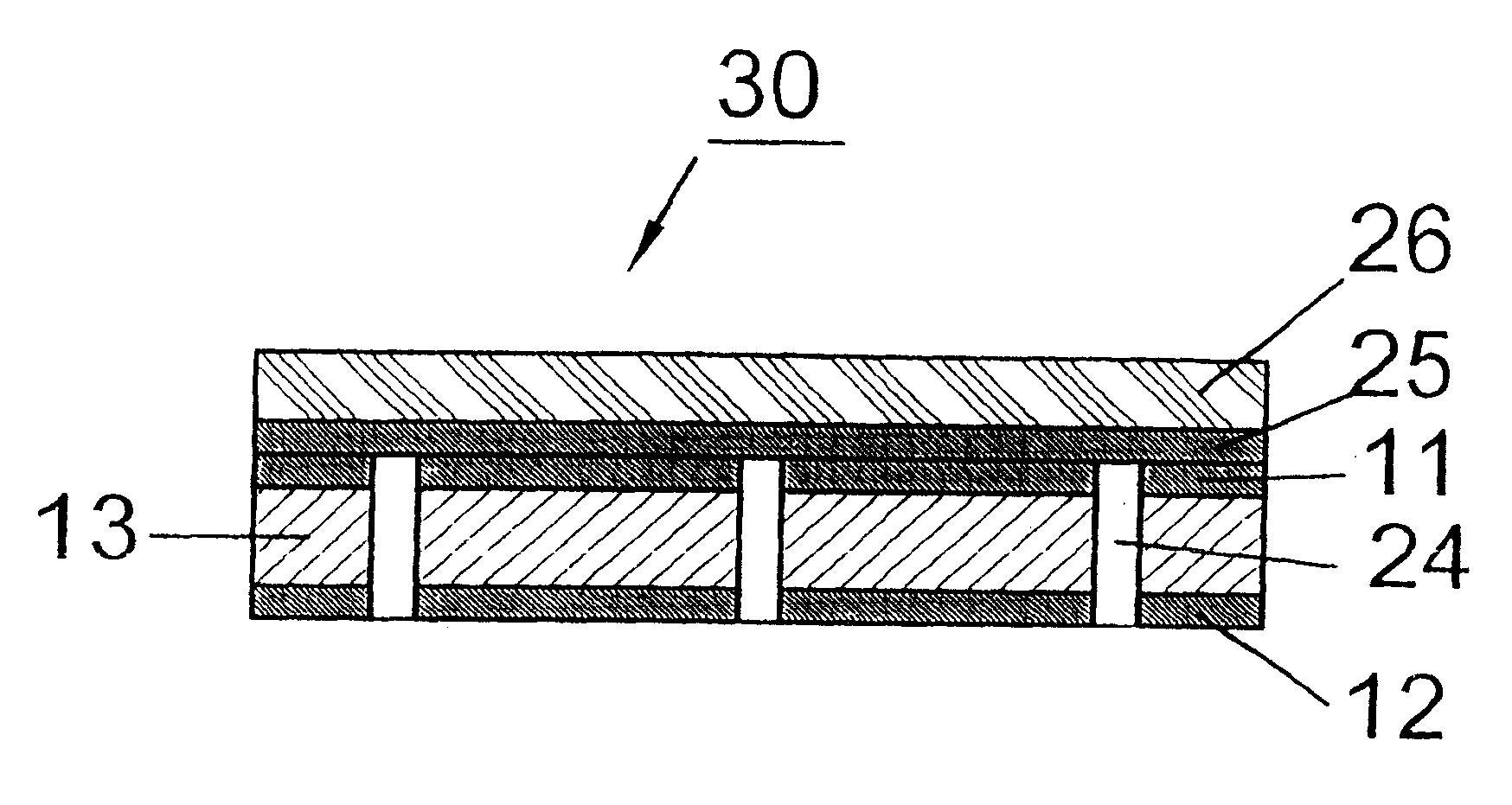
图6为本发明实施例的上图例中的金属层压材料与含碳黑高分子复合材料板材经热压合后的剖面图;Fig. 6 is the cross-sectional view of the metal laminated material and the polymer composite material plate containing carbon black in the upper legend of the embodiment of the present invention after thermal compression bonding;
图7为本发明实施例制成正温度系数热敏电阻元件的电性测量样品的剖面示意图;7 is a schematic cross-sectional view of an electrical measurement sample made of a positive temperature coefficient thermistor element according to an embodiment of the present invention;
图8为本发明实施例的电阻测试方法示意图;8 is a schematic diagram of a resistance testing method according to an embodiment of the present invention;
图9为本发明实施例中碳黑一次聚集体的说明图,碳黑一次聚集体平均粒径为0.1微米至0.5微米;Figure 9 is an explanatory diagram of a primary aggregate of carbon black in an embodiment of the present invention, the average particle size of the primary aggregate of carbon black is 0.1 micron to 0.5 micron;
图10为本发明实施例中碳黑二次聚集体的说明图;Figure 10 is an explanatory diagram of carbon black secondary aggregates in an embodiment of the present invention;
图11为本发明实施例中连续多孔性碳黑与金属的复合电镀层的剖面示意图;11 is a schematic cross-sectional view of a composite electroplating layer of continuous porous carbon black and metal in an embodiment of the present invention;
图中编号的简单说明:A brief description of the numbers in the figure:
10:金属层压材料10: Metal Laminate
11:金属层压材料的上层金属电极11: The upper metal electrode of the metal laminate
12:金属层压材料的下层金属电极12: Lower layer metal electrode of metal laminate
13:金属层压材料的中间层由环氧树脂浸渍的玻璃纤维布所形成的复合材料13: A composite material in which the middle layer of a metal laminate is formed of glass fiber cloth impregnated with epoxy resin
20:金属层压材料20: Metal Laminate
24:金属层压材料以印刷电路板制造过程制作的电镀通孔24: Metal laminates with plated through-holes made in the printed circuit board manufacturing process
25:金属层压材料的金属电极表面生成的一层连续多孔性碳黑及金属的复合电镀层25: A layer of continuous porous carbon black and metal composite electroplating layer formed on the surface of the metal electrode of the metal laminate
26:碳黑填充导电结晶性高分子复合材料层26: Carbon black filled conductive crystalline polymer composite material layer
30:经热压后的板状导电性复合材料30: Plate-shaped conductive composite material after hot pressing
40:金属层压材料与碳黑填充导电结晶性高分子复合材料热压合形成的多层的电路层压结构40: A multi-layer circuit laminate structure formed by thermocompression bonding of metal laminates and carbon black-filled conductive crystalline polymer composites
具体实施方式 Detailed ways
请参照图1,为本发明第一实施例金属薄板层压材料10的剖面示意图,在此可用现有的印刷电路板。其中,下方金属层(第一电极)12及上方金属层(第二电极)11为18微米厚的铜箔(亦可用镍箔、铂、铜合金、镍合金与铂合金,或其它导电材料),中间绝缘层13,可用环氧树脂浸渍的玻璃纤维布所形成的复合材料。取20厘米乘20厘米大小的金属薄板层压材料10,先以印刷电路板制造方法将金属薄板层压材料10以每隔1厘米左右间隔制作0.05厘米直径的电镀通孔24。请参考图2,使金属薄板层压材料20的上方金属层11及下方金属层12形成电导通状态。Please refer to FIG. 1 , which is a schematic cross-sectional view of a metal
将金属薄板层压材料20以图3所示的制作程序,继而对上方金属层11进行复合电镀。其中,每一升电镀液中,加入硼酸四十克、碳黑XC-72六克,及镍三十克(指氨基磺酸镍镀液中镍金属重量)。而电镀温度为摄氏三十五度,电镀电流密度为3A/dm2。The metal thin
请参考图4,电镀后得到一电镀处理后的金属层压材料20。该电镀会使金属薄板层压材料的上方金属层11表面,形成一层连续多孔性碳黑与金属的复合电镀层25,其是金属基复合材料层,并且为连续多孔性结构(请参考图5),其主要是电镀的金属,碳黑的一次聚集体与二次聚集体所构成,电镀金属会附着在碳黑的一次聚集体与二次聚集体的表面,而形成多孔性结构。在此实施例中,经过复合电镀处理后,所产生复合电镀层(金属基复合材料层)的厚度大约在十七至二十五微米之间。Please refer to FIG. 4 , an electroplated
请参考图6,使用碳黑填充导电结晶性高分子复合材料26与该金属层压材料20进行热压。此碳黑填充导电结晶性高分子复合材料中的高分子复合材料,可为聚乙烯、聚丙烯、聚氟烯或其共聚物。在本实施例中,是由聚乙烯(PE)PetrotheneLB832(此为美国Equistar公司商品)、和碳黑Raven450(此为美国C01umbian公司商品)以重量比例一比一,于摄氏二百一十度下以塑谱仪混练八分钟混合而成。而后将之再与金属层压材料20以热压成型机在摄氏一百七十五度下热压成具有PTC特性的厚度为1mm左右的板状导电性复合材料30。Please refer to FIG. 6 , the conductive crystalline
因为所采用的复合电镀处理会将碳黑电镀至金属层压材料的金属层11表面,使之形成连续多孔性结构层25。由于金属层压材料上方金属层表面11、以及碳黑填充导电结晶性高分子复合材料层26之中,都有碳黑的成份。在上方金属层表面11的连续多孔性结构层25,以及碳黑填充导电结晶性高分子复合材料26中,碳黑以一次聚集体(请参见图9)为基本单位,相互堆排存在于树脂基材中;在高碳黑含量时,碳黑的一次聚集体,会相互堆排成为二次聚集体(请参见图10),在复合材料中形成导电连续相。而该连续多孔性结构25是由金属、以及碳黑一次聚集体与二次聚集体所构成。而因使用复合电镀,会使该碳黑二次聚集体表面附着有金属(请参见图11)。再者,该连续多孔性结构25会更进一步与该碳黑填充结晶性导电高分子复合材料26再形成碳黑二次聚集体。而碳黑一次聚集体的大小,随碳黑种类不同而异,平均约在0.1微米到0.5微米之间。Because the composite electroplating treatment adopted will electroplate the carbon black onto the surface of the
而在微观上,由于上方金属层11表面连续多孔性结构25的凹凸起伏结构,和碳黑填充导电结晶性高分子复合材料26中的碳黑导电连续相之微结构相似,因此,上方金属层表面连续多孔性结构25,和碳黑填充导电结晶性高分子复合材料26中的碳黑导电连续相,形成良好的粘接,再者,碳黑填充导电结晶性高分子复合材料26中,附着在碳黑表面的树脂基材,在热压合过程中受热流动后,会渗入上方金属层11经复合电镀形成的连续多孔性结构25中,因此不会影响碳黑填充导电结晶性高分子复合材料26的碳黑导电通路,而与上方金属层11直接导电接触。而为了能确保聚乙烯导电复合材料以及上方金属层11有良好粘接强度,复合电镀层(连续多孔性结构25)的厚度,最好在碳黑一次聚集体平均粒径的二倍以上,亦即,连续多孔性结构25的厚度在0.2微米以上较佳。And microscopically, because the concave-convex undulating structure of the continuous
请参考图7,将二片处理得到的板状导电性复合材料30,以碳黑填充导电结晶性高分子复合材料层26相对,以摄氏一百七十五度进行热压合十分钟,使之成为正温度系数热敏电阻元件的电性量测样品40,再裁切成2厘米乘2厘米大小试片。将试片以钴60辐射线照射20Mad辐射剂量。Please refer to Fig. 7, the plate-shaped conductive
参考图8,使用微欧姆计进行电阻测试,测量试片常温电阻R1及试片经浸在摄氏二百三十度熔锡中三秒钟,再静置常温环境一小时后的常温电阻R2,以观察受热过程后试片常温电阻变化。由实施例及对照例测试结果比较,证明使用碳黑复合电镀处理的金属薄板层压材料,与碳黑填充导电结晶性高分子复合材料之间,有良好粘接而且界面电阻较低。Referring to Figure 8, use a micro-ohmmeter to perform resistance testing, measure the normal temperature resistance R1 of the test piece and the normal temperature resistance R2 after the test piece is immersed in molten tin at 230 degrees Celsius for three seconds, and then stand in a room temperature environment for one hour. To observe the resistance change of the test piece at room temperature after the heating process. Comparing the test results of the examples and the comparative example, it is proved that the metal sheet laminate material treated with carbon black composite electroplating has good adhesion and low interface resistance with the carbon black filled conductive crystalline polymer composite material.
有关本发明此第一实施例,及其它实施例,乃至于对照例所使用的电镀配方及电镀条件,请参考表1。而上述实施例至对照例经复合电镀处理后,所产生的复合电镀层厚度请参考表2。由此可知,本发明确有较佳的粘接力,并且界面电阻较低。Please refer to Table 1 for the electroplating formula and electroplating conditions used in the first embodiment of the present invention, other embodiments, and even comparative examples. Please refer to Table 2 for the thickness of the composite electroplating layer produced in the above-mentioned examples to comparative examples after the composite electroplating treatment. It can be seen that the present invention clearly has better adhesive force and lower interface resistance.
同时,由于所使用的金属层压材料,可以现成的单面印刷电路板,或是双面金属箔基板,使热敏电阻元件的制造过程可以直接使用目前成熟的印刷电路板制造过程,采取片材方式加工,比目前使用软质金属箔整卷的连续制造过程更为简便,从而大幅度简化制造过程。At the same time, due to the metal laminate materials used, ready-made single-sided printed circuit boards or double-sided metal foil substrates can be used, so that the manufacturing process of the thermistor element can directly use the current mature printed circuit board manufacturing process, using chip It is easier to process than the current continuous manufacturing process of using a whole roll of soft metal foil, thus greatly simplifying the manufacturing process.
虽然本发明以上述的实施例作说明,但并不表示本发明的保护范围以上述的说明为限。对于熟知此项技艺的人士而言,当可作各种修改,例如,改变选择的电镀液材料如瓦式镍(Watts Nickel),或添加不同的碳黑粒子,或是改变复合电镀条件如电镀温度、电镀电流及电镀时间,而可达到相同的功效。此等修改应不脱离本发明的精神,仍属于本发明的保护范围内。本发明的保护范围仍应以权利要求所述为主。Although the present invention is described with the above-mentioned embodiments, it does not mean that the protection scope of the present invention is limited to the above-mentioned description. For those who are familiar with the art, various modifications can be made, for example, changing the selected plating solution material such as Watts Nickel, or adding different carbon black particles, or changing composite plating conditions such as electroplating Temperature, electroplating current and electroplating time can achieve the same effect. These modifications should not depart from the spirit of the present invention, and still belong to the protection scope of the present invention. The scope of protection of the present invention should still be based on the claims.
表1本发明中复合电镀的使用材料与操作条件Materials used and operating conditions of composite electroplating in table 1 the present invention
注1:表1中所示试剂重量,是指每1升电镀液中试剂添加量。Note 1: The weight of reagents shown in Table 1 refers to the amount of reagent added per 1 liter of electroplating solution.
注2:镍是指氨基磺酸镍镀液中镍金属重量。Note 2: Nickel refers to the weight of nickel metal in the nickel sulfamate bath.
表2本发明复合电镀后电镀层厚度与制成多层电路的阻抗值Thickness of electroplated layer after table 2 composite electroplating of the present invention and the impedance value of making multilayer circuit
注1:R1为经加上碳黑填充导电分子复合材料热压后的试片未经浸在摄氏230度熔锡之前的常温电阻。Note 1: R1 is the room temperature resistance of the test piece after being hot-pressed with carbon black-filled conductive molecule composite material before being immersed in 230 degrees Celsius molten tin.
注2:R2为上述试片浸在摄氏230度熔锡之中3秒钟后再静置常温环境1小时后的常温电阻。Note 2: R2 is the normal temperature resistance of the above test piece immersed in molten tin at 230 degrees Celsius for 3 seconds and then left to stand in a normal temperature environment for 1 hour.
Claims (44)
Priority Applications (1)
| Application Number | Priority Date | Filing Date | Title |
|---|---|---|---|
| CNB01109754XA CN100409373C (en) | 2001-04-06 | 2001-04-06 | Composite structure material for positive temperature coefficient thermistor element and manufacturing method thereof |
Applications Claiming Priority (1)
| Application Number | Priority Date | Filing Date | Title |
|---|---|---|---|
| CNB01109754XA CN100409373C (en) | 2001-04-06 | 2001-04-06 | Composite structure material for positive temperature coefficient thermistor element and manufacturing method thereof |
Publications (2)
| Publication Number | Publication Date |
|---|---|
| CN1379415A CN1379415A (en) | 2002-11-13 |
| CN100409373C true CN100409373C (en) | 2008-08-06 |
Family
ID=4658118
Family Applications (1)
| Application Number | Title | Priority Date | Filing Date |
|---|---|---|---|
| CNB01109754XA Expired - Fee Related CN100409373C (en) | 2001-04-06 | 2001-04-06 | Composite structure material for positive temperature coefficient thermistor element and manufacturing method thereof |
Country Status (1)
| Country | Link |
|---|---|
| CN (1) | CN100409373C (en) |
Families Citing this family (7)
| Publication number | Priority date | Publication date | Assignee | Title |
|---|---|---|---|---|
| CN1321801C (en) * | 2002-12-31 | 2007-06-20 | 冯宏 | Accumulating composite plate matericl capable of rethermoplastic to form and its reshaping processing method |
| US20100266850A1 (en) * | 2007-12-11 | 2010-10-21 | Shimoohsako Kanji | Laminate, method for producing laminate, flexible printed circuit board, and method for manufacturing flexible printed circuit board |
| CN103267616A (en) * | 2013-06-04 | 2013-08-28 | 南京航空航天大学 | Restorable air conduit pipeline leakage detecting device and method |
| CN104582028B (en) * | 2013-10-15 | 2016-06-22 | 安邦电气集团有限公司 | A kind of composite high-molecular self limiting temperature accompanying-heat cable |
| CN105186006B (en) * | 2014-06-17 | 2017-08-11 | 北京好风光储能技术有限公司 | A kind of compound porous collector and preparation method and application |
| DE102017121042A1 (en) * | 2017-05-24 | 2018-11-29 | Webasto SE | Liquid heater, in particular water heater |
| TWI767129B (en) * | 2018-07-11 | 2022-06-11 | 台虹科技股份有限公司 | composite material |
Citations (3)
| Publication number | Priority date | Publication date | Assignee | Title |
|---|---|---|---|---|
| JPS63312601A (en) * | 1987-06-15 | 1988-12-21 | Tdk Corp | Conductive polymer ptc resistance element and manufacture thereof |
| JPH047801A (en) * | 1990-04-25 | 1992-01-13 | Daito Tsushinki Kk | Ptc device |
| CN1273423A (en) * | 1999-05-10 | 2000-11-15 | 松下电器产业株式会社 | Electgrode for PTC thermister and manufacture method thereof and PTC thermistor |
-
2001
- 2001-04-06 CN CNB01109754XA patent/CN100409373C/en not_active Expired - Fee Related
Patent Citations (3)
| Publication number | Priority date | Publication date | Assignee | Title |
|---|---|---|---|---|
| JPS63312601A (en) * | 1987-06-15 | 1988-12-21 | Tdk Corp | Conductive polymer ptc resistance element and manufacture thereof |
| JPH047801A (en) * | 1990-04-25 | 1992-01-13 | Daito Tsushinki Kk | Ptc device |
| CN1273423A (en) * | 1999-05-10 | 2000-11-15 | 松下电器产业株式会社 | Electgrode for PTC thermister and manufacture method thereof and PTC thermistor |
Also Published As
| Publication number | Publication date |
|---|---|
| CN1379415A (en) | 2002-11-13 |
Similar Documents
| Publication | Publication Date | Title |
|---|---|---|
| US6686827B2 (en) | Surface mountable laminated circuit protection device and method of making the same | |
| TW545092B (en) | Prepreg and circuit board and method for manufacturing the same | |
| US6228467B1 (en) | Heat-resistant insulating film, raw substrate for printed wiring board using the same and method for producing the substrate | |
| US7069641B2 (en) | Method for preparing composite materials of a positive temperature coefficient thermistor | |
| TW507220B (en) | Surface mountable polymeric circuit protection device and its manufacturing process | |
| CN210157469U (en) | Metal base copper clad laminate | |
| US6873244B2 (en) | Surface mountable laminated thermistor device | |
| CN102124474A (en) | RF tag and method for producing same | |
| CN106393873B (en) | A composite sheet of multi-layer porous metal and polymer material | |
| US8576043B2 (en) | Surface-mount type overcurrent protection element | |
| JP3514647B2 (en) | Multilayer printed wiring board and method of manufacturing the same | |
| JP2000200950A (en) | Flexible printed wiring board and method of manufacturing the same | |
| CN1379415A (en) | Composite structural material for positive temperature coefficient thermistor element and its preparation method | |
| TWI496172B (en) | Low resistance sheet resistors and methods of manufacturing the same | |
| CN217336012U (en) | High-reliability sandwich metal-based PCB based on coating | |
| CN100403460C (en) | Surface-adhesive multilayer circuit protection device and method for manufacturing the same | |
| CN116419479A (en) | A kind of support body of metal foil and its application | |
| JP3514669B2 (en) | Metal-based printed wiring board, metal-based multilayer printed wiring board, and method of manufacturing the same | |
| CN111696739A (en) | PTC over-current protection device capable of effectively improving long-term environmental stability | |
| CN213343117U (en) | High-strength heat-conducting silica gel patch | |
| JP3990513B2 (en) | Heat-resistant insulating film, base plate for printed wiring board using the same, and method for manufacturing board | |
| CN222940964U (en) | Metal foil carrier, peelable metal foil and circuit board | |
| US20260112546A1 (en) | Solid electrolytic capacitor | |
| CN206196133U (en) | Multilayer printed circuit board | |
| JP2001036252A (en) | Multilayer printed wiring board and method of manufacturing the same |
Legal Events
| Date | Code | Title | Description |
|---|---|---|---|
| C06 | Publication | ||
| PB01 | Publication | ||
| C10 | Entry into substantive examination | ||
| SE01 | Entry into force of request for substantive examination | ||
| C14 | Grant of patent or utility model | ||
| GR01 | Patent grant | ||
| C17 | Cessation of patent right | ||
| CF01 | Termination of patent right due to non-payment of annual fee |
Granted publication date: 20080806 Termination date: 20140406 |