WO2025142831A1 - 化粧品用ソフトカプセル - Google Patents
化粧品用ソフトカプセル Download PDFInfo
- Publication number
- WO2025142831A1 WO2025142831A1 PCT/JP2024/045448 JP2024045448W WO2025142831A1 WO 2025142831 A1 WO2025142831 A1 WO 2025142831A1 JP 2024045448 W JP2024045448 W JP 2024045448W WO 2025142831 A1 WO2025142831 A1 WO 2025142831A1
- Authority
- WO
- WIPO (PCT)
- Prior art keywords
- soft capsule
- capsule
- weight
- particle size
- soft
- Prior art date
- Legal status (The legal status is an assumption and is not a legal conclusion. Google has not performed a legal analysis and makes no representation as to the accuracy of the status listed.)
- Pending
Links
Images

Classifications
-
- A—HUMAN NECESSITIES
- A61—MEDICAL OR VETERINARY SCIENCE; HYGIENE
- A61K—PREPARATIONS FOR MEDICAL, DENTAL OR TOILETRY PURPOSES
- A61K8/00—Cosmetics or similar toiletry preparations
- A61K8/02—Cosmetics or similar toiletry preparations characterised by special physical form
- A61K8/11—Encapsulated compositions
-
- A—HUMAN NECESSITIES
- A61—MEDICAL OR VETERINARY SCIENCE; HYGIENE
- A61K—PREPARATIONS FOR MEDICAL, DENTAL OR TOILETRY PURPOSES
- A61K8/00—Cosmetics or similar toiletry preparations
- A61K8/18—Cosmetics or similar toiletry preparations characterised by the composition
- A61K8/30—Cosmetics or similar toiletry preparations characterised by the composition containing organic compounds
- A61K8/33—Cosmetics or similar toiletry preparations characterised by the composition containing organic compounds containing oxygen
- A61K8/34—Alcohols
-
- A—HUMAN NECESSITIES
- A61—MEDICAL OR VETERINARY SCIENCE; HYGIENE
- A61K—PREPARATIONS FOR MEDICAL, DENTAL OR TOILETRY PURPOSES
- A61K8/00—Cosmetics or similar toiletry preparations
- A61K8/18—Cosmetics or similar toiletry preparations characterised by the composition
- A61K8/72—Cosmetics or similar toiletry preparations characterised by the composition containing organic macromolecular compounds
Definitions
- the present invention relates to soft capsules for use in cosmetics.
- Capsule preparations in which medicinal substances are coated with a membrane are used in a variety of fields.
- capsules are also used in the field of cosmetics, where various capsules are used in various ways, such as separating the capsule contents from the cosmetic ingredients to improve shelf life, disintegrating the capsule when used to release fresh contents, or using the coloring of the capsule shell to create a moving design impact.
- Patent Document 1 proposes an agar-coated capsule that has a content made of an oily component and an agar coating that covers the content, with silica blended into the agar coating. This capsule does not break during storage when a cosmetic product containing the capsule to be applied to the skin is used, and after application to the skin, the capsule is easily broken when crushed with fingers, and no gel residue from the capsule coating remains on the skin or the gel residue from the capsule coating is reduced.
- Patent Document 1 describes the silica added to the agar coating as an ingredient that smoothes the skin and imparts cleansing power to the cosmetic product when the agar coating is crushed on the user's skin.
- the present invention aims to solve this problem.
- the present invention aims to provide a capsule that, even if shell pieces are formed by grinding with the fingers when used as a cosmetic, the presence of the shell pieces is difficult to feel with the fingers, and the contents are easily absorbed into the skin.
- a soft capsule comprising a liquid content at room temperature and a shell that encapsulates the content
- a soft capsule for cosmetics characterized in that in the particle size distribution of the membrane fragments obtained by pulverizing the soft capsule with a bead homogenizer, the particle diameter at which the cumulative frequency on a volume basis is 90% is 1000 ⁇ m or less.
- the soft capsule contents are used in cosmetics and contain a liquid content at room temperature and a membrane that encapsulates the content.
- the soft capsule contents usually contain an oily liquid.
- the oily liquid may be a liquid of natural origin, a liquid obtained by synthesis, or a mixture thereof.
- the coating contains water.
- the water is a component that moistens the soft capsule, and is, for example, at least one selected from the group consisting of tap water, ion-exchanged water, distilled water, and ultrapure water.
- the amount of water is 60% by weight or more based on the total weight of the coating.
- the soft capsule shell of the present invention may contain various additives commonly used in this field, such as flavorings, sweeteners, colorants, and preservatives such as paraben, in addition to the above-mentioned shell composition, as necessary.
- additives commonly used in this field, such as flavorings, sweeteners, colorants, and preservatives such as paraben, in addition to the above-mentioned shell composition, as necessary.
- the total content of all additives is, for example, 0.01% to 10% by weight, and preferably 0.1% to 5% by weight, based on the total solids weight in the composition that becomes the capsule shell.
- the soft capsule shell does not need to contain poorly water-soluble particles. Poorly water-soluble particles are particles composed of substances that are difficult to dissolve in water.
- the size of the soft capsule of the present invention is not particularly limited, but it is desirable that the diameter be 0.3 to 10 mm, preferably 1 to 8 mm. If the diameter of the capsule is less than 0.3 mm, there is a tendency for fewer ingredients to be blended into the contents, and if it exceeds 10 mm, it takes a long time to grind it down.
- the soft capsule of the present invention basically consists of two layers, the above-mentioned contents and the shell, but one or more intermediate layers may be provided between the contents and the shell, if necessary or depending on the type of contents.
- the intermediate layer may exist to prevent the contents from adversely affecting the shell or to inhibit its solubility.
- fats and oils with a melting point of 45°C or higher are used. Fat and oils with a melting point of 45°C or higher are selected from the fats and oils with a melting point of 40°C or higher mentioned above. Specific examples of fats and oils with a melting point of 45°C or higher include the above-mentioned vegetable (fractionated) fats and oils, beeswax, highly hydrogenated oils, margarine, shortening, etc.
- Lecithin and silicon dioxide may be added to the intermediate layer to adjust the interfacial tension, viscosity, and specific gravity. There are no particular restrictions on the amount of these ingredients, but the amount must not be such that it inhibits the function of the soft capsule of the present invention.
- the soft capsules of the present invention are usually produced by a dropping method using a multiple nozzle, specifically a method of dropping the capsules into a cooling liquid using a two-layer nozzle (double nozzle).
- Figure 1 is a schematic vertical cross-sectional view showing one embodiment of the nozzle part of an apparatus for producing the soft capsules of the present invention (i.e., seamless capsules).
- the soft capsule manufacturing device uses a dropping method using a double nozzle 100.
- the content liquid is discharged from the inner nozzle 120, and the coating liquid is discharged from the outer nozzle 110.
- another layer nozzle may be added and a three-layer nozzle including an intermediate nozzle may be used to manufacture the soft capsules.
- the liquid is simultaneously extruded at a constant speed into a cooling liquid flowing down at a steady speed to form a composite jet, which is then released into the cooling liquid, and soft capsules 10 can be continuously manufactured by the surface tension acting between the cooling liquid and the coating liquid.
- the soft capsule 10 is composed of a coating 11 and content 12.
- the resulting capsules have a two-layer structure
- a three-layer nozzle (not shown) is used, the resulting capsules have a three-layer structure.
- the contents exist as the innermost layer.
- the method for producing soft capsules includes a separation step for separating the soft capsules from the cooling liquid.
- this production method does not have to include a drying step.
- the particle size distribution of the membrane pieces described above is a physical property value of the membrane that indicates the ease of fragmentation of the membrane, and does not necessarily need to match the particle size distribution of the membrane pieces obtained by crushing the membrane on the skin during use.
- the beads may be any material capable of crushing the soft capsules, and there are no particular limitations on the material or particle size of the beads.
- bead materials include ceramics, glass, and metals such as stainless steel.
- the particle size of the beads may be larger than that of the soft capsules. If the beads are larger than the soft capsules, the particle size of the beads can be, for example, 4 to 5 times that of the soft capsules. As a specific example, if the soft capsules have a particle size of 1.5 mm, the particle size of the beads can be 6.3 to 7.8 mm.
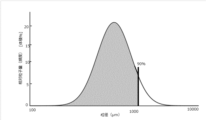
- the particle size distribution of the film pieces it is necessary that the particle diameter with a cumulative volumetric frequency of 90% is 1000 ⁇ m or less.
- the particle size distribution is expressed as a graph with the particle diameter ( ⁇ m) on the horizontal axis and the particle amount (frequency) (volume %) on the vertical axis, and the particle diameter at the point where the cumulative volume of the curve reaches 90% of the total is the "particle diameter with a cumulative volumetric frequency of 90%".
- Figure 2 shows a case where the relative particle amount (frequency) is displayed in volume % on the vertical axis and the particle diameter is on the horizontal axis, and for the purpose of explanation, they show a normal distribution.
- the particle diameter with a cumulative volumetric frequency of 90% is 1000 ⁇ m or less (i.e., 1 mm or less). If the particle size with a cumulative frequency of 90% by volume exceeds 1000 ⁇ m, the film is difficult to break into small pieces, so even if it is crushed with fingers, the residual feeling remains for a long time.
- the particle size with a cumulative frequency of 90% by volume is preferably 960 ⁇ m or less.
- the particle size with a cumulative frequency of 90% by volume may be 950 ⁇ m or less, 940 ⁇ m or less, 930 ⁇ m or less, 920 ⁇ m or less, 910 ⁇ m or less, or 900 ⁇ m or less.
- the particle size will not be 0 ⁇ m, but it is better to be smaller, and about 100 ⁇ m is sufficient.
- the particle size at which the cumulative volume frequency is 90% may be 200 ⁇ m or more, 300 ⁇ m or more, 400 ⁇ m or more, 500 ⁇ m or more, 600 ⁇ m or more, 700 ⁇ m or more, 800 ⁇ m or more, 850 ⁇ m or more, or 890 ⁇ m or more.
- the soft capsules have been described as seamless capsules, but the soft capsules are not limited to seamless capsules and may be capsules obtained by the rotary method.
- the production equipment and the conditions for the production equipment can be selected arbitrarily.
- Example 1 1.3 parts by weight of agar A (agar with a jelly strength of 610 to 650 g/ cm2 ), 0.6 parts by weight of sodium alginate, 10.0 parts by weight of 1,3-butylene glycol, and 88.1 parts by weight of ion-exchanged water were mixed and dissolved by heating in an autoclave at a temperature of 105°C for 10 minutes to prepare a coating liquid.
- agar A agar with a jelly strength of 610 to 650 g/ cm2
- sodium alginate 10.0 parts by weight of 1,3-butylene glycol
- 88.1 parts by weight of ion-exchanged water 88.1 parts by weight of ion-exchanged water were mixed and dissolved by heating in an autoclave at a temperature of 105°C for 10 minutes to prepare a coating liquid.
- the above-mentioned shell liquid and medium-chain fatty acid triglyceride as the content liquid were fed into a seamless capsule manufacturing device equipped with a concentric double nozzle, the content liquid was charged into the inner nozzle of the double nozzle, and the above-mentioned shell liquid was charged into the outer nozzle.
- the content liquid temperature was set to 20°C and the shell liquid temperature to 70°C, and the liquid was discharged into the flowing medium-chain fatty acid triglyceride (10°C), producing seamless capsules with a particle size of 1.5 mm.
- a continuous phase a mixture of 4.0 parts by weight of 1,3-butylene glycol, 1.0 parts by weight of glycerin, 0.1 parts by weight of phenoxyethanol, and 94.9 parts by weight of ion-exchanged water
- a continuous phase a mixture of 4.0 parts by weight of 1,3-butylene glycol, 1.0 parts by weight of glycerin, 0.1 parts by weight of phenoxyethanol, and 94.9 parts by weight of ion-exchanged water
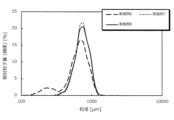
- the obtained film sample was used to measure the volumetric particle size distribution and average diameter (or particle diameter at 90% cumulative frequency) under wet conditions in ethanol using a laser diffraction scattering particle size distribution measuring device (Shimadzu Corporation SALD-2300).
- the volumetric particle size distribution was plotted on a graph with the measured values on the vertical axis representing the relative particle amount (volume %) and the horizontal axis representing the particle size ( ⁇ m), as shown in Figure 3.
- the following sensory tests were conducted on the obtained capsules.
- + It took 15 to 30 seconds for all the capsules to break, the size of the remaining shell pieces was less than the particle size (1.5 mm), the presence of the shell pieces was difficult to feel with the hand, and there was an improvement in the compatibility of the contents with the skin.
- Table 1 shows the coating formulation, the mass ratio of polyol/water-soluble polymer, and the particle size and coating thickness ( ⁇ m) with a cumulative frequency of 90% on a volume basis.
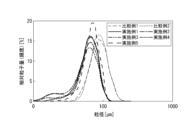
- Example 2 to 5 and Comparative Examples 1 to 2 A capsule shell liquid was prepared according to the formula shown in Table 1, and seamless capsules and cosmetics were produced in the same manner as in Example 1.
- Example 1 the particle size at which the cumulative frequency based on volume was 90% was measured and a sensory evaluation was performed, and the results are shown in Table 1.
- agar B in Table 1 is an agar with a jelly strength of 900 to 1000 g/ cm2 .
- Na alginate is sodium alginate
- 1,3-BG is 1,3-butanediol
- PG 1,2-propanediol.
- the particle size distribution of each Example and Comparative Example is shown in a graph with the relative particle amount (volume %) on the vertical axis and the particle size ( ⁇ m) on the horizontal axis, as shown in FIG. 3.
- the soft capsules of the present invention When the soft capsules of the present invention are used in cosmetics, the time required to crush the capsules during use is shortened and no membrane fragments are present, providing a very excellent feeling to the user.
- the soft capsules of the present invention can be used by adding ingredients that have a different function to the cosmetics or that have the same function but improve the function, and when used, the capsules can be taken in the hand and crushed with the fingers to release the functional ingredients, improving the functionality of the cosmetics.
- the soft capsules of the present invention can also be used for coloring, making it possible to adjust the color of the cosmetics using the capsules.
- a soft capsule comprising a liquid content at room temperature and a shell that encapsulates the content
- a soft capsule for cosmetics characterized in that in the particle size distribution of the membrane pieces obtained by pulverizing the soft capsule with a bead homogenizer, the particle diameter at which the cumulative frequency on a volume basis is 90% is 1000 ⁇ m or less.
- the cosmetic soft capsule described in [1] wherein the content is an oily liquid.
Landscapes
- Health & Medical Sciences (AREA)
- Life Sciences & Earth Sciences (AREA)
- Birds (AREA)
- Epidemiology (AREA)
- Animal Behavior & Ethology (AREA)
- General Health & Medical Sciences (AREA)
- Public Health (AREA)
- Veterinary Medicine (AREA)
- Emergency Medicine (AREA)
- Cosmetics (AREA)
Priority Applications (2)
| Application Number | Priority Date | Filing Date | Title |
|---|---|---|---|
| JP2025543726A JPWO2025142831A1 (https=) | 2023-12-28 | 2024-12-23 | |
| JP2026016813A JP2026065749A (ja) | 2023-12-28 | 2026-02-04 | 化粧品用ソフトカプセル |
Applications Claiming Priority (2)
| Application Number | Priority Date | Filing Date | Title |
|---|---|---|---|
| JP2023-222890 | 2023-12-28 | ||
| JP2023222890 | 2023-12-28 |
Publications (1)
| Publication Number | Publication Date |
|---|---|
| WO2025142831A1 true WO2025142831A1 (ja) | 2025-07-03 |
Family
ID=96217853
Family Applications (1)
| Application Number | Title | Priority Date | Filing Date |
|---|---|---|---|
| PCT/JP2024/045448 Pending WO2025142831A1 (ja) | 2023-12-28 | 2024-12-23 | 化粧品用ソフトカプセル |
Country Status (3)
| Country | Link |
|---|---|
| JP (2) | JPWO2025142831A1 (https=) |
| TW (1) | TW202541778A (https=) |
| WO (1) | WO2025142831A1 (https=) |
Citations (1)
| Publication number | Priority date | Publication date | Assignee | Title |
|---|---|---|---|---|
| WO2017090214A1 (ja) * | 2015-11-25 | 2017-06-01 | アサヌマ コーポレーション株式会社 | カプセルの製造方法 |
Family Cites Families (7)
| Publication number | Priority date | Publication date | Assignee | Title |
|---|---|---|---|---|
| JPH06104606B2 (ja) * | 1986-06-24 | 1994-12-21 | 森下仁丹株式会社 | 寒天皮膜カプセルを含有する化粧用組成物 |
| JP2849437B2 (ja) * | 1990-03-30 | 1999-01-20 | 東陽化成株式会社 | 乳化状の化粧品と医薬部外品 |
| JP3879941B2 (ja) * | 1995-07-13 | 2007-02-14 | エーザイ・アール・アンド・ディー・マネジメント株式会社 | シームレスソフトカプセル |
| JPWO2018043661A1 (ja) * | 2016-09-05 | 2019-06-24 | 富士カプセル株式会社 | 寒天皮膜カプセル |
| EP3636253B1 (en) * | 2017-06-09 | 2023-09-13 | Fuji Capsule Co., Ltd. | Seamless capsule shell composition and seamless capsule |
| JP2020097554A (ja) * | 2018-12-19 | 2020-06-25 | 株式会社美源堂 | シームレスカプセルを含む皮膚外用組成物 |
| WO2023210481A1 (ja) * | 2022-04-28 | 2023-11-02 | 学校法人近畿大学 | カリオフィレン含有組成物 |
-
2024
- 2024-12-23 WO PCT/JP2024/045448 patent/WO2025142831A1/ja active Pending
- 2024-12-23 JP JP2025543726A patent/JPWO2025142831A1/ja active Pending
- 2024-12-25 TW TW113150630A patent/TW202541778A/zh unknown
-
2026
- 2026-02-04 JP JP2026016813A patent/JP2026065749A/ja active Pending
Patent Citations (1)
| Publication number | Priority date | Publication date | Assignee | Title |
|---|---|---|---|---|
| WO2017090214A1 (ja) * | 2015-11-25 | 2017-06-01 | アサヌマ コーポレーション株式会社 | カプセルの製造方法 |
Also Published As
| Publication number | Publication date |
|---|---|
| JPWO2025142831A1 (https=) | 2025-07-03 |
| JP2026065749A (ja) | 2026-04-15 |
| TW202541778A (zh) | 2025-11-01 |
Similar Documents
| Publication | Publication Date | Title |
|---|---|---|
| US6183762B1 (en) | Oil body based personal care products | |
| JP3869861B2 (ja) | 油体の使用法 | |
| JP7383867B2 (ja) | 皮膚用乳化組成物 | |
| JP7372714B1 (ja) | 水封入カプセル及びその製造方法 | |
| CN109966184A (zh) | 一种悬浮油珠卸妆水及其制备方法 | |
| JP7490226B2 (ja) | ハイドロゲル粒子 | |
| KR20170065947A (ko) | 오일-볼 화장료 조성물 | |
| TW201811296A (zh) | 瓊脂膠囊 | |
| JP5692618B1 (ja) | 皮膚外用剤用キット | |
| WO2025142831A1 (ja) | 化粧品用ソフトカプセル | |
| TWI262796B (en) | Shaped articles, use of shaped articles for external application, and a combination including the shaped articles | |
| CN100551354C (zh) | 一种蛇油纳米微囊乳液及其制备方法 | |
| KR20210052011A (ko) | 라이스 하이드로겔 및 이의 제조방법 | |
| WO2004069210A1 (ja) | 肌用化粧料 | |
| CN113242748B (zh) | 可再分散的两层化妆品 | |
| JP5388561B2 (ja) | ハイドロゲル粒子の製造方法 | |
| JP7823965B2 (ja) | 水封入カプセル及びその製造方法 | |
| JP2022011029A (ja) | 粒形状化粧料及び粒形状化粧料を含有する化粧料 | |
| CA2290278C (en) | Oil body based personal care products | |
| WO2010071095A1 (ja) | ハイドロゲル粒子の製造方法 | |
| WO2020032006A1 (ja) | ゲル粒子及びそれを含む皮膚外用剤 | |
| KR20190126015A (ko) | 펄 안료를 함유한 컬러 체인지 소프트 에멀젼 비드의 제조 방법 | |
| JPS61286316A (ja) | 皮膚洗浄用化粧料 | |
| JP2018199731A (ja) | 皮膚外用剤用キット | |
| TW202529738A (zh) | 口腔用無縫膠囊 |
Legal Events
| Date | Code | Title | Description |
|---|---|---|---|
| ENP | Entry into the national phase |
Ref document number: 2025543726 Country of ref document: JP Kind code of ref document: A |
|
| WWE | Wipo information: entry into national phase |
Ref document number: 2025543726 Country of ref document: JP |
|
| 121 | Ep: the epo has been informed by wipo that ep was designated in this application |
Ref document number: 24912718 Country of ref document: EP Kind code of ref document: A1 |