WO2025142364A1 - 回転電機の制御装置、プログラム、及び回転電機の制御方法 - Google Patents
回転電機の制御装置、プログラム、及び回転電機の制御方法 Download PDFInfo
- Publication number
- WO2025142364A1 WO2025142364A1 PCT/JP2024/042879 JP2024042879W WO2025142364A1 WO 2025142364 A1 WO2025142364 A1 WO 2025142364A1 JP 2024042879 W JP2024042879 W JP 2024042879W WO 2025142364 A1 WO2025142364 A1 WO 2025142364A1
- Authority
- WO
- WIPO (PCT)
- Prior art keywords
- control
- arm switch
- lower arm
- switch
- upper arm
- Prior art date
- Legal status (The legal status is an assumption and is not a legal conclusion. Google has not performed a legal analysis and makes no representation as to the accuracy of the status listed.)
- Pending
Links
Images













Classifications
-
- H—ELECTRICITY
- H02—GENERATION; CONVERSION OR DISTRIBUTION OF ELECTRIC POWER
- H02P—CONTROL OR REGULATION OF ELECTRIC MOTORS, ELECTRIC GENERATORS OR DYNAMO-ELECTRIC CONVERTERS; CONTROLLING TRANSFORMERS, REACTORS OR CHOKE COILS
- H02P21/00—Arrangements or methods for the control of electric machines by vector control, e.g. by control of field orientation
- H02P21/22—Current control, e.g. using a current control loop
-
- H—ELECTRICITY
- H02—GENERATION; CONVERSION OR DISTRIBUTION OF ELECTRIC POWER
- H02P—CONTROL OR REGULATION OF ELECTRIC MOTORS, ELECTRIC GENERATORS OR DYNAMO-ELECTRIC CONVERTERS; CONTROLLING TRANSFORMERS, REACTORS OR CHOKE COILS
- H02P27/00—Arrangements or methods for the control of AC motors characterised by the kind of supply voltage
- H02P27/04—Arrangements or methods for the control of AC motors characterised by the kind of supply voltage using variable-frequency supply voltage, e.g. inverter or converter supply voltage
- H02P27/06—Arrangements or methods for the control of AC motors characterised by the kind of supply voltage using variable-frequency supply voltage, e.g. inverter or converter supply voltage using DC to AC converters or inverters
- H02P27/08—Arrangements or methods for the control of AC motors characterised by the kind of supply voltage using variable-frequency supply voltage, e.g. inverter or converter supply voltage using DC to AC converters or inverters with pulse width modulation
Definitions
- This disclosure relates to a control device for a rotating electric machine, a program, and a control method for a rotating electric machine.
- the primary objective of this disclosure is to provide a control device, program, and method for controlling a rotating electric machine that can prevent the system from overheating.
- the present disclosure relates to a rotating electric machine having a multi-phase armature winding, a first inverter including a first upper arm switch and a first lower arm switch connected in series to the number of phases, the first upper arm switch and the first lower arm switch being connected in series to a DC power source in parallel; a second inverter having second upper arm switches and second lower arm switches connected in series, the number of which corresponds to the number of phases; a positive busbar electrically connecting a high potential side terminal of the first upper arm switch and a high potential side terminal of the second upper arm switch in each phase; a negative busbar electrically connecting a low potential side terminal of the first lower arm switch and a low potential side terminal of the second lower arm switch in each phase;
- a control device for a rotating electric machine applied to a system including: In each phase, a low potential terminal of the first upper arm switch and a high potential terminal of the first lower arm switch are electrically connected to a first end of the armature winding, In each phase, a low potential side terminal
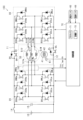
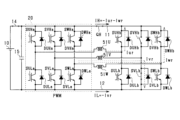
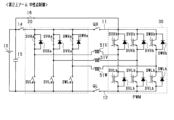
- FIG. 1 is an overall configuration diagram of a control system according to a first embodiment
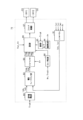
- FIG. 2 is a functional block diagram of a control process executed by a control device
- FIG. 3 is a diagram showing a control mode of the Y drive control
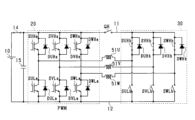
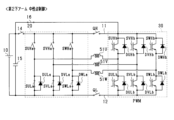
- FIG. 4 is a diagram showing a control mode of the H drive control.
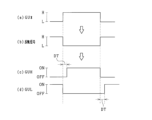
- FIG. 5 is a time chart showing an example of a method for generating a drive signal
- FIG. 6 is a diagram showing an example of a current flow state when a locked state occurs during Y drive control
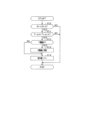
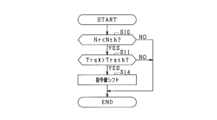
- FIG. 7 is a flowchart of the overheat protection control process.
- FIG. 1 is an overall configuration diagram of a control system according to a first embodiment
- FIG. 2 is a functional block diagram of a control process executed by a control device
- FIG. 3 is a diagram showing a control mode of the Y drive control
- FIG. 4 is a diagram showing a control mode of the H drive control.
- FIG. 5 is a time chart showing an example of a method
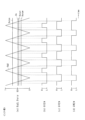
- FIG. 8 is a time chart showing transitions of a carrier signal, a PWM signal, and the like before overheat protection control in the first inverter
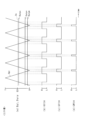
- FIG. 9 is a time chart showing transitions of a carrier signal, a PWM signal, etc. before overheat protection control in the second inverter
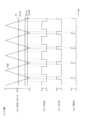
- FIG. 10 is a time chart showing transitions of a carrier signal, a PWM signal, and the like during overheat protection control in the first inverter
- FIG. 11 is a time chart showing transitions of a carrier signal, a PWM signal, and the like during overheat protection control in the second inverter
- FIG. 12 is a comparison diagram of the transition of the PWM signal, etc. before and after the overheat protection control in the V phase.
- FIG. 13 is a diagram showing an example of a current flow pattern in mode A;
- FIG. 14 is a diagram showing an example of a current flow pattern in B mode;
- FIG. 15 is a diagram showing an example of a current flow state in mode C;
- FIG. 16 is a diagram showing an example of a current flow state in a D mode;
- FIG. 17 is a flowchart of an overheat protection control process according to the second embodiment.
- FIG. 18 is a time chart showing the effect of the overheat protection control.
- FIG. 19 is a functional block diagram of a control process executed by a control device;
- FIG. 20 is a flowchart of an overheat protection control process according to a third embodiment.
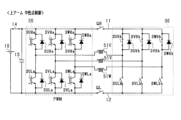
- FIG. 21 is a diagram showing an overheat protection control mode;
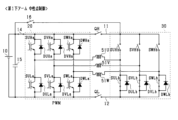
- FIG. 31 is a flowchart of the overheat protection control process.
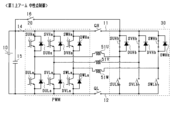
- FIG. 32 is a diagram showing a first upper arm neutral point control mode;
- FIG. 33 is a diagram showing a first lower arm neutral point control mode;
- FIG. 34 is a diagram showing a second upper arm neutral point control mode;
- FIG. 35 is a diagram showing a second lower arm neutral point control mode;
- FIG. 36 is a flowchart of an overheat protection control process according to another embodiment;
- FIG. 37 is a flowchart of an overheat protection control process according to another embodiment.
- control device of the present embodiment is applied to a control system mounted on an electrically powered vehicle such as an electric vehicle or a hybrid vehicle.
- the first inverter 20 includes a series connection of U-, V-, and W-phase first upper arm switches SUHa, SVHa, and SWHa, and U-, V-, and W-phase first lower arm switches SULa, SVLa, and SWLa.
- the second inverter 30 includes a series connection of U-, V-, and W-phase second upper arm switches SUHb, SVHb, and SWHb, and U-, V-, and W-phase second lower arm switches SULb, SVLb, and SWLb.
- the U-, V-, W-phase first upper-arm switches SUHa, SVHa, SWHa are connected in inverse parallel to the U-, V-, W-phase first upper-arm diodes DUHa, DVHa, DWHa, and the U-, V-, W-phase first lower-arm switches SULa, SVLa, SWLa are connected in inverse parallel to the U-, V-, W-phase first lower-arm diodes DULa, DVLa, DWLa.
- the U, V, W phase second upper arm diodes DUHb, DVHb, DWHb are connected in anti-parallel to the U, V, W phase second upper arm switches SUHb, SVHb, SWHb, and the U, V, W phase second lower arm diodes DULb, DVLb, DWLb are connected in anti-parallel to the U, V, W phase second lower arm switches SULb, SVLb, SWLb.
- the control system 100 includes a power switch 14.
- the power switch 14 is, for example, a semiconductor switching element or a mechanical relay.
- the power switch 14 connects the positive bus 11 and the positive terminal of the battery 10.
- the power switch 14 is turned off, it electrically disconnects the positive terminal of the battery 10 and the collectors of the first upper arm switches SUHa, SVHa, and SWHa of each phase.
- the control system 100 includes a capacitor 15.
- the capacitor 15 functions as a smoothing capacitor.
- the capacitor 15 is connected in parallel to the series connection of the first upper arm switches SUHa to SWHa of each phase and the first lower arm switches SULa to SWLa of each phase.
- the rotating electric machine 40 is an on-board main engine that serves as the power source for running the vehicle.
- the rotating electric machine 40 includes a rotor 41 and a stator 50.
- the rotor 41 is capable of transmitting power to the drive wheels of the vehicle.
- the rotating electric machine 40 is a permanent magnet field type synchronous machine.
- the rotor 41 includes a permanent magnet 42 (e.g., a neodymium magnet) as a field pole.
- the stator 50 has a U-phase winding 51U, a V-phase winding 51V, and a W-phase winding 51W as armature windings.
- the phase windings 51U, 51V, and 51W are arranged in the stator core that constitutes the stator 50, shifted by 120° in electrical angle.
- the phase windings 51U, 51V, and 51W are open windings.
- the emitters of the first upper arm switches SUHa, SVHa, SWHa and the collectors of the first lower arm switches SULa, SVLa, SWLa are connected to the first ends 51Ua, 51Va, 51Wa of the windings 51U, 51V, 51W.
- the emitters of the second upper arm switches SUHb, SVHb, SWHb and the collectors of the second lower arm switches SULb, SVLb, SWLb are connected to the second ends 51Ub, 51Vb, 51Wb of the windings 51U, 51V, 51W.
- the setting unit 86 When H drive control is selected by the selection unit 85, the setting unit 86 performs H drive control by turning on the changeover switch QH as shown in FIG. 4, PWM driving each of the switches SUHa to SWLa of the first inverter 20, and PWM driving each of the switches SUHb to SWLb of the second inverter 30.
- the frequency, amplitude, and fluctuation center value of the second carrier signal Sg2 are the same as the frequency, amplitude, and fluctuation center value of the first carrier signal Sg1.
- the maximum value of each carrier signal Sg1, Sg2 is 1, the minimum value is 0, and the center value of fluctuation is 0.5.
- the phase difference between the first carrier signal Sg1 and the second carrier signal Sg2 is 180°.
- the frequency of the carrier signals Sg1, Sg2 used in the H drive control is the same as the frequency of the carrier signal Sgc used in the Y drive control.
- the lock determination unit 88 determines whether or not the rotor 41 is in a locked state. More specifically, in step S10, it is determined whether or not the rotation speed Nr is below the speed threshold Nth.
- the speed threshold Nth is set to a value that can determine whether the rotor 41 is in a stopped state or in an extremely low rotation speed state where the rotor 41 is rotating in a state close to a stopped state.
- the speed threshold Nth is, for example, a value of 10 rpm or more and 15 rpm or less, a value of 5 rpm or more and 10 rpm or less, a value of 2 rpm or more and 5 rpm or less, or 0 rpm.
- the value to be compared with the speed threshold Nth by the lock determination unit 88 may be, for example, the electrical angular speed ⁇ r of the rotor 41 calculated based on the electrical angle ⁇ r.
- step S10 If the answer in step S10 is positive, the process proceeds to step S11, where it is determined whether the command torque Trq* exceeds the torque threshold Trqth.
- the torque threshold Trqth may be set to, for example, the continuous allowable torque of the rotating electric machine 40.
- FIG. 8 and 9 show the transitions of each waveform when the rotor 41 is in a stopped state and before overheat protection control is executed.
- FIG. 8 shows the transitions of the first carrier signal Sg1 and the U-, V-, and W-phase normalized command values Dutyu, Dutyv, and Dutyw.
- (b), (c), and (d) show the transitions of the U-, V-, and W-phase PWM signals GU1*, GV1*, and GW1* in the first inverter 20.
- FIG. 9 shows the transitions of the second carrier signal Sg2 and the U-, V-, and W-phase normalized command values Dutyu, Dutyv, and Dutyw.
- the U-, V-, and W-phase normalized command values Dutyu, Dutyv, and Dutyw are controlled to be smaller by a predetermined command value ⁇ D.
- the predetermined command value ⁇ D is set to a value such that the minimum value of the U-, V-, and W-phase normalized command values Dutyu, Dutyv, and Dutyw is not less than 0, and is set to, for example, a value of 0.1 or more and 0.4 or less, a value of 0.1 or more and 0.3 or less, a value of 0.15 or more and 0.3 or less, or a value of 0.2 or more and 0.3 or less.
- the predetermined command value ⁇ D is set to 0.25.
- Figures 10 and 11 show the progression of each waveform when the normalized command value is shifted by overheat protection control.
- Figures 10 and 11 (a) to (d) correspond to Figures 8 and 9 (a) to (d).
- the overheat protection control alternates between a process of decreasing the U-, V-, and W-phase normalized command values Dutyu, Dutyv, and Dutyw by a predetermined command value ⁇ D, and a process of returning the decreased U-, V-, and W-phase normalized command values Dutyu, Dutyv, and Dutyw to their original values.
- This control is for switching the current flow paths in each inverter 20, 30 when the inverter is in a locked state.
- FIG. 12 shows the progression of the V-phase PWM signals GV1* and GV2* shown in FIGS. 8 to 11.
- (a) and (b) show the V-phase PWM signals GV1* and GV2* before they are shifted by the predetermined command value ⁇ D
- (d) and (e) show the V-phase PWM signals GV1* and GV2* after they have been shifted by the predetermined command value ⁇ D.
- Figure 12(c) shows the current flow mode realized by the V-phase PWM signals GV1* and GV2* in (a) and (b).
- the dead time DT is assumed to be 0.
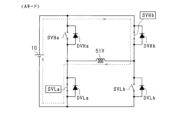
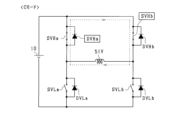
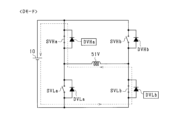
- FIG. 13 When the logic of the V-phase PWM signal GV1* is L and the logic of the V-phase PWM signal GV2* is H, the A mode shown in FIG. 13 is entered. In A mode, current flows through the second upper arm switch SVHb and the first lower arm switch SVLa. Note that FIG. 13 and FIGS. 14 to 16 illustrate the case where the direction of the phase current flowing through the armature winding 51V is negative.
- FIG. 12(f) shows the current flow mode realized by the V-phase PWM signals GV1* and GV2* in (d) and (e).
- Mode D is the mode shown in FIG. 16 that appears when the logic of the V-phase PWM signal GV1* is H and the logic of the V-phase PWM signal GV2* is L. In mode D, current flows through the first upper arm diode DVHa and the second lower arm diode DVLb.
- the heating elements in the inverters 20 and 30 can be switched, and the occurrence of an overheating state in the inverters 20 and 30 can be suppressed.
- the control device 70 may, for example, switch between a process of decreasing the standardized command value by a predetermined command value ⁇ D and a process of restoring the reduced standardized command value to its original state at predetermined intervals.
- the control device 70 may, for example, switch between a process of decreasing the standardized command value by a predetermined command value ⁇ D and a process of restoring the reduced standardized command value to its original state based on, for example, the temperatures of the first and second inverters 20 and 30 detected by the temperature sensor 63.
- FIG. 17 shows a flowchart of the overheat protection control process executed during the execution of torque control of the rotating electric machine 40.
- the process shown in FIG. 17 is repeatedly executed by the processor 71, for example, at a predetermined control period.
- step S13 When the process of step S13 is completed, or when it is determined in step S12 that H drive control is being performed, the process proceeds to step S14, where the setting unit 86 performs overheat protection control. More specifically, H drive control that satisfies the first and second conditions is performed.
- the first condition is that a zero-phase current ⁇ I0 is passed through the armature windings 51U, 51V, and 51W of each phase so as to reduce the maximum current among the U, V, and W phase currents detected by the current sensor 60.
- a zero-phase current ⁇ I0 is passed through the armature windings 51U, 51V, and 51W of each phase so as to reduce the maximum current among the U, V, and W phase currents detected by the current sensor 60.
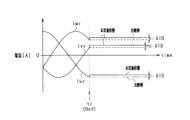
- the motor is in a locked state at time t1
- the U-phase current Iur is the maximum among the U-, V-, and W-phase currents Iur, Ivr, and Iwr.
- the solid line indicates the current transition when overheat protection control is performed
- the dashed line indicates the current transition in the comparative example in which overheat protection control is not performed.
- the second condition is that a zero-phase current ⁇ I0 is passed through the armature windings 51U, 51V, and 51W of each phase so that the magnitudes of the U-, V-, and W-phase currents Iur, Ivr, and Iwr other than the currents reduced by the first condition are equal to or less than the reduced currents.
- the magnitude of the W-phase current Iwr when overheat protection control is executed is equal to or less than the magnitude of the U-phase current Iur when overheat protection control is executed.
- FIG. 19 shows an example of a block diagram for executing the overheat protection control of this embodiment.
- the zero-phase signal generating unit 89 generates a zero-phase signal V0* for controlling the zero-phase current flowing through the U-, V-, and W-phase windings 51U, 51V, and 51W to a target value, and outputs it to the U-, V-, and W-phase superimposing units 90U, 90V, and 90W.
- the zero-phase signal V0* is a signal for passing the zero-phase current ⁇ I0 in FIG. 18 through the armature windings 51U, 51V, and 51W of each phase, and is a DC signal.
- the U, V, W phase superimposing units 90U, 90V, 90W add a common zero-phase signal V0* to the U, V, W phase voltage command values Vu*, Vv*, Vw* and output the result to the switch control unit 87.
- the switch control unit 87 uses "Vu*+V0*, Vv*+V0*, Vw*+V0*" to generate drive signals in H drive control.
- FIG. 22 shows a comparative example in which the second lower arm switches SULb, SVLb, and SWLb for three phases are turned on. In this case, phase currents for three phases flow through the changeover switch QH.
- the setting unit 86 may fix the second lower arm switches for two phases to ON.
- step S12 If it is determined in step S12 that Y drive control is being performed, the process proceeds to step S20, where overheat protection control is performed.
- control is performed to alternate between a process of decreasing the U-, V-, and W-phase normalized command values Dutyu, Dutyv, and Dutyw by a predetermined command value ⁇ D, and a process of returning the decreased U-, V-, and W-phase normalized command values Dutyu, Dutyv, and Dutyw to their original values.
- the control system 100 includes a second changeover switch QL in addition to the first changeover switch QH, as shown in FIG. 26.
- the second changeover switch QL is provided on the negative pole side bus 12 (corresponding to the "target bus").
- the second changeover switch QL is, for example, a semiconductor switching element or a mechanical relay.
- the second changeover switch QL in this embodiment is an IGBT.
- a freewheel diode DL is connected in inverse parallel to the second changeover switch QL.
- the collector of the second changeover switch QL is connected to the second inverter 30 side, and the emitter of the second changeover switch QL is connected to the first inverter 20 side.
- the second changeover switch QL When the second changeover switch QL is turned on, it electrically connects the emitters of the lower phase arm switches SULa, SVLa, SWLa of the first inverter 20 to the emitters of the lower phase arm switches SULb, SVLb, SWLb of the second inverter 30.
- the second changeover switch QL when the second changeover switch QL is turned off, it electrically disconnects the emitters of the lower phase arm switches SULa, SVLa, SWLa of the first inverter 20 from the emitters of the lower phase arm switches SULb, SVLb, SWLb of the second inverter 30.
- control device 70 when the control device 70 selects H drive control, it turns on the first changeover switch QH and the second changeover switch QL. On the other hand, when the control device 70 selects Y drive control, it turns off the first changeover switch QH and the second changeover switch QL.
- FIG. 27 shows a flowchart of the overheat protection control process executed during the execution of torque control of the rotating electric machine 40.
- the process shown in FIG. 27 is repeatedly executed by the processor 71, for example, at a predetermined control period.
- step S21 overheat protection control is performed while continuing Y drive control. More specifically, control is performed to alternate between upper arm neutral point control and lower arm neutral point control.
- the upper arm neutral point control is the control shown in FIG. 28, and corresponds to the control shown in FIG. 3 above.
- the lower arm neutral point control is the control to fix the upper arm switches SUHb, SVHb, SWHb of each phase of the second inverter 30 to OFF, and fix the lower arm switches SULb, SVLb, SWLb of each phase of the second inverter 30 to ON, as shown in FIG. 29.
- the lower arm side of the second inverter 30 functions as the neutral point.
- control device 70 may, for example, alternate between upper arm neutral point control and lower arm neutral point control at predetermined intervals.
- step S21 the process of step S20 in FIG. 25 in the fourth embodiment may be executed together.
- the control system 100 includes a second power switch 16 in addition to the first power switch 14.
- the second power switch 16 is, for example, a semiconductor switching element or a mechanical relay.
- the second power switch 16 connects the positive terminal of the battery 10 to the collectors of the upper arm switches SUHb, SVHb, and SWHb of each phase of the second inverter 30.
- the second power switch 16 When the second power switch 16 is turned on, it electrically connects the positive terminal of the battery 10 to the collectors of the upper arm switches SUHb, SVHb, and SWHb of each phase.
- the second power switch 16 when the second power switch 16 is turned off, it electrically disconnects the positive terminal of the battery 10 from the collectors of the upper arm switches SUHb, SVHb, and SWHb of each phase.
- the first power switch 14 and the second power switch 16 correspond to a "connection switching unit.”
- the capacitor 15 is connected in parallel to the battery 10. Furthermore, when H drive control is selected, the control device 70 turns on the first power switch 14 and turns off the second power switch 16.
- FIG. 31 shows a flowchart of the overheat protection control process executed during the execution of torque control of the rotating electric machine 40.
- the process shown in FIG. 31 is repeatedly executed by the processor 71, for example, at a predetermined control period.
- step S12 If it is determined in step S12 that Y drive control is being performed, the process proceeds to step S22, where overheat protection control is performed.
- overheat protection control In detail, control is performed to switch between the first upper arm neutral point control, the first lower arm neutral point control, the second upper arm neutral point control, and the second lower arm neutral point control.
- the first upper arm neutral point control PWM drives each switch SUHa to SWLa of the first inverter 20 when the first power switch 14 is on and the second power switch 16 is off.
- the upper arm switches SUHb, SVHb, and SWHb of each phase of the second inverter 30 are fixed on, and the lower arm switches SULb, SVLb, and SWLb of each phase of the second inverter 30 are fixed off.
- the first mode is entered in which the battery 10 and the first inverter 20 are electrically connected and the battery 10 and the second inverter 30 are electrically disconnected.
- the first lower upper arm neutral point control PWM drives each switch SUHa to SWLa of the first inverter 20 when the first power switch 14 is on and the second power switch 16 is off.
- the lower arm switches SULb, SVLb, and SWLb of each phase of the second inverter 30 are fixed on, and the upper arm switches SUHb, SVHb, and SWHb of each phase of the second inverter 30 are fixed off.
- the second upper arm neutral point control PWM drives each switch SUHb to SWLb of the second inverter 30 when the first power switch 14 is turned off and the second power switch 16 is turned on.
- each upper arm switch SUHa, SVHa, SWHa of the first inverter 20 is fixed on, and each lower arm switch SULa, SVLa, SWLa of the second inverter 30 is fixed off.
- the second lower arm neutral point control PWM drives each switch SUHb to SWLb of the second inverter 30 when the first power switch 14 is turned off and the second power switch 16 is turned on.
- each phase lower arm switch SULa, SVLa, SWLa of the first inverter 20 is fixed on, and each phase upper arm switch SUHa, SVHa, SWHa of the second inverter 30 is fixed off.
- the control device 70 can switch between the controls shown in Figures 32 to 35 in various ways. Examples of the switching methods are described below.
- control device 70 may sequentially switch between the first upper arm neutral point control, the first lower arm neutral point control, the second upper arm neutral point control, and the second lower arm neutral point control at a specified cycle.
- the specified cycle may be, for example, a predetermined period.
- the control device 70 when the control device 70 is alternately switching between the first upper arm neutral point control and the first lower arm neutral point control at a predetermined cycle, if it determines that the temperature of the second inverter 30 detected by the temperature sensor 63 (e.g., the maximum temperature of each switch SUHb to SWLb of the second inverter 30) exceeds the temperature threshold value, the control device 70 may transition to a process of alternately switching between the second upper arm neutral point control and the second lower arm neutral point control at a predetermined cycle.
- the temperature of the second inverter 30 detected by the temperature sensor 63 e.g., the maximum temperature of each switch SUHb to SWLb of the second inverter 30
- the control device 70 when the control device 70 is alternately switching between the second upper arm neutral point control and the second lower arm neutral point control at a predetermined period, if it determines that the temperature of the first inverter 20 detected by the temperature sensor 63 (for example, the maximum temperature of each switch SUHa to SWLa of the first inverter 20) exceeds the temperature threshold value, the control device 70 may transition to a process of alternately switching between the first upper arm neutral point control and the first lower arm neutral point control at a specified period.
- the temperature of the first inverter 20 detected by the temperature sensor 63 for example, the maximum temperature of each switch SUHa to SWLa of the first inverter 20
- the overheat protection control during H drive control described in the third embodiment may be applied to the circuit shown in Fig. 30.
- the control of the switches in Figs. 21, 23, and 24 in the second inverter 30 can also be performed in the first inverter 20.
- control device 70 may use, for example, the detection value of the current sensor 60 instead of the command torque Trq* to determine whether or not the locked state is occurring.
- control device 70 may perform a process of determining whether or not the detection value of the current sensor 60 exceeds a predetermined current value.
- the control system does not need to be provided with a changeover switch.
- the control system is a system in which Y drive control is not executed and the H drive state is executed.
- the processing related to the Y drive control may be deleted from each flowchart. For example, using FIG. 7 as an example, if the processing related to the Y drive control is deleted, the flowchart will be as shown in FIG. 37.
- the carrier signal is not limited to a triangular wave signal, but may be, for example, a sawtooth wave signal.
- control device 70 may perform PWM driving based on space vector modulation instead of PWM driving based on a magnitude comparison between the command value and the carrier signal.
Landscapes
- Engineering & Computer Science (AREA)
- Power Engineering (AREA)
- Control Of Ac Motors In General (AREA)
Priority Applications (1)
| Application Number | Priority Date | Filing Date | Title |
|---|---|---|---|
| JP2025566436A JPWO2025142364A1 (https=) | 2023-12-26 | 2024-12-04 |
Applications Claiming Priority (2)
| Application Number | Priority Date | Filing Date | Title |
|---|---|---|---|
| JP2023219450 | 2023-12-26 | ||
| JP2023-219450 | 2023-12-26 |
Publications (1)
| Publication Number | Publication Date |
|---|---|
| WO2025142364A1 true WO2025142364A1 (ja) | 2025-07-03 |
Family
ID=96217526
Family Applications (1)
| Application Number | Title | Priority Date | Filing Date |
|---|---|---|---|
| PCT/JP2024/042879 Pending WO2025142364A1 (ja) | 2023-12-26 | 2024-12-04 | 回転電機の制御装置、プログラム、及び回転電機の制御方法 |
Country Status (2)
| Country | Link |
|---|---|
| JP (1) | JPWO2025142364A1 (https=) |
| WO (1) | WO2025142364A1 (https=) |
Citations (4)
| Publication number | Priority date | Publication date | Assignee | Title |
|---|---|---|---|---|
| JP2020188590A (ja) * | 2019-05-14 | 2020-11-19 | 株式会社Soken | 回転電機の制御装置 |
| JP2021002898A (ja) * | 2019-06-19 | 2021-01-07 | 株式会社Soken | 回転電機の制御装置 |
| JP2021112072A (ja) * | 2020-01-14 | 2021-08-02 | アイシン・エィ・ダブリュ株式会社 | 回転電機制御装置 |
| JP2021184666A (ja) * | 2020-05-22 | 2021-12-02 | 株式会社豊田中央研究所 | モータシステム |
-
2024
- 2024-12-04 WO PCT/JP2024/042879 patent/WO2025142364A1/ja active Pending
- 2024-12-04 JP JP2025566436A patent/JPWO2025142364A1/ja active Pending
Patent Citations (4)
| Publication number | Priority date | Publication date | Assignee | Title |
|---|---|---|---|---|
| JP2020188590A (ja) * | 2019-05-14 | 2020-11-19 | 株式会社Soken | 回転電機の制御装置 |
| JP2021002898A (ja) * | 2019-06-19 | 2021-01-07 | 株式会社Soken | 回転電機の制御装置 |
| JP2021112072A (ja) * | 2020-01-14 | 2021-08-02 | アイシン・エィ・ダブリュ株式会社 | 回転電機制御装置 |
| JP2021184666A (ja) * | 2020-05-22 | 2021-12-02 | 株式会社豊田中央研究所 | モータシステム |
Also Published As
| Publication number | Publication date |
|---|---|
| JPWO2025142364A1 (https=) | 2025-07-03 |
Similar Documents
| Publication | Publication Date | Title |
|---|---|---|
| US11196372B2 (en) | Control apparatus for rotating electric machine | |
| CN111201705B (zh) | 旋转电机的控制装置 | |
| US20200259425A1 (en) | Inverter control device | |
| JP6173516B1 (ja) | 電動機制御装置および電動機制御方法 | |
| JP2016226190A (ja) | 回転電機の制御装置 | |
| JP6407382B1 (ja) | 電動機制御装置および電動機制御方法 | |
| JP2011050183A (ja) | インバータ装置 | |
| CN111279607B (zh) | 旋转电机的控制装置 | |
| JP7211242B2 (ja) | 変調方式切替装置 | |
| WO2025004660A1 (ja) | 電力変換器の制御装置、及びプログラム | |
| JP7632197B2 (ja) | インバータ制御装置、プログラム、及びインバータ制御方法 | |
| WO2025142364A1 (ja) | 回転電機の制御装置、プログラム、及び回転電機の制御方法 | |
| JP6203318B1 (ja) | 電動機制御装置および電動機制御方法 | |
| JP6627633B2 (ja) | 電力変換器の制御装置 | |
| JP7639627B2 (ja) | インバータ制御装置、及びプログラム | |
| WO2025142363A1 (ja) | 回転電機の制御装置、プログラム、及び回転電機の制御方法 | |
| JP7468377B2 (ja) | 回転電機の制御装置 | |
| JP7446358B2 (ja) | 交流回転電機の制御装置 | |
| WO2025158895A1 (ja) | 回転電機の制御装置、プログラム、及び回転電機の制御方法 | |
| WO2025142362A1 (ja) | 回転電機の制御装置、プログラム、及び回転電機の制御方法 | |
| JP7639626B2 (ja) | インバータ制御装置、及びプログラム | |
| WO2025134730A1 (ja) | 回転電機の制御装置、プログラム、及び回転電機の制御方法 | |
| JP7631745B2 (ja) | インバータ制御装置、プログラム | |
| WO2025134731A1 (ja) | 回転電機の制御装置、プログラム、及び回転電機の制御方法 | |
| JP7277348B2 (ja) | 電力変換装置 |
Legal Events
| Date | Code | Title | Description |
|---|---|---|---|
| 121 | Ep: the epo has been informed by wipo that ep was designated in this application |
Ref document number: 24912254 Country of ref document: EP Kind code of ref document: A1 |
|
| ENP | Entry into the national phase |
Ref document number: 2025566436 Country of ref document: JP Kind code of ref document: A |
|
| WWE | Wipo information: entry into national phase |
Ref document number: 2025566436 Country of ref document: JP |