WO2025115804A1 - 感放射線性樹脂組成物、パターン形成方法、電子デバイスの製造方法、酸発生剤、化合物の製造方法、化合物および酸発生方法 - Google Patents
感放射線性樹脂組成物、パターン形成方法、電子デバイスの製造方法、酸発生剤、化合物の製造方法、化合物および酸発生方法 Download PDFInfo
- Publication number
- WO2025115804A1 WO2025115804A1 PCT/JP2024/041628 JP2024041628W WO2025115804A1 WO 2025115804 A1 WO2025115804 A1 WO 2025115804A1 JP 2024041628 W JP2024041628 W JP 2024041628W WO 2025115804 A1 WO2025115804 A1 WO 2025115804A1
- Authority
- WO
- WIPO (PCT)
- Prior art keywords
- radiation
- resin composition
- sensitive resin
- general formula
- group
- Prior art date
- Legal status (The legal status is an assumption and is not a legal conclusion. Google has not performed a legal analysis and makes no representation as to the accuracy of the status listed.)
- Pending
Links
Classifications
-
- C—CHEMISTRY; METALLURGY
- C07—ORGANIC CHEMISTRY
- C07C—ACYCLIC OR CARBOCYCLIC COMPOUNDS
- C07C309/00—Sulfonic acids; Halides, esters, or anhydrides thereof
- C07C309/78—Halides of sulfonic acids
- C07C309/79—Halides of sulfonic acids having halosulfonyl groups bound to acyclic carbon atoms
- C07C309/80—Halides of sulfonic acids having halosulfonyl groups bound to acyclic carbon atoms of a saturated carbon skeleton
-
- C—CHEMISTRY; METALLURGY
- C07—ORGANIC CHEMISTRY
- C07C—ACYCLIC OR CARBOCYCLIC COMPOUNDS
- C07C381/00—Compounds containing carbon and sulfur and having functional groups not covered by groups C07C301/00 - C07C337/00
- C07C381/12—Sulfonium compounds
-
- C—CHEMISTRY; METALLURGY
- C08—ORGANIC MACROMOLECULAR COMPOUNDS; THEIR PREPARATION OR CHEMICAL WORKING-UP; COMPOSITIONS BASED THEREON
- C08F—MACROMOLECULAR COMPOUNDS OBTAINED BY REACTIONS ONLY INVOLVING CARBON-TO-CARBON UNSATURATED BONDS
- C08F220/00—Copolymers of compounds having one or more unsaturated aliphatic radicals, each having only one carbon-to-carbon double bond, and only one being terminated by only one carboxyl radical or a salt, anhydride ester, amide, imide or nitrile thereof
- C08F220/02—Monocarboxylic acids having less than ten carbon atoms; Derivatives thereof
- C08F220/10—Esters
- C08F220/12—Esters of monohydric alcohols or phenols
-
- C—CHEMISTRY; METALLURGY
- C09—DYES; PAINTS; POLISHES; NATURAL RESINS; ADHESIVES; COMPOSITIONS NOT OTHERWISE PROVIDED FOR; APPLICATIONS OF MATERIALS NOT OTHERWISE PROVIDED FOR
- C09K—MATERIALS FOR MISCELLANEOUS APPLICATIONS, NOT PROVIDED FOR ELSEWHERE
- C09K3/00—Materials not provided for elsewhere
-
- G—PHYSICS
- G03—PHOTOGRAPHY; CINEMATOGRAPHY; ANALOGOUS TECHNIQUES USING WAVES OTHER THAN OPTICAL WAVES; ELECTROGRAPHY; HOLOGRAPHY
- G03F—PHOTOMECHANICAL PRODUCTION OF TEXTURED OR PATTERNED SURFACES, e.g. FOR PRINTING, FOR PROCESSING OF SEMICONDUCTOR DEVICES; MATERIALS THEREFOR; ORIGINALS THEREFOR; APPARATUS SPECIALLY ADAPTED THEREFOR
- G03F7/00—Photomechanical, e.g. photolithographic, production of textured or patterned surfaces, e.g. printing surfaces; Materials therefor, e.g. comprising photoresists; Apparatus specially adapted therefor
- G03F7/004—Photosensitive materials
-
- G—PHYSICS
- G03—PHOTOGRAPHY; CINEMATOGRAPHY; ANALOGOUS TECHNIQUES USING WAVES OTHER THAN OPTICAL WAVES; ELECTROGRAPHY; HOLOGRAPHY
- G03F—PHOTOMECHANICAL PRODUCTION OF TEXTURED OR PATTERNED SURFACES, e.g. FOR PRINTING, FOR PROCESSING OF SEMICONDUCTOR DEVICES; MATERIALS THEREFOR; ORIGINALS THEREFOR; APPARATUS SPECIALLY ADAPTED THEREFOR
- G03F7/00—Photomechanical, e.g. photolithographic, production of textured or patterned surfaces, e.g. printing surfaces; Materials therefor, e.g. comprising photoresists; Apparatus specially adapted therefor
- G03F7/004—Photosensitive materials
- G03F7/039—Macromolecular compounds which are photodegradable, e.g. positive electron resists
Definitions
- the present invention relates to a radiation-sensitive resin composition, a pattern forming method, a method for manufacturing an electronic device, an acid generator, a method for manufacturing a compound, a compound, and an acid generating method.
- radiation-sensitive resin compositions such as photoresists are used to form fine patterns on substrates.
- a resin film formed on a substrate using the radiation-sensitive resin composition is irradiated with radiation and then developed to form a pattern on the substrate.
- a fine circuit is formed on the substrate by dry etching using the pattern as a mask.
- Chemically amplified radiation-sensitive resin compositions are roughly divided into the following two types. (i) Those containing a resin that decomposes under the action of an acid and changes its solubility in a developer, and a compound (acid generator) that generates an acid when irradiated with radiation. (ii) Those containing a component (e.g., a resin and a crosslinking agent) that becomes highly polymerized under the action of an acid and changes its solubility in a developer, and an acid generator.
- a component e.g., a resin and a crosslinking agent
- Patent Document 1 describes an energy active salt having an anion represented by (CF 3 SO 2 ) 3 C — .
- This energy active salt can be used as an acid generator in a radiation-sensitive resin composition.
- Patent Document 2 describes a radiation-sensitive resin composition containing an acid generator having a characteristic cationic structure.
- Patent Document 3 also describes various acid generators that can be used in radiation-sensitive resin compositions. Many acid generators contain fluorine atoms, which have a high electronegativity, in order to increase the acid strength of the generated acid and thereby increase the sensitivity of the radiation-sensitive resin composition.
- the present inventors conducted research with the aim of providing a novel acid generator and a radiation-sensitive resin composition containing the same.
- the inventors have completed the radiation-sensitive resin composition shown below.
- a radiation-sensitive resin composition comprising an acid generator represented by general formula (AG1) below.
- R 1 and R 2 each independently represent a fluorine atom or -OR, and R represents a monovalent organic group; A + is the counter cation.
- a radiation-sensitive resin composition according to 1. A radiation-sensitive resin composition comprising a resin that is decomposed by the action of an acid and has a change in solubility in a developer. 3.
- the radiation-sensitive resin composition according to 1. A radiation-sensitive resin composition comprising a component which undergoes molecular weight increase due to the action of an acid, and which exhibits a change in solubility in a developer. 4. 1. The radiation-sensitive resin composition according to any one of 1.
- a radiation-sensitive resin composition wherein R 1 and R 2 are both fluorine atoms. 5. 1. The radiation-sensitive resin composition according to any one of 1. to 4., A radiation-sensitive resin composition, wherein one of R 1 and R 2 is a fluorine atom, and the other is -OR. 6. 1. The radiation-sensitive resin composition according to any one of 1. to 5., A radiation-sensitive resin composition, wherein at least one of R 1 and R 2 is —OR, and R contains a cyclic skeleton. 7. 1. The radiation-sensitive resin composition according to any one of 1.
- a radiation-sensitive resin composition wherein A + is at least any one cation selected from the group consisting of a sulfonium cation and an iodonium cation.
- a + is at least any one cation selected from the group consisting of a sulfonium cation and an iodonium cation.
- 8. 1. Forming a film using the radiation-sensitive resin composition according to any one of 1. to 7.; irradiating the film with radiation; developing the irradiated film; A pattern forming method comprising the steps of: 9. 8.
- a method for producing an electronic device comprising the pattern forming method according to Item 8.
- An acid generator represented by the following general formula (AG1).
- R 1 and R 2 each independently represent a fluorine atom or -OR, and R represents a monovalent organic group;
- a + is the counter cation. 11. 10.
- the acid generator according to claim 1 An acid generator, wherein R 1 and R 2 are both fluorine atoms. 12. 10. The acid generator according to 11. or 12., An acid generator, wherein one of R 1 and R 2 is a fluorine atom, and the other is -OR. 13. 10. The acid generator according to claim 1, An acid generator, wherein at least one of R 1 and R 2 is —OR, and R contains a cyclic skeleton. 14. 10. The acid generator according to any one of 10. to 13., An acid generator, wherein A + is at least any one cation selected from the group consisting of a sulfonium cation and an iodonium cation. 15.
- a method for producing a compound represented by general formula (AG1-1) below by reacting a compound represented by general formula (ag1) below with a compound represented by general formula A 1 + X - (A 1 + is a sulfonium cation or an iodonium cation, and X - is a halide ion, a sulfonate ion, a sulfate ion, a phosphate ion, a hydroxide ion or a carboxylate ion).
- M + is a metal cation
- R 1 and R 2 each independently represent a fluorine atom or -OR, where R is a monovalent organic group.
- a 1 + is defined as above; R 1 and R 2 each independently represent a fluorine atom or -OR, where R is a monovalent organic group. 16.
- a method for producing a compound including a step of reacting a compound represented by general formula (M-FSM) below with a compound represented by R-OH, where R is a monovalent organic group, to obtain a compound represented by general formula (ag1) below.
- M + is a metal cation.
- M + is a metal cation; R 1 and R 2 are each independently a fluorine atom or -OR, provided that at least one of R 1 and R 2 is -OR, and R is a monovalent organic group. 17.
- R 1 and R 2 each independently represent a fluorine atom or -OR, and R represents a monovalent organic group;
- a + is the counter cation. 18.
- a method for generating an acid comprising irradiating the compound according to any one of 17. to 21. with radiation to generate an acid.
- novel acid generators and radiation-sensitive resin compositions described above are useful in forming patterns by forming a resin film on a substrate, irradiating it with radiation, and carrying out a development process.
- the expression “X to Y” in the description of a numerical range means from X to Y.
- “1 to 5% by mass” means “1% by mass to 5% by mass.”
- the term “non-volatile components” refers to components other than the solvent in the radiation-sensitive resin composition, unless otherwise specified.
- radiation refers to light rays or particle rays capable of activating an acid generator. Typically, radiation can be ultraviolet rays (particularly far ultraviolet and extreme ultraviolet rays), X-rays, gamma rays, electron beams, etc.
- acid generator typically means a compound that has the property of generating an acid in response to an external stimulus (external energy) such as light or heat.
- an external stimulus external energy
- a compound represented by a certain general formula X that does not generate an acid in response to an external stimulus does not fall under the category of "acid generator represented by general formula X”.
- a compound represented by general formula X encompasses all compounds represented by general formula X, regardless of properties such as responsiveness to external stimuli.
- an "alkyl group” includes not only an alkyl group having no substituents (unsubstituted alkyl group) but also an alkyl group having a substituent (substituted alkyl group).
- (meth)acrylic refers to a concept that includes both acrylic and methacrylic.
- organic group refers to an atomic group obtained by removing one or more hydrogen atoms from an organic compound.
- a “monovalent organic group” refers to an atomic group obtained by removing one hydrogen atom from any organic compound.
- electronic device is used to include elements, devices, final products, etc. to which electronic engineering technology is applied, such as semiconductor chips, semiconductor elements, printed wiring boards, electric circuit display devices, information and communication terminals, light-emitting diodes, physical batteries, and chemical batteries.
- a radiation-sensitive resin composition containing an acid generator represented by general formula (AG1) below is novel, and can be suitably used for pattern formation by forming a resin film on a substrate, irradiating it with radiation, and performing a development treatment.
- R 1 and R 2 each independently represent a fluorine atom or -OR, and R represents a monovalent organic group;
- a + is the counter cation.
- the acid generated from the acid generator represented by general formula (AG1) has a -SO 2 F structure, which has strong electron-withdrawing properties. This is believed to be the reason why the acid strength of the generated acid is high. This is believed to lead to increased sensitivity of the radiation-sensitive resin composition. Furthermore, according to the investigations of the present inventors, the acid generator represented by general formula (AG1) exists stably in an organic solvent, but the acid generated from the acid generator represented by general formula (AG1) easily decomposes (it is believed that the S-F bond is hydrolyzed) when it comes into contact with an alkali developer (alkaline aqueous solution).
- R 1 and R 2 each independently represent a fluorine atom or -OR, and R represents a monovalent organic group. It is preferable that R1 and R2 are appropriately selected in view of the acid strength and diffusibility of the generated acid.
- R 1 and R 2 are fluorine atoms, and it is more preferable that both R 1 and R 2 are fluorine atoms. Increasing the acid strength of the generated acid tends to improve the sensitivity of the radiation-sensitive resin composition.
- At least one of R1 and R2 is -OR.
- the diffusibility of the generated acid can be adjusted in various ways by adjusting the molecular weight and bulkiness of R. By appropriately adjusting the diffusibility of the generated acid, the performance of the radiation-sensitive resin composition, such as resolution and line edge roughness, tends to be improved.
- R there are no particular limitations on R so long as it is a monovalent organic group. From the viewpoint of suppressing the diffusibility of the generated acid and improving the resolution and line edge roughness, however, it is preferable that R contains a cyclic skeleton. More specifically, R may include a monocyclic or polycyclic aliphatic hydrocarbon group, a monocyclic or polycyclic aromatic hydrocarbon group, etc. R may include a heterocyclic group, which may be aromatic or non-aromatic. Examples of heteroatoms contained in the heterocyclic group include an oxygen atom, a nitrogen atom, and a sulfur atom.
- R may be a group having only a cyclic skeleton as a chemical structure (for example, a monocyclic or polycyclic aliphatic hydrocarbon group, or a monocyclic or polycyclic aromatic hydrocarbon group itself), or may be a group having a cyclic skeleton and other chemical structures.
- -OR may be -O-L-R', where L is a divalent linking group, and R' is a monocyclic or polycyclic aliphatic hydrocarbon group, a monocyclic or polycyclic aromatic hydrocarbon group, or a heterocyclic group.
- the divalent linking group for L include a linear or branched alkylene group and a carbonyl group.
- Examples of the monocyclic aliphatic hydrocarbon group include a cycloalkyl group and a cycloalkenyl group. Specific examples include a cyclopropyl group, a cyclobutyl group, a cyclopentyl group, a cyclohexyl group, a cyclobutyl group, a cyclooctyl group, a cyclododecanyl group, a cyclopentenyl group, a cyclohexenyl group, and a cyclooctadienyl group.
- cyclopropyl group the cyclopentyl group, the cyclohexyl group, and the cyclooctyl group are preferred.
- polycyclic aliphatic hydrocarbon groups include bicyclo[4.3.0]nonanyl, decahydronaphthalenyl, tricyclo[5.2.1.0 2,6 ]decanyl, bornyl, isobornyl, norbornyl, adamantyl, noradamantyl, 1,7,7-trimethyltricyclo[2.2.1.0 2,6 ]heptanyl, 3,7,7-trimethylbicyclo[4.1.0]heptanyl, and groups having a steroid skeleton.
- norbornyl, adamantyl, and noradamantyl are preferred.
- aromatic hydrocarbon group include a phenyl group and a naphthyl group.
- heterocyclic group include groups containing a lactone skeleton.
- the monovalent organic group of R may or may not have a substituent.
- the substituent is not particularly limited. Examples of the substituent include an alkyl group, an alicyclic group, an aryl group, an aralkyl group, a hydroxyl group, a carbonyl group, a cyano group, a halogeno group, an alkoxycarbonyl group, and an alkylcarbonyloxy group.
- the monovalent organic group (preferably containing a cyclic skeleton) for R preferably has 5 to 30 carbon atoms, more preferably 6 to 25 carbon atoms, from the viewpoint of appropriate diffusibility of the generated acid.
- R 1 and R 2 are a fluorine atom and the other is --OR.
- the structure of the counter cation of the cation-side structure A + is not particularly limited as long as the acid generator represented by formula (AG1) functions as an acid generator.
- a + having an appropriate structure it is possible to increase the sensitivity of the radiation-sensitive resin composition, for example.
- a + is preferably an onium cation, and more preferably at least any cation selected from the group consisting of a sulfonium cation and an iodonium cation.
- a + is preferably represented by the following general formula (A1) or (A2).
- R 21 , R 22 and R 23 each independently represent an organic group.
- the carbon number of the organic group is usually 1 to 30, preferably 1 to 20.
- At least two of R 21 , R 22 and R 23 may be bonded to form a ring structure.
- the ring structure may contain one or more selected from the group consisting of an oxygen atom, a sulfur atom, an ester bond, an amide bond and a carbonyl group.
- an alkylene group e.g., a butylene group, a pentylene group
- R 24 and R 25 each independently represent an organic group having 1 to 30 carbon atoms, and preferably 1 to 20 carbon atoms.
- the organic groups of R 21 , R 22 and R 23 as well as R 24 and R 25 can be aryl groups, alkyl groups, cycloalkyl groups, and the like.
- the aryl group is preferably a phenyl group or a naphthyl group, more preferably a phenyl group.
- the aryl group may be an aryl group having a heterocyclic structure with an oxygen atom, a nitrogen atom, a sulfur atom, or the like. Examples of the aryl group having a heterocyclic structure include pyrrole residue, furan residue, thiophene residue, indole residue, benzofuran residue, and benzothiophene residue.
- R 21 , R 22 , and R 23 are aryl groups
- the two or more aryl groups may be the same or different.
- R 24 and R 25 are aryl groups
- the two aryl groups may be the same or different.
- alkyl group or cycloalkyl group include a linear or branched alkyl group having 1 to 15 carbon atoms, and a cycloalkyl group having 3 to 15 carbon atoms.
- More specific examples include a methyl group, an ethyl group, a propyl group, an n-butyl group, a sec-butyl group, a t-butyl group, a cyclopropyl group, a cyclobutyl group, and a cyclohexyl group.
- the organic groups constituting R 21 , R 22 and R 23 as well as R 24 and R 25 may or may not have a substituent.
- substituents include an alkyl group, a cycloalkyl group, an aryl group, an alkoxy group, an alkoxycarbonyl group, an alkylcarbonyloxy group, a halogeno group, a hydroxy group, and a phenylthio group.
- Preferred substituents are a linear or branched alkyl group having 1 to 12 carbon atoms, a cycloalkyl group having 3 to 12 carbon atoms, and a linear, branched or cyclic alkoxy group having 1 to 12 carbon atoms, and more preferably an alkyl group having 1 to 4 carbon atoms, and an alkoxy group having 1 to 4 carbon atoms.
- R 21 , R 22 and R 23 may not have a substituent.
- R 24 and R 25 may not have a substituent.
- the total number of carbon atoms of R 21 is not particularly limited, but from the viewpoint of the balance of various performances, it is, for example, 3 to 20, preferably 5 to 18, more preferably 6 to 16, and further preferably 6 to 12. The same applies to the total number of carbon atoms of R 22 and R 23 , and R 24 and R 25 .
- At least one of R 21 , R 22 and R 23 is preferably an aryl group, more preferably at least three of R 21 , R 22 and R 23 are aryl groups, and further preferably all of R 21 , R 22 and R 23 are aryl groups.
- at least one of R 24 and R 25 is preferably an aryl group, and more preferably both are aryl groups.
- a + in general formula (AG1) Preferred structures of A + in general formula (AG1) are exemplified below:
- “Ph” represents a phenyl group.
- the cationic structures of acid generators exemplified in, for example, paragraphs 0221 to 0227 and 0241 to 0249 of JP-A No. 2002-341539 can also be used as A + .
- the radiation-sensitive resin composition may contain only one acid generator represented by general formula (AG1), or may contain two or more acid generators.
- the amount of the acid generator represented by formula (AG1) used may be appropriately adjusted in consideration of the sensitivity and other properties.
- the concentration of the acid generator represented by formula (AG1) in the non-volatile components of the radiation-sensitive resin composition is typically 1 to 50% by mass, and preferably 2 to 40% by mass.
- the radiation-sensitive resin composition of the first embodiment contains an acid generator represented by the above general formula (AG1) and a resin that decomposes under the action of an acid and changes its solubility in a developer.
- the acid generator represented by formula (AG1) has already been described in detail, and therefore will not be described again here.
- the radiation-sensitive resin composition of the first embodiment contains a resin that is decomposed by the action of an acid and has a change in solubility in a developer.
- the "resin that is decomposed by the action of an acid and has a change in solubility in a developer” may be referred to as an "acid-decomposable resin”.
- the acid-decomposable resin typically has a group (hereinafter also referred to as "acid-decomposable group") that decomposes under the action of an acid to generate a polar group such as an alkali-soluble group in the main chain or side chain, or in both the main chain and the side chain of the resin.
- acid-decomposable group a group that decomposes under the action of an acid to generate a polar group such as an alkali-soluble group in the main chain or side chain, or in both the main chain and the side chain of the resin.
- the acid-decomposable resin is insoluble or poorly soluble in a developer before being decomposed by the action of an acid.
- the acid decomposable group preferably has a structure in which a polar group such as an alkali-soluble group is protected by a group that decomposes and leaves under the action of an acid.
- the polar group may be a phenolic hydroxyl group, an alcoholic hydroxyl group, a carboxyl group, a fluorinated alcohol group, a sulfonic acid group, a sulfonamide group, a sulfonylimide group, an (alkylsulfonyl) (alkylcarbonyl) methylene group, an (alkylsulfonyl) (alkylcarbonyl) imide group, a bis(alkylcarbonyl) methylene group, a bis(alkylcarbonyl) imide group, a bis(alkylsulfonyl) methylene group, a bis(alkylsulfonyl) imide group, a bis(alkylsulfonyl
- Preferred as the acid-decomposable group are groups in which the hydrogen atom of these polar groups (alkali-soluble groups, etc.) is substituted with a group that is cleaved by the action of an acid.
- groups that are eliminated by an acid include -C(R 36 )(R 37 )(R 38 ), -C(R 36 )(R 37 )(OR 39 ), and -C(R 01 )(R 02 )(OR 39 ).
- R 36 to R 39 each independently represent an alkyl group, a monocyclic or polycyclic alicyclic group, an aryl group, an aralkyl group, or an alkenyl group.
- R 36 and R 37 may be bonded to each other to form a ring.
- R 01 to R 02 each independently represent a hydrogen atom, an alkyl group, a cycloalkyl group, an aryl group, an aralkyl group, or an alkenyl group.
- the acid-decomposable resin is a resin that does not substantially contain aromatic structures such as benzene rings. This is because aromatic structures absorb light with a wavelength of 193 nm.
- substantially does not contain aromatic structures means, for example, that structural units having aromatic structures account for 5 mol % or less of the total structural units of the resin.
- the acid-decomposable resin preferably contains a (meth)acrylic resin.
- the (meth)acrylic resin contains an alicyclic skeleton.
- the (meth)acrylic resin as an acid-decomposable resin preferably has (i) a structural unit having an acid-decomposable group, (ii) a structural unit having a lactone structure, (iii) a structural unit having a hydroxyl group, etc.
- R A is a hydrogen atom or a methyl group
- ALG is an acid-removable group.
- Preferable examples of the group of ALG that is removable by an acid include the above-mentioned group represented by --C( R.sub.36 )( R.sub.37 )( R.sub.38 ).
- the ratio of structural units having an acid-decomposable group in the (meth)acrylic resin is, for example, 10 to 90 mol%, preferably 20 to 80 mol%.
- the (meth)acrylic resin may have structural units having two or more acid-decomposable groups.
- R A is a hydrogen atom or a methyl group
- Lc is a group containing a lactone skeleton.
- lactone skeletons examples include gamma-butyrolactone skeleton and norbornane lactone skeleton (norbornane 2,6-lactone skeleton).
- the ratio of structural units having a lactone structure in the (meth)acrylic resin is, for example, 10 to 90 mol%, preferably 20 to 80 mol%.
- the (meth)acrylic resin may have structural units having two or more lactone structures.
- R A is a hydrogen atom or a methyl group
- Cyc is a group formed by removing n+1 hydrogen atoms from an alicyclic hydrocarbon
- L is a single bond or a divalent linking group
- n is 1 or 2.
- Preferred examples of the alicyclic hydrocarbon constituting the skeleton of Cyc include adamantane and norbornane.
- L is a divalent linking group
- examples of L include a linear or branched alkylene group.
- L may be substituted with a fluorine atom.
- L can be -C(CF 3 ) 2 -.
- L is -C(CF 3 ) 2 -
- the hydrogen atom of -OH is easily dissociated.
- -OH can function as an alkali-soluble group.
- n is 2, the two L's may be the same or different.
- the ratio of structural units having hydroxyl groups in the (meth)acrylic resin is, for example, 10 to 90 mol%, preferably 20 to 80 mol%.
- the (meth)acrylic resin may have structural units having two or more hydroxyl groups.
- the (meth)acrylic resin as the acid-decomposable resin may or may not have structural units other than the above (i) to (iii).
- a polyhydroxystyrene resin can also be used as the acid-decomposable resin.
- the polyhydroxystyrene resin is preferably used when patterning is performed with light (wavelength 248 nm) emitted from a KrF excimer laser, or when patterning is performed with EUV light or an electron beam.
- Specific examples of polyhydroxystyrene-based resins include (i) resins having a hydroxystyrene structural unit and a hydroxystyrene structural unit protected by an acid-decomposable group, and (ii) resins having a hydroxystyrene structural unit and a structural unit represented by the above general formula (U1).
- Calixarene resins can also be used as acid-decomposable resins. Calixarene resins are also preferably used when patterning is performed with light (wavelength 248 nm) emitted from a KrF excimer laser, or when patterning is performed with EUV light or an electron beam. Specific examples of calixarene resins include (i) resins having a phenolic hydroxyl group structural unit and a phenolic hydroxyl group structural unit protected by an acid-decomposable group.
- the weight average molecular weight of the acid-decomposable resin is, for example, 1,000 to 100,000, and preferably 2,000 to 50,000.
- the dispersity (weight average molecular weight/number average molecular weight) of the acid-decomposable resin is, for example, 1.0 to 2.5, and preferably 1.0 to 2.0.
- the weight average molecular weight and dispersity of the acid-decomposable resin can be determined, for example, by gel permeation chromatography using polystyrene as a standard substance.
- the radiation-sensitive resin composition of the first embodiment may contain only one acid-decomposable resin, or may contain two or more acid-decomposable resins.
- the amount of the acid-decomposable resin is, for example, from 30 to 99% by mass, and preferably from 50 to 95% by mass, based on the non-volatile components of the radiation-sensitive resin composition.
- the radiation-sensitive resin composition of the first embodiment may preferably contain a quencher, i.e., a component having a function of deactivating the acid generated from the acid generator.
- a quencher i.e., a component having a function of deactivating the acid generated from the acid generator.
- the use of a quencher can suppress excessive movement of the acid in the resin film, leading to higher resolution and reduced line edge roughness.
- the quencher is, for example, a basic compound, specifically, a nitrogen-containing basic compound.
- the quencher include guanidine, aminopyrrolidine, pyrazole, pyrazoline, piperazine, aminomorpholine, aminoalkylmorpholine, piperidine, etc.
- compounds having an imidazole structure compounds having a diazabicyclo structure, compounds having an onium hydroxide structure, compounds having an onium carboxylate structure, trialkylamines, alkylamine derivatives, aniline derivatives, etc.
- compounds known as "photodecomposable bases” or “photodisintegrating bases” in the field of photoresists can also be used as quenchers.
- quencher When a quencher is used, only one quencher may be used, or two or more quenchers may be used. When a quencher is used, the amount thereof is, for example, 0.1 to 10% by mass, and preferably 0.5 to 5% by mass, based on the non-volatile components of the radiation-sensitive resin composition.
- the radiation-sensitive resin composition of the first embodiment usually contains a solvent.
- the radiation-sensitive resin composition of the first embodiment usually contains the above-mentioned components dissolved or dispersed in a solvent.
- the solvent typically contains an organic solvent. From the same viewpoint, it is preferable that the solvent does not contain water. However, a small amount of water unintentionally mixed in due to moisture in the air may be acceptable.
- organic solvents include ketones, alcohols, polyhydric alcohols and their derivatives, ethers, esters, aromatic solvents, and fluorine-based solvents.
- Ketones include acetone, methyl ethyl ketone, cyclopentanone, cyclohexanone, methyl isoamyl ketone, methyl isobutyl ketone, methyl isopentyl ketone, and 2-heptanone.
- alcohols examples include isopropanol, butanol, isobutanol, n-pentanol, isopentanol, tert-pentanol, 4-methyl-2-pentanol, 3-methyl-3-pentanol, 2,3-dimethyl-2-pentanol, n-hexanol, n-heptanol, 2-heptanol, n-octanol, n-decanol, s-amyl alcohol, t-amyl alcohol, isoamyl alcohol, 2-ethyl-1-butanol, lauryl alcohol, hexyldecanol, and oleyl alcohol.
- polyhydric alcohols and their derivatives include ethylene glycol, ethylene glycol monoacetate, ethylene glycol dimethyl ether, diethylene glycol, diethylene glycol dimethyl ether, diethylene glycol monoacetate, propylene glycol, propylene glycol monoacetate, propylene glycol monomethyl ether (PGME), propylene glycol monoethyl ether, propylene glycol monopropyl ether, propylene glycol monobutyl ether, propylene glycol monomethyl ether acetate (PGMEA), monomethyl ether, monoethyl ether, monopropyl ether, monobutyl ether, and monophenyl ether of dipropylene glycol or dipropylene glycol monoacetate.
- PGME propylene glycol monomethyl ether
- PGMEA propylene glycol monomethyl ether acetate
- Ethers include diethyl ether, diisopropyl ether, tetrahydrofuran, dioxane, anisole, etc.
- Esters include methyl lactate, ethyl lactate (EL), methyl acetate, ethyl acetate, butyl acetate, methyl pyruvate, ethyl pyruvate, methyl methoxypropionate, ethyl ethoxypropionate, and gamma-butyrolactone.
- Aromatic solvents include xylene and toluene.
- fluorine-based solvents examples include fluorocarbons, fluorocarbon substitutes, perfluoro compounds, and hexafluoroisopropyl alcohol.
- the non-volatile component concentration becomes, for example, 1 to 60% by mass, preferably 5 to 50% by mass, from the viewpoint of providing a film of a desired thickness.
- the radiation-sensitive resin composition of the second embodiment contains an acid generator represented by general formula (AG1) and a component that undergoes molecular weight increase due to the action of an acid and changes in solubility in a developer.
- AG1 an acid generator represented by general formula (AG1)
- specific aspects and a preferred amount of the acid generator represented by general formula (AG1) are as described in the section ⁇ Radiation-sensitive resin composition>.
- the component that undergoes the action of an acid to increase its molecular weight and change its solubility in the developer is usually a combination of an alkali-soluble resin and a crosslinker.
- An alkali-soluble resin is a resin that is soluble in the alkaline aqueous solution used as the developer, which will be described later, and is neither sparingly soluble nor insoluble.
- alkali-soluble resins examples include novolak resins, hydrogenated novolak resins, acetone-pyrogallol resins, o-polyhydroxystyrene, m-polyhydroxystyrene, p-polyhydroxystyrene, hydrogenated polyhydroxystyrene, halogen- or alkyl-substituted polyhydroxystyrene, hydroxystyrene-N-substituted maleimide copolymers, o/p- and m/p-hydroxystyrene copolymers, partial O-alkylation of the hydroxyl groups of polyhydroxystyrene (e.g., 5 to 30 mol % O-methylation, Examples include O-(1-methoxy)ethylated products, O-(1-ethoxy)ethylated products, O-2-tetrahydropyranylated products, O-(t-butoxycarbonyl)methylated products, etc.) or O
- alkali-soluble resins are novolak resins, o-polyhydroxystyrene, m-polyhydroxystyrene, p-polyhydroxystyrene, alkyl-substituted polyhydroxystyrene, partially O-alkylated or O-acylated polyhydroxystyrene, styrene-hydroxystyrene copolymers, and ⁇ -methylstyrene-hydroxystyrene copolymers.
- alkali-soluble resin When using an alkali-soluble resin, only one alkali-soluble resin may be used, or two or more alkali-soluble resins may be used.
- the crosslinking agent is not particularly limited as long as it is a compound that crosslinks an alkali-soluble resin by the action of an acid.
- the following (1) to (3) are preferably exemplified. Specific compounds corresponding to these are described in, for example, paragraphs 0208 to 0209 of JP-A-2004-117688.
- (1) Hydroxymethyl, alkoxymethyl, and acyloxymethyl derivatives of phenol derivatives (2) Compounds having an N-hydroxymethyl group, an N-alkoxymethyl group, or an N-acyloxymethyl group (3) Compounds having an epoxy group
- the alkoxymethyl group preferably has 6 or less carbon atoms.
- the crosslinking agent has an acyloxymethyl group, the acyloxymethyl group preferably has 6 or less carbon atoms.
- crosslinking agent When using a crosslinking agent, only one crosslinking agent may be used, or two or more crosslinking agents may be used.
- the ratio of the alkali-soluble resin to the crosslinking agent can be adjusted appropriately, taking into account the balance of various performance properties.
- the amount of crosslinking agent per 100 parts by mass of the alkali-soluble resin can be, for example, 5 to 50 parts by mass, specifically 10 to 40 parts by mass.
- the ratio of components (typically alkali-soluble resins and crosslinking agents) that undergo molecular weight increase and change in solubility in a developer due to the action of an acid in the non-volatile components of the radiation-sensitive resin composition of the second embodiment is, for example, 50 to 95% by mass, and preferably 60 to 90% by mass.
- the radiation-sensitive resin composition of the second embodiment may contain an acid generator represented by general formula (AG1), a component that undergoes the action of an acid to increase its molecular weight and change its solubility in a developer, and various additive components and solvents.
- AG1 an acid generator represented by general formula (AG1)
- a component that undergoes the action of an acid to increase its molecular weight and change its solubility in a developer and various additive components and solvents.
- additive components include the quencher and other optional components described in the section Radiation-sensitive resin composition (first embodiment). Specific aspects and amounts of additive components and solvents are as described in the section Radiation-sensitive resin composition (first embodiment).
- the radiation-sensitive resin composition of the first embodiment and the radiation-sensitive resin composition of the second embodiment will be collectively referred to as the "radiation-sensitive resin composition."
- the radiation-sensitive resin composition can be used to form a pattern. Specifically, forming a film using a radiation-sensitive resin composition; - irradiating the membrane with radiation; - developing the irradiated film; Thus, a pattern can be formed.
- the formed pattern can also be used as a mask for dry etching, ion implantation, metal sputtering, or metal plating to manufacture electronic devices.
- the substrate on which the film is formed is not particularly limited.
- a glass substrate, a silicon wafer, a ceramic substrate, an aluminum substrate, a SiC wafer, a GaN wafer, a copper substrate, a copper-plated substrate, etc. can be mentioned.
- the substrate may be an unprocessed substrate, or a substrate on which electrodes or elements are formed. From the viewpoint of preventing the irradiated light from being reflected by the substrate and deteriorating the resolution, it is preferable that an anti-reflection film is provided on the surface of the substrate.
- the method for forming the film is not particularly limited.
- spin coating using a spinner is common, but other methods are also acceptable.
- spray coating using a spray coater, dipping, printing, roll coating, inkjet methods, etc. are also acceptable.
- the radiation-sensitive resin composition applied to the substrate is typically dried by a heat treatment.
- the heating temperature is usually 80 to 250°C, preferably 90 to 220°C.
- the heating time varies depending on the heating device, but when a hot plate is used, it is usually 30 to 300 seconds, preferably 40 to 180 seconds, and when a hot air oven is used, it is usually 5 to 60 minutes, preferably 10 to 30 minutes.
- the thickness of the film is not particularly limited and may be appropriately adjusted depending on the application to be applied, the pattern to be finally obtained, etc.
- the thickness of the film is, for example, 5 to 500 nm, preferably 10 to 400 nm, and more preferably 15 to 300 nm.
- the thickness of the film can be adjusted by adjusting the concentration of the non-volatile components in the radiation-sensitive resin composition or by changing the coating method and coating conditions.
- Radiation is usually performed by directing radiation to the film through a suitable photomask.
- a photomask may not be used.
- the types of radiation are as described above.
- light having a wavelength of 248 nm emitted from a KrF excimer laser, light having a wavelength of 193 nm emitted from an ArF excimer laser, extreme ultraviolet light (EUV light) having a wavelength of 13.5 nm, electron beams, etc. are usually used.
- a top coat film may be provided to provide water repellency.
- devices for irradiating radiation include a contact aligner, a mirror projection, a stepper, and a scanner.
- the amount of radiation to be applied may be appropriately adjusted depending on the amount of the photoacid generator in the film, and is, for example, about 1 to 500 mJ/cm 2 .
- the film can be heated after exposure and before the development step (PEB: Post Exposure Bake).
- the temperature is, for example, 70 to 150°C, preferably 80 to 140°C.
- the time is usually 30 to 300 seconds, preferably 40 to 180 seconds, when using a hot plate, for example.
- the irradiated film can be developed with a developer to obtain a pattern, for example, by a dipping method, a paddle method, a rotary spray method, or the like.
- an alkaline aqueous solution is usually used, and specific examples of the alkaline aqueous solution include (i) inorganic alkaline aqueous solutions such as sodium hydroxide, sodium carbonate, sodium silicate, and ammonia, (ii) organic amine aqueous solutions such as ethylamine, diethylamine, triethylamine, and triethanolamine, and (iii) aqueous solutions of quaternary ammonium salts such as tetramethylammonium hydroxide and tetrabutylammonium hydroxide.
- an aqueous solution of tetramethylammonium hydroxide is particularly preferred.
- the concentration of tetramethylammonium hydroxide is preferably 0.1 to 10% by mass, and more preferably 0.5 to 5% by mass.
- a film is formed using the radiation-sensitive resin composition of the first embodiment, and after irradiation with radiation, a development treatment is carried out using an alkaline aqueous solution, whereby a positive pattern can usually be obtained.
- a film is formed using the radiation-sensitive resin composition of the second embodiment, and after irradiation with radiation, a development treatment is carried out using an alkaline aqueous solution, whereby a negative pattern can usually be obtained.
- an organic solvent-based developer (a developer in which the organic solvent accounts for 90% by weight or more) instead of an alkaline aqueous solution.
- an organic solvent-based developer a developer in which the organic solvent accounts for 90% by weight or more
- a negative pattern not a positive pattern, can usually be obtained, because the polarity of the alkaline aqueous solution and the organic solvent-based developer are opposite.
- a negative pattern can usually be obtained, similar to development using an alkaline aqueous solution.
- a negative pattern is usually formed whether the developer is an alkaline aqueous solution or an organic solvent-based developer.
- Development treatment using an organic solvent-based developer is described in, for example, JP-A-2008-292975, etc.
- an organic solvent-based developer a butyl acetate developer is particularly widely known.
- a pattern can be formed by development, and after development, it is preferable to wash the pattern and the substrate with a rinsing liquid.
- a rinsing liquid When an alkaline aqueous solution is used as the developer, ultrapure water is suitable as the rinsing liquid.
- an organic solvent-based developer When an organic solvent-based developer is used as the developer, an organic solvent such as an alcohol-based solvent is suitable as the rinsing liquid.
- the resulting pattern can be used, for example, in electronic device manufacturing as a mask for dry etching, a mask in an ion implantation process, or a mask for metal sputtering or metal plating.
- the compound represented by formula (AG1) (preferably an acid generator or a precursor thereof) can be produced (synthesized) based on known techniques and methods in organic synthetic chemistry. For specific examples of production (synthesis) conditions and raw materials, see the synthesis examples described below.
- examples of the "precursor" of the acid generator represented by general formula (AG1) include compounds that have substantially no sensitivity to radiation, for example, a cationic moiety of which is a metal cation.
- the manufacturing (synthesis) procedure will be briefly described below.
- the compound represented by general formula (AG1) can be manufactured (synthesized), for example, by the following procedure. Note that, in order to prevent unintended decomposition due to radiation, it is preferable that at least a part of the following procedure is carried out under appropriately controlled lighting conditions.
- Methanetrisulfonic acid is reacted with a fluorinating agent (preferably a nucleophilic fluorinating agent) and then with a metal fluoride such as potassium fluoride.
- a fluorinating agent preferably a nucleophilic fluorinating agent
- a metal fluoride such as potassium fluoride
- M + is a metal cation.
- the metal cation can be K + , Na + , or the like, but is not particularly limited as long as the compound represented by the general formula (M-FSM) is electrically neutral.
- the fluorinating agent is not particularly limited, but a preferred fluorinating agent is FLUOLEAD (compound name: 4-tert-butyl-2,6-dimethylphenylsulfur trifluoride) available from UBE Corporation. Of course, other known fluorinating agents may be used as long as the compound represented by the general formula (M-FSM) is obtained.
- the amount of the fluorinating agent used may be preferably 3.0 to 8.0 equivalents.
- metal fluorides include potassium fluoride as mentioned above, as well as sodium fluoride. Of course, the metal fluoride is not particularly limited as long as the compound represented by the general formula (M-FSM) is obtained.
- the amount of metal fluoride used can be preferably 3.0 to 20.0 equivalents.
- anhydrous hydrogen fluoride (AHF) or an organic hydrogen fluoride salt such as hydrogen fluoride pyridine or triethylamine trihydrofluoride may be used instead of the metal fluoride.
- the reaction temperature here can be, for example, 10 to 50° C.
- the reaction time can be, for example, 2 to 24 hours.
- preferred examples include halogen-based solvents such as dichloromethane and dichloroethane.
- Other examples include heptane, toluene, tetrahydrofuran, and acetonitrile.
- solvents not listed here can also be used as long as they can produce the compound represented by general formula (M-FSM).
- M + is a metal cation
- R 1 and R 2 each independently represent a fluorine atom or -OR, where R is a monovalent organic group.
- the metal cation can be K + , Na + , or the like, but is not particularly limited as long as the compound represented by the general formula (M-FSM) is electrically neutral.
- Specific examples and preferred embodiments of the monovalent organic group for R are as explained in ⁇ Radiation-sensitive resin composition (first embodiment)>.
- a compound represented by the following general formula (AG1-1) (preferably an acid generator ) can be produced by reacting a compound represented by the general formula (ag1) with a compound represented by the general formula A 1 + X - , in which A 1 + is a sulfonium cation or an iodonium cation, and X - is a halide ion (preferably Cl - , Br - , I - ), a sulfonate ion, a sulfate ion, a phosphate ion, a hydroxide ion or a carboxylate ion.
- a 1 + is a sulfonium cation or an iodonium cation
- X - is a halide ion (preferably Cl - , Br - , I - ), a sulfonate ion, a sulfate ion, a phosphate
- a 1 + is a sulfonium cation or an iodonium cation
- R 1 and R 2 each independently represent a fluorine atom or -OR, where R is a monovalent organic group.
- Specific examples and preferred embodiments of the sulfonium cation or iodonium cation of A 1 + are as explained in the section ⁇ Radiation-sensitive resin composition>. The same applies to the structure of the sulfonium moiety in the sulfonium chloride and the structure of the iodonium moiety in the iodonium chloride.
- Specific examples and preferred embodiments of the monovalent organic group for R are as explained in the section entitled "Radiation-sensitive resin composition.”
- a 0.5 L three-necked flask was charged with 70.6 g of the filter cake (quantitative value by K-FSM: 13.0 g, 41.3 mmol) obtained by combining filter cakes from different batches obtained by the same procedure, and ethyl methyl carbonate (160 g), and the mixture was stirred at room temperature for 3 hours.
- the reaction solution was filtered with a pressure filter (Kishida Chemical Co., Ltd., 40 g of ethyl methyl carbonate washing). This resulted in 77.6 g of residue and 185 g of filtrate.
- the filtrate was then subjected to reduced pressure distillation (vacuum degree ⁇ 2 kPa, oil bath 55°C) to remove the solvent and dry it.
- K-FSM in which the amount of the impurity KF was reduced (11.6 g, quantitative value 36.2 mmol, internal standard substance: trifluoromethylbenzene, purity 94 mass%, step yield 88%, total yield 66%) was obtained.
- reaction solution was transferred to a 200 mL separatory funnel and allowed to settle for 10 minutes. Thereafter, the reaction solution was separated into two layers, yielding 31.91 g of an aqueous layer and 22.08 g of an organic layer. Next, ion-exchanged water (27.50 g) was added to the obtained organic layer, stirred for 10 minutes, and allowed to settle for 10 minutes in a 200 mL separatory funnel. Then, by separating into two layers, 27.49 g of an aqueous layer and 20.68 g of an organic layer were obtained.
- ion-exchanged water 26.47 g was added to the obtained organic layer, stirred for 10 minutes, and allowed to settle for 10 minutes in a 200 mL separatory funnel. Then, by separating into two layers, 27.03 g of an aqueous layer and 19.46 g of an organic layer were obtained. The organic layer was subjected to solvent distillation and drying by vacuum distillation (vacuum degree ⁇ 2 kPa, oil bath 50 ° C.). In this manner, PAG-1 (5.46 g, quantitative value 9.38 mmol, purity 99% by mass, yield 93%) was obtained.
- the reaction solution was filtered with a syringe filter (pore size 0.22 ⁇ m, made of PTFE (polytetrafluoroethylene)) to obtain 52 g of filtrate.
- the filtrate was dropped into 1 M aqueous hydrochloric acid solution (30.33 g) and stirred at room temperature for 30 minutes.
- Heptane 66.60 g was then added to the filtrate and stirred for 15 minutes.
- the reaction solution was transferred to a 500 mL separatory funnel and allowed to settle for 5 minutes. This settling caused three-layer separation to obtain 67.01 g of heptane layer, 43.47 g of acetonitrile layer, and 35.26 g of water layer.
- Triphenylsulfonium chloride (TPSCl, Tokyo Chemical Industry Co., Ltd., 1.51 g, 5.0 mmol, 1.5 equivalents), chloroform (152.76 g), and ion-exchanged water (100.01 g) were added to the obtained acetonitrile layer and aqueous layer, and the mixture was stirred for 1 hour. After the stirring was completed, the reaction mixture was transferred to a 500 mL separatory funnel and allowed to settle for 5 minutes. Then, the mixture was separated into two layers, yielding 141.52 g of aqueous layer and 188.47 g of organic layer.
- ion-exchanged water 101.14 g was added to the obtained organic layer, and the mixture was stirred for 10 minutes and then allowed to settle for 5 minutes in a 500 mL separatory funnel. Thereafter, the mixture was separated into two layers, yielding 110.81 g of an aqueous layer and 175.89 g of an organic layer. Subsequently, ion-exchanged water (99.59 g) was added to the obtained organic layer, and the mixture was stirred for 10 minutes and then allowed to settle in a 500 mL separatory funnel for 5 minutes. Then, the mixture was separated into two layers, yielding 106.15 g of an aqueous layer and 166.85 g of an organic layer.
- Ad represents an adamantyl group.
- chloroform (10.36 g) and ion-exchanged water (12.98 g) were added and stirred for an additional 5 minutes.
- the reaction solution after the stirring was transferred to a 200 mL separatory funnel and allowed to settle for 10 minutes. Thereafter, the mixture was separated into two layers, to obtain 31.91 g of an aqueous layer and 22.08 g of an organic layer.
- ion-exchanged water 27.50 g was added to the obtained organic layer, and the mixture was stirred for 10 minutes and allowed to settle for 10 minutes in a 200 mL separatory funnel.
- Comparative Acid Generator PAG-4 As a comparative acid generator, an acid generator PAG-4 having the following chemical structure manufactured by Central Glass Co., Ltd. was prepared: In the following chemical formula, Ad represents an adamantyl group.
- 1-bromo-4-tert-butylbenzene (Tokyo Chemical Industry Co., Ltd., 21.3 g, 0.1 mol) was added intermittently over 3 hours, and the mixture was stirred at 50°C for 3 hours. Complete disappearance of 1-bromo-4-tert-butylbenzene was confirmed by gas chromatography, and the mixture was cooled to room temperature. In this way, a THF solution of 4-tert-butylbenzene magnesium bromide was obtained.
- diphenyl sulfoxide (Tokyo Chemical Industry Co., Ltd., 20.3 g, 0.1 mol), dehydrated THF (Kanto Chemical Co., Ltd., 100 mL), and chlorotrimethylsilane (Tokyo Chemical Industry Co., Ltd., 14.1 g, 0.13 mol) were added to a 500 mL three-neck flask and cooled to 0°C.
- the previously synthesized THF solution of 4-tert-butylbenzene magnesium bromide was added dropwise over 1 hour while maintaining the total internal temperature at 20°C or less. After that, while stirring at 20°C, the disappearance of the diphenyl sulfoxide peak was confirmed by HPLC. After that, 15% by mass hydrochloric acid (200 mL) was added to terminate (deactivate) the reaction.
- Synthesis Example 7 Synthesis of MOPDPS-Cl
- 1-bromo-4-tert-butylbenzene in Synthesis Example 6 was replaced with 4-bromoanisole (a product of Tokyo Chemical Industry Co., Ltd.) to obtain an aqueous solution containing 4-methoxyphenyldiphenylsulfonium chloride (MOPDPS-Cl).
- radiation-sensitive resin compositions (Example 2-2, Comparative Examples 2-1 to 2-2, and Examples 2-3 to 2-12) were prepared using PAG-2 to PAG-14 instead of PAG-1. Please also refer to the table below for the correspondence between the Example/Comparative Example numbers and the acid generators used.
- Resin A has a weight average molecular weight Mw of 10,600 and a dispersity Mw/Mn of 1.75.
- the thickness of the resin film remaining after the rinsing was measured with an ellipsometer M2000 (manufactured by J.A. Woollam Japan Co., Ltd.)
- the exposure amount at which the film thickness was reduced by 90% or more was defined as the minimum required exposure amount (E th ) to evaluate the sensitivity.
- the radiation-sensitive resin composition was applied onto a silicon wafer having a diameter of 4 inches using a spin coater, and baked at 120° C. for 60 seconds, thus forming a resin film having a thickness of 280 nm.
- the formed resin film was irradiated with light having a wavelength of 193 nm using an exposure device: ArFES-3500LDLS (manufactured by LithoTech Japan Co., Ltd.). No photomask was used (solid exposure). The exposure dose was 10 mJ/cm 2 (amount of exposure sufficiently greater than Eth ).
- the silicon wafer on which the resin film was formed was then baked at 120° C. for 60 seconds. Then, development was performed at 23° C. for 60 seconds using a 2.38 mass % aqueous solution of tetramethylammonium hydroxide. The silicon wafer after development was rinsed with pure water.
- the F1s spectrum of the silicon wafer surface after rinsing was measured using X-ray photoelectron spectroscopy (XPS), and the F component intensity (unit: cps) was compared.
- XPS measurements were performed using a JEOL JPS-9000MA. Measurements were performed at 10 different locations, and the level of residual fluorine was evaluated using the average intensity value at the 10 locations. The smaller the value obtained here, the less fluorine-containing components remained on the wafer.
- Resin A has a weight average molecular weight Mw of 11,600 and a polydispersity Mw/Mn of 1.95.
- the thickness of the resin film remaining after the rinsing was measured with an ellipsometer M2000 (manufactured by J.A. Woollam Japan Co., Ltd.)
- the exposure amount at which the film thickness was reduced by 90% or more was defined as the minimum required exposure amount (E th ) to evaluate the sensitivity.
- a radiation-sensitive resin composition (for KrF exposure) was applied onto a silicon wafer having a diameter of 4 inches using a spin coater, and baked at 100° C. for 60 seconds. In this manner, a resin film having a thickness of 280 nm was formed. The formed resin film was irradiated with light having a wavelength of 248 nm using an exposure device: VUVES-4700i (manufactured by Litho Tech Japan Co., Ltd.). No photomask was used (solid exposure). The exposure dose was 10 mJ/cm 2 (amount of exposure sufficiently greater than Eth ).
- the silicon wafer on which the resin film was formed was then baked at 120° C. for 60 seconds. Then, development was performed at 23° C. for 60 seconds using a 2.38 mass % aqueous solution of tetramethylammonium hydroxide. The silicon wafer after development was rinsed with pure water.
- the F1s spectrum of the silicon wafer surface after rinsing was measured using X-ray photoelectron spectroscopy (XPS), and the F component intensity (unit: cps) was compared.
- XPS measurements were performed using a JEOL JPS-9000MA. Measurements were performed at 10 different locations, and the level of residual fluorine was evaluated using the average intensity value at the 10 locations. The smaller the value obtained here, the less fluorine-containing components remained on the wafer.
- the compound (acid generator) represented by general formula (AG1) can also be used in KrF resists.
- the present invention is also expected to be used in EUV resist applications.
- this specification does not provide examples of the radiation-sensitive resin composition of the second embodiment.
- the radiation-sensitive resin composition of the second embodiment can also suppress the residual fluorine-containing components.
Landscapes
- Chemical & Material Sciences (AREA)
- Organic Chemistry (AREA)
- Physics & Mathematics (AREA)
- General Physics & Mathematics (AREA)
- Spectroscopy & Molecular Physics (AREA)
- Engineering & Computer Science (AREA)
- Materials Engineering (AREA)
- Health & Medical Sciences (AREA)
- Chemical Kinetics & Catalysis (AREA)
- Medicinal Chemistry (AREA)
- Polymers & Plastics (AREA)
- Materials For Photolithography (AREA)
Abstract
以下一般式(AG1)で表される酸発生剤を含む、感放射線性樹脂組成物。一般式(AG1)中、R1およびR2は、それぞれ独立にフッ素原子または-ORであり、Rは1価の有機基であり、A+は、対カチオンである。また、以下一般式(AG1)で表される酸発生剤。また、以下一般式(AG1)で表される化合物。
Description
本発明は、感放射線性樹脂組成物、パターン形成方法、電子デバイスの製造方法、酸発生剤、化合物の製造方法、化合物および酸発生方法に関する。
電子デバイス製造においては、基板上に微細パターンを形成するために、フォトレジスト等の感放射線性樹脂組成物が用いられる。典型的には、感放射線性樹脂組成物を用いて基板上に形成した樹脂膜に、放射線を照射し、そして現像処理をすることで、基板上にパターンを形成する。このパターンをマスクとしてドライエッチングを行うなどして、基板上に微細回路を形成する。
電子デバイスの微細化・複雑化の進展に伴い、感放射線性樹脂組成物の改良も継続されている。
電子デバイスの微細化・複雑化の進展に伴い、感放射線性樹脂組成物の改良も継続されている。
ナノメートルオーダーの微細パターンを形成するための感放射線性樹脂組成物の多くは、化学増幅型である。化学増幅型の感放射線性樹脂組成物においては、酸発生剤から発生した1つの酸が、組成物の可溶化または不溶化の反応に、触媒的に複数回関与する。よって化学増幅型の感放射線性樹脂組成物は比較的高感度に設計しやすい。
化学増幅型の感放射線性樹脂組成物には、大きく分けて以下の2種類が存在する。
(i)酸の作用により分解して現像液に対する溶解性が変化する樹脂、および、放射線の照射により酸を発生する化合物(酸発生剤)を含むもの
(ii)酸の作用により高分子量化して現像液に対する溶解性が変化する成分(例えば樹脂および架橋剤)、および、酸発生剤を含むもの
(i)酸の作用により分解して現像液に対する溶解性が変化する樹脂、および、放射線の照射により酸を発生する化合物(酸発生剤)を含むもの
(ii)酸の作用により高分子量化して現像液に対する溶解性が変化する成分(例えば樹脂および架橋剤)、および、酸発生剤を含むもの
特許文献1には、例えば(CF3SO2)3C-で表されるアニオンを有するエネルギー活性塩が記載されている。このエネルギー活性塩は、感放射線性樹脂組成物における酸発生剤として使用可能である。
特許文献2には、カチオン構造が特徴的な酸発生剤を含む感放射線性樹脂組成物が記載されている。
特許文献3にも、感放射線性樹脂組成物に適用可能な様々な酸発生剤が記載されている。
酸発生剤の多くは、電気陰性度が大きいフッ素原子を含んでいる。これは、発生酸の酸強度を高めて、感放射線性樹脂組成物の感度を高めるためである。
特許文献2には、カチオン構造が特徴的な酸発生剤を含む感放射線性樹脂組成物が記載されている。
特許文献3にも、感放射線性樹脂組成物に適用可能な様々な酸発生剤が記載されている。
酸発生剤の多くは、電気陰性度が大きいフッ素原子を含んでいる。これは、発生酸の酸強度を高めて、感放射線性樹脂組成物の感度を高めるためである。
前述のように、電子デバイスの微細化・複雑化の進展に伴い、感放射線性樹脂組成物の改良が継続されている。感放射線性樹脂組成物の改良検討に伴い、感放射線性樹脂組成物の何らかの性能を改良しうる、新規な酸発生剤の潜在的ニーズがある。
本発明者らは、新規な酸発生剤、および、それを含む感放射線性樹脂組成物を提供することを目的の1つとして、検討を行った。
本発明者らは、以下に示す感放射線性樹脂組成物等を完成させた。
1.
以下一般式(AG1)で表される酸発生剤を含む、感放射線性樹脂組成物。

一般式(AG1)中、
R1およびR2は、それぞれ独立にフッ素原子または-ORであり、Rは1価の有機基であり、
A+は、対カチオンである。
2.
1.に記載の感放射線性樹脂組成物であって、
酸の作用により分解して現像液に対する溶解性が変化する樹脂を含む、感放射線性樹脂組成物。
3.
1.に記載の感放射線性樹脂組成物であって、
酸の作用により高分子量化して現像液に対する溶解性が変化する成分を含む、感放射線性樹脂組成物。
4.
1.~3.のいずれか1つに記載の感放射線性樹脂組成物であって、
R1およびR2がともにフッ素原子である、感放射線性樹脂組成物。
5.
1.~4.のいずれか1つに記載の感放射線性樹脂組成物であって、
R1およびR2の一方がフッ素原子であり、他方が-ORである、感放射線性樹脂組成物。
6.
1.~5.のいずれか1つに記載の感放射線性樹脂組成物であって、
R1およびR2の少なくとも一方が-ORであり、Rが環状骨格を含む、感放射線性樹脂組成物。
7.
1.~6.のいずれか1つに記載の感放射線性樹脂組成物であって、
A+がスルホニウムカチオンおよびヨードニウムカチオンからなる群より選ばれる少なくともいずれかのカチオンである、感放射線性樹脂組成物。
8.
1.~7.のいずれか1つに記載の感放射線性樹脂組成物を用いて膜を形成することと、
前記膜に放射線を照射することと、
放射線が照射された前記膜を現像することと、
を含む、パターン形成方法。
9.
8.に記載のパターン形成方法を含む、電子デバイスの製造方法。
10.
以下一般式(AG1)で表される酸発生剤。
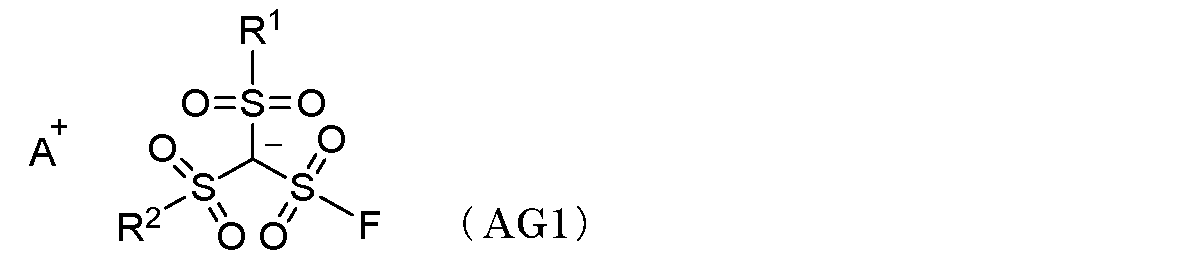
一般式(AG1)中、
R1およびR2は、それぞれ独立にフッ素原子または-ORであり、Rは1価の有機基であり、
A+は、対カチオンである。
11.
10.に記載の酸発生剤であって、
R1およびR2がともにフッ素原子である、酸発生剤。
12.
10.または11.に記載の酸発生剤であって、
R1およびR2の一方がフッ素原子であり、他方が-ORである、酸発生剤。
13.
10.に記載の酸発生剤であって、
R1およびR2の少なくとも一方が-ORであり、Rが環状骨格を含む、酸発生剤。
14.
10.~13.のいずれか1つに記載の酸発生剤であって、
A+がスルホニウムカチオンおよびヨードニウムカチオンからなる群より選ばれる少なくともいずれかのカチオンである、酸発生剤。
15.
以下一般式(ag1)で表される化合物と、一般式A1 +X-(A1 +はスルホニウムカチオンまたはヨードニウムカチオンであり、X-はハライドイオン、スルホネートイオン、硫酸イオン、リン酸イオン、水酸化物イオンまたはカルボキシレートイオンである)で表される化合物とを反応させることにより、以下一般式(AG1-1)で表される化合物を製造する、化合物の製造方法。

一般式(ag1)中、
M+は、金属カチオンであり、
R1およびR2は、それぞれ独立にフッ素原子または-ORであり、Rは1価の有機基である。

一般式(AG1-1)中、
A1 +の定義は前述のとおりであり、
R1およびR2は、それぞれ独立にフッ素原子または-ORであり、Rは1価の有機基である。
16.
以下一般式(M-FSM)で表される化合物と、R-OHで表され、Rは1価の有機基である化合物とを反応させて、以下一般式(ag1)で表される化合物を得る工程を含む、化合物の製造方法。

一般式(M-FSM)中、
M+は、金属カチオンである。

一般式(ag1)中、
M+は、金属カチオンであり、
R1およびR2は、それぞれ独立にフッ素原子または-ORであり、ただしR1およびR2の少なくとも一方は-ORであり、Rは1価の有機基である。
17.
以下一般式(AG1)で表される化合物。

一般式(AG1)中、
R1およびR2は、それぞれ独立にフッ素原子または-ORであり、Rは1価の有機基であり、
A+は、対カチオンである。
18.
17.に記載の化合物であって、
R1およびR2がともにフッ素原子である、化合物。
19.
17.または18.に記載の化合物であって、
R1およびR2の一方がフッ素原子であり、他方が-ORである、化合物。
20.
17.に記載の化合物であって、
R1およびR2の少なくとも一方が-ORであり、Rが環状骨格を含む、化合物。
21.
17.~20.のいずれか1つに記載の化合物であって、
A+がスルホニウムカチオンおよびヨードニウムカチオンからなる群より選ばれる少なくともいずれかのカチオンである、化合物。
22.
17.~21.のいずれか1つに記載の化合物に放射線を照射して、酸を発生させる、酸発生方法。
以下一般式(AG1)で表される酸発生剤を含む、感放射線性樹脂組成物。
R1およびR2は、それぞれ独立にフッ素原子または-ORであり、Rは1価の有機基であり、
A+は、対カチオンである。
2.
1.に記載の感放射線性樹脂組成物であって、
酸の作用により分解して現像液に対する溶解性が変化する樹脂を含む、感放射線性樹脂組成物。
3.
1.に記載の感放射線性樹脂組成物であって、
酸の作用により高分子量化して現像液に対する溶解性が変化する成分を含む、感放射線性樹脂組成物。
4.
1.~3.のいずれか1つに記載の感放射線性樹脂組成物であって、
R1およびR2がともにフッ素原子である、感放射線性樹脂組成物。
5.
1.~4.のいずれか1つに記載の感放射線性樹脂組成物であって、
R1およびR2の一方がフッ素原子であり、他方が-ORである、感放射線性樹脂組成物。
6.
1.~5.のいずれか1つに記載の感放射線性樹脂組成物であって、
R1およびR2の少なくとも一方が-ORであり、Rが環状骨格を含む、感放射線性樹脂組成物。
7.
1.~6.のいずれか1つに記載の感放射線性樹脂組成物であって、
A+がスルホニウムカチオンおよびヨードニウムカチオンからなる群より選ばれる少なくともいずれかのカチオンである、感放射線性樹脂組成物。
8.
1.~7.のいずれか1つに記載の感放射線性樹脂組成物を用いて膜を形成することと、
前記膜に放射線を照射することと、
放射線が照射された前記膜を現像することと、
を含む、パターン形成方法。
9.
8.に記載のパターン形成方法を含む、電子デバイスの製造方法。
10.
以下一般式(AG1)で表される酸発生剤。
R1およびR2は、それぞれ独立にフッ素原子または-ORであり、Rは1価の有機基であり、
A+は、対カチオンである。
11.
10.に記載の酸発生剤であって、
R1およびR2がともにフッ素原子である、酸発生剤。
12.
10.または11.に記載の酸発生剤であって、
R1およびR2の一方がフッ素原子であり、他方が-ORである、酸発生剤。
13.
10.に記載の酸発生剤であって、
R1およびR2の少なくとも一方が-ORであり、Rが環状骨格を含む、酸発生剤。
14.
10.~13.のいずれか1つに記載の酸発生剤であって、
A+がスルホニウムカチオンおよびヨードニウムカチオンからなる群より選ばれる少なくともいずれかのカチオンである、酸発生剤。
15.
以下一般式(ag1)で表される化合物と、一般式A1 +X-(A1 +はスルホニウムカチオンまたはヨードニウムカチオンであり、X-はハライドイオン、スルホネートイオン、硫酸イオン、リン酸イオン、水酸化物イオンまたはカルボキシレートイオンである)で表される化合物とを反応させることにより、以下一般式(AG1-1)で表される化合物を製造する、化合物の製造方法。
M+は、金属カチオンであり、
R1およびR2は、それぞれ独立にフッ素原子または-ORであり、Rは1価の有機基である。
A1 +の定義は前述のとおりであり、
R1およびR2は、それぞれ独立にフッ素原子または-ORであり、Rは1価の有機基である。
16.
以下一般式(M-FSM)で表される化合物と、R-OHで表され、Rは1価の有機基である化合物とを反応させて、以下一般式(ag1)で表される化合物を得る工程を含む、化合物の製造方法。
M+は、金属カチオンである。
M+は、金属カチオンであり、
R1およびR2は、それぞれ独立にフッ素原子または-ORであり、ただしR1およびR2の少なくとも一方は-ORであり、Rは1価の有機基である。
17.
以下一般式(AG1)で表される化合物。
R1およびR2は、それぞれ独立にフッ素原子または-ORであり、Rは1価の有機基であり、
A+は、対カチオンである。
18.
17.に記載の化合物であって、
R1およびR2がともにフッ素原子である、化合物。
19.
17.または18.に記載の化合物であって、
R1およびR2の一方がフッ素原子であり、他方が-ORである、化合物。
20.
17.に記載の化合物であって、
R1およびR2の少なくとも一方が-ORであり、Rが環状骨格を含む、化合物。
21.
17.~20.のいずれか1つに記載の化合物であって、
A+がスルホニウムカチオンおよびヨードニウムカチオンからなる群より選ばれる少なくともいずれかのカチオンである、化合物。
22.
17.~21.のいずれか1つに記載の化合物に放射線を照射して、酸を発生させる、酸発生方法。
基板上に樹脂膜を形成し、放射線の照射および現像処理を行うパターン形成において、上掲の新規な酸発生剤や感放射線性樹脂組成物は有用である。
以下、本発明の実施形態について詳細に説明する。
本明細書中、数値範囲の説明における「X~Y」との表記は、特に断らない限り、X以上Y以下のことを表す。例えば、「1~5質量%」とは「1質量%以上5質量%以下」を意味する。
本明細書中、「不揮発成分」とは、特に断らない限り、感放射線性樹脂組成物中の溶剤以外の成分を意味する。
本明細書において、「放射線」とは、酸発生剤を活性化可能な光線または粒子線を意味する。典型的には、放射線は、紫外線(特に遠紫外線および極紫外線)、X線、γ線、電子線等であることができる。また、本明細書においては、特に断らない限り、「光」は「放射線」と同義である。
本明細書において、「酸発生剤」とは、典型的には、光や熱などの外部刺激(外部からのエネルギー)により酸を発生する性質を有する化合物のことを意味する。例えば、ある一般式Xで表されるが、外部刺激により酸を発生することが無い化合物は「一般式Xで表される酸発生剤」には該当しない。これに対し、例えば「一般式Xで表される化合物」は、外部刺激への応答性などの特性に関係なく、一般式Xで表される化合物全般を包含する。
本明細書中、数値範囲の説明における「X~Y」との表記は、特に断らない限り、X以上Y以下のことを表す。例えば、「1~5質量%」とは「1質量%以上5質量%以下」を意味する。
本明細書中、「不揮発成分」とは、特に断らない限り、感放射線性樹脂組成物中の溶剤以外の成分を意味する。
本明細書において、「放射線」とは、酸発生剤を活性化可能な光線または粒子線を意味する。典型的には、放射線は、紫外線(特に遠紫外線および極紫外線)、X線、γ線、電子線等であることができる。また、本明細書においては、特に断らない限り、「光」は「放射線」と同義である。
本明細書において、「酸発生剤」とは、典型的には、光や熱などの外部刺激(外部からのエネルギー)により酸を発生する性質を有する化合物のことを意味する。例えば、ある一般式Xで表されるが、外部刺激により酸を発生することが無い化合物は「一般式Xで表される酸発生剤」には該当しない。これに対し、例えば「一般式Xで表される化合物」は、外部刺激への応答性などの特性に関係なく、一般式Xで表される化合物全般を包含する。
本明細書における基(原子団)の表記において、置換か無置換かを記していない表記は、置換基を有しないものと置換基を有するものの両方を包含するものである。例えば「アルキル基」とは、置換基を有しないアルキル基(無置換アルキル基)のみならず、置換基を有するアルキル基(置換アルキル基)をも包含するものである。
本明細書における「(メタ)アクリル」との表記は、アクリルとメタクリルの両方を包含する概念を表す。「(メタ)アクリレート」等の類似の表記についても同様である。
本明細書における「有機基」の語は、特に断りが無い限り、有機化合物から1つ以上の水素原子を除いた原子団のことを意味する。例えば、「1価の有機基」とは、任意の有機化合物から1つの水素原子を除いた原子団のことを表す。
本明細書における「(メタ)アクリル」との表記は、アクリルとメタクリルの両方を包含する概念を表す。「(メタ)アクリレート」等の類似の表記についても同様である。
本明細書における「有機基」の語は、特に断りが無い限り、有機化合物から1つ以上の水素原子を除いた原子団のことを意味する。例えば、「1価の有機基」とは、任意の有機化合物から1つの水素原子を除いた原子団のことを表す。
本明細書における「電子デバイス」の語は、半導体チップ、半導体素子、プリント配線基板、電気回路ディスプレイ装置、情報通信端末、発光ダイオード、物理電池、化学電池など、電子工学の技術が適用された素子、デバイス、最終製品等を包含する意味で用いられる。
<感放射線性樹脂組成物>
以下一般式(AG1)で表される酸発生剤を含む感放射線性樹脂組成物は、新規であり、基板上に樹脂膜を形成し、放射線の照射および現像処理を行うパターン形成に好適に適用することができる。
以下一般式(AG1)で表される酸発生剤を含む感放射線性樹脂組成物は、新規であり、基板上に樹脂膜を形成し、放射線の照射および現像処理を行うパターン形成に好適に適用することができる。

一般式(AG1)中、
R1およびR2は、それぞれ独立にフッ素原子または-ORであり、Rは1価の有機基であり、
A+は、対カチオンである。
R1およびR2は、それぞれ独立にフッ素原子または-ORであり、Rは1価の有機基であり、
A+は、対カチオンである。
一般式(AG1)で表される酸発生剤を用いて感放射線性樹脂組成物を構成することの利点として考えられることを、従来の知見を踏まえつつ、以下に説明する。
一般式(AG1)で表される酸発生剤からの発生酸は、電子求引性が強い-SO2F構造を有する。このことに起因して、発生酸の酸強度が高くなっていると考えられる。このことは感放射線性樹脂組成物の高感度化につながると考えられる。
また、本発明者らの検討によれば、一般式(AG1)で表される酸発生剤は、有機溶剤中では安定的に存在するが、一般式(AG1)で表される酸発生剤からの発生酸は、アルカリ現像液(アルカリ水溶液)と接触することで容易に分解する(S-F結合が加水分解すると考えられる)。このため、一般式(AG1)で表される酸発生剤を用いて基板上にパターンを形成したときの、基板上への、酸発生剤に由来するフッ素含有成分の意図せぬ残留が少なくなると考えられる。
ちなみに、一般式(AG1)におけるアニオン部のフッ素原子数が、もともと、比較的少ないことも、フッ素含有成分の残留が少なくなることに寄与していると思われる。
また、本発明者らの検討によれば、一般式(AG1)で表される酸発生剤は、有機溶剤中では安定的に存在するが、一般式(AG1)で表される酸発生剤からの発生酸は、アルカリ現像液(アルカリ水溶液)と接触することで容易に分解する(S-F結合が加水分解すると考えられる)。このため、一般式(AG1)で表される酸発生剤を用いて基板上にパターンを形成したときの、基板上への、酸発生剤に由来するフッ素含有成分の意図せぬ残留が少なくなると考えられる。
ちなみに、一般式(AG1)におけるアニオン部のフッ素原子数が、もともと、比較的少ないことも、フッ素含有成分の残留が少なくなることに寄与していると思われる。
従来の酸発生剤の多くは、感放射線性樹脂組成物に用いた際に、高解像度、低ラフネスを満たし、かつ発生酸の酸強度を高めて高感度化を達成するため、電子求引性であるフッ素原子を含んでいる。しかし、酸発生剤に由来するフッ素含有成分が基板上に意図しない形で残存することによる、電子デバイスの歩留まりや性能への悪影響が懸念される。具体的には、意図しないフッ素含有成分の残留は、ドライエッチングのレートに影響を及ぼす懸念がある。つまり、基板上に、感放射線性樹脂組成物に由来するフッ素含有成分が意図せず残留していると、適切なドライエッチングを行えなくなる懸念がある。また、フッ素含有化合物の多くは撥水的であるため、基板上への意図しないフッ素含有化合物の残留は、基板表面の特性を意図しないものに変えてしまう懸念もある。特に、近年の電子デバイスの微細化・複雑化の進展に伴い、これまで問題にならなかった程度のごく微量の残留物が問題となることがありうる。
基板上への意図しないフッ素含有化合物の残留を減らすため、フッ素原子を含まない酸発生剤を用いることが考えられる。しかし、フッ素原子を含まない酸発生剤の多くは、酸強度が小さいために感放射線性樹脂組成物の低感度化を招く恐れがある。つまり、発生酸の酸強度を高めて感放射線性樹脂組成物を高感度化するということと、基板上への意図しないフッ素含有化合物の残留を少なくすこととは、トレードオフの関係にあると捉えることもできる。
さらに、近年、環境汚染防止や健康被害防止の観点から、フッ素の使用量自体を減らすことが求められる場合がある。
一般式(AG1)で表される酸発生剤を用いて感放射線性樹脂組成物を調製することで、上記の懸念や課題をクリアできると考えられる。特に、発生酸の酸強度を高めて感放射線性樹脂組成物を高感度化することと、基板上への意図しないフッ素含有化合物の残留を減らすことのトレードオフの脱却は、注目されるべきである。
一般式(AG1)について以下により具体的に説明する。
・アニオン側の構造
前述のように、一般式(AG1)において、R1およびR2は、それぞれ独立にフッ素原子または-ORであり、Rは1価の有機基である。
R1およびR2は、発生酸の酸強度および発生酸の拡散性の観点で、適切に選択することが好ましい。
前述のように、一般式(AG1)において、R1およびR2は、それぞれ独立にフッ素原子または-ORであり、Rは1価の有機基である。
R1およびR2は、発生酸の酸強度および発生酸の拡散性の観点で、適切に選択することが好ましい。
発生酸の酸強度を強める点では、R1およびR2の少なくとも一方がフッ素原子であることが好ましく、R1およびR2の両方がフッ素原子であることがより好ましい。発生酸の酸強度が強くなることで、感放射線性樹脂組成物の感度が向上する傾向がある。
発生酸の拡散性制御の観点では、R1およびR2の少なくとも一方が-ORであることが好ましい。Rの分子量や嵩高さを調製することにより、発生酸の拡散性を様々に調整することができる。発生酸の拡散性が適切に調整させることにより、感放射線性樹脂組成物の性能としては、解像度やラインエッジラフネスなどの性能が良好となる傾向がある。
Rは1価の有機基であれば特に限定されないが、発生酸の拡散性を抑えて解像度やラインエッジラフネスを良好とする観点からは、Rは環状骨格を含むことが好ましい。
より具体的には、Rは、単環または多環の脂肪族炭化水素基、単環または多環の芳香族炭化水素基などを含むことができる。Rはヘテロ環基を含んでもよく、ヘテロ環基は芳香族性であっても非芳香族性であってもよい。ヘテロ環基が含むヘテロ原子としては、酸素原子、窒素原子、硫黄原子などが挙げられる。
Rは、化学構造として環状骨格のみを有する基(例えば単環または多環の脂肪族炭化水素基、単環または多環の芳香族炭化水素基そのもの)であってもよいし、環状骨格とそれ以外の化学構造を有する基であってもよい。後者について具体的に記載すると、-ORは、-O-L-R’であってもよい。ここでLは2価の連結基であり、R’は単環または多環の脂肪族炭化水素基、単環または多環の芳香族炭化水素基またはヘテロ環基である。Lの2価の連結基としては、直鎖または分岐状のアルキレン基、カルボニル基などを挙げることができる。
より具体的には、Rは、単環または多環の脂肪族炭化水素基、単環または多環の芳香族炭化水素基などを含むことができる。Rはヘテロ環基を含んでもよく、ヘテロ環基は芳香族性であっても非芳香族性であってもよい。ヘテロ環基が含むヘテロ原子としては、酸素原子、窒素原子、硫黄原子などが挙げられる。
Rは、化学構造として環状骨格のみを有する基(例えば単環または多環の脂肪族炭化水素基、単環または多環の芳香族炭化水素基そのもの)であってもよいし、環状骨格とそれ以外の化学構造を有する基であってもよい。後者について具体的に記載すると、-ORは、-O-L-R’であってもよい。ここでLは2価の連結基であり、R’は単環または多環の脂肪族炭化水素基、単環または多環の芳香族炭化水素基またはヘテロ環基である。Lの2価の連結基としては、直鎖または分岐状のアルキレン基、カルボニル基などを挙げることができる。
単環の脂肪族炭化水素基としては、シクロアルキル基やシクロアルケニル基を挙げることができる。具体的には、シクロプロピル基、シクロブチル基、シクロペンチル基、シクロヘキシル基、シクロプチル基、シクロオクチル基、シクロドデカニル基、シクロぺンテニル基、シクロヘキセニル基、シクロオクタジエニル基等が挙げられる。これらの中でも、シクロプロピル基、シクロペンチル基、シクロヘキシル基、シクロオクチル基が好ましい。
多環の脂肪族炭化水素基としては、ビシクロ[4.3.0]ノナニル基、デカヒドロナフタレニル基、トリシクロ[5.2.1.02,6]デカニル基、ボルニル基、イソボルニル基、ノルボルニル基、アダマンチル基、ノルアダマンチル基、1,7,7-トリメチルトリシクロ[2.2.1.02,6]ヘプタニル基、3,7,7-トリメチルビシクロ[4.1.0]ヘプタニル基、ステロイド骨格を有する基などが挙げられる。これらの中でも、ノルボルニル基、アダマンチル基、ノルアダマンチル基が好ましい。
芳香族炭化水素基としては、フェニル基、ナフチル基などを挙げることができる。
ヘテロ環基としては、例えばラクトン骨格を含む基などを挙げることができる。
多環の脂肪族炭化水素基としては、ビシクロ[4.3.0]ノナニル基、デカヒドロナフタレニル基、トリシクロ[5.2.1.02,6]デカニル基、ボルニル基、イソボルニル基、ノルボルニル基、アダマンチル基、ノルアダマンチル基、1,7,7-トリメチルトリシクロ[2.2.1.02,6]ヘプタニル基、3,7,7-トリメチルビシクロ[4.1.0]ヘプタニル基、ステロイド骨格を有する基などが挙げられる。これらの中でも、ノルボルニル基、アダマンチル基、ノルアダマンチル基が好ましい。
芳香族炭化水素基としては、フェニル基、ナフチル基などを挙げることができる。
ヘテロ環基としては、例えばラクトン骨格を含む基などを挙げることができる。
Rの1価の有機基は、置換基を有していてもよいし、有していなくてもよい。置換基は特に限定されない。置換基の例としては、アルキル基、脂環式基、アリール基、アラルキル基、ヒドロキシ基、カルボニル基、シアノ基、ハロゲノ基、アルコキシカルボニル基、アルキルカルボニルオキシ基などを挙げることができる。
Rの1価の有機基(好ましくは環状骨格を含む)の炭素数は、発生酸の適度な拡散性の観点で、好ましくは5~30、より好ましくは6~25である。
Rの1価の有機基(好ましくは環状骨格を含む)の炭素数は、発生酸の適度な拡散性の観点で、好ましくは5~30、より好ましくは6~25である。
発生酸の酸強度および発生酸の拡散性のバランスの点では、R1およびR2の一方がフッ素原子であり、他方が-ORであることが好ましい。
一般式(AG1)で表される酸発生剤における、アニオン側の好ましい構造を以下に挙げる。


・カチオン側の構造
A+の対カチオンの構造は、一般式(AG1)で表される酸発生剤が酸発生剤として機能する限り特に限定されない。適切な構造のA+を採用することで、例えば感放射線性樹脂組成物の感度を高めることができる。
A+の対カチオンの構造は、一般式(AG1)で表される酸発生剤が酸発生剤として機能する限り特に限定されない。適切な構造のA+を採用することで、例えば感放射線性樹脂組成物の感度を高めることができる。
A+は、好ましくはオニウムカチオンであり、より好ましくはスルホニウムカチオンおよびヨードニウムカチオンからなる群より選ばれる少なくともいずれかのカチオンである。
より具体的には、A+は、好ましくは以下一般式(A1)または(A2)で表されるものが好ましい。
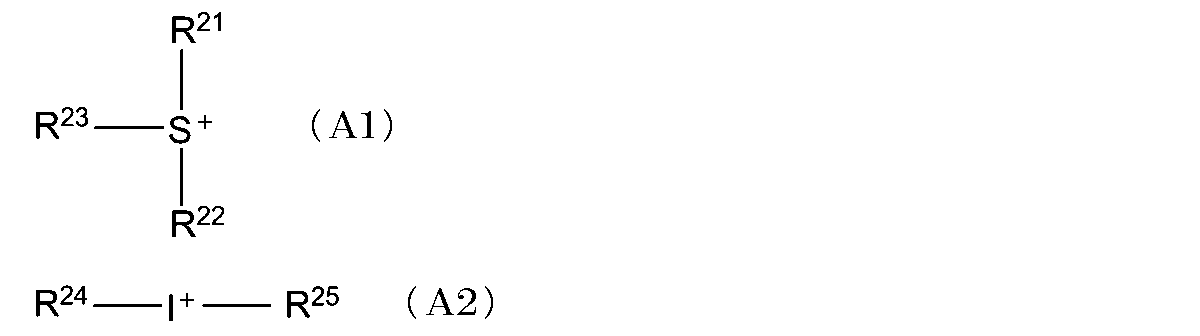
一般式(A1)において、R21、R22およびR23は、各々独立に、有機基を表す。有機基の炭素数は、通常1~30、好ましくは1~20である。R21、R22およびR23のうち少なくとも2つが結合して環構造を形成してもよい。また、その環構造内に酸素原子、硫黄原子、エステル結合、アミド結合およびカルボニル基からなる群より選ばれる1または2以上が含まれていてもよい。R21、R22およびR23のうち少なくとも2つが結合して形成される基として好ましくはアルキレン基(例えば、ブチレン基、ペンチレン基)を挙げることができる。
一般式(A2)において、R24およびR25は、各々独立に、有機基を表す。有機基の炭素数は、通常1~30、好ましくは1~20である。
一般式(A2)において、R24およびR25は、各々独立に、有機基を表す。有機基の炭素数は、通常1~30、好ましくは1~20である。
R21、R22およびR23ならびにR24およびR25の有機基は、アリール基、アルキル基、シクロアルキル基などであることができる。
アリール基としては、フェニル基、ナフチル基が好ましく、更に好ましくはフェニル基である。アリール基は、酸素原子、窒素原子、硫黄原子等を有する複素環構造を有するアリール基であってもよい。複素環構造を有するアリール基としては、例えば、ピロール残基、フラン残基、チオフェン残基、インドール残基、ベンゾフラン残基、ベンゾチオフェン残基等を挙げることができる。一般式(A1)において、R21、R22およびR23のうち2以上がアリール基である場合に、2つ以上あるアリール基は同一であっても異なっていてもよい。同様に、一般式(A2)において、R24およびR25の両方がアリール基である場合に、2つのアリール基は同一であっても異なっていてもよい。
アルキル基またはシクロアルキル基としては、炭素数1~15の直鎖または分岐アルキル基、炭素数3~15のシクロアルキル基などを挙げることができる。より具体的には、メチル基、エチル基、プロピル基、n-ブチル基、sec-ブチル基、t-ブチル基、シクロプロピル基、シクロブチル基、シクロヘキシル基等を挙げることができる。
アリール基としては、フェニル基、ナフチル基が好ましく、更に好ましくはフェニル基である。アリール基は、酸素原子、窒素原子、硫黄原子等を有する複素環構造を有するアリール基であってもよい。複素環構造を有するアリール基としては、例えば、ピロール残基、フラン残基、チオフェン残基、インドール残基、ベンゾフラン残基、ベンゾチオフェン残基等を挙げることができる。一般式(A1)において、R21、R22およびR23のうち2以上がアリール基である場合に、2つ以上あるアリール基は同一であっても異なっていてもよい。同様に、一般式(A2)において、R24およびR25の両方がアリール基である場合に、2つのアリール基は同一であっても異なっていてもよい。
アルキル基またはシクロアルキル基としては、炭素数1~15の直鎖または分岐アルキル基、炭素数3~15のシクロアルキル基などを挙げることができる。より具体的には、メチル基、エチル基、プロピル基、n-ブチル基、sec-ブチル基、t-ブチル基、シクロプロピル基、シクロブチル基、シクロヘキシル基等を挙げることができる。
R21、R22およびR23ならびにR24およびR25を構成する有機基は、置換基を有していてもよいし、有していなくてもよい。置換基としては、アルキル基、シクロアルキル基、アリール基、アルコキシ基、アルコキシカルボニル基、アルキルカルボニルオキシ基、ハロゲノ基、ヒドロキシ基、フェニルチオ基、などが挙げられる。好ましい置換基としては炭素数1~12の直鎖または分岐アルキル基、炭素数3~12のシクロアルキル基、炭素数1~12の直鎖、分岐または環状のアルコキシ基であり、より好ましくは炭素数1~4のアルキル基、炭素数1~4のアルコキシ基である。
一般式(A1)で表されるカチオン構造において、置換基は、R21、R22およびR23のうち1つのみに置換していてもよいし、2つに置換していてもよいし、3つ全てに置換していてもよい。もちろん、R21、R22およびR23は置換基を有していなくてもよい。
一般式(A2)で表されるカチオン構造において、置換基は、R24およびR25のうち1つのみに置換していてもよいし、2つに置換していてもよい。もちろん、R24およびR25は置換基を有していなくてもよい。
一般式(A1)で表されるカチオン構造において、置換基は、R21、R22およびR23のうち1つのみに置換していてもよいし、2つに置換していてもよいし、3つ全てに置換していてもよい。もちろん、R21、R22およびR23は置換基を有していなくてもよい。
一般式(A2)で表されるカチオン構造において、置換基は、R24およびR25のうち1つのみに置換していてもよいし、2つに置換していてもよい。もちろん、R24およびR25は置換基を有していなくてもよい。
R21の総炭素数は特に限定されないが、諸性能のバランスの観点で、例えば3~20、好ましくは5~18、より好ましくは6~16、さらに好ましくは6~12である。R22およびR23ならびにR24およびR25の総炭素数についても同様である。
感放射線性樹脂組成物中での安定性や、放射線の吸収性などの観点から、一般式(A1)で表されるカチオン構造において、R21、R22およびR23の少なくとも1つはアリール基であることが好ましく、R21、R22およびR23の少なくとも3つはアリール基であることがより好ましく、R21、R22およびR23のすべてがアリール基であることがさらに好ましい。
同様に、一般式(A2)で表されるカチオン構造において、R24およびR25の少なくとも1つはアリール基であることが好ましく、両方がアリール基であることがより好ましい。
同様に、一般式(A2)で表されるカチオン構造において、R24およびR25の少なくとも1つはアリール基であることが好ましく、両方がアリール基であることがより好ましい。
一般式(AG1)におけるA+の好ましい構造を以下に例示する。以下において、「Ph」はフェニル基を表す。
また、以下に示す構造のほか、例えば特開2002-341539号公報の段落0221~0227および段落0241~0249に例示されている酸発生剤のカチオン構造も、A+として採用可能である。
また、以下に示す構造のほか、例えば特開2002-341539号公報の段落0221~0227および段落0241~0249に例示されている酸発生剤のカチオン構造も、A+として採用可能である。
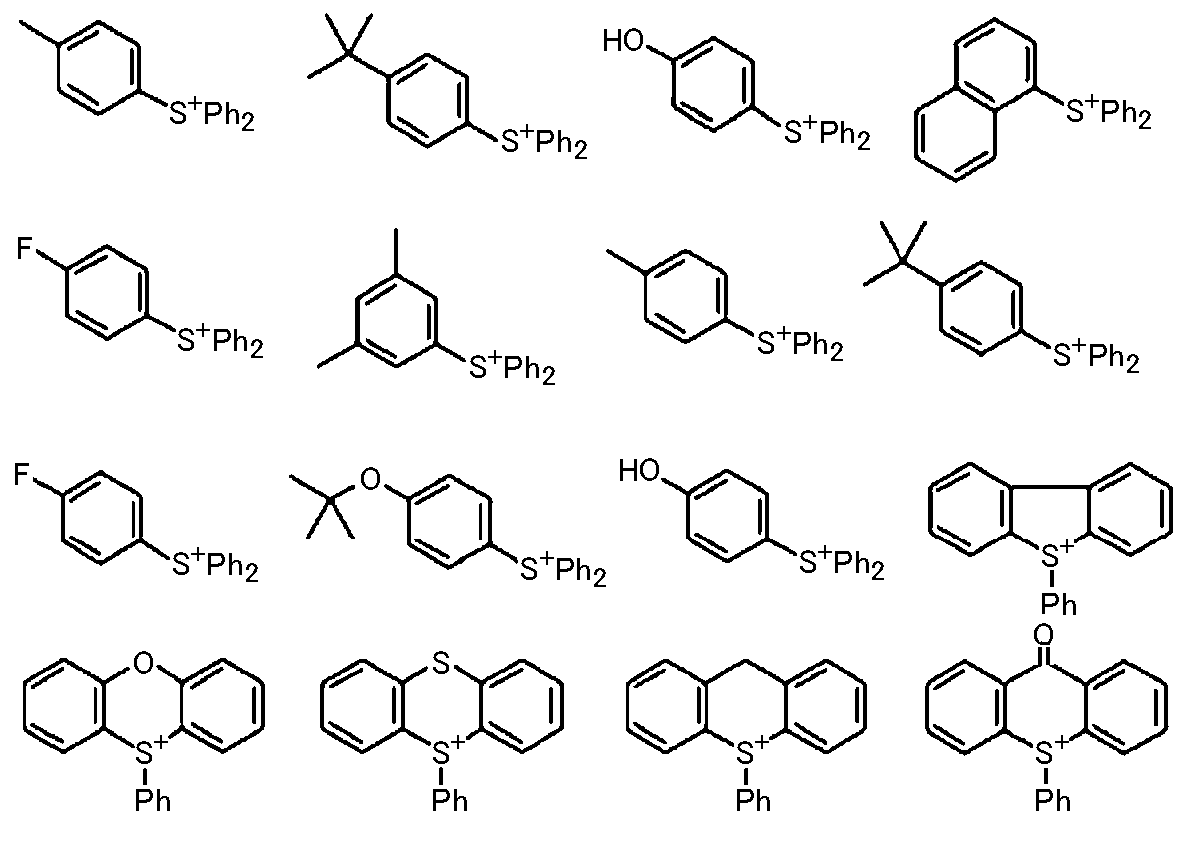
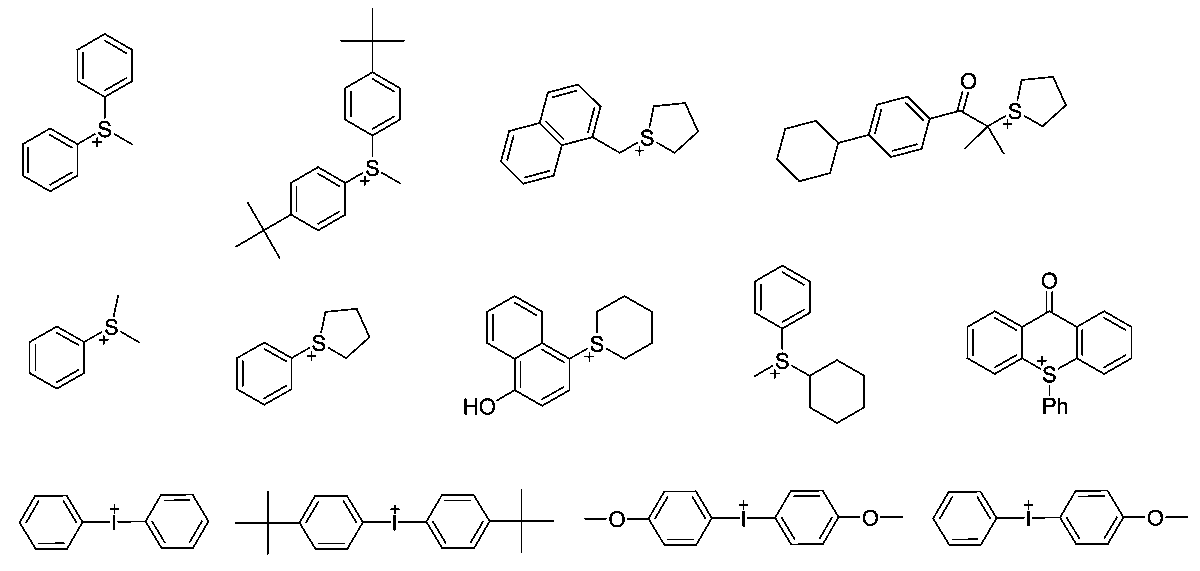
一般式(AG1)で表される化合物の好ましい具体例を以下に示す。以下において「Me」はメチル基を表す。


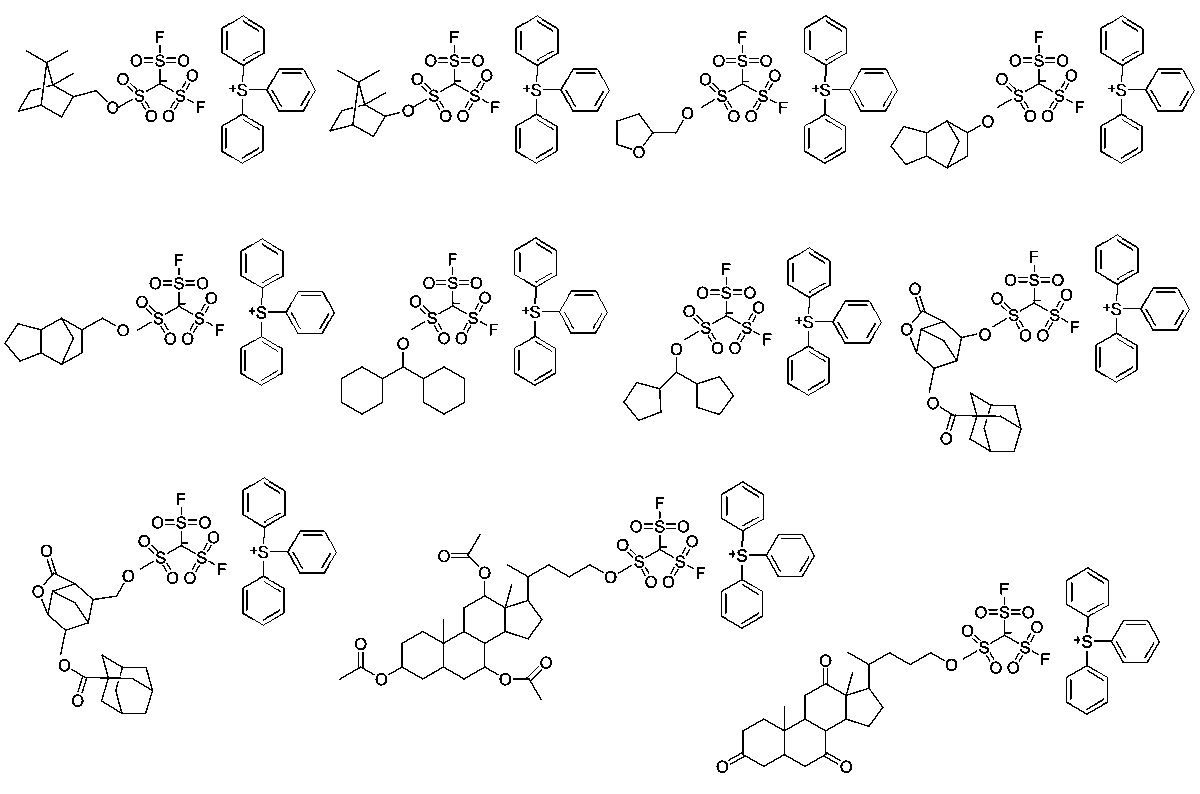
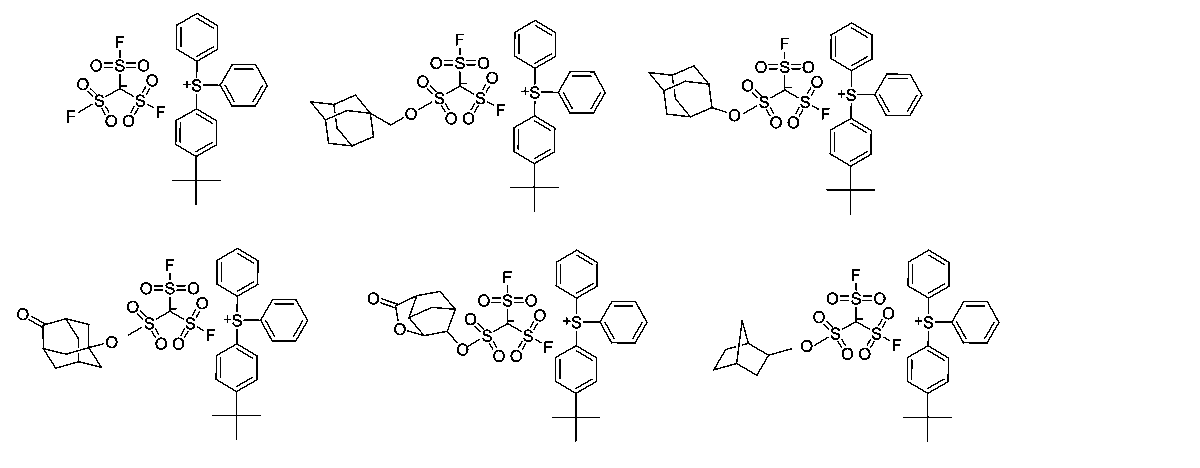

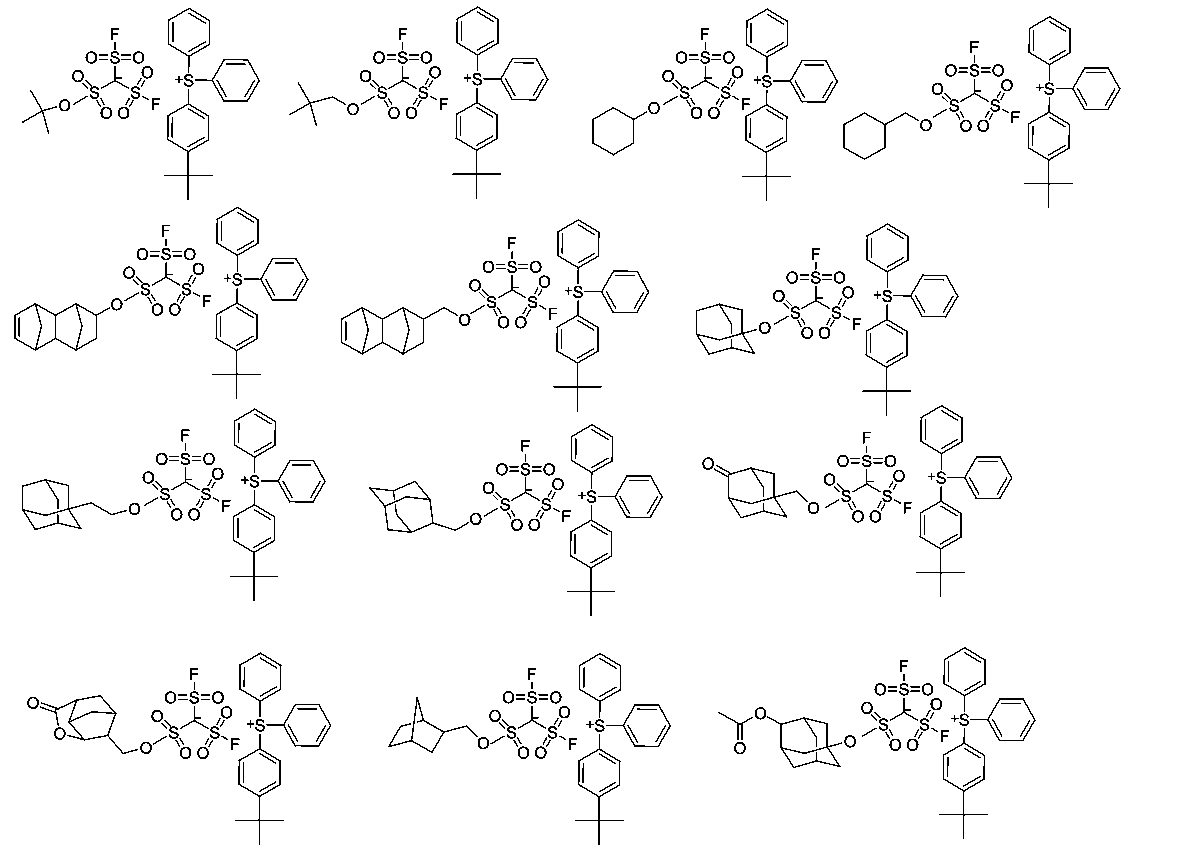
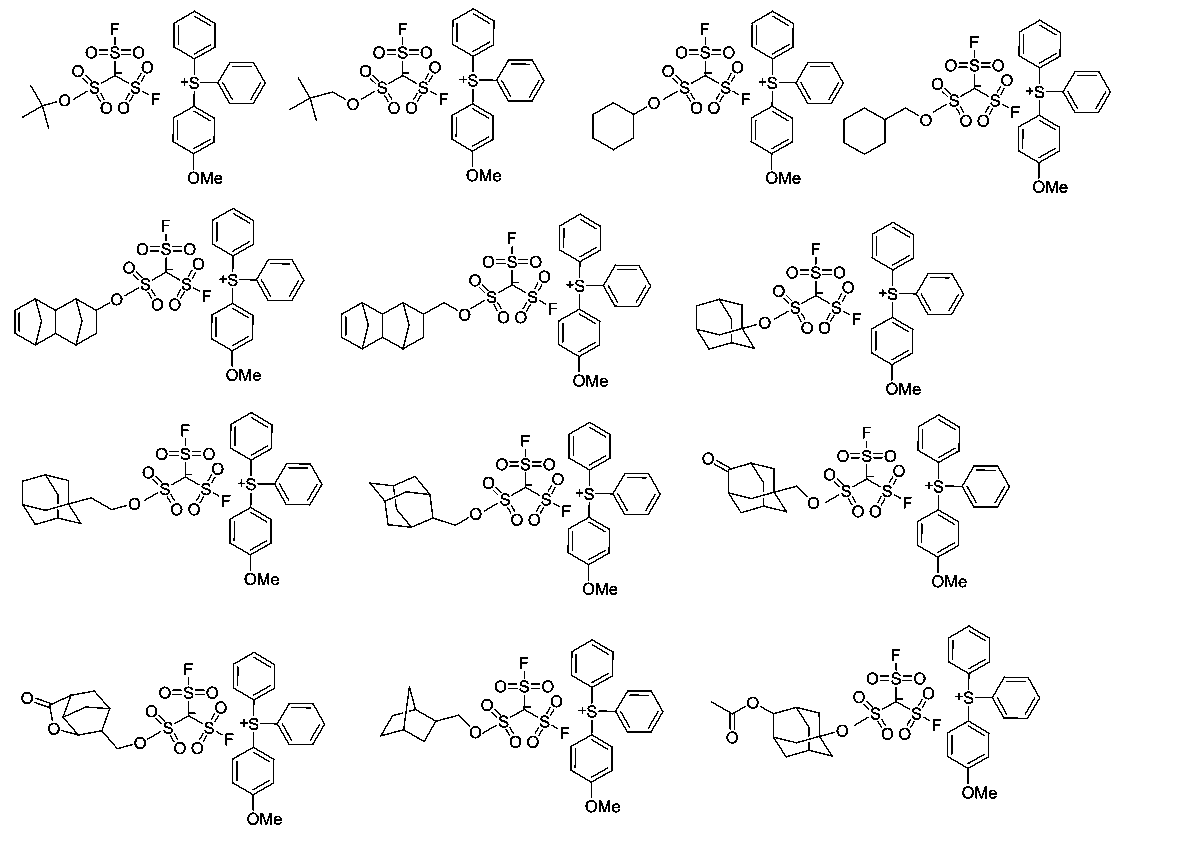
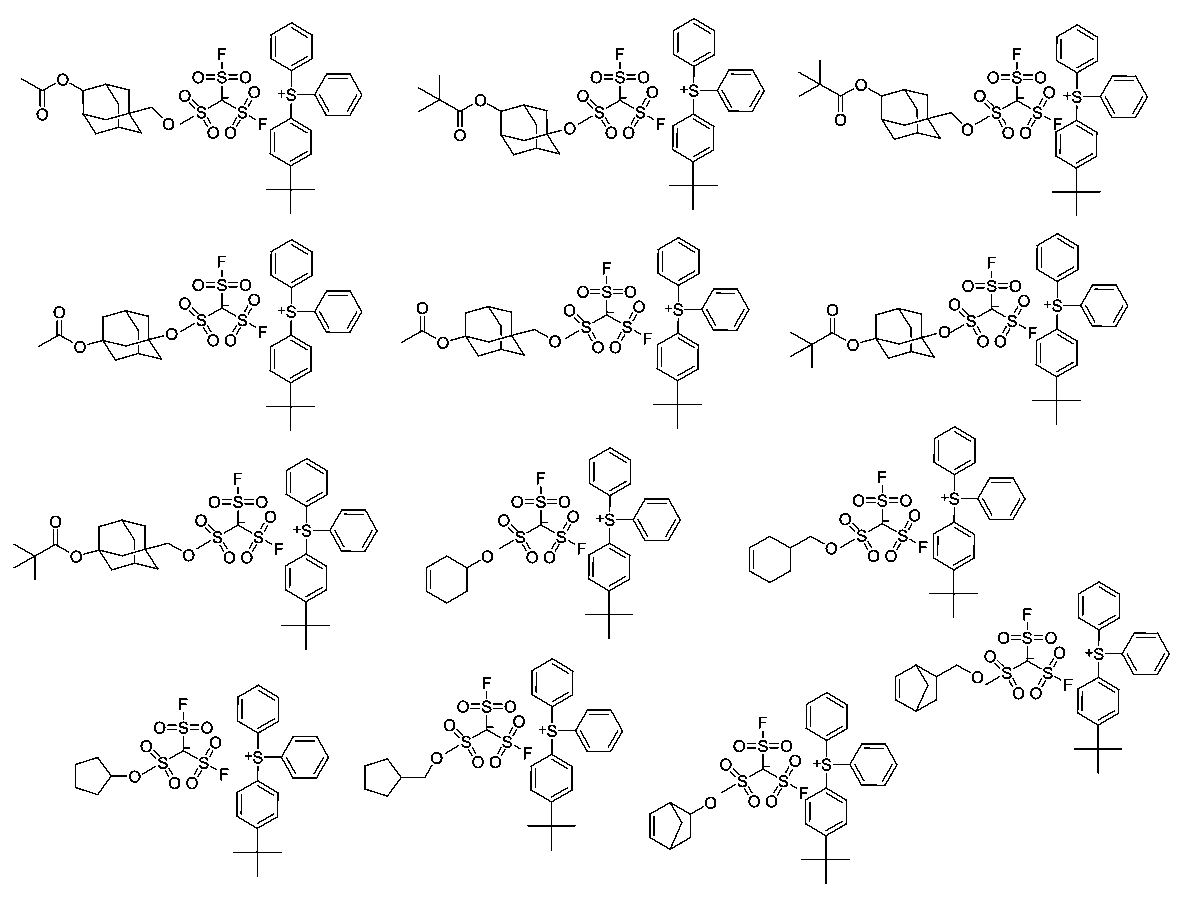


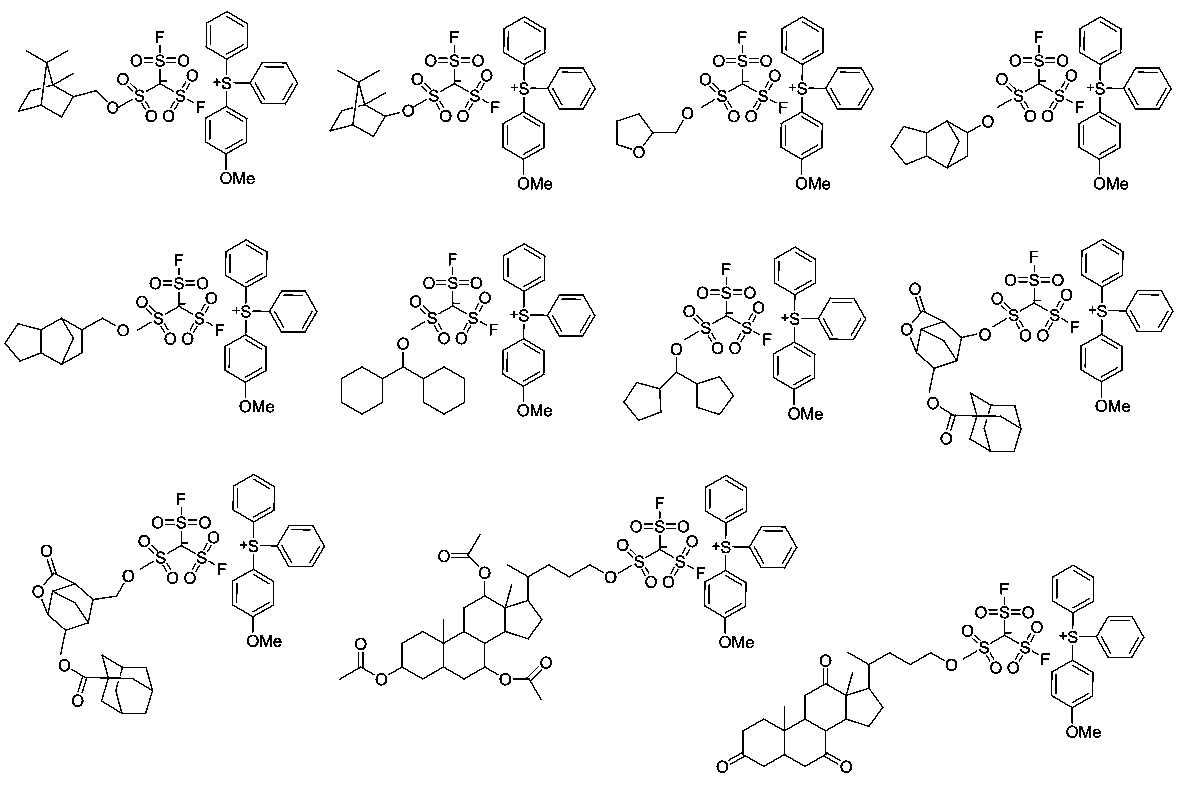
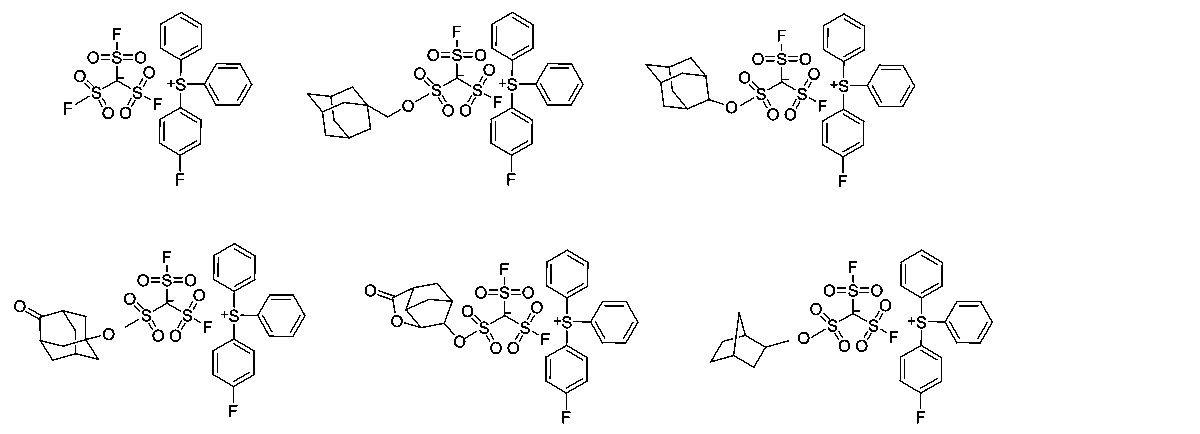
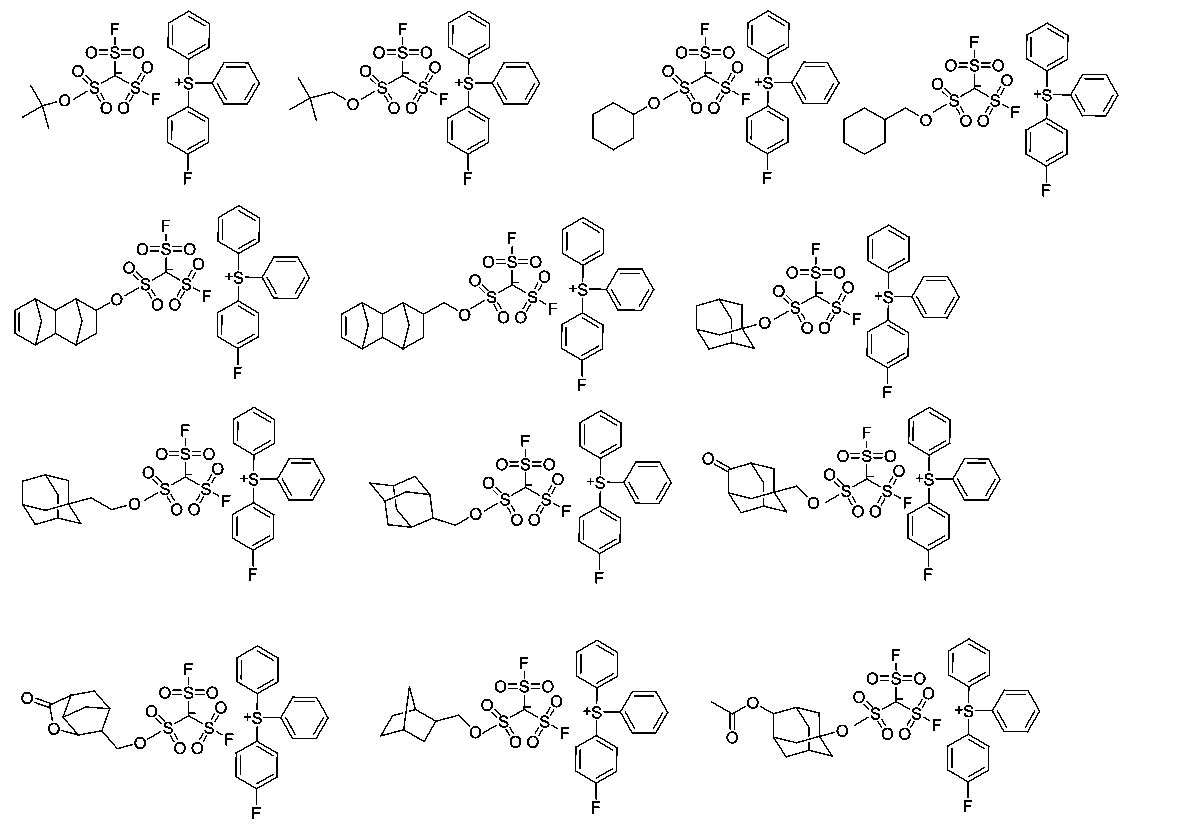
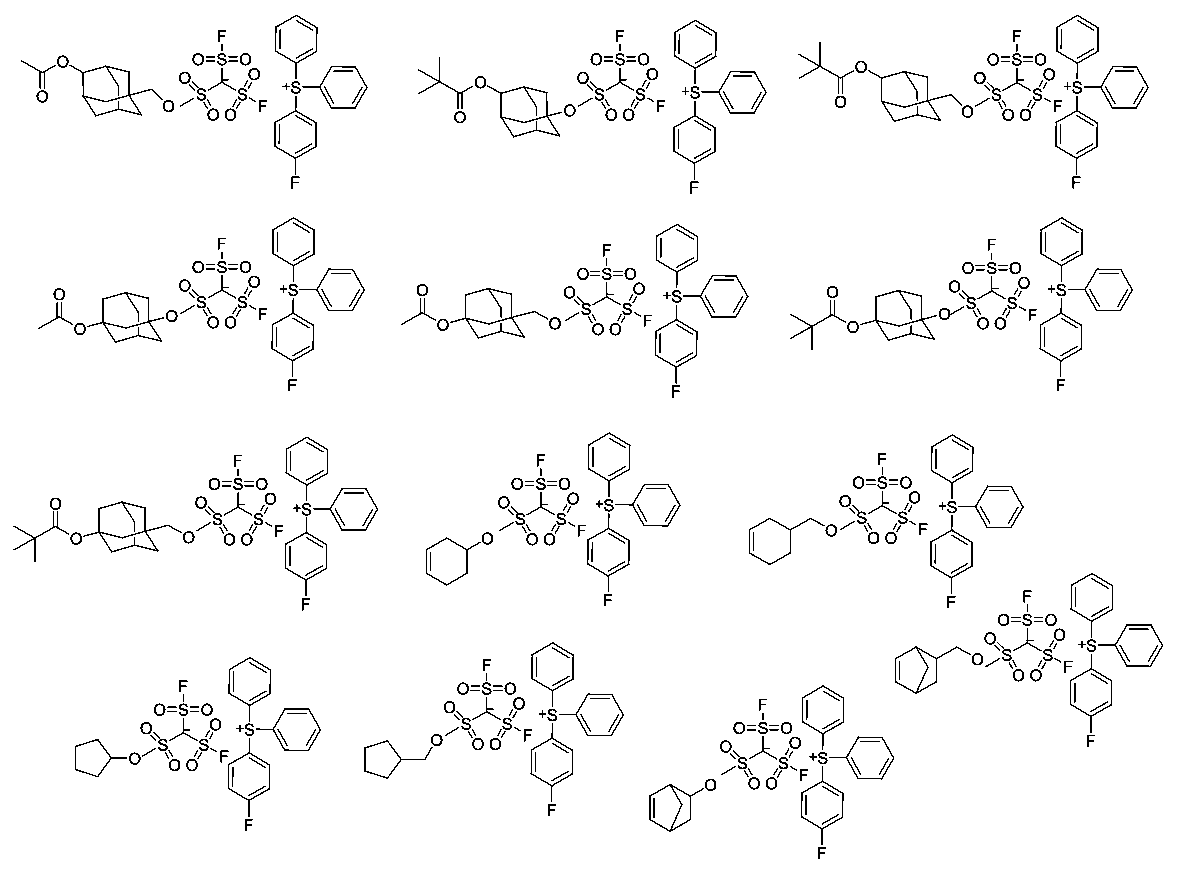
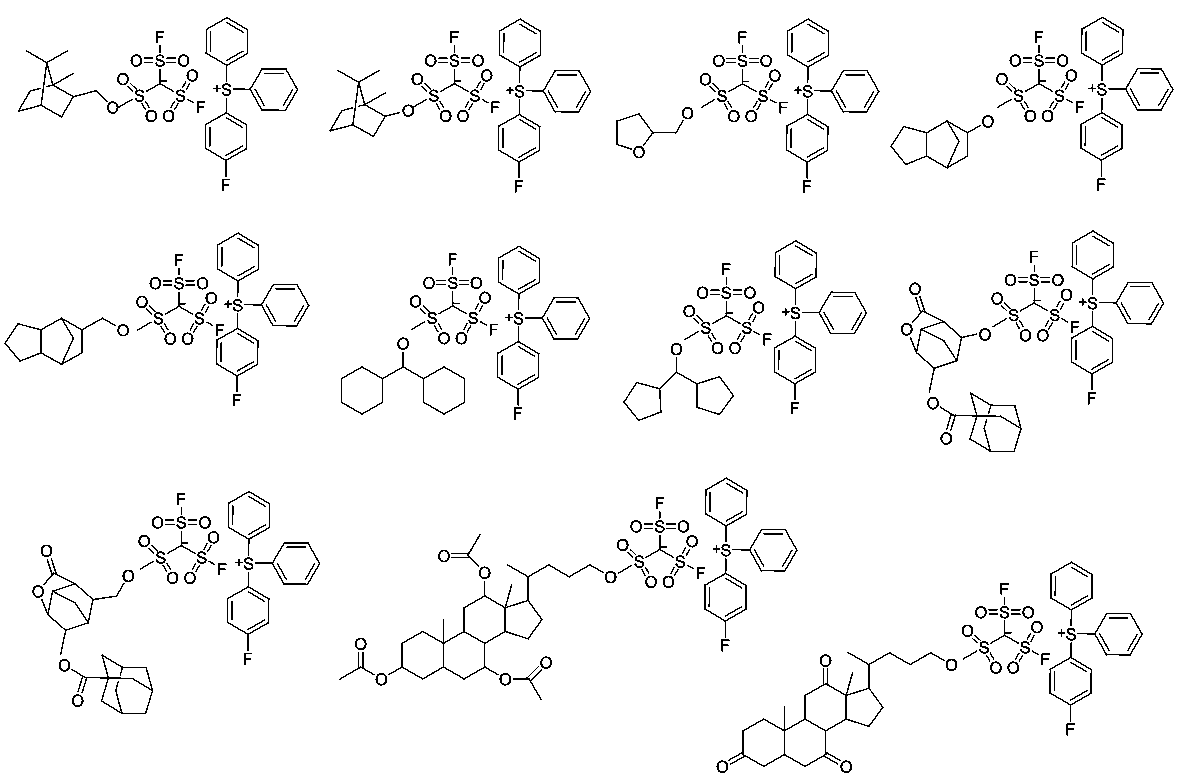
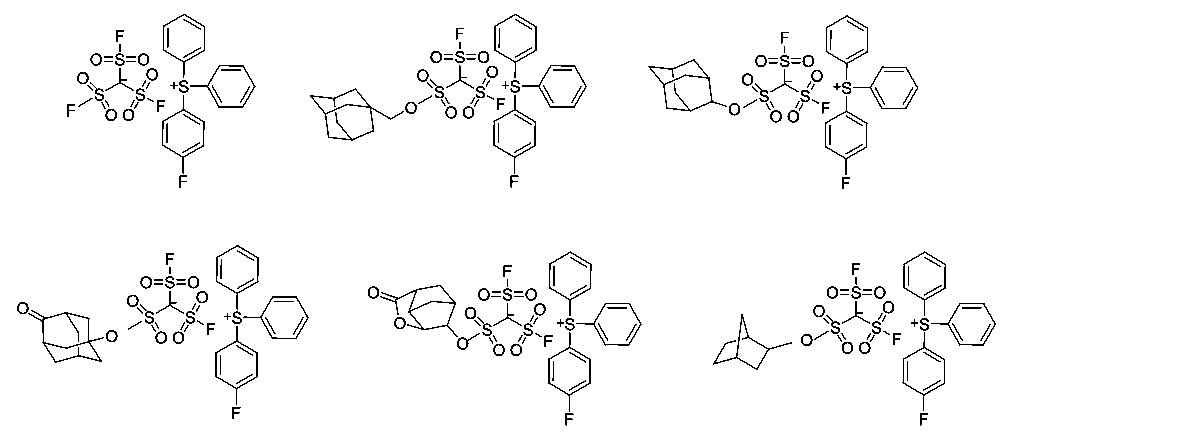


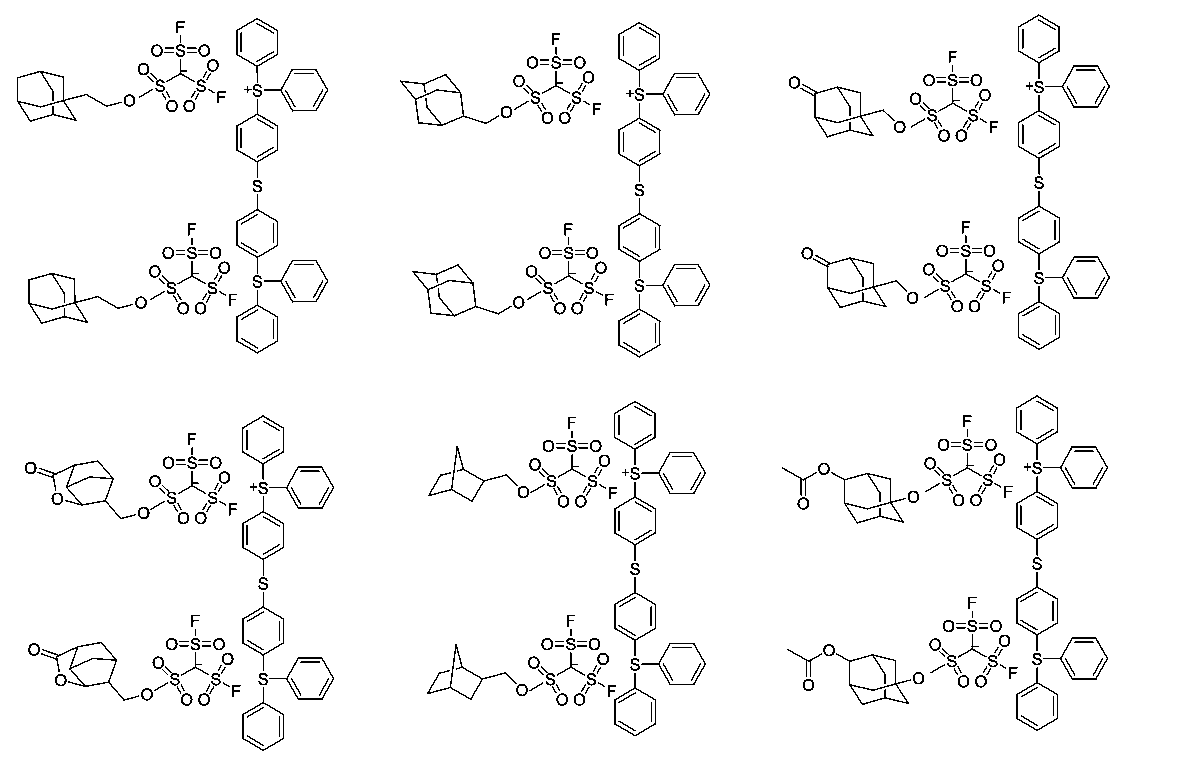


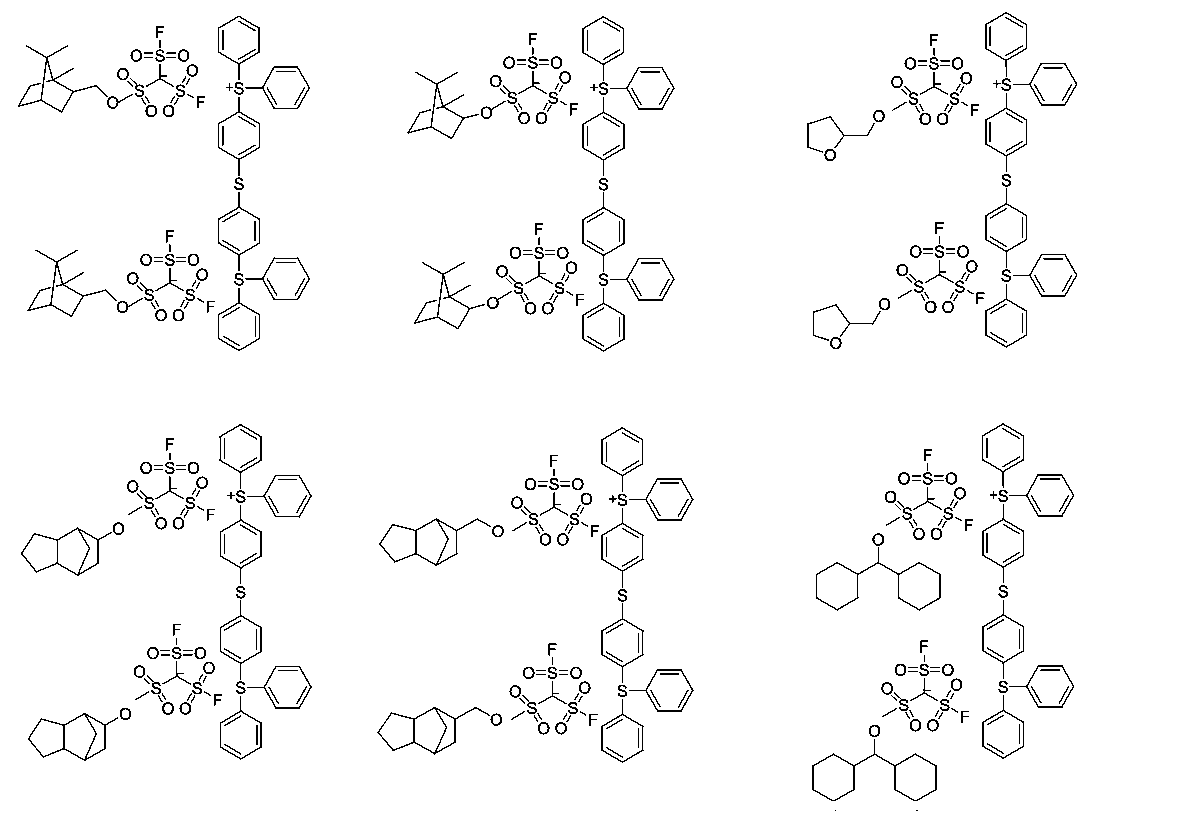

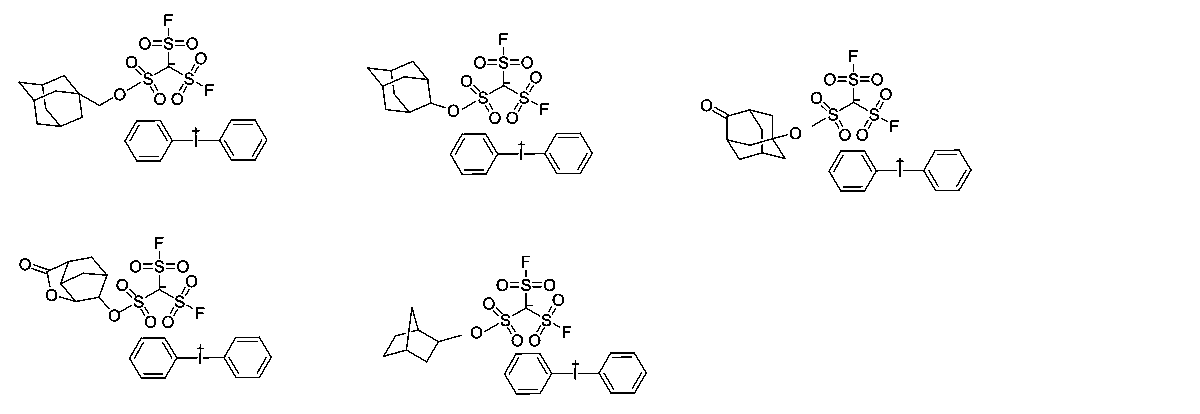
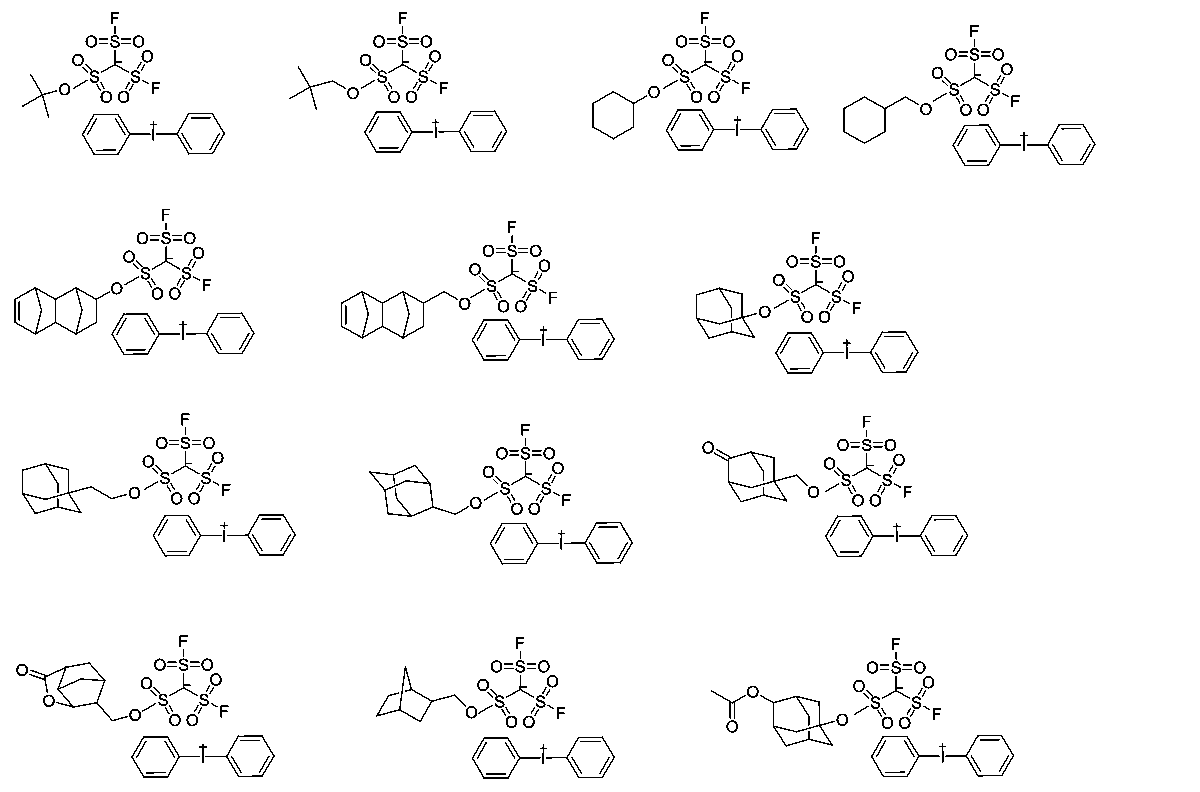

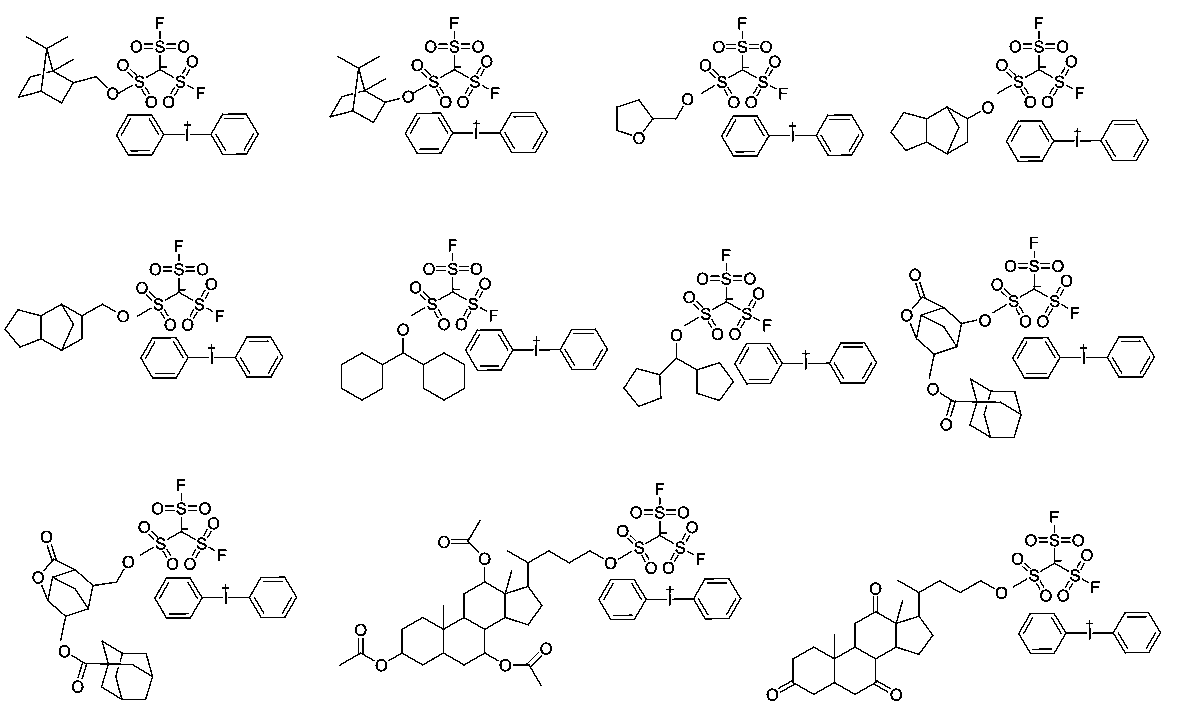

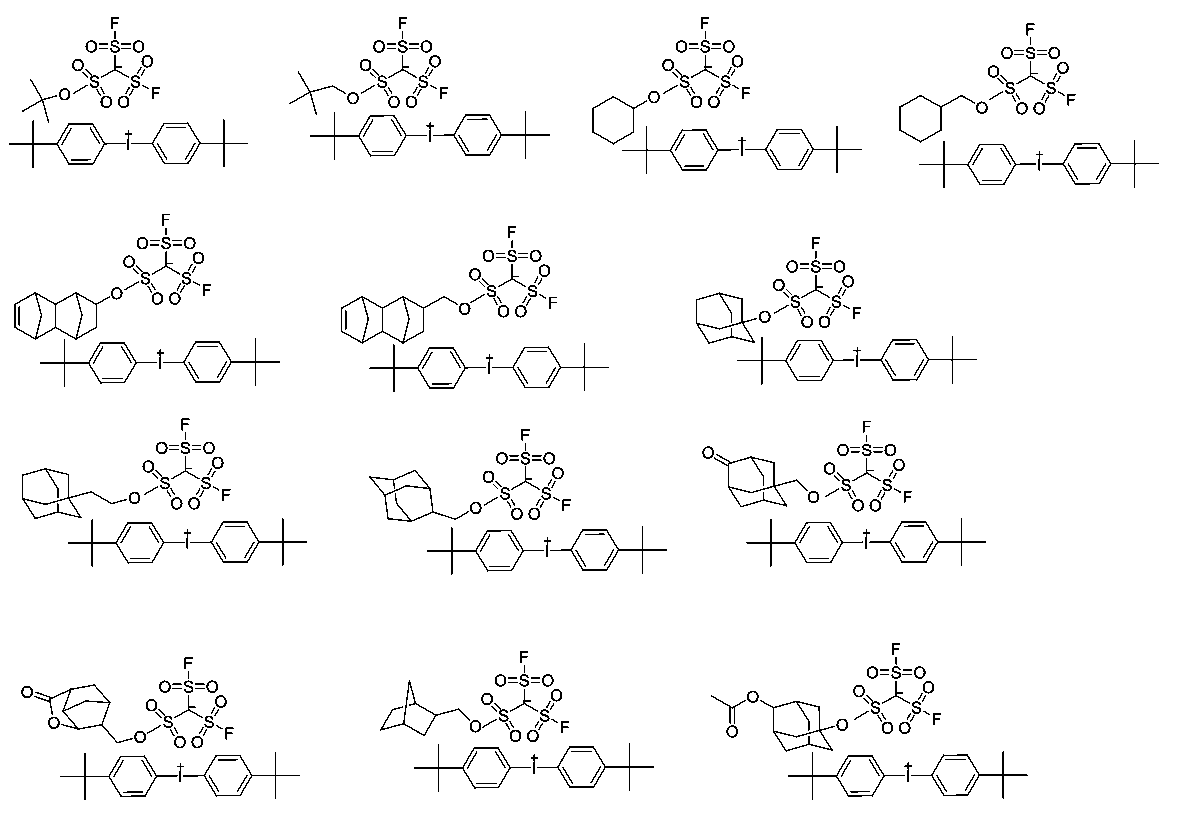


感放射線性樹脂組成物は、一般式(AG1)で表される酸発生剤を1のみ含んでもよいし、2以上含んでもよい。
一般式(AG1)で表される酸発生剤の使用量は、感度やその他の性能を勘案して適宜調整すればよい。感放射線性樹脂組成物中の不揮発成分中の一般式(AG1)で表される酸発生剤の濃度は、典型的には1~50質量%、好ましくは2~40質量%である。
一般式(AG1)で表される酸発生剤の使用量は、感度やその他の性能を勘案して適宜調整すればよい。感放射線性樹脂組成物中の不揮発成分中の一般式(AG1)で表される酸発生剤の濃度は、典型的には1~50質量%、好ましくは2~40質量%である。
以下、感放射線性樹脂組成物の具体的態様として、第1実施形態と第2実施形態を説明する。
<感放射線性樹脂組成物(第1実施形態)>
第1実施形態の感放射線性樹脂組成物は、前掲の一般式(AG1)で表される酸発生剤と、酸の作用により分解して現像液に対する溶解性が変化する樹脂と、を含む。
一般式(AG1)で表される酸発生剤については既に詳述されたため、改めての説明はしない。
第1実施形態の感放射線性樹脂組成物は、前掲の一般式(AG1)で表される酸発生剤と、酸の作用により分解して現像液に対する溶解性が変化する樹脂と、を含む。
一般式(AG1)で表される酸発生剤については既に詳述されたため、改めての説明はしない。
(酸分解性樹脂)
第1実施形態の感放射線性樹脂組成物は、酸の作用により分解して現像液に対する溶解性が変化する樹脂を含有する。本明細書では、「酸の作用により分解して現像液に対する溶解性が変化する樹脂」を「酸分解性樹脂」と表記することがある。
第1実施形態の感放射線性樹脂組成物は、酸の作用により分解して現像液に対する溶解性が変化する樹脂を含有する。本明細書では、「酸の作用により分解して現像液に対する溶解性が変化する樹脂」を「酸分解性樹脂」と表記することがある。
酸分解性樹脂は、典型的には、樹脂の主鎖または側鎖、あるいは、主鎖および側鎖の両方に、酸の作用により分解して、アルカリ可溶性基等の極性基を生じる基(以下、「酸分解性基」ともいう)を有する。通常、酸分解性樹脂は、酸の作用により分解する前には、現像液に不溶又は難溶である。
酸分解性基は、アルカリ可溶性基などの極性基を、酸の作用により分解し脱離する基で保護した構造を有することが好ましい。極性基としては、フェノール性ヒドロキシ基、アルコール性ヒドロキシ基、カルボキシル基、フッ素化アルコール基、スルホン酸基、スルホンアミド基、スルホニルイミド基、(アルキルスルホニル)(アルキルカルボニル)メチレン基、(アルキルスルホニル)(アルキルカルボニル)イミド基、ビス(アルキルカルボニル)メチレン基、ビス(アルキルカルボニル)イミド基、ビス(アルキルスルホニル)メチレン基、ビス(アルキルスルホニル)イミド基、トリス(アルキルカルボニル)メチレン基、トリス(アルキルスルホニル)メチレン基等が挙げられる。好ましい極性基としては、フェノール性水酸基、カルボキシル基、フッ素化アルコール基が挙げられる。
酸分解性基は、アルカリ可溶性基などの極性基を、酸の作用により分解し脱離する基で保護した構造を有することが好ましい。極性基としては、フェノール性ヒドロキシ基、アルコール性ヒドロキシ基、カルボキシル基、フッ素化アルコール基、スルホン酸基、スルホンアミド基、スルホニルイミド基、(アルキルスルホニル)(アルキルカルボニル)メチレン基、(アルキルスルホニル)(アルキルカルボニル)イミド基、ビス(アルキルカルボニル)メチレン基、ビス(アルキルカルボニル)イミド基、ビス(アルキルスルホニル)メチレン基、ビス(アルキルスルホニル)イミド基、トリス(アルキルカルボニル)メチレン基、トリス(アルキルスルホニル)メチレン基等が挙げられる。好ましい極性基としては、フェノール性水酸基、カルボキシル基、フッ素化アルコール基が挙げられる。
酸分解性基として好ましい基は、これらの極性基(アルカリ可溶性基等)の水素原子を酸で脱離する基で置換した基である。
酸で脱離する基としては、例えば、-C(R36)(R37)(R38)、-C(R36)(R37)(OR39)、-C(R01)(R02)(OR39)等を挙げることができる。これらの一般式中、R36~R39は、各々独立に、アルキル基、単環または多環の脂環式基、アリール基、アラルキル基又はアルケニル基を表す。R36とR37とは、互いに結合して環を形成してもよい。R01~R02は、各々独立に、水素原子、アルキル基、シクロアルキル基、アリール基、アラルキル基又はアルケニル基を表す。
酸で脱離する基としては、例えば、-C(R36)(R37)(R38)、-C(R36)(R37)(OR39)、-C(R01)(R02)(OR39)等を挙げることができる。これらの一般式中、R36~R39は、各々独立に、アルキル基、単環または多環の脂環式基、アリール基、アラルキル基又はアルケニル基を表す。R36とR37とは、互いに結合して環を形成してもよい。R01~R02は、各々独立に、水素原子、アルキル基、シクロアルキル基、アリール基、アラルキル基又はアルケニル基を表す。
後掲のパターン形成方法において、ArFエキシマレーザーから発せられる光(波長193nm)によりパターニングを行う場合、酸分解性樹脂は、ベンゼン環などの芳香族構造を実質的に含まない樹脂であることが好ましい。芳香族構造は波長193nmの光を吸収してしまうためである。ここで「芳香族構図を実質的に含まない」とは、例えば、芳香族構造を有する構造単位が、樹脂の全構造単位中5mol%以下であることをいう。
ArFエキシマレーザーから発せられる光(波長193nm)によりパターニングを行う場合、酸分解性樹脂は、(メタ)アクリル系樹脂を含むことが好ましい。なお、エッチング耐性の点で、(メタ)アクリル系樹脂は脂環式骨格を含むことが好ましい。
酸分解性樹脂としての(メタ)アクリル系樹脂は、好ましくは、(i)酸分解性基を有する構造単位、(ii)ラクトン構造を有する構造単位、(iii)ヒドロキシ基を有する構造単位などを有する。
(i)酸分解性基を有する構造単位としては、例えば以下一般式(U1)で表される構造単位を挙げることができる。
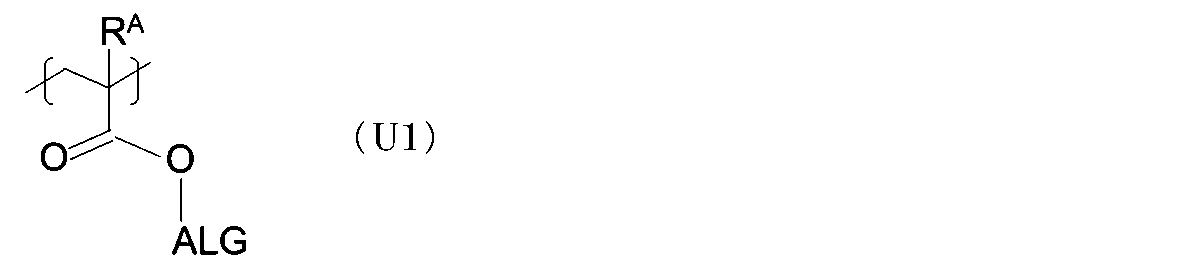
一般式(U1)中、
RAは、水素原子またはメチル基であり、
ALGは、酸で脱離する基である。
RAは、水素原子またはメチル基であり、
ALGは、酸で脱離する基である。
ALGの酸で脱離する基として好ましくは、前述の-C(R36)(R37)(R38)で表される基を挙げることができる。
(メタ)アクリル系樹脂中の酸分解性基を有する構造単位の比率は、例えば10~90mol%、好ましくは20~80mol%である。(メタ)アクリル系樹脂は、2以上の酸分解性基を有する構造単位を有していてもよい。
(ii)ラクトン構造を有する構造単位としては、例えば以下一般式(U2)で表される構造単位を挙げることができる。
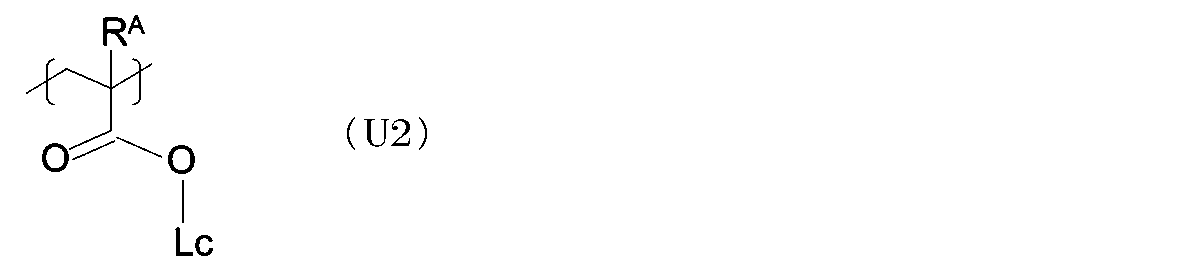
一般式(U2)中、
RAは、水素原子またはメチル基であり、
Lcは、ラクトン骨格を含む基である。
RAは、水素原子またはメチル基であり、
Lcは、ラクトン骨格を含む基である。
ラクトン骨格としては、γ-ブチロラクトン骨格、ノルボルナンラクトン骨格(ノルボルナン2,6-ラクトン骨格)などを挙げることができる。
(メタ)アクリル系樹脂中のラクトン構造を有する構造単位の比率は、例えば10~90mol%、好ましくは20~80mol%である。(メタ)アクリル系樹脂は、2以上のラクトン構造を有する構造単位を有していてもよい。
(iii)ヒドロキシ基を有する構造単位としては、例えば以下一般式(U3)で表される構造単位を挙げることができる。
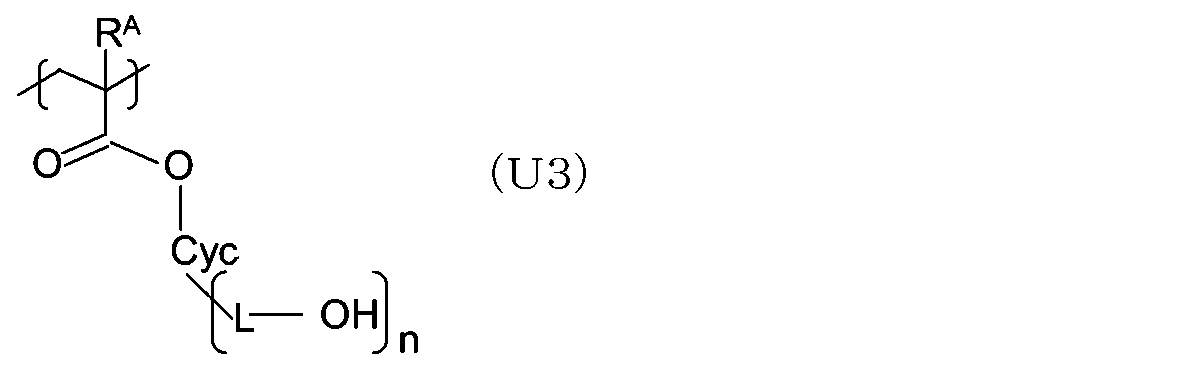
一般式(U3)中、
RAは、水素原子またはメチル基であり、
Cycは、脂環式炭化水素からn+1個の水素原子を除いた基であり、
Lは単結合または2価の連結基であり、
nは1または2である。
RAは、水素原子またはメチル基であり、
Cycは、脂環式炭化水素からn+1個の水素原子を除いた基であり、
Lは単結合または2価の連結基であり、
nは1または2である。
Cycの骨格を構成する脂環式炭化水素としては、アダマンタン、ノルボルナンなどを好ましく挙げることができる。
Lが2価の連結基である場合、Lとしては、直鎖または分岐のアルキレン基などを挙げることができる。
Lはフッ素置換されていてもよい。具体的には、Lは-C(CF3)2-であることができる。Lが-C(CF3)2-である場合、-OHの水素原子は解離しやすくなる。つまりこの場合は-OHはアルカリ可溶性基として機能しうる。
nが2である場合、2つのLは同じであっても異なっていてもよい。
Lが2価の連結基である場合、Lとしては、直鎖または分岐のアルキレン基などを挙げることができる。
Lはフッ素置換されていてもよい。具体的には、Lは-C(CF3)2-であることができる。Lが-C(CF3)2-である場合、-OHの水素原子は解離しやすくなる。つまりこの場合は-OHはアルカリ可溶性基として機能しうる。
nが2である場合、2つのLは同じであっても異なっていてもよい。
(メタ)アクリル系樹脂中のヒドロキシ基を有する構造単位の比率は、例えば10~90mol%、好ましくは20~80mol%である。(メタ)アクリル系樹脂は、2以上のヒドロキシ基を有する構造単位を有していてもよい。
酸分解性樹脂としての(メタ)アクリル系樹脂は、上記(i)~(iii)以外のその他の構造単位を有していてもよいし、有していなくてもよい。
(メタ)アクリル系樹脂とは別に、ポリヒドロキシスチレン系樹脂を酸分解性樹脂として用いることもできる。ポリヒドロキシスチレン系樹脂は、KrFエキシマレーザーから発せられる光(波長248nm)によりパターニングを行う場合、や、EUV光または電子線によりパターニングを行う場合に好ましく用いられる。
ポリヒドロキシスチレン系樹脂として具体的には、(i)ヒドロキシスチレン構造単位と、酸分解性基で保護されたヒドロキシスチレン構造単位と、を有する樹脂、(ii)ヒドロキシスチレン構造単位と、前掲の一般式(U1)で表される構造単位と、を有する樹脂などを挙げることができる。
ポリヒドロキシスチレン系樹脂として具体的には、(i)ヒドロキシスチレン構造単位と、酸分解性基で保護されたヒドロキシスチレン構造単位と、を有する樹脂、(ii)ヒドロキシスチレン構造単位と、前掲の一般式(U1)で表される構造単位と、を有する樹脂などを挙げることができる。
カリックスアレーン系樹脂を酸分解性樹脂として用いることもできる。カリックスアレーン系樹脂もKrFエキシマレーザーから発せられる光(波長248nm)によりパターニングを行う場合、や、EUV光または電子線によりパターニングを行う場合に好ましく用いられる。カリックスアレーン系樹脂として具体的には、(i)フェノール系ヒドロキシ基構造単位と、酸分解性基で保護されたフェノール系ヒドロキシ基構造単位と、を有する樹脂などを挙げることができる。
酸分解性樹脂の重量平均分子量は、例えば1000~100000、好ましくは2000~50000である。酸分解性樹脂の分散度(重量平均分子量/数平均分子量)は、例えば1.0~2.5、好ましくは1.0~2.0である。
酸分解性樹脂の重量平均分子量および分散度は、例えば、ポリスチレンを標準物質としたゲルパーミエーションクロマトグラフィーにより求めることができる。
酸分解性樹脂の重量平均分子量および分散度は、例えば、ポリスチレンを標準物質としたゲルパーミエーションクロマトグラフィーにより求めることができる。
第1実施形態の感放射線性樹脂組成物は、酸分解性樹脂を1のみ含んでもよいし、2以上含んでもよい。
酸分解性樹脂の量は、感放射線性樹脂組成物の不揮発成分中、例えば30~99質量%、好ましくは50~95質量%である。
酸分解性樹脂の量は、感放射線性樹脂組成物の不揮発成分中、例えば30~99質量%、好ましくは50~95質量%である。
(クエンチャー)
第1実施形態の感放射線性樹脂組成物は、好ましくは、クエンチャー、すなわち、酸発生剤から発生した酸を失活させる機能を有する成分を含んでもよい。クエンチャーを用いることで、樹脂膜中での酸の過度な移動が抑えられるため、高解像度化やラインエッジラフネスの低減などにつながる。
第1実施形態の感放射線性樹脂組成物は、好ましくは、クエンチャー、すなわち、酸発生剤から発生した酸を失活させる機能を有する成分を含んでもよい。クエンチャーを用いることで、樹脂膜中での酸の過度な移動が抑えられるため、高解像度化やラインエッジラフネスの低減などにつながる。
クエンチャーは、例えば塩基性化合物であり、具体的には含窒素塩基性化合物であることができる。
クエンチャーとして具体的には、グアニジン、アミノピロリジン、ピラゾール、ピラゾリン、ピペラジン、アミノモルホリン、アミノアルキルモルフォリン、ピペリジン等を挙げることができる。また、イミダゾール構造を有する化合物、ジアザビシクロ構造を有する化合物、オニウムヒドロキシド構造を有する化合物、オニウムカルボキシレート構造を有する化合物、トリアルキルアミン、アルキルアミン誘導体、アニリン誘導体等を挙げることができる。さらに、フォトレジストの分野においていわゆる「光分解性塩基」「光崩壊性塩基」として知られている化合物を、クエンチャーとして用いることも可能である。
クエンチャーとして具体的には、グアニジン、アミノピロリジン、ピラゾール、ピラゾリン、ピペラジン、アミノモルホリン、アミノアルキルモルフォリン、ピペリジン等を挙げることができる。また、イミダゾール構造を有する化合物、ジアザビシクロ構造を有する化合物、オニウムヒドロキシド構造を有する化合物、オニウムカルボキシレート構造を有する化合物、トリアルキルアミン、アルキルアミン誘導体、アニリン誘導体等を挙げることができる。さらに、フォトレジストの分野においていわゆる「光分解性塩基」「光崩壊性塩基」として知られている化合物を、クエンチャーとして用いることも可能である。
クエンチャーを用いる場合は、1のみのクエンチャーを用いてもよいし、2以上のクエンチャーを用いてもよい。
クエンチャーを用いる場合、その量は、感放射線性樹脂組成物の不揮発成分中、例えば0.1~10質量%、好ましくは0.5~5質量%である。
クエンチャーを用いる場合、その量は、感放射線性樹脂組成物の不揮発成分中、例えば0.1~10質量%、好ましくは0.5~5質量%である。
(溶剤)
第1実施形態の感放射線性樹脂組成物は、通常、溶剤を含む。換言すると、第1実施形態の感放射線性樹脂組成物は、通常、上記の各成分が溶剤に溶解または分散したものである。
第1実施形態の感放射線性樹脂組成物は、通常、溶剤を含む。換言すると、第1実施形態の感放射線性樹脂組成物は、通常、上記の各成分が溶剤に溶解または分散したものである。
酸発生剤や酸分解性樹脂の溶解性や安定性の観点から、溶剤は、典型的には有機溶剤を含む。同様の観点から、溶剤は水を含まないことが好ましい。ただし、空気中の水分に由来して非意図的に混入する微量の水は許容される場合がある。
有機溶剤として具体的には、ケトン類、アルコール類、多価アルコール類およびその誘導体、エーテル類、エステル類、芳香族系溶剤、フッ素系溶剤などを挙げることができる。
ケトン類としては、アセトン、メチルエチルケトン、シクロペンタノン、シクロヘキサノン、メチルイソアミルケトン、メチルイソブチルケトン、メチルイソペンチルケトン、2-ヘプタノンなどを挙げることができる。
アルコール類としては、イソプロパノール、ブタノール、イソブタノール、n-ペンタノール、イソペンタノール、tert-ペンタノール、4-メチル-2-ペンタノール、3-メチル-3-ペンタノール、2,3-ジメチル-2-ペンタノール、n-ヘキシサノール、n-ヘプタノール、2-ヘプタノール、n-オクタノール、n-デカノール、s-アミルアルコール、t-アミルアルコール、イソアミルアルコール、2-エチル-1-ブタノール、ラウリルアルコール、ヘキシルデカノール、オレイルアルコールなどを挙げることができる。
多価アルコール類及びその誘導体としては、エチレングリコール、エチレングリコールモノアセテート、エチレングルコールジメチルエーテル、ジエチレングリコール、ジエチレングリコールジメチルエーテル、ジエチレングリコールモノアセテート、プロピレングリコール、プロピレングリコールモノアセテート、プロピレングリコールモノメチルエーテル(PGME)、プロピレングリコールモノエチルエーテル、プロピレングリコールモノプロピルエーテル、プロピレングリコールモノブチルエーテル、プロピレングリコールモノメチルエーテルアセテート(PGMEA)、ジプロピレングリコールまたはジプロピレングリコールモノアセテートのモノメチルエーテル、モノエチルエーテル、モノプロピルエーテル、モノブチルエーテル、モノフェニルエーテルなどを挙げることができる。
エーテル類としては、ジエチルエーテル、ジイソプロピルエーテル、テトラヒドロフラン、ジオキサン、アニソールなどを挙げることができる。
エステル類としては乳酸メチル、乳酸エチル(EL)、酢酸メチル、酢酸エチル、酢酸ブチル、ピルビン酸メチル、ピルビン酸エチル、メトキシプロピオン酸メチル、エトキシプロピオン酸エチル、γ-ブチロラクトンなどを挙げることができる。
芳香族系溶剤としては、キシレン、トルエンなどを挙げることができる。
フッ素系溶剤としては、フロン、代替フロン、パーフルオロ化合物、ヘキサフルオロイソプロピルアルコールなどを挙げることができる。
溶剤を用いる場合、1のみの溶剤を用いてもよいし、2以上の溶剤を用いてもよい。
溶剤の使用量は、所望の厚みの膜を設ける観点などから、不揮発成分濃度が、例えば1~60質量%、好ましくは5~50質量%となる量で用いることができる。
溶剤の使用量は、所望の厚みの膜を設ける観点などから、不揮発成分濃度が、例えば1~60質量%、好ましくは5~50質量%となる量で用いることができる。
(その他任意成分)
第1実施形態の感放射線性樹脂組成物は、上記以外の任意成分を含んでもよいし、含まなくてもよい。
任意成分としては、一般式(AG1)で表される酸発生剤以外の酸発生剤、界面活性剤(フッ素系が好ましい)、酸化防止剤、染料、可塑剤、光増感剤、光吸収剤、現像液に対する溶解性を促進させる化合物(例えば低分子のフェノール化合物やカルボン酸)などを挙げることができる。
また、第1実施形態の感放射線性樹脂組成物を液浸露光に適用する場合には、撥水性ポリマーを用いてもよい。好ましい撥水性ポリマーとしてはフッ素含有ポリマーやケイ素含有ポリマーが知られている。
第1実施形態の感放射線性樹脂組成物は、上記以外の任意成分を含んでもよいし、含まなくてもよい。
任意成分としては、一般式(AG1)で表される酸発生剤以外の酸発生剤、界面活性剤(フッ素系が好ましい)、酸化防止剤、染料、可塑剤、光増感剤、光吸収剤、現像液に対する溶解性を促進させる化合物(例えば低分子のフェノール化合物やカルボン酸)などを挙げることができる。
また、第1実施形態の感放射線性樹脂組成物を液浸露光に適用する場合には、撥水性ポリマーを用いてもよい。好ましい撥水性ポリマーとしてはフッ素含有ポリマーやケイ素含有ポリマーが知られている。
<感放射線性樹脂組成物(第2実施形態)>
第2実施形態の感放射線性樹脂組成物は、一般式(AG1)で表される酸発生剤と、酸の作用により高分子量化して現像液に対する溶解性が変化する成分と、を含む。
第2実施形態の感放射線性樹脂組成物において、一般式(AG1)で表される酸発生剤の具体的態様や好ましい使用量などは、<感放射線性樹脂組成物>の項に記載の通りである。
第2実施形態の感放射線性樹脂組成物は、一般式(AG1)で表される酸発生剤と、酸の作用により高分子量化して現像液に対する溶解性が変化する成分と、を含む。
第2実施形態の感放射線性樹脂組成物において、一般式(AG1)で表される酸発生剤の具体的態様や好ましい使用量などは、<感放射線性樹脂組成物>の項に記載の通りである。
酸の作用により高分子量化して現像液に対する溶解性が変化する成分としては、通常、アルカリ可溶性樹脂と架橋剤との組み合わせが考えられる。アルカリ可溶性樹脂とは、後述する現像液としてのアルカリ水溶液に可溶であり、難溶でも不溶でもない樹脂のことである。
アルカリ可溶性樹脂としては、例えばノボラック樹脂、水素化ノボラック樹脂、アセトン-ピロガロール樹脂、o-ポリヒドロキシスチレン、m-ポリヒドロキシスチレン、p-ポリヒドロキシスチレン、水素化ポリヒドロキシスチレン、ハロゲンもしくはアルキル置換ポリヒドロキシスチレン、ヒドロキシスチレン-N-置換マレイミド共重合体、o/p-及びm/p-ヒドロキシスチレン共重合体、ポリヒドロキシスチレンの水酸基に対する一部O-アルキル化物(例えば、5~30モル%のO-メチル化物、O-(1-メトキシ)エチル化物、O-(1-エトキシ)エチル化物、O-2-テトラヒドロピラニル化物、O-(t-ブトキシカルボニル)メチル化物等)もしくはO-アシル化物(例えば、5~30モル%のo-アセチル化物、O-(t-ブトキシ)カルボニル化物等)、スチレン-無水マレイン酸共重合体、スチレン-ヒドロキシスチレン共重合体、α-メチルスチレン-ヒドロキシスチレン共重合体、カルボキシル基含有メタクリル系樹脂及びその誘導体、ポリビニルアルコール誘導体を挙げることができる。
特に好ましいアルカリ可溶性樹脂は、ノボラック樹脂、o-ポリヒドロキシスチレン、m-ポリヒドロキシスチレン、p-ポリヒドロキシスチレン、アルキル置換ポリヒドロキシスチレン、ポリヒドロキシスチレンの一部O-アルキル化、もしくはO-アシル化物、スチレン-ヒドロキシスチレン共重合体、α-メチルスチレン-ヒドロキシスチレン共重合体である。
アルカリ可溶性樹脂を用いる場合、1のみのアルカリ可溶性樹脂を用いてもよいし、2以上のアルカリ可溶性樹脂を用いてもよい。
架橋剤は、酸の作用によりアルカリ可溶性樹脂を架橋する化合物である限り特に限定されない。具体的には以下の(1)~(3)を好ましく挙げることができる。これらに該当する具体的化合物は、例えば特開2004-117688号公報の段落0208~0209に記載されている。
(1)フェノール誘導体のヒドロキシメチル体、アルコキシメチル体、アシルオキシメチル体
(2)N-ヒドロキシメチル基、N-アルコキシメチル基、N-アシルオキシメチル基を有する化合物
(3)エポキシ基を有する化合物
(1)フェノール誘導体のヒドロキシメチル体、アルコキシメチル体、アシルオキシメチル体
(2)N-ヒドロキシメチル基、N-アルコキシメチル基、N-アシルオキシメチル基を有する化合物
(3)エポキシ基を有する化合物
ちなみに、架橋剤がアルコキシメチル基を有する場合、アルコキシメチル基の炭素数は6個以下が好ましい。また、架橋剤がアシルオキシメチル基を有する場合、アシルオキシメチル基の炭素数は6個以下が好ましい。
架橋剤を用いる場合、1のみの架橋剤を用いてもよいし、2以上の架橋剤を用いてもよい。
諸性能のバランスを考慮し、アルカリ可溶性樹脂と架橋剤の比率は適宜調整すればよい。アルカリ可溶性樹脂100質量部に対して、架橋剤の量は、例えば5~50質量部、具体的には10~40質量部であることができる。
第2実施形態の感放射線性樹脂組成物の不揮発成分中の、酸の作用により高分子量化して現像液に対する溶解性が変化する成分(典型的にはアルカリ可溶性樹脂および架橋剤)の比率は、例えば50~95質量%、好ましくは60~90質量%である。
第2実施形態の感放射線性樹脂組成物は、一般式(AG1)で表される酸発生剤と、酸の作用により高分子量化して現像液に対する溶解性が変化する成分のほか、種々の添加成分や溶剤を含むことができる。添加成分としては、<感放射線性樹脂組成物(第1実施形態)>の項で説明した、クエンチャーやその他任意成分などを挙げることができる。添加成分や溶剤の具体的態様や使用量については<感放射線性樹脂組成物(第1実施形態)>の項で説明したとおりである。
<パターン形成方法および電子デバイスの製造方法>
(以下では、特に断らない限り、第1実施形態の感放射線性樹脂組成物と、第2実施形態の感放射線性樹脂組成物を、まとめて「感放射線性樹脂組成物」と記載する。)
(以下では、特に断らない限り、第1実施形態の感放射線性樹脂組成物と、第2実施形態の感放射線性樹脂組成物を、まとめて「感放射線性樹脂組成物」と記載する。)
感放射線性樹脂組成物を用いて、パターンを形成することができる。具体的には、
・感放射線性樹脂組成物を用いて膜を形成することと、
・その膜に放射線を照射することと、
・放射線が照射されたその膜を現像すること、
により、パターンを形成することができる。
・感放射線性樹脂組成物を用いて膜を形成することと、
・その膜に放射線を照射することと、
・放射線が照射されたその膜を現像すること、
により、パターンを形成することができる。
また、形成されたパターンを、ドライエッチングやイオンインプランテーション、あるいは金属スパッターや金属メッキの際のマスクとして用いるなどして、電子デバイスを製造することができる。
上記の膜形成、放射線の照射および現像について以下に簡単に説明する。また、これら以外の任意または付随的な事項についても説明する。
(膜形成)
膜を形成する基板は特に限定されない。例えばガラス基板、シリコンウエハ、セラミック基板、アルミ基板、SiCウエハー、GaNウエハー、銅基板、銅メッキ基板などを挙げることができる。基板は、未加工の基板であってもよいし、電極や素子が表面に形成された基板であってもよい。照射された光が基板で反射して解像性を悪化させることを抑える観点では、基板の表面には反射防止膜が設けられていることが好ましい。
膜を形成する基板は特に限定されない。例えばガラス基板、シリコンウエハ、セラミック基板、アルミ基板、SiCウエハー、GaNウエハー、銅基板、銅メッキ基板などを挙げることができる。基板は、未加工の基板であってもよいし、電極や素子が表面に形成された基板であってもよい。照射された光が基板で反射して解像性を悪化させることを抑える観点では、基板の表面には反射防止膜が設けられていることが好ましい。
膜の形成方法は特に限定されない。電子デバイスの製造分野では、スピナーを用いた回転塗布が一般的だが、他の方法でもよい。例えば、スプレーコーターを用いた噴霧塗布、浸漬、印刷、ロールコーティング、インクジェット法などでもよい。
基板上に塗布された感放射線性樹脂組成物の乾燥は、典型的には加熱処理により行われる。加熱温度は、通常80~250℃、好ましくは90~220℃である。また、加熱の時間は、加熱装置により異なるが、ホットプレートを使用した場合、通常30~300秒、好ましくは40~180秒程度、熱風式オーブンを使用した場合、通常5~60分、好ましくは10~30分程度である。
膜の厚みは、特に限定されず、適用するアプリケーションや最終的に得ようとするパターン等に応じて適宜調整すればよい。膜の厚みは、例えば5~500nm、好ましくは10~400nm、より好ましくは15~300nmである。
膜の厚みは、感放射線性樹脂組成物の不揮発成分濃度の調整や、塗布方法・塗布条件の変更などにより調整可能である。
膜の厚みは、感放射線性樹脂組成物の不揮発成分濃度の調整や、塗布方法・塗布条件の変更などにより調整可能である。
(放射線の照射)
放射線の照射は、通常、適当なフォトマスクを介して放射線を膜に当てることで行われる。電子線のようにビーム径が小さい場合にはフォトマスクを用いない場合もある。
放射線の種類については、前述のとおりである。電子デバイス製造においては、KrFエキシマレーザーから発せられる波長248nmの光、ArFエキシマレーザーから発せられる波長193nmの光、波長13.5nmの極紫外光(EUV光)、電子線、などが通常用いられる。
特に、ArFエキシマレーザーから発せられる波長193nmの光を膜に照射する場合、高解像度化のため、液浸露光を適用することも可能である。この場合、撥水のためにトップコート膜を設けてもよい。
放射線の照射のための装置としては、コンタクトアライナー、ミラープロジェクション、ステッパー、スキャナーなどが挙げられる。
放射線の照射量は、膜中の光酸発生剤の量などにより適宜調整すればよいが、例えば1~500mJ/cm2程度である。
放射線の照射は、通常、適当なフォトマスクを介して放射線を膜に当てることで行われる。電子線のようにビーム径が小さい場合にはフォトマスクを用いない場合もある。
放射線の種類については、前述のとおりである。電子デバイス製造においては、KrFエキシマレーザーから発せられる波長248nmの光、ArFエキシマレーザーから発せられる波長193nmの光、波長13.5nmの極紫外光(EUV光)、電子線、などが通常用いられる。
特に、ArFエキシマレーザーから発せられる波長193nmの光を膜に照射する場合、高解像度化のため、液浸露光を適用することも可能である。この場合、撥水のためにトップコート膜を設けてもよい。
放射線の照射のための装置としては、コンタクトアライナー、ミラープロジェクション、ステッパー、スキャナーなどが挙げられる。
放射線の照射量は、膜中の光酸発生剤の量などにより適宜調整すればよいが、例えば1~500mJ/cm2程度である。
必要に応じ、露光後かつ現像工程前に、膜を加熱することも可能である(PEB:Post Exposure Bake)。その温度は、例えば70~150℃、好ましくは80~140℃である。また、時間は、例えばホットプレートを使用した場合、通常30~300秒、好ましくは40~180秒である。PEBをすることで、酸発生剤から発生した酸による樹脂の可溶化または不溶化反応を一層促進できるため、一層の高感度化などを期待することができる。
(現像)
放射線が照射された膜を、現像液で現像することで、パターンを得ることができる。現像は、例えば、浸漬法、パドル法、回転スプレー法などの方法で行うことができる。
放射線が照射された膜を、現像液で現像することで、パターンを得ることができる。現像は、例えば、浸漬法、パドル法、回転スプレー法などの方法で行うことができる。
現像液としては、通常、アルカリ水溶液が用いられる。アルカリ水溶液として具体的には、(i)水酸化ナトリウム、炭酸ナトリウム、ケイ酸ナトリウム、アンモニアなどの無機アルカリ水溶液、(ii)エチルアミン、ジエチルアミン、トリエチルアミン、トリエタノールアミンなどの有機アミン水溶液、(iii)テトラメチルアンモニウムヒドロキシド、テトラブチルアンモニウムヒドロキシドなどの4級アンモニウム塩の水溶液などが挙げられる。
現像液としては、特に、テトラメチルアンモニウムヒドロキシド水溶液が好ましい。テトラメチルアンモニウムヒドロキシドの濃度は、好ましくは0.1~10質量%であり、更に好ましくは0.5~5質量%である。
現像液としては、特に、テトラメチルアンモニウムヒドロキシド水溶液が好ましい。テトラメチルアンモニウムヒドロキシドの濃度は、好ましくは0.1~10質量%であり、更に好ましくは0.5~5質量%である。
第1実施形態の感放射線性樹脂組成物を用いて膜を形成し、放射線の照射の後、アルカリ水溶液を用いた現像処理をすることで、通常、ポジ型のパターンを得ることができる。
第2実施形態の感放射線性樹脂組成物を用いて膜を形成し、放射線の照射の後、アルカリ水溶液を用いた現像処理をすることで、通常、ネガ型のパターンを得ることができる。
第2実施形態の感放射線性樹脂組成物を用いて膜を形成し、放射線の照射の後、アルカリ水溶液を用いた現像処理をすることで、通常、ネガ型のパターンを得ることができる。
一方、現像液として、アルカリ水溶液ではなく有機溶剤系現像液(有機溶剤が90質量%以上を占める現像液)を用いることも可能である。
第1実施形態の感放射線性樹脂組成物を用いて膜を形成し、放射線の照射の後、有機溶剤系現像液を用いた現像処理をした場合、通常、ポジ型ではなくネガ型のパターンを得ることができる。アルカリ水溶液と有機溶剤系現像液とは、極性が逆であるためである。
第2実施形態の感放射線性樹脂組成物を用いて膜を形成し、放射線の照射の後、有機溶剤系現像液を用いた現像処理をした場合には、通常、アルカリ水溶液による現像と同様、ネガ型のパターンを得ることができる。現像液に対する不溶化のメカニズムが、高分子量化であるため、現像液がアルカリ水溶液であっても有機溶剤系現像液であっても通常はネガ型のパターンが形成される。
有機溶剤系現像液を用いた現像処理については、特開2008-292975号公報などに記載されている。有機溶剤系現像液としては、特に酢酸ブチル現像液が広く知られている。
第1実施形態の感放射線性樹脂組成物を用いて膜を形成し、放射線の照射の後、有機溶剤系現像液を用いた現像処理をした場合、通常、ポジ型ではなくネガ型のパターンを得ることができる。アルカリ水溶液と有機溶剤系現像液とは、極性が逆であるためである。
第2実施形態の感放射線性樹脂組成物を用いて膜を形成し、放射線の照射の後、有機溶剤系現像液を用いた現像処理をした場合には、通常、アルカリ水溶液による現像と同様、ネガ型のパターンを得ることができる。現像液に対する不溶化のメカニズムが、高分子量化であるため、現像液がアルカリ水溶液であっても有機溶剤系現像液であっても通常はネガ型のパターンが形成される。
有機溶剤系現像液を用いた現像処理については、特開2008-292975号公報などに記載されている。有機溶剤系現像液としては、特に酢酸ブチル現像液が広く知られている。
現像によりパターンを形成することができるが、現像の後、リンス液によりパターンおよび基板を洗浄することが好ましい。
現像液としてアルカリ水溶液を用いた場合、リンス液としては、超純水が好適である。
現像液として有機溶剤系現像液を用いた場合、リンス液としては、アルコール系溶剤などの有機溶剤が好適である。
現像液としてアルカリ水溶液を用いた場合、リンス液としては、超純水が好適である。
現像液として有機溶剤系現像液を用いた場合、リンス液としては、アルコール系溶剤などの有機溶剤が好適である。
得られたパターンは、例えば、電子デバイス製造において、ドライエッチング時のマスクや、イオンインプランテーションプロセスにおけるマスク、あるいは金属スパッターや金属メッキ用のマスクとして利用することができる。
<化合物、好ましくは酸発生剤>
ここまで、「組成物」およびそれを用いたパターン形成方法および電子デバイスの製造方法の観点で、本発明者らによる新規技術の実施形態を説明してきた。
念のため述べておくと、本発明者らによる新規技術は、組成物として捉えられるだけでなく、化合物、好ましくは酸発生剤としても捉えることができる。つまり、前掲の一般式(AG1)で表される化合物(好ましくは酸発生剤)それ自体、新規であり、有用であり得る。
前掲の一般式(AG1)で表される化合物が酸発生剤である場合には、この化合物に外部刺激を与える(例えば放射線を照射する)ことで、酸を発生させることができる。
一般式(AG1)で表される化合物、好ましくは酸発生剤についての説明は、<感放射線性樹脂組成物>の項で十分に行ったので、改めての説明は割愛する。
ここまで、「組成物」およびそれを用いたパターン形成方法および電子デバイスの製造方法の観点で、本発明者らによる新規技術の実施形態を説明してきた。
念のため述べておくと、本発明者らによる新規技術は、組成物として捉えられるだけでなく、化合物、好ましくは酸発生剤としても捉えることができる。つまり、前掲の一般式(AG1)で表される化合物(好ましくは酸発生剤)それ自体、新規であり、有用であり得る。
前掲の一般式(AG1)で表される化合物が酸発生剤である場合には、この化合物に外部刺激を与える(例えば放射線を照射する)ことで、酸を発生させることができる。
一般式(AG1)で表される化合物、好ましくは酸発生剤についての説明は、<感放射線性樹脂組成物>の項で十分に行ったので、改めての説明は割愛する。
<化合物、好ましくは酸発生剤またはその前駆体、の製造方法>
一般式(AG1)で表される化合物(好ましくは酸発生剤またはその前駆体)は、有機合成化学における公知の技術・手法に基づき製造(合成)可能である。製造(合成)の条件や原料物質の具体例については後掲の合成例を参照されたい。
ちなみに、一般式(AG1)で表される酸発生剤の「前駆体」としては、例えばカチオン部分が金属カチオンであるなどして、放射線に対する感応性が実質的に無い化合物が挙げられる。
一般式(AG1)で表される化合物(好ましくは酸発生剤またはその前駆体)は、有機合成化学における公知の技術・手法に基づき製造(合成)可能である。製造(合成)の条件や原料物質の具体例については後掲の合成例を参照されたい。
ちなみに、一般式(AG1)で表される酸発生剤の「前駆体」としては、例えばカチオン部分が金属カチオンであるなどして、放射線に対する感応性が実質的に無い化合物が挙げられる。
製造(合成)の手順について簡潔に触れておく。一般式(AG1)で表される化合物は、例えば以下のような手順で製造(合成)することができる。なお、放射線による意図せぬ分解を防ぐため、以下手順の少なくとも一部は照明が適切に制御された条件下で行われることが好ましい。
(i)発煙硫酸と無水酢酸とを反応させて、メタントリスルホン酸を合成する。
(ii-1)メタントリスルホン酸に、フッ素化剤(好ましくは求核型フッ素化剤)を反応させ、続けてフッ化カリウムなどの金属フッ化物を反応させる。このようにして以下一般式(M-FSM)で表される化合物(酸発生剤の前駆体)を得ることができる。
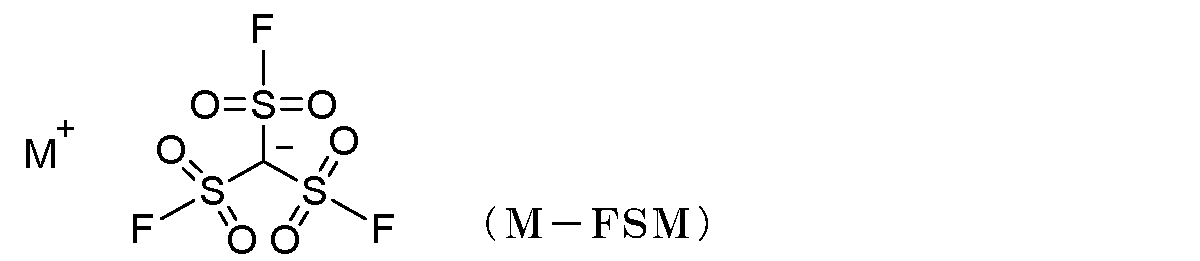
一般式(M-FSM)中、M+は、金属カチオンである。
金属カチオンは、K+、Na+などであることができるが、一般式(M-FSM)で表される化合物が電気的中性である限り特に限定されない。
金属カチオンは、K+、Na+などであることができるが、一般式(M-FSM)で表される化合物が電気的中性である限り特に限定されない。
フッ素化剤は特に限定されないが、好ましいフッ素化剤として、UBE株式会社の商品名FLUOLEAD(化合物名:4-tert-Butyl-2,6-dimethylphenylsulfur trifluoride)を挙げることができる。もちろん、一般式(M-FSM)で表される化合物が得られる限り、その他公知のフッ素化剤を利用してもよい。フッ素化剤の使用量は、好ましくは、当量で3.0~8.0とすることができる。
金属フッ化物としては、前掲のフッ化カリウムのほか、フッ化ナトリウムを挙げることができる。もちろん、一般式(M-FSM)で表される化合物が得られる限り、金属フッ化物は特に限定されない。金属フッ化物の使用量は、好ましくは、当量で3.0~20.0とすることができる。ちなみに、金属フッ化物の代わりに、無水フッ化水素(AHF)や、フッ化水素ピリジンやトリエチルアミン三フッ化水素塩などの有機フッ化水素塩を使用可能な可能性がある。
ここでの反応温度は例えば10~50℃、反応時間は例えば2~24時間とすることができる。
ここでの溶媒として好ましくはジクロロメタン、ジクロロエタン等のハロゲン系溶媒を挙げることができる。その他、ヘプタン、トルエン、テトラヒドロフラン、アセトニトリルなども使用可能と考えられる。もちろん、一般式(M-FSM)で表される化合物が得られる限り、ここに挙げていない溶媒も使用可能である。
金属フッ化物としては、前掲のフッ化カリウムのほか、フッ化ナトリウムを挙げることができる。もちろん、一般式(M-FSM)で表される化合物が得られる限り、金属フッ化物は特に限定されない。金属フッ化物の使用量は、好ましくは、当量で3.0~20.0とすることができる。ちなみに、金属フッ化物の代わりに、無水フッ化水素(AHF)や、フッ化水素ピリジンやトリエチルアミン三フッ化水素塩などの有機フッ化水素塩を使用可能な可能性がある。
ここでの反応温度は例えば10~50℃、反応時間は例えば2~24時間とすることができる。
ここでの溶媒として好ましくはジクロロメタン、ジクロロエタン等のハロゲン系溶媒を挙げることができる。その他、ヘプタン、トルエン、テトラヒドロフラン、アセトニトリルなども使用可能と考えられる。もちろん、一般式(M-FSM)で表される化合物が得られる限り、ここに挙げていない溶媒も使用可能である。
(ii―2)最終的に一般式(AG1)で表される化合物においてR1およびR2の少なくともいずれかが-ORであるものを製造したい場合には、一般式(M-FSM)で表される化合物と、R-OHで表される化合物と反応させる。このようにして、以下一般式(ag1)で表される化合物において、R1およびR2の少なくとも一方が-ORであるもの(酸発生剤の前駆体)を得ることができる。
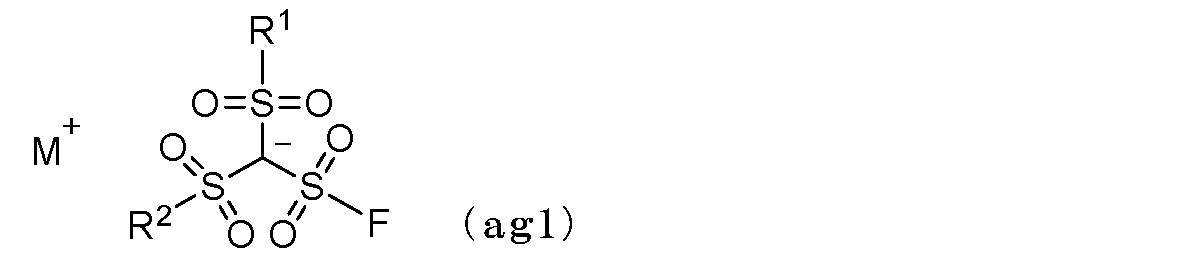
一般式(ag1)中、
M+は、金属カチオンであり、
R1およびR2は、それぞれ独立にフッ素原子または-ORであり、Rは1価の有機基である。
金属カチオンは、K+、Na+などであることができるが、一般式(M-FSM)で表される化合物が電気的中性である限り特に限定されない。
Rの1価の有機基の具体例や好ましい態様については、<感放射線性樹脂組成物(第1実施形態)>で説明のとおりである。
M+は、金属カチオンであり、
R1およびR2は、それぞれ独立にフッ素原子または-ORであり、Rは1価の有機基である。
金属カチオンは、K+、Na+などであることができるが、一般式(M-FSM)で表される化合物が電気的中性である限り特に限定されない。
Rの1価の有機基の具体例や好ましい態様については、<感放射線性樹脂組成物(第1実施形態)>で説明のとおりである。
(iii)一般式(M-FSM)で表される化合物または一般式(ag1)で表される化合物における金属カチオンM+を、適当なカチオンに置き換える。これにより一般式(AG1)で表される化合物(好ましくは酸発生剤)を得ることができる。
具体例として、一般式(ag1)で表される化合物と、一般式A1 +X-で表される化合物とを反応させることにより、以下一般式(AG1-1)で表される化合物(好ましくは酸発生剤)を製造することができる。一般式A1 +X-において、A1 +はスルホニウムカチオンまたはヨードニウムカチオンであり、X-はハライドイオン(好ましくはCl-、Br-、I-)、スルホネートイオン、硫酸イオン、リン酸イオン、水酸化物イオンまたはカルボキシレートイオンである。
具体例として、一般式(ag1)で表される化合物と、一般式A1 +X-で表される化合物とを反応させることにより、以下一般式(AG1-1)で表される化合物(好ましくは酸発生剤)を製造することができる。一般式A1 +X-において、A1 +はスルホニウムカチオンまたはヨードニウムカチオンであり、X-はハライドイオン(好ましくはCl-、Br-、I-)、スルホネートイオン、硫酸イオン、リン酸イオン、水酸化物イオンまたはカルボキシレートイオンである。
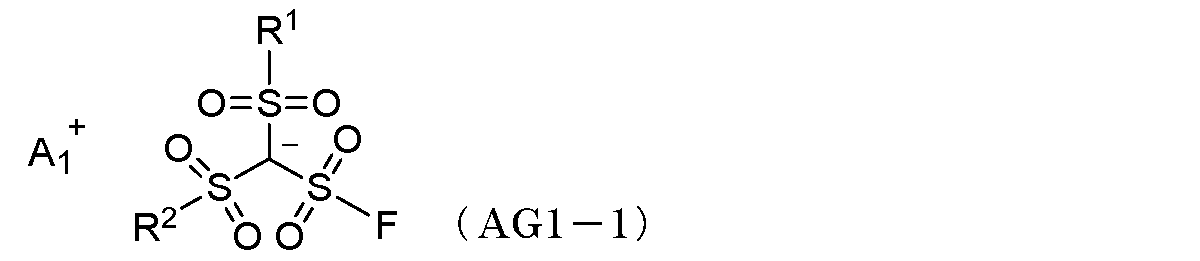
一般式(AG1-1)中、
A1 +は、スルホニウムカチオンまたはヨードニウムカチオンであり、
R1およびR2は、それぞれ独立にフッ素原子または-ORであり、Rは1価の有機基である。
A1 +のスルホニウムカチオンまたはヨードニウムカチオンの具体例や好ましい態様については、<感放射線性樹脂組成物>の項で説明のとおりである。スルホニウムクロライドにおけるスルホニウム部分の構造や、ヨードニウムクロライドにおけるヨードニウム部分の構造についても同様である。
Rの1価の有機基の具体例や好ましい態様については、<感放射線性樹脂組成物>の項で説明のとおりである。
A1 +は、スルホニウムカチオンまたはヨードニウムカチオンであり、
R1およびR2は、それぞれ独立にフッ素原子または-ORであり、Rは1価の有機基である。
A1 +のスルホニウムカチオンまたはヨードニウムカチオンの具体例や好ましい態様については、<感放射線性樹脂組成物>の項で説明のとおりである。スルホニウムクロライドにおけるスルホニウム部分の構造や、ヨードニウムクロライドにおけるヨードニウム部分の構造についても同様である。
Rの1価の有機基の具体例や好ましい態様については、<感放射線性樹脂組成物>の項で説明のとおりである。
以上、本発明の実施形態について述べたが、これらは本発明の例示であり、上記以外の様々な構成を採用することができる。また、本発明は上述の実施形態に限定されるものではなく、本発明の目的を達成できる範囲での変形、改良等は本発明に含まれる。
本発明の実施態様を、実施例および比較例に基づき詳細に説明する。念のため述べておくと、本発明は実施例のみに限定されない。
<合成例>
[合成例1:メタントリスルホン酸の合成]
0.5L三口ナスフラスコに、30%発煙硫酸(富士フイルム和光純薬社製、137g、発煙硫酸中のSO3 41g、512mmol、5.2当量)を入れ、氷浴にて冷却した。
このフラスコ中に、無水酢酸(富士フイルム和光純薬社製、10g、98.3mmol)を加えた。その後、段階的に昇温を行い90℃にて終夜撹拌した。
反応液を室温まで冷却後、ポアサイズ1.0μmのポリテトラフルオロエチレン製のフィルターで減圧濾過を行い、濾物56.7gと濾液77.9gを得た。濾物を1H-NMRにて定量を行った結果、目的物は118mmol(定量収率70%、内部標準物質:1,4-ビストリフルオロメチルベンゼン)含まれていた。
得られた濾物に対し、トルエン(富士フイルム和光純薬社製、111g×2回)とアセトニトリル(富士フイルム和光純薬社製、81g)で順次分散洗浄を実施した。そして、得られた結晶を減圧度<2kPa、バス温50℃の条件下で乾燥した。「減圧度<2kPa」とは、絶対圧を2kPa未満としたことを意味する(以下、同様の記載について同義)。
このようにして、メタントリスルホン酸(14.9g、定量値 42.5mmol、純度66質量%、収率32%)を得た。
[合成例1:メタントリスルホン酸の合成]
0.5L三口ナスフラスコに、30%発煙硫酸(富士フイルム和光純薬社製、137g、発煙硫酸中のSO3 41g、512mmol、5.2当量)を入れ、氷浴にて冷却した。
このフラスコ中に、無水酢酸(富士フイルム和光純薬社製、10g、98.3mmol)を加えた。その後、段階的に昇温を行い90℃にて終夜撹拌した。
反応液を室温まで冷却後、ポアサイズ1.0μmのポリテトラフルオロエチレン製のフィルターで減圧濾過を行い、濾物56.7gと濾液77.9gを得た。濾物を1H-NMRにて定量を行った結果、目的物は118mmol(定量収率70%、内部標準物質:1,4-ビストリフルオロメチルベンゼン)含まれていた。
得られた濾物に対し、トルエン(富士フイルム和光純薬社製、111g×2回)とアセトニトリル(富士フイルム和光純薬社製、81g)で順次分散洗浄を実施した。そして、得られた結晶を減圧度<2kPa、バス温50℃の条件下で乾燥した。「減圧度<2kPa」とは、絶対圧を2kPa未満としたことを意味する(以下、同様の記載について同義)。
このようにして、メタントリスルホン酸(14.9g、定量値 42.5mmol、純度66質量%、収率32%)を得た。
得られたメタントリスルホン酸の1H-NMR分析結果を以下に示す。
1H-NMR(DMSO、基準物質:DMSO):4.70ppm(s,1H,C-H)
1H-NMR(DMSO、基準物質:DMSO):4.70ppm(s,1H,C-H)
参考のため、上記反応のスキーム図を以下に示す。

[合成例2:K-FSMの合成](K-FSMの化学構造は後掲)
容量1LのPFA(パーフルオロアルコキシアルカン)製のジャーに、メタントリスルホン酸(10g、28.5mmol、純度73質量%)、FLUOLEADTM(UBE社製、44g、176mmol、6.2当量)、および、塩化メチレン(富士フイルム和光純薬社製、333g)を入れた。そして、40℃にて8.5時間、その後室温にて終夜撹拌した。
その後、このジャー中の反応液に、フッ化カリウム(富士フイルム和光純薬社製、22.7g、390mmol、13.7当量)を加え、室温にて5.5時間攪拌した。
攪拌終了後の反応液を、加圧濾過機にて濾過した(塩化メチレン洗浄、25g×2回)。
このようにして、濾物39.4g(K-FSM定量値 6.4g、21.3mmol、定量収率75%)と濾液352gを得た。
容量1LのPFA(パーフルオロアルコキシアルカン)製のジャーに、メタントリスルホン酸(10g、28.5mmol、純度73質量%)、FLUOLEADTM(UBE社製、44g、176mmol、6.2当量)、および、塩化メチレン(富士フイルム和光純薬社製、333g)を入れた。そして、40℃にて8.5時間、その後室温にて終夜撹拌した。
その後、このジャー中の反応液に、フッ化カリウム(富士フイルム和光純薬社製、22.7g、390mmol、13.7当量)を加え、室温にて5.5時間攪拌した。
攪拌終了後の反応液を、加圧濾過機にて濾過した(塩化メチレン洗浄、25g×2回)。
このようにして、濾物39.4g(K-FSM定量値 6.4g、21.3mmol、定量収率75%)と濾液352gを得た。
参考のため、上記反応のスキーム図を以下に示す。
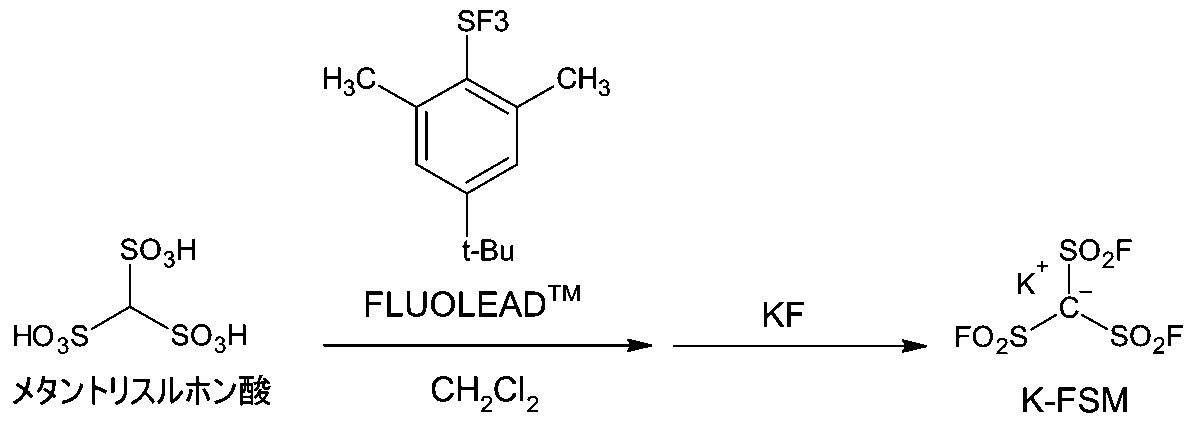
0.5L三口ナスフラスコに、同様の操作で得られた別バッチの濾物を合わせた濾物70.6g(K-FSM定量値 13.0g、41.3mmol)と、エチルメチルカーボネート(160g)を入れ、室温にて3時間撹拌した。
攪拌終了後の反応液を、加圧濾過機にて濾過した(キシダ化学社製、エチルメチルカーボネート洗浄 40g)。これにより濾物77.6gと濾液185gを得た。そして、濾液に対して減圧蒸留(減圧度<2kPa,オイルバス55℃)にて溶媒留去と乾燥を行った。
このようにして、不純物であるKFの量が低減されたK-FSM(11.6g、定量値36.2mmol、内部標準物質:トリフルオロメチルベンゼン、純度94質量%、工程収率88%、全収率66%)を得た。
攪拌終了後の反応液を、加圧濾過機にて濾過した(キシダ化学社製、エチルメチルカーボネート洗浄 40g)。これにより濾物77.6gと濾液185gを得た。そして、濾液に対して減圧蒸留(減圧度<2kPa,オイルバス55℃)にて溶媒留去と乾燥を行った。
このようにして、不純物であるKFの量が低減されたK-FSM(11.6g、定量値36.2mmol、内部標準物質:トリフルオロメチルベンゼン、純度94質量%、工程収率88%、全収率66%)を得た。
得られたK-FSMの19F-NMR分析結果を以下に示す。
19F-NMR(CD3CN、基準物質:トリフルオロメチルベンゼン):70.2ppm(s,3F)
19F-NMR(CD3CN、基準物質:トリフルオロメチルベンゼン):70.2ppm(s,3F)
[合成例3:PAG-1の合成](PAG-1の化学構造は後掲)
200mL三口ナスフラスコに、K-FSM(3.03g、10mmol、純度94質量%)、トリフェニルスルホニウムクロリド(TPSCl、東京化成工業社製、2.98g、10mmol、1.06当量)、クロロホルム(富士フイルム和光純薬社製、11.15g)、および、イオン交換水(12.18g)を入れて、室温で4時間攪拌した。その後、クロロホルム(10.36g)、および、イオン交換水(12.98g)を加えてさらに5分間攪拌した。
攪拌終了後の反応液を、200mL分液ロートに移液して10分静定した。その後、二層分離することで、水層31.91g、有機層22.08gを得た。
続いて、得られた有機層に、イオン交換水(27.50g)を加えて10分攪拌して、200mL分液ロートで10分静定した。その後、二層分離することで、水層27.49g、有機層20.68gを得た。さらに、得られた有機層に、イオン交換水(26.47g)を加えて10分攪拌して、200mL分液ロートで10分静定した。その後、二層分離することで、水層27.03g、有機層19.46gを得た。有機層は減圧留去(減圧度<2kPa、オイルバス50℃)にて溶媒留去と乾燥を行った。
以上のようにして、PAG-1(5.46g、定量値9.38mmol、純度99質量%、収率93%)を得た。
200mL三口ナスフラスコに、K-FSM(3.03g、10mmol、純度94質量%)、トリフェニルスルホニウムクロリド(TPSCl、東京化成工業社製、2.98g、10mmol、1.06当量)、クロロホルム(富士フイルム和光純薬社製、11.15g)、および、イオン交換水(12.18g)を入れて、室温で4時間攪拌した。その後、クロロホルム(10.36g)、および、イオン交換水(12.98g)を加えてさらに5分間攪拌した。
攪拌終了後の反応液を、200mL分液ロートに移液して10分静定した。その後、二層分離することで、水層31.91g、有機層22.08gを得た。
続いて、得られた有機層に、イオン交換水(27.50g)を加えて10分攪拌して、200mL分液ロートで10分静定した。その後、二層分離することで、水層27.49g、有機層20.68gを得た。さらに、得られた有機層に、イオン交換水(26.47g)を加えて10分攪拌して、200mL分液ロートで10分静定した。その後、二層分離することで、水層27.03g、有機層19.46gを得た。有機層は減圧留去(減圧度<2kPa、オイルバス50℃)にて溶媒留去と乾燥を行った。
以上のようにして、PAG-1(5.46g、定量値9.38mmol、純度99質量%、収率93%)を得た。
得られたPAG-1の核磁気共鳴分析の結果を以下に示す。
1H-NMR(CDCl3、基準物質:TMS):7.63-7.82ppm(m,15H)
19F-NMR(CDCl3、基準物質:CF3CH2OH):71.7ppm(s,3F)
1H-NMR(CDCl3、基準物質:TMS):7.63-7.82ppm(m,15H)
19F-NMR(CDCl3、基準物質:CF3CH2OH):71.7ppm(s,3F)
参考のため、上記反応のスキーム図を以下に示す。

[合成例4:PAG-2の合成]
200mL三口フラスコに、K-FSM(1.06g、3.3mmol、純度94質量%)、1-アダマンタンメタノール(東京化成工業社製、0.55g、3.3mmol、1.0当量)、水素化ナトリウム(富士フイルム和光純薬社製、60wt%(ミネラルオイル品)、0.27g、6.6mmol、2.0当量)、および、アセトニトリル(富士フイルム和光純薬社製、50.28g)を入れ、室温にて20時間撹拌した。
攪拌終了後の反応液を、シリンジフィルター(ポアサイズ0.22μm、PTFE(ポリテトラフルオロエチレン)製)にて濾過を行い、濾液52gを得た。濾液は1M塩酸水溶液(30.33g)に滴下し、室温で30分攪拌した。その後、濾液にヘプタン(66.60g)を加えて15分攪拌した。さらにその後、反応液を500mL分液ロートに移液して5分静定した。この静定により三層分離させることで、ヘプタン層67.01g、アセトニトリル層43.47g、水層35.26gを得た。
200mL三口フラスコに、K-FSM(1.06g、3.3mmol、純度94質量%)、1-アダマンタンメタノール(東京化成工業社製、0.55g、3.3mmol、1.0当量)、水素化ナトリウム(富士フイルム和光純薬社製、60wt%(ミネラルオイル品)、0.27g、6.6mmol、2.0当量)、および、アセトニトリル(富士フイルム和光純薬社製、50.28g)を入れ、室温にて20時間撹拌した。
攪拌終了後の反応液を、シリンジフィルター(ポアサイズ0.22μm、PTFE(ポリテトラフルオロエチレン)製)にて濾過を行い、濾液52gを得た。濾液は1M塩酸水溶液(30.33g)に滴下し、室温で30分攪拌した。その後、濾液にヘプタン(66.60g)を加えて15分攪拌した。さらにその後、反応液を500mL分液ロートに移液して5分静定した。この静定により三層分離させることで、ヘプタン層67.01g、アセトニトリル層43.47g、水層35.26gを得た。
得られたアセトニトリル層と水層に、トリフェニルスルホニウムクロリド(TPSCl、東京化成工業社製、1.51g、5.0mmol、1.5当量)、クロロホルム(152.76g)、および、イオン交換水(100.01g)を加えて1時間攪拌した。攪拌終了後の反応駅を、500mL分液ロートに移液して5分静定した。その後、二層分離することで、水層141.52g、有機層188.47gを得た。
続いて、得られた有機層にイオン交換水(101.14g)を加えて10分攪拌して、500mL分液ロートで5分静定した。その後、二層分離することで、水層110.81g、有機層175.89gを得た。
さらに続いて、得られた有機層にイオン交換水(99.59g)を加えて10分攪拌して、500mL分液ロートで5分静定した。その後、二層分離することで、水層106.15g、有機層166.85gを得た。有機層は減圧留去(減圧度<2kPa、オイルバス50℃)にて溶媒留去と乾燥を行った。
このようにして、PAG-2(1.92g、定量値2.84mmol、純度97質量%、収率85%)を得た。
続いて、得られた有機層にイオン交換水(101.14g)を加えて10分攪拌して、500mL分液ロートで5分静定した。その後、二層分離することで、水層110.81g、有機層175.89gを得た。
さらに続いて、得られた有機層にイオン交換水(99.59g)を加えて10分攪拌して、500mL分液ロートで5分静定した。その後、二層分離することで、水層106.15g、有機層166.85gを得た。有機層は減圧留去(減圧度<2kPa、オイルバス50℃)にて溶媒留去と乾燥を行った。
このようにして、PAG-2(1.92g、定量値2.84mmol、純度97質量%、収率85%)を得た。
得られたPAG-2の核磁気共鳴分析の結果を以下に示す。
1H-NMR(CDCl3、基準物質:TMS):1.58-1.96ppm(m,15H)、3.78ppm(s,2H)、7.63-7.82ppm(m,15H)
19F-NMR(CDCl3、基準物質:CF3CH2OH):72.1ppm(s,2F)
1H-NMR(CDCl3、基準物質:TMS):1.58-1.96ppm(m,15H)、3.78ppm(s,2H)、7.63-7.82ppm(m,15H)
19F-NMR(CDCl3、基準物質:CF3CH2OH):72.1ppm(s,2F)
参考のため、上記反応のスキーム図を以下に示す。以下において、Adはアダマンチル基を表す。

[合成例5:PAG-3(比較用)の合成]
200mL三口ナスフラスコに、カリウムトリス(トリフルオロメタンスルホニル)メタニド(東京化成工業社製、4.6g、10mmol、純度98wt%)、トリフェニルスルホニウムクロリド(TPSCl、東京化成工業社製、2.98g、10mmol、1.06当量)、クロロホルム(富士フイルム和光純薬社製、11.15g)、および、イオン交換水(12.18g)を入れて、室温で4時間攪拌した。その後、クロロホルム(10.36g)、および、イオン交換水(12.98g)を加えてさらに5分間攪拌した。
攪拌終了後の反応液を、200mL分液ロートに移液して10分静定した。その後、二層分離することで、水層31.91g、有機層22.08gを得た。続いて、得られた有機層にイオン交換水(27.50g)を加えて10分攪拌して、200mL分液ロートで10分静定した。その後、二層分離することで、水層27.49g、有機層20.68gを得た。さらに、得られた有機層にイオン交換水(26.47g)を加えて10分攪拌して、200mL分液ロートで10分静定した。その後、二層分離することで、水層27.03g、有機層19.46gを得た。有機層は減圧留去(減圧度<2kPa、オイルバス50℃)にて溶媒留去と乾燥を行った。
このようにして、PAG-3(6.11g、定量値9.0mmol、純度99質量%、収率90%)を得た。
200mL三口ナスフラスコに、カリウムトリス(トリフルオロメタンスルホニル)メタニド(東京化成工業社製、4.6g、10mmol、純度98wt%)、トリフェニルスルホニウムクロリド(TPSCl、東京化成工業社製、2.98g、10mmol、1.06当量)、クロロホルム(富士フイルム和光純薬社製、11.15g)、および、イオン交換水(12.18g)を入れて、室温で4時間攪拌した。その後、クロロホルム(10.36g)、および、イオン交換水(12.98g)を加えてさらに5分間攪拌した。
攪拌終了後の反応液を、200mL分液ロートに移液して10分静定した。その後、二層分離することで、水層31.91g、有機層22.08gを得た。続いて、得られた有機層にイオン交換水(27.50g)を加えて10分攪拌して、200mL分液ロートで10分静定した。その後、二層分離することで、水層27.49g、有機層20.68gを得た。さらに、得られた有機層にイオン交換水(26.47g)を加えて10分攪拌して、200mL分液ロートで10分静定した。その後、二層分離することで、水層27.03g、有機層19.46gを得た。有機層は減圧留去(減圧度<2kPa、オイルバス50℃)にて溶媒留去と乾燥を行った。
このようにして、PAG-3(6.11g、定量値9.0mmol、純度99質量%、収率90%)を得た。
得られたPAG-3の核磁気共鳴分析の結果を以下に示す。
1H-NMR(DMSO、基準物質:TMS):7.67-7.85ppm(m,15H)
19F-NMR(DMSO、基準物質:CF3-Ph):-77.2ppm(s,9F)
1H-NMR(DMSO、基準物質:TMS):7.67-7.85ppm(m,15H)
19F-NMR(DMSO、基準物質:CF3-Ph):-77.2ppm(s,9F)
参考のため、上記反応のスキーム図を以下に示す。
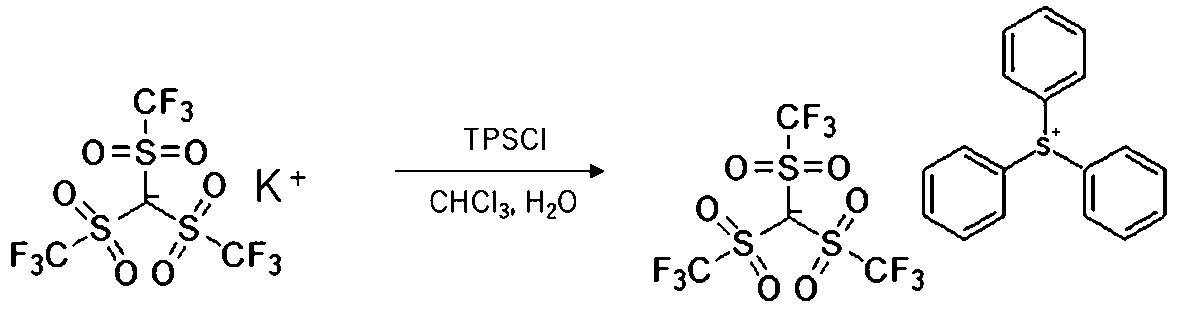
[比較用の酸発生剤PAG-4の準備]
比較用の酸発生剤として、セントラル硝子社が製造している以下化学構造の酸発生剤PAG-4を準備した。以下化学式において、Adはアダマンチル基を表す。
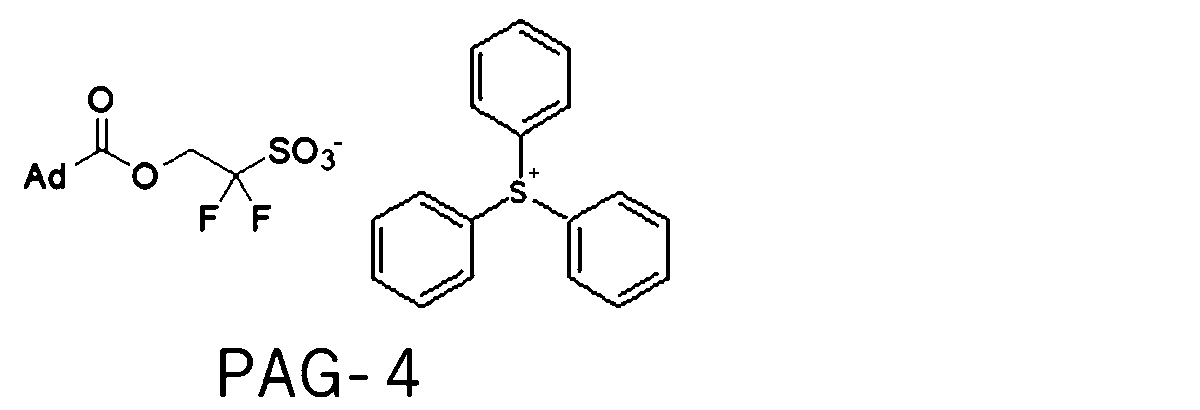
比較用の酸発生剤として、セントラル硝子社が製造している以下化学構造の酸発生剤PAG-4を準備した。以下化学式において、Adはアダマンチル基を表す。
[合成例6:TBPDPS-Clの合成]
200mL三口フラスコに、マグネシウム(切削り片状)(関東化学社製2.64g、0.1mol)を入れた。フラスコにスターラーチップを入れ、窒素雰囲気下で一晩攪拌した。これによりマグネシウム表面の酸化膜を削り活性化させた。その後、フラスコに脱水THF(テトラヒドロフラン、関東化学社製80ml)を加え、40℃まで昇温した。その後、1-ブロモ-4-tertブチルベンゼン(東京化成工業社製21.3g、0.1mol)を断続的に3時間かけて添加し、その後50℃で3時間攪拌し、ガスクロマトグラフィーを用い、1-ブロモ-4-tertブチルベンゼンの完全消失を確認後、室温まで冷却した。このようにして、4-tertブチルベンゼンマグネシウムブロミドのTHF溶液を得た。
200mL三口フラスコに、マグネシウム(切削り片状)(関東化学社製2.64g、0.1mol)を入れた。フラスコにスターラーチップを入れ、窒素雰囲気下で一晩攪拌した。これによりマグネシウム表面の酸化膜を削り活性化させた。その後、フラスコに脱水THF(テトラヒドロフラン、関東化学社製80ml)を加え、40℃まで昇温した。その後、1-ブロモ-4-tertブチルベンゼン(東京化成工業社製21.3g、0.1mol)を断続的に3時間かけて添加し、その後50℃で3時間攪拌し、ガスクロマトグラフィーを用い、1-ブロモ-4-tertブチルベンゼンの完全消失を確認後、室温まで冷却した。このようにして、4-tertブチルベンゼンマグネシウムブロミドのTHF溶液を得た。
一方、500mL三口フラスコに、ジフェニルスルホキシド(東京化成工業社製20.3g、0.1mol)、脱水THF(関東化学社製100mL)、クロロトリメチルシラン(東京化成工業社製14.1g、0.13mol)を加え、0℃まで冷却した。そこへ先に合成した、4-tertブチルベンゼンマグネシウムブロミドのTHF溶液を、全量内温が20℃以下を保ちながら1時間かけて滴下した。その後、20℃で攪拌しながら、HPLCにてジフェニルスルホキシドのピークの消失を確認した。さらにその後、15質量%の塩酸(200mL)加え、反応を終了(失活)させた。
反応終了後の溶液に、ヘプタン300mLを加え攪拌し、2層分離した。その後、下層(水層)を回収し、IPE(イソプロピルエーテル)100mLを用い、攪拌、2層分離し水層を回収した。このようにして、固形分30.1g、収率85%で、4-t-ブチルフェニルジフェニルスルホニウムクロリド(TBPDPS-Cl)を含む水溶液を得た。
[合成例7:MOPDPS-Clの合成]
合成例6の1-ブロモ-4-tertブチルベンゼンを、4-ブロモアニソール(東京化成工業社品)に変更した以外、同様な操作を行った。これにより、4-メトキシフェニルジフェニルスルホニウムクロリド(MOPDPS-Cl)を含む水溶液を得た。
合成例6の1-ブロモ-4-tertブチルベンゼンを、4-ブロモアニソール(東京化成工業社品)に変更した以外、同様な操作を行った。これにより、4-メトキシフェニルジフェニルスルホニウムクロリド(MOPDPS-Cl)を含む水溶液を得た。
[合成例8:FPDPS-Clの合成]
合成例6の1-ブロモ-4-tertブチルベンゼンを4-ブロモフルオロベンゼン(東京化成工業社品)に変更した以外、同様な操作を行った。これにより、4-フルオロフェニルジフェニルスルホニウムクロリド(FPDPS-Cl)を含む水溶液を得た。
合成例6の1-ブロモ-4-tertブチルベンゼンを4-ブロモフルオロベンゼン(東京化成工業社品)に変更した以外、同様な操作を行った。これにより、4-フルオロフェニルジフェニルスルホニウムクロリド(FPDPS-Cl)を含む水溶液を得た。
[合成例9:ビススルホニウムクロリド(1)の合成]
合成例6の1-ブロモ-4-tertブチルベンゼンをビス(4-ブロモフェニル)スルフィド(東京化成工業社品)に変更した以外、同様な操作を行った。これにより、(チオジ-4,1-フェニレン)ビス(ジフェニルスルホニウム)ジクロリドを含む水溶液を得た。
合成例6の1-ブロモ-4-tertブチルベンゼンをビス(4-ブロモフェニル)スルフィド(東京化成工業社品)に変更した以外、同様な操作を行った。これにより、(チオジ-4,1-フェニレン)ビス(ジフェニルスルホニウム)ジクロリドを含む水溶液を得た。
以下に上記合成例6~9で得られた化合物の構造を示す。
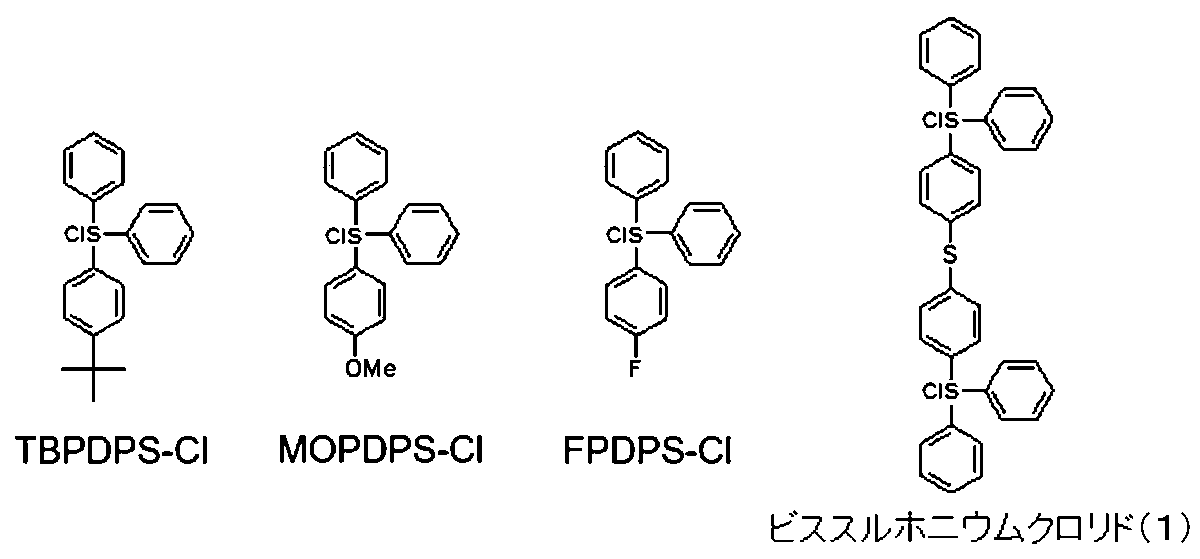
[合成例10:PAG-5の合成]
合成例4の1-アダマンタンメタノールを、2-アダマンタノール(東京化成工業社品)に変更した以外、同様な操作でPAG-5を得た。
[合成例11:PAG-6の合成]
合成例4の1-アダマンタンメタノールを、5-ヒドロキシ-2-アダマンタノン(東京化成工業社品)に変更した以外、同様な操作でPAG-6を得た。
合成例4の1-アダマンタンメタノールを、2-アダマンタノール(東京化成工業社品)に変更した以外、同様な操作でPAG-5を得た。
[合成例11:PAG-6の合成]
合成例4の1-アダマンタンメタノールを、5-ヒドロキシ-2-アダマンタノン(東京化成工業社品)に変更した以外、同様な操作でPAG-6を得た。
[合成例12:PAG-7の合成]
合成例4の1-アダマンタンメタノールを、5-ヒドロキシノルボルナン-2、6-ラクトン(東京化成工業社品)に変更した以外、同様な操作でPAG-7を得た。
合成例4の1-アダマンタンメタノールを、5-ヒドロキシノルボルナン-2、6-ラクトン(東京化成工業社品)に変更した以外、同様な操作でPAG-7を得た。
[合成例13:PAG-8の合成]
合成例4の1-アダマンタンメタノールを、exo-ノルボルネオール(東京化成工業社品)に変更した以外、同様な操作でPAG-8を得た。
合成例4の1-アダマンタンメタノールを、exo-ノルボルネオール(東京化成工業社品)に変更した以外、同様な操作でPAG-8を得た。
[合成例14:PAG-9の合成]
合成例4のトリフェニルスルホニウムクロリド(TPSCl)を、ジフェニルヨードニウムクロリド(DPICl)(東京化成工業社品)に変更した以外、同様な操作でPAG-9を得た。
合成例4のトリフェニルスルホニウムクロリド(TPSCl)を、ジフェニルヨードニウムクロリド(DPICl)(東京化成工業社品)に変更した以外、同様な操作でPAG-9を得た。
[合成例15:PAG-10の合成]
合成例4のトリフェニルスルホニウムクロリド(TPSCl)を、ビス(4-tert―ブチルフェニル)ヨードニウムクロリド(BTPICl)(東京化成工業社品)に変更した以外、同様な操作でPAG-10を得た。
合成例4のトリフェニルスルホニウムクロリド(TPSCl)を、ビス(4-tert―ブチルフェニル)ヨードニウムクロリド(BTPICl)(東京化成工業社品)に変更した以外、同様な操作でPAG-10を得た。
[合成例16:PAG-11の合成]
合成例4のトリフェニルスルホニウムクロリド(TPSCl)を、合成例6で合成した4-t-ブチルフェニルジフェニルスルホニウムクロリドに変更した以外、同様な操作でPAG-11を得た。
合成例4のトリフェニルスルホニウムクロリド(TPSCl)を、合成例6で合成した4-t-ブチルフェニルジフェニルスルホニウムクロリドに変更した以外、同様な操作でPAG-11を得た。
[合成例17:PAG-12の合成]
合成例4のトリフェニルスルホニウムクロリド(TPSCl)を、合成例7で合成した4-メトキシフェニルジフェニルスルホニウムクロリドに変更した以外、同様な操作でPAG-12を得た。
合成例4のトリフェニルスルホニウムクロリド(TPSCl)を、合成例7で合成した4-メトキシフェニルジフェニルスルホニウムクロリドに変更した以外、同様な操作でPAG-12を得た。
[合成例18:PAG-13の合成]
合成例4のトリフェニルスルホニウムクロリド(TPSCl)を、合成例8で合成した4-フルオロフェニルジフェニルスルホニウムクロリドに変更した以外、同様な操作でPAG-13を得た。
合成例4のトリフェニルスルホニウムクロリド(TPSCl)を、合成例8で合成した4-フルオロフェニルジフェニルスルホニウムクロリドに変更した以外、同様な操作でPAG-13を得た。
[合成例19:PAG-14の合成]
合成例4のトリフェニルスルホニウムクロリド(TPSCl)を、合成例9で合成した(チオジ-4,1-フェニレン)ビス(ジフェニルスルホニウム)ジクロリドに変更した以外、同様な操作でPAG-14を得た。
合成例4のトリフェニルスルホニウムクロリド(TPSCl)を、合成例9で合成した(チオジ-4,1-フェニレン)ビス(ジフェニルスルホニウム)ジクロリドに変更した以外、同様な操作でPAG-14を得た。
以下にPAG-5からPAG-14の化学構造を示す。以下においてAdはアダマンチル基の略である。

<評価:保存安定性>
上記PAG-1からPAG-14のそれぞれ0.5gを、重クロロホルム(4.5g)に溶解させて、酸発生剤の濃度が10質量%の溶液を調製した。
調製直後と、室温保管24時間後に、19F-NMRを測定した。調整直後と室温保管24時間後のNMRチャートを比較して、以下のように評価した。
・室温保管24時間後のNMRチャートに新規ピークが確認された場合:不良
・室温保管24時間後のNMRチャートに新規ピークが確認されなかった場合:良好
上記PAG-1からPAG-14のそれぞれ0.5gを、重クロロホルム(4.5g)に溶解させて、酸発生剤の濃度が10質量%の溶液を調製した。
調製直後と、室温保管24時間後に、19F-NMRを測定した。調整直後と室温保管24時間後のNMRチャートを比較して、以下のように評価した。
・室温保管24時間後のNMRチャートに新規ピークが確認された場合:不良
・室温保管24時間後のNMRチャートに新規ピークが確認されなかった場合:良好
<評価:アルカリ加水分解性>
上記PAG-1からPAG-14のそれぞれ0.5gを、2.38質量%テトラメチルアンモニウム水溶液(0.1g)および重クロロホルム(4.5g)と混合し、酸発生剤の濃度が10質量%の溶液を調製した。そして、得られた溶液を室温で24時間攪拌した。
攪拌終了後の溶液について、19F-NMRを測定した。上記<評価:保存安定性>で測定した調製直後のNMRチャートと比較して、以下のように評価した。
・酸発生剤中のフッ素に帰属されるピークが完全に消失し、酸発生剤中のフッ素に帰属されない新規ピークが確認された場合:良好
・酸発生剤中のフッ素に帰属されるピークと、酸発生剤中のフッ素に帰属されない新規ピークの両方が確認できた場合:可
・酸発生剤中のフッ素に帰属されない新規ピークが確認されなかった場合:不良
上記PAG-1からPAG-14のそれぞれ0.5gを、2.38質量%テトラメチルアンモニウム水溶液(0.1g)および重クロロホルム(4.5g)と混合し、酸発生剤の濃度が10質量%の溶液を調製した。そして、得られた溶液を室温で24時間攪拌した。
攪拌終了後の溶液について、19F-NMRを測定した。上記<評価:保存安定性>で測定した調製直後のNMRチャートと比較して、以下のように評価した。
・酸発生剤中のフッ素に帰属されるピークが完全に消失し、酸発生剤中のフッ素に帰属されない新規ピークが確認された場合:良好
・酸発生剤中のフッ素に帰属されるピークと、酸発生剤中のフッ素に帰属されない新規ピークの両方が確認できた場合:可
・酸発生剤中のフッ素に帰属されない新規ピークが確認されなかった場合:不良
評価結果をまとめて下表に示す。
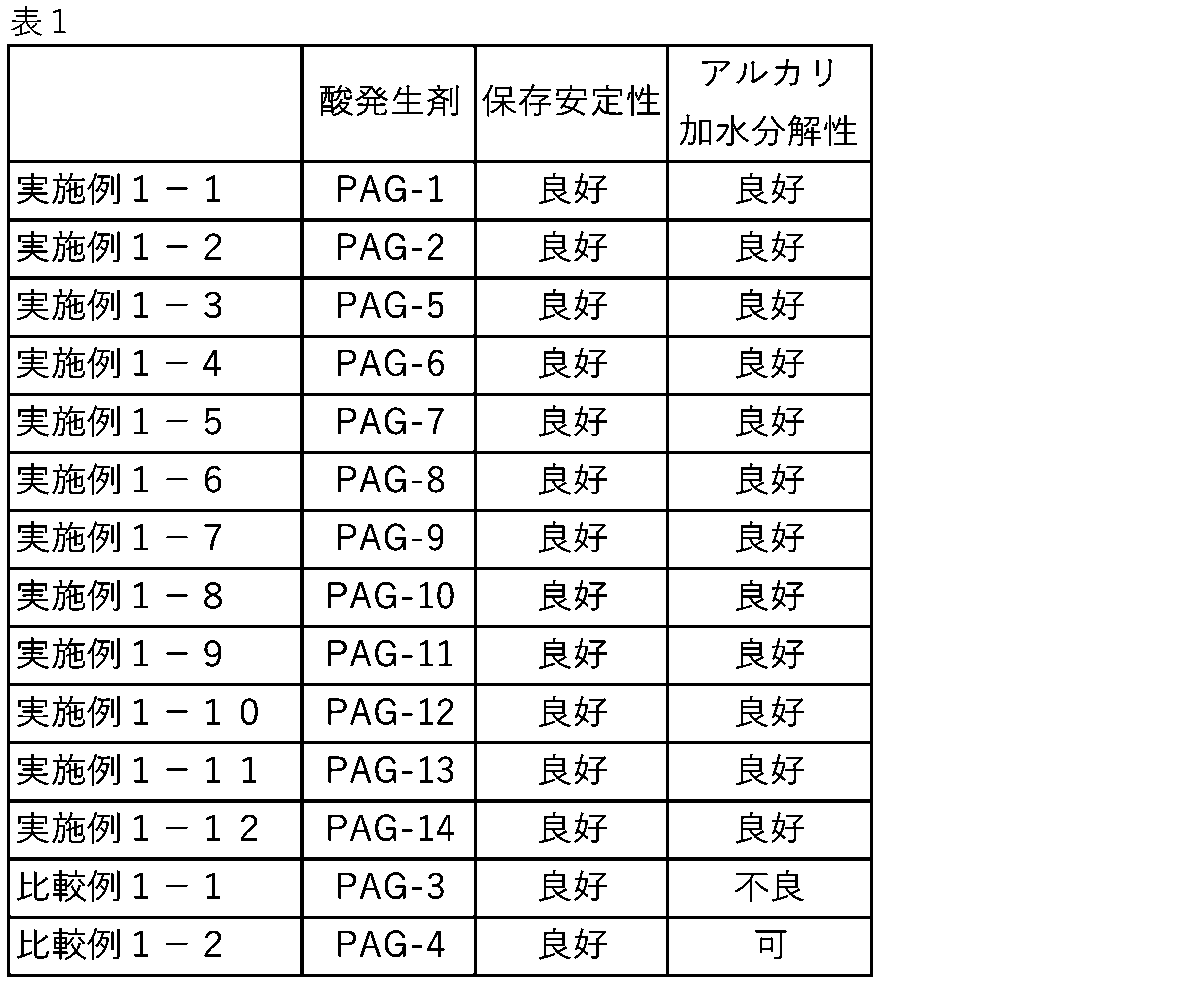
上掲の結果より、一般式(AG1)で表される酸発生剤は、有機溶剤中では安定である一方、アルカリの作用により容易に分解することが示された。このことは、一般式(AG1)で表される酸発生剤を含む感放射線性樹脂組成物を用いて、露光およびアルカリ現像処理により基板上にパターンを形成した際に、基板上に酸発生剤由来の残留物が残りにくく、よって基板上へのフッ素原子の残留を少なくすることができることを意味する。
<感放射線性樹脂組成物(ArF露光向け)の調製>
上記PAG-1(0.8g)、下記樹脂A(10g)、クエンチャーとしてトリエチルアミン(0.1g)、溶剤としてプロピレングリコールモノメチルエーテルアセテート(50g)およびγ-ブチロラクトン(50g)を十分に混合して溶液とした。下記樹脂Aはランダム共重合体である。この溶液をポアサイズ0.2μmのテフロン(登録商標)フィルターでろ過をした。このようにして感放射線性樹脂組成物(実施例2-1)を調製した。
また、PAG-1の代わりに、PAG-2~PAG-14を用いて、感放射線性樹脂組成物(実施例2-2、比較例2-1~2-2、実施例2-3~2-12)を調製した。実施例・比較例番号と、使用した酸発生剤との対応関係は、後掲の表も参照されたい。
上記PAG-1(0.8g)、下記樹脂A(10g)、クエンチャーとしてトリエチルアミン(0.1g)、溶剤としてプロピレングリコールモノメチルエーテルアセテート(50g)およびγ-ブチロラクトン(50g)を十分に混合して溶液とした。下記樹脂Aはランダム共重合体である。この溶液をポアサイズ0.2μmのテフロン(登録商標)フィルターでろ過をした。このようにして感放射線性樹脂組成物(実施例2-1)を調製した。
また、PAG-1の代わりに、PAG-2~PAG-14を用いて、感放射線性樹脂組成物(実施例2-2、比較例2-1~2-2、実施例2-3~2-12)を調製した。実施例・比較例番号と、使用した酸発生剤との対応関係は、後掲の表も参照されたい。
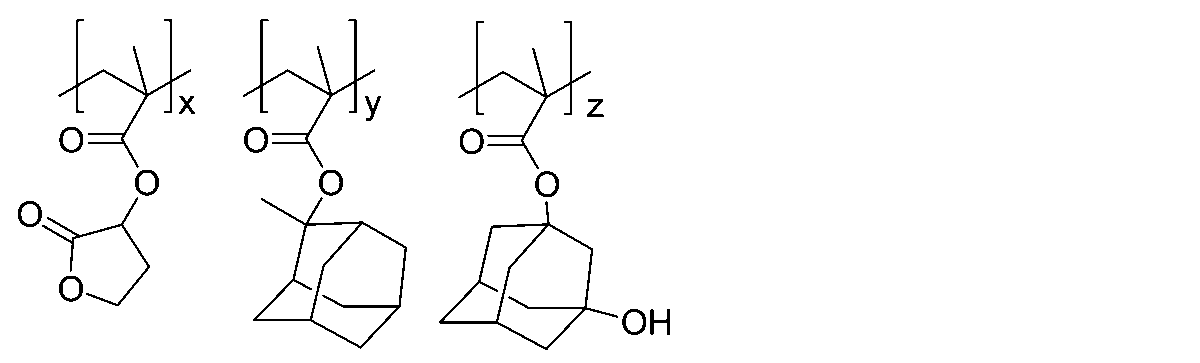
樹脂Aにおいて、x=0.4、y=0.4、z=0.2である。
また、樹脂Aの重量平均分子量Mwは10,600、分散度Mw/Mnは1.75である。
また、樹脂Aの重量平均分子量Mwは10,600、分散度Mw/Mnは1.75である。
<感放射線性樹脂組成物の評価(ArF露光)>
直径4インチのシリコンウエハ上に、日産化学工業社製の反射防止膜ARC29Aをスピンコーターで塗布し、200℃で60秒間ベークを行い、膜厚84nmの反射防止膜を形成した。
その上に、感放射線性樹脂組成物をスピンコーターで塗布し、120℃、60秒間ベークして膜厚280nmの樹脂膜を形成した。
露光装置:ArFES-3500LDLS (リソテックジャパン株式会社製)を用いて、形成された樹脂膜に対し、波長193nmの光を照射した。この際、フォトマスクは用いなかった(ベタ露光)。照射終了後、120℃、60秒間の条件で、樹脂膜が設けられたシリコンウエハをベークした。そして、2.38質量%テトラメチルアンモニウムヒドロキシド水溶液を用いて、23℃、60秒間現像した。現像後のシリコンウエハは純水でリンスした。
直径4インチのシリコンウエハ上に、日産化学工業社製の反射防止膜ARC29Aをスピンコーターで塗布し、200℃で60秒間ベークを行い、膜厚84nmの反射防止膜を形成した。
その上に、感放射線性樹脂組成物をスピンコーターで塗布し、120℃、60秒間ベークして膜厚280nmの樹脂膜を形成した。
露光装置:ArFES-3500LDLS (リソテックジャパン株式会社製)を用いて、形成された樹脂膜に対し、波長193nmの光を照射した。この際、フォトマスクは用いなかった(ベタ露光)。照射終了後、120℃、60秒間の条件で、樹脂膜が設けられたシリコンウエハをベークした。そして、2.38質量%テトラメチルアンモニウムヒドロキシド水溶液を用いて、23℃、60秒間現像した。現像後のシリコンウエハは純水でリンスした。
上記リンス後に残った樹脂膜の膜厚を、エリプソ型膜厚計M2000(J.A.Woollam Japan社製)で測定した。膜厚減少量が90%以上になった露光量を最低必要露光量(Eth)として感度を評価した。
<感放射線性樹脂組成物の評価(基板上に残留するフッ素の評価)>
直径4インチのシリコンウエハ上に感放射線性樹脂組成物をスピンコーターで塗布し、120℃、60秒間ベークした。このようにして膜厚280nmの樹脂膜を形成した。
露光装置:ArFES-3500LDLS (リソテックジャパン株式会社製)を用いて、形成した樹脂膜に対して、波長193nmの光を照射した。この際、フォトマスクは用いなかった(ベタ露光)。また、露光量は10mJ/cm2(Ethよりも十分に大きい照射量)とした。その後、120℃、60秒間の条件で、樹脂膜が設けられたシリコンウエハをベークした。そして、2.38質量%テトラメチルアンモニウムヒドロキシド水溶液を用いて、23℃、60秒間現像した。現像後のシリコンウエハは純水でリンスした。
直径4インチのシリコンウエハ上に感放射線性樹脂組成物をスピンコーターで塗布し、120℃、60秒間ベークした。このようにして膜厚280nmの樹脂膜を形成した。
露光装置:ArFES-3500LDLS (リソテックジャパン株式会社製)を用いて、形成した樹脂膜に対して、波長193nmの光を照射した。この際、フォトマスクは用いなかった(ベタ露光)。また、露光量は10mJ/cm2(Ethよりも十分に大きい照射量)とした。その後、120℃、60秒間の条件で、樹脂膜が設けられたシリコンウエハをベークした。そして、2.38質量%テトラメチルアンモニウムヒドロキシド水溶液を用いて、23℃、60秒間現像した。現像後のシリコンウエハは純水でリンスした。
リンス後のシリコンウエハを、X線光電子分光法(XPS)を用いて、ウエハ表面のF1sスペクトルを測定し、F成分強度(単位:cps)を比較した。XPS測定は日本電子社製JPS-9000MAを用いて行った。測定は場所を変え10か所で行い、10か所での強度の平均値をもって、フッ素の残留の程度を評価した。ここで得られた値が小さいほど、ウエハ上にフッ素原子含有成分の残留が少ないと言える。
感放射線性樹脂組成物を用いた評価(ArF露光)の結果を下表にまとめて示す。
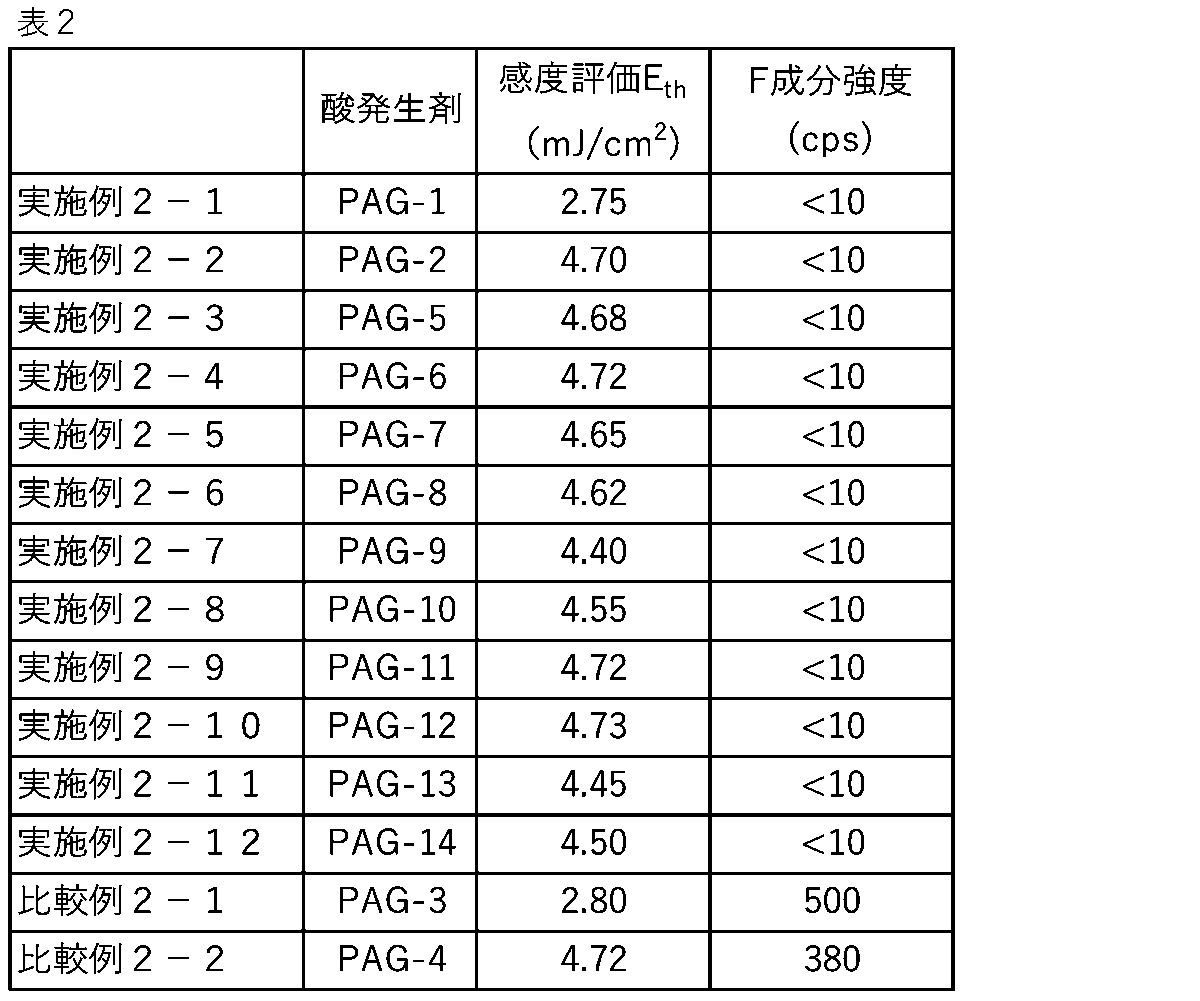
<感放射線性樹脂組成物(KrF露光向け)の調製>
上記PAG-1(0.8g)、下記樹脂B(10g)、クエンチャーとしてトリエチルアミン(0.1g)、溶剤としてプロピレングリコールモノメチルエーテルアセテート(50g)およびγ-ブチロラクトン(50g)を十分に混合して溶液とした。樹脂Bはランダム共重合体である。この溶液をポアサイズ0.2μmのテフロン(登録商標)フィルターでろ過をした。このようにして感放射線性樹脂組成物(実施例3-1)を調製した。
また、PAG-1の代わりに、PAG-2、4を用いて、感放射線性樹脂組成物(実施例3-2、比較例3-1)を調製した。
上記PAG-1(0.8g)、下記樹脂B(10g)、クエンチャーとしてトリエチルアミン(0.1g)、溶剤としてプロピレングリコールモノメチルエーテルアセテート(50g)およびγ-ブチロラクトン(50g)を十分に混合して溶液とした。樹脂Bはランダム共重合体である。この溶液をポアサイズ0.2μmのテフロン(登録商標)フィルターでろ過をした。このようにして感放射線性樹脂組成物(実施例3-1)を調製した。
また、PAG-1の代わりに、PAG-2、4を用いて、感放射線性樹脂組成物(実施例3-2、比較例3-1)を調製した。

樹脂Bにおいて、x=0.3、y=0.7である。
また、樹脂Aの重量平均分子量Mwは11,600、分散度Mw/Mnは1.95である。
また、樹脂Aの重量平均分子量Mwは11,600、分散度Mw/Mnは1.95である。
<感放射線性樹脂組成物(KrF露光向け)の調製>
上記PAG-1(0.8g)、カレックスアレーン樹脂(10g)、クエンチャーとしてトリエチルアミン(0.1g)、溶剤としてプロピレングリコールモノメチルエーテルアセテート(50g)およびγ-ブチロラクトン(50g)を十分に混合して溶液とした。この溶液をポアサイズ0.2μmのテフロン(登録商標)フィルターでろ過をした。このようにして感放射線性樹脂組成物(実施例4-1)を調製した。ここで、カレックスアレーン樹脂は、J.Photopolym. Sci. Technol., Vol. 25, 5, 2012,587-592を参考に準備した。重量平均分子量Mwは3300、分散度Mw/Mnは1.1、フェノール系ヒドロキシ基の保護率は60%であった。
また、PAG-1の代わりに、PAG-2、4を用いて、感放射線性樹脂組成物(実施例4-2、比較例4-1)を調製した。
上記PAG-1(0.8g)、カレックスアレーン樹脂(10g)、クエンチャーとしてトリエチルアミン(0.1g)、溶剤としてプロピレングリコールモノメチルエーテルアセテート(50g)およびγ-ブチロラクトン(50g)を十分に混合して溶液とした。この溶液をポアサイズ0.2μmのテフロン(登録商標)フィルターでろ過をした。このようにして感放射線性樹脂組成物(実施例4-1)を調製した。ここで、カレックスアレーン樹脂は、J.Photopolym. Sci. Technol., Vol. 25, 5, 2012,587-592を参考に準備した。重量平均分子量Mwは3300、分散度Mw/Mnは1.1、フェノール系ヒドロキシ基の保護率は60%であった。
また、PAG-1の代わりに、PAG-2、4を用いて、感放射線性樹脂組成物(実施例4-2、比較例4-1)を調製した。
<感放射線性樹脂組成物の評価(KrF露光)>
直径4インチのシリコンウエハ上に、感放射線性樹脂組成物(KrF露光向け)をスピンコーターで塗布し、100℃、60秒間ベークして膜厚280nmの樹脂膜を形成した。
露光装置:VUVES-4700i (リソテックジャパン株式会社製)を用いて、形成された樹脂膜に対し、波長248nmの光を照射した。この際、フォトマスクは用いなかった(ベタ露光)。照射終了後、120℃、60秒間の条件で、樹脂膜が設けられたシリコンウエハをベークした。そして、2.38質量%テトラメチルアンモニウムヒドロキシド水溶液を用いて、23℃、60秒間現像した。現像後のシリコンウエハは純水でリンスした。
直径4インチのシリコンウエハ上に、感放射線性樹脂組成物(KrF露光向け)をスピンコーターで塗布し、100℃、60秒間ベークして膜厚280nmの樹脂膜を形成した。
露光装置:VUVES-4700i (リソテックジャパン株式会社製)を用いて、形成された樹脂膜に対し、波長248nmの光を照射した。この際、フォトマスクは用いなかった(ベタ露光)。照射終了後、120℃、60秒間の条件で、樹脂膜が設けられたシリコンウエハをベークした。そして、2.38質量%テトラメチルアンモニウムヒドロキシド水溶液を用いて、23℃、60秒間現像した。現像後のシリコンウエハは純水でリンスした。
上記リンス後に残った樹脂膜の膜厚を、エリプソ型膜厚計M2000(J.A.Woollam Japan社製)で測定した。膜厚減少量が90%以上になった露光量を最低必要露光量(Eth)として感度を評価した。
<感放射線性樹脂組成物の評価(基板上に残留するフッ素の評価)>
直径4インチのシリコンウエハ上に感放射線性樹脂組成物(KrF露光向け)をスピンコーターで塗布し、100℃、60秒間ベークした。このようにして膜厚280nmの樹脂膜を形成した。
露光装置:VUVES-4700i (リソテックジャパン株式会社製)を用いて、形成した樹脂膜に対して、波長248nmの光を照射した。この際、フォトマスクは用いなかった(ベタ露光)。また、露光量は10mJ/cm2(Ethよりも十分に大きい照射量)とした。その後、120℃、60秒間の条件で、樹脂膜が設けられたシリコンウエハをベークした。そして、2.38質量%テトラメチルアンモニウムヒドロキシド水溶液を用いて、23℃、60秒間現像した。現像後のシリコンウエハは純水でリンスした。
直径4インチのシリコンウエハ上に感放射線性樹脂組成物(KrF露光向け)をスピンコーターで塗布し、100℃、60秒間ベークした。このようにして膜厚280nmの樹脂膜を形成した。
露光装置:VUVES-4700i (リソテックジャパン株式会社製)を用いて、形成した樹脂膜に対して、波長248nmの光を照射した。この際、フォトマスクは用いなかった(ベタ露光)。また、露光量は10mJ/cm2(Ethよりも十分に大きい照射量)とした。その後、120℃、60秒間の条件で、樹脂膜が設けられたシリコンウエハをベークした。そして、2.38質量%テトラメチルアンモニウムヒドロキシド水溶液を用いて、23℃、60秒間現像した。現像後のシリコンウエハは純水でリンスした。
リンス後のシリコンウエハを、X線光電子分光法(XPS)を用いて、ウエハ表面のF1sスペクトルを測定し、F成分強度(単位:cps)を比較した。XPS測定は日本電子社製JPS-9000MAを用いて行った。測定は場所を変え10か所で行い、10か所での強度の平均値をもって、フッ素の残留の程度を評価した。ここで得られた値が小さいほど、ウエハ上にフッ素原子含有成分の残留が少ないと言える。
感放射線性樹脂組成物を用いた評価(KrF露光)の結果を下表にまとめて示す。

表2および3に示した結果より、以下のことが言える。
(i)一般式(AG1)に該当する酸発生剤(PAG-1、PAG-2、PAG-5からPAG-14)を含む感放射線性樹脂組成物の感度は、従来の酸発生剤(PAG-3、PAG-4)を含む感放射線性樹脂組成物の感度と同程度であった。これは、PAG-1、PAG-2、PAG-5からPAG-14、が電子求引的なフルオロスルホニル構造を有することによって発生酸の酸強度が十分に強くなっているためと考えられる。
(ii)一般式(AG1)に該当する酸発生剤を含む感放射線性樹脂組成物を用いて、アルカリ水溶液による現像プロセスを含むリソグラフィープロセスを行った場合、基板へのフッ素原子含有成分の残留を抑えることができた。これは、PAG-1、PAG-2、PAG-5からPAG-14から発生した酸がアルカリ成分により加水分解されたことによるものと考えられる。
(iii)PAG-1、PAG-2、PAG-5からPAG-14を含む実施例2-1~12、3-1、3-2、4-1、4-2の感放射線性樹脂組成物は、高感度化のために酸発生剤がフッ素原子を含むにもかかわらず、アルカリ現像処理後の基板へのフッ素原子の残留が抑えられた。これは従来のトレードオフを脱却するものである。
(iv)表3に示されるように、KrF露光(波長248nm)においても一般式(AG1)に該当する酸発生剤(PAG-1、PAG-2)を含む感放射線性樹脂組成物の感度は、従来の酸発生剤(PAG-4)を含む感放射線性樹脂組成物の感度と同程度であった。この結果より、一般式(AG1)で表される化合物(酸発生剤)はKrFレジストにも利用可能である。また、KrF感度とEUV感度は相間があるため(Journal of Photopolymer Science and Technology Volume 37, Number 1 (2024) 89-93)本発明はEUVレジスト用途にも期待できる。
(i)一般式(AG1)に該当する酸発生剤(PAG-1、PAG-2、PAG-5からPAG-14)を含む感放射線性樹脂組成物の感度は、従来の酸発生剤(PAG-3、PAG-4)を含む感放射線性樹脂組成物の感度と同程度であった。これは、PAG-1、PAG-2、PAG-5からPAG-14、が電子求引的なフルオロスルホニル構造を有することによって発生酸の酸強度が十分に強くなっているためと考えられる。
(ii)一般式(AG1)に該当する酸発生剤を含む感放射線性樹脂組成物を用いて、アルカリ水溶液による現像プロセスを含むリソグラフィープロセスを行った場合、基板へのフッ素原子含有成分の残留を抑えることができた。これは、PAG-1、PAG-2、PAG-5からPAG-14から発生した酸がアルカリ成分により加水分解されたことによるものと考えられる。
(iii)PAG-1、PAG-2、PAG-5からPAG-14を含む実施例2-1~12、3-1、3-2、4-1、4-2の感放射線性樹脂組成物は、高感度化のために酸発生剤がフッ素原子を含むにもかかわらず、アルカリ現像処理後の基板へのフッ素原子の残留が抑えられた。これは従来のトレードオフを脱却するものである。
(iv)表3に示されるように、KrF露光(波長248nm)においても一般式(AG1)に該当する酸発生剤(PAG-1、PAG-2)を含む感放射線性樹脂組成物の感度は、従来の酸発生剤(PAG-4)を含む感放射線性樹脂組成物の感度と同程度であった。この結果より、一般式(AG1)で表される化合物(酸発生剤)はKrFレジストにも利用可能である。また、KrF感度とEUV感度は相間があるため(Journal of Photopolymer Science and Technology Volume 37, Number 1 (2024) 89-93)本発明はEUVレジスト用途にも期待できる。
ちなみに、本明細書においては、第2実施形態の感放射線性樹脂組成物の実施例は記載していない。しかし、前述の、酸発生剤から発生した酸がアルカリ現像液により分解することによりフッ素含有成分の残留を抑えることができる、というメカニズムや、このメカニズムを支持する結果(上記<評価:アルカリ加水分解性>参照)などを考慮すると、第2実施形態の感放射線性樹脂組成物においても、フッ素含有成分の残留を抑えることができると考えられる。
この出願は、2023年11月30日に出願された日本出願特願2023-202572号を基礎とする優先権を主張し、その開示の全てをここに取り込む。
Claims (22)
- 以下一般式(AG1)で表される酸発生剤を含む、感放射線性樹脂組成物。
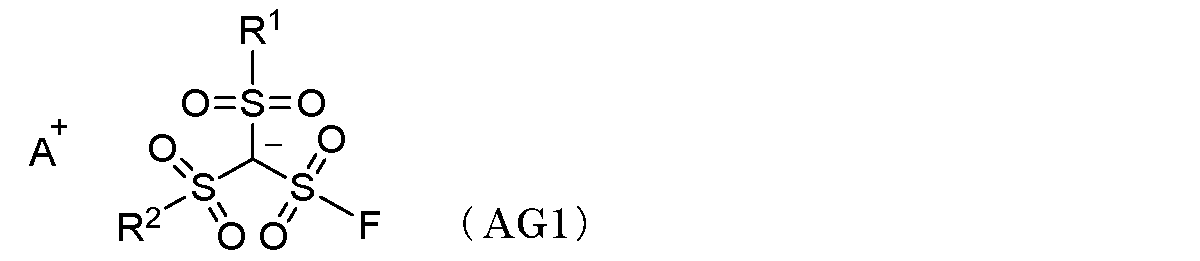
R1およびR2は、それぞれ独立にフッ素原子または-ORであり、Rは1価の有機基であり、
A+は、対カチオンである。 - 請求項1に記載の感放射線性樹脂組成物であって、
酸の作用により分解して現像液に対する溶解性が変化する樹脂を含む、感放射線性樹脂組成物。 - 請求項1に記載の感放射線性樹脂組成物であって、
酸の作用により高分子量化して現像液に対する溶解性が変化する成分を含む、感放射線性樹脂組成物。 - 請求項1~3のいずれか1項に記載の感放射線性樹脂組成物であって、
R1およびR2がともにフッ素原子である、感放射線性樹脂組成物。 - 請求項1~3のいずれか1項に記載の感放射線性樹脂組成物であって、
R1およびR2の一方がフッ素原子であり、他方が-ORである、感放射線性樹脂組成物。 - 請求項1~3のいずれか1項に記載の感放射線性樹脂組成物であって、
R1およびR2の少なくとも一方が-ORであり、Rが環状骨格を含む、感放射線性樹脂組成物。 - 請求項1~3のいずれか1項に記載の感放射線性樹脂組成物であって、
A+がスルホニウムカチオンおよびヨードニウムカチオンからなる群より選ばれる少なくともいずれかのカチオンである、感放射線性樹脂組成物。 - 請求項1~3のいずれか1項に記載の感放射線性樹脂組成物を用いて膜を形成することと、
前記膜に放射線を照射することと、
放射線が照射された前記膜を現像することと、
を含む、パターン形成方法。 - 請求項8に記載のパターン形成方法を含む、電子デバイスの製造方法。
- 以下一般式(AG1)で表される酸発生剤。
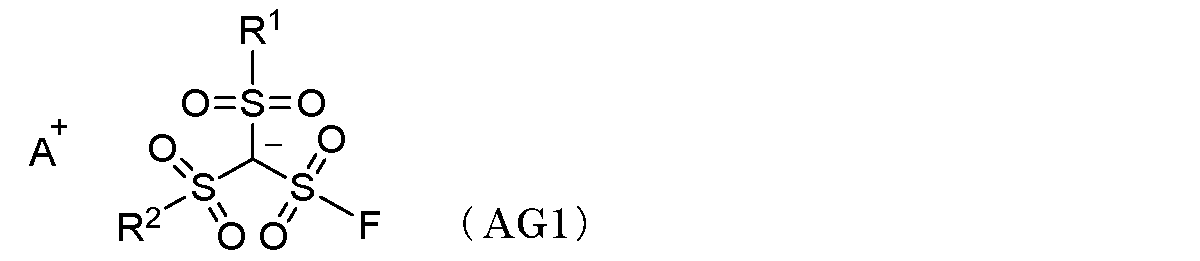
R1およびR2は、それぞれ独立にフッ素原子または-ORであり、Rは1価の有機基であり、
A+は、対カチオンである。 - 請求項10に記載の酸発生剤であって、
R1およびR2がともにフッ素原子である、酸発生剤。 - 請求項10または11に記載の酸発生剤であって、
R1およびR2の一方がフッ素原子であり、他方が-ORである、酸発生剤。 - 請求項10に記載の酸発生剤であって、
R1およびR2の少なくとも一方が-ORであり、Rが環状骨格を含む、酸発生剤。 - 請求項10または11に記載の酸発生剤であって、
A+がスルホニウムカチオンおよびヨードニウムカチオンからなる群より選ばれる少なくともいずれかのカチオンである、酸発生剤。 - 以下一般式(ag1)で表される化合物と、一般式A1 +X-(A1 +はスルホニウムカチオンまたはヨードニウムカチオンであり、X-はハライドイオン、スルホネートイオン、硫酸イオン、リン酸イオン、水酸化物イオンまたはカルボキシレートイオンである)で表される化合物とを反応させることにより、以下一般式(AG1-1)で表される化合物を製造する、化合物の製造方法。
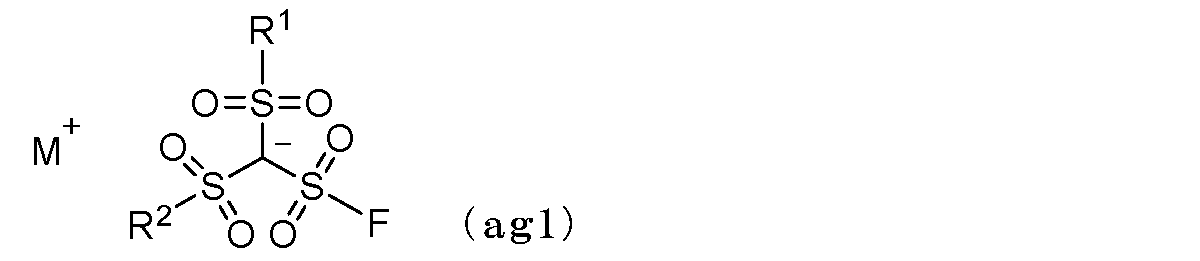
M+は、金属カチオンであり、
R1およびR2は、それぞれ独立にフッ素原子または-ORであり、Rは1価の有機基である。

A1 +の定義は前述のとおりであり、
R1およびR2は、それぞれ独立にフッ素原子または-ORであり、Rは1価の有機基である。 - 以下一般式(M-FSM)で表される化合物と、R-OHで表され、Rは1価の有機基である化合物とを反応させて、以下一般式(ag1)で表される化合物を得る工程を含む、化合物の製造方法。
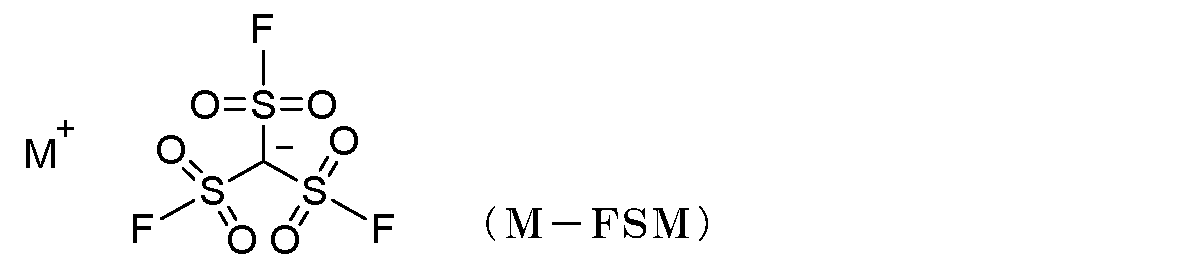
M+は、金属カチオンである。

M+は、金属カチオンであり、
R1およびR2は、それぞれ独立にフッ素原子または-ORであり、ただしR1およびR2の少なくとも一方は-ORであり、Rは1価の有機基である。 - 以下一般式(AG1)で表される化合物。

R1およびR2は、それぞれ独立にフッ素原子または-ORであり、Rは1価の有機基であり、
A+は、対カチオンである。 - 請求項17に記載の化合物であって、
R1およびR2がともにフッ素原子である、化合物。 - 請求項17または18に記載の化合物であって、
R1およびR2の一方がフッ素原子であり、他方が-ORである、化合物。 - 請求項17に記載の化合物であって、
R1およびR2の少なくとも一方が-ORであり、Rが環状骨格を含む、化合物。 - 請求項17または18に記載の化合物であって、
A+がスルホニウムカチオンおよびヨードニウムカチオンからなる群より選ばれる少なくともいずれかのカチオンである、化合物。 - 請求項17または18に記載の化合物に放射線を照射して、酸を発生させる、酸発生方法。
Applications Claiming Priority (2)
| Application Number | Priority Date | Filing Date | Title |
|---|---|---|---|
| JP2023-202572 | 2023-11-30 | ||
| JP2023202572 | 2023-11-30 |
Publications (1)
| Publication Number | Publication Date |
|---|---|
| WO2025115804A1 true WO2025115804A1 (ja) | 2025-06-05 |
Family
ID=95897889
Family Applications (1)
| Application Number | Title | Priority Date | Filing Date |
|---|---|---|---|
| PCT/JP2024/041628 Pending WO2025115804A1 (ja) | 2023-11-30 | 2024-11-25 | 感放射線性樹脂組成物、パターン形成方法、電子デバイスの製造方法、酸発生剤、化合物の製造方法、化合物および酸発生方法 |
Country Status (2)
| Country | Link |
|---|---|
| TW (1) | TW202528280A (ja) |
| WO (1) | WO2025115804A1 (ja) |
Citations (4)
| Publication number | Priority date | Publication date | Assignee | Title |
|---|---|---|---|---|
| JPH10226658A (ja) * | 1996-10-03 | 1998-08-25 | Alain Vallee | フッ素化されたイオン性スルホニルイミド及びスルホニルメチリド、それらの製造方法並びに光開始剤としての使用 |
| JP2007327983A (ja) * | 2006-06-06 | 2007-12-20 | Jsr Corp | 感放射線性樹脂組成物 |
| WO2016031961A1 (ja) * | 2014-08-29 | 2016-03-03 | 国立研究開発法人産業技術総合研究所 | イオン液体および柔粘性結晶 |
| WO2021005508A1 (fr) * | 2019-07-10 | 2021-01-14 | Sce France | Procédés de production de tris(halosulfonyl)méthane ou de ses sels |
-
2024
- 2024-11-25 WO PCT/JP2024/041628 patent/WO2025115804A1/ja active Pending
- 2024-11-29 TW TW113146308A patent/TW202528280A/zh unknown
Patent Citations (4)
| Publication number | Priority date | Publication date | Assignee | Title |
|---|---|---|---|---|
| JPH10226658A (ja) * | 1996-10-03 | 1998-08-25 | Alain Vallee | フッ素化されたイオン性スルホニルイミド及びスルホニルメチリド、それらの製造方法並びに光開始剤としての使用 |
| JP2007327983A (ja) * | 2006-06-06 | 2007-12-20 | Jsr Corp | 感放射線性樹脂組成物 |
| WO2016031961A1 (ja) * | 2014-08-29 | 2016-03-03 | 国立研究開発法人産業技術総合研究所 | イオン液体および柔粘性結晶 |
| WO2021005508A1 (fr) * | 2019-07-10 | 2021-01-14 | Sce France | Procédés de production de tris(halosulfonyl)méthane ou de ses sels |
Non-Patent Citations (1)
| Title |
|---|
| YAGUPOL'SKII, YU. L. ET AL.: "Bis(fluorosulfonyl)(phenoxysulfonyl)methane and oxosulfonium ylides from it", ZHURNAL ORGANICHESKOI KHIMII, vol. 27, no. 3, 1 January 1991 (1991-01-01), pages 492 - 498, XP009563737, ISSN: 0514-7492 * |
Also Published As
| Publication number | Publication date |
|---|---|
| TW202528280A (zh) | 2025-07-16 |
Similar Documents
| Publication | Publication Date | Title |
|---|---|---|
| TWI499597B (zh) | 光阻組成物,光阻圖型之形成方法,高分子化合物,化合物 | |
| TWI525071B (zh) | 新穎化合物 | |
| JP5732306B2 (ja) | 化合物、高分子化合物、酸発生剤、レジスト組成物、レジストパターン形成方法 | |
| JP5398246B2 (ja) | レジスト組成物およびレジストパターン形成方法 | |
| TWI542947B (zh) | 阻劑組成物及用以產生阻劑圖案的方法 | |
| JP5548487B2 (ja) | 感活性光線性又は感放射線性樹脂組成物、並びに該組成物を用いたレジスト膜及びパターン形成方法 | |
| TWI534531B (zh) | 光阻組成物,光阻圖型之形成方法,高分子化合物 | |
| JP5103316B2 (ja) | 新規なスルホニウム化合物を含有するポジ型レジスト組成物、該ポジ型レジスト組成物を用いたパターン形成方法及び新規なスルホニウム化合物 | |
| TWI464533B (zh) | 光阻組成物,光阻圖型之形成方法,新穎化合物與酸產生劑 | |
| KR101839155B1 (ko) | 레지스트 조성물, 레지스트 패턴 형성 방법, 신규 화합물, 산 발생제 | |
| JP2007293250A (ja) | ポジ型レジスト組成物およびそれを用いたパターン形成方法 | |
| JP2008107817A (ja) | レジスト組成物およびこれを用いたパターン形成方法 | |
| JP2012098390A (ja) | レジスト組成物、レジストパターン形成方法、新規な化合物、酸発生剤 | |
| WO2023120250A1 (ja) | 感活性光線性又は感放射線性樹脂組成物、感活性光線性又は感放射線性膜、パターン形成方法、電子デバイスの製造方法、及び化合物 | |
| TWI554528B (zh) | 光阻組成物,光阻圖型之形成方法 | |
| WO2010004979A1 (ja) | レジスト処理方法 | |
| TWI427416B (zh) | 正型光阻組成物、光阻圖型之形成方法、高分子化合物及化合物 | |
| WO2025115804A1 (ja) | 感放射線性樹脂組成物、パターン形成方法、電子デバイスの製造方法、酸発生剤、化合物の製造方法、化合物および酸発生方法 | |
| JP2005041857A (ja) | スルホニウム塩化合物、感放射線性酸発生剤およびポジ型感放射線性樹脂組成物 | |
| WO2010026968A1 (ja) | レジスト処理方法 | |
| JP2008089871A (ja) | レジスト組成物およびこれを用いたパターン形成方法 | |
| JP5162293B2 (ja) | 電子線、x線又はeuv光用ポジ型レジスト組成物及びそれを用いたパターン形成方法 | |
| JP5690653B2 (ja) | レジスト組成物、レジストパターン形成方法、新規な化合物、酸発生剤 | |
| JP2025071079A (ja) | 塩、酸発生剤、樹脂、レジスト組成物及びレジストパターンの製造方法 | |
| JP2025015499A (ja) | 塩、酸発生剤、化合物、樹脂、レジスト組成物及びレジストパターンの製造方法 |
Legal Events
| Date | Code | Title | Description |
|---|---|---|---|
| 121 | Ep: the epo has been informed by wipo that ep was designated in this application |
Ref document number: 24897489 Country of ref document: EP Kind code of ref document: A1 |
|
| ENP | Entry into the national phase |
Ref document number: 2025561090 Country of ref document: JP Kind code of ref document: A |
|
| WWE | Wipo information: entry into national phase |
Ref document number: 2025561090 Country of ref document: JP |