WO2025110133A1 - 熱間圧延方法、方向性電磁鋼板の製造方法および方向性電磁鋼板用熱間圧延コイル - Google Patents
熱間圧延方法、方向性電磁鋼板の製造方法および方向性電磁鋼板用熱間圧延コイル Download PDFInfo
- Publication number
- WO2025110133A1 WO2025110133A1 PCT/JP2024/040885 JP2024040885W WO2025110133A1 WO 2025110133 A1 WO2025110133 A1 WO 2025110133A1 JP 2024040885 W JP2024040885 W JP 2024040885W WO 2025110133 A1 WO2025110133 A1 WO 2025110133A1
- Authority
- WO
- WIPO (PCT)
- Prior art keywords
- hot
- steel slab
- less
- hot rolling
- heating furnace
- Prior art date
- Legal status (The legal status is an assumption and is not a legal conclusion. Google has not performed a legal analysis and makes no representation as to the accuracy of the status listed.)
- Pending
Links
Images

Classifications
-
- B—PERFORMING OPERATIONS; TRANSPORTING
- B21—MECHANICAL METAL-WORKING WITHOUT ESSENTIALLY REMOVING MATERIAL; PUNCHING METAL
- B21B—ROLLING OF METAL
- B21B1/00—Metal-rolling methods or mills for making semi-finished products of solid or profiled cross-section; Sequence of operations in milling trains; Layout of rolling-mill plant, e.g. grouping of stands; Succession of passes or of sectional pass alternations
- B21B1/22—Metal-rolling methods or mills for making semi-finished products of solid or profiled cross-section; Sequence of operations in milling trains; Layout of rolling-mill plant, e.g. grouping of stands; Succession of passes or of sectional pass alternations for rolling plates, strips, bands or sheets of indefinite length
- B21B1/24—Metal-rolling methods or mills for making semi-finished products of solid or profiled cross-section; Sequence of operations in milling trains; Layout of rolling-mill plant, e.g. grouping of stands; Succession of passes or of sectional pass alternations for rolling plates, strips, bands or sheets of indefinite length in a continuous or semi-continuous process
- B21B1/26—Metal-rolling methods or mills for making semi-finished products of solid or profiled cross-section; Sequence of operations in milling trains; Layout of rolling-mill plant, e.g. grouping of stands; Succession of passes or of sectional pass alternations for rolling plates, strips, bands or sheets of indefinite length in a continuous or semi-continuous process by hot-rolling, e.g. Steckel hot mill
-
- B—PERFORMING OPERATIONS; TRANSPORTING
- B21—MECHANICAL METAL-WORKING WITHOUT ESSENTIALLY REMOVING MATERIAL; PUNCHING METAL
- B21B—ROLLING OF METAL
- B21B3/00—Rolling materials of special alloys so far as the composition of the alloy requires or permits special rolling methods or sequences ; Rolling of aluminium, copper, zinc or other non-ferrous metals
- B21B3/02—Rolling special iron alloys, e.g. stainless steel
-
- C—CHEMISTRY; METALLURGY
- C21—METALLURGY OF IRON
- C21D—MODIFYING THE PHYSICAL STRUCTURE OF FERROUS METALS; GENERAL DEVICES FOR HEAT TREATMENT OF FERROUS OR NON-FERROUS METALS OR ALLOYS; MAKING METAL MALLEABLE, e.g. BY DECARBURISATION OR TEMPERING
- C21D8/00—Modifying the physical properties of ferrous metals or ferrous alloys by deformation combined with, or followed by, heat treatment
- C21D8/12—Modifying the physical properties of ferrous metals or ferrous alloys by deformation combined with, or followed by, heat treatment during manufacturing of articles with special electromagnetic properties
-
- C—CHEMISTRY; METALLURGY
- C21—METALLURGY OF IRON
- C21D—MODIFYING THE PHYSICAL STRUCTURE OF FERROUS METALS; GENERAL DEVICES FOR HEAT TREATMENT OF FERROUS OR NON-FERROUS METALS OR ALLOYS; MAKING METAL MALLEABLE, e.g. BY DECARBURISATION OR TEMPERING
- C21D9/00—Heat treatment, e.g. annealing, hardening, quenching or tempering, adapted for particular articles; Furnaces therefor
-
- C—CHEMISTRY; METALLURGY
- C22—METALLURGY; FERROUS OR NON-FERROUS ALLOYS; TREATMENT OF ALLOYS OR NON-FERROUS METALS
- C22C—ALLOYS
- C22C38/00—Ferrous alloys, e.g. steel alloys
-
- C—CHEMISTRY; METALLURGY
- C22—METALLURGY; FERROUS OR NON-FERROUS ALLOYS; TREATMENT OF ALLOYS OR NON-FERROUS METALS
- C22C—ALLOYS
- C22C38/00—Ferrous alloys, e.g. steel alloys
- C22C38/60—Ferrous alloys, e.g. steel alloys containing lead, selenium, tellurium, or antimony, or more than 0.04% by weight of sulfur
-
- H—ELECTRICITY
- H01—ELECTRIC ELEMENTS
- H01F—MAGNETS; INDUCTANCES; TRANSFORMERS; SELECTION OF MATERIALS FOR THEIR MAGNETIC PROPERTIES
- H01F1/00—Magnets or magnetic bodies characterised by the magnetic materials therefor; Selection of materials for their magnetic properties
- H01F1/01—Magnets or magnetic bodies characterised by the magnetic materials therefor; Selection of materials for their magnetic properties of inorganic materials
- H01F1/03—Magnets or magnetic bodies characterised by the magnetic materials therefor; Selection of materials for their magnetic properties of inorganic materials characterised by their coercivity
- H01F1/12—Magnets or magnetic bodies characterised by the magnetic materials therefor; Selection of materials for their magnetic properties of inorganic materials characterised by their coercivity of soft-magnetic materials
- H01F1/14—Magnets or magnetic bodies characterised by the magnetic materials therefor; Selection of materials for their magnetic properties of inorganic materials characterised by their coercivity of soft-magnetic materials metals or alloys
- H01F1/147—Alloys characterised by their composition
Definitions
- the present invention relates to a hot rolling method, a manufacturing method for grain-oriented electrical steel sheet, and a hot rolled coil for grain-oriented electrical steel sheet.
- Grain-oriented electrical steel sheets are usually manufactured by using precipitates called inhibitors to induce secondary recrystallization of Goss-oriented ( ⁇ 110 ⁇ 001>) grains during final annealing.
- Patent Document 1 discloses a method of using AlN as an inhibitor
- Patent Document 2 discloses a method of using MnS or MnSe as an inhibitor, both of which have been put to industrial use.
- the method of using the above inhibitors is a useful method for stably developing secondary recrystallized grains, but the precipitates must be finely dispersed. For this reason, it is necessary to heat the steel slab for grain-oriented electrical steel sheet (hereinafter simply referred to as "steel slab”) to a high temperature of 1300°C or higher before hot rolling.
- steel slab for grain-oriented electrical steel sheet
- Patent Document 3 discloses a technique that uses a highly purified steel slab that does not contain inhibitor components as the steel slab, and induces secondary recrystallization by texture (control of the aggregate structure).
- Steel slabs that contain almost no inhibitor-forming elements do not need to be heated to temperatures above 1300°C, so there is no need to use special furnaces when heating steel slabs. Therefore, hot rolling can be carried out using slab heating equipment such as gas furnaces that are used in general steel manufacturing, making it possible to manufacture grain-oriented electrical steel sheets at low cost.
- hot-rolled coil the hot-rolled coil obtained after hot rolling.
- hot-rolled sheet the hot-rolled sheet obtained after hot rolling.
- this affects the meandering of the hot-rolled coil in the subsequent hot-rolled sheet (hereinafter also referred to as “hot-rolled sheet”) annealing process and the breakage of the sheet in the cold rolling process, and is one of the factors that hinders production on an industrial scale.
- the present invention was made in consideration of the above problems, and its purpose is to propose a hot rolling method that can produce hot rolled coils with fewer surface defects.
- the locations where surface defects occur generally correspond to the positions of the skid that supported the steel slab when the steel slab was heated, where the material temperature was thought to be around 1,050°C (i.e., the positions on the steel slab with which the skid was in contact).
- the gamma phase ratio of the steel slab at around 1050°C is approximately 20 mol% or less.
- the air-fuel ratio during heating the ratio of the mass of air to the mass of fuel gas
- the occurrence rate of defects is high when the ratio of the mass of air is high.
- the ⁇ phase ratio in 2) above was calculated using thermodynamics software Thermo-calc ver. 2019b (database TCFE7) manufactured by Thermo-Calc Software AB.
- FIG. 1 shows a schematic diagram of an example of a walking beam type slab heating furnace (hereinafter also simply referred to as a "heating furnace").
- a walking beam type heating furnace a steel slab 1 is generally supported and transported by multiple skids 2 that extend approximately parallel to one another.
- the skids 2 are arranged in an alternating fashion of fixed skids and movable skids, and the movable skids move up and down to lift the steel slab 1 and transport it little by little from the furnace loading side to the furnace unloading side.
- shift skids 3 are often provided inside the heating furnace, and the furnace is configured so that the position of the skid 2 supporting the steel slab 1 changes before and after the shift skid 3.
- the inventors confirmed the corresponding position on the steel slab 1 for the position where the surface defect occurred on the hot rolled coil, taking into consideration the length of the steel slab 1 before rolling. As a result, it was found to be almost identical to the position of the skid 2 that supported the steel slab 1 when the temperature of the steel slab 1 was around 1050°C during its stay in the heating furnace (i.e., the position where the bottom surface of the steel slab 1 was in contact with the skid 2). However, in reality, the steel slab 1 meandered slightly during transport in the heating furnace, resulting in an error (deviation) of 0.15 m from the corresponding position on the steel slab 1.
- Creep deformation occurring at high temperatures is likely to occur in the ⁇ (ferrite) phase and slows down in the ⁇ (austenite) phase, but since the frequency of occurrence varies depending on the ⁇ phase ratio of steel slab 1, creep behavior may be one of the factors. Furthermore, since the occurrence rate also varies depending on the air-fuel ratio during heating, there is a possibility that the atmosphere, particularly the oxygen concentration, may be an influence.
- a steel slab 1 was cast in which, by mass%, C: 0.04%, Si: 3.0%, Mn: 0.10%, Al: 0.007%, N, O, S + 0.405 ⁇ Se were suppressed to less than 0.0060%, and the balance was Fe and unavoidable impurities.
- a test piece 4 mm square and 40 mm long was taken from the surface of the cast steel slab 1, and the test piece was heated uniformly in a heating furnace at a temperature of 900 ° C. to 1200 ° C., and stress was applied to the test piece so that it was bent at three points, and a creep test was performed.
- the oxygen concentration in the heating furnace was changed from 0 volume % (100 volume % N 2 ) to 20 volume % (80 volume % N 2 ). As a result, it was revealed that under conditions of high oxygen concentration and in a specific temperature range, the test piece was not only deformed but also progressed to cracking.
- the inventors have deduced the mechanism by which surface defects are formed as follows. That is, when the oxygen concentration is high on the surface of the steel slab 1 where tensile stress occurs directly above the skid 2, grain boundary embrittlement occurs due to oxidation, which progresses to cracking during hot working. However, in skids 2 where the distance between two adjacent skids 2 is small, the stress that each skid 2 exerts on the steel slab 1 is small and deformation is also suppressed, so this does not progress to cracking.
- the inventors investigated ways to reduce surface defects in hot-rolled coils.
- Electrical steel sheets contain a high concentration of Si in order to improve the final magnetic properties.
- Si stabilizes the ⁇ phase and reduces the gamma phase ratio when heated to high temperatures.
- Another element that greatly affects the gamma phase ratio is C, but since C has the effect of improving the hot-rolled structure and the texture during primary recrystallization, there is an optimum amount from the perspective of improving the final magnetic properties. Therefore, it is difficult to adopt a method of increasing the gamma phase ratio at a given temperature by significantly changing the composition of electrical steel sheets that have already been manufactured in a process.
- the temperature of the steel slab 1 gradually increases inside the heating furnace, it is difficult to completely avoid the above temperature range, even if it is possible to shorten the residence time in a specific temperature range. Furthermore, since the steel slab 1 is supported by the skid 2, it is difficult to ensure that no stress is applied to the steel slab 1. The inventors therefore came up with a method for appropriately controlling the oxygen concentration inside the heating furnace in a specific temperature range, and completed the present invention.
- a hot rolling method for heating a steel slab in a heating furnace and then hot rolling the same In a temperature range T in which the temperature of the steel slab in the heating furnace is 950° C. or higher and 1150° C. or lower, When a steel slab having a composition in which the gamma phase ratio is 20 mol% or less at 1050°C, which is the median value of the temperature range T, is heated, a heating furnace in which the distance between multiple skids supporting the steel slab exceeds 1.1 m is used.
- a hot rolling method characterized in that an average oxygen concentration in the heating furnace in the temperature range T is 5.0 volume % or less.
- a method for producing grain-oriented electrical steel sheet comprising hot rolling a steel slab using the hot rolling method described in any one of [1] to [3] above, annealing the resulting hot-rolled coil, cold rolling once or at least twice with intermediate annealing, optionally followed by decarburization annealing, and then final annealing to obtain grain-oriented electrical steel sheet.
- L 0 (m) is given by the following formula (1) where X is the width of the skid, Y 1 (m) is the thickness of the steel slab, and Y 2 (m) is the thickness of the hot rolled coil for grain-oriented electrical steel sheet.
- L 0 (m) ⁇ 0.15 (m) + X (m) ⁇ x Y 1 (mm) / Y 2 (mm) (1)
- the present invention makes it possible to obtain hot-rolled coils with fewer surface defects.
- FIG. 1 is a schematic diagram of an example of a walking beam type slab heating furnace.
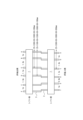
- FIG. 2 is a diagram showing details of a skid in a heating furnace used in the examples.
- the hot rolling method according to the present invention is a hot rolling method in which a steel slab is heated in a heating furnace and then hot rolled.
- the average oxygen concentration in the heating furnace in the temperature range T is set to 5.0 volume% or less when a heating furnace in which the distance between multiple skids supporting the steel slab exceeds 1.1 m is used.
- a steel slab 1 for grain-oriented electrical steel sheet is used as a starting material.
- a suitable composition of the steel slab 1 will be described.
- “%” means “mass %”
- “ppm” means “mass ppm” unless otherwise specified.
- Steel slab 1 preferably has a composition containing C, Si, and Mn in the ranges described below, with the remainder being Fe and unavoidable impurities.
- the present invention preferably performs two hot rollings under appropriate conditions in a specific temperature range (1030°C or more and 1150°C or less) to reduce the sulfides and selenides present in the central layer of the steel slab 1 to a size smaller than the size that becomes a problem during cold rolling.
- the temperature range of hot rolling is almost entirely ferrite single phase, but the target temperature coincides with the temperature range in which the austenite phase is formed, although with a small volume fraction, suggesting that it contributes to the division and destruction of sulfides and selenides.
- the effect of division and destruction of sulfides and selenides cannot be obtained in steel with a C content of 0.02%. Therefore, the C content is preferably 0.03% or more.
- Si 2.0% to 8.0%
- Si is a useful element that improves iron loss by increasing electrical resistance.
- the Si content is preferably 2.0% or more.
- Si is also an element that increases the brittleness of steel, and if the Si content exceeds 8.0%, the risk of breakage during equipment threading increases and the cold rolling property also deteriorates significantly. Therefore, the Si content is preferably 8.0% or less. Since the risk during equipment threading can be further reduced, the Si content is more preferably 2.8% to 4.5%.
- Mn 0.005% or more and 3.0% or less
- Mn is an element that has the effect of improving hot workability during manufacturing. If the Mn content is less than 0.005%, the effect is poor in terms of both improving hot workability and controlling oxide film formation. Therefore, the Mn content is preferably 0.005% or more. On the other hand, if the Mn content exceeds 3.0%, the primary recrystallization texture deteriorates, leading to deterioration of magnetic properties. Therefore, the Mn content is preferably 3.0% or less. The Mn content is more preferably 0.010% or more and 0.5% or less.
- the contents of Al, N, S, and Se which are components that form inhibitors, as much as possible. In this case, it is possible to cause secondary recrystallization of the Goss orientation due to the texture inhibition effect. Therefore, it is preferable to reduce the contents of Al, N, S, and Se in the composition of the steel slab to the following ranges.
- the Al content is preferably less than 0.010%.
- the lower the Al content the more preferable it is, and it may be 0%.
- O 0.006% or less
- O also forms oxides and deteriorates the magnetic properties of the final product sheet. Therefore, the content of O is preferably 0.006% or less, and more preferably 0.003% or less.
- N 0.006% or less N generates Si nitrides after purification annealing.
- the N content is preferably 0.006% or less.
- the lower the N content the more preferable it is, and it may be 0%.
- S+0.405 ⁇ Se 0.0060% or less
- S+0.405 ⁇ Se 0.0060% or less
- S+0.405 ⁇ Se 0.0060% or less
- the lower S+0.405 ⁇ Se is preferable, and it may be 0%, but excessive reduction leads to increased manufacturing costs. Therefore, it is preferable to set S+0.405 ⁇ Se to 0.0010% or more.
- the present invention also contains the following elements: Ni: 0.005% or more and 1.50% or less Sn: 0.01% or more and 0.50% or less; It is possible to contain one or more elements selected from the group consisting of Sb: 0.005% or more and 0.50% or less, Cu: 0.01% or more and 0.50% or less, Mo: 0.01% or more and 0.50% or less, P: 0.0050% or more and 0.50% or less, Cr: 0.01% or more and 1.50% or less, B: 0.0005% or more and 0.0200% or less, Bi: 0.0005% or more and 0.0200% or less, Nb: 0.0005% or more and 0.0200% or less, Ti: 0.0005% or more and 0.0200% or less, and Te: 0.0005% or more and 0.0200% or less.
- Sb 0.005% or more and 0.50% or less
- Cu 0.01% or more and 0.50% or less
- Mo 0.01% or more and 0.50% or less
- P 0.0050% or more and
- Ni 0.005% or more and 1.50% or less
- Ni is a useful element that improves the hot-rolled sheet structure and improves the magnetic properties.
- the Ni content is preferably 0.005% or more.
- the Ni content is preferably 1.50% or less.
- Nb 0.0005% or more and 0.0200% or less
- Ti 0.0005% or more and 0.0200% or less
- Te 0.0005% or more and 0.0200% or less
- Nb, Ti and Te are precipitate forming elements.
- the contents of Nb, Ti and Te are equal to or more than the lower limit value.
- the contents of Nb, Ti and Te exceed the upper limit value of the above range, it makes the secondary recrystallization unstable. Therefore, it is preferable that the contents of Nb, Ti and Te are equal to or less than the upper limit value.
- the molten steel adjusted to the above-mentioned suitable composition is refined by a known method using a converter, electric furnace, etc., and if necessary, subjected to vacuum treatment, etc., and then a steel slab 1 is produced using a normal ingot-making method or continuous casting method. Also, a thin cast piece having a thickness of 100 mm or less may be directly produced using a direct casting method.
- the steel slab 1 having the above-mentioned composition is hot-rolled to obtain a hot-rolled sheet.
- the steel slab 1 can be heated in a heating furnace to a temperature of, for example, 1050°C or more and less than 1300°C, and then hot-rolled.
- the steel slab 1 in the present invention does not need to be subjected to high-temperature treatment of 1300°C or more, particularly for complete solid solution of precipitates, when the inhibitor components are preferably suppressed. If the steel slab 1 is heated to a temperature of 1300°C or more, the crystal structure becomes too large and it becomes difficult to control the texture, so the maximum temperature during heating is preferably less than 1300°C.
- the temperature of the steel slab 1 is the surface temperature of the steel slab 1.
- the distance between skids is not necessarily equal.
- a defect occurs at a position on the hot rolled coil corresponding to the contact position between the skid 2 and the steel slab 1. Therefore, focusing on a certain skid 2, when the distance to two adjacent skids 2 exceeds 1.1 m on both sides, the average oxygen concentration in the heating furnace is set to 5.0 volume % or less.
- skid spacing does not refer to the distance between the centers of two skids 2, but rather refers to the distance of the space (gap) between the centers of two skids 2.
- the skid spacing is not taken into consideration for the skids 2 at both ends.
- the average oxygen concentration in the heating furnace refers to the time average of the oxygen concentration in the heating furnace.
- the heating temperature of the steel slab 1 is in the range of 950°C to 1150°C, for example 1050°C
- the average oxygen concentration in the heating furnace is set to 5.0 volume% or less in the temperature range of 950°C to 1050°C.
- the effect of suppressing the formation of surface defects can be greatly achieved by setting the average oxygen concentration to 5.0 vol.% or less. It is more preferable to set the average oxygen concentration to 3.0 vol.% or less, as this can further enhance the effect of suppressing the formation of surface defects, and it is even more preferable to set the average oxygen concentration to 0.5 vol.% or less, as this can almost completely prevent the formation of surface defects.
- the temperature range T of 950°C or more and 1150°C or less often corresponds to the middle of the heating process in slab heating. Therefore, in the above temperature range T, it is rare to directly measure the temperature of the steel slab 1 or to continuously sample the atmospheric gas at the target location in the heating furnace to measure the oxygen concentration. On the other hand, the atmosphere in the furnace changes from moment to moment, as the air-fuel ratio changes when the temperature inside the furnace is changed, and air is drawn in when the steel slab 1 is put in and taken out.
- the oxygen concentration in order to control the oxygen concentration as described above, it is preferable to directly measure the slab temperature or to grasp the target temperature range by calculation, and to use a heating furnace having a mechanism for continuously measuring the atmosphere at at least one location in the heating furnace in order to continuously grasp the gas atmosphere in the target temperature range, and to increase the amount of inert gas introduced to reduce the oxygen concentration in response to the fluctuations.
- hot rolling is applied to the steel slab 1.
- the following rolling conditions it is preferable that at least two consecutive passes of rolling from the stage of the steel slab 1 to the formation of the sheet bar are performed in a temperature range of 1030°C to 1150°C, with each pass having a reduction rate of 50% or less and a strain rate of 15/sec or more, and the time between two passes being 5 seconds or more. It is even more preferable that the time between two passes be 15 seconds or more.
- the gamma phase ratio is maximum at a temperature of approximately 1030°C to 1150°C.
- the austenite phase has a higher deformation resistance than the ferrite phase, and is less likely to deform when rolled down. Therefore, it is preferable to limit the reduction rate of each pass to 50% or less. If the reduction rate is excessively large, even if the surface defect was minor before rolling down, the cracks will be greatly expanded by friction with the roll and will become more likely to become apparent.
- the time between two passes is set to 15 seconds or more.
- dislocations formed by deformation once will recover or disappear by recrystallization, so that rolling can be performed without excessively increasing the deformation resistance. This also works advantageously in terms of friction suppression.
- the strain rate was calculated using the following Ekeland formula (2).
- d ⁇ /dt is the strain rate (/sec)
- vR is the roll peripheral speed (mm/sec)
- R′ is the roll radius (mm)
- h1 is the roll entry thickness (mm)
- r is the reduction ratio (%).
- the presence or absence of surface defects in hot-rolled coils can be evaluated visually.
- the presence or absence of surface defects can be more easily evaluated by subjecting the hot-rolled coil to a process that makes surface defects more apparent. For example, a sample is cut from a portion of the hot-rolled coil that corresponds to the position of the skid 2 that supports the steel slab 1 in the heating furnace, and the sample is then pickled to remove surface scale, dried at 180°C for one minute, and then left to stand for several days. This causes localized rusting in the areas where defects exist, making it easier to evaluate the presence or absence of surface defects.
- a defect detector that uses a general defect evaluation device such as an eddy current sensor or an optical camera.
- a method for determining a position in a hot-rolled coil that corresponds to the position of the skid 2 supporting the steel slab 1 in a heating furnace (i.e., the contact position between the steel slab 1 and the skid 2).
- a skid 2 of interest i.e., the skid spacing is more than 1.1 m
- the width of the skid 2 itself supporting the steel slab 1 is 50 mm.
- the width of the skid 2 that contacts the steel slab 1 is 50 mm, but the 50 mm wide area in the steel slab 1 expands to a 35 m wide area in the hot rolled coil due to the 0.15 m error mentioned above and the 50 mm width of the skid 2. Therefore, the area 17.5 m in front and behind the position 300 m from the longitudinal end of the hot rolled coil corresponds to a position 3 m from the longitudinal end of the steel slab 1.
- the width of the steel slab 1 increases due to rolling (for example, if a steel slab 1 that is 1 m wide becomes 1.1 m wide), the amount of extension in the longitudinal direction is subtracted to take into account the increase in width.
- an area of 17.5 m in front and behind the end, centered at a position 300 m from the end, is evaluated for surface defects, and the number of surface defects within that area is evaluated.
- the method of the present invention it is possible to suppress the occurrence of surface defects in hot-rolled coils, and by accumulating the number of surface defects for multiple hot-rolled coils or multiple target skids for a single hot-rolled coil and averaging them as the amount of defects occurring per skid (for example, for 20 or more coils), it is possible to reduce the number to 0.3 or less.
- the method for producing a grain-oriented electrical steel sheet according to the present invention is characterized in that a steel slab 1 is hot-rolled by the above-mentioned hot rolling method according to the present invention, the obtained hot-rolled coil is subjected to hot-rolled sheet annealing, and then cold rolling is performed once or at least twice with intermediate annealing therebetween, and then optionally decarburization annealing is performed, followed by final annealing to obtain a grain-oriented electrical steel sheet.
- the hot-rolled sheet is annealed and cold-rolled, but with hot-rolled coils that have reduced surface defects, breakage during the cold rolling process can be reduced.
- Hot-rolled sheet annealing is preferably performed at 1150°C or less. If the temperature of hot-rolled sheet annealing exceeds 1150°C, the inhibitor-forming components that are inevitably mixed in will dissolve and will re-precipitate unevenly during cooling, making it difficult to achieve a regular grain primary recrystallization structure and inhibiting the development of secondary recrystallization. Furthermore, if the temperature of hot-rolled sheet annealing exceeds 1150°C, the grain size after hot-rolled sheet annealing will become too coarse, which is also detrimental to achieving an appropriate primary recrystallization structure. Therefore, hot-rolled sheet annealing is preferably performed at 1150°C or less.
- the steel is cold-rolled at least once, with intermediate annealing as necessary, and then decarburization annealing is performed to reduce the C content to 50 ppm or less, at which point magnetic aging does not occur, and preferably to 30 ppm or less.
- the decarburization annealing after the final cold rolling is also intended to decarburize and to primary recrystallize the cold rolled sheet having a rolling structure, thereby adjusting the primary recrystallized grain size to an optimal size for secondary recrystallization.
- the decarburization annealing is performed in a H2 mixed atmosphere with a dew point at 750°C to 900°C.
- the temperature increase rate from 550°C to 680°C is set to 200°C/sec or more, so that the texture improvement effect can be further enhanced.
- a technique for increasing the Si content by siliconizing or a technique for increasing the N content by nitriding may be used in combination after the decarburization annealing.
- a forsterite film may be formed using an annealing separator mainly composed of MgO.
- the formation of the forsterite film can be further promoted by adding an appropriate amount of Ti oxide, Sr compound, etc. to the separator.
- the addition of an auxiliary agent that promotes the formation of the forsterite film uniformly is advantageous for improving the peeling characteristics.
- the formation of the film may be suppressed by using any annealing separator such as Al2O3 .
- the final annealing is preferably performed at 800°C or higher to induce secondary recrystallization, but the heating rate up to 800°C does not significantly affect the magnetic properties, so it can be performed under any conditions.
- the annealing atmosphere can be any of N2 , Ar, H2 , or a mixture of these gases.
- the material can be isothermally held near the secondary recrystallization temperature. However, this can be achieved by slowing down the heating rate, so isothermal holding is not necessarily required. If trace elements are precipitated in the final product, this will lead to deterioration of the magnetic properties, so the maximum annealing temperature is preferably 1100°C or higher to purify the elements.
- an insulating coating can be applied and baked on the surface of the steel sheet.
- any conventionally known insulating coating is suitable.
- a suitable method is to apply a coating liquid containing phosphate, chromate, and colloidal silica, as described in JP-A-50-79442 and JP-A-48-39338, to the steel sheet and bake it at about 800°C.
- flattening annealing can be used to adjust the shape of the steel sheet, and this flattening annealing can also be combined with the baking process of the insulating coating.
- the hot rolled coil for grain-oriented electrical steel sheet according to the present invention is a hot rolled coil for grain-oriented electrical steel sheet obtained by hot rolling a steel slab 1 by the above-mentioned hot rolling method according to the present invention, characterized in that the number of surface defects is an average of 0.3 or less in a range L 0 (m) forward and backward in the rolling direction of the hot rolling with respect to a location corresponding to a position on the skid 2 when the steel slab 1 is heated, where L 0 (m) is given by the following formula (1) where X is the width of the skid 1, Y 1 (m) is the thickness of the steel slab 1, and Y 2 (m) is the thickness of the hot rolled coil for grain-oriented electrical steel sheet.
- L 0 (m) ⁇ 0.15 (m) + X (m) ⁇ x Y 1 (mm) / Y 2 (mm) (1)
- the hot rolling method according to the present invention is characterized in that in a temperature range T in which the temperature of the steel slab 1 in the heating furnace is 950° C. or more and 1150° C. or less, the average oxygen concentration in the heating furnace in the temperature range T is 5.0 volume % or less. This makes it possible to reduce surface defects at a position in the hot rolled coil corresponding to the position supported by the target skid 2 in the steel slab 1.
- a region L 0 (m) before and after a position X (m) ⁇ Y 1 (mm)/Y 2 (mm) from the end of the hot rolled coil corresponds to the position where the steel slab 1 is supported by the target skid 2, and the occurrence of surface defects in the above region can be suppressed to an average of 0.3 or less.
- the average number of surface defects can be, for example, an average for 20 or more coils.
- Example 1 A steel slab 1 having a thickness of 200 mm and containing, in mass%, C: 0.035% to 0.055%, Si: 3.0% to 3.4%, Mn: 0.07%, Al: 0.005% to 0.008%, N, O, S + 0.405 ⁇ Se: each less than 0.0060%, and the balance being Fe and unavoidable impurities and containing no inhibitor components, was heated in a heating furnace equipped with a plurality of skids 2 having a skid width of 50 mm and a skid spacing as shown in Fig. 2. The sum of the numerical values in Fig. 2 indicates the distance from the center of skid D or the center of skid C to the longitudinal end of the steel slab 1.
- Pattern A in which the steel slab 1 was heated to 1150°C upstream of the shift skid 3 (hereinafter also referred to as “before the shift") and to 1250°C downstream of the shift skid 3 (hereinafter referred to as “after the shift")
- Pattern B in which the steel slab 1 was heated to 950°C before the shift and to 1200°C after the shift.
- a heat-resistant gas suction tube was installed in the heating furnace, and a mechanism for continuously measuring the oxygen concentration was provided, and the amount of N2 gas supplied to the positions before and after the shift was controlled to control the opening and closing of the heating furnace and the change in the burner combustion efficiency in real time.
- the finish hot rolling performed in multiple passes in the temperature range of 850 ° C. to 950 ° C. was performed to finish the steel slab to a thickness of 2.0 mm.
- the width was suppressed as much as possible by applying an appropriate tension to the steel plate between the rolls. 20 hot rolled coils were produced under the same manufacturing conditions.
- samples were cut out from the longitudinal end, which was used as a reference point, at a location on the steel slab 1 supported by the target skid 2 (the contact position between the steel slab 1 and the target skid 2).
- the samples were pickled in 5% HCl at 80°C for 120 seconds to remove surface scale, and then the surface was dried by heat treatment at 180°C for 1 minute. After leaving it for 7 days, the number of locations where localized rust had occurred was confirmed. The results are shown in Table 2.
- the skids 2 targeted by the present invention are those indicated by "c" before the shift and "C and D” after the shift, and in the comparative example, the number of surface defects was high at 2.5 or more per skid. In contrast, in the invention example, the number of surface defects was low at 0.3 or less per skid, and when the oxygen concentration was 3.0 volume% or less, the number was 0.1 or less per skid, meaning that surface defects were almost completely prevented. Thus, it can be seen that the number of surface defects can be significantly reduced by the present invention.
- Example 2 Steel slab 1 containing 0.04% C, 3.3% Si, 0.05% Mn, and other components shown in Table 3, and calculated to have a gamma phase rate of 20 mol% or less in all temperature ranges, was heated to 1150 ° C. before shifting and to 1250 ° C. after shifting using a heating furnace having the skid arrangement of FIG. 2 in the same manner as in Example 1, and hot rolled under the conditions shown in Table 3. Some hot rolled coils were produced under the same conditions, and 20 coils were cut out from 10 coils at a position corresponding to the position supported by the skid 2 marked with the symbol "c" in the steel slab 1, and the amount of surface defects was evaluated in the same manner as in Example 1.
- the hot rolled coils (10 coils each) for which no samples were taken were subjected to hot rolled sheet annealing at an attained temperature of 1020 ° C. Thereafter, each material was divided into a two-rolling method in which the final plate thickness was obtained by rolling twice, and a one-rolling method in which the final plate thickness was obtained by rolling once.
- the first cold rolling was performed at 100 ° C. to 1.7 mm in a reverse mill, and after the target thickness was reached, intermediate annealing was performed at 900 ° C. for 1 minute, and then the second reverse cold rolling was performed again, and the thickness was reduced to 0.22 mm while performing winding aging treatment at 200 ° C. in the middle.
- the material allocated to the one-rolling method was rolled to a thickness of 0.26 mm using a tandem mill. It was also evaluated at the same time whether each material (10 coils) broke during the rolling line.
- the cold-rolled sheet with the final thickness was subjected to primary recrystallization annealing with a heating rate of 300 ° C. / sec at 550 ° C. to 680 ° C., a soaking temperature of 840 ° C., and a soaking time of 60 seconds, and an annealing separator of MgO: 95% and TiO 2 : 5% was applied to the steel sheet surface as a water slurry and subjected to secondary recrystallization annealing.
- a coating solution containing phosphate-chromate-colloidal silica in a mass ratio of 3:1:3 was applied to the surface of the finish annealed sheet thus obtained, and baked at 800°C.
- the magnetic properties of the center of the width of the obtained product sheet coil were also confirmed.
- Table 3 when “other components” are not included, the magnetic properties can be judged to be good if B8 (magnetic flux density at magnetizing force of 800 A/m) is 1.910 or more, and when “other components” are included, the magnetic properties can be judged to be good if B8 is 1.915 or more.
- Table 3 shows that the manufacturing stability is improved and good magnetic properties are obtained in the examples of the invention.
- the present invention makes it possible to obtain hot-rolled coils with fewer surface defects.
Landscapes
- Chemical & Material Sciences (AREA)
- Engineering & Computer Science (AREA)
- Mechanical Engineering (AREA)
- Organic Chemistry (AREA)
- Materials Engineering (AREA)
- Metallurgy (AREA)
- Physics & Mathematics (AREA)
- Electromagnetism (AREA)
- Thermal Sciences (AREA)
- Crystallography & Structural Chemistry (AREA)
- Dispersion Chemistry (AREA)
- Power Engineering (AREA)
- Manufacturing & Machinery (AREA)
- Manufacturing Of Steel Electrode Plates (AREA)
Priority Applications (1)
| Application Number | Priority Date | Filing Date | Title |
|---|---|---|---|
| JP2025520975A JPWO2025110133A1 (https=) | 2023-11-22 | 2024-11-18 |
Applications Claiming Priority (2)
| Application Number | Priority Date | Filing Date | Title |
|---|---|---|---|
| JP2023-198573 | 2023-11-22 | ||
| JP2023198573 | 2023-11-22 |
Publications (1)
| Publication Number | Publication Date |
|---|---|
| WO2025110133A1 true WO2025110133A1 (ja) | 2025-05-30 |
Family
ID=95826741
Family Applications (1)
| Application Number | Title | Priority Date | Filing Date |
|---|---|---|---|
| PCT/JP2024/040885 Pending WO2025110133A1 (ja) | 2023-11-22 | 2024-11-18 | 熱間圧延方法、方向性電磁鋼板の製造方法および方向性電磁鋼板用熱間圧延コイル |
Country Status (2)
| Country | Link |
|---|---|
| JP (1) | JPWO2025110133A1 (https=) |
| WO (1) | WO2025110133A1 (https=) |
Citations (5)
| Publication number | Priority date | Publication date | Assignee | Title |
|---|---|---|---|---|
| JPS52105507A (en) * | 1976-03-03 | 1977-09-05 | Kawasaki Steel Co | Arrangements for heating steel slabs |
| JPS5470907U (https=) * | 1977-10-28 | 1979-05-19 | ||
| JPS60114518A (ja) * | 1983-11-24 | 1985-06-21 | Kawasaki Steel Corp | 一方向性けい素鋼板の製造方法 |
| US4898628A (en) * | 1989-01-19 | 1990-02-06 | Armco Advanced Materials Corporation | Hot working method for producing grain oriented silicon steel with improved glass film formation |
| JP2004291051A (ja) * | 2003-03-27 | 2004-10-21 | Jfe Steel Kk | 方向性電磁鋼板の熱間圧延方法 |
-
2024
- 2024-11-18 JP JP2025520975A patent/JPWO2025110133A1/ja active Pending
- 2024-11-18 WO PCT/JP2024/040885 patent/WO2025110133A1/ja active Pending
Patent Citations (5)
| Publication number | Priority date | Publication date | Assignee | Title |
|---|---|---|---|---|
| JPS52105507A (en) * | 1976-03-03 | 1977-09-05 | Kawasaki Steel Co | Arrangements for heating steel slabs |
| JPS5470907U (https=) * | 1977-10-28 | 1979-05-19 | ||
| JPS60114518A (ja) * | 1983-11-24 | 1985-06-21 | Kawasaki Steel Corp | 一方向性けい素鋼板の製造方法 |
| US4898628A (en) * | 1989-01-19 | 1990-02-06 | Armco Advanced Materials Corporation | Hot working method for producing grain oriented silicon steel with improved glass film formation |
| JP2004291051A (ja) * | 2003-03-27 | 2004-10-21 | Jfe Steel Kk | 方向性電磁鋼板の熱間圧延方法 |
Also Published As
| Publication number | Publication date |
|---|---|
| JPWO2025110133A1 (https=) | 2025-05-30 |
Similar Documents
| Publication | Publication Date | Title |
|---|---|---|
| JP5772410B2 (ja) | 方向性電磁鋼板の製造方法 | |
| KR101351706B1 (ko) | 방향성 전자기 강판의 제조 방법, 권취 철심용 방향성 전자기 강판 및 권취 철심 | |
| JP7364966B2 (ja) | 方向性電磁鋼板の製造方法 | |
| US12344909B2 (en) | Method for producing grain-oriented electrical steel sheet and cold-rolling facility | |
| JP7052391B2 (ja) | 方向性電磁鋼板、および方向性電磁鋼板の製造方法 | |
| KR101389248B1 (ko) | 방향성 전자기 강판의 제조 방법 | |
| KR102517647B1 (ko) | 방향성 전자 강판의 제조 방법 및 방향성 전자 강판 | |
| KR102499994B1 (ko) | 방향성 전자 강판의 제조 방법 및 방향성 전자 강판 | |
| CN108779509B (zh) | 取向性电磁钢板的制造方法及生产设备线 | |
| JP2008063655A (ja) | 板幅方向にわたり安定して磁気特性が得られる方向性電磁鋼板の製造方法 | |
| JP6137490B2 (ja) | 一次再結晶集合組織の予測方法および方向性電磁鋼板の製造方法 | |
| JP7508012B2 (ja) | 方向性電磁鋼板およびその製造方法 | |
| JP4258156B2 (ja) | 方向性電磁鋼板およびその製造方法 | |
| JP5668440B2 (ja) | 珪素含有鋼スラブの熱間圧延方法 | |
| JP4893259B2 (ja) | 方向性電磁鋼板用焼鈍分離剤の塗布方法および方向性電磁鋼板の製造方法 | |
| WO2025110133A1 (ja) | 熱間圧延方法、方向性電磁鋼板の製造方法および方向性電磁鋼板用熱間圧延コイル | |
| KR20250122492A (ko) | 방향성 전자 강판의 제조 방법 | |
| JP7782755B2 (ja) | 熱間圧延方法、熱延コイルの製造方法、方向性電磁鋼板の製造方法及びスラブ加熱設備 | |
| KR20260051482A (ko) | 열간 압연 방법, 방향성 전기 강판의 제조 방법 및 방향성 전기 강판용 열간 압연 코일 | |
| JP7264322B1 (ja) | 方向性電磁鋼板の製造方法 | |
| WO2025115662A1 (ja) | 熱間圧延方法、熱延コイルの製造方法及び方向性電磁鋼板の製造方法 | |
| US20250146110A1 (en) | Method for manufacturing grain-oriented electrical steel sheet, and grain-oriented electrical steel sheet | |
| JP7670948B2 (ja) | 方向性電磁鋼板の製造方法 | |
| US20250236926A1 (en) | Grain-Oriented Electrical Steel Sheet and Method for Its Production | |
| WO2025187797A1 (ja) | 方向性電磁鋼板およびその製造方法 |
Legal Events
| Date | Code | Title | Description |
|---|---|---|---|
| ENP | Entry into the national phase |
Ref document number: 2025520975 Country of ref document: JP Kind code of ref document: A |
|
| WWE | Wipo information: entry into national phase |
Ref document number: 2025520975 Country of ref document: JP |
|
| 121 | Ep: the epo has been informed by wipo that ep was designated in this application |
Ref document number: 24894124 Country of ref document: EP Kind code of ref document: A1 |
|
| WWE | Wipo information: entry into national phase |
Ref document number: 2024894124 Country of ref document: EP |
|
| ENP | Entry into the national phase |
Ref document number: 1020267010536 Country of ref document: KR Free format text: ST27 STATUS EVENT CODE: A-0-1-A10-A15-NAP-PA0105 (AS PROVIDED BY THE NATIONAL OFFICE) |