WO2025109967A1 - ガスタービンシステムおよびガスタービンシステムを改造するための方法 - Google Patents
ガスタービンシステムおよびガスタービンシステムを改造するための方法 Download PDFInfo
- Publication number
- WO2025109967A1 WO2025109967A1 PCT/JP2024/038640 JP2024038640W WO2025109967A1 WO 2025109967 A1 WO2025109967 A1 WO 2025109967A1 JP 2024038640 W JP2024038640 W JP 2024038640W WO 2025109967 A1 WO2025109967 A1 WO 2025109967A1
- Authority
- WO
- WIPO (PCT)
- Prior art keywords
- gas turbine
- fuel
- adjuster
- flow rate
- combustor
- Prior art date
- Legal status (The legal status is an assumption and is not a legal conclusion. Google has not performed a legal analysis and makes no representation as to the accuracy of the status listed.)
- Pending
Links
Images


Classifications
-
- F—MECHANICAL ENGINEERING; LIGHTING; HEATING; WEAPONS; BLASTING
- F02—COMBUSTION ENGINES; HOT-GAS OR COMBUSTION-PRODUCT ENGINE PLANTS
- F02C—GAS-TURBINE PLANTS; AIR INTAKES FOR JET-PROPULSION PLANTS; CONTROLLING FUEL SUPPLY IN AIR-BREATHING JET-PROPULSION PLANTS
- F02C7/00—Features, components parts, details or accessories, not provided for in, or of interest apart form groups F02C1/00 - F02C6/00; Air intakes for jet-propulsion plants
- F02C7/22—Fuel supply systems
-
- F—MECHANICAL ENGINEERING; LIGHTING; HEATING; WEAPONS; BLASTING
- F02—COMBUSTION ENGINES; HOT-GAS OR COMBUSTION-PRODUCT ENGINE PLANTS
- F02C—GAS-TURBINE PLANTS; AIR INTAKES FOR JET-PROPULSION PLANTS; CONTROLLING FUEL SUPPLY IN AIR-BREATHING JET-PROPULSION PLANTS
- F02C9/00—Controlling gas-turbine plants; Controlling fuel supply in air- breathing jet-propulsion plants
-
- F—MECHANICAL ENGINEERING; LIGHTING; HEATING; WEAPONS; BLASTING
- F02—COMBUSTION ENGINES; HOT-GAS OR COMBUSTION-PRODUCT ENGINE PLANTS
- F02C—GAS-TURBINE PLANTS; AIR INTAKES FOR JET-PROPULSION PLANTS; CONTROLLING FUEL SUPPLY IN AIR-BREATHING JET-PROPULSION PLANTS
- F02C9/00—Controlling gas-turbine plants; Controlling fuel supply in air- breathing jet-propulsion plants
- F02C9/26—Control of fuel supply
- F02C9/40—Control of fuel supply specially adapted to the use of a special fuel or a plurality of fuels
Definitions
- Non-Patent Document 1 discloses a method for indirectly determining the gas temperature at the turbine inlet based on the gas temperature at the turbine outlet.
- the flame temperature of carbon-free fuels may be lower than that of hydrocarbon fuels. Therefore, for example, in a gas turbine, when such carbon-free fuels are mixed with hydrocarbon fuels to obtain the same output, the temperature of the combustion gas is lower than when only hydrocarbon fuels are burned. Therefore, the gas temperature at the turbine inlet is also lower. In this case, even if the output of the gas turbine is increased, the gas temperature at the turbine inlet does not exceed the heat resistance temperature of the turbine inlet. Therefore, in this case, the maximum output of the gas turbine can be increased compared to when only hydrocarbon fuels are burned. However, in many cases, the same maximum output as when only hydrocarbon fuels are burned is used.
- the present disclosure aims to provide a gas turbine system and a method for modifying a gas turbine system that can increase maximum power output.
- a gas turbine system includes a gas turbine including a combustor, a first line in fluid communication with the combustor and supplying a first fuel to the combustor, a second line in fluid communication with the combustor and supplying a second fuel having a lower flame temperature than the first fuel to the combustor, a first adjuster provided in the first line and adjusting a first flow rate of the first fuel flowing into the combustor, a second adjuster provided in the second line and adjusting a second flow rate of the second fuel flowing into the combustor, and a control device communicatively connected to the first adjuster and the second adjuster, the control device being configured to calculate a flow rate ratio indicating a ratio between the first flow rate and the second flow rate, and to control the first adjuster and the second adjuster based on the flow rate ratio.
- Controlling the first adjuster and the second adjuster may include determining a maximum power output of the gas turbine based on the flow ratio, obtaining a power output of the gas turbine, and controlling the first adjuster and the second adjuster to adjust the first flow rate and the second flow rate such that the obtained power output of the gas turbine does not exceed the maximum power output.
- the gas turbine system may include a temperature sensor that measures the temperature of the intake air to the compressor of the gas turbine, the control device may be communicatively connected to the temperature sensor, and determining the maximum output of the gas turbine may include adjusting the maximum output of the gas turbine based on measurement data from the temperature sensor.
- the gas turbine system may include a first analyzer that measures a composition of the first fuel, and the control device may be communicatively connected to the first analyzer, and determining the maximum output of the gas turbine may include adjusting the maximum output of the gas turbine based on measurement data from the first analyzer.
- the gas turbine system may include a second analyzer that measures a composition of the second fuel, and the control device may be communicatively connected to the second analyzer, and determining the maximum output of the gas turbine may include adjusting the maximum output of the gas turbine based on measurement data from the second analyzer.
- a method for modifying a gas turbine system includes preparing a program for controlling a gas turbine system, the gas turbine system including a gas turbine including a combustor, a first line in fluid communication with the combustor and supplying a first fuel to the combustor, a second line in fluid communication with the combustor and supplying a second fuel having a lower flame temperature than the first fuel to the combustor, a first adjuster provided in the first line and adjusting a first flow rate of the first fuel flowing into the combustor, a second adjuster provided in the second line and adjusting a second flow rate of the second fuel flowing into the combustor, and a control device communicatively connected to the first adjuster and the second adjuster, the program including preparing a program for causing a computer to execute the following: calculating a flow rate ratio indicating a ratio between the first flow rate and the second flow rate; and controlling the first adjuster and the second adjuster based on the flow rate ratio;
- the maximum output of a gas turbine can be increased.
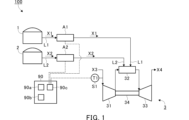
- FIG. 1 is a schematic diagram showing a gas turbine system according to a first embodiment.
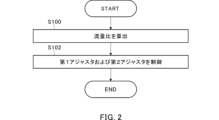
- FIG. 2 is a flowchart illustrating an example of processing by the control device.
- FIG. 3 is a graph showing the relationship between the output of a gas turbine and the gas temperature at the turbine inlet.
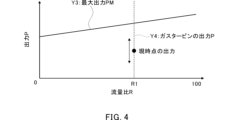
- FIG. 4 is a graph showing an example of the processing of the control device.
- FIG. 5 is a graph showing another example of the process of the control device.
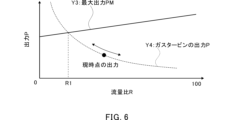
- FIG. 6 is a graph showing yet another example of the process of the control device.
- FIG. 7 is a schematic diagram showing a gas turbine system according to the second embodiment.
- FIG. 1 is a schematic diagram showing a gas turbine system 100 according to a first embodiment.
- the gas turbine system may also be simply referred to as a "system.”
- the system 100 includes a first tank (first fuel supply source) 1, a second tank (second fuel supply source) 2, a first adjuster A1, a second adjuster A2, a gas turbine 3, a temperature sensor S1, and a control device 90.
- the system 100 may further include other components.
- the gas turbine 3 includes a compressor 31, a combustor 32, and a turbine 33.
- the gas turbine 3 may further include other components.
- the first tank 1 stores the first fuel X1.
- the first fuel X1 may be a hydrocarbon fuel such as natural gas.
- the first tank 1 is connected to the first line L1.
- the first line L1 includes one or more pipes.
- the first line L1 is connected to the combustor 32.
- the first tank 1 supplies the first fuel X1 to the combustor 32 via the first line L1.
- the first line L1 may include a compressor or pump (not shown) for sending the first fuel X1.
- a device for producing the first fuel may be used as the first fuel supply source.
- the second tank 2 stores the second fuel X2.
- the second fuel X2 has a lower flame temperature than the first fuel.
- the "flame temperature" may be defined as an "adiabatic flame temperature".
- the second fuel X2 may be ammonia.
- the second tank 2 may store liquid ammonia, or may store gaseous ammonia.
- the second tank 2 is connected to the second line L2.
- the second line L2 includes one or more pipes.
- the second line L2 is connected to the combustor 32.
- the second tank 2 supplies the second fuel X2 to the combustor 32 via the second line L2.
- the second line L2 may include a compressor or pump (not shown) for sending the second fuel X2.
- the second line L2 may be provided with a vaporizer (not shown).
- a device for producing the second fuel instead of the second tank 2, may be used as the second fuel supply source.
- the first adjuster A1 is provided in the first line L1 between the first tank 1 and the combustor 32.
- the first adjuster A1 adjusts the flow rate of the first fuel X1 flowing through the first line L1, i.e., the first flow rate F1 of the first fuel X1 flowing into the combustor 32.
- the first adjuster A1 may include a flow controller capable of measuring the first flow rate F1 and adjusting the first flow rate F1.
- the first adjuster A1 may include a flow meter and at least one valve.
- the first adjuster A1 is communicatively connected to the control device 90 and transmits measurement data to the control device 90.
- the control device 90 is configured to adjust the first flow rate F1 by controlling the first adjuster A1.
- the second adjuster A2 is provided in the second line L2 between the second tank 2 and the combustor 32.
- the second adjuster A2 adjusts the flow rate of the second fuel X2 flowing through the second line L2, i.e., the second flow rate F2 of the second fuel X2 flowing into the combustor 32.
- the second adjuster A2 may include a flow controller capable of measuring the second flow rate F2 and adjusting the second flow rate F2.
- the second adjuster A2 may include a flow meter and at least one valve.
- the second adjuster A2 is communicatively connected to the control device 90 and transmits measurement data to the control device 90.
- the control device 90 is configured to adjust the second flow rate F2 by controlling the second adjuster A2.
- the compressor 31 compresses the intake air (intake air) X3.
- the air X3 may be ambient air around the compressor 31.
- the compressed air X3 is supplied to the combustor 32.
- the combustor 32 burns a mixed gas containing a first fuel X1 from the first tank 1, a second fuel X2 from the second tank 2, and the air X3 from the compressor 31.
- the combustion gas X4 from the combustor 32 is supplied to the turbine 33.
- the compressor 31 and the turbine 33 are connected to each other by a shaft 34.
- the shaft 34 may be connected to a generator (not shown), and the rotational force of the shaft 34 may be used to generate electricity. In other embodiments, the rotational force of the shaft 34 may be used in other devices. Also, the rotational force of the shaft 34 is used to compress the air X3 in the compressor 31.
- the combustion gas X4 that has passed through the turbine 33 may be used in various facilities, such as a boiler.
- the temperature sensor S1 measures the temperature T1 of the air X3 drawn into the compressor 31.
- the temperature sensor S1 may be provided in a pipe connected to the compressor 31.
- the temperature sensor S1 is communicatively connected to the control device 90 and transmits the temperature T1 to the control device 90.
- the control device 90 controls the whole or part of the system 100.
- the control device 90 may be composed of one or more PCs.
- the control device 90 includes components such as a processor 90a, a storage device 90b, and a connector 90c, and these components are connected to each other via a bus.
- the processor 90a includes a CPU (Central Processing Unit), etc.
- the storage device 90b includes a hard disk, a ROM in which programs and the like are stored, and a RAM as a work area, etc.
- the control device 90 is connected to each component of the system 100 via the connector 90c so as to be able to communicate with each component via a wired or wireless connection.
- control device 90 may further include other components such as a display device such as a liquid crystal display or a touch panel, and an input device such as a keyboard, buttons, or a touch panel.
- a display device such as a liquid crystal display or a touch panel
- an input device such as a keyboard, buttons, or a touch panel.
- the following operations of the control device 90 may be realized by the processor 90a executing a program stored in the storage device 90b.
- FIG. 2 is a flowchart showing an example of the processing of the control device 90.
- the processing shown in FIG. 2 may be repeated periodically during operation of the gas turbine system 100.
- the processor 90a calculates the flow ratio R (step S100).
- the "flow ratio” refers to the ratio between the first flow rate F1 of the first fuel X1 and the second flow rate F2 of the second fuel X2.
- the processor 90a can receive the first flow rate F1 and the second flow rate F2 from the first adjuster A1 and the second adjuster A2, respectively.
- the processor 90a controls the first adjuster A1 and the second adjuster A2 based on the flow rate ratio R (step S102), and the operation shown in FIG. 2 is terminated. Specifically, the processor 90a controls the first adjuster A1 and the second adjuster A2 as follows.
- Figure 3 is a graph showing the relationship between the output P of the gas turbine 3 and the gas temperature T2 at the inlet of the turbine 33.
- the horizontal axis shows the output P of the gas turbine 3
- the vertical axis shows the gas temperature T2 at the inlet of the turbine 33, i.e., the temperature of the combustion gas X4 from the combustor 32.
- T0 indicates the heat resistance temperature of the inlet of the turbine 33.
- the heat resistance temperature T0 may be determined by factors such as the material used at the inlet of the turbine 33.
- the temperature T2 of the combustion gas X4 is highest before passing through the impeller, i.e., at the inlet. Therefore, the heat resistance temperature T0 of the inlet of the turbine 33 is taken into consideration.
- Line Y2 shows the temperature T2 when the first fuel X1 and the second fuel X2 are mixed.
- the second fuel X2 has a lower adiabatic flame temperature than the first fuel X1. Therefore, when comparing under the same output conditions, the temperature T2 of the combustion gas X4 when the first fuel X1 and the second fuel X2 are mixed (line Y2) is lower than when only the first fuel X1 is burned (line Y1). In other words, line Y2 is lower than line Y1. In this embodiment, line Y2 decreases (slides downward) as the flow ratio R increases.
- the maximum output PM2 when the first fuel X1 and the second fuel X2 are mixed and burned can be set higher than the maximum output PM1 when only the first fuel X1 is burned. Therefore, when the second fuel X2, such as ammonia, is used, the maximum output PM2 can be increased compared to when only the first fuel X1, such as natural gas, is burned.
- the maximum output PM2 varies depending on the flow ratio. Specifically, in this embodiment, the maximum output PM2 increases as the flow ratio R increases.
- control device 90 may store in the storage device 90b a map indicating the relationship between the flow ratio R and the maximum output PM of the gas turbine 3.
- the processor 90a may read out the maximum output PM corresponding to the flow ratio R calculated in step S100 from the map.
- control device 90 may store in the storage device 90b an equation indicating the relationship between the flow ratio R and the maximum output PM of the gas turbine 3.
- the processor 90a may calculate the maximum output PM by substituting the flow ratio R calculated in step S100 into the equation.
- control device 90 may adjust the maximum output PM based on the temperature T1 from the temperature sensor S1.
- the processor 90a may adjust the maximum output PM to decrease as the temperature T1 increases, and to increase as the temperature T1 decreases.
- control device 90 may store in the storage device 90b a map showing the relationship between the flow ratio R, the temperature T1, and the maximum output PM of the gas turbine 3.
- the processor 90a may read out from the map the maximum output PM corresponding to the flow ratio R calculated in step S100 and the temperature T1 received from the temperature sensor S1.
- the control device 90 may store in the storage device 90b an equation showing the relationship between the flow ratio R, the temperature T1, and the maximum output PM of the gas turbine 3.
- the processor 90a may calculate the maximum output PM by substituting the flow ratio R calculated in step S100 and the temperature T1 received from the temperature sensor S1 into the equation.
- the processor 90a obtains the current output P of the gas turbine 3.
- the control device 90 may be communicatively connected to the gas turbine 3, and may calculate the output P of the gas turbine 3 based on various measurement data transmitted from the gas turbine 3. Note that the method of obtaining the output P of the gas turbine 3 is not limited to this.
- the processor 90a controls the first adjuster A1 and the second adjuster A2 to adjust the first flow rate F1 and the second flow rate F2 so that the obtained output P of the gas turbine 3 does not exceed the determined maximum output PM.
- FIG. 4 is a graph showing an example of processing by the control device 90.
- the horizontal axis indicates the flow ratio R
- the vertical axis indicates the output P of the gas turbine 3
- line Y3 indicates the maximum output PM of the gas turbine 3 determined as described above
- dashed line Y4 indicates the output P of the gas turbine 3.
- the gas turbine system 100 may be required to operate at a constant flow ratio R1 for various reasons.
- the maximum power output PM is also fixed at a constant value.
- the processor 90a controls the first adjuster A1 and the second adjuster A2 to adjust the first flow rate F1 and the second flow rate F2 so that the output P of the gas turbine 3 does not exceed the fixed maximum power output PM and the flow ratio R is maintained at a constant value R1.
- FIG. 5 is a graph showing another example of processing by the control device 90.
- the gas turbine system 100 may be required to operate with the first flow rate F1 of the first fuel X1 fixed for various reasons.
- only the second flow rate F2 of the second fuel X2 is adjusted.
- the gas turbine output P increases as the flow ratio R increases.
- the processor 90a controls only the second adjuster A2 to adjust only the second flow rate F2 so that the flow ratio R does not exceed a value R1 corresponding to the intersection between line Y3 and dashed line Y4.
- FIG. 6 is a graph showing yet another example of processing by the control device 90.
- the gas turbine system 100 may be required to operate with the second flow rate F2 of the second fuel X2 fixed for various reasons.
- the first flow rate F1 of the first fuel X1 is adjusted.
- the gas turbine output P increases as the flow ratio R decreases.
- the processor 90a controls only the first adjuster A1 to adjust only the first flow rate F1 so that the flow ratio R does not fall below a value R1 corresponding to the intersection between line Y3 and dashed line Y4.
- the control device 90 may store a compressor map showing the relationship between the flow rate of the air X3 and the pressure in the compressor 31, and showing the boundary line that causes surging and the boundary line that causes choking.
- the control device 90 may also store a turbine map showing the relationship between the flow rate of the combustion gas X4 and the pressure in the turbine 33, and showing the boundary line that causes choking.
- the control device 90 may control the system 100 based on these maps so that surging and choking do not occur.
- the system 100 as described above includes a gas turbine 3 including a combustor 32, a first line L1 in fluid communication with the combustor 32 and supplying a first fuel X1 to the combustor 32, a second line L2 in fluid communication with the combustor 32 and supplying a second fuel X2 having a flame temperature lower than the first fuel X1 to the combustor 32, a first adjuster A1 provided on the first line L1 and adjusting a first flow rate F1 of the first fuel X1 flowing into the combustor 32, a second adjuster A2 provided on the second line L2 and adjusting a second flow rate F2 of the second fuel X2 flowing into the combustor 32, and a control device 90 communicatively connected to the first adjuster A1 and the second adjuster A2.
- the control device 90 is configured to calculate a flow rate ratio R indicating a ratio between the first flow rate F1 and the second flow rate F2, and to control the first adjuster A1 and the second adjuster A2 based on the flow rate ratio R.
- a flow rate ratio R indicating a ratio between the first flow rate F1 and the second flow rate F2
- the temperature T2 of the combustion gas X4 when the first fuel X1 and the second fuel X2 are mixed is lower than when only the first fuel X1 is mixed. Therefore, the maximum output PM2 of the gas turbine 3 when the first fuel X1 and the second fuel X2 are mixed can be set higher than the maximum output PM1 when only the first fuel X1 is mixed.
- the maximum output PM2 varies according to the flow ratio R. Therefore, the maximum output PM of the gas turbine 3 can be increased by controlling the first adjuster A1 and the second adjuster A2 according to the flow ratio R.
- controlling the first adjuster A1 and the second adjuster A2 includes determining the maximum output PM of the gas turbine 3 based on the flow ratio R, obtaining the output P of the gas turbine 3, and controlling the first adjuster A1 and the second adjuster A2 to adjust the first flow rate F1 and the second flow rate F2 so that the obtained output P of the gas turbine 3 does not exceed the maximum output PM.
- controlling the first adjuster A1 and the second adjuster A2 to adjust the first flow rate F1 and the second flow rate F2 so that the obtained output P of the gas turbine 3 does not exceed the maximum output PM.
- the system 100 also includes a temperature sensor S1 that measures the temperature T1 of the intake air X3 to the compressor 31 of the gas turbine 3, and the control device 90 is communicatively connected to the temperature sensor S1. Determining the maximum output PM of the gas turbine 3 includes adjusting the maximum output PM of the gas turbine 3 based on the measurement data from the temperature sensor S1. With this configuration, the maximum output PM can be determined more accurately.
- the above-described system 100 can be realized by the following method for retrofitting an existing gas turbine system.
- the method for retrofitting a gas turbine system includes preparing a program for controlling the gas turbine system.
- the gas turbine system to which the method is applied includes a gas turbine 3 including a combustor 32, a first line L1 fluidly connected to the combustor 32 and supplying a first fuel X1 to the combustor 32, a second line L2 fluidly connected to the combustor 32 and supplying a second fuel X2 having a flame temperature lower than the first fuel X1 to the combustor 32, a first adjuster A1 provided in the first line L1 and adjusting a first flow rate F1 of the first fuel X1 flowing into the combustor 32, a second adjuster A2 provided in the second line L2 and adjusting a second flow rate F2 of the second fuel X2 flowing into the combustor 32, and a control device 90 communicatively connected to the first adjuster
- the prepared program is configured to cause the computer to calculate a flow ratio R indicating the ratio between the first flow rate F1 and the second flow rate F2, and to control the first adjuster A1 and the second adjuster A2 based on the flow ratio R.
- the method includes installing the prepared program in the control device 90. With this configuration, the maximum output PM of the gas turbine 3 can be increased in an existing gas turbine system.
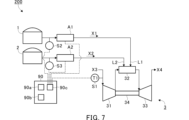
- FIG. 7 is a schematic diagram showing a gas turbine system 200 according to the second embodiment.
- the system 200 differs from the system 100 according to the first embodiment in that the system 200 includes a first analyzer S2 and a second analyzer S3. In other respects, the system 200 may be the same as the system 100.
- the first analyzer S2 measures the composition of the first fuel X1.
- the first analyzer S2 may be provided in the first line L1.
- the first analyzer S2 is provided in the first line L1 between the first tank 1 and the first adjuster A1.
- the first analyzer S2 may be provided in the first tank 1, or may be provided in the first line L1 between the first adjuster A1 and the combustor 32.
- the first analyzer S2 may be a calorimeter.
- the first analyzer S2 is communicatively connected to the control device 90 and transmits measurement data to the control device 90.
- control device 90 may calculate the lower heating value (LHV) of the first fuel X1 based on the measurement data of the first fuel X1 from the first analyzer S2, and may calculate the flame temperature of the first fuel X1 from the lower heating value.
- LHV lower heating value
- the second analyzer S3 measures the composition of the second fuel X2.
- the second analyzer S3 may be provided in the second line L2.
- the second analyzer S3 is provided in the second line L2 between the second tank 2 and the second adjuster A2.
- the second analyzer S3 may be provided in the second tank 2, or may be provided in the second line L2 between the second adjuster A2 and the combustor 32.
- the second analyzer S3 may be a calorimeter.
- the second analyzer S3 is communicatively connected to the control device 90 and transmits measurement data to the control device 90.
- the control device 90 may calculate the lower heating value of the second fuel X2 based on the measurement data of the second fuel X2 from the second analyzer S3, and may calculate the flame temperature of the second fuel X2 from the lower heating value.
- the flame temperature of a fuel may vary depending on its composition.
- the composition of the fuel may vary depending on various factors.
- the flame temperature of the first fuel X1 and the flame temperature of the second fuel X2 affect the temperature T2 of the combustion gas X4.
- the control device 90 may further finely adjust the allowable maximum power PM of the gas turbine 3 by taking into account the composition of the first fuel X1 and the composition of the second fuel X2.
- control device 90 may pre-store the reference flame temperatures of the first fuel X1 and the second fuel X2 in the storage device 90b, and may adjust (correct) the maximum output PM based on the ratio between the calculated flame temperatures of the first fuel X1 and the second fuel X2 and the reference flame temperatures of the first fuel X1 and the second fuel X2.
- control device 90 may store the reference lower heating values of the first fuel X1 and the second fuel X2 in the storage device 90b in advance, and may adjust (correct) the maximum output PM based on the ratio between the calculated lower heating values of the first fuel X1 and the second fuel X2 and the reference lower heating values of the first fuel X1 and the second fuel X2.
- the method of adjusting the maximum PM output based on the measurement data from the first analyzer S2 and the second analyzer S3 is not limited to these.
- the above system 200 has the same effects as system 100.
- the system 200 includes a first analyzer S2 that measures the composition of the first fuel X1, the control device 90 is communicatively connected to the first analyzer S2, and determining the maximum output PM of the gas turbine 3 includes adjusting the maximum output PM of the gas turbine 3 based on the measurement data from the first analyzer S2.
- the system 200 also includes a second analyzer S3 that measures the composition of the second fuel X2, the control device 90 is communicatively connected to the second analyzer S3, and determining the maximum output PM of the gas turbine 3 includes adjusting the maximum output PM of the gas turbine 3 based on the measurement data from the second analyzer S3. With these configurations, the maximum output PM can be determined more accurately.
- the control device 90 determines the maximum output PM of the gas turbine 3 based on the flow ratio.
- the control device 90 may not need to determine the maximum output PM.
- the control device 90 may pre-store in the storage device 90b a map or equation indicating the relationship between the flow ratio R and the first flow rate F1 and the second flow rate F2 for obtaining the maximum output PM corresponding to the flow ratio R. In this case, the control device 90 does not need to determine the maximum output PM.
- the system 200 includes both the first analyzer S2 and the second analyzer S3.
- the system 200 may include only one of the first analyzer S2 and the second analyzer S3.
- the present disclosure can promote the use of ammonia leading to reduced CO2 emissions, and can therefore contribute, for example, to Sustainable Development Goal (SDG) Goal 7 "Ensure access to affordable, reliable, sustainable and modern energy.”
- SDG Sustainable Development Goal
Landscapes
- Engineering & Computer Science (AREA)
- Chemical & Material Sciences (AREA)
- Combustion & Propulsion (AREA)
- Mechanical Engineering (AREA)
- General Engineering & Computer Science (AREA)
- Regulation And Control Of Combustion (AREA)
Priority Applications (1)
| Application Number | Priority Date | Filing Date | Title |
|---|---|---|---|
| JP2025559123A JPWO2025109967A1 (https=) | 2023-11-22 | 2024-10-30 |
Applications Claiming Priority (2)
| Application Number | Priority Date | Filing Date | Title |
|---|---|---|---|
| JP2023-198470 | 2023-11-22 | ||
| JP2023198470 | 2023-11-22 |
Publications (1)
| Publication Number | Publication Date |
|---|---|
| WO2025109967A1 true WO2025109967A1 (ja) | 2025-05-30 |
Family
ID=95826463
Family Applications (1)
| Application Number | Title | Priority Date | Filing Date |
|---|---|---|---|
| PCT/JP2024/038640 Pending WO2025109967A1 (ja) | 2023-11-22 | 2024-10-30 | ガスタービンシステムおよびガスタービンシステムを改造するための方法 |
Country Status (2)
| Country | Link |
|---|---|
| JP (1) | JPWO2025109967A1 (https=) |
| WO (1) | WO2025109967A1 (https=) |
Citations (5)
| Publication number | Priority date | Publication date | Assignee | Title |
|---|---|---|---|---|
| JPS6213739A (ja) * | 1985-07-11 | 1987-01-22 | Toshiba Corp | コンバインドサイクル発電設備におけるガスタ−ビンの燃料供給装置 |
| JPH06193472A (ja) * | 1992-12-24 | 1994-07-12 | Hitachi Ltd | ガスタービンシステム |
| JP2010216319A (ja) * | 2009-03-16 | 2010-09-30 | Hitachi Ltd | ガスタービンおよびガスタービンの燃料流量制御方法 |
| WO2014132932A1 (ja) * | 2013-02-26 | 2014-09-04 | 三菱日立パワーシステムズ株式会社 | ガスタービンシステム、制御装置及びガスタービンの運転方法 |
| JP2016513774A (ja) * | 2013-03-15 | 2016-05-16 | ゼネラル・エレクトリック・カンパニイ | ガスタービンの燃料混合および制御のためのシステムおよび方法 |
-
2024
- 2024-10-30 JP JP2025559123A patent/JPWO2025109967A1/ja active Pending
- 2024-10-30 WO PCT/JP2024/038640 patent/WO2025109967A1/ja active Pending
Patent Citations (5)
| Publication number | Priority date | Publication date | Assignee | Title |
|---|---|---|---|---|
| JPS6213739A (ja) * | 1985-07-11 | 1987-01-22 | Toshiba Corp | コンバインドサイクル発電設備におけるガスタ−ビンの燃料供給装置 |
| JPH06193472A (ja) * | 1992-12-24 | 1994-07-12 | Hitachi Ltd | ガスタービンシステム |
| JP2010216319A (ja) * | 2009-03-16 | 2010-09-30 | Hitachi Ltd | ガスタービンおよびガスタービンの燃料流量制御方法 |
| WO2014132932A1 (ja) * | 2013-02-26 | 2014-09-04 | 三菱日立パワーシステムズ株式会社 | ガスタービンシステム、制御装置及びガスタービンの運転方法 |
| JP2016513774A (ja) * | 2013-03-15 | 2016-05-16 | ゼネラル・エレクトリック・カンパニイ | ガスタービンの燃料混合および制御のためのシステムおよび方法 |
Also Published As
| Publication number | Publication date |
|---|---|
| JPWO2025109967A1 (https=) | 2025-05-30 |
Similar Documents
| Publication | Publication Date | Title |
|---|---|---|
| JP5721944B2 (ja) | 燃焼ガスタービン用の燃料配合及び制御のためのシステム及び方法 | |
| JP5281823B2 (ja) | ガスタービンにおける燃焼を制御するための方法及び装置 | |
| CN102080602B (zh) | 用于控制燃料混合的系统和方法 | |
| JP5129839B2 (ja) | 燃料の熱エネルギ量を制御するシステム及び方法 | |
| CN102725498B (zh) | 用于控制燃气涡轮的操作点的方法和控制器 | |
| JP4331406B2 (ja) | バーナの運転方法およびバーナ装置 | |
| EP2778354A1 (en) | Variable heat/power ratio cogeneration system | |
| JP2009036206A (ja) | インライン燃料改質によるウォッベ数制御及び作動性の向上 | |
| CN115585401A (zh) | 燃气管道天然气掺氢浓度控制方法、系统 | |
| JP5259204B2 (ja) | 修正ウォッベ指数制御範囲を増大させる方法及びシステム | |
| CN103080560B (zh) | 气体压缩机的运转方法及具备气体压缩机的燃气涡轮 | |
| EP2333281A2 (en) | Systems and methods for unchoked control of gas turbine fuel gas control valves | |
| CN102188941B (zh) | 操作燃气轮机发动机系统的催化重整组件的系统和方法 | |
| CN101684749A (zh) | 液化天然气发电站及其运行方法 | |
| US20110146288A1 (en) | Method of controlling a fuel flow to a turbomachine | |
| CN111043631A (zh) | 燃具的燃烧控制系统、方法、装置及存储介质 | |
| WO2025109967A1 (ja) | ガスタービンシステムおよびガスタービンシステムを改造するための方法 | |
| CN216976520U (zh) | 一种用于天然气氢气的混气输配系统 | |
| CN103857891B (zh) | 贫燃料吸入燃气轮机 | |
| TW201226809A (en) | Method of testing and compensating gas supply for safety | |
| CN102947572B (zh) | 起动或停止燃气涡轮发动机的方法和设备 | |
| JP5787651B2 (ja) | ガスタービン設備、及びその燃料温度管理方法 | |
| US12516812B2 (en) | Control and/or regulation of a combustion apparatus | |
| KR102921011B1 (ko) | 가스터빈용 다종연료 공급장치 및 그 제어방법 | |
| JP2024154180A (ja) | ガスタービン制御装置、ガスタービン制御方法、及び、ガスタービン制御プログラム |
Legal Events
| Date | Code | Title | Description |
|---|---|---|---|
| 121 | Ep: the epo has been informed by wipo that ep was designated in this application |
Ref document number: 24893959 Country of ref document: EP Kind code of ref document: A1 |
|
| ENP | Entry into the national phase |
Ref document number: 2025559123 Country of ref document: JP Kind code of ref document: A |