WO2025099878A1 - 鉄系焼結体、焼結含油軸受、及び鉄系焼結体の製造方法 - Google Patents
鉄系焼結体、焼結含油軸受、及び鉄系焼結体の製造方法 Download PDFInfo
- Publication number
- WO2025099878A1 WO2025099878A1 PCT/JP2023/040289 JP2023040289W WO2025099878A1 WO 2025099878 A1 WO2025099878 A1 WO 2025099878A1 JP 2023040289 W JP2023040289 W JP 2023040289W WO 2025099878 A1 WO2025099878 A1 WO 2025099878A1
- Authority
- WO
- WIPO (PCT)
- Prior art keywords
- iron
- sintered body
- mass
- based sintered
- oil
- Prior art date
- Legal status (The legal status is an assumption and is not a legal conclusion. Google has not performed a legal analysis and makes no representation as to the accuracy of the status listed.)
- Pending
Links
Images

Classifications
-
- B—PERFORMING OPERATIONS; TRANSPORTING
- B22—CASTING; POWDER METALLURGY
- B22F—WORKING METALLIC POWDER; MANUFACTURE OF ARTICLES FROM METALLIC POWDER; MAKING METALLIC POWDER; APPARATUS OR DEVICES SPECIALLY ADAPTED FOR METALLIC POWDER
- B22F1/00—Metallic powder; Treatment of metallic powder, e.g. to facilitate working or to improve properties
-
- B—PERFORMING OPERATIONS; TRANSPORTING
- B22—CASTING; POWDER METALLURGY
- B22F—WORKING METALLIC POWDER; MANUFACTURE OF ARTICLES FROM METALLIC POWDER; MAKING METALLIC POWDER; APPARATUS OR DEVICES SPECIALLY ADAPTED FOR METALLIC POWDER
- B22F3/00—Manufacture of workpieces or articles from metallic powder characterised by the manner of compacting or sintering; Apparatus specially adapted therefor ; Presses and furnaces
- B22F3/10—Sintering only
- B22F3/11—Making porous workpieces or articles
-
- B—PERFORMING OPERATIONS; TRANSPORTING
- B22—CASTING; POWDER METALLURGY
- B22F—WORKING METALLIC POWDER; MANUFACTURE OF ARTICLES FROM METALLIC POWDER; MAKING METALLIC POWDER; APPARATUS OR DEVICES SPECIALLY ADAPTED FOR METALLIC POWDER
- B22F5/00—Manufacture of workpieces or articles from metallic powder characterised by the special shape of the product
-
- C—CHEMISTRY; METALLURGY
- C22—METALLURGY; FERROUS OR NON-FERROUS ALLOYS; TREATMENT OF ALLOYS OR NON-FERROUS METALS
- C22C—ALLOYS
- C22C33/00—Making ferrous alloys
- C22C33/02—Making ferrous alloys by powder metallurgy
Definitions
- This disclosure relates to iron-based sintered bodies, sintered oil-impregnated bearings, and methods for producing iron-based sintered bodies.
- Sintered bearings made using powder metallurgy technology are known as bearings that support rotating shafts.
- a sintered bearing is an oil-impregnated sintered bearing, which is a sliding bearing that has self-lubricating properties due to the pores of the sintered body being impregnated with lubricating oil (see Patent Document 1).
- Oil-impregnated sintered bearings have the advantage of being able to be used for long periods of time without oiling, and are therefore widely used in fields such as home appliances, office equipment, and automobiles.
- This disclosure provides an iron-based sintered body having excellent durability and a method for producing the same. This disclosure also provides a sintered oil-impregnated bearing having excellent durability.
- the present invention includes the following embodiments, but is not limited to the following embodiments.
- One embodiment relates to an iron-based sintered body having an air permeability of 0.01 ⁇ 10 ⁇ 11 to 5.0 ⁇ 10 ⁇ 11 cm 2 and a rate of change in diameter of an oil droplet when oil is dropped onto the surface of the iron-based sintered body of ⁇ 15 to 15%.
- Another embodiment relates to an iron-based sintered body having an air permeability of 0.01 ⁇ 10 ⁇ 11 to 5.0 ⁇ 10 ⁇ 11 cm 2 and containing Mg, Si, and O in the pores.
- Another embodiment relates to a method for producing an iron-based sintered body, comprising: compression molding a raw material powder containing an iron-based powder and a powder containing Mg, Si, and O to obtain a molded body; and heating the molded body to obtain a sintered body.
- Another embodiment relates to a sintered, oil-impregnated bearing comprising any one of the iron-based sintered bodies described above and a lubricating oil.
- the present disclosure provides an iron-based sintered body having excellent durability and a manufacturing method thereof.
- the present disclosure also provides a sintered oil-impregnated bearing having excellent durability.
- FIG. 1 is a schematic diagram showing one embodiment of an iron-based sintered body, in which (a) is a schematic front view, (b) is a schematic side view, and (c) is a schematic perspective view.
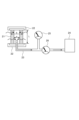
- FIG. 2 is a schematic diagram showing an outline of an apparatus used for determining air permeability in the examples.
- FIG. 3 is a digital microscope image of an iron-based sintered body having a lubricating oil dropped onto its surface, as observed in the examples.
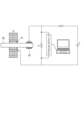
- FIG. 4 is a schematic diagram showing an outline of a bearing test machine used in the examples.
- a numerical range indicated using “to” means a range that includes the numerical values before and after “to” as the minimum and maximum values, respectively.
- the upper or lower limit of a certain numerical range may be replaced with the upper or lower limit of another numerical range.
- the upper or lower limit of a numerical range described in the present disclosure may be replaced with a value shown in the examples.
- a numerical range may be set in stages by selecting a numerical value from each of the upper limit and lower limit numerical values described in stages in the present disclosure.
- the upper limit and lower limit numerical values described in the present disclosure may be replaced with values shown in the examples.
- each component may contain multiple types of corresponding substances.
- the content or amount of each component means the total content or amount of the multiple substances present in the composition, unless otherwise specified.
- the term "step” includes not only a step that is independent of other steps, but also a step that cannot be clearly distinguished from other steps, as long as the initial action of the step is achieved.
- the configuration of the embodiment is not limited to the configuration shown in the drawings.
- the size of the members in each drawing is conceptual, and the relative relationship between the sizes of the members is not limited to the relationship shown in the drawings.
- the iron-based sintered body has an iron-based matrix and pores dispersed in the iron-based matrix.
- the iron-based sintered body contains iron and may further contain copper.
- the air permeability of the iron-based sintered body is 0.01 ⁇ 10 ⁇ 11 to 5.0 ⁇ 10 ⁇ 11 cm 2.
- the air permeability of the iron-based sintered body is 0.01 ⁇ 10 ⁇ 11 cm 2 or more
- the air permeability of the iron-based sintered body is, for example, 0.05 ⁇ 10 ⁇ 11 cm 2 or more, 0.08 ⁇ 10 ⁇ 11 cm 2 or more, or 0.1 ⁇ 10 ⁇ 11 cm 2 or more.
- the air permeability of the iron-based sintered body is 5.0 ⁇ 10 ⁇ 11 cm 2 or less
- the iron-based sintered body is used in an oil-impregnated bearing, a stable oil film is likely to be formed on the surface of the oil-impregnated bearing during sliding.
- the air permeability of the iron-based sintered body is, for example, 4.0 ⁇ 10 ⁇ 11 cm 2 or less, 3.0 ⁇ 10 ⁇ 11 cm 2 or less, 1.0 ⁇ 10 ⁇ 11 cm 2 or less, or 0.5 ⁇ 10 ⁇ 11 cm 2 or less.
- the air permeability of the iron-based sintered body can be, for example, 0.05 ⁇ 10 ⁇ 11 to 4.0 ⁇ 10 ⁇ 11 cm 2 , 0.08 ⁇ 10 ⁇ 11 to 3.0 ⁇ 10 ⁇ 11 cm 2 , 0.08 ⁇ 10 ⁇ 11 to 1.0 ⁇ 10 ⁇ 11 cm 2 , or 0.1 ⁇ 10 ⁇ 11 to 0.5 ⁇ 10 ⁇ 11 cm 2 .
- the air permeability of an iron-based sintered body can be adjusted by changing the particle size of the raw material powder, the molding conditions, the sintering conditions, etc. For example, there is a tendency that the air permeability of an iron-based sintered body can be reduced by reducing the particle size of the raw material powder, increasing the molding pressure, increasing the sintering temperature, lengthening the sintering time, etc.
- the air permeability of an iron-based sintered body can be calculated by the following formula.
- the device shown in Figure 2 can be used to measure Q. ⁇ is set to 1.82 x 10 -4 g/(cm sec).
- ⁇ Q ⁇ In(b/a)/(2 ⁇ L ⁇ p) ⁇ : Air permeability (cm 2 ) Q: Air permeability ( cm3 /sec) ⁇ : Viscosity of air (g/(cm sec)) L: Length of sintered body (cm) ⁇ p: Pressure difference (g/(cm ⁇ sec 2 )) b/a: Outer diameter (cm)/Inner diameter (cm)
- 21 is an iron-based sintered body
- 22 is an air-blocking member
- 23 is an air passage
- 24 is a vacuum pump
- 25 is a vacuum meter
- 26 is an air flow meter
- a is the inner diameter of the iron-based sintered body
- b is the outer diameter of the iron-based sintered body
- L is the length of the iron-based sintered body.
- the dashed wavy arrows in the figure represent the air flow.
- the porosity of the iron-based sintered body is, for example, 1 to 20 vol% based on the volume of the iron-based sintered body.
- the porosity of the iron-based sintered body may be, for example, 2 vol% or more, 5 vol% or more, or 8 vol% or more.
- the porosity of the iron-based sintered body may be, for example, 19 vol% or less, 18 vol% or less, or 15 vol% or less.
- the porosity of the iron-based sintered body may be, for example, 1 to 20 vol%, 2 to 19 vol%, 5 to 18 vol%, or 8 to 15 vol%.
- the porosity of the iron-based sintered body can be adjusted by changing the particle size of the raw material powder, the copper content, the molding conditions, the sintering conditions, etc. For example, there is a tendency to reduce the porosity of the iron-based sintered body by reducing the particle size of the raw material powder, increasing the molding pressure, increasing the sintering temperature, lengthening the sintering time, etc.
- the porosity of the iron-based sintered body is the open porosity, and can be measured in accordance with JIS Z 2501:2000.
- the average pore size of the pores is, for example, 0.1 to 50 ⁇ m.
- the average pore size of the pores may be, for example, 0.3 ⁇ m or more, 0.5 ⁇ m or more, or 1.0 ⁇ m or more.
- an oil film having a sufficient thickness is easily maintained on the surface of the oil-impregnated bearing during sliding.
- the average pore size of the pores may be, for example, 40 ⁇ m or less, 20 ⁇ m or less, 15 ⁇ m or less, or 10 ⁇ m or less.
- the average pore size of the pores may be 0.3 to 20 ⁇ m, 0.5 to 15 ⁇ m, or 1.0 to 10 ⁇ m.
- the average pore size can be measured by the following method.
- the iron-based sintered body is cut and the cross section is mirror-polished.
- the polished surface is observed to obtain a color image of the polished surface.
- the area of each pore contained in an arbitrary measurement area of the polished surface is measured, and the diameter of a perfect circle with the equivalent area is calculated.
- the calculated diameter of the perfect circle is the pore diameter.
- the arithmetic mean value calculated from the pore diameters of each pore obtained is the average pore diameter.
- an optical microscope (Nikon Corporation's "ECLIPSE", epi-illumination) can be used to observe the polished surface.
- the magnification is, for example, 100 times.
- the area of the measurement area is, for example, 1.0 mm2 .
- the number of pores to be measured is, for example, 2,000.
- commercially available image analysis software may be used.
- the pores may have a diameter of 30 to 200 ⁇ m, with a ratio of 5 to 50 per 2,000 pores. If the pores have a diameter of 30 to 200 ⁇ m, with a ratio of 5 to 50 per 2,000 pores, it becomes easier to maintain an oil film of sufficient thickness on the surface of the oil-impregnated bearing during sliding.
- the iron-based sintered body meets the following properties: When lubricating oil is dropped onto the surface of an iron-based sintered body, the rate of change in the diameter of the oil droplets (sometimes referred to as "oil droplet diameter" in this disclosure) is -15 to 15%.
- the iron-based sintered body has oil repellency
- the lubricating oil is unlikely to return from the surface to the inside of the pores during sliding, and the oil film is stabilized.
- a rate of change in oil droplet size of -15% or more means that the lubricating oil is unlikely to seep into the iron-based sintered body. This is also presumed to be due to the iron-based sintered body having oil repellency.
- the oil film is stabilized and good self-lubrication is obtained, so it is believed that the durability of the iron-based sintered body is improved. The above is speculation, and the present invention is not limited to these.
- the rate of change in oil droplet diameter may be, for example, -10% or more, -5% or more, 0% or more, or 3% or more.
- the rate of change in oil droplet diameter may be, for example, 13% or less, 12% or less, 10% or less, or 7% or less.
- the rate of change in oil droplet diameter may be, for example, -10 to 13%, -5 to 12%, 0 to 10%, or 3% to 7%.
- the rate of change in the oil droplet diameter may be the rate of change in the oil droplet diameter at any time between 15 and 30 minutes after the oil is dropped, based on the oil droplet diameter immediately after the oil is dropped; for example, it may be the rate of change in the oil droplet diameter 15 minutes or 30 minutes after the oil is dropped, based on the oil droplet diameter immediately after the oil is dropped. If the rate of change in the oil droplet diameter after a long time has passed falls within the above range, a more stable oil film tends to be formed.
- the rate of change in oil droplet size can be adjusted, for example, by having the iron-based sintered body contain Mg, Si, and O in the pores, by changing the porosity, by changing the air permeability, or by having the raw material powder used in production contain powder containing Mg, Si, and O.
- the rate of change in oil droplet diameter can be measured by the following method.
- the measurement can be performed in the atmosphere (1 atm) at room temperature (25° C.).
- the measurement may be performed using an iron-based sintered body for measurement.
- the iron-based sintered body is washed with a hydrocarbon solvent and dried.
- the iron-based sintered body is placed so that the surface on which the oil droplets are to be formed is horizontal.
- (3) Prepare a precision pipette (20 ⁇ L) containing lubricating oil (25° C.).
- the tip of the precision pipette is brought close to the iron-based sintered body so that the distance from the surface of the iron-based sintered body is 5 mm or less.
- the iron-based sintered body may have a rate of change in oil droplet diameter of -15 to 15% when measured using a lubricating oil selected from synthetic oils having a kinetic viscosity (40°C) of 10 to 460 mm 2 /s and a viscosity index of 100 to 300.
- a lubricating oil selected from synthetic oils having a kinetic viscosity (40°C) of 10 to 460 mm 2 /s and a viscosity index of 100 to 300.
- synthetic oils having a kinetic viscosity (40°C) of 10 to 460 mm 2 /s and a viscosity index of 100 to 300.
- synthetic oils having a kinetic viscosity (40°C) of 10 to 460 mm 2 /s and a viscosity index of 100 to 300.
- the kinetic viscosity and viscosity index may be measured according to JIS K 2283:2000.
- the iron-based sintered body may have a rate of change in oil droplet diameter of -15 to 15% or less when measured using a lubricating oil contained in a sintered bearing using the iron-based sintered body.
- an image obtained by observing the oil droplets using an optical microscope, digital microscope, etc. can be used.
- a digital microscope for example, the "VHX-1000" manufactured by Keyence Corporation can be used.
- the magnification is, for example, 20 times.
- the iron-based sintered body contains at least iron (Fe), and preferably contains iron as a main component.
- the iron-based sintered body exhibits particularly good characteristics when used as an oil-impregnated bearing for high peripheral speed, high surface pressure, or high peripheral speed and high surface pressure, and is therefore suitable as a member for an oil-impregnated bearing.
- the iron content is, for example, more than 45.0 mass%, 50.0 mass% or more, 70.0 mass% or more, or 80.0 mass% or more, based on the mass of the iron-based sintered body.
- the iron content is, for example, 99.0 mass% or less, 97.0 mass% or less, or 95.0 mass% or less, based on the mass of the iron-based sintered body.
- the iron content can be 50.0 to 99.0 mass%, 70.0 to 97.0 mass%, or 80.0 to 95.0 mass%, based on the mass of the iron-based sintered body.
- the iron-based sintered body may contain copper (Cu).
- Cu copper
- the copper content is, for example, 0.1 mass% or more, 1.0 mass% or more, 2.0 mass% or more, 3.0 mass% or more, or 5.0 mass% or more based on the mass of the iron-based sintered body.
- the higher the copper content the higher the strength of the iron-based sintered body tends to be.
- the copper content is, for example, 40.0 mass% or less, 30.0 mass% or less, 25.0 mass% or less, or 20.0 mass% or less based on the mass of the iron-based sintered body.
- the copper content may be 10.0 mass% or less, 7.0 mass% or less, or 5.0 mass% or less. The lower the copper content, the more likely it is that rust generation can be suppressed.
- the copper content may be, for example, 0.1 to 40.0 mass%, 1.0 to 10.0 mass%, or 2.0 to 7.0 mass%.
- the iron-based sintered body may further contain at least one element selected from the group consisting of Sn, C, Zn, Ni, P, Co, Cr, Mo, V, W, Mg, Si, and O. These elements can be appropriately selected and contained in the iron-based sintered body depending on the intended use of the iron-based sintered body.
- the iron-based sintered body contains C and may further contain Ni.
- the iron-based sintered body contains Sn and may further contain Zn.
- the iron-based sintered body contains Sn and may further contain P.
- iron-based matrices include Fe, Fe-Mg, Fe-Si, Fe-Mg-Si, Fe-C, Fe-Ni, Fe-Ni-C, Fe-Sn, Fe-Zn-Sn, Fe-Sn-P, Fe-P, Fe-Cr, and Fe-Mo matrices.
- iron-based matrices include Fe, Fe-Cu, Fe-Cu-Mg, Fe-Cu-Si, Fe-Cu-Mg-Si, Fe-Cu-C, Fe-Cu-Ni, Fe-Cu-Ni-C, Fe-Cu-Sn, Fe-Cu-Zn-Sn, Fe-Cu-Sn-P, Fe-Cu-P, Fe-Cu-Cr, Fe-Cu-Mo, Fe-Mg, Fe-Si, Fe-Mg-Si, Fe-C, Fe-Ni, Fe-Ni-C, Fe-Sn, Fe-Zn-Sn, Fe-Sn-P, Fe-P, Fe-Cr, and Fe-Mo matrices.
- the iron-based matrix may include, for example, a ferrite phase, a pearlite phase, a copper phase, etc.
- the iron-based matrix may further include any other phase.
- the iron-based matrix preferably contains a ferrite phase.
- the inclusion of the ferrite phase can prevent wear of the rotating shaft.
- the iron-based matrix may contain a pearlite phase.
- the inclusion of the pearlite phase tends to improve the strength of the sintered oil-impregnated bearing.
- the content (area ratio) of the ferrite phase in the iron-based matrix is 90% or more based on the area of the iron-based matrix.
- the content (area ratio) of the pearlite phase in the iron-based matrix may be 90% or more based on the area of the iron-based matrix.
- the content of the pearlite phase is high.
- the area ratio can be determined by observing the surface or cross section of the iron-based sintered body with an optical microscope.
- the iron-based matrix may contain a copper phase.
- the copper phase is a phase containing copper and may be a copper alloy phase.
- the compatibility between the sintered oil-impregnated bearing and the rotating shaft tends to be improved.
- the iron-based sintered body may contain magnesium (Mg), silicon (Si), and oxygen (O) in the pores.
- Mg, Si, and O magnesium
- SEM scanning electron microscope
- EDX energy dispersive X-ray spectroscopy
- a stable oil film is easily formed on the surface of the oil-impregnated bearing during sliding, which is thought to prevent seizure of the oil-impregnated bearing and improve durability.
- a JSM-IT100 InTouchScope manufactured by JEOL Ltd. can be used as the scanning electron microscope, and the conditions are, for example, an acceleration voltage of 20 kV and a working distance of 10 mm.
- the total content of Mg, Si, and O in the iron-based sintered body is, for example, 10.0 mass% or less, 9.0 mass% or less, 8.0 mass% or less, 5.0 mass% or less, or 2.0 mass% or less, based on the mass of the iron-based sintered body.
- the total content of Mg, Si, and O is, for example, 0.01 mass% or more, 0.05 mass% or more, 0.1 mass% or more, 0.5 mass% or more, 1.0 mass% or more, or 1.5 mass% or more, based on the mass of the iron-based sintered body.
- the total content of Mg, Si, and O may be 0.01 to 10.0 mass%, 0.1 to 8.0 mass%, or 1.0 to 5.0 mass%, based on the mass of the iron-based sintered body.
- the iron-based sintered body may contain, in its pores, one or more selected from the group consisting of enstatite, ferrosilite, silicon dioxide, and magnesium oxide.
- the iron-based sintered body may contain, in its pores, enstatite, and may further contain silicon dioxide, magnesium oxide, or both.
- the iron-based sintered body may contain, in its pores, silicon dioxide and magnesium oxide, and may further contain enstatite. All of these iron-based sintered bodies fall under the category of iron-based sintered bodies that contain Mg, Si, and O in their pores.
- Enstatite is a type of orthopyroxene and has a chemical composition of MgSiO3 or (Mg,Fe) SiO3 (where Mg/(Mg+Fe) ⁇ 0.5).
- Ferrosilite is a type of orthopyroxene and has a chemical composition of FeSiO3 or (Mg,Fe) SiO3 (where Mg/(Mg+Fe) ⁇ 0.5 ) .
- commonly available enstatite and ferrosilite can be used.
- Commonly available enstatite and ferrosilite may contain impurities such as CaO, Al2O3 , and Fe2O3 .
- the total content of the one or more in the iron-based sintered body is, for example, 10.0 mass% or less, 9.0 mass% or less, 8.0 mass% or less, 5.0 mass% or less, or 2.0 mass% or less, based on the mass of the iron-based sintered body.
- the strength of the iron-based sintered body tends to be easily maintained, and when it is 5.0 mass% or less, good strength is easily obtained.
- the total content is, for example, 0.1 mass% or more, 0.5 mass% or more, 1.0 mass% or more, 1.5 mass% or more, or 2.0 mass% or more, based on the mass of the iron-based sintered body.
- the total content can be 0.01 to 10.0 mass%, 0.1 to 8.0 mass%, or 1.0 to 5.0 mass%, based on the mass of the iron-based sintered body.
- the content of silicon dioxide is, for example, 4.0 mass% or less, 3.5 mass% or less, 3.0 mass% or less, 2.5 mass% or less, or 1.5 mass% or less based on the mass of the iron-based sintered body.
- the content of silicon dioxide is 4.0 mass% or less, the effect of preventing wear of the rotating shaft is easily obtained, and the durability of the rotating device can be further improved.
- the content of silicon dioxide is, for example, 0.01 mass% or more, 0.1 mass% or more, 0.1 mass% or more, 0.5 mass% or more, or 1.0 mass% or more based on the mass of the iron-based sintered body.
- the content of silicon dioxide can be 0.1 to 3.5 mass%, 0.3 to 2.5 mass%, or 0.5 to 2.5 mass% based on the mass of the iron-based sintered body.
- the content of magnesium oxide is, for example, 3.5 mass% or less, 3.0 mass% or less, 2.0 mass% or less, 1.0 mass% or less, or 0.8 mass% or less based on the mass of the iron-based sintered body.
- the content of magnesium oxide is, for example, 0.01 mass% or more, 0.05 mass% or more, 0.1 mass% or more, 0.3 mass% or more, or 0.5 mass% or more based on the mass of the iron-based sintered body.
- the content of magnesium oxide can be 0.1 to 3.5 mass%, 0.3 to 2.0 mass%, or 0.5 to 1.0 mass% based on the mass of the iron-based sintered body.
- the iron-based sintered body may contain carbon (C) in the pores.
- C carbon
- the carbon may be free graphite.
- the carbon content is 0.1 mass% or more, 1.0 mass% or more, or 2.0 mass% or more based on the mass of the iron-based sintered body.
- the carbon content is, for example, 10.0 mass% or less, 5.0 mass% or less, 4.0 mass% or less, or 3.0 mass% or less based on the mass of the iron-based sintered body.
- the carbon content may be 0.1 to 10.0 mass%, 1.0 to 5.0 mass%, or 2.0 to 3.0 mass% based on the mass of the iron-based sintered body.
- the iron-based sintered body contains, for example, a total of 0.01 to 10.0 mass% Mg, Si, and O, 0.1 to 40.0 mass% Cu, 0.1 to 10.0 mass% C, based on the mass of the iron-based sintered body, with the remainder being Fe and unavoidable impurities.
- the density of the iron-based sintered body may be, for example, 5.5 g/cm 3 or more, 6.0 g/cm 3 or more, 6.2 g/cm 3 or more, or 6.5 g/cm 3 or more, taking into consideration the strength of the sintered oil-impregnated bearing.
- the density of the iron-based sintered body may be 7.0 g/cm 3 or less, 6.7 g/cm 3 or less, or 6.5 g/cm 3 or less, from the viewpoint of impregnating the pores with a sufficient amount of lubricating oil to obtain a lubricating effect.
- the density of the iron-based sintered body can be measured in accordance with JIS Z 2501:2000.
- the hardness of the iron-based sintered body is the hardness measured by a Rockwell hardness test.
- the hardness of the iron-based sintered body may be 10 HRH or more, 20 HRH or more, 30 HRH or more, 40 HRH or more, 50 HRH or more, or 60 HRH or more.
- the upper limit of the hardness of the iron-based sintered body is not particularly limited, but may be, for example, 90 HRH or less, 80 HRH or less, or 70 HRH or less.
- the hardness of the iron-based sintered body can be measured according to the method of JIS Z 2245:2016.
- the radial crushing strength of the iron-based sintered body may be 80 MPa or more, 100 MPa or more, 120 MPa or more, 140 MPa, 160 MPa or more, or 180 MPa or more.
- the upper limit of the radial crushing strength of the iron-based sintered body is not particularly limited, but may be, for example, 300 MPa or less, 250 MPa or less, or 200 MPa or less.
- the radial crushing strength of the iron-based sintered body can be measured according to the method of JIS Z 2507:2000.
- the density, hardness, and radial crushing strength of an iron-based sintered body can be adjusted, for example, by changing the composition, molding conditions, sintering conditions, pore size, crystal grain size, additives, etc. of the iron-based sintered body. For example, there is a tendency to increase the density, hardness, and radial crushing strength of an iron-based sintered body by increasing the molding pressure, increasing the sintering temperature, lengthening the sintering time, suppressing coarsening of pores, suppressing coarsening of crystal grains, etc. If the density, hardness, and radial crushing strength of an iron-based sintered body are high, it can withstand the load during sliding.
- the method for producing an iron-based sintered body includes compressing a raw material powder containing an iron-based powder to obtain a molded body, and heating the molded body to obtain an iron-based sintered body.
- the method for producing an iron-based sintered body may further include any steps such as preparing a raw material powder and cooling the iron-based sintered body.
- the raw powder contains, for example, at least an iron-based powder.
- the raw powder may be a powder mixture containing a plurality of types of powder.
- the iron-based powder include iron powder and iron alloy powder.
- the content of the iron-based powder is, for example, 45.0 mass% or more, 50.0 mass% or more, 70.0 mass% or more, or 80.0 mass% or more, based on the mass of the raw powder.
- the content of the iron-based powder is, for example, 99.0 mass% or less, 97.0 mass% or less, or 95.0 mass% or less, based on the mass of the raw powder.
- the content of the iron-based powder may be 50.0 to 99.0 mass%, 70.0 to 97.0 mass%, or 80.0 to 95.0 mass%, based on the mass of the raw powder.
- the content of the powder in this disclosure is "based on the mass of the raw powder", it means that "based on the total mass of the raw powder excluding the mass of the powder lubricant described later".
- the raw powder may contain copper-based powder.
- copper-based powder include copper powder and copper alloy powder.
- the content of the copper-based powder is, for example, 0.1 mass% or more, 1.0 mass% or more, 2.0 mass% or more, 3.0 mass% or more, or 5.0 mass% or more based on the total mass of the raw powder from the viewpoint of improving compatibility in the initial stage of rotation.
- the content of the copper-based powder is, for example, 40.0 mass% or less, 30.0 mass% or less, 25.0 mass% or less, or 20.0 mass% or less based on the total mass of the raw powder from the viewpoint of material strength.
- the content of the copper-based powder may be 10.0 mass% or less, 7.0 mass% or less, or 5.0 mass% or less.
- the content of the copper-based powder may be, for example, 0.1 to 40.0 mass%, 1.0 to 10.0 mass%, or 2.0 to 7.0 mass%.
- the raw powder preferably contains flat copper-based powder, and an example of the flat copper-based powder is copper foil powder.
- the raw powder may be, for example, a powder mixture containing an iron-based powder and a powder containing Mg, Si, and O, and having a copper content of less than 1.0 mass%.
- the powder containing Mg, Si, and O may contain one or more selected from the group consisting of enstatite powder, ferrosilite powder, silicon dioxide powder, and magnesium oxide powder.
- the powder mixture may contain an iron-based powder and an enstatite powder, and may further contain silicon dioxide powder, magnesium oxide powder, or both of these.
- the powder mixture may contain an iron-based powder, silicon dioxide powder, and magnesium oxide powder, and may further contain enstatite powder.
- the enstatite powder corresponds to a powder containing Mg, Si, and O
- the combination of silicon dioxide powder and magnesium oxide powder corresponds to a powder containing Mg, Si, and O.
- the total content of the one or more is, for example, 10.0 mass% or less, 9.0 mass% or less, 8.0 mass% or less, 5.0 mass% or less, or 2.0 mass% or less, based on the mass of the raw powder.
- the total content is 10.0 mass% or less, the strength of the iron-based sintered body tends to be easily maintained, and when it is 5.0 mass% or less, good strength is easily obtained.
- the total content is, for example, 0.1 mass% or more, 0.5 mass% or more, 1.0 mass% or more, 1.5 mass% or more, or 2.0 mass% or more, based on the mass of the raw powder.
- the total content can be 0.01 to 10.0 mass%, 0.1 to 8.0 mass%, or 1.0 to 5.0 mass%, based on the mass of the iron-based sintered body.
- the raw powder may contain silicon dioxide (SiO 2 ) powder.
- the content of the silicon dioxide powder is, for example, 4.0 mass% or less, 3.5 mass% or less, 3.0 mass% or less, 2.5 mass% or less, or 1.5 mass% or less, based on the mass of the raw powder.
- the content of the silicon dioxide powder is 4.0 mass% or less, the effect of preventing wear of the rotating shaft is easily obtained, and the durability of the rotating device can be further improved.
- the content of the silicon dioxide powder is, for example, 0.01 mass% or more, 0.1 mass% or more, 0.1 mass% or more, 0.5 mass% or more, or 1.0 mass% or more, based on the mass of the raw powder.
- the content of the silicon dioxide powder may be 0.1 to 3.5 mass %, 0.3 to 2.5 mass %, or 0.5 to 2.5 mass %, based on the mass of the raw material powder.
- the raw powder may contain magnesium oxide (MgO) powder.
- MgO magnesium oxide
- the content of the magnesium oxide powder is, for example, 3.5 mass% or less, 3.0 mass% or less, 2.0 mass% or less, 1.0 mass% or less, or 0.8 mass% or less, based on the mass of the raw powder.
- the content of the magnesium oxide powder is, for example, 0.01 mass% or more, 0.05 mass% or more, 0.1 mass% or more, 0.3 mass% or more, or 0.5 mass% or more, based on the mass of the raw powder.
- the content of magnesium oxide powder can be 0.1 to 3.5 mass%, 0.3 to 2.0 mass%, or 0.5 to 1.0 mass%, based on the mass of the raw material powder.
- the raw powder may contain carbon powder.
- Examples of carbon powder include graphite powder, carbon black, fullerene, etc., and graphite powder is preferred.
- the carbon powder content is, for example, 0.1 mass% or more, 1.0 mass% or more, or 2.0 mass% or more based on the total mass of the raw powder.
- the carbon powder content is, for example, 10.0 mass% or less, 5.0 mass% or less, 4.0 mass% or less, or 3.0 mass% or less based on the total mass of the raw powder.
- the carbon powder content may be 0.1 to 10.0 mass%, 1.0 to 5.0 mass%, or 2.0 to 3.0 mass% based on the mass of the raw powder.
- the raw powder may further contain other optional powders.
- optional powders include metal oxides, powder lubricants, and flowability improvers.
- powder lubricants examples include metal soaps such as zinc stearate and calcium stearate; and amide-based lubricants such as stearic acid amide, stearic acid bisamide, and ethylene bisstearic acid amide.
- metal soaps such as zinc stearate and calcium stearate
- amide-based lubricants such as stearic acid amide, stearic acid bisamide, and ethylene bisstearic acid amide.
- One type of powder lubricant may be used alone, or two or more types may be used in combination.
- the content of the powder lubricant may be, for example, 0.01 to 2.0 mass%, 0.1 to 1.5 mass%, or 0.5 to 1.0 mass%, based on the mass of the raw material powder.
- the method for producing an iron-based sintered body includes a step of compressing and molding the raw material powder to obtain a molded body.
- a die having a mold hole, a core rod disposed in the mold hole, a lower punch slidably fitted into the mold hole of the die and the outer periphery of the core rod, and an upper punch slidably fitted into the mold hole of the die and the outer periphery of the core rod can be used.
- the molding pressure is set to a pressure that can form an appropriate amount of pores in the molded body to impregnate it with lubricating oil.
- the molding process includes filling a cavity consisting of a die having a mold hole, a core rod placed in the mold hole, and a lower punch that slidably fits into the mold hole of the die and the outer periphery of the core rod with raw material powder, and compression molding the raw material powder with an upper punch and a lower punch that slidably fits into the mold hole of the die and the outer periphery of the core rod.
- a die lubricant may be applied to the die to perform die lubrication compaction.
- the method for producing an iron-based sintered body includes a step of heating the molded body to obtain an iron-based sintered body. By heating, powder lubricant and the like that are optionally used are removed (degreasing step), and sintering proceeds to obtain an iron-based sintered body (sintering step).
- the compact is sintered to obtain an iron-based sintered body.
- the sintering temperature is 950°C or higher, sintering proceeds and it is easy to obtain a sufficient strength of the iron-based sintered body.
- the sintering temperature is 1,050°C or lower, the amount of pearlite phase increases, which prevents the iron-based matrix from becoming hard, and wear of the rotating shaft can be prevented.
- the sintering temperature is preferably 950 to 1,050°C, and more preferably 960 to 1,030°C.
- the holding time at the sintering temperature may be, for example, 0.5 to 3 hours.
- a belt furnace such as a mesh belt furnace or a pot-type furnace can be used, with a belt furnace being preferred.
- the atmosphere used for sintering can be selected from, for example, a non-oxidizing gas such as nitrogen gas, a reducing gas such as ammonia decomposition gas (AX gas), a carburizing gas (for example, a mixed gas of hydrogen, nitrogen, and carbon monoxide with a carbon potential in the range of 0.1 to 1.2%), and the like.
- the compact is sintered in an ammonia decomposition gas atmosphere.
- the method for producing an iron-based sintered body may further include other optional steps, such as cooling the high-temperature iron-based sintered body (cooling step), heating the iron-based sintered body for modification (heat treatment step), and compressing the iron-based sintered body (compression step).
- the sintered oil-impregnated bearing includes the above-mentioned iron-based sintered body and a lubricating oil.
- the sintered oil-impregnated bearing has a shape capable of supporting a rotating shaft.
- the sintered oil-impregnated bearing preferably has a shape having an inner diameter surface capable of supporting a rotating shaft.
- the shape of the sintered oil-impregnated bearing is a hollow cylinder.
- the inner diameter surface of the cylinder becomes the bearing surface.
- the rotating shaft is inserted into the inner diameter of the cylinder and supported.
- FIG. 1 is a schematic diagram showing one embodiment of an iron-based sintered body.
- (a) is a front schematic diagram
- (b) is a side schematic diagram
- (c) is a perspective schematic diagram.
- 11 indicates an iron-based sintered body
- 12 indicates an inner diameter surface
- 13 indicates an end face.
- the lubricating oil may be selected from an appropriate type depending on the application of the sintered oil-impregnated bearing, the desired characteristics, etc.
- Examples of lubricating oils are broadly divided into two types: mineral oils and synthetic oils.
- mineral oils include paraffinic mineral oils, naphthenic mineral oils, and hydrodewaxed oils.
- synthetic oils include hydrocarbon synthetic oils, ester synthetic oils, ether synthetic oils, and fluorine synthetic oils.
- the lubricating oil is preferably a synthetic oil, more preferably a hydrocarbon synthetic oil, ester synthetic oil, or fluorine synthetic oil, and even more preferably a fluorine synthetic oil.
- the lubricating oil may further contain additives.
- additives include viscosity index improvers, pour point depressants, oiliness agents, friction modifiers, antioxidants, extreme pressure agents, detergents, rust inhibitors, and antifoaming agents.
- Lubricating oils are commercially available as bearing oils, refrigeration oils, engine oils, gear oils, etc. Commercially available products can be used as lubricating oils. For example, commercially available lubricating oils such as ester-based synthetic oils (ISO VG68), synthetic hydrocarbon oils (ISO VG68), fluorine oils (ISO VG150), or paraffin-based mineral oils (VG ISO460) can be used. The numbers in parentheses above are the ISO viscosity grades.
- the kinetic viscosity of the lubricating oil at 40°C is preferably 10 mm 2 /s or more.
- the kinetic viscosity of the lubricating oil may be, for example, 15 mm 2 /s or more, 20 mm 2 /s or more, 25 mm 2 /s or more, or 30 mm 2 /s or more.
- the kinetic viscosity of the lubricating oil is preferably 460 mm 2 /s or less.
- the kinetic viscosity of the lubricating oil may be, for example, 460 mm 2 /s or less, 400 mm 2 /s or less, 350 mm 2 /s or less, 300 mm 2 /s or less, or 200 mm 2 /s or less.
- the viscosity index of the lubricating oil may be, for example, 50 or more, 70 or more, 100 or more, or 150 or more.
- the viscosity index of the lubricating oil may be, for example, 300 or less, 200 or less, 150 or less, or 100 or less.
- the oil content of the sintered oil-impregnated bearing may be, for example, 1 volume % or more, 2 volume % or more, or 5 volume % or more based on the volume of the sintered oil-impregnated bearing. Furthermore, taking into consideration the strength of the sintered oil-impregnated bearing, the oil content of the sintered oil-impregnated bearing may be 20 volume % or less, 19 volume % or less, or 18 volume % or less based on the volume of the sintered oil-impregnated bearing.
- the oil content of the sintered oil-impregnated bearing can be measured according to JIS Z 2501:2000.
- Sintered oil-impregnated bearings can be manufactured by a manufacturing method that includes impregnating a sintered body with a lubricating oil (oil impregnation process).
- oil impregnation process vacuum impregnation is preferably used as a method for impregnating a sintered body with a lubricating oil.
- the lubricating oils described above can be used as the lubricating oil.
- sintered oil-impregnated bearings are preferably used at a peripheral speed of 0.2 m/sec or more. From the viewpoint of obtaining excellent sliding characteristics, a peripheral speed of 10 m/sec or less is preferable, and a peripheral speed of 7 m/sec or less is even more preferable.
- the sintered oil-impregnated bearing exhibits particularly good characteristics when used as a bearing for high peripheral speed, high surface pressure, or high peripheral speed and high surface pressure.
- the sintered oil-impregnated bearing is used at a peripheral speed of 5 m/sec or more.
- Peripheral speed refers to the relative rotation speed of the rotating shaft with respect to the sintered oil-impregnated bearing.
- Particularly good durability is obtained when the sintered oil-impregnated bearing is used at a peripheral speed of 5 m/sec or more. It is considered that even under sliding conditions of a peripheral speed of 5 m/sec or more, the sintered oil-impregnated bearing can maintain a sufficient oil film and maintain a good lubricated state.
- the rotation speed may change over the course of use.
- the sintered oil-impregnated bearing is not limited to a sliding condition of "peripheral speed of 5 m/sec or more", but may be used under a sliding condition of "peripheral speed of less than 5 m/sec".
- the sliding conditions of a sintered oil-impregnated bearing may alternate between a peripheral speed of 5 m/sec or more and a peripheral speed of less than 5 m/sec over time.
- sintered oil-impregnated bearings can be preferably used as eccentric bearings. It is presumed that eccentric bearings support a rotating shaft that rotates eccentrically, suppressing the pumping action during sliding and the resulting oil film formation.
- the sintered oil-impregnated bearings according to embodiments of the present invention are capable of forming a stable oil film, and therefore exhibit good durability even when used as eccentric bearings.
- the iron-based sintered body according to any one of (1) to (4) above which contains copper and has a copper content of 0.1 mass % or more.
- the iron-based sintered body according to any one of (1) to (5) above containing, in its pores, at least one or more selected from the group consisting of enstatite, ferrosilite, silicon dioxide, and magnesium oxide.
- the iron-based sintered body according to (6) above in which the total content of at least one or more selected from the group consisting of enstatite, ferrosilite, silicon dioxide, and magnesium oxide is 10.0 mass% or less.
- An iron-based matrix and the pores dispersed in the iron-based matrix The iron-based sintered body according to any one of (1) to (9) above, wherein the iron-based matrix contains at least one phase selected from the group consisting of a ferrite phase and a pearlite phase.
- a raw material powder containing an iron-based powder and a powder containing Mg, Si, and O is compression-molded to obtain a molded body; heating the molded body to obtain a sintered body;
- a method for producing an iron-based sintered body comprising: (12) The method for producing an iron-based sintered body according to the above (11), wherein the raw material powder contains carbon powder.
- a sintered, oil-impregnated bearing comprising the iron-based sintered body according to any one of (1) to (10) above, or the iron-based sintered body obtained by the manufacturing method according to (11) or (12) above, and a lubricating oil.
- the iron-based sintered body was produced by the following method.
- the composition of the raw material powder is shown in Table 1.
- Example 1 The following powders were used to prepare the raw material powders: The average particle size is the median diameter (D50) in the volume-based particle size distribution measured using a laser diffraction/scattering type particle size distribution measuring device.
- Iron-based powder reduced iron powder, average particle size 100 ⁇ m
- Copper-based powder copper foil powder, average particle size 50 ⁇ m
- Powder containing Mg, Si, and O powder with a composition ratio of 68 mass % silicon dioxide, 31 mass % magnesium oxide, and 1% impurities, average particle size 27 ⁇ m
- Carbon powder natural graphite powder, average particle size 60 ⁇ m
- Powder lubricant Zinc stearate powder
- the above powders were used to obtain the composition shown in Table 1, and mixed in a mixer to obtain a raw powder.
- the contents of the iron-based powder, copper-based powder, powder containing Mg, Si, and O, and carbon-based powder in Table 1 are contents (mass%) based on the total mass of the raw powder excluding the powder lubricant.
- the powder lubricant was used in the amount (mass%) shown in Table 1 relative to 100.0 mass% of the raw powder, when the total of the raw powder excluding the powder lubricant is 100.0 mass%.
- the obtained iron-based sintered body had an iron matrix containing a ferrite phase and a pearlite phase, and contained silicon (Si), magnesium (Mg), oxygen (O), and carbon (C) in the pores dispersed in the iron matrix.
- silicon (Si), magnesium (Mg), oxygen (O), and carbon (C) in the pores was confirmed by SEM-EDX.
- SEM-EDX the surface of the iron-based sintered body was observed by SEM-EDX ("JSM-IT100 InTouchScope" manufactured by JEOL Ltd.), and a mapping image showing the element distribution was obtained.
- the observation conditions were an acceleration voltage of 20 kV and a working distance of 10 mm.
- Examples 2 to 6 and Comparative Examples 1 to 6 Using the raw material powders shown in Table 1, hollow cylindrical iron-based sintered bodies and cylindrical iron-based sintered bodies were produced in the same manner as in Example 1.
- the iron-based sintered bodies of Examples 2 to 6 had an iron matrix containing a ferrite phase and a pearlite phase, and contained silicon (Si), magnesium (Mg), oxygen (O), and carbon (C) in pores dispersed in the iron matrix.
- the density of the iron-based sintered body was measured in accordance with JIS Z 2501:2000.
- the air permeability of the iron-based sintered body was measured by the method described above using the apparatus shown in FIG. (Porosity) The porosity of the iron-based sintered body was measured in accordance with JIS Z 2501:2000. (Rockwell hardness) The hardness of the iron-based sintered body was measured in accordance with JIS Z 2245:2016. (Ring crushing strength) The hardness of the iron-based sintered body was measured in accordance with JIS Z 2507:2000.
- the surface of the iron-based sintered body was polished with #800 abrasive paper, washed with a naphthenic solvent ("Exxol” manufactured by Exxon Mobil Corporation), and dried using a dryer (50°C, 3 hours).
- the iron-based sintered body was placed on the stage of a digital microscope ("VHX-1000" manufactured by Keyence Corporation) so that the surface on which the oil droplets were formed was horizontal.
- bearing oil (ANDEROL 465, Anderol, ester compound, kinetic viscosity 63.8 mm2 /s (40°C), viscosity index 189) was sucked into a precision pipette (20 ⁇ L, Gilson Pipetman), and the tip of the precision pipette was brought close to the surface of an iron-based sintered compact (25°C) so that the distance from the surface was 5 mm or less. 20 ⁇ L of bearing oil was gently dropped from the precision pipette onto the surface of the iron-based sintered compact, forming oil droplets on the surface of the iron-based sintered compact.
- the oil droplets were observed from directly above using a digital microscope (20x), and the diameters of the circumscribing circles of the oil droplets were measured 10 seconds, 15 minutes, and 30 minutes after dropping.
- the diameter of the circumscribing circle of the oil droplets after 10 seconds was taken as diameter 1 (mm)
- the diameter of the circumscribing circle of the oil droplets after 15 minutes was taken as diameter 2 (mm).
- the rate of change in the oil droplet diameter (%) was calculated using the following formula.
- Figure 3 shows digital microscope images (20x) of the oil droplets 10 seconds, 15 minutes, and 30 minutes after dropping.
- the iron-based sintered body was used as a sintered bearing, and the state of oil film formation was evaluated by the following method.
- the iron-based sintered body was pressed into a housing (made of brass), and a rotating shaft attached to a bearing tester (bearing tester: "4-line high-speed bearing tester” manufactured by Chihoda Seiko Co., Ltd., rotating shaft (shaft): S45C material (carbon steel material for mechanical structures), diameter 9.980 mm x length 80 mm) was supported by the iron-based sintered body as a bearing.
- the shaft and the iron-based sintered body were installed so that the axial direction of the shaft was horizontal to the ground.
- the clearance was 20 ⁇ m.
- ANDEROL 465 (ester compound, viscosity 63.8 cSt (40 ° C), viscosity index 189) was applied to both ends of the shaft supported by the iron-based sintered body, and ANDEROL 465 was introduced into the clearance by moving the shaft in the longitudinal direction.
- FIG. 4 A schematic of the bearing tester is shown in Figure 4.
- 31 denotes a bearing (iron-based sintered body)
- 32 denotes a shaft
- 33 denotes a carbon brush.
- a circuit is formed in which a resistor (R) and the bearing-shaft (B) are connected in parallel to a power source (V).
- R resistor
- B bearing-shaft
- V power source
- the bearing 31 and shaft 32 are conductive, so current flows through B, which has low electrical resistance, and does not flow through R.
- the bearing-shaft is insulated by the formation of an oil film, so current flows through R, which has a relatively low electrical resistance.
- the voltage generated at R at this time reflects the state of oil film formation (degree of insulation between the bearing and shaft). It can be said that the higher the voltage, the more stable the oil film is formed.
- the shaft was rotated at room temperature (25°C).
- the rotation speed was 4,000 min -1 (circumferential speed 2.09 m/sec).
- Loads of 20N, 40N, and then increased by 20N each up to 300N were applied to the housing in the vertical direction.
- the housing was rotated for 10 seconds and stopped for 10 seconds, and each load was held for 3 minutes.
- the voltage was measured for each load.
- Table 4 shows the voltages when the load was 20N (surface pressure of 0.2MPa) and when the load was 300N (surface pressure of 3.0MPa), as well as the average voltages at all loads.
- iron-based sintered body 12 inner diameter surface, 13 end surface, 21 iron-based sintered body, 22 air-blocking member, 23 air passage, 24 vacuum pump, 25 vacuum meter, 26 air flow meter, a inner diameter, b outer diameter, L length, 31 bearing (iron-based sintered body), 32 shaft, 33 carbon brush, B iron-based sintered body-shaft, V power supply, R resistor
Landscapes
- Engineering & Computer Science (AREA)
- Mechanical Engineering (AREA)
- Manufacturing & Machinery (AREA)
- Chemical & Material Sciences (AREA)
- Materials Engineering (AREA)
- Metallurgy (AREA)
- Organic Chemistry (AREA)
- Sliding-Contact Bearings (AREA)
Priority Applications (3)
| Application Number | Priority Date | Filing Date | Title |
|---|---|---|---|
| PCT/JP2023/040289 WO2025099878A1 (ja) | 2023-11-08 | 2023-11-08 | 鉄系焼結体、焼結含油軸受、及び鉄系焼結体の製造方法 |
| JP2025556113A JPWO2025099878A1 (https=) | 2023-11-08 | 2023-11-08 | |
| CN202380097686.8A CN121057633A (zh) | 2023-11-08 | 2023-11-08 | 铁系烧结体、烧结含油轴承以及铁系烧结体的制造方法 |
Applications Claiming Priority (1)
| Application Number | Priority Date | Filing Date | Title |
|---|---|---|---|
| PCT/JP2023/040289 WO2025099878A1 (ja) | 2023-11-08 | 2023-11-08 | 鉄系焼結体、焼結含油軸受、及び鉄系焼結体の製造方法 |
Publications (1)
| Publication Number | Publication Date |
|---|---|
| WO2025099878A1 true WO2025099878A1 (ja) | 2025-05-15 |
Family
ID=95695332
Family Applications (1)
| Application Number | Title | Priority Date | Filing Date |
|---|---|---|---|
| PCT/JP2023/040289 Pending WO2025099878A1 (ja) | 2023-11-08 | 2023-11-08 | 鉄系焼結体、焼結含油軸受、及び鉄系焼結体の製造方法 |
Country Status (3)
| Country | Link |
|---|---|
| JP (1) | JPWO2025099878A1 (https=) |
| CN (1) | CN121057633A (https=) |
| WO (1) | WO2025099878A1 (https=) |
Citations (7)
| Publication number | Priority date | Publication date | Assignee | Title |
|---|---|---|---|---|
| JPS63118047A (ja) * | 1986-10-29 | 1988-05-23 | イートンコーポレーション | 粉末金属部品およびその製造方法 |
| JPH04157139A (ja) * | 1990-10-18 | 1992-05-29 | Hitachi Powdered Metals Co Ltd | 焼結金属部品、及びその製造方法 |
| JP2005082867A (ja) * | 2003-09-10 | 2005-03-31 | Hitachi Powdered Metals Co Ltd | 鉄銅系焼結含油軸受用合金の製造方法 |
| JP2006009846A (ja) * | 2004-06-23 | 2006-01-12 | Hitachi Powdered Metals Co Ltd | 高荷重用すべり軸受 |
| JP2010007141A (ja) * | 2008-06-27 | 2010-01-14 | Porite Corp | 焼結含油軸受材およびその製造法 |
| JP2020085004A (ja) * | 2018-11-15 | 2020-06-04 | 日立化成株式会社 | 金属制振材料 |
| JP2023036234A (ja) * | 2021-09-02 | 2023-03-14 | 株式会社ダイヤメット | 焼結摺動部品及びその製造方法 |
-
2023
- 2023-11-08 CN CN202380097686.8A patent/CN121057633A/zh active Pending
- 2023-11-08 WO PCT/JP2023/040289 patent/WO2025099878A1/ja active Pending
- 2023-11-08 JP JP2025556113A patent/JPWO2025099878A1/ja active Pending
Patent Citations (7)
| Publication number | Priority date | Publication date | Assignee | Title |
|---|---|---|---|---|
| JPS63118047A (ja) * | 1986-10-29 | 1988-05-23 | イートンコーポレーション | 粉末金属部品およびその製造方法 |
| JPH04157139A (ja) * | 1990-10-18 | 1992-05-29 | Hitachi Powdered Metals Co Ltd | 焼結金属部品、及びその製造方法 |
| JP2005082867A (ja) * | 2003-09-10 | 2005-03-31 | Hitachi Powdered Metals Co Ltd | 鉄銅系焼結含油軸受用合金の製造方法 |
| JP2006009846A (ja) * | 2004-06-23 | 2006-01-12 | Hitachi Powdered Metals Co Ltd | 高荷重用すべり軸受 |
| JP2010007141A (ja) * | 2008-06-27 | 2010-01-14 | Porite Corp | 焼結含油軸受材およびその製造法 |
| JP2020085004A (ja) * | 2018-11-15 | 2020-06-04 | 日立化成株式会社 | 金属制振材料 |
| JP2023036234A (ja) * | 2021-09-02 | 2023-03-14 | 株式会社ダイヤメット | 焼結摺動部品及びその製造方法 |
Also Published As
| Publication number | Publication date |
|---|---|
| JPWO2025099878A1 (https=) | 2025-05-15 |
| CN121057633A (zh) | 2025-12-02 |
Similar Documents
| Publication | Publication Date | Title |
|---|---|---|
| JP5378530B2 (ja) | 耐摩耗性が向上した滑り軸受け及びその製造方法 | |
| JP5247329B2 (ja) | 鉄系焼結軸受およびその製造方法 | |
| KR100961459B1 (ko) | 소결 함유 베어링 및 그 제조방법 | |
| CN104755775B (zh) | 烧结轴承 | |
| US12129891B2 (en) | Sintered bearing and method of manufacturing same | |
| JP2014177658A (ja) | 鉄基焼結摺動部材およびその製造方法 | |
| JP6114512B2 (ja) | 焼結軸受およびその製造方法 | |
| JP6440297B2 (ja) | Cu基焼結軸受 | |
| JP2009079136A (ja) | 銅系含油焼結摺動部材 | |
| JP6424983B2 (ja) | 鉄系焼結含油軸受 | |
| JPWO2019059248A1 (ja) | 焼結含油軸受 | |
| JP2021001686A (ja) | 焼結軸受 | |
| WO2025099878A1 (ja) | 鉄系焼結体、焼結含油軸受、及び鉄系焼結体の製造方法 | |
| JP7024291B2 (ja) | 鉄系焼結軸受及び鉄系焼結含油軸受 | |
| WO2025099879A1 (ja) | 鉄系焼結体、焼結含油軸受、及び鉄系焼結体の製造方法 | |
| JP6548952B2 (ja) | 焼結軸受及びその製造方法 | |
| JPWO2019130566A1 (ja) | 焼結軸受、焼結軸受装置及び回転装置 | |
| KR102210213B1 (ko) | 철기 소결 합금제 밸브 가이드 및 그의 제조 방법 | |
| JPWO2018100660A1 (ja) | 鉄系焼結含油軸受 | |
| JP6487957B2 (ja) | 焼結軸受 | |
| JP6384687B2 (ja) | 鉄基焼結摺動部材の製造方法 | |
| JP7721477B2 (ja) | 焼結含油軸受、焼結含油軸受の製造方法、及び、モータ | |
| JP2019207030A (ja) | 焼結軸受及びその製造方法 | |
| WO2025142315A1 (ja) | 焼結合金軸受 | |
| JP2019116903A (ja) | 焼結含油軸受及びその製造方法 |
Legal Events
| Date | Code | Title | Description |
|---|---|---|---|
| 121 | Ep: the epo has been informed by wipo that ep was designated in this application |
Ref document number: 23958279 Country of ref document: EP Kind code of ref document: A1 |
|
| ENP | Entry into the national phase |
Ref document number: 2025556113 Country of ref document: JP Kind code of ref document: A |
|
| WWE | Wipo information: entry into national phase |
Ref document number: 2025556113 Country of ref document: JP |
|
| WWE | Wipo information: entry into national phase |
Ref document number: CN2023800976868 Country of ref document: CN Ref document number: 202547104811 Country of ref document: IN |
|
| WWP | Wipo information: published in national office |
Ref document number: 202547104811 Country of ref document: IN |