WO2025070525A1 - ガラス及びガラスの製造方法 - Google Patents
ガラス及びガラスの製造方法 Download PDFInfo
- Publication number
- WO2025070525A1 WO2025070525A1 PCT/JP2024/034246 JP2024034246W WO2025070525A1 WO 2025070525 A1 WO2025070525 A1 WO 2025070525A1 JP 2024034246 W JP2024034246 W JP 2024034246W WO 2025070525 A1 WO2025070525 A1 WO 2025070525A1
- Authority
- WO
- WIPO (PCT)
- Prior art keywords
- glass
- less
- content
- mass
- raw material
- Prior art date
- Legal status (The legal status is an assumption and is not a legal conclusion. Google has not performed a legal analysis and makes no representation as to the accuracy of the status listed.)
- Pending
Links
Images


Classifications
-
- C—CHEMISTRY; METALLURGY
- C03—GLASS; MINERAL OR SLAG WOOL
- C03B—MANUFACTURE, SHAPING, OR SUPPLEMENTARY PROCESSES
- C03B3/00—Charging the melting furnaces
- C03B3/02—Charging the melting furnaces combined with preheating, premelting or pretreating the glass-making ingredients, pellets or cullet
-
- C—CHEMISTRY; METALLURGY
- C03—GLASS; MINERAL OR SLAG WOOL
- C03C—CHEMICAL COMPOSITION OF GLASSES, GLAZES OR VITREOUS ENAMELS; SURFACE TREATMENT OF GLASS; SURFACE TREATMENT OF FIBRES OR FILAMENTS MADE FROM GLASS, MINERALS OR SLAGS; JOINING GLASS TO GLASS OR OTHER MATERIALS
- C03C3/00—Glass compositions
- C03C3/04—Glass compositions containing silica
- C03C3/062—Glass compositions containing silica with less than 40% silica by weight
- C03C3/064—Glass compositions containing silica with less than 40% silica by weight containing boron
- C03C3/068—Glass compositions containing silica with less than 40% silica by weight containing boron containing rare earths
-
- G—PHYSICS
- G02—OPTICS
- G02B—OPTICAL ELEMENTS, SYSTEMS OR APPARATUS
- G02B1/00—Optical elements characterised by the material of which they are made; Optical coatings for optical elements
Definitions
- the present invention relates to glass and a method for manufacturing glass.
- Patent Document 1 describes an optical glass that contains La 2 O 3 and B 2 O 3 and contains sulfur S in an amount of 1 ppm or more and less than 300 ppm. Patent Document 1 describes that degassing can be promoted by containing sulfur S.
- the present invention aims to provide glass and a method for manufacturing glass that can suppress the inclusion of air bubbles while suppressing a decrease in transmittance.
- the glass according to the present disclosure contains La 2 O 3 and B 2 O 3 and has, by mass ratio, an S content of 100 ppm or more, an internal transmittance for light with a wavelength of 440 nm of 70% or more, and ⁇ OH of 0.1 mm -1 or more and 1.0 mm -1 or less.
- the method for producing glass according to the present disclosure includes mixing a raw material containing La, a raw material containing B, a raw material containing SO3 , and a raw material containing H2O , heating and melting the mixed raw materials, and cooling the melted raw materials to obtain glass, wherein the raw material containing H2O is mixed so that the ratio of the amount of H2O added to the total mass of the glass based on oxides is 0.5 wt% or more and 20 wt% or less.
- the present invention makes it possible to suppress the inclusion of air bubbles while also suppressing the decrease in transmittance.
- FIG. 1 is a schematic diagram of the glass according to this embodiment.
- FIG. 2 is a cross-sectional view of the glass according to this embodiment when made into a glass plate.
- FIG. 1 is a schematic diagram of the glass according to the present embodiment.
- the glass 10 according to the present embodiment is a plate-shaped glass plate, but the shape of the glass 10 is not limited to a plate shape and may be any shape.
- the glass 10 is used as a light guide plate. More specifically, the glass 10 is used as a light guide plate for a head-mounted display.
- a head-mounted display is a display device (wearable device) that is worn on a person's head.
- the use of the glass 10 is arbitrary, and is not limited to being used as a light guide plate, and is not limited to being used in a head-mounted display.
- composition The composition of the glass 10 will be described below.
- the glass 10 contains La 2 O 3 and B 2 O 3.
- La 2 O 3 and B 2 O 3 By containing La 2 O 3 and B 2 O 3 , a high refractive index and high transmittance can be appropriately achieved.
- the presence or absence of La 2 O 3 and B 2 O 3 can be measured by ICP mass spectrometry.
- Agilent 8800 manufactured by Agilent Technologies can be used as a measuring device.
- (S) Glass 10 has a S content relative to the total mass of glass 10 (S content/total mass of glass) in terms of mass ratio of 60 ppm or more, preferably 80 ppm or more, 100 ppm or more, preferably 120 ppm or more, more preferably 140 ppm or more, even more preferably 160 ppm or more, preferably 500 ppm or less, more preferably 400 ppm or less, even more preferably 350 ppm or less, preferably 300 ppm or less, more preferably 250 ppm or less, and even more preferably 200 ppm or less.
- the content of S relative to the total mass of glass 10 is preferably 100 ppm to 500 ppm, more preferably 100 ppm to 300 ppm, more preferably 120 ppm to 250 ppm, more preferably 140 ppm to 200 ppm, and even more preferably 160 ppm to 200 ppm.
- the S content can be measured by ion chromatography.
- the total mass of glass 10 refers to the total mass of glass 10 based on oxides.
- the oxide basis refers to assuming that all raw materials containing metal atoms other than S, which are components of glass 10, are decomposed and converted to metal oxides during melting, and the sum of the masses of these metal oxides is the total mass of glass 10 (100 wt %).
- the ⁇ OH of the glass 10 is 0.1 mm -1 or more, preferably 0.2 mm -1 or more, more preferably 0.3 mm -1 or more, and even more preferably 0.4 mm -1 or more.
- the ⁇ OH of the glass 10 is 1.0 mm -1 or less, preferably 0.8 mm -1 or less, more preferably 0.6 mm -1 or less, and even more preferably 0.5 mm -1 or less.
- the ⁇ OH of the glass 10 is 0.1 mm -1 or more and 1.0 mm -1 or less, preferably 0.2 mm -1 or more and 0.8 mm -1 or less, more preferably 0.3 mm -1 or more and 0.6 mm -1 or less, and even more preferably 0.4 mm -1 or more and 0.5 mm -1 or less.
- ⁇ OH is an index indicating the amount of water in the glass, and a larger ⁇ OH value means a larger amount of water in the glass.
- the degree of water content based on the amount of ⁇ OH and the amount of H 2 O contained in the raw materials. Furthermore, by setting the upper limit of ⁇ OH in the glass 10 within this range, it is possible to suppress the generation of bubbles before molding. It is generally known that water contained in glass dissolved in a Pt container generates O2 bubbles due to H permeation through the Pt container. In order to suppress O2 bubbles, it is preferable to suppress the amount of water before the molding process.
- the ⁇ OH of the glass 10 is calculated by the following formula (1).
- ⁇ OH indicates the value of ⁇ OH (mm ⁇ 1 ) of the glass 10
- D indicates the thickness (mm) of the glass 10
- ⁇ 1 indicates the transmittance (%) of the glass 10 at a reference wave number of 4000 (cm ⁇ 1 )
- ⁇ 2 indicates the minimum transmittance (%) of the glass 10 at a reference wave number of 3450 (cm ⁇ 1 ).
- FT-IR Fourier transform infrared spectrophotometer
- the glass 10 preferably contains SiO 2.
- the glass 10 preferably has a SiO 2 content of 2.5% or more, more preferably 3.0% or more, and even more preferably 3.5% or more, expressed in mass% based on oxide.
- the glass 10 preferably has a SiO 2 content of 7.0% or less, more preferably 6.0% or less, and even more preferably 5.0% or less, expressed in mass% based on oxide.
- the glass 10 preferably has a SiO 2 content of 2.5% or more and 7.0% or less, more preferably 3.0% or more and 6.0% or less, and even more preferably 3.5% or more and 5.0% or less, expressed in mass% based on oxide.
- the upper limit of the SiO 2 content is in this range, good melting properties can be realized.
- the lower limit of the SiO 2 content is in this range, good devitrification resistance can be realized.
- the glass 10 contains B 2 O 3.
- the content of B 2 O 3 is preferably 6% or more, more preferably 7% or more, even more preferably 7.5% or more, and most preferably 8% or more, expressed in mass% based on oxide.
- the content of B 2 O 3 is preferably 12% or less, more preferably 10% or less, even more preferably 9.5% or less, and most preferably 9% or less, expressed in mass% based on oxide.
- the content of B 2 O 3 is preferably 6% or more and 12% or less, more preferably 7% or more and 10% or less, even more preferably 7.5% or more and 9.5% or less, and most preferably 8% or more and 9% or less, expressed in mass% based on oxide.
- the upper limit of the content of B 2 O 3 is in this range, good melting property can be realized.
- the lower limit of the content of B 2 O 3 is in the above range, good devitrification resistance can be realized.
- the glass 10 may contain P 2 O 5 or may not contain P 2 O 5.
- the glass 10 may have a P 2 O 5 content of 0% or more, 0.3% or more, or 0.5% or more, expressed in mass% based on oxide.
- the glass 10 has a P 2 O 5 content of 3% or less, more preferably 2% or less, and even more preferably 1% or less, expressed in mass% based on oxide.
- the glass 10 has a P 2 O 5 content of 0% or more and 3% or less, 0.3% or more and 2% or less, or 0.5% or more and 1% or less, expressed in mass% based on oxide.
- the P 2 O 5 content is within this range, devitrification resistance can be appropriately achieved. In order to appropriately maintain devitrification resistance, it is more preferable not to contain P 2 O 5 .
- the glass 10 may contain CaO or may not contain CaO.
- the glass 10 has a CaO content of 0% or more, more preferably 1% or more, and even more preferably 2% or more, expressed in mass% on an oxide basis.
- the glass 10 has a CaO content of 5% or less, more preferably 4% or less, and even more preferably 3% or less, expressed in mass% on an oxide basis.
- the glass 10 has a CaO content of 0% or more and 5% or less, more preferably 1% or more and 4% or less, and even more preferably 2% or more and 3% or less, expressed in mass% on an oxide basis.
- the glass 10 may contain SrO or may not contain SrO.
- the glass 10 has an SrO content of 0% or more, more preferably 1% or more, and even more preferably 2% or more, expressed in mass% on an oxide basis.
- the glass 10 has an SrO content of 5% or less, more preferably 4% or less, and even more preferably 3% or less, expressed in mass% on an oxide basis.
- the glass 10 has an SrO content of 0% or more and 5% or less, more preferably 1% or more and 4% or less, and even more preferably 2% or more and 3% or less, expressed in mass% on an oxide basis. When the SrO content is within this range, devitrification resistance, high refractive index, and high transmittance can be appropriately realized.
- the glass 10 may contain BaO or may not contain BaO.
- the glass 10 has a BaO content of 0% or more, more preferably 1% or more, and even more preferably 2% or more, expressed in mass% on an oxide basis.
- the glass 10 has a BaO content of 5% or less, more preferably 4% or less, and even more preferably 3% or less, expressed in mass% on an oxide basis.
- the glass 10 has a BaO content of 0% or more and 5% or less, more preferably 1% or more and 4% or less, and even more preferably 2% or more and 3% or less, expressed in mass% on an oxide basis.
- the glass 10 may contain Li 2 O to improve melting properties, or may not contain Li 2 O.
- the glass 10 may have a Li 2 O content of 0% or more, 0.1% or more, or 0.3% or more, expressed in mass% based on oxide.
- the glass 10 has a Li 2 O content of 3% or less, more preferably 2% or less, and even more preferably 1% or less, expressed in mass% based on oxide.
- the glass 10 has a Li 2 O content of 0% or more and 3% or less, 0.1% or more and 2% or less, or 0.3% or more and 1% or less, expressed in mass% based on oxide.
- the Li 2 O content is within this range, devitrification resistance, high refractive index, and high transmittance can be appropriately realized. In order to appropriately maintain devitrification resistance, it is more preferable not to contain Li 2 O.
- the glass 10 may contain Na 2 O or may not contain Na 2 O.
- the glass 10 may have a Na 2 O content of 0% or more, 0.1% or more, or 0.3% to 1% in mass% on an oxide basis.
- the glass 10 has a Na 2 O content of 3% or less, more preferably 2% or less, and even more preferably 1% or less, in mass% on an oxide basis.
- the glass 10 has a Na 2 O content of 0% or more and 3% or less, 0.1% or more and 2% or less, or 0.3% or more and 1% or less, in mass% on an oxide basis.
- the Na 2 O content is within this range, devitrification resistance, high refractive index, and high transmittance can be appropriately realized. In order to appropriately maintain devitrification resistance, it is more preferable not to contain Na 2 O.
- the glass 10 may contain K 2 O or may not contain K 2 O.
- the glass 10 may have a K 2 O content of 0% or more, 0.1% or more, or 0.3% or more, expressed in mass% based on oxide.
- the glass 10 has a K 2 O content of 3% or less, more preferably 2% or less, and even more preferably 1% or less, expressed in mass% based on oxide.
- the glass 10 has a K 2 O content of 0% or more and 3% or less, 0.1% or more and 2% or less, or 0.3% or more and 1% or less, expressed in mass% based on oxide.
- the K 2 O content is within this range, devitrification resistance, high refractive index, and high transmittance can be appropriately realized. In order to appropriately maintain devitrification resistance, it is preferable not to contain K 2 O.
- the glass 10 may contain ZnO or may not contain ZnO.
- the glass 10 has a ZnO content of 0% or more, more preferably 1% or more, and even more preferably 2% or more, expressed in mass% on an oxide basis.
- the glass 10 has a ZnO content of 5% or less, more preferably 4% or less, and even more preferably 3% or less, expressed in mass% on an oxide basis.
- the glass 10 has a ZnO content of 0% or more and 5% or less, more preferably 1% or more and 4% or less, and even more preferably 2% or more and 3% or less, expressed in mass% on an oxide basis.
- the glass 10 preferably contains TiO 2.
- the glass 10 preferably has a TiO 2 content of 14% or more, more preferably 15% or more, and even more preferably 16% or more, expressed in mass% based on oxide.
- the glass 10 preferably has a TiO 2 content of 20% or less, more preferably 18% or less, and even more preferably 17% or less, expressed in mass% based on oxide.
- the glass 10 preferably has a TiO 2 content of 14% or more and 20% or less, more preferably 15% or more and 18% or less, and even more preferably 16% or more and 17% or less, expressed in mass% based on oxide.
- the glass 10 preferably contains Nb 2 O 5.
- the content of Nb 2 O 5 in the glass 10 is preferably 8% or more, more preferably 8.5% or more, and even more preferably 9% or more, expressed in mass% on an oxide basis.
- the content of Nb 2 O 5 in the glass 10 is preferably 13% or less, more preferably 12% or less, preferably 11% or less, and even more preferably 10% or less, expressed in mass% on an oxide basis.
- the content of Nb 2 O 5 in the glass 10 is preferably 8% or more and 13% or less, more preferably 8.5% or more and 12% or less, more preferably 9% or more and 12% or less, more preferably 9% or more and 11% or less, and even more preferably 9% or more and 10% or less, expressed in mass% on an oxide basis.
- the upper limit of the content of Nb 2 O 5 is within this range, devitrification resistance can be appropriately achieved.
- the lower limit of the Nb 2 O 5 content falls within this range, a high refractive index can be appropriately achieved.
- the glass 10 may contain Ta 2 O 5 or may not contain Ta 2 O 5.
- the glass 10 has a Ta 2 O 5 content of 0% or more, more preferably 0.3% or more, and even more preferably 0.5% or more, expressed in mass% based on oxide.
- the glass 10 has a Ta 2 O 5 content of 5% or less, more preferably 3% or less, and even more preferably 1% or less, expressed in mass% based on oxide.
- the glass 10 has a Ta 2 O 5 content of 0% or more and 5% or less, more preferably 0.3% or more and 3% or less, and even more preferably 0.5% or more and 1% or less, expressed in mass% based on oxide.
- the glass 10 preferably contains WO3 .
- the content of WO3 is preferably 0% or more, more preferably 0.1% or more, more preferably 0.2% or more, and even more preferably 0.3% or more, expressed in mass% based on oxide.
- the content of WO3 is preferably 5% or less, more preferably 3% or less, more preferably 2% or less, even more preferably 1% or less, and even more preferably 0.5% or less, expressed in mass% based on oxide.
- the content of WO3 is preferably 0% or more and 5% or less, more preferably 0.1% or more and 3% or less, more preferably 0.2% or more and 2% or less, and even more preferably 0.3% or more and 1% or less, expressed in mass% based on oxide.
- the content of WO3 is within this range, meltability, resistance to devitrification, and a high refractive index can be appropriately realized.
- La2O3 Glass 10 contains La 2 O 3.
- the content of La 2 O 3 is preferably 38% or more, more preferably 40% or more, and even more preferably 41% or more, expressed in mass% based on oxide.
- the content of La 2 O 3 is preferably 47% or less, more preferably 45% or less, and even more preferably 44% or less, expressed in mass% based on oxide.
- the content of La 2 O 3 is preferably 38% or more and 47% or less, more preferably 40% or more and 45% or less, and even more preferably 41% or more and 44% or less, expressed in mass% based on oxide.
- specific gravity and devitrification resistance can be appropriately realized.
- the lower limit of the content of La 2 O 3 is within this range, both a high refractive index and a high transmittance can be appropriately realized.
- the glass 10 preferably contains Gd 2 O 3.
- the content of Gd 2 O 3 in the glass 10 is preferably 6% or more, more preferably 7% or more, more preferably 8% or more, and even more preferably 9% or more, expressed in mass% based on the oxide.
- the content of Gd 2 O 3 in the glass 10 is preferably 12% or less, more preferably 11% or less, more preferably 10% or less, and even more preferably 9.5% or less, expressed in mass% based on the oxide.
- the content of Gd 2 O 3 in the glass 10 is preferably 6% or more and 12% or less, more preferably 7% or more and 11% or less, more preferably 8% or more and 11% or less, more preferably 8% or more and 10% or less, and even more preferably 9% or more and 9.5% or less, expressed in mass% based on the oxide.
- the upper limit of the content of Gd 2 O 3 is within this range, the specific gravity and devitrification resistance can be appropriately realized.
- the lower limit of the Gd 2 O 3 content falls within this range, a high refractive index and high transmittance can be appropriately achieved.
- the glass 10 preferably contains Y 2 O 3.
- the glass 10 preferably has a Y 2 O 3 content of 0% or more, more preferably 1% or more, and even more preferably 2% or more, expressed in mass% based on oxide.
- the glass 10 preferably has a Y 2 O 3 content of 5% or less, more preferably 4.0% or less, and even more preferably 3.5% or less, expressed in mass% based on oxide.
- the glass 10 preferably has a Y 2 O 3 content of 0% or more and 5% or less, more preferably 1% or more and 4.0% or less, and even more preferably 2% or more and 3.5% or less, expressed in mass% based on oxide.
- the specific gravity and devitrification resistance can be appropriately realized.
- the lower limit of the Y 2 O 3 content within this range, a high refractive index and high transmittance can be appropriately realized.
- the total content of SiO 2 and B 2 O 3 is preferably 9% or more, more preferably 10% or more, and even more preferably 11% or more, in terms of mass% based on oxides.
- the total content of SiO 2 and B 2 O 3 is preferably 14% or less, and more preferably 13% or less, in terms of mass% based on oxides.
- the total content of SiO 2 and B 2 O 3 is preferably 9% or more, more preferably 10% or more and 14% or less, and even more preferably 11% or more and 13% or less, in terms of mass% based on oxides.
- the ratio ( TiO2 / B2O3 ) of the content of TiO2 to the content of B2O3 contained in the glass 10 is preferably 3.00 or less, more preferably 2.50 or less, even more preferably 2.20 or less, even more preferably 2.00 or less, even more preferably 1.95 or less, even more preferably 1.90 or less, and even more preferably 1.70 or less.
- the ratio ( TiO2 / B2O3 ) is preferably 0.50 or more, more preferably 0.80 or more, even more preferably 1.00 or more, even more preferably 1.20 or more, even more preferably 1.30 or more, and even more preferably 1.50 or more.
- the ratio ( TiO2 / B2O3 ), in terms of mass ratio, is preferably 0.50 or more and 3.00 or less, more preferably 0.80 or more and 2.50 or less, even more preferably 1.00 or more and 2.20 or less, even more preferably 1.20 or more and 2.00 or less, even more preferably 1.30 or more and 1.95 or less, even more preferably 1.50 or more and 1.90 or less, and even more preferably 1.50 or more and 1.70 or less.
- the total content of Pt and Fe in the glass 10, in terms of mass ratio, is preferably 10 ppm or less, more preferably 9 ppm or less, even more preferably 8 ppm or less, and even more preferably 7 ppm or less, relative to the entirety of the glass 10.
- the total content of Pt and Fe in the glass 10, in terms of mass ratio is preferably 0 ppm or more and 10 ppm or less, more preferably 0.1 ppm or more and 9 ppm or less, even more preferably 0.3 ppm or more and 8 ppm or less, and even more preferably 0.5 ppm or more and 7 ppm or less, relative to the entirety of the glass 10.
- the Pt and Fe contents can be measured by ICP mass spectrometry, using, for example, an Agilent 8800 manufactured by Agilent Technologies.
- the glass 10 preferably does not contain Sb. By not containing Sb, high transmittance can be appropriately achieved. Note that not containing Sb means that the glass 10 is allowed to contain Sb as an unavoidable impurity.
- the presence or absence of Sb can be measured by ICP mass spectrometry.
- a measuring device for example, Agilent 8800 manufactured by Agilent Technologies can be used.
- Glass characteristics The properties of the glass 10 are described below.
- the internal transmittance ⁇ 440 of the glass 10 is 70% or more, preferably 85% or more, more preferably 88% or more, and more preferably 92% or more.
- the transmittance ⁇ 440 of the glass 10 may be 99.9% or less, may be 99.8% or less, may be 99% or less, or may be 98% or less.
- the transmittance ⁇ 440 of the glass 10 is 70% or more, preferably 85% or more and 99% or less, more preferably 88% or more and 98% or less, and more preferably 92% or more and 98% or less.
- the transmittance ⁇ 440 refers to the internal transmittance for light with a wavelength of 440 nm. More specifically, the internal transmittance ⁇ 440 is the internal transmittance for light with a wavelength of 440 nm when converted to a thickness of 10 mm.
- the internal transmittance can be calculated from the measured values of the external transmittances of two different plate thicknesses and the following formula (2).
- the external transmittance means the transmittance including the surface reflection loss.
- ⁇ is the internal transmittance of the glass when converted to a thickness of 10 mm
- T1 and T2 are the external transmittances
- ⁇ d is the difference in thickness of the sample.
- the external transmittance can be measured using a spectrophotometer (U-4100 manufactured by Hitachi High-Technologies Corporation) for a sample that has been mirror-polished on both sides to a plate thickness of 10 mm.
- the refractive index n d of the glass 10 is preferably 1.95 or more, more preferably 1.98 or more, more preferably 2.03 or more, and even more preferably 2.04 or more.
- the refractive index n d of the glass 10 is preferably 2.06 or less, and more preferably 2.05 or less.
- the refractive index n d of the glass 10 is more preferably 1.98 or more and 2.06 or less, and even more preferably 2.03 or more and 2.05 or less.
- the refractive index n d refers to the refractive index at the helium d line (wavelength 587.6 nm) and can be measured by the V - block method.
- the Abbe number v d of the glass 10 is preferably 24 or more, more preferably 25 or more, and even more preferably 26 or more.
- the Abbe number v d of the glass 10 is preferably 30 or less, more preferably 28 or less, and even more preferably 27 or less.
- the Abbe number v d of the glass 10 is preferably 24 or more and 30 or less, more preferably 25 or more and 28 or less, and even more preferably 26 or more and 27 or less.
- the Abbe number v d represents the ratio of the refractive index (n d -1) to the dispersion (n F -n C ).
- the refractive index n F refers to the refractive index at the F line of hydrogen (wavelength 486.1 nm)
- the refractive index n C refers to the refractive index at the C line of hydrogen (wavelength 656.3 nm).
- the glass transition temperature Tg of the glass 10 is preferably 680° C. or higher, more preferably 700° C. or higher, and even more preferably 710° C. or higher.
- the glass transition temperature Tg of the glass 10 is preferably 760° C. or lower, more preferably 750° C. or lower, even more preferably 740° C. or lower, and even more preferably 730° C. or lower.
- the glass transition temperature Tg of the glass 10 is preferably 680° C. or higher and 760° C. or lower, more preferably 700° C. or higher and 750° C. or lower, and even more preferably 710° C. or higher and 740° C. or lower.
- the glass transition temperature can be measured according to the method specified in JIS R3103-3:2001 "Viscosity and Viscosity Fixed Points of Glass-Part 3: Transition Temperature Measurement Method by Thermal Expansion Method".
- the devitrification temperature of glass 10 is preferably less than 1290° C., more preferably equal to or lower than 1270° C., and even more preferably equal to or lower than 1250° C. When the devitrification temperature is within this range, the temperature at which the raw materials are melted during the production of glass 10 can be relatively low, and Pt contained in the melting equipment can be prevented from being dissolved and mixed into the glass, thereby appropriately suppressing a decrease in transmittance.
- the devitrification temperature can be measured by the following method. A sample glass was crushed to obtain glass particles that passed through a 4 mm sieve and remained on a 2 mm sieve. The glass particles were immersed in ethanol, ultrasonically cleaned, and then dried in a dryer.
- the linear thermal expansion coefficient ⁇ of the glass 10 is preferably 94 ⁇ 10 ⁇ 7 /° C. or less, more preferably 93 ⁇ 10 ⁇ 7 /° C. or less, even more preferably 92 ⁇ 10 ⁇ 7 /° C. or less, and even more preferably 91 ⁇ 10 ⁇ 7 /° C. or less.
- the linear thermal expansion coefficient ⁇ of the glass 10 is more preferably 86 ⁇ 10 ⁇ 7 /° C. or more, and even more preferably 87 ⁇ 10 ⁇ 7 /° C. or more.
- the linear thermal expansion coefficient ⁇ of the glass 10 is more preferably 86 ⁇ 10 ⁇ 7 /° C. or more and 93 ⁇ 10 ⁇ 7 /° C.
- the linear thermal expansion coefficient ⁇ is the average thermal expansion coefficient in the range of 100°C to 300°C, and is a value measured in accordance with DIN-51045-1 as a standard for thermal expansion measurement.
- thermal expansion meter DIL 402 Expedis Supreme manufactured by NETZSCH is used as a measuring device to measure in the range of 30°C to 400°C, and the average thermal expansion coefficient in the range of 100°C to 300°C may be used as the linear thermal expansion coefficient.
- the Young's modulus E of the glass 10 is preferably 125 GPa or more, more preferably 127 GPa or more, and even more preferably 130 GPa or more.
- the Young's modulus E of the glass 10 is preferably 145 GPa or less, more preferably 142 GPa or less, and even more preferably 140 GPa or less.
- the Young's modulus E of the glass 10 is preferably 125 GPa or more and 145 GPa or less, more preferably 127 GPa or more and 142 GPa or less, and even more preferably 130 GPa or more and 140 GPa or less.
- Such a high Young's modulus can appropriately suppress breakage of the glass 10.
- the Young's modulus can be measured based on the propagation of ultrasonic waves using 38DL PLUS manufactured by OLYMPUS Corporation.
- the specific gravity d of the glass 10 is preferably 5.5 g/ cm3 or less, more preferably 5.4 g/ cm3 or less, preferably 5.3 g/ cm3 or less, and even more preferably 5.2 g/ cm3 or less. Such a low specific gravity makes it easy to handle the glass 10.
- the specific gravity d can be measured by the Archimedes method.
- the glass 10 according to the present embodiment is preferably an optical glass, and is preferably a glass plate having a thickness of 0.01 mm or more and 2.0 mm or less. If the thickness is 0.01 mm or more, breakage during handling or processing of the glass 10 can be suppressed. In addition, deflection due to the weight of the glass 10 can be suppressed. This thickness is more preferably 0.1 mm or more, even more preferably 0.2 mm or more, and even more preferably 0.3 mm or more. On the other hand, if the thickness is 2.0 mm or less, the optical element using the glass 10 can be made lightweight. This thickness is more preferably 1.5 mm or less, even more preferably 1.0 mm or less, and even more preferably 0.8 mm or less.
- the area of the main surface is preferably 8 cm 2 or more. If this area is 8 cm 2 or more, a large number of optical elements can be arranged, and productivity is improved. This area is more preferably 30 cm 2 or more, even more preferably 170 cm 2 or more, even more preferably 300 cm 2 or more, and particularly preferably 1000 cm 2 or more. On the other hand, if the area is 6500 cm 2 or less, the glass plate becomes easy to handle, and breakage during handling or processing of the glass plate can be suppressed. This area is more preferably 4500 cm 2 or less, even more preferably 4000 cm 2 or less, even more preferably 3000 cm 2 or less, and particularly preferably 2000 cm 2 or less.
- the LTV (Local Thickness Variation) in 25 cm2 of the main surface is preferably 2 ⁇ m or less.
- a nanostructure of a desired shape can be formed on the main surface using imprint technology or the like, and the desired light guide characteristics can be obtained.
- ghost phenomena and distortions due to differences in optical path length can be prevented in the light guide.
- This LTV is more preferably 1.5 ⁇ m or less, even more preferably 1.0 ⁇ m or less, and particularly preferably 0.5 ⁇ m or less.
- the warp is preferably 50 ⁇ m or less. If the warp of this glass 10 is 50 ⁇ m or less, a nanostructure of the desired shape can be formed on the main surface using imprinting technology or the like, and the desired light guiding characteristics can be obtained. When multiple light guiding bodies are to be obtained, they can be obtained with stable quality.
- the warp of this glass 10 is more preferably 40 ⁇ m or less, even more preferably 30 ⁇ m or less, and particularly preferably 20 ⁇ m or less.
- the warp is preferably 30 ⁇ m or less. If the warp of this glass 10 is 30 ⁇ m or less, a nanostructure of the desired shape can be formed on the main surface using imprint technology or the like, and the desired light guiding characteristics can be obtained. When multiple light guiding bodies are to be obtained, they can be obtained with stable quality.
- the warp of this glass 10 is more preferably 20 ⁇ m or less, even more preferably 15 ⁇ m or less, and particularly preferably 10 ⁇ m or less.
- the warp is preferably 100 ⁇ m or less. If the warp of this glass 10 is 100 ⁇ m or less, a nanostructure of the desired shape can be formed on the main surface using imprinting technology or the like, and the desired light guiding characteristics can be obtained. When multiple light guiding bodies are to be obtained, they can be obtained with stable quality.
- the warp of this glass 10 is more preferably 70 ⁇ m or less, even more preferably 50 ⁇ m or less, even more preferably 35 ⁇ m or less, and particularly preferably 20 ⁇ m or less.
- Figure 2 is a cross-sectional view of the glass according to this embodiment when it is used as a glass plate.
- "Warping" refers to the difference C between the maximum value B and minimum value A of the perpendicular distance between the reference line G1D of the glass plate G1 and the center line G1C of the glass plate G1 in any cross section that passes through the center of the main surface G1F of the glass plate G1 and is perpendicular to the main surface G1F of the glass plate G1 when the glass 10 according to this embodiment is used as the glass plate G1.
- the intersection line between any of the orthogonal cross sections and the main surface G1F of the glass sheet G1 is the base line G1A.
- the intersection line between any of the orthogonal cross sections and the other main surface G1G of the glass sheet G1 is the top line G1B.
- the center line G1C is a line connecting the center of the glass sheet G1 in the thickness direction. The center line G1C is calculated by finding the midpoint between the base line G1A and the top line G1B in the direction of laser irradiation described below.
- the reference line G1D is found as follows. First, the base line G1A is calculated based on a measurement method that cancels the effects of the weight. A straight line is found from the base line G1A using the least squares method. The straight line found is the reference line G1D. A known method is used as the measurement method that cancels the effects of the weight.
- the main surface G1F of the glass plate G1 is supported at three points, a laser is irradiated onto the glass plate G1 using a laser displacement meter, and the height of the main surface G1F and the other main surface G1G of the glass plate G1 from an arbitrary reference plane is measured.
- the glass plate G1 is inverted, and three points on the other main surface G1G opposite to the three points on which the one main surface G1F is supported are supported, and the heights of the main surface G1F and the other main surface G1G of the glass plate G1 from an arbitrary reference plane are measured.
- the influence of the weight is cancelled.
- the height of the main surface G1F is measured as described above. After inverting the glass sheet G1, the height of the other main surface G1G is measured at a position corresponding to the measurement point of the main surface G1F. Similarly, before inversion, the height of the other main surface G1G is measured. After inverting the glass sheet G1, the height of the main surface G1F is measured at a position corresponding to the measurement point of the other main surface G1G.
- the warpage is measured, for example, by a laser displacement meter.
- the surface roughness Ra of the main surface is preferably 2 nm or less.
- an Ra in this range a nanostructure of a desired shape can be formed on the main surface using imprinting technology or the like, and the desired light guiding characteristics can be obtained.
- diffuse reflection at the interface can be suppressed, preventing ghosting and distortion.
- This Ra is more preferably 1.7 nm or less, even more preferably 1.4 nm or less, even more preferably 1.2 nm or less, and particularly preferably 1 nm or less.
- the surface roughness Ra is the arithmetic mean roughness defined in JIS B0601 (2001). In this specification, it is a value measured over an area of 10 ⁇ m x 10 ⁇ m using an atomic force microscope (AFM).
- the method for producing the glass 10 according to the present embodiment is not particularly limited, but a preferred method for producing the glass 10 will be described below.
- the process includes a mixing step for mixing the raw materials for glass 10, a melting step for melting the raw materials, and a cooling step for cooling the molten raw materials to obtain glass 10.
- a mixing step for mixing the raw materials for glass 10 a melting step for melting the raw materials
- existing methods for manufacturing flat glass can be used.
- known methods such as the float method, fusion method, and roll-out method can be used.
- the raw materials of glass 10 are selected according to the composition of glass 10 to be obtained, and are mixed in a compounding ratio according to the composition of glass 10 to be obtained.
- at least a raw material containing La, a raw material containing B, a raw material containing SO3 , and a raw material containing H2O are prepared as the raw materials of glass 10, and these raw materials are mixed.
- the raw material containing La, the raw material containing B, the raw material containing SO 3 , and the raw material containing H 2 O are not limited to being different raw materials, and at least two of them may be the same raw material.
- one kind of raw material containing B and H 2 O may be used as the raw material containing B and the raw material containing H 2 O.
- the raw materials of glass 10 are not limited to the raw materials containing La, the raw materials containing B, the raw materials containing SO 3 , and the raw materials containing H 2 O, and other raw materials may be used according to the composition of glass 10 to be obtained.
- the raw material containing La is a simple substance of La or a compound of La, and is preferably a compound of La.
- the raw material containing La for example, La2O3 is preferably used.
- the raw material containing B is a simple substance of B or a compound of B, and is preferably a compound of B.
- the raw material containing B for example, at least one of B 2 O 3 and H 3 BO 3 is preferably used, and in a glass composition containing 7 wt % or more of B 2 O 3 , it is more preferable to use H 3 BO 3 in order to realize a higher transmittance.
- the raw material containing SO 3 is preferably a compound containing SO 3 (containing at least one S and three O), and more preferably a sulfate.
- the raw material containing SO 3 for example, at least one of La 2 (SO 4 ) 3.9H 2 O and Zr (SO 4 ) 2.4H 2 O is preferably used.
- a raw material containing H2O is a compound that generates H2O upon combustion, in other words, a compound that contains at least two H and one O.
- a raw material containing H2O it is preferable to use at least one of H3BO3 , a hydrate, and an organic material.
- a sulfate hydrate such as La2 ( SO4 ) 3.9H2O and a nitrate hydrate such as La( NO3 ) 3.4H2O , which have good melting properties, are preferable.
- the organic substance a sugar such as glucose C6H12O6 is preferable.
- H3BO3 a glass composition containing 7 wt% or more of B2O3 .
- H2O Addition Ratio the ratio of the amount of H2O added (amount of H2O added/total mass of glass) based on the oxides in the mass ratio is defined as the H2O addition ratio.
- the amount of H2O added refers to the mass of the H2O component in the raw material containing H2O added in the mixing process, in other words, the mass of the components excluding the components other than H2O from the raw material containing H2O .
- the mass of the components excluding B2O3 from H3BO3 is the mass of H2O ( 3H2O ) in the raw material containing H2O .
- the ratio of the amount of H 3 BO 3 (a raw material containing H 2 O) added to the total mass of glass 10 based on oxides is 18.66 wt %
- the ratio of H 2 O added, excluding B 2 O 3 is 8.16 wt %.
- the H 2 O addition ratio is preferably 5 wt% or more, more preferably 6 wt% or more, and even more preferably 7 wt% or more.
- the H 2 O addition ratio is preferably 20 wt% or less, more preferably 15 wt% or less, and even more preferably 10 wt% or less.
- the H 2 O addition ratio is preferably 5 wt% or more and 20 wt% or less, more preferably 6 wt% or more and 15 wt% or less, and even more preferably 7 wt% or more and 10 wt% or less.
- ⁇ OH evaluated in a glass state is an index of the amount of water remaining in the molding process, and in order to evaluate the moisture itself during the glass melting in the fining process where Pt dissolution progresses most, it is more preferable to take into account the H 2 O addition ratio.
- the SO3 addition ratio the ratio of the amount of SO3 added (amount of SO3 added/total mass of glass) to the total mass of glass 10 based on oxides in mass ratio is defined as the SO3 addition ratio.
- the amount of SO3 added refers to the mass of the SO3 component in the raw material containing SO3 mixed in the mixing process, in other words, the mass of the components excluding components other than SO3 from the raw material containing SO3 .
- the SO 3 addition ratio is preferably 0.3 wt% or more, more preferably 0.5 wt% or more, and even more preferably 0.7 wt% or more.
- the SO 3 addition ratio is preferably 2.5 wt% or less, more preferably 2.2 wt% or less, more preferably 2.0 wt% or less, more preferably 1.5 wt% or less, and even more preferably 1.0 wt% or less.
- the SO 3 addition ratio is preferably 0.3 wt% or more and 2.0 wt% or less, more preferably 0.5 wt% or more and 1.5 wt% or less, more preferably 0.7 wt% or more and 1.3 wt% or less, and even more preferably 0.7 wt% or more and 1.0 wt% or less.
- the raw materials are placed in a container such as a crucible, and the raw materials placed in the container are heated to melt the raw materials.
- the container may be made of any material, but in this embodiment, a container containing Pt is used.
- the heating temperature when melting the raw material is preferably 1350° C. or less, more preferably 1330° C. or less, and even more preferably 1300° C. or less.
- the heating temperature when melting the raw material is preferably 1250° C. or more, and more preferably 1270° C. or more.
- the heating temperature when melting the raw material is preferably 1350° C. or less, more preferably 1250° C. or more and 1330° C. or less, and even more preferably 1270° C.
- the heating temperature in this range, there are no defects such as foreign matter and bubbles, and furthermore, dissolution of Pt contained in the container is suppressed, and the decrease in transmittance can be appropriately suppressed.
- glass 10 according to the first aspect of the present disclosure contains La 2 O 3 and B 2 O 3 and, by mass ratio, has an S content of 100 ppm or more, an internal transmittance of 70% or more for light with a wavelength of 440 nm, and ⁇ OH of 0.1 mm -1 or more and 1.0 mm -1 or less.
- Glass 10 according to the present disclosure can suppress the inclusion of bubbles by containing S in the above range.
- the present inventor also found a problem that when a fining agent (a raw material containing SO 3 ) is added to suppress bubbles when manufacturing glass containing La 2 O 3 and B 2 O 3 , in other words, when S is contained in the glass, the transmittance decreases.
- glass 10 according to the present disclosure can suppress the decrease in transmittance by appropriately containing water while suppressing the generation of bubbles by containing ⁇ OH in the above range.
- Glass 10 according to the second aspect of the present disclosure is glass 10 according to the first aspect, and preferably has a refractive index n d of 1.95 or greater. Due to its high refractive index, glass 10 of the present disclosure can be appropriately used as an optical component.
- Glass 10 according to the third aspect of the present disclosure is glass 10 according to the first or second aspect, and preferably has a ratio of the content of tetravalent Ti to the content of trivalent B of 3 or less. With such a composition, glass 10 according to the present disclosure can appropriately achieve a high refractive index and high transmittance.
- Glass 10 according to a fourth aspect of the present disclosure is glass 10 according to any one of the first to third aspects, and preferably has a combined content of SiO 2 and B 2 O 3 of 10% or more, expressed as a mass ratio based on oxides. With such a composition, glass 10 of the present disclosure can appropriately achieve a high refractive index and high transmittance.
- Glass 10 according to a fifth aspect of the present disclosure is glass 10 according to any of the first to fourth aspects, and preferably has a specific gravity of 5.30 g/cm 3 or less. Such a low specific gravity makes glass 10 easy to handle.
- Glass 10 according to the sixth aspect of the present disclosure is glass 10 according to any one of the first to fifth aspects, and preferably has a devitrification temperature of 1270°C or less. Since glass 10 according to the present disclosure has a devitrification temperature of 1270°C or less, the temperature at which the raw materials are melted during the manufacture of glass 10 can be kept relatively low, and a decrease in transmittance can be suppressed.
- the glass 10 according to the seventh aspect of the present disclosure is the glass 10 according to any one of the first to sixth aspects, and preferably does not contain Sb. This allows a high refractive index and high transmittance to be appropriately achieved.
- the glass 10 according to the eighth aspect of the present disclosure is the glass 10 according to any one of the first to seventh aspects, and is preferably used as a light guide plate.
- the glass 10 according to the present disclosure can be suitably used as a light guide plate.
- a method for producing glass 10 according to a ninth aspect of the present disclosure includes mixing a raw material containing La, a raw material containing B, a raw material containing SO3 , and a raw material containing H2O , heating and melting the mixed raw materials, and cooling the melted raw materials to obtain glass, wherein the raw materials containing H2O are mixed such that the ratio of the amount of H2O added to the total mass of glass 10 based on oxides is 5 wt% or more and 20 wt% or less. According to the present disclosure, it is possible to suppress a decrease in transmittance by appropriately incorporating moisture while suppressing the time required for production.
- a method for producing glass 10 according to a tenth aspect of the present disclosure is the method for producing glass 10 according to the ninth aspect, in which the raw material containing H 2 O is preferably at least one of boric acid (H 3 BO 3 ), a hydrate, and an organic substance.
- the raw material containing H 2 O is preferably at least one of boric acid (H 3 BO 3 ), a hydrate, and an organic substance.
- a method for producing glass 10 according to an eleventh aspect of the present disclosure is a method for producing glass 10 according to the ninth or tenth aspect, and preferably comprises mixing raw materials containing H 2 O such that the ratio of the amount of H 2 O added to the total mass of glass 10 based on oxides is 7 wt % or more.
- the amount of H 2 O added within this range, moisture can be appropriately contained in glass 10, and a decrease in transmittance can be suppressed.
- the method for producing glass 10 according to the twelfth aspect of the present disclosure is a method for producing glass 10 according to any one of the ninth to eleventh aspects, and preferably heats the mixed raw materials at 1350°C or less. By setting the heating temperature within this range, it is possible to appropriately suppress the decrease in transmittance.
- Tables 1 to 11 show glasses of the respective examples. Note that the embodiment may be modified as long as the effects of the invention are achieved.
- Example 1 glasses having thicknesses of 10 mm and 1 mm were manufactured with the composition shown in Table 1. Specifically, raw materials having the composition shown in Table 1 were uniformly mixed. In addition to the raw materials having the composition shown in Table 1, H 3 BO 3 as a raw material containing H 2 O and La 2 (SO 4 ) 3.9H 2 O, which is a raw material containing H 2 O and also a raw material containing SO 3 (also a raw material containing La ) , were also added as raw materials. The amount of raw material containing H 2 O added was adjusted so that the H 2 O addition ratio was the value shown in Table 1, and the amount of raw material containing SO 3 added was adjusted so that the SO 3 addition ratio was the value shown in Table 1.
- the H 2 O addition ratio I in Table 1 is the H 2 O addition ratio of raw material I containing H 2 O
- the H 2 O addition ratio II in Table 1 is the H 2 O addition ratio of raw material II containing H 2 O
- the H 2 O addition ratio III in Table 1 is the H 2 O addition ratio of raw material III containing H 2 O
- the H 2 O addition ratio (total) in Table 1 is the H 2 O addition ratio for the total of each raw material containing H 2 O.
- the mixed raw materials were melted in a platinum crucible at 1330°C for 2 hours to obtain a uniform molten glass.
- the molten glass was poured into a carbon mold having a length x width x height of 60 mm x width x height of 50 mm.
- the mold was held at 740°C for 1 hour, and then cooled to room temperature at a temperature drop rate of about 1°C/min to obtain a glass block.
- the glass block was cut into a length x width of 30 mm x width of 30 mm using a cutting machine (a small cutting machine manufactured by Marutoh Co., Ltd.), and the plate thickness was adjusted and the surface was polished using a grinding machine (SGM-6301 manufactured by Hidewa Kogyo Co., Ltd.) and a single-sided polishing machine (EJ-380IN manufactured by Engis Japan Co., Ltd.), to produce glass having a length x width of 30 mm x width of 10 mm and 1 mm in thickness.
- a cutting machine a small cutting machine manufactured by Marutoh Co., Ltd.
- the plate thickness was adjusted and the surface was polished using a grinding machine (SGM-6301 manufactured by Hidewa Kogyo Co., Ltd.) and a single-sided polishing machine (EJ-380IN manufactured
- the S content (S concentration) of the glass of Example 1 was measured.
- the measurement method was the same as that described in the above embodiment.
- the ⁇ OH was calculated for the glass of Example 1.
- the calculation method was the same as that described in the above embodiment.
- the glass of Example 1 was measured for glass transition temperature Tg, coefficient of linear thermal expansion ⁇ in the range of 100° C. to 300° C., specific gravity d, refractive index n d , Abbe number v d , internal transmittance (transmittance ⁇ 440 ), and devitrification temperature.
- the measurement methods used were the same as those described in the above embodiment. The results of each measurement are shown in Table 1.
- Examples 2 to 51 glasses were produced in the same manner as in Example 1, except that the production conditions and compositions were as shown in Tables 1 to 11. The measurement results of the glasses of each Example are shown in Tables 1 to 11. In Examples 2 to 51, the internal transmittance columns left blank had an internal transmittance of 70% or more.
- the glass of each example was evaluated for air bubbles and transparency.
- bubbles a case where the number of bubbles larger than 30 ⁇ m in 100 ml of molten glass was less than 50 was rated as "good”, and a case where the number was 50 or more was rated as "bad”.
- transmittance a case where the glass was transparent when visually observed under a fluorescent lamp was rated as "good”, and a case where the glass was cloudy was rated as "bad”.
Landscapes
- Chemical & Material Sciences (AREA)
- Physics & Mathematics (AREA)
- Engineering & Computer Science (AREA)
- Materials Engineering (AREA)
- Organic Chemistry (AREA)
- General Physics & Mathematics (AREA)
- Optics & Photonics (AREA)
- Life Sciences & Earth Sciences (AREA)
- Chemical Kinetics & Catalysis (AREA)
- General Chemical & Material Sciences (AREA)
- Geochemistry & Mineralogy (AREA)
- Glass Compositions (AREA)
Abstract
気泡の含有を抑制しつつ、透過率の低下を抑制する。ガラス(10)は、La2O3、及びB2O3を含み、質量比で、Sの含有量が100ppm以上であり、波長440nmの光に対する内部透過率が85%以上であり、βOHが0.1mm-1以上1.0mm-1以下である。
Description
本発明は、ガラス及びガラスの製造方法に関する。
近年、高屈折率のガラスが求められている。特に、例えばAR(Augumented Reality)、VR(Virtual Reality)、MR(Mixed Reality)などを実現するヘッドマウントディスプレイなどのウェアラブル機器においては、導光板として、可視光に対する高屈折率性および高透過率性が求められている。例えば特許文献1には、La2O3、及びB2O3を含み、硫黄Sを1ppm以上300ppm未満含有する光学ガラスが記載されている。特許文献1においては、硫黄Sを含有させることで、脱泡を促進させることができる旨が記載されている。
しかしながら、ガラスに含まれる気泡を抑制するために硫黄Sを含有させると、透過率が低下するおそれがある。従って、気泡の含有を抑制しつつ、透過率の低下を抑制させることが求められている。
本発明は、気泡の含有を抑制しつつ、透過率の低下を抑制可能なガラス及びガラスの製造方法を提供することを目的とする。
本開示に係るガラスは、La2O3、及びB2O3を含み、質量比で、Sの含有量が100ppm以上であり、波長440nmの光に対する内部透過率が70%以上であり、βOHが0.1mm-1以上1.0mm-1以下である。
本開示に係るガラスの製造方法は、Laを含む原料と、Bを含む原料と、SO3を含む原料と、H2Oを含む原料とを混合することと、混合した原料を加熱して溶解させることと、溶解させた前記原料を冷却してガラスを得ることと、を含み、酸化物基準の前記ガラスの全質量に対するH2Oの添加量の比率が0.5wt%以上20wt%以下となるように、H2Oを含む原料を混合する。
本発明によれば、気泡の含有を抑制しつつ、透過率の低下を抑制できる。
以下に添付図面を参照して、本発明の好適な実施形態を詳細に説明する。なお、この実施形態により本発明が限定されるものではなく、また、実施形態が複数ある場合には、各実施形態を組み合わせて構成するものも含むものである。また、数値については四捨五入の範囲が含まれる。また、「~」で表される数値範囲は、~の前後の数値を下限値及び上限値として含む数値範囲を意味し、以降でも「~」を使用する場合は、同様の意味を指す。また、本実施形態において、下限値及び上限値は、適宜組み合わせることができる。
(ガラス)
図1は、本実施形態に係るガラスの模式図である。図1に示すように、本実施形態に係るガラス10は、板状のガラス板であるが、ガラス10の形状は板状に限られず任意であってよい。本実施形態においては、ガラス10は、導光板として用いられる。さらに詳しくは、ガラス10は、ヘッドマウントディスプレイ用の導光板として用いられる。ヘッドマウントディスプレイとは、人の頭に装着されるディスプレイ装置(ウェアラブルデバイス)である。ただし、ガラス10の用途は任意であり、導光板として用いられることに限られず、また、ヘッドマウントディスプレイに用いられることにも限られない。
図1は、本実施形態に係るガラスの模式図である。図1に示すように、本実施形態に係るガラス10は、板状のガラス板であるが、ガラス10の形状は板状に限られず任意であってよい。本実施形態においては、ガラス10は、導光板として用いられる。さらに詳しくは、ガラス10は、ヘッドマウントディスプレイ用の導光板として用いられる。ヘッドマウントディスプレイとは、人の頭に装着されるディスプレイ装置(ウェアラブルデバイス)である。ただし、ガラス10の用途は任意であり、導光板として用いられることに限られず、また、ヘッドマウントディスプレイに用いられることにも限られない。
(組成)
以下で、ガラス10の組成について説明する。
以下で、ガラス10の組成について説明する。
(La2O3及びB2O3)
ガラス10は、La2O3及びB2O3を含む。La2O3及びB2O3を含むことで、高屈折率及び高透過率を適切に実現できる。
La2O3及びB2O3を含有するか否かは、ICP質量分析法で測定できる。測定器としては、例えば、Agilent Technologies社製Agilent8800を使用できる。
ガラス10は、La2O3及びB2O3を含む。La2O3及びB2O3を含むことで、高屈折率及び高透過率を適切に実現できる。
La2O3及びB2O3を含有するか否かは、ICP質量分析法で測定できる。測定器としては、例えば、Agilent Technologies社製Agilent8800を使用できる。
(S)
ガラス10は、質量比における、ガラス10の全体の質量に対するSの含有量(S含有量/ガラス全質量)が、60ppm以上であり、80ppm以上が好ましく、100ppm以上であり、120ppm以上が好ましく、140ppm以上がより好ましく、160ppm以上がさらにより好ましく、500ppm以下が好ましく、400ppm以下がより好ましく、350ppm以下がさらにより好ましく、300ppm以下が好ましく、250ppm以下がより好ましく、200ppm以下がさらにより好ましい。ガラス10の全体の質量に対するSの含有量は、100ppm以上500ppm以下が好ましく、100ppm以上300ppm以下が好ましく、120ppm以上250ppm以下が好ましく、140ppm以上200ppm以下がより好ましく、160ppm以上200ppm以下がさらにより好ましい。Sの含有量の下限がこの範囲となることで、ガラス10の気泡の含有を適切に抑制できる。また、Sの含有量の上限がこの範囲となることで、ガラス10の透過率の低下をより適切に抑制できる。
Sの含有量は、イオンクロマトグラフ法により測定できる。
Sの含有量を算出する際の、ガラス10の全体の質量とは、酸化物基準のガラス10の全質量を指す。酸化物基準とは、ガラス10の構成成分のSを除く金属原子を含む原料が溶融時に全て分解されて金属酸化物に変化すると仮定し、それらの金属酸化物の質量の合計値を、ガラス10の全質量(100wt%)とすることを指す。
ガラス10は、質量比における、ガラス10の全体の質量に対するSの含有量(S含有量/ガラス全質量)が、60ppm以上であり、80ppm以上が好ましく、100ppm以上であり、120ppm以上が好ましく、140ppm以上がより好ましく、160ppm以上がさらにより好ましく、500ppm以下が好ましく、400ppm以下がより好ましく、350ppm以下がさらにより好ましく、300ppm以下が好ましく、250ppm以下がより好ましく、200ppm以下がさらにより好ましい。ガラス10の全体の質量に対するSの含有量は、100ppm以上500ppm以下が好ましく、100ppm以上300ppm以下が好ましく、120ppm以上250ppm以下が好ましく、140ppm以上200ppm以下がより好ましく、160ppm以上200ppm以下がさらにより好ましい。Sの含有量の下限がこの範囲となることで、ガラス10の気泡の含有を適切に抑制できる。また、Sの含有量の上限がこの範囲となることで、ガラス10の透過率の低下をより適切に抑制できる。
Sの含有量は、イオンクロマトグラフ法により測定できる。
Sの含有量を算出する際の、ガラス10の全体の質量とは、酸化物基準のガラス10の全質量を指す。酸化物基準とは、ガラス10の構成成分のSを除く金属原子を含む原料が溶融時に全て分解されて金属酸化物に変化すると仮定し、それらの金属酸化物の質量の合計値を、ガラス10の全質量(100wt%)とすることを指す。
(βOH)
ガラス10のβOHは、0.1mm-1以上であり、0.2mm-1以上が好ましく、0.3mm-1以上がより好ましく、0.4mm-1以上が更に好ましい。ガラス10のβOHは、1.0mm-1以下であり、0.8mm-1以下が好ましく、0.6mm-1以下がより好ましく、0.5mm-1以下が更に好ましい。ガラス10のβOHは、0.1mm-1以上1.0mm-1以下であり、0.2mm-1以上0.8mm-1以下が好ましく、0.3mm-1以上0.6mm-1以下がより好ましく、0.4mm-1以上0.5mm-1以下が更に好ましい。βOHとは、ガラス中の水分量を示す指標であり、βOHの値が大きい程、ガラス中の水分量が多いことを意味する。ガラス10のβOHの下限がこの範囲となることで、Sの含有量が上記範囲(例えば100ppm以上)であっても、ガラス10の透過率の低下を抑制させる事が出来る。但し、清澄プロセスで多くの水を含んでおり、成形プロセスまでに水の量が低下していた場合では、βOHと原料中に含まれるH2Oの量とに基づいて、水分量の含有度合いを判断する事が好ましい。
また、ガラス10のβOHの上限がこの範囲となることで、成形前での泡の発生を抑制する事が出来る。一般に、Pt容器内で溶解されるガラス中に含まれる水は、Pt容器をHが透過する事により、O2泡が発生する事が知られている。O2泡を抑制するためには、成形工程までに水の量を抑制する事が好ましい。
なお、ガラス10のβOHは、次の式(1)により算出される。
ガラス10のβOHは、0.1mm-1以上であり、0.2mm-1以上が好ましく、0.3mm-1以上がより好ましく、0.4mm-1以上が更に好ましい。ガラス10のβOHは、1.0mm-1以下であり、0.8mm-1以下が好ましく、0.6mm-1以下がより好ましく、0.5mm-1以下が更に好ましい。ガラス10のβOHは、0.1mm-1以上1.0mm-1以下であり、0.2mm-1以上0.8mm-1以下が好ましく、0.3mm-1以上0.6mm-1以下がより好ましく、0.4mm-1以上0.5mm-1以下が更に好ましい。βOHとは、ガラス中の水分量を示す指標であり、βOHの値が大きい程、ガラス中の水分量が多いことを意味する。ガラス10のβOHの下限がこの範囲となることで、Sの含有量が上記範囲(例えば100ppm以上)であっても、ガラス10の透過率の低下を抑制させる事が出来る。但し、清澄プロセスで多くの水を含んでおり、成形プロセスまでに水の量が低下していた場合では、βOHと原料中に含まれるH2Oの量とに基づいて、水分量の含有度合いを判断する事が好ましい。
また、ガラス10のβOHの上限がこの範囲となることで、成形前での泡の発生を抑制する事が出来る。一般に、Pt容器内で溶解されるガラス中に含まれる水は、Pt容器をHが透過する事により、O2泡が発生する事が知られている。O2泡を抑制するためには、成形工程までに水の量を抑制する事が好ましい。
なお、ガラス10のβOHは、次の式(1)により算出される。
βOH=(1/D)log10(τ1/τ2) ・・・(1)
式(1)のβOHは、ガラス10のβOHの値(mm-1)を指し、Dは、ガラス10の厚み(mm)を指し、τ1は、参照波数4000(cm-1)におけるガラス10の透過率(%)を指し、τ2は、参照波数3450(cm-1)におけるガラス10の最小透過率(%)を指す。なお、透過率τ1、τ2の測定には、フーリエ変換赤外分光高度計(FT-IR)が用いられる。
以下で、ガラス10の好ましい組成の詳細について説明する。
(SiO2)
ガラス10は、SiO2を含有することが好ましい。ガラス10は、酸化物基準の質量%表示で、SiO2の含有量が、2.5%以上であることが好ましく、3.0%以上であることがより好ましく、3.5%以上であることが更に好ましい。ガラス10は、酸化物基準の質量%表示で、SiO2の含有量が、7.0%以下であることが好ましく、6.0%以下であることがより好ましく、5.0%以下であることが更に好ましい。ガラス10は、酸化物基準の質量%表示で、SiO2の含有量が、2.5%以上7.0%以下であることが好ましく、3.0%以上6.0%以下であることがより好ましく、3.5%以上5.0%以下であることが更に好ましい。SiO2の含有量の上限がこの範囲となることで、良好な溶融性を実現出来る。SiO2の含有量の下限がこの範囲となることで、良好な耐失透性を実現出来る。
ガラス10は、SiO2を含有することが好ましい。ガラス10は、酸化物基準の質量%表示で、SiO2の含有量が、2.5%以上であることが好ましく、3.0%以上であることがより好ましく、3.5%以上であることが更に好ましい。ガラス10は、酸化物基準の質量%表示で、SiO2の含有量が、7.0%以下であることが好ましく、6.0%以下であることがより好ましく、5.0%以下であることが更に好ましい。ガラス10は、酸化物基準の質量%表示で、SiO2の含有量が、2.5%以上7.0%以下であることが好ましく、3.0%以上6.0%以下であることがより好ましく、3.5%以上5.0%以下であることが更に好ましい。SiO2の含有量の上限がこの範囲となることで、良好な溶融性を実現出来る。SiO2の含有量の下限がこの範囲となることで、良好な耐失透性を実現出来る。
(B2O3)
ガラス10は、B2O3を含有する。ガラス10は、酸化物基準の質量%表示で、B2O3の含有量が、6%以上であることが好ましく、7%以上であることがより好ましく、7.5%以上であることが更に好ましく、8%以上であることが最も好ましい。ガラス10は、酸化物基準の質量%表示で、B2O3の含有量が、12%以下であることが好ましく、10%以下であることがより好ましく、9.5%以下であることが更に好ましく、9%以下であることが最も好ましい。ガラス10は、酸化物基準の質量%表示で、B2O3の含有量が、6%以上12%以下であることが好ましく、7%以上10%以下であることがより好ましく、7.5%以上9.5%以下であることが更に好ましく、8%以上9%以下であることが最も好ましい。B2O3の含有量の上限がこの範囲となることで、良好な溶融性を実現出来る。B2O3の含有量の下限が上記範囲となる事で、良好な耐失透性を実現出来る。
ガラス10は、B2O3を含有する。ガラス10は、酸化物基準の質量%表示で、B2O3の含有量が、6%以上であることが好ましく、7%以上であることがより好ましく、7.5%以上であることが更に好ましく、8%以上であることが最も好ましい。ガラス10は、酸化物基準の質量%表示で、B2O3の含有量が、12%以下であることが好ましく、10%以下であることがより好ましく、9.5%以下であることが更に好ましく、9%以下であることが最も好ましい。ガラス10は、酸化物基準の質量%表示で、B2O3の含有量が、6%以上12%以下であることが好ましく、7%以上10%以下であることがより好ましく、7.5%以上9.5%以下であることが更に好ましく、8%以上9%以下であることが最も好ましい。B2O3の含有量の上限がこの範囲となることで、良好な溶融性を実現出来る。B2O3の含有量の下限が上記範囲となる事で、良好な耐失透性を実現出来る。
(P2O5)
ガラス10は、P2O5を含有してもよいし、P2O5を非含有でもよい。ガラス10は、酸化物基準の質量%表示で、P2O5の含有量が、0%以上であってよく、0.3%以上であってよく、0.5%以上であってよい。ガラス10は、酸化物基準の質量%表示で、P2O5の含有量が、3%以下であることが好ましく、2%以下であることがより好ましく、1%以下であることが更に好ましい。ガラス10は、酸化物基準の質量%表示で、P2O5の含有量が、0%以上3%以下であってよく、0.3%以上2%以下であってよく、0.5%以上1%以下であってよい。P2O5の含有量がこの範囲となることで、耐失透性を適切に実現できる。耐失透性を適切に維持するためには、P2O5を含有させない事がより好ましい。
ガラス10は、P2O5を含有してもよいし、P2O5を非含有でもよい。ガラス10は、酸化物基準の質量%表示で、P2O5の含有量が、0%以上であってよく、0.3%以上であってよく、0.5%以上であってよい。ガラス10は、酸化物基準の質量%表示で、P2O5の含有量が、3%以下であることが好ましく、2%以下であることがより好ましく、1%以下であることが更に好ましい。ガラス10は、酸化物基準の質量%表示で、P2O5の含有量が、0%以上3%以下であってよく、0.3%以上2%以下であってよく、0.5%以上1%以下であってよい。P2O5の含有量がこの範囲となることで、耐失透性を適切に実現できる。耐失透性を適切に維持するためには、P2O5を含有させない事がより好ましい。
(CaO)
ガラス10は、CaOを含有してもよいし、CaOを非含有でもよい。ガラス10は、酸化物基準の質量%表示で、CaOの含有量が、0%以上であることが好ましく、1%以上であることがより好ましく、2%以上であることが更に好ましい。ガラス10は、酸化物基準の質量%表示で、CaOの含有量が、5%以下であることが好ましく、4%以下であることがより好ましく、3%以下であることが更に好ましい。ガラス10は、酸化物基準の質量%表示で、CaOの含有量が、0%以上5%以下であることが好ましく、1%以上4%以下であることがより好ましく、2%以上3%以下であることが更に好ましい。CaOの含有量がこの範囲となることで、低比重、耐失透性、高屈折率及び高透過率を適切に実現できる。
ガラス10は、CaOを含有してもよいし、CaOを非含有でもよい。ガラス10は、酸化物基準の質量%表示で、CaOの含有量が、0%以上であることが好ましく、1%以上であることがより好ましく、2%以上であることが更に好ましい。ガラス10は、酸化物基準の質量%表示で、CaOの含有量が、5%以下であることが好ましく、4%以下であることがより好ましく、3%以下であることが更に好ましい。ガラス10は、酸化物基準の質量%表示で、CaOの含有量が、0%以上5%以下であることが好ましく、1%以上4%以下であることがより好ましく、2%以上3%以下であることが更に好ましい。CaOの含有量がこの範囲となることで、低比重、耐失透性、高屈折率及び高透過率を適切に実現できる。
(SrO)
ガラス10は、SrOを含有してもよいし、SrOを非含有でもよい。ガラス10は、酸化物基準の質量%表示で、SrOの含有量が、0%以上であることが好ましく、1%以上であることがより好ましく、2%以上であることが更に好ましい。ガラス10は、酸化物基準の質量%表示で、SrOの含有量が、5%以下であることが好ましく、4%以下であることがより好ましく、3%以下であることが更に好ましい。ガラス10は、酸化物基準の質量%表示で、SrOの含有量が、0%以上5%以下であることが好ましく、1%以上4%以下であることがより好ましく、2%以上3%以下であることが更に好ましい。SrOの含有量がこの範囲となることで、耐失透性、高屈折率及び高透過率を適切に実現できる。
ガラス10は、SrOを含有してもよいし、SrOを非含有でもよい。ガラス10は、酸化物基準の質量%表示で、SrOの含有量が、0%以上であることが好ましく、1%以上であることがより好ましく、2%以上であることが更に好ましい。ガラス10は、酸化物基準の質量%表示で、SrOの含有量が、5%以下であることが好ましく、4%以下であることがより好ましく、3%以下であることが更に好ましい。ガラス10は、酸化物基準の質量%表示で、SrOの含有量が、0%以上5%以下であることが好ましく、1%以上4%以下であることがより好ましく、2%以上3%以下であることが更に好ましい。SrOの含有量がこの範囲となることで、耐失透性、高屈折率及び高透過率を適切に実現できる。
(BaO)
ガラス10は、BaOを含有してもよいし、BaOを非含有でもよい。ガラス10は、酸化物基準の質量%表示で、BaOの含有量が、0%以上であることが好ましく、1%以上であることがより好ましく、2%以上であることが更に好ましい。ガラス10は、酸化物基準の質量%表示で、BaOの含有量が、5%以下であることが好ましく、4%以下であることがより好ましく、3%以下であることが更に好ましい。ガラス10は、酸化物基準の質量%表示で、BaOの含有量が、0%以上5%以下であることが好ましく、1%以上4%以下であることがより好ましく、2%以上3%以下であることが更に好ましい。BaOの含有量がこの範囲となることで、耐失透性、高屈折率及び高透過率を適切に実現できる。
ガラス10は、BaOを含有してもよいし、BaOを非含有でもよい。ガラス10は、酸化物基準の質量%表示で、BaOの含有量が、0%以上であることが好ましく、1%以上であることがより好ましく、2%以上であることが更に好ましい。ガラス10は、酸化物基準の質量%表示で、BaOの含有量が、5%以下であることが好ましく、4%以下であることがより好ましく、3%以下であることが更に好ましい。ガラス10は、酸化物基準の質量%表示で、BaOの含有量が、0%以上5%以下であることが好ましく、1%以上4%以下であることがより好ましく、2%以上3%以下であることが更に好ましい。BaOの含有量がこの範囲となることで、耐失透性、高屈折率及び高透過率を適切に実現できる。
(Li2O)
ガラス10は、溶融性を改善するためにLi2Oを含有してもよいし、Li2Oを非含有でもよい。ガラス10は、酸化物基準の質量%表示で、Li2Oの含有量が、0%以上であってよく、0.1%以上であってよく、0.3%以上であってよい。ガラス10は、酸化物基準の質量%表示で、Li2Oの含有量が、3%以下であることが好ましく、2%以下であることがより好ましく、1%以下であることが更に好ましい。ガラス10は、酸化物基準の質量%表示で、Li2Oの含有量が、0%以上3%以下であってよく、0.1%以上2%以下であってよく、0.3%以上1%以下であってよい。Li2Oの含有量がこの範囲となることで、耐失透性、高屈折率及び高透過率を適切に実現できる。耐失透性を適切に維持するためには、Li2Oを含有させない事がより好ましい。
ガラス10は、溶融性を改善するためにLi2Oを含有してもよいし、Li2Oを非含有でもよい。ガラス10は、酸化物基準の質量%表示で、Li2Oの含有量が、0%以上であってよく、0.1%以上であってよく、0.3%以上であってよい。ガラス10は、酸化物基準の質量%表示で、Li2Oの含有量が、3%以下であることが好ましく、2%以下であることがより好ましく、1%以下であることが更に好ましい。ガラス10は、酸化物基準の質量%表示で、Li2Oの含有量が、0%以上3%以下であってよく、0.1%以上2%以下であってよく、0.3%以上1%以下であってよい。Li2Oの含有量がこの範囲となることで、耐失透性、高屈折率及び高透過率を適切に実現できる。耐失透性を適切に維持するためには、Li2Oを含有させない事がより好ましい。
(Na2O)
ガラス10は、Na2Oを含有してもよいし、Na2Oを非含有でもよい。ガラス10は、酸化物基準の質量%表示で、Na2Oの含有量が、0%以上であってよく、0.1%以上であってよく、0.3%以上1%以下であってよい。ガラス10は、酸化物基準の質量%表示で、Na2Oの含有量が、3%以下であることが好ましく、2%以下であることがより好ましく、1%以下であることが更に好ましい。ガラス10は、酸化物基準の質量%表示で、Na2Oの含有量が、0%以上3%以下であってよく、0.1%以上2%以下であってよく、0.3%以上1%以下であってよい。Na2Oの含有量がこの範囲となることで、耐失透性、高屈折率及び高透過率を適切に実現できる。耐失透性を適切に維持するためには、Na2Oを含有させない事がより好ましい。
ガラス10は、Na2Oを含有してもよいし、Na2Oを非含有でもよい。ガラス10は、酸化物基準の質量%表示で、Na2Oの含有量が、0%以上であってよく、0.1%以上であってよく、0.3%以上1%以下であってよい。ガラス10は、酸化物基準の質量%表示で、Na2Oの含有量が、3%以下であることが好ましく、2%以下であることがより好ましく、1%以下であることが更に好ましい。ガラス10は、酸化物基準の質量%表示で、Na2Oの含有量が、0%以上3%以下であってよく、0.1%以上2%以下であってよく、0.3%以上1%以下であってよい。Na2Oの含有量がこの範囲となることで、耐失透性、高屈折率及び高透過率を適切に実現できる。耐失透性を適切に維持するためには、Na2Oを含有させない事がより好ましい。
(K2O)
ガラス10は、K2Oを含有してもよいし、K2Oを非含有でもよい。ガラス10は、酸化物基準の質量%表示で、K2Oの含有量が、0%以上であってよく、0.1%以上であってよく、0.3%以上であってよい。ガラス10は、酸化物基準の質量%表示で、K2Oの含有量が、3%以下であることが好ましく、2%以下であることがより好ましく、1%以下であることが更に好ましい。ガラス10は、酸化物基準の質量%表示で、K2Oの含有量が、0%以上3%以下であってよく、0.1%以上2%以下であってよく、0.3%以上1%以下であってよい。K2Oの含有量がこの範囲となることで、耐失透性、高屈折率及び高透過率を適切に実現できる。耐失透性を適切に維持するためには、K2Oを含有させない事が好ましい。
ガラス10は、K2Oを含有してもよいし、K2Oを非含有でもよい。ガラス10は、酸化物基準の質量%表示で、K2Oの含有量が、0%以上であってよく、0.1%以上であってよく、0.3%以上であってよい。ガラス10は、酸化物基準の質量%表示で、K2Oの含有量が、3%以下であることが好ましく、2%以下であることがより好ましく、1%以下であることが更に好ましい。ガラス10は、酸化物基準の質量%表示で、K2Oの含有量が、0%以上3%以下であってよく、0.1%以上2%以下であってよく、0.3%以上1%以下であってよい。K2Oの含有量がこの範囲となることで、耐失透性、高屈折率及び高透過率を適切に実現できる。耐失透性を適切に維持するためには、K2Oを含有させない事が好ましい。
(ZnO)
ガラス10は、ZnOを含有してもよいし、ZnOを非含有でもよい。ガラス10は、酸化物基準の質量%表示で、ZnOの含有量が、0%以上であることが好ましく、1%以上であることがより好ましく、2%以上であることが更に好ましい。ガラス10は、酸化物基準の質量%表示で、ZnOの含有量が、5%以下であることが好ましく、4%以下であることがより好ましく、3%以下であることが更に好ましい。ガラス10は、酸化物基準の質量%表示で、ZnOの含有量が、0%以上5%以下であることが好ましく、1%以上4%以下であることがより好ましく、2%以上3%以下であることが更に好ましい。ZnOの含有量がこの範囲となることで、耐失透性、高屈折率及び高透過率を適切に実現できる。
ガラス10は、ZnOを含有してもよいし、ZnOを非含有でもよい。ガラス10は、酸化物基準の質量%表示で、ZnOの含有量が、0%以上であることが好ましく、1%以上であることがより好ましく、2%以上であることが更に好ましい。ガラス10は、酸化物基準の質量%表示で、ZnOの含有量が、5%以下であることが好ましく、4%以下であることがより好ましく、3%以下であることが更に好ましい。ガラス10は、酸化物基準の質量%表示で、ZnOの含有量が、0%以上5%以下であることが好ましく、1%以上4%以下であることがより好ましく、2%以上3%以下であることが更に好ましい。ZnOの含有量がこの範囲となることで、耐失透性、高屈折率及び高透過率を適切に実現できる。
(TiO2)
ガラス10は、TiO2を含有することが好ましい。ガラス10は、酸化物基準の質量%表示で、TiO2の含有量が、14%以上であることが好ましく、15%以上であることがより好ましく、16%以上であることが更に好ましい。ガラス10は、酸化物基準の質量%表示で、TiO2の含有量が、20%以下であることが好ましく、18%以下であることがより好ましく、17%以下であることが更に好ましい。ガラス10は、酸化物基準の質量%表示で、TiO2の含有量が、14%以上20%以下であることが好ましく、15%以上18%以下であることがより好ましく、16%以上17%以下であることが更に好ましい。TiO2の含有量の上限がこの範囲となることで、高透過率を適切に実現できる。TiO2の含有量の下限がこの範囲となる事で、高屈折率、耐失透性の両立を適切に実現出来る。
ガラス10は、TiO2を含有することが好ましい。ガラス10は、酸化物基準の質量%表示で、TiO2の含有量が、14%以上であることが好ましく、15%以上であることがより好ましく、16%以上であることが更に好ましい。ガラス10は、酸化物基準の質量%表示で、TiO2の含有量が、20%以下であることが好ましく、18%以下であることがより好ましく、17%以下であることが更に好ましい。ガラス10は、酸化物基準の質量%表示で、TiO2の含有量が、14%以上20%以下であることが好ましく、15%以上18%以下であることがより好ましく、16%以上17%以下であることが更に好ましい。TiO2の含有量の上限がこの範囲となることで、高透過率を適切に実現できる。TiO2の含有量の下限がこの範囲となる事で、高屈折率、耐失透性の両立を適切に実現出来る。
(Nb2O5)
ガラス10は、Nb2O5を含有することが好ましい。ガラス10は、酸化物基準の質量%表示で、Nb2O5の含有量が、8%以上であることが好ましく、8.5%以上であることがより好ましく、9%以上であることが更に好ましい。ガラス10は、酸化物基準の質量%表示で、Nb2O5の含有量が、13%以下であることが好ましく、12%以下であることがより好ましく、11%以下であることが好ましく、10%以下であることが更に好ましい。ガラス10は、酸化物基準の質量%表示で、Nb2O5の含有量が、8%以上13%以下であることが好ましく、8.5%以上12%以下であることがより好ましく、9%以上12%以下であることがより好ましく、9%以上11%以下であることがより好ましく、9%以上10%以下であることが更に好ましい。Nb2O5の含有量の上限がこの範囲となることで、耐失透性を適切に実現できる。Nb2O5の含有量の下限がこの範囲となる事で、高屈折率を適切に実現出来る。
ガラス10は、Nb2O5を含有することが好ましい。ガラス10は、酸化物基準の質量%表示で、Nb2O5の含有量が、8%以上であることが好ましく、8.5%以上であることがより好ましく、9%以上であることが更に好ましい。ガラス10は、酸化物基準の質量%表示で、Nb2O5の含有量が、13%以下であることが好ましく、12%以下であることがより好ましく、11%以下であることが好ましく、10%以下であることが更に好ましい。ガラス10は、酸化物基準の質量%表示で、Nb2O5の含有量が、8%以上13%以下であることが好ましく、8.5%以上12%以下であることがより好ましく、9%以上12%以下であることがより好ましく、9%以上11%以下であることがより好ましく、9%以上10%以下であることが更に好ましい。Nb2O5の含有量の上限がこの範囲となることで、耐失透性を適切に実現できる。Nb2O5の含有量の下限がこの範囲となる事で、高屈折率を適切に実現出来る。
(Ta2O5)
ガラス10は、Ta2O5を含有してもよいし、Ta2O5を非含有でもよい。ガラス10は、酸化物基準の質量%表示で、Ta2O5の含有量が、0%以上であることが好ましく、0.3%以上であることがより好ましく、0.5%以上であることが更に好ましい。ガラス10は、酸化物基準の質量%表示で、Ta2O5の含有量が、5%以下であることが好ましく、3%以下であることがより好ましく、1%以下であることが更に好ましい。ガラス10は、酸化物基準の質量%表示で、Ta2O5の含有量が、0%以上5%以下であることが好ましく、0.3%以上3%以下であることがより好ましく、0.5%以上1%以下であることが更に好ましい。Ta2O5の含有量がこの範囲となることで溶融性、耐失透性、高屈折率及び高透過率を適切に実現できる。
ガラス10は、Ta2O5を含有してもよいし、Ta2O5を非含有でもよい。ガラス10は、酸化物基準の質量%表示で、Ta2O5の含有量が、0%以上であることが好ましく、0.3%以上であることがより好ましく、0.5%以上であることが更に好ましい。ガラス10は、酸化物基準の質量%表示で、Ta2O5の含有量が、5%以下であることが好ましく、3%以下であることがより好ましく、1%以下であることが更に好ましい。ガラス10は、酸化物基準の質量%表示で、Ta2O5の含有量が、0%以上5%以下であることが好ましく、0.3%以上3%以下であることがより好ましく、0.5%以上1%以下であることが更に好ましい。Ta2O5の含有量がこの範囲となることで溶融性、耐失透性、高屈折率及び高透過率を適切に実現できる。
(WO3)
ガラス10は、WO3を含有することが好ましい。ガラス10は、酸化物基準の質量%表示で、WO3の含有量が、0%以上であることが好ましく、0.1%以上であることがより好ましく、0.2%以上であることがより好ましく、0.3%以上であることが更に好ましい。ガラス10は、酸化物基準の質量%表示で、WO3の含有量が、5%以下であることが好ましく、3%以下であることがより好ましく、2%以下であることがより好ましく、1%以下であることが更に好ましく、0.5%以下である事が更に好ましい。ガラス10は、酸化物基準の質量%表示で、WO3の含有量が、0%以上5%以下であることが好ましく、0.1%以上3%以下であることがより好ましく、0.2%以上2%以下であることがより好ましく、0.3%以上1%以下であることが更に好ましい。WO3の含有量がこの範囲となることで、溶融性、耐失透性、高屈折率を適切に実現できる。
ガラス10は、WO3を含有することが好ましい。ガラス10は、酸化物基準の質量%表示で、WO3の含有量が、0%以上であることが好ましく、0.1%以上であることがより好ましく、0.2%以上であることがより好ましく、0.3%以上であることが更に好ましい。ガラス10は、酸化物基準の質量%表示で、WO3の含有量が、5%以下であることが好ましく、3%以下であることがより好ましく、2%以下であることがより好ましく、1%以下であることが更に好ましく、0.5%以下である事が更に好ましい。ガラス10は、酸化物基準の質量%表示で、WO3の含有量が、0%以上5%以下であることが好ましく、0.1%以上3%以下であることがより好ましく、0.2%以上2%以下であることがより好ましく、0.3%以上1%以下であることが更に好ましい。WO3の含有量がこの範囲となることで、溶融性、耐失透性、高屈折率を適切に実現できる。
(La2O3)
ガラス10は、La2O3を含有する。ガラス10は、酸化物基準の質量%表示で、La2O3の含有量が、38%以上であることが好ましく、40%以上であることがより好ましく、41%以上であることが更に好ましい。ガラス10は、酸化物基準の質量%表示で、La2O3の含有量が、47%以下であることが好ましく、45%以下であることがより好ましく、44%以下であることが更に好ましい。ガラス10は、酸化物基準の質量%表示で、La2O3の含有量が、38%以上47%以下であることが好ましく、40%以上45%以下であることがより好ましく、41%以上44%以下であることが更に好ましい。La2O3の含有量の上限がこの範囲となることで、比重、耐失透性を適切に実現出来る。La2O3の含有量の下限がこの範囲となることで高屈折率、高透過率の両立を適切に実現できる。
ガラス10は、La2O3を含有する。ガラス10は、酸化物基準の質量%表示で、La2O3の含有量が、38%以上であることが好ましく、40%以上であることがより好ましく、41%以上であることが更に好ましい。ガラス10は、酸化物基準の質量%表示で、La2O3の含有量が、47%以下であることが好ましく、45%以下であることがより好ましく、44%以下であることが更に好ましい。ガラス10は、酸化物基準の質量%表示で、La2O3の含有量が、38%以上47%以下であることが好ましく、40%以上45%以下であることがより好ましく、41%以上44%以下であることが更に好ましい。La2O3の含有量の上限がこの範囲となることで、比重、耐失透性を適切に実現出来る。La2O3の含有量の下限がこの範囲となることで高屈折率、高透過率の両立を適切に実現できる。
(Gd2O3)
ガラス10は、Gd2O3を含有することが好ましい。ガラス10は、酸化物基準の質量%表示で、Gd2O3の含有量が、6%以上であることが好ましく、7%以上であることがより好ましく、8%以上であることが好ましく、9%以上であることが更に好ましい。ガラス10は、酸化物基準の質量%表示で、Gd2O3の含有量が、12%以下であることが好ましく、11%以下であることがより好ましく、10%以下であることがより好ましく、9.5%以下であることが更に好ましい。ガラス10は、酸化物基準の質量%表示で、Gd2O3の含有量が、6%以上12%以下であることが好ましく、7%以上11%以下であることがより好ましく、8%以上11%以下であることがより好ましく、8%以上10%以下であることが好ましく、9%以上9.5%以下であることが更に好ましい。Gd2O3の含有量の上限がこの範囲となることで、比重、耐失透性を適切に実現出来る。Gd2O3の含有量の下限がこの範囲となることで高屈折率及び高透過率を適切に実現できる。
ガラス10は、Gd2O3を含有することが好ましい。ガラス10は、酸化物基準の質量%表示で、Gd2O3の含有量が、6%以上であることが好ましく、7%以上であることがより好ましく、8%以上であることが好ましく、9%以上であることが更に好ましい。ガラス10は、酸化物基準の質量%表示で、Gd2O3の含有量が、12%以下であることが好ましく、11%以下であることがより好ましく、10%以下であることがより好ましく、9.5%以下であることが更に好ましい。ガラス10は、酸化物基準の質量%表示で、Gd2O3の含有量が、6%以上12%以下であることが好ましく、7%以上11%以下であることがより好ましく、8%以上11%以下であることがより好ましく、8%以上10%以下であることが好ましく、9%以上9.5%以下であることが更に好ましい。Gd2O3の含有量の上限がこの範囲となることで、比重、耐失透性を適切に実現出来る。Gd2O3の含有量の下限がこの範囲となることで高屈折率及び高透過率を適切に実現できる。
(Y2O3)
ガラス10は、Y2O3を含有することが好ましい。ガラス10は、酸化物基準の質量%表示で、Y2O3の含有量が、0%以上であることが好ましく、1%以上であることがより好ましく、2%以上であることが更に好ましい。ガラス10は、酸化物基準の質量%表示で、Y2O3の含有量が、5%以下であることが好ましく、4.0%以下であることがより好ましく、3.5%以下であることが更に好ましい。ガラス10は、酸化物基準の質量%表示で、Y2O3の含有量が、0%以上5%以下であることが好ましく、1%以上4.0%以下であることがより好ましく、2%以上3.5%以下であることが更に好ましい。Y2O3の含有量の上限がこの範囲となることで、比重、耐失透性を適切に実現出来る。Y2O3の含有量の下限がこの範囲となることで高屈折率及び高透過率を適切に実現できる。
ガラス10は、Y2O3を含有することが好ましい。ガラス10は、酸化物基準の質量%表示で、Y2O3の含有量が、0%以上であることが好ましく、1%以上であることがより好ましく、2%以上であることが更に好ましい。ガラス10は、酸化物基準の質量%表示で、Y2O3の含有量が、5%以下であることが好ましく、4.0%以下であることがより好ましく、3.5%以下であることが更に好ましい。ガラス10は、酸化物基準の質量%表示で、Y2O3の含有量が、0%以上5%以下であることが好ましく、1%以上4.0%以下であることがより好ましく、2%以上3.5%以下であることが更に好ましい。Y2O3の含有量の上限がこの範囲となることで、比重、耐失透性を適切に実現出来る。Y2O3の含有量の下限がこの範囲となることで高屈折率及び高透過率を適切に実現できる。
(SiO2及びB2O3)
ガラス10は、酸化物基準の質量%表示において、SiO2とB2O3との合計含有量が、9%以上であることが好ましく、10%以上であることがより好ましく、11%以上であることが更に好ましい。ガラス10は、酸化物基準の質量%表示において、SiO2とB2O3との合計含有量が、14%以下であることが好ましく、13%以下であることがより好ましい。ガラス10は、酸化物基準の質量%表示において、SiO2とB2O3との合計含有量が、9%以上であることが好ましく、10%以上14%以下であることがより好ましく、11%以上13%以下であることが更に好ましい。SiO2とB2O3との合計含有量の上限がこの範囲であることで、高屈折率及び高透過率を適切に実現できる。SiO2とB2O3との合計含有量の下限がこの範囲にあることで、耐失透性を適切に実現出来る。
ガラス10は、酸化物基準の質量%表示において、SiO2とB2O3との合計含有量が、9%以上であることが好ましく、10%以上であることがより好ましく、11%以上であることが更に好ましい。ガラス10は、酸化物基準の質量%表示において、SiO2とB2O3との合計含有量が、14%以下であることが好ましく、13%以下であることがより好ましい。ガラス10は、酸化物基準の質量%表示において、SiO2とB2O3との合計含有量が、9%以上であることが好ましく、10%以上14%以下であることがより好ましく、11%以上13%以下であることが更に好ましい。SiO2とB2O3との合計含有量の上限がこの範囲であることで、高屈折率及び高透過率を適切に実現できる。SiO2とB2O3との合計含有量の下限がこの範囲にあることで、耐失透性を適切に実現出来る。
(TiO2/B2O3)
ガラス10に含まれるB2O3に対する、TiO2の含有量の割合(TiO2/B2O3)は、質量比において、3.00以下であることが好ましく、2.50以下であることがより好ましく、2.20以下であることが更に好ましく、2.00以下であることがさらにより好ましく、1.95以下であることがさらにより好ましく、1.90以下であることがさらにより好ましく、1.70以下がさらにより好ましい。割合(TiO2/B2O3)は、質量比において、0.50以上が好ましく、0.80以上がさらに好ましく、1.00以上がさらにより好ましく、1.20以上がさらにより好ましく、1.30以上がさらにより好ましく、1.50以上がさらにより好ましい。割合(TiO2/B2O3)は、質量比において、0.50以上3.00以下が好ましく、0.80以上2.50以下がさらに好ましく、1.00以上2.20以下がさらにより好ましく、1.20以上2.00以下がさらにより好ましく、1.30以上1.95以下がさらにより好ましく、1.50以上1.90以下がさらにより好ましく、1.50以上1.70以下がさらにより好ましい。
ガラス10に含まれるB2O3に対する、TiO2の含有量の割合(TiO2/B2O3)は、質量比において、3.00以下であることが好ましく、2.50以下であることがより好ましく、2.20以下であることが更に好ましく、2.00以下であることがさらにより好ましく、1.95以下であることがさらにより好ましく、1.90以下であることがさらにより好ましく、1.70以下がさらにより好ましい。割合(TiO2/B2O3)は、質量比において、0.50以上が好ましく、0.80以上がさらに好ましく、1.00以上がさらにより好ましく、1.20以上がさらにより好ましく、1.30以上がさらにより好ましく、1.50以上がさらにより好ましい。割合(TiO2/B2O3)は、質量比において、0.50以上3.00以下が好ましく、0.80以上2.50以下がさらに好ましく、1.00以上2.20以下がさらにより好ましく、1.20以上2.00以下がさらにより好ましく、1.30以上1.95以下がさらにより好ましく、1.50以上1.90以下がさらにより好ましく、1.50以上1.70以下がさらにより好ましい。
(Pt及びFe)
ガラス10は、質量比における、ガラス10の全体に対する、Pt及びFeの合計含有量が、10ppm以下が好ましく、9ppm以下がより好ましく、8ppm以下が更に好ましく、7ppm以下が更により好ましい。ガラス10は、質量比における、ガラス10の全体に対する、Pt及びFeの合計含有量が、0ppm以上10ppm以下が好ましく、0.1ppm以上9ppm以下がより好ましく、0.3ppm以上8ppm以下が更に好ましく、0.5ppm以上7ppm以下が更により好ましい。Pt及びFeがこの範囲となることで、透過率の低下を適切に抑制できる。
Pt及びFeの含有量は、ICP質量分析法で測定できる。測定器としては、例えば、Agilent Technologies社製Agilent8800を使用できる。
ガラス10は、質量比における、ガラス10の全体に対する、Pt及びFeの合計含有量が、10ppm以下が好ましく、9ppm以下がより好ましく、8ppm以下が更に好ましく、7ppm以下が更により好ましい。ガラス10は、質量比における、ガラス10の全体に対する、Pt及びFeの合計含有量が、0ppm以上10ppm以下が好ましく、0.1ppm以上9ppm以下がより好ましく、0.3ppm以上8ppm以下が更に好ましく、0.5ppm以上7ppm以下が更により好ましい。Pt及びFeがこの範囲となることで、透過率の低下を適切に抑制できる。
Pt及びFeの含有量は、ICP質量分析法で測定できる。測定器としては、例えば、Agilent Technologies社製Agilent8800を使用できる。
(Sb)
ガラス10は、Sbを非含有であることが好ましい。Sbを非含有であることで、高透過率を適切に実現できる。なお、Sbを非含有とは、不可避的不純物としてSbを含有することは許容するものである。
Sbを含有するか否かは、ICP質量分析法で測定できる。測定器としては、例えば、Agilent Technologies社製Agilent8800を使用できる。
ガラス10は、Sbを非含有であることが好ましい。Sbを非含有であることで、高透過率を適切に実現できる。なお、Sbを非含有とは、不可避的不純物としてSbを含有することは許容するものである。
Sbを含有するか否かは、ICP質量分析法で測定できる。測定器としては、例えば、Agilent Technologies社製Agilent8800を使用できる。
(ガラスの特性)
ガラス10の特性について、以下で説明する。
ガラス10の特性について、以下で説明する。
(内部透過率τ440)
ガラス10の内部透過率τ440は、70%以上であり、85%以上が好ましく、88%以上であることがより好ましく、92%以上であることがより好ましい。ガラス10の透過率τ440は、99.9%以下であってよく、99.8%以下であってよく、99%以下であってよく、98%以下であってよい。ガラス10の透過率τ440は、70%以上であり、85%以上99%以下が好ましく、88%以上98%以下であることがより好ましく、92%以上98%以下であることがより好ましい。内部透過率τ440がこの範囲となることで、可視光を適切に透過できる。なお、透過率τ440は、波長440nmの光に対する内部透過率を指す。
より詳しくは、内部透過率τ440は、厚み10mmに換算した際の波長440nmの光に対する内部透過率である。内部透過率は、板厚の異なる2種類の外部透過率の測定値と、以下の式(2)から求めることができる。なお、外部透過率とは表面反射損失を含む透過率を意味する。式(2)において、τは、厚さ10mmに換算した際のガラスの内部透過率であり、T1およびT2は、外部透過率であり、Δdは、試料の厚さの差である。外部透過率は、板厚10mmに両面鏡面研磨したサンプルに対して分光光度計(日立ハイテクノロジーズ社製:U-4100)を用いて測定できる。
ガラス10の内部透過率τ440は、70%以上であり、85%以上が好ましく、88%以上であることがより好ましく、92%以上であることがより好ましい。ガラス10の透過率τ440は、99.9%以下であってよく、99.8%以下であってよく、99%以下であってよく、98%以下であってよい。ガラス10の透過率τ440は、70%以上であり、85%以上99%以下が好ましく、88%以上98%以下であることがより好ましく、92%以上98%以下であることがより好ましい。内部透過率τ440がこの範囲となることで、可視光を適切に透過できる。なお、透過率τ440は、波長440nmの光に対する内部透過率を指す。
より詳しくは、内部透過率τ440は、厚み10mmに換算した際の波長440nmの光に対する内部透過率である。内部透過率は、板厚の異なる2種類の外部透過率の測定値と、以下の式(2)から求めることができる。なお、外部透過率とは表面反射損失を含む透過率を意味する。式(2)において、τは、厚さ10mmに換算した際のガラスの内部透過率であり、T1およびT2は、外部透過率であり、Δdは、試料の厚さの差である。外部透過率は、板厚10mmに両面鏡面研磨したサンプルに対して分光光度計(日立ハイテクノロジーズ社製:U-4100)を用いて測定できる。

(屈折率nd)
ガラス10の屈折率ndは、1.95以上であることが好ましく、1.98以上がより好ましく、2.03以上が好ましく、2.04以上が更に好ましい。ガラス10の屈折率ndは、2.06以下が好ましく、2.05以下がより好ましい。ガラス10の屈折率ndは、1.98以上2.06以下がより好ましく、2.03以上2.05以下が更に好ましい。
なお、屈折率ndとは、ヘリウムのd線(波長587.6nm)における屈折率を指す。屈折率ndは、Vブロック法で測定できる。
ガラス10の屈折率ndは、1.95以上であることが好ましく、1.98以上がより好ましく、2.03以上が好ましく、2.04以上が更に好ましい。ガラス10の屈折率ndは、2.06以下が好ましく、2.05以下がより好ましい。ガラス10の屈折率ndは、1.98以上2.06以下がより好ましく、2.03以上2.05以下が更に好ましい。
なお、屈折率ndとは、ヘリウムのd線(波長587.6nm)における屈折率を指す。屈折率ndは、Vブロック法で測定できる。
(アッベ数vd)
ガラス10のアッベ数vdは、24以上であることが好ましく、25以上がより好ましく、26以上が更に好ましい。ガラス10のアッベ数vdは、30以下であることが好ましく、28以下がより好ましく、27以下が更に好ましい。ガラス10のアッベ数vdは、24以上30以下であることが好ましく、25以上28以下がより好ましく、26以上27以下が更に好ましい。アッベ数vdがこの範囲となることで、波長分散性を適切に管理する事が出来る。なお、アッベ数vdは、分散(nF-nC)に対する屈折率(nd-1)の割合を表す。屈折率nFとは、水素のF線(波長486.1nm)における屈折率、屈折率nCとは、水素のC線(波長656.3nm)における屈折率を指す。
ガラス10のアッベ数vdは、24以上であることが好ましく、25以上がより好ましく、26以上が更に好ましい。ガラス10のアッベ数vdは、30以下であることが好ましく、28以下がより好ましく、27以下が更に好ましい。ガラス10のアッベ数vdは、24以上30以下であることが好ましく、25以上28以下がより好ましく、26以上27以下が更に好ましい。アッベ数vdがこの範囲となることで、波長分散性を適切に管理する事が出来る。なお、アッベ数vdは、分散(nF-nC)に対する屈折率(nd-1)の割合を表す。屈折率nFとは、水素のF線(波長486.1nm)における屈折率、屈折率nCとは、水素のC線(波長656.3nm)における屈折率を指す。
(ガラス転移温度)
ガラス10のガラス転移温度Tgは、680℃以上であることが好ましく、700℃以上であることがより好ましく、710℃以上であることが更に好ましい。ガラス10のガラス転移温度Tgは、760℃以下であることが好ましく、750℃以下であることがより好ましく、740℃以下であることが更に好ましく、730℃以下であることが更に好ましい。ガラス10のガラス転移温度Tgは、680℃以上760℃以下であることが好ましく、700℃以上750℃以下であることがより好ましく、710℃以上740℃以下であることが更に好ましい。ガラス転移温度は、JIS R3103-3:2001「ガラスの粘性及び粘性定点―第3部:熱膨張法による転移温度測定方法」に規定されている方法に従い測定できる。
ガラス10のガラス転移温度Tgは、680℃以上であることが好ましく、700℃以上であることがより好ましく、710℃以上であることが更に好ましい。ガラス10のガラス転移温度Tgは、760℃以下であることが好ましく、750℃以下であることがより好ましく、740℃以下であることが更に好ましく、730℃以下であることが更に好ましい。ガラス10のガラス転移温度Tgは、680℃以上760℃以下であることが好ましく、700℃以上750℃以下であることがより好ましく、710℃以上740℃以下であることが更に好ましい。ガラス転移温度は、JIS R3103-3:2001「ガラスの粘性及び粘性定点―第3部:熱膨張法による転移温度測定方法」に規定されている方法に従い測定できる。
(失透温度)
ガラス10の失透温度は、1290℃未満であることが好ましく、1270℃以下であることがより好ましく、1250℃以下であることが更に好ましい。失透温度がこの範囲であることで、ガラス10の製造時に原料を溶解させる温度を比較的低くすることができ、熔解設備に含まれるPtが溶解してガラスに混入することを抑制して、透過率の低下を適切に抑制できる。
失透温度は、以下に示す方法により測定できる。試料ガラスを粉砕し、4mmのふるいを通過し、2mmのふるい上に留まったガラス粒を得た。このガラス粒をエタノールに浸漬し、超音波洗浄した後、乾燥機で乾燥させた。乾燥させたガラス粒を、白金皿に約5gを入れ、1000℃~1400℃まで10℃刻みにてそれぞれ1時間保持したものを自然放冷により冷却した後、結晶析出の有無を顕微鏡により観察して、長辺又は長径で1μm以上の結晶の認められない最低温度を失透温度とした。
ガラス10の失透温度は、1290℃未満であることが好ましく、1270℃以下であることがより好ましく、1250℃以下であることが更に好ましい。失透温度がこの範囲であることで、ガラス10の製造時に原料を溶解させる温度を比較的低くすることができ、熔解設備に含まれるPtが溶解してガラスに混入することを抑制して、透過率の低下を適切に抑制できる。
失透温度は、以下に示す方法により測定できる。試料ガラスを粉砕し、4mmのふるいを通過し、2mmのふるい上に留まったガラス粒を得た。このガラス粒をエタノールに浸漬し、超音波洗浄した後、乾燥機で乾燥させた。乾燥させたガラス粒を、白金皿に約5gを入れ、1000℃~1400℃まで10℃刻みにてそれぞれ1時間保持したものを自然放冷により冷却した後、結晶析出の有無を顕微鏡により観察して、長辺又は長径で1μm以上の結晶の認められない最低温度を失透温度とした。
(線熱膨張係数)
ガラス10の線熱膨張係数αは、94×10-7/℃以下が好ましく、93×10-7/℃以下がより好ましく、92×10-7/℃以下が更に好ましく、91×10-7/℃以下が更に好ましい。ガラス10の線熱膨張係数αは、86×10-7/℃以上がより好ましく、87×10-7/℃以上が更に好ましい。ガラス10の線熱膨張係数αは、86×10-7/℃以上93×10-7/℃以下がより好ましく、86×10-7/℃以上91×10-7/℃以下がより好ましく、87×10-7/℃以上92×10-7/℃以下が更に好ましく、87×10-7/℃以上90×10-7/℃以下が更に好ましい。
線熱膨張係数をこの範囲とすることで、たわみを適切に抑制できる。線熱膨張係数αは、100℃~300℃の範囲における平均熱膨張係数であり、熱膨張測定の規格としてDIN-51045-1に準拠して測定した値である。例えば、測定装置としてNETZSCH社製の熱膨張計DIL 402 Expedis Supreme)を用いて30℃~400℃の範囲で測定し、そのうち100℃~300℃の範囲の平均熱膨張係数を、線熱膨張係数としてよい。
ガラス10の線熱膨張係数αは、94×10-7/℃以下が好ましく、93×10-7/℃以下がより好ましく、92×10-7/℃以下が更に好ましく、91×10-7/℃以下が更に好ましい。ガラス10の線熱膨張係数αは、86×10-7/℃以上がより好ましく、87×10-7/℃以上が更に好ましい。ガラス10の線熱膨張係数αは、86×10-7/℃以上93×10-7/℃以下がより好ましく、86×10-7/℃以上91×10-7/℃以下がより好ましく、87×10-7/℃以上92×10-7/℃以下が更に好ましく、87×10-7/℃以上90×10-7/℃以下が更に好ましい。
線熱膨張係数をこの範囲とすることで、たわみを適切に抑制できる。線熱膨張係数αは、100℃~300℃の範囲における平均熱膨張係数であり、熱膨張測定の規格としてDIN-51045-1に準拠して測定した値である。例えば、測定装置としてNETZSCH社製の熱膨張計DIL 402 Expedis Supreme)を用いて30℃~400℃の範囲で測定し、そのうち100℃~300℃の範囲の平均熱膨張係数を、線熱膨張係数としてよい。
(ヤング率E)
ガラス10のヤング率Eは、125GPa以上であることが好ましく、127GPa以上がより好ましく、130GPa以上が更に好ましい。ガラス10のヤング率Eは、145GPa以下であることが好ましく、142GPa以下がより好ましく、140GPa以下が更に好ましい。ガラス10のヤング率Eは、125GPa以上145GPa以下であることが好ましく、127GPa以上142GPa以下がより好ましく、130GPa以上140GPa以下が更に好ましい。ヤング率がこのように高いことで、ガラス10の破損を適切に抑制できる。なお、ヤング率は、OLYMPUS社製の38DL PLUSを用いて超音波の伝搬に基づいて測定できる。
ガラス10のヤング率Eは、125GPa以上であることが好ましく、127GPa以上がより好ましく、130GPa以上が更に好ましい。ガラス10のヤング率Eは、145GPa以下であることが好ましく、142GPa以下がより好ましく、140GPa以下が更に好ましい。ガラス10のヤング率Eは、125GPa以上145GPa以下であることが好ましく、127GPa以上142GPa以下がより好ましく、130GPa以上140GPa以下が更に好ましい。ヤング率がこのように高いことで、ガラス10の破損を適切に抑制できる。なお、ヤング率は、OLYMPUS社製の38DL PLUSを用いて超音波の伝搬に基づいて測定できる。
(比重d)
ガラス10の比重dは、5.5g/cm3以下であることが好ましく、5.4g/cm3以下がより好ましく、5.3g/cm3以下であることが好ましく、5.2g/cm3以下であることが更に好ましい。比重がこのように低いことで、ガラス10の取り扱いが容易になる。なお、比重dは、アルキメデス法により測定できる。
ガラス10の比重dは、5.5g/cm3以下であることが好ましく、5.4g/cm3以下がより好ましく、5.3g/cm3以下であることが好ましく、5.2g/cm3以下であることが更に好ましい。比重がこのように低いことで、ガラス10の取り扱いが容易になる。なお、比重dは、アルキメデス法により測定できる。
(ガラスの形態)
本実施形態に係るガラス10は、光学ガラスであることが好ましく、厚さが0.01mm以上2.0mm以下のガラス板が好ましい。厚さが0.01mm以上であれば、ガラス10の取り扱い時や加工時の破損を抑制できる。また、ガラス10の自重によるたわみを抑えられる。この厚さは、より好ましくは0.1mm以上であり、さらに好ましくは0.2mm以上であり、よりさらに好ましくは0.3mm以上である。一方で厚さが2.0mm以下であれば、ガラス10を用いた光学素子を軽量にできる。この厚さは、より好ましくは1.5mm以下であり、さらに好ましくは1.0mm以下であり、よりさらに好ましくは0.8mm以下である。
本実施形態に係るガラス10は、光学ガラスであることが好ましく、厚さが0.01mm以上2.0mm以下のガラス板が好ましい。厚さが0.01mm以上であれば、ガラス10の取り扱い時や加工時の破損を抑制できる。また、ガラス10の自重によるたわみを抑えられる。この厚さは、より好ましくは0.1mm以上であり、さらに好ましくは0.2mm以上であり、よりさらに好ましくは0.3mm以上である。一方で厚さが2.0mm以下であれば、ガラス10を用いた光学素子を軽量にできる。この厚さは、より好ましくは1.5mm以下であり、さらに好ましくは1.0mm以下であり、よりさらに好ましくは0.8mm以下である。
本実施形態に係るガラス10がガラス板である場合においては、主表面の面積は8cm2以上が好ましい。この面積が8cm2以上であれば、多数の光学素子を配置でき生産性が向上する。この面積はより好ましくは30cm2以上であり、さらに好ましくは170cm2以上であり、よりさらに好ましくは300cm2以上であり、特に好ましくは1000cm2以上である。一方で面積が6500cm2以下であればガラス板の取り扱いが容易になり、ガラス板の取り扱い時や加工時の破損を抑制できる。この面積はより好ましくは4500cm2以下であり、さらに好ましくは4000cm2以下であり、よりさらに好ましくは3000cm2以下であり、特に好ましくは2000cm2以下である。
本実施形態に係るガラス10がガラス板である場合においては、主表面の25cm2におけるLTV(Local Thickness Variation)は2μm以下が好ましい。この範囲の平坦度を有することで、主表面にインプリント技術等を用いて所望形状のナノ構造を形成でき、また所望の導光特性を得ることができる。特に、導光体では光路長の差異によるゴースト現象や歪みを防止できる。このLTVは、より好ましくは1.5μm以下であり、さらに好ましくは1.0μm以下であり、特に好ましくは0.5μm以下である。
本実施形態に係るガラス10を直径8インチ~12インチの円形のガラス板としたとき、反りは50μm以下が好ましい。このガラス10の反りが50μm以下であれば、主表面にインプリント技術等を用いて所望形状のナノ構造を形成でき、また所望の導光特性が得られる。複数の導光体を得ようとするとき、品質の安定したものが得られる。このガラス10の反りはより好ましくは40μm以下であり、さらに好ましくは30μm以下であり、特に好ましくは20μm以下である。
また、本実施形態に係るガラス10を直径6インチの円形のガラス板としたとき、反りは30μm以下が好ましい。このガラス10の反りは30μm以下であれば、主表面にインプリント技術等を用いて所望形状のナノ構造を形成でき、また所望の導光特性が得られる。複数の導光体を得ようとするとき、品質の安定したものが得られる。このガラス10の反りはより好ましくは20μm以下であり、さらに好ましくは15μm以下であり、特に好ましくは10μm以下である。
また、本実施形態に係るガラス10を各辺が6インチの正方形のガラス板としたとき、反りは100μm以下が好ましい。このガラス10の反りは100μm以下であれば、主表面にインプリント技術等を用いて所望形状のナノ構造を形成でき、また所望の導光特性が得られる。複数の導光体を得ようとするとき、品質の安定したものが得られる。このガラス10の反りはより好ましくは70μm以下であり、さらに好ましくは50μm以下であり、さらに好ましくは35μm以下であり、特に好ましくは20μm以下である。
図2は、本実施形態に係るガラスをガラス板としたときの断面図である。「反り」とは、本実施形態に係るガラス10をガラス板G1としたときのガラス板G1の主表面G1Fの中心を通り、ガラス板G1の主表面G1Fに対して直交する任意の断面において、ガラス板G1の基準線G1Dとガラス板G1の中心線G1Cとの垂直方向の距離の最大値Bと最小値Aとの差Cである。
前記直交する任意の断面とガラス板G1の主表面G1Fとの交線を、底線G1Aとする。前記直交する任意の断面とガラス板G1の他の主表面G1Gとの交線を、上線G1Bとする。ここで、中心線G1Cは、ガラス板G1の板厚方向の中心を結んだ線である。中心線G1Cは、底線G1Aと上線G1Bとの後述するレーザ照射の方向に対しての中点を求めることにより算出される。
基準線G1Dは、以下のように求められる。まず、自重の影響をキャンセルする測定方法のもとに、底線G1Aを算出する。該底線G1Aから、最小自乗法により直線を求める。求められた直線が、基準線G1Dである。自重による影響をキャンセルする測定方法としては公知の方法が用いられる。
例えば、ガラス板G1の主表面G1Fを3点支持し、レーザ変位計によりガラス板G1にレーザを照射し、任意の基準面からの、ガラス板G1の主表面G1Fおよび他の主表面G1Gの高さを測定する。
次に、ガラス板G1を反転させ、一の主表面G1Fを支持した3点に対向する他の主表面G1Gの3点を支持し、任意の基準面からの、ガラス板G1の主表面G1Fおよび他の主表面G1Gの高さを測定する。
反転前後における各測定点の高さの平均を求めることで自重による影響がキャンセルされる。例えば、反転前に、上述のとおり、主表面G1Fの高さを測定する。ガラス板G1を反転後、主表面G1Fの測定点に対応する位置で、他の主表面G1Gの高さを測定する。同様に、反転前に、他の一の主表面G1Gの高さを測定する。ガラス板G1を反転後、他の主表面G1Gの測定点に対応する位置で、主表面G1Fの高さを測定する。
反りは、例えば、レーザ変位計により測定される。
反転前後における各測定点の高さの平均を求めることで自重による影響がキャンセルされる。例えば、反転前に、上述のとおり、主表面G1Fの高さを測定する。ガラス板G1を反転後、主表面G1Fの測定点に対応する位置で、他の主表面G1Gの高さを測定する。同様に、反転前に、他の一の主表面G1Gの高さを測定する。ガラス板G1を反転後、他の主表面G1Gの測定点に対応する位置で、主表面G1Fの高さを測定する。
反りは、例えば、レーザ変位計により測定される。
また、本実施形態に係るガラス10において、主表面の表面粗さRaは2nm以下が好ましい。この範囲のRaを有することで、主表面にインプリント技術等を用いて所望形状のナノ構造を形成でき、また所望の導光特性が得られる。特に、導光体では界面での乱反射が抑制されてゴースト現象や歪を防止できる。このRaは、より好ましくは1.7nm以下であり、さらに好ましくは1.4nm以下、さらにより好ましくは1.2nm以下、特に好ましくは1nm以下である。ここで、表面粗さRaは、JIS B0601(2001年)で定義された算術平均粗さである。本明細書では、10μm×10μmのエリアを、原子間力顕微鏡(AFM)を用いて測定した値である。
(ガラスの製造方法)
本実施形態に係るガラス10の製造方法は特に限定されないが、以下でガラス10の好ましい製造方法を説明する。
本実施形態に係るガラス10の製造方法は特に限定されないが、以下でガラス10の好ましい製造方法を説明する。
本実施形態においては、ガラス10の原料を混合する混合工程と、原料を溶解する溶解工程と、溶解した原料を冷却してガラス10を得る冷却工程と、を含む。本製造方法においては、既存の板ガラス製造方法を使用することができる。例えばフロート法、フュージョン法及びロールアウト法等、公知の手法を用いることができる。
(混合工程)
ガラス10の原料は、得たいガラス10の組成に応じた種類が選定され、得たいガラス10の組成に応じた配合比で混合される。本実施形態においては、ガラス10の原料として、少なくとも、Laを含む原料と、Bを含む原料と、SO3を含む原料と、H2Oを含む原料とを準備して、それらの原料を混合する。
なお、Laを含む原料と、Bを含む原料と、SO3を含む原料と、H2Oを含む原料とは、それぞれ異なる原料であることに限られず、それらの少なくとも2つ同士が、同じ原料であってもよい。すなわち例えば、Bを含む原料及びH2Oを含む原料として、BとH2Oとを含む1種類の原料を用いてもよい。
また、ガラス10の原料は、Laを含む原料と、Bを含む原料と、SO3を含む原料と、H2Oを含む原料とのみに限られず、得たいガラス10の組成に応じた他の原料も用いてよい。
ガラス10の原料は、得たいガラス10の組成に応じた種類が選定され、得たいガラス10の組成に応じた配合比で混合される。本実施形態においては、ガラス10の原料として、少なくとも、Laを含む原料と、Bを含む原料と、SO3を含む原料と、H2Oを含む原料とを準備して、それらの原料を混合する。
なお、Laを含む原料と、Bを含む原料と、SO3を含む原料と、H2Oを含む原料とは、それぞれ異なる原料であることに限られず、それらの少なくとも2つ同士が、同じ原料であってもよい。すなわち例えば、Bを含む原料及びH2Oを含む原料として、BとH2Oとを含む1種類の原料を用いてもよい。
また、ガラス10の原料は、Laを含む原料と、Bを含む原料と、SO3を含む原料と、H2Oを含む原料とのみに限られず、得たいガラス10の組成に応じた他の原料も用いてよい。
(Laを含む原料)
Laを含む原料とは、Laの単体又はLaの化合物であり、Laの化合物であることが好ましい。Laを含む原料としては、例えば、La2O3が用いられることが好ましい。
Laを含む原料とは、Laの単体又はLaの化合物であり、Laの化合物であることが好ましい。Laを含む原料としては、例えば、La2O3が用いられることが好ましい。
(Bを含む原料)
Bを含む原料とは、Bの単体又はBの化合物であり、Bの化合物であることが好ましい。Bを含む原料としては、例えば、B2O3及びH3BO3の少なくとも一方が用いられることが好ましく、B2O3が7wt%以上含むガラス組成においては、より高透過率を実現するためにはH3BO3が用いられることがより好ましい。
Bを含む原料とは、Bの単体又はBの化合物であり、Bの化合物であることが好ましい。Bを含む原料としては、例えば、B2O3及びH3BO3の少なくとも一方が用いられることが好ましく、B2O3が7wt%以上含むガラス組成においては、より高透過率を実現するためにはH3BO3が用いられることがより好ましい。
(SO3を含む原料)
SO3を含む原料とは、SO3を含む(少なくとも1つのSと3つのOを含む)化合物であることが好ましく、硫酸塩であることがより好ましい。SO3を含む原料としては、例えば、La2(SO4)3・9H2O、及びZr(SO4)2・4H2Oの少なくとも一方が用いられることが好ましい。
SO3を含む原料とは、SO3を含む(少なくとも1つのSと3つのOを含む)化合物であることが好ましく、硫酸塩であることがより好ましい。SO3を含む原料としては、例えば、La2(SO4)3・9H2O、及びZr(SO4)2・4H2Oの少なくとも一方が用いられることが好ましい。
(H2Oを含む原料)
H2Oを含む原料とは、燃焼してH2Oを発生させる化合物であり、言い換えれば、少なくとも2つのHと1つのOとを含む化合物である。H2Oを含む原料としては、H3BO3、水和物、有機物の少なくともひとつが用いられることが好ましい。但し、H2Oを含む原料を使用する事により、溶融性が悪化させてしまいかえって透過率を悪化させる場合があるので注意が必要である。
水和物としては、溶融性が良好である、前記La2(SO4)3・9H2Oなどの硫酸塩の水和物、La(NO3)3・4H2Oなどの硝酸塩の水和物が好ましい。有機物としてはグルコースC6H12O6などの糖類が好ましい。B2O3が7wt%以上含むガラス組成では、H3BO3を用いる事がより好ましい。
H2Oを含む原料とは、燃焼してH2Oを発生させる化合物であり、言い換えれば、少なくとも2つのHと1つのOとを含む化合物である。H2Oを含む原料としては、H3BO3、水和物、有機物の少なくともひとつが用いられることが好ましい。但し、H2Oを含む原料を使用する事により、溶融性が悪化させてしまいかえって透過率を悪化させる場合があるので注意が必要である。
水和物としては、溶融性が良好である、前記La2(SO4)3・9H2Oなどの硫酸塩の水和物、La(NO3)3・4H2Oなどの硝酸塩の水和物が好ましい。有機物としてはグルコースC6H12O6などの糖類が好ましい。B2O3が7wt%以上含むガラス組成では、H3BO3を用いる事がより好ましい。
(H2O添加比率)
ここで、質量比における、酸化物基準のガラス10の全質量に対する、外割のH2Oの添加量の比率(H2O添加量/ガラス全質量)を、H2O添加比率とする。H2Oの添加量とは、混合工程において添加されるH2Oを含む原料のうちの、H2Oの成分の質量を指し、言い換えれば、H2Oを含む原料から、H2O以外の成分を除いた成分の質量を指す。例えば、H2Oを含む原料としてH3BO3を用いた場合、H3BO3のうちのB2O3を除いた成分の質量が、H2Oを含む原料のうちのH2O(3H2O)の質量となる。従って例えば、酸化物基準のガラス10の全質量に対する、H3BO3(H2Oを含む原料)の添加量の比率が、18.66wt%である場合には、H2O添加比率は、B2O3を除いた、8.16wt%となる。
ここで、質量比における、酸化物基準のガラス10の全質量に対する、外割のH2Oの添加量の比率(H2O添加量/ガラス全質量)を、H2O添加比率とする。H2Oの添加量とは、混合工程において添加されるH2Oを含む原料のうちの、H2Oの成分の質量を指し、言い換えれば、H2Oを含む原料から、H2O以外の成分を除いた成分の質量を指す。例えば、H2Oを含む原料としてH3BO3を用いた場合、H3BO3のうちのB2O3を除いた成分の質量が、H2Oを含む原料のうちのH2O(3H2O)の質量となる。従って例えば、酸化物基準のガラス10の全質量に対する、H3BO3(H2Oを含む原料)の添加量の比率が、18.66wt%である場合には、H2O添加比率は、B2O3を除いた、8.16wt%となる。
この場合、H2O添加比率は、5wt%以上であることが好ましく、6wt%以上がより好ましく、7wt%以上が更に好ましい。H2O添加比率は、20wt%以下であることが好ましく、15wt%以下がより好ましく、10wt%以下が更に好ましい。H2O添加比率は、5wt%以上20wt%以下であることが好ましく、6wt%以上15wt%以下がより好ましく、7wt%以上10wt%以下が更に好ましい。H2O添加比率の下限がこの範囲となることで、ガラス10のガラス融液中の水分を適切に含ませて、SO3を含む原料を添加した場合であっても、適切な還元雰囲気となるためPt器具からのPt溶出を低減させて透過率の低下を抑制できる。また、H2O添加比率の上限がこの範囲となることで、適切な溶融性とする事が出来る。尚、ガラス状態で評価するβOHとは、成形プロセスにて残存した水の量の指標であり、最もPt溶出が進行する清澄プロセスにおけるガラス熔解中の水分そのものを評価するには、H2O添加比率を考慮することがより好ましい。
(SO3添加比率)
ここで、質量比における、酸化物基準のガラス10の全質量に対する、外割のSO3の添加量の比率(SO3添加量/ガラス全質量)を、SO3添加比率とする。SO3の添加量とは、混合プロセスにおいて混合されるSO3を含む原料のうちの、SO3の成分の質量を指し、言い換えれば、SO3を含む原料から、SO3以外の成分を除いた成分の質量を指す。
この場合、SO3添加比率は、0.3wt%以上であることが好ましく、0.5wt%以上がより好ましく、0.7wt%以上が更に好ましい。SO3添加比率は、2.5wt%以下が好ましく、2.2wt%以下がより好ましく、2.0wt%以下が好ましく、1.5wt%以下がより好ましく、1.0wt%以下が更に好ましい。SO3添加比率は、0.3wt%以上2.0wt%以下であることが好ましく、0.5wt%以上1.5wt%以下がより好ましく、0.7wt%以上1.3wt%以下がさらに好ましく、0.7wt%以上1.0wt%以下が更に好ましい。SO3添加比率の下限がこの範囲となることで、ガラス10の気泡の含有を適切に抑制できる。更に、ガラスメルト時の溶融温度を下げる事に寄与して、Pt成分の溶出を抑制可能となり、透過率を適切に抑制できる。
また、SO3添加比率の上限がこの範囲となることで、ガラス10の透過率の低下をより適切に抑制できる。
ここで、質量比における、酸化物基準のガラス10の全質量に対する、外割のSO3の添加量の比率(SO3添加量/ガラス全質量)を、SO3添加比率とする。SO3の添加量とは、混合プロセスにおいて混合されるSO3を含む原料のうちの、SO3の成分の質量を指し、言い換えれば、SO3を含む原料から、SO3以外の成分を除いた成分の質量を指す。
この場合、SO3添加比率は、0.3wt%以上であることが好ましく、0.5wt%以上がより好ましく、0.7wt%以上が更に好ましい。SO3添加比率は、2.5wt%以下が好ましく、2.2wt%以下がより好ましく、2.0wt%以下が好ましく、1.5wt%以下がより好ましく、1.0wt%以下が更に好ましい。SO3添加比率は、0.3wt%以上2.0wt%以下であることが好ましく、0.5wt%以上1.5wt%以下がより好ましく、0.7wt%以上1.3wt%以下がさらに好ましく、0.7wt%以上1.0wt%以下が更に好ましい。SO3添加比率の下限がこの範囲となることで、ガラス10の気泡の含有を適切に抑制できる。更に、ガラスメルト時の溶融温度を下げる事に寄与して、Pt成分の溶出を抑制可能となり、透過率を適切に抑制できる。
また、SO3添加比率の上限がこの範囲となることで、ガラス10の透過率の低下をより適切に抑制できる。
(溶解工程)
溶解工程においては、原料をるつぼなどの容器に投入して、容器内に投入された原料を加熱して、原料を溶解する。容器としては任意の材料の物を用いてよいが、本実施形態では、Ptを含む容器を用いる。
原料を溶解する際の加熱温度は、1350℃以下が好ましく、1330℃以下がより好ましく、1300℃以下が更に好ましい。原料を溶解する際の加熱温度は、1250℃以上が好ましく、1270℃以上がより好ましい。原料を溶解する際の加熱温度は、1350℃以下が好ましく、1250℃以上1330℃以下がより好ましく、1270℃以上1300℃以下が更に好ましい。加熱温度をこの範囲とすることで、異物、泡などの欠点が無く、更に容器に含まれるPtの溶解が抑制されて、透過率の低下を適切に抑制できる。
溶解工程においては、原料をるつぼなどの容器に投入して、容器内に投入された原料を加熱して、原料を溶解する。容器としては任意の材料の物を用いてよいが、本実施形態では、Ptを含む容器を用いる。
原料を溶解する際の加熱温度は、1350℃以下が好ましく、1330℃以下がより好ましく、1300℃以下が更に好ましい。原料を溶解する際の加熱温度は、1250℃以上が好ましく、1270℃以上がより好ましい。原料を溶解する際の加熱温度は、1350℃以下が好ましく、1250℃以上1330℃以下がより好ましく、1270℃以上1300℃以下が更に好ましい。加熱温度をこの範囲とすることで、異物、泡などの欠点が無く、更に容器に含まれるPtの溶解が抑制されて、透過率の低下を適切に抑制できる。
(効果)
以上説明したように、本開示の第1態様に係るガラス10は、La2O3、及びB2O3を含み、質量比で、Sの含有量が100ppm以上であり、波長440nmの光に対する内部透過率が70%以上であり、βOHが0.1mm-1以上1.0mm-1以下である。
本開示に係るガラス10は、Sを上記範囲含有することで、気泡の含有を抑制できる。また、本発明者は、La2O3及びB2O3を含むガラスを製造する際に、気泡を抑制するために清澄剤(SO3を含む原料)を加えた場合、言い換えればガラスにSが含有される場合、透過率が低下してしまうという問題を見出した。そして、本発明者は、鋭意研究の結果、このようなガラスに含まれる水分量を高めることで、透過率を改善することを見出した。すなわち、本開示に係るガラス10は、βOHを上記範囲含有することで、泡の発生を抑制しつつ、水分を適切に含ませて、透過率の低下を抑制できる。
以上説明したように、本開示の第1態様に係るガラス10は、La2O3、及びB2O3を含み、質量比で、Sの含有量が100ppm以上であり、波長440nmの光に対する内部透過率が70%以上であり、βOHが0.1mm-1以上1.0mm-1以下である。
本開示に係るガラス10は、Sを上記範囲含有することで、気泡の含有を抑制できる。また、本発明者は、La2O3及びB2O3を含むガラスを製造する際に、気泡を抑制するために清澄剤(SO3を含む原料)を加えた場合、言い換えればガラスにSが含有される場合、透過率が低下してしまうという問題を見出した。そして、本発明者は、鋭意研究の結果、このようなガラスに含まれる水分量を高めることで、透過率を改善することを見出した。すなわち、本開示に係るガラス10は、βOHを上記範囲含有することで、泡の発生を抑制しつつ、水分を適切に含ませて、透過率の低下を抑制できる。
本開示の第2態様に係るガラス10は、第1態様に係るガラス10であって、屈折率ndが1.95以上であることが好ましい。本開示のガラス10は、高屈折率であることで、光学部材として適切に用いることができる。
本開示の第3態様に係るガラス10は、第1態様又は第2態様に係るガラス10であって、3価のBの含有量に対する4価のTiの含有量の比率が、3以下であることが好ましい。本開示のガラス10は、このような組成となることで、高屈折率及び高透過率を適切に実現できる。
本開示の第4態様に係るガラス10は、第1態様から第3態様のいずれかに係るガラス10であって、酸化物基準の質量比で、SiO2、及びB2O3の合計含有量が、10%以上であることが好ましい。本開示のガラス10は、このような組成となることで、高屈折率及び高透過率を適切に実現できる。
本開示の第5態様に係るガラス10は、第1態様から第4態様のいずれかに係るガラス10であって、比重が5.30g/cm3以下であることが好ましい。比重がこのように低いことで、ガラス10の取り扱いが容易になる。
本開示の第6態様に係るガラス10は、第1態様から第5態様のいずれかに係るガラス10であって、失透温度が1270℃以下であることが好ましい。本開示のガラス10は、失透温度が1270℃以下あることで、ガラス10の製造時に原料を溶解させる温度を比較的低くすることができ、透過率の低下を抑制できる。
本開示の第7態様に係るガラス10は、第1態様から第6態様のいずれかに係るガラス10であって、Sbを非含有であることが好ましい。これにより、高屈折率及び高透過率を適切に実現できる。
本開示の第8態様に係るガラス10は、第1態様から第7態様のいずれかに係るガラス10であって、導光板として用いられることが好ましい。本開示のガラス10は、導光板に適切に用いることができる。
本開示の第9態様に係るガラス10の製造方法は、Laを含む原料と、Bを含む原料と、SO3を含む原料と、H2Oを含む原料とを混合することと、混合した原料を加熱して溶解させることと、溶解させた原料を冷却してガラスを得ることと、を含み、酸化物基準のガラス10の全質量に対するH2Oの添加量の比率が5wt%以上20wt%以下となるように、H2Oを含む原料を混合する。本開示によると、製造に要する時間を抑制しつつ、水分を適切に含ませて、透過率の低下を抑制できる。
本開示の第10態様に係るガラス10の製造方法は、第9態様に係るガラス10の製造方法であって、H2Oを含む原料は、ホウ酸(H3BO3)、水和物及び有機物の少なくともひとつであることが好ましい。このような原料を用いることで、ガラス10に水分を適切に含ませて、透過率の低下を抑制できる。
本開示の第11態様に係るガラス10の製造方法は、第9態様又は第10態様に係るガラス10の製造方法であって、酸化物基準のガラス10の全質量に対するH2Oの添加量の比率が7wt%以上となるように、H2Oを含む原料を混合することが好ましい。H2Oの添加量をこの範囲にすることで、ガラス10に水分を適切に含ませて、透過率の低下を抑制できる。
本開示の第12態様に係るガラス10の製造方法は、第9態様から第11態様のいずれかに係るガラス10の製造方法であって、混合した原料を1350℃以下で加熱することが好ましい。加熱温度をこの範囲とすることで、透過率の低下を適切に抑制できる。
(実施例)
次に、実施例について説明する。表1から表11は、各例のガラスを示す表である。なお、発明の効果を奏する限りにおいて実施態様を変更しても構わない。
次に、実施例について説明する。表1から表11は、各例のガラスを示す表である。なお、発明の効果を奏する限りにおいて実施態様を変更しても構わない。
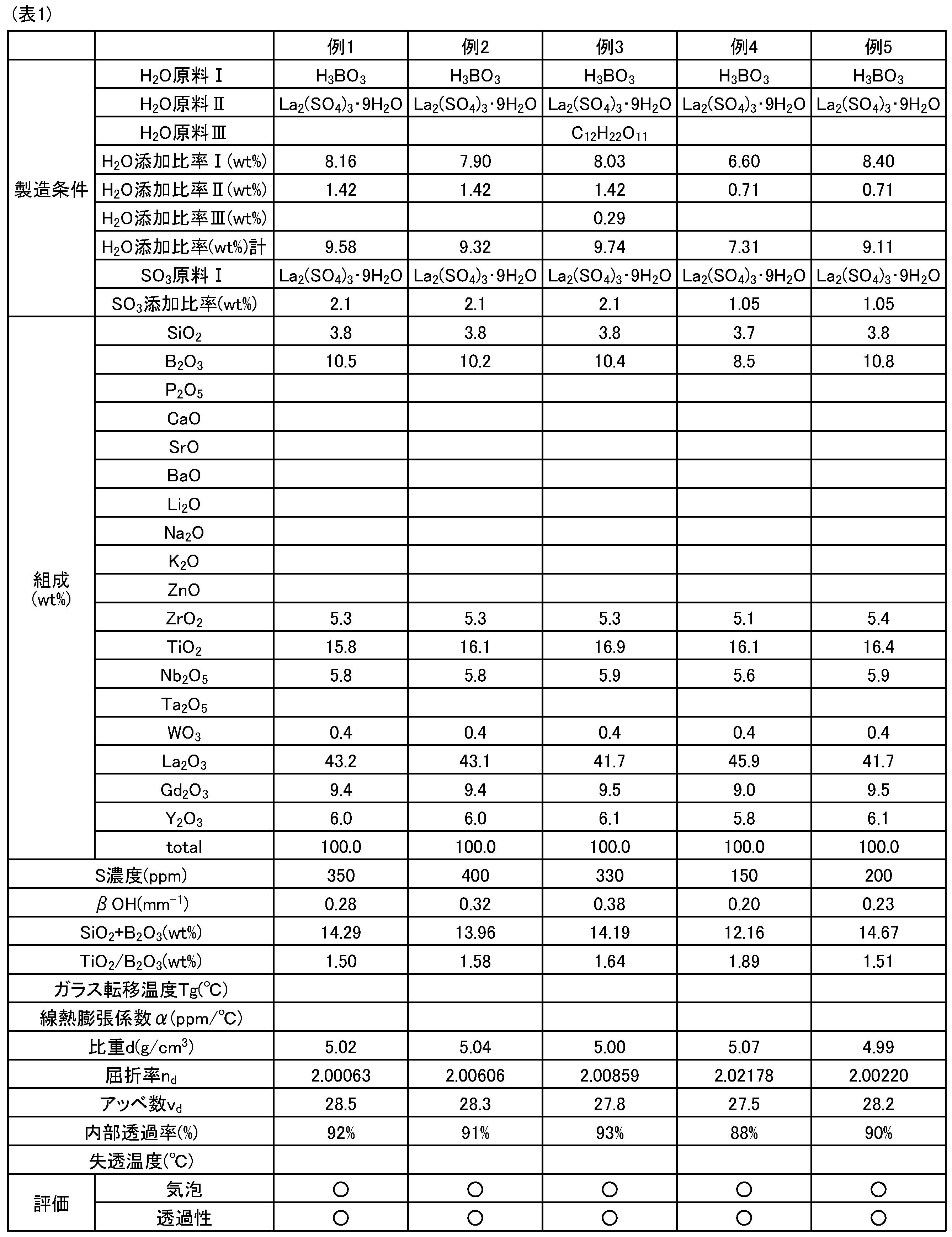


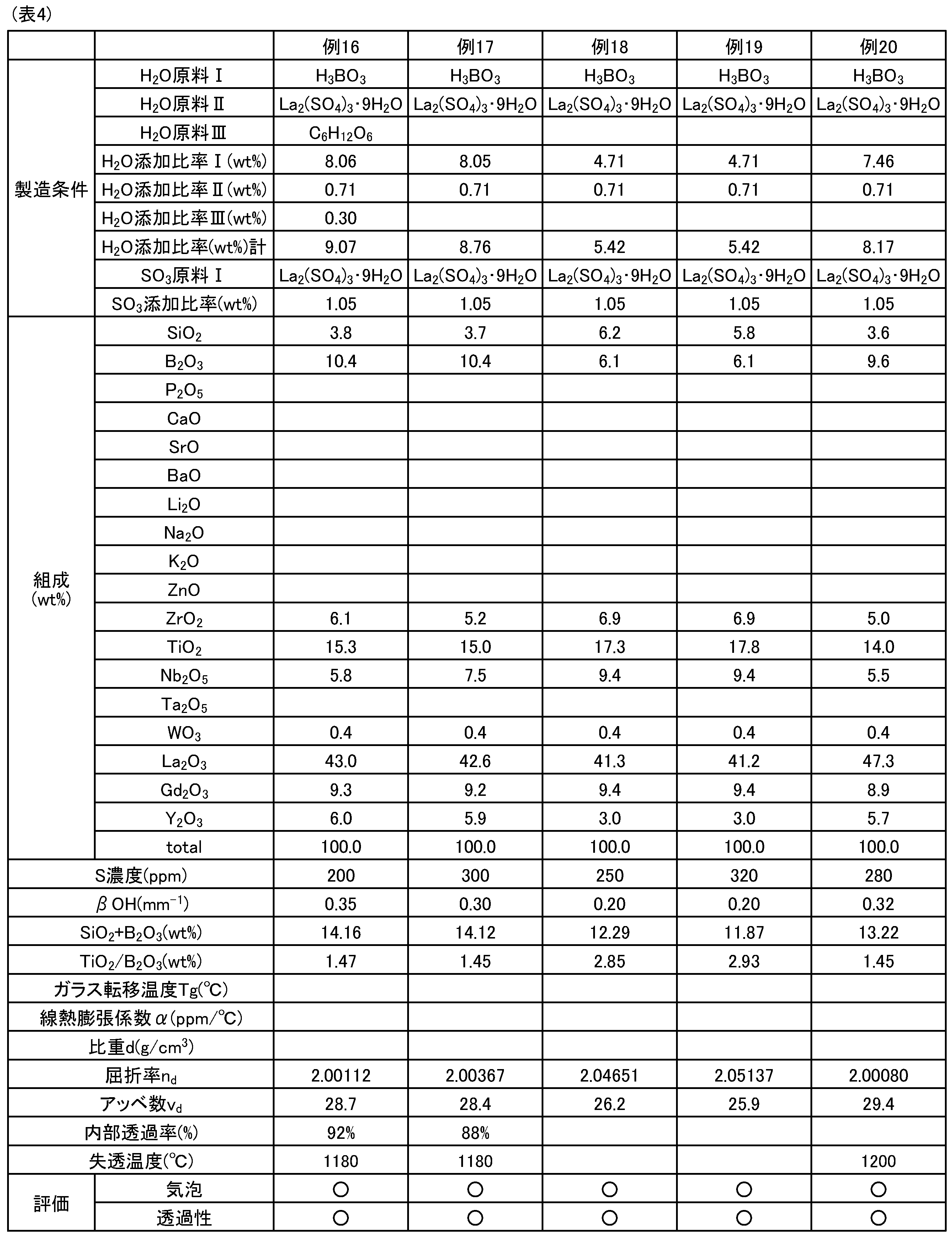

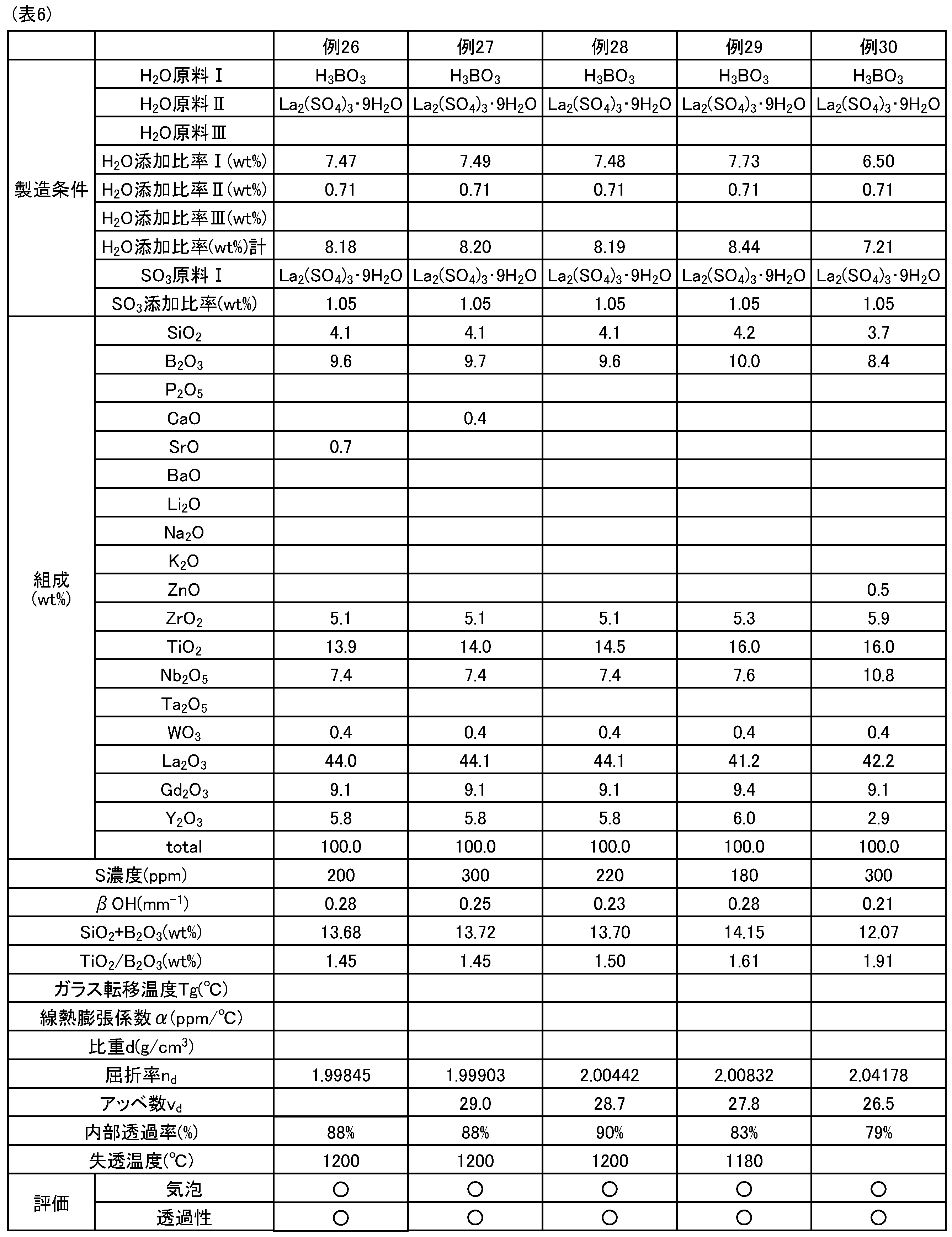
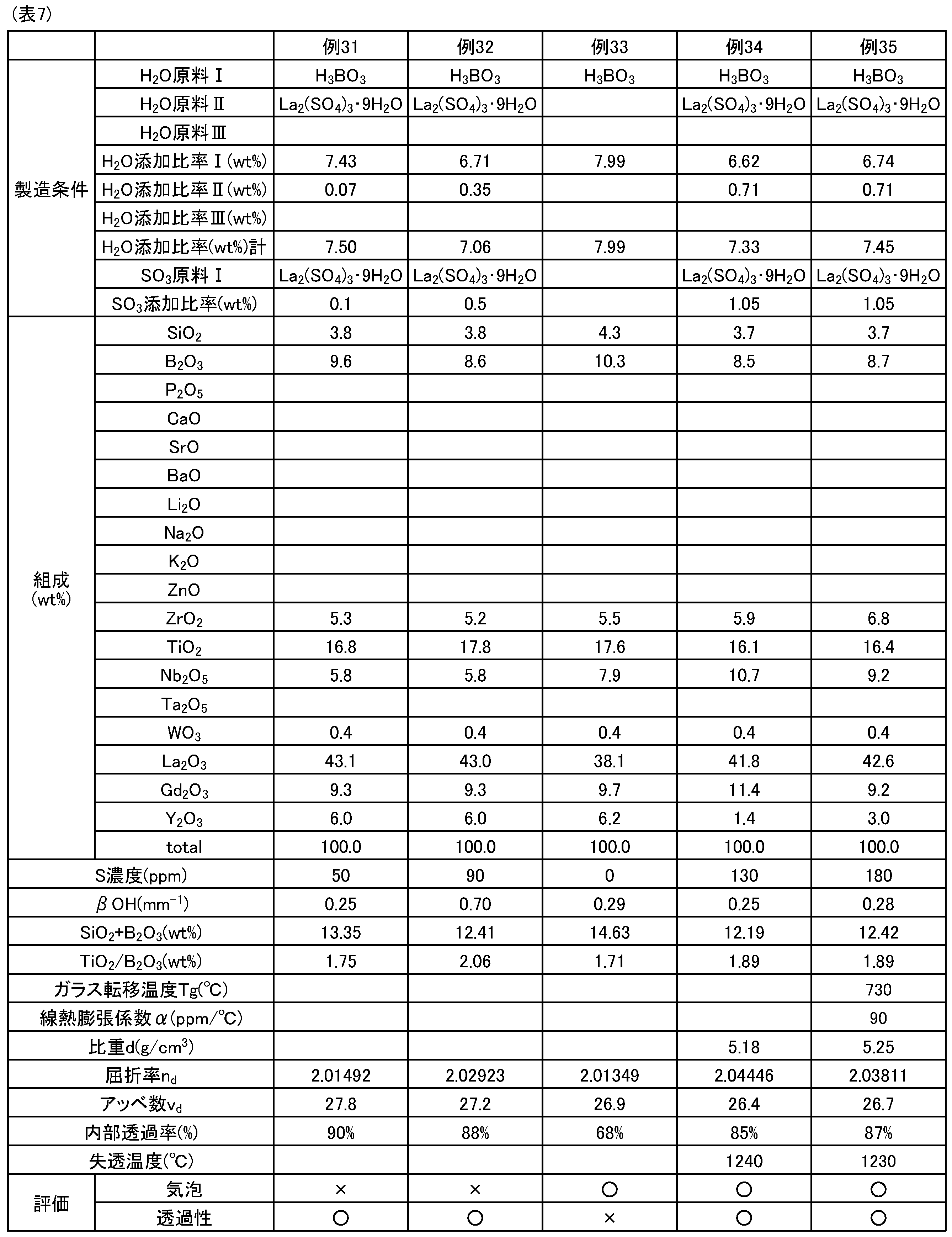
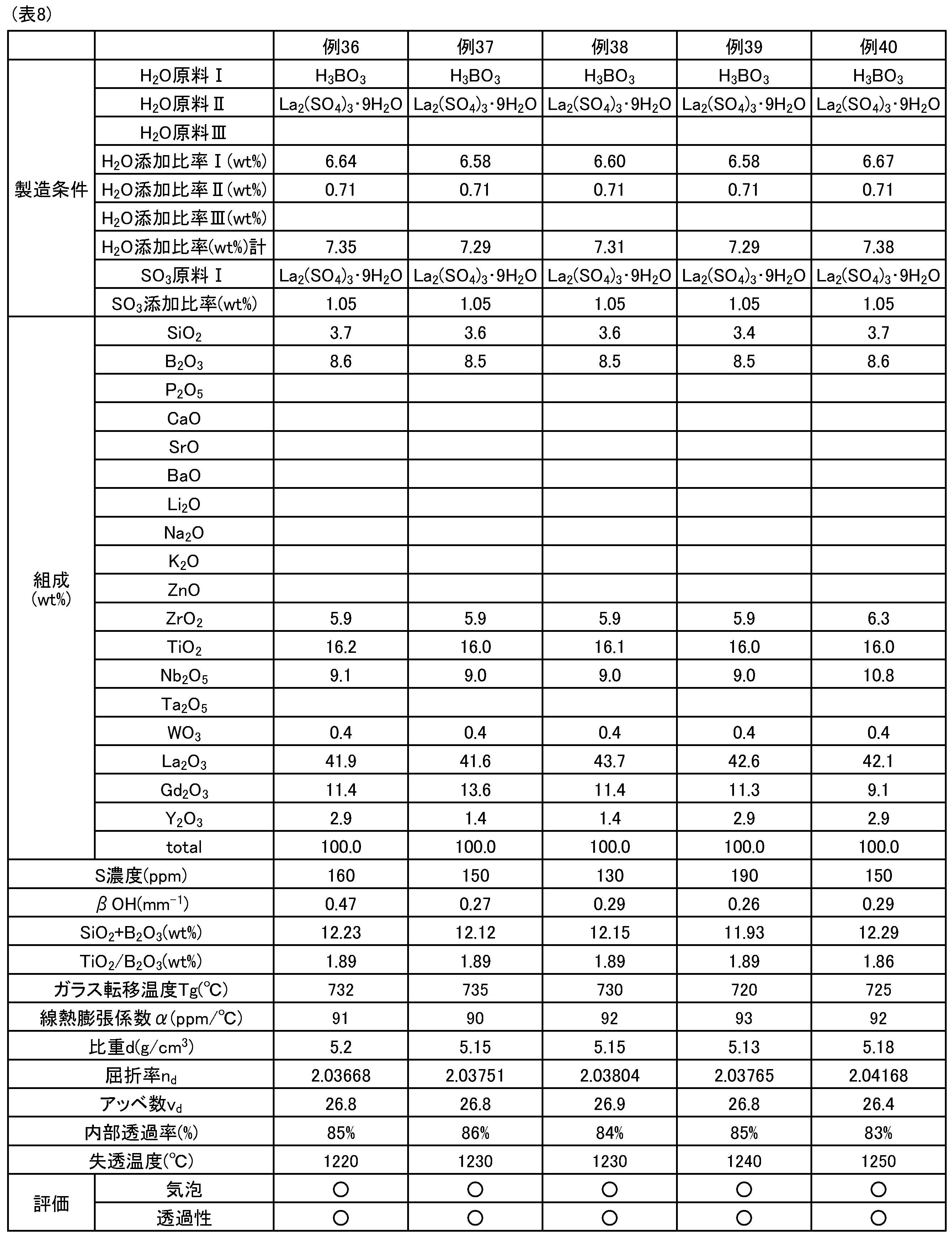


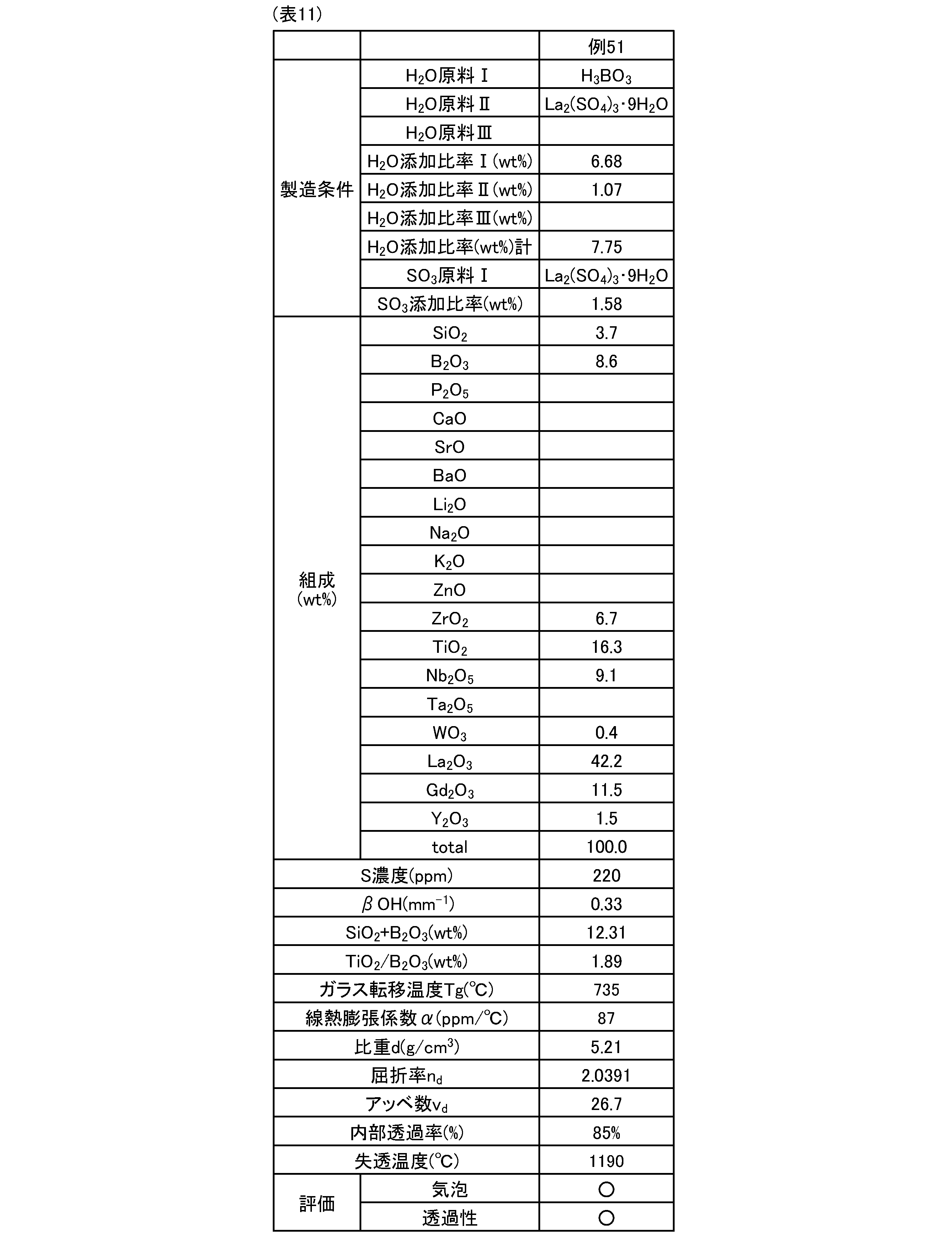
(例1)
例1においては、表1に記載の組成で、厚さが10mmと1mmのガラスを製造した。具体的には、表1に示す組成の原料を均一に混合した。この際、表1に示す組成の原料の他に、原料として、H2Oを含む原料としてのH3BO3と、H2Oを含む原料でありSO3を含む原料でもある(Laを含む原料でもある)La2(SO4)3・9H2Oも添加した。H2O添加比率が表1に示す値となるように、H2Oを含む原料の添加量を調整し、SO3添加比率が表1に示す値となるように、SO3を含む原料の添加量を調整した。なお、表1のH2O添加比率Iは、H2Oを含む原料IのH2O添加比率であり、表1のH2O添加比率IIは、H2Oを含む原料IIのH2O添加比率であり、表1のH2O添加比率IIIは、H2Oを含む原料IIIのH2O添加比率であり、表1のH2O添加比率(計)は、それぞれのH2Oを含む原料の合計についての、H2O添加比率である。
次に、混合した原料を、1330℃の白金坩堝内で2時間溶融させ、均一な溶融ガラスとした。次に、溶融ガラスを縦×横×高さ=縦60mm×横50mm×高さ30mmのカーボン製モールドに流し込んだ。その後、740℃で1時間保持した後、約1℃/分の降温速度で室温まで冷却し、ガラスブロックを得た。次にガラスブロックを、切断機(マルトー社製小型切断機)を用いて縦×横=30mm×30mmに切断し研削機(秀和工業社製SGM-6301)及び片面研磨機(日本エンギス社製EJ-380IN)を用いて板厚の調整と表面研磨を行い、縦×横=30mm×30mm、板厚10mm、及び1mmのガラスを製造した。
例1においては、表1に記載の組成で、厚さが10mmと1mmのガラスを製造した。具体的には、表1に示す組成の原料を均一に混合した。この際、表1に示す組成の原料の他に、原料として、H2Oを含む原料としてのH3BO3と、H2Oを含む原料でありSO3を含む原料でもある(Laを含む原料でもある)La2(SO4)3・9H2Oも添加した。H2O添加比率が表1に示す値となるように、H2Oを含む原料の添加量を調整し、SO3添加比率が表1に示す値となるように、SO3を含む原料の添加量を調整した。なお、表1のH2O添加比率Iは、H2Oを含む原料IのH2O添加比率であり、表1のH2O添加比率IIは、H2Oを含む原料IIのH2O添加比率であり、表1のH2O添加比率IIIは、H2Oを含む原料IIIのH2O添加比率であり、表1のH2O添加比率(計)は、それぞれのH2Oを含む原料の合計についての、H2O添加比率である。
次に、混合した原料を、1330℃の白金坩堝内で2時間溶融させ、均一な溶融ガラスとした。次に、溶融ガラスを縦×横×高さ=縦60mm×横50mm×高さ30mmのカーボン製モールドに流し込んだ。その後、740℃で1時間保持した後、約1℃/分の降温速度で室温まで冷却し、ガラスブロックを得た。次にガラスブロックを、切断機(マルトー社製小型切断機)を用いて縦×横=30mm×30mmに切断し研削機(秀和工業社製SGM-6301)及び片面研磨機(日本エンギス社製EJ-380IN)を用いて板厚の調整と表面研磨を行い、縦×横=30mm×30mm、板厚10mm、及び1mmのガラスを製造した。
例1のガラスの、Sの含有量(S濃度)を測定した。測定方法は上述の実施形態で説明した方法を用いた。
例1のガラスの、βOHを算出した。算出方法は上述の実施形態で説明した方法を用いた。
例1のガラスの、ガラス転移温度Tg、100℃~300℃の範囲の線熱膨張係数α、比重d、屈折率nd、アッベ数vd、内部透過率(透過率τ440)、及び失透温度を測定した。測定方法は上述の実施形態で説明した方法を用いた。
各測定結果を、表1に示す。
例1のガラスの、βOHを算出した。算出方法は上述の実施形態で説明した方法を用いた。
例1のガラスの、ガラス転移温度Tg、100℃~300℃の範囲の線熱膨張係数α、比重d、屈折率nd、アッベ数vd、内部透過率(透過率τ440)、及び失透温度を測定した。測定方法は上述の実施形態で説明した方法を用いた。
各測定結果を、表1に示す。
(例2~例51)
例2~例51においては、製造条件及び組成を表1~11に示したものとした以外は、例1と同じ方法で、ガラスを製造した。各例のガラスの測定結果を表1~表11に示す。なお、例2~例51において、内部透過率が空欄のものは、内部透過率が70%以上であった。
例2~例51においては、製造条件及び組成を表1~11に示したものとした以外は、例1と同じ方法で、ガラスを製造した。各例のガラスの測定結果を表1~表11に示す。なお、例2~例51において、内部透過率が空欄のものは、内部透過率が70%以上であった。
(評価)
各例のガラスについて、気泡の評価と、透過性の評価とを行った。
気泡の評価においては、溶融ガラス100ml中の30μm超の泡の数が50個未満の場合を〇、50個以上の場合を×とした。透過性の評価においては、蛍光灯下の環境で目視で透明の場合を〇、白濁していた場合を×とした。
各例のガラスについて、気泡の評価と、透過性の評価とを行った。
気泡の評価においては、溶融ガラス100ml中の30μm超の泡の数が50個未満の場合を〇、50個以上の場合を×とした。透過性の評価においては、蛍光灯下の環境で目視で透明の場合を〇、白濁していた場合を×とした。
表1~表11に示すように、比較例である例31、例47、例48はSO3の添加量が少ないので、泡が残存してしまい気泡の評価が×となっている。比較例である例32は、SO3が他の比較例よりは多く添加されているが、S濃度に対してβOHの値が相対的に高く、発泡した泡により気泡の評価が×となっている。比較例である例33では、SO3が添加されておらず、溶融性が悪化して透過性が×となっている。以上の通り、例31~33、例47~例48においては、気泡の評価と透過性の評価の少なくとも一方が×であり、気泡の含有を抑制しつつ、透過率の低下を抑制できないことが分かる。実施例である例1~30、例34~例46、例49~例51においては、気泡の評価と透過性の評価の両方が〇であり、気泡の含有を抑制しつつ、透過率の低下を抑制できることが分かる。
以上、本発明の実施形態を説明したが、この実施形態の内容により実施形態が限定されるものではない。また、前述した構成要素には、当業者が容易に想定できるもの、実質的に同一のもの、いわゆる均等の範囲のものが含まれる。さらに、前述した構成要素は適宜組み合わせることが可能である。さらに、前述した実施形態の要旨を逸脱しない範囲で構成要素の種々の省略、置換又は変更を行うことができる。
10 ガラス
Claims (12)
- La2O3、及びB2O3を含み、
質量比で、Sの含有量が100ppm以上であり、
波長440nmの光に対する内部透過率が70%以上であり、
βOHが0.1mm-1以上1.0mm-1以下である、
ガラス。 - 屈折率ndが1.95以上である、請求項1に記載のガラス。
- 質量比で、B2O3に対する、TiO2の含有量の割合(TiO2/B2O3)が、3以下である、請求項1又は請求項2に記載のガラス。
- 酸化物基準の質量比で、SiO2、及びB2O3の合計含有量が、10%以上である、請求項1又は請求項2に記載のガラス。
- 比重が5.30g/cm3以下である、請求項1又は請求項2に記載のガラス。
- 失透温度が1270℃以下である、請求項1又は請求項2に記載のガラス。
- Sbを非含有である、請求項1又は請求項2に記載のガラス。
- 導光板として用いられる、請求項1又は請求項2に記載のガラス。
- Laを含む原料と、Bを含む原料と、SO3を含む原料と、H2Oを含む原料とを混合することと、
混合した原料を加熱して溶解させることと、
溶解させた前記原料を冷却してガラスを得ることと、
を含み、
酸化物基準の前記ガラスの全質量に対するH2Oの添加量の比率が5wt%以上20wt%以下となるように、H2Oを含む原料を混合する、
ガラスの製造方法。 - H2Oを含む原料は、ホウ酸、水和物、及び有機物の少なくともひとつである、請求項9に記載のガラスの製造方法。
- 酸化物基準の前記ガラスの全質量に対するH2Oの添加量の比率が7wt%以上となるように、H2Oを含む原料を混合する、請求項9又は請求項10に記載のガラスの製造方法。
- 混合した原料を1350℃以下で加熱する、請求項9又は請求項10に記載のガラスの製造方法。
Applications Claiming Priority (2)
| Application Number | Priority Date | Filing Date | Title |
|---|---|---|---|
| JP2023-168688 | 2023-09-28 | ||
| JP2023168688 | 2023-09-28 |
Publications (1)
| Publication Number | Publication Date |
|---|---|
| WO2025070525A1 true WO2025070525A1 (ja) | 2025-04-03 |
Family
ID=95201547
Family Applications (1)
| Application Number | Title | Priority Date | Filing Date |
|---|---|---|---|
| PCT/JP2024/034246 Pending WO2025070525A1 (ja) | 2023-09-28 | 2024-09-25 | ガラス及びガラスの製造方法 |
Country Status (2)
| Country | Link |
|---|---|
| TW (1) | TW202528254A (ja) |
| WO (1) | WO2025070525A1 (ja) |
Citations (7)
| Publication number | Priority date | Publication date | Assignee | Title |
|---|---|---|---|---|
| WO2007111079A1 (ja) * | 2006-03-27 | 2007-10-04 | Asahi Glass Company, Limited | ガラス製造方法 |
| JP2011042556A (ja) * | 2009-07-24 | 2011-03-03 | Nippon Electric Glass Co Ltd | 光学ガラスの製造方法 |
| JP2015117169A (ja) * | 2013-12-19 | 2015-06-25 | Hoya株式会社 | ガラスの製造方法および光学素子の製造方法 |
| JP2016052971A (ja) * | 2014-09-04 | 2016-04-14 | 株式会社オハラ | ガラスの製造方法およびガラス |
| JP2016074558A (ja) * | 2014-10-06 | 2016-05-12 | 株式会社オハラ | 光学ガラス及び光学素子 |
| JP2016113311A (ja) * | 2014-12-11 | 2016-06-23 | 株式会社オハラ | 光学ガラス及び光学素子の製造方法 |
| WO2019017205A1 (ja) * | 2017-07-20 | 2019-01-24 | Hoya株式会社 | 光学ガラスおよび光学素子 |
-
2024
- 2024-09-25 WO PCT/JP2024/034246 patent/WO2025070525A1/ja active Pending
- 2024-09-27 TW TW113136944A patent/TW202528254A/zh unknown
Patent Citations (7)
| Publication number | Priority date | Publication date | Assignee | Title |
|---|---|---|---|---|
| WO2007111079A1 (ja) * | 2006-03-27 | 2007-10-04 | Asahi Glass Company, Limited | ガラス製造方法 |
| JP2011042556A (ja) * | 2009-07-24 | 2011-03-03 | Nippon Electric Glass Co Ltd | 光学ガラスの製造方法 |
| JP2015117169A (ja) * | 2013-12-19 | 2015-06-25 | Hoya株式会社 | ガラスの製造方法および光学素子の製造方法 |
| JP2016052971A (ja) * | 2014-09-04 | 2016-04-14 | 株式会社オハラ | ガラスの製造方法およびガラス |
| JP2016074558A (ja) * | 2014-10-06 | 2016-05-12 | 株式会社オハラ | 光学ガラス及び光学素子 |
| JP2016113311A (ja) * | 2014-12-11 | 2016-06-23 | 株式会社オハラ | 光学ガラス及び光学素子の製造方法 |
| WO2019017205A1 (ja) * | 2017-07-20 | 2019-01-24 | Hoya株式会社 | 光学ガラスおよび光学素子 |
Also Published As
| Publication number | Publication date |
|---|---|
| TW202528254A (zh) | 2025-07-16 |
Similar Documents
| Publication | Publication Date | Title |
|---|---|---|
| JP7772130B2 (ja) | 導光板用ガラス板 | |
| JP7537546B2 (ja) | 3次元形状の結晶化ガラス、3次元形状の化学強化ガラスおよびそれらの製造方法 | |
| JP6777893B2 (ja) | 紫外線透過ガラス | |
| US7645714B2 (en) | Crystallized glass, and method for producing crystallized glass | |
| JP7351334B2 (ja) | 結晶化ガラス及び化学強化ガラス並びにそれらの製造方法 | |
| US20070293386A1 (en) | Crystallized glass, and method for producing crystallized glass | |
| JP7602188B2 (ja) | 結晶化ガラス | |
| EP3747840B1 (en) | Optical glass and optical component | |
| CN102015566A (zh) | 强化玻璃及其制造方法 | |
| JP2025102978A (ja) | 化学強化用ガラス | |
| WO2023090177A1 (ja) | 結晶化ガラス | |
| TW202142507A (zh) | 玻璃 | |
| CN115210191A (zh) | 光学玻璃 | |
| JP2017122045A (ja) | 化学強化用ガラス | |
| WO2019167399A1 (ja) | 紫外線透過ガラス及びその製造方法 | |
| TW202528254A (zh) | 玻璃及玻璃之製造方法 | |
| US20240417312A1 (en) | Glass | |
| US20260078051A1 (en) | Chemically strengthened glass, method for producing chemically strengthened glass, cover glass, and solar cell module | |
| WO2025135106A1 (ja) | ガラス、及びガラスの製造方法 | |
| WO2025070524A1 (ja) | ガラス及びガラスの製造方法 | |
| JP2026053967A (ja) | ガラス | |
| JP2026053968A (ja) | ガラス | |
| WO2025127035A1 (ja) | 無アルカリガラス板 | |
| TW202330421A (zh) | 玻璃 | |
| WO2025263441A1 (ja) | ガラス、レーザー発振装置、及びガラスの製造方法 |
Legal Events
| Date | Code | Title | Description |
|---|---|---|---|
| 121 | Ep: the epo has been informed by wipo that ep was designated in this application |
Ref document number: 24872311 Country of ref document: EP Kind code of ref document: A1 |
|
| ENP | Entry into the national phase |
Ref document number: 2025549032 Country of ref document: JP Kind code of ref document: A |