WO2025070392A1 - ジアミン及びジカルボン酸の製造方法、ポリアミドのリサイクル方法、及びポリアミド - Google Patents
ジアミン及びジカルボン酸の製造方法、ポリアミドのリサイクル方法、及びポリアミド Download PDFInfo
- Publication number
- WO2025070392A1 WO2025070392A1 PCT/JP2024/033940 JP2024033940W WO2025070392A1 WO 2025070392 A1 WO2025070392 A1 WO 2025070392A1 JP 2024033940 W JP2024033940 W JP 2024033940W WO 2025070392 A1 WO2025070392 A1 WO 2025070392A1
- Authority
- WO
- WIPO (PCT)
- Prior art keywords
- polyamide
- diamine
- dicarboxylic acid
- producing
- derivative
- Prior art date
- Legal status (The legal status is an assumption and is not a legal conclusion. Google has not performed a legal analysis and makes no representation as to the accuracy of the status listed.)
- Pending
Links
Images
Classifications
-
- C—CHEMISTRY; METALLURGY
- C08—ORGANIC MACROMOLECULAR COMPOUNDS; THEIR PREPARATION OR CHEMICAL WORKING-UP; COMPOSITIONS BASED THEREON
- C08G—MACROMOLECULAR COMPOUNDS OBTAINED OTHERWISE THAN BY REACTIONS ONLY INVOLVING UNSATURATED CARBON-TO-CARBON BONDS
- C08G69/00—Macromolecular compounds obtained by reactions forming a carboxylic amide link in the main chain of the macromolecule
- C08G69/02—Polyamides derived from amino-carboxylic acids or from polyamines and polycarboxylic acids
- C08G69/26—Polyamides derived from amino-carboxylic acids or from polyamines and polycarboxylic acids derived from polyamines and polycarboxylic acids
-
- C—CHEMISTRY; METALLURGY
- C08—ORGANIC MACROMOLECULAR COMPOUNDS; THEIR PREPARATION OR CHEMICAL WORKING-UP; COMPOSITIONS BASED THEREON
- C08J—WORKING-UP; GENERAL PROCESSES OF COMPOUNDING; AFTER-TREATMENT NOT COVERED BY SUBCLASSES C08B, C08C, C08F, C08G or C08H
- C08J11/00—Recovery or working-up of waste materials
- C08J11/04—Recovery or working-up of waste materials of polymers
- C08J11/10—Recovery or working-up of waste materials of polymers by chemically breaking down the molecular chains of polymers or breaking of crosslinks, e.g. devulcanisation
- C08J11/16—Recovery or working-up of waste materials of polymers by chemically breaking down the molecular chains of polymers or breaking of crosslinks, e.g. devulcanisation by treatment with inorganic material
-
- Y—GENERAL TAGGING OF NEW TECHNOLOGICAL DEVELOPMENTS; GENERAL TAGGING OF CROSS-SECTIONAL TECHNOLOGIES SPANNING OVER SEVERAL SECTIONS OF THE IPC; TECHNICAL SUBJECTS COVERED BY FORMER USPC CROSS-REFERENCE ART COLLECTIONS [XRACs] AND DIGESTS
- Y02—TECHNOLOGIES OR APPLICATIONS FOR MITIGATION OR ADAPTATION AGAINST CLIMATE CHANGE
- Y02W—CLIMATE CHANGE MITIGATION TECHNOLOGIES RELATED TO WASTEWATER TREATMENT OR WASTE MANAGEMENT
- Y02W30/00—Technologies for solid waste management
- Y02W30/50—Reuse, recycling or recovery technologies
- Y02W30/62—Plastics recycling; Rubber recycling
Definitions
- the present invention relates to a method for producing diamines and dicarboxylic acids, a method for recycling polyamides, and polyamides.
- Polyamides have excellent mechanical properties, such as mechanical strength, rigidity, and impact resistance, as well as excellent heat resistance and chemical resistance, and therefore have traditionally been used in a variety of industrial fields, such as clothing, industrial materials, automobiles, electric and electronic parts, and other industrial products. Meanwhile, in recent years, the plastics industry has also been called upon to respond to the trend toward a resource-circulating society, and there is a demand for the establishment of recycling technologies for polyamides as well.
- Recycling is generally classified into three types: material recycling, chemical recycling, and thermal recycling.
- material recycling In present, in the automobile industry, which accounts for the majority of polyamide applications, most of the polyamide in scrapped automobiles is burned for thermal recycling and is not effectively utilized as a resource, and there is a demand for effective utilization of the polyamide through material recycling and chemical recycling. Also, from the viewpoint of reducing GHG (greenhouse gas) emissions, material recycling and chemical recycling of polyamides are required.
- GHG greenhouse gas
- polyamide resin compositions and molded products for automotive use contain, in addition to polyamide, inorganic fillers such as glass fibers, various additives such as heat stabilizers, pigments, dyes, etc. (see, for example, Patent Document 1), so polyamide obtained by material recycling has the problem that it is difficult to maintain mechanical properties sufficient for practical use after recycling. For this reason, chemical recycling, in which polyamide is depolymerized to break it down into monomers diamine and dicarboxylic acid, and these monomers are then polymerized again for recycling, is seen as promising, and research and development into this method is underway.
- Patent Document 2 proposes a technology in which polyamide is decomposed by ammonolysis using a Lewis acid catalyst to produce monomers.
- Patent Document 3 also proposes a method in which polyamide and glass fibers are separated from a molded article of a glass fiber-containing polyamide resin composition using an aqueous phosphoric acid solution, and the polyamide is further decomposed into monomers.
- Non-Patent Document 1 also proposes the depolymerization of polyamide 66 using microwaves.
- Patent Document 2 has a problem in that the monomer yield is low.
- Patent Document 3 in a specific example using polyamide 66, it takes as long as 200 minutes to dissolve the polyamide and glass fibers.
- Patent Document 3 does not provide a specific description regarding the depolymerization method, and furthermore, since it takes as long as 200 minutes to dissolve the polyamide and glass fibers, if it is assumed that the polyamide is further depolymerized after dissolving the molded article of the polyamide resin composition, the total time becomes even longer, which is problematic in terms of lack of practicality.
- Non-Patent Document 1 achieves depolymerization of polyamide in a short time and with a high yield by using a high-concentration hydrochloric acid of 17% by mass or more and heating to a high temperature of 170°C or more using microwaves. Therefore, although microwave irradiation using a glass reaction vessel is possible at the laboratory level, when considering implementation at an industrial level, the use of high-concentration hydrochloric acid at a high temperature of 170°C or more advances corrosion of the reaction vessel, so the material used for the reaction vessel is extremely limited.
- Non-Patent Document 2 Corrosion Resistance of New Metallic Materials, Takamura Akira, Anticorrosion Technology, Vol. 16 (1967) No. 3, pp. 97-106
- titanium which is generally said to be highly corrosion-resistant, suffers from corrosion problems when used with high-concentration hydrochloric acid of 5% or more at 100°C or more.
- Patent Documents 2 and 3 have problems in that the monomer yield is low and the time required, including monomer recovery and depolymerization, is not practical.
- the method described in Non-Patent Document 1 has a problem of corrosion of the reaction apparatus, making it industrially impractical.
- the energy required for the process increases, making it impractical from the perspective of reducing greenhouse gas (GHG) emissions.
- GFG greenhouse gas
- the present invention aims to provide a method for producing diamines and dicarboxylic acids, a method for recycling polyamides, and polyamides obtained by said method, which can be safely carried out even in a high-pressure environment even when carried out industrially, cause little corrosion to the reaction apparatus, and enable recovery of diamines and dicarboxylic acids in high yields and with high purity, and can provide polyamides as polymerization raw materials having physical properties and quality equivalent to those of polyamides derived from petrochemical raw materials.
- the present inventors have found that the above-mentioned problems can be solved by heating polyamide, polyamide resin compositions, and molded articles thereof in a prescribed solvent within a prescribed temperature range to depolymerize them, and separating and removing impurities derived from the recycled raw materials and foreign matter used in the recycling process or generated as a by-product, and purifying the diamine and dicarboxylic acid, thereby completing the present invention. That is, the present invention is as follows.
- the crude polyamide is introduced into an aqueous solution containing an acid in a closed reactor, a depolymerization step of heating the crude polyamide to a target temperature of 90° C. or more and 160° C.
- microwaves are irradiated from the upper portion of the reactor through a waveguide and the unfilled space by a microwave transmission device.
- the temperature increase rate during the temperature increase is 25° C./min or less. The method for producing the diamine and dicarboxylic acid according to [1] or [2] above.
- the reactor has a device for monitoring the pressure in the reactor and venting the reactor when the pressure in the reactor becomes higher than a reference pressure.
- the separation step includes a step of removing components other than the diamine and the diamine derivative, and the dicarboxylic acid and the dicarboxylic acid derivative as insoluble matters from the reaction solution in a state in which the dicarboxylic acid and/or the dicarboxylic acid derivative and the diamine and the diamine derivative are partially or entirely dissolved in the reaction solution, The method for producing a diamine and a dicarboxylic acid according to any one of [1] to [4] above.
- the pKa of the acid is 0 or less; The method for producing a diamine and a dicarboxylic acid according to any one of [1] to [5] above.
- the amount of the acid being expressed as a ratio of the number of moles of amide groups of the crude polyamide to the number of moles of protons of the acid, The ratio of amide groups of the crude polyamide to acid protons is 1:1 to 1:5.5.
- the acid is hydrochloric acid;
- the concentration of the hydrochloric acid in the aqueous solution is 5% by mass or more and 25% by mass or less.
- the main component of polyamide in the polyamide-containing waste is polyamide 66.
- a reactor having an inner surface made of a material such as glass lining, zirconium, or tantalum is used.
- the separation step when removing components other than the diamine, the derivative of the diamine, the dicarboxylic acid, and the derivative of the dicarboxylic acid, Hot filtration and centrifugation are performed.
- the dicarboxylic acid is purified by crystallization.
- the diamine is purified by distillation.
- a partition window is provided in the middle of the waveguide to separate the reactor from the microwave transmission device. The method for producing a diamine and a dicarboxylic acid according to any one of [2] to [14] above.
- the partition window is made of quartz glass.
- the microwave frequency during the microwave heating is 0.8 to 6 GHz.
- the content of Si element is set to 1 ppm by mass or more and 200 ppm by mass or less based on the total amount of the dicarboxylic acid.
- a method for producing a diamine and a dicarboxylic acid according to any one of [1] to [18] above is used to obtain a diamine and a dicarboxylic acid;
- the present invention provides a method for producing diamines and dicarboxylic acids, a method for recycling polyamides, and polyamides obtained by said method, which can be carried out safely even in a high-pressure environment, with minimal corrosion of the reaction apparatus, and which can recover diamines and dicarboxylic acids in high yields and with high purity, and which can use the resulting monomers as polymerization raw materials to obtain polyamides with physical properties and quality equivalent to those derived from petrochemical raw materials.
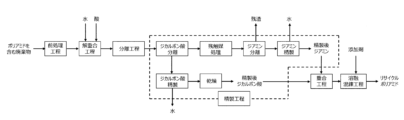
- FIG. 1 is a diagram showing a flow of a polyamide recycling method.
- the present embodiment a DETAILED DESCRIPTION OF THE PREFERRED EMBODIMENTS
- the present embodiment an embodiment for carrying out the present invention
- the following embodiment is an example for explaining the present invention, and is not intended to limit the present invention to the following content.
- the present invention can be carried out with appropriate modifications within the scope of the gist thereof.
- the method for producing a diamine and a dicarboxylic acid includes the steps of: a pretreatment step of subjecting a polyamide-containing waste to one or more treatments selected from the group consisting of pulverization, washing, and separation of foreign matter to obtain a crude polyamide;
- the crude polyamide is introduced into an aqueous solution containing an acid in a closed reactor, a depolymerization step of heating the crude polyamide to a target temperature of 90° C. or more and 160° C.
- the method for producing diamines and dicarboxylic acids and the method for recycling polyamides according to this embodiment can be carried out safely even in a high-pressure environment on an industrial scale, with minimal corrosion of the reaction apparatus, and it is possible to recover diamines and dicarboxylic acids in high yields and with high purity, resulting in high-quality polyamides.
- a waste material containing a polyamide is subjected to one or more treatments selected from the group consisting of pulverization, washing, and separation of foreign matter to obtain a crude polyamide.
- waste containing polyamide is used.
- the waste does not mean waste as defined by law (Law on Disposal and Cleaning of Waste), but is defined as a general term for things that are no longer used as products, things that cannot be used as products, etc.
- the waste containing polyamide includes molded products of polyamide and polyamide resin compositions, as well as polyamide and polyamide resin compositions as products.
- FIG. 1 is a flow chart specifically illustrating the polyamide recycling method of this embodiment.
- Polyamide means a polymer having an amide bond (-NHCO-) in the main chain.
- the polyamide is preferably a polyamide polymerized from a diamine and a dicarboxylic acid.
- the polyamide is not limited to the following, but may be, for example, polyamide 46 (polytetramethylene adipamide), polyamide 56 (polypentamethylene adipamide), polyamide 66 (polyhexamethylene adipamide), polyamide 410 (polytetramethylene sebacamide), polyamide 412 (polytetramethylene dodecamide), polyamide 610 (polyhexamethylene sebacamide), polyamide 612 (polyhexamethylene dodecamide), polyamide 1010 (polydecamethylene sebacamide), polyamide 1012 (polydecamethylene dodecamide), polyamide 6T (polyhexamethylene terephthalamide), polyamide 9T (polynonamethylene terephthalamide), polyamide 6I (polyhe
- the polyamide is preferably composed mainly of one or more selected from the group consisting of polyamide 66, polyamide 66/6I, polyamide 610, polyamide 612, polyamide 6I, and polyamide 6, and more preferably polyamide 66, polyamide 66/6I, or a mixture of polyamide 66 and polyamide 6I.
- the term "main component” means a component that accounts for more than 50% by mass relative to 100% by mass of the entire polymer component.
- Polyamide 66 is a polyamide obtained by condensation polymerization of hexamethylenediamine and adipic acid. It has excellent heat resistance, mechanical strength, and creep properties, and is therefore suitable for use as a material for functional parts of automobiles, machinery, and electrical products, or as a high-strength fiber.
- the polyamide resin composition is a resin composition containing the above-mentioned polyamide and, if necessary, inorganic fillers such as glass fibers, lubricants, and other additives such as heat stabilizers, flame retardants, pigments, dyes, etc.
- the polyamide resin composition and the molded article thereof may contain an inorganic filler, which tends to impart excellent mechanical strength and rigidity to the polyamide resin composition and the molded article thereof.
- inorganic fillers include, but are not limited to, glass fibers, carbon fibers, calcium silicate fibers, potassium titanate, aluminum borate, glass flakes, glass beads, talc, kaolin, mica, hydrotalcite, calcium carbonate, zinc carbonate, zinc oxide, calcium hydrogen phosphate, wollastonite, silica, zeolite, alumina, boehmite, aluminum hydroxide, titanium oxide, silicon oxide, magnesium oxide, calcium silicate, sodium aluminosilicate, magnesium silicate, ketjen black, acetylene black, furnace black, carbon nanotubes, graphite, brass, copper, silver, aluminum, nickel, iron, calcium fluoride, mica, montmorillonite, swellable fluoromica, and apatite. These may be used alone or
- the polyamide resin composition and the molded article thereof may further contain a lubricant in addition to the above-mentioned polyamide resin and inorganic filler. This tends to give the polyamide resin composition and the molded article thereof excellent fluidity and appearance.
- the polyamide resin composition and the molded article thereof may contain other additives in addition to the above-mentioned polyamide, inorganic filler, and lubricant.
- additives include, but are not limited to, antioxidants, ultraviolet absorbers, heat stabilizers, photodegradation inhibitors, plasticizers, release agents, nucleating agents, flame retardants, colorants, other thermoplastic resins, and the like.
- the molded article of polyamide or polyamide resin composition used in this embodiment is produced by molding using various known methods, for example, injection molding, etc.
- the molded article of this embodiment may be a fiber of polyamide or polyamide resin composition.
- Polyamide is manufactured in various forms such as fibers and films, and more than 2 million tons are used annually for a wide range of applications such as clothing, carpets, packaging films, automotive parts, and industrial parts.
- Polyamide or fiber waste suitable for chemical recycling is preferable because the higher the polyamide ratio in the product, the higher the recycling efficiency.
- the base fabric of an airbag made of polyamide 66 is optimally about 90% polyamide 66.
- polyamide 66 fibers can be used for apparel, bags, and other clothing accessories, outdoor goods, sportswear, and the like.
- one of the typical applications of non-reinforced polyamide among molded products is cable ties.
- a pretreatment step is carried out on the waste containing the polyamide described above.
- the waste containing polyamide is subjected to one or more processes selected from the group consisting of crushing, washing, and separation of foreign matter to obtain crude polyamide.
- impurities such as metals, stones, glass, and sand are removed.
- a gravity separation process can be used by adding washing water.
- the washing and separation of foreign matter steps can be simplified or omitted.
- the depolymerization step described below is carried out, whereby monomerization can be carried out with high efficiency.
- a depolymerization step is carried out.
- the crude polyamide obtained in the pretreatment step is introduced into an aqueous solution containing an acid in a closed reactor, and the temperature is raised to a target temperature of 90° C. or more and 160° C. or less, and then heated at a temperature close to the target temperature, whereby 80% or more of the amide groups in all the polyamides contained in the crude polyamide are depolymerized to obtain a reaction liquid in which the amide groups are decomposed into diamines and dicarboxylic acids.
- the term "near the target temperature” means a temperature range in which the depolymerization reaction occurs stably and continuously.
- the heating method is not particularly limited, but examples thereof include steam, an electric heater, and the like.
- depolymerization can be performed with low energy, and the depolymerization step can be carried out safely even in a high-pressure environment. In order to accelerate the depolymerization, it is necessary to add an acid, the specific acid being described later. According to the depolymerization step, polyamide, polyamide resin composition, and molded articles thereof can be converted into monomers at high yields using low energy, and can be chemically recycled.
- a closed reactor is used as the reactor.
- the pressure inside the reactor may increase due to evaporation of water in the reaction system, generation of outgassing due to decomposition of organic matter other than polyamide contained in the crude polyamide used as a raw material, and generation of hydrogen gas due to reaction between metals that may be contained as foreign matter in polyamide-containing waste and acid, and therefore a sealed pressure-resistant vessel is preferable.
- microwaves When microwaves are used in the depolymerization step, in order to efficiently irradiate microwaves into the system, it is preferable to install a microwave transmitter (magnetron) and a waveguide above the reactor, and to have an unfilled portion that is not filled with the aqueous solution containing a crude polyamide within the reactor, rather than filling the entire reactor with the aqueous solution containing a crude polyamide.
- a microwave transmitter magnet
- the microwaves can be irradiated uniformly, which tends to result in more uniform heating within the system.
- a partition window is provided midway along the waveguide, which separates the reactor from the microwave generator and allows microwaves to pass through but physically blocks them.
- the partition window is preferably designed to withstand an increase in the internal pressure of the reactor, and more specifically, the partition window is preferably made of quartz glass.
- the reactor preferably has a device for constantly monitoring the internal pressure and venting the internal pressure when the internal pressure exceeds a reference pressure.
- solvent In the depolymerization step, an aqueous solution containing an acid is used. That is, water is used as the solvent. This is because the diamine, dicarboxylic acid, and their derivatives produced by the depolymerization are water-soluble, and when removing impurities derived from the recovered polyamide in the subsequent step, components insoluble in water, such as inorganic fillers such as glass fiber, carbon black, pigments, additives, etc., can be easily physically removed. However, if an appropriate process for removing impurities derived from the recovered polyamide in the subsequent step can be constructed, an organic solvent such as ethylene glycol or methanol may be used in combination.
- the crude polyamide i.e., the waste containing the polyamide
- the crude polyamide does not necessarily need to be completely dissolved in the solvent as a polymer, and it is sufficient that it is partially dissolved and decomposed into monomers in the depolymerization step. Since the crude polyamide does not need to be completely dissolved in the solvent as a polymer in the depolymerization step, there is also the advantage that the viscosity increase in the depolymerization step is small and a large amount of crude polyamide can be put into the solvent.
- an inorganic salt may be added to the aqueous solution in order to increase the solubility of the crude polyamide, i.e., the polyamide-containing waste, in water.
- an aqueous solution containing an inorganic salt By using an aqueous solution containing an inorganic salt, the hydrogen bonds between the polymer chains of the polyamide tend to be weakened, thereby increasing the solubility.
- An inorganic salt is a general term for salts composed only of inorganic components, and examples thereof include metal salts, which are compounds in which the hydrogen atoms of an acid are substituted with metal ions.
- the metal salt is not limited to the following, but examples thereof include halides of calcium, zinc, and lithium from the viewpoint of suitability for depolymerization, and specific examples thereof include calcium chloride, zinc chloride, zinc bromide, chromium bromide, iron bromide, lithium chloride, lithium bromide, cobalt chloride, etc. From the viewpoints of availability and safety, calcium chloride, zinc chloride, and lithium chloride are preferred.
- the crude polyamide is put into an aqueous solution containing an acid.
- the acid is believed to act as a catalyst for the hydrolysis of the polyamide.
- the acid include, but are not limited to, organic acids such as methanesulfonic acid, trifluoromethanesulfonic acid, p-toluenesulfonic acid, trifluoroacetic acid, etc., inorganic acids such as hydrochloric acid, sulfuric acid, nitric acid, phosphoric acid, etc., and Lewis acids such as Sc(OTf) 3 , Yb(OTf) 3 , Nb 2 O 5 , CeO 2 , etc. These may be used alone or in combination of two or more kinds, but in order to obtain a high depolymerization rate during depolymerization, an acid having a pKa of 0 or less is preferred.
- the acid is preferably hydrochloric acid from the standpoint of reaction efficiency, reduction of impurities, and reduction of waste that is difficult to regenerate.
- the amount of acid used in the depolymerization step (the number of moles of protons released) is preferably in excess of the number of moles of amide groups in the polyamide.
- the amount of polyamide to be added in the depolymerization step will inevitably be relatively small, so from the viewpoint of productivity, it is preferable that the amount of acid is not too large.
- the amount of water in the system increases, so the load of the water removal step during the purification of diamine in the subsequent step increases, leading to increased costs and increased GHG emissions.
- the ratio of the number of moles of amide groups to acid protons in the crude polyamide is preferably 1:1 to 1:5.5, more preferably 1:1 to 1:3, and even more preferably 1:1.15 to 1:2.
- the concentration of the acid in the aqueous solution in the depolymerization step is such that the activation energy Ea decreases with an increase in the hydrochloric acid concentration, making the reaction more likely to proceed, but at the same time, the frequency factor A decreases with a decrease in the number of water molecules, making it difficult for the reaction to proceed. Therefore, there is an optimum region for the hydrochloric acid concentration, and it is preferably 5% by mass or more and 25% by mass or less. It is more preferably from 10% by mass to 25% by mass, and even more preferably from 12% by mass to 22% by mass.
- the reactor from the viewpoint of preventing the reactor from being damaged due to an abnormal rise in internal pressure caused by a sudden gas generation such as outgassing due to decomposition of organic matter other than polyamide contained in the crude polyamide, i.e., waste containing polyamide, or hydrogen gas generated by reaction of metals that may be contained as foreign matter with acid, it is preferable to keep the temperature rise speed at a certain level or less, as in the above-mentioned numerical range. If the internal pressure rises abnormally, in the case of microwave heating, heating stops immediately if the power supply is stopped, so from the viewpoint of safety, it is preferable to use microwaves.
- the temperature increase rate during heating is preferably 1° C./min or more, more preferably 2° C./min or more, and even more preferably 3° C./min or more.
- the target temperature is from 90° C. to 160° C., preferably from 95 to 150° C., more preferably from 100 to 145° C., and even more preferably from 110 to 140° C., from the viewpoint of suppressing side reactions and from the viewpoint of corrosion resistance of the reactor.
- a heating method for increasing the temperature it is preferable to use microwaves from the viewpoint of shortening the heating time and reducing GHG.
- any of the known methods such as steam and electric heaters can be used. These methods may be used alone or in combination of two or more.
- the temperature is raised to the target temperature as described above, and then the material is heated at a temperature close to the target temperature.
- Near the target temperature means that the temperature difference between the temperature in the system during heating and the target temperature is within 10°C.
- the temperature during heating is preferably 90°C or higher and 160°C or lower, more preferably 95 to 150°C, even more preferably 100 to 145°C, and even more preferably 110 to 140°C.
- any of the known methods such as steam and electric heaters can be used, but from the viewpoint of shortening the heating time and reducing GHG emissions, a method using microwaves is preferred.
- a reactor that is less corroded and has industrial practicality. Specifically, it is preferable to use a reactor having an inner surface made of a material such as glass lining, zirconium, or tantalum.
- the corrosion resistance can be determined, for example, from the data described in "Properties of Tantalum for Applications in the Chemical Process Industry: F.J.Hunkeler (USA) ASTM STP849, 1984, P28-49".
- the residual rate of polyamide is preferably 10% or less, more preferably 7% or less, even more preferably 5% or less, and even more preferably 1% or less, of the amide groups in the total polyamide contained in the crude polyamide.
- the depolymerization rate is preferably 85% or more of the amide groups in the entire polyamide contained in the crude polyamide, more preferably 90% or more, and even more preferably 95% or more.
- the depolymerization rate of the polyamide, the amount of decomposition products and the residual rate of the polyamide can be controlled within the above-mentioned numerical ranges by adjusting the acid concentration, reaction time and temperature.
- a separation step is carried out after the above-mentioned depolymerization step.
- the separation step in a state in which a part or all of the dicarboxylic acid and/or the dicarboxylic acid derivative is dissolved in the reaction liquid obtained in the depolymerization step, components other than the diamine and the diamine derivative, and the dicarboxylic acid and the dicarboxylic acid derivative are removed as insoluble matters to obtain the diamine and the diamine derivative, and the dicarboxylic acid and the dicarboxylic acid derivative.
- Specific methods for separating components other than diamines and derivatives of said diamines, and dicarboxylic acids and derivatives of dicarboxylic acids can be, for example, filtration with a filter, or methods using ion exchange membranes or ion exchange resins, and other known methods can be used depending on the object to be removed.
- waste containing polyamide generally contains metals, glass, glass fibers, sand, etc., it is preferable from the viewpoint of process efficiency and energy saving to remove these foreign substances by hot filtration while the temperature of the reaction liquid is high immediately after the depolymerization step.
- the temperature of the hot filtration is preferably a temperature at which diamines and derivatives of said diamines, and dicarboxylic acids and derivatives of dicarboxylic acids do not precipitate. Therefore, it is preferably 55°C or higher, more preferably 60°C or higher, and even more preferably 65°C or higher.
- the separation step in order to improve the recovery rate of diamine and dicarboxylic acid, in the separation step, it is preferable to separate the insoluble matter in a state in which a part or all of the dicarboxylic acid and/or dicarboxylic acid derivative and a part or all of the diamine and diamine derivative are dissolved in the reaction liquid obtained in the above-mentioned depolymerization step, for example in a temperature range in which they are dissolved, and it is more preferable to separate the insoluble matter in a state in which the entire amount is dissolved.
- the dicarboxylic acid is selectively completely dissolved in a solvent from a mixture of the dicarboxylic acid and the insoluble solids, and only the insolubles are separated from the solution, thereby removing the solids.
- a purification step is carried out after the separation step.
- the diamine and the dicarboxylic acid are isolated and purified from the diamine and the diamine derivative, and the dicarboxylic acid and the dicarboxylic acid derivative obtained in the above-mentioned separation step.
- a known method can be used, and although there is no particular limitation, examples thereof include the following methods.
- the diamine is dissolved in the liquid after the above-mentioned separation step as a diamine salt with a dicarboxylic acid (e.g., adipic acid) or an acid (e.g., hydrochloric acid).
- a method for separating the diamine from a solution containing the diamine salt includes a neutralization treatment. By adjusting the pH to a range of 7 to 14, it is possible to liberate the diamine from the diamine salt.
- the alkali used in the neutralization treatment may be any alkali as long as it is higher than the pKa of the diamine to be separated as the target product, and examples of the alkali that are publicly used industrially include sodium hydroxide, calcium hydroxide, and potassium hydroxide.
- a method for purifying the liberated diamine to a purity sufficient for use in the polymerization of polyamide for example, purification by distillation can be mentioned. Purification by distillation can also remove residues contained in crude polyamide. If a compound having a carboxylic acid is contained in the reaction liquid after the above-mentioned separation process, the diamine and the carboxylic acid will polymerize during heating in the distillation, leading to a decrease in the yield of the diamine and scaling of the apparatus.
- [Dicarboxylic acid isolation and purification process] In the method for isolating and purifying the dicarboxylic acid in the purification step, it is preferable to carry out purification by crystallization after the above-mentioned separation step.
- Examples of purification by crystallization include a method in which a dicarboxylic acid is precipitated from the reaction liquid obtained in the above-mentioned separation step, crystallized by recrystallization, and crude dicarboxylic acid crystals are obtained by solid-liquid separation, and the crude dicarboxylic acid crystals obtained are further dissolved in pure water, crystallized and separated into solid and liquid, and dried to obtain a purified dicarboxylic acid.
- the solution may be stirred or heated to dissolve the crude dicarboxylic acid crystals, or the solution may be aged for an appropriate period of time to allow the crystals to grow.
- Appropriate drying conditions may be selected as long as the temperature is equal to or lower than the melting point of the dicarboxylic acid.
- the dicarboxylic acid obtained in the above-mentioned separation process is different from the dicarboxylic acid produced by the usual manufacturing method, and contains impurities such as metal compounds and organic compounds derived from additives and pigments. These impurities cause the dicarboxylic acid to be colored and act as polymerization inhibitors when repolymerizing to polyamide, so it is preferable to remove them by crystallization in this isolation and purification process.
- suitable methods include washing the dicarboxylic acid obtained by crystallization with inorganic acids such as nitric acid, sulfuric acid, and hydrochloric acid, physical adsorption with ion exchange resins or activated carbon, and membrane separation.
- the dicarboxylic acid thus purified can be recovered as a crystalline dicarboxylic acid by drying off the remaining water, or can be mixed with a diamine without drying and used as a dicarboxylic acid-diamine salt.
- Si element content In the above-mentioned purification step, when producing polyamide by polymerizing dicarboxylic acid and diamine, from the viewpoint of making the viscosity of polyamide appropriate and stabilizing polymerization, and from the viewpoint of making the handling property of the obtained polyamide good, it is preferable to make the content of Si element 1 mass ppm or more with respect to the total amount of the dicarboxylic acid. Also, from the viewpoint of preventing polymerization inhibition when producing polyamide by polymerizing dicarboxylic acid and diamine, it is preferable to make it 200 mass ppm or less.
- the content of the Si element is more preferably 1 to 150 ppm by mass, further preferably 1 to 120 ppm by mass, and further more preferably 1 to 100 ppm by mass.
- the silicon element is derived from waste polyamide, and can be controlled to fall within the above-mentioned numerical range by adjusting the refining process.
- the method for recycling polyamide according to the present embodiment includes a polymerization step of polymerizing the diamine and dicarboxylic acid obtained by the above-mentioned method for producing diamine and dicarboxylic acid according to the present embodiment to obtain polyamide, as shown in Fig. 1. This makes it possible to recycle polyamide.
- the polymerization step can be carried out by a known method, and is not particularly limited, but examples thereof include the following methods.
- Polymerization process In the polymerization step, a method in which a dicarboxylic acid-diamine salt, or an aqueous solution of a mixture of a dicarboxylic acid and a diamine, or an aqueous suspension of these is heated and polymerized while maintaining the molten state (hereinafter also referred to as a "thermal melt polymerization method") is commonly used, but the polymerization can be performed by any known method such as a solid-phase polymerization method or a solution method without being limited thereto.
- thermo melt polymerization method A method in which an aqueous solution of a dicarboxylic acid-diamine salt, or a mixture of a dicarboxylic acid and a diamine, or an aqueous suspension of these is heated and polymerized while maintaining the molten state (hereinafter also referred to as the "thermal melt polymerization method”).
- thermo melt polymerization method A method in which the degree of polymerization of polyamide obtained by hot melt polymerization is increased while maintaining the polyamide in a solid state at a temperature below the melting point.
- a method of polymerizing a dicarboxylic acid-diamine salt or a mixture of a dicarboxylic acid and a diamine while maintaining the mixture in a solid state (hereinafter, also referred to as a "solid-phase polymerization method”).
- a method of polymerization using a dicarboxylic acid halide component equivalent to a dicarboxylic acid and a diamine component (hereinafter also referred to as the "solution method”).
- a production method including a hot melt polymerization method is preferred, and when producing polyamide by a hot melt polymerization method, it is preferred to maintain the molten state until the polymerization is completed.
- the polymerization pressure in the hot melt polymerization method is controlled to 14 to 25 kg/cm 2 (gauge pressure), and while continuing heating, the pressure in the tank is reduced to atmospheric pressure (gauge pressure is 0 kg/cm 2 ) over 30 minutes or more can be mentioned.
- the polymerization mode of the polyamide is not particularly limited, and may be a batch type or a continuous type.
- the polymerization apparatus used for producing the polyamide is not particularly limited, and any known apparatus can be used. For example, an autoclave type reactor, a tumbler type reactor, an extruder type reactor such as a kneader, and the like can be mentioned.
- an aqueous solution containing about 40 to 60% by mass of raw material components of a polyamide is concentrated to about 65 to 90% by mass in a concentration tank operated at a temperature of 110 to 180° C. and a pressure of about 0.035 to 0.6 MPa (gauge pressure) to obtain a concentrated solution.
- the concentrated solution obtained is then transferred to an autoclave, and heating is continued until the pressure in the autoclave reaches about 1.2 to 2.2 MPa (gauge pressure). Thereafter, in the autoclave, the pressure is maintained at about 1.2 to 2.2 MPa (gauge pressure) while removing water and/or gas components, and when the temperature reaches about 220 to 260° C., the pressure is reduced to atmospheric pressure (gauge pressure: 0 MPa). After the pressure inside the autoclave is reduced to atmospheric pressure, the pressure can be reduced as necessary to effectively remove the by-produced water. The autoclave is then pressurized with an inert gas such as nitrogen, and the polyamide melt is extruded from the autoclave as a strand. The extruded strand is cooled and cut to obtain polyamide pellets.
- an inert gas such as nitrogen
- the polyamide obtained by the above-mentioned polyamide recycling method preferably has a Si element content of 1 ppm by mass or more relative to the total amount of the polyamide, from the viewpoint of preventing the viscosity from becoming too high when additives are added and melt-kneading, and improving the handleability of the melt-kneaded product. Also, from the viewpoint of suppressing the molecular weight reduction of the polyamide, it is preferable that the Si element content is 100 ppm by mass or less. It is more preferably 1 to 50 ppm by mass, and further preferably 1 to 30 ppm by mass.
- the polyamide obtained by the above-mentioned polymerization process may be mixed with various additives according to the desired physical properties, as shown in Figure 1. By melt-kneading such polyamide, the final desired recycled polyamide is obtained.
- polyamide Polyamide, polyamide resin composition, and polyamide-containing waste for use in chemical recycling
- polyamide A: Polyamide 66 (manufactured by Asahi Kasei Corporation, model number: Leona 1300)
- Polyamide resin composition B: Polyamide 66 resin composition (manufactured by Asahi Kasei Corporation, model number: Leona 14G33, glass fiber ratio 33%)
- these polyamides and polyamide resin compositions were used as "waste containing polyamide” and "crude polyamide” similarly to the waste materials described below, mainly from the viewpoint of utilizing remnants and recycling stock.
- the polyamide 66 (manufactured by Asahi Kasei Corporation, model number: Leona 1300) and the polyamide 66 resin composition (manufactured by Asahi Kasei Corporation, model number: Leona 14G33, glass fiber ratio 33%) were used as pellets as crude polyamide.
- alkali used in the purification process for isolating and purifying diamine
- alkali The following sodium hydroxide was used as an alkali to neutralize the acid in the purification process.
- Examples 1 to 37 [Comparative Examples 1 to 16] Using each of sample solutions 1 to 18 shown in Tables 1 to 3, a depolymerization step was carried out under the conditions shown in Tables 4 to 8 and 10. Table 9 shows the analytical results of the purified hexamethylenediamine and adipic acid, and the analytical results of the polymerized polyamide 66.
- the temperature increase process up to a predetermined temperature was fixed at a temperature increase time of 20 minutes, and after depolymerization, the system was allowed to cool naturally within the system, and the pressure vessel was removed when the temperature had dropped to 80° C. Furthermore, in Examples 28 to 32, the actual recovery rate of adipic acid and hexamethylenediamine actually recovered after purification was calculated by the following method.
- the masses of the pure polyamide components in the input polyamide, polyamide resin composition, and crude polyamide were calculated, and the theoretical maximum recovery mass assuming that the pure polyamide components are 100% depolymerized, 100% diamine and dicarboxylic acid are generated without secondary reactions after depolymerization, and 100% is recovered without physical loss during purification was taken as 100%, and the ratio of the masses of the actually recovered adipic acid and hexamethylenediamine to the theoretical maximum recovery mass was taken as the actual recovery rate (%).
- the temperature was gradually increased to 110°C and 160 mbar and the pressure was reduced, and the temperature was further increased to 140°C and 80 mbar and the pressure was reduced, and the temperature was maintained for about 1 hour, and finally the target diamine was recovered.
- the purified diamine and dicarboxylic acid were subjected to NMR measurement, and it was confirmed that they were the intended products. Furthermore, trace amounts of impurities were confirmed by ICP-AES semi-quantitative analysis.
- the analytical equipment used was an ICP emission spectrometer SPS3520UV-DD manufactured by Hitachi (SII).
- the polymerization reaction of polyamide was carried out by the "thermal melt polymerization method" as follows. 150 g of the equimolar salt of adipic acid and hexamethylenediamine recovered as described above was dissolved in 150 g of distilled water to prepare a 50% by mass equimolar homogeneous aqueous solution of the raw material monomers. This aqueous solution was placed in an autoclave with an internal volume of 0.5 L and purged with nitrogen. The mixture was concentrated by gradually releasing steam until the solution concentration reached 70% by mass while stirring at a temperature of 110 to 150°C. The internal temperature was then raised to 220°C. At this time, the autoclave was pressurized to 1.8 MPa.
- the mixture was allowed to react for 1 hour while gradually releasing steam to keep the pressure at 1.8 MPa until the internal temperature reached 245°C. The pressure was then reduced over a period of 1 hour. Thereafter, the inside of the autoclave was kept under a reduced pressure of 650 torr (86.66 kPa) by a vacuum device for 10 minutes. At this time, the final internal temperature of the polymerization was 265° C.
- the resulting polyamide was subjected to NMR measurement and was confirmed to be polyamide 66. Trace amounts of impurities were confirmed by ICP-AES semi-quantitative analysis.
- the analytical equipment used was an ICP emission spectrometer SPS3520UV-DD manufactured by Hitachi (SII).
- the method for producing diamines and dicarboxylic acids, and the method for recycling polyamides of the present invention have industrial applicability as efficient recycling methods for polyamide resins, polyamide fibers, polyamide resin compositions, and molded articles used in automobile parts and various industrial parts.
Landscapes
- Chemical & Material Sciences (AREA)
- Health & Medical Sciences (AREA)
- Chemical Kinetics & Catalysis (AREA)
- Medicinal Chemistry (AREA)
- Polymers & Plastics (AREA)
- Organic Chemistry (AREA)
- Life Sciences & Earth Sciences (AREA)
- Sustainable Development (AREA)
- Separation, Recovery Or Treatment Of Waste Materials Containing Plastics (AREA)
- Organic Low-Molecular-Weight Compounds And Preparation Thereof (AREA)
- Polyamides (AREA)
Priority Applications (2)
| Application Number | Priority Date | Filing Date | Title |
|---|---|---|---|
| JP2025520754A JPWO2025070392A1 (https=) | 2023-09-27 | 2024-09-24 | |
| CN202480003994.4A CN120051519A (zh) | 2023-09-27 | 2024-09-24 | 二元胺和二元羧酸的制造方法、聚酰胺的回收利用方法和聚酰胺 |
Applications Claiming Priority (2)
| Application Number | Priority Date | Filing Date | Title |
|---|---|---|---|
| JP2023165285 | 2023-09-27 | ||
| JP2023-165285 | 2023-09-27 |
Publications (1)
| Publication Number | Publication Date |
|---|---|
| WO2025070392A1 true WO2025070392A1 (ja) | 2025-04-03 |
Family
ID=95203449
Family Applications (1)
| Application Number | Title | Priority Date | Filing Date |
|---|---|---|---|
| PCT/JP2024/033940 Pending WO2025070392A1 (ja) | 2023-09-27 | 2024-09-24 | ジアミン及びジカルボン酸の製造方法、ポリアミドのリサイクル方法、及びポリアミド |
Country Status (3)
| Country | Link |
|---|---|
| JP (1) | JPWO2025070392A1 (https=) |
| CN (1) | CN120051519A (https=) |
| WO (1) | WO2025070392A1 (https=) |
Citations (11)
| Publication number | Priority date | Publication date | Assignee | Title |
|---|---|---|---|---|
| JPH08269461A (ja) * | 1995-03-30 | 1996-10-15 | Toshiba Corp | プラスチック油化処理装置 |
| JP2000080199A (ja) | 1998-09-07 | 2000-03-21 | Toray Ind Inc | ガラス繊維含有ポリアミド成形品からのポリアミドとガラス繊維との分離方法 |
| JP3571723B2 (ja) | 1994-01-21 | 2004-09-29 | イー・アイ・デュポン・ドゥ・ヌムール・アンド・カンパニー | ルイス酸触媒によるナイロンのアンモノリシス |
| JP2006335856A (ja) * | 2005-06-01 | 2006-12-14 | Kumamoto Technology & Industry Foundation | ポリエステルの解重合方法、その方法を用いたポリエステルモノマーの回収方法 |
| JP2009286867A (ja) * | 2008-05-28 | 2009-12-10 | Univ Kansai | 脂肪族ポリアミド繊維基布複合体からの脂肪族ポリアミドの再生方法 |
| JP2011168755A (ja) * | 2010-02-22 | 2011-09-01 | Yamaguchi Prefectural Industrial Technology Institute | ポリオレフィン類を含む複合プラスチックの分離方法とその分離装置 |
| JP2015168741A (ja) * | 2014-03-06 | 2015-09-28 | 大和製罐株式会社 | ポリエステルの解重合方法および当該解重合方法を用いたポリエステル原料の回収方法 |
| JP6839266B2 (ja) | 2017-03-30 | 2021-03-03 | 旭化成株式会社 | ポリアミド組成物及び成形品 |
| WO2022092196A1 (ja) * | 2020-10-30 | 2022-05-05 | 豊田通商株式会社 | シリコーンを除去する方法及びリサイクルポリアミド製品の製造方法 |
| WO2023120427A1 (ja) * | 2021-12-23 | 2023-06-29 | 旭化成株式会社 | 解重合方法 |
| JP2023165285A (ja) | 2022-05-02 | 2023-11-15 | キヤノン株式会社 | ズームレンズおよび撮像装置 |
-
2024
- 2024-09-24 CN CN202480003994.4A patent/CN120051519A/zh active Pending
- 2024-09-24 JP JP2025520754A patent/JPWO2025070392A1/ja active Pending
- 2024-09-24 WO PCT/JP2024/033940 patent/WO2025070392A1/ja active Pending
Patent Citations (11)
| Publication number | Priority date | Publication date | Assignee | Title |
|---|---|---|---|---|
| JP3571723B2 (ja) | 1994-01-21 | 2004-09-29 | イー・アイ・デュポン・ドゥ・ヌムール・アンド・カンパニー | ルイス酸触媒によるナイロンのアンモノリシス |
| JPH08269461A (ja) * | 1995-03-30 | 1996-10-15 | Toshiba Corp | プラスチック油化処理装置 |
| JP2000080199A (ja) | 1998-09-07 | 2000-03-21 | Toray Ind Inc | ガラス繊維含有ポリアミド成形品からのポリアミドとガラス繊維との分離方法 |
| JP2006335856A (ja) * | 2005-06-01 | 2006-12-14 | Kumamoto Technology & Industry Foundation | ポリエステルの解重合方法、その方法を用いたポリエステルモノマーの回収方法 |
| JP2009286867A (ja) * | 2008-05-28 | 2009-12-10 | Univ Kansai | 脂肪族ポリアミド繊維基布複合体からの脂肪族ポリアミドの再生方法 |
| JP2011168755A (ja) * | 2010-02-22 | 2011-09-01 | Yamaguchi Prefectural Industrial Technology Institute | ポリオレフィン類を含む複合プラスチックの分離方法とその分離装置 |
| JP2015168741A (ja) * | 2014-03-06 | 2015-09-28 | 大和製罐株式会社 | ポリエステルの解重合方法および当該解重合方法を用いたポリエステル原料の回収方法 |
| JP6839266B2 (ja) | 2017-03-30 | 2021-03-03 | 旭化成株式会社 | ポリアミド組成物及び成形品 |
| WO2022092196A1 (ja) * | 2020-10-30 | 2022-05-05 | 豊田通商株式会社 | シリコーンを除去する方法及びリサイクルポリアミド製品の製造方法 |
| WO2023120427A1 (ja) * | 2021-12-23 | 2023-06-29 | 旭化成株式会社 | 解重合方法 |
| JP2023165285A (ja) | 2022-05-02 | 2023-11-15 | キヤノン株式会社 | ズームレンズおよび撮像装置 |
Non-Patent Citations (3)
| Title |
|---|
| AKIRA TAKAMURA, CORROS. ENG, vol. 16, no. 3, 1967, pages 97 - 106 |
| PROPERTIES OF TANTALUM FOR APPLICATIONS IN THE CHEMICAL PROCESS INDUSTRY: F.J. HUNKELER (USA) ASTM STP849, 1984, pages 28 - 49 |
| URSKA CESAREK ET AL.: "Chemical Recycling of Aliphatic Polyamides by Microwave-Assisted Hydrolysis for Efficient Monomer Recovery", ACS SUSTAINABLE CHEM. ENG., vol. 8, 2020, pages 16274 - 16282, XP055980628, DOI: 10.1021/acssuschemeng.0c05706 |
Also Published As
| Publication number | Publication date |
|---|---|
| CN120051519A (zh) | 2025-05-27 |
| JPWO2025070392A1 (https=) | 2025-04-03 |
Similar Documents
| Publication | Publication Date | Title |
|---|---|---|
| US9994678B2 (en) | Process for the continuous preparation of an aliphatic or partially aromatic polyamide | |
| US20250282925A1 (en) | Method of producing thermoplastic resin | |
| JP7772830B2 (ja) | 解重合方法 | |
| EP3130627B1 (en) | Polyamide resin composition | |
| US20240352217A1 (en) | METHOD OF COLLECTING FIBROUS FILLING MATERIAL AND e-CAPROLACTAM, AND METHOD OF PRODUCING POLYAMIDE 6 | |
| CA3226741A1 (en) | Process for producing epsilon-caprolactam by depolymerization of polycaprolactam (pa6) | |
| US20250257037A1 (en) | METHOD OF COLLECTING e-CAPROLACTAM AND POLYAMIDE 6 OLIGOMER, AND METHOD OF PRODUCING POLYAMIDE 6 | |
| EP4630481A1 (en) | Method for recycling a polyamide comprising a pretreatment step | |
| CA2914102C (en) | Method for the continuous production of an aliphatic or semi-aromatic polyamide oligomer | |
| WO2024002975A1 (en) | Method for recycling a polyamide under acidic conditions | |
| WO2025070392A1 (ja) | ジアミン及びジカルボン酸の製造方法、ポリアミドのリサイクル方法、及びポリアミド | |
| JP7334871B1 (ja) | ε-カプロラクタムの製造方法およびポリアミド6の製造方法 | |
| JP2024147066A (ja) | ポリアミドオリゴマー組成物およびその製造方法 | |
| JP2000080199A (ja) | ガラス繊維含有ポリアミド成形品からのポリアミドとガラス繊維との分離方法 | |
| JP2025179153A (ja) | 熱可塑性ポリマー由来成分の回収方法、回収装置、解重合中間体組成物、解重合反応組成物、およびリサイクルモノマーの製造方法、製造装置 | |
| TW202610796A (zh) | 源自熱可塑性聚合物的成分之回收方法、回收裝置、解聚合中間體組成物、解聚合反應組成物、及再生單體之製造方法、製造裝置 | |
| JP3621234B2 (ja) | ε−カプロラクタム重合体の解重合方法および再重合方法 | |
| US20250019516A1 (en) | Method of producing epsilon-caprolactam and method of producing polyamide 6 | |
| WO2025051714A2 (en) | Method for recycling an aromatic monomer from a polyamide | |
| WO2024070904A1 (ja) | 粉末ポリアミドの製造方法 | |
| JP2024126572A (ja) | 固形状ポリアミドの製造方法 | |
| CN120092037A (zh) | 二胺或二胺组合物、聚酰胺、成型品、纤维、膜或片材、二胺和/或二羧酸的制造方法、二胺和/或二胺组合物的制造方法及聚酰胺的制造方法 |
Legal Events
| Date | Code | Title | Description |
|---|---|---|---|
| WWE | Wipo information: entry into national phase |
Ref document number: 202480003994.4 Country of ref document: CN |
|
| ENP | Entry into the national phase |
Ref document number: 2025520754 Country of ref document: JP Kind code of ref document: A |
|
| WWE | Wipo information: entry into national phase |
Ref document number: 2025520754 Country of ref document: JP |
|
| 121 | Ep: the epo has been informed by wipo that ep was designated in this application |
Ref document number: 24861370 Country of ref document: EP Kind code of ref document: A1 |
|
| WWP | Wipo information: published in national office |
Ref document number: 202480003994.4 Country of ref document: CN |