WO2025069918A1 - ピリダジノン系化合物又はその塩及びそれらを含有する有害生物防除剤 - Google Patents
ピリダジノン系化合物又はその塩及びそれらを含有する有害生物防除剤 Download PDFInfo
- Publication number
- WO2025069918A1 WO2025069918A1 PCT/JP2024/031121 JP2024031121W WO2025069918A1 WO 2025069918 A1 WO2025069918 A1 WO 2025069918A1 JP 2024031121 W JP2024031121 W JP 2024031121W WO 2025069918 A1 WO2025069918 A1 WO 2025069918A1
- Authority
- WO
- WIPO (PCT)
- Prior art keywords
- alkyl
- compound
- alkoxy
- optionally substituted
- formula
- Prior art date
- Legal status (The legal status is an assumption and is not a legal conclusion. Google has not performed a legal analysis and makes no representation as to the accuracy of the status listed.)
- Pending
Links
Classifications
-
- A—HUMAN NECESSITIES
- A01—AGRICULTURE; FORESTRY; ANIMAL HUSBANDRY; HUNTING; TRAPPING; FISHING
- A01N—PRESERVATION OF BODIES OF HUMANS OR ANIMALS OR PLANTS OR PARTS THEREOF; BIOCIDES, e.g. AS DISINFECTANTS, AS PESTICIDES OR AS HERBICIDES; PEST REPELLANTS OR ATTRACTANTS; PLANT GROWTH REGULATORS
- A01N43/00—Biocides, pest repellants or attractants, or plant growth regulators containing heterocyclic compounds
- A01N43/48—Biocides, pest repellants or attractants, or plant growth regulators containing heterocyclic compounds having rings with two nitrogen atoms as the only ring hetero atoms
- A01N43/58—1,2-Diazines; Hydrogenated 1,2-diazines
-
- A—HUMAN NECESSITIES
- A01—AGRICULTURE; FORESTRY; ANIMAL HUSBANDRY; HUNTING; TRAPPING; FISHING
- A01N—PRESERVATION OF BODIES OF HUMANS OR ANIMALS OR PLANTS OR PARTS THEREOF; BIOCIDES, e.g. AS DISINFECTANTS, AS PESTICIDES OR AS HERBICIDES; PEST REPELLANTS OR ATTRACTANTS; PLANT GROWTH REGULATORS
- A01N43/00—Biocides, pest repellants or attractants, or plant growth regulators containing heterocyclic compounds
- A01N43/64—Biocides, pest repellants or attractants, or plant growth regulators containing heterocyclic compounds having rings with three nitrogen atoms as the only ring hetero atoms
- A01N43/647—Triazoles; Hydrogenated triazoles
- A01N43/653—1,2,4-Triazoles; Hydrogenated 1,2,4-triazoles
-
- A—HUMAN NECESSITIES
- A01—AGRICULTURE; FORESTRY; ANIMAL HUSBANDRY; HUNTING; TRAPPING; FISHING
- A01N—PRESERVATION OF BODIES OF HUMANS OR ANIMALS OR PLANTS OR PARTS THEREOF; BIOCIDES, e.g. AS DISINFECTANTS, AS PESTICIDES OR AS HERBICIDES; PEST REPELLANTS OR ATTRACTANTS; PLANT GROWTH REGULATORS
- A01N47/00—Biocides, pest repellants or attractants, or plant growth regulators containing organic compounds containing a carbon atom not being member of a ring and having no bond to a carbon or hydrogen atom, e.g. derivatives of carbonic acid
- A01N47/02—Biocides, pest repellants or attractants, or plant growth regulators containing organic compounds containing a carbon atom not being member of a ring and having no bond to a carbon or hydrogen atom, e.g. derivatives of carbonic acid the carbon atom having no bond to a nitrogen atom
-
- A—HUMAN NECESSITIES
- A01—AGRICULTURE; FORESTRY; ANIMAL HUSBANDRY; HUNTING; TRAPPING; FISHING
- A01N—PRESERVATION OF BODIES OF HUMANS OR ANIMALS OR PLANTS OR PARTS THEREOF; BIOCIDES, e.g. AS DISINFECTANTS, AS PESTICIDES OR AS HERBICIDES; PEST REPELLANTS OR ATTRACTANTS; PLANT GROWTH REGULATORS
- A01N47/00—Biocides, pest repellants or attractants, or plant growth regulators containing organic compounds containing a carbon atom not being member of a ring and having no bond to a carbon or hydrogen atom, e.g. derivatives of carbonic acid
- A01N47/02—Biocides, pest repellants or attractants, or plant growth regulators containing organic compounds containing a carbon atom not being member of a ring and having no bond to a carbon or hydrogen atom, e.g. derivatives of carbonic acid the carbon atom having no bond to a nitrogen atom
- A01N47/06—Biocides, pest repellants or attractants, or plant growth regulators containing organic compounds containing a carbon atom not being member of a ring and having no bond to a carbon or hydrogen atom, e.g. derivatives of carbonic acid the carbon atom having no bond to a nitrogen atom containing —O—CO—O— groups; Thio analogues thereof
-
- A—HUMAN NECESSITIES
- A01—AGRICULTURE; FORESTRY; ANIMAL HUSBANDRY; HUNTING; TRAPPING; FISHING
- A01N—PRESERVATION OF BODIES OF HUMANS OR ANIMALS OR PLANTS OR PARTS THEREOF; BIOCIDES, e.g. AS DISINFECTANTS, AS PESTICIDES OR AS HERBICIDES; PEST REPELLANTS OR ATTRACTANTS; PLANT GROWTH REGULATORS
- A01N47/00—Biocides, pest repellants or attractants, or plant growth regulators containing organic compounds containing a carbon atom not being member of a ring and having no bond to a carbon or hydrogen atom, e.g. derivatives of carbonic acid
- A01N47/08—Biocides, pest repellants or attractants, or plant growth regulators containing organic compounds containing a carbon atom not being member of a ring and having no bond to a carbon or hydrogen atom, e.g. derivatives of carbonic acid the carbon atom having one or more single bonds to nitrogen atoms
- A01N47/10—Carbamic acid derivatives, i.e. containing the group —O—CO—N<; Thio analogues thereof
- A01N47/24—Carbamic acid derivatives, i.e. containing the group —O—CO—N<; Thio analogues thereof containing the groups, or; Thio analogues thereof
-
- A—HUMAN NECESSITIES
- A01—AGRICULTURE; FORESTRY; ANIMAL HUSBANDRY; HUNTING; TRAPPING; FISHING
- A01N—PRESERVATION OF BODIES OF HUMANS OR ANIMALS OR PLANTS OR PARTS THEREOF; BIOCIDES, e.g. AS DISINFECTANTS, AS PESTICIDES OR AS HERBICIDES; PEST REPELLANTS OR ATTRACTANTS; PLANT GROWTH REGULATORS
- A01N53/00—Biocides, pest repellants or attractants, or plant growth regulators containing cyclopropane carboxylic acids or derivatives thereof
-
- A—HUMAN NECESSITIES
- A01—AGRICULTURE; FORESTRY; ANIMAL HUSBANDRY; HUNTING; TRAPPING; FISHING
- A01P—BIOCIDAL, PEST REPELLANT, PEST ATTRACTANT OR PLANT GROWTH REGULATORY ACTIVITY OF CHEMICAL COMPOUNDS OR PREPARATIONS
- A01P5/00—Nematocides
-
- A—HUMAN NECESSITIES
- A01—AGRICULTURE; FORESTRY; ANIMAL HUSBANDRY; HUNTING; TRAPPING; FISHING
- A01P—BIOCIDAL, PEST REPELLANT, PEST ATTRACTANT OR PLANT GROWTH REGULATORY ACTIVITY OF CHEMICAL COMPOUNDS OR PREPARATIONS
- A01P7/00—Arthropodicides
- A01P7/02—Acaricides
-
- A—HUMAN NECESSITIES
- A01—AGRICULTURE; FORESTRY; ANIMAL HUSBANDRY; HUNTING; TRAPPING; FISHING
- A01P—BIOCIDAL, PEST REPELLANT, PEST ATTRACTANT OR PLANT GROWTH REGULATORY ACTIVITY OF CHEMICAL COMPOUNDS OR PREPARATIONS
- A01P7/00—Arthropodicides
- A01P7/04—Insecticides
-
- C—CHEMISTRY; METALLURGY
- C07—ORGANIC CHEMISTRY
- C07D—HETEROCYCLIC COMPOUNDS
- C07D401/00—Heterocyclic compounds containing two or more hetero rings, having nitrogen atoms as the only ring hetero atoms, at least one ring being a six-membered ring with only one nitrogen atom
- C07D401/02—Heterocyclic compounds containing two or more hetero rings, having nitrogen atoms as the only ring hetero atoms, at least one ring being a six-membered ring with only one nitrogen atom containing two hetero rings
- C07D401/04—Heterocyclic compounds containing two or more hetero rings, having nitrogen atoms as the only ring hetero atoms, at least one ring being a six-membered ring with only one nitrogen atom containing two hetero rings directly linked by a ring-member-to-ring-member bond
-
- C—CHEMISTRY; METALLURGY
- C07—ORGANIC CHEMISTRY
- C07D—HETEROCYCLIC COMPOUNDS
- C07D401/00—Heterocyclic compounds containing two or more hetero rings, having nitrogen atoms as the only ring hetero atoms, at least one ring being a six-membered ring with only one nitrogen atom
- C07D401/14—Heterocyclic compounds containing two or more hetero rings, having nitrogen atoms as the only ring hetero atoms, at least one ring being a six-membered ring with only one nitrogen atom containing three or more hetero rings
-
- C—CHEMISTRY; METALLURGY
- C07—ORGANIC CHEMISTRY
- C07D—HETEROCYCLIC COMPOUNDS
- C07D403/00—Heterocyclic compounds containing two or more hetero rings, having nitrogen atoms as the only ring hetero atoms, not provided for by group C07D401/00
- C07D403/02—Heterocyclic compounds containing two or more hetero rings, having nitrogen atoms as the only ring hetero atoms, not provided for by group C07D401/00 containing two hetero rings
- C07D403/04—Heterocyclic compounds containing two or more hetero rings, having nitrogen atoms as the only ring hetero atoms, not provided for by group C07D401/00 containing two hetero rings directly linked by a ring-member-to-ring-member bond
-
- C—CHEMISTRY; METALLURGY
- C07—ORGANIC CHEMISTRY
- C07D—HETEROCYCLIC COMPOUNDS
- C07D405/00—Heterocyclic compounds containing both one or more hetero rings having oxygen atoms as the only ring hetero atoms, and one or more rings having nitrogen as the only ring hetero atom
- C07D405/14—Heterocyclic compounds containing both one or more hetero rings having oxygen atoms as the only ring hetero atoms, and one or more rings having nitrogen as the only ring hetero atom containing three or more hetero rings
Definitions
- the present invention relates to novel pyridazinone compounds or salts thereof and pest control agents containing them as active ingredients.
- Patent Document 1 describes a 4-(heterocyclyl)pyridazinone compound. This compound has an alkyl, cycloalkyl, or the like at the 2-position of the pyridazinone ring, but does not have an aromatic ring at the same position as the compound represented by formula (I) described below, and the two compounds have different chemical structures.
- Patent Documents 2 and 3 disclose pyridazinone compounds. These compounds have an alkyl, cycloalkyl, tetrahydropyranyl, or the like at the 2-position of the pyridazinone ring, and do not have an aromatic ring at the same position as the compound represented by formula (I) described below, and the two compounds have different chemical structures.
- Patent Document 4 describes a pyridazinone compound.
- This compound has A-R 3 (A includes NR 4 , and R 4 may represent a C 1 -C 6 alkyl group or may form a 5- or 6-membered ring together with R 3) at the 4-position of the pyridazinone ring, and does not have a pyrazole or triazole at the same position as the compound represented by formula (I) described below, and the two compounds have different chemical structures.
- Patent Document 5 describes an antibacterial composition containing a pyridazinone compound.
- Patent Document 6 describes a 4-substituted pyridazinone compound and a c-Met inhibitor.
- Patent Document 7 describes a pyridazinone compound and a therapeutic agent for a proliferative disease.
- Patent Document 8 describes a pyridazinone compound and a P2X7 receptor inhibitor.
- Patent Documents 5 to 8 do not specifically disclose a compound in which the 2-position of the pyridazinone ring is an aromatic ring and the 4-position of the pyridazinone ring is a pyrazole or triazole, such as the compound represented by formula (I) described below, and furthermore, there is no disclosure about the control of agricultural and horticultural pests or animal parasitic organisms.
- Patent Document 9 published after the priority date of the present application, describes a pyridazinone compound.
- the 5-position of the pyridazinone ring is an OH group, and there is no disclosure of a compound in which the OH group is modified, such as the compound represented by formula (I) described below.
- the object of the present invention is to provide a compound that is highly active against pests, to provide a pest control agent containing the compound, and to provide a method for controlling pests by applying the compound.
- a pyridazinone compound or a salt thereof represented by the formula (I) described below which is a novel diarylpyridazinone compound having an aromatic ring at the 2-position of the pyridazinone ring and a pyrazole or triazole bonded to the 4-position of the pyridazinone ring via its nitrogen atom, has a pest control effect, and have completed the present invention. That is, the present invention relates to a compound of formula (I):
- Q is Q 1 , Q 2 , Q 3 or Q 4 :
- X is CH, C(R A ) or N;
- Z is alkyl, cycloalkyl, alkoxyalkyl, cycloalkylalkyl, or haloalkyl;
- R 1 , R 2 , R 3 and R 4 are each halogen, alkyl, cycloalkyl, haloalkyl, alkoxy, cycloalkyloxy, haloalkoxy, alkylthio, alkylsulfinyl, alkylsulfonyl, haloalkylthio, haloalkylsul
- the present invention also relates to a pest control agent containing the pyridazinone compound represented by the above formula (I) or a salt thereof as an active ingredient, and to a method for controlling undesirable organisms by applying an effective amount of the compound or its salt to undesirable organisms or to a place where they grow.
- the pyridazinone compound represented by formula (I) or its salt exerts a pest control effect.
- the halogen atom or halogen atom as a substituent in the formula (I) includes fluorine, chlorine, bromine, and iodine atoms.
- the number of halogen atoms as a substituent may be one or more, and when there are two or more, the halogen atoms may be the same or different.
- the substitution position of the halogen atom may be any position.
- alkyl or alkyl moiety in formula (I) examples include straight or branched chain groups having 1 to 8 carbon atoms (C 1 -C 8 ), such as methyl, ethyl, normal propyl, isopropyl, normal butyl, isobutyl, secondary butyl, tertiary butyl, 2,2-dimethylbutyl, 2,3-dimethylbutyl, 2,2,3-trimethylbutyl, normal pentyl, isopentyl, neopentyl, 2-methylpentyl, 3-methylpentyl, 2,2-dimethylpentyl, 2,3-dimethylpentyl, 2,4-dimethylpentyl, 3,3-dimethylpentyl, 3-ethylpentyl, normal hexyl, 2- methylhexyl , 3- methylhexyl , normal heptyl, or normal octyl.
- C 1 -C 8 carbon
- alkoxy or alkoxy moiety in formula (I) include straight or branched chain groups having 1 to 7 carbon atoms (C 1 -C 7 ), such as methoxy, ethoxy, propoxy, isopropoxy, normal butoxy, isobutoxy, secondary butoxy, tertiary butoxy, 2,2-dimethylbutoxy, 2,3-dimethylbutoxy, normal pentyloxy, isopentyloxy, neopentyloxy, 2-methylpentyloxy, 3-methylpentyloxy, normal hexyloxy , or normal heptyloxy .
- C 1 -C 7 straight or branched chain groups having 1 to 7 carbon atoms
- alkenyl or alkenyl moiety in formula (I) examples include straight or branched chain groups having 2 to 8 carbon atoms (C 2 -C 8 ) and at least one double bond at any position, such as vinyl, 1-propenyl, 2-propenyl, isopropenyl, 2-methyl-1-propenyl, 1-methyl-1-propenyl, 2-methyl-2-propenyl, 1-methyl-2-propenyl, 1-butenyl, 2-butenyl, 3-butenyl, 1-pentenyl, 2-pentenyl, 2-methyl-2-butenyl, 3-methyl-2-butenyl, 1-hexenyl, 2,3-dimethyl-2-butenyl, 1 -heptenyl, or 1 -octenyl.
- alkynyl or alkynyl moiety in formula (I) examples include linear or branched groups having 2 to 7 carbon atoms (C 2 -C 7 ) and at least one triple bond at any position, such as ethynyl, 1-propynyl, 2-propynyl, 1-butynyl, 2-butynyl, 3-butynyl, 1-methyl-2-propynyl, 2-methyl-3-butynyl, 1-hexynyl, 2-hexynyl, 3-hexynyl, 4 - hexynyl, 5 -hexynyl, or 1-heptynyl.
- the cycloalkyl or cycloalkyl moiety in formula (I) includes, for example, groups having 3 to 6 carbon atoms (C 3 -C 6 ), such as cyclopropyl, cyclobutyl, cyclopentyl, or cyclohexyl.
- the ring in the cycloalkyl or cycloalkyl moiety may be substituted with an alkyl group at any position on the ring, and such cycloalkyl or cycloalkyl moiety includes, for example, groups having 3 to 6 carbon atoms (C 3 -C 6 ), such as 1-methylcyclopropyl, 2-methylcyclopropyl, 1,2-dimethylcyclopropyl, 2,2-dimethylcyclopropyl, 1- methylcyclobutyl , or 1-methylcyclopentyl (the number of carbon atoms in this case includes the number of carbon atoms in the alkyl group due to substitution).
- the heterocycloalkyl or heterocycloalkyl portion in the formula (I) may, for example, be oxiranyl, thiiranyl, aziridinyl, oxetanyl, thietanyl, azetidinyl, dihydrofuryl, tetrahydrofuryl, dihydrothiophenyl, tetrahydrothiophenyl, pyrrolinyl, pyrrolidinyl, dioxolyl, dioxolanyl, dithiolanyl, oxathiolanyl, imidazolinyl, imidazolidinyl, pyrazolinyl, pyrazolidinyl, oxazolinyl, oxazolidin ...
- Examples of such groups include 3- to 6-membered groups that contain one or more atoms selected from oxygen atoms, nitrogen atoms, and sulfur atoms in addition to carbon atoms, such as 3- to 6-membered groups such as 3- to 6-membered groups, ...
- the pyridyl in formula (I) may be 2-pyridyl, 3-pyridyl, or 4-pyridyl, and the position of the nitrogen atom is not particularly limited.
- each substituent Y when n is an integer of 2 or more, each substituent Y may be the same or different. Similarly, when a is an integer of 2 or more, each substituent R 1 may be the same or different. Similarly, when b, c, or d is 2, each substituent R 2 , R 3 , and R 4 may be the same or different.
- Q is represented by Q 1 to Q 4 , and therefore the compounds of the formula (I) are specifically represented by the following formulas (i) to (iv).
- the compound of formula (i) includes compounds of the following formulae (ia) to (ih) depending on the number and positions of the substituents in Q1 .
- the compound of formula (ii) includes compounds of the following formulae (ii-a) to (ii-c) depending on the number and positions of the substituents in Q2 .
- the compound of formula (iii) includes compounds of the following formulae (iii-a) to (iii-d) depending on the number and positions of the substituents in Q3 .
- the compound of formula (iv) includes compounds of the following formulae (iv-a) to (iv-d) depending on the number and positions of the substituents in Q4 .
- Q is preferably Q1 or Q3 , i.e., the compound represented by formula (i) or formula (iii) is preferred.
- the compound represented by formula (i) or formula (iii) the compound represented by formula (ic), formula (id), formula (ig) or formula (iii-c) is preferred.
- Salts of the compound of formula (I) include any salts that are acceptable in the art, such as inorganic acid salts, such as hydrochlorides, perchlorates, sulfates, and nitrates; and organic acid salts, such as acetates and methanesulfonates.
- inorganic acid salts such as hydrochlorides, perchlorates, sulfates, and nitrates
- organic acid salts such as acetates and methanesulfonates.
- the compound of formula (I) or a salt thereof may have isomers such as diastereoisomers and optical isomers, and the present invention includes both each isomer and a mixture of isomers. In this specification, unless otherwise specified, isomers are described as a mixture. The present invention also includes various isomers other than the above isomers within the scope of common technical knowledge in the relevant technical field. In addition, depending on the type of isomer, the chemical structure may be different from that of general formula (I), but since a person skilled in the art would be able to fully recognize that these chemical structures are in an isomeric relationship with general formula (I), it is clear that they are within the scope of the present invention.
- the compound of formula (I) or a salt thereof can be produced according to the following production method or a conventional salt production method, but is not limited to these methods.
- the compound (I) of the present invention can be produced by applying various substituent conversion reactions well known in the art (e.g., alkylation reaction, haloalkylation reaction, cross-coupling reaction such as Suzuki coupling reaction, Sandmeyer type reaction, halogenation reaction, oxidation reaction, reduction reaction, etc.) to the substituents on the pyridazinone ring and the pyrazolyl group, triazolyl group, phenyl group, and pyridyl group.
- substituent conversion reactions well known in the art
- substituent conversion reactions e.g., alkylation reaction, haloalkylation reaction, cross-coupling reaction such as Suzuki coupling reaction, Sandmeyer type reaction, halogenation reaction, oxidation reaction, reduction reaction, etc.
- any functional group in the starting material or intermediate may be protected with a protecting group well known in the art. These protecting groups can be removed at an appropriate stage in the reaction sequence using a method well known in the art. If necessary, the reaction may be carried out under an inert gas atmosphere such as nitrogen or argon.
- isomers such as diastereoisomers and optical isomers may exist, but the following description includes both each isomer and a mixture containing them in any ratio.
- there may be geometric isomers derived from the carbon-nitrogen double bond in the chemical structural formula and in that case, the wavy line in the chemical structural formula means that any of the geometric isomers derived from the carbon-nitrogen double bond are included.
- the compound of formula (II) below which is useful as a precursor of compound (I), or a salt thereof, may have the following tautomers, and the compound of formula (II) below or a salt thereof includes both each tautomer and a mixture containing them in any ratio.
- the compound of the present invention can be produced by reacting a compound of formula (II) with a compound of formula (III) in the presence of a base.
- the compound of formula (III) is commercially available or can be produced according to a known method.
- a compound of formula (IV), which is an isomer of the compound of formula (I) may be produced, but the compound of formula (I) can be isolated by a normal operation such as purification.
- L is a halogen atom, and the other symbols are as described above.
- the base examples include alkali metal carbonates such as sodium carbonate, potassium carbonate, and cesium carbonate; alkaline earth metal carbonates such as calcium carbonate and barium carbonate; alkali metal hydroxides such as lithium hydroxide, sodium hydroxide, and potassium hydroxide; alkaline earth metal hydroxides such as calcium hydroxide and barium hydroxide; alkali metal hydrides such as sodium hydride; metal amides such as lithium diisopropylamide, lithium hexamethyldisilazide, and potassium hexamethyldisilazide; metal alkoxides such as sodium methoxide and potassium tertiary butoxide; tertiary amines such as triethylamine, 4-methylmorpholine, and diisopropylethylamine; 1,8-diazabicyclo[5.4.0]-7-undecene, 1,4-diazabicyclo[2.2.2]octane, pyridine, 4-(dimethyl
- the reaction of the process [1] may be carried out in the presence of a catalyst, if necessary.
- a catalyst include sodium iodide and potassium iodide.
- the catalyst can be used in an amount of 0.005 to 0.8 equivalents per equivalent of the compound of formula (II).
- the reaction of the production method [1] can be carried out in the presence of a solvent, if necessary.
- the solvent may be any solvent that is inert to the reaction, and is not particularly limited.
- ethers such as diethyl ether, butyl methyl ether, tetrahydrofuran, ethylene glycol dimethyl ether, 1,4-dioxane, dimethoxyethane, etc.
- aliphatic halogenated hydrocarbons such as dichloromethane, dichloroethane, chloroform, etc.
- aromatic hydrocarbons such as benzene, toluene, xylene, chlorobenzene, etc.
- aprotic polar solvents such as N,N-dimethylformamide, N,N-dimethylacetamide, N-methyl-2-pyrrolidone, dimethyl sulfoxide, sulfolane, etc.
- aliphatic hydrocarbons such as diethyl ether, but
- the reaction temperature for process [1] is approximately -20°C to 150°C.
- the reaction time is approximately 0.5 hours to 24 hours.
- the compound of formula (II-a) in which X is N can be produced by continuously carrying out step 1 of reacting a compound of formula (V) with a compound of formula (VI) to obtain a compound of formula (VII), and step 2 of reacting the compound of formula (VII) in the presence of a base.
- Z1 is alkyl, and the other symbols are as defined above.
- step 1 of the intermediate production method [1] a compound of formula (V) is reacted with a compound of formula (VI) in the presence of a base to produce a compound of formula (VII).
- the compound of formula (VI) is commercially available or can be produced according to a known method.
- Examples of the base include alkali metal hydrides such as sodium hydride; alkali metal carbonates such as sodium carbonate, potassium carbonate, and cesium carbonate; and alkali metal hydroxides such as lithium hydroxide, sodium hydroxide, and potassium hydroxide.
- the base can be used in an amount of 0.5 to 10 equivalents per equivalent of the compound of formula (V).
- the reaction in step 1 in the intermediate production method [1] can be carried out in the presence of a solvent, if necessary.
- the solvent can be any solvent that is inert to the reaction, and is not particularly limited.
- One or more of the same solvents as those in the above production method [1] can be appropriately selected or mixed for use.
- the reaction temperature in step 1 of intermediate production method [1] is approximately -20°C to 150°C.
- the reaction time is approximately 0.5 hours to 24 hours.
- step 2 of the intermediate production method [1] the compound of formula (VII) obtained in step 1 is reacted with a base to produce the compound of formula (II-a).
- the base may be the same as in step 1 above.
- the reaction in step 2 in the intermediate production method [1] can be carried out in the presence of a solvent, if necessary.
- the solvent may be any solvent inert to the reaction, and is not particularly limited.
- ethers such as diethyl ether, butyl methyl ether, tetrahydrofuran, ethylene glycol dimethyl ether, 1,4-dioxane, and dimethoxyethane
- aliphatic halogenated hydrocarbons such as dichloromethane, dichloroethane, and chloroform
- aromatic hydrocarbons such as benzene, toluene, xylene, and chlorobenzene
- aprotic polar solvents such as N,N-dimethylformamide, N,N-dimethylacetamide, N-methyl-2-pyrrolidone, dimethyl sulfoxide, and sulfolane
- aliphatic hydrocarbons such as pentane
- the reaction temperature in step 2 of intermediate production method [1] is approximately -20°C to 150°C.
- the reaction time is approximately 0.5 hours to 24 hours.
- the compound of formula (V) can be produced by reacting a compound of formula (VIII) with a compound of formula (IX) in the presence of a base.
- the compound of formula (IX) is commercially available or can be produced according to a known method.
- the base may be, for example, an alkali metal hydride such as sodium hydride; an alkali metal carbonate such as sodium carbonate, potassium carbonate, or cesium carbonate; an alkali metal hydroxide such as lithium hydroxide, sodium hydroxide, or potassium hydroxide; or a tertiary amine such as triethylamine, 4-methylmorpholine, or diisopropylethylamine.
- an alkali metal hydride such as sodium hydride
- an alkali metal carbonate such as sodium carbonate, potassium carbonate, or cesium carbonate
- an alkali metal hydroxide such as lithium hydroxide, sodium hydroxide, or potassium hydroxide
- a tertiary amine such as triethylamine, 4-methylmorpholine, or diisopropylethylamine.
- the reaction of the intermediate production method [1-1] can be carried out in the presence of a solvent, if necessary.
- the solvent can be any solvent that is inert to the reaction, and is not particularly limited.
- One or more of the same solvents as those used in the above production method [1] can be appropriately selected or mixed for use.
- the reaction temperature for intermediate production method [1-1] is approximately 0°C to 150°C.
- the reaction time is approximately 0.5 hours to 24 hours.
- the compound of formula (VIII) can be produced according to the description in known documents (e.g., Protective Groups in Organic Synthesis Fourth Edition, John Wiley & Sons, Inc., etc.).
- the compound of formula (VIII) can be produced by reacting the compound of formula (X) in the presence of an acid.
- the acid may be, for example, an inorganic acid such as hydrochloric acid; or an organic acid such as acetic acid, formic acid, or trifluoroacetic acid.
- the acid may be used in an amount of 0.1 to 10 equivalents per equivalent of the compound of formula (X). In some cases, an excess amount may be used to act as a solvent.
- the reaction of the intermediate production method [1-2] can be carried out in the presence of a solvent, if necessary.
- the solvent may be any solvent inert to the reaction, and is not particularly limited.
- ethers such as diethyl ether, butyl methyl ether, tetrahydrofuran, ethylene glycol dimethyl ether, 1,4-dioxane, dimethoxyethane, etc.
- aliphatic halogenated hydrocarbons such as dichloromethane, dichloroethane, chloroform, etc.
- aromatic hydrocarbons such as benzene, toluene, xylene, chlorobenzene, etc.
- aprotic polar solvents such as N,N-dimethylformamide, N,N-dimethylacetamide, N-methyl-2-pyrrolidone, dimethyl sulfoxide, sulfolane, etc.
- nitriles such as ace
- the reaction temperature for intermediate production method [1-2] is approximately 0°C to 150°C.
- the reaction time is approximately 0.5 hours to 24 hours.
- the compound of formula (X) can be produced by reacting a compound of formula (XI) with a compound of formula (XII) in the presence of a metal catalyst and a base.
- the compound of formula (XII) is commercially available or can be produced according to a known method.
- two R a are each independently a hydrogen atom or a (C 1- C 6 ) alkyl, and when two R a are (C 1- C 6 ) alkyl, they may be the same or different. Two R a may be taken together to form -CH 2 CH 2 - or -C(CH 3 ) 2 C(CH 3 ) 2 -, and other symbols are as defined above.
- the metal catalyst may be any one generally used in cross-coupling reactions. Examples include palladium catalysts such as palladium-carbon, palladium chloride, palladium acetate, tetrakis(triphenylphosphine)palladium, bis(triphenylphosphine)palladium dichloride, and [1,1'-bis(diphenylphosphino)ferrocene]palladium dichloride dichloromethane adduct; copper catalysts such as metallic copper, copper(I) acetate, copper(II) acetate, copper(I) oxide, copper(II) oxide, and copper iodide; and the like. The metal catalyst can be used in an amount of 0.001 to 0.5 equivalents per equivalent of the compound of formula (XI).
- palladium catalysts such as palladium-carbon, palladium chloride, palladium acetate, tetrakis(triphenylphosphine)palladium, bis(triphenylpho
- the base may be selected from, for example, tertiary amines such as triethylamine and diisopropylethylamine; alkali metal carbonates such as sodium carbonate, potassium carbonate and cesium carbonate; alkaline earth metal carbonates such as calcium carbonate and barium carbonate; alkali metal hydroxides such as lithium hydroxide, sodium hydroxide and potassium hydroxide; alkaline earth metal hydroxides such as calcium hydroxide and barium hydroxide; alkali metal phosphates such as sodium phosphate and potassium phosphate; alkaline earth metal phosphates such as calcium phosphate; and the like, and may be used in combination. 0.5 to 10 equivalents of the base may be used per equivalent of the compound of formula (XI).
- the reaction of the intermediate production method [1-3] can be carried out in the presence of a solvent, if necessary.
- the solvent may be any solvent inert to the reaction, and is not particularly limited.
- ethers such as diethyl ether, butyl methyl ether, tetrahydrofuran, ethylene glycol dimethyl ether, 1,4-dioxane, dimethoxyethane, etc.
- aliphatic halogenated hydrocarbons such as dichloromethane, dichloroethane, chloroform, etc.
- aromatic hydrocarbons such as benzene, toluene, xylene, chlorobenzene, etc.
- aprotic polar solvents such as N,N-dimethylformamide, N,N-dimethylacetamide, N-methyl-2-pyrrolidone, dimethyl sulfoxide, sulfolane, etc.
- nitriles such as ace
- the reaction temperature for intermediate production method [1-3] is approximately 20°C to 150°C.
- the reaction time is approximately 0.5 hours to 24 hours.
- the compound of formula (XI) can be produced according to the description in known documents (e.g., Protective Groups in Organic Synthesis Fourth Edition, John Wiley & Sons, Inc., etc.).
- the compound of formula (XI) can be produced by reacting the compound of formula (XIII) with 3,4-dihydro-2H-pyran in the presence of an acid.
- the compound of formula (XIII) is commercially available or can be produced according to known methods.
- the acid may be, for example, an organic acid such as methanesulfonic acid, trifluoroacetic acid, p-toluenesulfonic acid, or pyridinium p-toluenesulfonate.
- the acid may be used in an amount of 0.1 to 10 equivalents per equivalent of the compound of formula (XIII).
- the reaction of the intermediate production method [1-4] can be carried out in the presence of a solvent, if necessary.
- the solvent can be any solvent that is inert to the reaction, and is not particularly limited.
- ethers such as diethyl ether, butyl methyl ether, tetrahydrofuran, ethylene glycol dimethyl ether, 1,4-dioxane, and dimethoxyethane
- aliphatic halogenated hydrocarbons such as dichloromethane, dichloroethane, and chloroform
- aromatic hydrocarbons such as benzene, toluene, xylene, and chlorobenzene
- aprotic polar solvents such as N,N-dimethylformamide, N,N-dimethylacetamide, N-methyl-2-pyrrolidone, dimethyl sulfoxide, and sulfolane
- nitriles such as acetonitrile and pro
- the reaction temperature for intermediate production method [1-4] is approximately 10°C to 150°C.
- the reaction time is approximately 0.5 hours to 24 hours.
- the compound of formula (II) can be produced by reacting a compound of formula (XIV) in the presence of a base.
- R b is (C 1- C 6 ) alkyl, and the other symbols are as defined above.
- bases include alkali metal carbonates such as sodium carbonate, potassium carbonate, and cesium carbonate; alkaline earth metal carbonates such as calcium carbonate and barium carbonate; alkali metal hydroxides such as lithium hydroxide, sodium hydroxide, and potassium hydroxide; alkaline earth metal hydroxides such as calcium hydroxide and barium hydroxide; alkali metal hydrides such as sodium hydride; alkyl lithiums such as normal butyl lithium and tertiary butyl lithium; metal amides such as lithium diisopropylamide, lithium hexamethyldisilazide, and potassium hexamethyldisilazide; metal alkoxides such as sodium methoxide and potassium tertiary butoxide; tertiary amines such as triethylamine, 4-methylmorpholine, and diisopropylethylamine; 1,8-diazabicyclo[5.4.0]-7-undecene, 1,4-diaza
- the reaction in the intermediate production method [2] can be carried out in the presence of a solvent, if necessary.
- the solvent can be any solvent that is inert to the reaction, and is not particularly limited.
- One or more of the same solvents as those in the intermediate production method [1-2] can be appropriately selected or mixed for use.
- the reaction temperature for intermediate production method [2] is approximately -20°C to 150°C.
- the reaction time is approximately 0.5 hours to 24 hours.
- the compound of formula (XIV) can be produced by reacting a compound of formula (XV) with a compound of formula (XVI), optionally in the presence of an acid.
- the compound of formula (XVI) is commercially available or can be produced according to a known method, for example, according to the description in a known document (e.g., US2004087569A1 (page 6, [0092], page 7, [0093], etc.).
- the acid may be, for example, an inorganic acid such as hydrochloric acid or sulfuric acid; or an organic acid such as acetic acid, formic acid, methanesulfonic acid, trifluoroacetic acid, or p-toluenesulfonic acid. 0.1 to 10 equivalents of the acid may be used per equivalent of the compound of formula (XV).
- the reaction of the intermediate production method [2-1] can be carried out in the presence of a solvent, if necessary.
- the solvent may be any solvent inert to the reaction, and is not particularly limited.
- ethers such as diethyl ether, butyl methyl ether, tetrahydrofuran, ethylene glycol dimethyl ether, 1,4-dioxane, and dimethoxyethane
- aliphatic halogenated hydrocarbons such as dichloromethane, dichloroethane, and chloroform
- aromatic hydrocarbons such as benzene, toluene, xylene, and chlorobenzene
- aprotic polar solvents such as N,N-dimethylformamide, N,N-dimethylacetamide, N-methyl-2-pyrrolidone, dimethyl sulfoxide, and sulfolane
- nitriles such as acetonitrile and propionit
- the reaction temperature for intermediate production method [2-1] is approximately -20°C to 150°C.
- the reaction time is approximately 0.5 hours to 24 hours.
- the compound of formula (XV) can be produced according to the description in known documents (e.g., Protective Groups in Organic Synthesis Fourth Edition, John Wiley & Sons, Inc., etc.).
- the compound of formula (XV) can be produced by reacting the compound of formula (XVII) in the presence of an acid.
- the acid examples include inorganic acids such as hydrochloric acid; organic acids such as trifluoroacetic acid; and the like.
- the acid can be used in an amount of 0.1 to 10 equivalents per equivalent of the compound of formula (XVII). In some cases, an excess amount of the acid may be used to act as a solvent.
- the reaction of the intermediate production method [2-2] can be carried out in the presence of a solvent, if necessary.
- the solvent can be any solvent that is inert to the reaction, and is not particularly limited.
- ethers such as diethyl ether, butyl methyl ether, tetrahydrofuran, ethylene glycol dimethyl ether, 1,4-dioxane, dimethoxyethane, etc.
- aliphatic halogenated hydrocarbons such as dichloromethane, dichloroethane, chloroform, etc.
- aromatic hydrocarbons such as benzene, toluene, xylene, chlorobenzene, etc.
- esters such as ethyl acetate, ethyl propionate, etc.
- aliphatic hydrocarbons such as pentane, hexane, heptane, octane, cyclohexane, etc.
- the reaction temperature for intermediate production method [2-2] is approximately 0°C to 150°C.
- the reaction time is approximately 0.5 hours to 24 hours.
- the compound of formula (XVII) can be produced by reacting a compound of formula (XVIII) with a compound of formula (XIX) in the presence of a base.
- the compound of formula (XIX) is commercially available or can be produced by the method of intermediate production method [2-6].
- the base may be the same as that used in the intermediate production method [2]. 0.5 to 10 equivalents of the base may be used per equivalent of the compound of formula (XVIII).
- the reaction in the intermediate production method [2-3] can be carried out in the presence of a solvent, if necessary.
- the solvent can be any solvent that is inert to the reaction, and is not particularly limited.
- One or more of the same solvents as those in the intermediate production method [1-2] can be appropriately selected or mixed for use.
- the reaction temperature for intermediate production method [2-3] is approximately -20°C to 150°C.
- the reaction time is approximately 0.5 hours to 24 hours.
- the compound of formula (XVIII) can be produced according to the description in known documents (e.g., Protective Groups in Organic Synthesis Fourth Edition, John Wiley & Sons, Inc., etc.).
- the compound of formula (XVIII) can be produced by reacting the compound of formula (XX) with a protecting reagent such as di-tert-butyl dicarbonate ((Boc) 2 O) in the presence of a base, if necessary.
- the reaction in the intermediate production method [2-4] can be carried out in the presence of a base, if necessary.
- bases include alkali metal carbonates such as sodium carbonate, potassium carbonate, and cesium carbonate; alkaline earth metal carbonates such as calcium carbonate and barium carbonate; alkali metal hydrides such as sodium hydride; tertiary amines such as triethylamine, 4-methylmorpholine, and diisopropylethylamine; 1,8-diazabicyclo[5.4.0]-7-undecene, and 4-(dimethylamino)pyridine.
- 0.5 to 10 equivalents of the base can be used per equivalent of the compound of formula (XX).
- the reaction of the intermediate production method [2-4] can be carried out in the presence of a solvent, if necessary.
- the solvent can be any solvent that is inert to the reaction, and is not particularly limited.
- ethers such as diethyl ether, butyl methyl ether, tetrahydrofuran, ethylene glycol dimethyl ether, 1,4-dioxane, and dimethoxyethane; aliphatic halogenated hydrocarbons such as dichloromethane, dichloroethane, and chloroform; aprotic polar solvents such as N,N-dimethylformamide, N,N-dimethylacetamide, N-methyl-2-pyrrolidone, dimethylsulfoxide, and sulfolane; esters such as ethyl acetate and ethyl propionate; and water.
- the reaction temperature for intermediate production method [2-4] is approximately 0°C to 150°C.
- the reaction time is approximately 0.5 hours to 24 hours.
- the compound of the formula (XX) can be commercially available, or can be prepared by reacting a compound of the formula (XXI) with a nitrite such as sodium nitrite in an aqueous solution containing an acid to prepare a diazonium salt of the corresponding formula (XXII), and then reacting the prepared diazonium salt with a reducing agent in an aqueous solution containing an acid.
- a nitrite such as sodium nitrite in an aqueous solution containing an acid
- a reducing agent in an aqueous solution containing an acid.
- the compound of the formula (XXI) is commercially available or can be produced according to a known method, for example, according to the description in known literature (for example, International Publication No. 2021/097057 (page 348, Step 1 to Step 3 of Intermediate A-7), etc.).
- the compound of the formula (XXI) can also be produced by the method of intermediate production method [2-5-1].
- T ⁇ represents a chloride ion, a sulfate ion, an acetate ion, or a trifluoroacetate anion, and the other symbols are as defined above.
- the acid for example, one or more of inorganic acids such as hydrochloric acid and sulfuric acid; organic acids such as acetic acid and trifluoroacetic acid; etc. may be appropriately selected or mixed and used.
- the acid is usually used in an amount of 1 equivalent or more per equivalent of the compound of formula (XXI), and in some cases, an excess amount is used to double as a solvent.
- the reducing agent may be tin(II) chloride.
- the reducing agent may be used in an amount of 0.5 to 10 equivalents per equivalent of the compound of formula (XXI).
- the reaction temperature for intermediate production method [2-5] is approximately -20°C to 100°C.
- the reaction time is approximately 0.5 hours to 24 hours.
- m is an integer of 0 to 3
- Z2 is a primary alkyl, and the other symbols are as defined above.
- step 1 of the intermediate production method [2-5-1] the compound of formula (XXXIII) is reacted with ammonium thiocyanate in the presence of an oxidizing agent to produce the compound of formula (XXXIV).
- the compound of formula (XXXIII) is commercially available or can be produced according to known methods.
- oxidizing agent examples include potassium peroxodisulfate and ammonium peroxodisulfate.
- the oxidizing agent can be used in an amount of 0.5 to 10 equivalents per equivalent of the compound of formula (XXXIII).
- Step 1 of the intermediate production method [2-5-1] can be carried out in the presence of a solvent, if necessary.
- the solvent can be any solvent that is inert to the reaction, and is not particularly limited.
- ethers such as diethyl ether, butyl methyl ether, tetrahydrofuran, ethylene glycol dimethyl ether, 1,4-dioxane, and dimethoxyethane
- aliphatic halogenated hydrocarbons such as dichloromethane, dichloroethane, and chloroform
- nitriles such as acetonitrile and propionitrile
- alcohols such as methanol, ethanol, and isopropyl alcohol
- water and acetic acid.
- the reaction temperature in step 1 of the intermediate production method [2-5-1] is approximately 0°C to 100°C.
- the reaction time is approximately 0.5 hours to 24 hours.
- step 2 of the intermediate production method [2-5-1] the compound of formula (XXXIV) obtained in step 1 is reacted with a primary alcohol in the presence of a base to produce the compound of formula (XXI-a).
- Examples of primary alcohols include methanol, ethanol, propanol, butanol, etc.
- Examples of the base include alkali metal carbonates such as sodium carbonate, potassium carbonate, and cesium carbonate; alkaline earth metal carbonates such as calcium carbonate and barium carbonate; alkali metal hydroxides such as lithium hydroxide, sodium hydroxide, and potassium hydroxide; alkaline earth metal hydroxides such as calcium hydroxide and barium hydroxide; alkali metal hydrides such as sodium hydride; metal alkoxides such as sodium methoxide and potassium tert-butoxide; and the like.
- 0.5 to 10 equivalents of the base can be used per equivalent of the compound of formula (XXXIV).
- the reaction temperature in step 2 of the intermediate production method [2-5-1] is approximately 0°C to 150°C.
- the reaction time is approximately 0.5 hours to 24 hours.
- the compound of formula (XIX) can be produced by reacting a compound of formula (XXIII) with a halogenating agent.
- the compound of formula (XXIII) is commercially available or can be produced by the intermediate production method [2-7] or the intermediate production method [2-9].
- the halogenating agent is not particularly limited, but examples thereof include thionyl chloride, oxalyl chloride, phosphoryl chloride, sulfuryl chloride, phosphorus trichloride, phosphorus pentachloride, etc.
- the halogenating agent can be used in an amount of 0.5 to 20 equivalents per equivalent of the compound of formula (XXIII). In some cases, 20 or more equivalents per equivalent of the compound of formula (XXIII) may be used.
- the reaction in the intermediate production method [2-6] can be carried out in the presence of a solvent, if necessary.
- the solvent can be any solvent that is inert to the reaction, and is not particularly limited.
- One or more of the same solvents as those in the intermediate production method [1-2] can be appropriately selected or mixed for use.
- the reaction temperature for intermediate production method [2-6] is approximately 0°C to 150°C.
- the reaction time is approximately 0.5 hours to 24 hours.
- the compound of formula (XXIII) can be prepared by hydrolyzing the compound of formula (XXIV) in the presence of a base.
- Examples of the base include alkali metal carbonates such as sodium carbonate, potassium carbonate, and cesium carbonate; alkaline earth metal carbonates such as calcium carbonate and barium carbonate; alkali metal hydroxides such as lithium hydroxide, sodium hydroxide, and potassium hydroxide; and alkaline earth metal hydroxides such as calcium hydroxide and barium hydroxide.
- alkali metal carbonates such as sodium carbonate, potassium carbonate, and cesium carbonate
- alkaline earth metal carbonates such as calcium carbonate and barium carbonate
- alkali metal hydroxides such as lithium hydroxide, sodium hydroxide, and potassium hydroxide
- alkaline earth metal hydroxides such as calcium hydroxide and barium hydroxide.
- the reaction of the intermediate production method [2-7] can be carried out in the presence of a solvent, if necessary.
- the solvent can be any solvent that is inert to the reaction, and is not particularly limited.
- ethers such as diethyl ether, butyl methyl ether, tetrahydrofuran, ethylene glycol dimethyl ether, 1,4-dioxane, and dimethoxyethane
- aprotic polar solvents such as N,N-dimethylformamide, N,N-dimethylacetamide, N-methyl-2-pyrrolidone, dimethyl sulfoxide, and sulfolane
- aliphatic hydrocarbons such as pentane, hexane, heptane, octane, and cyclohexane
- alcohols such as methanol, ethanol, and isopropyl alcohol; and water.
- the reaction temperature for intermediate production method [2-7] is approximately 0°C to 150°C.
- the reaction time is approximately 0.5 hours to 24 hours.
- the compound of formula (XXIV) can be a commercially available product, or can be produced by reacting a compound of formula (XXV) with a compound of formula (VI) in the presence of a base.
- the compound of formula (XXV) is commercially available.
- the base may be the same as that in the production method [1]. 0.5 to 10 equivalents of the base may be used per equivalent of the compound of formula (XXV).
- the reaction of the intermediate production method [2-8] can be carried out in the presence of a solvent, if necessary.
- the solvent can be any solvent that is inert to the reaction, and is not particularly limited.
- ethers such as diethyl ether, butyl methyl ether, tetrahydrofuran, ethylene glycol dimethyl ether, 1,4-dioxane, and dimethoxyethane
- aprotic polar solvents such as N,N-dimethylformamide, N,N-dimethylacetamide, N-methyl-2-pyrrolidone, dimethyl sulfoxide, and sulfolane
- nitriles such as acetonitrile and propionitrile
- esters such as ethyl acetate and ethyl propionate.
- the reaction temperature for intermediate production method [2-8] is approximately 0°C to 150°C.
- the reaction time is approximately 0.5 hours to 24 hours.
- the compound of formula (XXIII) can be prepared by reacting a compound of formula (XXVI) with a compound of formula (VI) in the presence of a base.
- the compound of formula (XXVI) is commercially available.
- Examples of the base include alkali metal carbonates such as sodium carbonate, potassium carbonate, and cesium carbonate; alkaline earth metal carbonates such as calcium carbonate and barium carbonate; alkali metal hydroxides such as lithium hydroxide, sodium hydroxide, and potassium hydroxide; alkaline earth metal hydroxides such as calcium hydroxide and barium hydroxide; alkali metal hydrides such as sodium hydride; metal amides such as lithium diisopropylamide, lithium hexamethyldisilazide, and potassium hexamethyldisilazide; metal alkoxides such as sodium methoxide and potassium tertiary-butoxide; and the like.
- 0.5 to 10 equivalents of the base can be used per equivalent of the compound of formula (XXVI).
- the reaction of the intermediate production method [2-9] can be carried out in the presence of a solvent, if necessary.
- the solvent can be any solvent that is inert to the reaction, and is not particularly limited.
- ethers such as diethyl ether, butyl methyl ether, tetrahydrofuran, ethylene glycol dimethyl ether, 1,4-dioxane, and dimethoxyethane; aprotic polar solvents such as N,N-dimethylformamide, N,N-dimethylacetamide, N-methyl-2-pyrrolidone, dimethyl sulfoxide, and sulfolane; and water.
- ethers such as diethyl ether, butyl methyl ether, tetrahydrofuran, ethylene glycol dimethyl ether, 1,4-dioxane, and dimethoxyethane
- aprotic polar solvents such as N,N-dimethylformamide, N,N-
- the reaction temperature for intermediate production method [2-9] is approximately 20°C to 150°C.
- the reaction time is approximately 0.5 hours to 24 hours.
- the compound of formula (II) can be produced by reacting a compound of formula (XXVII) with a compound of formula (XIX).
- the reaction in the intermediate production method [3] can be carried out in the presence of a base, if necessary.
- a base include those similar to those in the intermediate production method [2].
- 0.5 to 10 equivalents of the base can be used per equivalent of the compound of formula (XXVII).
- the reaction of the intermediate production method [3] can be carried out in the presence of a solvent, if necessary.
- the solvent may be any solvent inert to the reaction, and is not particularly limited.
- ethers such as diethyl ether, butyl methyl ether, tetrahydrofuran, ethylene glycol dimethyl ether, 1,4-dioxane, and dimethoxyethane
- aliphatic halogenated hydrocarbons such as dichloromethane, dichloroethane, and chloroform
- aromatic hydrocarbons such as benzene, toluene, xylene, and chlorobenzene
- aprotic polar solvents such as N,N-dimethylformamide, N,N-dimethylacetamide, N-methyl-2-pyrrolidone, dimethyl sulfoxide, and sulfolane
- nitriles such as acetonitrile and propionit
- the reaction temperature for intermediate production method [3] is approximately -20°C to 150°C.
- the reaction time is approximately 0.5 hours to 24 hours.
- the compound of formula (XXVII) can be produced by reacting a compound of formula (XX) with a compound of formula (XVI) in the presence of an acid, if necessary.
- the reaction of the intermediate production process [3-1] can be carried out in the same manner as in the above-mentioned intermediate production process [2-1].
- the acid may be, for example, an inorganic acid such as hydrochloric acid or sulfuric acid; or an organic acid such as acetic acid, formic acid, methanesulfonic acid, trifluoroacetic acid, or p-toluenesulfonic acid. 0.1 to 10 equivalents of the acid may be used per equivalent of the compound of formula (XX).
- the compound of formula (XXVII) can also be produced according to the description in known literature (e.g., Bioorganic and Medicinal Chemistry Letters, 2014, 24, 1944-1947, etc.).
- the compound of formula (II-b) in which Q is Qb can be produced by reacting the compound of formula (II-c) with the compound of formula (XII) or formula (XXVIII).
- the compound of formula (XII) or formula (XXVIII) is commercially available or can be produced according to a known method.
- the reaction of the intermediate production process [4] can be carried out in the same manner as in the above-mentioned intermediate production process [1-3].
- Qa is Q1, Q2, Q3 or Q4 having at least one chlorine, bromine or iodine as a substituent on the ring
- Qb is Q1 , Q2 , Q3 or Q4 having at least one alkyl as a substituent on the ring
- multiple Z1s in formula ( XXVIII ) may be the same or different.
- the compound of formula (II-d) having cyano as Y can be produced by reacting the compound of formula (II-e) with acetic anhydride.
- the reaction of the intermediate production method [5] can be carried out in the presence of a solvent, if necessary.
- the solvent can be any solvent that is inert to the reaction, and is not particularly limited.
- aromatic hydrocarbons such as benzene, toluene, xylene, and chlorobenzene
- aprotic polar solvents such as N,N-dimethylformamide, N,N-dimethylacetamide, N-methyl-2-pyrrolidone, dimethylsulfoxide, and sulfolane.
- the reaction temperature for intermediate production method [5] is approximately 50°C to 200°C.
- the reaction time is approximately 0.5 hours to 24 hours.
- a base or solvent as listed below may be added to the vessel during the reaction.
- the mixture obtained after post-treatment or purification of the reaction may be mixed with a base or solvent as listed below.
- the stirring time after adding the base or solvent is about 0.5 to 12 hours.
- the base to be added may be the same as that in the intermediate production method [2-7]. 0.5 to 10 equivalents of base may be used per equivalent of the compound of formula (II-e). In some cases, 10 or more equivalents of base may be used per equivalent of the compound of formula (II-e).
- the solvent to be added is not particularly limited, but may be one or more of the following, selected appropriately or mixed: ethers such as diethyl ether, butyl methyl ether, tetrahydrofuran, ethylene glycol dimethyl ether, 1,4-dioxane, and dimethoxyethane; aliphatic hydrocarbons such as pentane, hexane, heptane, octane, and cyclohexane; alcohols such as methanol, ethanol, and isopropyl alcohol; and water.
- ethers such as diethyl ether, butyl methyl ether, tetrahydrofuran, ethylene glycol dimethyl ether, 1,4-dioxane, and dimethoxyethane
- aliphatic hydrocarbons such as pentane, hexane, heptane, octane, and cyclohexane
- alcohols such as
- the compound of formula (II-e) can be produced by reacting the compound of formula (II-f) with hydroxylamine in the presence of a base.
- the hydroxylamine may be used in the form of a hydroxylamine solution or a hydroxylamine salt.
- hydroxylamine solutions include aqueous hydroxylamine solutions and hydroxylamine-ethanol mixed solutions.
- hydroxylamine salts include hydroxylamine hydrochloride and hydroxylamine sulfate.
- the base may be one or more of the following, selected appropriately from tertiary amines such as triethylamine and diisopropylethylamine; alkali metal carbonates such as sodium carbonate, potassium carbonate and cesium carbonate; alkaline earth metal carbonates such as calcium carbonate and barium carbonate; alkali metal hydroxides such as lithium hydroxide, sodium hydroxide and potassium hydroxide; alkaline earth metal hydroxides such as calcium hydroxide and barium hydroxide; acetates such as sodium acetate and potassium acetate; and the like.
- tertiary amines such as triethylamine and diisopropylethylamine
- alkali metal carbonates such as sodium carbonate, potassium carbonate and cesium carbonate
- alkaline earth metal carbonates such as calcium carbonate and barium carbonate
- alkali metal hydroxides such as lithium hydroxide, sodium hydroxide and potassium hydroxide
- alkaline earth metal hydroxides such as calcium
- the reaction of the intermediate production method [5-1] can be carried out in the presence of a solvent, if necessary.
- the solvent can be any solvent that is inert to the reaction, and is not particularly limited.
- ethers such as diethyl ether, butyl methyl ether, tetrahydrofuran, ethylene glycol dimethyl ether, 1,4-dioxane, and dimethoxyethane
- aliphatic halogenated hydrocarbons such as dichloromethane, dichloroethane, and chloroform
- aprotic polar solvents such as N,N-dimethylformamide, N,N-dimethylacetamide, N-methyl-2-pyrrolidone, dimethyl sulfoxide, and sulfolane
- alcohols such as methanol, ethanol, and isopropyl alcohol; and water.
- the reaction temperature for intermediate production method [5-1] is approximately -20°C to 150°C.
- the reaction time is approximately 0.5 hours to 24 hours.
- the compound of formula (II-f) having a formyl group as Y can be produced by reacting a compound of formula (XXIX) with an oxidizing agent.
- oxidizing agents include dimethyl sulfoxide-activator, 2,2,6,6-tetramethylpiperidine 1-oxyl, 1,1,1-triacetoxy-1,1-dihydro-1,2-benzoiodoxol-3-(1H)-one, manganese dioxide, pyridinium chlorochromate, and pyridinium dichromate.
- 2,2,6,6-Tetramethylpiperidine 1-oxyl can be used in catalytic amounts, in which case, for example, sodium hypochlorite or iodobenzene diacetate is used as a reoxidizing agent.
- the reaction of the intermediate production method [5-2] can be carried out in the presence of a solvent, if necessary.
- the solvent can be any solvent that is inert to the reaction, and is not particularly limited.
- ethers such as diethyl ether, butyl methyl ether, tetrahydrofuran, ethylene glycol dimethyl ether, 1,4-dioxane, dimethoxyethane, etc.
- aliphatic halogenated hydrocarbons such as dichloromethane, dichloroethane, chloroform, etc.
- aromatic hydrocarbons such as benzene, toluene, xylene, chlorobenzene, etc.
- aliphatic hydrocarbons such as pentane, hexane, heptane, octane, cyclohexane, etc.
- ketones such as acetone, ethyl methyl ketone, etc.
- alcohol ethyl methyl
- the reaction temperature for intermediate production method [5-2] is approximately -78°C to 150°C.
- the reaction time is approximately 0.5 hours to 24 hours.
- the compound of formula (XXIX) can be produced by reacting the compound of formula (II-g) with a reducing agent.
- the compound of formula (II-g) can be produced by intermediate production process [2] or intermediate production process [3].
- the reducing agent is not particularly limited, but examples thereof include lithium aluminum hydride, diisobutylaluminum hydride, sodium bis(2-methoxyethoxy)aluminum hydride, sodium borohydride, lithium borohydride, and borane-tetrahydrofuran complex.
- the reducing agent can be used in an amount of 0.5 to 10 equivalents per equivalent of the compound of formula (II-g).
- the reaction of the intermediate production method [5-3] can be carried out in the presence of a solvent, if necessary.
- the solvent can be any solvent that is inert to the reaction, and is not particularly limited.
- halogenated hydrocarbons such as dichloromethane, chloroform, dichloroethane, trichloroethane, carbon tetrachloride, etc.
- aromatic hydrocarbons such as benzene, toluene, xylene, chlorobenzene, etc.
- aliphatic hydrocarbons such as pentane, hexane, heptane, octane, cyclohexane, etc.
- ethers such as diethyl ether, butyl methyl ether, tetrahydrofuran, ethylene glycol dimethyl ether, 1,4-dioxane, dimethoxyethane, etc.
- alcohols such as methanol,
- the reaction temperature for intermediate production method [5-3] is approximately -20°C to 150°C.
- the reaction time is approximately 0.5 hours to 24 hours.
- the compound of formula (II-h) in which Z is alkoxyalkyl can be produced by reacting a compound of formula (XXX) with a compound of formula (XXXI) in the presence of a base.
- the compound of formula (XXXI) is commercially available or can be produced according to a known method.
- the base may be the same as that in the above-mentioned production method [1]. 0.5 to 10 equivalents of the base may be used per equivalent of the compound of formula (XXX).
- the reaction temperature for intermediate production method [6] is approximately 0°C to 150°C.
- the reaction time is approximately 0.5 hours to 24 hours.
- a base or water as listed below may be added to the vessel during the reaction.
- the stirring time after adding the base is about 0.5 to 12 hours.
- the base to be added may be the same as that in the intermediate production method [2-7]. 0.5 to 10 equivalents of base may be used per equivalent of the compound of formula (XXX). In some cases, 10 or more equivalents of base may be used per equivalent of the compound of formula (XXX).
- the compound of formula (XXX) can be produced by reacting the compound of formula (XXXII) with a reducing agent.
- the reducing agent is not particularly limited, but examples thereof include lithium aluminum hydride, diisobutylaluminum hydride, sodium bis(2-methoxyethoxy)aluminum hydride, sodium borohydride, lithium borohydride, and borane-tetrahydrofuran complex.
- the reducing agent can be used in an amount of 0.5 to 10 equivalents per equivalent of the compound of formula (XXXII).
- the reaction in the intermediate production method [6-1] can be carried out in the presence of a solvent, if necessary.
- the solvent can be any solvent that is inert to the reaction, and is not particularly limited.
- One or more of the same solvents as those in the intermediate production method [5-3] can be appropriately selected or mixed for use.
- the reaction temperature for intermediate production method [6-1] is approximately -20°C to 150°C.
- the reaction time is approximately 0.5 hours to 24 hours.
- the compound of formula (II-i) having an alkylsulfinyl or alkylsulfonyl as Y can be produced by reacting the compound of formula (II-j) with an oxidizing agent.
- the compound of formula (II-j) can be produced by intermediate production process [1] and intermediate production processes [1-1] to [1-4], intermediate production process [2] and intermediate production processes [2-1] to [2-9], or intermediate production process [3] and intermediate production process [3-1].
- the oxidizing agent may be, for example, a peroxide such as hydrogen peroxide, peracetic acid, perbenzoic acid, or metachloroperbenzoic acid.
- a peroxide such as hydrogen peroxide, peracetic acid, perbenzoic acid, or metachloroperbenzoic acid.
- hydrogen peroxide is used as the oxidizing agent, sodium tungstate or the like may be added as necessary.
- the reaction of the intermediate production method [7] can be carried out in the presence of a solvent, if necessary.
- the solvent may be any solvent inert to the reaction, and is not particularly limited.
- ethers such as diethyl ether, butyl methyl ether, tetrahydrofuran, ethylene glycol dimethyl ether, 1,4-dioxane, dimethoxyethane, etc.
- aliphatic halogenated hydrocarbons such as methylene chloride, dichloroethane, chloroform, etc.
- aromatic hydrocarbons such as benzene, toluene, xylene, chlorobenzene, etc.
- aprotic polar solvents such as N,N-dimethylformamide, N,N-dimethylacetamide, N-methyl-2-pyrrolidone, dimethyl sulfoxide, sulfolane, etc.
- nitriles such as ace
- the reaction temperature for intermediate production method [7] is approximately -20°C to 100°C.
- the reaction time is approximately 0.5 hours to 24 hours.
- the compound of formula (Ia) having alkylsulfinyl or alkylsulfonyl as Y can be produced by reacting the compound of formula (Ib) with an oxidizing agent.
- the reaction of the preparation process [2] can be carried out in the same manner as in the above-mentioned intermediate preparation process [7].
- the oxidizing agent may be, for example, a peroxide such as hydrogen peroxide, peracetic acid, perbenzoic acid, or metachloroperbenzoic acid.
- a peroxide such as hydrogen peroxide, peracetic acid, perbenzoic acid, or metachloroperbenzoic acid.
- hydrogen peroxide is used as the oxidizing agent, sodium tungstate or the like may be added as necessary.
- the pesticide containing the compound of the present invention is useful as an agent for controlling pests, mites, nematodes or soil pests that are problematic in the agricultural and horticultural fields, i.e., an agricultural and horticultural insecticide, acaricide, nematodeicide or soil pesticide, and is also useful as an agent for controlling animal parasites, i.e., an animal parasite killer.
- pests that are problematic in the agricultural and horticultural fields include aphids (such as the green peach aphid and the cotton aphid), planthoppers (such as the brown planthopper), leafhoppers, scale insects, stink bugs, whiteflies (such as the tobacco whitefly), thrips, grasshoppers, flower flies, scarabs, ants, diamondback moths, armyworms, cutworms, codling moths, ball worms, tobacco budworms, gypsy moths, rice leafrollers, tea
- pests include agricultural pests such as the sawtooth tortrix, Colorado potato beetle, cucumber beetle, ball weevil, cuttlefish moth, turnip cuttlefish moth, etc.; gastropods such as slugs and snails; sanitary pests such as house mites, cockroaches, house flies, Culex pipiens, etc.; grain storage pests such as the box moth, azuki bean
- mites that are problematic in the agricultural and horticultural fields include plant parasitic mites such as two-spotted spider mite, Tetranychus urticae, Kanzawa spider mite, citrus red mite, European red mite, Tarsus arbutus, citrus rust mite, and bulb mite; and indoor dust mites such as Tyrophagus putrescentiae, Dermatophagoides farinae, and Chelonia umbellata.
- plant parasitic mites such as two-spotted spider mite, Tetranychus urticae, Kanzawa spider mite, citrus red mite, European red mite, Tarsus arbutus, citrus rust mite, and bulb mite
- indoor dust mites such as Tyrophagus putrescentiae, Dermatophagoides farinae, and Chelonia umbellata.
- Examples of the nematodes that are problematic in the agricultural and horticultural fields include plant-parasitic nematodes such as root-knot nematodes, cyst nematodes, root-lesion nematodes, rice root-lesion nematodes, strawberry melanochlematodes, and pine wood nematodes.
- Examples of the soil pests that are problematic in the agricultural and horticultural fields include isopods such as pill bugs and woodlouse.
- a pest control agent containing the compound of the present invention is suitable for controlling, for example, Hemiptera, Thysanoptera, Coleoptera, Acari, Lepidoptera, and Nematoda pests among the above, and is particularly effective for controlling Hemiptera and Acari pests.
- Specific examples of these pests and nematodes include the following:
- Pests classified in the Hemiptera order include the pea aphid (Acyrthosiphon pisum), the black aphid (Tetraneura nigriabdominalis), the cotton aphid (Ceratovacuna lanigera), the potato aphid (Aulacorthum solani), the radish aphid (Brevicoryne brassicae), the soybean aphid (Aphis glycines), and the tulip aphid (Macrosiphum eupatorium).
- Stink bugs such as the Pentagonal stink bug (Eysarcoris aeneus), the southern green stink bug (Nezara viridula), the purple spotted stink bug (Eysarcoris annamita), the black paddy bug (Scotinophara coarctata), the brown stink bug (Euschistus heros), the green-berry stink bug (Dichelops melacanthus), the red-banded stink bug (Piezodorus guildinii), and the rice stink bug (Oebalus pugnax) atomidae); Cydnidae such as the subterraneous stink bug (Scaptocoris castanea); Alydidae such as the spider bug (Leptocorisa chinensis), the narrow-legged bug (Leptocorisa acuta), and the narrow-legged bug (Riptortus clavatus); Corbicula stink bugs such as the long-legged bug (Leptoglossus australis) and
- Lygaeidae such as Blissus leucopterus, Cavelius saccharivorus, Togo hemipterus, and other long-winged bugs
- Stenotus rubrovittatus Trigonotylus caelestialium
- Lygus lineolaris Lygus rugulip.
- anonensis and other scale insects Diaspididae
- hard scale insects Coccidae
- cottony scale insects Margarodidae
- moth mealybugs Pseudococcus calceolariae
- sable mealybugs Phenacoccus solenopsis
- mulberry mealybugs Mealybugs (Pseudococcidae) such as Pseudococcus comstocki, Pseudococcus longispinus, Phenacoccus solani, Planococcus kraunhiae, Planococcus citri, and Brevennia rehi
- potato psyllid Bosricera cockerelli
- Chinese pear psyllid C Psyllidae, such as acopsylla chinensis, pear
- Thysanoptera Thripidae (rice thrips, Stenchaetothrips biformis), tea tree thrips, Scirtothrips dorsalis, onion thrips, Frankliniella intonsa, western flower thrips, Frankliniella occidentalis, southern green thrips, Echinothrips americanus, avocado thrips, and other thrips; Phlaeothripidae (rice thrips, Haplothrips aculeatus, and other thrips).
- the rice spur beetle (Dicladispa armigera), the rice leaf beetle (Oulema oryzae), the cucumber beetle (Aulacophora femoralis), the striped flea beetle (Phyllotreta striolata), the red-necked beetle (Oulema melanopus), the Colorado beetle (Leptinotarsa decemlineata), the sweet potato spur beetle (Chaetocnema confinis), the eight-spotted cucumber beetle (Diabrotica undecimpunctata Mannerheim), the tobacco flea beetle (Epitrix hirtipennis), the four-spotted tortoise beetle (Laccoptera quadrimaculata), the banded cucumber beetle (Diabrotica balteata), the bean leaf beetle ( Cerotoma trifurcata,
- Scarabaeidae beetles such as Phyllophaga crinita, Phyllophaga anxia, Phyllophaga crassissima, and Diloboderus abderus; Anthriibidae beetles such as Araecerus coffeee; Sweet potato weevil (Cylas formicarius), etc.
- bark beetles such as the pine bark beetle (Tomicus piniperda) and the coffee berry borer (Hypothenemus hampei); alfalfa weevil (Hyp era postica), rice weevil (Echinocnemus squameus), rice water weevil (Lissorhoptrus oryzophilus), potato weevil (Euscepes postfasciatus), granaria weevil (Sitophilus granarius), maize weevil (Sitophilus zeamais), rice weevil (Sitophilus oryzae), rust gourd weevil (Scepticus griseus), grass striped weevil (Sphenophorus venatus),
- Tetranychidae mites such as Oligonychus spp., Tetranychus kanzawai, Tetranychus urticae, Panonychus citri, Tetranychus evansi, and Panonychus ulmi, which are classified as pests of the order Acari; Aceria diospyri, Shevtchenkella sp., Calacarus carinatus, Acaphylla theavagrans, Aculops lycopersici, Eriophyes chibaensis, Aculops pelekassi, and Ryukyu Mikansa Eriophyidae mites such as Phyllocoptruta citri, Aculus Mattendali, and Aceria tosichella; Tarsonemidae mites such as Polyphagotarsonemus latus; Tenuipalpidae mites such as Brevipalpus phoenicis; Tuckerellidae mites; Acaridae mites
- Lepidoptera pests Ostrinia scapulalis, Ostrinia furnacalis, Scirpophaga incertulas, Marasmia exigua, Cnaphalocrocis medinalis, Pediasia teterrellus, Chilo suppressalis, Hellula undalis, Herpetogramma luctuosale, Haritalodes derogata, Chilo polychrysus, Nymphula depunctalis, Scirpophaga innotata, Sugar bean leaf moth, Crambidae moths such as Diatraea saccharalis, Leucinodes orbonalis, and Ostrinia nubilalis; Ephestia kuehniella, Cadra cautella, Plodia interpunctella, and Euz ophera batangensis, Elasmopalpus lignosellus, and other moths (Pyralidae); Spodoptera exempta,
- the Aphelenchoididae family includes Aphelenchoides besseyi; Pratylenchus penetrans, Pratylenchus coffeee, Pratylenchus neglectus, Pratylenchus brachyurus, Rado Pratylenchidae such as pholus similis; Meloidogyne hapla, Meloidogyne incognita, Meloidogyne javanica, Globodera rostochiensis, Globodera pallida, and soybean cyst nematodes.
- Heteroderidae including nematodes (Heterodera glycines) and guava root-knot nematodes (Meloidogyne enterolobii); Hoplolaimidae, including Rotylenchulus reniformis; Anguinidae, including the strawberry root nematode (Nothotylenchus acris) and the stem nematode (Ditylenchus dipsaci); Tylenchulidae, including Tylenchulus semipenetrans; Longidoridae, including Xiphinema index; Trichodoridae; Parasitaphelenchidae, including the pinewood nematode (Bursaphelenchus xylophilus).
- Agricultural and horticultural insecticides, acaricides, nematocides or soil pesticides containing the compound of the present invention are particularly effective for controlling plant parasitic mites, agricultural pests, plant parasitic nematodes, etc.
- the compound of the present invention is very useful as an insecticide or acaricide because it shows a more excellent effect for controlling plant parasitic mites and agricultural pests.
- agricultural and horticultural insecticides, acaricides, nematicides or soil pesticides containing the compounds of the present invention are also effective in controlling various pests resistant to existing agents such as organophosphate agents, carbamates, synthetic pyrethroid agents and neonicotinoid agents.
- the compound of the present invention has excellent systemic and translocating properties, by treating soil with an agricultural and horticultural insecticide, acaricide, nematocide or soil pesticide containing the compound of the present invention, it is possible to control soil harmful insects, mites, nematodes, gastropods and isopods as well as pests of stem and leaf parts.
- Another desirable embodiment of the insecticide, acaricide, nematicide or soil pesticide containing the compound of the present invention is an agricultural and horticultural insecticide, acaricide, nematicide or soil pesticide that comprehensively controls the above-mentioned agricultural pests, gastropods, plant parasitic mites, plant parasitic nematodes, soil pests, etc.
- Pest control agents containing the compound of the present invention can be used on, for example, fruit vegetables such as tomatoes, cherry tomatoes, bell peppers, eggplants, cucumbers, zucchinis, watermelons, melons, pumpkins, okra, chili peppers, Chinese gourds, wax gourds, bitter melons, and Japanese melons; lettuce, leaf lettuce, spinach, cabbage, onions, garlic, asparagus, broccoli, cauliflower, Chinese cabbage, morning glory, green onions, mizuna, shiso, and komatsuna.
- root vegetables such as potatoes, sweet potatoes, radishes, carrots, burdock, lotus root, taro, konjac, Chinese yam, ginger, turnip, shallot, Japanese ginger, and thistle
- beans such as soybeans, adzuki beans, peas, kidney beans, peanuts, broad beans, and edamame
- grains such as rice, wheat, oats, rye, and corn
- apples, citrus fruits, pears, grapes, strawberries It can be used for horticulturally useful plants such as fruit trees, fruits, and nuts such as walnuts, almonds, bananas, figs, pineapples, peaches, nectarines, cherries, apricots, coconuts, avocados, persimmons, plums, pistachios, kiwifruit, and loquats; grasses such as Korean lawn grass and bentgrass; flowers such as chrysanthemums, lilies, roses, carnations, dah
- plants include plants that have been imparted resistance to herbicides (e.g., HPPD inhibitors such as isoxaflutole; ALS inhibitors such as imazethapyr and thifensulfuron-methyl; EPSP synthase inhibitors such as glyphosate; glutamine synthase inhibitors such as glufosinate; acetyl-CoA carboxylase inhibitors such as sethoxydim; bromoxynil; dicamba; 2,4-D, etc.) by classical breeding methods.
- herbicides e.g., HPPD inhibitors such as isoxaflutole; ALS inhibitors such as imazethapyr and thifensulfuron-methyl; EPSP synthase inhibitors such as glyphosate; glutamine synthase inhibitors such as glufosinate; acetyl-CoA carboxylase inhibitors such as sethoxydim; bromoxynil; dicamba; 2,4-D, etc
- Pest control agents containing the compounds of the present invention are usually formulated by mixing the compounds with various adjuvants and using them in various forms such as dusts, granules, hydrated granules, wettable powders, aqueous suspensions, oily suspensions, water-soluble granules, water-soluble powders, emulsions, liquids, pastes, aerosols and microsprays, but as long as the purpose of the present invention is met, they may be formulated in any form commonly used in the field.
- auxiliary agents used in the formulation include solid carriers such as diatomaceous earth, slaked lime, calcium carbonate, talc, white carbon, kaolin, bentonite, kaolinite, sericite, clay, sodium carbonate, baking soda, Glauber's salt, zeolite, and starch; solvents such as water, toluene, xylene, solvent naphtha, dioxane, acetone, isophorone, methyl isobutyl ketone, chlorobenzene, cyclohexane, dimethyl sulfoxide, N,N-dimethylformamide, N,N-dimethylacetamide, N-methyl-2-pyrrolidone, and alcohol; fatty acid salts, benzoates, alkyl sulfosuccinates, diamines, and the like.
- alkyl sulfosuccinates polycarboxylates, alkyl sulfates, alkyl sulfates, alkylaryl sulfates, alkyl diglycol ether sulfates, alcohol sulfates, alkyl sulfonates, alkylaryl sulfonates, aryl sulfonates, lignin sulfonates, alkyl diphenyl ether disulfonates, polystyrene sulfonates, alkyl phosphates, alkylaryl phosphates, styrylaryl phosphates, polyoxyethylene alkyl ether sulfates, polyoxyethylene alkyl aryl ...
- anionic surfactants such as ethylene alkylaryl ether sulfate salts, polyoxyethylene alkyl ether phosphates, polyoxyethylene alkylaryl phosphate salts, and naphthalene sulfonate formaldehyde condensates; nonionic surfactants such as sorbitan fatty acid esters, glycerin fatty acid esters, fatty acid polyglycerides, fatty acid alcohol polyglycol ethers, acetylene glycol, acetylene alcohol, oxyalkylene block polymers, polyoxyethylene alkyl ethers, polyoxyethylene alkylaryl ethers, polyoxyethylene styryl aryl ethers, polyoxyethylene glycol alkyl ethers, polyethylene glycol, polyoxyethylene fatty acid esters, polyoxyethylene sorbitan fatty acid esters, polyoxyethylene glycerin fatty acid esters, polyoxyethylene hydrogenated castor oil, and polyoxypropylene fatty acid est
- these adjuvants may be appropriately selected and used.
- these adjuvants those known in the art may be appropriately selected and used, and for example, various commonly used adjuvants such as bulking agents, thickening agents, antisettling agents, antifreezing agents, dispersion stabilizers, phytotoxicity reducing agents, and antifungal agents may also be used.
- the mixing ratio (weight ratio) of the compound of the present invention to the various adjuvants is 0.001:99.999 to 95:5, preferably 0.005:99.995 to 90:10.
- these preparations When these preparations are actually used, they may be used as is, or diluted to a predetermined concentration with a diluent such as water, and various spreading agents (surfactants, vegetable oils, mineral oils, etc.) may be added as necessary.
- the application of the pest control agent containing the compound of the present invention cannot be specified in general terms due to differences in weather conditions, formulation form, application time, application location, type of pest and occurrence status, etc., but is generally carried out at an active ingredient concentration of 0.1 to 50,000 ppm, preferably 1 to 30,000 ppm, and the application amount per unit area is 0.01 to 50,000 g, preferably 1 to 30,000 g, of the compound of the present invention per hectare.
- the present invention also includes a method for controlling pests, mites, nematodes or soil pests using such an application method, particularly a method for controlling plant parasitic mites, agricultural pests and plant parasitic nematodes.
- the application of various formulations of pest control agents containing the compounds of the present invention, or dilutions thereof, can be carried out by the usual application methods, i.e., spraying (e.g., spraying, misting, atomizing, granulation, water surface application, etc.), soil application (mixing, irrigation, etc.), surface application (painting, dusting, covering, etc.), immersion poison bait, etc.
- spraying e.g., spraying, misting, atomizing, granulation, water surface application, etc.
- soil application mixtureing, irrigation, etc.
- surface application painting, dusting, covering, etc.
- immersion poison bait etc.
- the pests can be controlled by applying an effective amount of the pest control agent directly to pests such as insects, mites, nematodes, and soil pests, and/or to the soil or plant body.
- the plant body means the above-ground parts (e.g., stems, leaves, trunks), underground parts (e.g., roots), or seeds of the plant to which the pest control agent is applied.
- the seeds mean propagules (so-called seeds) formed by sexual reproduction, plant organs (e.g., tubers, bulbs, corms, rhizomes, seed potatoes), or cuttings of fruit trees, flowering trees, or ornamental plants (e.g., grape branches, which are fruit trees), etc.
- plant organs e.g., tubers, bulbs, corms, rhizomes, seed potatoes
- cuttings of fruit trees, flowering trees, or ornamental plants e.g., grape branches, which are fruit trees
- the application of the pest control agent containing the compound of the present invention to plants can be carried out, for example, by soil treatment, foliage treatment, irrigation treatment, seed treatment, trunk injection treatment, or application to rice seedling boxes.
- the appropriate application amount of the compound of the present invention per hectare can be 0.01 g to 50,000 g, preferably 1 g to 30,000 g.
- the appropriate application amount can be 0.01 g to 200 g, preferably 0.05 to 100 g, per 1 kg of seeds.
- the appropriate application amount can be 0.001 g to 3,000 g, preferably 0.01 g to 1,000 g, of the compound of the present invention per seedling box.
- the appropriate application amount of the compound of the present invention per tree can be 0.001g to 5,000g, preferably about 0.01g to 3,000g.
- examples of soil treatment include a method in which the compound of the present invention is prepared into a liquid formulation (liquid, aqueous suspension, oily suspension, emulsion, etc.) or a solid formulation (granule, dust, hydrated agent, water-soluble agent, water-dispersible granule, water-soluble granule, etc.), and then sprayed and mixed directly or diluted with water over the entire surface of the soil before transplanting or sowing plants, a method in which the compound is sprayed into a hole (planting hole) made for planting plants, or a method in which the compound is sprayed into a shallow trench dug to a certain width for sowing or planting plants.
- a liquid formulation liquid, aqueous suspension, oily suspension, emulsion, etc.
- a solid formulation granule, dust, hydrated agent, water-soluble agent, water-dispersible granule, water-soluble granule, etc.
- Examples of foliar treatment include a method in which the compound of the present invention is prepared into a liquid formulation (such as a liquid agent, an aqueous suspension, an oily suspension, or an emulsion) or a solid formulation (such as a wettable powder, a water-soluble powder, a wettable powder granule, or a water-soluble powder granule), which is then diluted with water and sprayed over the entire plant body.
- a liquid formulation such as a liquid agent, an aqueous suspension, an oily suspension, or an emulsion
- a solid formulation such as a wettable powder, a water-soluble powder, a wettable powder granule, or a water-soluble powder granule
- Examples of irrigation treatment include a method in which the compound of the present invention is prepared into a liquid formulation (such as a liquid agent, an aqueous suspension agent, or an oil-based suspension agent) or a solid formulation (such as a wettable powder, a water-soluble powder, a water-dispersible granule, or a water-soluble granule), and then irrigated directly or after diluting with water into a cultivation container for raising seedlings, the base of a plant body under cultivation, or the vicinity thereof, etc.
- a liquid formulation such as a liquid agent, an aqueous suspension agent, or an oil-based suspension agent
- a solid formulation such as a wettable powder, a water-soluble powder, a water-dispersible granule, or a water-soluble granule
- Seed treatment includes, for example, a method in which the compound of the present invention is prepared into a liquid formulation (aqueous suspension, oily suspension, emulsion, liquid, etc.) or a solid formulation (dust, wettable powder, water-soluble powder, water-dispersible granule, water-soluble granule, etc.), and then mixed with seeds as is or diluted in water to adhere to the seed surface; a method in which it is mixed with a coating material to adhere to the seed surface; a method in which it is sprayed onto seeds to adhere; a method in which seeds are soaked and the agent is absorbed.
- a liquid formulation aqueous suspension, oily suspension, emulsion, liquid, etc.
- a solid formulation dust, wettable powder, water-soluble powder, water-dispersible granule, water-soluble granule, etc.
- Application to rice seedling boxes includes, for example, a method in which the compound of the present invention is prepared as a solid formulation (granules, powders, etc.) or liquid formulation (aqueous suspension, oil-based suspension, liquid, etc.) and then sprayed as is or diluted in water onto the seedling boxes before sowing, after sowing, both before and after sowing, during growth in the seedling boxes, or before transplanting into the paddy field.
- mixing with the culture soil at the time of sowing into the seedling boxes includes, for example, preparing the compound of the present invention as a solid formulation (granules, powders, water dispersible granules, etc.) and mixing it with the entire bed soil, covering soil, or culture soil.
- Trunk injection treatment includes, for example, a method in which the compound of the present invention is prepared as a liquid formulation (such as a liquid agent) and then directly injected into the plant body through a hole drilled in the trunk.
- a liquid formulation such as a liquid agent
- agricultural and horticultural insecticides, acaricides, nematicides or soil pesticides containing the compounds of the present invention can be mixed or used in combination with other agricultural chemicals, fertilizers, pesticide safeners, etc., and in this case, even more excellent effects and activity can be exhibited.
- the above-mentioned mixture or combination use means that the compound of the present invention and other components are used simultaneously, separately or with an interval between them.
- other agricultural chemicals include herbicides, insecticides, acaricides, nematicides, soil pesticides, fungicides, antiviral agents, attractants, antibiotics, plant hormones, and plant growth regulators.
- the insecticidal composition, acaricidal composition, nematicidal composition, or soil pesticide composition which is a mixture or combination of the compound of the present invention and one or more active ingredient compounds of other agricultural chemicals, can improve the scope of application, the timing of chemical treatment, and the control activity in a favorable direction.
- the compound of the present invention and the active ingredient compounds of other agricultural chemicals may be formulated separately and mixed at the time of spraying, or both may be formulated together and used.
- the present invention also includes such an insecticidal composition, acaricidal composition, nematicidal composition, or soil pesticide composition.
- the mixing ratio of the compound of the present invention and the active ingredient compounds of other insecticides and/or nematicides cannot be generally determined due to differences in weather conditions, formulation form, target crops, application time, application location, types of pests and nematodes, and occurrence conditions, but is generally 1:300 to 300:1, and preferably 1:100 to 100:1, by weight.
- the appropriate application amount is 0.1 to 70,000 g, preferably 5 to 50,000 g, of the total active ingredient compounds per hectare.
- the present invention also includes a method for controlling pests and nematodes by applying such a mixed insecticidal and nematicidal composition.
- the insecticides, acaricides, nematicides or soil pesticides i.e., the active ingredient compounds of the pesticides (common name or Japan Plant Protection Association test code)
- the active ingredient compounds of the pesticides can be appropriately selected, for example, from the following compound groups. Even if not specifically stated, if these compounds have various structural isomers such as salts, alkyl esters and optical isomers, these are of course also included.
- Nereistoxin derivatives such as cartap, thiocyclam, thiocyclam oxalate, thiocyclam hydrochloride, bensultap, thiosultap, monosultap (also known as thiosultap-monosodium), bisultap (also known as thiosultap-disodium), and polythialan;
- Organochlorines such as dicofol, tetradifon, endosulfan, dienochlor, dieldrin, and methoxychlor;
- Organotin compounds such as fenbutatin oxide, cyhexatin, and azocyclotin; Fenvalerate, permethrin, cypermethrin, alpha-cypermethrin, zeta-cypermethrin, theta-cypermethrin, beta-cypermethrin, deltamethrin, cyhalothrin
- Benzoyl urea compounds such as diflubenzuron, chlorfluazuron, teflubenzuron, flufenoxuron, lufenuron, novaluron, triflumuron, hexaflumuron, bistrifluron, noviflumuron, fluazuron, and flufenoxuron; Juvenile hormone-like compounds such as methoprene, pyriproxyfen, fenoxycarb, diofenolan; Pyridazinone compounds such as pyridaben; Pyrazole compounds such as fenpyroximate, cyenopyrafen, and cyetpyrafen; Phenylpyrazole compounds such as acetoprole, ethiprole, fipronil, flufiprole, pyrafluprole, pyriprole, nicofluprole, vaniliprole; Pyrazolecarboxamide compounds such as pyflubumide
- Neonicotinoid compounds such as imidacloprid, nitenpyram, acetamiprid, thiacloprid, thiamethoxam, clothianidin, dinotefuran, and nithiazine; Hydrazine compounds such as tebufenozide, methoxyfenozide, chromafenozide, and halofenozide; Pyridine compounds such as pyridalyl and flonicamid; Tetronic acid compounds such as spirodiclofen, spiromesifen, and spirobudifen; Tetramic acid compounds such as spirotetramat, spiropidion, and spidoxamat; Strobilurin compounds such as fluacrypyrim, pyriminostrobin, and flupyroxystrobin; Pyrimidinamine compounds such as flufenerim and pyrimidifen; Organosulfur compounds such as malathion; Triazine compounds
- Metadiamide compounds such as broflanilide, cyproflanilide, modoflaner, and piperflanilide; Thiourea compounds such as diafenthiuron and chloromethiuron; Formamidine compounds such as amitraz, chlordimeform, and chloromebuform; Pyridine azomethine compounds such as pymetrozine and pyrifluquinazon; Isoxazolines such as afoxolaner, fluralaner, fluxametamide, sarolaner, isocycloseram, umifoxolaner, tigolaner, mivorilaner, isoflualanam; Fluoroalkenyl compounds such as fluensulfone and trifluenfuronate;
- Mesoionic compounds such as dichloromezotiaz, triflumezopyrim, fenmezoditiaz; Pyropene compounds such as afidopyropen;
- Other compounds include buprofezin, hexythiazox, triazamate, chlorfenapyr, indoxacarb, acequinocyl, etoxazole, 1,3-dichloropropene, benclothiaz, bifenazate, propargite, clofentezine, metaflumizone, cyflumetofen, fenazaquin, amidoflumet, sulfluramid, hydramethylnon, metaldehyde, and sulfoxaflor.
- Microbial pesticides such as crystal protein toxins produced by Bacillus thuringiensis aizawai, Bacillus thuringiensis kurstaki, Bacillus thuringiensis israelensis, Bacillus thuringiensis japonensis, Bacillus thuringiensis tenebrionis, Bacillus thuringiensis, Paecilomyces lilacinus, Bacillus methylotrophicus, Bacillus subtilis, Bacillus amyloliquefaciens, or Bacillus licheniformis, insect pathogenic virus agents, insect pathogenic fungal agents, nematode pathogenic fungal agents, etc.;
- Antibiotics and semi-synthetic antibiotics such as abamectin, emamectin benzoate, ivermectin, milbemectin, milbemycin oxime, lepimectin, spinosad, spinetoram; Natural products such as azadirachtin, rotenone, and ryanodine; repellents such as deet; Physical control agents such as paraffin oil, mineral oil; RNAi pesticides such as ledprona.
- the active ingredient compound of the fungicide (generic name or Japan Plant Protection Association test code) can be appropriately selected, for example, from the following compound group. Even if not specifically stated, when these compounds have various structural isomers such as salts, alkyl esters, and optical isomers, these are naturally included.
- Anilinopyrimidine compounds such as mepanipyrim, pyrimethanil, and cyprodinil; Triazolopyrimidine compounds such as ametoctradin; Triazolobenzothiazole compounds such as tricyclazole; Pyridinamine compounds such as fluazinam; Triadimefon, bitertanol, triflumizole, etaconazole, propiconazole, penconazole, flusilazole, myclobutanil, cyproconazole, tebuconazole, hexaconazole, furconazole-cis, prochloraz, metconazole, epoxiconazole, tetraconazole, oxpoconazole fumarate azole compounds such as fumarate, prothioconazole, triadimenol, flutriafol, difenoconazole, fluquinconazole, fenbuconazole, bromu
- Dithiocarbamate compounds such as maneb, zineb, mancozeb, polycarbamate, metiram, propineb, thiram; Organochlorine compounds such as phthalide, chlorothalonil, and quintozene; Benzimidazole compounds such as benomyl, thiophanate-methyl, carbendazim, thiabendazole, and fuberidazole; Cyanoacetamide compounds such as cymoxanil; Phenylamide compounds such as metalaxyl, metalaxyl-M (also known as mefenoxam), oxadixyl, ofurace, benalaxyl, benalaxyl-M (also known as chiralaxyl or chiralaxyl), furalaxyl, and valifenalate; Anilides such as cyprofuram, carboxin, oxycarboxin, thifluzamide, boscalid, fen
- Sulfamide (sulfenic acid) compounds such as dichlofluanid and tolylfluanid; Copper compounds such as cupric hydroxide, oxine copper, anhydrous copper sulfate, copper nonylphenolsulfonate, copper 8-hydroxyquinoline, and copper dodecylbenzenesulfonate bis(ethylenediamine)copper(II) complex (also known as DBEDC); Organophosphates such as fosetyl-Al, tolclofos-Methyl, edifenphos, iprobenfos; Phthalimide compounds such as captan, captafol, and folpet; Dicarboximide compounds such as procymidone, iprodione, and vinclozolin;
- Benzanilide compounds such as flutolanil, mepronil, benodanil, and flufenoxadiazam; Amide compounds such as carpropamid, diclocymet, silthiofam, and fenoxanil; pyrazolecarboxamide compounds such as benzovindiflupyr, bixafen, fluindapyr, fluxapyroxad, furametpyr, isopyrazam, penflufen, penthiopyrad, pydiflumetofen, sedaxane, isoflucipram, inpyrfluxam, pyrapropoyne, flubeneteram;
- benzamide compounds such as fluopicolide, fluopyram, zoxamide, and fluopimomide
- Furanilide compounds such as fenfuram
- Thiophene amide compounds such as isofetamide
- Piperazine compounds such as triforine
- Pyridine compounds such as pyrifenox, pyrisoxazole, and aminopyrifen
- Pyrimidine compounds such as fenarimol, ferimzone, nuarimol, and flumetylsulforim
- Piperidine compounds such as fenpropidin
- Morpholine compounds such as fenpropimorph and tridemorph
- Organotin compounds such as fentin hydroxide and fentin acetate
- Urea compounds such as pencycuron;
- Carboxylic acid amide compounds such as dimethomorph, flumorph, pyrimorph, iprovalicarb, benthiavalicarb-isopropyl, and mandipropamid; Phenylcarbamate compounds such as diethofencarb; cyanopyrrole compounds such as fludioxonil and fenpiclonil; strobilurin compounds such as azoxystrobin, kresoxim-methyl, metominostrobin, trifloxystrobin, picoxystrobin, orysastrobin, dimoxystrobin, pyraclostrobin, fluoxastrobin, pyraoxystrobin, pyrametostrobin, coumoxystrobin, enoxastrobin, phenaminestrobin, flufenoxystrobin, triclopyricarb, and mandestrobin;
- Oxazole compounds such as famoxadone, oxathiapiprolin, and fluoxapiprolin; Thiazolecarboxamide compounds such as ethaboxam; Imidazolinone compounds such as fenamidone; benzenesulfonamide compounds such as flusulfamide; Oxime ether compounds such as cyflufenamid; Anthraquinone compounds such as dithianon; Crotonic acid compounds such as meptyldinocap; Antibiotics such as validamycin, kasugamycin, streptomycin, polyoxins; Guanidine compounds such as iminoctadine, dodine, and guazatine; Aliphatic nitrogen-based compounds such as butylamine and seboctylamine;
- Quinoline compounds such as tebufloquin, quinoxyfen, quinofumelin, and ipflufenoquin; Thiazolidine compounds such as flutianil; Carbamate compounds such as propamocarb hydrochloride, pyribencarb, and tolprocarb; Tetrazole compounds such as picarbutrazox and metyltetraprole; Sulfonamide compounds such as amisulbrom and cyazofamid; Allyl phenyl ketone compounds such as metrafenone and pyriophenone; Benzothiazole compounds such as probenazole and dichlobentiazox; Phenylpyrazole compounds such as fenpyrazamine; Dithiolane compounds such as isoprothiolane; Picolinamide compounds such as fenpicoxamid, florylpicoxamid, and metarylpicoxamid; Pyridazine compounds such as pyridachlometyl; S
- Other compounds include pyroquilon, diclomezine, chloropicrin, dazomet, metam-sodium, proquinazid, spiroxamine, dipymetitrone, fenopyramid, feneptamidoquin, etc.; Microbial germicides such as Bacillus amyloliqefaciens strain QST713, Bacillus amyloliqefaciens strain FZB24, Bacillus amyloliqefaciens strain MBI600, Bacillus amyloliqefaciens strain D747, Pseudomonas fluorescens, Bacillus subtilis, Trichoderma atroviride SKT-1; and plant extracts such as tea tree oil.
- Microbial germicides such as Bacillus amyloliqefaciens strain QST713, Bacillus amyloliqefaciens strain FZB24, Bacillus amyloliqefaciens
- a pyridazinone compound represented by the above formula (I) or a salt thereof (2) The pyridazinone compound or a salt thereof according to (1), wherein Y and R 2 A are each halogen, alkyl, alkenyl, alkynyl, cycloalkyl, haloalkyl, alkoxy, haloalkoxy, alkylsulfonyl, cyano, or —C( ⁇ O)R 2 B.
- Z is (C 1 -C 5 )alkyl, (C 3 -C 6 )cycloalkyl, (C 1 -C 4 )alkoxy(C 1 -C 4 )alkyl or (C 1 -C 4 )haloalkyl;
- R 1 , R 2 , R 3 and R 4 are each halogen, (C 1 -C 4 )alkyl, (C 3 -C 6 )cycloalkyl, (C 1 -C 4 )haloalkyl, (C 1 -C 4 )alkoxy, (C 1 -C 4 )haloalkoxy, (C 1 -C 4 )alkylthio, (C 1 -C 4 )alkylsulfinyl, (C 1 -C 4 )alkylsulfonyl, cyano, nitro, aldehyde, -CH( ⁇ NOR C ), or 1,3-dioxolan-2-yl;
- (6) The pyridazinone compound or a salt thereof according to any one of (1) to (5), wherein Q is Q1 or Q3 .
- (7) The pyridazinone compound or a salt thereof according to any one of (1) to (6), wherein X is CH or C(R A ).
- (8) The pyridazinone compound or a salt thereof according to any one of (1) to (6), wherein X is represented by C(R A ).
- (9) The pyridazinone compound or a salt thereof according to any one of (1) to (6), wherein X represents CH.
- a pyridazinone compound represented by the above formula (i) or a salt thereof A pyridazinone compound represented by the above formula (i) or a salt thereof.
- the pyridazinone compound according to (14) or a salt thereof which is represented by the formula (ic), (id) or (ig).
- R 1 , R 2 , R 3 and R 4 are each halogen, (C 1 -C 4 ) alkyl, (C 3 -C 6 ) cycloalkyl, (C 1 -C 4 ) haloalkyl, (C 1 -C 4 ) alkoxy, (C 1 -C 4 ) haloalkoxy, (C 1 -C 4 ) alkylthio or (C 1 -C 4 ) alkylsulfinyl.
- G is (C 1 -C 4 )alkyl, —C( ⁇ O)E or alkylsulfonyl optionally substituted by R D ;
- R D is (C 1 -C 4 )alkoxy, cyano, (C 1 -C 4 )alkoxycarbonyl or (C 1 -C 4 )alkoxycarbonyloxy;
- E is (C 1 -C 8 ) alkyl, (C 2 -C 8 ) alkenyl, (C 3 -C 6 ) cycloalkyl, heterocycloalkyl, (C 1 -C 8 ) haloalkyl, (C 1 -C 4 ) dialkylamino, N-(C 1 -C 4 ) alkoxy-N-(C 1 -C 4 ) alkylamino, phenyl optionally substituted with V A , pyridyl optionally substituted with V A , (C 3 -C 6 ) cyclo
- E is (C 1 -C 8 ) alkyl, (C 2 -C 8 ) alkenyl, (C 3 -C 6 ) cycloalkyl, heterocycloalkyl, (C 1 -C 8 ) haloalkyl, (C 1 -C 4 ) dialkylamino, N-(C 1 -C 4 ) alkoxy-N-(C 1 -C 4 ) alkylamino, phenyl optionally substituted with V A , pyridyl optionally substituted with V A , (C 3 -C 6 ) cycloalkyl(C 1 -C 4 ) alkyl, heterocycloalkyl(C 1 -C 4 ) alkyl, (C 1 -C 4 ) alkoxy(C 1 -C 3 ) alkyl, (C 1 -C 4 ) alkylthio(C 1 -C 3 ) alkyl
- E is (C 1 -C 8 ) alkyl, (C 2 -C 8 ) alkenyl, (C 3 -C 6 ) cycloalkyl, heterocycloalkyl, (C 1 -C 8 ) haloalkyl, (C 1 -C 4 ) dialkylamino, N-(C 1 -C 4 ) alkoxy-N-(C 1 -C 4 ) alkylamino, phenyl optionally substituted with V A , pyridyl optionally substituted with V A , (C 3 -C 6 ) cycloalkyl(C 1 -C 4 ) alkyl, phenyl(C 1 -C 4 ) alkyl optionally substituted with V A , phenyloxy(C 1 -C 3 ) alkyl optionally substituted with
- E is (C 1 -C 7 )alkoxy, (C 2 -C 7 )alkenyloxy, (C 2 -C 7 )alkynyloxy, (C 3 -C 6 )cycloalkyloxy, (C 1 -C 7 )haloalkoxy, (C 1 -C 4 )alkoxy(C 1 -C 3 )alkoxy or phenyl(C 1 -C 3 )alkoxy optionally substituted by VB .
- E is (C 1 -C 8 ) alkyl, (C 2 -C 8 ) alkenyl, (C 3 -C 6 ) cycloalkyl, heterocycloalkyl, (C 1 -C 8 ) haloalkyl, phenyl optionally substituted with V A , pyridyl optionally substituted with V A , (C 3 -C 6 ) cycloalkyl(C 1 -C 4 ) alkyl, heterocycloalkyl(C 1 -C 4 ) alkyl, (C 1 -C 4 ) alkoxy(C 1 -C 3 ) alkyl, (C 1 -C 4 ) alkylthio(C 1 -C 3 ) alkyl, phenyl(C 1 -C 4 ) alkyl optionally substituted with V A , phenyloxy(C 1 -C 3 ) alkyl optionally substituted
- E is (C 1 -C 8 ) alkyl, (C 2 -C 8 ) alkenyl, (C 3 -C 6 ) cycloalkyl, heterocycloalkyl, (C 1 -C 8 ) haloalkyl, (C 3 -C 6 ) cycloalkyl(C 1 -C 4 ) alkyl, heterocycloalkyl(C 1 -C 4 ) alkyl, (C 1 -C 4 ) alkoxy(C 1 -C 3 ) alkyl, (C 1 -C 4 ) alkylthio(C 1 -C 3 ) alkyl, phenyl(C 1 -C 4 ) alkyl optionally substituted with V A , phenyloxy(C 1 -C 3 ) alkyl optionally substituted with V A , or phenyl(C 2 -C 4 ) optionally substituted with V A.
- alkenyl, and the heterocycloalkyl and heterocycloalkyl moiety in E are each a 3- to 6-membered group containing, in addition to carbon atoms, one or more atoms of one or more kinds selected from oxygen atoms, nitrogen atoms, and sulfur atoms.
- E is (C1-C8 ) alkyl , ( C2 - C8 ) alkenyl, ( C3 - C6 ) cycloalkyl, ( C1 - C8 ) haloalkyl, ( C1 - C4 ) alkoxy( C1 - C3 ) alkyl, ( C1 - C7 ) alkoxy, ( C2 - C7 ) alkenyloxy, ( C3 - C6 ) cycloalkyloxy, (C1- C7 ) haloalkoxy or ( C1 -C4) alkoxy(C1-C3) alkoxy.
- the pyridazinone compound or a salt thereof according to any one of (1) to (42), wherein R 3 B is (C 1 -C 4 ) alkyl.
- a pest control agent comprising the compound or a salt thereof according to any one of (1) to (46) as an active ingredient.
- An insecticide, acaricide, nematicide or soil pesticide comprising the compound or a salt thereof according to any one of (1) to (46) as an active ingredient.
- An insecticide comprising the compound or a salt thereof according to any one of (1) to (46) as an active ingredient.
- a method for controlling pests which comprises applying an effective amount of the compound or a salt thereof according to any one of (1) to (46).
- the collected organic extract was washed with saturated saline, dried over anhydrous sodium sulfate, filtered, and concentrated to obtain a crude product.
- the resulting crude product was purified by silica gel column chromatography (eluent: ethyl acetate/heptane) to obtain 0.15 g of the target product (yield 91%).
- potassium carbonate (0.18 g, 1.31 mmol) was added to a dichloromethane (3 mL) solution of 2-[2,6-dimethyl-4-(trifluoromethyl)phenyl]hydrazine-1-tertiary butyl formate (0.20 g, 0.66 mmol).
- a dichloromethane (2 mL) solution of the acid chloride was added dropwise at 0° C. After the dropwise addition, the mixture was reacted at room temperature for 3 hours under stirring. After the reaction, ethyl acetate and water were added, and the resulting mixture was extracted with ethyl acetate.
- Trifluoroacetic acid (0.50 mL) was added to a dichloromethane (3 mL) solution of 2-[2,6-dimethyl-4-(trifluoromethyl)phenyl]-2-[2-(4-fluoro-1H-pyrazol-1-yl)acetyl]hydrazine-1-tert-butyl formate (0.21 g, 0.49 mmol), and the mixture was reacted at room temperature for 3 hours under stirring. After the reaction, a saturated aqueous sodium bicarbonate solution was added, and the resulting mixture was extracted with ethyl acetate.
- the collected organic extract was washed with saturated saline, dried over anhydrous sodium sulfate, filtered, and concentrated to obtain a crude product.
- the resulting crude product was purified by silica gel column chromatography (eluent: ethyl acetate/heptane) to obtain 45 mg of the target product (yield 81%).
- the mixture was reacted with stirring at 140° C. for 6 hours while being heated in a microwave synthesis apparatus. After the reaction, it was allowed to cool to room temperature. Water and 1N hydrochloric acid were added, followed by addition of ethyl acetate, and filtration through Celite was performed. The resulting mixture of filtrates was extracted with ethyl acetate. The collected organic extracts were washed with saturated saline, dried over anhydrous sodium sulfate, filtered, and concentrated to obtain a crude product.
- the collected organic extract was washed with saturated saline, dried over anhydrous sodium sulfate, filtered, and concentrated to obtain a crude product.
- the resulting crude product was purified by silica gel column chromatography (eluent: ethyl acetate/heptane) to obtain 10 mg of the target product (yield 34%).
- 2N hydrochloric acid was added to adjust the mixture to acidic, and the resulting mixture was extracted with ethyl acetate.
- the collected organic extracts were washed with saturated saline, dried over anhydrous sodium sulfate, filtered, and concentrated to obtain a mixture containing the target product.
- a 2N aqueous solution of sodium hydroxide (2 mL) was added to a solution of this mixture in tetrahydrofuran (2 mL), and the mixture was reacted at room temperature for 1 hour with stirring.
- 2N hydrochloric acid was added to adjust the mixture to acidic, and the resulting mixture was extracted with ethyl acetate.
- the collected organic extract was washed with saturated saline, dried over anhydrous sodium sulfate, filtered, and concentrated to obtain a crude product.
- the resulting crude product was purified by silica gel column chromatography (eluent: ethyl acetate/heptane) to obtain 19 mg of the target product (yield 80%).
- the resulting mixture was extracted with ethyl acetate.
- the collected organic extract was washed with saturated saline, dried over anhydrous sodium sulfate, filtered, and concentrated to obtain a crude product.
- the resulting crude product was purified by silica gel column chromatography (eluent: ethyl acetate/n-heptane) to obtain 81 mg of the target product (yield 77%).
- General formula (I-1) in Table 1 is a general formula including a compound group in which Q is Q1 in the compound of formula (I) and a compound group in which Q is Q3 .
- W A in general formula (I-1) is N, it corresponds to a compound group in which Q is Q3 , and in other cases, it corresponds to a compound group in which Q is Q1 .
- general formula (I-2) in Table 2 is a general formula including a compound group in which Q is Q2 in the compound of formula (I) and a compound group in which Q is Q4 .
- Table 2 when W C in general formula (I-2) is N, it corresponds to a compound group in which Q is Q2 , and otherwise it corresponds to a compound group in which Q is Q4 .
- Table 3 shows 1 H-NMR spectrum data of representative examples of the compound of formula (I). In the 1 H-NMR spectrum data in Table 3, s is singlet, brs is broad singlet, d is doublet, t is triplet, q is quartet, quin is quintet, sext is sextet, sep is septet, m is multiplet, and br is broad.
- Table 4 shows the melting points of representative examples of the compound of formula (I).
- OMe indicates a methoxy group
- SMe indicates a methylthio group
- OcPr indicates a cyclopropyloxy group.
- Test Example 1 Efficacy test against brown planthopper Rice seedlings were immersed in a chemical solution prepared so that the test compound had a concentration of 200 ppm or 50 ppm. After the chemical solution was air-dried, the roots were wrapped in wet absorbent cotton and placed in a test tube. About 10 2nd to 3rd instar larvae of the brown planthopper were released into the tube, the opening of the tube was covered with gauze, and the tube was left to stand in a lighted thermostatic chamber at 25°C.
- Test Example 2 Efficacy test against green peach aphid Five adult green peach aphids were released on radish leaves placed in water in a test tube. After removing the adults one day later, the number of larvae parasitizing the radish leaves was counted as the number of test insects, and the leaves were immersed in a drug solution prepared so that the test compound had a concentration of 200 ppm or 50 ppm. After the drug solution was air-dried, the leaves were left to stand in a lighted thermostatic chamber at 25°C. Five days after the treatment, the survival or death of the green peach aphids was judged, and the mortality rate (%) was calculated using the following formula. The detached and abnormal insects were considered as dead insects.
- Mortality rate (%) (Number of dead insects/Number of tested insects) x 100
- Formulation Example 1 (1) 20 parts by weight of the compound of the present invention (2) 70 parts by weight of clay (3) 5 parts by weight of white carbon (4) 3 parts by weight of sodium polycarboxylate (5) 2 parts by weight of sodium alkylnaphthalenesulfonate The above ingredients are uniformly mixed to give a wettable powder.
- Formulation Example 2 (1) 5 parts by weight of the compound of the present invention (2) 60 parts by weight of talc (3) 34.5 parts by weight of calcium carbonate (4) 0.5 parts by weight of liquid paraffin The above ingredients are uniformly mixed to give a powder.
- Formulation Example 3 (1) 20 parts by weight of the compound of the present invention (2) 20 parts by weight of N,N-dimethylacetamide (3) 10 parts by weight of polyoxyethylene tristyrylphenyl ether (4) 2 parts by weight of calcium dodecylbenzenesulfonate (5) 48 parts by weight of xylene The above ingredients are uniformly mixed and dissolved to prepare an emulsion.
- Formulation Example 4 (1) 68 parts by weight of clay (2) 2 parts by weight of sodium lignin sulfonate (3) 5 parts by weight of polyoxyethylene alkylaryl sulfate (4) 25 parts by weight of white carbon A mixture of the above components and the compound of the present invention are mixed in a weight ratio of 4:1 to obtain a wettable powder.
- Formulation Example 5 (1) 50 parts by weight of the compound of the present invention, (2) 2 parts by weight of sodium alkylnaphthalenesulfonate formaldehyde condensate, (3) 0.2 parts by weight of silicone oil, and (4) 47.8 parts by weight of water.
- the above ingredients are uniformly mixed and pulverized to obtain a stock solution to which (5) 5 parts by weight of sodium polycarboxylate and (6) 42.8 parts by weight of anhydrous sodium sulfate are further added, mixed uniformly, granulated, and dried to obtain a water dispersible granule.
- Formulation Example 6 (1) 5 parts by weight of the compound of the present invention (2) 1 part by weight of polyoxyethylene octylphenyl ether (3) 0.1 part by weight of polyoxyethylene alkyl ether phosphate (4) 93.9 parts by weight of granular calcium carbonate (1) to (3) are mixed uniformly in advance, diluted with an appropriate amount of acetone, and then sprayed onto (4), and the acetone is removed to obtain a granule.
- Formulation Example 7 (1) 2.5 parts by weight of the compound of the present invention (2) 2.5 parts by weight of N,N-dimethylacetamide (3) 95.0 parts by weight of soybean oil The above ingredients are uniformly mixed and dissolved to prepare an ultra low volume formulation.
- Formulation Example 8 (1) 10 parts by weight of the compound of the present invention (2) 80 parts by weight of diethylene glycol monoethyl ether (3) 10 parts by weight of polyoxyethylene alkyl ether The above components are uniformly mixed to prepare a liquid preparation.
Landscapes
- Life Sciences & Earth Sciences (AREA)
- Chemical & Material Sciences (AREA)
- Organic Chemistry (AREA)
- Plant Pathology (AREA)
- Zoology (AREA)
- Environmental Sciences (AREA)
- Engineering & Computer Science (AREA)
- Pest Control & Pesticides (AREA)
- Wood Science & Technology (AREA)
- Agronomy & Crop Science (AREA)
- Health & Medical Sciences (AREA)
- Dentistry (AREA)
- General Health & Medical Sciences (AREA)
- General Chemical & Material Sciences (AREA)
- Chemical Kinetics & Catalysis (AREA)
- Insects & Arthropods (AREA)
- Plural Heterocyclic Compounds (AREA)
- Agricultural Chemicals And Associated Chemicals (AREA)
Abstract
Description
特許文献2及び3には、ピリダジノン系化合物が記載されている。当該化合物は、ピリダジノン環の2位にアルキル、シクロアルキル、テトラヒドロピラニル等を有するものであり、後記式(I)で表される化合物のように同位置に芳香族環を含むものではなく、両化合物は化学構造が異なる。
特許文献4には、ピリダジノン系化合物が記載されている。当該化合物は、ピリダジノン環の4位にA-R3(AはNR4を含み、R4はC1~C6のアルキルを示すか、またはR3と一緒になって5員環あるいは6員環を形成してもよい)を有するものであり、後記式(I)で表される化合物のように同位置にピラゾール又はトリアゾールを含むものではなく、両化合物は化学構造が異なる。
しかしながら、特許文献5~8には、後記式(I)で表される化合物のように、ピリダジノン環の2位が芳香族環であると同時に、ピリダジノン環の4位がピラゾール又はトリアゾールである化合物について具体的に開示はなく、加えて、農園芸用の有害生物や、動物寄生性の生物の防除について開示はない。
即ち本発明は、式(I):
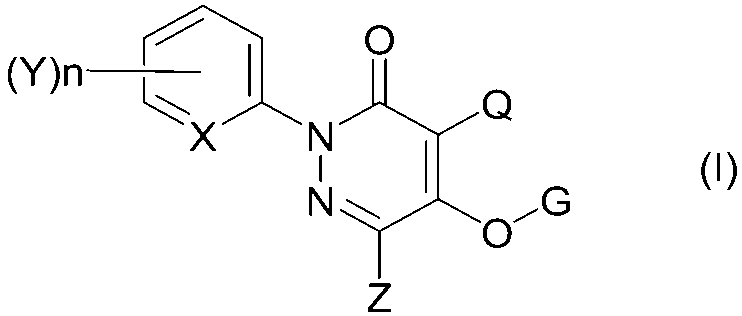
XはCH、C(RA)又はNであり;
Y及びRAは各々ハロゲン、アルキル、アルケニル、アルキニル、シクロアルキル、ハロアルキル、アルコキシ、ハロアルコキシ、アルキルチオ、アルキルスルフィニル、アルキルスルホニル、シアノ又は-C(=O)RBであり;
Zはアルキル、シクロアルキル、アルコキシアルキル、シクロアルキルアルキル又はハロアルキルであり;
R1、R2、R3及びR4は各々ハロゲン、アルキル、シクロアルキル、ハロアルキル、アルコキシ、シクロアルキルオキシ、ハロアルコキシ、アルキルチオ、アルキルスルフィニル、アルキルスルホニル、ハロアルキルチオ、ハロアルキルスルフィニル、ハロアルキルスルホニル、シアノ、ニトロ、アルデヒド、-CH(=NORC)、1,3-ジオキサン-2-イル又は1,3-ジオキソラン-2-イルであり;
RBは水素原子又はアルキルであり;
RCはアルキルであり;
nは0~4の整数であり;
aは0~3の整数であり;
b、c及びdは各々0、1又は2であり;
GはRDで置換されてもよいアルキル、-C(=O)E又はアルキルスルホニルであり;
RDはアルコキシ、シアノ、アルコキシカルボニル又はアルコキシカルボニルオキシであり;
Eはアルキル、アルケニル、シクロアルキル、ヘテロシクロアルキル、ハロアルキル、ハロアルケニル、ジアルキルアミノ、N-アルコキシ-N-アルキルアミノ、VAで置換されてもよいフェニル、VAで置換されてもよいピリジル、シクロアルキルアルキル、ヘテロシクロアルキルアルキル、アルコキシアルキル、アルキルチオアルキル、VAで置換されてもよいフェニルアルキル、VAで置換されてもよいフェニルオキシアルキル、VAで置換されてもよいフェニルアルケニル、アルコキシ、アルケニルオキシ、アルキニルオキシ、シクロアルキルオキシ、ヘテロシクロアルキルオキシ、ハロアルコキシ、アルコキシアルコキシ、VAで置換されてもよいフェニルオキシ、VAで置換されてもよいナフチルオキシ、シクロアルキルアルコキシ、ヘテロシクロアルキルアルコキシ、VBで置換されてもよいフェニルアルコキシ、アルキルチオ又は2-イミダゾリジノンであり;
VAはハロゲンであり;
VBはハロゲン又はアルキルである)で表されるピリダジノン系化合物又はその塩に関する。
本発明化合物は、式(II)の化合物と式(III)の化合物とを塩基の存在下で反応させることにより製造することができる。式(III)の化合物は、市販されているか或いは既知の方法に準じて製造することができる。本製法において、式(I)の化合物の異性体である式(IV)の化合物が生成する可能性もあるが、精製等の通常の操作により式(I)の化合物を単離することができる。
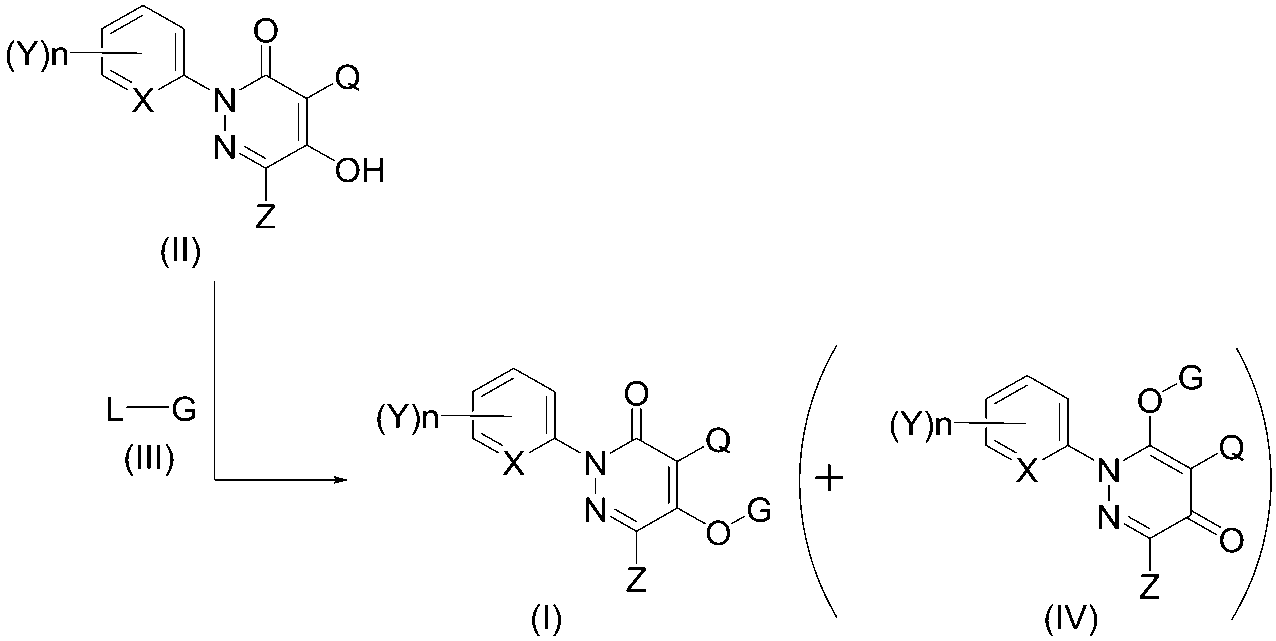
前記式(II)の化合物中、XがNである式(II-a)の化合物は、式(V)の化合物と式(VI)の化合物とを反応させて式(VII)の化合物を得る工程1と、式(VII)の化合物を塩基の存在下で反応させる工程2を、連続的に行うことにより製造することができる。
前記式(V)の化合物は、式(VIII)の化合物と式(IX)の化合物とを、塩基の存在下で反応させることにより製造することができる。式(IX)の化合物は、市販されているか或いは既知の方法に準じて製造することができる。
前記式(VIII)の化合物は、公知の文献(例えば、Protective Groups in Organic Synthesis Fourth Edition, John Wiley & Sons, Inc等)の記載に準じて製造することができる。例えば、式(VIII)の化合物は、式(X)の化合物を酸の存在下で反応させることにより製造することができる。
前記式(X)の化合物は、式(XI)の化合物と式(XII)の化合物とを、金属触媒及び塩基の存在下で反応させることにより製造することができる。式(XII)の化合物は、市販されているか或いは既知の方法に準じて製造することができる。
前記式(XI)の化合物は、公知の文献(例えば、Protective Groups in Organic Synthesis Fourth Edition, John Wiley & Sons, Inc等)の記載に準じて製造することができる。例えば、式(XI)の化合物は、式(XIII)の化合物と3,4-ジヒドロ-2H-ピランとを、酸の存在下で反応させることにより製造することができる。式(XIII)の化合物は、市販されているか或いは既知の方法に準じて製造することができる。
前記式(II)の化合物は、式(XIV)の化合物を塩基の存在下で反応させることにより製造することができる。
前記式(XIV)の化合物は、式(XV)の化合物と式(XVI)の化合物とを、必要に応じて酸の存在下で、反応させることにより製造することができる。式(XVI)の化合物は、市販されているか或いは既知の方法に準じて製造することができ、例えば、公知の文献(例えば、US2004087569A1(6頁目の[0092]、7頁目の[0093])等)の記載に準じて製造することができる。
前記式(XV)の化合物は、公知の文献(例えば、Protective Groups in Organic Synthesis Fourth Edition, John Wiley & Sons, Inc等)の記載に準じて製造することができる。例えば、式(XV)の化合物は、式(XVII)の化合物を酸の存在下で反応させることにより製造することができる。
前記式(XVII)の化合物は、式(XVIII)の化合物と式(XIX)の化合物とを、塩基の存在下で反応させることにより製造することができる。式(XIX)の化合物は市販されているか或いは中間体製法〔2-6〕の方法で製造することができる。
前記式(XVIII)の化合物は、公知の文献(例えば、Protective Groups in Organic Synthesis Fourth Edition, John Wiley & Sons, Inc等)の記載に準じて製造することができる。例えば、式(XVIII)の化合物は、式(XX)の化合物と、例えば二炭酸ジ-tert-ブチル((Boc)2O)などの保護化試薬とを、必要に応じて塩基の存在下で反応させることにより製造することができる。
前記式(XX)の化合物は、市販品を使用できる他、式(XXI)の化合物と亜硝酸ナトリウム等の亜硝酸塩とを、酸を含む水溶液中で反応させて、該当する式(XXII)のジアゾニウム塩を調製した後、調製したジアゾニウム塩と還元剤とを、酸を含む水溶液中で反応させることにより製造することができる。式(XXI)の化合物は、市販されているか或いは既知の方法に準じて製造することができ、例えば、公知の文献(例えば、国際公開第2021/097057号(348頁、IntermediateA-7のStep1~Step3)等)の記載に準じて製造することができる。また、式(XXI)の化合物は中間体製法〔2-5-1〕の方法で製造することもできる。
中間体製法〔2-5〕における前記式(XXI)の化合物中、Yとしてアルキルチオを有する式(XXI-a)の化合物は、例えば、次の工程1及び工程2の反応により製造することができる。
前記式(XIX)の化合物は、式(XXIII)の化合物とハロゲン化剤とを反応させることにより製造することができる。式(XXIII)の化合物は市販されているか或いは中間体製法〔2-7〕や中間体製法〔2-9〕の方法で製造することができる。
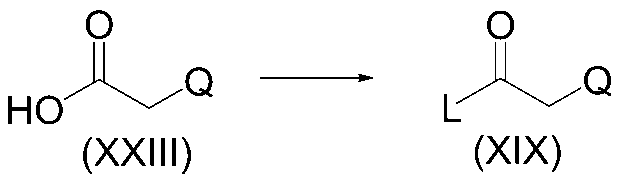
前記式(XXIII)の化合物は、式(XXIV)の化合物を塩基の存在下で加水分解することにより製造することができる。
前記式(XXIV)の化合物は、市販品を使用できる他、式(XXV)の化合物と式(VI)の化合物とを、塩基の存在下で反応させることにより製造することができる。式(XXV)の化合物は市販されている。
前記式(XXIII)の化合物は、式(XXVI)の化合物と式(VI)の化合物とを、塩基の存在下で反応させることにより製造することができる。式(XXVI)の化合物は市販されている。
前記式(II)の化合物は、式(XXVII)の化合物と式(XIX)の化合物とを反応させることにより製造することができる。
前記式(XXVII)の化合物は、式(XX)の化合物と式(XVI)の化合物とを、必要に応じて酸の存在下で反応させることにより製造することができる。
中間体製法〔3-1〕の反応は、前記中間体製法〔2-1〕と同様の方法で行うことができる。
前記式(II)の化合物中、QがQbである式(II-b)の化合物は、式(II-c)の化合物と式(XII)又は式(XXVIII)の化合物とを反応させることにより製造することができる。式(XII)又は式(XXVIII)の化合物は、市販されているか或いは既知の方法に準じて製造できる。
中間体製法〔4〕の反応は、前記中間体製法〔1-3〕と同様の方法で行うことができる。
前記式(II)の化合物中、Yとしてシアノを有する式(II-d)の化合物は、式(II-e)の化合物と無水酢酸とを反応させることにより製造することができる。
前記式(II-e)の化合物は、式(II-f)の化合物とヒドロキシルアミンとを、塩基の存在下で反応させることにより製造することができる。ヒドロキシルアミンは、ヒドロキシルアミン溶液又はヒドロキシルアミン塩を使用しても良い。
前記式(II)の化合物中、Yとしてホルミル基を有する式(II-f)の化合物は、式(XXIX)の化合物と酸化剤とを反応させることにより製造することができる。
前記式(XXIX)の化合物は、式(II-g)の化合物と還元剤とを反応させることにより製造することができる。式(II-g)の化合物は、中間体製法〔2〕又は中間体製法〔3〕の方法で製造することができる。
前記式(II)の化合物中、Zがアルコキシアルキルである式(II-h)の化合物は、式(XXX)の化合物と式(XXXI)の化合物とを、塩基の存在下で反応させることにより製造することができる。式(XXXI)の化合物は、市販されているか或いは既知の方法に準じて製造できる。
前記式(XXX)の化合物は、式(XXXII)の化合物と還元剤とを反応させることにより製造することができる。式(XXXII)の化合物は、中間体製法〔2〕及び中間体製法〔2-1〕、又は中間体製法〔3〕及び中間体製法〔3-1〕において、前記式(I)中のZを-C(=O)ORbと読み替えることにより、各製法及び各中間体製法に準じて製造することができる。
前記式(II)の化合物中、Yとしてアルキルスルフィニル、アルキルスルホニルを有する式(II-i)の化合物は、式(II-j)の化合物と酸化剤とを反応させることにより製造することができる。式(II-j)の化合物は、中間体製法〔1〕及び中間体製法〔1-1〕~〔1-4〕、中間体製法〔2〕及び中間体製法〔2-1〕~〔2-9〕、又は中間体製法〔3〕及び中間体製法〔3-1〕の方法で製造することができる。
前記式(I)の化合物中、Yとしてアルキルスルフィニル、アルキルスルホニルを有する式(I-a)の化合物は、式(I-b)の化合物と酸化剤とを反応させることにより製造することができる。
製法〔2〕の反応は、前記中間体製法〔7〕と同様の方法で行うことができる。

本発明化合物を含有する有害生物防除剤は、例えば農園芸分野で問題となる害虫、ダニ、線虫又は土壌害虫の防除剤、即ち農園芸用殺虫剤、殺ダニ剤、殺線虫剤又は殺土壌害虫剤として有用である。また、動物寄生生物の防除剤、即ち殺動物寄生生物剤として有用である。
農園芸分野で問題となる前記ダニとしては、ナミハダニ、ニセナミハダニ、カンザワハダニ、ミカンハダニ、リンゴハダニ、チャノホコリダニ、ミカンサビダニ、ネダニ等のような植物寄生性ダニ類;ケナガコナダニ、コナヒョウヒダニ、ミナミツメダニ等のような屋内塵性ダニ類;などが挙げられる。
農園芸分野で問題となる前記線虫としては、ネコブセンチュウ類、シストセンチュウ類、ネグサレセンチュウ類、イネシンガレセンチュウ、イチゴメセンチュウ、マツノザイセンチュウ等のような植物寄生性線虫類;などが挙げられる。
農園芸分野で問題となる前記土壌害虫としては、ダンゴムシ、ワラジムシ等のような等脚類;などが挙げられる。
これらの害虫及び線虫の具体的な例は、例えば以下のようなものなどが挙げられる。
また、本発明化合物を含有する農園芸用殺虫剤、殺ダニ剤、殺線虫剤又は殺土壌害虫剤は、有機リン剤、カーバメート剤、合成ピレスロイド剤、ネオニコチノイド剤等の既存薬剤に対する各種抵抗性害虫の防除にも有効である。
さらに本発明化合物は、優れた浸透移行性を有していることから、本発明化合物を含有する農園芸用殺虫剤、殺ダニ剤、殺線虫剤又は殺土壌害虫剤を土壌に処理することによって土壌有害昆虫類、ダニ類、線虫類、腹脚類、等脚類の防除と同時に茎葉部の害虫類をも防除することができる。
前記混用又は併用とは、本発明化合物と他の成分とを、同時に、別々に又は時間間隔をおいて使用することを意味する。
他の農薬としては、除草剤、殺虫剤、殺ダニ剤、殺線虫剤、殺土壌害虫剤、殺菌剤、抗ウイルス剤、誘引剤、抗生物質、植物ホルモン、植物成長調整剤等が挙げられる。特に、本発明化合物と他の農薬の有効成分化合物の1種又は2種以上とを混用又は併用した殺虫用組成物、殺ダニ用組成物、殺線虫用組成物又は殺土壌害虫用組成物は、適用範囲、薬剤処理の時期、防除活性等を好ましい方向へ改良することが可能である。尚、本発明化合物と他の農薬の有効成分化合物は各々別々に製剤したものを散布時に混合して使用しても、両者を一緒に製剤して使用してもよい。本発明には、このような殺虫用組成物、殺ダニ用組成物、殺線虫用組成物又は殺土壌害虫用組成物も含まれる。
カルバリル(carbaryl)、プロポキスル(propoxur)、アルジカルブ(aldicarb)、カルボフラン(carbofuran)、チオジカルブ(thiodicarb)、メソミル(methomyl)、オキサミル(oxamyl)、エチオフェンカルブ(ethiofencarb)、ピリミカルブ(pirimicarb)、フェノブカルブ(fenobucarb)、カルボスルファン(carbosulfan)、ベンフラカルブ(benfuracarb)、ベンダイオカルブ(bendiocarb)、フラチオカルブ(furathiocarb)、イソプロカルブ(isoprocarb)、メトルカルブ(metolcarb)、キシリルカルブ(xylylcarb)、XMC(3,5-xylyl methylcarbamate)、フェノチオカルブ(fenothiocarb)のようなカーバメート系化合物;
ジコホル(dicofol)、テトラジホン(tetradifon)、エンドスルファン(endosulfan)、ジエノクロル(dienochlor)、ディルドリン(dieldrin)、メトキシクロル(methoxychlor)のような有機塩素系化合物;
酸化フェンブタスズ(fenbutatin oxide)、シヘキサチン(cyhexatin)、アゾシクロチン(azocyclotin)のような有機スズ系化合物;
フェンバレレート(fenvalerate)、ペルメトリン(permethrin)、シペルメトリン(cypermethrin)、アルファ-シペルメトリン(alpha-cypermethrin)、ゼータ-シペルメトリン(zeta-cypermethrin)、シータ-シペルメトリン(theta-cypermethrin)、ベータ-シペルメトリン(beta-cypermethrin)、デルタメトリン(deltamethrin)、シハロトリン(cyhalothrin)、ガンマ-シハロトリン(gamma-cyhalothrin)、ラムダ-シハロトリン(lambda-cyhalothrin)、テフルトリン(tefluthrin)、カッパ-テフルトリン(kappa-tefluthrin)、エトフェンプロックス(etofenprox)、フルフェンプロックス(flufenprox)、シフルトリン(cyfluthrin)、ベータ-シフルトリン(beta-cyfluthrin)、フェンプロパトリン(fenpropathrin)、フルシトリネート(flucythrinate)、フルバリネート(fluvalinate)、シクロプロトリン(cycloprothrin)、ピレスリン(pyrethrins)、エスフェンバレレート(esfenvalerate)、テトラメスリン(tetramethrin)、レスメトリン(resmethrin)、プロトリフェンブト(protrifenbute)、ビフェントリン(bifenthrin)、カッパ-ビフェントリン(kappa-bifenthrin)、アクリナトリン(acrinathrin)、アレスリン(allethrin)、タウ-フルバリネート(tau-fluvalinate)、トラロメトリン(tralomethrin)、プロフルトリン(profluthrin)、メトフルトリン(metofluthrin)、イプシロンメトフルトリン(epsilon-metofluthrin)、ヘプタフルトリン(heptafluthrin)、フェノトリン(phenothrin)、フルメトリン(flumethrin)、モムフルオロトリン(momfluorothrin)、イプシロンモムフルオロトリン(epsilon-momfluorothrin)、シラフルオフェン(silafluofen)、クロロプラレトリン(chloroprallethrin)のようなピレスロイド系化合物;
メトプレン(methoprene)、ピリプロキシフェン(pyriproxyfen)、フェノキシカルブ(fenoxycarb)、ジオフェノラン(diofenolan)のような幼若ホルモン様化合物;
ピリダベン(pyridaben)のようなピリダジノン系化合物;
フェンピロキシメート(fenpyroximate)、シエノピラフェン(cyenopyrafen)、シエトピラフェン(cyetpyrafen)のようなピラゾール系化合物;
アセトプロール(acetoprole)、エチプロール(ethiprole)、フィプロニル(fipronil)、フルフィプロール(flufiprole)、ピラフルプロール(pyrafluprole)、ピリプロール(pyriprole)、ニコフルプロール(nicofluprole)、バニリプロール(vaniliprole)のようなフェニルピラゾール系化合物;
ピフルブミド(pyflubumide)、テブフェンピラド(tebufenpyrad)、トルフェンピラド(tolfenpyrad)、ジンプロピリダズ(dimpropyridaz)のようなピラゾールカルボキサミド系化合物;
クロラントラニリプロール(chlorantraniliprole)、シアントラニリプロール(cyantraniliprole)、シクラニリプロール(cyclaniliprole)、テトラクロラントラニリプロール(tetrachlorantraniliprole)、テトラニリプロール(tetraniliprole)、チクロピラゾフロル(tyclopyrazoflor)、フルクロルジニリプロール(fluchlordiniliprole)、チオラントラニリプロール(tiorantraniliprole)、ピオキサニリプロール(pioxaniliprole)のようなピリジルピラゾール系化合物;
テブフェノジド(tebufenozide)、メトキシフェノジド(methoxyfenozide)、クロマフェノジド(chromafenozide)、ハロフェノジド(halofenozide)のようなヒドラジン系化合物;
ピリダリル(pyridalyl)、フロニカミド(flonicamid)のようなピリジン系化合物;
スピロジクロフェン(spirodiclofen)、スピロメシフェン(spiromesifen)、スピロブジフェン(spirobudifen)のようなテトロン酸系化合物;
スピロテトラマト(spirotetramat)、スピロピジオン(spiropidion)、スピドキサマト(spidoxamat)のようなテトラミン酸系化合物;
フルアクリピリム(fluacrypyrim)、ピリミノストロビン(pyriminostrobin)、フルピロキシストロビン(flupyroxystrobin)のようなストロビルリン系化合物;
フルフェネリム(flufenerim)、ピリミジフェン(pyrimidifen)のようなピリミジナミン系化合物;
マラチオン(malathion)のような有機硫黄化合物;
シロマジン(cyromazine)のようなトリアジン系化合物;
ヒドラメチルノン(hydramethylnon)のようなヒドラゾン系化合物;
フルベンジアミド(flubendiamide)、シハロジアミド(cyhalodiamide)のようなフタルアミド系化合物;
ジアフェンチウロン(diafenthiuron)、クロロメチウロン(chloromethiuron)のようなチオウレア系化合物;
アミトラズ(amitraz)、クロルジメホルム(chlordimeform)、クロロメブホルム(chloromebuform)のようなホルムアミジン系化合物;
ピメトロジン(pymetrozine)、ピリフルキナゾン(pyrifluquinazon)のようなピリジンアゾメチン系化合物;
アフォキソラネル(afoxolaner)、フルララネル(fluralaner)、フルキサメタミド(fluxametamide)、サロラネル(sarolaner)、イソシクロセラム(isocycloseram)、ウミフォキソラネル(umifoxolaner)、チゴラネル(tigolaner)、ミボリラネル(mivorilaner)、イソフルアラナム(isoflualanam)のようなイソキサゾリン系化合物;
フルエンスルホン(fluensulfone)、トリフルエンフロネート(trifluenfuronate)のようなフルオロアルケニル系化合物;
アフィドピロペン(afidopyropen)のようなピロペン系化合物;
また、その他の化合物として、ブプロフェジン(buprofezin)、ヘキシチアゾクス(hexythiazox)、トリアザメート(triazamate)、クロルフェナピル(chlorfenapyr)、インドキサカルブ(indoxacarb)、アセキノシル(acequinocyl)、エトキサゾール(etoxazole)、1,3-ジクロロプロペン(1,3-dichloropropene)、ベンクロチアズ(benclothiaz)、ビフェナゼート(bifenazate)、プロパルギット(propargite)、クロフェンテジン(clofentezine)、メタフルミゾン(metaflumizone)、シフルメトフェン(cyflumetofen)、フェナザキン(fenazaquin)、アミドフルメト(amidoflumet)、スルフルラミド(sulfluramid)、ヒドラメチルノン(hydramethylnon)、メタアルデヒド(metaldehyde)、スルホキサフロル(sulfoxaflor)、ベルブチン(verbutin)、フルヘキサホン(fluhexafon)、チオキサザフェン(tioxazafen)、フロメトキン(flometoquin)、フルピラジフロン(flupyradifurone)、フルアザインドリジン(fluazaindolizine)、アシノナピル(acynonapyr)、ベンズピリモキサン(benzpyrimoxan)、フルピリミン(flupyrimin)、オキサゾスルフィル(oxazosulfyl)、シクロブトリフルラム(cyclobutrifluram)、フルペンチオフェノクス(flupentiofenox)、インダザピロキサメット(indazapyroxamet)、スルフィフルミン(sulfiflumin)、ビスルフルフェン(bisulflufen)、シベンゾキサスルフィル(cybenzoxasulfyl)、チアピラクロル(tiapyrachlor)、ベンチオフルミン(bentioflumin)のような化合物など。
Bacillus thuringiensis aizawai、Bacillus thuringiensis kurstaki、Bacillus thuringiensis israelensis、Bacillus thuringiensis japonensis、Bacillus thuringiensis tenebrionis、Bacillus thuringiensis、Paecilomyces lilacinus、Bacillus methylotrophicus、Bacillus subtilis、Bacillus amyloliquefaciens、又はBacillus licheniformisが生成する結晶タンパク毒素、昆虫病原ウイルス剤、昆虫病原糸状菌剤、線虫病原糸状菌剤などのような微生物農薬;
アザジラクチン(azadirachtin)、ロテノン(rotenone)、リアノジン(ryanodine)のような天然物;
ディート(deet)のような忌避剤;
パラフィン油、鉱物油(mineral oil)のような物理的防除剤;
レドプロナ(ledprona)のようなRNAi農薬。
メパニピリム(mepanipyrim)、ピリメタニル(pyrimethanil)、シプロジニル(cyprodinil)のようなアニリノピリミジン系化合物;
アメトクトラジン(ametoctradin)のようなトリアゾロピリミジン系化合物;
トリシクラゾール(tricyclazole)のようなトリアゾロベンゾチアゾール系化合物;
フルアジナム(fluazinam)のようなピリジナミン系化合物;
トリアジメホン(triadimefon)、ビテルタノール(bitertanol)、トリフルミゾール(triflumizole)、エタコナゾール(etaconazole)、プロピコナゾール(propiconazole)、ペンコナゾール(penconazole)、フルシラゾール(flusilazole)、ミクロブタニル(myclobutanil)、シプロコナゾール(cyproconazole)、テブコナゾール(tebuconazole)、ヘキサコナゾール(hexaconazole)、フルコナゾールシス(furconazole-cis)、プロクロラズ(prochloraz)、メトコナゾール(metconazole)、エポキシコナゾール(epoxiconazole)、テトラコナゾール(tetraconazole)、オキスポコナゾールフマル酸塩(oxpoconazole fumarate)、プロチオコナゾール(prothioconazole)、トリアジメノール(triadimenol)、フルトリアホール(flutriafol)、ジフェノコナゾール(difenoconazole)、フルキンコナゾール(fluquinconazole)、フェンブコナゾール(fenbuconazole)、ブロムコナゾール(bromuconazole)、ジニコナゾール(diniconazole)、シメコナゾール(simeconazole)、ペフラゾエート(pefurazoate)、イプコナゾール(ipconazole)、イミベンコナゾール(imibenconazole)、アザコナゾール(azaconazole)、トリチコナゾール(triticonazole)、イマザリル(imazalil)、イプフェントリフルコナゾール(ipfentrifluconazole)、メフェントリフルコナゾール(mefentrifluconazole)、フルオキシチオコナゾール(fluoxytioconazole)のようなアゾール系化合物;
キノメチオナート(chinomethionat)のようなキノキサリン系化合物;
フサライド(phthalide)、クロロタロニル(chlorothalonil)、キントゼン(quintozene)のような有機塩素系化合物;
ベノミル(benomyl)、チオファネートメチル(thiophanate-methyl)、カルベンダジム(carbendazim)、チアベンダゾール(thiabendazole)、フベリダゾール(fuberidazole)のようなベンゾイミダゾール系化合物;
シモキサニル(cymoxanil)のようなシアノアセトアミド系化合物;
メタラキシル(metalaxyl)、メタラキシル-M(metalaxyl-M;別名メフェノキサム(mefenoxam))、オキサジキシル(oxadixyl)、オフラセ(ofurace)、ベナラキシル(benalaxyl)、ベナラキシル-M(benalaxyl-M、別名キララキシル(kiralaxyl、chiralaxyl))、フララキシル(furalaxyl)、バリフェナレート(valifenalate)のようなフェニルアミド系化合物;
シプロフラム(cyprofuram)、カルボキシン(carboxin)、オキシカルボキシン(oxycarboxin)、チフルザミド(thifluzamide)、ボスカリド(boscalid)、フェンヘキサミド(fenhexamid)、イソチアニル(isotianil)、チアジニル(tiadinil)、ピラジフルミド(pyraziflumid)のようなアニリド系化合物;
水酸化第二銅(cupric hydroxide)、有機銅(oxine copper)、無水硫酸銅、ノニルフェノールスルホン酸銅、8-ヒドロキシキノリン銅、ドデシルベンゼンスルホン酸ビスエチレンジアミン銅錯塩(II)(別名DBEDC)のような銅系化合物;
ホセチルアルミニウム(fosetyl-Al)、トルクロホスメチル(tolclofos-Methyl)、エジフェンホス(edifenphos)、イプロベンホス(iprobenfos)のような有機リン系化合物;
キャプタン(captan)、カプタホール(captafol)、フォルペット(folpet)のようなフタルイミド系化合物;
プロシミドン(procymidone)、イプロジオン(iprodione)、ビンクロゾリン(vinclozolin)のようなジカルボキシイミド系化合物;
カルプロパミド(carpropamid)、ジクロシメット(diclocymet)、シルチオファム(silthiofam)、フェノキサニル(fenoxanil)のようなアミド系化合物;
ベンゾビンジフルピル(benzovindiflupyr)、ビキサフェン(bixafen)、フルインダピル(fluindapyr)、フルキサピロキサド(fluxapyroxad)、フラメトピル(furametpyr)、イソピラザム(isopyrazam)、ペンフルフェン(penflufen)、ペンチオピラド(penthiopyrad)、ピジフルメトフェン(pydiflumetofen)、セダキサン(sedaxane)、イソフルシプラム(isoflucypram)、インピルフルキサム(inpyrfluxam)、ピラプロポイン(pyrapropoyne)、フルベネテラム(flubeneteram)のようなピラゾールカルボキサミド系化合物;
フェンフラム(fenfuram)のようなフラニリド系化合物;
イソフェタミド(isofetamid)のようなチオフェンアミド系化合物;
トリホリン(triforine)のようなピペラジン系化合物;
ピリフェノックス(pyrifenox)、ピリソキサゾール(pyrisoxazole)、アミノピリフェン(aminopyrifen)のようなピリジン系化合物;
フェナリモル(fenarimol)、フェリムゾン(ferimzone)、ヌアリモール(nuarimol)、フルメチルスルホリム(flumetylsulforim)のようなピリミジン系化合物;
フェンプロピジン(fenpropidin)のようなピペリジン系化合物;
フェンプロピモルフ(fenpropimorph)、トリデモルフ(tridemorph)のようなモルホリン系化合物;
水酸化トリフェニルスズ(fentin hydroxide)、酢酸トリフェニルスズ(fentin acetate)のような有機スズ系化合物;
ペンシクロン(pencycuron)のような尿素系化合物;
ジエトフェンカルブ(diethofencarb)のようなフェニルカーバメート系化合物;
フルジオキソニル(fludioxonil)、フェンピクロニル(fenpiclonil)のようなシアノピロール系化合物;
アゾキシストロビン(azoxystrobin)、クレソキシムメチル(kresoxim-methyl)、メトミノストロビン(metominostrobin)、トリフロキシストロビン(trifloxystrobin)、ピコキシストロビン(picoxystrobin)、オリサストロビン(orysastrobin)、ジモキシストロビン(dimoxystrobin)、ピラクロストロビン(pyraclostrobin)、フルオキサストロビン(fluoxastrobin)、ピラオキシストロビン(Pyraoxystrobin)、ピラメトストロビン(Pyrametostrobin)、クモキシストロビン(coumoxystrobin)、エノキサストロビン(enoxastrobin)、フェナミンストロビン(fenaminstrobin)、フルフェノキシストロビン(flufenoxystrobin)、トリクロピリカルブ(triclopyricarb)、マンデストロビン(mandestrobin)のようなストロビルリン系化合物;
エタボキサム(ethaboxam)のようなチアゾールカルボキサミド系化合物;
フェンアミドン(フェナミドン、fenamidone)のようなイミダゾリノン系化合物;
フルスルファミド(flusulfamide)のようなベンゼンスルホンアミド系化合物;
シフルフェナミド(cyflufenamid)のようなオキシムエーテル系化合物;
ジチアノン(dithianon)のようなアントラキノン系化合物;
メプチルジノカップ(meptyldinocap)のようなクロトン酸系化合物;
バリダマイシン(validamycin)、カスガマイシン(kasugamycin)、ストレプトマイシン(streptomycin)、ポリオキシン(polyoxins)のような抗生物質;
イミノクタジン(iminoctadine)、ドジン(dodine)、グアザチン(guazatine)のようなグアニジン系化合物;
ブチルアミン(butylamine)、セボクチラミン(seboctylamine)のような脂肪族窒素系化合物;
フルチアニル(flutianil)のようなチアゾリジン系化合物;
プロパモカルブ塩酸塩(propamocarb hydrochloride)、ピリベンカルブ(pyribencarb)、トルプロカルブ(tolprocarb)のようなカーバメート系化合物;
ピカルブトラゾクス(picarbutrazox)、メチルテトラプロール(metyltetraprole)のようなテトラゾール系化合物;
アミスルブロム(amisulbrom)、シアゾファミド(cyazofamid)のようなスルホンアミド系化合物;
メトラフェノン(metrafenone)、ピリオフェノン(pyriofenone)のようなアリルフェニルケトン系化合物;
プロベナゾール(probenazole)、ジクロベンチアゾクス(dichlobentiazox)のようなベンゾチアゾール系化合物;
フェンピラザミン(fenpyrazamine)のようなフェニルピラゾール系化合物;
イソプロチオラン(isoprothiolane)のようなジチオラン系化合物;
フェンピコキサミド(fenpicoxamid)、フロリルピコキサミド(florylpicoxamid)、メタリルピコキサミド(metarylpicoxamid)のようなピコリンアミド系化合物;
ピリダクロメチル(pyridachlometyl)のようなピリダジン系化合物;
硫黄(Sulfur)、石灰硫黄剤のような硫黄系化合物;
クロロインコナジド(chloroinconazide)のようなヒドラジド系化合物;
Bacillus amyloliqefaciens strain QST713、Bacillus amyloliqefaciens strain FZB24、Bacillus amyloliqefaciens strain MBI600、Bacillus amyloliqefaciens strain D747、Pseudomonas fluorescens、Bacillus subtilis、Trichoderma atroviride SKT-1のような微生物殺菌剤;及び
ティーツリー油(Tea tree oil)のような植物抽出物。
(2) Y及びRAは各々ハロゲン、アルキル、アルケニル、アルキニル、シクロアルキル、ハロアルキル、アルコキシ、ハロアルコキシ、アルキルスルホニル、シアノ又は-C(=O)RBである(1)に記載のピリダジノン系化合物又はその塩。
(3) Y及びRAは各々ハロゲン、(C1-C4)アルキル、(C2-C4)アルケニル、(C2-C4)アルキニル、(C3-C6)シクロアルキル、(C1-C4)ハロアルキル、(C1-C4)アルコキシ、(C1-C4)ハロアルコキシ、(C1-C4)アルキルチオ、(C1-C4)アルキルスルフィニル、(C1-C4)アルキルスルホニル、シアノ又は-C(=O)RBであり;
Zは(C1-C5)アルキル、(C3-C6)シクロアルキル、(C1-C4)アルコキシ(C1-C4)アルキル、(C3-C6)シクロアルキル(C1-C4)アルキル又は(C1-C4)ハロアルキルであり;
R1、R2、R3及びR4は各々ハロゲン、(C1-C4)アルキル、(C3-C6)シクロアルキル、(C1-C4)ハロアルキル、(C1-C4)アルコキシ、(C3-C6)シクロアルキルオキシ、(C1-C4)ハロアルコキシ、(C1-C4)アルキルチオ、(C1-C4)アルキルスルフィニル、(C1-C4)アルキルスルホニル、(C1-C4)ハロアルキルチオ、(C1-C4)ハロアルキルスルフィニル、(C1-C4)ハロアルキルスルホニル、シアノ、ニトロ、アルデヒド、-CH(=NORC)、1,3-ジオキサン-2-イル又は1,3-ジオキソラン-2-イルであり;
RBは水素原子又は(C1-C4)アルキルであり;
RCは(C1-C4)アルキルであり;
GはRDで置換されてもよい(C1-C4)アルキル、-C(=O)E又は(C1-C4)アルキルスルホニルであり;
RDは(C1-C4)アルコキシ、シアノ、(C1-C4)アルコキシカルボニル又は(C1-C4)アルコキシカルボニルオキシであり;
Eは(C1-C8)アルキル、(C2-C8)アルケニル、(C3-C6)シクロアルキル、ヘテロシクロアルキル、(C1-C8)ハロアルキル、(C2-C8)ハロアルケニル、(C1-C4)ジアルキルアミノ、N-(C1-C4)アルコキシ-N-(C1-C4)アルキルアミノ、VAで置換されてもよいフェニル、VAで置換されてもよいピリジル、(C3-C6)シクロアルキル(C1-C4)アルキル、ヘテロシクロアルキル(C1-C4)アルキル、(C1-C4)アルコキシ(C1-C3)アルキル、(C1-C4)アルキルチオ(C1-C3)アルキル、VAで置換されてもよいフェニル(C1-C4)アルキル、VAで置換されてもよいフェニルオキシ(C1-C3)アルキル、VAで置換されてもよいフェニル(C2-C4)アルケニル、(C1-C7)アルコキシ、(C2-C7)アルケニルオキシ、(C2-C7)アルキニルオキシ、(C3-C6)シクロアルキルオキシ、ヘテロシクロアルキルオキシ、(C1-C7)ハロアルコキシ、(C1-C4)アルコキシ(C1-C3)アルコキシ、VAで置換されてもよいフェニルオキシ、VAで置換されてもよいナフチルオキシ、(C3-C6)シクロアルキル(C1-C3)アルコキシ、ヘテロシクロアルキル(C1-C3)アルコキシ、VBで置換されてもよいフェニル(C1-C3)アルコキシ、(C1-C7)アルキルチオ又は2-イミダゾリジノンであり、当該Eにおけるヘテロシクロアルキル及びヘテロシクロアルキル部分は各々炭素原子以外に酸素原子、窒素原子及び硫黄原子から選ばれる1種以上の原子を1つ以上含む3員~6員の基であり;
VBはハロゲン又は(C1-C4)アルキルである(1)に記載のピリダジノン系化合物又はその塩。
(4) Y及びRAは各々ハロゲン、(C1-C4)アルキル、(C2-C4)アルケニル、(C2-C4)アルキニル、(C3-C6)シクロアルキル、(C1-C4)ハロアルキル、(C1-C4)アルコキシ、(C1-C4)ハロアルコキシ、(C1-C4)アルキルスルホニル、シアノ又は-C(=O)RBである(3)に記載のピリダジノン系化合物又はその塩。
R1、R2、R3及びR4は各々ハロゲン、(C1-C4)アルキル、(C3-C6)シクロアルキル、(C1-C4)ハロアルキル、(C1-C4)アルコキシ、(C1-C4)ハロアルコキシ、(C1-C4)アルキルチオ、(C1-C4)アルキルスルフィニル、(C1-C4)アルキルスルホニル、シアノ、ニトロ、アルデヒド、-CH(=NORC)又は1,3-ジオキソラン-2-イルであり;
Eは(C1-C8)アルキル、(C2-C8)アルケニル、(C3-C6)シクロアルキル、ヘテロシクロアルキル、(C1-C8)ハロアルキル、(C1-C4)ジアルキルアミノ、N-(C1-C4)アルコキシ-N-(C1-C4)アルキルアミノ、VAで置換されてもよいフェニル、VAで置換されてもよいピリジル、(C3-C6)シクロアルキル(C1-C4)アルキル、ヘテロシクロアルキル(C1-C4)アルキル、(C1-C4)アルコキシ(C1-C3)アルキル、(C1-C4)アルキルチオ(C1-C3)アルキル、VAで置換されてもよいフェニル(C1-C4)アルキル、VAで置換されてもよいフェニルオキシ(C1-C3)アルキル、VAで置換されてもよいフェニル(C2-C4)アルケニル、(C1-C7)アルコキシ、(C2-C7)アルケニルオキシ、(C2-C7)アルキニルオキシ、(C3-C6)シクロアルキルオキシ、(C1-C7)ハロアルコキシ、(C1-C4)アルコキシ(C1-C3)アルコキシ、VAで置換されてもよいフェニルオキシ、VAで置換されてもよいナフチルオキシ、VBで置換されてもよいフェニル(C1-C3)アルコキシ、(C1-C7)アルキルチオ又は2-イミダゾリジノンであり、当該Eにおけるヘテロシクロアルキル及びヘテロシクロアルキル部分は各々炭素原子以外に酸素原子、窒素原子及び硫黄原子から選ばれる1種以上の原子を1つ以上含む3員~6員の基である(3)又は(4)に記載のピリダジノン系化合物又はその塩。
(6) QがQ1又はQ3で表される(1)~(5)のいずれか一つに記載のピリダジノン系化合物又はその塩。
(7) XがCH又はC(RA)で表される(1)~(6)のいずれか一つに記載のピリダジノン系化合物又はその塩。
(8) XがC(RA)で表される(1)~(6)のいずれか一つに記載のピリダジノン系化合物又はその塩。
(9) XがCHで表される(1)~(6)のいずれか一つに記載のピリダジノン系化合物又はその塩。
(10) XがNで表される(1)~(6)のいずれか一つ記載のピリダジノン系化合物又はその塩。
(11) XがC(RA)又はNで表される(1)~(6)のいずれか一つに記載のピリダジノン系化合物又はその塩。
(12) XがCHの場合はnが1~3の整数であり、XがC(RA)又はNの場合はnが1又は2である(1)~(6)のいずれか一つに記載のピリダジノン系化合物又はその塩。
(13) a、b、c及びdが各々1又は2である(1)~(12)のいずれか一つに記載のピリダジノン系化合物又はその塩。
(14) 前記式(i)で表されるピリダジノン系化合物又はその塩。
(15) 前記式(i-c)、式(i-d)又は式(i-g)で表される(14)に記載のピリダジノン系化合物又はその塩。
(16) aが1又は2である(14)に記載のピリダジノン系化合物又はその塩。
(17) 前記式(ii)で表されるピリダジノン系化合物又はその塩。
(18) bが1又は2である(17)に記載のピリダジノン系化合物又はその塩。
(19) 前記式(iii)で表されるピリダジノン系化合物又はその塩。
(20) 前記式(iii-c)で表される(19)に記載のピリダジノン系化合物又はその塩。
(21) cが1又は2である(19)に記載のピリダジノン系化合物又はその塩。
(22) 前記式(iv)で表されるピリダジノン系化合物又はその塩。
(23) dが1又は2である(22)に記載のピリダジノン系化合物又はその塩。
(24) Y及びRAは各々ハロゲン、(C1-C4)アルキル、(C2-C4)アルケニル、(C2-C4)アルキニル、(C1-C4)ハロアルキル又は(C1-C4)ハロアルコキシである(1)~(23)のいずれか一つに記載のピリダジノン系化合物又はその塩。
(25) R1、R2、R3及びR4は各々ハロゲン、(C1-C4)アルキル、(C3-C6)シクロアルキル、(C1-C4)ハロアルキル、(C1-C4)アルコキシ、(C1-C4)ハロアルコキシ、(C1-C4)アルキルチオ又は(C1-C4)アルキルスルフィニルである(1)~(24)のいずれか一つに記載のピリダジノン系化合物又はその塩。
(26) R1、R2、R3及びR4は各々ハロゲン、(C1-C4)アルキル又は(C1-C4)ハロアルキルである(1)~(24)のいずれか一つに記載のピリダジノン系化合物又はその塩。
(27) GはRDで置換されてもよい(C1-C4)アルキル、-C(=O)E又はアルキルスルホニルであり;
RDは(C1-C4)アルコキシ、シアノ、(C1-C4)アルコキシカルボニル又は(C1-C4)アルコキシカルボニルオキシであり;
Eは(C1-C8)アルキル、(C2-C8)アルケニル、(C3-C6)シクロアルキル、ヘテロシクロアルキル、(C1-C8)ハロアルキル、(C1-C4)ジアルキルアミノ、N-(C1-C4)アルコキシ-N-(C1-C4)アルキルアミノ、VAで置換されてもよいフェニル、VAで置換されてもよいピリジル、(C3-C6)シクロアルキル(C1-C4)アルキル、ヘテロシクロアルキル(C1-C4)アルキル、(C1-C4)アルコキシ(C1-C3)アルキル、(C1-C4)アルキルチオ(C1-C3)アルキル、VAで置換されてもよいフェニル(C1-C4)アルキル、VAで置換されてもよいフェニルオキシ(C1-C3)アルキル、VAで置換されてもよいフェニル(C2-C4)アルケニル、(C1-C7)アルコキシ、(C2-C7)アルケニルオキシ、(C2-C7)アルキニルオキシ、(C3-C6)シクロアルキルオキシ、(C1-C7)ハロアルコキシ、(C1-C4)アルコキシ(C1-C3)アルコキシ、VAで置換されてもよいフェニルオキシ、VAで置換されてもよいナフチルオキシ、VBで置換されてもよいフェニル(C1-C3)アルコキシ、(C1-C7)アルキルチオ又は2-イミダゾリジノンである(1)~(26)のいずれか一つに記載のピリダジノン系化合物又はその塩。
(28) Gは-C(=O)Eであり;
Eは(C1-C8)アルキル、(C2-C8)アルケニル、(C3-C6)シクロアルキル、ヘテロシクロアルキル、(C1-C8)ハロアルキル、(C1-C4)ジアルキルアミノ、N-(C1-C4)アルコキシ-N-(C1-C4)アルキルアミノ、VAで置換されてもよいフェニル、VAで置換されてもよいピリジル、(C3-C6)シクロアルキル(C1-C4)アルキル、ヘテロシクロアルキル(C1-C4)アルキル、(C1-C4)アルコキシ(C1-C3)アルキル、(C1-C4)アルキルチオ(C1-C3)アルキル、VAで置換されてもよいフェニル(C1-C4)アルキル、VAで置換されてもよいフェニルオキシ(C1-C3)アルキル、VAで置換されてもよいフェニル(C2-C4)アルケニル、(C1-C7)アルコキシ、(C2-C7)アルケニルオキシ、(C2-C7)アルキニルオキシ、(C3-C6)シクロアルキルオキシ、(C1-C7)ハロアルコキシ、(C1-C4)アルコキシ(C1-C3)アルコキシ、VAで置換されてもよいフェニルオキシ、VAで置換されてもよいナフチルオキシ、VBで置換されてもよいフェニル(C1-C3)アルコキシ、(C1-C7)アルキルチオ又は2-イミダゾリジノンであり、当該Eにおけるヘテロシクロアルキル及びヘテロシクロアルキル部分は各々炭素原子以外に酸素原子、窒素原子及び硫黄原子から選ばれる1種以上の原子を1つ以上含む3員~6員の基である(1)~(26)のいずれか一つに記載のピリダジノン系化合物又はその塩。
(29) Gは-C(=O)Eであり;
Eは(C1-C8)アルキル、(C2-C8)アルケニル、(C3-C6)シクロアルキル、ヘテロシクロアルキル、(C1-C8)ハロアルキル、(C1-C4)ジアルキルアミノ、N-(C1-C4)アルコキシ-N-(C1-C4)アルキルアミノ、VAで置換されてもよいフェニル、VAで置換されてもよいピリジル、(C3-C6)シクロアルキル(C1-C4)アルキル、VAで置換されてもよいフェニル(C1-C4)アルキル、VAで置換されてもよいフェニルオキシ(C1-C3)アルキル、VAで置換されてもよいフェニル(C2-C4)アルケニル、(C1-C7)アルコキシ、(C2-C7)アルケニルオキシ、(C3-C6)シクロアルキルオキシ、(C1-C7)ハロアルコキシ、(C1-C4)アルコキシ(C1-C3)アルコキシ、VAで置換されてもよいフェニルオキシ又はVBで置換されてもよいフェニル(C1-C3)アルコキシであり、当該Eにおけるヘテロシクロアルキル及びヘテロシクロアルキル部分は各々炭素原子以外に酸素原子、窒素原子及び硫黄原子から選ばれる1種以上の原子を1つ以上含む3員~6員の基である(1)~(26)のいずれか一つに記載のピリダジノン系化合物又はその塩。
(30) Gは-C(=O)Eであり;
Eは(C1-C7)アルコキシ、(C2-C7)アルケニルオキシ、(C2-C7)アルキニルオキシ、(C3-C6)シクロアルキルオキシ、(C1-C7)ハロアルコキシ、(C1-C4)アルコキシ(C1-C3)アルコキシ又はVBで置換されてもよいフェニル(C1-C3)アルコキシである(1)~(26)のいずれか一つに記載のピリダジノン系化合物又はその塩。
(31) Gは-C(=O)Eであり;
Eは(C1-C8)アルキル、(C2-C8)アルケニル、(C3-C6)シクロアルキル、ヘテロシクロアルキル、(C1-C8)ハロアルキル、VAで置換されてもよいフェニル、VAで置換されてもよいピリジル、(C3-C6)シクロアルキル(C1-C4)アルキル、ヘテロシクロアルキル(C1-C4)アルキル、(C1-C4)アルコキシ(C1-C3)アルキル、(C1-C4)アルキルチオ(C1-C3)アルキル、VAで置換されてもよいフェニル(C1-C4)アルキル、VAで置換されてもよいフェニルオキシ(C1-C3)アルキル、VAで置換されてもよいフェニル(C2-C4)アルケニル、VAで置換されてもよいフェニルオキシ又はVAで置換されてもよいナフチルオキシであり、当該Eにおけるヘテロシクロアルキル及びヘテロシクロアルキル部分は各々炭素原子以外に酸素原子、窒素原子及び硫黄原子から選ばれる1種以上の原子を1つ以上含む3員~6員の基である(1)~(26)のいずれか一つに記載のピリダジノン系化合物又はその塩。
(32) Gは-C(=O)Eであり;
Eは(C1-C8)アルキル、(C2-C8)アルケニル、(C3-C6)シクロアルキル、ヘテロシクロアルキル、(C1-C8)ハロアルキル、(C3-C6)シクロアルキル(C1-C4)アルキル、ヘテロシクロアルキル(C1-C4)アルキル、(C1-C4)アルコキシ(C1-C3)アルキル、(C1-C4)アルキルチオ(C1-C3)アルキル、VAで置換されてもよいフェニル(C1-C4)アルキル、VAで置換されてもよいフェニルオキシ(C1-C3)アルキル又はVAで置換されてもよいフェニル(C2-C4)アルケニルであり、当該Eにおけるヘテロシクロアルキル及びヘテロシクロアルキル部分は各々炭素原子以外に酸素原子、窒素原子及び硫黄原子から選ばれる1種以上の原子を1つ以上含む3員~6員の基である(1)~(26)のいずれか一つに記載のピリダジノン系化合物又はその塩。
(33) Gは-C(=O)Eであり;
Eは(C1-C8)アルキル、(C2-C8)アルケニル、(C3-C6)シクロアルキル、(C1-C8)ハロアルキル、(C1-C4)アルコキシ(C1-C3)アルキル、(C1-C7)アルコキシ、(C2-C7)アルケニルオキシ、(C3-C6)シクロアルキルオキシ、(C1-C7)ハロアルコキシ又は(C1-C4)アルコキシ(C1-C3)アルコキシである(1)~(26)のいずれか一つに記載のピリダジノン系化合物又はその塩。
(34) Zは(C1-C5)アルキル、(C3-C6)シクロアルキル、(C1-C4)アルコキシ(C1-C4)アルキル又は(C1-C4)ハロアルキルである(1)~(33)に記載のピリダジノン系化合物又はその塩。
(35) Zは(C1-C5)アルキル又は(C3-C6)シクロアルキルである(1)~(33)に記載のピリダジノン系化合物又はその塩。
(36) nが1又は2である(1)~(35)のいずれか一つに記載のピリダジノン系化合物又はその塩。
(37) nが2である(1)~(35)のいずれか一つに記載のピリダジノン系化合物又はその塩。
(38) ピリダジノン環に対しパラ位に結合したYを少なくとも有し、このYは、ハロゲン、(C1-C4)ハロアルキル、(C1-C4)ハロアルコキシ、(C1-C4)アルキルチオ、(C1-C4)アルキルスルフィニル、(C1-C4)アルキルスルホニル又はシアノである(1)~(37)のいずれか一つに記載のピリダジノン系化合物又はその塩。
(39) ピリダジノン環に対しパラ位に結合したYを少なくとも有し、このYは、ハロゲン、(C1-C4)ハロアルキル又は(C1-C4)ハロアルコキシである(1)~(37)のいずれか一つに記載のピリダジノン系化合物又はその塩。
(40) ピリダジノン環に対しパラ位に結合したYを少なくとも有し、このYは、ハロゲンである(1)~(37)のいずれか一つに記載のピリダジノン系化合物又はその塩。
(41) ピリダジノン環に対しパラ位に結合したYを少なくとも有し、このYは、(C1-C4)ハロアルキルである(1)~(37)のいずれか一つに記載のピリダジノン系化合物又はその塩。
(42) ピリダジノン環に対しパラ位に結合したYを少なくとも有し、このYは、(C1-C4)ハロアルコキシである(1)~(37)のいずれか一つに記載のピリダジノン系化合物又はその塩。
(43) ピリダジノン環に対しオルト位にY及び/又はRAとして結合した少なくとも1つの置換基を有し、オルト位に結合した前記置換基は、ハロゲン、(C1-C4)アルキル、(C2-C4)アルケニル、(C2-C4)アルキニル、(C3-C6)シクロアルキル、(C1-C4)アルコキシ又は-C(=O)RBであり;
RBは(C1-C4)アルキルである(1)~(42)のいずれか一つに記載のピリダジノン系化合物又はその塩。
(44) ピリダジノン環に対しオルト位にY及び/又はRAとして結合した少なくとも1つの置換基を有し、オルト位に結合した前記置換基は、ハロゲン又は(C1-C4)アルキルである(1)~(42)のいずれか一つに記載のピリダジノン系化合物又はその塩。
(45) XがC(RA)又はNであり、nが1又は2であり、少なくとも一つのYが、ピリダジノン環に対しパラ位に置換している(1)~(6)、(13)~(44)のいずれか一つに記載のピリダジノン系化合物又はその塩。
(46) XがC(RA)又はNであり、nが2であり、これらの2つのYは、ピリダジノン環に対しパラ位及びオルト位に置換している(1)~(6)、(13)~(44)のいずれか一つに記載のピリダジノン系化合物又はその塩。
(48) (1)~(46)のいずれか一つに記載の化合物又はその塩を有効成分として含有する殺虫剤、殺ダニ剤、殺線虫剤又は殺土壌害虫剤。
(49) (1)~(46)のいずれか一つに記載の化合物又はその塩を有効成分として含有する殺虫剤。
(50) (1)~(46)のいずれか一つに記載の化合物又はその塩の有効量を施用して有害生物を防除する方法。
(1)6-ブロモ-4,5-ジクロロピリダジン-3(2H)-オン(19.0g、77.9mmol)、3,4-ジヒドロ-2H-ピラン(13.1g、156mmol)、p-トルエンスルホン酸一水和物(1.48g、7.79mmol)及びテトラヒドロフラン(130mL)の混合物を加熱しながら80℃で16時間攪拌下に反応させた。反応後室温まで放冷し、飽和炭酸水素ナトリウム水溶液を加えた。得られた混合物を酢酸エチルで抽出した後、集めた有機抽出物を無水硫酸ナトリウムで乾燥させ、ろ過し、濃縮して粗生成物を得た。得られた粗生成物をシリカゲルカラムクロマトグラフィー(溶離液:酢酸エチル/ヘプタン)で精製し、6-ブロモ-4,5-ジクロロ-2-(テトラヒドロ-2H-ピラン-2-イル)ピリダジン-3(2H)-オン19.1g(収率75%)を得た。このものの1H-NMRスペクトラムデータは以下の通りである。
1H-NMR (CDCl3, 500MHz): 5.95 (1H, dd), 4.07-4.15 (1H, m), 3.66-3.75 (1H, m), 1.97-2.25 (2H, m), 1.63-1.80 (4H, m)
1H-NMR (CDCl3, 500MHz): 6.00 (1H, dd), 4.05-4.20 (1H, m), 3.70-3.83 (1H, m), 2.77-2.87 (2H, m), 2.17-2.34 (1H, m), 1.95-2.13 (2H, m), 1.60-1.80 (4H, m), 1.28 (3H, t)
1H-NMR (CDCl3, 500MHz): 10.47 (1H, brs), 2.80 (2H, q), 1.26 (3H, t)
1H-NMR (CDCl3, 500MHz): 8.81 (1H, d), 8.18 (1H, d), 2.87 (2H, q), 1.27 (3H, t)
1H-NMR (CDCl3, 300MHz): 12.98 (1H, s), 9.33 (1H, dd), 8.84 (1H, dd), 8.20 (1H, dd), 6.78 (1H, dd), 2.88 (2H, q), 1.31 (3H, t)
(1)水酸化ナトリウム(2.79g、69.7mmol)の水(20mL)溶液に、4-フルオロ-1H-ピラゾール(2.00g、23.3mmol)、ブロモ酢酸(4.84g、34.9mmol)を順に加えた。その後、混合物を加熱しながら100℃で15時間攪拌下に反応させた。反応後0℃まで冷却した後に、2N塩酸を加え溶液を酸性に調整した。酢酸エチルで希釈後、水を加えた。得られた混合物を酢酸エチルで抽出した。集めた有機抽出物を飽和食塩水で洗浄し、無水硫酸ナトリウムで乾燥させ、ろ過し、濃縮して粗生成物の2-(4-フルオロ-1H-ピラゾール-1-イル)酢酸2.08 g(収率62%)を得た。このものの1H-NMRスペクトラムデータは以下の通りである。
1H-NMR(CDCl3, 500MHz):7.43 (1H, d), 7.37 (1H, d), 4.88 (2H, s)
1H-NMR (DMSO-d6, 500 MHz): 9.77 (3H, br), 7.46 (2H, s), 6.96 (1H, br), 2.43 (6H, s)
1H-NMR(CDCl3, 500MHz):7.22 (2H, s), 6.34 (1H, br), 5.83 (1H, d), 2.40 (6H, s), 1.40 (9H, brs)
1H-NMR(CDCl3, 300MHz):7.58 (1H, brs), 7.32-7.52 (7.48H, m), 6.78 (0.87H, brs), 5.11 (2H, brs), 4.53 (1.74H, s), 2.52 (5.22H, s), 2.38 (6H, brs), 1.39-1.55 (16.83H, m)
1H-NMR(CDCl3, 300MHz):7.39-7.51 (3.28H, m), 7.35 (2H, s), 5.54 (0.64H, s), 5.52 (2H, s), 3.91 (0.96H, s), 3.11 (3H, s), 2.50 (2H, q), 2.21 (1.92H, s), 2.18 (6H, s), 1.90 (0.64H, q), 1.28 (0.96H, t), 1.22 (3H, t)
1H-NMR (CDCl3, 500MHz): 13.55 (1H, s), 9.21 (1H, d), 7.66 (1H, d), 7.46 (2H, s), 2.84 (2H, q), 2.16 (6H, s), 1.27 (3H, t)
(1)水酸化ナトリウム(2.12g、52.9mmol)の水(30mL)溶液に、3-(トリフルオロメチル)ピラゾール(3.00g、22.1mmol)、ブロモ酢酸(3.22g、23.2mmol)を順に加えた。その後、混合物を加熱しながら100℃で15時間攪拌下に反応させた。反応後0℃まで冷却した後に、2N塩酸を加え溶液を酸性に調整し、さらにヘプタンを加えた。析出した固体をろ過で回収し、粗生成物の2-[3-(トリフルオロメチル) -1H-ピラゾール-1-イル]酢酸3.41 g(収率80%)を得た。このものの1H-NMRスペクトラムデータは以下の通りである。
1H-NMR(CDCl3, 500MHz):7.55 (1H, d), 6.62 (1H, d), 5.04 (2H, s)
1H-NMR(CDCl3, 500MHz):8.54 (1H, s), 7.82 (1H, s), 3.91 (3H, s), 2.69 (2H, q), 1.20 (3H, t)
1H-NMR(CDCl3, 300MHz):12.98 (1H, s), 9.33 (1H, dd), 8.84 (1H, dd), 8.19 (1H, dd), 6.78 (1H, dd), 2.88 (2H, q), 1.31 (3H, t)
(1)合成例2の(1)から(6)の記載に準じて調製した4-(3-ブロモ-1H-ピラゾール-1-イル)-2-[2,6-ジメチル-4-(トリフルオロメチル)フェニル]-5-ヒドロキシ-6-(トリフルオロメチル)ピリダジン-3(2H)-オン(81mg、0.16mmol)、トリメチルボロキシン(0.11mL、0.81mmol)、[1,1’-ビス(ジフェニルホスフィノ)フェロセン]パラジウムジクロリドジクロロメタン付加物(13mg、0.020mmol)及び炭酸カリウム(68mg、0.49mmol)を、水(2mL)及び1,4-ジオキサン(4mL)に溶解させた。その混合物をマイクロウェーブ合成装置で加熱しながら140℃で6時間攪拌下に反応させた。反応後室温まで放冷した。水と1N塩酸を加えた後に酢酸エチルを加え、セライトろ過を行った。得られたろ液の混合物を酢酸エチルで抽出した。集めた有機抽出物を飽和食塩水で洗浄し、無水硫酸ナトリウムで乾燥させ、ろ過し、濃縮して粗生成物を得た。得られた粗生成物をシリカゲルカラムクロマトグラフィー(溶離液:酢酸エチル/ヘプタン)で精製し、2-[2,6-ジメチル-4-(トリフルオロメチル)フェニル]-5-ヒドロキシ-4-(3-メチル-1H-ピラゾール-1-イル)-6-(トリフルオロメチル)ピリダジン-3(2H)-オン46mg(収率65%)を得た。このものの1H-NMRスペクトラムデータは以下の通りである。
1H-NMR(CDCl3, 300MHz):8.93 (1H, d), 7.32 (2H, s), 6.18 (1H, d), 2.28 (3H, s), 2.01 (6H, s)
(1)合成例2の(1)から(6)の記載に準じて調製した4-[5-(4-クロロ-1H-ピラゾール-1-イル)-3-エチル-4-ヒドロキシ-6-オキソピリダジン-1(6H)-イル]-3,5-ジメチル安息香酸メチル(0.15g、0.37mmol)、水素化アルミニウムリチウム(42mg、1.10mmol)及びテトラヒドロフラン(5mL)の混合物を0℃で3時間攪拌下に反応させた。反応後に0℃で2N塩酸を加えた。セライトろ過を行った後に、ろ液を酢酸エチルで希釈後、水を加えた。得られた混合物を酢酸エチルで抽出した。集めた有機抽出物を飽和食塩水で洗浄し、無水硫酸ナトリウムで乾燥させ、シリカゲルを充填した漏斗でろ過し、濃縮して粗生成物の4-(4-クロロ-1H-ピラゾール-1-イル)-6-エチル-5-ヒドロキシ-2-[4-(ヒドロキシメチル)-2,6-ジメチルフェニル]ピリダジン-3(2H)-オン93mgを得た。このものの1H-NMRスペクトラムデータは以下の通りである。
1H-NMR(CDCl3, 300MHz):13.34 (1H, brs), 9.36 (1H, s), 7.72 (1H, s), 7.22 (2H, s), 4.71 (2H, s), 2.86 (2H, q), 2.12 (6H, s), 1.29 (3H, t)
1H-NMR(CDCl3, 300MHz):13.45 (1H, brs), 10.04 (1H, s), 9.32 (1H, s), 7.74-7.75 (3H, m), 2.88 (2H, q), 2.20 (6H, s), 1.29 (3H, t)
1H-NMR(CDCl3, 300MHz):13.45 (1H, brs), 9.35 (1H, s), 8.13 (1H, s), 7.73 (1H, s), 7.43 (2H, s), 2.86 (2H, q), 2.13 (6H, s), 1.30 (3H, t)
1H-NMR(CDCl3, 300MHz):13.47 (1H, brs), 9.30 (1H, s), 7.74 (1H, s), 7.52 (2H, s), 2.86 (2H, q), 2.15 (6H, s), 1.28 (3H, t)
(1)合成例2の(1)から(6)の記載に準じて調製した5-(3-クロロ-1H-ピラゾール-1-イル)-1-[2,6-ジメチル-4-(トリフルオロメチル)フェニル]-4-ヒドロキシ-6-オキソ-1,6-ジヒドロピリダジン-3-カルボン酸エチル(0.40g、0.88mmol)、水素化アルミニウムリチウム(0.10g、2.63mmol)及びテトラヒドロフラン(18mL)の混合物を0℃で3時間攪拌下に反応させた。反応後に酢酸エチルと水を加え、得られた混合物を水酸化ナトリウム水溶液で抽出した。集めた水層に2N塩酸を加え酸性に調整し、得られた混合物を酢酸エチルで抽出した。集めた有機抽出物を飽和食塩水で洗浄し、無水硫酸ナトリウムで乾燥させ、ろ過し、濃縮して粗生成物の4-(3-クロロ-1H-ピラゾール-1-イル)-2-[2,6-ジメチル-4-(トリフルオロメチル)フェニル]-5-ヒドロキシ-6-(ヒドロキシメチル)ピリダジン-3(2H)-オン0.35gを得た。このものの1H-NMRスペクトラムデータは以下の通りである。
1H-NMR(CDCl3, 300MHz):13.06 (1H, brs), 9.23 (1H, d), 7.49 (2H, s), 6.48 (1H, d), 4.85 (2H, s), 2.18 (6H, s)
1H-NMR(CDCl3, 300MHz):13.01 (1H, brs), 9.22 (1H, d), 7.48 (2H, s), 6.47 (1H, d), 4.61 (2H, s), 3.49 (3H, s), 2.18 (6H, s)
(1)2,6-ジクロロアニリン(3.00g、18.5mmol)をジクロロメタン(30mL)に溶解させ、ペルオキソ二硫酸カリウム(10.0g、37.0mmol)、チオシアン酸アンモニウム(2.11g、27.8mmol)及び水(0.33mL)を加えた。その後、室温で15時間攪拌下に反応させた。セライトとシリカゲルを充填した漏斗でろ過を行った後に、得られたろ液を濃縮して粗生成物を得た。得られた粗生成物をシリカゲルカラムクロマトグラフィー(溶離液:酢酸エチル/ヘプタン)で精製し、2,6-ジクロロ-4-チオシアナトアニリン3.91g(収率96%)を得た。このものの1H-NMRスペクトラムデータは以下の通りである。
1H-NMR(CDCl3, 300MHz):7.45 (2H, s), 4.79 (2H, brs)
1H-NMR(CDCl3, 300MHz):7.26 (2H, s), 4.42 (2H, brs), 2.42 (3H, s)
第1表における一般式(I-1)は、式(I)の化合物においてQがQ1である化合物群と、QがQ3である化合物群とを包含する一般式である。第1表において、一般式(I-1)のWAがNである場合はQがQ3である化合物群に相当し、それ以外の場合はQがQ1である化合物群に相当する。
また、第2表における一般式(I-2)は、式(I)の化合物においてQがQ2である化合物群と、QがQ4である化合物群とを包含する一般式である。第2表において、一般式(I-2)のWCがNである場合はQがQ2である化合物群に相当し、それ以外の場合はQがQ4である化合物群に相当する。
また、式(I)の化合物の代表例の物性値を第3表及び第4表に示す。第3表には、式(I)の化合物の代表例の1H-NMRスペクトラムデータを示す。第3表中の1H-NMRスペクトラムデータのsはシングレット(一重線)、brsはブロードしたシングレット、dはダブレット(二重線)、tはトリプレット(三重線)、qはカルテット(四重線)、quinはクインテット(五重線)、sextはセクテット(六重線)、sepはセプテット(七重線)、mはマルチプレット(多重線)、brはブロード(幅広線)である。第4表には、式(I)の化合物の代表例の融点を示す。
各表中、No.は化合物番号を示す。また、第1表から第2表で用いた略語は以下の置換基、Meはメチル基、Etはエチル基、nPrはノルマルプロピル基、iPrはイソプロピル基、nBuはノルマルブチル基、sBuはセカンダリーブチル基、tBuはターシャリーブチル基、cPrはシクロプロピル基、cBuはシクロブチル基、cPenはシクロペンチル基、cHexはシクロヘキシル基、DXANは1,3-ジオキサン-2-イル基、DXOLは1,3-ジオキソラン-2-イル基を各々示す。表中、例えば「OMe」はメトキシ基を、「SMe」はメチルチオ基を、「OcPr」はシクロプロピルオキシ基を、各々示している。
また、第1表中、(R)Aの欄において、例えば「3-CF3」と記載された化合物は、表中の化学構造式に付与したピラゾール環の「3」の置換位置がCF3で置換されていること、即ち、ピラゾール環の3位が1つのRによって置換されている「A=1」の化合物であることを表す。また、第1表中、(R)Aの欄において、「A=0」と記載された化合物は、Rが置換していないことを表し、(Y)nの欄において、「n=0」と記載された化合物は、Yが置換していないことを表す。また、Z及びGの欄において、*は結合位置を示す。第1表から第2表における他の同様の記載もこれに準じる。

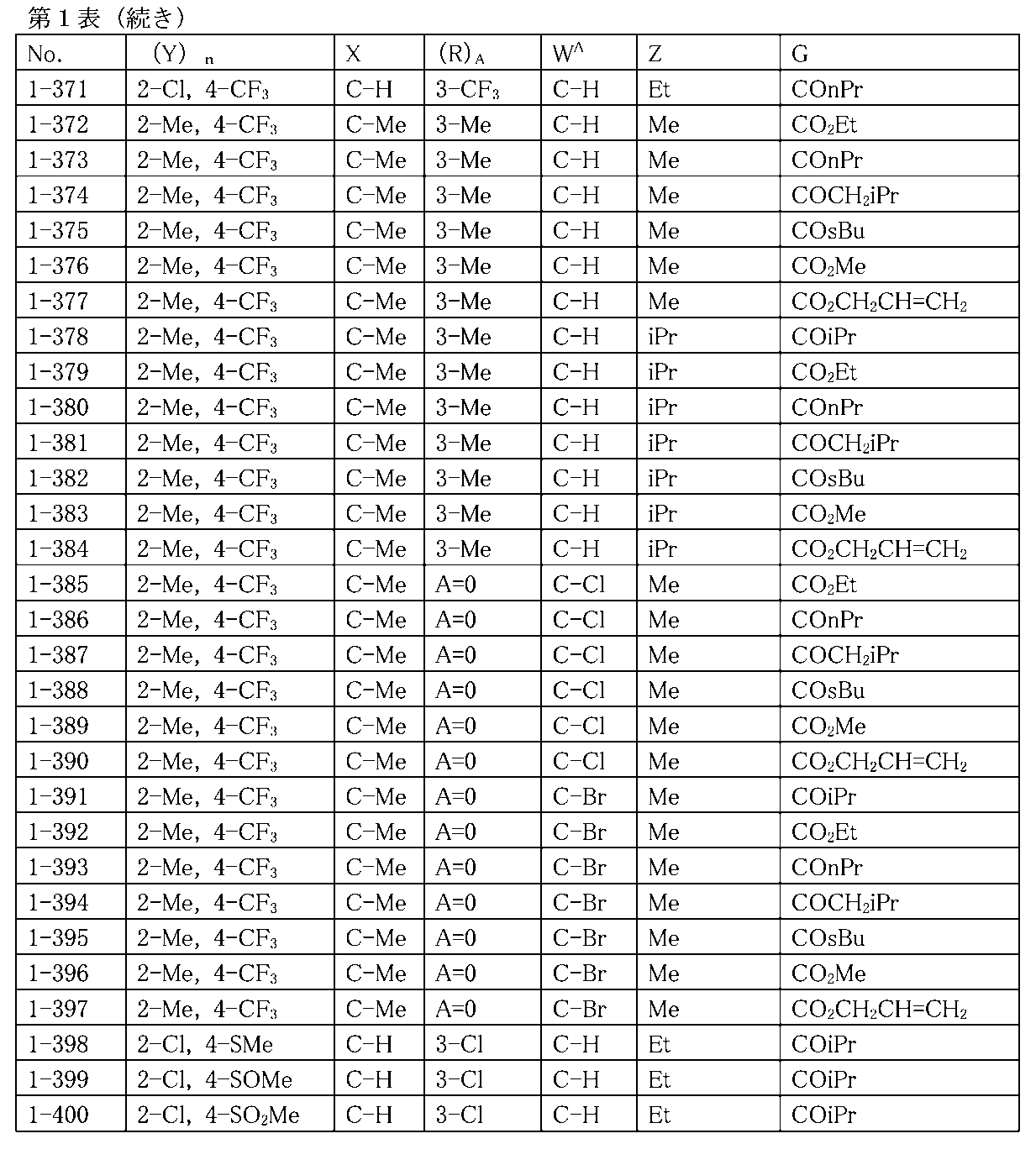
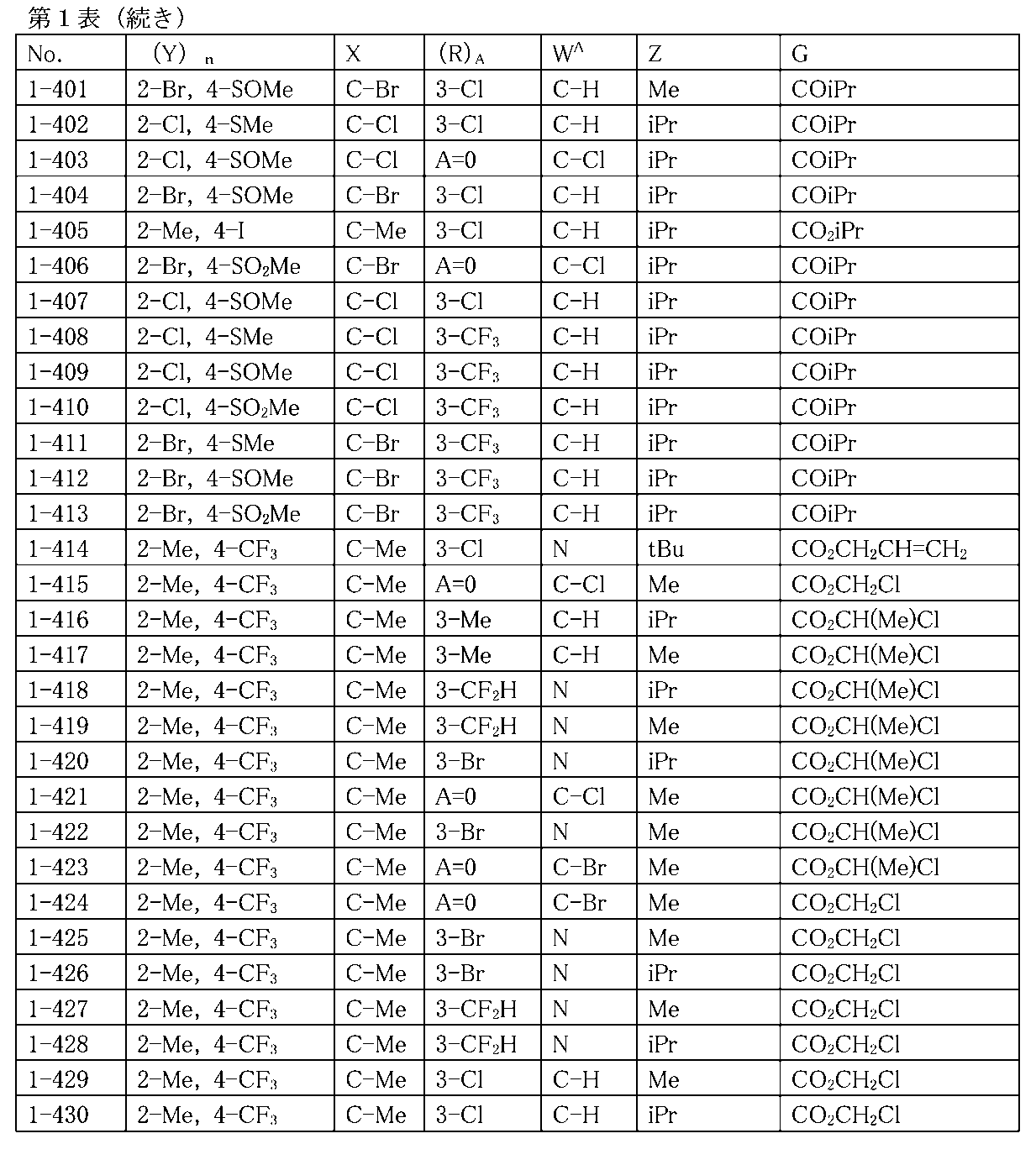
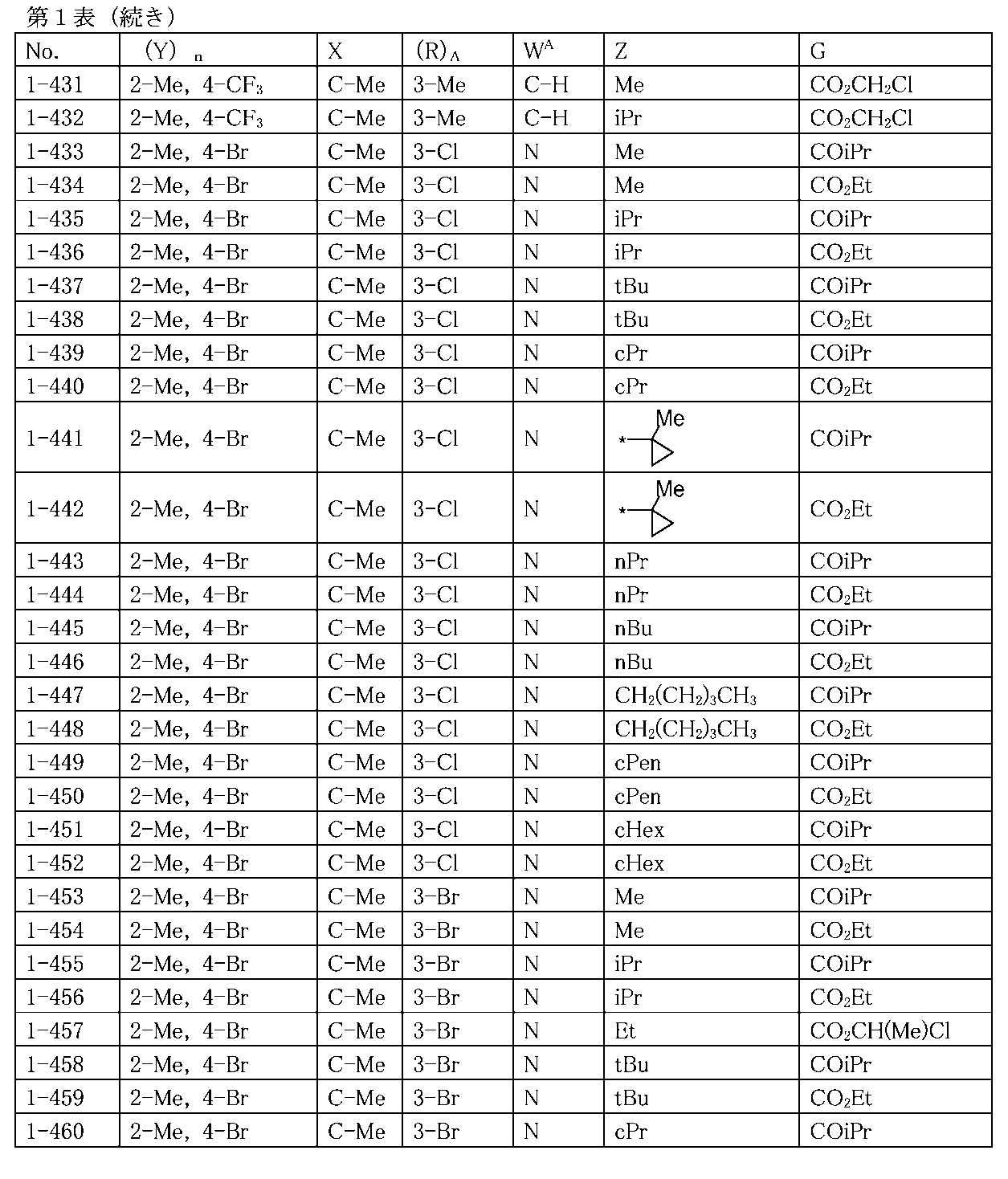


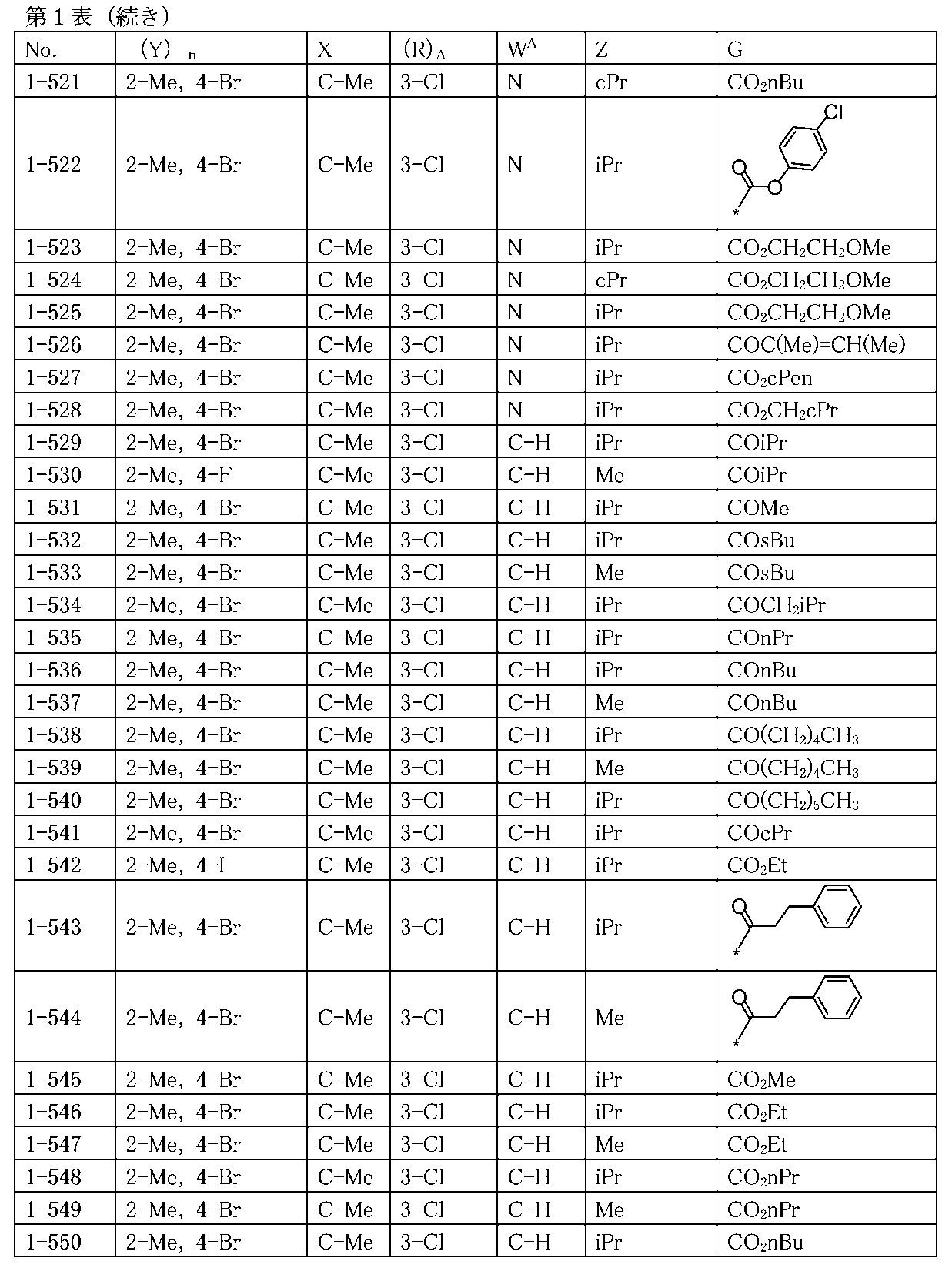

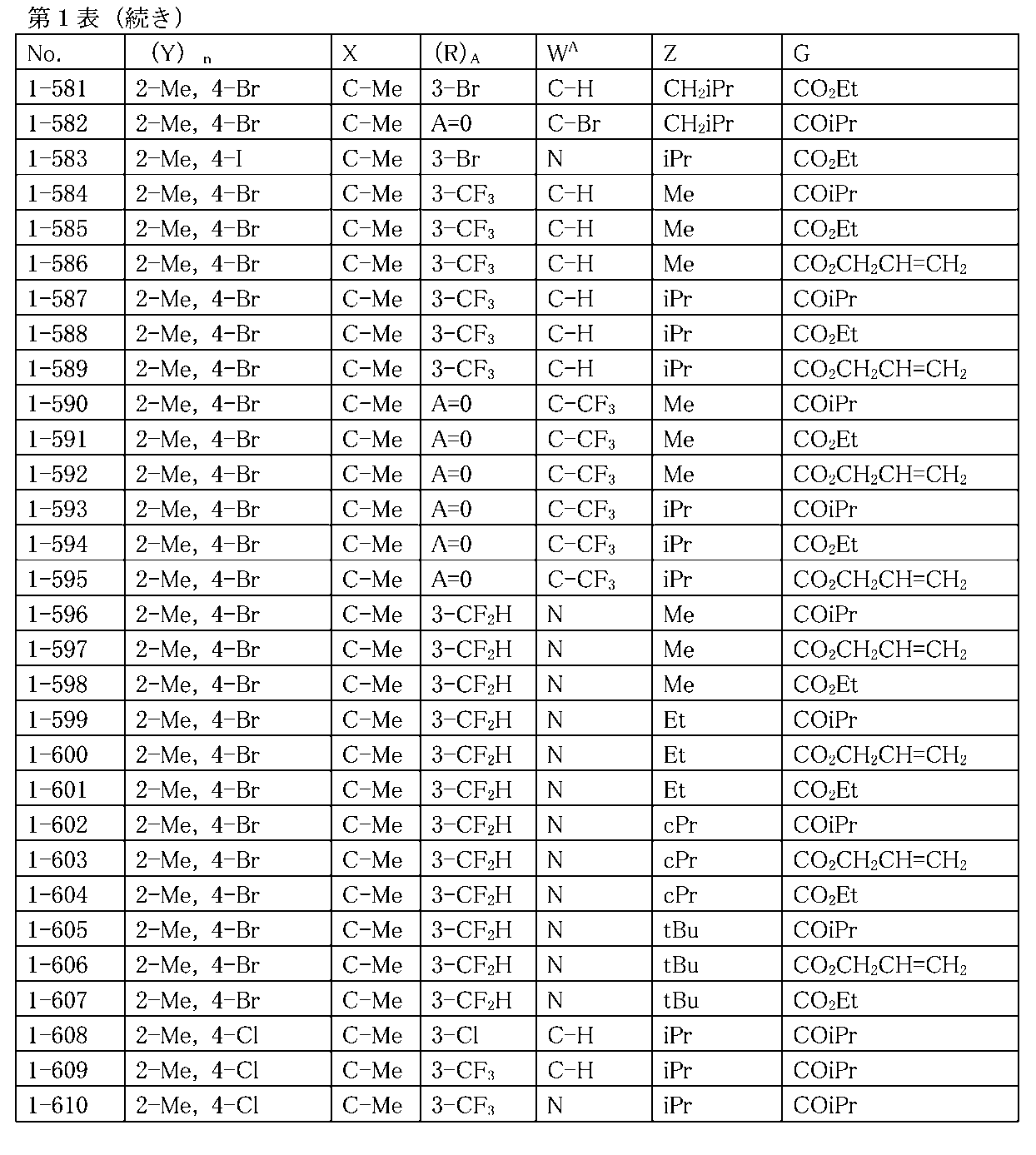
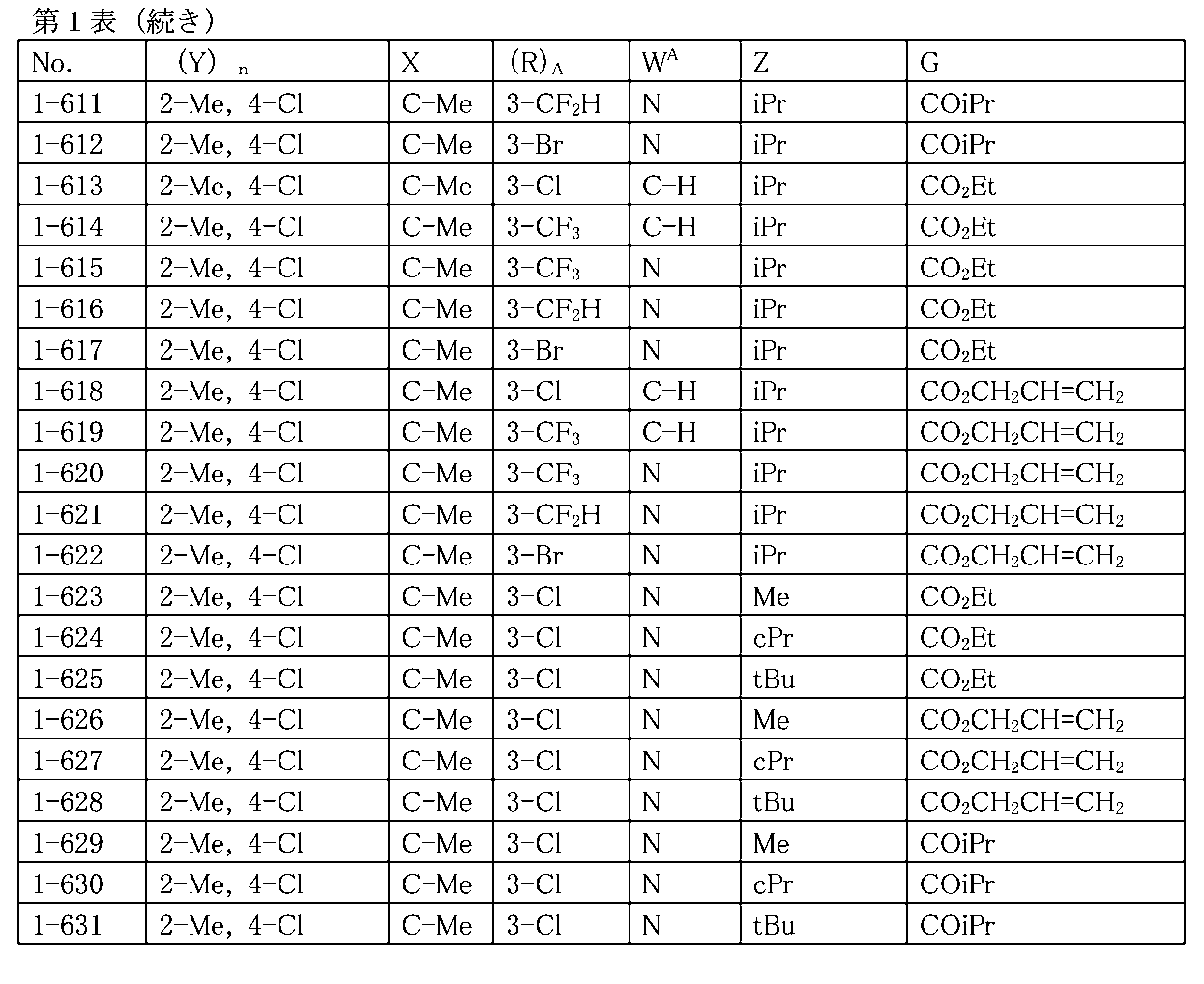


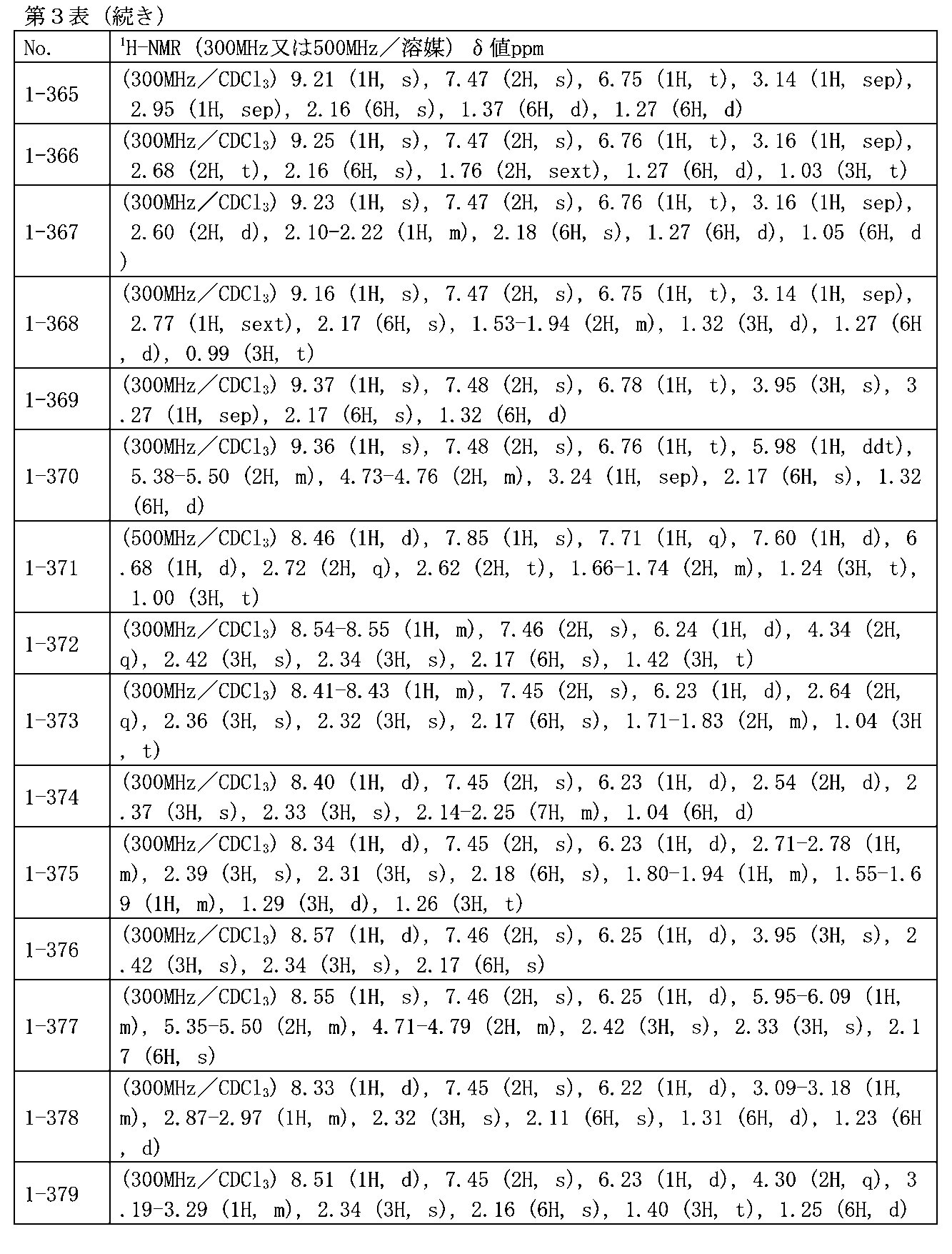

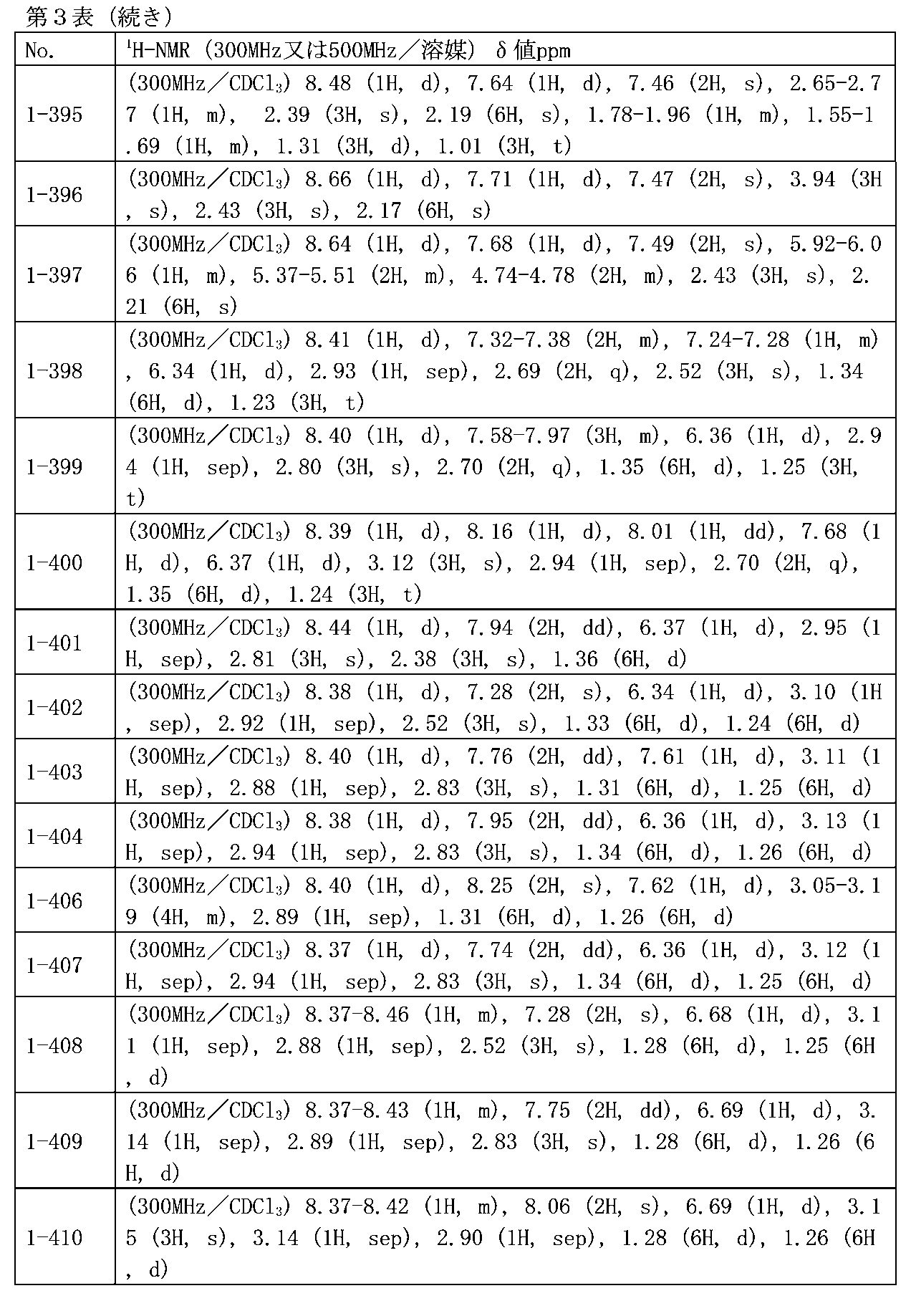
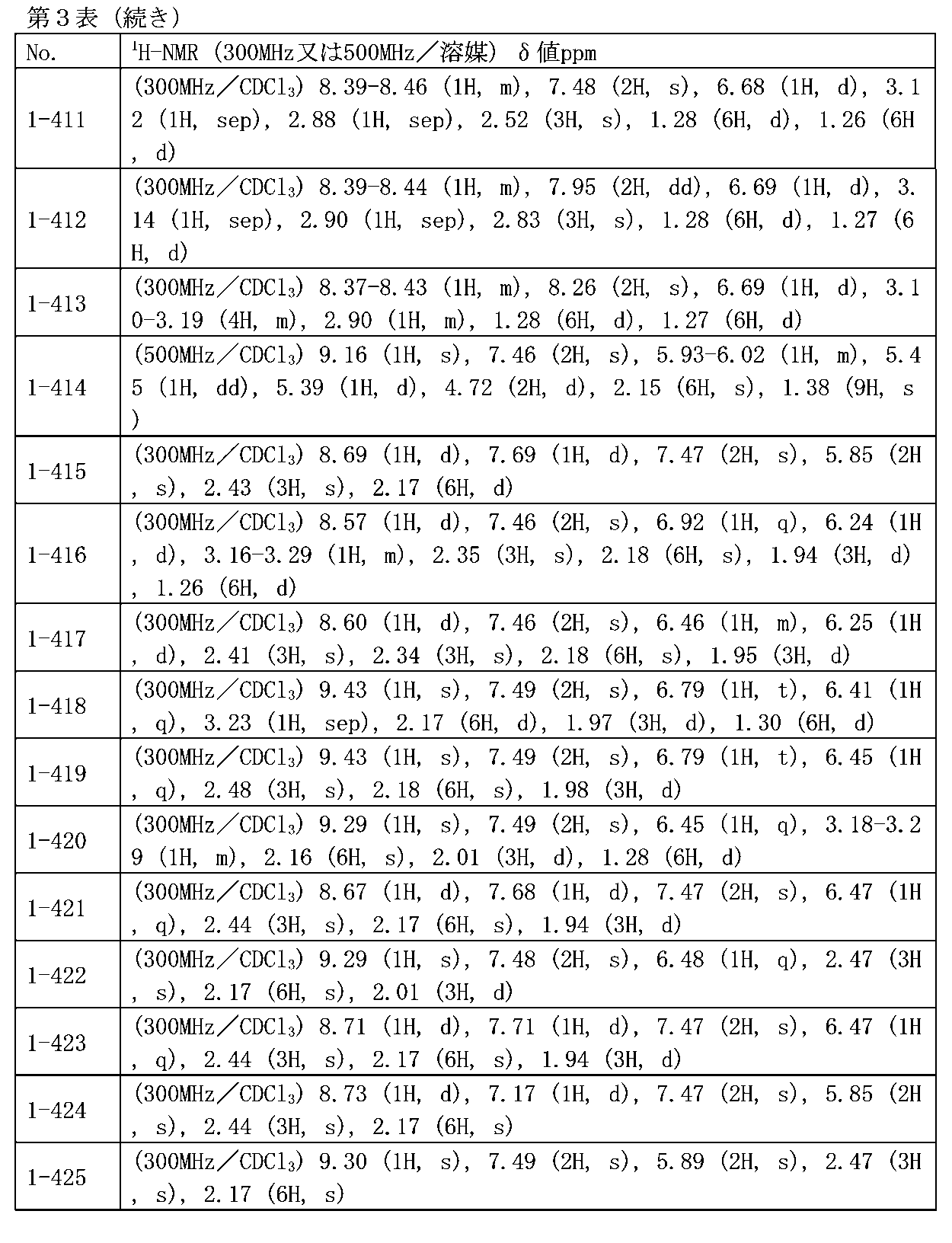
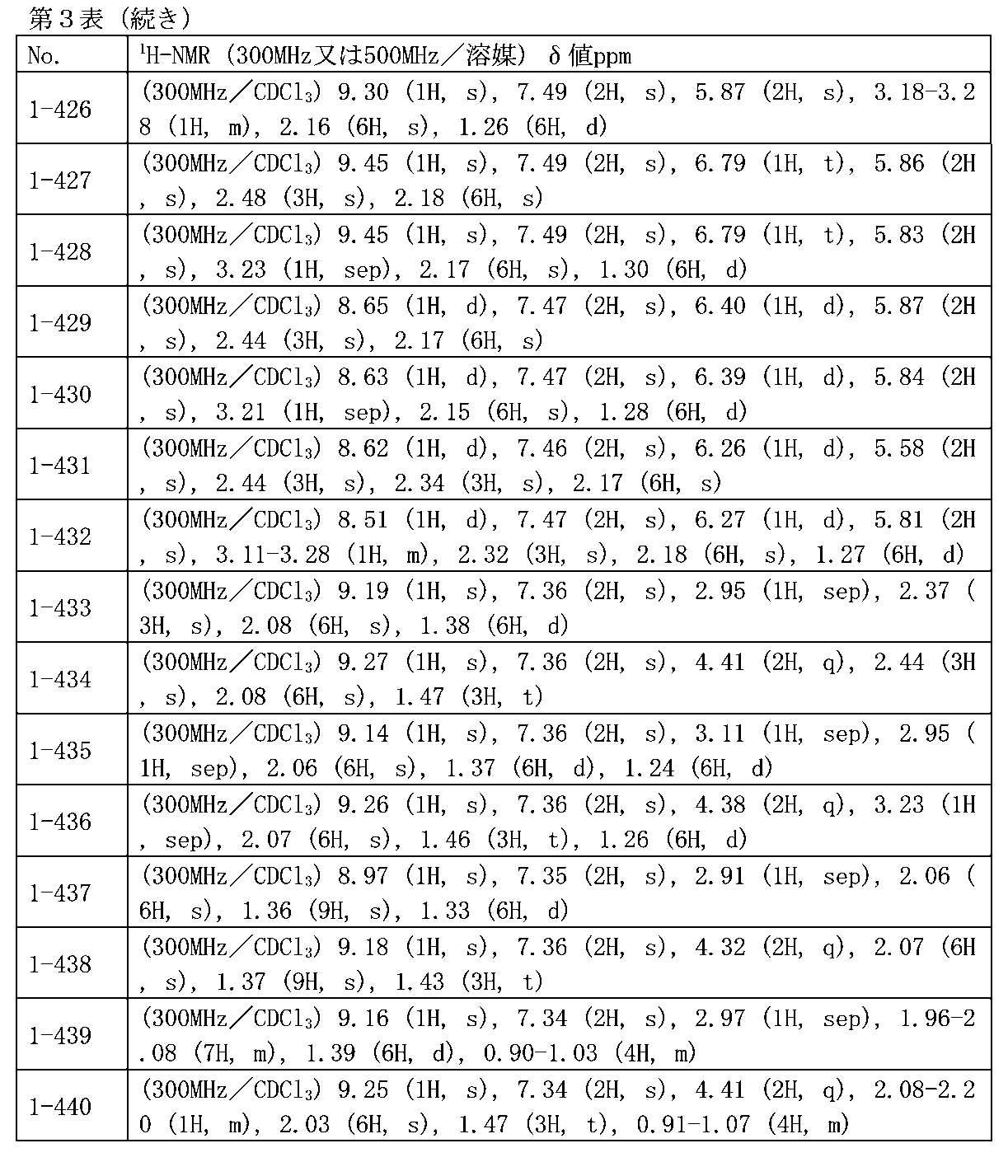

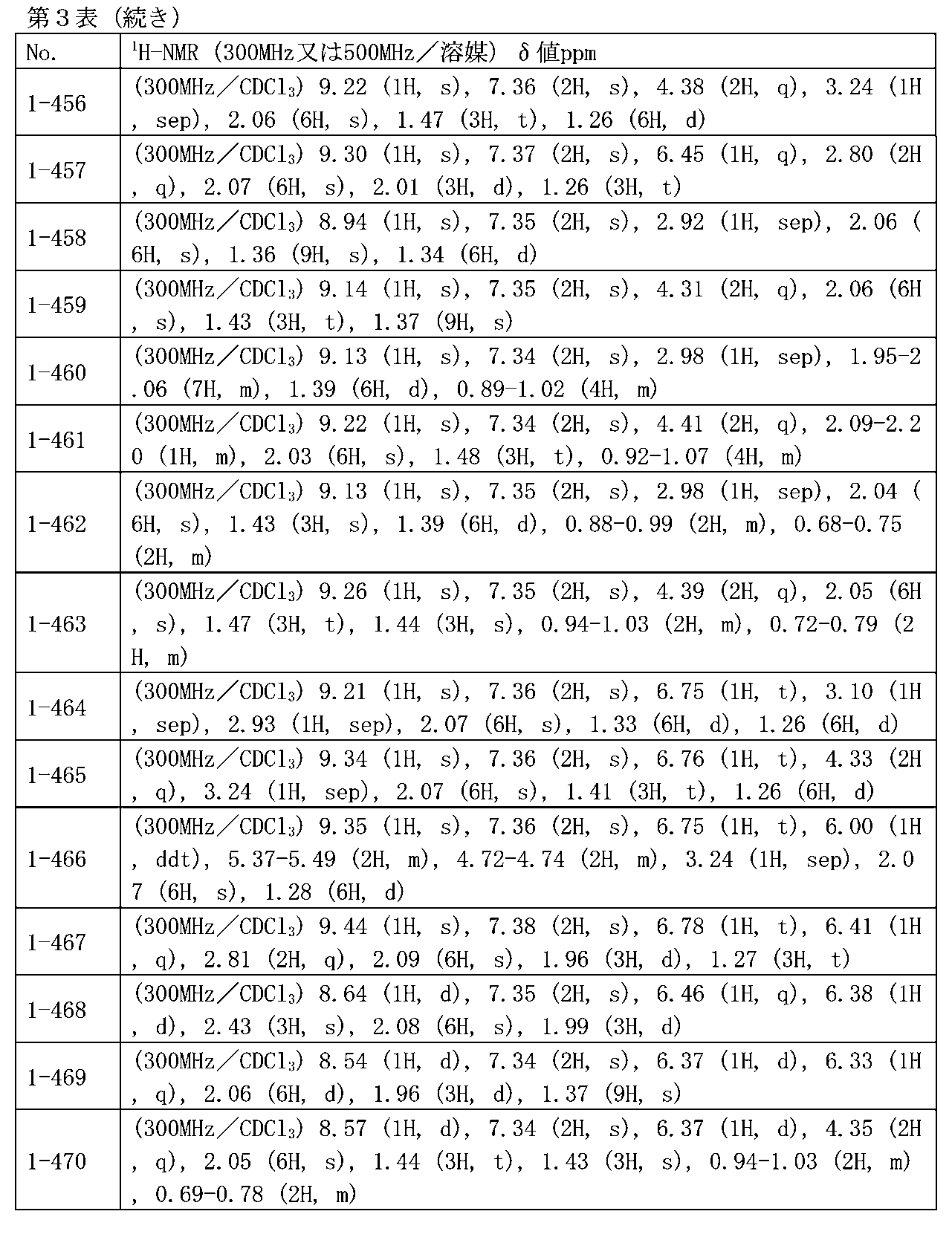
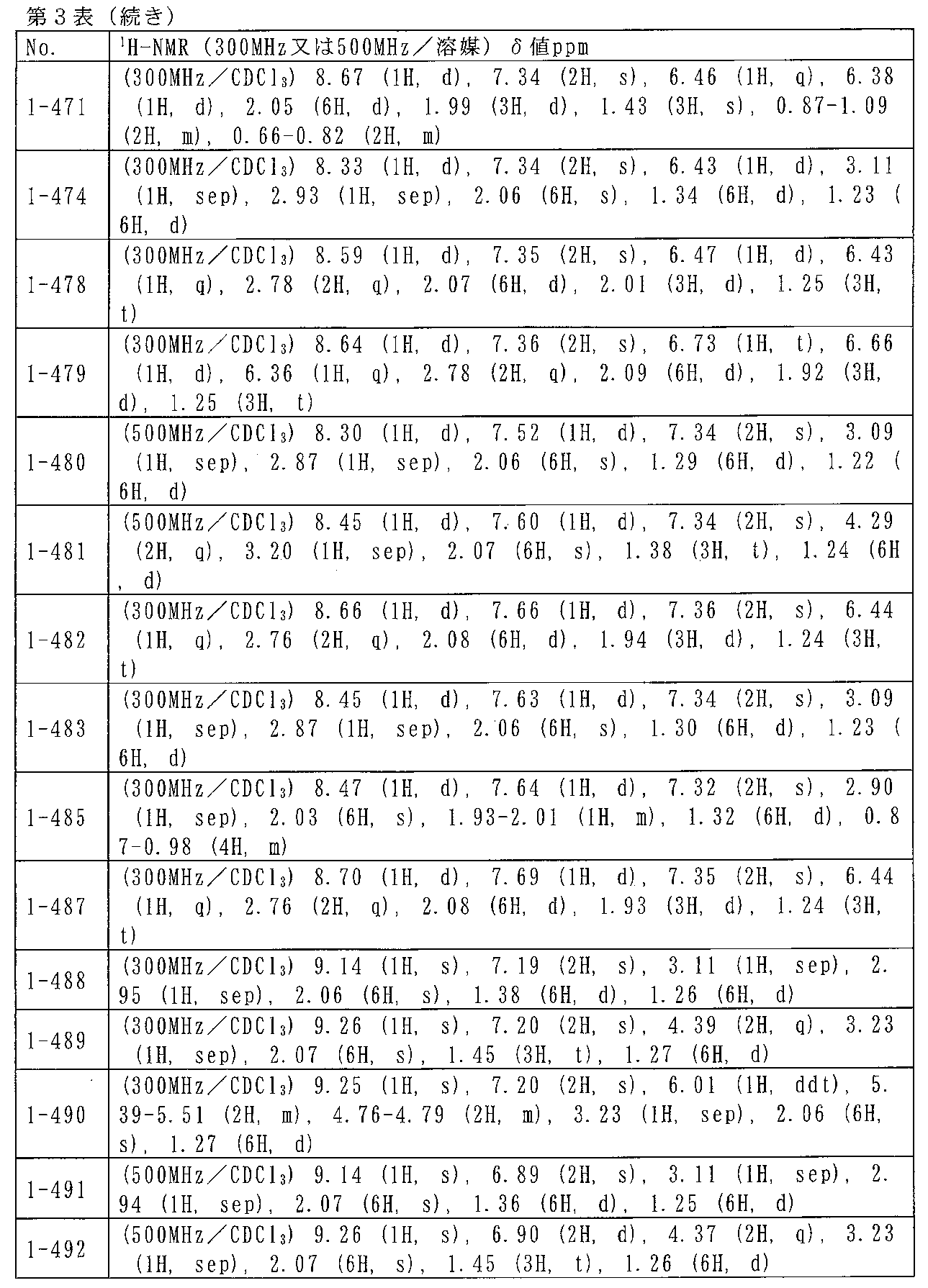
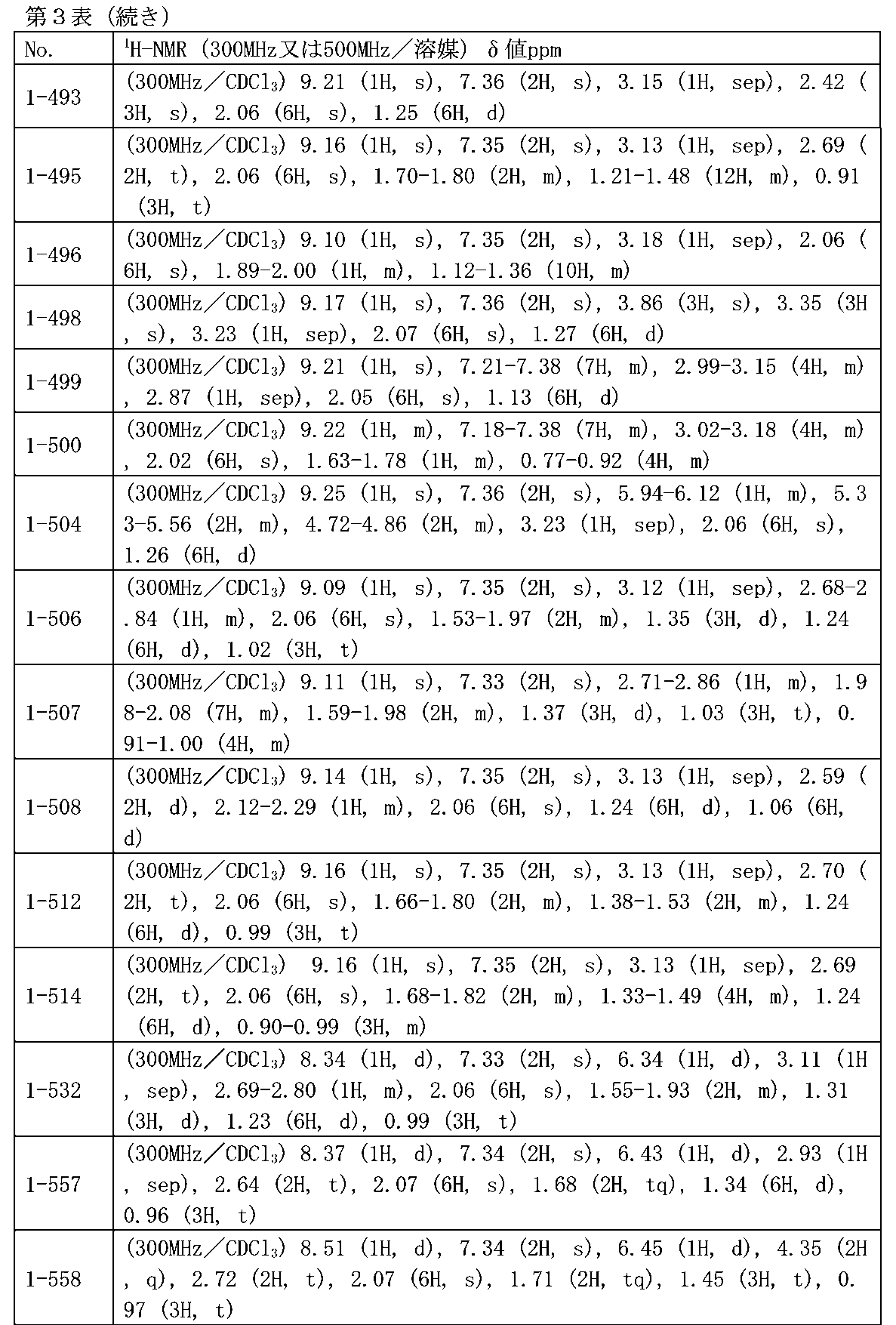

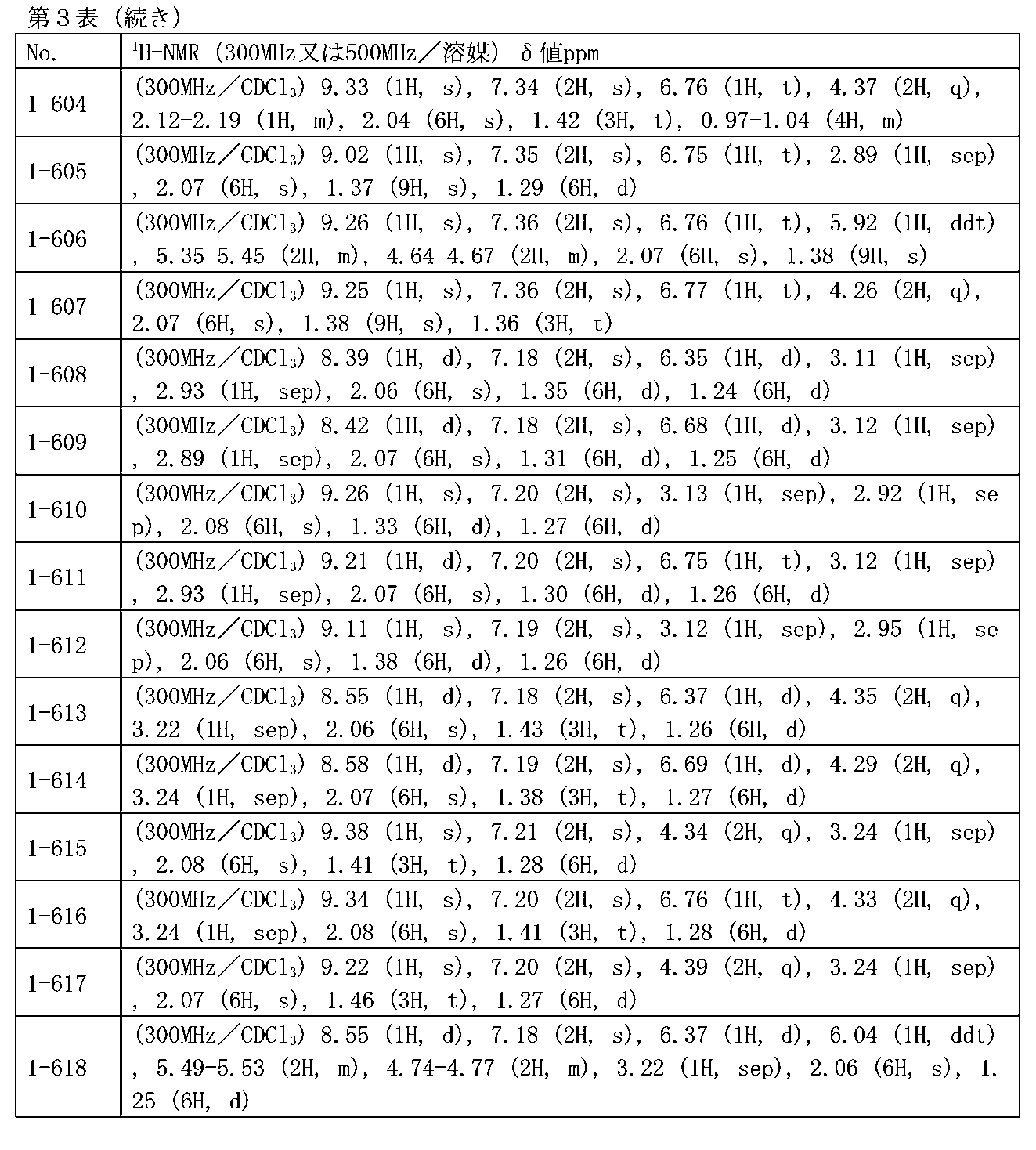
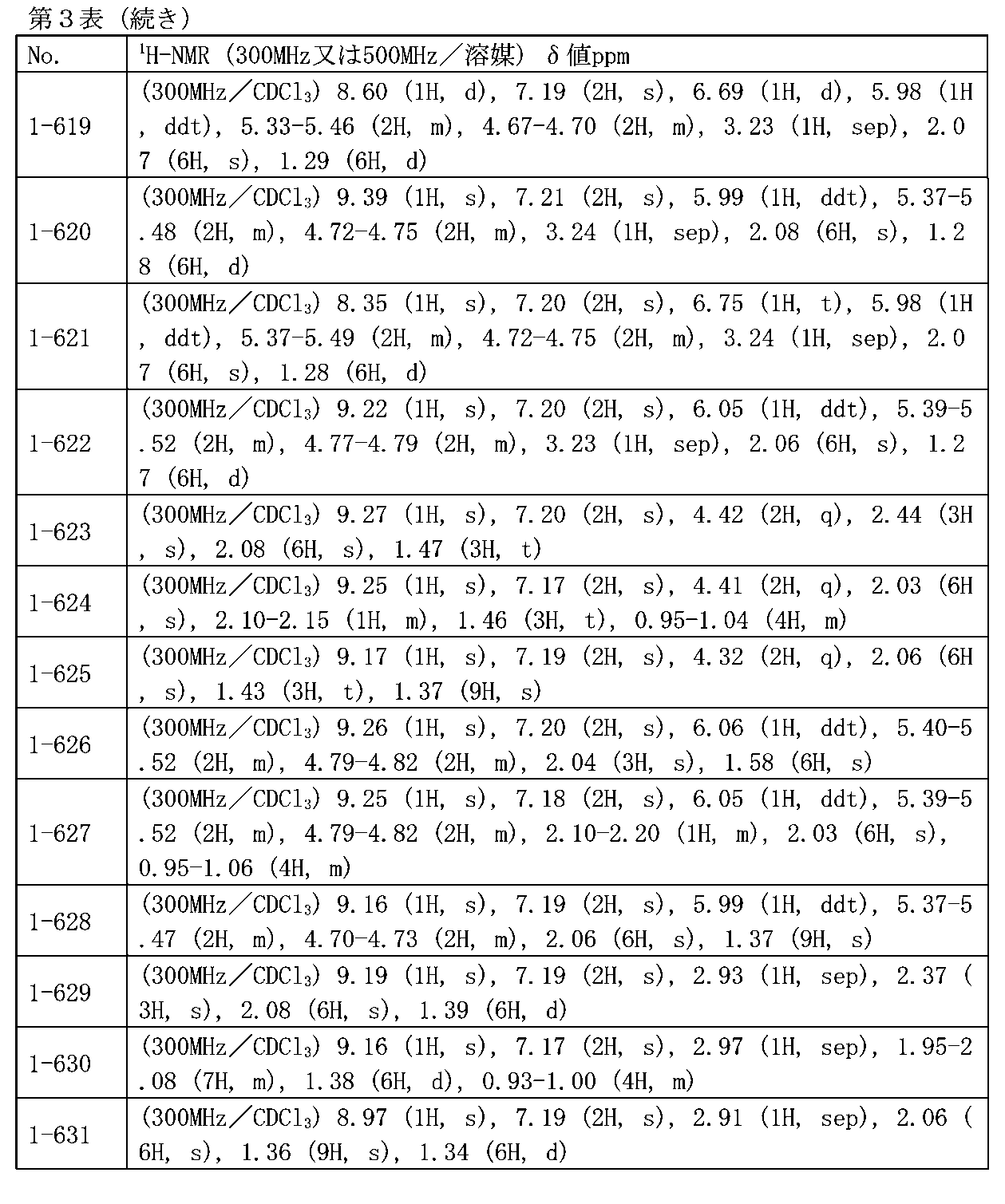
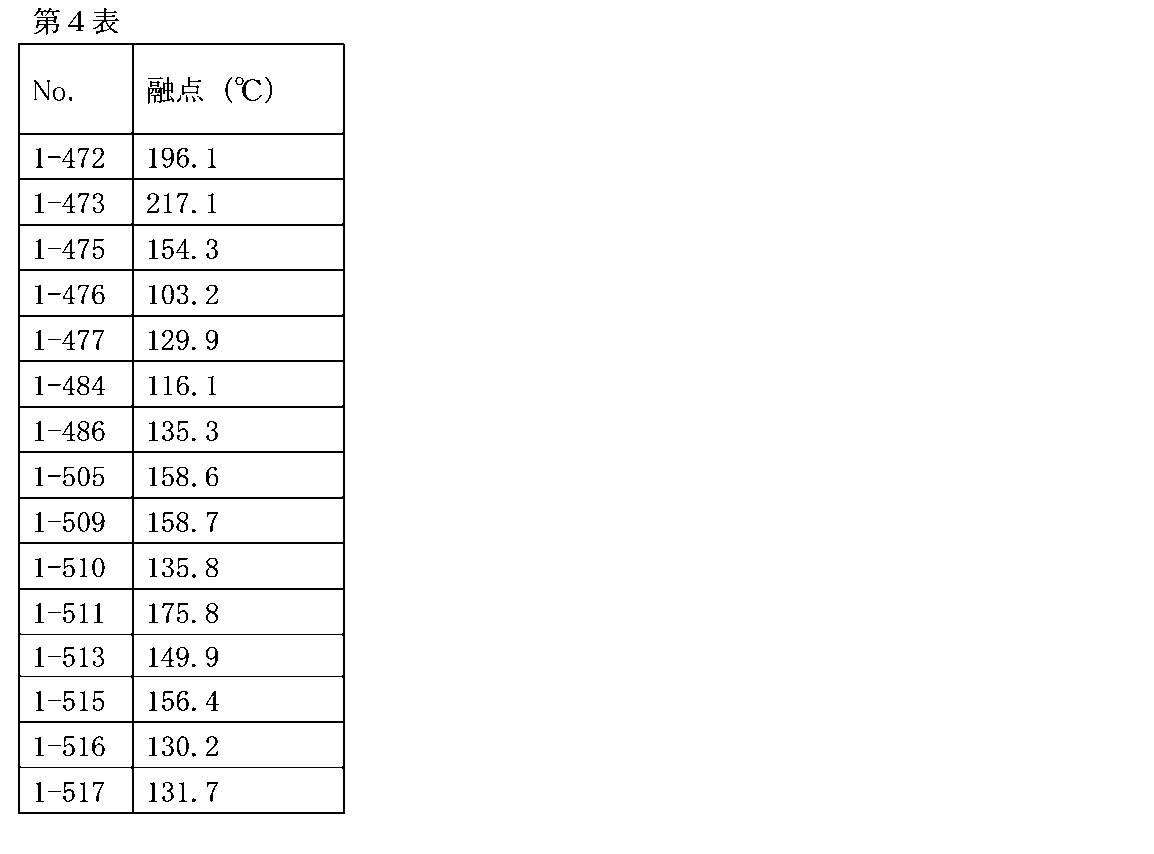

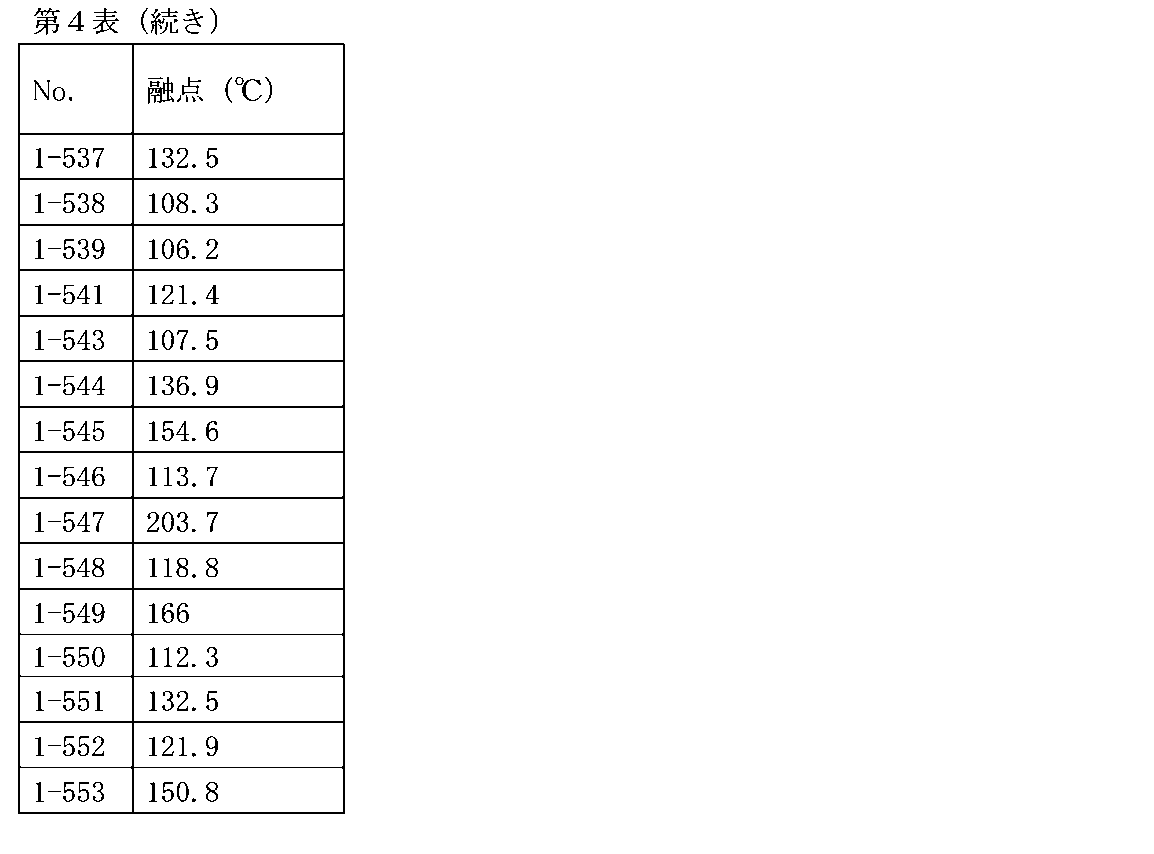
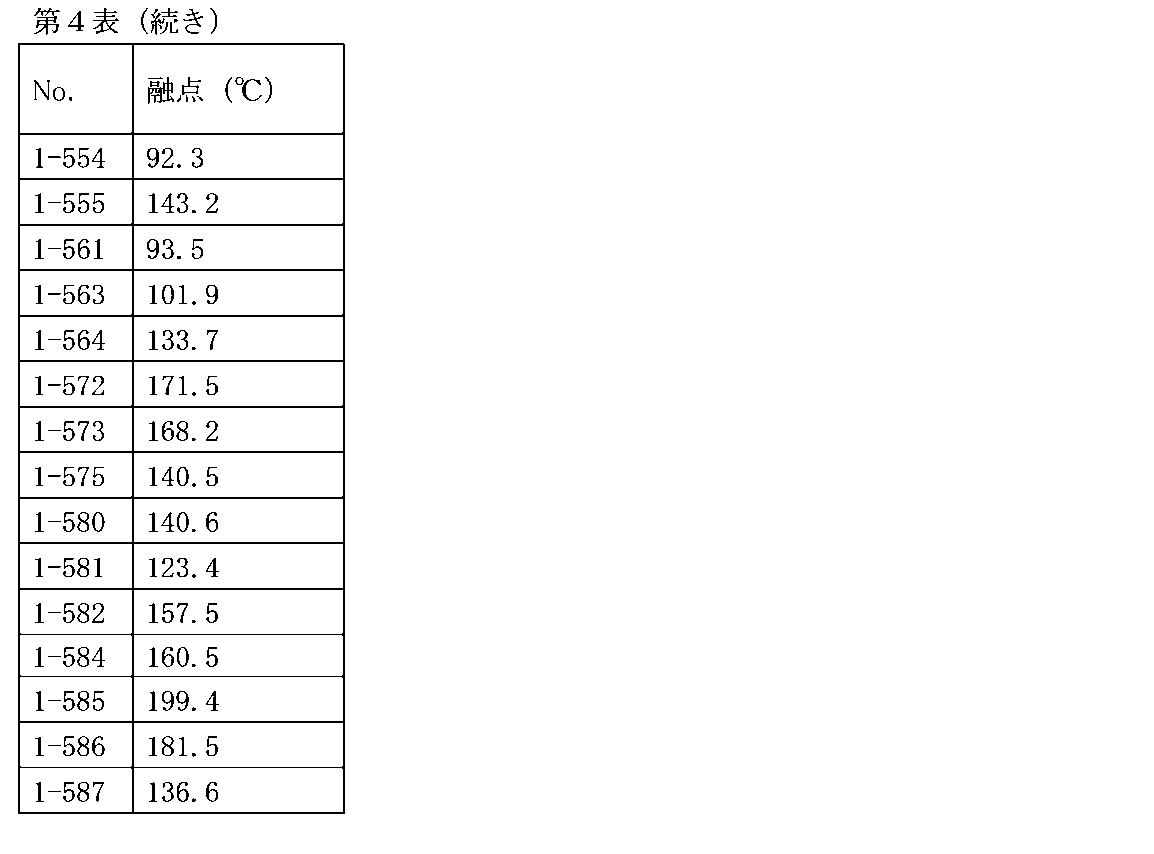
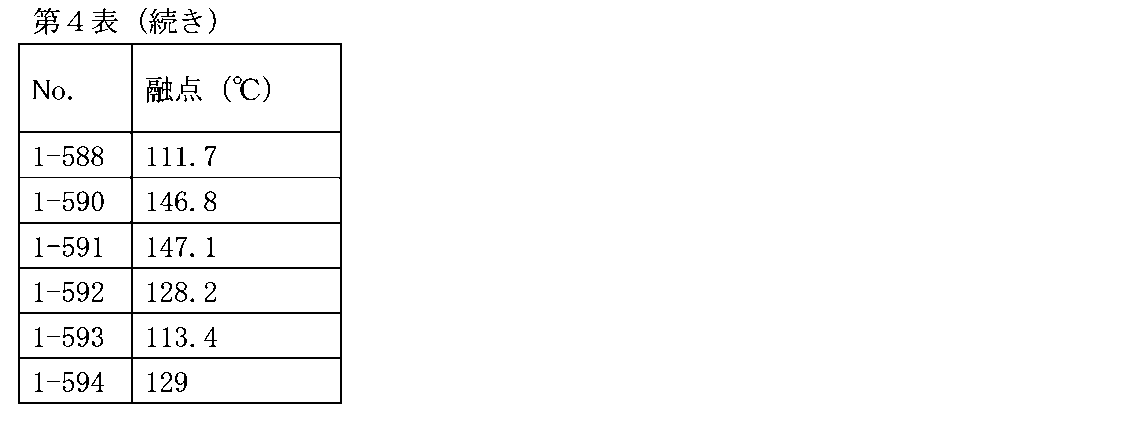
供試化合物の濃度が200ppm又は50ppmとなるよう調製した薬液に、イネ幼苗を浸漬処理した。薬液が風乾した後に、湿った脱脂綿で根部を包んで試験管に入れた。この中にトビイロウンカ2~3齢幼虫を約10頭放虫し、管口をガーゼでふたをして25℃の照明付恒温室内に静置した。処理5日後にトビイロウンカの生死を判定し、下記の計算式により死虫率(%)を求めた。
[計算式]
死虫率(%)=(死亡虫数/放虫数)×100
その結果、前記化合物No.1-1、1-2、1-3、1-4、1-5、1-6、1-7、1-8、1-9、1-10、1-11、1-12、1-13、1-14、1-15、1-16、1-17、1-18、1-19、1-20、1-21、1-22、1-23、1-24、1-25、1-26、1-27、1-28、1-29、1-30、1-31、1-32、1-33、1-34、1-35、1-36、1-37、1-38、1-39、1-40、1-41、1-42、1-43、1-44、1-45、1-46、1-47、1-48、1-49、1-50、1-51、1-52、1-53、1-54、1-55、1-56、1-57、1-58、1-59、1-60、1-61、1-62、1-63、1-64、1-65、1-66、1-67、1-68、1-69、1-70、1-71、1-72、1-73、1-74、1-75、1-76、1-77、1-78、1-79、1-80、1-82、1-83、1-84、1-85、1-86、1-87、1-88、1-89、1-90、1-91、1-92、1-93、1-94、1-95、1-96、1-97、1-98、1-99、1-100、1-101、1-102、1-103、1-107、1-108、1-110、1-111、1-112、1-113、1-114、1-115、1-116、1-117、1-118、1-119、1-120、1-121、1-123、1-124、1-125、1-126、1-127、1-128、1-131、1-132、1-133、1-134、1-135、1-136、1-137、1-138、1-140、1-141、1-142、1-143、1-144、1-145、1-146、1-147、1-148、1-149、1-150、1-151、1-152、1-153、1-157、1-158、1-159、1-161、1-164、1-165、1-166、1-172、1-173、1-174、1-175、1-178、1-180、1-183、1-184、1-186、1-187、1-188、1-189、1-190、1-191、1-192、1-193、1-194、1-195、1-196、1-197、1-199、1-204、1-205、1-206、1-207、1-209、1-210、1-212、1-213、1-214、1-215、1-216、1-217、1-218、1-219、1-220、1-221、1-222、1-223、1-224、1-227、1-228、1-230、1-231、1-232、1-234、1-242、1-243、1-250、1-265、1-272、1-280、1-283、1-285、1-286、1-288、1-290、1-291、1-301、1-303、1-304、1-305、1-308、1-309、1-310、1-312、1-313、1-318、1-321、1-323、1-325、1-326、1-327、1-329、1-330、1-338、1-339、1-340、1-341、1-342、1-343、1-344、1-345、1-346、1-347、1-348、1-349、1-350、1-351、1-352、1-353、1-354、1-355、1-356、1-357、1-358、1-359、1-360、1-361、1-362、1-363、1-364、1-365、1-366、1-367、1-368、1-369、1-370、1-371、1-373、1-374、1-375、1-376、1-377、1-378、1-379、1-380、1-382、1-383、1-384、1-385、1-386、1-387、1-388、1-389、1-390、1-391、1-392、1-393、1-394、1-395、1-396、1-397、1-398、1-399、1-400、1-401、1-402、1-404、1-407、1-409、1-412、1-414、1-415、1-416、1-418、1-419、1-420、1-421、1-422、1-423、1-424、1-425、1-426、1-427、1-428、1-429、1-430、1-431、1-433、1-435、1-436、1-437、1-438、1-439、1-440、1-441、1-442、1-443、1-444、1-445、1-446、1-450、1-451、1-452、1-455、1-456、1-457、1-458、1-459、1-460、1-461、1-462、1-463、1-464、1-465、1-466、1-467、1-469、1-470、1-471、1-474、1-475、1-476、1-477、1-478、1-479、1-480、1-481、1-482、1-483、1-485、1-487、1-488、1-489、1-490、1-491、1-492、1-496、1-498、1-500、1-504、1-505、1-506、1-507、1-508、1-510、1-511、1-512、1-513、1-514、1-515、1-516、1-517、1-518、1-521、1-523、1-524、1-526、1-527、1-529、1-531、1-532、1-533、1-534、1-535、1-536、1-537、1-538、1-539、1-541、1-543、1-544、1-545、1-546、1-548、1-550、1-551、1-552、1-553、1-554、1-555、1-557、1-558、1-563、1-564、1-569、1-570、1-571、1-572、1-573、1-580、1-581、1-584、1-586、1-587、1-588、1-589、1-590、1-591、1-592、1-596、1-597、1-598、1-599、1-600、1-601、1-602、1-604、1-605、1-608、1-609、1-610、1-611、1-612、1-613、1-614、1-615、1-616、1-617、1-618、1-619、1-620、1-621、1-622、1-623、1-624、1-625、1-628、1-629、1-630、1-631、2-1及び2-3が200ppmの濃度で80%以上の死虫率を示した。また、前記化合物No.1-104、1-105、1-106、1-129、1-155、1-162、1-168、1-170、1-171、1-176、1-177、1-179、1-181、1-182、1-208、1-289、1-302、1-319、1-320、1-322、1-324、1-381、1-432、1-453、1-493、1-495、1-499、1-509、1-520、1-603、1-626及び1-627が50ppmの濃度で80%以上の死虫率を示した。
試験管に水挿ししたダイコン葉上にモモアカアブラムシ成虫を5頭放虫した。1日後に成虫を取り除いた後、ダイコン葉上に寄生している幼虫数を供試虫数として数え、供試化合物の濃度が200ppm又は50ppmとなるように調製した薬液に浸漬処理した。薬液が風乾した後に、25℃の照明付恒温室内に静置した。処理5日後にモモアカアブラムシの生死を判定し、下記の計算式により死虫率(%)を求めた。尚、離脱虫及び異常虫は死亡虫とみなした。
[計算式]
死虫率(%)=(死亡虫数/供試虫数)×100
その結果、前記化合物No.1-1、1-2、1-3、1-4、1-5、1-6、1-7、1-8、1-9、1-10、1-11、1-12、1-13、1-14、1-15、1-16、1-17、1-18、1-19、1-20、1-21、1-22、1-23、1-24、1-25、1-26、1-27、1-28、1-29、1-30、1-31、1-32、1-33、1-34、1-35、1-36、1-37、1-38、1-39、1-40、1-41、1-42、1-43、1-44、1-45、1-46、1-47、1-48、1-49、1-50、1-51、1-52、1-53、1-54、1-55、1-56、1-57、1-58、1-59、1-60、1-61、1-62、1-63、1-64、1-65、1-66、1-67、1-68、1-69、1-70、1-71、1-72、1-73、1-74、1-75、1-76、1-77、1-78、1-79、1-80、1-81、1-82、1-83、1-84、1-85、1-86、1-87、1-88、1-89、1-90、1-91、1-92、1-93、1-94、1-95、1-96、1-97、1-98、1-99、1-100、1-101、1-102、1-103、1-107、1-108、1-110、1-111、1-112、1-113、1-114、1-117、1-121、1-123、1-124、1-125、1-126、1-127、1-128、1-131、1-132、1-133、1-134、1-135、1-136、1-137、1-138、1-139、1-140、1-141、1-143、1-144、1-145、1-146、1-147、1-148、1-149、1-150、1-151、1-152、1-153、1-157、1-158、1-159、1-161、1-164、1-165、1-166、1-172、1-173、1-174、1-175、1-178、1-180、1-183、1-184、1-186、1-187、1-188、1-189、1-190、1-191、1-192、1-193、1-194、1-195、1-196、1-197、1-198、1-199、1-207、1-209、1-210、1-212、1-213、1-214、1-215、1-216、1-217、1-218、1-219、1-220、1-221、1-222、1-223、1-225、1-227、1-229、1-230、1-231、1-234、1-242、1-243、1-250、1-265、1-272、1-279、1-280、1-281、1-283、1-285、1-286、1-288、1-290、1-291、1-301、1-303、1-305、1-308、1-309、1-310、1-312、1-313、1-318、1-321、1-323、1-325、1-326、1-327、1-329、1-330、1-338、1-339、1-340、1-341、1-342、1-343、1-344、1-345、1-346、1-347、1-348、1-349、1-350、1-351、1-352、1-353、1-354、1-355、1-356、1-357、1-358、1-359、1-360、1-361、1-362、1-363、1-364、1-365、1-366、1-367、1-368、1-369、1-370、1-371、1-372、1-373、1-374、1-375、1-376、1-377、1-378、1-380、1-382、1-383、1-385、1-386、1-387、1-388、1-389、1-390、1-391、1-392、1-393、1-394、1-395、1-396、1-397、1-399、1-402、1-403、1-404、1-406、1-407、1-408、1-409、1-410、1-411、1-412、1-413、1-414、1-415、1-416、1-417、1-418、1-419、1-420、1-421、1-422、1-423、1-424、1-425、1-426、1-427、1-428、1-429、1-430、1-431、1-433、1-434、1-435、1-436、1-437、1-438、1-439、1-440、1-441、1-442、1-443、1-444、1-447、1-448、1-452、1-453、1-454、1-455、1-456、1-457、1-458、1-459、1-460、1-461、1-462、1-463、1-464、1-465、1-466、1-467、1-468、1-469、1-470、1-471、1-472、1-473、1-474、1-475、1-476、1-477、1-478、1-479、1-480、1-481、1-482、1-483、1-484、1-485、1-486、1-487、1-488、1-489、1-490、1-491、1-496、1-498、1-500、1-504、1-505、1-506、1-507、1-508、1-510、1-511、1-512、1-513、1-514、1-515、1-516、1-517、1-518、1-519、1-521、1-523、1-524、1-526、1-527、1-529、1-532、1-533、1-534、1-535、1-536、1-537、1-538、1-539、1-541、1-543、1-544、1-545、1-546、1-547、1-549、1-550、1-552、1-553、1-554、1-555、1-557、1-558、1-559、1-561、1-563、1-564、1-566、1-569、1-570、1-571、1-572、1-573、1-575、1-580、1-581、1-582、1-584、1-585、1-586、1-587、1-588、1-589、1-592、1-593、1-594、1-595、1-596、1-597、1-598、1-599、1-600、1-601、1-602、1-605、1-607、1-608、1-610、1-611、1-612、1-614、1-615、1-616、1-617、1-620、1-621、1-622、1-623、1-624、1-628、1-629、1-630及び1-631が200ppmの濃度で80%以上の死虫率を示した。また、前記化合物No.1-105、1-106、1-109、1-129、1-155、1-162、1-168、1-170、1-176、1-177、1-179、1-182、1-208、1-211、1-289、1-302、1-319、1-322、1-324、1-381、1-432、1-493、1-495、1-499、1-509、1-520、1-603、1-606、1-626及び1-627が50ppmの濃度で80%以上の死虫率を示した。
供試化合物の濃度が800ppm、200ppm又は50ppmとなるように調製した薬液に、予めナミハダニ成虫を約20頭放虫しておいたインゲン葉を浸漬処理した。薬液が風乾した後に、25℃の照明付恒温室内に静置した。処理3日後にナミハダニ成虫の生死を判定し、下記の計算式により殺成虫率(%)を求めた。尚、離脱した成虫及び異常虫は死亡虫とみなした。
[計算式]
殺成虫率(%)=(死亡虫数/放虫数)×100
その結果、前記化合物No.1-1、1-2、1-3、1-5、1-6、1-7、1-8、1-9、1-11、1-13、1-15、1-16、1-19、1-20、1-21、1-22、1-24、1-27、1-28、1-29、1-32、1-34、1-35、1-36、1-37、1-38、1-39、1-40、1-41、1-43、1-46、1-47、1-48、1-49、1-50、1-51、1-52、1-53、1-54、1-55、1-56、1-57、1-59、1-60、1-62、1-63、1-64、1-66、1-67、1-68、1-69、1-71、1-72、1-77、1-79、1-80、1-82、1-85、1-86、1-91、1-92、1-95、1-96、1-97、1-102、1-103、1-107、1-108、1-124、1-126、1-131、1-132、1-133、1-134、1-135、1-136、1-137、1-138、1-140、1-141、1-144、1-146、1-151、1-153、1-157、1-172、1-174、1-178、1-189、1-199、1-231、1-243、1-265、1-283、1-301、1-303、1-329、1-343、1-344、1-345、1-346、1-347、1-350、1-353、1-354、1-355、1-356、1-357、1-368、1-369、1-371、1-378、1-379、1-380、1-382、1-388、1-414、1-415、1-416、1-418、1-421、1-424、1-430、1-435、1-437、1-449、1-455、1-456、1-458、1-460、1-470、1-474、1-475、1-476、1-477、1-478、1-480、1-481、1-483、1-485、1-490、1-500、1-507、1-529、1-532、1-535、1-538、1-543、1-555、1-563、1-564及び1-605が200ppmの濃度で80%以上の殺成虫率を示した。また、前記化合物No.1-155、1-176、1-177、1-179、1-182、1-302及び1-381が50ppmの濃度で80%以上の殺成虫率を示した。
供試化合物の濃度が200ppm又は50ppmとなるよう調製した薬液に、イネ幼苗を浸漬処理した。薬液が風乾した後に、湿った脱脂綿で根部を包んで試験管に入れた。この中にトビイロウンカ2~3齢幼虫を約10頭放虫し、管口をガーゼでふたをして25℃の照明付恒温室内に静置した。処理5日後にトビイロウンカの生死を判定し、下記の計算式により死虫率(%)を求めた。
[計算式]
死虫率(%)=(死亡虫数/放虫数)×100
供試化合物は、本発明化合物として化合物No.1-371を用い、比較用化合物として下記比較用化合物(A)を用いた。
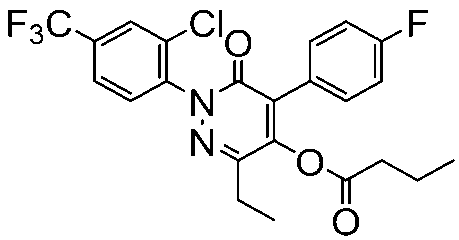
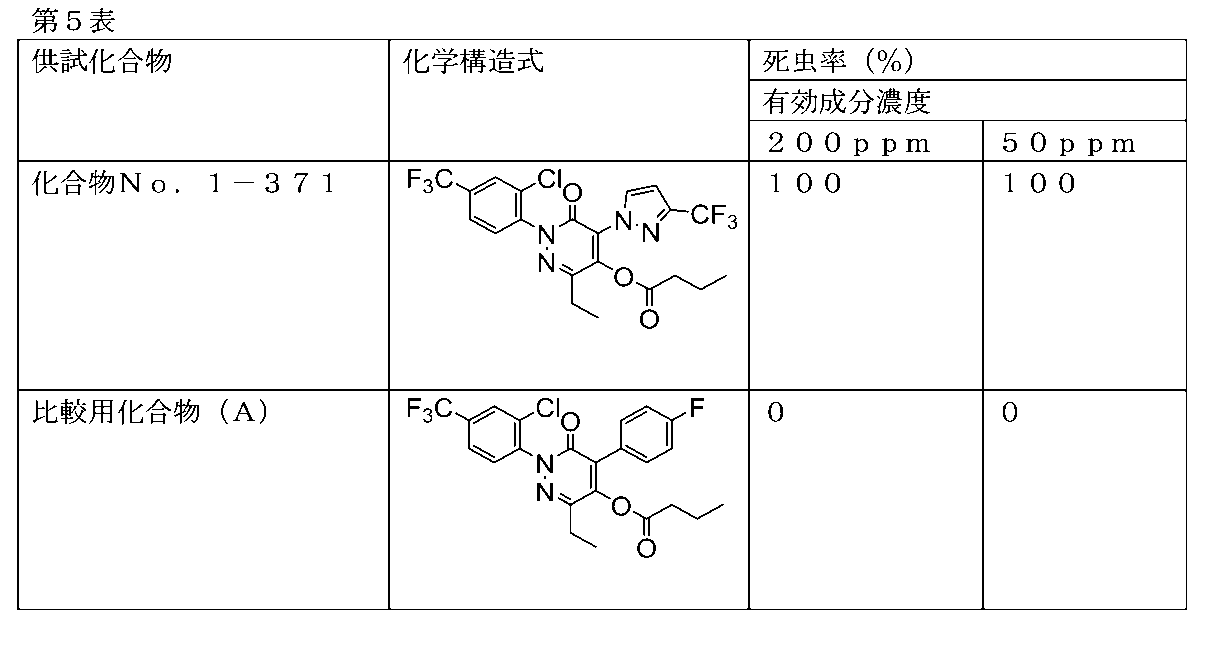
(1)本発明化合物 20重量部
(2)クレー 70重量部
(3)ホワイトカーボン 5重量部
(4)ポリカルボン酸ナトリウム 3重量部
(5)アルキルナフタレンスルホン酸ナトリウム 2重量部
以上のものを均一に混合して水和剤とする。
(1)本発明化合物 5重量部
(2)タルク 60重量部
(3)炭酸カルシウム 34.5重量部
(4)流動パラフィン 0.5重量部
以上のものを均一に混合して粉剤とする。
(1)本発明化合物 20重量部
(2)N,N-ジメチルアセトアミド 20重量部
(3)ポリオキシエチレントリスチリルフェニルエーテル 10重量部
(4)ドデシルベンゼンスルホン酸カルシウム 2重量部
(5)キシレン 48重量部
以上のものを均一に混合、溶解して乳剤とする。
(1)クレー 68重量部
(2)リグニンスルホン酸ナトリウム 2重量部
(3)ポリオキシエチレンアルキルアリールサルフェート 5重量部
(4)ホワイトカーボン 25重量部
以上の各成分の混合物と、本発明化合物とを4:1の重量割合で混合し、水和剤とする。
(1)本発明化合物 50重量部
(2)アルキルナフタレンスルホン酸ナトリウムホルムアルデヒド縮合物 2重量部
(3)シリコーンオイル 0.2重量部
(4)水 47.8重量部
以上のものを均一に混合、粉砕した原液に更に
(5)ポリカルボン酸ナトリウム 5重量部
(6)無水硫酸ナトリウム 42.8重量部
を加え均一に混合、造粒、乾燥して顆粒水和剤とする。
(1)本発明化合物 5重量部
(2)ポリオキシエチレンオクチルフェニルエーテル 1重量部
(3)ポリオキシエチレンアルキルエーテルリン酸エステル 0.1重量部
(4)粒状炭酸カルシウム 93.9重量部
(1)~(3)を予め均一に混合し、適量のアセトンで希釈した後、(4)に吹付け、アセトンを除去して粒剤とする。
(1)本発明化合物 2.5重量部
(2)N,N-ジメチルアセトアミド 2.5重量部
(3)大豆油 95.0重量部
以上のものを均一に混合、溶解して微量散布剤(ultra low volume formulation)とする。
(1)本発明化合物 10重量部
(2)ジエチレングリコールモノエチルエーテル 80重量部
(3)ポリオキシエチレンアルキルエーテル 10重量部
以上の成分を均一に混合し、液剤とする。
Claims (13)
- 式(I):

XはCH、C(RA)又はNであり;
Y及びRAは各々ハロゲン、アルキル、アルケニル、アルキニル、シクロアルキル、ハロアルキル、アルコキシ、ハロアルコキシ、アルキルチオ、アルキルスルフィニル、アルキルスルホニル、シアノ又は-C(=O)RBであり;
Zはアルキル、シクロアルキル、アルコキシアルキル、シクロアルキルアルキル又はハロアルキルであり;
R1、R2、R3及びR4は各々ハロゲン、アルキル、シクロアルキル、ハロアルキル、アルコキシ、シクロアルキルオキシ、ハロアルコキシ、アルキルチオ、アルキルスルフィニル、アルキルスルホニル、ハロアルキルチオ、ハロアルキルスルフィニル、ハロアルキルスルホニル、シアノ、ニトロ、アルデヒド、-CH(=NORC)、1,3-ジオキサン-2-イル又は1,3-ジオキソラン-2-イルであり;
RBは水素原子又はアルキルであり;
RCはアルキルであり;
nは0~4の整数であり;
aは0~3の整数であり;
b、c及びdは各々0、1又は2であり;
GはRDで置換されてもよいアルキル、-C(=O)E又はアルキルスルホニルであり;
RDはアルコキシ、シアノ、アルコキシカルボニル又はアルコキシカルボニルオキシであり;
Eはアルキル、アルケニル、シクロアルキル、ヘテロシクロアルキル、ハロアルキル、ハロアルケニル、ジアルキルアミノ、N-アルコキシ-N-アルキルアミノ、VAで置換されてもよいフェニル、VAで置換されてもよいピリジル、シクロアルキルアルキル、ヘテロシクロアルキルアルキル、アルコキシアルキル、アルキルチオアルキル、VAで置換されてもよいフェニルアルキル、VAで置換されてもよいフェニルオキシアルキル、VAで置換されてもよいフェニルアルケニル、アルコキシ、アルケニルオキシ、アルキニルオキシ、シクロアルキルオキシ、ヘテロシクロアルキルオキシ、ハロアルコキシ、アルコキシアルコキシ、VAで置換されてもよいフェニルオキシ、VAで置換されてもよいナフチルオキシ、シクロアルキルアルコキシ、ヘテロシクロアルキルアルコキシ、VBで置換されてもよいフェニルアルコキシ、アルキルチオ又は2-イミダゾリジノンであり;
VAはハロゲンであり;
VBはハロゲン又はアルキルである)で表されるピリダジノン系化合物又はその塩。 - Y及びRAは各々ハロゲン、アルキル、アルケニル、アルキニル、シクロアルキル、ハロアルキル、アルコキシ、ハロアルコキシ、アルキルスルホニル、シアノ又は-C(=O)RBである請求項1に記載のピリダジノン系化合物又はその塩。
- Y及びRAは各々ハロゲン、(C1-C4)アルキル、(C2-C4)アルケニル、(C2-C4)アルキニル、(C3-C6)シクロアルキル、(C1-C4)ハロアルキル、(C1-C4)アルコキシ、(C1-C4)ハロアルコキシ、(C1-C4)アルキルチオ、(C1-C4)アルキルスルフィニル、(C1-C4)アルキルスルホニル、シアノ又は-C(=O)RBであり;
Zは(C1-C5)アルキル、(C3-C6)シクロアルキル、(C1-C4)アルコキシ(C1-C4)アルキル、(C3-C6)シクロアルキル(C1-C4)アルキル又は(C1-C4)ハロアルキルであり;
R1、R2、R3及びR4は各々ハロゲン、(C1-C4)アルキル、(C3-C6)シクロアルキル、(C1-C4)ハロアルキル、(C1-C4)アルコキシ、(C3-C6)シクロアルキルオキシ、(C1-C4)ハロアルコキシ、(C1-C4)アルキルチオ、(C1-C4)アルキルスルフィニル、(C1-C4)アルキルスルホニル、(C1-C4)ハロアルキルチオ、(C1-C4)ハロアルキルスルフィニル、(C1-C4)ハロアルキルスルホニル、シアノ、ニトロ、アルデヒド、-CH(=NORC)、1,3-ジオキサン-2-イル又は1,3-ジオキソラン-2-イルであり;
RBは水素原子又は(C1-C4)アルキルであり;
RCは(C1-C4)アルキルであり;
GはRDで置換されてもよい(C1-C4)アルキル、-C(=O)E又は(C1-C4)アルキルスルホニルであり;
RDは(C1-C4)アルコキシ、シアノ、(C1-C4)アルコキシカルボニル又は(C1-C4)アルコキシカルボニルオキシであり;
Eは(C1-C8)アルキル、(C2-C8)アルケニル、(C3-C6)シクロアルキル、ヘテロシクロアルキル、(C1-C8)ハロアルキル、(C2-C8)ハロアルケニル、(C1-C4)ジアルキルアミノ、N-(C1-C4)アルコキシ-N-(C1-C4)アルキルアミノ、VAで置換されてもよいフェニル、VAで置換されてもよいピリジル、(C3-C6)シクロアルキル(C1-C4)アルキル、ヘテロシクロアルキル(C1-C4)アルキル、(C1-C4)アルコキシ(C1-C3)アルキル、(C1-C4)アルキルチオ(C1-C3)アルキル、VAで置換されてもよいフェニル(C1-C4)アルキル、VAで置換されてもよいフェニルオキシ(C1-C3)アルキル、VAで置換されてもよいフェニル(C2-C4)アルケニル、(C1-C7)アルコキシ、(C2-C7)アルケニルオキシ、(C2-C7)アルキニルオキシ、(C3-C6)シクロアルキルオキシ、ヘテロシクロアルキルオキシ、(C1-C7)ハロアルコキシ、(C1-C4)アルコキシ(C1-C3)アルコキシ、VAで置換されてもよいフェニルオキシ、VAで置換されてもよいナフチルオキシ、(C3-C6)シクロアルキル(C1-C3)アルコキシ、ヘテロシクロアルキル(C1-C3)アルコキシ、VBで置換されてもよいフェニル(C1-C3)アルコキシ、(C1-C7)アルキルチオ又は2-イミダゾリジノンであり、当該Eにおけるヘテロシクロアルキル及びヘテロシクロアルキル部分は各々炭素原子以外に酸素原子、窒素原子及び硫黄原子から選ばれる1種以上の原子を1つ以上含む3員~6員の基であり;
VBはハロゲン又は(C1-C4)アルキルである請求項1に記載のピリダジノン系化合物又はその塩。 - Y及びRAは各々ハロゲン、(C1-C4)アルキル、(C2-C4)アルケニル、(C2-C4)アルキニル、(C3-C6)シクロアルキル、(C1-C4)ハロアルキル、(C1-C4)アルコキシ、(C1-C4)ハロアルコキシ、(C1-C4)アルキルスルホニル、シアノ又は-C(=O)RBである請求項1に記載のピリダジノン系化合物又はその塩。
- Zは(C1-C5)アルキル、(C3-C6)シクロアルキル、(C1-C4)アルコキシ(C1-C4)アルキル又は(C1-C4)ハロアルキルであり;
R1、R2、R3及びR4は各々ハロゲン、(C1-C4)アルキル、(C3-C6)シクロアルキル、(C1-C4)ハロアルキル、(C1-C4)アルコキシ、(C1-C4)ハロアルコキシ、(C1-C4)アルキルチオ、(C1-C4)アルキルスルフィニル、(C1-C4)アルキルスルホニル、シアノ、ニトロ、アルデヒド、-CH(=NORC)又は1,3-ジオキソラン-2-イルであり;
Eは(C1-C8)アルキル、(C2-C8)アルケニル、(C3-C6)シクロアルキル、ヘテロシクロアルキル、(C1-C8)ハロアルキル、(C1-C4)ジアルキルアミノ、N-(C1-C4)アルコキシ-N-(C1-C4)アルキルアミノ、VAで置換されてもよいフェニル、VAで置換されてもよいピリジル、(C3-C6)シクロアルキル(C1-C4)アルキル、ヘテロシクロアルキル(C1-C4)アルキル、(C1-C4)アルコキシ(C1-C3)アルキル、(C1-C4)アルキルチオ(C1-C3)アルキル、VAで置換されてもよいフェニル(C1-C4)アルキル、VAで置換されてもよいフェニルオキシ(C1-C3)アルキル、VAで置換されてもよいフェニル(C2-C4)アルケニル、(C1-C7)アルコキシ、(C2-C7)アルケニルオキシ、(C2-C7)アルキニルオキシ、(C3-C6)シクロアルキルオキシ、(C1-C7)ハロアルコキシ、(C1-C4)アルコキシ(C1-C3)アルコキシ、VAで置換されてもよいフェニルオキシ、VAで置換されてもよいナフチルオキシ、VBで置換されてもよいフェニル(C1-C3)アルコキシ、(C1-C7)アルキルチオ又は2-イミダゾリジノンであり、当該Eにおけるヘテロシクロアルキル及びヘテロシクロアルキル部分は各々炭素原子以外に酸素原子、窒素原子及び硫黄原子から選ばれる1種以上の原子を1つ以上含む3員~6員の基である請求項3に記載のピリダジノン系化合物又はその塩。 - QはQ1又はQ3である請求項1に記載のピリダジノン系化合物又はその塩。
- XはCH又はC(RA)である請求項1に記載のピリダジノン系化合物又はその塩。
- XはNである請求項1に記載のピリダジノン系化合物又はその塩。
- XがCHの場合はnが1~3の整数であり、XがC(RA)又はNの場合はnが1又は2である請求項1に記載のピリダジノン系化合物又はその塩。
- a、b、c及びdが各々1又は2である請求項1に記載のピリダジノン系化合物又はその塩。
- 請求項1から10までのいずれか一項に記載の化合物又はその塩を有効成分として含有する有害生物防除剤。
- 請求項1から10までのいずれか一項に記載の化合物又はその塩を有効成分として含有する農園芸用殺虫剤、殺ダニ剤、殺線虫剤又は殺土壌害虫剤。
- 請求項1から10までのいずれか一項に記載の化合物又はその塩の有効量を施用して有害生物を防除する方法。
Priority Applications (1)
| Application Number | Priority Date | Filing Date | Title |
|---|---|---|---|
| CN202480059736.8A CN121866251A (zh) | 2023-09-27 | 2024-08-30 | 哒嗪酮系化合物或其盐及含有它们的有害生物防除剂 |
Applications Claiming Priority (2)
| Application Number | Priority Date | Filing Date | Title |
|---|---|---|---|
| JP2023-166313 | 2023-09-27 | ||
| JP2023166313 | 2023-09-27 |
Publications (1)
| Publication Number | Publication Date |
|---|---|
| WO2025069918A1 true WO2025069918A1 (ja) | 2025-04-03 |
Family
ID=95203114
Family Applications (1)
| Application Number | Title | Priority Date | Filing Date |
|---|---|---|---|
| PCT/JP2024/031121 Pending WO2025069918A1 (ja) | 2023-09-27 | 2024-08-30 | ピリダジノン系化合物又はその塩及びそれらを含有する有害生物防除剤 |
Country Status (5)
| Country | Link |
|---|---|
| CN (1) | CN121866251A (ja) |
| AR (1) | AR133923A1 (ja) |
| PY (1) | PY2485140A (ja) |
| TW (1) | TW202530191A (ja) |
| WO (1) | WO2025069918A1 (ja) |
Citations (5)
| Publication number | Priority date | Publication date | Assignee | Title |
|---|---|---|---|---|
| JPS63185966A (ja) * | 1987-01-27 | 1988-08-01 | Nissan Chem Ind Ltd | ピリダジノン誘導体および害虫防除剤 |
| JPH11152273A (ja) * | 1997-11-19 | 1999-06-08 | Otsuka Chem Co Ltd | 窒素含有6員環ジオン誘導体 |
| JP2012056903A (ja) * | 2010-09-10 | 2012-03-22 | Sumitomo Chemical Co Ltd | ピリダジノン化合物、それを含有する除草剤及び有害節足動物防除剤 |
| JP2012512211A (ja) * | 2008-12-19 | 2012-05-31 | バイエル・クロップサイエンス・アーゲー | 除草および殺虫効果のある4−フェニル置換ピリダジノン類 |
| WO2023189602A1 (ja) * | 2022-03-30 | 2023-10-05 | 石原産業株式会社 | ピリダジノン系化合物又はその塩及びそれらを含有する有害生物防除剤 |
-
2024
- 2024-08-30 CN CN202480059736.8A patent/CN121866251A/zh active Pending
- 2024-08-30 WO PCT/JP2024/031121 patent/WO2025069918A1/ja active Pending
- 2024-09-11 TW TW113134504A patent/TW202530191A/zh unknown
- 2024-09-25 AR ARP240102570A patent/AR133923A1/es unknown
- 2024-09-27 PY PY202402485140A patent/PY2485140A/es unknown
Patent Citations (5)
| Publication number | Priority date | Publication date | Assignee | Title |
|---|---|---|---|---|
| JPS63185966A (ja) * | 1987-01-27 | 1988-08-01 | Nissan Chem Ind Ltd | ピリダジノン誘導体および害虫防除剤 |
| JPH11152273A (ja) * | 1997-11-19 | 1999-06-08 | Otsuka Chem Co Ltd | 窒素含有6員環ジオン誘導体 |
| JP2012512211A (ja) * | 2008-12-19 | 2012-05-31 | バイエル・クロップサイエンス・アーゲー | 除草および殺虫効果のある4−フェニル置換ピリダジノン類 |
| JP2012056903A (ja) * | 2010-09-10 | 2012-03-22 | Sumitomo Chemical Co Ltd | ピリダジノン化合物、それを含有する除草剤及び有害節足動物防除剤 |
| WO2023189602A1 (ja) * | 2022-03-30 | 2023-10-05 | 石原産業株式会社 | ピリダジノン系化合物又はその塩及びそれらを含有する有害生物防除剤 |
Also Published As
| Publication number | Publication date |
|---|---|
| PY2485140A (es) | 2025-04-25 |
| CN121866251A (zh) | 2026-04-14 |
| AR133923A1 (es) | 2025-11-12 |
| TW202530191A (zh) | 2025-08-01 |
Similar Documents
| Publication | Publication Date | Title |
|---|---|---|
| US11884633B2 (en) | Arylazole compound and pest control agent | |
| EP3312162B1 (en) | 1-(2-(ethylsulfonyl)-phenyl)-4-(phenyl)-1h-pyrazole derivatives and related compounds as pesticides | |
| JP6710273B2 (ja) | 環状アミン化合物および有害生物防除剤 | |
| RU2664574C1 (ru) | Амидное соединение или его соль, сельскохозяйственный и садовый инсектицид и бактерицид, содержащие данное соединение, и способ применения данного инсектицида и бактерицида | |
| US10021880B2 (en) | Diarylimidazole compound and harmful organism control agent | |
| KR102954481B1 (ko) | 유해 생물 방제 방법, 그리고 유해 생물 방제제 조성물 및 유해 생물 방제제 세트 | |
| JPWO2020054712A1 (ja) | 有害生物防除剤 | |
| CN104024222A (zh) | 邻苯二甲酰胺衍生物和含有该衍生物的农业和园艺用杀虫剂及其使用方法 | |
| JPWO2019039429A1 (ja) | 環状アミン化合物および有害生物防除剤 | |
| EP3556751B1 (en) | Diarylpyrazole compound and pest control agent | |
| JP6924677B2 (ja) | ピラジン化合物 | |
| JP2022071005A (ja) | ピラジン化合物 | |
| JPWO2015068719A1 (ja) | ピリジン化合物および有害生物防除剤 | |
| JP2023077429A (ja) | ベンズアミド化合物および有害生物防除剤 | |
| KR20220015388A (ko) | 피리디늄염 및 유해 생물 방제제 | |
| TW201938027A (zh) | 雜芳基嘧啶化合物、其n-氧化物化合物、立體異構物、互變異構物、水合物或其鹽、有害生物防治劑、殺蟲或殺蟎劑、外部寄生蟲防治劑、以及內部寄生蟲防治或驅除劑 | |
| CN121866251A (zh) | 哒嗪酮系化合物或其盐及含有它们的有害生物防除剂 | |
| EP4219491A1 (en) | Imidazo[1,2-a]pyridine compound and pest control agent | |
| EP3647308A1 (en) | Heteroaryl pyrimidine compound and pest control agent | |
| TWI677493B (zh) | 二唑啉化合物及有害生物防除劑 | |
| KR20240008308A (ko) | (헤테로)아릴아미드 화합물 및 유해 생물 방제제 |
Legal Events
| Date | Code | Title | Description |
|---|---|---|---|
| 121 | Ep: the epo has been informed by wipo that ep was designated in this application |
Ref document number: 24871719 Country of ref document: EP Kind code of ref document: A1 |
|
| ENP | Entry into the national phase |
Ref document number: 2025548649 Country of ref document: JP Kind code of ref document: A |
|
| WWE | Wipo information: entry into national phase |
Ref document number: 2025548649 Country of ref document: JP |
|
| WWE | Wipo information: entry into national phase |
Ref document number: 202617001574 Country of ref document: IN |
|
| WWP | Wipo information: published in national office |
Ref document number: 202617001574 Country of ref document: IN |
|
| WWE | Wipo information: entry into national phase |
Ref document number: 2601001959 Country of ref document: TH |
|
| REG | Reference to national code |
Ref country code: BR Ref legal event code: B01A Ref document number: 112026006712 Country of ref document: BR |