WO2025063180A1 - 設計支援装置、設計支援方法、プログラム及び設計支援システム - Google Patents
設計支援装置、設計支援方法、プログラム及び設計支援システム Download PDFInfo
- Publication number
- WO2025063180A1 WO2025063180A1 PCT/JP2024/033154 JP2024033154W WO2025063180A1 WO 2025063180 A1 WO2025063180 A1 WO 2025063180A1 JP 2024033154 W JP2024033154 W JP 2024033154W WO 2025063180 A1 WO2025063180 A1 WO 2025063180A1
- Authority
- WO
- WIPO (PCT)
- Prior art keywords
- condition
- combination
- experimental data
- search
- candidate
- Prior art date
- Legal status (The legal status is an assumption and is not a legal conclusion. Google has not performed a legal analysis and makes no representation as to the accuracy of the status listed.)
- Pending
Links
Images




Classifications
-
- G—PHYSICS
- G06—COMPUTING OR CALCULATING; COUNTING
- G06F—ELECTRIC DIGITAL DATA PROCESSING
- G06F16/00—Information retrieval; Database structures therefor; File system structures therefor
- G06F16/90—Details of database functions independent of the retrieved data types
- G06F16/903—Querying
- G06F16/9032—Query formulation
-
- G—PHYSICS
- G16—INFORMATION AND COMMUNICATION TECHNOLOGY [ICT] SPECIALLY ADAPTED FOR SPECIFIC APPLICATION FIELDS
- G16C—COMPUTATIONAL CHEMISTRY; CHEMOINFORMATICS; COMPUTATIONAL MATERIALS SCIENCE
- G16C20/00—Chemoinformatics, i.e. ICT specially adapted for the handling of physicochemical or structural data of chemical particles, elements, compounds or mixtures
- G16C20/70—Machine learning, data mining or chemometrics
-
- G—PHYSICS
- G16—INFORMATION AND COMMUNICATION TECHNOLOGY [ICT] SPECIALLY ADAPTED FOR SPECIFIC APPLICATION FIELDS
- G16C—COMPUTATIONAL CHEMISTRY; CHEMOINFORMATICS; COMPUTATIONAL MATERIALS SCIENCE
- G16C60/00—Computational materials science, i.e. ICT specially adapted for investigating the physical or chemical properties of materials or phenomena associated with their design, synthesis, processing, characterisation or utilisation
Definitions
- This disclosure relates to a design support device, a design support method, a program, and a design support system.
- AI artificial intelligence
- Patent Document 1 For example, in research and development support systems aimed at improving the efficiency of research and development, technology that uses AI-based research and development chatbots as personal research assistants has long been known (see, for example, Patent Document 1).
- Patent Document 1 does not describe such content.
- the present disclosure aims to provide a design support device, a design support method, a program, and a design support system that reduce the workload of an operator who finds a desired composition.
- This disclosure has the following configuration:
- an input receiving unit that receives input of first blending conditions from an operator in an interactive format
- a prompt generator that generates a prompt incorporating the first blending condition
- a first search unit that searches a database that stores past experimental data for experimental data that matches the first combination condition using search conditions generated by a language model based on the prompt, and if there is no experimental data that matches the first combination condition, searches for experimental data that matches a second combination condition that is a relaxed version of the first combination condition;
- a prediction unit that predicts physical properties of a plurality of candidate combinations generated from combinations of experimental data that meet the second combination condition;
- a second search unit that searches for the candidate combination that matches the first combination condition based on the search conditions from the plurality of candidate combinations;
- a combination display unit that displays the candidate combination that meets the first combination condition;
- a design support device comprising:
- the second search unit searches for the candidate combination that meets a second combination condition that is a relaxed version of the first combination condition;
- the design support device according to [1], wherein the composition display unit displays the candidate compositions that meet the second composition conditions.
- the input receiving unit receives an input of the first blending condition, which is not quantitative, from the operator in a conversational format;
- the design support device according to claim 3, wherein the search condition generation unit generates the search conditions using a language model based on the prompt incorporating the first non-quantitative formulation condition received from the worker.
- a computer comprising: an input receiving step of receiving an input of the first blending conditions from an operator in an interactive manner; a prompt generating step of generating a prompt incorporating the first blending condition; a first search step of searching a database storing past experimental data for experimental data that matches the first combination condition using search conditions generated by a language model based on the prompt, and if there is no experimental data that matches the first combination condition, searching for experimental data that matches a second combination condition that is a relaxed version of the first combination condition; A prediction step of predicting physical properties of a plurality of candidate combinations generated from combinations of experimental data that meet the second combination condition; A second search step of searching for the candidate combination that matches the first combination condition based on the search conditions from the plurality of candidate combinations; A combination display step of displaying the candidate combination that meets the first combination condition; A design support method comprising:
- a computer comprising: an input receiving step of receiving an input of the first blending condition from an operator in an interactive manner; a prompt generation step for generating a prompt incorporating the first formulation condition; a first search step of searching a database storing past experimental data for experimental data matching the first combination condition using search conditions generated by a language model based on the prompt, and searching for experimental data matching a second combination condition that is a relaxed version of the first combination condition if no experimental data matching the first combination condition is found; a prediction step of predicting physical properties of a plurality of candidate combinations generated from combinations of experimental data that meet the second combination condition; A second search step of searching for candidate combinations that meet the first combination condition based on the search conditions from the plurality of candidate combinations; a combination display step of displaying the candidate combinations that meet the first combination condition; A program that executes the following.
- a design support system having a plurality of computers, an input receiving unit that receives input of the first blending conditions from an operator in an interactive format; A prompt generator that generates a prompt incorporating the first blending condition; a first search unit that searches a database that stores past experimental data for experimental data that matches the first combination condition using search conditions generated by a language model based on the prompt, and if there is no experimental data that matches the first combination condition, searches for experimental data that matches a second combination condition that is a relaxed version of the first combination condition; A prediction unit that predicts physical properties of a plurality of candidate combinations generated from combinations of experimental data that meet the second combination condition; A second search unit that searches for the candidate combination that matches the first combination condition based on the search conditions from the plurality of candidate combinations; A combination display unit that displays the candidate combination that meets the first combination condition; A design support system equipped with:
- This disclosure provides a design support device, a design support method, a program, and a design support system that reduce the workload of an operator who finds a desired combination.
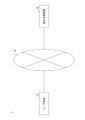
- FIG. 1 is a configuration diagram of an example of a design support system according to an embodiment of the present invention.
- FIG. 2 is a diagram illustrating an example of a hardware configuration of a computer according to the present embodiment.
- FIG. 13 is an explanatory diagram of an example of a prompt incorporating a first blending condition.
- FIG. 11 is an explanatory diagram of an example of search conditions for searching past experimental data for experimental data that matches a first blending condition.
- FIG. 13 is an image diagram of an example of a screen displaying experimental data that matches a second blending condition that is a relaxation of the first blending condition.
- FIG. 13 is an explanatory diagram of an example of combination generation conditions. An image diagram of an example of a screen displaying candidate combinations that meet the first combination conditions.
- FIG. 13 is an image diagram of an example of a screen for inputting blending conditions.
- FIG. 2 is an explanatory diagram of an example of a large-scale language model used in the design support system according to the present embodiment.
- Fig. 1 is a configuration diagram of an example of a design support system according to this embodiment.
- the design support system 1 in Fig. 1 includes a design support device 10 and a user terminal 12.
- the design support device 10 and the user terminal 12 are connected to each other so as to be able to communicate data with each other via a communication network 18 such as a local area network (LAN) or the Internet.
- LAN local area network
- the user terminal 12 is an information processing terminal operated by a worker, such as a PC, tablet terminal, or smartphone.
- the user terminal 12 displays a screen on a display device that accepts information input from the worker, and accepts information input from the worker.
- the user terminal 12 also transmits the information input from the worker to the design support device 10, and executes a process that reduces the workload of the worker who finds the desired combination.
- the user terminal 12 receives information on the results of the processing of the design support device 10, and displays it on the display device for the worker to confirm. For example, the user terminal 12 receives information on the composition desired by the worker, and displays it on the display device for the worker to confirm.
- the design support device 10 is an information processing device such as a PC that supports the work of an operator who is trying to find a desired composition.
- the design support device 10 executes a process that reduces the workload of an operator who is trying to find a desired composition.
- the design support device 10 transmits information on the results of the process and causes the user terminal 12 to display the information on the results of the process.
- the design support device 10 uses a language model to understand the mixing conditions (hereinafter referred to as the first mixing conditions) entered by the worker in a conversational format, and searches a database for past experimental data that matches the first mixing conditions.
- the mixing conditions hereinafter referred to as the first mixing conditions
- the design support device 10 displays it on the user terminal 12. If there is no past experimental data that matches the first combination condition, the design support device 10 uses a language model to search for past experimental data that matches a combination condition that is a relaxed version of the first combination condition (hereinafter referred to as the second combination condition) as a reference point.
- the second combination condition a combination condition that is a relaxed version of the first combination condition
- the design support device 10 generates a candidate composition close to the composition of the experimental data from the composition of past experimental data that meets the second composition condition, and predicts the physical properties of the candidate composition using a machine learning model that has learned the correspondence between the composition and the physical properties.
- the design support device 10 causes the user terminal 12 to display the candidate combination that meets the first combination condition. If there is no candidate combination that meets the first combination condition, the design support device 10 causes the user terminal 12 to display the candidate combination that meets the second combination condition.
- the design support device 10 uses a database that stores past experimental data.
- the design support device 10 may use a database stored in the device itself, or may use a database such as a database server connected via the communication network 18.
- machine learning methods used for the machine learning model include linear, generalized linear, partial least squares, kernel ridge, Gaussian process, k-nearest neighbor method, decision tree, random forest, AdaBoost, bagging, gradient boosting, support vector machine, and neural network.
- machine learning model trained machine learning model
- a quantitative candidate formulation is input into the trained machine learning model, and the physical properties of the candidate formulation are output.
- the design support device 10 may also use a large-scale language model such as ChatGPT (registered trademark) as a language model.
- the design support device 10 may use a language model stored in its own device, or may use a language model on a server (including a cloud service) connected via the communication network 18.
- the design support system 1 in FIG. 1 may be realized by a design support device 10 having a web server function and a user terminal 12 that executes a web application using a web browser function.
- the design support system 1 in FIG. 1 may be realized by an application installed in the user terminal 12 cooperating with a program installed in the design support device 10 to perform processing.
- the design support system 1 in FIG. 1 is just one example, and it goes without saying that there are various system configuration examples depending on the application and purpose.
- the design support device 10 may be realized by multiple computers, may be realized as a cloud computing service, or may be realized in cooperation with a cloud computing service.
- the design support system 1 in FIG. 1 may be realized by a stand-alone computer.
- the design support device 10 and the user terminal 12 in FIG. 1 are realized by, for example, a computer 500 having a hardware configuration shown in FIG.
- FIG. 2 is a hardware configuration diagram of an example of a computer according to this embodiment.
- the computer 500 in FIG. 2 includes an input device 501, a display device 502, an external I/F 503, a RAM 504, a ROM 505, a CPU 506, a communication I/F 507, and a HDD 508, all of which are interconnected via a bus B.
- the input device 501 and the display device 502 may be connected for use.
- the input device 501 is a touch panel, operation keys or buttons, keyboard, mouse, etc. that the operator uses to input various signals.
- the display device 502 is composed of a display such as a liquid crystal or organic electroluminescence display for displaying a screen, and a speaker for outputting sound data such as voice and sound.
- the communication I/F 507 is an interface through which the computer 500 performs data communication.
- the HDD 508 is an example of a non-volatile storage device that stores programs and data.
- the stored programs and data include the OS, which is the basic software that controls the entire computer 500, and applications that provide various functions on the OS.
- the computer 500 may use a drive device that uses flash memory as a storage medium (such as a solid-state drive: SSD).
- the external I/F 503 is an interface with an external device.
- the external device may be a recording medium 503a. This allows the computer 500 to read and/or write data to the recording medium 503a via the external I/F 503.
- the recording medium 503a may be a flexible disk, a CD, a DVD, an SD memory card, a USB memory, etc.
- ROM 505 is an example of a non-volatile semiconductor memory (storage device) that can retain programs and data even when the power is turned off. ROM 505 stores programs and data such as the BIOS, OS settings, and network settings that are executed when computer 500 starts up.
- RAM 504 is an example of a volatile semiconductor memory (storage device) that temporarily retains programs and data.
- the CPU 506 is a calculation device that reads programs and data from storage devices such as the ROM 505 and HDD 508 onto the RAM 504 and executes processing to realize the overall control and functions of the computer 500. By executing programs, the computer 500 according to this embodiment can realize various functions of the design support device 10 and the user terminal 12, which will be described later.
- Fig. 3 is a functional configuration diagram of an example of the design support system according to this embodiment. Note that the configuration diagram of Fig. 3 appropriately omits parts that are not necessary for the description of this embodiment.
- the information display unit 60 displays on the display device 502 a screen that accepts information input from the worker and information on the results of processing by the design support device 10.
- the operation reception unit 62 accepts operations by the worker, such as input of information.
- the request transmission unit 64 transmits a processing request to the design support device 10 in response to the information input by the worker.
- the response reception unit 66 receives a response to the processing request transmitted by the request transmission unit 64 from the design support device 10.
- the request receiving unit 20 receives a processing request from the user terminal 12.
- the response sending unit 22 responds with the execution result of the processing according to the processing request.
- the input accepting unit 24 cooperates with the user terminal 12 to accept input of the first blending conditions desired by the operator in an interactive format.
- the prompt generation unit 26 generates a prompt by incorporating the first combination condition received in a conversational format into the variable portion of the template prompt.
- the prompt generated by the prompt generation unit 26 will be described in detail later.
- the search condition generation unit 28 acquires search conditions that are generated (output from the language model) by inputting the prompt generated by the prompt generation unit 26 into the language model.
- the language model understands the first combination condition incorporated in the prompt, and generates search conditions (search condition expressions) for searching past experimental data for experimental data that matches the first combination condition.
- the search condition generation unit 28 also understands the first combination condition incorporated in the prompt, and generates search conditions for searching past experimental data for experimental data that matches a second combination condition that is a relaxed version of the first combination condition.
- the first search unit 30 searches a database that stores past experimental data for experimental data that matches the first blending condition, using search conditions for searching past experimental data for experimental data that matches the first blending condition. If there is experimental data that matches the first blending condition in the database that stores past experimental data, the design support device 10 ends the search for the blend desired by the operator.
- the first search unit 30 searches for experimental data that matches the second blending condition from the database that stores past experimental data, using search conditions for searching past experimental data for experimental data that matches the second blending condition.
- the prediction unit 34 generates multiple candidate combinations that are close to the combination of the experimental data that meets the second combination condition, and predicts the physical properties of the multiple candidate combinations using, for example, a trained machine learning model stored in the machine learning model storage unit 52.
- the second search unit 36 refers to the physical properties of the predicted candidate combinations and searches the multiple candidate combinations for a candidate combination that meets the first combination condition. If there is no candidate combination that meets the first combination condition, the second search unit 36 searches the multiple candidate combinations for a candidate combination that meets the second combination condition.
- the compounding display unit 38 presents the experimental data that matches the first compounding conditions to the operator by displaying it on the user terminal 12.
- the compounding display unit 38 presents the candidate compounding that matches the first compounding condition or the candidate compounding that matches the second compounding condition to the operator by displaying it on the user terminal 12.
- the database storage unit 50 stores past experimental data.
- the machine learning model storage unit 52 stores a machine learning model that has learned the correspondence between formulations and physical properties.
- the language model storage unit 54 stores a language model that generates search conditions based on an input prompt.
- the control unit 32 controls the request receiving unit 20, the response sending unit 22, the input accepting unit 24, the prompt generating unit 26, the search condition generating unit 28, the first search unit 30, the prediction unit 34, the second search unit 36, the combination display unit 38, the database storage unit 50, the machine learning model storage unit 52, and the language model storage unit 54 shown in FIG. 3.
- the configuration of the design support system 1 in FIG. 3 is one example.
- the design support system 1 according to this embodiment can be realized in various configurations.
- the database storage unit 50, the machine learning model storage unit 52, and the language model storage unit 54 may be included in a storage device, computer, cloud storage, or the like that can communicate data with the design support device 10 via the communication network 18.
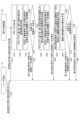
- the design support system 1 supports the work of an operator to find a desired composition, for example, in the procedure shown in Fig. 4.
- Fig. 4 is a flowchart showing an example of the process of the design support system according to this embodiment.
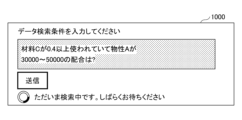
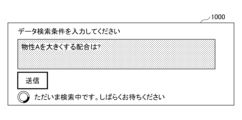
- step S10 the input receiving unit 24 of the design support device 10 displays, for example, a screen 1000 shown in FIG. 5 and FIG. 6 on the user terminal 12.
- FIG. 5 and FIG. 6 are image diagrams of an example of a screen that receives input of the first blending condition in a conversational format.
- FIG. 5 is an example of screen 1000 that receives a conversational specification from the operator as the first blending condition, "What blending method uses 0.4 or more of material C and has physical property A of 30,000 to 50,000?".
- FIG. 6 is an example of screen 1000 that receives a conversational specification from the operator as the first blending condition, "What blending method increases physical property A?”.
- the operator can specify the first blending condition, which is not quantitative, in a conversational format.
- step S12 when the user terminal 12 receives the operator's operation of pressing the send button on the screen 1000, it transmits the first mixing conditions in the conversational format entered on the screen 1000 to the design support device 10.
- the input receiving unit 24 of the design support device 10 receives the first mixing conditions in the conversational format.
- step S14 the prompt generation unit 26 generates a prompt, for example, as shown in FIG. 7, by incorporating the conversational first combination condition received from the user terminal 12 into the variable portion of the template prompt.
- step S16 the search condition generation unit 28 generates a first search condition by inputting the prompt generated by the prompt generation unit 26 into a language model.
- the language model understands the first combination condition incorporated in the prompt, and generates search conditions, for example, as shown in FIG. 8, for searching past experimental data for experimental data that matches the first combination condition.
- Figure 8 is an explanatory diagram of an example of search conditions for searching past experimental data for experimental data that matches the first blending condition.
- the search conditions in Figure 8 are an example of search conditions for searching experimental data that matches the first blending condition, "What blend contains 0.4 or more of material C and has physical property A between 30,000 and 50,000?"
- step S20 if there is past experimental data that matches the first blending condition, the first search unit 30 proceeds to processing in step S22.
- step S22 the first search unit 30 notifies the blending display unit 38 of the experimental data that matches the first blending condition.
- the blending display unit 38 presents the experimental data that matches the first blending condition to the operator by displaying it on the user terminal 12.
- step S20 the search condition generation unit 28 proceeds to processing in step S24.
- step S24 the search condition generation unit 28 understands the first combination condition incorporated in the prompt, and generates search conditions for searching past experimental data for experimental data that matches a second combination condition that is a relaxation of the first combination condition.
- the search condition generation unit 28 may generate the second search conditions by inputting a prompt to the language model that causes the language model to generate search conditions for searching past experimental data for experimental data that matches the second combination condition that is a relaxation of the first combination condition.
- step S26 the first search unit 30 searches past experimental data for experimental data that matches the second blending conditions using the search conditions generated by the search condition generation unit 28 in step S24.
- step S28 the first search unit 30 notifies the combination display unit 38 of the experimental data that meets the second combination condition.
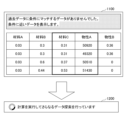
- the combination display unit 38 presents the experimental data that meets the second combination condition to the operator by displaying it on the user terminal 12, for example, as shown on screen 1100 in FIG. 9.
- FIG. 9 is an image diagram of an example of a screen that displays experimental data that matches the second blending condition, which is a relaxed version of the first blending condition.
- Screen 1100 in FIG. 9 does not match the first blending condition, "a blend in which material C is used at 0.4 or more and physical property A is 30,000 to 50,000," but displays past experimental data that is close to the first blending condition.
- the blending display unit 38 then displays message 1200 in FIG. 9.
- step S30 the prediction unit 34 generates multiple candidate combinations close to the combination of the experimental data that meets the second combination conditions, for example, using the combination generation conditions in FIG. 10.
- FIG. 10 is an explanatory diagram of an example of the combination generation conditions.
- the combination generation conditions shown in FIG. 10 can be created using past experimental data that meets the second combination conditions. For example, if the combination amount of "material A" in the past experimental data that meets the second combination conditions is in the range of "0.1 to 0.5", the combination amount of "material A” can be set to a random number in the range of "0.1 to 0.5".
- step S32 the prediction unit 34 predicts the physical properties of multiple candidate formulations, for example, using a trained machine learning model stored in the machine learning model storage unit 52.
- step S34 the second search unit 36 uses the search conditions generated by the search condition generation unit 28 in step S16 to search for candidate combinations that match the first combination conditions from among the multiple candidate combinations.
- the second search unit 36 uses the search conditions generated by the search condition generation unit 28 in step S24 to search for a candidate combination that meets the second combination condition from among the multiple candidate combinations.
- step S36 the second search unit 36 notifies the combination display unit 38 of the candidate combination that meets the first combination condition.
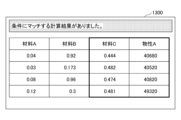
- the formulation display unit 38 presents candidate formulations that meet the first formulation condition to the operator by displaying them on the user terminal 12, for example, as shown on screen 1300 in FIG. 11.
- FIG. 11 is an image diagram of an example of a screen that displays candidate formulations that meet the first formulation condition.
- Screen 1300 in FIG. 11 displays multiple candidate formulations that meet the first formulation condition, "a formulation in which 0.4 or more of material C is used and physical property A is 30,000 to 50,000.”
- step S38 the second search unit 36 notifies the combination display unit 38 of the candidate combination that meets the second combination condition.
- the combination display unit 38 presents the candidate combination that meets the second combination condition to the operator by displaying it on the user terminal 12.
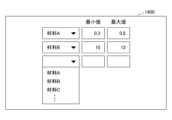
- the operator can input the first compounding condition in a conversational format, and even if the first compounding condition is not necessarily quantitative, the language model can generate appropriate search conditions and the desired compounding can be found from past experimental data. Furthermore, according to the process of the flowchart in FIG. 4, the workload is reduced compared to inputting compounding conditions as in screen 1400 of FIG. 12, and usability is improved.
- FIG. 12 is an image diagram of an example of a screen for inputting compounding conditions.
- Screen 1400 shown in FIG. 12 places a heavy workload on the operator, as it is necessary to select materials from a large number of options and quantitatively specify the compounding amounts of each material with minimum and maximum values. In particular, in experiments using many materials, a large amount of input is required, placing a heavy workload on the operator.
- the operator can interactively input the first combination conditions, thereby increasing the possibility of finding a candidate combination that meets the first combination conditions, even if the desired combination is not available in past experimental data. Therefore, the operator is more likely to find an unexpected and desirable candidate combination.
- past experimental data is searched for experimental data that matches the second combination condition, which is a relaxed version of the first combination condition, and multiple candidate combinations close to the combination of the experimental data that matches the second combination condition are generated using random numbers, thereby reducing the possibility of an unrealistic candidate combination being proposed even for combination conditions that are not necessarily quantitative.
- multiple candidate combinations close to the combination of the experimental data that matches the second combination condition are generated using random numbers, making it easier to satisfy the conditions required for the combination (such as the sum of the main chains being 1), and increasing the possibility of a realistic candidate combination being proposed.
- the design support system 1 can use a large-scale language model 100 whose functions are extended by a library, as shown in FIG. 13, for example.
- FIG. 13 is an explanatory diagram of an example of a large-scale language model used in the design support system according to this embodiment.
- the large-scale language model 100 can use, for example, GPT4.
- the library capable of extending the functions of the large-scale language model 100 can use, for example, LangChain.
- the design support system 1 uses a large-scale language model 100 whose functions have been expanded by a library to execute a program such as Python, and as shown in FIG. 13, can realize a search process for past experimental data 110 and a link with a prediction process of a trained machine learning model 120.
- composition proposed by the design support device 10 according to this embodiment may be supplied as composition information to, for example, a manufacturing device that synthesizes a plurality of materials, so that the materials are synthesized.
- the design support system 1 can provide a design support device, a design support method, a program, and a design support system that reduce the workload of an operator searching for a desired composition.
Landscapes
- Engineering & Computer Science (AREA)
- Theoretical Computer Science (AREA)
- Databases & Information Systems (AREA)
- Computing Systems (AREA)
- Life Sciences & Earth Sciences (AREA)
- Physics & Mathematics (AREA)
- Data Mining & Analysis (AREA)
- Bioinformatics & Computational Biology (AREA)
- Bioinformatics & Cheminformatics (AREA)
- Health & Medical Sciences (AREA)
- Evolutionary Computation (AREA)
- Computational Linguistics (AREA)
- General Physics & Mathematics (AREA)
- General Engineering & Computer Science (AREA)
- Artificial Intelligence (AREA)
- Computer Vision & Pattern Recognition (AREA)
- Mathematical Physics (AREA)
- General Health & Medical Sciences (AREA)
- Medical Informatics (AREA)
- Software Systems (AREA)
- Chemical & Material Sciences (AREA)
- Crystallography & Structural Chemistry (AREA)
- Information Retrieval, Db Structures And Fs Structures Therefor (AREA)
Priority Applications (2)
| Application Number | Priority Date | Filing Date | Title |
|---|---|---|---|
| JP2025547403A JP7845589B2 (ja) | 2023-09-21 | 2024-09-17 | 設計支援装置、設計支援方法、プログラム及び設計支援システム |
| CN202480035672.8A CN121241396A (zh) | 2023-09-21 | 2024-09-17 | 设计辅助装置、设计辅助方法、程序及设计辅助系统 |
Applications Claiming Priority (2)
| Application Number | Priority Date | Filing Date | Title |
|---|---|---|---|
| JP2023155551 | 2023-09-21 | ||
| JP2023-155551 | 2023-09-21 |
Publications (1)
| Publication Number | Publication Date |
|---|---|
| WO2025063180A1 true WO2025063180A1 (ja) | 2025-03-27 |
Family
ID=95072925
Family Applications (1)
| Application Number | Title | Priority Date | Filing Date |
|---|---|---|---|
| PCT/JP2024/033154 Pending WO2025063180A1 (ja) | 2023-09-21 | 2024-09-17 | 設計支援装置、設計支援方法、プログラム及び設計支援システム |
Country Status (3)
| Country | Link |
|---|---|
| JP (1) | JP7845589B2 (https=) |
| CN (1) | CN121241396A (https=) |
| WO (1) | WO2025063180A1 (https=) |
Citations (8)
| Publication number | Priority date | Publication date | Assignee | Title |
|---|---|---|---|---|
| JP2012048615A (ja) * | 2010-08-30 | 2012-03-08 | Hitachi Chem Co Ltd | 物質作用配合解析データ保存抽出機構 |
| JP2014199490A (ja) * | 2013-03-29 | 2014-10-23 | 株式会社ニコン | コンテンツ取得装置およびプログラム |
| JP2020052602A (ja) | 2018-09-26 | 2020-04-02 | 株式会社日立製作所 | 研究開発支援システム |
| JP2021026478A (ja) * | 2019-08-05 | 2021-02-22 | 三井化学株式会社 | 物性情報推測方法、物性情報推測モデル生成方法、物性情報推測装置、物性情報推測モデル生成装置、物性情報推測プログラム、及び物性情報推測モデル生成プログラム |
| JP2022526120A (ja) * | 2019-03-18 | 2022-05-23 | エボニック オペレーションズ ゲーエムベーハー | 塗料、ワニス、印刷インキ、研削用樹脂、色素濃縮物、または他のコーティング剤の組成物の生成方法 |
| JP2022123344A (ja) * | 2021-02-12 | 2022-08-24 | 横浜ゴム株式会社 | ゴム配合の設計方法およびシステム |
| WO2023008450A1 (ja) * | 2021-07-28 | 2023-02-02 | パナソニックIpマネジメント株式会社 | 情報表示方法、情報表示装置およびプログラム |
| JP2023155551A (ja) | 2022-04-11 | 2023-10-23 | 日本エラストマー株式会社 | ゴム組成物、アウトソール、ゴム組成物の製造方法、及び架橋ゴムシートの製造方法 |
-
2024
- 2024-09-17 CN CN202480035672.8A patent/CN121241396A/zh active Pending
- 2024-09-17 WO PCT/JP2024/033154 patent/WO2025063180A1/ja active Pending
- 2024-09-17 JP JP2025547403A patent/JP7845589B2/ja active Active
Patent Citations (8)
| Publication number | Priority date | Publication date | Assignee | Title |
|---|---|---|---|---|
| JP2012048615A (ja) * | 2010-08-30 | 2012-03-08 | Hitachi Chem Co Ltd | 物質作用配合解析データ保存抽出機構 |
| JP2014199490A (ja) * | 2013-03-29 | 2014-10-23 | 株式会社ニコン | コンテンツ取得装置およびプログラム |
| JP2020052602A (ja) | 2018-09-26 | 2020-04-02 | 株式会社日立製作所 | 研究開発支援システム |
| JP2022526120A (ja) * | 2019-03-18 | 2022-05-23 | エボニック オペレーションズ ゲーエムベーハー | 塗料、ワニス、印刷インキ、研削用樹脂、色素濃縮物、または他のコーティング剤の組成物の生成方法 |
| JP2021026478A (ja) * | 2019-08-05 | 2021-02-22 | 三井化学株式会社 | 物性情報推測方法、物性情報推測モデル生成方法、物性情報推測装置、物性情報推測モデル生成装置、物性情報推測プログラム、及び物性情報推測モデル生成プログラム |
| JP2022123344A (ja) * | 2021-02-12 | 2022-08-24 | 横浜ゴム株式会社 | ゴム配合の設計方法およびシステム |
| WO2023008450A1 (ja) * | 2021-07-28 | 2023-02-02 | パナソニックIpマネジメント株式会社 | 情報表示方法、情報表示装置およびプログラム |
| JP2023155551A (ja) | 2022-04-11 | 2023-10-23 | 日本エラストマー株式会社 | ゴム組成物、アウトソール、ゴム組成物の製造方法、及び架橋ゴムシートの製造方法 |
Also Published As
| Publication number | Publication date |
|---|---|
| CN121241396A (zh) | 2025-12-30 |
| JPWO2025063180A1 (https=) | 2025-03-27 |
| JP7845589B2 (ja) | 2026-04-14 |
Similar Documents
| Publication | Publication Date | Title |
|---|---|---|
| JP5634860B2 (ja) | 第2言語モードを有する入力メソッドエディタ | |
| US10339916B2 (en) | Generation and application of universal hypothesis ranking model | |
| US10649836B2 (en) | Detecting an error message and automatically presenting links to relevant solution pages | |
| US20140006003A1 (en) | Trust scoring for language translation systems | |
| JP2010524135A (ja) | クライアントの入力メソッド | |
| KR20220009338A (ko) | 모델링 매개 변수의 설정 방법, 장치, 전자 기기 및 기록 매체 | |
| JP7586386B1 (ja) | 特許関連書面作成支援システム | |
| US20130139061A1 (en) | Desktop sound source discovery | |
| US12147769B2 (en) | Method for aligning text with media material, apparatus and storage medium | |
| JP7591212B1 (ja) | 情報処理装置、情報処理方法、およびプログラム | |
| US20200279000A1 (en) | Information processing apparatus and non-transitory computer readable medium storing program | |
| WO2025063180A1 (ja) | 設計支援装置、設計支援方法、プログラム及び設計支援システム | |
| WO2023167107A1 (ja) | 情報処理装置、情報処理システム、プログラム、及び材料組成探索方法 | |
| CN120498716A (zh) | 一种用于测试模型防御机制的越狱攻击方法、装置和设备 | |
| US20230410188A1 (en) | Information processing method and apparatus, user terminal, program product, and storage medium | |
| CN121794756A (zh) | 设计辅助装置、设计辅助方法、程序及设计辅助系统 | |
| US20080319960A1 (en) | Information searching method, information searching system and inputting device thereof | |
| CN111159616A (zh) | 基于多语言的交换机管理方法、装置及存储介质 | |
| JP7424544B2 (ja) | 情報処理システム、材料組成探索方法、材料組成探索装置、及びプログラム | |
| US12436980B2 (en) | Method, server, information processing apparatus, and storage medium for generating query character string | |
| EP4625151A1 (en) | Information processing device, program, and inference method | |
| KR102801828B1 (ko) | 멀티모달 컨텐츠 블록 검색을 지원하는 기업 영상 생성 방법 및 장치 | |
| Ruoxuan et al. | A Multitenant Single-Page Application for Programming Education | |
| KR102772482B1 (ko) | 사용자 단말과 서비스 서버 간의 하이브리드 랜더링을 기반으로 하는 영상 생성 방법 및 시스템 | |
| US20250328546A1 (en) | Automatically generating context-based dynamic outputs using artificial intelligence techniques |
Legal Events
| Date | Code | Title | Description |
|---|---|---|---|
| 121 | Ep: the epo has been informed by wipo that ep was designated in this application |
Ref document number: 24868257 Country of ref document: EP Kind code of ref document: A1 |
|
| WWE | Wipo information: entry into national phase |
Ref document number: CN2024800356728 Country of ref document: CN |
|
| ENP | Entry into the national phase |
Ref document number: 2025547403 Country of ref document: JP Kind code of ref document: A |
|
| WWE | Wipo information: entry into national phase |
Ref document number: 2025547403 Country of ref document: JP |